This is the author’s version of a work that was submitted/accepted for pub-lication in the following source:
Chang, Anne M., Gardener, Glenn E., & Duffield , Christine (2012) Ad-vanced practice nursing role development : factor analysis of a modified role delineation tool. Journal Of Advanced Nursing,68(6), pp. 1369-1379. This file was downloaded from: http://eprints.qut.edu.au/58679/
c
Copyright 2012 John Wiley & Sons, Inc.
Notice: Changes introduced as a result of publishing processes such as copy-editing and formatting may not be reflected in this document. For a definitive version of this work, please refer to the published source:
ABSTRACT
Title: Advanced practice nursing role development: factor analysis of a modified role
delineation tool
Aim: This study reports the use of exploratory factor analysis to determine construct
validity of amodified advanced practice role delineation tool.
Background: Little research exists on specific activities and domains of practice
within advanced practice nursing roles, making it difficult to define service parameters of this level of nursing practice. A valid and reliable tool would assist those responsible for employing or deploying advanced practice nurses by identifying and defining their service profile. This is the third paper from a multi-phase Australian study aimed at assigning advanced practice roles.
Methods: A postal survey was conducted of a random sample of state government
employed Registered nurses and midwives, across various levels and grades of practice in the state of Queensland, Australia, using the modified Advanced Practice Role Delineation tool. Exploratoryfactor analysis, using principal axis factoring was undertaken to examine factors in the modified tool. Cronbach’s alpha coefficient determined reliability of the overall scale and identified factors.
Results: There were 658 responses (42% response rate). The five factors found with
loadings of ≥.400 for 40 of the 41 APN activities were similar to the five domains in the Strong model. Cronbach’s alpha coefficient was .94 overall and for the factors ranged from 0.83 to 0.95.
Conclusion: Exploratory factor analysis of the modified tool supports validity of the
five domains of the original tool. Further investigation will identify use of the tool in a broader healthcare environment.
What is already known about the topic?
There is a great deal of research on barriers to implementing advanced practice roles, but little is known on the actual activities and domains of practice for such roles.
Ambiguity in advanced practice roles is hindering the effective utilisation of a skilled workforce.
What this paper adds
Validation of a tool to depict the activities and domains of practice for the advanced practice nurse and consequently assistance in defining the role for an Australian context.
Potential for the tool to become a vital component of an advanced practice nurse organisational framework to enhance development, implementation and evaluation of such roles internationally.
Implications for Practice/Policy
The modified advanced practice role delineation tool is valid and reliable for defining the activities and discerning the domains of practice for an advanced practice nurse.
The tool can be used by healthcare and administrative personnel to assist effective deployment of a uniquely experienced workforce, resulting in benefits to patients, greater efficiency within healthcare services and possible greater retention of nursing staff.
Key words: Advanced Practice Nursing, factor analysis, nursing evaluation research,
Introduction
Clarity around nomenclature relating to advanced practice nursing has to date received scant research attention. Consequently the term has been simplistically applied to a range of roles and positions including nurse practitioner, specialist, consultant and other terms. This research is aimed at clarifying the dimensions of the advanced practice nursing role to provide a framework to support the establishment and deployment of such roles.
The advanced practice nurse (APN) position emerged as a result of changing healthcare needs and workforce requirements, with societal forces such as economic climate, changes in technology and health care delivery influencing its evolution (Hamric et al., 2009; Holloway et al., 2009). The positive effects of advanced practice roles on patient outcomes have been widely documented and include health improvement and increased patient satisfaction (Loftus & Weston, 2001; Wong & Chung, 2005), reduced hospital admissions and shorter lengths of stay (Naylor et al., 2004; Pearson & Peels, 2002). Economic savings to the health care system are a natural consequence (McCauley, et al., 2006). However despite this the introduction of APN roles has often occurred, in some countries in an unplanned manner, resulting in barriers to the full utilisation of this role (Bryant-Lukosius & DiCenso, 2004; Bryant-Lukosius et al., 2004; Jamieson & Williams, 2002). A systematic, evidence-based process which includes collection of data relevant to service needs and role requirements is required to implement and develop APN roles effectively (Bryant-Lukosius et al., 2004; Jamieson & Williams, 2002).
This paper reports on the third part of a state-wide Australian study aimed at clarifying the APN role and creating a framework to support the introduction and utilisation of such roles to meet consumer and health organisational needs. Previous work by the authors has identified the original Strong Model of Advanced Practice Role Delineation tool (Ackerman et al., 1996), as having potential to define the activities of practice of advanced practice nursing roles. The original tool was designed as a list of advanced practice activities fitting within five domains of practice, and underwent minor modification to suit the Australian context (Chang et al, 2010). The continuing validation process is reported here.
Background
Challenges in developing and implementing APN roles
The complexity within the international field of advanced practice nursing is evident from global discussion on the many titles, concepts and generic features of APN roles (Bryant-Lukosius et al., 2004; Lloyd-Jones, 2005; Mantzoukas & Watkinson, 2006). Consistent with the many changes within healthcare delivery, advanced practice nursing roles have been influenced by government and societal factors as well as changing demographics, rising consumer demands and healthcare workforce shortages (Gardner et al., 2007; Holloway et al., 2009; Por, 2008). The nursing profession has evolved to meet these demands with the introduction of new and innovative roles, but this has led to a proliferation of poorly defined APN roles. (Bryant-Lukosius et al., 2004; Daly & Carnwell, 2003). Within the United States of America, titles such as clinical nurse specialist, nurse practitioner, certified nurse-midwife and certified registered nurse anaesthetist all sit beneath the umbrella of advanced practice (Hamric et al., 2009) while in the UK, nurse practitioner, clinical
nurse specialist, advanced practitioner, nurse consultant and nurse therapist are some of the many advanced role titles in use (Daly & Carnwell, 2003). Currently in Australia, the nurse practitioner role has been regulated but other advanced roles such as clinical nurse consultant and clinical nurse specialist remain poorly defined and supported, therefore potentially inappropriately or under utilised.
Many of the issues surrounding the introduction of advanced nursing positions have resulted from the ‘ad hoc’ implementation of poorly defined new roles receiving
inconsistent professional and organisational support (Bryant-Lukosius et al., 2004, Coombs et al., 2007; Micevski, et al., 2004). Consequently, many countries are now looking towards workforce planning procedures and/or organisational frameworks to develop, implement and evaluate APN roles more effectively (Coombs et al., 2007; Holloway et al., 2009, Micevski et al., 2004, Rutherford et al., 2005).
Lloyd-Jones (2005) identified a number of barriers and facilitators to role development for APNs and highlighted the need for clear role definitions and objectives in order to reduce role ambiguity and enhance the effective introduction and adoption of such roles. A vital part of the development process for the APN role, should be a clear definition of the specific features of the role, namely the activities undertaken and the skills, attributes and competencies required (Bryant-Lukosius et al., 2004; Por, 2008). A tool that clearly articulates the role of practice should then be considered a useful component to an APN framework.
APN role definition for framework development
McKenna et al., (2008) identified clarity of role description as being of prime importance to innovative role holders in a study undertaken in Northern Ireland. Their study aimed to identify developmental and managerial issues affecting people holding new and innovative roles. Data from the 450 respondents revealed that the introduction of such roles, without proper definition and ongoing support, can lead to blurring of activities and responsibilities, which in turn, may contribute to role confusion and conflict and ultimately become a risk to patient safety (McKenna et al., 2008). Recommendations from this study included determining relevant education programs, infrastructure and support to effectively maintain innovative roles. This structure underlying the system could also be defined as a framework.
Along with global ambiguity within the field of advanced practice, there is currently an international shortage of skilled nurses. Addressing supply and demand issues does not just mean increasing the number of nurses available, but means effectively managing and planning to match a skilled nursing workforce to an increasingly complex patient population (Buchan, 2000; Holloway et al., 2010). In order to achieve this however, it is imperative that the activities of practice required of APNs are clearly defined (Holloway et al., 2010; Por, 2008).
Some organisations have recently developed frameworks for advanced practice nurses, in order to meet their patient and service needs. Micevski et al., (2004) report on the process of creating a framework to articulate and clearly define the APN role and scope of practice for a network of APN’s working in a variety of settings. Bryant –Lukosius and Di Censo (2004) have also reported on an evidence based framework
to guide the development and implementation of APN roles. The individual components of any framework will vary according to local needs, but central to each of these frameworks is the need for definition of the APN role.
Within Australia, the role of the nurse practitioner has been formally defined and regulated; however there is currently no nationally accepted definition or framework for other advanced nursing roles. Previous research, including the authors’(Gardner et al., 2007; Chang et al., 2010), has identified the Strong Model of Advanced Practice (Ackerman et al., 1996; Mick & Ackerman, 2000) as being able to contribute to this process, subject to further validation.
The Study Aim
The aim of this study was to evaluate the construct validity of the modified advanced practice role delineation (APRD) tool, through exploratory factor analysis, to determine its potential for use as a vital component of a workforce planning framework for the utilisation of APN roles.
Methods Design of study
A survey of nurses from within the state of Queensland (Australia) was undertaken in November 2008. The same tool was sent again four weeks after the first, to enhance response rates. Included in each mail-out was the questionnaire, the modified advance practice role delineation tool (Chang et al., 2010), a demographic data collection sheet and a cover letter explaining the survey.
Data collection tools
The original advanced practice role delineation tool (APRD) based on the Strong Model (Mick & Ackerman, 2000) comprised 42 items across five domains. Permission to use the APRD tool was obtained from the original authors, who recognized the necessity for further testing on larger samples (Mick & Ackerman, 2000). A Delphi study was conducted in the previous phase of this study, which resulted in an expert panel of nurses recommending modification of some wording of the tool and deletion of one item (Chang et al., 2010). This resulted in the modified tool being ready for a survey of a large state-wide sample of nurses. The modified APRD tool contains 41 activities, grouped within five domains of practice: direct comprehensive care, support of systems, research, education and publication and professional leadership. The tool requests participants to indicate the extent of time that they would spend in their current position on each listed activity, by placing a tick in the corresponding box. A five point Likert scale from 0 to 4 was used where 4 =to a very great extent; 3 = to a great extent; 2 = to some extent; 1 = to a little extent; 0 = not at all. Demographic data were also collected on the nurses’ current position, length of nursing experience and qualifications.
Participants and setting
The study population was nurses/midwives employed by the state health system, throughout the state of Queensland, Australia. All nurses/midwives employed by the state health service, Queensland Health, had the potential to be invited to participate in this study. Stratified random sampling generated from a computer database was undertaken to ensure all areas of healthcare employing nurses/midwives were
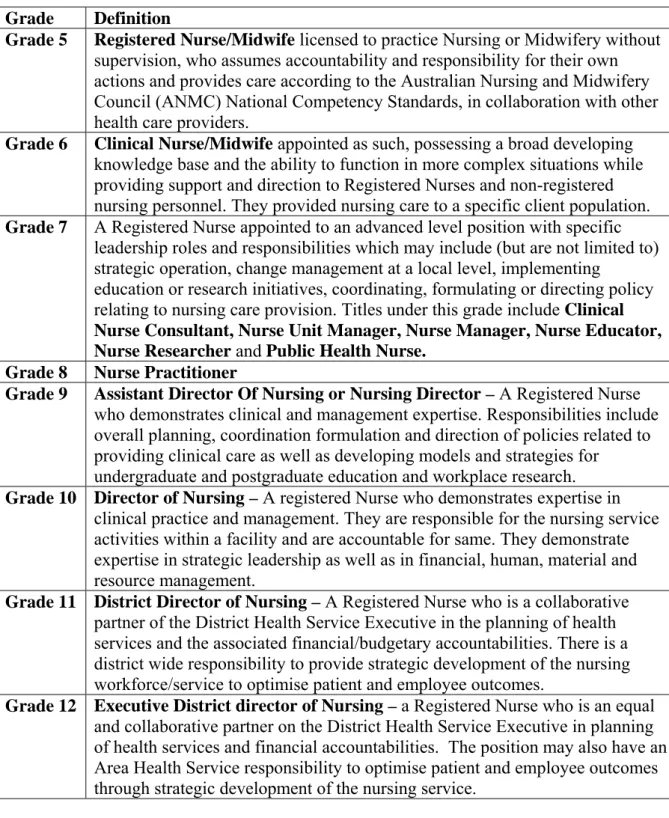
included such as tertiary, acute, community and executive roles as well as representation of nurses from urban, rural and remote regions. Furthermore Registered Nurses/Midwives from all levels of practice were eligible for inclusion in the sample (Grade 5 to Grade 12) however nurse practitioners (Grade 8) were excluded, as their role has been previously defined and regulated within Queensland. Definitions for the grades of nursing/midwifery practice can be seen in Table 1. Responses were collated and analysed from January to April 2009.
Sample size
The sample size required for conducting exploratory factor analysis, was based on the number of cases for each of the 41 items in the tool being tested. While there is a wide variation in the recommendations for determining sample size, Costello & Osbourne (2005) tested different sample sizes for factor analysis and found that accuracy was greater in factor solutions with larger sample sizes: 60% accuracy for a 10:1 sample to item ratio and 70% accuracy for 20:1, compared to 40% accuracy for a 5:1 sample to item ratio. Obtaining a sample of 820 nurses/midwives would provide a 20:1 ratio for factor analysis. This number was doubled to allow for a 50 % survey response rate giving 1640 nurses/midwives who were invited to participate, representing approximately 11% of nurses employed in Queensland Health from Grade 5 to Grade12.
Statistical analysis
Demographic data were analysed using means and standard deviations and other descriptive analyses. SPSS version 16.0 (Chicago, Illinois, USA) was used for statistical analysis. Prior to analysis, the data were cleaned using frequency counts for
categorical variables and descriptive statistics for continuous variables which allowed any discrepancies and errors to be highlighted and addressed (Pallant, 2007; Portney & Watkins, 2000).
Exploratory factor analysis, using principal axis factoring (PAF) was used to explore the construct validity of the modified APRD tool. As there was no available evidence to suggest that the tool had been tested in this way previously, exploratory factor analysis (EFA) was deemed more appropriate than confirmatory factor analysis (CFA) as EFA is often used to analyse or ‘explore’ relationships between variables (Pallant, 2007). When all factors with Eigen values exceeding 1 were extracted using the default setting of SPSS, the correct number of factors retained will be confirmed by Parallel Analysis (Haytone et al., 2004), using 100 replications of Monte Carlo simulations with datasets of the same size. An oblique, oblimin rotation with Kaiser Normalisation was used to explore the degree of correlation between the factors and variables, and the cut-off point for factor loading was 0.40 (Ferguson & Cox, 1993). Analysis of the overall total APRD and identified factors for reliability was also undertaken using Cronbach’s alpha coefficient.
Ethical considerations
The study was approved by ethics committees at the university as well as the state health authority through which the study was conducted. The participants were advised that responses to the questionnaire were anonymous and were informed of the research procedures through an accompanying cover letter. Response to the questionnaire was indicative of consent to participate.
Results
Sample characteristics
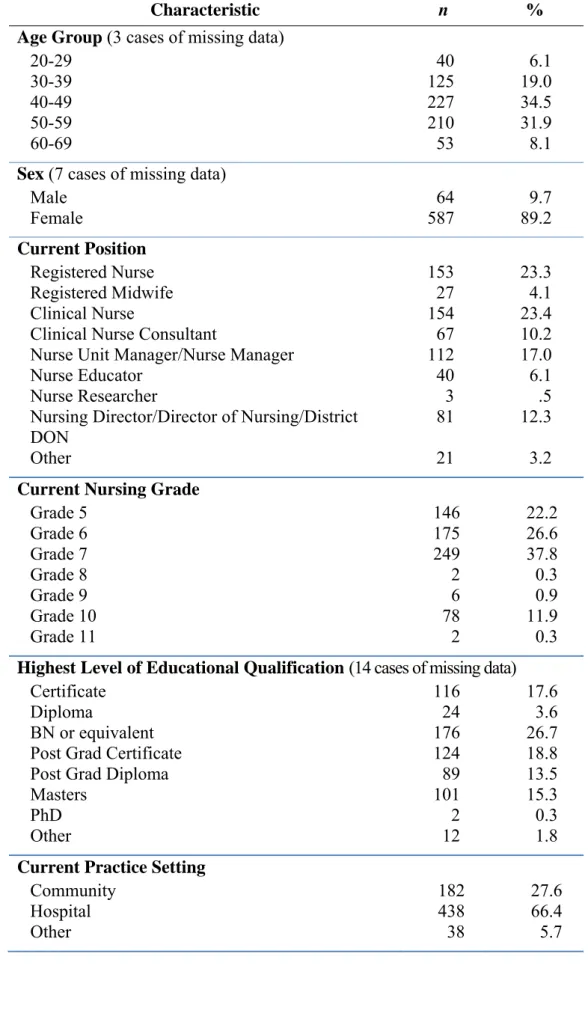
A total of 658 responses were obtained, with an additional 31 questionnaires returned due to wrong or unknown address, giving an adjusted response rate of 42%. Sample characteristics are outlined in Table 2.
Approximately a third of the sample were aged between 40 and 49 years (34.5 %) and the majority of the sample was female (90%). Most nurses in the sample were employed in a single workplace, with 49 (7.4%) working in two different practice settings and 3 (0.45%) working in three different settings. The majority of participants worked in the hospital setting. Responses that made up ‘other’ workplace
settings included aged care (n= 16), combined district services and integrated facilities (n=10) and miscellaneous settings such as tele-nursing, corrections facilities, high care disability residential units and academia. Some respondents had specified a field of work, such as paediatrics and outpatients, but with no indication whether this was within a hospital or community setting, therefore were included in ‘other’.
The largest proportion of nurses held an educational qualification of a Bachelor of Nursing (26.7%) or equivalent, with 15.3 % having attained a Masters level of education. The mean length of experience as a registered nurse or midwife was 22.34 years (SD 10.72) while the mean length of time in current position was 6.06 years (SD 6.40).
Factor analysis
Given that 658 nurse/midwives returned completed questionnaires the final sample to item ratio was 16:1 indicating between 60% and 70% level of accurate solution (Costello & Osborne, 2005).
The data were deemed suitable for factor analysis with 0.95 Kaiser-Meyer-Olkin measure of sampling adequacy, a value above the 0.6 accepted cut-off (Kaiser 1970; Kaiser 1974) and Bartlett’s Test of Sphericity (Bartlett 1954) achieving statistical significance. Results showed five factors with eigenvalues above 1, which accounted for just over 70% of the total variance. This was supported by the scree plot which demonstrated a change in slope from the larger to smaller eigenvalues, between the fifth and sixth factor, suggesting a five factor solution (Tabachnick & Fidell, 1996; Watson & Thompson, 2006). These five factors were further supported by the results of a Parallel Analysis.
The five factors were consequently named in accord with the five domains in the original tool. Items 1-14, 27 and 29 loaded on Factor 2 (direct comprehensive care); Items 15-23 loaded on Factor 3 (support of systems); Items 25 - 28 loaded on Factor 4 (education); Items 30 – 35 loaded on Factor 5 (research) and items 36 – 41 loaded on to Factor 1 (publication and professional leadership). The loading for item 24 was below the 0.40 cut off level and was not included in any factor. Item 27 loaded onto both the direct care and education factors, with a stronger factor loading in the latter domain. In contrast to the original tool, item 29 concerning patient education loaded onto Factor 2 about direct, comprehensive care rather than onto the education factor (see Appendix 1).
Reliability
Cronbach’s alpha coefficient for the modified APN role delineation tool was .94 and for each of the factors: direct comprehensive care (α =.95), support of systems (α = .93), education (α = .83), research (α = .90) and publication and professional leadership (α = .94).
Discussion Limitations
The main limitation in this study relates to the use of mail surveys. Non-response error is the main concern when conducting mail surveys (Dillman, 1991); consequently in order to improve our response rate we included a stamped, addressed return envelope with the questionnaire, and re-sent these four weeks after the initial survey. Both techniques are said to be effective for increasing responses, with other recommended methods such as pre-contact and financial reimbursement (Dillman, 1991; Harvey 1987) considered not feasible for this study. We have attempted to reduce the risk of sampling and non-coverage error (Dillman, 1991) through the use of a stratified, random large sample size and have addressed the issue of measurement error through previous content validity analysis (Chang et al., 2010).
Factor analysis
Factor analysis on data from a large sample has supported the construct validity of the modified APRD tool within an Australian nursing/midwifery population, finding support for five discrete factors which were largely similar to the five domains of the original tool.
Exploratory factor analysis is often used to validate tools due to its ability to summarize and group variables; effectively reducing a large amount of variables into smaller, more meaningful groups, according to the relationships within the variables. The principal axis factor extraction method was chosen as this is deemed to focus on the common variance among items, that is, the latent factors (Henson & Roberts, 2006).
Exploratory factor analysis (EFA) was chosen to assess construct validity of the modified APNRD tool, as no prior validation studies had been undertaken using the original tool. Using a large sample size and a systematic approach (Costello & Osborne, 2005) has allowed exploration of the variables within the modified APNRD tool and examination of the factor structure of the tool. The factor analysis results are further strengthened because each factor contained four or more items (Costello & Osborne, 2005; Henson & Roberts, 2006), and all but one factor scored above the 0.40 cut off.
Domains of practice
The factor of direct comprehensive care has the greatest number of activities within it and includes items such as patient assessment, investigations, procedures and counselling of patients and their families. All items within this factor scored above the cut off point of 0.40, with one item from the original education domain, sitting within the direct comprehensive care factor. The focus of this particular item on patient and family education suggests that this activity is an integral part of patient care, rather than being seen as a separate education based practice. Conceptual frameworks on advanced practice, developed by Manley (1997) and Micevski et al., (2004) both
include a similar patient care focussed domain, which reflects expert clinical practice. The Micesvski et al., (2004) framework also includes two items specific to learning needs and patient education in the clinical, expert practice competency. Determining whether patient education sits within an education domain or a care domain should be a consideration for future research.
The factor loadings for some of the items in the domain of education were equivocal suggesting the need for further investigation. One item about education programs which did not reach the cut off point, may have scored differently if it had been less ambiguous and had clearly identified whether the education programs were for staff or for patients and their families. Rewording of this item needs to be considered in future testing of the tool. Item 27 (informal educator to staff) loaded onto both the education and the direct comprehensive care factor, but with a higher score in the education factor. Costello & Osborne (2005) suggest that cross-loading may be indicative of poorly worded items, but as staff education was specified in this activity it is difficult to determine why this activity had double-loaded. Interestingly, within the Micevski et al. framework, (2004), the activities incorporating education programs for staff come under the core competency of leadership, and patient or client education is included in the clinical core competency; there is no separate education competency (Micevski et al., 2004).
The support of systems factor included 9 items, all scoring above the 0.40 cut-off point. Items within this factor include quality improvement activities, mentoring, collaborations, advocacy and strategic planning, all aimed at assisting the patient to progress smoothly through the health care system. These types of items or activities
represent various functions of the APN role that require collaboration with others in order to promote the role within the organisation and in the external environment. Collaboration is one of the underlying conceptual threads of the original Strong model (Ackerman et al., 1996) and is an integral part of many other APN models (Manley, 1997; Micevski et al., 2005; Spross & Lawson, 2009). APNs are frequently required to collaborate with various stakeholders, such as health care providers, administrators, patients and families in order to achieve mutual goals (Bryant-Lukosius & DiCenso, 2004) and optimal patient outcomes.
There were six items within the research factor, with a range of scores from 0.476 to 0.759 and no cross-loading. APN practice should be based on a culture of integrating current, evidence-based knowledge into practice, making research an integral part of the role of APN. A conceptual framework for advanced practice reported by Manley (1997) identified the role of researcher as being a very clear sub-role of APN practice. Depending on the APN practice environment different levels of research capability may be demonstrated but according to our data, all items within this domain were reflective of APN practice. These include identifying data that need to be collected, identifying potential funding sources, participating in investigations to improve patient care and conducting clinical investigations. Micevski et al. (2005) also have a competency of research in their framework and agree that APNs are ideally suited to identify research questions and participate in conducting research solutions. Others may envisage that APNs would go beyond participation to leading research in a specific field for those with greater knowledge, skill and experience.
The scores for all items in the factor of publication and professional leadership were above 0.693. This would suggest that the wording of the items is appropriate for this factor. Leadership is a vital part of any APN role and can be applied to clinical, professional, system and health care policy areas (Hamric et al., 2009). The original Strong Model of Advanced Practice (Ackerman et al., 1996) acknowledged this domain as extending beyond ones own area of practice, in order to promote nursing as a profession. Micevski et al. (2005) also reiterate this in their framework, proposing that APN leadership can extend to the national and international arena. Promoting clinical knowledge and judgement through being visible in broader environments, outside ones own area of practice, is a key feature of APN professional leadership (Mantzoukas & Watkinson, 2006; Spross & Hanson, 2009).
Overall the factor scores indicate that the modified role delineation tool does represent APN activities within five domains of practice - direct comprehensive care, support of systems, research, education and publication and professional leadership. Although EFA is by no means definitive, our results indicate the tool to be valid and reliable, with consideration needed in refinement of the domain of education. Further research into defining the education roles of an APN and the relative emphasis of activities within roles is warranted, as the scores may have been reflective of a nurse’s particular area of practice or role, e.g. a nurse working as an educator would automatically score higher on the activities of staff education, while a clinical nurse who is involved in direct patient care would score higher on patient and family education activities.
Conclusion
The APN role emerged in order to meet the needs of a changing health care system, however without a supportive framework and clear definition the role may lose its efficacy. Comparison of the modified APRD tool against current APN frameworks identified similarities within the domains of practice. However, a contextually appropriate framework which allows clarification and support for the development and implementation of advanced practice roles should be the goal for all healthcare organisations. It is noted also, that many current frameworks include the nurse practitioner role, but our tool is being developed to consider other APN roles as the NP role in Australia has been professionally and legislatively developed. Defining the activities and domains of practice of the generic APN role using a validated, modified APRD tool, will allow health care managers and other regulatory or funding authorities to effectively deploy this experienced workforce to its full potential, resulting in benefits to patients and greater efficiency within healthcare services. Advanced practice nurses have the ability to provide a high level of skill to a complex patient demographic and differences among individual APN roles are to be expected. It is contended here that all domains are applicable to all APN positions but that the relative emphasis on domains will vary according to the nature of the particular position and specific practice setting. Some APNs will spend more time on direct patient care, some in education and others in research or other fields (Chang et al., 2010; Gardner et al., 2007; Spross & Heaney, 2000). Further comparative studies will identify how, and to what extent different levels of nurses undertake activities within each domain.
References
1. Ackerman, M., Norsen, L., Martin, B., Wiedrich, J., & Kitzman, H., 1996.
Development of a model of advanced practice. American Journal of Critical Care 5(1), 68-73.
2. Bartlett M.S., 1954. A note on the multiplying factors for various chi square
approximations. Journal of the Royal Statistical Society 16, 296-298.
3. Bryant-Lukosius, D., & DiCenso, A., 2004. A framework for the introduction
and evaluation of advanced practice nursing roles. Journal of Advanced Nursing 48(5), 530-540.
4. Bryant-Lukosius, D., DiCenso, A., Browne, G., & Pinelli, J., 2004. Advanced
practice nursing roles: development, implementation and evaluation. Journal of Advanced Nursing 48(5), 519-529.
5. Buchan, J., 2000. Planning for change: developing a policy framework for
nursing labour markets. International Nursing Review 47, 199-206.
6. Chang, A., Gardner, G., Duffield, C., Ramis, M.-A., 2010. A Delphi study to
validate an Advanced Practice Nursing tool. Journal of Advanced Nursing
66 (10), 2320-2330.
7. Coombs, M., Chaboyer, W., & Sole, M., 2007. Advanced Nursing Roles in
Critical Care-A Natural or Forced Evolution? Journal of Professional Nursing
23(2), 83-90.
8. Costello AB. & Osborne JW. (2005). Best Practices in Exploratory Factor
Analysis: Four recommendations for getting the most from your analysis. Practical Assessment. Research & Evaluation, 10(7),
9. Daly. W. & Carnwell. R., 2003. Nursing roles and levels of practice: a
framework for differentiating between elementary, specialist and advancing nursing practice. Journal of Clinical Nursing 12, 158-167.
10. Dillman, D., 1991. The design and administration of mail surveys. Annual Review of Sociology 17, 225-49.
11. Ferguson E. & Cox, T. (1993) Exploratory Factor Analysis: a users’ guide. International Journal of Selection and Assessment. 1, 84-94.
12. Gardner, G., Chang, A., & Duffield, C., 2007. Making nursing work: breaking
through the role confusion of advanced practice nursing. Journal of Advanced Nursing 57(4), 382-391.
13. Hamric, A., Spross, J. A., & Hanson, C. M., eds. 2009. Advanced Practice Nursing: An Integrative Approach (4th Edition) St Louis, Missouri: Saunders
Elsevier.
14. Harvey, L., 1987. Factors affecting response rates to mailed questionnaires: A
comprehensive literature review. Journal of the Market Research Society 29,
341-353.
15. Henson, R. K., & Roberts, J. K., 2006. Use of Exploratory Factor Analysis in
Published Research: Common Errors and Some Comment on Improved Practice. Educational and Psychological Measurement 66(3), 393-416.
16. Hayton, J.C., Allen, D.G. & Scarpello, V. 2008. Factor Retention Decisions in
Exploratory Factor Analysis: A Tutorial on Parallel Analysis. Organizational Research Methods. 7(2), 191-205.
17. Holloway, K., Baker. J. & Lumby. J., 2009. Specialist Nursing Framework for
New Zealand: A Missing Link in Workforce Planning. Policy Politics & Nursing Practice 10(4), 269-275.
18. Jamieson, L. & Williams, L., 2002. Confusion Prevails in defining 'Advanced
Nursing Practice'. Collegian 9 (4), 29-33.
19. Kaiser, H. 1970. A second generation little jiffy. Psychimetrika 35(4),
401-415.
20. Kaiser H., 1974. An index of factorial simplicity. Psychimetrika 39, 31-36. 21. Loftus, L., Weston, V., 2001. The development of nurse-led clinics in cancer
care. Journal of Clinical Nursing 10 (2), 215-220.
22. Lloyd-Jones, M., 2005. Role development and effective practice in specialist
and advanced practice roles in acute hospital settings: systematic review and meta-synthesis. Journal of Advanced Nursing 49 (2), 191-209.
23. Manley, K. 1997. A conceptual framework for advanced practice: an action
research project operationalizing an advanced practice/consultant nurse role.
Journal of Clinical Nursing 6, 179-190.
24. Mantzoukas, S., Watkinson, S., 2007. Review of advanced nursing practice:
the international literature and developing the generic features. Journal of Clinical Nursing 16 (1), 28-37.
25. McCauley, K.M., Bixby, M.B., Naylor, M.D., 2006. Advanced practice nurse
strategies to improve outcomes and reduce cost in elders with heart failure.
Disease Management 9 (5), 302-310.
26. McIntosh, J. & Tolson, D. 2008. Leadership as part of the nurse consultant
role: banging the drum for patient care. Journal of Clinical Nursing. 18,
219-227.
27. McKenna, H., Richey, R., Keeney, S., Hasson, F., Poulton, B., Sinclair, M.,
2008. The managerial and development issues of nurses and midwives in new roles. Scandinavian Journal of Caring Science 22, 227-235.
28. Micevski, V., Mulcahy, V., Belford, L., & Kells, L., 2004. University Health
Network Framework for Advanced Nursing Practice: development of a comprehensive conceptual framework describing the multidimensional contributions of advanced practice nurses. Nursing Leadership 17, 52-64. 29. Mick, D., & Ackerman, M., 2000. Advanced practice nursing role delineation
in acute and critical care: Application of the Strong Model of Advanced Practice. Heart & Lung: The Journal of Acute and Critical Care 29(3),
210-221.
30. Mick, D., & Ackerman, M., 2002. Deconstructing the myth of the advanced
practice blended role: Support for role divergence. Heart & Lung: The Journal of Acute and Critical Care 31(6), 393-398.
31. Naylor, M. D., Brooten, D., Campbell, R. L., Maislin, G., McCauley, K. M., &
Schwartz, J. S., 2004. Transitional Care of Older Adults Hospitalized with Heart Failure: a Randomised, Controlled trial. Journal of the American Geriatrics Society 52(5), 675-684.
32. Pallant, J., 2007. SPSS Survival Manual (3rd Ed.). Crows Nest: Allen &
Unwin.
33. Pearson, A., Peels, S., 2002. Advanced Practice in Nursing: International
Perspective. International Journal of Nursing Practice 8, S1-S4.
34. Por, J., 2008. A Critical Engagement with the concept of advancing nursing
practice. Journal of Nursing Management 16, 84-90.
35. Portney, L.G., Watkins, M.P., 2000. Foundations of clinical Research applications to Practice. Prentice Hall Health, New Jersey.
36. Rutherford, J., Leigh, J., Monk, J., & Murray, C., 2005. Creating an
organizational infrastructure to develop and support new nursing roles–a framework for debate. Journal of Nursing Management 13(2), 97-105. 37. Spross, J. A. & Hanson, C. M. 2009. Clinical, Professional and Systems
Leadership. In: Hamric, A. B., Spross, J. A. & Hanson, C.M. (Eds.), Advanced Practice Nursing: an Integrative Approach. Saunders Elsevier, St Louis,
Missouri, pp. 249-282.
38. Spross, J. A. & Heaney, C.A. 2000. Shaping advanced nursing practice in the
new millennium. Seminars in Oncology Nursing Vol 16 (1), 12-24.
39. Tabachnick, B. G., & Fidell, L. S., 1996. Using Multivariate Statistics (3rd
Ed.) New York: HarperCollins College Publishers.
40. Watson, R. & Thompson, D.R. 2006. Use of factor analysis in Journal of
Advanced Nursing: literature review. Journal of Advanced Nursing 55(3),
330-341.
41. Wong, F. K. Y. and L. C. Y. Chung, 2006. Establishing a definition for a
nurse-led clinic: structure, process, and outcome. Journal of Advanced Nursing 53(3): 358-369.
Table 1. Definition Summary of Nursing Levels of Practice in Queensland, Australia
Grade Definition
Grade 5 Registered Nurse/Midwife licensed to practice Nursing or Midwifery without
supervision, who assumes accountability and responsibility for their own actions and provides care according to the Australian Nursing and Midwifery Council (ANMC) National Competency Standards, in collaboration with other health care providers.
Grade 6 Clinical Nurse/Midwife appointed as such, possessing a broad developing
knowledge base and the ability to function in more complex situations while providing support and direction to Registered Nurses and non-registered nursing personnel. They provided nursing care to a specific client population.
Grade 7 A Registered Nurse appointed to an advanced level position with specific
leadership roles and responsibilities which may include (but are not limited to) strategic operation, change management at a local level, implementing
education or research initiatives, coordinating, formulating or directing policy relating to nursing care provision. Titles under this grade include Clinical Nurse Consultant, Nurse Unit Manager, Nurse Manager, Nurse Educator, Nurse Researcher and Public Health Nurse.
Grade 8 Nurse Practitioner
Grade 9 Assistant Director Of Nursing or Nursing Director – A Registered Nurse
who demonstrates clinical and management expertise. Responsibilities include overall planning, coordination formulation and direction of policies related to providing clinical care as well as developing models and strategies for
undergraduate and postgraduate education and workplace research.
Grade 10 Director of Nursing – A registered Nurse who demonstrates expertise in
clinical practice and management. They are responsible for the nursing service activities within a facility and are accountable for same. They demonstrate expertise in strategic leadership as well as in financial, human, material and resource management.
Grade 11 District Director of Nursing – A Registered Nurse who is a collaborative
partner of the District Health Service Executive in the planning of health services and the associated financial/budgetary accountabilities. There is a district wide responsibility to provide strategic development of the nursing workforce/service to optimise patient and employee outcomes.
Grade 12 Executive District director of Nursing – a Registered Nurse who is an equal
and collaborative partner on the District Health Service Executive in planning of health services and financial accountabilities. The position may also have an Area Health Service responsibility to optimise patient and employee outcomes through strategic development of the nursing service.
Source: Queensland Health, 2008. Nursing and Midwifery Classification Structure, Human Resources Policy. Available on line athttp://www.health.qld.gov.au/hrpolicies/resourcing/b_7.pdf
Table 2. Sample characteristics (n = 658)
Characteristic n %
Age Group (3 cases of missing data)
20-29 40 6.1
30-39 125 19.0
40-49 227 34.5
50-59 210 31.9
60-69 53 8.1
Sex (7 cases of missing data)
Male 64 9.7 Female 587 89.2 Current Position Registered Nurse 153 23.3 Registered Midwife 27 4.1 Clinical Nurse 154 23.4
Clinical Nurse Consultant 67 10.2
Nurse Unit Manager/Nurse Manager 112 17.0
Nurse Educator 40 6.1
Nurse Researcher 3 .5
Nursing Director/Director of Nursing/District DON
81 12.3
Other 21 3.2
Current Nursing Grade
Grade 5 146 22.2 Grade 6 175 26.6 Grade 7 249 37.8 Grade 8 2 0.3 Grade 9 6 0.9 Grade 10 78 11.9 Grade 11 2 0.3
Highest Level of Educational Qualification (14 cases of missing data)
Certificate 116 17.6
Diploma 24 3.6
BN or equivalent 176 26.7
Post Grad Certificate 124 18.8
Post Grad Diploma 89 13.5
Masters 101 15.3
PhD 2 0.3
Other 12 1.8
Current Practice Setting
Community 182 27.6
Hospital 438 66.4
Appendix 1. Factor analysis for Advanced Practice Nursing Activities
Factor loadings
1 2 3 4 5
Publication and professional leadership:
36. Disseminate nursing knowledge .693 37. Serve as a resource .757 38. Serve as a consultant .859 39. Represent nursing .974 40. Represent a professional nursing image .841 41. Collaborate with other healthcare professionals .760
Direct comprehensive care:
1. Patient history .777
2. Assess psychosocial factors .785
3. Diagnostic tests .655
4. Interpret assessment data .822 5. Specialty-specific care .650 6. Patient/family response .816
7. Communicate plan .875
8. Provide appropriate education (counselling) .838
9. Documentation .830
10. Consultant regarding patient care .431 11. Ethical decision making .680 12. Interdisciplinary plan .861 13. Collaborate with other services .834 14. Efficient movement of patient .696 29. Patient and family education .675
Support of systems:
15. Consult with others .476
16. Contribute, consult, collaborate .659
17. Strategic planning .567
18. Quality improvement .614
19. Assessment, development, implementation and evaluation .609
20. Leadership .679
21. Mentor .676
22. Advocate .657
23. Spokesperson for nursing .528
Education:
25. Educator and clinical preceptor .703
26. Identify learning needs .458
27. Informal educator to staff .407 .515
28. Professional development .419
Research:
30. Clinical investigation .746
31. Monitor and improve quality .759
32. Identification of potential funding .476
33. Use research and theory .571
34. Identify clinical data for collation .692 35. Collaborate with Information Specialists .606