Calhoun: The NPS Institutional Archive
Theses and Dissertations Thesis Collection
2014-09
Stacking the deck: can we better develop future
homeland security leaders with formal mentoring programs?
Taylor, Todd M.
Monterey, California: Naval Postgraduate School
NAVAL
POSTGRADUATE
SCHOOL
MONTEREY, CALIFORNIA
THESIS
Approved for public release; distribution is unlimited STACKING THE DECK—CAN WE BETTER DEVELOP
FUTURE HOMELAND SECURITY LEADERS WITH FORMAL MENTORING PROGRAMS?
by Todd M. Taylor September 2014
Thesis Advisor: Chris Bellavita
REPORT DOCUMENTATION PAGE Form Approved OMB No. 0704–0188 Public reporting burden for this collection of information is estimated to average 1 hour per response, including the time for reviewing instruction, searching existing data sources, gathering and maintaining the data needed, and completing and reviewing the collection of information. Send comments regarding this burden estimate or any other aspect of this collection of information, including suggestions for reducing this burden, to Washington headquarters Services, Directorate for Information Operations and Reports, 1215 Jefferson Davis Highway, Suite 1204, Arlington, VA 22202-4302, and to the Office of Management and Budget, Paperwork Reduction Project (0704-0188) Washington, DC 20503.
1. AGENCY USE ONLY (Leave blank) 2. REPORT DATE September 2014
3. REPORT TYPE AND DATES COVERED
Master’s Thesis
4. TITLE AND SUBTITLE
STACKING THE DECK—CAN WE BETTER DEVELOP FUTURE HOMELAND SECURITY LEADERS WITH FORMAL MENTORING PROGRAMS?
5. FUNDING NUMBERS
6. AUTHOR(S) Todd M. Taylor
7. PERFORMING ORGANIZATION NAME(S) AND ADDRESS(ES)
Naval Postgraduate School Monterey, CA 93943-5000
8. PERFORMING ORGANIZATION REPORT NUMBER
9. SPONSORING /MONITORING AGENCY NAME(S) AND ADDRESS(ES)
N/A
10. SPONSORING/MONITORING AGENCY REPORT NUMBER
11. SUPPLEMENTARY NOTES The views expressed in this thesis are those of the author and do not reflect the official policy or position of the Department of Defense or the U.S. Government. IRB Protocol number ____N/A____.
12a. DISTRIBUTION / AVAILABILITY STATEMENT Approved for public release; distribution is unlimited
12b. DISTRIBUTION CODE
A
13. ABSTRACT (maximum 200 words)
Informal mentoring appears to be the status quo in homeland security agencies for leadership development. However, informal mentoring is flawed due to the lack of organizational input into the quantity or quality of the mentoring relationships, underrepresentation of minority groups, and generational differences. The thesis explores the research question, “Is the establishment of a formal mentoring program a smart practice for homeland security agencies to develop future leaders?”
Case studies of the California Highway Patrol Coaching and Mentoring Program, the Lansing (Michigan) Police Department Mentor Program, and the Henrico County (Virginia) Division of Fire Acting Officer program were conducted in an effort to identify smart practices for other homeland security agencies to use when implementing a formal mentoring program. Research revealed that if properly implemented, formal mentoring programs can assist organizations with employee retention, succession planning, leadership development, closing generational gaps, and transferring organizational knowledge and skill among employees. The outcome of this thesis is a list of smart practices for formal mentoring programs. It will be up to the individual agencies to identify which smart practices fit the culture of their organization when creating a formal mentoring program, as no “one size fits all” model exists for a formal mentoring program.
14. SUBJECT TERMS
mentoring, leadership, staff development, diversity, role modeling, employee retention, succession planning, training 15. NUMBER OF PAGES 193 16. PRICE CODE 17. SECURITY CLASSIFICATION OF REPORT Unclassified 18. SECURITY CLASSIFICATION OF THIS PAGE Unclassified 19. SECURITY CLASSIFICATION OF ABSTRACT Unclassified 20. LIMITATION OF ABSTRACT UU
NSN 7540–01-280-5500 Standard Form 298 (Rev. 2–89)
Approved for public release; distribution is unlimited
STACKING THE DECK—CAN WE BETTER DEVELOP FUTURE HOMELAND SECURITY LEADERS WITH FORMAL MENTORING PROGRAMS?
Todd M. Taylor
Captain, Virginia State Police, Culpeper, Virginia B.S., Virginia Commonwealth University, 1990
Submitted in partial fulfillment of the requirements for the degree of
MASTER OF ARTS IN SECURITY STUDIES (HOMELAND SECURITY AND DEFENSE)
from the
NAVAL POSTGRADUATE SCHOOL September 2014
Author: Todd M. Taylor
Approved by: Chris Bellavita Thesis Advisor
Patrick Miller Second Reader
Mohammed M. Hafez, Ph.D.
ABSTRACT
Informal mentoring appears to be the status quo in homeland security agencies for leadership development. However, informal mentoring is flawed due to the lack of organizational input into the quantity or quality of the mentoring relationships, underrepresentation of minority groups, and generational differences. The thesis explores the research question, “Is the establishment of a formal mentoring program a smart practice for homeland security agencies to develop future leaders?”
Case studies of the California Highway Patrol Coaching and Mentoring Program, the Lansing (Michigan) Police Department Mentor Program, and the Henrico County (Virginia) Division of Fire Acting Officer program were conducted in an effort to identify smart practices for other homeland security agencies to use when implementing a formal mentoring program. Research revealed that if properly implemented, formal mentoring programs can assist organizations with employee retention, succession planning, leadership development, closing generational gaps, and transferring organizational knowledge and skill among employees. The outcome of this thesis is a list of smart practices for formal mentoring programs. It will be up to the individual agencies to identify which smart practices fit the culture of their organization when creating a formal mentoring program, as no “one size fits all” model exists for a formal mentoring program.
TABLE OF CONTENTS
I. INTRODUCTION...1
A. THE RESEARCH QUESTION ...1
B. MENTORING AND THE DISTINCTION BETWEEN FORMAL AND INFORMAL ...1
C. THE STATUS QUO—INFORMAL MENTORING ...3
D. THESIS OVERVIEW ...5 E. LITERATURE REVIEW ...8 1. How to Guides ...10 2. Case Studies ...12 3. Participant Characteristics ...15 4. Definitions ...16
5. Identified Knowledge Gaps ...17
F. ANALYSIS ...18
G. CONCLUSION ...19
II. THE PROBLEM ...21
A. HISTORY OF MENTORING ...21
B. PROBLEMS IDENTIFIED WITH THE STATUS QUO ...22
C. EXISTING CASE STUDIES THAT MAY HELP TO ADDRESS THE PROBLEM ISSUES ...27
D. CONCLUSION ...30
III. A CASE STUDY OF THE CALIFORNIA HIGHWAY PATROL COACHING AND MENTORING PROGRAM ...33
A. DESCRIPTION OF THE PROGRAM ...33
1. History ...35
2. Department Policy ...37
3. Practical Application ...40
B. EVALUATION RESULTS ...41
C. ANALYSIS AND IDENTIFIED SMART PRACTICES ...45
D. CONCLUSION ...48
IV. A CASE STUDY OF THE LANSING (MICHIGAN) POLICE DEPARTMENT MENTORING PROGRAM ...49
A. DESCRIPTION OF THE PROGRAM ...49
1. History ...50
2. Department Policy ...51
3. Practical Application ...53
B. EVALUATION RESULTS ...56
C. ANALYSIS AND IDENTIFIED SMART PRACTICES ...58
D. CONCLUSION ...61
V. A CASE STUDY OF THE HENRICO COUNTY (VIRGINIA) DIVISION OF FIRE ACTING OFFICER CAREER DEVELOPMENT PROGRAM ...63
A. DESCRIPTION OF THE PROGRAM ...63
1. History and Background ...64
2. Department Policy ...65
3. Practical Application ...67
B. EVALUATION RESULTS ...68
C. ANALYSIS AND IDENTIFIED SMART PRACTICES ...70
D. CONCLUSION ...74
VI. POLICY ANALYSIS AND FINDINGS...75
A. AN AGENCY SELF-ASSESSMENT COMES FIRST ...75
B. THE ALTERNATIVES...76
1. Policy A—Full Implementation of Formal Mentoring Programs—All Employees ...77
2. Policy B—Partial Implementation of a Formal Mentoring Program—For Some Employees ...79
3. Policy C—Maintenance of the Status Quo of Informal Mentoring Relationships—Only Utilize Informal Mentoring Relationships ...79
C. CHALLENGES AND TRADEOFFS FOR FORMAL MENTORING PROGRAMS ...82
1. Organizational Culture ...82
2. Conditions Required for Program Success...83
3. Training Requirements ...84
4. Establishing Inter-Personal Relationships ...85
5. Program Costs ...87
6. Program Evaluation...88
D. CRITERIA FOR JUDGING PROGRAM SUCCESS ...89
a. Knowledge ...90
b. Perceptions ...90
c. Behavior ...91
E. CONCLUSION ...92
VII. CONCLUSIONS AND RECOMMENDATIONS ...93
A. ANSWER THE RESEARCH QUESTION ...93
B. IDENTIFIED SMART PRACTICES OF (AND SMART POLICIES FOR) FORMAL MENTORING PROGRAMS IN ORGANIZATIONS WITH HOMELAND SECURITY RESPONSIBILITIES ...93
C. LIMITATIONS AND NEED FOR FUTURE RESEARCH ...100
D. IMPLEMENTATION STRATEGY ...101
E. CLOSING REMARKS ...102
APPENDIX A. THE BUSINESS MODEL CANVAS FOR FORMAL MENTORING PROGRAMS IN HOMELAND SECURITY AGENCIES ...105
APPENDIX B. ACTING OFFICER PRECEPTING MANUAL ...107
LIST OF FIGURES
Figure 1. Patch photo from California Highway Patrol ...33
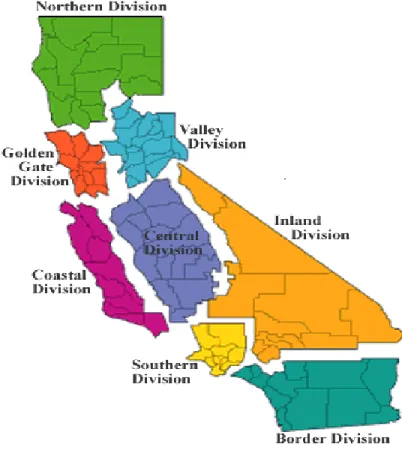
Figure 2. CHP divisions ...34
Figure 3. Lansing police department seal ...49
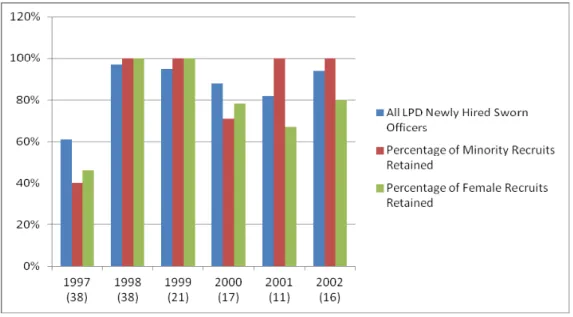
Figure 4. Retention rates of newly hired LPD recruits by category. The mentor program was implemented in April of 1997. The number of recruits hired is displayed in parenthesis below the year they were hired. ...57
Figure 5. Retention rates of the LPD communications center. The mentoring program was expanded to include this center in 1998. ...57
Figure 6. Henrico fire patch ...63
Figure 7. Percentage of participants who completed the Henrico Fire acting officer program after enrolling, 86 percent completed, 14 percent dropped out ...68
LIST OF TABLES
Table 1. Examples of each of the two types of objectives organizations have for implementing a formal mentoring program ...10
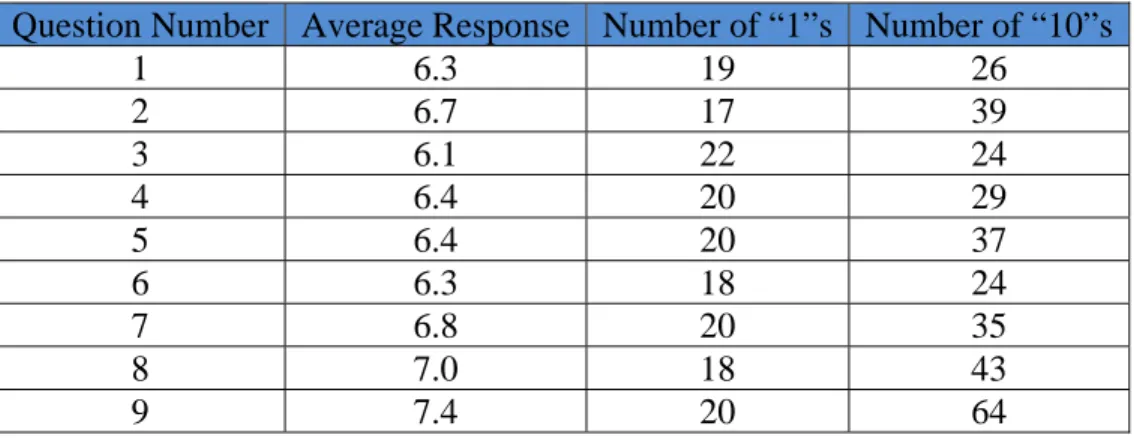
Table 2. Statistical data compiled from review of 133 CHP mentee survey responses filed between September 24, 2012, and March 4, 2014 ...42
LIST OF ACRONYMS AND ABBREVIATIONS
ALS advanced life support
CHDS Center for Defense and Homeland Security CHP California Highway Patrol
CTO Communications Training Officer DHS Department of Homeland Security EMT emergency medical technician FOP Fraternal Order of Police FTO Field Training Officer
IACP International Association of Chiefs of Police IFSTA Fire Service Training Association
LPD Lansing Michigan Police Department NPS Naval Postgraduate School
EXECUTIVE SUMMARY
This thesis is an exploration of the use of formal mentoring programs in homeland security disciplines for leadership development and addressing problem issues in an attempt to answer the primary research question: Is the establishment of a formal mentoring program a smart practice for homeland security agencies to develop future leaders? In addition to addressing this question, a secondary goal is to identify smart practices for leadership development and address problem issues with formal mentoring programs that could help organizations find the right strategy and policy for their specific needs.
Mentoring involves personal interaction between an individual with a high level of knowledge and experience (the mentor) who supports and assists a less experienced person (the protégé).1 Mentoring has three primary functions: role-modeling, psychosocial support, such as listening and advising, and career development support, such as promotion.2 Each of these functions provides mutual benefits for the mentor, protégé, and organization, such as increased productivity and organizational commitment, improved communication, higher job satisfaction, faster employee integration, and higher employee retention rates.3
The primary difference between informal and formal mentoring programs is how the interpersonal relationships between participants are formed. Informal mentoring relationships form on their own, usually between those who have a common interest or ideals.4 Formal mentoring relationships are typically established by the organization.
1 Belle Rose Ragins and John L. Cotton, “Mentor Functions and Outcomes: A Comparison of Men and
Women in Formal and Informal Mentoring Relationships,” Journal of Applied Social Psychology 84, no. 4 (1999): 529.
2 Belle Rose Ragins and Kathy E. Kram, The Handbook of Mentoring at Work: Theory, Research, and
Practice (Thousand Oaks, CA: SAGE, 2007), 163.
3 Ibid.
4 Frank A. Colaprete, Mentoring in the Criminal Justice Professions: Conveyance of the Craft
Mentoring has traditionally been conducted informally,5 and informal mentoring appears to be the status quo for homeland security agencies. History shows mentoring is not a new concept, but formal mentoring is new by comparison to informal mentoring. Increases in the academic study of mentoring, and the implementation of formal mentoring programs in both the public and private sectors, has resulted in changes to longstanding mentoring practices, especially in the last three decades.6
As Baby Boomers—born between 1946 and 19647—retire, another generation is coming into the workforce—Millennials. In November 2011, MTV conducted an on-line survey of Millennials (ages 19 to 28) that found 75 percent of respondents want a mentor.8 While studies show Millennials want to have a mentor, they may not be receptive to traditional informal mentoring methods in the workplace. A study of 1,000 college educated Millennials by Bently University found that just 2 percent claimed a mentor provided the most encouragement at work for them.9 These statistics indicate organizations may be missing the mark of Millennial mentoring expectations.
Roselinde Torres, a fellow with the Boston Consulting Group, conducted a study of 4,000 companies regarding the effectiveness of their leadership programs. Fifty-eight percent of those companies reported having “significant talent gaps for critical leadership roles.”10 Torres claims present “narrow 360 reviews” and “outdated performance measures” were linked to “false positive” results for good leaders that can make organizations think they were ready when they were not.11 An agency must look to the
5 Georgia T. Chao, “Formal Mentoring: Lessons Learned from Past Practice,” Professional
Psychology: Research and Practice 40, no. 3 (2009): 314.
6 Hansman et al., “Critical Perspectives on Mentoring: Trends and Issues, Critical Perspectives on
Mentoring: Trends and Issues,” VOCEDplus, 2002, 24, http://www.voced.edu.au/content/ngv20265.
7 CNN Library, “Baby Boomer Generation Fast Facts,” CNN, November 6, 2013, http://www.cnn.
com/2013/11/06/us/baby-boomer-generation-fast-facts/index.html.
8 Alison Hillhouse, October 4, 2012 (11:35 a.m.), “Consumer Insights: MTV’s ‘No Collar Workers,’”
Blog.Viacom, accessed March 26, 2014, http://blog.viacom.com/2012/10/consumer-insights-mtvs-no-collar-workers/.
9 Bentley University, “Millennials in the Workplace,” Center for Women and Business, accessed
March 30, 2014, http://www.bentley.edu/centers/center-for-women-and-business/millennials-workplace.
10 Roselinde Torres, “What It Takes to Be a Great Leader,” TED, accessed March 26, 2014,
http://www.ted.com/talks/roselinde_torres_what_it_takes_to_be_a_great_leader.html.
future to anticipate changes—like the challenges and opportunities created by Millennials entering the workforce or limitations of current leadership development methods—and act upon them before they become problematic. The literature review reveals formal mentoring programs appear to offer a means to address these problem issues (and others), but they must be implemented properly by each individual agency to do so. Six essential steps to create a formal mentoring program were also identified in this review:
Conduct an organizational needs assessment
Planning—determine the guidelines, goals and objectives for the program
Identify participants—both mentors and mentees
Train participants
Pair the participants
Monitor, evaluate, and refine the program
Three case studies of formal mentoring programs in homeland security agencies are examined: the California Highway Patrol (CHP) Coaching and Mentoring Program, the Lansing Michigan Police Department (LPD) Mentor Program, and the Henrico County (Virginia) Division of Fire (Henrico Fire) Acting Officer Program. Each selected mentoring program is evaluated using the individual agency’s own evaluation criteria to measure results. A comparison of smart practices identified in the literature review is made for each case study.
The CHP mentoring program is mandatory—all personnel at all ranks but officer—and participant surveys are required by policy.12 The case study of the CHP Coaching and Mentoring Program shows the agency followed the steps necessary to develop and implement a successful mentoring program identified in the literature review. The organization faced challenges in this process that were compounded by the sheer size of the agency and the vast geographic territory it is responsible to cover. However, the CHP overcame those challenges with planning and strategy that fit its
12 California Highway Patrol, Highway Patrol Manual 70.13 (California: California Highway Patrol,
organization. Over 130 surveys of CHP mentees were provided to the author by the agency and analyzed. While the survey responses of mentees were not all positive, the vast majority of program participants responded favorably regarding their experience.
The LPD mentoring program is voluntary, and it has been in existence for more than a decade.13 The LPD has competed for a national award for this program, and the United States (U.S.) Department of Justice has recognized it as a “best practice.”14 The LPD mentor program has had a positive impact on the retention rates of new employees and improved the diversity of the agency. The LPD case study shows the long-term impact one person can have on an organization when possessing a solid understanding of the problems and the determination to overcome obstacles to success. Even though this program began 17 years ago, lessons can still be learned from it.
The Henrico Fire Acting Officer Program is essentially a hybrid-mentoring program that systematically prepares members for leadership roles before assuming full responsibility for them. This program combines mentoring with knowledge testing, classroom instruction, practical exercises, and real world experiences in a progressive sequence. The Acting Officer Program virtually eliminates the risk of the agency promoting a member to an officer position who is not ready to handle the job, as candidates have already had to demonstrate their suitability for leadership in the program. A policy analysis shows homeland security organizations have three primary choices when it comes to the implementation of a formal mentoring program: full implementation (for all employees), partial implementation (for some employees), and maintaining the status quo (no implementation). Leadership must consider the individual needs and limitations of the agency before deciding which option to choose, including consideration of the challenges and tradeoffs of each choice prior to implementation. A decision to implement a formal mentoring program requires a means to evaluate the program for success, and results can be measured by examining changes in the knowledge, perceptions, and/or behavior of the program participants.
13 Lansing Police Department, “Officer to Officer Mentor Program,” accessed January 16, 2014,
http://www.lansingmi.gov/mentor_program.
The primary steps of creating a mentoring program are listed in order above, but the process is circular instead of linear, as the last step leads back to the first where changes can be made, and the cycle begins again. Based heavily on these steps, the smart practices (ideas behind practices to “take advantage” of opportunities present in a particular situation15) identified in this thesis are compiled in the final chapter. However, due to the independent organizational culture and needs of other agencies, it is up to the reader to decide if they apply to a particular organization. The list of smart practices provides a starting point for that assessment.
While certainly not a cure all, a formal mentoring program has the potential to address a variety of problems in a cost effective manner. Is the organization experiencing problem issues that formal mentoring can help address, such as high turnover, lack of diversity, skill and knowledge limitations, and a need for succession planning or leadership development? If so, and the agency understands the benefits and tradeoffs of formal mentoring programs, then it may be time that leadership considers implementation of a formal mentoring program.
15 Eugene Bardach, A Practical Guide for Policy Analysis: The Eightfold Path to More Effective
ACKNOWLEDGMENTS
There are a number of good people behind this thesis that I am indebted to for their guidance and support. The first to acknowledge is my family. My wife, Amy, bore the brunt of the support load by pulling extra duty with our children while I spent time researching and writing this thesis in addition to other course work. My children, Travis and Callie, have been understanding and patient with their dad, and Travis has done more than his share of work around the house for the last 18 months to free up extra time for me—without anyone asking him to. I know I am blessed to have a loving family that extends to my parents and in-laws.
I also would like to thank Colonel W. Steven Flaherty of the Virginia State Police for allowing me to attend the Naval Postgraduate School, Center for Defense and Homeland Security. Without his support, I would not have had this wonderful opportunity. I am grateful to my co-workers who helped pick up the slack at work while I attended classes. You all are a dedicated bunch, and I do not take that fact for granted. Thank you. My thesis committee, Dr. Chris Bellavita and Chief Patrick Miller, provided timely input, support, and guidance (with a dose of patience) and made this thesis exponentially better. The faculty and staff have also impacted this project in addition to my writing and thought processes. I am grateful to each one of them.
The three mentor program coordinators for the case studies in this thesis, Mrs. Sara Anderson, Lieutenant Cheri Ballor, and Captain J. “Scotty” Southall, went above and beyond what was expected to provide information about their agencies’ programs. All three are a credit to the professionalism of their organization.
Finally, I want to thank my fellow cohort members whose support and encouragement throughout this process has been priceless.
I.
INTRODUCTION
This thesis is an exploration of the use of formal mentoring programs in homeland security disciplines for leadership development and addressing problem issues. The distinction between formal and informal mentoring, the thesis research question, and the status quo of leadership development programs for homeland security organizations are examined in this first chapter. In addition, an overview of the thesis and a literature review regarding formal mentoring are discussed.
A. THE RESEARCH QUESTION
An inquiry starts with a question. The focus of this thesis is an attempt to answer the primary research question: Is the establishment of a formal mentoring program a smart practice for homeland security agencies to develop future leaders? In addition to addressing the primary research question, a secondary goal of this thesis is identifying smart practices for leadership development and addressing problem issues with formal mentoring programs that could help organizations find the right strategy and policy for their specific needs.
What is a smart practice? Dr. Eugene Bardach, of the University of California, Berkeley, differentiates between a “best practice” and a “smart practice,” and claims it is very difficult to know that any practice is really the very best to employ to address a particular problem or issue out of all the potential solutions. However, Bardach recognizes that ideas behind practices are available to “take advantage” of opportunities present in a particular situation that can be very clever, and he refers to those as “smart practices.”1
B. MENTORING AND THE DISTINCTION BETWEEN FORMAL AND
INFORMAL
Mentoring has been defined in numerous ways, but the basic concept involves personal interaction between an individual with a high level of knowledge and experience
1 Eugene Bardach, A Practical Guide for Policy Analysis: The Eightfold Path to More Effective
(the mentor) who supports and assists a less experienced person (the protégé).2 Mentoring is a perpetual cycle with the roles of mentors and mentees changing as they advance in the process, but mentoring is not a linear process.3 A person can be both a mentor and mentee at the same time depending on that individual’s role in the organization, and can mentor—or be mentored—by more than one person at a time.4
Mentoring involves three primary functions: role-modeling, psychosocial support, such as listening and advising, and career development support, such as promotions and salary increases.5 Each of these functions provides mutual benefits for the mentor, protégé, and organization, such as increased productivity and organizational commitment, improved communication, higher job satisfaction, faster employee integration, and higher employee retention rates.6
The primary difference between informal and formal mentoring programs is how the interpersonal relationships between participants are formed. Informal mentoring relationships form on their own, usually between those who have a common interest or ideals.7 Formal mentoring relationships are typically established by the organization, but the pairing process varies substantially between programs from mandatory participation and no input from the participants, to voluntary participation and the participants can choose each other.8 Formal mentoring programs are relatively new, but are rapidly growing in popularity.9
2 Belle Rose Ragins and John L. Cotton, “Mentor Functions and Outcomes: A Comparison of Men and
Women in Formal and Informal Mentoring Relationships,” Journal of Applied Social Psychology 84, no. 4 (1999): 529.
3 Clinton H. Smoke, Company Officer (Stamford, CT: Cengage Learning, 2009), 164.
4 Kathy E. Kram and Lynn A. Isabella, “The Role of Peer Relationships in Career Development,” The
Academy of Management Journal 28, no. 1 (March 1985): 121.
5 Belle Rose Ragins and Kathy E. Kram, The Handbook of Mentoring at Work: Theory, Research, and
Practice (Thousand Oaks, CA: SAGE, 2007), 163.
6 Ibid.
7 Frank A. Colaprete, Mentoring in the Criminal Justice Professions: Conveyance of the Craft
(Springfield, IL: Charles C Thomas Publisher, 2009), 118–120.
8 Ibid., 150.
9 Tammy D. Allen, Lisa M. Finkelstein, and Mark L. Poteet, Designing Workplace Mentoring
C. THE STATUS QUO—INFORMAL MENTORING The manager accepts the status quo; the leader challenges it.
—Warren G. Bennis
Mentoring has traditionally been conducted informally.10 However, informal mentoring has a number of weaknesses from the organizational point of view. For example, organizations have little or no input in the content, quantity, and quality of informal mentoring relationships, and few mentoring programs have quantitative measurements to assess their effectiveness.11 Informal mentoring programs require identification of mentoring participants first before any evaluation could be conducted. Another example is the underrepresentation of minority groups. Diversity has been problematic in law enforcement since the 1960s and resulted in Federal Consent Decrees in a number of cases.12 Studies also show women and minorities can be left behind by informal mentoring programs,13 but also indicate an agency supported formal mentoring program can create more mentoring relationship opportunities for underrepresented leadership groups.14
Informal mentoring appears to be the status quo for homeland security agencies based on the degree of difficulty locating ones that have a formal mentoring program to use as case studies for this thesis. At least one other researcher has come to a similar conclusion for the profession of law enforcement.15 Baby Boomers are now retiring in large numbers and taking many decades worth of knowledge and experience with them.16
10 Georgia T. Chao, “Formal Mentoring: Lessons Learned from Past Practice,” Professional
Psychology: Research and Practice 40, no. 3 (2009): 314.
11 Linda Kyle Stromei, Creating Mentoring and Coaching Programs: Twelve Case Studies from the
Real World of Training (Alexandria, VA: American Society for Training and Development, 2001, 176– 182.
12 Colaprete, Mentoring in the Criminal Justice Professions, 53.
13 Rogers et al., Practical Teaching in Emergency Medicine (New York: John Wiley & Sons, 2012),
37.
14 Ibid.
15 Colaprete, Mentoring in the Criminal Justice Professions, 5.
16 Jeremy M. Wilson et al., “Police Recruitment and Retention for the New Millennium,” RAND
Some homeland security agencies, like the Virginia State Police, have an executive staff comprised almost entirely of Baby Boomers. Those executive level positions will likely be filled in the near future by members of the next one—Generation X17 (those born between 1961 and 1981).18 A longitudinal study of 4,000 Generation X members surveyed every year between 1987 and 2010 indicates this generation is highly social, well educated, and two thirds were satisfied with their jobs.19
The latest generation to enter the workforce, Millennials or Generation Y, is known for having advanced technological skills, a sense of entitlement, altruistic ideals, and a commitment to personal and family time, but studies show this newer generation has not blended well with the traditional policing organization.20 A partial explanation for this failure to mesh may be overuse of the traditional classroom lecture format typically found in police training programs that is not as effective for teaching Millennials.21 A second factor may be the heavy reliance on technology and social media this generation has, which has helped to contribute to the “I want it all” and “I want it now” (especially at work) mentality,22 and weakened social skills compared to other generations.23
While the lecture format is a necessity for education, one way to better facilitate learning and improve collaboration is group interactivity, which is attributed to the fact that Millennials are team-oriented.24 Meister and Willyerd also subscribe to the potential
17 Laura Brown, “Get Read for Generation X to Take the Reins,” U.S. News & World Report, March
12, 2014, http://www.usnews.com/opinion/blogs/lara-brown/2014/03/12/generation-xs-leaders-will-take-power-before-the-millennials.
18 Jon D. Miller, “Active, Balanced and Happy: These Young Americans Are Not Bowling Alone,”
The Generation X Report 1, no. 1 (Fall 2011): 1, http://lsay.org/GenX_Rept_Iss1.pdf.
19 Miller, “Active, Balanced and Happy: These Young Americans Are Not Bowling Alone.”
20 National Institute of Justice (Nij), Anthony Batts, and Sean Smoot, Police Leadership Challenges in
a Changing World (Charleston, SC: BiblioBazaar, 2012), 3.
21 Eric P. Werth and Loredana Werth, “Effective Training for Millennial Students,” Adult Learning
22, no. 3 (June 2011): 17, doi:10.1177/104515951102200302.
22 Thorsten Gruber, “Understanding Generation Y and Their Use of Social Media: A Review and
Research Agenda,” Academia, 9, accessed July 14, 2014, http://www.academia.edu/5521214/Under standing_Generation_Y_and_Their_Use_of_Social_Media_A_Review_and_Research_Agenda.
23 Ash Beyhan Acar, “Do Intrinsic and Extrinsic Motivation Factors Differ for Generation X and
Generation Y?,” International Journal of Business and Social Science 5, no. 5 (April 2014): 15.
for success a collaborative work environment for Millennials can bring in their book The 2020 Workplace.25 Outside of the classroom, formal mentoring programs may be beneficial for organizations to continue the effective education of Millennials since mentoring requires a team effort and potentially improves social skills at the same time.
The initial hypothesis of this thesis is, for contemporary homeland security agencies, solely relying on informal mentoring programs is unlikely to be effective for leadership development. Generational differences of employees, the lack of organizational input into the mentoring process, and unequal access by employees hamper the potential effectiveness of informal mentoring. The following sections are a description of the process taken to test that hypothesis.
D. THESIS OVERVIEW
The sample of this thesis involves the study of three existing formal mentoring programs in homeland security agencies. The Department of Homeland Security (DHS) is comprised of 22 agencies, but is only the proverbial “tip of the iceberg” when it comes to homeland security agencies.26 Homeland security includes the disciplines of fire, police, public health, emergency medical services, emergency dispatch, intelligence, emergency management, government administration, and the military, but also encompasses some of the private sector, such as transportation and critical infrastructure like the electric power grid.27 For the purposes of this thesis, the phrase “homeland security agency” is intended to include government organizations involved in homeland security. However, the application of the thesis outcomes may not be confined to this definition.
Three case studies were identified through a literature review of formal mentoring programs with a concentration on those in homeland security disciplines. Data sources
25 Jeanne C. Meister and Karie Willyerd, The 2020 Workplace: How Innovative Companies Attract,
Develop, and Keep Tomorrow’s Employees Today, 1st ed. (New York: HarperBusiness, 2010).
26 Department of Homeland Security, “Organization,” accessed July 14, 2014, http://www.dhs.gov/
organization.
27 Jason Nairn, “What Are the Disciplines of Homeland Security?” Homeland Security Roundtable,
accessed July 10, 2014, http://homelandsecurityroundtable.com/2012/07/02/what-disciplines-associated-homeland-security/.
include literature on formal mentoring programs from multiple homeland security disciplines, and information from existing agency mentoring programs, including their written policies on mentoring. However, literature resources outside of homeland security were not excluded from the process.
The methods of analysis are twofold: a case study of three formal mentoring programs and policy options analysis. The case studies provide a direct comparison for other similar (in size, structure, and/or responsibilities) homeland security organizations considering the adoption of a formal mentoring program. The three programs chosen were the California Highway Patrol (CHP) Coaching and Mentoring Program, the Lansing Michigan Police Department (LPD) Mentor Program, and the Henrico County (Virginia) Division of Fire Acting Officer Program. Each of these programs was selected for academic review due to homeland security related responsibilities of the organization, multiple years of service, and the willingness to provide evaluation data to the researcher. The CHP program is the only fully implemented—all personnel at all ranks, but officer—mentoring program I have been able to identify for a homeland security agency, and participant surveys are mandatory.28 CHP also graciously provided extremely detailed (sometimes handwritten) interagency notes about their lengthy program design and implementation process.
Unlike the CHP program, the Lansing mentoring program is voluntary, and it has been in existence for more than a decade.29 The LPD has competed for a national award for this program, and the U.S. Department of Justice has recognized it as a “best practice.”30
The Henrico Fire Acting Officer Program is essentially a hybrid formal mentoring program in practice that is creative and unique to the mentoring schemes reviewed for potential case studies. Henrico has a detailed five-step process that program candidates
28 California Highway Patrol, Highway Patrol Manual 70.13 (California: California Highway Patrol,
October 2011), 5–5.
29 Lansing Police Department, “Officer to Officer Mentor Program,” accessed January 16, 2014,
http://www.lansingmi.gov/mentor_program.
follow in order with each step building on the last, and supervisors are primary as mentors.31
Each selected mentoring program is evaluated using the individual agency’s own evaluation criteria to measure results. Due to academic restrictions on human subject research beyond the student’s control, independent surveys were not conducted. A comparison of smart practices identified in the literature review is also made for each case study in an attempt to answer the primary research question.
The literature review revealed no “one size fits all” method exists for an agency to implement a formal mentoring program; instead, each organization should use a program structure that fits into its own organizational culture to be successful.32 Since the literature review revealed some smart practices of formal mentoring programs in case studies with replicated results outside of the homeland security realm, it appears to be possible to synthesize and apply those practices to construct formal mentoring policy options for homeland security organizations. Measurement of the formal mentoring programs’ impact on knowledge, behavior, and perception of protégés are used to gauge the effectiveness of policy options from case study program data. These criteria are discussed in depth in Chapter V. However, elements of all three criteria may not be available for each case study.
The thesis outcome is a compilation of smart practices on which to base a formal mentoring policy from three case studies and reviewed literature. As the target audience of this thesis, homeland security leaders should be better educated about the practice of formal mentoring, understand the limitations of the status quo of informal mentoring, and have a framework of good formal mentoring practices (policies) to choose from when selecting those that are the best fit for their agency.
Chapter II is an in-depth review of the problem with a discussion of the history of mentoring, the problems with relying on informal mentoring to develop future leaders in
31 Henrico County Division of Fire, Acting Officer Precepting Manual, DOF 305 (Virginia: Henrico
County Division of Fire, 2010).
homeland security organizations, and a brief look at identified case studies related to problem issues with the status quo. Chapters III, IV, and V are individual case studies of three existing formal mentoring programs in organizations with homeland security responsibilities: the California Highway Patrol, the Lansing Michigan Police Department, and the Henrico County Division of Fire. These case studies will describe the structure, history, agency policy, practical application, evaluation, and lessons learned from each program. Chapter VI is a policy analysis and discusses the findings of a combination of the literature reviewed and the cases studied for this thesis. Policy alternatives, criteria to measure success, and challenges of formal mentoring programs are also discussed in this chapter. The final chapter contains the author’s conclusions and recommendations. E. LITERATURE REVIEW
The process to answer the question “Is the establishment of a formal mentoring program a smart practice for homeland security agencies to develop future leaders?” begins with a literature review of formal mentoring programs with a concentration on those programs in homeland security related disciplines as previously defined. The history of mentoring is discussed at the beginning of the next chapter.
Information on mentoring is abundant and longstanding. However, sources for formal mentoring programs are less abundant and typically more recent; the vast majority of sources available were written in the last few decades.33 For example, a search of “mentoring” on Google Books produced 185,000 results, while a search for “formal mentoring programs” had 16,200 results.34 Source availability for formal mentoring programs depends on the discipline reviewed but is abundant in the fields of education and business.35 Relevant sources are primarily scholarly books and journal articles, but also include organizational policies and theses. This review includes formal mentoring
33 Catherine A. Hansman et al., “Critical Perspectives on Mentoring: Trends and Issues, Critical
Perspectives on Mentoring: Trends and Issues,” VOCEDplus, 2002, 10, http://www.voced.edu.au/content/ ngv20265.
34 Google Books, on-line search of “mentoring” and “formal mentoring programs,” July 12, 2014,
http://books.google.com/.
35 Hansman et al., “Critical Perspectives on Mentoring: Trends and Issues, Critical Perspectives on
program sources from multiple disciplines to include business, education, emergency medicine, criminal justice, military, fire service, intelligence, and faith-based organizations. Resources for disciplines with homeland security responsibilities were much more limited and recent in comparison to those available for business and education, but were available with identified gaps to be discussed later in this review.
Resources for formal mentoring programs are primarily divided into three types or groups.
How to guides for development of formal mentoring programs
Case studies of formal mentoring programs
Works that specifically focus on the program participants, usually to identify desired characteristics and traits of both mentors and mentees Throughout these resources, three different points of view are apparent: the organizational view, the mentor view, and the mentee view. Titles, such as Creating a Mentoring Culture: The Organization’s Guide, Being an Effective Mentor, and So You Want to be Mentored are examples from each of the three viewpoints. Each has a unique perspective of the process and a different set of program expectations and needs, and each is discussed in this review.
Before examining the how to guides, case studies, and participants in formal mentoring programs, it is important to understand why an organization would even consider one in the first place. The literature reveals formal mentoring programs are considered by organizations for two primary reasons, striving toward organizational goals and addressing developmental needs of employees.36 The diagram below demonstrates examples of each category of objectives, but is not all inclusive.
36 Christina A. Douglas, Formal Mentoring Programs in Organizations: An Annotated Bibliography
Organizational Goals Employee Developmental Needs Recruitment37 Retention of Employees38 Succession Planning39 Improving Diversity40 Manage Change41
Flatten the Learning Curve for New Employees42 Improve Skill Level and Performance43
Improve Confidence44
Promote Collaboration/Teamwork45 Career Development46
Table 1. Examples of each of the two types of objectives organizations have for implementing a formal mentoring program
The literature on formal mentoring programs tends to be one sided with a primary focus on benefits.47 However, drawbacks can occur to formal mentoring that are discussed in the case study portion of this literature review and in Chapter VI.
1. How to Guides
Designing Workplace Mentoring Programs, Creating a Mentoring Culture, Mentoring the Future, Mentoring in the Criminal Justice Professions, The Complete Guide to Mentoring, and Best Practices: Mentoring, all describe how to develop a formal mentoring program from the ground up with an organizational point of view. These sources differ greatly on the exact steps and order of the process. While certainly not
37 Jack McKeever and April Kranda, “Recruitment & Retention of Qualified Police Personnel: A Best
Practices Guide,” International Association of Chiefs of Police: Big Ideas for Smaller Police Departments 1, no. 2 (Summer 2000): 12.
38 Ibid.
39 T. Zane Reeves, “Mentoring Programs in Succession Planning,” State and Local Government
Review 42, no. 1 (April 2010): 62, doi: 10.1177/0160323X10368036.
40 Jeffrey H. Greenhaus, Gerard A. Callanan, and Veronica M. Godshalk, Career Management
(Thousand Oaks, CA: SAGE, 2009), 213.
41 Douglas, Formal Mentoring Programs in Organizations, 81.
42 United States Office of Personnel Management, Best Practices: Mentoring (Washington, DC:
United States Office of Personnel Management, 2008), 3.
43 Smoke, Company Officer, 165.
44 Lisa C. Ehrich and Brian Hansford, “Mentoring: Pros and Cons for HRM,” Asia Pacific Journal of
Human Resources 37, no. 3 (1999): 97.
45 Hilarie Owen, The Complete Guide to Mentoring: How to Design, Implement and Evaluate
Effective Mentoring Programmes (London, UK and Philadelphia, PA: Kogan Page Publishers, 2011), 3.
46 United States Office of Personnel Management, Best Practices, 3. 47 Douglas, Formal Mentoring Programs in Organizations, 85.
universal, the collective synthesis of recommended steps to this process according to the literature reviewed is as follows.
Conduct an organizational needs assessment
Determine the guidelines, goals and objectives for the program
Identify participants, both mentors and mentees
Train participants
Pair the participants
Monitor, evaluate, and refine the program
Outside of these steps, the strategies to accomplish these tasks are vastly different within the literature and cannot be synthesized into a general overview. Examples of these variances include one-on-one mentoring, group mentoring, team mentoring, supervisory mentoring, reverse or upward mentoring (less experienced employees mentoring senior employees, usually in areas of technology and current trends), and combinations of these recommendations.48 One source, Designing Workplace Mentoring Programs: An Evidence Based Approach, by Allen, Finkelstein, and Poteet, recognizes the differences in recommendations of how to guides as a positive circumstance. The authors of this book claim no one rigid structure exists for creating formal mentorship programs due to inherent differences in each individual entity. Instead, this work asserts each organization should use a program structure that fits into its own organizational culture to be successful.49
How to guides for formal mentoring programs are further divided into two types, those for new and newly promoted employees and those for developing future leaders as a part of succession planning or a minority advancement strategy. An example of this distinction is seen with literature from the fire service. Company Officer discusses how to mentor new recruits50 while Fire Service Instructor teaches how to mentor others for
48 United States Office of Personnel Management, Best Practices, 15–16. 49 Allen, Finkelstein, and Poteet, Designing Workplace Mentoring Programs, 8. 50 Smoke, Company Officer, 164–165.
succession planning.51 Within the literature, these two categories of programs have distinct differences in their recommended duration and approaches. Programs for new and newly promoted employees are often discussed in terms of short and/or fixed periods of time and are more focused on specific tasks, such as the International Association of Chiefs of Police’s “Big Ideas for smaller police departments,” and the best practices guide titled “Recruitment and Retention of Qualified Police Personnel” that recommends formal mentoring for new police officers.52 In contrast, those for identified future leaders are usually long-term endeavors that typically concentrate on strategic principles and concepts, such as the article “How to Mentor a Police Chief” published in Law and Order magazine in 2007.53 Although these two types of formal mentoring programs share a similar physical structure, the literature indicates each requires a different approach by the organization in regards to accomplishing established goals and objectives, training, and selection criteria for participants.
2. Case Studies
Case studies in the reviewed literature provide insight into smart practices of established formal mentoring programs. Lessons from some of these studies are incorporated in the how to guides previously discussed, but case study sources are sometimes a compilation of multiple studies with lessons learned from each one identified like Creating Mentoring and Coaching Programs: Twelve Case Studies from the Real World of Training. Only rarely do these case study resources cross discipline lines, but the observations and smart practice recommendations made in them are frequently similar, even if the disciplines or countries they were conducted in are not. For instance, a 2008 study of a U.S. software firm-mentoring program showed formal mentoring “is critical to sharing knowledge between employees and fostering knowledge
51 Iafc, Fire Service Instructor (Sudbury, MA: Jones & Bartlett Publishers, 2013), 388–390.
52 McKeever and Kranda, “Recruitment & Retention of Qualified Police Personnel: A Best Practices
Guide,” 12–13.
53 Albert Varga, “How to Mentor a Chief of Police,” Law & Order 55, no. 9 (September 2007): 129–
creation and sharing in the organization.”54 A 2012 study conducted on health care workers involved in a formal mentoring program in the United Kingdom had a substantially similar result, which found positive outcomes for learning and personal development for both the mentor and protégé.55
Benefits of formal mentoring programs are cited in every case study work reviewed and are usually divided into three sub-groups: organizational benefits, mentor benefits, and mentee benefits.56 Organizational benefits routinely include improved productivity and capabilities, succession planning, higher retention rates for employees, and greater collaboration as previously cited in Table 1. Mentor benefits repeatedly found in case studies are revitalization of the mentor with a sense of purpose and/or accomplishment and renewed vigor.57 Mentee benefits show more variance in the sources reviewed, but are routinely broken down into two broad categories of career benefits and psychological benefits.58 Specific advantages cited for the mentee often include faster advancement in the organization, improved capabilities and productivity, better decision making, and improved confidence.59
Some of the sources reviewed also discussed informal mentoring programs, and the benefits cited above are nearly identical for both formal and informal programs, although the degree of benefits varies between program types with informal relationships usually having more positive impact.60 However, the literature identifies several benefits that are specific to formal mentoring programs including increased opportunities for women and minorities,61 more frequent mentoring interactions between participants, the
54 Scott E. Bryant and James R. Terborg, “Impact of Peer Mentor Training on Creating and Sharing
Organizational Knowledge,” Journal of Managerial Issues XX, no. 1 (2008): 25.
55 Jenni Jones, “An Analysis of Learning Outcomes within Formal Mentoring Relationships,”
International Journal of Evidence Based Coaching and Mentoring 10, no. 1 (February 2012): 67.
56 Chao, “Formal Mentoring,” 314.
57 Ragins and Kram, The Handbook of Mentoring at Work, 163.
58 Kram and Isabella, “The Role of Peer Relationships in Career Development.” 59 Ehrich and Hansford, “Mentoring: Pros and Cons for HRM,” 97.
60 Ragins and Cotton, “Mentor Functions and Outcomes: A Comparison of Men and Women in
Formal and Informal Mentoring Relationships,” 544.
ability to measure results, and the creation of more mentoring relationships within an agency.62
Some measures of effectiveness of formal mentoring programs in case study literature are surveys of the participants and their management, and few provide quantitative measures of effectiveness.63 Garvey, Stokes, and Megginson recognize the limitations survey data has and call for improvement in the measures used to evaluate formal mentoring programs.64 In addition, the majority of case studies on formal mentoring programs have focused only on positive aspects of relationships between junior and senior managers.65 It is much more difficult to identify negative aspects of formal mentoring programs, but a few researchers have done so.
One study concludes that formal mentoring programs are no substitute for informal mentoring relationships and should be used in addition to informal mentoring.66 The formal mentoring process can also be ineffective if not adequately supported by the organization (time, resources, etc.) and implemented for the right reasons (such as those in Table 1).67 Another study found facilitating inter-personal relationships could go wrong if expectations of both mentors and protégés are not managed at the beginning of the relationship.68 Challenges of formal mentoring program case studies in the sources reviewed were regularly related to the process of intentionally structuring interpersonal relationships between participants, the very essence of a formal program. Smart practices identified in multiple case study sources for this issue were participant involvement in the selection of their mentors and mentees, regular monitoring of relationships by an independent party, and a “no-fault” system in place to change pairings during the
62 Stromei, Creating Mentoring and Coaching Programs.
63 Bob Garvey, Paul Stokes, and David Megginson, Coaching and Mentoring: Theory and Practice
(Thousand Oaks, CA: SAGE, 2008), 35–40.
64 Ibid.
65 Douglas, Formal Mentoring Programs in Organizations, 85.
66 Ragins and Cotton, “Mentor Functions and Outcomes: A Comparison of Men and Women in
Formal and Informal Mentoring Relationships,” 546.
67 Ehrich and Hansford, “Mentoring: Pros and Cons for HRM,” 102–103.
68 Young and Perrewe, “The Role of Expectations in the Mentoring Exchange: An Analysis of Mentor
program if problem issues arise within the relationship.69 However, it appears that many of the problem issues associated with formal mentoring programs can be mitigated in the planning and implementation stages.70
Smart practices identified in the literature occasionally conflict. For example, Stromei explains a case study in Creating Mentoring and Coaching Programs that cited close working relationships as important to the success of a formal mentoring program,71 while Rogers et al. cited program benefits related to the use of communications technologies (such as email or social media) for long distance mentoring in Practical Teaching in Emergency Medicine.72 It is possible each of these practices has some benefit over no mentoring connection, but a close working relationship may be more difficult to obtain from afar. As noted above, no “apples to apples” measurement is available to determine which of these two approaches is best.
3. Participant Characteristics
Literature on formal mentoring program participant characteristics comes in all three identified points of view (the organization, the mentor, and the protégés). Preferred characteristics of both mentors and mentees are generally similar in the literature reviewed and an overview can be synthesized. This synthesis is not all inclusive of desired traits, but it is comprised of information corroborated on some level by almost every source examined in this review.
Sought mentor characteristics cited generally include experienced— knowledgeable and competent, open-minded, possess good inter-personal skills (patience, tact, empathy, etc.), possess good communications skills—to include being a good listener, a role model for leadership (integrity, trustworthy, strong work ethic, critical thinker, etc.), and a willing program participant with high expectations.73 Desired
69 Allen, Finkelstein, and Poteet, Designing Workplace Mentoring Programs, 37–58, 88. 70 Ehrich and Hansford, “Mentoring: Pros and Cons for HRM,” 104.
71 Ibid., 176.
72 Rogers et al., Practical Teaching in Emergency Medicine, 37. 73 Colaprete, Mentoring in the Criminal Justice Professions, 65–66.
mentee characteristics identified are a positive attitude, commitment (to the organization and the mentor program), open minded, and flexible.74
Resources reviewed in this sub-category agreed consideration of participant characteristics in the selection and pairing process is a key factor for success of formal mentoring programs.75 A 2004 study by Young and Perrewe concluded that managing expectations between participants is also important for program success and the perception of organizational support.76 Nearly all challenges and negative impacts addressed in the literature for formal programs involved the potential for, or actuality of, ineffective interpersonal relationships between mentors and mentees.
4. Definitions
Many resources define mentors by describing their behaviors and functions, which include role model, teacher, guide, motivator, coach, communicator, counselor, supporter, advisor, protector, nurturer, talent developer, sponsor, and confidant.77 These same terms are used to describe the process of mentoring, but both words have wide variations of their meaning in the literature. Some examples of mentoring definitions from homeland security related resources include:
Mentoring is an intentional process of interaction between two individuals, which includes nurturing to promote the growth of the mentee.78
The mentoring process can be summarized with the words lead, follow, and get out of the way. Lead, as used here, is showing the way by being a teacher and role model. Follow involves watching, advising, and counseling the student or new member. And by get out of the way, we mean letting go, delineating, or withdrawing. The process is not linear.79
74 Allen, Finkelstein, and Poteet, Designing Workplace Mentoring Programs, 27.
75 Jones, “An Analysis of Learning Outcomes within Formal Mentoring Relationships,” 68.
76 Young and Perrewe, “The Role of Expectations in the Mentoring Exchange: An Analysis of Mentor
and Protege Expectations in Relation to Perceived Support,” 120.
77 Colaprete, Mentoring in the Criminal Justice Professions, 8–9. 78 Rogers et al., Practical Teaching in Emergency Medicine, 36. 79 Smoke, Company Officer.
Mentoring is a mutually beneficial relationship in which a knowledgeable veteran employee provides insight, guidance, and development opportunities to a less experienced colleague.80
Many sources define the mentor as outside the chain of command of the protégé,81 but some include supervision as mentors.82 While peer-to-peer is the most common type of mentor-to-protégé relationship discussed, sources also describe mentoring relationships between individuals several supervisory ranks apart.83 Such variation within the sources makes synthesizing a common definition for mentor and mentoring very difficult outside the descriptions of a mentor and mentoring behaviors, which are consistent in the literature reviewed.
Mentees are interchangeably referred to as protégés, students, apprentices, and studies, all of which lack the same level of experience and skill held by their mentors. All sources reviewed agree that mentees are the primary focus of formal mentoring programs, but, as outlined above, they are not the only ones to benefit from them. This thesis often refers to mentees as protégés and program candidates.
5. Identified Knowledge Gaps
As previously noted, how to guides for formal mentoring programs vary widely on their recommendations. Allen, Finkelstein, and Poteet may be correct in their assessment that this variation is healthy for individual agencies because they can pick and choose which ones suit their organizational culture best. However, these authors also claim formal mentoring programs can do more harm than good if not properly implemented.84 What appears to be missing from the literature reviewed is a compilation
80 California Highway Patrol, Coaching/Mentoring Program, Policy HPM 70.13 (California:
California Highway Patrol, October 2011), 5–5.
81 Workplace Gender and Equality Agency, “Training and Development: Establish and Maintain
Effective Mentoring Programs,” Australian Government, January 1, 2013, 11, https://www.wgea.gov. au/sites/default/files/GEI1.3.1_mentoring_programs.pdf.
82 Dana L. Haggard and Daniel B. Turban, “The Mentoring Relationship as a Context for
Psychological Contract Development,” Journal of Applied Social Psychology 42, no. 8 (August 1, 2012): 1911, doi: 10.1111/j.1559-1816.2012.00924.x.
83 McKeever and Kranda, “Recruitment & Retention of Qualified Police Personnel: A Best Practices
Guide,” 13.
of existing smart practices regarding formal mentoring programs for homeland security agencies, how some homeland security agencies have accomplished the steps of planning and implementing a formal mentoring program. This thesis attempts to close that gap.
F. ANALYSIS
While not completely unexplored, sources regarding formal mentoring programs for future leaders and succession planning in homeland security related fields are minimal when compared to those for business and education, with one exception, the emergency medical field. Emergency management mentoring resources primarily come from the U.S. government, such as Best Practices: Mentoring, and apply across homeland security disciplines. Only one report related to mentoring was located for the intelligence community from the National Research Council titled, Intelligence Analysis: Behavioral and Social Scientific Foundations. A number of theses related to formal mentoring programs for individual agencies written by students attending the National Fire Academy are available online85 in addition to training textbooks, such as Fire Service Instructor and Company Officer. Law enforcement resources are more plentiful, such as Effective Police Supervision, Mentoring in the Criminal Justice Professions, Police Leadership and Management, Police Leadership Challenges in a Changing World, and Every Officer is a Leader, and are just some of the mentoring related resources from this discipline referenced in this review.
Information is also lacking on the formal mentorship programs in existence within homeland security agencies. Formal coaching and mentoring programs, such as the one implemented by the CHP appear to be an emergent practice for homeland security organizations. An emergent practice is defined as an attempt to address a complex problem in which not all the variables are known.86 A case study of formal mentoring
85 U.S. Fire Administration Library, “U.S. Fire Administration Library,” accessed July 12, 2014,
http://www.google.com/url?sa=t&rct=j&q=&esrc=s&source=web&cd=1&cad=rja&uact=8&ved=0CB0QF jAA&url=http%3A%2F%2Fwww.usfa.fema.gov%2Flibrary%2F&ei=JuPCU5LoIeWtigL96YD4Ag&usg= AFQjCNHU7HjzH0YA1uoTmaXoqMET-EuFQg&bvm=bv.70810081,d.cGE.
86 Cynthia F. Kurtz, and Dave J. Snowden, “The New Dynamics of Strategy: Sense-making in a
programs in agencies that have homeland security related responsibilities to identify potential smart practices could be beneficial to other homeland security agencies.
The literature review revealed some smart practices for formal mentoring programs, such as the synthesized steps for planning, developing, and implementing a formal mentoring program were routinely repeated in how to guides and case studies across multiple disciplines, such as business, education, and health care. Therefore, although the literature reviewed was not all directly related to homeland security disciplines, application to homeland security might be beneficial.
G. CONCLUSION
Attempting to answer the research question (“Is the establishment of a formal mentoring program a smart practice for homeland security agencies to develop future leaders?”) should serve to benefit all homeland security disciplines, either to help facilitate a more effective leadership development process within each individual organization, or to avoid less effective measures if the initial hypothesis is incorrect.
Understanding what mentoring is and how formal and informal mentoring are different are important to answering the research question. This chapter has explained those terms and the current status quo of relying on informal mentoring for leadership development. It has also provided an overview of the remainder of this thesis and the methods used to test the hypothesis. The literature review offers a more in-depth perspective on formal mentoring from three points of view. The next chapter focuses on the history of mentoring, a detailed review of the problems with the status quo, and a brief examination of existing case studies related to the problem.
Should the process of mentoring in homeland security agencies be formalized? Even if the answer to this question turns out to be an absolute yes, it would not mean eliminating informal mentoring connections in homeland security disciplines. Those informal relationships have benefits in and of themselves,87 but formal mentoring