ON THE PROGRAMMABILITY OF
MULTI-GPU COMPUTING SYSTEMS
by
Javier Cabezas Rodríguez
Advisor: Prof. Nacho Navarro Co−advisor: Prof. Wen−mei Hwu
DISSERTATION
Submitted in partial fulllment of the requirements
for the degree of Doctor of Philosophy
in the Department of Computer Architecture
Universitat Politècnica de Catalunya
2015
Abstract
Multi-GPU systems are widely used in High Performance Computing envi-ronments to accelerate scientic computations. This trend is expected to continue as integrated GPUs will be introduced to processors used in multi-socket servers and servers will pack a higher number of GPUs per node. GPUs are currently connected to the system through the PCI Express interconnect, which provides limited bandwidth (compared to the bandwidth of the mem-ory in GPUs) and it often becomes a bottleneck for performance scalability. Fortunately, the utilization of integrated GPUs that share the physical mem-ory with CPUs, or higher-bandwidth interconnects such as NVLink, will help to address this problem.
Current programming models present GPUs as isolated devices with their own memory, even if they share the host memory with the CPU. Program-mers need to copy the required data to the GPU memory before it is used in a GPU computation, and copy the generated results to host memory be-fore they are accessed by the CPU code. Moreover, complex data transfer schemes (e.g., prefetching or speculative updates) are required to eciently exploit GPUs, but they are dicult to maintain, especially across dierent system topologies. This problem is aggravated when using multiple GPUs. Multi-GPU systems are programmed like distributed systems in which each GPU is a node with its own memory. Programmers explicitly manage alloca-tions in all GPU memories and use primitives to communicate data between GPUs. Furthermore, programmers are required to use mechanisms such as command queues and inter-GPU synchronization. This explicit model harms the maintainability of the code and introduces new sources for potential er-rors.
The rst proposal of this thesis is the HPE model. HPE enables multi-GPU applications to eciently exchange data while preserving developer productivity and application maintainability. HPE builds a simple, consis-tent programming interface based on three major features. (1) All device address spaces are combined with the host address space to form a Unied Virtual Address Space, or UVAS. (2) Programs are provided with an
Asym-metric Distributed Shared Memory (ADSM) system for all the GPUs in the system. It allows applications to allocate memory objects that can be ac-cessed by any GPU or CPU. HPE exploits the UVAS to easily keep track of the location and the state of the copies for each object. (3) Every CPU thread can request a data exchange between any two GPUs, through simple memory copy calls. Such a simple interface allows HPE to automatically op-timize data exchanges between devices; eliminating the need for application code to handle dierent system topologies.
Experimental results show that the HPE model eases programming of multi-accelerator applications while providing performance improvements of 2×compared to the best data transfer scheme implemented on top of CUDA 3.
Improvements on real applications range from 5% in compute-bound bench-marks and up to 2.6×in communication-bound benchmarks. HPE
transpar-ently implements sophisticated communication schemes that can deliver up to a 2.9× speedup in I/O device transfers.
The second proposal of this thesis is a shared memory programming model that exploits the new GPU capabilities for remote memory accesses to remove the need for explicit communication between GPUs. This model turns a multi-GPU system into a shared memory system with NUMA (i.e., Non-Uniform Memory Access) characteristics. In order to validate the viability of the model we also perform an exhaustive performance analysis of remote memory accesses over PCIe. We show that the unique characteristics of the GPU execution model and memory hierarchy help to hide the costs of remote memory accesses.
Results show that PCI Express 3.0 is able to hide the costs of a 10% of remote memory accesses if the kernels produce high GPU core occupancy and the accesses are spread through the whole kernel execution. We also show that caching of remote memory accesses can have a large performance impact on kernel performance.
Finally, we introduce AMGE, a programming interface, compiler sup-port and runtime system that automatically executes computations that are programmed for a single GPU across all the GPUs in the system. The pro-gramming interface provides a data type for multidimensional arrays that allows for robust, transparent distribution of arrays across all GPU memo-ries. The compiler extracts the dimensionality information from the type of each array, and is able to determine the access pattern in each dimension of the array. The runtime system uses the compiler-provided information to au-tomatically choose the best computation and data distribution conguration to minimize inter-GPU communication and memory footprint. This model eectively frees programmers from the task of decomposing and distributing computation and data to exploit several GPUs.
AMGE achieves almost linear speedups for a wide range of dense com-putation benchmarks on a real 4-GPU system with an interconnect with moderate bandwidth. We show that irregular computations can also benet from AMGE, too, if kernels do not suer from computation distribution im-balance across thread blocks. We believe that AMGE can be used in shared memory multi-GPU systems to automatically scale the performance of GPU kernels to multiple GPUs.
Thanks to the results obtained in the experiments of this thesis we demon-strate that careful programming interface design and ecient implementation of our proposals enable applications with not only simpler and more main-tainable codebases, but also a performance scalability similar to hand-tuned low-level implementations especially designed for multi-GPU systems.
Contents
1 Introduction 1
1.1 Objectives and contributions . . . 3
1.1.1 Multi-GPU Reverse Time Migration . . . 3
1.1.2 Data sharing between the CPU and multiple GPUs . . 4
1.1.3 Shared memory programming for multiple GPUs . . . 5
1.1.4 Transparent parallelization of GPU programs to run on multiple GPUs . . . 6
1.2 Organization . . . 7
2 Reference Hardware and Software Environment 9 2.1 Graphics Processing Units . . . 9
2.1.1 Memory technologies . . . 11
2.2 Multi-GPU systems . . . 12
2.2.1 Interconnect . . . 13
2.2.2 GPU NUMA systems . . . 14
2.3 Programming models for GPU-based systems . . . 15
2.3.1 C for CUDA . . . 15
2.3.2 OpenCL . . . 17
3 State of the Art 19 3.1 Automatic CPU/GPU memory coherence . . . 19
3.2 System support and GPU virtualization . . . 20
3.3 Automatic multi-GPU execution . . . 22
3.3.1 Compiler-based transparent multi-GPU execution . . . 22
3.3.2 Compiler-based multi-GPU code generation . . . 23
3.3.3 Multi-GPU libraries . . . 24
3.4 Languages for multi-GPU execution . . . 25
4 Guiding Example: Reverse Time Migration 29 4.1 The Reverse Time Migration computation . . . 29
4.2 RTM base implementation . . . 31
4.2.1 Memory . . . 32
4.2.2 Input/Output . . . 33
4.2.3 Computation . . . 33
4.3 Porting RTM to GPUs . . . 34
4.3.1 Data I/O schemes . . . 34
4.3.2 GPU kernels . . . 36
4.4 RTM implementation on other architectures . . . 39
4.4.1 General purpose CPUs . . . 39
4.4.2 Cell B.E . . . 40
4.4.3 FPGA . . . 42
4.5 Performance evaluation . . . 42
4.6 Summary . . . 44
5 Heterogeneous Multi-GPU Execution 45 5.1 Programmability issues under CUDA . . . 45
5.1.1 RTM on multiple GPUs . . . 46
5.1.2 Performance considerations . . . 50
5.2 The Heterogeneous Parallel Execution model . . . 51
5.2.1 Multi-threaded GPU sharing . . . 52
5.2.2 UVAS and remote memory access . . . 54
5.2.3 Multi-threaded ADSM . . . 57
5.3 Performance evaluation of the HPE model . . . 60
5.3.1 Experimental methodology . . . 60
5.3.2 Benchmarks . . . 60
5.3.3 Inter-GPU data transfers . . . 62
5.3.4 Application benchmarks . . . 63
5.3.5 Communication with I/O devices . . . 67
5.3.6 Inter-node communication (MPI) . . . 67
5.4 Summary . . . 68
5.5 Impact on CUDA 4/5/6 . . . 69
6 Shared Memory GPU Programming 71 6.1 Multi-GPU NUMA systems . . . 71
6.2 Experimental methodology . . . 73
6.2.1 Hardware setup . . . 73
6.2.2 Microbenchmarks . . . 73
6.2.3 Multi-GPU applications . . . 74
6.3 Performance analysis of the remote access mechanism . . . 76
6.4 GPU-SM: towards shared memory multi-GPU programming . 83 6.4.1 Distributed memory vs shared memory . . . 84
6.4.2 Writing code for GPU-SM . . . 84
6.4.3 Current limitations . . . 87
6.5 Implementation and performance evaluation of GPU-SM ap-plications . . . 87
6.5.1 FDTD . . . 88
6.5.2 Image ltering . . . 91
6.6 Summary . . . 93
7 Automatic Multi-GPU Execution 99 7.1 AMGE overview . . . 99
7.1.1 An example: matrix multiplication . . . 101
7.2 Computation and data distribution . . . 102
7.2.1 Compiler analysis . . . 103
7.2.2 Run-time distribution . . . 106
7.3 AMGE implementation details . . . 108
7.3.1 Array data type . . . 108
7.3.2 Source-to-source transformations . . . 110
7.3.3 Run-time distribution selection policy . . . 111
7.4 Experimental methodology . . . 113
7.5 Performance evaluation . . . 115
7.5.1 Indexing overhead . . . 115
7.5.2 Multi-GPU performance . . . 118
7.5.3 Impact of remote accesses on performance . . . 119
7.5.4 Comparison with previous works . . . 123
7.5.5 Sparse benchmarks . . . 124
7.6 Summary . . . 127
8 Conclusions and Future Work 129 8.1 Conclusions . . . 129
8.1.1 Impact . . . 130
8.2 Future work . . . 131
8.2.1 Full system memory coherence . . . 131
8.2.2 Hiding the costs of remote accesses . . . 132
8.2.3 Memory placement . . . 132
8.2.4 Extensions to other environments . . . 133
A Publications 135 A.1 Conference papers . . . 135
A.2 Journal papers . . . 135
A.3 Workshops . . . 136
List of Figures
2.1 Multi-GPU system architectures. . . 10
2.2 Microarchitecture of AMD and NVIDIA GPU cores. . . 10
2.3 Multi-GPU NUMA system targeted in this thesis. . . 12
2.4 PCIe transfer rates for dierent data sizes. . . 14
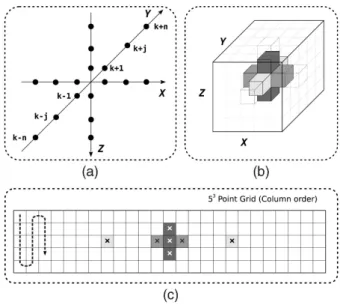
4.1 Computation and memory access patterns of RTM. . . 32
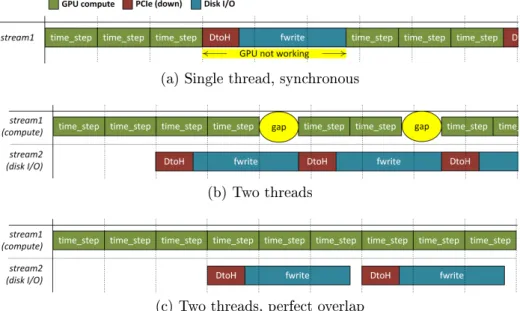
4.2 Execution timelines of the GPU implementation of RTM for dierent data I/O schemes. . . 35
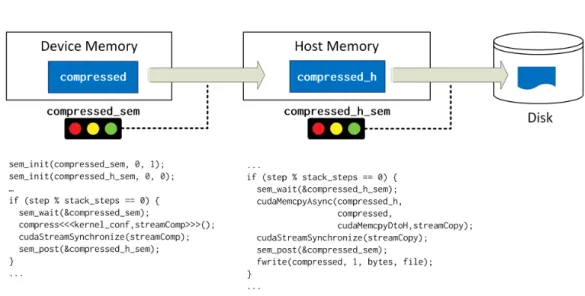
4.3 Synchronization scheme used to overlap I/O and communica-tion in the GPU implementacommunica-tion of RTM. . . 36
4.4 Data access and vectorization pattern for the Cell B.E. . . 41
4.5 Elapsed times for dierent platform implementations of RTM. 42 4.6 I/O requirements of RTM using a stack rate 5, and high level of compression. . . 43
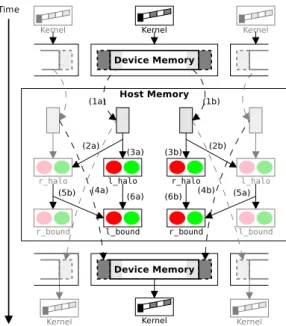
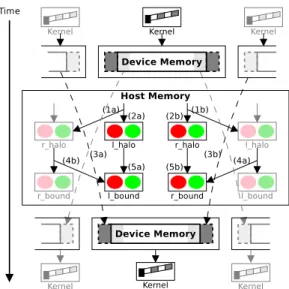
5.1 Execution timeline for the multi-GPU implementation of RTM. 47 5.2 Exchange steps and synchronization in the RTM computation using the CUDA 3 programming interface. . . 49
5.3 Exchange steps and synchronization in the RTM computation when GPUs are shared across CPU threads. . . 51
5.4 Exchange steps and synchronization in the RTM computation when UVAS is available. . . 54
5.5 Software-based Unied Virtual Address Space implementation using segmentation. . . 57
5.6 Measured throughput for dierent data communication sizes. . 62
5.7 CPU thread wait time for dierent inter-GPU data communi-cation sizes. . . 62
5.8 Speedup over single GPU execution dierent input dataset sizes. 64 5.9 Percentage of time devoted to memory transfers over the total execution time. . . 66
5.10 Disk↔GPU transfer speedups of HPE compared to the base
synchronous version. . . 67 5.11 MPI transfer speedups of HPE compared to the base
syn-chronous version. . . 68 6.1 Multi-GPU systems used to evaluate GPU-SM. . . 73 6.2 Data dependences in a 4-point 3D stencil computation. . . 75 6.3 Data needed to compute an output pixel in a convolution. . . 76 6.4 Memory bandwidth achieved by remote accesses for dierent
PCIe generations. . . 77 6.5 Dierent remote memory access patterns for a 2D computation
grid. . . 78 6.6 Execution timeline of a 2D kernel in which the 20% of the input
and 10% of the output elements of the matrices are accessed remotely. . . 79 6.7 Performance overhead imposed by remote accesses for dierent
computation intensities. . . 80 6.8 Execution time for dierent remote accesses and SM
occupan-cies. . . 81 6.9 Execution time for dierent sizes of the remotely accessed
read-only data structure and dierent occupancies. . . 82 6.10 Distributed and shared memory multi-GPU system models. . . 83 6.11 Inter-domain data dependences for FDTD. . . 88 6.12 FDTD: speedups of the multi-GPU implementations for 4
GPUs compared to the original implementation on a single GPU. . . 90 6.13 FDTD: execution timeline for dierent decompostion
congu-rations. . . 91 6.14 Image ltering: speedups of the multi-GPU GPU-SM
imple-mentation for 4 GPUs compared to the original implementa-tion on a single GPU. . . 92 7.1 Overview of AMGE components. . . 100 7.2 Computation-to-data mapping examples. . . 104 7.3 Data and computation distribution congurations for sgemm
and transposeon a 4-GPU system. . . 107
7.4 Sparse matrices used in the SpMV benchmarks. . . 116 7.5 Overhead imposed by indexing routines of the proposed
multi-dimensional array type. . . 117 7.6 Speedup over baseline for dierent computation decomposition
congurations using reshape and VM implementations. . . 118 x
7.7 Memory requests served by remote GPUs. . . 119 7.8 Execution timeline of stencil2Dfor 4 GPUs. . . 121
7.9 Overhead of the coherence mechanisms in AMGE and in the related work [57]. . . 123 7.10 Execution time of dierent implementations of the sparse
ma-trix vector computation on AMGE for 1, 2 and 4 GPUs. . . . 125 7.11 Computation imbalance in the SpMV benchmark (4 GPUs). . 126 7.12 Performance scalability in the BFS benchmark. . . 126
List of Tables
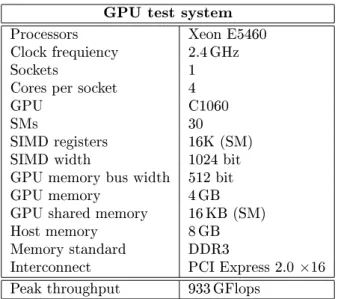
2.1 Memory and interconnection network characteristics. . . 14 4.1 Hardware conguration used for the evaluation of the GPU
implementation of RTM. . . 37 4.2 Hardware conguration used for the evaluation of the CPU
implementation of RTM. . . 39 4.3 Hardware conguration used for the evaluation of the Cell B.E.
implementation of RTM. . . 40 4.4 Hardware conguration used for the evaluation of the FPGA
implementation of RTM. . . 41 6.1 Analyzed congurations for the GPU-SM implementation of
FDTD. . . 75 6.2 Analyzed congurations for the GPU-SM implementation of
image ltering. . . 76 7.1 Dense benchmarks used for the evaluation of AMGE. . . 112 7.2 Sparse benchmarks used for the evaluation of AMGE. . . 114 7.3 Maximum problem size for a 4-GPU system in AMGE and in
Listings
4.1 Pseudocode of the RTM algorithm. . . 31
5.1 Simplied host code of the RTM computation using the CUDA 3 programming interface. . . 48
5.2 Simplied host code of the RTM computation when GPUs are shared across CPU threads. . . 53
5.3 Simplied host code of the RTM computation when UVAS is available. . . 55
5.4 Simplied host code of the RTM computation when ADSM is available. . . 58
6.1 FDTD: distributed implementation (simplied version of the kernel). . . 93
6.2 FDTD: distributed implementation (host). . . 94
6.3 FDTD: GPU-SM implementation (simplied version of the kernel). . . 95
6.4 FDTD: GPU-SM implementation (host). . . 96
7.1 Multi-GPU sgemm GPU code with AMGE. . . 101
Chapter 1
Introduction
In the last years, massively-parallel accelerators have experienced widespread adoption in dierent environments due to their outstanding performance in many types of computations. Companies and research centers that rely on High Performance Computing (HPC) to solve complex scientic simulations were the rst to embrace the utilization of such processors. Further improve-ments in the manufacturing technologies of chips have also made possible the integration of accelerators and general purpose processors in a single (het-erogeneous) chip; and they can now be found in mobile devices, desktops, and servers. Thus, this types of accelerators are becoming ubiquitous and this trend is expected to continue in the next years.
The most common type of massively-parallel accelerator is the Graphics Processing Unit (i.e., GPU). GPUs have traditionally excelled at executing xed-function primitives that process in parallel data such as vertices, edges and pixels. With the introduction of user-dened shaders (user-dened com-putations on the geometry or color of 3D objects), GPUs were extended to be programmable processors. At the beginning, this capabilities were only acces-sible through extensions of the most popular graphics' application program interfaces (e.g., OpenGL and DirectX). Many scientists saw the potential of GPUs to be used for general purpose computing, and started to develop programming frameworks such as Lib Sh [67], BrookGPU [31], and Accelera-tor [90]. Since then, GPU vendors have created new programming languages and frameworks such as NVIDIARCUDATM [74] or OpenCLTM [56] to enable
true general purpose computing on GPUs.
The preferred form factor in HPC environments is discrete GPUs be-cause they provide their own specialized memories (e.g., GDDR5) that de-liver much higher bandwidth than host memory. Examples of discrete GPUs are NVIDIA Tesla and AMD FirePro. Discrete GPUs are connected to the
system through standard I/O interconnects like PCI Express. Many manu-facturers also couple a general purpose processor and an integrated GPU in the same die. This type of chip is common in desktop and mobile systems. Examples of integrated CPU/GPU processors include Intel Haswell, AMD Kaveri, and NVIDIA K1. In these systems, CPUs and GPUs share the host memory. This has two eects: (1) Integrated GPUs have lower performance than their discrete counterparts (due to the lower memory bandwidth). (2) On the other hand, they benet from faster CPU↔GPU communication
since they do not rely on I/O interconnects.
Oftentimes, problems are too computationally demanding or the required data is too big to be run on a single GPU. In such cases, the problem is decomposed into smaller subproblems (e.g., using domain decomposition) that are executed on several GPUs in parallel. Many HPC systems systems install several discrete GPUs per node1. GPUs installed in the same node
benet from lower-latency and higher-bandwidth communication. In order to pack as many GPUs as possible in the same node, some manufacturers have announced products that include several GPUs in the same board (e.g., NVIDIA Pascal). Nevertheless, the increased performance of multiple GPUs comes at the cost of higher programming complexity.
Current programming models present GPUs as isolated devices with their own memory. This is the case even if they share the host memory with the GPU, because most chips with integrated GPUs do not implement hardware memory coherence between the CPU and the GPU cores. However, exposing separate memories hurts programmability. Programmers need to copy the required data to the GPU memory before it is used in a GPU computation, and copy the generated results to host memory before they are accessed by the CPU code. Moreover, simple data transfer schemes are likely to incur into performance penalties. On the other hand, elaborated schemes (e.g., prefetching or speculative updates) require complex implementations that are dicult to maintain, especially across dierent system topologies.
This problem is aggravated when using multiple GPUs. Multi-GPU sys-tems are programmed like distributed syssys-tems in which each GPU is a node with its own memory. Programmers need to manage allocations in all GPU memories and explicitly use primitives to communicate data between GPUs, which can be dicult in computations with complex data dependencies be-tween GPUs. Furthermore, in order to manage several GPUs eciently, programmers are required to use mechanisms such as command queues and inter-GPU synchronization. This, again, further harms the maintainability
1No integrated multi-GPU systems have been released so far, but they are expected to appear in the next years.
CHAPTER 1. INTRODUCTION
of the code and introduces new sources for potential errors.
1.1 Objectives and contributions
The main objective of this thesis is to facilitate the utilization of GPUs so that they can be adopted by a broader community. More specically, improvements to the current programming models for GPUs are proposed in order to simplify the management of multiple GPUs and the data transfers between the host and GPU memories. Some of these changes require support from the Operating System or the GPU architecture, too.
1.1.1 Multi-GPU Reverse Time Migration
In order to accomplish our goals, we rst analyze the GPU programmability issues in real applications. The RTM (i.e., Reverse Time Migration) appli-cation is used as a guiding example in this thesis. It is a key appliappli-cation in the oil and gas industry with much higher computing power requirements than previous algorithms, that can only be fullled thanks to multi-GPU execution.
We present an optimized implementation of the RTM that is specically designed to exploit the architectural characteristics of the GPUs. The work is divided in two parts:
1. An optimized implementation of the dierent computational kernels on the GPU.
2. A multi-GPU multi-node execution framework for RTM. This work was done using CUDA 3, which imposes several restrictions on how CPU threads can access the GPUs in the system (e.g., each CPU thread can access 1 GPU only).
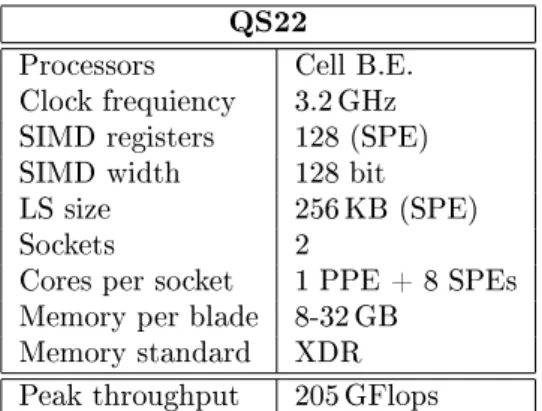
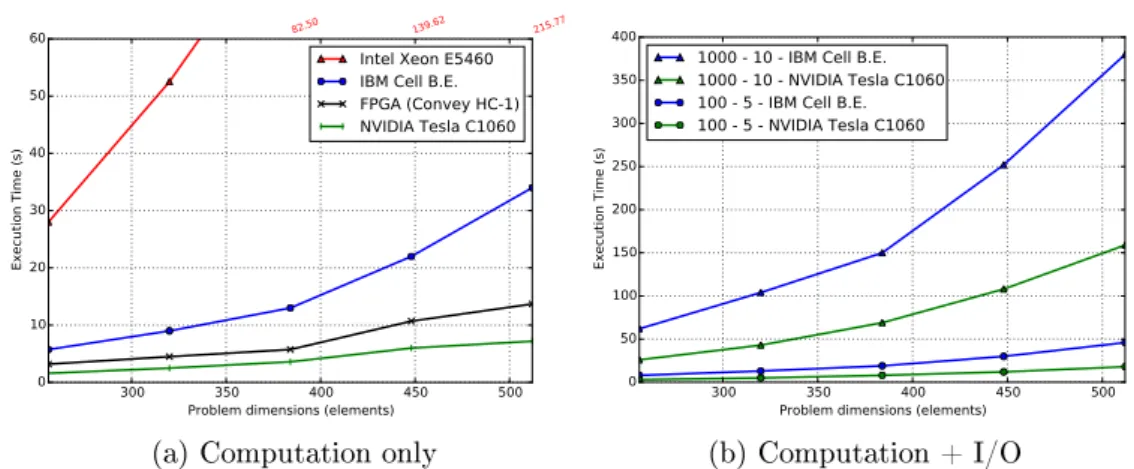
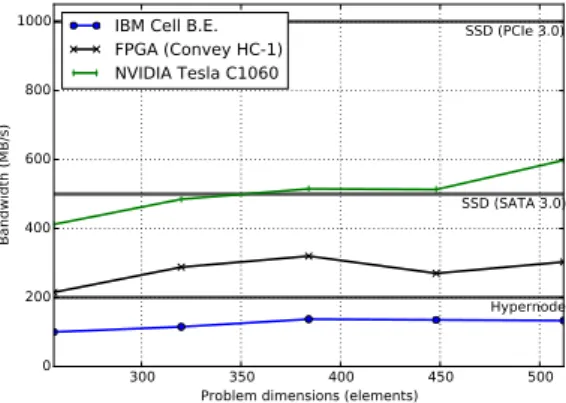
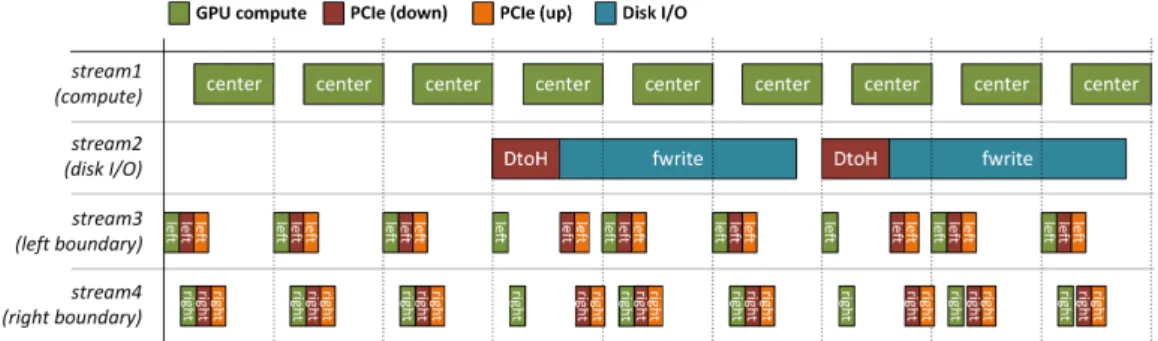
This implementation is measured against three reference HPC platforms: one that employs traditional cache-coherent cores, another one that uses Cell B.E. accelerators [53], and a Convey HC-1 FPGA system. Results show that GPUs outperform any other accelerator. However, PCIe and disk I/O needs to be carefully performed to overlap them with computation to hide the costs. Limitations in the GPU programming model makes this a dicult task, and we identify several programmability issues that we try to address in the thesis.
1.1. OBJECTIVES AND CONTRIBUTIONS
1.1.2 Data sharing between the CPU and multiple GPUs
To eectively utilize a multi-GPU computing system, application developers need to distribute large data sets across GPU memories. Within a hetero-geneous computing cluster, application-level data exchange between GPUs involves interactions between node-level APIs such as CUDA or OpenCL, and inter-node APIs such as MPI. While MPI hides the complexity of the system interconnect topology and inter-node routing, there is currently no similar node-level interface. Therefore, developers are left with the challenging task of code versioning needed to eectively use a wide variety of hardware and drivers with very dierent capabilities.
Moreover, CPU and GPU have separate memory spaces and developers are in charge of managing separate copies on host and GPU memories for each data structure, and keeping them coherent through explicit memory transfers. Some solutions propose a single virtual memory space that is shared between CPU and GPU [45, 52]. In these solutions, each object is allocated once although memory is allocated both in host and GPU memory; and a runtime system transparently keeps the dierent copies of the object coherent. However, they target systems with a single GPU.
We propose the Heterogeneous Parallel Execution (HPE) programming interface and its runtime system. HPE enables multi-GPU applications to eciently exchange data while preserving developer productivity and appli-cation maintainability. HPE is available to CUDA and OpenCL developers as a user-level library. It allows applications to allocate memory objects that can be accessed by any GPU or CPU in the system. The HPE runtime transparently handles data copies.
Both CUDA and OpenCL allow applications to interact with all devices in the system. However, the physical bus topology of the system dictates the level of interaction and data exchanges allowed between GPUs. As a result, programmers write application code to discover the physical system topology and implement dierent code paths for each type of system congu-ration. This represents a signicant eort resulting in large, hard-to-maintain application code base.
HPE builds a simple, consistent programming interface based on three major features.
1. All GPU address spaces are combined with the host address space to form a Unied Virtual Address Space, or UVAS. Starting with the Fermi generation, all NVIDIA GPUs support UVAS based on virtual memory.
2. Programs are provided with an Asymmetric Distributed Shared Mem-4
CHAPTER 1. INTRODUCTION
ory (ADSM) system [45] for all the GPUs in the system. HPE exploits the UVAS to easily keep track of the location and the state of the copies for each object. The simple relation between a GPU address and its corresponding host address allows a lock-free implementation of the HPE runtime.
3. Every CPU thread can request a data exchange between any two GPUs, through simple memory copy calls. The HPE runtime manages thread-to-GPU connection and performs intermediate data copies when nec-essary to realize this abstraction. Such a simple interface allows HPE to automatically optimize data exchanges between GPUs; eliminating the need for application code to handle dierent system topologies. We have been working with NVIDIA to include many of the features of HPE in the latest versions of CUDA.
1.1.3 Shared memory programming for multiple GPUs
The common approach to multi-GPU programming is to use each GPU as an isolated device with its own memory. This imposes the utilization of explicit memory transfers between GPU memories every time a GPU needs data that is located on the memory of a dierent GPU. Further, these memory transfers must be overlapped with computation to minimize their overhead, thus increasing the complexity of the code. While HPE takes care of some of these optimizations, we would like to remove all explicit data transfers.
Modern NVIDIA GPUs provide the capability of accessing the memories of all the GPUs connected to the same PCI Express root complex [5]. They also present a single Unied Virtual Address Space (i.e., UVAS) that in-cludes all the GPU memories in the system and the host memory. Thanks to these features, CUDA kernels can access any memory in the system through regular load/store instructions. While these features have been available
for some time they have gone unnoticed among application developers, and their utilization has been mainly restricted to accelerate bulk data transfers between GPU memories and to enable better integration with I/O devices.
In this dissertation, we propose GPU-SM, a shared memory programming model that exploits the new GPU capabilities to remove the need for explicit communication between GPUs. The memory of multiple GPUs is aggregated to form a shared memory system with NUMA (i.e., Non-Uniform Memory Access) characteristics. In this type of systems computation can be freely decomposed and distributed across all the GPUs in the system, because any GPU can access all the memory in the system, although with a lower bandwidth and higher latency.
1.1. OBJECTIVES AND CONTRIBUTIONS
We also perform an exhaustive performance analysis of remote memory accesses over PCIe and their viability as a mechanism to implement the shared memory model in multi-GPU systems. Dierent PCIe revisions (i.e., 2.0 and 3.0) and topologies are studied. We show that the highly-multi-threaded GPU execution model helps to hide the costs of remote memory accesses. Other features introduced in the latest GPU families such as read-only caches can minimize the amount of accesses to remote GPUs. The importance of the thread block scheduling and its relation with data decom-position is also discussed, as they determine how remote memory accesses are distributed along kernel execution.
1.1.4 Transparent parallelization of GPU programs to
run on multiple GPUs
While using a shared memory model improves programmability of multi-GPU systems, programmers are still in charge of decomposing the problem and distributing it across several GPUs. Moreover, memory placement needs to be performed in such a way that remote memory accesses are minimized, in order to avoid the impact on the performance. This has shown to be a challenging task in the past in other type of systems [30, 66, 65, 38] and usually rely on hardware mechanisms not available in current GPUs such as paging..
In this dissertation, we propose exposing to programmers a single virtual GPU that aggregates the resources of all GPUs in the system. Similar so-lutions have been proposed [57, 61], but their design imposes fundamental limitations. (1) Memory footprint overhead: these solutions replicate por-tions of the arrays that are never accessed. This is because they do not take into account the dimensionality of the arrays. For example, consider a kernel that performs n-dimensional tiling (a common pattern in dense GPU computations [83, 92, 21]) where each computation partition accesses a non-contiguous memory region of a matrix. In such a case, they transfer the whole memory address ranges accessed by each computation partition, which may include large portions of the array that are never used. This limits the size of the problems that can be handled and imposes performance overheads due to larger data transfers. (2) Data coherence overhead: replicated output memory regions need to be merged in the host memory after each kernel call. In many cases, this merge step leads to large performance overheads. (3) Applications that use atomic and global memory instructions, resort to single-GPU execution.
In this thesis, we introduce AMGE (Automatic Multi-GPU Execution), a 6
CHAPTER 1. INTRODUCTION
programming interface, compiler support and runtime system that automat-ically executes computations that are programmed for a single GPU across all the GPUs in the system. The programming interface provides a data type for multidimensional arrays that allows for robust, transparent distribution of arrays across all GPU memories. The compiler extracts the dimension-ality information from the type of each array, and is able to determine the access pattern in each dimension of the array. The runtime system uses the compiler-provided information to automatically choose the best computation and data distribution conguration to minimize inter-GPU communication and memory footprint.
AMGE assumes non-coherent non-uniform shared memory accesses (NCC-NUMA) between GPUs through a relatively low-bandwidth interconnect, such that all GPUs can access and cache any partition of the arrays. Thus, we ensure that arrays can be arbitrarily decomposed, distributed and safely accessed from any GPU in the system. In current systems based on discrete GPUs, we utilize Peer-to-Peer [5] and Unied Virtual Address Space [74] technologies that enable a GPU to transparently access the memory of any other GPU connected to the same PCIe domain. While remote GPU mem-ory accesses have been used in the past [89], this is the rst work to use them as an enabling mechanism for automatic multi-GPU execution.
Results show that AMGE can eectively provide linear speedups for a wide reange of dense computations a 4 GPU system. Moreover, the size of the problems that can be handled is much larger than previous solutions. Furthermore, AMGE can also be benecial to irregular workloads.
1.2 Organization
This dissertation is organized as follows:
Chapter 1: Introduction Provides an overview of the programmability problems we are trying to solve and outline the proposed solutions.
Chapter 2: Reference Hardware and Software Environment The chapter explains the unique characteristics of the GPU architecture and the technologies (e.g., PCI Express, GDDR5 memory) in multi-GPU systems, that are used in the proposals. This is followed with a discussion of current programming models for GPUs, their features, and their limitations. Since the RTM algorithm is used as a guiding example, it is introduced here, too.
1.2. ORGANIZATION
Chapter 3: State of the Art Several works have been proposed to sim-plify the programmability of GPU-based systems. These previous works are discussed and their limitations are highlighted. We focus on memory man-agement and automatic multi-GPU execution.
Chapter 4: Guiding Example: Reverse Time Migration Reverse Time Migration (RTM) is used as a guiding example in this thesis to illus-trate programmability problems in multi-GPU systems. The RTM compu-tation is composed of a number of compucompu-tational kernels and has high I/O requirements. We explain the implementation optimizations for GPUs and compare them with previous approaches for dierent architectures.
Chapter 5: Heterogeneous Multi-GPU Execution Multi-GPU exe-cution is required to handle real-world problem sizes. This chapter intro-duces a multi-GPU paralelization strategy in CUDA for RTM with support for several nodes through MPI. We identify and analyze the programmability problems that arise and propose the HPE model that eliminates or minimizes them.
Chapter 6: Shared Memory GPU Programming Discusses the hard-ware requirements and the characteristics to enable shared memory program-ming in multi-GPU systems. The chapter also includes an analysis of the performance characteristics of PCI Express and the capabilities of current GPUs to hide the costs of remote memory accesses.
Chapter 7: Automatic Multi-GPU Execution This chapter intro-duces a programming framework that transparently decomposes computation and data and distributes them across all the GPUs in the system.
Chapter 8: Conclusions and Future Work Sumarizes the discoveries made in this thesis and outlines future directions to achieve simpler and more ecient multi-GPU execution.
Chapter 2
Reference Hardware and
Software Environment
This thesis proposes improvements in the programmability of systems that install several GPUs. This chapter introduces the details of the GPU hard-ware and programming models which are important to understand the perfor-mance trade-os and the implementability of our proposals. It also presents the terminology used in the rest of the thesis.
2.1 Graphics Processing Units
Modern GPUs are presented in two dierent form factors.
• Discrete GPUs are dedicated boards connected to the rest of the system
through expansion slots such as PCI Express (shown in Figure 2.1a). They have their own high-bandwidth memory, which is explicitly man-aged by the programmers.
• Integrated GPUs are included in the same die as the CPU and both
share the host memory (shown in Figure 2.1b). They may also share some levels of the cache memory hierarchy with the CPU cores. For example, the CPU and GPU in the Intel Ivy Bridge [49] chip share the L3 cache. AMD APU [2] provides both coherent (which shares the L2 cache) and non-coherent interconnects for the integrated GPU, which are chosen at programmer's request. On the other hand, the GPU in the NVIDIA K1 [14] chip does not share any level of the cache memory hierarchy with the CPU cores.
2.1. GRAPHICS PROCESSING UNITS
(a) Discrete (b) Integrated
Figure 2.1: Multi-GPU system architectures.
Discrete designs are preferred in High Performance Computing environ-ments due to their much higher memory bandwidth. Moreover, several dis-crete GPUs can be installed in each node, while there are no multi-GPU designs that use integrated GPUs yet. Since this thesis targets the pro-grammability of multiple GPUs, we mainly focus on discrete GPUs, although many of the presented concepts and analyses can be applied to integrated GPUs, too.
(a) AMD Graphics Core Next (b) NVIDIA Maxwell
Figure 2.2: Microarchitecture of AMD and NVIDIA GPU cores.
Current GPUs have several highly-multithreaded cores that contain wide vector units. They use a SIMT (i.e., Single Instruction Multiple Threads) execution model in which threads are organized in xed-length groups (i.e., warps in NVIDIA GPUs, wave fronts in AMD GPUs) that execute the same instruction concurrently on the dierent lanes of the vector units. The cur-rent size of a warp is 32 threads in NVIDIA GPUs and 64 threads in AMD GPUs. When threads in the same warp take dierent execution paths they produce thread divergence. Since all threads in the warp execute in lockstep, each path is executed by all the threads, although predication is used to dis-able the lanes of the threads that are not in the executed path. Divergence degrades the throughput of the GPU up to as many times as the number
CHAPTER 2. REFERENCE HARDWARE AND SOFTWARE ENVIRONMENT
of diverging execution paths and must be minimized. GPU cores switch ex-ecution between dierent warps to hide the cost of long latency operations such as memory requests. NVIDIA refers to each of this cores as Streaming Multiprocessor (i.e., SM) and uses CUDA core to refer to each of the lanes of the vector unit [46, 4, 12] (Figure 2.2b). AMD uses Computing Unit (i.e., CU) for the cores, SIMD for the vector unit and work item for the vector lane [1] (Figure 2.2a). In this thesis we use the terms warp, GPU core, vector unit and vector lane.
GPUs typically include a cache memory hierarchy, but it serves a dier-ent purpose than CPU caches. In CPUs, threads compute coarse grain tasks and CPU caches exploit spatial/temporal locality within each thread to min-imize the access latency by reducing the number of o-chip memory requests. GPUs, however, use a large number of threads that perform ne grain com-putations which result in much lower data locality within each thread. On the other hand, neighboring threads tend to access to contiguous data ele-ments. Thus, the main purpose of caches in GPUs is to serve as a coalescing point: memory accesses from dierent threads in a warp to elements within the same cache line are coalesced into a single request. In order to maximize performance, data must be laid out in such a way that memory accesses are always coalesced. A scratchpad memory is also commonly provided for programmers to exploit inter-thread locality.
NVIDIA GPUs implement a two-level hierarchy with a rst level com-posed of a non-coherent private cache per core, and a shared second level cache. L1 caches are write-through and, therefore, modications from dif-ferent cores to the same cache line are consolidated in the L2 cache. The cache hierarchy supports atomic operations, which are implemented in the L2 cache, too. The Kepler family of GPUs added a second private cache per SM for read-only data. Each core also contains a scratchpad memory (96 KB in the Maxwell family, 48 KB in previous families). AMD Core Next architec-ture use a similar two-level memory hierarchy with a local 64 KB scratchpad per core. The main dierence with respect to NVIDIA GPUs is that L1 caches are coherent. AMD GPUs also provide a scalar core that handles the execution of common scalar operations (e.g., branches, pointer arithmetic) across threads in a wave front and has its own L1 read-only cache.
2.1.1 Memory technologies
CPUs use DDR SDRAM (i.e., Double Data Rate Synchronous Dynamic Random Access Memory) or simply DDR. The revision of this technology that is currently used is DDR3, although many vendors are already shipping DDR4 modules. High-end systems provide several independent
communi-2.2. MULTI-GPU SYSTEMS
Figure 2.3: Multi-GPU NUMA system targeted in this thesis.
cation channels with the memory modules (AMD Socket G34 supports up to 4 channels). Each channel uses a 64-bit bus and many channels can be combined to build a wider bus (i.e., ganged mode) although this mode is not commonly used. Read and write accesses to the SDRAM are burst ori-ented; an access starts at a selected location and consists of a total of four or eight data words. For write operations a mask can be used to specify which individual bytes are actually written to memory.
Conversely, discrete GPUs use GDDR5 (i.e., Graphics DDR version 5), which presents some dierences with respect to DDR3. GDDR5 devices are always directly soldered down on the board and are not mounted on a memory module (e.g., DIMM). They operate at a much higher frequency than DDR devices. Each channel uses a 32-bit bus, and channels are always ganged by the GPU memory controller to form a much wider bus (up to 512 bits). Bursts in GDDR5 always have a size of eight data words.
2.2 Multi-GPU systems
The base system targeted in this thesis is composed of several discrete GPUs connected to the system through a PCI Express (i.e., PCIe) interconnect (Figure 2.3). Besides having access to their own memories, since the Fermi microarchitecture [46], NVIDIA GPUs can access other memories through the PCIe interconnect (i.e., GPUDirect[5]) without host code intervention. At the same time, they introduced a single Unied Virtual Memory Address Space (i.e., UVAS) for all the GPUs in the system. The goal of UVAS is to allow every object in the system, no matter which physical memory it resides in, to have a unique virtual address to be used by application point-ers. Combining these two features allows regular load/store instructions to
transparently generate local or remote requests, based on the translation of 12
CHAPTER 2. REFERENCE HARDWARE AND SOFTWARE ENVIRONMENT
virtual address to the physical location of the data being accessed. Several of the designs proposed in this thesis take advantage of the remote memory access mechanism to implement shared memory programming on multiple GPUs. As far as we know, AMD does not currently support remote memory access between GPU memories.
2.2.1 Interconnect
Practically all current discrete GPUs use the PCIe interconnect to interface with the host. However, interconnects that oer higher bandwidth have been announced.
PCI Express
PCIe is a expansion bus that uses a point-to-topology that connects the de-vices to the root complex[76]. It uses a separate link per device, which can contain several lanes (currently from 1 to 16 lanes are commonly used). The root complex can interface with PCIe endpoints (i.e., devices) or switches that multiplex the link among several devices. This exibility allows to cre-ate complex device hierarchies. Data is transmitted in packets, that can be stripped accross lanes. Therefore, bandwidth increases with the number of lanes. Moreover, PCIe supports full-duplex communication between any two endpoints. Current PCIe 3.0 provides up to 16 GB/s per direction. The en-coding used to transmit data in previous PCIe versions reduced the eective bandwidth by a 20%, but PCIe 3.0 uses a dierent encoding that introduces a 2% overhead, only.
The PCIe standard packets support up to 30-byte headers and up to 4 KB payloads (although most PCIe controllers in current processors limit it to 256 bytes or less [50]). The overhead imposed by the size of the headers makes PCIe not well suited for very small transfers. On the other hand, transfers larger than the payload size are broken by the PCIe controller to several packets (which is more ecient than breaking the transfer to smaller transfers in software). Another source of overhead is due to PCIe transactions not being able to use pageable host memory. To solve this problem, the GPU driver copies data to temporary non-pageable (or pinned) buers before transmitting them to the GPU memory. While double-buering can be used to hide this cost, they are only eective for large data transfers. Figure 2.4 shows the achieved memory transfer rates for dierent data sizes in a system with a NVIDIA C2050 and a PCIe 2.0 x16 interconnect. Lines with circles represent transfers using pinned memory buers instead of regular pageable allocations.
2.2. MULTI-GPU SYSTEMS 4KB 8KB 16KB 32KB 64KB128KB256KB512KB 1MB 2MB 4MB 8MB16MB32MB64MB Transfer size 0 1 2 3 4 5 6 7 Bandwidth (GB/s)
Read (pinned)
Write (pinned)
Read
Write
Figure 2.4: PCIe transfer rates for dierent data sizes.
Memory Latency Bandwidth
DDR3 (CPU, 2 channels) ∼50ns ∼30GBps
GDDR5 (GPU, 4-8 channels) ∼500ns ∼250GBps
HBM ∼500ns 5001000 GBps
Interconnect Latency Bandwidth
Hypertransport 3 ∼40ns 25+25 GBps
QPI ∼40ns 25+25 GBps
PCIe 2.0 ∼200ns 8+8 GBps
PCIe 3.0 ∼200ns 16+16 GBps
NVLink (4 interconnection points) - 80 GBps
Table 2.1: Memory and interconnection network characteristics.
NVLink
NVIDIA will introduce a new interconnect called NVLink [13] in the Pascal GPU family (to be released in 2016), in an eort to replace PCIe with a faster bus. NVLink also uses a point-to-point bus and includes one or several NVLink interconnection points in each device. Devices can bond together several interconnection points to increase the bandwidth. Preliminary studies show 80 GB/s per direction for a device using four interconnection points.
2.2.2 GPU NUMA systems
The interconnects and memories in the system have dierent dierent latency and bandwidth characteristics (Table 2.1). GPUs access their local memory (Figure 2.3, arc a) with full-bandwidth (e.g.,∼250GBps in GDDR5). They
CHAPTER 2. REFERENCE HARDWARE AND SOFTWARE ENVIRONMENT
access other memories in the system through the PCIe interconnect: host memory (arc b) or another GPU memory (arc c)1. Remote accesses can
traverse any PCIe switch found between the client and the server GPUs. Both CPU memory and the inter-GPU interconnects like PCIe deliver a memory bandwidth which is an order of magnitude lower than the local GPU memory (e.g., ∼ 12GBps in PCIe 3), thus creating a Non-Uniform Memory Access
(i.e., NUMA) system. Future interconnects such as NVLink will increase the bandwidth, but memory interfaces with higher bandwidths have been announced too (HBM [6] will deliver up to 1 TB/s).
Remote access characteristics
Besides the lower bandwidth and increased latency, remote accesses present some other peculiarities compared to regular memory accesses. They are not cached in the regular memory hierarchy because modications from dierent GPUs to the same cache line could produce coherence problems. However, remote accesses to data that is only read in the computation can be safely cached in the read-only (R/O) cache (currently, this must be specied by programmers by using the __ldg intrinsic provided by CUDA).
2.3 Programming models for GPU-based
sys-tems
GPUs are typically programmed using a Single Program Multiple Data (SPMD) programming model, such as NVIDIA CUDA [74] or OpenCL [56]. Unless stated otherwise, the CUDA naming conventions are used in the rest of the thesis.
2.3.1 C for CUDA
Although the programming framework is called C for CUDA, we refer to it simply as CUDA in the rest of the thesis. CUDA [74] is divided into two parts:
1. A C/C++ API that exposes GPUs to programs and allows them to manage their memory and launch computations to be run on the GPUs.
1In systems with multiple CPU sockets, the inter-CPU interconnect (e.g., HyperTrans-port/QPI) might need to be traversed, too. Unfortunately, current systems do not support routing remote GPU↔GPU requests over the inter-CPU interconnect. Therefore, all the
experiments presented in this thesis that require the remote memory access capability are performed on systems with a single CPU socket.
2.3. PROGRAMMING MODELS FOR GPU-BASED SYSTEMS
2. A C++-like programming language to write computations that run on the GPU.
CPU-GPU interface
Programmers need to manage GPU and host memories. Although they are presented with a UVAS, they control in which GPU memory is physically allocated. They need to copy the necessary data to the GPU memory be-fore launching any GPU computation that uses it. Conversely, output data computed on a GPU needs to be copied back to host memory before it can be accessed by the CPU. Thanks to the UVAS, pointers to data allocated on one GPU can be passed to a dierent GPU, since it can be transparently accessed through the PCIe interconnect (although with much higher latency and much lower bandwidth).
The GPU is a passive device that executes asynchronous commands pushed by the host code: mainly kernel launches and memory transfers. The GPU address space is abstracted with a CUDA context. By default, a single CUDA context is assigned to each GPU, but additional contexts can be created. GPUs provide several command queues which are abstracted as CUDA streams. Commands pushed to a stream are executed in order, but commands from dierent streams can execute in any order and, if there are enough available resources, concurrently. Therefore, several streams must be used to overlap computation and data transfers. CUDA provides dierent levels of synchronization: device, stream, and individual operation (using CUDA events). Event barrier operations can be also pushed to streams to guarantee inter-stream command ordering. All these abstractions need to be used in most cases in order to achieve high performance, thus greatly increasing coding complexity.
GPU programming model
Programmers encapsulate computations in functions (called kernels) that are executed in parallel by a potentially large number of threads, although each thread might take a completely dierent control ow path within the kernel. All these threads are organized into a computation grid of groups of threads (i.e., thread blocks). Each thread block has an identier and each thread has an identier within the thread block, that can be used by programmers to map the computation to the data structures. CUDA provides a weak consistency model: memory updates performed by a thread block might not be perceived by other thread blocks, except for atomic and memory fence (GPU-wide and system-wide) instructions.
CHAPTER 2. REFERENCE HARDWARE AND SOFTWARE ENVIRONMENT
Each thread block is scheduled to run on an SM, and threads within a thread block are issued in xed-length groups (the previously described warps). Each thread has its own set of private registers and threads within the same thread block can communicate through a shared user-managed scratchpad and using synchronization instructions. The number of thread blocks that can execute concurrently on the same SM (i.e., occupancy) de-pends on the number of threads and other resources needed by each block (i.e., scratchpad memory and registers). Hence, the utilization of these re-sources must be carefully managed to achieve full utilization of the GPU.
2.3.2 OpenCL
OpenCL [56] is an open programming framework maintained by the Khronos standardization organization. It shares many design principles with CUDA but its scope is far more ambitious since it targets virtually any type of computing device. However, its genericity makes it more cumbersome than CUDA to use in applications. Instead, OpenCL is more commonly used to create higher-level development frameworks or in commercial applications that need to run on a wide variety of hardware platforms.
Although being more generic than CUDA, it provides higher abstractions in some areas like memory management. For example, memory is allocated in a context instead of a device. A context can be bound to several devices and it is the OpenCL runtime who decides in which physical memory it is allocated. Due to the dierent capabilities of the devices that support OpenCL, mechanisms like remote memory accesses are not supported either. Since the proposed techniques heavily rely on these mechanisms, we use CUDA in the rest of the thesis.
Chapter 3
State of the Art
Programmability of multi-GPU systems can be tackled at dierent levels, ranging from system support to memory management and transparent com-putation decomposition and distribution.
3.1 Automatic CPU/GPU memory coherence
GPUs use dierent memories or separate memory subsystems than CPUs. This provides a performance advantage but, on the other hand, programmers are forced to use several copies of data and keep them coherent. Some solu-tions have been proposed to automatize the CPU/GPU memory coherence.
The ADSM model proposed by Gelado et al. [45] presents a Unied Vir-tual Address Space (UVAS) which is shared by CPU and GPU. ADSM allows programmers to declare objects once and use them both in GPU and CPU functions with no need for explicit memory transfers at all. The ADSM runtime transparently creates the needed copies of the objects and makes sure that they are coherent at consistency points. It uses acquire/release consistency at kernel call boundaries. ADSM is implemented in the GMAC user-level library [10] that provides eager GPU memory update to transpar-ently overlap CPU computation (e.g., data initialization) and data transfers. GMAC uses the memory protection mechanism of modern CPUs to detect with pages are accessed in the host code. However the work in these thesis targets multi-GPU systems while ADSM is restricted to a single GPU. In Chapter 5, we present the HPE model that extends ADSM to multi-GPU systems.
While ADSM greatly simplies GPU development, programmers still need to use a specialized allocation/free functions for data that is shared between CPU and GPU. Jablin et al. propose compiler analysis in [52] to
3.2. SYSTEM SUPPORT AND GPU VIRTUALIZATION
automatically determine which data structures are shared. They also add support for stack allocations and global variables, while GMAC is limited to heap allocations. The runtime system inspects the parameters at kernel call boundaries and keeps track of the location of data to determine when data transfers are required. This approach prevents the utilization of complex data types that use pointers, as they should be recursively inspected. Jablin et al. extend this work in [51] by replacing the parameter inspection with the memory protecting mechanism like the one used in GMAC. These works, like ADSM, target systems with a single GPU, only.
Some higher-level languages have been proposed to simplify memory man-agement in GPU programs. C++ AMP [3] provides a multi-dimensional ar-ray data type to represent the data that is used in the GPU kernels. Objects created from this type can be used in the CPU code, too. Using this type instead of raw pointers allows the compiler to detect the memory objects passed to each GPU kernel and insert the appropriate coherence annotations for the runtime system. The solution proposed in Chapter 7 uses the same approach of using a special data type, but the proposal in Chapter 5 works for any type of memory allocation.
3.2 System support and GPU virtualization
GPUs are commonly presented as isolated compute-only devices that cannot interact with other devices (e.g., network interfaces or disks). Moreover GPU programs are not well integrated with many of the mechanisms oered by Operating Systems such as inter-process communication and memory paging. Silberstein et al. propose GPUfs in [82], a POSIX-like API for GPU programs that makes the le system directly accessible to GPU code. The API is designed to exploit structured data parallelism such that threads in the same warp cooperate to perform read/write operations. GPUfs is mostly implemented as a library that works with the host OS on the CPU to coordinate the le system's namespace and data. The GPU sends le operation requests to the CPU while the kernel is running, by using a shared communication buer. A kernel module component enables caching both in the CPU and GPU memories by distributing the buer cache in the OS. Dierent GPUs and CPUs can concurrently work on the same le and changes are consolidated using ding1 at synchronization points.
Kim et al. present GPUnet in [58], a native networking layer that pro-vides a socket abstraction and high-level networking APIs to GPU programs.
1Ding is a technique that compares a memory buer with its original copy to nd the values that have changed.
CHAPTER 3. STATE OF THE ART
GPUnet removes the need for programmers to coordinate NIC, CPU and GPU in order to transfer data that resides on the GPU memory. Fur-ther, GPU kernels can trigger network transfers and, therefore, programs no longer need to wait for kernel nalization in order to transfer data. GPUnet takes advantage of GPUDirect, enabling direct communication between NIC buers and GPU memories, and avoiding intermediate copies to host mem-ory. Optimized paths are implemented for communication between sockets of GPUs that reside in the same node (and do not require using the NIC).
Rossbach et al. [78] propose a new abstraction called PTask for processes that run on the accelerator and the addition of ports and channels to repre-sent the communication graph among regular processes and PTasks. Using this scheme, unnecessary memory transfers among CPU and GPU memo-ries can be avoided since the placement of memory objects is known to the system runtime. Moreover, more intelligent scheduling policies can be imple-mented by taking advantage of the features provided by the accelerators in the system (e.g., concurrent GPU execution and memory transfers).
Duato et al. propose the rCUDA middleware. rCUDA virtualizes the CUDA-RT API and implements a client/server architecture to execute ap-plications on remote GPUs. In [40], authors use rCUDA to manage all the GPUs in a cluster. This allows applications to use remote GPUs in a similar way as if they were local GPUs. It also enables cluster-level scheduling, which leads to higher GPU utilization. In [39], rCUDA allows programs in guest Virtual Machines to access the GPUs on the physical machine. Compared to our work, rCUDA is limited to and requires a complete implementation of the CUDA-RT API, while the HPE model proposal in Chapter 5 can be implemented in dierent programming models (versions exist for CUDA and OpenCL).
Similarly to rCUDA, Shi et al. propose vCUDA in [80] to implement GPU sharing for programs running in guest Virtual Machines. It provides a virtual GPU view to each application running on the node, though multiple applications actually share a single physical GPU. Instead of sharing among applications, our solution in Chapter 7 aggregates all the GPU resources into a single virtual GPU to transparently scale the performance of applications. Virtualization proposals for OpenCL-based clusters also exist. Barak et al. introduce VCL in [25], a solution based on MOSIX that exposes all the GPUs in the cluster to standard OpenCL programs. Xiao et al. present VOCL in [98, 99]. Besides the transparent access to remote GPUs, VOCL is able to perform live migration of virtual GPUs between dierent physical GPUs in a cluster. Like rCUDA, these solutions are limited to applications that use the OpenCL API.
3.3. AUTOMATIC MULTI-GPU EXECUTION
by implementing GPU-aware resource management in the OS, called Gdev. Gdev integrates virtual memory management in the OS kernel, thus allowing to implement mechanisms such as shared memory between processes. It also implements preliminary support for paging although GPUs do not provide support for restartable page faults (needed to implement on demand paging). Instead, when a process requests more memory than is available on the GPU, Gdev evicts data from other processes using the GPU and moves it to host memory.
HSA [16] (i.e., Heterogeneous System Architecture) is a industry stan-dard for heterogeneous systems that denes a set of features that need to be supported by devices. Many of the members of the HSA Foundation are major silicon vendors such as AMD, ARM and Samsung. One of the main objectives of HSA is to completely remove the need for programmers to ex-plicitly manage all the memories in the system. Similarly to our proposal in Chapter 5, HSA provides a single at virtual address space in which all the memory can be accessed by any processor in the system. HSA also requires support for context switching and paging to implement system-wide policies. Currently, only a few devices have support for HSA and support in GPUs is limited to integrated designs such as the ones in AMD APUs. While HSA theoretically supports any high-level programming language, current HSA-compliant GPUs use OpenCL.
3.3 Automatic multi-GPU execution
3.3.1 Compiler-based transparent multi-GPU execution
Kim et al. [57] introduce an OpenCL framework that combines multiple GPUs and treats them as a single compute device. Thus, when a kernel is launched, they decompose computation and data across the GPUs in the system. The computation grid of the kernel is decomposed into uniform partitions that are distributed across GPUs. In order to perform data de-composition, they compute the array range accessed by each computation partition by performing a sampling run of the kernel on the CPU. This step is only performed if array references are ane transformations of the thread and block identiers, which is determined using compiler analysis; otherwise the whole array is replicated in all GPU memories. This solution does not detect the dimensionality of the arrays used in the GPU kernels. Therefore, even in cases where data can be decomposed, any array decomposition not performed on its highest-order dimension will produce tiles whose memory address ranges overlap, replicating big portions of the array in all memories.
CHAPTER 3. STATE OF THE ART
The main problem of using replication is that it reduces the size of the prob-lems that can be handled. Another drawback is that replicated array regions that are potentially modied from dierent computation partitions need to be merged after every kernel execution. This step is executed on the CPU, thus increasing CPU↔GPU trac and imposing a large overhead in many
computations. Furthermore, atomic operations do not on replicated data, either.
Lee et al. [61] propose SKMD, which extends the same idea to hetero-geneous systems with CPUs and GPUs. SKMD performs a prole of the dierent devices in the system to distribute the computation partitions ac-cording to their capabilities. They do not use the sampling runs on the CPU and solely rely on the compiler to detect the array region accessed by each partition, which leads to replication in more cases than in [57]. On the other hand, they generate a merge kernel (based on the original kernel code) for replicated data, that is more ecient. However, this step is still performed on the CPU, requiring all the replicated copies to be transferred to host memory (which is the part of the merge step that incurs the most overhead).
The solution proposed in Chapter 7 exploits the support for remote access across GPU memories thus avoiding, in most cases, data replication and merge operations that are required in these previous works.
3.3.2 Compiler-based multi-GPU code generation
Lee et al. [63, 62] provide automatic GPU code generation called OpenMPC, which relies on standard OpenMP annotations for the host code. It detects the variables accessed in each loop (that can be explicitly specied through clauses or implicitly), the access type, and implicit synchronization points. A second phase divides parallel regions at synchronization points to enforce correctness (there are no kernel-wide synchronization primitives in CUDA). The next phase transforms the CPU-oriented kernel into a CUDA kernel and performs CUDA-specic optimizations. The compiler inserts calls for GPU memory allocation and data transfers between CPU and GPU memories. Sabne et al. [79] extend OpenMPC to support out of core computations and multi-GPU execution. It also provides communication and computation overlap. The achieved speedups are competitive with hand-written CUDA versions for a single GPU but they do not scale when several GPUs are used. PGI proposes custom directives for Fortran programs to automatically generate optimized code for accelerators in [97]. Clauses are included to ex-plicitly specify data transfers to the GPU memory. The compiler performs
3.3. AUTOMATIC MULTI-GPU EXECUTION
strip-mining2 on the program loops to generate inner loops and assign the
dierent loops to block-level and thread-level parallelism oered in CUDA. These directives have been later extended and published as the OpenACC standard [75] which is supported by many hardware and systems vendors. OpenACC, however, requires programmers to manually decompose compu-tations so that they can be executed on multiple GPUs.
Our solution presented in Chapter 7 uses compiler analysis to automat-ically determine how computation and data can be decomposed and dis-tributed, achieving linear speedups.
3.3.3 Multi-GPU libraries
Using libraries is a simple way for programs to transparently be able to run eciently on dierent computer architectures. Programmers only need to ex-press computations in terms of calls to library functions, with no knowledge of the characteristics of the hardware. Libraries can implement optimized ver-sions of these computations for dierent accelerator architectures and system topologies.
MAGMA [93] is a widely-used linear algebra library with support for large systems. It implements heterogeneous execution of computation kernels that uses both CPUs and GPUs. Unfortunately, only a subset of the provided functions is able to exploit several GPUs.
Nukada et al. [73] present a 3D FFT library for CUDA. It uses autotuning to generate CUDA kernels that are optimized for dierent transform sizes.
Babich et al. [24] propose QUDA, a library for numerical lattice quan-tum chromodynamics (LQCD) calculations. Thanks to a multi-dimensional decomposition of the problem, they are able to scale the performance to up to 256 GPUs.
ArrayFire [17] is a C/C++/Fortran library that provides abstractions for multidimensional arrays and a number of libraries that use them (e.g., data analysis, linear algebra, image and signal processing). However, the utilization of these arrays is limited to the functions oered in their libraries and cannot be used in custom user-dened kernels.
In the latest versions of CUDA, NVIDIA oers cuBLAS-XT [8], an exten-sion of their cuBLAS [7] library that is able to decompose and spread work across several GPUs for a set of Level 3 BLAS calls. Moreover, they also provide NVBLAS [11], which provides automatic multi-GPU acceleration for applications that use regular BLAS calls. NVBLAS builds on cuBLAS-XT
2Strip-mining reshapes a multi-dimensional space to create additional dimensions from the elements of one of the original dimensions. It is commonly used to perform blocking.
CHAPTER 3. STATE OF THE ART
and intercepts calls from the application to regular BLAS libraries, and re-placing them with GPU calls, transparently.
The main problem of the library approach is that only the computations provided in the library are able to transparently use multiple GPUs.
3.4 Languages for multi-GPU execution
Several languages (that mainly use the PGAS model) have been proposed or extended to ease the exploitation of multiple accelerators in large sys-tems. These PGAS (Partitioned Global Address Space) languages require a complete rewrite of the program and are not typically used to port existing codebases.
Universal Parallel C (UPC) has been extended in [100] to transparently access data allocated in GPUs. UPC uses a Hybrid PGAS in which each CPU thread is bound to one shared segment, that can be either in host memory or in GPU memory, but not both. Each thread is bound to the same memory segment during its lifetime.
GlobalArrays [70] (GA) is a library that allows execution of computations across a distributed system using an array-like interface. GA-GPU [91] ex-tends GA to GPUs, and dierentiates explicit and implicit utilization models. The implicit model is oered to programmers through a pre-dened set of data-parallel primitives such as linear algebra operations (e.g., GA_Dot). It
is preferred to the explicit model because its computations are encapsulated and the runtime knows how to distribute computation data and which por-tion of the array is used in any GPU. On the other hand, launching a kernel for each of the operations imposes an overhead, compared to using a custom kernel that contains all the operations. Custom kernels from programmers (i.e., the explicit model) need to honor the memory model in GA. This mem-ory model allows memmem-ory accesses ordering and system-wide memmem-ory fences and, hence, it does not t into bulk synchronous SPMD programming models such as CUDA or OpenCL.
X10 [34] provides a Java-like syntax that is able to generate code versions for dierent targets (e.g., multicore, GPU). X10 presents an Asynchronous PGAS in which the memories in the system are abstracted as places. Each computing device is bound to a place, although they can manage (copy to/ from) objects in remote places. Since CPUs and GPUs are bound to dierent places, explicit memory transfers are required between CPU and GPU ob-jects. To improve performance, copies and kernel execution can be spawned asynchronously and managed through explicit synchronization primitives. Habanero [33] builds on top of X10 and adds abstractions to better integrate
3.4. LANGUAGES FOR MULTI-GPU EXECUTION
stream parallelism with task parallelism.
Lime [41] extends Java with several constructs to program heterogeneous architectures. The Lime compiler emits OpenCL code that can target dier-ent types of accelerators. Lime includes the task operator to create coarse-grain tasks, and map and reduce primitives for ne-coarse-grained data parallelism. The communication between tasks is expressed through the connect oper-ator, which allows the compiler and runtime system to optimize I/O and synchronization without programmer intervention.
Chapel [36] is a programming language developed by Cray designed to provide performance scalability in large systems. It provides abstractions for data parallelism, task, concurrency and nested parallelism. Chapel supports a global view of data structures, so that programmers can easily perform computations on distributed data. On the other hand, it allows to reason about data and computation placement, thus enabling performance tuning. Sidelnik et al. [81] add support for GPUs in Chapel. They implement GPU code generation by adding a new clause that lets programmers dene the dimensionality and size of problem and data. Two data management models are oered: implicit (i.e., fully automated) and explicit for hand tuning. However, it only generates code for single-GPU execution.
Sequoia [42] tries to address the problem of programming systems with dierent memory topologies/hierarchies. Programs written for Sequoia are composed of two parts: (a) an algorithmic representation of the computation using a C-like programming language that decomposes data structures and denes how to map the computation on them; and (b) a mapping of the algorithm to the specic system using a declarative language. Legion [94] is a generalization of Sequoia that exposes abstractions to declare the proper-ties of program data. Programmers dynamically organize data into regions and dene how regions are accessed (i.e., access privileges) and computed. Using this information, Legion tries to implicitly extract parallelism to dis-tribute the computation across all the computing devices and optimize data movement.
Task-based programming models
Ayguadé et al. present the GPU Superscalar (GPUSs) programming model and runtime in [23]. GPUSs relies on annotations to host functions and CUDA kernels, processed by a source-to-source compiler, to create a data dependency graph. These annotations are based on the OpenMP task prag-mas, that dene what data is used in each task, and the type of access. A runtime is in charge of scheduling kernel execution, allocating memory and performing data copies among the GPUs in the system.