c
COMPILERS FOR PORTABLE PROGRAMMING OF HETEROGENEOUS PARALLEL & APPROXIMATE COMPUTING SYSTEMS
BY
PRAKALP SRIVASTAVA
DISSERTATION
Submitted in partial fulfillment of the requirements for the degree of Doctor of Philosophy in Computer Science
in the Graduate College of the
University of Illinois at Urbana-Champaign, 2019
Urbana, Illinois Doctoral Committee:
Professor Vikram Adve, Chair Professor Sarita Adve
Dr. Michael Garland, NVIDIA Research Assistant Professor Sasa Misailovic Professor Naresh Shanbhag
ABSTRACT
Programming heterogeneous systems such as the System-on-chip (SoC) processors in mod-ern mobile devices can be extremely complex because a single system may include multiple different parallelism models, instruction sets, memory hierarchies, and systems use differ-ent combinations of these features. This is further complicated by software and hardware approximate computing optimizations. Different compute units on an SoC use different ap-proximate computing methods and an application would usually be composed of multiple compute kernels, each one specialized to run on a different hardware. Determining how best to map such an application to a modern heterogeneous system is an open research problem. First, we propose a parallel abstraction of heterogeneous hardware that is a carefully chosen combination of well-known parallel models and is able to capture the parallelism in a wide range of popular parallel hardware. This abstraction uses a hierarchical dataflow graph with side effects and vector SIMD instructions. We use this abstraction to define a parallel program representation called HPVM that aims to address both functional portability and performance portability across heterogeneous systems.
Second, we further extend HPVM representation to enable accuracy-aware performance and energy tuning on heterogeneous systems with multiple compute units and approxi-mation methods. We call it ApproxHPVM, and it automatically translates end-to-end application-level accuracy constraints into accuracy requirements for individual operations. ApproxHPVM uses a hardware-agnostic accuracy-tuning phase to do this translation, which greatly speeds up the analysis, enables greater portability, and enables future capabilities like accuracy-aware dynamic scheduling and design space exploration.
We have implemented a prototype HPVM system, defining the HPVM IR as an extension of the LLVM compiler IR, compiler optimizations that operate directly on HPVM graphs, and code generators that translate the virtual ISA to NVIDIA GPUs, Intel’s AVX vector units, and to multicore X86-64 processors. Experimental results show that HPVM optimiza-tions achieve significant performance improvements, HPVM translators achieve performance competitive with manually developed OpenCL code for both GPUs and vector hardware, and that runtime scheduling policies can make use of both program and runtime information to exploit the flexible compilation capabilities. Furthermore, our evaluation of ApproxHPVM shows that our framework can offload chunks of approximable computations to special-purpose accelerators that provide significant gains in performance and energy, while staying within a user-specified application-level accuracy constraint with high probability.
ACKNOWLEDGMENTS
There are several people whom I would like to thank for supporting me and believing in me throughout my Ph.D. journey. First, I want to extend my sincere gratitude to my advisor, Vikram Adve, for being my mentor through this journey. He always inspired me to do my best and match up to his uncompromising high standards. I thank him for his time and effort to train me as an independent researcher. I would also like to thank Sarita Adve and Sasa Misailovic for their guidance in the ApproxHPVM project. I thank Naresh Shanbhag and Nam Sung Kim for their collaboration and guidance through the PROMISE project. I also sincerely thank my Ph.D. committee for their insightful comments and suggestions for improvements on my thesis.
I am thankful to Maria Kotsifakou for her collaboration on the HPVM and ApproxHPVM project. I would also thank Hashim Sharif and Huzaifa Muhammad for their collaborations on the ApproxHPVM project. I have learned a lot by working closely with these three. In addition, I am also thankful for my other collaborators on these projects, Mingu Kang, Sujan Kumar Gonugondla, Matt Sinclair, Rakesh Komuravelli, John Alsop, Sungmin Lim and Keyur Joshi. I thank my other lab-mates, Joshua, Nathan, Sandeep, Sean, Theo, and Will who played a very important role in not only providing a great and fun research envi-ronment in the lab but also provided several thoughtful philosophical discussions. I thank the Computer Science department at Illinois for providing a wonderful Ph.D. curriculum and flexibility for conducting research. Specifically, I would like to thank the staff mem-bers, Kathy, Jennifer, Maggie, and Mary Beth who on several occasions helped me with administrative chores.
My work has been supported by the National Science Foundation under grants CCF 13-02641 and CCF 16-19245, by the Center for Future Architectures Research (C-FAR) and SONIC - two of six centers of STARnet, a Semiconductor Research Corporation program sponsored by MARCO and DARPA, and by Intel Corporation. Part of this work was also supported by DARPA through the Domain Specific System on Chip (DSSoC) program and by the Applications Driving Architectures (ADA) Research Center, a JUMP Center co-sponsored by SRC and DARPA.
I have made many valuable friends during my stay here at UIUC with whom I have experienced some of the best moments of my graduate life. My immense thanks to Shikha, Shashank, Vivek, Urwashi, Ankur, Manila, Advitya, Komal, Mayank, Pranav, Eros, Ankita, Kini, Shishir, Shikhar, Renato, Jia, and Fardin. This is by no means an exhaustive list.
Finally, it goes without saying how much I am indebted to my family for their under-standing and encouragement for all these years. This journey of my Ph.D. would have been much harder if it were not for you and I proudly dedicate this dissertation to you.
TABLE OF CONTENTS
CHAPTER 1 INTRODUCTION . . . 1
1.1 Heterogeneous Systems: Current Trends and Future . . . 1
1.2 Programmability Challenges . . . 2
1.3 Summary of Related Work . . . 5
1.4 Contributions . . . 6
1.5 Thesis Organization . . . 12
CHAPTER 2 RELATED WORK . . . 13
2.1 HPVM . . . 13
2.2 ApproxHPVM . . . 16
2.3 Hardware Accelerators for Machine Learning . . . 19
CHAPTER 3 HPVM: HETEROGENEOUS PARALLEL VIRTUAL MACHINE . . . 21
3.1 HPVM Parallelism Abstractions . . . 21
3.2 HPVM Virtual ISA and Compiler IR . . . 26
3.3 Compilation Strategy . . . 28
3.4 HPVM Runtime and Scheduling Framework . . . 32
3.5 Compiler Optimization . . . 33
3.6 Evaluation . . . 35
CHAPTER 4 PROMISE: AN END-TO-END DESIGN OF PROGRAMMABLE MIXED-SIGNAL ACCELERATOR FOR MACHINE LEARNING ALGORITHMS 40 4.1 Motivation . . . 40 4.2 Background . . . 41 4.3 Compiler . . . 51 4.4 Validation Methodology . . . 58 4.5 Evaluation . . . 60 CHAPTER 5 APPROXHPVM . . . 65
5.1 The HPVM Internal Representation . . . 66
5.2 System Workflow . . . 71
5.3 Methodology . . . 78
5.4 Evaluation . . . 81
CHAPTER 6 CONCLUSIONS AND FUTURE DIRECTIONS . . . 87
6.1 Conclusions . . . 87
6.2 Future Directions . . . 88
CHAPTER 1: INTRODUCTION
1.1 HETEROGENEOUS SYSTEMS: CURRENT TRENDS AND FUTURE
Earlier Moore’s Law and Dernard’s scaling allowed computer architects to design single core processors with smaller transistors that were faster than their predecessors because smaller transistors can switch at higher speeds with power density remaining constant [1]. However, the end of Dernard’s scaling around 2006 meant that as transistors became smaller, the power density increases. In other words, architects can no longer design smaller and faster single core processors with same power density. As a result, the computer architects turned to multicore processors and parallelism [2]. This allowed manufacturers to double the number of transistors every 2 years according to Moore’s Law but this approach is limited by power constraints [3]. Thus, the design of energy efficient processors became a major goal for the computer architecture community. Heterogeneous Computing has emerged as a promising approach to pursue this goal as specialized compute units can be orders of magnitude more energy efficient than general purpose processing.
Heterogeneous computing systems are becoming increasingly popular in systems ranging from portable mobile devices to high-end supercomputers to data centers [3]. Such systems are attractive because they use specialized computing elements, including GPUs, vector hard-ware, FPGAs, and domain-specific accelerators, that can greatly improve energy efficiency, performance, or both, compared with traditional homogeneous systems [4]. Two studies [5, 6] of a media encoder and TCP offload engine illustrate the large energy-efficiency im-provement that is possible. They achieve these goals through specialized computing which includes exploiting parallelism, data access patterns, and other forms of domain specific knowledge [7, 8]. Also, domains such as machine learning are inherently tolerant to impre-cision which is effectively exploited by specialized accelerators [9, 10].
The term “heterogeneous systems” is very broad in its scope and depending on the context and current trends could mean anything from single ISA heterogeneous systems such as ARM’s big.LITTLE [11] chip to a system composed of compute units that differ not only in microarchitecture but have different instruction-set architectures (ISAs), many of them could be highly specialized domain-specific accelerators. At the time of writing this thesis, the term “heterogeneous systems” typically refers to systems with general purpose CPUs and GPUs, usually on the same integrated circuit. CPUs can run the operating system and traditional serial tasks, while GPUs and CPU vector instructions can be used to exploit data parallelism in applications. It is also fairly common to have some domain-specific accelerators on the
same integrated chip which may or may not support limited programmability. For example, Qualcomm’s Snapdragon [12] system-on-a-chip (SoC) has accelerators such as audio/video encoders/decoders, programmable Hexagon [13] DSP integrated on the chip, apart from Kryo CPU [12] and Adreno GPU [14]. In May’2018 Intel released the Xeon Gold 6138P product which includes a FPGA along with the Intel Xeon processor. The CPU and the FPGA talk with one another over the Ultra Path Interconnect (UPI) bus, providing a cache-coherent coupling between the two.
We expect this trend of increasing diversity in heterogeneous systems to continue [15]. The computation requirements of applications is increasing, specially for domains which rely on processing large amounts of data [16]. Application specific hardware have been shown to be orders of magnitude more energy efficient than general purpose processors [5, 6]. To meet the power and energy constraints, it is expected that the level of heterogeneity in modern computing systems would keep increasing gradually, as further scaling of fabrication technologies allows for formerly discrete components to become integrated parts of a SoC [3]. This heterogeneity is not limited to different ISAs, memory hierarchies and parallelism models. Approximate computing has been shown to be viable in multiple domains [17] and provides throughput and energy benefits in these domains. Researchers and engineers have successfully exploited applications’ tolerance to imprecision using a diverse range of approximate computing techniques, both in software and hardware [18, 19, 20, 21, 22, 23].
1.2 PROGRAMMABILITY CHALLENGES
Heterogeneous parallel computing systems, including both mobile System-on-Chip (SoC) designs such as Qualcomm’s Snapdragon and nVidia’s Tesla, or high-end supercomputers like Cray’s BlueWaters (which has many GPU coprocessors) or Convey’s FPGA-based HC-1, raise numerous difficult programming challenges. We believe these challenges arise from
four fundamental root causes and we first discuss these root causes and then outline the challenges they engender.
1.2.1 Root Causes of Programmability Challenges
(1) Diverse models of parallelism: Different hardware components in heterogeneous systems support different models of parallelism. We tentatively identify five broad classes of
1. General purpose cores Flexible multithreading 2. Vector hardware Vector parallelism
3. GPUs Restrictive data parallelism
4. FPGAs Customized dataflow
5. Custom accelerators Various forms
In addition, applications running on multiple such components may exhibit asynchronous or synchronous parallelism relative to each other. OpenCL [24] and OpenMP [25] are efforts to achieve portability at source language level. They follow a similar programming model where a single-threaded kernel function is replicated across a large number of cores. This maps well to GPUs and vector parallelism. Also, they have been used to compile to FPGAs. However, they make it difficult to express important kinds of parallelism, like pipelined parallelism useful for custom accelerators.
(2) Diverse memory architectures: With the different parallel models come deep dif-ferences in the memory system. Common choices in the various components above include cache-coherent memory hierarchies, vector register files, private or “scratchpad” memory, stream buffers, and custom memory designs used in custom accelerators. These differences in memory architectures strongly influence both algorithm design and application program-ming. Moreover, the performance tradeoffs are becoming even more complex as new ar-chitectures provide more options, e.g., nVidia’s Fermi architecture allows a 64 KB block of SRAM to be partitioned flexibly into part L1 cache and part private scratchpad memory.
(3) Diverse hardware-level instruction sets and execution semantics: Finally, the various hardware components have very different instruction sets, register architectures, performance characteristics, and execution semantics. These differences have an especially profound effect on object-code portability. They also have other negative effects, described below.
(4) Diverse approximate computing methods: Software and hardware techniques that exploit application’s tolerance to approximation further exacerbate the problem. Dif-ferent compute units on an SoC use difDif-ferent software and hardware methods to trade-off energy and performance for accuracy using approximate computing. Application developers and end users cannot be expected to specify error tolerances in terms of the system-level parameters required by the various approximation techniques, or even know about many of them: we require automated mapping strategies that can translate application-level specifi-cations (e.g., tolerable classification error in a machine learning application) to system-level parameters (e.g., neural network parameter precision or voltage swings).
1.2.2 Major Programmability Challenges
These fundamental forms of diversity create deep programmability challenges for hetero-geneous systems. First, it is extremely difficult to design a single algorithm for a given problem that works well across a range of such different models of parallelism, with such different memory systems, as previous work has shown [26, 27]. We envisage two options to address this problem: design algorithms that achieve good, but not optimal, performance across the targeted range of hardware, or use multiple algorithms for a given problem and select among them when the actual hardware configuration is known (e.g., at install time, load time, or run time) [28, 27]. In practice, both approaches will likely be necessary.
Second, it is much more difficult to design effective source-level programming languages
for heterogeneous systems. A single programming language or library typically supports only one or two models of parallelism. For example, CUDA, OpenCL and AMP naturally support fine-grain data parallelism, with a macro function replicated across a large number of threads, but other parallelism models (like more flexible dataflow) are not specifically addressed. Similarly, BlueSpec [29] and Lime [30], which have proved successful for FPGAs, are both dataflow models but it is not clear whether these can be mapped effectively to GPUs. The consequence today is that, a programmer must program each hardware compo-nent differently, which creates a huge barrier to entry for widespread use of heterogeneous hardware.
A third challenge issource code portability. Heterogeneous systems can provide different combinations of hardware, both within a single manufacturer’s family of devices and across different manufacturers’ devices. This makes source-code level portability difficult, in two ways. First, each component must solve the algorithm portability problem (above). Second, compilers must map source code embodying one or more algorithms for each component down to the various hardware components on which those algorithms must run. This task is greatly complicated by all three forms of diversity.
Fourth,performance tuning for heterogeneous systems will also be significantly more com-plex. The disparate parallelism models, memory architectures, and lower-level performance details require significantly different performance models and tuning strategies. Because of these disparities, the programmer training, software tools, and application libraries all become prohibitively expensive as the number of different hardware components grows.
Finally, object-code portability across the same and different manufacturers’ devices is essential as well. An application vendor must be able to ship a single software version for a broad range of devices – it is impractical to create, test, market and support different versions of an application package for all the different devices running a single platform, e.g.,
all the smartphones running Android. Today, Android solves this problem by using Java bytecode,but only for CPU application code: few application components take advantage of the on-phone GPU or DSPs, and those are usually native libraries. Moreover, the debuggers, profilers and performance tools for a family of heterogeneous systems must support the full range of available hardware, both within a single system and also across different system configurations. Because both tuning and debugging often need to go down to the level of object code, these tools become expensive to develop, learn and use for each family of hardware.
1.2.3 Scope of Heterogeneous Systems for this Thesis
Our aim, in this thesis, is to address these programmability and portability challenges. Thus, it is also important to define the scope of heterogeneous systems for this thesis. For this work, we envision a SoC similar to Qualcomm’s Snapdragon SoC. It has multicore CPUs (with SIMD instruction support), GPUs, DSPs, programmable accelerators and possibly FPGAs. An example of the programmable accelerator would be PROMISE [18], a mixed signal accelerator for machine learning designed as part of this thesis.
1.3 SUMMARY OF RELATED WORK
Virtual Instruction Sets (virtual ISAs). An approach to solving these programmabil-ity challenges is by eliminating all the root causes. This can be achieved by abstracting away the differences in heterogeneous hardware, and presenting a more uniform hardware abstraction across devices to software. More specifically, a virtual instruction set (virtual ISA) can encapsulate all the relevant programmable hardware components on target sys-tems. In this instruction set, source-level applications are compiled, optimized, and shipped as virtual object code and then translated down to a specific hardware configuration, usually at install time, using system- specific compiler back ends (translators). Some widely used heterogeneous devices, such as GPUs, define a virtual instruction set (ISA) spanning one or more families of devices, e.g., PTX for NVIDIA GPUs, HSAIL for GPUs from several vendors and SPIR for devices running OpenCL. Except for SPIR, which is essentially a lower-level representation of the OpenCL language, these virtual ISAs are primarily focused on GPUs and do not specifically address other hardware classes, like vector hardware or FPGAs. Moreover, none of these virtual ISAs aim to address the other challenges, such as algorithm design, language design, support for approximation and compiler optimizations, across diverse heterogeneous devices.
Compiler IRs. Previous parallel compiler IRs we know of (for example, [31, 32, 33, 34, 35]) use hierarchical task dependence graph as parallel program representation. None of them can be used as a parallel program representation for runtime scheduling (because they are not retained after static translation to native code, which is a non-trivial design challenge). Framework for Approximate Computing. To deal with heterogeneity of approxima-tion methods, existing systems for accuracy-aware optimizaapproxima-tions do not provide a fully au-tomated framework that is able to target multiple heterogeneous devices without requiring programmer-guided annotations. The ACCEPT [36] framework uses a programmer-guided approach with source-level approximation annotations. It targets accelerators using a combi-nation of static analysis and autotuning to choose between multiple approximation options. However, ACCEPT cannot support systems with diverse compute units which is a key goal of our work. Also, it composes errors linearly which is quite arbitrary because how errors compose would depend on the functions involved. Valid configurations where after linearly composing errors, the end-to-end constraints are not met would be discarded. Our approach detailed in Chapter 5 does not assume that errors compose linearly and executes the pro-gram to see if the end-to-end accuracy threshold is met and thus, does not unnecessarily discard valid configurations. Moreover, ACCEPT does not decouple hardware-independent accuracy constraints from hardware-specific knobs, thereby reducing the extensibility of the technique to multiple kinds of hardware devices. EnerJ [37] presents a type system that separates approximate and precise data. Chisel [38] and Rely [39] programming languages introduced the idea of quantifiable reliability and accuracy at the program level. Introducing approximation metrics as part of a new programming language hurts program portability since applications need to be ported at the source-level.
1.4 CONTRIBUTIONS
Our contributions in this work can be broken down into three logical components, which also follows the chronological order in which we broke down and devised solution for the programmability and portability challenges of heterogeneous systems.
First, we aim to address the programmability challenges of heterogeneous systems where underlying compute units have different ISAs, different memory hierarchy and exploit dif-ferent parallelism models. Section 1.4.1 summarizes our approach and contributions in ad-dressing the diversity in parallelism in heterogeneous systems. This work was done jointly (and equally) with Maria Kotsifakou ([email protected]) and would appear in both of our theses.
Second, we did a joint project with Professor Naresh Shanbhag’s research group [40] (especially his student Mingu Kang) to design a programmable mixed signal accelerator for machine learning algorithms. This project described in Section 1.4.2 helped in getting useful insight into the diversity of new accelerators that can be part of a heterogeneous SoC in future. There were three logical components to this projects: (1) modifications to the existing hardware which was led by Mingu Kang, (2) designing the analog ISA for the accelerator which was done jointly by Mingu and I, and (3) the compiler for this accelerator which I designed and implemented.
Lastly, we extend our work to tackle the heterogeneity of approximation techniques in heterogeneous systems. We summarize our approach in Section 1.4.3. Hashim Sharif ([email protected]) contributed equally to this project and this would appear in his thesis as well.
1.4.1 Heterogeneous Parallel Systems
We believe that the programmability and portability challenges can be best addressed by developing a single parallel program representation flexible enough to support at least three different purposes: (1) A compiler intermediate representation, for compiler optimizations and code generation for diverse heterogeneous hardware. Such a compiler IR must be able to implement a wide range of different parallel languages, including general-purpose ones like OpenMP, CUDA and OpenCL, and domain-specific ones like Halide and TensorFlow. (2) A virtual ISA, to allow virtual object code to be shipped and then translated down to native code for different heterogeneous system configurations. This requirement is essen-tial to enable application teams to develop and ship application code for multiple devices within a family. (3) Arepresentation for runtime scheduling, to enable flexible mapping and load-balancing policies, in order to accommodate static variations among different compute kernels and dynamic variations due to external effects like energy fluctuations or job arrivals and departures. We believe that a representation that can support all these three capa-bilities could (in future) also simplify parallel algorithm development and influence parallel language design, although we do not explore those in this work.
In this work, we propose such a parallel program representation, Heterogeneous Parallel Virtual Machine (HPVM), and evaluate it for three classes of parallel hardware: GPUs, SIMD vector instructions, and multicore CPUs. Our evaluation shows that HPVM can serve all three purposes listed above: a compiler IR, a virtual ISA, and a scheduling representation, as described below.
memory. The graph nodes can represent either coarse-grain or fine-grain computational tasks, although we focus on moderately coarse-grain tasks (such as an entire inner-loop iteration) in this work. The dataflow graph edges capture explicit data transfers between nodes, while ordinary load and store instructions express implicit communication via shared memory. The graph is hierarchical because a node may contain another dataflow graph. The leaf nodes can contain both scalar and vector computations. A graph node represents a static computation, and any such node can be “instantiated” in a rectangular grid of dynamic node instances, representing independent parallel instances of the computation (in which case, the incident edges are instantiated as well, as described later).
The hierarchical dataflow graphs naturally capture all the important kinds of coarse- and fine-grain data and task parallelism in heterogeneous systems. In particular, the graph structure captures coarse-grain task parallelism (including pipelined parallelism in stream-ing computations); the graph hierarchy captures multiple levels and granularities of nested parallelism; the node instantiation mechanism captures either coarse- or fine-grain SPMD-style data parallelism; and explicit vector instructions within leaf nodes capture fine-grain vector parallelism (this can also be generated by automatic vectorization across independent node instances).
We describe a prototype system (also called HPVM) that supports all three capabilities listed earlier. The system defines a compiler IR as an extension of the LLVM IR [41] by adding HPVM abstractions as a higher-level layer describing the parallel structure of a program.
As examples of the use of HPVM as a compiler IR, we have implemented two illustrative compiler optimizations, graph node fusion and tiling, both of which operate directly on the HPVM dataflow graphs. Node fusion achieves “kernel fusion”, and the graph structure makes it explicit when it is safe to fuse two or more nodes. Similarly (and somewhat surprisingly), we find that the graph hierarchy is also an effective andportable method to capture tiling of computations, which can be mapped either to a cache hierarchy or to explicit local memories such as the scratchpads in a GPU.
To show the use of HPVM as a virtual ISA, we implemented translators for NVIDIA GPUs (using PTX), Intel’s AVX vector instructions, and multicore X86-64 host processors using Posix threads. The system can translate each HPVM graph node to one or more of these distinct target architectures (e.g., a 6-node pipeline can generate 36 = 729 distinct code configurations from a single HPVM version). Experimental comparisons against hand-coded OpenCL programs compiled with native (commercial) OpenCL compilers show that the code generated by HPVM is within 22% of hand-tuned OpenCL on a GPU (in fact, nearly identical in all but one case), and within 7% of the hand-tuned OpenCL in all but
one case on AVX. We expect the results to improve considerably by further implementation effort and tuning.
Finally, to show the use of HPVM as a basis for runtime scheduling, we developed a graph-based scheduling framework that can apply a wide range of static and dynamic scheduling policies that take full advantage of the ability to generate different versions of code for each node. Although developing effective scheduling policies is outside the scope of this work, our experiments show that HPVM enables flexible scheduling policies that can take advantage of a wide range of static and dynamic information, and these policies are easy to implement directly on the HPVM representation.
1.4.2 Programmable Machine Learning Accelerator: PROMISE
The goal of this project in the context of this thesis was to gain necessary insights into the diversity of programmable accelerators that can be part of a heterogeneous SoC in fu-ture. The project itself was motivated by the computation and large data processing needs of machine learning (ML) algorithms as they begin to perform better than humans [42] in cogni-tive and decision-making tasks [43]. We closely collaborated with the team behind Compute Memory [10] to work on a programmable mixed signal accelerator for ML algorithms based on deep in-memory computing.
We proposed PROMISE, the first end-to-end design of a programmable mixed-signal ac-celerator for diverse ML algorithms PROMISE can accomplish a high level of programma-bility without noticeably losing the efficiency of mixed-signal accelerators for specific ML algorithms. PROMISE exposes instruction set mechanisms that allow software control over energy-vs-accuracy tradeoffs, and supports compilation of high-level languages down to the hardware. Specifically, we make following key contributions.
PROMISE Architecture and ISA: First, we identify prevalent operations in widely-used ML algorithms and key constraints in supporting these operations for a programmable mixed-signal accelerator. These include (C1) intrinsic sequentiality imposed on operations and (C2) high variations in delay across different types of operations. C1limits the number of possible programmable operations and C2 significantly affects performance and energy efficiency of mixed-signal accelerators. Second, we explore PROMISE Instruction Set Ar-chitecture (ISA), which can expose these operations and constraints to a compiler, with a programmable mixed-signal accelerator architecture built with silicon-proven components for mixed-signal operations [10]. The hardware design and ISA include mechanisms to con-trol the accuracy-vs-energy tradeoff by varying swing voltages, which can be concon-trolled by compiler-generated code.
Compiler for PROMISE: First, we discuss design goals for a compiler when PROMISE aims to maximize energy efficiency while delivering a desired accuracy for a given ML algo-rithm. Particularly, the following two aspects of PROMISE explode the solution space to explore when generating code. (A1) PROMISE demands software to determine the accuracy of each mixed-signal instruction in given code, while a complex interplay among accuracy of instructions strongly affects energy efficiency and overall final accuracy of the code. (A2) PROMISE provides many possible compositions of mixed-signal operations even under the (C1) and(C2) constraints. Considering the large solution space, we reason that it is inher-ently impractical for users to manually generate code for a complex ML algorithm. Second, we develop a code generator that translates machine learning kernels down to sequences of mixed-signal operations. Third, for neural network algorithms in particular, we show how to automatically map programmer-specified end-to-end accuracy error tolerances down to hardware-level swing voltage parameter values for individual PROMISE instruction (called PROMISETask). A direct mapping is difficult, but we show how to break down the problem into two steps: (i) mapping error tolerance to computational bit precision (using an existing analysis [44]), and (ii) mapping bit precision to voltage swings (using simulation-based pro-filing). Putting these together, we develop a compiler which can take a broad range of ML algorithms described in a high-level programming language (Julia) and compile it to native PROMISE code. For neural network algorithms, we can translate a specified end-to-end error tolerance and compile it to PROMISE code that satisfies the error tolerance while approximately minimizing voltage swings (within available quantization levels).
Efficacy of PROMISE End-to-End Design: To demonstrate the efficacy of PROMISE, we first build energy and throughput models of PROMISE based on silicon-validated energy, delay and behavioral models of mixed-signal blocks. Second, we take nine popular ML algorithms, describe them in Julia, and generate the code with the PROMISE compiler. Our evaluation shows that PROMISE can offer 3.4−5.5× lower energy and 1.4−3.4× higher throughput than algorithm-specific digital accelerators at comparable inference accuracy. Lastly, the swing voltage optimized code by the PROMISE compiler further provides 4%− 20% (geometric mean: 15%) lower energy than the unoptimized code for complex ML kernels.
1.4.3 Portable Approximate Computing
We propose ApproxHPVM (an extension of HPVM) a unified compiler IR and frame-work that enables a program with application-level end-to-end error tolerance constraints to be optimized and scheduled on a heterogeneous system containing multiple approximation techniques. The ApproxHPVM system takes as input a program compiled to
ApproxH-PVM, and end-to-end constraints that quantify the acceptable difference between outputs with no approximation and approximate results. It generates final code that maps individ-ual approximable computations within the program to specific hardware components and specific chosen approximation techniques, while satisfying end-to-end constraints with high probability and attempting to minimize execution time and maximize energy savings under those constraints. To our knowledge, no previous system achieves all these capabilities, es-pecially full automation and support for multiple heterogeneous compute units. Specifically, ApproxHPVM makes the following contributions:
Decompose end-to-end error specification: For applications with multiple approx-imable computations, it translates end-to-end (application-level) error specifications to indi-vidual error specifications and bounds per approximable computation. For instance, a user may specify an acceptable classification accuracy degradation of 2%, allowing the tuner to reduce the accuracy requirements for an individual matrix add operation by up to 20%. In this way, the tuner facilitates the hardware scheduler in mapping error-tolerant operations to approximate hardware that provides improved performance while satisfying the end-to-end accuracy requirement.
Mapping to heterogeneous hardware with multiple approximate computing meth-ods: It automatically determines how to map approximable computations to a variety of compute units and multiple approximation mechanisms, including efficient special-purpose accelerators designed to provide improved performance with lower accuracy guarantees. Decouple autotuning into hardware-agnostic and hardware dependent stage: It greatly reduces the cost of mapping to a given heterogeneous system providing multiple approximation techniques by decoupling the mapping problem into a somewhat expensive development-time hardware-independent autotuning stage and a fast hardware-dependent stage. Such a strategy provides multiple benefits including a) shipping portable code that can be mapped to different heterogeneous hardware configurations, b) ability to dynamically schedule operations based on hardware-independent accuracy constraints, c) enabling hard-ware design space exploration to incorporate approximation information via fast decision algorithms.
Evaluation on Target Platform: To show the efficacy of ApproxHPVM, we envision a mobile SoC with CPUs, a GPU, and an analog accelerator called PROMISE [18] using a hybrid hardware simulator-real hardware approach. PROMISE is a mixed-signal machine learning accelerator which employs imprecise analog computation to get orders of magni-tude energy and throughput benefits for large-vector reduction operations. PROMISE is particularly well-suited for large matrix multiplications, which are commonly-used kernels
in deep learning applications. Our system is built as an extension of a mobile SoC plat-form, NVIDIA Jetson TX2 [45], which has 8 GB shared memory between ARM cores and an NVIDIA Pascal GPU. We extend the platform by adding a PROMISE timing simulator connected to the same physical shared memory. The platform provides 9 hardware settings to trade-off energy and accuracy. The GPU provides two settings (32-bit and 16-bit floating point computation) and PROMISE provides seven more settings. We evaluate four different deep neural networks (DNNs) on our platform. Our results show that by smart scheduling of DNN operations, ApproxHPVM provides performance speedups ranging from 2.8x to 20x and energy reduction ranging from 1.9x to 7.1x for an accuracy loss of 1%.
1.5 THESIS ORGANIZATION
The remaining chapters are organized as follows. Chapter 2 gives more details on the state of the art for each of the projects part of this thesis and compares our approach to them. Chapter 3 gives details of the HPVM IR and how it address the source code portability, object code portability and performance portability for current and future heterogeneous systems. It presents the design of HPVM IR and evaluates it to show how it can serve as a virtual ISA, compiler IR and a runtime representation that facilitates flexible scheduling. Chapter 4 presents the design and evaluation of PROMISE accelerator, the design of PROMISE ISA and compiler for PROMISE. Chapter 5 proposes extensions to HPVM that help address the challenges due to heterogeneity in approximation methods. Finally, Chapter 6 summarizes the contributions and discusses some directions for future work.
CHAPTER 2: RELATED WORK
This chapter gives context to this thesis by giving a literature review of state of the art work in programming languages, compiler infrastructures, and runtimes aimed at addressing the programmability challenges of heterogeneous computing. Apart from these, I have also added the state of the art work in programmable mixed signal accelerators. This would give context to our machine learning accelerator PROMISE.
2.1 HPVM
There is a long history of work on dataflow execution models, programming languages, and compiler systems for homogeneous parallel systems [46, 47, 48, 49, 35, 50, 51, 52]. HPVM aims to adapt the dataflow model to modern heterogeneous parallel hardware. We focus below on programming technologies for heterogeneous systems.
Virtual ISAs: NVIDIA’s PTX virtual ISA provides portability across NVIDIA GPUs of different sizes and generations. HSAIL [53] and SPIR [54] both provide a portable object code distribution format for a wider class of heterogeneous systems, including GPUs, vectors and CPUs. All these systems implement a model that can be described as a “grid of kernel functions,” which captures individual parallel loop nests well, but more complex parallel structures (such as the 6-node pipeline DAG used in our Edge Detection example) are only expressed via explicit, low-level data movement and kernel coordination. This makes the underlying model unsuitable for use as a retargetable compiler IR, or for flexible runtime scheduling. Finally, it is difficult, at best, to express some important kinds of parallelism, such as pipelined parallelism (important for streaming applications) : they must be written explicitly using programmer-defined buffer management and enqueuing an explicit “event” for synchronizing every data transfer between every pair of pipeline stages. An event rep-resents a single dependency between two operations, thus a different event would need to be used per stage per data item. and expressing the dependency between pipeline stages. This detailed low-level operations for expressing pipelined parallelism in PTX or HSAIL or SPIR are highly prescriptive and remove flexibility for optimizations from the compiler and run-time, whereas HPVM allows the programmer to simply express the goal (pipelining) and leave the details of implementation to the system. In contrast, HPVM allows the pro-grammer to simply express the goal (pipelining) and leave the details of implementation to the system.
compil-ers for heterogeneous systems. The closest relevant compiler work is OSCAR [31, 55, 32], which uses a hierarchical task dependence graph as a parallel program representation for their compiler IR. They do not use this representation as a virtual ISA, which means they cannot provide object code portability. Their graph edges represent data and control de-pendences,not dataflow (despite the name), which is well suited to shared memory systems but not as informative for non-shared memory. In particular, for explicit data transfers, the compiler must infer automatically what data must be moved (e.g., host memory to accel-erator memory). They use hierarchical graphs only for the (homogeneous) host processors, not for accelerators, because they do not aim to perform parallel compiler transformations for code running within an accelerator nor runtime scheduling choices for such code. KIM-BLE [56, 33] adds a hierarchical parallel program representation to GCC, while SPIRE [34] defines a methodology for sequential to parallel IR extension. Neither KIMBLE nor SPIRE make any claim to, or give evidence of, performance portability or parallel object code portability.
Runtime Libraries for Heterogeneous Systems: Parallel Virtual Machine (PVM) [57] enables a network of diverse machines to be used cooperatively for parallel computation. An application in the PVM model is a collection of tasks (akin to a Unix process) that use an explicit, highly portable message passing library for communication. Despite the simi-larity in the names, the systems have different goals. What is virtualized in PVM are the application programming interfaces for task management and communication across diverse operating systems, to achieve portability and performance across homogeneous parallel sys-tems. HPVM virtualizes the parallel execution behavior and the parallel hardware ISAs, to enable portability and performance across heterogeneous parallel hardware, including GPUs, vector hardware, FPGAs 1 and potentially domain-specific accelerators.
Several other runtime systems [58, 59, 60, 61] support scheduling and executing parallel programs on heterogeneous parallel systems.
Programming Languages: Source-level languages such as CUDA, [62] OpenCL, [63] OpenACC, [64] and OpenMP [25], all support a similar programming model that maps well to GPUs and vector parallelism. None of them, however, address object code portability and none can serve as a parallel compiler IR. They also make it difficult to express important kinds of parallelism, like pipelined parallelism as explained earlier for PTX, SPIR and HSAIL. PENCIL [65] is a programming language defined as a restricted subset of C99, intended as an implementation language for libraries and a compilation target for DSLs. Its compiler 1My colleague Adel Ejjeh ([email protected]) is working on efficient code generation on FPGAs using
uses the polyhedral model to optimize code and is combined with an auto-tuning framework. It shares the goals of source code portability and performance portability with HPVM. However, it is designed as a readable language with high-level optimization directives rather than as a compiler IR, per se, and it also does not address object code portability.
StreamIt [66] and CnC [67] are programming languages with a somewhat more general representation for streaming pipelines. StreamIt streams are more general, for example, allowing cycles via itsFeedbackLoop mechanism, whereas HPVM does not. In future, it can be explored how to map StreamIt to HPVM. Most other key StreamIt features such as filters,
SplitJoin andPipeline can be naturally expressed in HPVM. They, however, focus on stream parallelism, whereas HPVM supports both streaming and non-streaming parallelism. This is crucial when defining a compiler IR or a virtual ISA for parallel systems (of any kind), because most parallel languages (e.g., OpenMP, OpenCL, CUDA, Chapel, etc.) are used for non-streaming parallel programs.
Frameworks: Habanero-Java [68] and Habanero-C [69], provide an abstraction of heteroge-neous systems called Hierarchical Place Trees (HPT), that supports co-location of data and computation at multiple levels of a memory hierarchy to support different communication mechanisms across memory hierarchies. HPT is aimed at handling the challenge of diversity of memory hierarchies in heterogeneous systems. However, the challenges of diversity in instruction sets of compute units are not addressed and thus do not provide object code portability.
Legion [70, 71] is a programming model and runtime system for writing high performance applications for distributed heterogeneous architectures. It focuses on the placement and partitioning of program data in the complex memory hierarchies of such systems where cost of data movement dominates the cost of computation. It provides abstractions for describing the structure of program data in a machine independent way including organization, parti-tioning, privileges, and coherence. In the Legion programming model, every Legion program executes as a tree of tasks with a top-level task spawning sub-tasks which can recursively spawn further sub-tasks. All tasks in Legion must specify the logical regions they will access as well as the privileges and coherence for each logical region. However, broadly it focuses on addressing the challenge of data layout for heterogeneous architectures with deep memory hierarchies and not on different parallelism models or object code portability. It does not address the portability of leaf tasks and relies on the programmer to provide multiple version of leaf tasks for each processor kind. Also, it does not support partitioning or fusion of tasks to adapt to different type of compute units. Lastly, in its current form, it focuses on systems built using CPUs and GPUs, and not DSPs, or semi-custom programmable accelerators.
Similar to Legion, Sequoia [72] provides rich memory abstractions to enable explicit control over movement and placement of data at all levels of a heterogeneous memory hierarchy.
HPVM lacks these memory related features, but does express tiling effectively and portably using the hierarchical graphs. In future, we aim to add richer memory abstractions to HPVM. Petabricks [27] explores the search space of different algorithm choices and how they map to CPU and GPU processors. In Tangram [73], a program is written in interchangeable, composable building blocks, enabling architecture-specific algorithm and implementation selection. Exploring algorithm choices is orthogonal to, and can be combined with, our approach.
Delite [74] is a framework for developing compiled, embedded DSLs inside the program-ming language Scala. The Delite execution graph encodes the dependencies between compu-tations. One important characteristic of Delite is that IR nodes are simultaneously viewed in multiple ways: a generic layer, a parallel layer, called Delite ops, and a domain-specific layer, which is the actual operation, for example, vector reduction. The IR can be optimized by viewing nodes at any layer, enabling both generic and domain-specific optimizations to be expressed on the same IR. To provide flexibility to run new ops on different hardware devices, Delite relies on the DSL developers to provide Scala, CUDA, OpenCL implementa-tions of these computaimplementa-tions as necessary for efficiency. HPVM on the other hand relies on the hardware vendors to provide platform specific implementation of new ops/parallel patterns in HPVM IR. The broader Delite approach can be combined with HPVM approach to ease burden on the DSL developers. The feature of simultaneous multi-level view of Delite IR helps it perform both generic and domain specific optimizations on the same IR. We think something similar can benefit HPVM as well, in future.
2.2 APPROXHPVM
Software Approximations: Many studies have introduced novel software techniques for approximation that reduce execution time and/or energy. The transformations include task skipping [75, 76, 77], loop perforation [78, 21, 79], approximate function substitu-tion [80, 81, 23, 82], dynamic knobs [83] (dynamically changing funcsubstitu-tion version), reducsubstitu-tion sampling [84, 82], tuning floating-point operations [85, 86], and approximate paralleliza-tion [87, 88, 82, 89]. These techniques have been shown to work well across a variety of application domains resilient to small errors. We envision that ApproxHPVM will provide a general framework for expressing and developing as many of these optimizations as possible (we leave the goal of covering all software or hardware approximation methods as future work), leveraging the ability of the underlying IR to explicitly specify parallelism and data
dependency. In conjunction, our IR allows a developer to explicitly specify approximation metrics and the error tolerance allowing the compiler to apply more flexible approximations. Approximation-Aware Languages: EnerJ [37] presents a type system that separates approximate and precise data. Chisel [38] and Rely [39] introduced the idea of quantifi-able reliability and accuracy at the program level. Specifically, Rely enquantifi-ables an application developer to manually identify unreliable instructions and variables that can be stored in unreliable memories. In other words, the developer can specify what instructions are ap-proximable and which variables are apap-proximable. The developer also provides a reliability specification, which identifies the minimum required probability with which the kernel must produce a correct result. Given this specification and the exact kernel computation, the Chisel analysis then automatically navigates the trade-off space between energy savings and reliability and provides an approximate computation that minimizes the energy savings while satisfying the reliability and accuracy specification.
ApproxHPVM introduces the concept of quantifiable reliability at the IR level. Incorpo-rating approximation metrics at the IR level provides a more portable alternative, since the metrics are preserved even after compiling the program and the approximation becomes a first-class citizen in a compiler workflow, which is able to interact with various front-end languages and hardware-specific features. Also, the accuracy specification we use is user defined end-to-end application accuracy. It is flexible and can be different for different ap-plications. For the machine learning classification benchmarks we use in this thesis, we use the degradation in the classification accuracy of the benchmark on a dataset as the metric. In ApproxHPVM the frontend or developer would specify which IR nodes (macro compu-tations) are approximable. Our hardware agnostic analysis only adds errors to the outputs of such nodes. Other details such as approximable instructions, variables and memories, are specific to the underlying approximation method and hardware and have been abstracted away in ApproxHPVM IR for portability. Lastly, ApproxHPVM decouples autotuning into hardware-agnostic and hardware dependent stages unlike any other work that we know of in this field.
Approximate Hardware Accelerators: Recently there have been many proposals for machine learning accelerators [90, 91, 92, 93, 94, 19], some of which explicitly incorporate approximations. Although we have chosen PROMISE and GPUs as the accelerators in our evaluations, our approach of decoupling autotuning into hardware-agnostic and hardware dependent approach makes ApproxHPVM easily extensible to adapt to these accelerators as well. The hardware-independent metrics would remain the same. Similar to how we created a look-up table to map L-norm metrics to PROMISE and GPU configurations, we would
need to create a mapping for these accelerators as well.
Systems for Automated Accuracy-tuning: ACCEPT [36] used source-level approxima-tion annotaapproxima-tions for automatically offloading computaapproxima-tions to approximate hardware. Like our work, they target accelerators, they use a combination of static and dynamic analysis, and they use autotuning to choose between multiple approximation options. We differ from ACCEPT in several ways. They require programmer involvement in an interactive optimiza-tion loop for greater programmer control, whereas ApproxHPVM is fully automatic. They cannot support systems with multiple compute units, which is a key goal of our work (in addition to multiple approximation techniques). ACCEPT composes errors linearly which is quite arbitrary because how errors compose depends on the functions involved. This would lead to valid configurations being discarded where after linearly composing errors, the end-to-end constraints are not met. Our approach does not assume that errors com-pose linearly and executes the program to see if the end-to-end accuracy threshold is met and thus, does not unnecessarily discard valid configurations. Lastly, they do not decouple hardware-independent from hardware-dependent tuning, which enables us to achieve much
faster target-specific tuning times and portable object code, and enables future uses like dynamic scheduling and design space exploration.
The Petabricks programming language automatically autotunes the choice of an algorithm among multiple user-provided choices with varying accuracy and performance characteris-tics [95, 81]. Autotuning algorithmic choice could be incorporated in ApproxHPVM as simply another approximation mechanism. For example, different algorithms for specific IR-level operations could be mapped to different accuracy levels in the back end.
Approximation techniques for deep neural networks, e.g., fixed point quantization of pre-trained neural networks [96] or layer-grained analytical models for bit-widths of weights and activations [97], are done using highly domain-specific algorithmic knowledge. In con-trast, our accuracy-tuning does not require any domain-specific knowledge, instead using an efficient search-based approach for determining the accuracy requirements for different operations.
Existing general tools, e.g. [85] tune the floating point precision of numerical computations by using a domain-neutral search derivations. While these systems are only concerned with tuning computational precision, ApproxHPVM includes more generic domain-neutral search with approximation metrics tune floating point precision together with other transformations provided by software or hardware.
2.3 HARDWARE ACCELERATORS FOR MACHINE LEARNING
Here we discuss related work in relation to the programmable analog accelerator project, PROMISE. As mentioned in Section 1.4.2 and discussed in detail in Chapter 4 the accelerator brings the benefits of deep in-memory computing and analog computing to a wide range of machine learning algorithms through PROMISE and PROMISE ISA. Here we compare it against other recent Machine Learning accelerators with/without instruction set (ISA).
2.3.1 Accelerators without ISA
The bandwidth of processor-memory interfaces is a longstanding problem in high-performance computing. Machine learning applications have greatly aggravated the problem, where mem-ory access has begun to dominate the overall energy consumption. There have been proposal for digital ML accelerators such as Eyeriss [8] to reduce memory access energy and latency by exploiting the dataflow of convolution neural networks. Such accelerators give signifi-cant benefits over more general purpose processors like CPUs and GPUs, but are algorithm specific (Eyeriss is specific to convolution neural networks).
Many analog accelerators have also been proposed. RedEye [98] performs the initial convolution layer computations in analog domain before going to digital domain. RedEye [98] performs the initial convolution layer computations in analog domain before going to digital domain. [99, 100] employed Adaptive Boosting algorithm for image recognition processing raw analog signals from sensors. [101] suggested mixed-signal matrix multiplier via switched-capacitor. Such papers exploit the efficient analog calculation for large data processing at slightly compromised accuracy. However, they are not programmable and do not cover diverse ML algorithms in general.
There have also been efforts to integrate computation near memory with emerging tech-nologies such as resistive RAM (RRAM) [102], and a Memristor crossbar based CNN accel-erator [103]. These accelaccel-erators too are not programmable and limited to neural network algorithm.
2.3.2 Accelerators with ISA
Cambricon [104] and PuDianNao [105] aim to cater to a wider range of ML algorithms and have a instruction set (ISA) for the digital ML accelerator they propose. The Dian-Nao family of deep learning processors demonstrate approximately 100× improvement in both energy and speed-up compared to a GPU. PROMISE [18] employs an alternate approach of
using Compute Memory (CM) [106] technology to get even more energy benefits while at the same time keeping it programmable and applicable to wider set of ML algorithms.
CHAPTER 3: HPVM: HETEROGENEOUS PARALLEL VIRTUAL MACHINE
We1 studied the programmability and portability challenges of heterogeneous systems and proposed a parallel program representation designed to enable performance portability across a wide range of popular hardware, including GPUs, vector instruction sets, multicore CPUs and potentially FPGAs. The representation, which we call HPVM, is a hierarchical dataflow graph with shared memory and vector instructions. HPVM supports three important ca-pabilities for programming heterogeneous systems: a compiler intermediate representation (IR), a virtual instruction set (ISA), and a basis for runtime scheduling; previous systems fo-cus on only one of these capabilities. As a compiler IR, HPVM aims to enable effective code generation and optimization for heterogeneous systems. As a virtual ISA, it can be used to ship executable programs, in order to achieve both functional portability and performance portability across such systems. At runtime, HPVM enables flexible scheduling policies, both through the graph structure and the ability to compile individual nodes in a program to any of the target devices on a system. We have implemented a prototype HPVM system, defining the HPVM IR as an extension of the LLVM compiler IR, compiler optimizations that operate directly on HPVM graphs, and code generators that translate the virtual ISA to NVIDIA GPUs, Intel’s AVX vector units, and to multicore X86-64 processors. Experimen-tal results show that HPVM optimizations achieve significant performance improvements, HPVM translators achieve performance competitive with manually developed OpenCL code for both GPUs and vector hardware, and that runtime scheduling policies can make use of both program and runtime information to exploit the flexible compilation capabilities. Overall, we conclude that the HPVM representation is a promising basis for achieving per-formance portability and for implementing parallelizing compilers for heterogeneous parallel systems.
3.1 HPVM PARALLELISM ABSTRACTIONS
This section describes the Heterogeneous Parallel Virtual Machine parallel program repre-sentation. The next section describes a specific realization of Heterogeneous Parallel Virtual Machine on top of the LLVM compiler IR.
1This work was done jointly (and equally) with Maria Kotsifakou ([email protected])
Dilation Filter 𝐼"= 𝐼 ⊕ Β Linear Combination 𝐿 = 𝐼"+ 𝐼(− 2𝐼 Erosion Filter 𝐼(= 𝐼 ⊖ Β Laplacian Estimate 𝐵 = 0 1 0 1 1 1 0 1 0
Image Processing Algorithm
. . . I input image 𝐵 structuring element 𝐿 laplacian estimate streaming edge simple edge binding
Figure 3.1: Non-linear Laplacian computation in HPVM 3.1.1 Dataflow Graph
In HPVM, a program is represented as a host program plus a set of one or more distinct dataflow graphs. Each dataflow graph (DFG) is a hierarchical graph with side effects. Nodes represent units of execution, and edges between nodes describe the explicit data transfer requirements. A node can begin execution once it receives a data item on every one of its input edges. Thus, repeated transfer of data items between nodes (if overlapped) yields a pipelined execution of different nodes in the graph. The execution of the pipeline is initiated and terminated by host code that launches the graph. For example, this mechanism can be used for streaming computations on data streams, e.g., processing successive frames in a video stream.
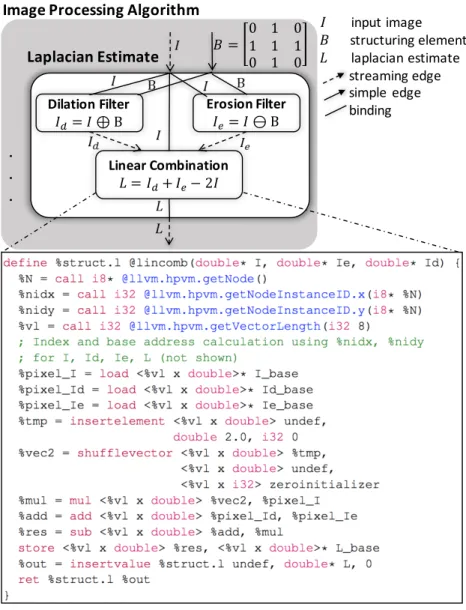
Nodes may access globally shared memory through load and store instructions (“side-effects”), since hardware shared memory is increasingly common across heterogeneous sys-tems. These operations may result in implicit data transfers, depending on the mapping of nodes to hardware compute units and on the underlying memory system. Because of these side effects, HPVM is not a “pure dataflow” model. Figure 3.1 shows the HPVM version of a Laplacian estimate computation of a greyscale image, used as part of image processing filters. This will be used as a running example. The figure shows the components of the Laplacian as separate dataflow nodes – Dilation Filter (DF), Erosion Filter (EF) and Linear
Combination (LC)– connected by edges. The figure also shows the code for nodeLC, which
is standard LLVM IR except for the new intrinsic functions named Load/store instructions access shared memory, using pointers that must be received explicitly from preceding nodes. Dynamic Instances of Nodes and Edges: The dataflow graphs in HPVM can describe varying (data-dependent) degrees of parallelism at each node. In particular, a single static dataflow node or edge represents multiple dynamic instances of the node or edge, each executing the same code with different index values. The dynamic instances of a node are required to be independent of each other, so that each time a (static) node is executed on receiving a new set of data items, all dynamic instances of the node may execute in parallel, similar to invoking a parallel loop. The dynamic instances form an n-dimensional grid, with integer indexes in functions. Our implementation allows up to three dimensions. For example, the LC node in the example is replicated to have dimX ×dimY instances,
wheredimX and dimY are computed at runtime. Similarly, a static edge between two static
nodes may represent multiple dynamic edges between dynamic instances of the two nodes, as explained further in Section 3.1.1.
Dataflow Node Hierarchy: Each dataflow node in a DFG can either be aleaf node or an
internal node. An internal node contains a complete dataflow graph, called a child graph, and the child graph itself can have internal nodes and leaf nodes. In Figure 3.1, the node
Laplacian Estimate is an internal node, and its child graph comprises the leaf nodes DF,
EF, and LC.
A leaf node contains scalar and/or vector code, expressing actual computations. Dynamic instances of a leaf node capture independent computations, and a single instance of a leaf node can contain fine-grain vector parallelism. Leaf nodes may contain instructions to query the structure of the underlying dataflow graph, as described in Section 3.2.
Internal nodes describe the structure of the child graph. The internal nodes are traversed by the translators to construct a static graph and generate code for the leaf nodes and edges (Section 3.3). One restriction of this model is that the dataflow graph cannot be modified
at runtime, e.g., by data-dependent code, dynamically spawning new nodes; this enables fully-static optimization and code generation at the cost of some expressivity.
The grouping and hierarchy of parallelism has several advantages. It helps express sev-eral different kinds of parallelism in a compact and intuitive manner: coarse-grain task (i.e., pipelined) parallelism via top-level nodes connected using dataflow edges; independent coarse- or fine-grained data parallelism via dynamic instances of a single static node; and fine-grained data parallelism via vector instructions within single instances of leaf nodes. It provides a flexible and powerful mechanism to express tiling of computations for mem-ory hierarchy in a portable manner (Section 3.5.3). It enables efficient scheduling of the execution of the dataflow graph by grouping together appropriate sets of dataflow nodes. For example, a runtime scheduler could choose to map a single top-level (internal) node to a GPU or to one core of a multicore CPU, instead of having to manage potentially large numbers of finer-grain nodes. Finally, it supports a high-degree of modularity by allowing separate compilation of parallel components, represented as individual dataflow graphs that can be composed into larger programs.
Hardware feature Typical HPVM representation
Heterogeneous multiprocessor system
Major hardware compute units, e.g., CPU cores, GPUs
Top-level nodes in the DFG and edges between them
GPUs
GPU Threads DFG leaf nodes
GPU Thread Blocks Parent nodes of DFG leaf nodes
Grid of Thread Blocks (SMs) Either same as GPU Thread Blocks or parent node of DFGs rep-resenting thread blocks
GPU registers, private memory Virtual registers in LLVM code for leaf nodes
GPU Scratch-pad Memory Memory allocated in DFG internal nodes representing thread blocks
GPU Global Memory and GPU Con-stant Memory
Other memory accessed via loads and stores in DFG leaf nodes
Short-vector SIMD instructions
Vector instructions with independent operations
Dynamic instances of first-level internal nodes, and/or Vector code in leaf nodes
Vector instructions with cross-lane de-pendences
Vector code in leaf nodes
Vector registers Virtual registers in LLVM code for leaf nodes
Homogeneous host multiprocessor
CPU threads in a shared-memory mul-tiprocessor
One or more nodes in one or more DFGs
Shared memory Memory accessed via loads and stores in DFG leaf nodes. HPVM intrinsics for synchronization.
Dataflow Edges and Bindings: Explicit data movement between nodes is expressed with dataflow edges. A dataflow edge has the semantics of copying specified data from the source to the sink dataflow node, after the source node has completed execution. Depending on where the source and sink nodes are mapped, the dataflow edge may be translated down to an explicit copy between compute units, or communication through shared memory, or simply a local pointer-passing operation.
As with dataflow nodes, static dataflow edges also represent multiple dynamic instances of dataflow edges between the dynamic instances of the source and the sink dataflow nodes. An edge can be instantiated at runtime using one of two simple replication mechanisms: “all-to-all”, where all dynamic instances of the source node are connected with all dynamic instances of the sink node, thus expressing a synchronization barrier between the two groups of nodes, or “one-to-one” where each dynamic instance of the source dataflow node is connected with a single corresponding instance of the sink node. One-to-one replication requires that the grid structure (number of dimensions and the extents in each dimension) of the source and sink nodes be identical.
Figure 3.1 shows the dataflow edges describing the data movement of input imageI, dilated image Id, eroded image Ie, and matrix B between dataflow nodes. Some edges (e.g., input B to node Laplacian Estimate) are “fixed” edges: their semantics is as if they repeatedly transfer the same data for each node execution. In practice, they are treated as a constant across node executions, which avoids unnecessary data transfers (after the first execution on a device).
In an internal node, the incoming edges may provide the inputs to one or more nodes of the child graph, and conversely with the outgoing edges, such as the inputs I and B and outputLof nodeLaplacian Estimate. Semantically, these representbindings of input and output values and not data movement. We show these as undirected edges.
3.1.2 Vector Instructions
The leaf nodes of a dataflow graph can contain explicit vector instructions, in addition to scalar code. We allow parametric vector lengths to enable better performance portability, i.e., more efficient execution of the same HPVM code on various vector hardware. The vector length for a relevant vector type need not be a fixed constant in the HPVM code, but it must be a translation-time constant for a given vector hardware target. This means that the parametric vector types simply get lowered to regular, fixed-size vector types during native code generation. Figure 3.1 shows an example of parametric vector length (%vl) computation and use.
Evaluating the effect of parametric vector lengths on performance is out of the scope of this work because we only support one vector target (Intel AVX) for now. Moreover, in all the benchmarks we evaluate, we find that vectorizing across dynamic instances of a leaf node is more effective than using explicit vector code, as explained in Sections 3.3.2 and 3.6.2. More complex vector benchmarks, however, may benefit from the explicit vector instructions.
3.1.3 Integration with Host Code
Each HPVM dataflow graph is “launched” by a host program, which can uselaunch and
wait operations to initiate execution and block for completion of a dataflow graph. The graph execution is asynchronous, allowing the host program to run concurrently and also allowing multiple independent dataflow graphs to be launched concurrently. The host code initiates graph execution by passing initial data during the launch operation. It can then sustain a streaming graph computation by sending data to input graph nodes and receiving data from output nodes. The details are straightforward and are omitted here.
3.1.4 Discussion
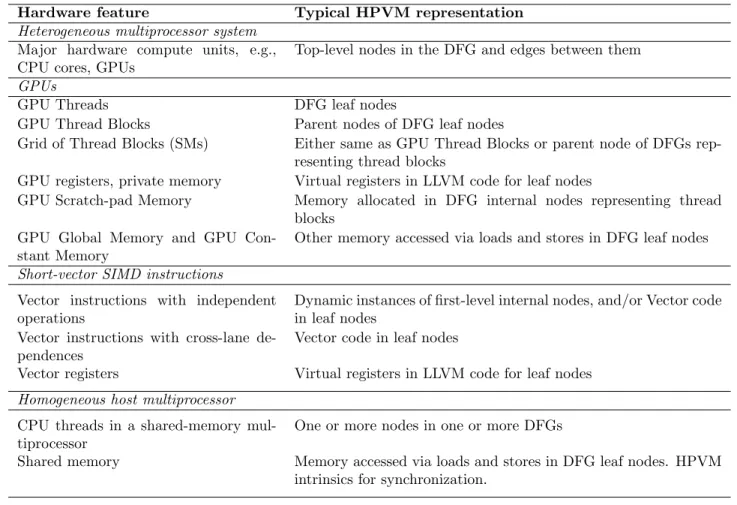
An important consideration in the design of HPVM is to enable efficient mapping of code to key features of various target hardware. We focus on three kinds of parallel hardware in this work: GPUs, vectors, and multithreaded CPUs. Table 3.1 describes which HPVM code constructs are mapped to the key features of these three hardware families. This mapping is the role of the translators described in Section 3.3. The table is a fairly comprehensive list of the major hardware features used by parallel computations, showing that HPVM is effective at capturing different kinds of hardware.
3.2 HPVM VIRTUAL ISA AND COMPILER IR
We have developed a prototype system, also called HPVM, including a Compiler IR, a Virtual ISA, an optimizing compiler, and a runtime scheduler, all based on the HPVM representation The compiler IR is an extension of the LLVM IR, defined via LLVM intrinsic functions, and supports both code generation (Section 3.3) and optimization (Section 3.5) for heterogeneous parallel systems. The virtual ISA is essentially just an external, fully executable, assembly language representation of the compiler IR.
We define new instructions for describing and querying the structure of the dataflow graph, for memory management and synchronization, as well as for initiating and terminating