Active vibration control of a horizontal
flexible plate structure using intelligent
proportional–integral–derivative
controller tuned by fuzzy logic and
artificial bee colony algorithm
M Sukri Hadi
1, Intan Z Mat Darus
2, M Osman Tokhi
3and
Mohd Fairus Jamid
2Abstract
This paper presents the development of an intelligent controller for vibration suppression of a horizontal flexible plate structure using hybrid Fuzzy–proportional–integral–derivative controller tuned by Ziegler–Nichols tuning rules and intelligent proportional–integral–derivative controller tuned by artificial bee colony algorithm. Active vibration control technique was implemented during the development of the controllers. The vibration data obtained through experi-mental rig was used to model the system using system identification technique based on auto-regressive with exogenous input model. Next, the developed model was used in the development of an active vibration control for vibration suppression of the horizontal flexible plate system using proportional–integral–derivative controller. Two types of controllers were proposed in this paper which are the hybrid Fuzzy–proportional–integral–derivative controller and intelligent proportional–integral–derivative controller tuned by artificial bee colony algorithm. The performances of the developed controllers were assessed and validated. Proportional–integral–derivative–artificial bee colony controller achieved the highest attenuation for first mode of vibration with 47.54 dB attenuation as compared to Fuzzy–propor-tional–integral–derivative controller with 32.04 dB attenuation. The experimental work was then conducted for the best controller to confirm the result achieved in the simulation work.
Keywords
Active vibration control, flexible plate, Fuzzy–PID, PID–ABC, particle swarm optimization, system identification
Introduction
In the past decades, rigid structure has been used in many engineering applications to avoid unwanted vibration. However, the heavy and strong metal characteristics possessed by rigid structures limit their operation speeds and further needed more energy and power to operate.1Flexible structure offers many advantages over rigid structure that include lighter weight, low energy consumption, faster system response, and safer operation due to reduce inertia.2–4Plates with different shapes and boundary are frequently found in several engineering applications, for example, in solar panel, naval structures, bridge decks, and electronic circuit board design.5Therefore, the usage of flexible structure has received substantial attention recently.
1
Faculty of Mechanical Engineering, Universiti Teknologi MARA, Shah Alam, Selangor, Malaysia
2
School of Mechanical Engineering, Universiti Teknologi Malaysia, Skudai, Johor, Malaysia
3
School of Engineering, London South Bank, London, UK
Corresponding author:
M Sukri Hadi, Faculty of Mechanical Engineering, Universiti Teknologi MARA, Shah Alam, Selangor, Malaysia. Email: [email protected]
Journal of Low Frequency Noise, Vibration and Active Control 0(0) 1–13
!The Author(s) 2019 DOI: 10.1177/1461348419852454 journals.sagepub.com/home/lfn
Creative Commons CC BY: This article is distributed under the terms of the Creative Commons Attribution 4.0 License (http://www. creativecommons.org/licenses/by/4.0/) which permits any use, reproduction and distribution of the work without further permission provided the original work is attributed as specified on the SAGE and Open Access pages (https://us.sagepub.com/en-us/nam/open-access-at-sage).
Although the advantages are highly desirable, the system vibration arising from the structural flexibility needs major consideration. The flexible plate is easily affected by external force which will lead to the vibration on the system. A large number of discrete frequencies that exist in the system will generate high amplitude of vibrations leading to noise, fatigue, wear, failure, and decrease the performance of the flexible plate system. Thus, controlling the unwanted vibration on the plate structure is compulsory to main-tain the effectiveness of the system.5 Many methods have been proposed to reduce the undesired vibration; however, controlling a flexible plate structure is more complicated due to the highly non-linear dynamic of the system.6
Previous researchers introduced passive vibration control techniques to remove the undesired vibration; how-ever, due to its limitation such as increasing the weight of overall structure and lack of versatility, it therefore cannot withstand low frequency vibration of the flexible plate system. Hence, active vibration control (AVC) is anticipated in this research study to overcome the problem related to the low frequency vibration of the flexible plate system.7Lueg8was the pioneer who introduced the fundamental of AVC technique for noise cancellation in the early 1930s. His work was based on the superposition theory where sound signal might be cancelled out by introducing a secondary sound signal with 180 out of the phase.9–13
Proportional–integral–derivative (PID) controller has been widely used in order to control a dynamic system in many applications. In fact, more than 90% of industrial controllers used PID controllers due to its simplicity and robustness.14–16 However, finding an optimal gains for the PID controller is very crucial and challenging for achieving the best performance in control system. Thus, this paper serves to present an alternative way to cope with the vibration control problem of such complex system. The controllers proposed in this research are hybrid Fuzzy–PID and intelligent PID controllers optimized by artificial bee colony algorithm (PID–ABC).
Several works on the development of the proposed controllers have been done by other researchers in various engineering applications previously. Mesyam17 proposed an effective hybrid harmony search and cuckoo opti-mization algorithm-based fuzzy PID controller for load frequency control. Akash et al.18designed a fuzzy PID controller under varying load condition for speed response of brushless DC motor. Rajesh et al.19 proposed a novel hybrid firefly and pattern search algorithms to tune the parameter and structure of fuzzy PID controller for automatic generation control of power systems. Savran and Kahraman20developed a fuzzy model-based adaptive PID controller in order to control nonlinear processes.
Recently, evolutionary algorithms become a trend to be used by researchers to tune the parameter gains of PID controller in various applications. Various attempts have been made to find the optimal gains for PID controller by using ABC algorithm. Naidu et al.21 investigated the performance of PID controller tuning using multi objective ABC algorithm for load frequency control. Elkhateed and Badr22 presented an improved ABC algo-rithm to tune the PID controller. Dongshan et al.23have developed a PID controller tuned by ABC algorithm for DC motor.
Inspired by the success of research conducted previously, hybrid Fuzzy–PID controller and intelligent PID controller optimized by ABC algorithm are proposed in this paper. The performance of both controllers is compared in terms of attenuation level of the first mode of vibration which is the dominant mode in the system. The input–output vibration data was collected experimentally. The development of the proposed con-troller and its performances for vibration suppression are explained in detail in the next section.
Active vibration control
In this section, the development of intelligent control schemes of the horizontal flexible plate structure is introduced. AVC technique was developed and applied with the objective of suppressing the vibration of the plate system. The concept of AVC is to reduce the amplitude of the vibration by using superposition of waves where a secondary signal of vibration is generated to destructively interfere with the unwanted vibration at the desired location.6 In this research, the AVC is implemented where sensors were utilized to detect the unwanted disturbances. This signal is used later to produce secondary vibration signal that will act as controller to suppress the disturbance. An actuator was utilized to supply this secondary signal to superim-pose the disturbance and interference exhibited by the primary signal and thus led to vibration cancellation.24 The dynamic model of the system was developed using system identification technique utilizing particle swarm optimization (PSO) algorithm based on input–output vibration data obtained experimentally. The model obtained using PSO algorithm in previous research is used in this work to develop the controller. Details regarding PSO algorithm and modeling results can be found in this paper.25 The transfer function obtained using PSO is described in equation (1)
0:3483z10:002182z2
11:414z1þ0:9931z2 (1)
Due to its robustness and reliability, PID controller is employed in this research paper. These types of con-troller are widely used in industries because they are cheap, easy to understand, maintain, and implement in controlling various engineering applications. However, it is hard to find the optimal gains to be applied for optimum performance. Many strategies have been proposed by researchers to obtain the best tuning method because improper tuning method may lead to poor robustness, cyclic, and slow recovery of the system.26 Therefore, this paper presents the development of PID controller tuned by an intelligent algorithm via ABC for vibration suppression of the horizontal flexible plate system. The performance of proposed controller will be compared to the hybrid controller known as Fuzzy–PID controller.
The purpose of this study is to achieve the best tuning methods and better control strategy for further improve-ment of the control performance. Then, the proposed controller will be validated by employing the different disturbances in the system. A MATLAB/Simulink was utilized to assess and verify the proposed controller schemes in this paper. The corresponding controller parameters are fed to the closed-loop PID controller in MATLAB/Simulink. The error for each sample was calculated, and the mean squared error (MSE) was evaluated. MSE was set as the fitness value in this algorithm. This function is used to adjust the PID parameters in order to achieve the lower fitness value.
Fuzzy–PID-based controller
This section presents the detailed structure of Fuzzy–PID-based controller. This hybrid controller is used in order to achieve the best attenuation in the system. Conventionally, the parameters of PID controller are obtained by trial and error method. The process is time consuming and the PID parameters need to be retuned every time there are changes in the system’s parameters. Thus, in this paper, the PID parameters were optimized by incorporating fuzzy selection to the system. Based on the initial PID parameter values obtained through Ziegler–Nichols tuning rules, the fuzzy structure will further be tuned by the PID controller for the best value ofKp,KiandKdwithin a
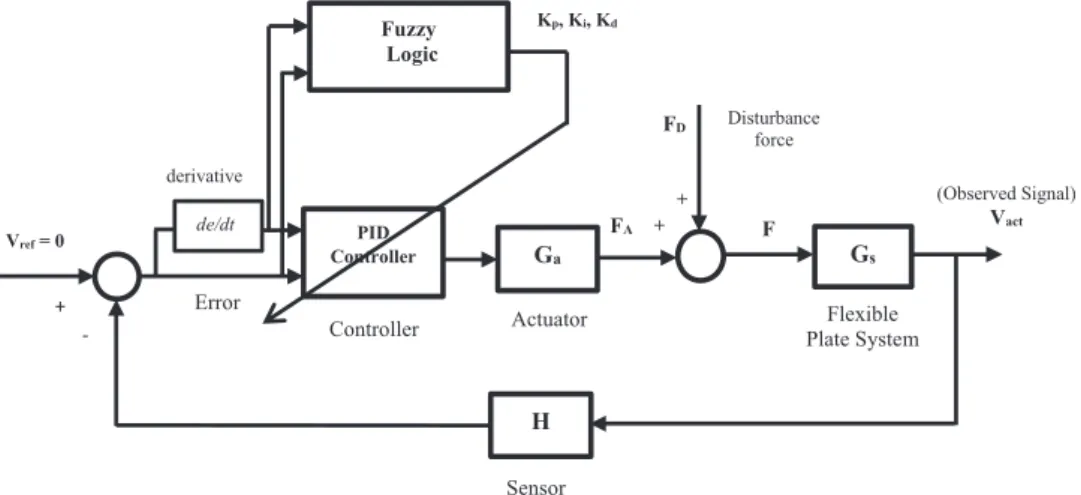
specified certain range. Two types of disturbance were introduced in the controller system known as multiple sinusoidal and multiple real disturbances to test the robustness of the developed controller. Figure 1 shows the block diagram of Fuzzy–PID-based controller. Fuzzy-based controller action basically depends on the error,e, and the derivative error,de/dtof the system. The error and derivative of error are fed to the fuzzy structure to optimize the PID controller to achieve the best attenuation in the system.
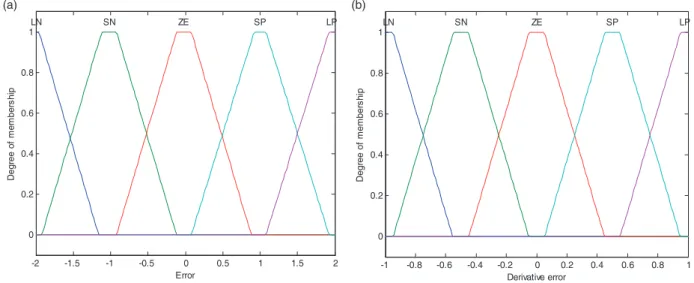
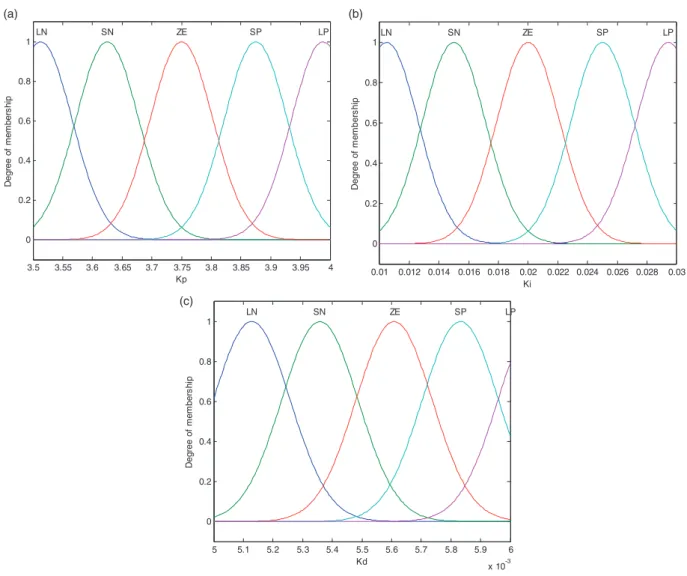
In this study, two input membership functions known as error,e, and derivative error,de/dt, and three output membership functions known as proportional,Kpintegral,Kiand derivative,Kdare defined. Trapezoidal shapes
were chosen for both input (e and de/dt) membership functions while Gaussian shapes were chosen to be employed in the three output membership functions (Kp, Ki and Kd). Trial and error method was used in this
study to select the best shapes for both input and output membership functions. Five regions for input and output
variables used in this study are defined as Negative Large (NL), Negative Small (NS), Zero (ZE), Positive Small (PS), and Positive Large (PL) are used as linguistic variables.
The input interval for error and derivative error is [–2 2] and [–1 1], respectively. Meanwhile, the output interval forKp,KiandKdare [3.5 4], [0.01 0.03], and [0.005 0.006], respectively.The input interval was determined based
on trial and error method while the interval for PID parameter in fuzzy scheme was determined based on Ziegler– Nichols tuning rules. The input membership functions for error and derivative error as shown in Figure 2. The output membership functions for proportional,Kpintegral,Kiand derivative,Kdas shown in Figure 3. The rule
base of Fuzzy–PID-based controller was used in this study as shown in Table 1.
PID controller optimized by ABC
ABC algorithm was introduced by Karaboga27to solve the numerical optimization problem based on foraging behavior of bee colony. Basically, a colony of bee is divided into three groups which are employed bees, onlookers, and scouts. Employed bees search food source within a neighborhood of food source and keep the information in the memory. Then, they will share the information with onlookers within the nest. Onlookers will select one of the best food sources. Every employed bee will represent one food source. The employed bee will continue to look out in exploiting the food source, and they will become a scout if the food source is abandoned. A scout will start to explore for a new food source randomly to be exploited by the employed bees.28,29
The preference of a food sources chosen by the onlookers depends on the amount of nectarNðhÞof that food sources. The probability of preferred source by onlookers increases proportionally with nectar amount of food source. Hence, the probability of food source located athiwhich will be selected by onlookers can be written as
equation (2)28,29 Pi¼ NðhiÞ Xs k¼1NðhkÞ (2)
where Pi is the probability of food source located, NðhÞis the amount of nectar in the food sources, hi is the
position ofith food sources, andSis the number of food source in around the nest. An onlooker bee will go to the food source located athiafter they get the dance information from the employed bees using this probability and
determine the nectar amount of food sources. The position of food sources selected by onlookers will follow equation (3)28,29
hiðcþ1Þ ¼hiðcÞ /iðcÞ (3)
(a) (b)
where/iðcÞ is randomly step in finding the more nectar location around the food source. Onlookers will share the information with others in the hive if the nectar amountFðhiðcþ1ÞÞat locationhiðcþ1Þis higher than the food source
at location/iðcÞ. Then, the location for food source will be changed to behiðcþ1Þ. Otherwise, the previous location of
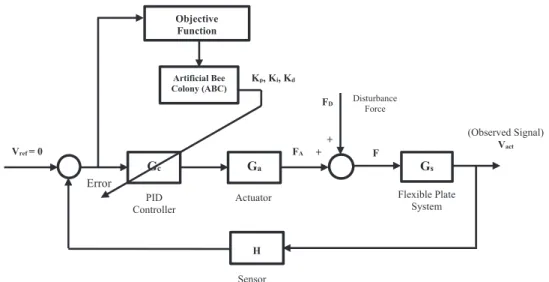
food source athi is kept as it is. Figure 4 shows the block diagram of PID controller tuned by ABC algorithm.
Simulation results and analysis
In this section, the simulation results obtained by hybrid Fuzzy–PID and intelligent PID–ABC controllers are presented. The performances of both controllers are compared and assessed in terms of highest attenuation level
Table 1. Rule base of Fuzzy-PID-based controller tuned by Ziegler–Nichols.
Fuzzy rules Error NL NS ZE PS PL Derivative error NL NL NL NS NS ZE NS NL NL NS ZE PS ZE NS NS ZE PS PS PS NS ZE PS PS PL PL ZE PS PS PL PL 3.5 3.55 3.6 3.65 3.7 3.75 3.8 3.85 3.9 3.95 4 0 0.2 0.4 0.6 0.8 1 Kp D egree of m e m bers h ip LN SN ZE SP LP 0.01 0.012 0.014 0.016 0.018 0.02 0.022 0.024 0.026 0.028 0.03 0 0.2 0.4 0.6 0.8 1 Ki De g re e of m e m b er s h ip LN SN ZE SP LP 5 5.1 5.2 5.3 5.4 5.5 5.6 5.7 5.8 5.9 6 x 10⁻³ 0 0.2 0.4 0.6 0.8 1 Kd D e gree of m e m b ers h ip LN SN ZE SP LP (a) (b) (c)
achieved in the first mode of vibration. Two different types of disturbances were introduced into the system for the assessment of the developed controller. The disturbances used in this study are multiple sinusoidal and multiple real disturbance.
For hybrid Fuzzy–PID controller, the parameters used to tune the controller are as discussed in “Fuzzy–PID-based controller” section. The values ofKp,KiandKdwere obtained through the calculation based on Ziegler–
Nichols formulation. For the intelligent PID–ABC controller, the tuning method was initialized by setting the number of iterations (NI) to 100 and number of bee colony size (NP) to 500, then varying the limit range of search boundary (LB) from 1 to 11. Then, the highest attenuation was observed with L¼10 obtained the best highest attenuation in the system. The procedure was repeated by fixing value of L¼10 and NI¼100 but the values of NP were varied from 50 until 500. The highest attenuation was observed with NP¼100. Last, the values of NP and L were fixed with 100 and 10, respectively, but the NI was varied from 50 until 500. The best attenuation was observed with NI¼100. So, the best parameters of PID–ABC controller were achieved by using NP¼100, L¼10, and NI¼100. Table 2 shows the PID parameters obtained using PID–ABC controller with multiple sinusoidal disturbance. By referring to Table 2, PID–ABC controller achieved lower MSE of 0.0220 as compared to Fuzzy– PID controller with MSE of 0.0961 for vibration suppression in the horizontal flexible plate system.
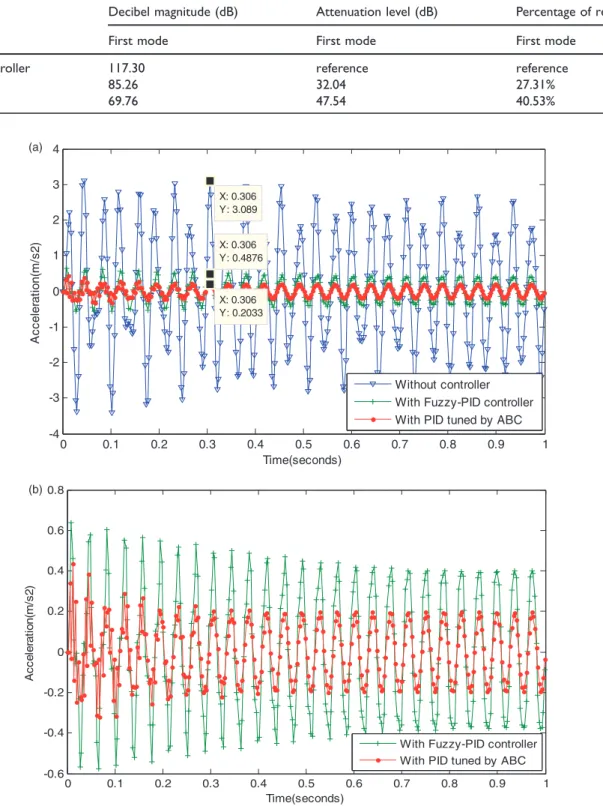
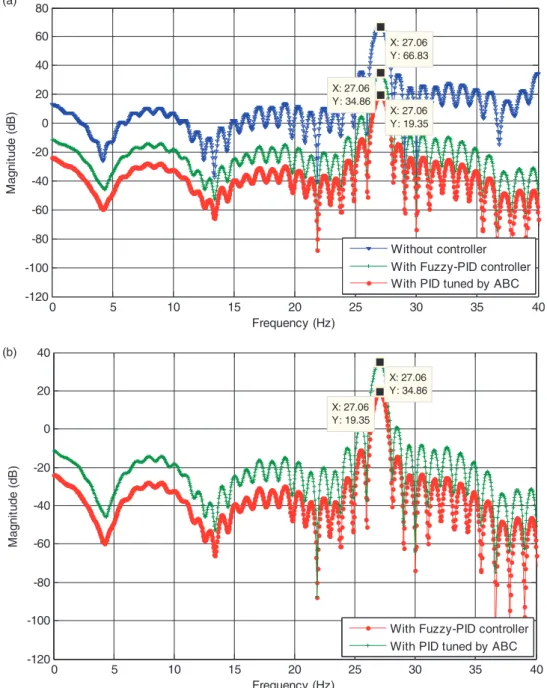
The attenuation level and percentage reduction in vibration suppression were achieved for both controllers as described in Table 3. From Table 3, it shows that the PID controller tuned by ABC algorithm achieved the higher attenuation level at the first mode of vibration which is the dominant mode in the horizontal plate system. This can be further illustrated in Figures 5 and 6 for vibration suppression through the proposed controllers using multiple sinusoidal disturbance in time and frequency domains, respectively. The PID–ABC controller provided better vibration suppression in the horizontal plate system by achieving 47.54 dB attenuation at the first mode of vibration in the system with 40.53% percentage of reduction, while the Fuzzy–PID controller achieved 32.04 dB attenuation with 27.31% of reduction. From the results, it is shown that the PID controller optimised by evo-lutionary algorithm using ABC as proposed in this paper has successfully suppressed higher unwanted vibration in the horizontal flexible plate system by achieving higher percentage reduction of vibration as compared to Fuzzy–PID controller.
Figure 4. The block diagram of PID-based controller tuned by ABC algorithm.
Table 2. PID–ABC controller parameters with multiple sinusoidal disturbance.
Controller Parameters gains MSE Kp Ki Kd Without controller – – – 2.6619 Fuzzy–PID [3.5 4] [0.01 0.03] [0.005 0.006] 0.0961 PID–ABC 8.8632 0.2857 0.0046 0.0220
The robustness of the developed controller was later tested by employing difference disturbance in the system known as multiple real disturbance. Table 4 shows the MSE achieved for both the controllers using multiple real disturbance. Here, it can be seen that PID–ABC controller obtained lower MSE in the system with 0.0018 as compared with Fuzzy–PID controller which MSE value of 0.0047. The attenuation level and percentage reduction
(a)
(b)
Figure 5. Fuzzy-PID and PID tuned by ABC controllers for vibration suppression in time domain using multiple sinusoidal distur-bance: (a) Comparison of the controller’s performance before and after vibration control (b) enlarge view for the controller performances in time domain.
Table 3. The attenuation level achieved for both controllers with multiple sinusoidal disturbance.
Controller
Decibel magnitude (dB) Attenuation level (dB) Percentage of reduction
First mode First mode First mode
Without controller 117.30 reference reference
Fuzzy–PID 85.26 32.04 27.31%
in vibration suppression are observed for both controllers as shown in Table 5. From Table 5, it is found that the PID controller tuned by ABC algorithm achieves higher attenuation level at the first mode of vibration which is the dominant mode in the horizontal plate system. This can be further illustrated in Figures 7 and 8 for vibration suppression through the proposed controllers using multiple real disturbance in time and frequency domains, respectively.
(a)
(b)
Figure 6. Fuzzy-PID and PID tuned by ABC controllers for vibration suppression in frequency domain using multiple sinusoidal disturbance: (a)Comparison of the controller’s performance before and after vibration control (b) enlarge view for the controller performances in frequency domain.
Table 4. The PID–ABC controller parameter with multiple real disturbance.
Controller Parameters gains MSE Kp Ki Kd Without controller – – – 0.0308 Fuzzy–PID [3.5 4] [0.01 0.03] [0.005 0.006] 0.0047 PID–ABC 8.8632 0.2857 0.0046 0.0018
The PID–ABC controller provides to better vibration suppression in the horizontal plate system by achieving 47.48 dB attenuation at the first mode of vibration in the system with 71.05% of reduction, while the Fuzzy–PID controller achieved 31.97 dB attenuation with 47.84% of reduction. Based on result presented, it is clearly observed that the proposed controllers achieving high robustness performances when it is successfully reduced
(a)
(b)
Figure 7. Fuzzy-PID and PID tuned by ABC controllers for vibration suppression in time domain using multiple real disturbance: (a) Comparison of the controller’s performance before and after vibration control (b) enlarge view for the controller performances in time domain.
Table 5. The attenuation level achieved for both controllers with multiple real disturbance.
Controller
Decibel magnitude (dB) Attenuation level (dB) Percentage of reduction
First mode First mode First mode
Without controller 66.83 Reference Reference
Fuzzy–PID 34.86 31.97 47.84%
the unwanted vibration while the system was exerted by different types of disturbances. In addition, it is found that the gain values obtained in this study are possible to be implemented in a real system, since the gain values are not too large. This statement is supported by Spearrit and Asokanthon,30where the large values of gain obtained by the controller cannot be implemented into the real system because it can shorten the lifetime of the actuator itself. Furthermore, it will ruin the actuator linearity at a certain point of the operating condition and indirectly bring instability to the system.31
It is shown that the proposed controller is robust and can work properly for vibration suppression in a horizontal plate system. Both of the proposed methods are shown to successfully reduce the unwanted vibration; however, PID–ABC has shown to be more effective in suppressing the unwanted vibration.
In addition, the best controller achieved in the simulation work known as PID–ABC controller was tested on the experimental rig, whereby the experimental environment is applied as a platform of validation due to verify
(a)
(b)
Figure 8. Fuzzy-PID and PID tuned by ABC controllers for vibration suppression in frequency domain using multiple real distur-bance: (a) Comparison of the controller’s performance before and after vibration control (b) enlarge view for the controller performances in frequency domain.
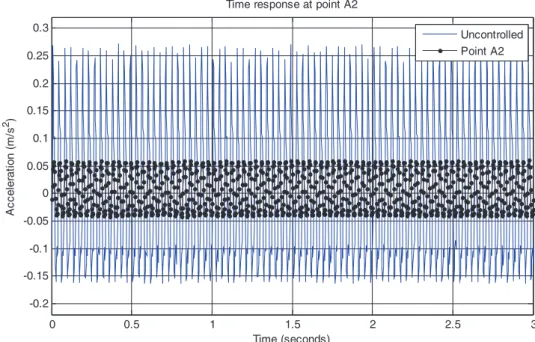
the robustness of developed controllers. The horizontal flexible plate experimental rig was developed with attached sensors and actuators on the rig for such a purpose of controller validation. Consequently, the main contribution of this research is to serve the intelligent controller and employed with the self-developed actuator namely magnetic shaker for vibration suppression of the horizontal flexible plate through experimental work. Figures 9 and 10 present the experimental performance of PID–ABC controller in time and frequency responses, respectively. The experimental performance of PID–ABC controller is summarized in Table 6.
From Table 6, it can be seen that PID–ABC has shown attenuation level at the first mode of vibration with 23.83 dB. The attenuation value has been reduced from 110.2 to 86.37 dB, equivalent to 21.62% attenuation, after
Figure 9. Experimental performances of PID-based controller tuned by ABC algorithm in time response.
the introduction of vibration control. The MSE achieved by PID–ABC is 0.0012, compared to 0.0168 before the activation of controller. From those results, conclusion can be made that PID–ABC controller succeeded in making remarkable vibration suppression for horizontal flexible plate system. Hence, this result confirmed the simulation part that shows that PID–ABC is the superior controller in suppressing the unwanted vibration as compared to other controllers.
Conclusion
The development of parametric modeling using PSO algorithm and AVC of horizontal flexible plate system using Fuzzy–PID controller and PID controller optimized by ABC algorithm has been presented. The model was developed using parametric identification technique based on auto-regressive with exogenous input structure. The vibration modes of the flexible plate structure have been successfully detected which leads to a good controller design. The performance of the developed controllers has been considered for the horizontal flexible plate system. Based on the simulation results using multiple sinusoidal disturbance, the PID–ABC controller showed 40.53% improvement of performance compared to Fuzzy–PID controller for the vibration suppression. Based on these results, it can be concluded that the PID–ABC controller has performed better than Fuzzy–PID controller for horizontal flexible plate system used in this research.
Acknowledgements
The authors would like to express their gratitude to Universiti Teknologi MARA (UiTM) and Universiti Teknologi Malaysia (UTM) for funding the research and providing facilities to conduct this research.
Declaration of conflicting interests
The author(s) declared no potential conflicts of interest with respect to the research, authorship, and/or publication of this article.
Funding
The author(s) received financial support from Universiti Teknologi MARA (UiTM) and Universiti Teknologi Malaysia (UTM) for the research, authorship, and/or publication of this article.
ORCID iD
M Sukri Hadi https://orcid.org/0000-0002-4180-0296 Intan Z Mat Darus https://orcid.org/0000-0002-5864-5018
References
1. Mohamed Z, Martins JM, Tokhi MO, et al. Vibration control of a very flexible manipulator system.Contr Eng Pract2003; 13: 267–277.
2. Mohamed Z, Tokhi MO and Azad AKM.Finite difference and finite element simulation of a flexible manipulator. Research Report no. 617, Department of Automatic Control and System Engineering, University of Sheffield, UK, 1996. 3. Choi SB, Cho SS, Shin HC, et al. Quantitative feedback theory control of a single-link flexible manipulator featuring
piezoelectric actuator and sensor.Smart Mater Struct1999; 8: 338–349.
4. Tokhi MO, Mohamed Z and Shaheed MH. Dynamic characterization of a flexible manipulator system.Robotica2001; 19: 571–580.
5. Chakraverty S.Vibration of plates. 1st ed. Boca Raton, Florida: Taylor & Francis Group, LLC, 2009.
6. Rahman TAZ, Asarry A and Jalil NAA.Active vibration control of a flexible beam structure using Chaotic Fractal Search algorithm.Proc Eng2017; 170: 299–306.
Table 6. The attenuation level achieved for PID–ABC controller through experimental work.
Controller
Decibel Magnitude (dB) Attenuation Level (dB) Percentage of Reduction
MSE
First mode First mode First mode
Without Controller 110.20 Reference Reference 0.0168
7. Cihang X, Ying W and Zishun L. Modeling and active vibration control of lattice grid beam with piezoelectric fiber composite using fractional order PDmalgorithm.Compos Struct2018; 198: 126–134.
8. Lueg P. Process of silencing sound oscillations. Patent 2,043,416, USA, 1936.
9. Peng W, Anton K, Xavier B, et al. Active vibration control in specific zones of smart structures.J Contr Eng Pract2019; 84: 305–322.
10. Hashim SZM, Tokhi MO and Mat Darus IZ. Active vibration control of flexible structures using genetic optimization.J Low Freq Noise Vib Active Contr2006; 25: 195–207.
11. Jinqiang L, Yu X, Fengming L, et al. Active vibration control of functionally graded piezoelectric material plate.Compos Struct2019; 207: 509–518.
12. Zhi CQ, Cheng L and Xian MZ. Experimental study on active vibration control for a kind of two-link flexible manip-ulator.J Mech Syst Signl Proc2018; 118: 623–644.
13. Baader J and Fontana M. Active vibration control of lightweight floor systems.J Proc Eng2017; 199: 2772–2777. 14. Pritesh S and Sudhir A. Review of fractional PID controller.Mechatronics2016; 38: 29–41.
15. Selamat NA, Wahab NA and Sahlan S. Particle swarm optimization for multivariable PID controller tuning. In:IEEE 9th international colloquium on signal processing and its applications, Kuala Lumpur, Malaysia, 8–10 March 2013.
16. Zhao ZL, Qiu ZC, Zhang XM, et al. Vibration control of a pneumatic driven piezoelectric flexible manipulator using self-organizing map based multiple models.J Mech Syst Signal Proc2016; 70: 345–372.
17. Mesyam G. An effective hybrid harmony search and cuckoo optimization algorithm based fuzzy PID controller for load frequency control.J Appl Soft Computat2018; 65: 121–138.
18. Akash V, Deeksha G and Bharti D. Speed response of brushless DC motor using fuzzy PID controller under varying load condition.J Electr Syst Inform Technol2017; 4: 310–321.
19. Rajesh KS, Dash SS and Ragam R. Hybrid improved firefly-pattern search optimized fuzzy aided PID controller for automatic generation control of power systems with multi-type generations.J Swarm Evol Computat2019; 44: 200–211. 20. Savran A and Kahraman G. A fuzzy model based adaptive PID controller design for nonlinear and uncertain processes.J
Autom ISA Trans2013; 53: 280–288.
21. Naidu K, Mokhlis H and Bakar A. Multiobjective optimization using weighted sum artificial bee colony algorithm for load frequency control.J Elect Power Energy Syst2014; 55: 657–667.
22. Elkhateeb NA and Badr RI. Employing artificial bee colony with dynamic inertia weight for optimal tuning of PID controller. In:Proceedings of international conference on modeling, identification and control (ICMIC), Cairo, Egypt, 31 August–2 September 2013, pp.42–46.
23. Dongshan G, Kunyi C, Yongchao Y, et al. A research of dc motor dual close-loop PID speed-tuning system on the basis of ABC algorithm. In: The 26th Chinese control and decision conference (CCDC), Changsha, China, 31 May–2 June 2014, pp.3450–2454.
24. Hadi MS, Mat Darus IZ, Pek RTE, et al. Swarm intelligence for modeling a flexible plate structure system with clamped-clamped-free-free boundary condition edges. In:IEEE symposium on industrial electronics and applications (ISIEA), Kota Kinabalu, Sabah, 28 September–1 October 2014, pp.119–124.
25. Hadi MS and Mat Darus IZ. Intelligence swarm model optimization of flexible plate structure system.Int Rev Auto Contr 2013; 6: 322–331.
26. Hadi MS. Evolutionary swarm algorithm or modelling and control of horizontal flexible plate structures. PhD Thesis, Universiti Teknologi Malaysia, Malaysia, 2017.
27. Karaboga D. An idea based on honey bee swarm for numerical optimization.Technical Report-TR06, Erciyes University, Engineering Faculty, Computer Engineering Department, 2005.
28. Karaboga D and Basturk B. On the performance of artificial bee colony (ABC) algorithm.Int J Appl Soft Computat Math 2008; 8: 687–697.
29. Changhao S and Duan H. ABC optimized controller for unmanned rotorcraft pendulum.Aircr Eng Aerosp Technol2013; 2: 104–114.
30. Spearritt SJ and Asokanthon SF. Torisonal vibration control of a flexible beam using laminated PVDF actuators.J Sound Vib1996; 193: 941–956.
31. Goldfard M and Sirithanapipat T. The effect of actuator saturation on the performance of PD-controlled servo systems. Mechatronics1999; 9: 497–511.