The PDF of the article you requested follows this cover page.
2008;90:142-148. doi:10.2106/JBJS.H.00442
J Bone Joint Surg Am.
John Antoniou, David J. Zukor, Fackson Mwale, William Minarik, Alain Petit and Olga L. Huk
Metal-on-Metal Prostheses
Comparison Between Twenty-eight and Thirty-six-Millimeter-Head
Metal Ion Levels in the Blood of Patients After Hip Resurfacing: A
This information is current as of October 19, 2008
Reprints and Permissions
Permissions] link.
and click on the [Reprints and
jbjs.org
article, or locate the article citation on
to use material from this order reprints or request permission
Click here to
Publisher Information
www.jbjs.org
20 Pickering Street, Needham, MA 02492-3157 The Journal of Bone and Joint Surgery
Metal Ion Levels in the Blood of Patients After
Hip Resurfacing: A Comparison Between
Twenty-eight and Thirty-six-Millimeter-Head
Metal-on-Metal Prostheses
By John Antoniou, MD, PhD, FRCSC, David J. Zukor, MD, FRCSC, Fackson Mwale, PhD, William Minarik, PhD, Alain Petit, PhD, and Olga L. Huk, MD, MSc, FRCSC
Background: Metal ion toxicity, metal hypersensitivity, and metal carcinogenicity are causes for concern for patients with metal-on-metal hip replacements. Thus, understanding the biological fate of metal ions, and consequently their long-term systemic effects, is of great interest to patients and surgeons alike.
Methods: Inductively coupled plasma mass spectrometry was used to measure the levels of cobalt, chromium, and molybdenum ions in the blood of control patients (preoperative control pre-resurfacing patients), patients with a metal-on-polyethylene total hip prosthesis, patients with a metal-on-metal total hip prosthesis with either a 28 or 36-mm femoral head, and patients with a hip resurfacing prosthesis. Since cobalt and chromium ions have the potential to induce oxidative stress through irreversible biochemical damage to macromolecules, the levels of ions were correlated to the concentration of three oxidative stress markers in the plasma of these patients.
Results: The median cobalt level was significantly lower (p < 0.001) in the 36-mm metal-on-metal total hip arthroplasty group (1.8 parts per billion [1.8mg/L]) compared with the 28-mm metal-on-metal total hip arthroplasty group (2.5 parts per billion [2.5mg/L]) and the hip resurfacing group (2.3 parts per billion [2.3mg/L]) at six months postoperatively. The median chromium level was also significantly lower (p < 0.01) in the 36-mm metal-on-metal total hip arthroplasty group (0.25 parts per billion [0.25mg/L]) compared with the 28-mm metal-on-metal total hip arthroplasty group (0.35 parts per billion [0.35mg/L]) and the hip resurfacing group (0.50 parts per billion [0.50mg/L]) at six months postoperatively. However, neither the median cobalt levels nor the median chromium levels were significantly different among the three metal-on-metal groups at one year. The median levels of molybdenum were not significantly different among the three groups at either six months or one year. In addition, there was no significant difference in the plasma concentration of oxidative stress markers in patients with metal-on-metal bearings compared with that in control patients.
Conclusions: The blood metal ion levels in the hip resurfacing group were similar to those in the 28 and 36-mm-head metal-on-metal total hip arthroplasty groups. This study suggests that the increased metal ion levels had no effect on oxidative stress markers in the blood of these patients.
Level of Evidence: Therapeutic Level III. See Instructions to Authors for a complete description of levels of evidence.
S
everal studies have demonstrated elevated levels of ions in the blood of patients with metal-on-metal bearings com-pared with patients with metal-on-polyethylene bearings1-7. For these reasons, metal ion toxicity8,9
, metal hypersensitivity10,11
, and metal carcinogenicity12
remain a cause for concern. Tribol-ogy theory13
and the results from hip simulator studies14,15
all
indicate that there is a reduction in wear as the bearing diameter increases, given that all other manufacturing parameters are equal. However, a previous report showed that the concen-tration of ions was higher in patients with a hip resurfacing prosthesis than in those with a 28-mm-head metal-on-metal total hip prosthesis16
. It should be recognized that there were
Disclosure:In support of their research for or preparation of this work, one or more of the authors received, in any one year, outside funding or grants in excess of $10,000 from the Orthopaedic Research Fund, SMBD-Jewish General Hospital, Montreal, Quebec, Canada. Neither they nor a member of their immediate families received payments or other benefits or a commitment or agreement to provide such benefits from a commercial entity. No commercial entity paid or directed, or agreed to pay or direct, any benefits to any research fund, foundation, division, center, clinical practice, or other charitable or nonprofit organization with which the authors, or a member of their immediate families, are affiliated or associated.
substantial differences in the radial clearances and other man-ufacturing parameters between the resurfacing prostheses and the total hip bearings that were studied. In addition, metal ions can be generated from surface corrosion as well as from wear particles. Therefore, the concentration of ions in the blood of patients with metal-on-metal hip implants is multifactorial.
In the present study, we compared the blood ion levels of patients who received a hip resurfacing prosthesis (ASR; DePuy Orthopaedics, Warsaw, Indiana) with the blood ion levels in patients who received a 28 or 36-mm-head metal-on-metal standard total hip prosthesis, a metal-on-polyethylene total hip prosthesis, or no prosthesis (control pre-resurfacing patients). The presence of metal ions in the blood of patients who re-ceived a metal-on-metal bearing also points to the importance of understanding the biological fate, and consequently the long-term effects, of these ions. Metal ions have the potential to induce the production of reactive oxygen species17
, making them prime suspects for disturbing the balance of oxidants and/or antioxidants in circulating cells. To assess this, the blood ion levels were correlated to the concentration of three oxidative stress markers (total antioxidants, peroxides, and nitrated proteins) in the plasma of these patients.
Materials and Methods
Patient Selection
F
rom January 2005 to March 2006, all patients with a di-agnosis of noninflammatory degenerative joint disease who were scheduled to undergo hip replacement surgery per-formed by one of three orthopaedic surgeons from the same institution (J.A., O.L.H., or D.J.Z.) were considered for entry into the study. Exclusion criteria, which were determined with a specific attempt to minimize alternate sources of increased metal ions in the blood, included bilateral hip involvement, infection, the presence of any metal hardware, and severe medical disability that limited the ability to walk.Of the 174 total patients in the study, eighteen patients (ten men and eight women with a mean age of seventy years [range, thirty-eight to eighty-five years]) underwent primary total hip arthroplasty with use of metal-on-polyethylene com-ponents (Prodigy; DePuy Orthopaedics); twenty-eight patients (eleven men and seventeen women with a mean age of sixty-one years [range, thirty-two to seventy-four years]) underwent pri-mary total hip arthroplasty with use of a 28-mm femoral head with a metal-on-metal articulation (Metasul; Zimmer, Warsaw, Indiana); fifty-eight patients (twenty-five men and thirty-three women with a mean age of fifty-eight years [range, thirty-seven to seventy years)] underwent primary total hip arthroplasty with use of a 36-mm femoral head with a metal-on-metal ar-ticulation (Ultamet; DePuy Orthopaedics); and seventy patients (fifty-four men and sixteen women with a mean age of fifty-five years [range, thirty-three to seventy-three years]) underwent hip resurfacing arthroplasty with a metal-on-metal prosthesis (ASR; DePuy Orthopaedics).
The study was approved by our institutional review board, and patients signed the approved consent forms for the use of their blood and clinical data. All total hip arthroplasties
and resurfacings were prospectively registered in a computer-ized database. Two validated outcome measures (the Harris hip score18
and the University of California at Los Angeles [UCLA] activity score19
) were obtained at each patient visit. All lab-oratory analyses were performed by personnel blinded to the protocol. Patients were assessed at the time of follow-up visits up to one year postoperatively. In addition, forty pre-resurfacing patients were assessed as a control group.
Specimen Collection and Analysis
Blood samples were collected into Sarstedt Monovette tubes for trace metal analysis with 21-gauge needles that were also specific for trace metal analysis (Sarstedt, Montreal, Quebec, Canada) and kept at280°C until analysis. Blood samples (1-mL aliquots) were diluted one-to-ten with a diluent consisting of 10 mM of ammonium hydroxide (trace metal grade; Laboratoire Mat, Beauport, Quebec, Canada), 0.1 mM ethylenediaminetetraacetic acid (trace metal grade EDTA; Laboratoire Mat), and 0.1% Triton X-100 (molecular biology grade; Laboratoire Mat) in deionized water (18 ohm) as previously described20
. After dilution, all sam-ples were kept at 4°C and analyzed within twenty-four hours. Concentrations below the detection limit were approximated as one-half of the detection limit to facilitate calculation of the medians.
Inductively Coupled Plasma Mass Spectrometry Analysis
Levels of cobalt, chromium, and molybdenum were determined with use of inductively coupled plasma mass spectrome-try (PerkinElmer SCIEX Elan 6100 DRC ICP-MS system; PerkinElmer Instruments, Norwalk, Connecticut) at the Geo-chemical Laboratories of McGill University. Samples were run with use of the system’s Dynamic Reaction Cell technology, which is very effective at analyzing first-row transition elements in complex matrices such as blood. The system allows for the ef-ficient use of a very simple dilution protocol as compared with the more time-consuming acid-oxidative digestion technique. Inductively coupled plasma mass spectrometry is therefore an excellent tool for routine determination of metal ion levels in the blood of patients with metal-on-metal hip implants. The biological reference standard SeroNorm Trace Elements Whole Blood, Level 2 (Sero AS, Billingstad, Norway) was analyzed as a quality-control sample. Typically, the detection limits were very low at approximately 0.01 to 0.03 parts per billion (0.01 to 0.03mg/L).
Oxidative Stress Markers
Blood samples (1-mL aliquots) were also collected in Sarstedt Li-Heparin LH/1.3 tubes and centrifuged at 500 times gravity for ten minutes. Supernatants were stored at280°C. Plasma was chosen for this part of the project instead of whole blood because the assays for oxidative stress are not recommended for blood and can lead to erroneous data when blood is used. When oxidative stress becomes prolonged, the amount of total antioxidant decreases. In the present study, the total antioxidant status was measured in plasma with use of a total antioxidant power kit (Oxford Biomedical Research, Oxford,
TH EJO U R N A L O FBO N E& JO I N T SU R G E R YdJ B J S.O R G VO L U M E9 0 - AdSU P P L E M E N T3d2 0 0 8
ME TA LIO NLE V E L S I N T H EBL O O D O FPAT I E N T S
Michigan) that had a detection limit of 75mmol/L. Tyrosine res-idues of proteins are a target for oxidative attack by various agents, including nitric oxide, leading to the formation of 3-nitrotyrosine, which is associated with tissue injury21
. Plasma nitrotyrosine levels were quantified with use of the BIOXYTECH Nitrotyrosine-EIA assay (OxisResearch, Portland, Oregon) that can detect levels as low as 2 nM of nitrotyrosine. The level of circulating peroxides has been described as a valuable marker of oxidative stress22
. Lipid peroxidation was measured as the total peroxide concentration in plasma with use of the Biomedica OxyStat assay (Medicorp, Montreal, Quebec, Canada). The assay can detect levels as low as 7mmol/L of peroxides.
Statistical Analysis
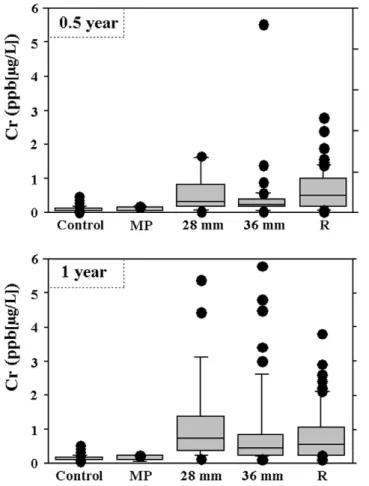
Metal ion data distributions were asymmetric, and variability between the groups was important. Therefore, the Kruskal-Wallis test, a nonparametric equivalent of a one-way analysis of variance, was used. This test is basically calculated as a regular analysis of variance, but because it uses ranked values of the data, it is therefore resistant to outliers, which are represented by dots (d) in the box-plot visualization of the results (Figs. 1-3),
in which the box itself represents the middle 50% (twenty-fifth to seventy-fifth percentiles) of the data. The nonparametric Kruskal-Wallis test was also used to analyze nitrotyrosine re-sults. For total antioxidants and peroxides that were symmet-rically distributed, analysis of variance followed by the Fisher protected least significant difference (PLSD) test was the method used to compare the different study groups. P < 0.05 was considered significant.
Results
A
ll patients were doing well at the time of the most recent follow-up visit, and no sign of osteolysis was observed on radiographs. The Harris hip score18was 49 ± 14 (mean ±
standard deviation) in the control group, and it was signifi-cantly increased (p < 0.01) at six months in the metal-on-polyethylene group (74± 14), the 28-mm-head group (86±
11), the 36-mm-head group (80 ± 14), and the resurfacing group (92±9). At one year, the score was approximately 90 in patients with all types of bearings (89±9 for the metal-on-polyethylene group, 88±11 for the 28-mm-head group, 85±
15 for the 36-mm-head group, and 89±11 for the resurfacing group). The UCLA activity score19
was used to assess routine activity. In comparison with the scores in the control group (5.3 ± 2.2, mean ± standard deviation), the UCLA activity scores at six months were significantly higher (p < 0.001) only in the resurfacing group (7.4±1.4). At one year, UCLA activity scores were significantly higher in patients in the 28-mm-head group (6.4±1.4; p < 0.05), the 36-mm-head group (6.4±0.8; p < 0.005), and the resurfacing group (7.5±1.6; p < 0.001) in comparison with the score in the control group. At one year, the UCLA score in patients who underwent resurfacing was also significantly higher (p < 0.05) than in patients who had a metal-on-polyethylene total hip arthroplasty (5.7±1.6) or in patients who had a metal-on-metal total hip arthroplasty with a 28 or 36-mm head.
Metal Ion Analysis
Figure 1 compares the median blood levels of cobalt in tients with different types of hip bearings and in control pa-tients at six months and at one year after surgery. At six months, the cobalt levels had increased significantly in the 28-mm-head (2.5 parts per billion [2.5 mg/L]) and resurfacing (2.3 parts per billion [2.3 mg/L]) groups compared with the control (1.75 parts per billion [1.75mg/L]) and the metal-on-polyethylene (1.65 parts per billion [1.65mg/L]) groups (p < 0.001), while there was no significant difference between the 36-mm-head (1.8 parts per billion [1.8 mg/L]) or metal-on-polyethylene bearing groups compared with the control group (p > 0.5). The levels of cobalt were also significantly higher in the 28-mm-head and resurfacing groups compared with the 36-mm-head group (p < 0.001). At one year, the levels of cobalt in the groups of patients with any of the three types of metal-on-metal bearings were significantly higher than the levels observed in the control and metal-on-polyethylene groups (p £0.001). However, no significant differences (p >
Fig. 1
Cobalt (Co) levels in patients with hip implants and in control patients. At six months and at one year after surgery, with use of inductively coupled plasma mass spectrometry, cobalt ions were measured in whole blood of patients who had no prosthesis (control patients), a metal-on-polyethylene (MP) prosthesis, a 28-mm-head metal-on-metal prosthesis, a 36-mm-head metal-on-metal prosthesis, or a resurfacing (R) prosthesis.
0.15) were observed among the 28-mm-head (2.6 parts per billion [2.6mg/L]), 36-mm-head (2.3 parts per billion [2.3mg/L]), and resurfacing (2.4 parts per billion [2.4mg/L]) groups.
Figure 2 compares the median blood levels of chromium in patients with different hip bearings and in control patients at six months and one year after surgery. At six months, the chromium levels in the groups of patients with any of the three types of metal-on-metal bearings were significantly higher than the levels observed in the control group (0.05 parts per billion [0.05mg/L]) (p < 0.001). The levels of chromium in the metal-on-polyethylene group (0.05 parts per billion [0.05mg/L]), although not significantly different from those in the control group (p > 0.5), were significantly lower than those in the 28-mm-head (0.35 parts per billion [0.35mg/L]), 36-mm-head (0.25 parts per billion [0.25mg/L]), and resurfacing (0.50 parts per billion [0.50mg/L]) groups (p < 0.001). The levels of chromium were also significantly lower in the 36-mm-head group than they were in the 28-mm-head and resurfacing groups (p < 0.01). At one year, the levels of chromium in the
groups with any of the three metal-on-metal bearings were higher than the levels observed in the control and metal-on-polyethylene groups. However, no significant differences (p > 0.2) were observed among the 28-mm-head (0.6 parts per billion [0.6mg/L]), 36-mm-head (0.4 parts per billion [0.4mg/L]), and resurfacing (0.5 parts per billion [0.5mg/L]) groups.
Figure 3 compares the median blood levels of mo-lybdenum in patients with different hip bearings at six months and at one year after surgery. Contrary to what was observed for cobalt and chromium ions, no significant differences (p > 0.2) were observed among the different groups, including the control group, both at six months and one year postopera-tively, with median levels varying from 1.30 to 1.65 parts per billion (1.30 to 1.65mg/L).
Oxidative Stress Markers
Measurement of the levels of oxidative stress markers in pa-tients with different hip bearings revealed no differences in the
Fig. 2
Chromium (Cr) levels in patients with hip implants and in control patients. At six months and at one year after surgery, with use of inductively coupled plasma mass spectrometry, chromium ions were measured in whole blood of patients who had no prosthesis (control patients), a metal-on-polyethylene (MP) prosthesis, a 28-mm-head metal-on-metal prosthesis, a 36-mm-head metal-on-metal prosthesis, or a resurfacing (R) prosthesis.
Fig. 3
Molybdenum (Mo) levels in patients with hip implants and in control patients. At six months and at one year after surgery, with use of in-ductively coupled plasma mass spectrometry, molybdenum ions were measured in whole blood of patients who had no prosthesis (control patients), a metal-on-polyethylene (MP) prosthesis, a 28-mm-head metal-on-metal prosthesis, a 36-mm-head metal-on-metal prosthesis, or a resurfacing (R) prosthesis.
TH EJO U R N A L O FBO N E& JO I N T SU R G E R YdJ B J S.O R G VO L U M E9 0 - AdSU P P L E M E N T3d2 0 0 8
ME TA LIO NLE V E L S I N T H EBL O O D O FPAT I E N T S
concentrations of total antioxidants, peroxides, or nitro-tyrosines among the different groups, including the control group, both at six months and one year postoperatively. Also, there was no correlation between the concentrations of these markers and the concentrations of either cobalt or chromium ions (r2£
0.01) (results not shown).
Discussion
T
he results of the present study show that, at one year postoperatively, the levels of cobalt and chromium ions in whole blood of patients with the 28 or 36-mm-head metal-on-metal prostheses were comparable with the levels observed in patients who underwent hip resurfacing. These results are similar to those recently described in the study by Daniel et al., in which the levels of cobalt and chromium in whole blood of patients with a Birmingham resurfacing prosthesis (Smith-Nephew, Arlington, Tennessee) were not significantly different from the levels observed in patients with a 28-mm-head Metasul total hip prosthesis (Zimmer)23. However, our results are different from the observations by Clarke et al., who, in a cohort of twenty-two matched patients, found an increased level of metal ions in patients who underwent resurfacing compared with patients who had implantation of a 28-mm-head metal-on-metal prosthesis16
. The number of patients was much higher in our study, especially for the resurfacing and 36-mm-head groups. Finally, the resurfacing bearings in the two studies were different. Clarke et al. compared the Bir-mingham (Smith-Nephew) and Cormet 2000 (Corin Surgical, Cirencester, United Kingdom) resurfacing prostheses with the Ultima (DePuy Orthopaedics) 28-mm-head metal-on-metal prosthesis, whereas we compared the ASR hip resurfacing prosthesis (DePuy Orthopaedics) with the Metasul (Zimmer) 28-mm-head and Ultamet (DePuy Orthopaedics) 36-mm-head metal-on-metal prostheses.
The levels of both cobalt and chromium in our study were in the same range as the levels reported in previous studies16,24-26
of different types of resurfacing bearings, in which the mean (or median) cobalt levels varied from 0.7 to 3.3 parts per billion (12 to 56 nmol/L or 0.7 to 3.3mg/L) and the mean (or median) chromium levels varied from 1.6 to 4.9 parts per billion (30 to 94 nmol/L or 1.6 to 4.9mg/L). However, due to differences in the choice of samples (serum or whole blood) and in the methodology (digested samples or diluted samples; inductively coupled plasma mass spectrometry or graphite furnace), it is impossible to identify the superiority of one resurfacing design in terms of ion release. Also, as described in these studies, outlier results were observed for both cobalt and chromium ions. In this regard, it has been suggested that cup inclination may affect metal ion levels in patients who have undergone metal-on-metal total hip arthroplasty27
. In the present study, we were unable to correlate the levels of cobalt and chromium with either the acetabular angle or the pin-shaft angle (results not shown). In another study on resurfacing, Vendittoli et al. were also unable to draw strong conclusions regarding the acetabular inclination and the level of cobalt24
. Additional studies are necessary to gain a better understanding
of the cause of outlier levels of ions in patients with hip re-surfacing prostheses.
Manufacturing factors also limit the comparison of the various metal-on-metal implants. The type of implant (total hip prosthesis or resurfacing prosthesis) is not the only pa-rameter that has the potential to affect wear performance and metal ion levels. Other factors, such as clearance and sphericity, metallurgical aspects (i.e., carbon content), surface roughness, and running-in time, may also have an impact. Moreover, al-though the sample size allows detection of increased levels of ions (as compared with the levels seen in controls) with a power greater than 80% and with an alpha level of confidence of 5%, it does not allow any absolute conclusions to be drawn regarding the absence of differences in metal ion levels between metal-on-metal implants and resurfacing prostheses. Indeed, due to the asymmetric distribution of ion levels that lead to a high standard deviation and due to the small differences between the groups, close to 100 patients per group would be necessary to reach this power of 80% with an alpha error of 5%.
To the best of our knowledge, little is known about the circulating levels of molybdenum in patients with metal-on-metal bearings. Moreover, very little is known about its toxic-ity28
. Taking advantage of the inductively coupled plasma mass spectrometry technique that allows multi-element determi-nations, we measured the levels of molybdenum in patients who had a metal-on-metal implant as well as in patients who had a metal-on-polyethylene implant or no implant. Our re-sults showed that there was no increase in blood molybdenum levels in patients who had a hip implant. This is not an un-expected finding because the percentage of molybdenum in the cobalt-chromium-molybdenum alloys that are used in the manufacture of metal-on-metal implants is very low in com-parison with the percentage of cobalt or chromium in those alloys.
The single most important obstacle that is preventing a broader application of total or resurfacing metal-on-metal prostheses continues to be concerns regarding elevated metal ion levels in the blood and urine of patients in whom a metal-on-metal bearing surface was used29
. Despite the concerns regarding chromosome aberrations and translocations30,31
, changes in the proportions of peripheral blood lymphocytes32-34
, and the risk of cancer34
, all of which are continuously raised in the literature, the International Agency for Research on Cancer concluded in two different reports in 199935
and 200336
that there is inadequate evidence in humans regarding the carci-nogenicity of orthopaedic implants and that orthopaedic im-plants of complex composition are not classifiable as to their carcinogenicity to humans. However, a more recent study of a large cohort of patients who underwent total hip arthroplasty has shown a substantial increase in the prevalence of mela-noma and prostate cancer37
. Also, metal ions have the potential to induce the production of reactive oxygen species17
, making metal ions prime suspects for disturbing the oxidant/ antioxidant balance in circulating cells38,39
. Since the damage that a free radical produces depends on its origin and type, the most accurate and clinically relevant measurement of oxidative
damage is to measure multiple products of this damage40
. In the present study, we measured the concentrations of three oxidative stress markers in patients who had metal-on-metal bearings. The markers were chosen because of their simplicity of measurement and because they are sensitive enough to detect changes in several physiopathological conditions. We found no changes in the levels of these markers in the metal-on-metal bearing groups when compared with the levels in the control or metal-on-polyethylene bearing groups. However, given the possible latency periods related to metal ion expo-sure, a longer follow-up period is required to conclusively determine the effects of elevated circulating ions on oxidative stress in the blood of patients with metal-on-metal bearings.
One of the limitations of this study is the absence of randomization along with the inherent bias created by that absence. For example, there were more men (77%) than women (23%) in the resurfacing group. This proportion is similar to what has been described previously in other nonrandomized studies, in which 68%25
and 75%26
of patients in the resurfacing groups were men. This disproportion is inherent to a tech-nique that excludes patients with osteoporosis. However, our results show that there were no differences between the levels of cobalt (p = 0.79) and chromium (p= 0.58) in male and female patients who underwent resurfacing (results not shown). Also, patients who underwent resurfacing tended to be younger, even if not statistically so, than patients who received a total hip prosthesis with a 28-mm (p=0.19) or 36-mm (p=0.37) head because overall, at our institution, the metal-on-metal resur-facing prosthesis is reserved for young patients. The patients who were selected for resurfacing in our study were also more active than the patients who were selected for implantation of a 28 or 36-mm-head metal prosthesis or a metal-on-polyethylene prosthesis. However, this increased level of activity
did not correlate with an increase in circulating metal ions. This is in agreement with recent results showing that metal ion levels are not acutely affected by patient activity24,41
. However, the results of two other studies4,42
showed a mild (10% to 13%) increase in the level of cobalt but not chromium following ex-ercise. Considering this small increase and the fact that patients who had a metal-on-metal total hip prosthesis had moderate activity levels, activity may not be a confounding factor in the interpretation of the results.
Taken together, our results show that at one year, pa-tients who have a metal-on-metal total hip prosthesis or a hip resurfacing prosthesis have higher circulating levels of cobalt and chromium ions than do patients who have a metal-on-polyethylene prosthesis or patients before arthroplasty. How-ever, the increased levels of metal ions had no apparent effect on oxidative stress markers in the blood of these patients. The concentration of ions after a longer term of follow-up remains to be investigated.n John Antoniou, MD, PhD, FRCSC David J. Zukor, MD, FRCSC Fackson Mwale, PhD Alain Petit, PhD Olga L. Huk, MD, MSc, FRCSC
Lady Davis Institute for Medical Research, SMBD-Jewish General Hospital, 3755, Chemin de la C ˆote Ste-Catherine, Montr´eal, QC H3T 1E2, Canada.
E-mail address for J. Antoniou: [email protected] William Minarik, PhD
Geochemical Laboratories, Earth and Planetary Sciences, McGill University, 3450 University Street, Montr´eal, QC H3A 2A7, Canada
References
1.Damie F, Favard L. [Metal serum levels in 48 patients bearing a chromium-cobalt total hip arthroplasty with a metal-on-polyethylene combination]. Rev Chir Orthop Reparatrice Appar Mot. 2004;90:241-8. French.
2.MacDonald SJ, McCalden RW, Chess DG, Bourne RB, Rorabeck CH, Cleland D, Leung F. Metal-on-metal versus polyethylene in hip arthroplasty: a randomized clinical trial. Clin Orthop Relat Res. 2003;406:282-96.
3.Savarino L, Granchi D, Ciapetti G, Cenni E, Nardi Pantoli A, Rotini R, Veronesi CA, Baldini N, Giunti A. Ion release in patients with metal-on-metal hip bearings in total joint replacement: a comparison with metal-on-polyethylene bearings. J Biomed Mater Res. 2002;63:467-74.
4.Gleizes V, Poupon J, Lazennec JY, Chamberlin B, Saillant G. [Value and limits of determining serum cobalt levels in patients with metal on metal articulating pros-theses]. Rev Chir Orthop Reparatrice Appar Mot. 1999;85:217-25. French.
5.Lhotka C, Szekeres T, Steffan I, Zhuber K, Zweym¨uller K. Four-year study of cobalt and chromium blood levels in patients managed with two different metal-on-metal total hip replacements. J Orthop Res. 2003;21:189-95.
6.Brodner W, Bitzan P, Meisinger V, Kaider A, Gottsauner-Wolf F, Kotz R. Elevated serum cobalt with metal-on-metal articulating surfaces. J Bone Joint Surg Br. 1997;79:316-21. Erratum in: J Bone Joint Surg Br. 1997;79:885.
7.Jacobs JJ, Skipor AK, Doorn PF, Campbell P, Schmalzried TP, Black J, Amstutz HC. Cobalt and chromium concentrations in patients with metal on metal total hip replacements. Clin Orthop Relat Res. 1996;(329 Suppl):S256-63.
8.Rae T. A study on the effects of particulate metals of orthopaedic interest on murine macrophages in vitro. J Bone Joint Surg Br. 1975;57:444-50.
9. Haynes DR, Rogers SD, Pearcy MJ, Howie DW. The differences in toxicity and release of bone-resorbing mediators induced by titanium and cobalt-chromium-alloy wear particles. J Bone Joint Surg Am. 1993;75:825-34.
10. Hallab N, Merritt K, Jacobs JJ. Metal sensitivity in patients with orthopaedic implants. J Bone Joint Surg Am. 2001;83:428-36.
11. Gawkrodger DJ. Metal sensitivities and orthopaedic implants revisited: the potential for metal allergy with the new metal-on-metal joint prostheses. Br J Dermatol. 2003;148:1089-93.
12. Case CP. Chromosomal changes after surgery for joint replacement. J Bone Joint Surg Br. 2001;83:1093-5.
13. Dowson D. New joints for the Millennium: wear control in total replacement hip joints. Proc Inst Mech Eng [H]. 2001;215:335-58.
14. Medley JB, Chan FW, Krygier JJ, Bobyn JD. Comparison of alloys and designs in a hip simulator study of metal on metal implants. Clin Orthop Relat Res. 1996;(329 Suppl):148-59.
15. Smith SL, Dowson D, Goldsmith AA. The effect of femoral head diameter upon lubrication and wear of metal-on-metal total hip replacements. Proc Inst Mech Eng [H]. 2001;215:161-70.
16. Clarke MT, Lee PT, Arora A, Villar RN. Levels of metal ions after small- and large-diameter metal-on-metal hip arthroplasty. J Bone Joint Surg Br. 2003; 85:913-7.
17. Stohs SJ, Bagchi D. Oxidative mechanisms in the toxicity of metal ions. Free Radic Biol Med. 1995;18:321-36.
TH EJO U R N A L O FBO N E& JO I N T SU R G E R YdJ B J S.O R G VO L U M E9 0 - AdSU P P L E M E N T3d2 0 0 8
ME TA LIO NLE V E L S I N T H EBL O O D O FPAT I E N T S
18. Harris WH. Traumatic arthritis of the hip after dislocation and acetabular fractures: treatment by mold arthroplasty. An end-result study using a new method of result evaluation. J Bone Joint Surg Am. 1969;51:737-55.
19. Zahiri CA, Schmalzried TP, Szuszczewicz ES, Amstutz HC. Assessing activity in joint replacement patients. J Arthroplasty. 1998;13:890-5.
20. Case CP, Ellis L, Turner JC, Fairman B. Development of a routine method for the determination of trace metals in whole blood by magnetic sector inductively coupled plasma mass spectrometry with particular relevance to patients with total hip and knee arthroplasty. Clin Chem. 2001;47:275-80.
21. Kaur H, Halliwell B. Evidence for nitric oxide-mediated oxidative damage in chronic inflammation. Nitrotyrosine in serum and synovial fluid from rheumatoid patients. FEBS Lett. 1994;350:9-12.
22. Halliwell B, Chirico S. Lipid peroxidation: its mechanism, measurement, and significance. Am J Clin Nutr. 1993;57(5 Suppl):715S-25S.
23. Daniel J, Ziaee H, Salama A, Pradhan C, McMinn DJ. The effect of the diameter of metal-on-metal bearings on systemic exposure to cobalt and chromium. J Bone Joint Surg Br. 2006;88:443-8.
24. Vendittoli PA, Mottard S, Roy AG, Dupont C, Lavigne M. Chromium and cobalt ion release following the Durom high carbon content, forged metal-on-metal surface replacement of the hip. J Bone Joint Surg Br. 2007;89:441-8.
25. Skipor AK, Campbell PA, Patterson LM, Amstutz HC, Schmalzried TP, Jacobs JJ. Serum and urine metal levels in patients with metal-on-metal surface arthro-plasty. J Mater Sci Mater Med. 2002;13:1227-34.
26. Back DL, Young DA, Shimmin AJ. How do serum cobalt and chromium levels change after metal-on-metal hip resurfacing? Clin Orthop Relat Res.
2005;438:177-81.
27. Brodner W, Gr¨ubl A, Jankovsky R, Meisinger V, Lehr S, Gottsauner-Wolf F. Cup inclination and serum concentration of cobalt and chromium after metal-on-metal total hip arthroplasty. J Arthroplasty. 2004;19(8 Suppl 3):66-70.
28. Vyskocil A, Viau C. Assessment of molybdenum toxicity in humans. J Appl Toxicol. 1999;19:185-92.
29. MacDonald SJ. Can a safe level for metal ions in patients with metal-on-metal total hip arthroplasties be determined? J Arthroplasty. 2004;19(8 Suppl 3):71-7.
30. Case CP. Chromosomal changes after surgery for joint replacement. J Bone Joint Surg Br. 2001;83:1093-5.
31. Tharani R, Dorey FJ, Schmalzried TP. The risk of cancer following total hip or knee arthroplasty. J Bone Joint Surg Am. 2001;83:774-80.
32. Savarino L, Granchi D, Ciapetti G, Stea S, Donati ME, Zinghi G, Fontanesi G, Rotini R, Montanaro L. Effects of metal ions on white blood cells of patients with failed total joint arthroplasties. J Biomed Mater Res. 1999;47:543-50.
33. Case CP, Langkamer VG, Lock RJ, Perry MJ, Palmer MR, Kemp AJ. Changes in the proportions of peripheral blood lymphocytes in patients with worn implants. J Bone Joint Surg Br. 2000;82:748-54.
34. Granchi D, Savarino L, Ciapetti G, Cenni E, Rotini R, Mieti M, Baldini N, Giunti A. Immunological changes in patients with primary osteoarthritis of the hip after total joint replacement. J Bone Joint Surg Br. 2003;85:758-64.
35. International Agency for Research on Cancer, World Health Organization. IARC monographs on the evaluation of carcinogenic risks to humans. Surgical implants and other foreign bodies. Vol 74. Lyon, France: IARC; 1999.
36. International Agency for Research on Cancer, World Health Organization. IARC monographs on the evaluation of carcinogenic risks to humans. Cobalt in hard metals and cobalt sulfate, gallium arsenide, indium phosphide and vanadium pentoxide. Vol 86. Lyon, France: IARC; 2003.
37. Visuri TI, Pukkala E, Pulkkinen P, Paavolainen P. Cancer incidence and causes of death among total hip replacement patients: a review based on Nordic cohorts with a special emphasis on metal-on-metal bearings. Proc Inst Mech Eng [H]. 2006;220:399-407.
38. Bagchi D, Hassoun EA, Bagchi M, Stohs SJ. Chromium-induced excretion of urinary lipid metabolites, DNA damage, nitric oxide production, and generation of reactive oxygen species in Sprague-Dawley rats. Comp Biochem Physiol C Phar-macol Toxicol Endocrinol. 1995;110:177-87.
39. Stohs SJ, Bagchi D, Hassoun E, Bagchi M. Oxidative mechanisms in the tox-icity of chromium and cadmium ions. J Environ Pathol Toxicol Oncol. 2001;20: 77-88.
40. Arg¨uelles S, Garcı´a S, Maldonado M, Machado A, Ayala A. Do the serum oxidative stress biomarkers provide a reasonable index of the general oxidative stress status? Biochim Biophys Acta. 2004;1674:251-9.
41. Heisel C, Silva M, Skipor AK, Jacobs JJ, Schmalzried TP. The relationship between activity and ions in patients with metal-on-metal bearing hip prostheses. J Bone Joint Surg Am. 2005;87:781-87.
42. Khan M, Takahashi T, Kuiper JH, Sieniawska CE, Takagi K, Richardson JB. Current in vivo wear of metal-on-metal bearings assessed by exercise-related rise in plasma cobalt level. J Orthop Res. 2006;24:2029-35.