Master’s Programme in Computer, Communication and Information Sciences
Vitalii Ivanov
Implementation of DevOps pipeline for
Serverless Applications
Master’s Thesis Espoo, May 27, 2018
Supervisor: Professor Kari Smolander, Aalto University Advisor: Jussi Kyr¨ohonka M.Sc. (Tech.)
Aalto University School of Science
Master’s Programme in Computer, Communication and In-formation Sciences
ABSTRACT OF MASTER’S THESIS Author: Vitalii Ivanov
Title:
Implementation of DevOps pipeline for Serverless Applications
Date: May 27, 2018 Pages: 78
Major: Software and Service Engineering Code: SCI3043 Supervisor: Professor Kari Smolander
Advisor: Jussi Kyr¨ohonka M.Sc. (Tech.)
Serverless computing is a cloud computing execution model where server-side logic runs in the stateless compute containers that are event-triggered and usu-ally fully managed by vendor hosts such as AWS Lambda. This approach is also called Function as a Service (FaaS). Applications that rely on this approach are called Serverless applications. Serverless usage promises infrastructure cost re-duction and automatic scalability. One more important benefit of serverless is making the operations part of DevOps process simpler. It reduces the time on the management and maintenance of the servers and sometimes makes them even completely unnecessary. Despite this fact, applications using serverless comput-ing model require a new look at DevOps automation practices since it is a new approach to software architecture design and software development workflow. The goal of this thesis is to implement DevOps pipeline for a Serverless application within a single case organization and evaluate the results of implementation. This is done through design science research, where result artifact is a release pipeline designed and implemented according to the requirements for a new project in the case organization.
The result of the study is automated DevOps pipeline with implemented Con-tinuous Integration (CI), ConCon-tinuous Delivery (CD) and Monitoring practices required for the case project. The research shows that architecture of Serverless applications affects many DevOps automation practices such as test execution, deployment and monitoring of the application. It also affects the decisions about source code repositories structure, mocking libraries and Infrastructure as Code (IaC) tools.
Keywords: DevOps, Continuous Integration, Continuous Delivery, Serverless, Design Science Research
Language: English
I would like to express my deep gratitude to Professor Kari Smolander for his constructive suggestions and professional guidance during the planning and development of this research work. I would also like to thank Jussi Kyr¨ohonka for his enthusiastic encouragement and valuable recommendations on this project. I am particularly grateful for the knowledge and experience given by academic staff of Aalto University. Finally, I wish to thank my family for their support throughout my study.
Espoo, May 27, 2018 Vitalii Ivanov
Abbreviations and Acronyms
AWS Amazon Web Services
BaaS Backend as a Service
CI Continuous Integration
CD Continuous Delivery
DB Database
DSRM Design Science Research Methodology
FaaS Function as a Service
IaaS Infrastructure as a Service
IaC Infrastructure as Code
IT Information Technology
PaaS Platform as a Service
QA Quality Assurance
SDK Software Development Kit
VCS Version Control System
VM Virtual Machine
Abbreviations and Acronyms 4
1 Introduction 7
1.1 Problem statement . . . 8
1.2 Structure of the Thesis . . . 8
2 Background 9 2.1 Introduction to DevOps . . . 9 2.2 DevOps practices . . . 12 2.2.1 Source Control . . . 13 2.2.2 Build Process . . . 13 2.2.3 Testing and QA . . . 15 2.2.4 Deployment . . . 17 2.2.5 Monitoring . . . 17 2.3 Serverless Applications . . . 18
2.4 DevOps for Serverless Applications . . . 21
2.5 Integration flow model . . . 22
3 Research Methods 24 3.1 Research motivation . . . 24
3.2 Research method . . . 25
3.3 Data collection . . . 26
4 Current State Analysis 28 4.1 Project architecture . . . 28
4.2 Serverless elements of application architecture . . . 31
4.3 Expectations for Serverless Applications . . . 32
4.4 Elicitation of requirements for DevOps pipeline . . . 34
4.4.1 Source Control . . . 34
4.4.2 Build Process . . . 36
4.4.3 Testing and QA . . . 37
4.4.4 Deployment . . . 39
4.4.5 Monitoring . . . 40
4.5 Results . . . 41
5 Implementation 44 5.1 Architecture . . . 44
5.2 Infrastructure as Code solution . . . 45
5.3 Source Control . . . 46
5.4 CI and CD pipeline . . . 48
5.5 Monitoring of the solution . . . 52
5.6 Implementation problems . . . 53
6 Evaluation 56 6.1 Implemented DevOps practices . . . 56
6.2 Cost calculation . . . 60
6.3 Pipeline evaluation . . . 62
7 Discussion 66 7.1 Answers to research questions . . . 66
7.2 Design Science Research . . . 69
7.3 Future research . . . 70
8 Conclusions 72
Introduction
Over the last decade, DevOps has become important part of cultures of many successful companies. Large influence on DevOps was done by wide adoption of microservices, containers and cloud computing [4]. The next step in evolution of cloud based and microservice architecture is serverless computing - code execution model where cloud provider totally takes the responsibilities of operating system and hardware management. The purpose of serverless computing is to simplify operations part of DevOps, provide very scalable execution architecture and predictable pricing model, where platform users are charged depending on amount of consumed resources.
Despite the large number of materials investigating serverless use cases [51][2], scalability [43], cloud providers, platforms [42] and success stories of serverless computing [35], less studies have focused on DevOps practices supporting Serverless applications. Even if serverless computing is by design aimed at simplification of operation processes, it still requires the changes of DevOps practices. How exactly DevOps practices should be implemented depends on specific use case of serverless computing and concrete project. But since serverless concept is the same regardless of provider and platform, the experience from one project might be useful for many other software companies.
The aim of this thesis is to implement DevOps pipeline for Serverless application in order to ensure high quality of the software development in a single case company. The output will be DevOps automation pipeline which includes the practices of Continuous Integration, Continuous Delivery and Monitoring implemented according to the requirements of the company such as technology stack and software architecture. In order to develop this solution, this thesis will use design science research methodology. To ensure the usefulness of DevOps practices, a series of workshops and interviews with developers, QA engineers and DevOps specialists will be done. The
CHAPTER 1. INTRODUCTION 8
implemented results will be demonstrated, evaluated and discussed with the development team of the project.
The scope of the thesis will be limited to one project. The features of the project will not be revealed. The architecture will be shown sufficiently to design and implement required DevOps practices without any extra details. Nowadays, the concept of DevOps includes Culture, Automation, Lean, Mea-surement and Sharing [14] [23]. This thesis is focused on technical aspects of DevOps and covers the following groups of practices: Continuous Integration, Continuous Delivery and Monitoring.
1.1
Problem statement
The thesis will answer the following research questions:
RQ1 What are the requirements for the DevOps pipeline of the case project?
RQ2 How does Serverless architecture affect DevOps practices such as CI, CD and Monitoring of the application?
RQ3 How well does implemented DevOps pipeline fulfil company require-ments?
1.2
Structure of the Thesis
This paper is structured as follows. Chapter 2 reviews existing literature about DevOps and Serverless applications, as well as describes how to com-bine them together. Chapter 3 defines the research method and research questions that the thesis is supposed to answer. Chapter 4 describes the cur-rent state of the project, architecture and expectations for DevOps pipeline from development team. Chapter 5 provides the details about DevOps pipeline implementation. Chapter 6 presents evaluation of implemented pipeline and cost calculation. Chapter 7 answers the research questions and proposes new ideas for the future research. Chapter 8 summarizes the find-ings and draw conclusions from the research.
Background
This chapter presents the results of literature review about impact of Server-less architectures on DevOps automation pipeline. It also introduces the key terms and concepts that will be used in the thesis. Section 2.1 explains the term of DevOps and summarizes the DevOps adoption benefits and prob-lems. Section 2.2 examines which groups of DevOps practices are influenced by architecture of the application and provides their description. Section 2.3 introduces the term Serverless and describes what is Serverless application and architecture. Finally, section 2.4 reviews the implementation of DevOps practices for applications with Serverless architectures and demonstrates the research gap in this field. In addition, section 2.5 explains the notation that will be used to describe the CI and CD pipeline in chapter 5.
Information provided in this chapter is required to find the answers on research questions defined in chapter 3. Understanding of available DevOps practices and awareness of their adoption will help with elicitation of re-quirements in RQ1. Research about influence of Serverless architectures on design and implementation of DevOps pipeline will give the background for the RQ2.
2.1
Introduction to DevOps
DevOps is a relatively new term that appeared a decade ago [30]. Initially it was a word to explain the need of collaboration between development and operation teams. Till now DevOps does not have a single definition and many companies understand it differently [17]. For instance, possible defini-tions are ”a way of collaboration in which processes are automated as much as possible”, ”aspect of organizational culture in which development and op-erations personnel work together closely” or ”the principles and practices
CHAPTER 2. BACKGROUND 10
which are needed to create a scalable service infrastructure” [20].
Definition from Gartner IT Glossary says thatDevOps represents a change in IT culture, focusing on rapid IT service delivery through the adoption of agile, lean practices in the context of a system-oriented approach. DevOps emphasizes people (and culture), and seeks to improve collaboration between operations and development teams. DevOps implementations utilize tech-nology - especially automation tools that can leverage an increasingly pro-grammable and dynamic infrastructure from a life cycle perspective [1].
Definition from Gartner reflects five most important aspects of DevOps: Culture, Automation, Lean, Measurement and Sharing. These five words em-phasize the most modern understanding of DevOps and can be abbreviated as CALMS. Short description of each of these aspects is presented below.
Culture
DevOps requires open culture with good communication and collaboration channels in the core of it. Collaboration is required not only between devel-opment and operations teams but also between all stakeholders within the company and even outside of it such as company clients. Good collaboration is the key of successful implementation of all other practices and sometimes it even requires changes in organization’s structure [33]. Attributes of good culture are empathy, good working environment and support between em-ployees [34].
Automation
Automation of routine tasks in software development makes their execution faster and reduces the risk of mistake [33]. The most repeated tasks in soft-ware lifecycle are building, testing and deployment. CI, CD practices sup-ported by declarative description of the infrastructure called ”Infrastructure as Code” (IaC) are aimed at elimination of manual actions.
Lean
Lean software development describes a set of principles aimed at waste min-imization and maxmin-imization of the customer value. DevOps should help to find and address the causes of development wastes and it will allow to re-duce product time to market which might be critical for the business needs. Possible practice here is Continuous Monitoring with the focus on immediate alarm in case of the problems [21]. It can help to find problematic places in the software and fix them quickly to create a value for the customer.
Measurement
Performance and usage data gathered from production environment allows to understand the product better. This data should drive decisions, im-provements and changes to the system [34]. This principle is called ”putting efficiency and process into perspective” [33]. Measurement and visualization are important not only for application running but also for QA status and code quality data.
Sharing
This aspect of DevOps emphasizes knowledge sharing part of collaboration within organization. For instance, developers and operations should try to make product documentation accessible and understandable by both sides. Sharing process should be facilitated by knowledge management [19].
Adoption of DevOps
Adoption of DevOps expects cultural change in IT organization. Only then it will make a positive impact on the overall productivity. Understanding of adoption benefits as well as problems will help to select and propose the useful practices for every new company and project case avoiding possible issues.
The expected benefits of DevOps are similar in all selected research pa-pers. They are related to faster feature release, improved quality assurance and enhanced collaboration within the team [40]. Interesting fact is that even the papers focused only on CI practice of DevOps list exactly the same benefits [44][39][48].
DevOps practices’ adoption problems can be divided into two groups: technological and social [32]. Example of technological barriers is dissimilar-ity of development and production environments [40].
Example of social problems is ambiguity in the definition of DevOps which is called as one of the main failure reasons in DevOps adoption [40]. El-berzhager and Arif with the group of authors also emphasize the importance of common understanding of DevOps within the company [18]. Based on their studies they recommend starting with the small changes in a manage-able context of a small project and define requirements for tools and processes to be utilized in the DevOps environment.
CHAPTER 2. BACKGROUND 12
Continuous Integration, Delivery and Monitoring
Lean concept of flow introduced many continuous activities such as Con-tinuous Planning, ConCon-tinuous Security, ConCon-tinuous Trust and ConCon-tinuous Innovations [23]. These activities affect business and planning, development, operations and innovations processes within the company. Continuous Inte-gration, Delivery and Monitoring are the most popular activities from the family of ”continuous” and they became the cornerstones of successful De-vOps implementation.
Continuous Integration can be defined as a software development practice where developers merge their code changes into the shared code base as often as possible and these changes are validated by running a code quality analysis tools, building the project and running automated tests. It allows to avoid integration problems when building and testing of the project is delayed for the last minute [24].
Continuous Delivery is the next step after CI that makes sure that a project is ready to be released at any time by request. It can be released to development, staging or production environments. One more similar term is Continuous Deployment which means that deployment of successful builds to chosen environment happens automatically after every commit to selected branches [29].
Continuous Monitoring is the set of practices to monitor applications’ run-time behaviour for early detection of problems, such as performance degradation or infrastructure or business logic errors [23].
Together CI and CD practices can be called release engineering pipeline [17]. This pipeline can also be called with a more wide term - DevOps pipeline, especially if it includes additional practices such as Continuous Monitoring.
2.2
DevOps practices
From software architecture perspective DevOps has an impact on the devel-opment cycle including build, test, deployment and post-deployment moni-toring phases [6]. This section presents the practices for effective work with all these phases of software development cycle. In addition, source control practices are combined into separate group because they play crucial role in code sharing and team collaboration and are also widely presented in De-vOps literature. Analysis of the practices was done based on four popular books about DevOps [6][31][50][29] and one CD maturity checklist [37].
2.2.1
Source Control
VCS is used to store code history and share the code. Version Control System (VCS) allows developers to save the code changes and rollback to the previous versions in case of mistakes. It is also a collaboration tool to share the code within the team being a single storage of the code base where all changes are merged.
Branches are used for isolating work. Branching is a powerful feature of VCS. Branching strategy is a set of rules that describes when branches should be created, how they should be named and what is the purpose of the shared branches. This strategy should be chosen properly to maintain code base in a consistent way and isolate developers work to avoid blocking of development process because of unstable or unfinished code in the main branch.
Pre-tested merge commits. Commits into the shared branches should be tested before merging to avoid unstable state of the code base. This practice is connected to the Testing and QA practices that are described in section 2.2.3.
All commits are tied to tasks. Commits should be linked to the tasks to simplify project navigation and issues investigation. Developers can check the tasks descriptions linked to the commits and the opposite - all commits linked to the task are listed in issue tracker. Implementation of this practice is usually achieved through integration of VCS with an issue tracker and usage of conventional commit messages.
Version control DB schema changes. Database (DB) schema changes also should be under version control. It helps to automatically apply the new changes in the data model and recover the schema in case of the problems.
Release notes auto-generated. A lot of projects require release notes re-ports. Usually release notes are based on the commits to the VCS. Release notes auto-generation can help to save a lot of time on manual copying of commit messages and making the reports out of them.
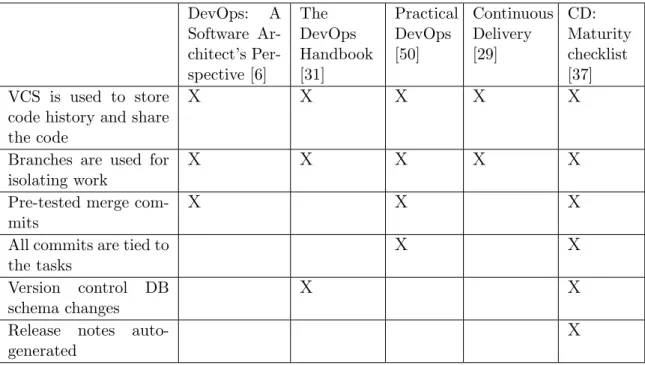
Table 2.1 shows summary of source control practices in existing literature.
2.2.2
Build Process
Build process is run automatically on commit. Build process is a process of making an artifact from the source code. It should be automatically triggered to immediately notify developers about the issues. Faster feedback about build status helps to keep the project in a stable state. There are many build
CHAPTER 2. BACKGROUND 14 DevOps: A Software Ar-chitect’s Per-spective [6] The DevOps Handbook [31] Practical DevOps [50] Continuous Delivery [29] CD: Maturity checklist [37] VCS is used to store
code history and share the code
X X X X X
Branches are used for isolating work
X X X X X
Pre-tested merge com-mits
X X X
All commits are tied to the tasks
X X
Version control DB schema changes
X X
Release notes auto-generated
X
Table 2.1: Source Control practices
process automation solutions available, such as Jenkins1 and CircleCI2. Build artifacts are managed by purpose-built tools, no manual scripts. Many common development routines are already simplified by automation tools. Artifacts managements is one of them. In case of cloud-based architec-tures there are many IaC solutions such as CloudFormation3 and Terraform4
that help to describe infrastructure in a declarative way and also maintain the artifacts such as AWS Lambda zip archives.
All artifacts have build versions with major version and commit or CI build number. To keep the history of artifacts and be able to rollback the project to the previous version it is helpful to have a versioning convention. Major, minor version and unique value such as commit or CI build number is a common example of such convention.
Dependencies are managed in a repository. All developers should use the same versions of project dependencies and, what is more important, the same dependencies should be used in production. To keep dependencies consistent among different environments it is recommended to store their versions in a repository.
1https://jenkins.io/ 2https://circleci.com/
3https://aws.amazon.com/cloudformation/ 4https://www.terraform.io/
Build environment based on VMs. Virtual machines (VMs) allow to iso-late build environment and make it portable. These qualities help to achieve more stable and scalable building process comparing to build environments with manual configuration on physical machines.
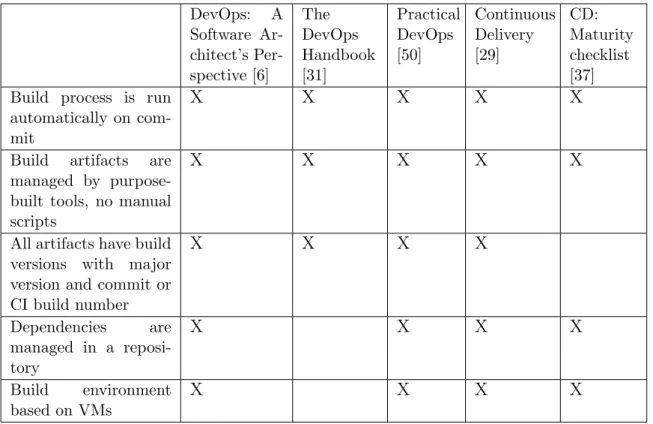
Table 2.2 outlines presence of build process practices in existing literature. DevOps: A Software Ar-chitect’s Per-spective [6] The DevOps Handbook [31] Practical DevOps [50] Continuous Delivery [29] CD: Maturity checklist [37] Build process is run
automatically on com-mit
X X X X X
Build artifacts are managed by purpose-built tools, no manual scripts
X X X X X
All artifacts have build versions with major version and commit or CI build number X X X X Dependencies are managed in a reposi-tory X X X X Build environment based on VMs X X X X
Table 2.2: Build process practices
2.2.3
Testing and QA
Automatic unit testing with every build. As with automatic build triggering, unit tests should be automatically triggered to give immediate feedback about the status of the project to fix it if it is required.
Code coverage and static code analysis is measured. Code coverage is a common approach to measure amount of unit tests and check which parts of the code base are not considered in the testing cases. Static code analysis helps to find the problems in the code based on community experience and coding style guides.
Peer-reviews. Peer-reviews allow to find the problems in the code that could not be found by static code analysis tools. In addition, peer-reviews
CHAPTER 2. BACKGROUND 16
increase the code awareness in the team and encourage knowledge sharing and collaboration.
Mockups & proxies used. Mockups and proxies allow to imitate behaviour of external components or systems that could be expensive, lead to much longer execution of the unit tests or even not required to test the targeted block of code.
Automated end-to-end testing. End-to-end tests purpose is to imitate the usage of the system by the end user with all dependencies and integrations. Execution of these tests should be automated to decrease a number of routine tasks making by QA engineers.
Integrated management and maintenance of the test data. Test data should be stored in VCS. It will help, for instance, to connect data with a certain version of database schema. Talking about the results of test ex-ecution, they should be easily accessible by project stakeholders and stored for statistics, such as code coverage dynamics, for chosen period of time.
Automated performance & security tests in target environment. Perfor-mance tests allow to understand how the system behaves under conditions of intensive usage. It helps to reveal hidden problems and bottlenecks of the system. Security tests are aimed at finding of software vulnerabilities that can be used by intruders to harm targeted company or its users.
Table 2.3 shows summary of testing and QA practices in existing litera-ture. DevOps: A Software Ar-chitect’s Per-spective [6] The DevOps Handbook [31] Practical DevOps [50] Continuous Delivery [29] CD: Maturity checklist [37] Automatic unit testing
with every build
X X X X X
Code coverage and static code analysis
X X X X X
Peer-reviews X X X X
Mockups & proxies used X X X X X
Automated end-to-end testing
X X X X X
Integrated management of the test data
X X X X
Automated performance & security tests
X X X X X
2.2.4
Deployment
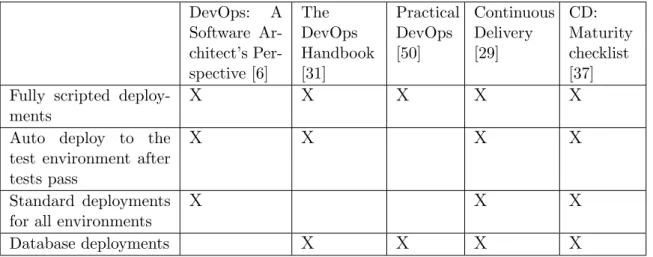
Fully scripted deployments. Manual task execution increases the risk of mis-take. Multistep deployments should be fully scripted, especially for the pro-duction environments.
Auto deploy to the test environment after tests pass. This practice al-lows to reduce time on manual routine tasks and immediately notify team members about the issues in deployment process or test execution.
Standard deployments across all environments. Standard deployments help to find the problems that can happen in production on an earlier stage such as testing or staging deployment. Identical environments for develop-ment and production increase reliability of the tests and deploydevelop-ment scripts. Database deployments. This practice expects the usage of database mi-gration tools that automatically apply schema changes. Database mimi-gration script should be a part of deployment script. It will help to make deployment process completely automatic.
Table 2.4 summarizes presence of deployment practices in existing litera-ture. DevOps: A Software Ar-chitect’s Per-spective [6] The DevOps Handbook [31] Practical DevOps [50] Continuous Delivery [29] CD: Maturity checklist [37] Fully scripted
deploy-ments
X X X X X
Auto deploy to the test environment after tests pass
X X X X
Standard deployments for all environments
X X X
Database deployments X X X X
Table 2.4: Deployment practices
2.2.5
Monitoring
Log aggregation. Log aggregation helps to deal with the large volumes of software execution log messages and provides centralized access to them.
Finding specific events in the past. Finding information in the logs his-tory is a common operation and it should be simplified through the use of
CHAPTER 2. BACKGROUND 18
convenient log browsing tools. These tools can have graphic UI and index the logs for faster search operations.
Large scale graphing of the trends. Visualization of the trends with the monitoring dashboard helps to identify the problems in the application before they became critical. Useful trends can be memory consumption, CPU usage and system response latency.
Active alerting according to the user-defined heuristics. Timely notifi-cation about the issues in an applinotifi-cation is an important factor of faster troubleshooting. Alerting can be done by email or SMS messages. Possible alerting heuristics are too high CPU or memory consumption, errors in the logs or long system response latency.
Tracing. Tracing allows to follow the request through all components of the application and measure how long each part of handling process takes. It is especially useful feature in applications with microservice architecture where one request can go through many services which might lead to com-plicated issue investigation process without enabled tracing.
Table 2.5 shows summary of monitoring practices in existing literature. DevOps: A Software Ar-chitect’s Per-spective [6] The DevOps Handbook [31] Practical DevOps [50] Continuous Delivery [29] CD: Maturity checklist [37] Log aggregation X X X X
Finding specific events in the past
X X
Large scale graphing of the trends (such as re-quests per minute)
X X X X
Active alerting accord-ing to the user-defined heuristics
X X X
Tracing X
Table 2.5: Monitoring practices
2.3
Serverless Applications
The term ”serverless” in the cloud context appeared in 2014 when Amazon launched its AWS Lambda5 service [10]. AWS Lambda allows to deploy
dividual functions to the cloud and pay only for their execution avoiding unnecessary expenses on the idle resources. This model is called Server-less Compute or FaaS and is defined as a cloud computing execution model where logic runs in the stateless containers that are event-triggered and fully managed by third party platforms [41]. The term ”serverless” also defines Backend as a Service (BaaS) model that describes applications that rely on extensive usage of services such as databases or authentication managers provided by external vendors [10]. Serverless does not mean that there is no server-side logic or servers in general. It emphasizes that developers can leave most of operational tasks related to the server maintenance such as operating system updates, fault-tolerance, scalability and monitoring to the cloud provider [5].
Currently FaaS is considered as one of the most modern step in evolution of public clouds [49]. The first one was Infrastructure as a Service (IaaS) that provides virtualized computing resources where user should configure operating systems by himself or herself. The next one was Platform as a Service (PaaS) which is built on top of IaaS and provides the services such as web-application hosting where provider is responsible for operating system maintenance. The wide spread of container technologies, such as Docker6 and Kubernetes7, made popular one more cloud computing model - Container as
a Service that combines flexibility of IaaS and reduced maintenance cost of PaaS solutions [10]. The main difference of FaaS with earlier cloud computing models is that user pays only for actual code execution and has out of the box application scalability.
Usage of BaaS and FaaS together allow to build powerful applications with minimum expenses on infrastructure or server maintenance [43]. Appli-cations that use BaaS, FaaS or both of them are called Serverless AppliAppli-cations or applications with Serverless Architecture [41].
Serverless applications have following benefits:
• Low cost. Serverless provides a pay-per-use model without a need to pay for idle resources. In addition, organization saves the resources on hardware maintenance. It applies not only to the expenses on hardware but also to the reduced labor cost. Some use cases show that migration of an application to the Serverless architecture can reduce the cost by between 66% and 95% [2].
• Enhanced scalability. Having huge amount of calculation resources, the cloud provider can easily do horizontal scaling of the containers running
6https://www.docker.com/ 7https://kubernetes.io/
CHAPTER 2. BACKGROUND 20
the deployed functions. It allows to execute thousands of operations concurrently without additional configuration [10].
• Decreased time to market. Time and resources that were previously spent on server maintenance now can be aimed at feature development and delivery. The use of external BaaS services promotes prototyping and lean approach which might be especially helpful for startups [10]. Serverless applications have their weaknesses and limitations as well:
• Latency. FaaS solutions are based on containers. Even if container is considered as the lightweight alternative to VM it is still takes from tens to hundreds of milliseconds to run it. It explains the problem of cold start that might make this Serverless computing as inappropriate for some use cases which require real-time processing [2][10].
• Security. Developers have access only to the security settings provided by the cloud platform. The fact that the code runs in a shared environ-ment with many other applications cannot make it absolutely secure [10][2].
• Limited life-span. AWS Lambda execution has a limit of 5 minutes which makes it unacceptable for some long-running processes like keep-ing open HTTP connection and receivkeep-ing a stream of data for a long period of time. Some use cases, such as big data analysis, can eliminate this problem through workflow chains [2].
• Vendor lock-in. Code running in Serverless environment is usually highly dependent on other services such as database, logging or API mapper provided by the same platform which can lead to the vendor lock-in [2].
The common use cases of Serverless applications are websites, chatbots, triggered processing, scheduled events and big data processing. CPU-intensive long running tasks and real-time processing such as multiplayer-intensive games should be avoided [53][52]. The typical Serverless application relies on third party cloud platform and uses the following services: API mapper, database, binary storage, logging solution, notification service, infrastructure provisioning tool and Serverless computing service by itself [47][12][53].
Success of AWS Lambda service led to the raise of new FaaS platforms such as Google Cloud Functions 8, Microsoft Azure Functions 9 and IBM
8https://cloud.google.com/functions/
OpenWhisk 10 [25]. The difference between these platforms is mostly in integration with other services of these cloud providers. It is also possible to deploy FaaS solution on-premises using open source platforms such as OpenWhick11, Kubeless12or OpenFaaS13. Deployment of your own Serverless platform adds server maintenance overhead but gives better security control. It is predicted that Serverless applications will become more and more popular due to high demand in edge computing to serve billions of mobile devices and impracticality of keeping idle servers in resource constrained environments [49].
2.4
DevOps for Serverless Applications
Literature review showed the lack of academic resources about DevOps for Serverless applications. At the same time, there are many blogposts about this topic mentioned below in this section. It confirms the observation made by Dingsøyr and Lassenius that continuous deployment and DevOps topics are industry rather than research driven [15].
The common pattern observed in existing literature is that cloud-based architectures encourage the use of DevOps through decomposition of the system into smaller and more manageable components which leads to smaller teams and simplifies decision making about each single component comparing to large monolith systems [4][13]. Serverless computing, being a next step in evolution of cloud computing as shown in the previous section, is sometimes described even as the No-Ops solution [11], but in practice, it still requires CI/CD pipeline and maintenance operations [7].
Serverless gives the following advantages to DevOps process:
• Operability from the start. Serverless approach combines development and operations. Even the simplest workflow with Serverless functions expects deployment to the cloud platform. And this deployment re-quires operational decisions such as amount of memory for calculations [26]. Serverless promotes a culture where software is developed to be ready for production right from the start [3].
• Broad skillset but less specialists are required. Serverless erases the dif-ference between development and operations specialists. Their skills
10https://www.ibm.com/cloud/functions 11https://openwhisk.apache.org/
12https://github.com/kubeless/kubeless 13https://github.com/openfaas/faas
CHAPTER 2. BACKGROUND 22
can be merged into single role of a cloud engineer. It makes the spe-cialists more universal and ready to solve all Serverless platform related problems [26]. In general, Serverless application maintenance requires less specialists comparing to on-premises deployments because it does not need hardware infrastructure or even virtual environments support [9].
Discovered DevOps challenges for Serverless applications are:
• Local debugging is complicated. Serverless approach expects application execution in a cloud and usually together with other cloud services. It makes difficult to reproduce execution environment in local debugging and requires extensive usage of mocking libraries [5].
• Limited access and monitoring. Developers no longer have access to the servers to monitor behaviour of the applications on operating system level. They only can read the messages that were written by the appli-cations and use cloud platform logging and tracing services. Traditional tools for monitoring and server access are not applicable anymore [5]. Serverless applications make CI and CD practices ”a new normal”[26]. Resulting infrastructure can be easily modified because serverless expects storage of configurations and business logic together in the same repository. This close connection between business logic and infrastructure together with atomic nature of serverless functions makes deployments and rollbacks espe-cially simple with a help of IaC tools.
Literature review helped to identify only few aspects of Serverless appli-cations that directly affect DevOps process and could be called as Pros and Cons of Serverless. But at the same time, almost all materials mentioned that this new cloud computing model requires properly designed CI/CD pipeline [9] development of which is the main goal of this work.
2.5
Integration flow model
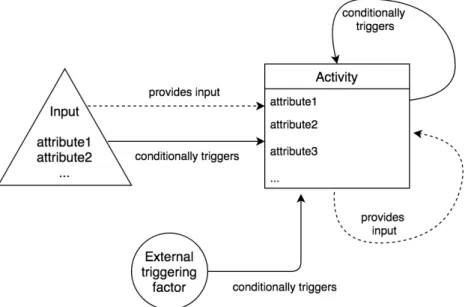
This section presents a notation for description of software integration flows. It will be used in chapter 5 to visualize implemented CI and CD pipeline. This notation was proposed by St˚ahl and Bosch to address the variation points in continuous integration flows [46]. Later the authors of the model improved it based on the feedback from the integration engineers and successfully used it to describe and compare different CI implementations in another work [45]. The reason for using an established descriptive model in this study is
to make representation of developed DevOps pipeline comparable to existing and future research simplifying experience exchange.
The model includes five elements to describe software integration flows. Figure 2.1 shows these elements and their possible relations. Input nodes (triangles) represent sources that provide input data to the model. Trigger nodes (circles) describe external triggering factors. Activity nodes (rectan-gles) perform actions on data input. Input edges (dashed arrows) show the flow of data between the elements. Trigger edges (solid arrows) define the conditions for triggering the activity nodes.
Figure 2.1: The elements of the Integration flow model
This chapter showed a context of the work and reviewed existing liter-ature about DevOps, Serverless and their interconnection. This knowledge is required to achieve the objectives of the work and answer the research questions defined in the next chapter.
Chapter 3
Research Methods
This chapter describes research motivation and defines research questions. It also presents the design science research method that will be used to achieve the goals of the study. Furthermore, the data collection process is described.
3.1
Research motivation
While many studies on the DevOps theory and adoption have been made [33][20], there are still not enough research on DevOps specific for archi-tectural patterns, in our case for Serverless applications. Every new project with Serverless architecture has a risk to face the issues with maintenance and code quality because there are not enough materials and best practices about Serverless development. Despite the fact that Serverless promises many ben-efits comparing to monolith and microservices in terms of operations, it is still unclear how much effort does it take to maintain DevOps pipeline for Serverless application. Available materials are usually focused on simple cases with only few Serverless functions and cannot be considered as the re-search works [7][27]. At the same time the usage of tens and hundreds of Serverless functions can lead to maintenance overhead. The reason can be atomic nature of Serverless functions that leads to many challenges. Some of the challenges are: should each function has a separate VCS repository, ver-sion and CI config file, should they share the common unit test data or not? The answers on these questions depend on every specific team and project, but the findings from a single case can be useful for the decisions about new projects.
The case organization studied in this thesis made a decision to use Server-less architecture for one of the projects. Preliminary analysis that was made within the company showed that the usage of Serverless model might be
eficial for the project. Architecture of the project is also ready. The main question is how to organize DevOps pipeline to satisfy the expectations of the company. Since it is a new project there is no data to compare the new pipeline with the previous one, so it is required to understand not only how to build the pipeline but also how to evaluate it.
This motivation and challenges allow us to define three research questions: RQ1 What are the requirements for the DevOps pipeline of the case
project?
The aim is to understand the company’s needs and expectations about the DevOps pipeline and how product development workflow should be designed considering available team resources, knowledge and possible limitations such as a cost of cloud services usage. It allows to propose and implement specific DevOps automation prac-tices to support company processes.
RQ2 How does Serverless architecture affect DevOps practices such as CI, CD and Monitoring of the application?
The purpose of this question is to identify the expectations of stake-holders regarding the usage of Serverless architecture, define the in-fluence of Serverless approach on DevOps automation practices and understand how to emphasize the opportunities and reduce the risks introduced by Serverless approach in the new DevOps pipeline. RQ3 How well does implemented DevOps pipeline fulfil company
require-ments?
Does the implemented pipeline match the expectations from De-vOps process identified with RQ1? Does it allow to emphasize benefits provided by Serverless architecture and reduce the risks of its usage identified with RQ2? What is the cost of execution of implemented pipeline on the chosen cloud platform?
3.2
Research method
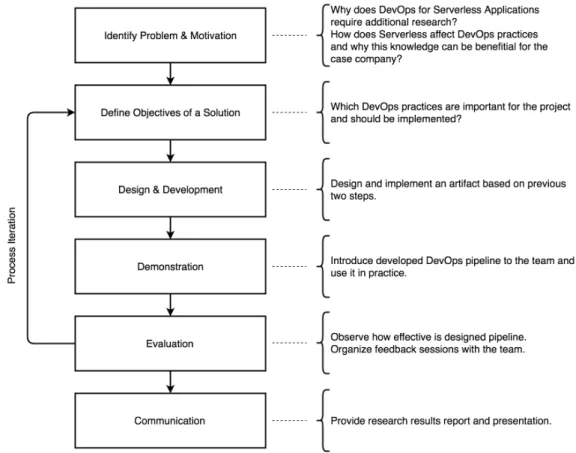
The method used in this thesis is design science research. The key idea of design science is to produce and evaluate IT artifact intended to solve iden-tified organizational problems [28]. This method was chosen because the expected outcome of the work should be an artifact - designed and imple-mented DevOps pipeline. To achieve this goal multiple problems should be addressed: problem identification and motivation, definition of the objectives for a solution, design and development, demonstration, evaluation and com-munication. All these activities and research examples are described in the
CHAPTER 3. RESEARCH METHODS 26
guideline by Peffers and Tuunanen [38].
The design science research methodology (DSRM) process model is shown in Figure 3.1.
Figure 3.1: DSRM Process Model
The result of the thesis is the DevOps pipeline made by DSRM guidelines with four iterations of improvements. Every iteration was a two-week Scrum sprint. In the beginning of the first sprint and at the end of the last sprint special workshops were organized to gather the data required to answer the research questions of this work. The details of these workshops are described in Section 3.3
3.3
Data collection
Problem and motivation identification was done by the author of the the-sis based on the personal experience in the case company and preliminary literature review. It was later discussed and approved by the stakeholders
within the company. In order to gather requirements, define the objectives and evaluate the solution, a series of workshops was organized. First work-shop to define the objectives was the longest one and its duration was four hours. The workshop was attended by DevOps engineer, team lead, two de-velopers and QA engineer. The participants were suggested to discuss CI, CD and Monitoring practices, evaluate their importance, efforts on imple-mentation and answer the question how does Serverless architecture affect these practices. Based on the results of the first workshop first version of the pipeline was designed and discussed with the development team. After the discussion it was modified and introduced into the project workflow. After this, the process was repeated in an iterative way: evaluation and objectives definition discussion, then design and development, then demonstration and usage. These steps were repeated four times with an interval of two weeks. The final review session was organized as a workshop that was attended by senior DevOps engineer, team lead, two developers and QA engineer. The goal of the final workshop was to get the feedback about implemented De-vOps pipeline. The content of the workshop was organized in a following way: the author presented the architecture of the project, emphasised the Serverless parts of it and described all steps of DevOps pipeline execution. The participants were free to ask the questions and give the suggestions dur-ing the presentation. At the end of presentation, the participants answered the questions what the best parts and risky parts of the pipeline are and also shared their opinion in a free form.
In addition to the workshops within the company the author interviewed two developers and one QA engineer outside of the case company to get their opinion about influence of Serverless architecture on DevOps automation practices.
Designed DevOps pipeline was the first pipeline for the current project, which means there were no quantitative or qualitative data available about previous DevOps process. Data gathered from the workshops was mostly qualitative. Every new review session provided more qualitative data about current version of DevOps pipeline. For the final pipeline the author made an estimation of the cost based on the pricing model of chosen cloud platform. Data collected in the first workshop helped to answer the RQ1 and RQ2. Interviews with the developers outside of the company and background re-search contributed into answering RQ2. The final workshop was the main source of data to answer the RQ3.
This chapter described research motivation, research questions and in-troduced DSRM together with data collection process. Next chapter will present the case project and requirements for the DevOps pipeline.
Chapter 4
Current State Analysis
This chapter introduces the case project and provides the results of DevOps pipeline requirements elicitation. Case project introduction provides its ar-chitecture description and explanations of Serverless design patterns used in it. The most important part of the chapter is description of the results of DevOps practices workshop. These results help to understand company’s requirements for the DevOps pipeline.
4.1
Project architecture
The thesis does not descibe the domain field of the project. The focus is made on Serverless aspects of it. In addition, the architecture of the project is simplified to visualize it in a more concise way emphasizing the Serverless parts of it. The project was designed with the usage of Amazon Web Ser-vices including AWS Lambda. Rationale of cloud platform provider choice and architectural decisions is out of scope of this work. These decisions are accepted as an input of this research. Architecture of the project is shown using context and container diagrams from C4 model [8].
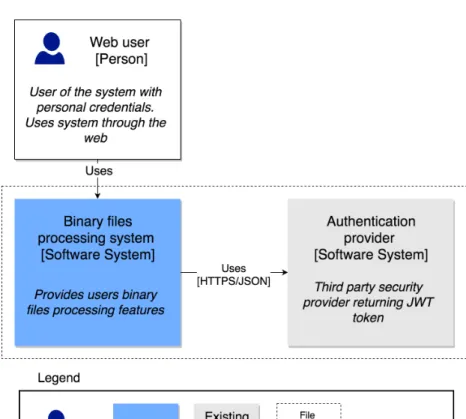
Context diagram of the project is shown in Figure 4.1.
Project described in current work is a web service for binary files process-ing. For authentication it uses third party authentication service.
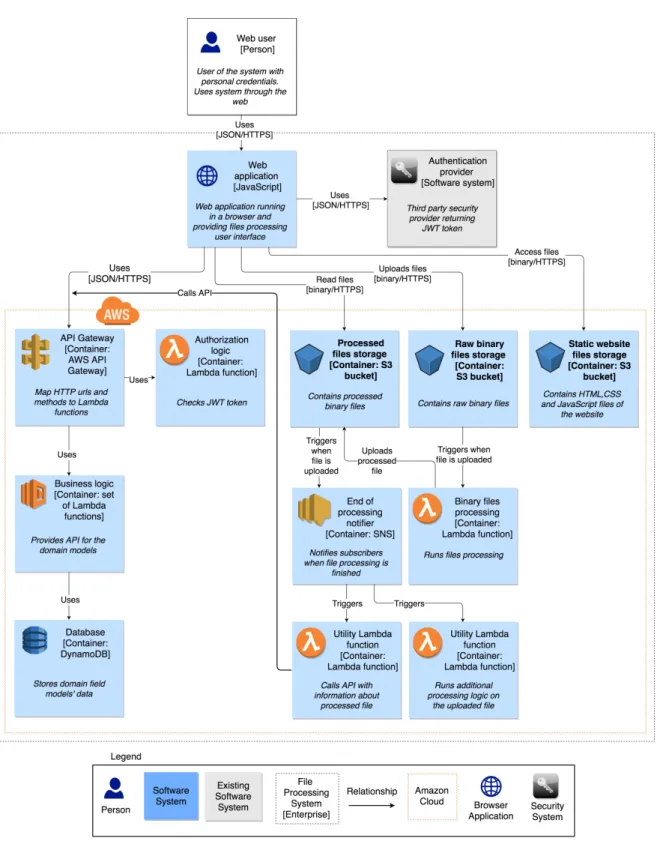
Container diagram shows architecture of the system in more details. All containers except web client should be hosted by Amazon cloud platform and use particular AWS services. Icons inside of the blocks are official icons of Amazon Web Services which correspond to the container names. The case
Figure 4.1: Case project context diagram
project uses following Amazon services: API Gateway1, AWS Lambda2, S33,
DynamoDB4and SNS5. Web client is a web application running in a browser. Component diagram is not presented, because it would repeat container di-agram due to atomic design of Lambda functions where each Lambda is responsible for one particular feature. Code diagram is not presented, be-cause such level of details is not required to make decisions about DevOps pipeline.
Container diagram is shown in Figure 4.2
1https://aws.amazon.com/api-gateway/ 2https://aws.amazon.com/lambda/ 3https://aws.amazon.com/s3/
4https://aws.amazon.com/dynamodb/ 5https://aws.amazon.com/sns/
CHAPTER 4. CURRENT STATE ANALYSIS 30
4.2
Serverless elements of application
archi-tecture
Container diagram shows that all backend logic of the application is stored in AWS Lambda functions. Solutions used for data storage, such as DynamoDB and S3 buckets, also can be considered as Serverless because they do not require any server configuration. It means that case project can be considered as a project with clean Serverless architecture using FaaS and BaaS services. Serverless use cases and design patterns used in the project are described below.
Use case: Use AWS Lambda with AWS ser-vices as event sources
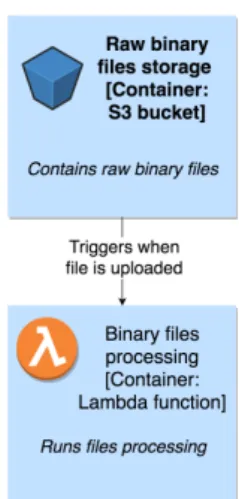
Description: Event source publishes an event that triggers Lambda function. This use case ensures loose coupling between the software components and is popular in event-driven ar-chitectures. In the case project S3 bucket trig-gers Lambda function when file uploading is finished. After that Lambda function can run some business logic to process uploaded file.
Figure 4.3 Event source use case
Use case: On-demand Lambda function invo-cation over HTTPS (Amazon API Gateway) Description: Lambda function is invoked over HTTPS. In this case API Gateway is config-ured to map particular HTTP request on spe-cific Lambda function. This configuration con-tains HTTP method, URL path and authenti-cation type. API Gateway together with AWS Lambda is the most typical way of design and implementation of REST API endpoints with AWS cloud infrastructure in Serverless applica-tions.
Figure 4.4 Lambda invo-cation over API Gateway
CHAPTER 4. CURRENT STATE ANALYSIS 32
Use case: Fan-out pattern
Description: Fan-out pattern is used to dis-tribute a message to all listeners subscribed on its publisher. In the case project SNS triggers two Lambda functions when file pro-cessing is finished. This pattern is also con-sidered as a way to create event-driven archi-tectures and perform multiple operations in parallel.
Figure 4.5 Fan-out pattern
Use case: Custom Authorizer
Description: Custom Authorizer is a design pattern where API Gateway endpoints call Lambda function to authorize the requests. In the case project Lambda function checks that JWT token passed in HTTP header is valid.
Figure 4.6 Custom Authorizer
4.3
Expectations for Serverless Applications
The author of the work interviewed two developers and one manager about their expectations for Serverless architecture of the project. It was done not to evaluate the architecture but to better understand what a motivation to use Serverless is and how it can be considered in design and implementation of DevOps pipeline. The results of interviews are provided below. They showed that expectations and concerns mostly correspond the benefits and potential drawbacks of Serverless architectures explored in section 2.4.
Benefits
• Scalability of the project without additional configuration. The cloud platform takes care of execution of the code and scales it automatically.
• Faster development because there is no need to spend time on server configuration and updates. Cloud provider takes care of it.
• Pay-per-use policy of FaaS allows to save money on idle services.
Risks
• Possible vendor lock-in. But this is a justified risk because of all pos-itive aspects of Serverless. To eliminate it the developers are going to use more interfaces and abstractions in their code which is in general considered as a good practice of coding.
• Serverless and cloud architectures usually expect Infrastructure as Code approach which might require DevOps skills from the developers. Not all developers might be ready to take additional responsibilities. From the other side, nowadays it is a normal practice that the developers expend their skills to DevOps, especially if it matches the culture of the company.
• Debugging can be more complicated because the only real environment of application execution is cloud platform environment. But the good code coverage by unit tests and extensive usage of mocking libraries can help to eliminate this problem.
• Lack of experience with Serverless might lead to some hidden problems. For instance, how to organize the VCS repositories and structure the code.
Even if interviewees were mostly speaking about the risks of Serverless applications, they were still very positive about it. The reason was that the benefits of the usage are worth of taking the risks. And for every risk the developers provided some ideas of how to eliminate it.
Some of the listed benefits and risks affect DevOps decisions. For in-stance, IaC might require organizing of the code in a certain way - i.e., store the infrastructure code together with business logic code. Serverless functions debugging limitations increase the necessity of unit tests and their automatic execution after every commit. Fear of vendor lock-in is raised be-cause of extensive usage of external services provided by cloud platform. All integrations should be tested with the help of mocking libraries at the unit tests stage and also at the stage of end-to-end tests in the production-like environment.
CHAPTER 4. CURRENT STATE ANALYSIS 34
4.4
Elicitation of requirements for DevOps
pipeline
As was described in section 3, to elicit requirements for DevOps pipeline the author organized workshop within the case company where it was proposed to discuss CI, CD and Monitoring practices for the project and gather the opinions of participants how does Serverless architecture affect these prac-tices.
All practices were grouped into five categories: Source Control, Build Process, Deployment, Testing & QA and Monitoring. For each practice the participants discussed Implementation ideas, answered the question how does Serverless architecture affect practice implementation and estimated how im-portant the practice is.
In addition to the workshop, the author interviewed two developers and one QA engineer outside of the case company and asked their opinion how does Serverless architecture affect DevOps practices. In the beginning of the workshop and interviews author made sure that by Serverless participants understand extensive usage of FaaS services and cloud databases provided by third-party cloud platforms. Following sections present the results of the workshop and provide summary table with practices sorted by importance for the case project.
The only one technical requirement for DevOps pipeline was the usage of GitLab Community Edition platform because it was already in use in the company and preliminary analysis showed that it can be used for Serverless applications as well. Implementation of the case project is done with Node.js framework which affects the choice of unit test and mocking libraries.
4.4.1
Source Control
VCS is used to store code history and share the code
Serverless influence: Serverless architecture affects the decision of how many code repositories to create. In case of monolithic architec-ture, the source code is tightly coupled and is usually stored in a single repository. Serverless architecture expects presence of multiple deploy-able units or functions that can be completely isolated from each other. Source code of these deployable units, for instance, of AWS Lambda functions, can be stored in multiple repositories with one repository per function approach or in one single repository for all functions. One more approach is to create several repositories, each of which will store
multiple functions based on their purpose or domain field.
Implementation ideas: VCS should be Git since it has very efficient branching model and team already has an experience with Git and GitLab. A number of created repositories should be defined based on the good practices of Serverless applications code maintenance.
Branches are used for isolating work
Serverless influence: Branching model does not depend on the ar-chitecture of the application. It can be the same for applications with monolithic, microservice or serverless architecture. The team can de-cide to use only master branch or extensively use feature branches depending on the team work practices.
Implementation ideas: Every feature and bugfix should be done in a separate branch. In addition, personal forks can be used to hide personal branches. Merges should be performed often to avoid merge conflicts.
Pre-tested merge commits
Serverless influence: As in the case of branching model, practice with pre-tested merge commits is not affected by Serverless architecture. Implementation ideas: GitHub open source development through merge requests can be used as a reference. Every merge request can be merged only after the unit tests were successfully executed. GitLab supports this feature.
All commits are tied to the tasks
Serverless influence: Fulfillment of this practice is ensured only by Git commit message conventions and integration with issue tracker. Implementation ideas: Issue management system and VCS should be connected to bind tickets and commits. Jira and GitLab can have such integration. Team should decide about Git messages conventions to connect the commits to the tickets.
CHAPTER 4. CURRENT STATE ANALYSIS 36
Version control DB schema changes
Serverless influence: Serverless approach does not affect this prac-tice. Schema changes should be stored as IaC and be launched before deployment of the new version automatically.
Implementation ideas: DynamoDB does not require version control of schema changes since it is a flexible NoSQL DB.
Release notes auto-generated
Serverless influence: Release notes content depends on how Server-less functions are grouped. In case if they are stored in separate repos-itories, then release notes can be unique for each function. If they are grouped, then release notes describe a set of functions or even all functions.
Implementation ideas: Each release version should be tagged with a Git tag. Tag creation can run a script to gather commit history and put it into release notes.
4.4.2
Build Process
Build process is run automatically on commit
Serverless influence: Build process triggering does not depend on the software architecture. It depends only on the build automation system.
Implementation ideas: GitLab Runners can be triggered right after the commit to run the build process.
Build artifacts are managed by purpose-built tools, no manual scripts
Serverless influence: In case of Lambda functions artifact is a zip archive. Purpose-build tools such as Terraform and CloudFormation should support management of the artifacts. Serverless affects what kind of purpose-built tools to use and how to store and deploy the artifacts.
Implementation ideas: Build artifacts can be managed by IaC tool such as CloudFormation or Terraform and stored in AWS S3 buckets.
All artifacts have build versions with major version and commit or CI build number
Serverless influence: Instead of API versioning Lambda functions usually have their own version number and alias. It affects the version-ing policies and the way how Lambda functions are called.
Implementation ideas: Every service and Lambda function zip archive should have a major and minor version. In addition, they should have a CI build number suffix.
Dependencies are managed in a repository
Serverless influence: Dependency management of Serverless func-tions has no differences with non-serverless project. The tools depend on the using language.
Implementation ideas: All project dependencies and their versions should be defined and stored in VCS.
Build environment based on VMs
Serverless influence: Serverless functions can be built inside of the VMs or Docker containers as all other project types. Serverless does not affect this practice.
Implementation ideas: GitLab Docker Runners can be used to pro-vide build containers that can be easily updated and reused.
4.4.3
Testing and QA
Automatic unit testing with every build
Serverless influence: Triggering of unit tests does not depend on project type or architecture. It depends on the CI system.
Implementation ideas: Test stage of GitLab CI should be run after each commit.
Code coverage and static code analysis is measured
Serverless influence: Code coverage and static code analysis tools are not affected by Serverless architecture, but atomic nature of Serverless
CHAPTER 4. CURRENT STATE ANALYSIS 38
raises a question: should code coverage and static code analysis be mea-sured for every Lambda function separately or for the set of Lambda functions of the same domain group.
Implementation ideas: Code coverage and static code analysis tools should be chosen depending on the project programming language.
Peer-reviews
Serverless influence: Serverless architecture does not affect peer-review practices, but number of peer-review requests may be increased be-cause of fragmented codebase in case if every function is stored in sep-arate repository.
Implementation ideas: Peer-reviews can be implemented using Git-Lab merge request feature.
Mockups & proxies used
Serverless influence: Mockup and proxy libraries are used more extensively. The code should be designed to support mockups, e.g., through the use of interfaces.
Implementation ideas: Mockup and proxies libraries should be cho-sen depending on the project programming language and used cloud services.
Automated end-to-end testing
Serverless influence: Since many of the functions are event-driven and are called asynchronously, writing end-to-end tests might be more cumbersome comparing to non-serverless computing. On the other hand, triggering end-to-end tests does not depend on the architecture and depends only on CI automation system. In addition, end-to-end tests execution price should be calculated to avoid extra cost. High price of execution and as well as long running time might be the reason to run the tests nightly.
Implementation ideas: End-to-end tests should be triggered auto-matically or manually from the CI system. The decision should be based on test execution price and duration.
Integrated management and maintenance of the test data
Serverless influence: Serverless architecture affects the decision of how to organize the test data. Atomic Lambda functions create a risk of duplication of the test data. For instance, if multiple Lambda func-tions work with the same database, then database initial test data has to be duplicated in all functions. Decision to store Lambda functions of the same group in one VCS repository can help to share test data among several Lambda functions. At the same time, test results man-agement and maintenance are not affected by Serverless architecture and depends on the chosen CI solution and testing framework.
Implementation ideas: Test data should be stored within the project repositories. Lambda functions code should be organized in a way to avoid test data duplication. Test reports can be stored in GitLab CI as the artifacts.
Automated performance & security tests in target environment
Serverless influence: The nature of Serverless computing make the production-like deployment possible only on infrastructure of the cloud provider.
Implementation ideas: Performance and security testing should be done in production-like environment using separate AWS account.
4.4.4
Deployment
Fully scripted deployments
Serverless influence: Serverless architecture influences a choice of cloud provider and deployment tool. Deployment tool should be scripted in a certain way.
Implementation ideas: Deployment of Lambda functions can be done with CloudFormation, Terraform or Serverless Framework tool. Any of these tools can be run by GitLab CI.
Auto deploy to the test environment after tests pass
Serverless influence: Script triggering depends on CI pipeline tool and does not depend on the architecture of application. At the same time, if the team decides to keep all Lambda functions in separate
CHAPTER 4. CURRENT STATE ANALYSIS 40
repositories with their own deployment scripts, it can make the deploy-ment of the project more cumbersome.
Implementation ideas: Deployment stage of GitLab CI pipeline should be triggered only after the test stage was passed.
Standard deployments for all environments
Serverless influence: Serverless environment depends on cloud provider. How exactly functions will be deployed depends on the Serverless archi-tecture. On-premises Serverless solutions such as Kubeless and Open-FaaS can help to avoid testing environment and vendor lock-in problems but they would also require resources on server maintenance nullifying time-saving benefits of third party provider usage.
Implementation ideas: Infrastructure provisioning should be done with a help of IaC tools: CloudFormation or Terraform. The project should be deployed directly to the cloud but to different stages or even accounts.
Database deployments
Serverless influence: Serverless databases make database admin tasks unnecessary. Only schema changes or query changes are required. In case of NoSQL databases even schema changes are not required. Implementation ideas: DynamoDB database will be deployed to the cloud as all other services. It also does not require database schema migrations, because it is NoSQL DB.
4.4.5
Monitoring
Serverless influence: Serverless logging capabilities are tightly coupled with the logging tools provided by the host platform. They even can be limited by them.
Log aggregation
Implementation ideas: AWS Lambda is automatically integrated with Amazon CloudWatch. All logs per one function/version are ag-gregated into CloudWatch group.
Finding specific events in the past
Implementation ideas: Use CloudWatch search feature that allows to search Log Groups, Log Streams and specific events within the Log Streams.
Large scale graphing of the trends (such as requests per minute)
Implementation ideas: Use CloudWatch Metrics that allow to cus-tomize dashboard with different metrics such as latency, calls counter, amount of errors, etc. For better visualization the tools such as Grafana can be used. It can be integrated with CloudWatch and provide better user experience comparing to the native Metrics tool.
Active alerting according to the user-defined heuristics
Implementation ideas: Use CloudWatch Alarms tool that allows to create alarms based on Metrics values. The alarm performs one or multiple actions based on the value of the chosen metric. The action can be a Lambda function call or a notification sent to Amazon SNS topic leading to email sending.
Tracing
Implementation ideas: Use Amazon X-Ray tool that allows to trace event sources that invoked Lambda functions or trace downstream calls that function made.
4.5
Results
The results of the workshops and interviews are summarized in the Table 4.1. The column ”Importance” answers the question ”How important is implementation of the practice for the case project”. The result value is the average of the grades given by the participants of the workshop where 0 means ”does not affect at all” and 10 means ”strongly affects”. The column ”Affected by Serverless” answers the question ”Is implementation of this DevOps practice affected by Serverless architecture”. In case if at least one person said ”yes”, it was marked as ”Yes”.
The results of the workshop and interviews showed that usage of Server-less architecture affects more than half of suggested DevOps automation practices:
CHAPTER 4. CURRENT STATE ANALYSIS 42
Practice Category Importance Affected by
Serverless VCS is used to store code history and
share the code
Source Control 10 Yes
Log aggregation Monitoring 10 Yes
Build process is run automatically on com-mit
Build Process 9 No
Build artifacts are managed by purpose-built tools, no manual scripts
Build Process 9 Yes
Dependencies are managed in a repository Build Process 9 No Automatic unit testing with every build Testing & QA 9 No Automated end-to-end testing Testing & QA 9 Yes
Fully scripted deployments Deployment 9 Yes
Standard deployments across all environ-ments
Deployment 9 Yes
Finding specific events in the past Monitoring 9 Yes Active alerting according to the
user-defined heuristics
Monitoring 9 Yes
Branches are used for isolating work Source Control 8 No
Peer-reviews Testing & QA 8 No
Mockups & proxies used Testing & QA 8 Yes Large scale graphing of the trends (such
as requests per minute)
Monitoring 8 Yes
Tracing Monitoring 8 Yes
Pre-tested merge commits Source Control 7 No
All artifacts have build versions with ma-jor version and commit or CI build num-ber
Build Process 7 Yes
Build environment based on VMs Build Process 7 No Code coverage and static code analysis is
measured
Testing & QA 7 Yes Integrated management and maintenance
of the test data
Testing & QA 7 Yes Automated performance & security tests
in target environment
Testing & QA 7 Yes Auto deploy to the test environment after
tests pass
Deployment 7 Yes
All commits are tied to tasks Source Control 6 No
Database deployments Deployment 6 Yes
Release notes auto-generated Source Control 3 Yes Version control DB schema changes Source Control 0 No
• 2 out of 6 source control practices
• 2 out of 5 build process practices
• 5 out of 7 testing and QA practices
• 4 out of 4 deployment practices
• 5 out of 5 monitoring practices
18 out of 27 practices in total are affected by Serverless Ar-chitecture
Such a significant impact of Serverless architecture on DevOps practices proves the relevance of current research work.
The participants of the workshop proposed to implement the practices that have a grade of Importance not less than 5. This criterion left only two practices out of scope of the developing DevOps pipeline. It proves that company requires reliable DevOps pipeline which would include almost all discussed practices and would guarantee high quality of the code through build process, QA and deployment automation, source control and monitor-ing.
The input condition for the DevOps pipeline was the usage of GitLab Community Edition. The AWS-based architecture of the case project also applied some limitations on the future DevOps pipeline such as usage of certain IaC tools and AWS cloud platform by itself. Node.js as the project implementation technology affects the choice of unit testing frameworks and mocking libraries. Jira was chosen as a project issue tracker that affects only one practice: ”All commits are tied to tasks”. No limitations for the cost of the pipeline execution were announced. The research plan expects two months of work on design and implementation of DevOps pipeline.
![Table 2.3 shows summary of testing and QA practices in existing litera- litera-ture. DevOps: A Software Ar-chitect’s Per-spective [6] The DevOps Handbook[31] PracticalDevOps[50] ContinuousDelivery[29] CD: Maturitychecklist[37]](https://thumb-us.123doks.com/thumbv2/123dok_us/9322002.2810761/16.892.154.818.682.1026/practices-existing-software-spective-handbook-practicaldevops-continuousdelivery-maturitychecklist.webp)