Headend Deployment Strategy
This paper describes the flow of the live content delivery
from the Headend to the customer premise equipment.
It also highlights the major issues encountered in
designing an IPTV Headend and discusses the
implementation of Headend for a variety of integration
scenarios. The paper elaborates on TCS’s expertise to
provide a Headend solution and the various decision
points that will enable the service provider inaugurate
the delivery of IPTV services.
With a continuously changing business scenario in the TV
market, Telco’s are looking to purchase or develop
cutting edge solutions to remain competitive and bring
down the cost of operation. As IPTV’s accessibility
depends on the network technology, the network
architecture used to deploy IPTV is vital. Content delivery
requires bandwidth and performance, not
only in the last mile (the access network), but also
in the edge, core of the network and in the
customer premises.
The IPTV reference architecture is a model designed by
the TCS IPTV team for Headend deployment. This model
provides the framework to overcome the challenges
encountered for deploying the IPTV solution. The
reference architecture model goes beyond system
integration by creating standards for flow of business
events and processes from one application to another.
The Headend deployment strategy suggested in this
paper will help Telco’s in establishing a common view of
the complex business entities, rocesses, and challenges
that they could come across in the IPTV deployment.
About the Author
Sanjay Ferro
Sanjay Ferro has been working with TCS since 2007. Sanjay holds a Bachelors degree in Electronic Engineering and a post graduate in Business Administration.
Sanjay has several years of experience in Television and Broadcasting systems, Wire-line/Wireless Telecommunication, IT and Networking, Installation and testing of
transmission equipments.
Sanjay as an IPTV Solution Architect and as a part of TCS IPTV initiative has designed various reference architectural models in the IPTV end-to-end gamut. Sanjay is also developing various assets in the IPTV space. Additionally, he has experience in managing various consulting engagements.
Table of Contents
1. Introduction To IPTV 4
2. Overview of IPTV Headend 4
Content Acquisition and Compression System 5
Middleware System 6
VODSystem 6
DRM System 6
OSS/BSS 6
HMS And Monitoring 6
3. A Bird’s Eye vew of the IPTV Components 7
4. Challenges in an IPTV Headend Deployment 7
5. Quality of Experience 8
6. TCS’s Capability In IPTV Business 9
TCS’s Headend Deployment Services Deliverables 10
Consulting 10
Project Management 10
Execution of Project Plan 10
Procurement Process 10
Architecture and Design 10
Contract Management 10
Change Management 10
Introduction to IPTV
Overview of IPTV Headend
Television is called as the “75-year-old killer application”. Internet Protocol Television (IPTV) is a digital television service distributed using IP network. Here IP network is predominantly the same kind of network that we use to surf the internet and send emails.
IPTV delivers enhanced video applications over a managed or dedicated network to the TV through broadband connection. IPTV also capitalizes on the two way nature of the IP network by providing an unprecedented interactive medium for subscribers.
In veracity, an IP network can deliver much more than television channels. Using IPTV network technology, a service provider can easily distribute terrestrial, radio and live satellite channels, digital videos on demand and other value added services such as Video conferencing, TV chat, TV mail, Games, TV banking, Reminders , Internet browsing on TV and many more value added services through the network infrastructure.
IPTV technology enables service providers to deliver unlimited content and functionality that has not been available previously on TV.
WithHeadend is a master facility for receiving television signals for processing and redistribution over a television service provider’s network.
Most channels are delivered to the Headend through satellite. The channel broadcaster modulates and transmits the signal to a satellite in geosynchronous orbit from an uplink facility (Satellites that orbit the earth's path are at a fixed position some 22,300 miles above the surface of the earth). The satellite then retransmits the signal back to dish antennas, which are installed at the service provider’s Headend site. The signal received by the parabolic surface of the antenna is redirected to the feed system and to the low noise block converter (LNB) of the dish antenna. The LNB that resides on top of the feed horn amplifies the signals and delivers them to the Headend through a coaxial cable. Broadcasters scramble and encrypt most of the transmitted satellite signals. Satellite receivers installed in the Headend decode these satellite signals using a smart card that the broadcasters provide. The satellite Integrated Receiver and Decoder (IRD) have the ability to decode or decrypt the scrambling of a particular format or type of signal built in IRD. The satellite receiver typically converts the signal to a base band audio and video signal or to a Serial Digital Interface (SDI) stream. This signal is further then compressed using an encoder. After encoding, each channel is encapsulated into IP and sent through the network. The compressed signal could be encrypted with a Digital Rights Management (DRM) technology. The signal is then streamed to the customer’s Set-top Box (STB) through the network infrastructure of the television service provider. The STB then decodes the available stream. The subscribers finally view the decoded content on the television that is connected to the STB.
Generally, it is perceived to have multiple Headends to deliver video services through an IP network considering the extent of personalization required in IPTV. To fulfill minimum Quality of Service (QoS) requirements, a single Super Headend will not suffice unless the service provider has huge bandwidth capability to deliver IPTV services through the network
If visualized broadly, the distance from one part of the State/Country to the other is in the range of few thousands of kilometers with long-haul underground optical fiber networks connecting them for telecommunication purposes. These cables are prone to multiple cuts at sporadic intervals, sometimes even requiring 24 hours for the splicing process to get the network back running.
If there is only one Super Headend serving the entire State/Country, then any damage to the optical fiber will isolate the region and affect the services of the region. Moreover, the required bandwidth to connect the different parts of the State/Country with a single Super Headend will be huge and any problem in the network will seriously hamper the end-user experience.
A distributed Headend architecture is ideal in this situation. Here, individual Headends will have their own compression system enabling broadcast of a particular channel list catering to the regional market segment. These Headends will also host regional Video on Demand (VoD) servers housing the local content and localized advertisements. The Middleware and Value Added Services (VAS) application servers will also be decentralized to cater to localized applications.
The decentralized Headend architecture may be adopted by large Tier 1 Telcos that serves the entire Country/States within the country. Whereas Telcos/MSO who target specific region with these services will prefer a Super Headend serving that region.
IPTV Headend System comprises of the following major elements: Content Acquisition and Compression System
Middleware System VoD System
DRM System OSS/BSS
HMS and Monitoring
Content Acquisition and Compression System
Content acquired from the broadcasters and content distributors will be aggregated at the Headend location for conditioning, repurposing and retransmitting the broadcast signal through the network infrastructure of the service provider. The compression system built in the Headend will transmit the compressed signal with enhanced compression technique based on the network requirements of the service provider. The compression system consists of the Dish Antenna farm, L-band system, power dividers, satellite receivers, IRD's, SDI/AV routers and encoders.
n n n n n n
Middleware System
IPTV middleware acts as the central system that controls the interaction of IPTV components from the Headend to the set-top boxes at the subscriber premises. The middleware system offers subscribers a rich, reliable and personalized viewing experience on their television sets for broadcast and on-demand services. The IPTV middleware is integrated with OSS/BSS through APIs to enable creating services, provisioning and billing. The middleware system supports the following major functionalities: User authentication and authorization
DRM
Billing and Mediation
Management interfaces for users, services, channels, packages and programs EPG Management
Subscription Management
Broadcast TV, Video-on-Demand, Personal Video Recording and interactive services Service statistics
VoD System
VoD ( Video on Demand) enables subscribers to view the movie content of their choice through an on-screen movie guide and thereby also control the streaming sessions with VCR-like functions such as stop, pause, fast-forward and rewind. This service also gives subscribers the liberty to view the movie as per their leisure time.
DRM System
DRM (Digital Rights Management) technology can restrict user’s access to live channels, movies, music, and literature, indeed all forms of digital data. It is primarily used for authentication of subscribers. DRM can support a richer set of business rules that can be implemented because of a wide variety of services that IP networks support and also the bi-directional nature of IPTV networks.
OSS/BSS
The OSS/BSS has a vital role to play in the customer databases as all subscriber information is defined within this system. This system not only defines and monitors the customer activity but also keeps track of all billing module defined for each and every subscriber. The system is designed in such a manner that it provides open interfaces for integration with high-level centralized billing systems and other
management platforms. The event detail records (EDR) generated by the middleware are sent to the mediation system of the billing system where they are processed and rated. The content packaging and pricing information is delivered into the billing system through the middleware APIs.
HMS and Monitoring
The Headend/network management system (HMS) monitors and configures all active equipments of the Headend and Network. The HMS supports the operation, configuration and redundancy of all the Headend components. n n n n n n n
A Bird’s Eye View of the IPTV Components
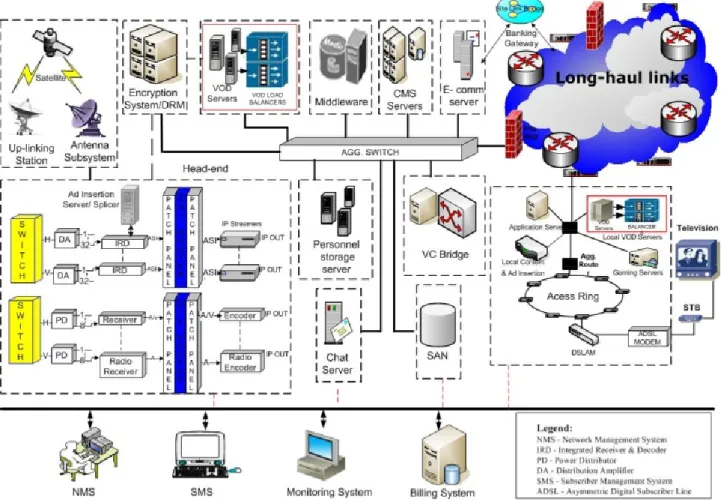
The following architectural layout depicts the components that could build up the eco system of an end-to-end IPTV deployment. This reference architecture is a high-level overview and, in reality, many IPTV subsystems and vendor specific architectures are required to make each incarnation of IPTV unique and of varying complexity.
TCS's IPTV Strategic Initiative team has created a reference IPTV deployment architecture module. This reference module offers a complete range of IPTV services that meets the requirements of Tier I, II and III Telecom service providers who want to pursue the IPTV business. The reference module enables service providers to develop a new and unique solution to differentiate offerings from their competitors.
The challenge in an IPTV Headend deployment is to obtain the highest quality video in the lowest network bandwidth. Popular video compression techniques such as Flash, MPEG-2, and H.263 have been surpassed by the newer H.264 standard, which has 2 to 3 times more compression capabilities. Also, IPTV network
Challenges in an IPTV Headend Deployment
Other challenges in deploying IPTV Headend are as follows:
n Integrate different vendor products and manage/monitor the components with a single Headend
Management system (that is, Multi-component Interoperability).
n Reduce the channel zap time while switching different channels.
n Migrate pre-deployed Headend components from MPEG-2 to MPEG-4 AVC.
n Cost-effectively deliver video services over service provider’s current DSL networks (that is, Network and
Infrastructure Readiness).
n Manage the network bandwidth.
n Overcome barriers that DSL providers face in supporting video applications protocols while upgrading
their current network infrastructure.
n Deliver services in a more proficient, reliable, flexible manner designed on open standards.
To create the television experience that viewers are accustomed to, the network infrastructure must provide a delivery medium that is free from glitches, lockups, dropouts and other problems. This could be
accomplished by ensuring that the network is designed and scaled in such a manner that there is sufficient bandwidth availability and distinguished ability to handle the services for the broadcast-quality streaming video.
Quality of Experience (QoE) is the suitability of an application or service as perceived subjectively by the end-user. QoE plays an essential role in the marketplace success of IPTV services and is expected to be a key differentiator with respect to other competing service offerings. Subscribers to network services do not care how service quality is achieved, what matters to them is how well a service meets their expectations for effectiveness, operability, availability, and ease of use.
To ensure timely delivery of IP packets, QoE is critical. Various exclusive features may attract consumers, but video quality is a must to sustain customer loyalty. QoE is an evolutionary step taken which is required beyond Quality of Service (QoS). It incorporates important elements such as maximum delays in transport of IP streams and minimizes the difference between transport times for individual IP packets (jitter).
QoE also includes a decisive factor for minimum downtimes and maintenance intervals, providing
reasonable channel change times, and guaranteeing availability of on-demand services, interactivity, and delivery of networkbased services such as time-shifted viewing with VCR-like functionality. To meet viewer expectations for highquality services, QoE must be sustained across the entire IPTV architecture, from
content source through delivery to multiple devices until the customer home. This level of controllability and diagnostic capability requires a management protocol that extends beyond service provider access to devices used by the customer.
TCS’s Capability in IPTV Business
TCS's IPTV Strategic Initiative team has developed an approach to cater different requirements of Telecom Service providers who want to pursue the IPTV business. The approach broadly categorizes four key areas namely Network, Content, OSS/BSS and VAS. The following decision points recline under these areas to help service providers inaugurate delivery of IPTV service in an increasingly secure, scalable and cost effective manner.
Network
Levels of investment Access network readiness Choice of STB
Middleware integration Network planning and design Network testing
Time to market for launch
Content
Content Management strategies Compression Technologies DRM
Meta data management
Content delivery network (CDN) planning and commissioning CDN testing
Targeted advertising
Content management process and solution Media asset management process and solution STB testing and support
OSS/BSS
Content acquisition and management Content billing
Service assurance QoE monitoring SLA Management Real time fulfillment Assurance/Billing
Business intelligence on viewing patterns Integration and testing
Revenue assurance n n n n n n n n n n n n n n n n n n n n n n n n n n n n
VAS
Application business case development Proof of concept
Time to market Testing
Life cycle management
6.1 TCS’s Headend Deployment Services Deliverables
The service deliverables for the Headend deployment are as follows.
Consulting
A consultant will assess the network and systems readiness, develop a roadmap for readiness and system rationalization strategies, and develop content and partner strategies.
Project Management
A TCS Project manager will be available at the customer’s site to plan, coordinate, and manage deployment activities during all phases of the project. The Project Manager will have an exclusive role and will be dedicated during the execution of the project.
Execution of Project Plan
TCS will prepare a detailed execution plan based on the understanding of the requirements for the Headend deployment. The project plan will also track all the milestones, tasks, and dependencies for the project.
Procurement Process
TCS will implement a detailed phase-by-phase Headend component procuring process, which would track the procurement and delivery of materials.
Architecture and Design
TCS will plan and prepare the architectural flow of the Headend, create chassis layouts, develop rack elevations and wiring schematics, create final bill of materials (BOM), and determine demarcation and test points.
Contract Management
Contract management procedures will provide a framework to oversee implementation of the contract, address the required contract changes and provide a mechanism to manage disputes.
Change Management
Change Management will manage the modifications to the design, BOM, schedule, scope, budget, and deliverables of project. n n n n n
Risk Administration
Risk Administration will manage the risks associated with the project, analyze major risks and suggest mitigation plans, and manage escalation as necessary.
Relationship Management
Relationship management involves identifying the shared vision of the engagement, identifying value creation opportunities, monitoring adherence to the set goals and mitigating risks.
Escalation Management
Critical issues that are not resolved in the required timeframe will be escalated to the Project management chain to ensure quick resolution.
Onsite Installation
TCS will install the Headend components onsite and perform final cabling and wire-listing.
Configuration and Commissioning
TCS will configure individual devices and perform performance analysis on the commissioned components ensuring efficient performance of the system stability of the components.
Acceptance Testing
TCS will perform system testing using a proposed test plan with the service provider’s participation for final acceptance.
Handover of the site
TCS will train and arrange knowledge transfer sessions for the personnel assigned by the service provider. The training will cover the functional and technical aspects for the solution deployment at the customer site.
Digital content, once produced, can be delivered through an arbitrary digital transmission system to an arbitrary consumer device. However, the key concern is to deploy Headend architectures that are more proficient, reliable, and flexible based on open standards.
TCS will extend its efforts beyond the traditional value chain to develop and deploy IPTV solutions for customers across the world. TCS's IPTV Strategic Initiative team has leveraged its experience in the IPTV domain and has formulated an approach to deliver the best possible service to meet the client’s business needs within the agreed resource levels, that is, a service that is professional, cost effective and with risks that can be understood and managed.
11
I
IT Services
Business Solutions Contact
For more information, contact [email protected] About TCS IPTV Strategic Initiative Group
TCS' IPTV Strategic Initiative has been at the forefront to drive the new wave of Telco and Cable business through IPTV services with the objective to be a trusted partner in delivering IPTV solutions that are efficient (value for money) and effective (meet the business need with built in futurity). TCS IPTV offerings are categorized into the key functional domains of Network, Content, OSS/BSS and VAS, and spread across the entire spectrum of services from consulting to IT services to BPO. TCS has invested in an IPTV Lab in Hyderabad, which is fully equipped with facilities to train, demonstrate and brainstorm. The team focuses on building assets and alliances, executing projects and training people to serve multiple customers across the globe
About Tata Consultancy Services (TCS)
www.tcs.com
Tata Consultancy Services is an IT services, consulting and business solutions organization that delivers real results to global business, ensuring a level of certainty no other firm can match. TCS offers a consulting-led, integrated portfolio of IT and IT-enabled infrastructure, engineering
TM
and assurance services. This is delivered through its unique Global Network Delivery Model , recognized as the benchmark of excellence in software development. A part of the Tata Group, India’s largest industrial conglomerate, TCS has a global footprint and is listed on the National Stock Exchange and Bombay Stock Exchange in India.
For more information, visit us at
Subscribe to TCS White Papers
TCS.com RSS: http://www.tcs.com/rss_feeds/Pages/feed.aspx?f=w Feedburner: http://feeds2.feedburner.com/tcswhitepapers