Calhoun: The NPS Institutional Archive
Institutional Publications Institutional Publications (Other)
2011
NPS Distance Learning 2011, Draft
Naval Postgraduate School (U.S.)
Monterey, California: Naval Postgraduate School. http://hdl.handle.net/10945/4043812/19/11
1
NPS Distance Learning 2011Summary
NPS is scheduled to provide the Western Association of Schools and Colleges, WASC, an interim report to include a section related to the NPS distance learning activities in March of 2014. As an effort to facilitate the interim WASC report, “NPS Distance Learning 2011” is the first of a series of annual reports that records and reports about NPS distant learning. The report is organized into the sections: 2011 – Notable Changes, Budget, Programs, Faculty, Students, and Support. Each of the sections contains data regarding performance, includes narrative regarding processes and support, and references the WASC guidance.
WASC guidance derives from two documents the WASC “Policy on Distance Education and on
Correspondence Education” and the WASC “Guideline for the Evaluation of Distance Education (On-line Learning). “ WASC defines distance education as “Education that uses one or more of the technologies …. to deliver instruction to students who are separated from the instructor and to support regular and substantive interaction between the students and the instructor, either synchronously or
asynchronously.”
The sections of the “Summary” - Programs, Faculty, Students, Support, Budget - provide a brief set of highlights from the full report. The full report contains the supporting charts, graphs, and tables.
Programs
Distance Learning Advisory Council (DLAC) - One direct result of the WASC self-study was the recognition that the development of DL programs at the departmental level was “disruptive” to established institutional policies and practices and that systematic normalization of DL policies would create an improved experience for faculty, staff, and students. In 2011 the Distance Learning Advisory Council, DLAC, was formed under the cognizance of the Vice Provost of Academic Affairs to sustain continuous improvement in the quality and relevance of the NPS Distance Learning, DL, enterprise.
Need Driven Programs - Programs at NPS continue to be need driven and supported by DoD sponsors who take a partnership role during the life of a program. New curricula are started when a “sponsor” identifies an educational need. Because programs are “need” driven they may begin as four course certificate programs and then grow to full degrees with initial iterations in residence and later moving to the DL environment. In FY11 1 new DL program, Master of Human Systems Integration, was started.
DL Delivery Technology - NPS DL courses are provided using a variety of methods including
synchronously, asynchronously, and with faculty embedded in locations remote to NPS Monterey. The clear technological trend is moving to Elluminate.
DL Class Size - Approximately 37 percent of the DL classes have less than 20 students and 56 percent have 20 to 30 students. Classes taught in residence tend to be smaller with 76 percent having less than 20 students.
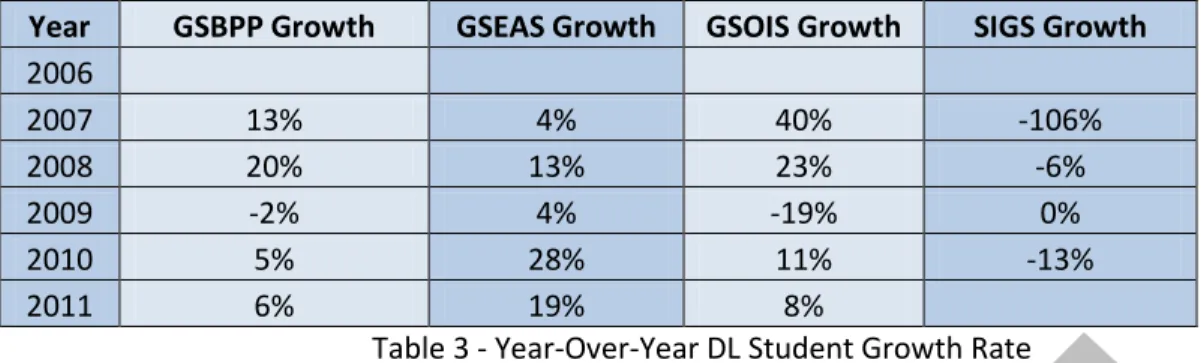
Student Growth –The year over year growth rate from 2010 to 2011 for GSBPP was 6%, GSEAS 19%, GSOIS 8%, and SIGS reported no DL in 2011.
12/19/11
2
FacultyTenure or Non-Tenure Track - When compared to resident sections taught, 30% more DL sections are taught by non-tenure track faculty.
Degree Level - When compared to resident sections taught, 26% more DL sections are taught by faculty holding Masters degrees.
Students
Career Limitations – DL is agood choice of advanced education for officers in aviation, special
operations, and undersea warfare that cannot include time to attend a residence degree program while maintaining the skill proficiency needed to successful fulfill their Naval duties.
DL Student communities - For academic year 2011 65 percent of the DL student population were civilians.
NPS serves students worldwide - Although the vast majority of the approximately 1100 DL students are located in the continental US, NPS DL serves students worldwide.
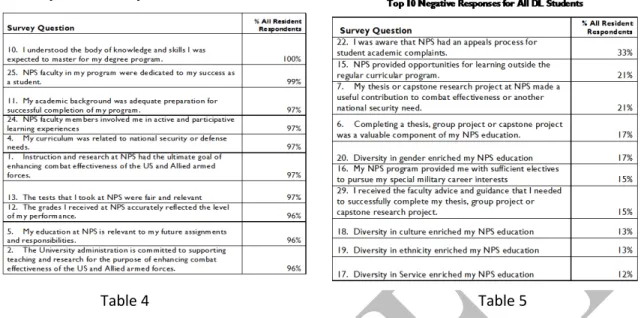
Capstone Project - 79% of NPS DL students believe their thesis or capstone project contributed to security or combat effectiveness and 83% believe their thesis or capstone project was a valuable component of their NPS education.
Faculty Support - 85% of NPS DL students believe they received sufficient faculty advice or guidance in their thesis or capstone process.
Graduation Rate – DL cohorts that started in 2008 had a 64% graduation rate at the 2 year point and it is expected that at the 5 year point approximately 80% will graduate. Resident cohorts starting in 2008 have an 89.3% graduation rate at the 2year point and it is expected that approximately 91% will graduate at the 5 year point.
Support
Consolidation of DL support services - In FY11 NPS established a policy that all new DL programs consult with the Center for Educational Design, Development, and Distribution, CED3, regarding DL support. The result has been a consolidation of DL support that resulted in CED3 providing programmatic support services to approximately 90% of all NPS DL programs.
Remote facilities – Remote facilities are typically training rooms or conference rooms at the students command but at Norfolk, San Diego, Pax River, and Arlington NPS is responsible for classrooms and office space with Internet and VTC capabilities.
Dudley Knox Library - DKL has continued the effort begun last year to increase our instruction and outreach to distance students in degree programs. DKL has created DL web pages, tutorials, and takes special effort to communicate with DL students including sending librarians to promote DKL services to classes at remote locations.
12/19/11
3
BudgetMission Funded - NPS is the confluence of education, government, and military and is a Navy base. Unlike public and private universities, NPS is a line item in the Department of the Navy’s budget.
Naval Students - Following Navy FMB guidance, the mission funding that NPS receives for the education of naval officers provides support for active duty Navy and US Marine Corps officers participating in “for credit” education. This includes distance learning degree programs, certificate programs, and individual for-credit courses.
Non-Naval Students – Non-Naval students are required to pay tuition and in FY11 NPS, via CED3, collected $7.7 million of tuition.
12/19/11
4
NPS Distance Learning 2011Introduction
In March of 2011 NPS received a letter from Ralph A. Wolff, President of the Western Association of Schools and Colleges, WASC, reaffirming NPS institutional accreditation and scheduling the next review for 2020 with an interim report due in March of 2014. That letter was the conclusion of a review by WASC and a rigorous NPS self study and reporting process including a review of NPS Distance learning, DL, programs and processes. The letter emphasized continued attention and development to three broad areas and specifically pointed to “strengthen and deepening appropriate infrastructure to support the institution’s rigorous distributed learning program around the world.” Additionally, in June 2011 WASC revised its “Policy on Distance Education and on Correspondence Education” (appendix 2) to reflect the changing federal regulatory environment. The policy specifically defines distance education as follows:
“Distance Education means [34 CFR §602.3]:
Education that uses one or more of the technologies listed in paragraphs (1) through (4) to deliver instruction to students who are separated from the instructor and to support regular and substantive interaction between the students and the instructor, either synchronously or asynchronously. The technologies may include:
(1) the internet;
(2) one-way and two-way transmissions through open broadcast, closed circuit, cable, microwave, broadband lines, fiber optics, satellite, or wireless communications devices;
(3) audio conferencing; or
(4) video cassettes, DVDs, and CD-ROMs, if the cassettes, DVDs, or CD-ROMs are used in a course in conjunction with any of the technologies listed in paragraphs (1) through (3).”
The “Policy on Distance Education and on Correspondence Education” contains the following seven policy elements:
• “development, implementation, and evaluation of all courses and programs, including those offered via distance education or correspondence education, must take place within the institution’s total educational mission.
• institutions are expected to control development, implementation, and evaluation of all courses and programs offered in their names, including those offered via distance education or correspondence education.
• institutions are expected to have clearly defined and appropriate student learning outcomes for all courses and programs, including those delivered through distance education or correspondence education.
• institutions are expected to provide the resources and structure needed to accomplish these outcomes and to demonstrate that their students achieve these outcomes through
12/19/11
5
• institutions are expected to provide the Commission advance notice of intent to initiate anew delivery mode, such as distance education or correspondence education, through the Substantive Change process.
• institutions are expected to provide the Commission advance notice of intent to offer a program, degree or certificate in which 50% or more of the courses are via distance education or correspondence education, through the Substantive Change process. For purposes of this requirement, the institution is responsible for calculating the percentage of courses that may be offered through distance or correspondence education.
• institutions which offer distance education or correspondence education must have processes in place through which the institution establishes that the student who registers in a distance education or correspondence course or program is the same person who participates every time in and completes the course or program and receives the academic credit. This requirement will be met if the institution verifies the identity of a student who participates in class or coursework by using, at the institution’s discretion, such methods as a secure log-in and password, proctored examinations, other technologies and/or practices that are developed and effective in verifying each student’s identification. The institution must also publish policies that ensure the protection of student privacy and will notify students at the time of class registration of any charges associated with verification of student identity [34 CFR§602.17g]. “
In addition to the “policy,” WASC has published “Guideline for the Evaluation of Distance Education (On-line Learning) (appendix 1) which was developed by the Council of Regional Accrediting Commissions (C-RAC). “The Guidelines for the Evaluation of Distance Education (On-line Learning)” is intended to assist institutions in planning distance education and to provide an assessment framework for evaluation teams and for institutions already involved in distance education. The “Guidelines” comprise nine hallmarks of quality for distance education and institutions are asked to include evidence of the extent to which they meet these hallmarks. “The nine hallmarks follow:
1. “On-line learning is appropriate to the institution’s mission and purposes.
2. The institution's plans for developing, sustaining and, if appropriate, expanding on-line learning offerings are integrated into its regular planning and evaluation processes.
3. On-line learning is incorporated into the institution’s systems of governance and academic oversight.
4. Curricula for the institution's on-line learning offerings are coherent, cohesive, and comparable in academic rigor to programs offered in traditional instructional formats.
5. The institution evaluates the effectiveness of its on-line learning offerings, including the extent to which the on-line learning goals are achieved, and uses the results of its evaluations to enhance the attainment of the goals.
6. Faculty responsible for delivering the on-line learning curricula and evaluating the students’ success in achieving the on-line learning goals are appropriately qualified and effectively supported.
7. The institution provides effective student and academic services to support students enrolled in on-line learning offerings.
8. The institution provides sufficient resources to support and, if appropriate, expand its on-line learning offerings
12/19/11
6
“NPS Distance Learning 2011” is written with the WASC policies and guidance in mind and is the first of a series of annual reports that records and reports about NPS distant learning. It provides management information regarding programs and trends and provides material for the March 2014 WASC Interim Report, the WASC Capacity and Preparatory Review of 2020, and the WASC Educational Effectiveness Review of 2022. The report is organized into the sections: 2011 – Notable Changes, Budget, Programs, Faculty, Students, and Support. Each of the sections contains data regarding performance, compares 2010 and 2011, includes narrative regarding processes and support, and references the WASC guidance noted above.
2011 - Notable Changes
Distance Learning Advisory Council (DLAC) – [Guideline points – 1, 2, 3, 7, and 8]
One direct result of the WASC self-study was the recognition that the development of DL programs at the departmental level was “disruptive” to the established institutional policies and practices and that systematic normalization of DL policies would create an improved experience for faculty, staff, and students. The Distance Learning Advisory Council, DLAC, was formed under the cognizance of the Vice Provost of Academic Affairs to sustain continuous improvement in the quality and relevance of the NPS Distance Learning, DL, enterprise. From the DLAC charter:
“• Specific tasks include but are not limited to: • Increasing DL student success;
• Commenting on matters referred to it by NPS leadership;
• Identifying and sharing best practices; • Improving cross-program collaboration;
• Sharing DL assessment efforts and results;
• Sharing strategies to increase program efficiencies; “
The DLAC is composed of four sub-groups: Programmatic Marketing, Operations, Policy, and Academics and all aspects of the campus are represented with the exception of the student body. As a brief overview, the DLAC Programmatic Marketing Group has members from NPS Outreach, CED3, Institutional Advancement, and individual NPS programs. In 2011 the group distributed and collected a SWOT survey and is using that to develop recommendations for areas of co-marketing NPS programs. The Operations group has been equally active and has worked successfully involving members of the Admissions office and DL programs to increase the amount of student information collected via the automated admissions process. The Academic group is currently exploring the differences between the “resident” and “DL” student graduation rates. The Policy group has been productive creating policies regarding tuition and the use of Navy provided money to educate Naval officers.
(DLAC Sharepoint http://sharepoint/dlac/default.aspx )
Consolidation of DL support services [Guideline points – 2, 7, and 8]
Until FY11 programmatic support services for DL students have been established, funded, and provided at the departmental level for some programs and at the institutional level via the Center for Educational Design, Development, and Distribution for others. As noted above in the DLAC section this practice led to inconsistent support across programs. In FY11 NPS established a policy that all new programs consult with the Center for Educational Design, Development, and Distribution, CED3, regarding DL support. The result has been a consolidation of DL support that resulted in CED3 providing programmatic support
12/19/11
7
services to approximately 90% of all NPS DL programs. The expected result is a very high quality student and faculty experience of support services through standardization of processes and procedures. See CED3 under the “Support” section on page 23.
Remote facilities [Guideline points – 3, 7, and 8]
Since NPS provides education to military officers and DoD civilians many DL students attend classes in DoD owned facilities. These are typically training rooms or conference rooms at the students command but at Norfolk, San Diego, Pax River, and Arlington NPS is responsible for classrooms and office space and each location has Internet and VTC capabilities. Each location provides admin and outreach staff. In FY11 the Norfolk location planned for major renovations to be completed in FY12. The San Diego facility is located at the 32nd Street Naval base in a building that is scheduled to be demolished to increase pier space in FY12. When NPS San Diego moves it will be near the 32nd Street location and co-located with the Navy Training and Education Command. The San Diego move is planned to be completed in June of FY12.
Budget
[Guideline points – 1, 2, 3, and 8]
When discussing the NPS budget it is important to note that NPS is established by an act of Congress under TITLE 10 - ARMED FORCES, Subtitle C - Navy and Marine Corps, PART III - EDUCATION AND TRAINING, CHAPTER 605 - UNITED STATES NAVAL POSTGRADUATE SCHOOL. NPS is the confluence of education, government, and military and is a Navy base. Unlike public and private universities, NPS is a line item in the Department of the Navy’s budget. Money is budgeted to NPS from the Department of the Navy and is distributed to NPS Schools, departments, and programs. Additionally NPS provides education to other branches of the military, DoD civilians, and friendly foreign military. Programs at NPS recover the costs of educating students who are not members of the Navy or Marine Corp by collecting tuition and grants. In FY11 NPS, via CED3, collected $7.7 million of tuition.
With regard to the money the Department of the Navy provides NPS, FY11 was a transition year moving distribution of funds from fully funding “programs” with enrollment as a secondary consideration to providing funding based on a Naval student enrollment formula. Following Navy FMB guidance, the mission funding that NPS receives for the education of naval officers provides support for active duty Navy and US Marine Corps officers participating in “for credit” education. This includes distance learning degree programs, certificate programs, and individual for-credit courses. The FY12 approach is to fund individual NPS schools on a per-student-per-course basis. In FY12 NPS’ budget was reduced from FY11 levels and NPS was directed to study methods of increasing its return on investment to the Navy.
12/19/11
8
Programs
[Guideline points – 1, 2, 3, 4, 5, 8 and 9]
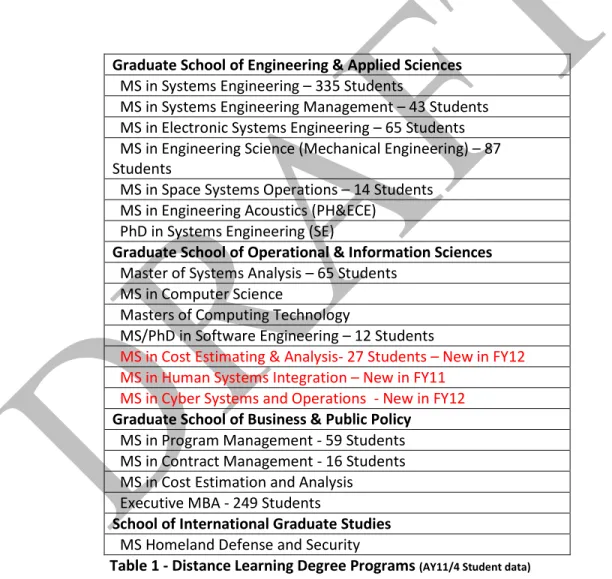
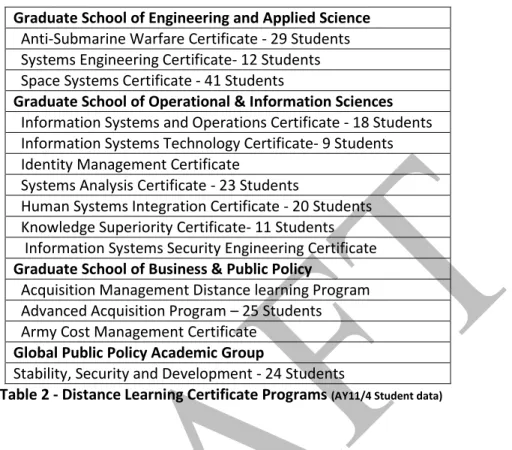
The program section of this report provides information about existing certificate and degree programs; about the lifecycle of NPS programs; about program assessment; and provides programmatic trend data. In FY11 Distance learning (DL) programs continued to be primarily guided by two NPS strategic goals, 1) extending education to the total force, and 2) sustaining continuous improvement in the quality and relevance of NPS graduate education and research programs. To those ends NPS, via DL, delivers (19)
degree programs and 14 Certificate programs (Tables 1 and 2). These programs continue to be fully embedded in NPS’ academic departments and are of comparable quality and subject to the same rigorous standards of review and assessment as NPS’ long-standing resident programs.
Graduate School of Engineering & Applied Sciences
MS in Systems Engineering – 335 Students
MS in Systems Engineering Management – 43 Students MS in Electronic Systems Engineering – 65 Students MS in Engineering Science (Mechanical Engineering) – 87 Students
MS in Space Systems Operations – 14 Students MS in Engineering Acoustics (PH&ECE)
PhD in Systems Engineering (SE)
Graduate School of Operational & Information Sciences
Master of Systems Analysis – 65 Students MS in Computer Science
Masters of Computing Technology
MS/PhD in Software Engineering – 12 Students
MS in Cost Estimating & Analysis- 27 Students – New in FY12 MS in Human Systems Integration – New in FY11
MS in Cyber Systems and Operations - New in FY12 Graduate School of Business & Public Policy
MS in Program Management - 59 Students MS in Contract Management - 16 Students MS in Cost Estimation and Analysis Executive MBA - 249 Students
School of International Graduate Studies
MS Homeland Defense and Security
12/19/11
9
Graduate School of Engineering and Applied ScienceAnti-Submarine Warfare Certificate - 29 Students Systems Engineering Certificate- 12 Students Space Systems Certificate - 41 Students
Graduate School of Operational & Information Sciences
Information Systems and Operations Certificate - 18 Students Information Systems Technology Certificate- 9 Students Identity Management Certificate
Systems Analysis Certificate - 23 Students
Human Systems Integration Certificate - 20 Students Knowledge Superiority Certificate- 11 Students Information Systems Security Engineering Certificate
Graduate School of Business & Public Policy
Acquisition Management Distance learning Program Advanced Acquisition Program – 25 Students Army Cost Management Certificate
Global Public Policy Academic Group
Stability, Security and Development - 24 Students
Table 2 - Distance Learning Certificate Programs (AY11/4 Student data)
Programs at NPS continue to be need driven and supported by DoD sponsors who take a partnership role during the life of a program. New curricula are started when a “sponsor” identifies an educational need. The sponsor works with an NPS program manager (faculty) to create educational skill
requirements, learning objectives, and the matrix of courses that comprise the curriculum. The program manager then briefs the Provost Council and the Academic Council to guarantee fiscal and academic standards are met. Once the program is approved, sponsors provide students and seed money, and participate in regular program reviews to ensure the curriculum is meeting the sponsor need. Because programs are “need” driven they may begin as four course certificate programs and then grow to full degrees with initial iterations in residence and later moving to the DL environment. In FY11 1 new DL program, Master of Human Systems Integration, was started. NPS expects several additional new programs to be started in FY12.During their life all programs continue to be reviewed and assessed via Department Curriculum Committees, Curriculum Reviews, and Academic Program Reviews.
12/19/11
10
The curricula development pattern is as follows:
Every distance learning and resident program at NPS is governed by an extensive curriculum sponsor review that occurs once every two years. The primary purpose of the Curriculum Review process is to assess the degree to which NPS curriculum retain high academic quality and alignment with the mission of NPS as well as the needs of its sponsor. This process validates or modifies ESRs as required; addresses joint stakeholder requirements; and, identifies academic degree requirements that may be independent of the ESRs. This comprehensive review assesses both the design and execution of the curriculum. Beyond the specific content of the curriculum, the CR process examines a department’s capacity for providing a quality program, including issues related to faculty, research programs, and resources. The curriculum review is a bi-annual process with the content of each curriculum assessed every two years. The review occurs through a structured sequence of events including: the review of courses and content of curricula; checking the alignment of course outcomes with the curricular ESR; interviews with
students, staff and faculty; and review of faculty and thesis research in the department. The review process culminates with the sponsors' visit to campus. Only 1 of the 18 DL degree programs is overdue for its curriculum review.
The Academic Program Review (APR) process is a peer review of NPS programs conducted by external academics and experts within disciplinary areas. The purpose of an academic program review is to validate that academic programs (education and research) are current, relevant, and of high quality as
Sponsor Need
Curriculum Development Provost Council &
Academic Council
Review and Approval WASC Sub-Change
Program Execution
Thesis and Capstone Data Generation
•NPS Review and Assesment Processes
Academic Program Review Curriculum Review Curriculum Revision
•or Teach-out end of life
12/19/11
11
assessed by peers in the academic community. The APR process calls for each academic department to conduct an APR approximately every six years.
Curriculum Deactivation – Teach Out
At NPS programs are continuously updated but curricula can become outmoded and irrelevant.
Although the process used to close a curriculum is complex, NPS uses two primary criteria to determine when to consider deactivating a program: low student enrollment and lack of sponsor funding. When NPS determines to close a program no new students are enrolled and all the courses existing students need are continued until all students in that curriculum cycle out of NPS. Even though a curriculum has ended, some courses used by that closed curriculum may continue to be taught if they are used in other curricula.
The Western Association of Schools and Colleges (WASC), NPS’ accrediting body, under guidance from the Department of Education, requires each institution it accredits to establish a ‘teach-out’ plan. The WASC Teach-Out Plans and Agreements Policy (11/06/2009) states“A teach-out plan means a written plan developed by an institution that provides for the equitable treatment of its own students if an institution, or an institutional location that provides one hundred percent of at least one program, ceases to operate before all students have completed their program of study, and may include if required by the institution’s accrediting agency, a out agreement between institutions. A teach-out agreement means a written agreement between two institutions that provides for equitable treatment of students under these circumstances. WASC may require an institution to enter into a teach-out agreement as part of its teach-out plan.”
The general focus of “curriculum deactivation – teach out” is foremost about the wellbeing of students and must address the need to provide students a method of completing their degree programs. Teach out agreements between institutions (MOUs) are strictly regulated by “federal regulation 602.24c” and although the WASC “Teach-Out Plans and Agreements Policy” is primarily directed to institutions that are closing a location or completely closing, it provides insight into new WASC sub-change requirements related to ending a program.
Additionally, considering the agreements NPS is forging with other institutions to provide joint degrees, a written NPS Curriculum Deactivation/Teach-Out Policy is like to be requested.
FY11 Programatic charts and data.
NPS DL courses are provided using a variety of methods including synchronously, asynchronously, and with faculty embedded in locations remote to NPS Monterey and use a variety of technology such as VTC, and computer to computer. For courses requiring a “lab” experience NPS faculty have found innovative means of providing “labs” to DL students. (Appendix 3 ) Chart 1 below shows the technology useage trends and the clear trend of moving to Elluminate.
12/19/11
12
Chart 1 DL Sections by Delivery Mode
The chart 2 and table 3 below “Average Enrollment by School: DL-Degree” and “Year-Over-Year DL Student Growth Rate” show the total number of DL students in each school from 2006 to 2011 and the year over year DL student growth rate for the same time period.
Chart 2 – Average Enrollment by School: DL-Degree 172 144 174 139 61 69 57 105 94 111 87 76 15 36 19 11 22 27 39 52 14 9 9 12 0 20 40 60 80 100 120 140 160 180 200 2008 2009 2010 2011
DL Sections by Delivery Mode
12/19/11
13
Year GSBPP Growth GSEAS Growth GSOIS Growth SIGS Growth2006 2007 13% 4% 40% -106% 2008 20% 13% 23% -6% 2009 -2% 4% -19% 0% 2010 5% 28% 11% -13% 2011 6% 19% 8%
Table 3 - Year-Over-Year DL Student Growth Rate
The charts 3,4,5, and 6 below focuses on the number of DL students per class. Approximately 37 percent of the DL classes have less than 20 students and 56 percent have 20 to 30 students. Classes taught in residence tend to be smaller with 76 percent having less than 20 students.
Chart 3 Chart 4 Charts 5 Chart 6 0 100 200 300 400 500 600 700 2009 2010 2011
Resident Sections by Class Size
< 7 students 7-10 students 11-20 students 21-25 students 26-30 students 31-40 students
0 20 40 60 80 100 120 140 2009 2010 2011
DL Sections by Class Size
< 7 students 7-10 students 11-20 students 21-25 students 26-30 students 31-40 students
12/19/11
14
Faculty
NPS faculty can be grouped into three broad categories; tenure–track (TT) faculty, a range of Non-tenure track (NTT) both as staff and on contract, and military faculty (MILFAC). While TT faculty retain general control for both resident or non-resident curricula and courses, military faculty and non-tenure track faculty members complement the tenured faculty by their expertise in the application of a discipline, usually through their operational or industrial experience. They enrich the classroom experience.
From the NPS Faculty Handbook - “The Faculty. The Faculty are members of the staff, military and civilian, engaged in teaching, the supervision of laboratory periods, research, supervision of theses, and other academic duties. They are assigned to specific academic Departments/Groups or Institutes and their responsibilities, under the cognizant Department/Group Chair (or Dean of the GSBPP) or Institute Director, include:
• Teaching effectively the courses assigned to them in accordance with the approved syllabus for the course.
• Maintaining a course journal in the Department/Group files for each course taught.
• Directing and supervising student research activities, including theses and group projects.
• Performing research in support of educational objectives
• Performing assigned administrative tasks.
• Recommending beneficial changes to curricula and courses and to laboratory development.
• Submitting grades to the Registrar at the end of each quarter, as specified by procedures promulgated by the Dean of Instruction.
• Keeping their Department Chair (or Dean of the GSBPP) informed of their professional activities.
• Maintaining professional proficiency by a program of personal scholarly activity, by participation in professional societies and meetings, and by outside contacts.
• Keeping themselves cognizant of the special needs of the Navy in advanced education and in the areas of their professional specialties.
• Training staff assigned to them so that the staff can most effectively aid the School's education program.
• Attending official functions, as required.
Some faculty members hold dual appointments. In such cases, one of the Department/Group Chairs (or Dean of the GSBPP) is assigned the primary responsibility for supervisory tasks such as mentoring and making recommendations for pay raises and promotion. The Department/Group/GSBPP is called the “home” Department/Group of the faculty member.”
Faculty Development[Guideline points – 4, 6, 8 and 9]
Faculty Development supports the effective integration of technology with pedagogy to
extend 'learning spaces' in ways that enhance meaningful interaction and significant learning for both the resident and DL academic programs. Faculty Development directly supports faculty through a variety of professional development programs and services under the umbrella of PETAL: Promoting
12/19/11
15
Excellence in Teaching to Advance Learning. PETAL short courses, seminars, independent study initiatives, course development and assessment practicum, individual consultations, and instructional coaching provide ongoing resources that enable faculty to develop sound instructional outcomes and monitor the quality of learning in academic programs. PETAL provides guidance and support to implement proven instructional and assessment practices that support effective teaching and learning across different instructional platforms. Faculty Development coordinates with other campus resources to ensure that faculty are competent and confident in their use of online resources and a variety of instructional software and tools provided by the institution.
http://intranet.nps.edu/Academics/AcademicAffairs/PETAL/index.htm
FY11 Faculty charts and data.
The two graphs below for AY2011 show a comparison of the type of faculty that taught both DL and Resident courses. When compared to resident sections taught, the charts show 30% more DL sections are taught by non-tenure track faculty.
12/19/11
16
Chart 9 Chart 10
The two graphs below also AY2011 compare faculty teaching DL and resident sections by the degree they hold. When compared to resident sections taught, the charts show 26% more DL sections are taught by faculty holding Masters degrees.
Chart 11 Chart 12 0 100 200 300 400 500 600 700 800 2009 2010 2011
Resident Sections by Faculty Type
TT NTT MIL CONT MISC
0 50 100 150 200 250 2009 2010 2011
DL Sections by Faculty Type
12/19/11
17
Chart 13 Chart 14
In addition to the faculty located at the NPS campus, NPS has hired and located full-time faculty in areas where the Navy has large concentrations of officers. For example, there are faculty in the national capital region (NCR), the Norfolk Virginia area, and San Diego. Placing faculty in these locations was expected to improve student thesis completion rates, increase motivation, and increase the fraction of instruction delivered face-to-face. Data needs to be collected and analyzed to determine the results of this strategy. 0 200 400 600 800 1000 1200 2009 2010 2011
Resident Sections by Faculty Degree
PHD Masters Bachelors Unknown
0 20 40 60 80 100 120 140 160 180 200 2009 2010 2011
DL Sections by Faculty Degree
12/19/11
18
Students
From the NPS Faculty Handbook - “The Naval Postgraduate School student body consists primarily of U.S. Naval Officers, but also includes other U.S. military officers, U.S. Government civilian employees, and international officers and civilians. Officers must have demonstrated both intellectual and leadership potential to warrant the government's investment in their higher education. They are mature, career-oriented individuals who realize that the graduate education programs provide the technical and managerial expertise needed in demanding billets to solve operational problems, and to employ modern weapons systems. Their goal is to qualify as a subspecialist and to complement their primary (warfare or staff) specialty.
In general, four or more years will have elapsed since the student's undergraduate education. These years will have been spent undergoing training and acquiring operational experience in a warfare specialty. In some cases, the return to an academic environment requires an extensive review to re-establish the student's academic proficiency. Further, officers may have developed new interests as a result of their career experience and may be pursuing advanced education in fields other than those of their undergraduate majors in order to meet Navy needs.
These unique characteristics of incoming students require that academic programs be adapted appropriately. Flexibility in academic course sequencing permits adjustments in the course selections offered individuals. Officers who validate sufficient courses may devote the time released to more advanced study, thesis or project work, or may complete the curriculum early. This academic tailoring is warranted due to the significant investment that the mature and experienced students represent. Each must be provided the opportunity for maximum personal development within a quality educational environment.”
Career Impact [Guideline points – 1, 2, 8, and 9]
In 2011, through a series of meetings with Department of Navy leaders and naval career community leaders, NPS’ understanding of the educational and career tensions of unrestricted line officers was refined. It became more evident that career paths for officers in aviation, special operations, and undersea warfare cannot include time to attend a residence degree program at NPS while maintaining the skill proficiency needed to successful fulfill their Naval duties. (Charts 15 and 16 below) NPS distance learning programs are an alternative that provides degrees and certificates to fulfill both the educational and career needs of these communities. Many officers in these career fields have enrolled in the NPS EMBA and Systems Engineering DL programs.
12/19/11
19
Chart 15
12/19/11
20
Chart 17 below shows student enrollment trends by student type. Civilian enrollment stands out with a continuation of the growth that started in 2000.
Chart 17
The charts 18, 19, 20, and 21 below for academic year 2011 data show 11 percent of the resident students are civilians compared to a 65 percent civilian DL student population. Using the data from the graph and the charts below show NPS enrollment growth is a result of “civilian” student enrolling in DL programs.
12/19/11
21
Chart 20 Chart 21 200 400 600 800 1,000 1,200 1,400 1,600 1,800 2,000Enrollment Trend
Resident/Hybrid Degree Non-resident Degree Non-Degree (Certificates & Cont'd Ed) Source: Registrar's Official Enrollment Report. Enrollment numbers for Non-resident and Certificate students available beginning AY2006, quarter 3
12/19/11
22
The map below show the distribution of the 1184 NPS DL students for academic quarter 2011/4. Although the vast majority of students are located in the continental US, NPS serves students worldwide.
Map 1
Student Satisfaction – provide by NPS Intuitional Advancement [Guideline points – 9]
AY 2011 Qtr 4 All Distance Learning (DL) Students Summary Findings Introduction
The Naval Postgraduate School (NPS) maintains a constant commitment to high quality education and research relevant to the mission of the Navy and Department of Defense (DoD). Through the use of surveys, student feedback has provided valuable and essential information for evaluating and assessing the school's effectiveness in achieving it's strategic goals. Since 1993, a principal vehicle for monitoring student perception of these goals has been the exit survey, administered to graduating students at the end of each academic quarter. Specifically, the exit survey addresses educational effectiveness, support services and resources, and the uniqueness and relevance of the DoD to the graduate education of NPS students.
Methodology Survey
The NPS Graduating Students Survey consisted of 37 items rated on a five-point Likert scale, extending from strongly disagree to strongly agree, as well as a non-choice option. The last item asks for (ended) comments on any experience at NPS. GSEAS has five additional questions beyond the open-ended question. Current WASC standards helped guide the development of the survey items. The relationship between the survey items and the WASC standards can be referenced from the document "Crosswalk of NPS Graduating Student Survey Items with WASC Criteria for Review".
12/19/11
23
Target Population consisted of current term graduating students in NPS degree programs for DL students.
- Surveys were administered to 157 graduating DL students. -Total Respondents = 78 students 50% response rate
Data Analysis: Survey response data is organized and analyzed for all of the four schools (GSBPP, GSEAS, GSOIS, SIGS), examining percentage of all DL respondents. The top 10 positive responses (Strongly agree + Agree), as well as top 10 negative responses (Strongly disagree + Disagree) are presented. Additionally, a demographic analysis of gender, ethnicity, and service is presented.
12/19/11
24
Table 4 Table 5
When looking at the charts above “Top 10 Positive…. and Top 10 Negative…” questions 1, 4 (positive), and 7 (negative). Questions 1 and 4 (positive) point out NPS DL students believe NPS curriculum and courses are defense and security related and question 7 (negative) indicates 79% believe their thesis or capstone project contributed to security or combat effectiveness. Additionally, question 29 (negative) indicates 85% of NPS DL students believe they received sufficient faculty advice or guidance in their thesis or capstone process and question 6 (negative) 83% believe the thesis or capstone project was a valuable component of their NPS education.
Graduation Rate [Guideline points – 3, 5]
NPS Institutional Research data shows DL cohorts that started in 2008 had a 64% graduation rate and could project that at the 5 year point approximately 80% will graduate. Resident cohorts starting in 2008 has an 89.3% graduation rate and could project approximately 91% will graduate at the 5 year point.
12/19/11
25
Distance learning Student ProfileAt NPS a candidate entering any master's degree program must possess a baccalaureate degree from a regionally accredited institution with a minimum grade point average of 2.2 on a 4.0 system, of which 100 semester hours/150 quarter hours must be letter-graded. The minimum qualification is a regionally accredited baccalaureate degree with appropriate preparation for the proposed program. Using AY2011 data and leaving SIGS out of the computation, about 10 percent of resident students and about 15 percent of DL students enter NPS with postgraduate degrees. SIGS has averaged about 33 percent of resident students with postgraduate degrees but does not report a DL certificate or degree program.
Chart 23 0 50 100 150 200 250 300 350 400
Students Entering with a Postgraduate Degree
Resident
Total Students Postgraduate Degree
GSBPP GSEAS¹ GSOIS SIGS²
¹Includes Curriculum 308 (SEACC)
239 150 161 135 219 205 191 181 340 301 257 283 211 189 208 201 83% 91% 91% 91% 94% 94% 93% 87% 86% 91% 87% 89% 73% 79% 65% 69% 17% 9% 9% 9% 6% 6% 7% 13% 14% 9% 9% 11% 27% 21% 35% 31% 177 90% 10% 216 95% 5% 86% 14% 308 39% 61% 208 161 91% 9% 192 92% 8% 291 86% 14% 67% 269 33%
12/19/11
26
Chart 24 0 50 100 150 200 250 300 350Students Entering with a Postgraduate Degree
Non-Resident
Total Students Postgraduate Degree GSBPP 107 188 188 193 94 143 150 220 33 59 47 45 29 87 80 79 10% 8% 11% 4% 14% 16% 17% 15% 12% 11% 31% 18% 46%
GSEAS GSOIS SIGS¹
163 15% 85% 89% 92% 90% 317 17% 34 24% 41% 96 96% 86% 84% 83% 83% 85% 88% 89% 69% 76% 82% 54% 59%
¹2006-2010 SIGS includes all 692 students with a non-resident location. In 2011 692 students all have resident location.
196 89% 11% 294 19% 81% 25% 75% 79 0
12/19/11
27
Support
[Guideline points – 2, 7, 8 and 9]
This section describes two different support organizations the Center for Educational Design, Development and Distribution (CED3) and the Dudley Knox Library (DKL).
Center for Educational Design, Development and Distribution (CED3) [Guideline points – 2, 7, 8 and 9]
CED3 is a sub-unit of Academic Affairs and the Director of CED3 reports directly to the Vice Provost for Academic Affairs. CED3 is comprised of five functional areas: Financial/Administrative Support Services, Student/Distribution Support Services, Instructional Design Services, Instructional Media Development, and Marketing and Communications.
CED3 provides services to approximately 85% of the NPS DL student population in the three key areas of logistical support, telephone support, and guidance regarding NPS administrative systems. Logistical support includes arranging VTE locations (current 101 points of contact including test proctors), course material shipment (3,374 items), and travel arrangement (46 students). CED3 is a primary point of contact for students who are confused about whom to call/e-mail regarding various administrative and technical questions Chart 10 below.
CED3 Support Charts Chart 25, 26, 27,28, 29
12/19/11
29
CED3 produced and updated both a DL Student Handbook http://www.nps.edu/DL/ and a DL Faculty Handbook. Several programs not using CED3 support have developed internal support structures performing functions equivalent to CED3. http://www.nps.edu/DL/ This duplication reduces efficiency but departments believe it may provide more responsive services.
12/19/11
30
Dudley Knox Library (DKL) [Guideline points – 2, 7, 8 and 9]DKL, provides resources and services to all NPS students and faculty, regardless of their geographic location. DKL recognizes that Distance Learning (DL) patrons need an extra level of outreach and communication. DKL has created DL web pages, tutorials, and takes special effort to communicate with these patrons, including sending librarians to promote DKL services to classes at remote locations. http://www.nps.edu/Library/
“Library Research Assistance, Instruction and Outreach DL Support, 2011
Provided by Ann Jacobson, Nov. 17 2011
We continued initiatives begun last year to increase our outreach to and support of distance learners. Our reference and instruction support is described in detail in the sections below. Of special note is the impressive increase in the number of instruction sessions we offered for distance learners. Other activities and accomplishments include:
• We improved our Information for Distance Learners suite of web pages by converting them to LibGuides format, reworking the content, and adding informative short video tutorials. This guide (http://libguides.nps.edu/dl) is now linked in various distance course sites as well as the DL Student Handbook.
• Two of our librarians were “embedded” in Sakai course sites (for Systems Engineering and Space Systems). They provided recorded tutorials, contributed to library research assignments, monitored message boards, and responded to email inquiries.
• Our part-time librarian in San Diego conducted two “in person” workshops for NPS distance students in the San Diego area, and provided a library-related article each quarter to the 32nd Street Outreach Office newsletter.
• The manager of our department represented the Library on the newly formed NPS Distance Learning Advisory Council, which provided her with opportunities to develop good working relationships and increase the visibility of the library with various distance faculty and administrators.
In early 2012 an NPS class will be conducting a survey of distance learning students regarding their awareness of and experience with Dudley Knox Library resources. We look forward to the insights we will gain regarding how we can continue to expand our outreach to this growing segment of the NPS community.
Instruction for Distance Learners
This year we continued the effort begun last year to increase our instruction and outreach to distance students in degree programs. The first chart below dramatically illustrates our push over time to have more of us involved in teaching distance students. Five years ago only three of us were doing so, whereas this past year seven were (out of eight possible). As a result our instruction to DL students increased considerably, as illustrated in the charts below. Programs reached includedCHDS, EMBA, Systems Engineering, SEM PD-21, Human Systems Integration, Cost Estimation & Analysis.
12/19/11
31
DKL Support
Chart 30
12/19/11
32
Chart 32
12/19/11
33
Chart 34
Chart 35
We were especially pleased about the increase in the number of presentations we were able to make to distance learners (and others) via Elluminate Live or VTC, as dramatically illustrated in the chart below. This increase was partially due to the number of opportunities to do orientation sessions for Systems Engineering and our new Elluminate Library Research “drop in” workshop.
12/19/11
34
Chart 36 Reference services for distance learners
NPS distance students can ask for help from a reference librarian through a variety of means including in person (if they are on campus), telephone, online chat, email and text message. Links to this “Ask a Librarian” service are prominently displayed on all library web pages.
As with last year, around 9% of the questions we received in FY 2011 were from distance students, as shown in the chart below. We responded to 402 questions from distance learners (out of a total of 4496).”
12/19/11
35
Chart 37 Chart 38 Resident Students 57% Distance Students 9% Non-NPS 13% Alumni 4% Faculty 17%Questions By Patron Type
AY2009
12/19/11
36
Table 8
12/19/11
37
Appendix 1Guidelines for the Evaluation of Distance Education (On-line Learning)
______
____
Introduction
The
Guidelines for the Evaluation of Distance Education (On-line Learning)
have been
developed by the Council of Regional Accrediting Commissions (C-RAC) to assist institutions in
planning distance education and to provide an assessment framework for institutions already
involved in distance education and for evaluation teams. They are based on a 2006 report
prepared by the General Accounting Office,
Evidence of Quality in Distance Education drawn
from Interviews with the Accreditation Community
and the
“
Best Practice Strategies to Promote
Academic Integrity in Online Education,” prepared by WCET. They replace the 2001 Statement
of Best Practices for Electronically Offered Degree and Certificate Programs, and are intended to
be used in conjunction with the relevant standards and policies of each accreditor.
The
Guidelines
comprise nine hallmarks of quality for distance education. In their discussions of
how their distance education programming fulfills their accreditor’s standards, institutions are
asked to include evidence of the extent to which they meet these hallmarks. Examples of the
types of evidence that institutions might use are given below. These lists are not meant to be
exhaustive; it is likely that institutions will include additional types of evidence in their reports.
12/19/11
38
Guidelines for the Evaluation of Distance Education (On-line Learning)
1.
On-line learning is appropriate to the institution’s mission and purposes.
Examples of evidence:
a.
The mission statement explains the role of on-line learning within the range of the
institution’s programs and services.
b.
Institutional and program statements of vision and values inform how the on-line
learning environment(s) is created and supported.
c.
As appropriate, the institution incorporates into its on-line learning programs
methods of meeting the stated institutional goals for the student experience at the
institution.
d.
The recruitment and admissions programs supporting the on-line learning courses
and programs appropriately target the student populations to be served.
e.
The students enrolled in the institution's on-line learning courses and programs fit
the profile of the students the institution intends to serve.
f.
Senior administrators and staff can articulate how on-line learning is consonant
with the institution's mission and goals.
2.
The institution's plans for developing, sustaining and, if appropriate, expanding
on-line learning offerings are integrated into its regular planning and evaluation
processes.
Examples of evidence:
a.
Development and ownership of plans for on-line learning extend beyond the
administrators directly responsible for it and the programs directly using it.
b.
Planning documents are explicit about any goals to increase numbers of programs
provided through on-line learning courses and programs and/or numbers of
students to be enrolled in them.
c.
Plans for on-line learning are linked effectively to budget and technology
planning to ensure adequate support for current and future offerings.
d.
Plans for expanding on-line learning demonstrate the institution’s capacity to
assure an appropriate level of quality.
e.
The institution and its on-line learning programs have a track record of
conducting needs analysis and of supporting programs.
12/19/11
39
3.
On-line learning is incorporated into the institution’s systems of governance and
academic oversight.
Examples of evidence:
a.
The institution’s faculty have a designated role in the design and implementation
of its on-line learning offerings.
b.
The institution ensures the rigor of the offerings and the quality of the instruction.
c.
Approval of on-line learning courses and programs follows standard processes
used in the college or university.
d.
On-line learning courses and programs are evaluated on a periodic basis.
e.
Contractual relationships and arrangements with consortial partners, if any, are
clear and guarantee that the institution can exercise appropriate responsibility for
the academic quality of all on-line learning offerings provided under its name.
4.
Curricula for the institution's on-line learning offerings are coherent, cohesive, and
comparable in academic rigor to programs offered in traditional instructional
formats.
Examples of evidence:
a.
The curricular goals and course objectives show that the institution or program
has knowledge of the best uses of on-line learning in different disciplines and
settings.
b.
Curricula delivered through on-line learning are benchmarked against on-ground
courses and programs, if provided by the institution, or those provided by
traditional institutions.
c.
The curriculum is coherent in its content and sequencing of courses and is
effectively defined in easily available documents including course syllabi and
program descriptions.
d.
Scheduling of on-line learning courses and programs provides students with a
dependable pathway to ensure timely completion of degrees.
e.
The institution or program has established and enforces a policy on on-line
learning course enrollments to ensure faculty capacity to work appropriately with
students.
f.
Expectations for any required face-to-face, on-ground work (e.g., internships,
specialized laboratory work) are stated clearly.
g.
Course design and delivery supports student-student and faculty-student
interaction.
12/19/11
40
h.
Curriculum design and the course management system enable active faculty
contribution to the learning environment.
i.
Course and program structures provide schedule and support known to be
effective in helping on-line learning students persist and succeed.
5.
The institution evaluates the effectiveness of its on-line learning offerings, including
the extent to which the on-line learning goals are achieved, and uses the results of its
evaluations to enhance the attainment of the goals.
Examples of evidence:
a.
Assessment of student learning follows processes used in onsite courses or
programs and/or reflects good practice in assessment methods.
b.
Student course evaluations are routinely taken and an analysis of them contributes
to strategies for course improvements.
c.
Evaluation strategies ensure effective communication between faculty members
who design curriculum, faculty members who interact with students, and faculty
members who evaluate student learning.
d.
The institution regularly evaluates the effectiveness of the academic and support
services provided to students in on-line courses and uses the results for
improvement.
e.
The institution demonstrates the appropriate use of technology to support its
assessment strategies.
f.
The institution documents its success in implementing changes informed by its
programs of assessment and evaluation.
g.
The institution provides examples of student work and student interactions among
themselves and with faculty.
h.
The institution sets appropriate goals for the retention/persistence of students
using on-line learning, assesses its achievement of these goals, and uses the
results for improvement.
6.
Faculty responsible for delivering the on-line learning curricula and evaluating the
students’ success in achieving the on-line learning goals are appropriately qualified
and effectively supported.
Examples of evidence:
a.
On-line learning faculties are carefully selected, appropriately trained, frequently
evaluated, and are marked by an acceptable level of turnover.
12/19/11
41
b.
The institution's training program for on-line learning faculty is periodic,
incorporates tested good practices in on-line learning pedagogy, and ensures
competency with the range of software products used by the institution.
c.
Faculty are proficient and effectively supported in using the course management
system.
d.
The office or persons responsible for on-line learning training programs are
clearly identified and have the competencies to accomplish the tasks, including
knowledge of the specialized resources and technical support available to support
course development and delivery.
e.
Faculty members engaged in on-line learning share in the mission and goals of the
institution and its programs and are provided the opportunities to contribute to the
broader activities of the institution.
f.
Students express satisfaction with the quality of the instruction provided by
on-line learning faculty members.
7.
The institution provides effective student and academic services to support students
enrolled in on-line learning offerings.
Examples of evidence:
a.
The institution's admissions program for on-line learning provides good
web-based information to students about the nature of the on-line learning
environment, and assists them in determining if they possess the skills important
to success in on-line learning.
b.
The institution provides an on-line learning orientation program.
c.
The institution provides support services to students in formats appropriate to the
delivery of the on-line learning program.
d.
Students in on-line learning programs have adequate access to student services,
including financial aid, course registration, and career and placement counseling.
e.
Students in on-line learning programs have ready access to 24/7 tech support.
f.
Students using on-line learning have adequate access to learning resources,
including library, information resources, laboratories, and equipment and tracking
systems.
g.
Students using on-line learning demonstrate proficiency in the use of electronic
forms of learning resources.
12/19/11
42
i.
Publications and advertising for on-line learning programs are accurate and
contain necessary information such as program goals, requirements, academic
calendar, and faculty.
j.
Students are provided with reasonable and cost-effective ways to participate in the
institution’s system of student authentication.
8. The institution provides sufficient resources to support
and, if appropriate, expand
its on-line learning offerings
Examples of evidence:
a. The institution prepares a multi-year budget for on-line learning that includes
resources for assessment of program demand, marketing, appropriate levels of
faculty and staff, faculty and staff development, library and information
resources, and technology infrastructure.
b. The institution provides evidence of a multi-year technology plan that addresses
its goals for on-line learning and includes provision for a robust and scalable
technical infrastructure.
9. The institution assures the integrity of its on-line learning offerings.
1Examples of evidence:
a.
The institution has in place effective procedures through which to ensure that the
student who registers in a distance education course or program is the same
student who participates in and completes the course or program and receives the
academic credit. The institution makes clear in writing that these processes
protect student privacy and notifies students at the time of registration or
enrollment of any projected additional costs associated with the verification
procedures.
(Note: This is a federal requirement. All institutions that offer
distance education programming must demonstrate compliance with this
requirement.)
b.
The institution’s policies on academic integrity include explicit references to
on-line learning.
c.
Issues of academic integrity are discussed during the orientation for on-line
students.
1 Institutions are encouraged to consult ‘‘Best Practice Strategies to Promote Academic Integrity in Online
12/19/11