Beacon Hill Institute
Project Labor Agreements and
the Cost of School Construction
in Massachusetts
Paul Bachman, MSIE
Darlene C. Chisholm, PhD
Jonathan Haughton, PhD
David G. Tuerck, PhD
BHI
Policy Study
S e p t e m b e r 2 0 0 3
Paul Bachman is a Research Assistant at BHI. He holds a MSIE from Suffolk University. Darlene C. Chisholm is an Associate Professor in Economics and a Senior Economist at BHI. She holds a Doctorate from the University of Washington. Jonathan Haughton, PhD, is an Associate Professor in the Economics Department at Suffolk University and a Senior Economist at the Beacon Hill Institute for Public Policy Research at Suffolk University. He holds a Doctorate from Havard University. David G. Tuerck, PhD, is chairman of the Economics Department at Suffolk University and Executive Director of the Beacon Hill Institute. He holds a doctorate from the University of Virginia. © 2003, Beacon Hill Institute at Suffolk University.
EXECUTIVE SUMMARY
Project Labor Agreements (PLAs) are agree-ments between construction clients (such as towns) and labor unions, which establish the rules to be followed by firms that bid on con-struction projects. PLAs typically require that all workers be hired though union halls, that non-union workers pay dues for the length of the project, and that union rules on pensions, work conditions and dispute resolution be followed.
It is widely believed that Project Labor Agreements add to the cost of construction projects. In spring 2003, the Beacon Hill In-stitute broke new ground with a study that was the first to test this proposition with sta-tistical, rather than anecdotal, evidence.1 In an analysis of 54 school construction projects undertaken in the Greater Boston area since 1995, the spring 2003 study found bid costs to be significantly higher when a school con-struction project was executed under a PLA.
This report updates and expands upon our earlier study. We have been able to increase the number of observations from 54 to 126 by collecting data on more recent projects and by actively pursuing missing informa-tion. This more complete data set has al-lowed us to test for the robustness of our results and to quantify the effect of PLAs on actual project costs (in addition to the effect on bid costs, which we used in our earlier study). Our main findings are as follows:
(i) PLA projects add an estimated $18.83 per square foot to the bid cost of construction (in 2001 prices). We obtain this figure af-ter adjusting the data for inflation (using an index that includes the trend in both construction wages and in materials costs) and after controlling both for the size of projects and for whether they in-volve new construction or reno-vations. Since the average cost per square foot of construction is
$137.24, PLAs raise the cost of building schools by almost 14%. The data support this result at a 99% confidence level.
(ii) Taken together, PLA projects ac-counted for 3.175 million square feet of construction with a com-bined bid cost of $481.4 million (in 2001 prices), based on the projects that we were able to in-clude in our study. Our esti-mates show that this cost was $60 million higher than it would have been if Project Labor Agreements had not been used. Our estimates show that the po-tential savings from not entering a PLA on a school construction project range from $1.88 million for a 100,000-square-foot struc-ture to $5.6 million for a 300,000-square-foot structure.
(iii) PLA projects have higher actual
costs of construction, adding an
estimated $16.51 per square foot, or 12%, to these costs (in 2001 prices).2
(iv) The finding that PLA projects have higher construction bid costs is statistically highly sig-nificant and robust, in that: a. The effect persists even
when the data are subdi-vided, so that the effect is evident separately for large and small projects, for el-ementary and secondary schools, and for new con-struction and renovations; b. The strong statistical results
persist under a variety of es-timation techniques.
In short, the evidence that Project Labor Agreements have increased the cost of school construction in the Boston area since 1995 is strong and the effect is substantial. On average, almost 70% of this additional cost was borne by the Commonwealth of Massachusetts, through the School Building Assistance Program; the remainder was
covered by the cities and towns that built schools using Project Labor Agreements. Officials at both the state and local level need to be aware of the higher costs attributable to PLAs when they choose the bid requirements on future school construction projects.
I. INTRODUCTION
Project Labor Agreements (PLAs) discour-age non-union contractors from bidding on state construction projects by requiring them to conform to union rules and hire through union halls. It is widely believed that construction projects are more expen-sive when a PLA is in effect. Until our re-cent study, however, the evidence for this had been largely anecdotal.3 No one has, to our knowledge, attempted carefully to esti-mate the degree to which PLAs might in-crease project costs.
The current study updates and expands upon our earlier study, by using a more complete data set. Once again it finds clear evidence on the differences in cost per square foot between PLA and non-PLA projects. This measure is based on an ex-amination of the cost of school construction projects in the greater Boston area since 1995.
II. HISTORICAL BACKGROUND TO PROJECT LABOR AGREEMENTS
Project Labor Agreements are a form of “pre-hire” collective bargaining agreement between the construction clients (such as towns or school districts) and labor unions pertaining to a specific project, contract or work location, and are unique to the con-struction industry. The terms of PLAs gen-erally recognize the participating unions as the sole bargaining representatives for the workers covered by the agreements, regard-less of current union membership status of these workers. A PLA requires all workers to be hired through the union hall referral system. Non-union workers must join the signatory union of their respective craft and
pay dues for the length of the project. The workers’ wages, pension contributions and working hours, along with the dispute reso-lution process and other work rules, are also prescribed in the agreement. PLAs super-sede all other collective bargaining agree-ments and prohibit strikes, slowdowns and lockouts for the duration of the project.4 Project Labor Agreements in the United States originated in the public works projects of the Great Depression, which included the Grand Coulee Dam in Washington State in 1938 and the Shasta Dam in California in 1940. PLAs have continued to be used for large construction projects since World War II, including the construction of Cape Canaveral in Florida, the current Central Artery project (the “Big Dig”) in Boston, and even private projects, such as the Alaskan pipeline and Disney World in Florida.
PLAs in the Balance
As PLAs have become more common in pub-licly financed construction projects, and as the number of non-union construction firms has grown, PLAs have become controversial. Opponents of PLAs argue
(i) that PLA agreements raise the cost of undertaking projects, and (ii) that non-union or open shop con-tractors are discouraged from bidding on jobs that have PLAs. Opponents cite the PLA requirements that all employees must be hired in union halls, pay union dues, contribute to union-sponsored retirement plans, and follow union work rules. They argue that the use of a union hir-ing hall can force the contractors to hire union workers over their own work force. The con-tractors and their employees are required to pay union wages, dues and contributions into union benefit plans even if they are cov-ered by their own plans. The work rules re-strict the contractors from using their own more flexible operating rules and procedures. These restrictive conditions cause costs to rise for a project that requires a PLA. It is worth noting that whether or not a PLA is in effect, all contractors must adhere to any “prevail-ing wage” rules that may be in effect.
Furthermore, open-shop contractors con-tend that their competitive advantages are nullified by the PLA. The result is that in practice, if not in principle, they are un-able to bid competitively on jobs that have a PLA requirement. In turn, the absence of open-shop bidders for PLA projects re-sults in fewer bidders for the project, and with fewer bidders, the lowest bids come in higher than if open-shop contractors had participated. Therefore, the cost of the project will be higher, with fewer bidders attempting to under-bid each other for the contract. Some opponents also argue that requiring a PLA violates state competitive bidding laws that require a free and open bidding process. A number of critics even see PLAs as a form of extortion, with an implicit threat that if a town does not agree to a PLA, then there is more likely to be disruption at the workplace.
Proponents of PLAs claim that the agree-ments provide for work conditions that are harmonious, and that they guarantee wage costs for the life of the contract. They contend that the provisions that prohibit strikes, slowdowns and lockouts keep the project on time and prevent cost overruns due to delays. They argue, furthermore, that the wage stipulations allow firms ac-curately to estimate labor costs for the life of the project and thus have more accu-rate bids; and that the union rules allow for a safer work environment, thereby re-ducing accidents and thus lowering the number of workman’s compensation claims. In this view, workers’ union certi-fications ensure the quality of the work and save money by avoiding costly mis-takes.
The controversy over the use of PLAs in pub-lic construction projects has become more in-tense since the late 1980s. Open-shop (non-union) construction firms and industry orga-nizations have challenged PLAs in the courts. As discussed below, the executive and legisla-tive branches at the federal, state and local lev-els of government have at times taken posi-tions in favor of the use of PLAs.
PLAs at the Federal Level
The executive branch of the federal gov-ernment has been involved in the PLA de-bate for over a decade. The administra-tion of George H. W. Bush issued an Ex-ecutive Order in 1992 forbidding the use of PLAs on federally funded projects.5 The Clinton Administration rescinded that order in February 1993 and attempted to go further in 1997, when it planned to issue an executive order requiring all fed-eral agencies to use PLAs on their con-struction projects. However, due to ex-tensive lobbying, the President instead issued a memorandum encouraging the use of PLAs on contracts over $5 million for construction projects, including reno-vation and repair work, for federally owned facilities.6 President George W. Bush canceled the Clinton order on Feb-ruary 17, 2001 by issuing an Executive Order prohibiting PLAs on federally funded and assisted construction projects.7
PLAs in Massachusetts
In Massachusetts, PLAs appeared on the legislative agendas of local and state gov-ernmental bodies as efforts were made to require them on local construction projects. The City of Cambridge enacted a local ordinance that put in place many of the same requirements that are found in PLAs, for all public projects. The Mas-sachusetts legislature attempted to re-quire PLAs on a bond authorization for the rebuilding and repair of courthouses throughout the state. Under intense ne-gotiation between the legislature and Governor Cellucci’s Office, a bill was pro-duced in 1998 that mandated PLAs for funds allocated to courthouse construc-tion projects in Boston, Worcester, and Fall River only. The legislation created a com-mission to recommend establishing cir-cumstances in which PLAs should be used. The legislation instructed the com-mission to consider the “appropriateness and function and the size, complexity and duration of the public construction projects” when deciding whether or not to use PLAs.8
The litigation came to a head in a 1993 Su-preme Court case involving the cleanup of the Boston Harbor. In 1988, a federal court directed the Massachusetts Water Resources Authority to clean up the pollution in Bos-ton Harbor. The Authority’s project man-agement firm, IFC Kaiser, negotiated a PLA with the local construction unions for the project. The precedent-setting aspect of this PLA was that its use was mandated in the project’s bid specifications.9 A non-union trade group filed a lawsuit contending that requiring the PLA as a part of the bid speci-fication violated the National Labor Rela-tions Act. The case was appealed to the United States Supreme Court, which, in 1993, upheld the use of the PLA for the project. The Supreme Court ruling opened the door for the use of PLAs in other public Massachusetts projects, including local school construction.
Yet Project labor agreements have remained controversial. The city of Lynn, Massachu-setts agreed to PLAs for a series of new school construction projects in 1997. Ac-cording to the Lynn Building Department, the projects were bid and construction be-gan that year. However, several non-union construction firms challenged the PLA in court on the grounds that it violated Massachusetts’s competitive bidding laws. The Court ruled that the plaintiffs suffered “irreparable harm” because “they would be required to conform to a variety of union practices and would be limited in their au-tonomy to negotiate employment with non-union workers.”10 The Court allowed that the city had the authority to enter into a PLA but that it “may not exercise its authority arbitrarily or capriciously” and added, “a PLA must be evaluated in the light of a project’s size, complexity, and duration.”11 The Court then found that the Lynn schools failed to meet these criteria, and granted a preliminary injunction preventing the city from requiring bidders to sign a PLA in or-der to work on the project.12 The City of Lynn subsequently opened the bidding for the projects without requiring firms to sign a PLA.
The outcome was different in the case of the city of Malden, which in 1996 began a five-year $100-million series of projects to replace its schools serving kindergarten through eighth-grade, and to remodel Malden High School. The projects were to be accom-plished by closing nine existing schools, re-placing five schools, and demolishing three. On the recommendation of its construction project management firm, O’Brien-Kreitzberg, Inc., the city negotiated a PLA with the Building and Construction Trades Council of the Metropolitan District, AFL-CIO and the New Council of Carpenters, AFL-CIO. The agreement included many of the PLA provisions discussed in Section II, including: the recognition of unions as the sole and exclusive bargaining representa-tives of all project employees; hiring through the union referral process; the requirement of contractors to contribute to union em-ployee benefit plans; uniform work rules and dispute resolution; and prohibiting strikes, picketing, work stoppages, slowdowns, and lockouts.13 The PLA was approved by a vote of the City of Malden municipal building committee in May of 1997; union approval followed.
In the initial phase of the project, the city bid the construction of the Beebe and Roosevelt schools as one project, with the stipulation that the project was subject to the PLA re-quirement. When the bids were reviewed by the city, the lowest exceeded the project budget and all bids were subsequently re-jected. The project was modified and the city offered each school for bid separately. On November 7, 1997, seven open-shop (non-union) contractors with public sector build-ing experience filed for a motion of prelimi-nary injunction against the use of a PLA in the bidding process. The plaintiffs argued that the PLA violated the state’s competitive bidding laws, and that they would have bid for both projects if the PLA were not in-cluded. The court denied the request for a preliminary injunction, and when the plain-tiffs filed an appeal, the Massachusetts Su-preme Judicial Court chose to hear the case.
The Supreme Judicial Court reaffirmed the lower court’s denial of the preliminary in-junction. The court majority argued that the objectives of the state’s competitive bid-ding laws were to “obtain the lowest price for its work that the competition among re-sponsible contractors [could] secure” and to create an “honest and open procedure for competition for public contracts.”14 The Court accepted the plaintiffs’ assertion that “they were inhibited from bidding, and that this inhibition could have anti-com-petitive effects.”15 However, the Court con-cluded, “that PLAs on public projects are not absolutely prohibited.”16 In echoing the decision of the Lynn case, and that of a New York case involving the restoration of the Tappan Zee Bridge, the Court stated that “the project is of such size, duration, tim-ing, and complexity that the goals of the competitive bidding statute can not other-wise be achieved and the record demon-strates that the awarding authority under-took a careful, reasoned process to con-clude that the adoption of a PLA furthered the statutory goals.”17 The Court went on to state, “it may be that in certain cases, sheer size of a project warrants the adop-tion of a PLA. In most circumstances, the building of a school will not, in and of it-self, justify the use of a PLA.” This first phase of the construction project came in on budget and on time, with no labor in-terruptions, according to city officials.18
School Construction Financing in Massachusetts
The School Building Assistance Program in Massachusetts has aided public school construction for more than half a century. The program began in 1948 as a three-year effort to provide resources to local commu-nities for the building of schools for the “Baby Boom” generation, with a 25% per-cent reimbursement rate for the local school districts.19
The program has since grown substantially, and has widespread political support.20 After several extensions, today “the school
building assistance program is the largest capital grant program operated by the Commonwealth…and the costs of the school building assistance program are in-creasing at an unsustainable rate.”21 In 1999, the program offered, on average, a 69% reimbursement rate for the construc-tion and financing costs of school projects. Over the period 1991-1999 the Common-wealth of Massachusetts made total con-tributions to the program of more than $1.7 billion.22
The financial commitment for the state rose consistently over the 1990s. In fiscal year (FY) 1999, the annual payment for school construction projects was $201 million, a 58% increase from the $127 million appro-priated in 1991.23 By FY 2003 school con-struction appropriations had jumped to $362 million, a remarkable 80% increase over the FY 1999 level.24 According to the School Building Assistance Program website, for FY 2003, 283 construction projects appeared on the Priority List, with 19 new projects receiving authorization. The rapid growth of the program has prompted increased attention to the issue. A report entitled Reconstructing the School Building Assistance Program Policy Report, published in 2000, predicted that by FY 2002 “this program will achieve ‘budget buster’ status.”25 It is within this fiscal en-vironment that school construction costs have become an important concern in the building of public schools in Massachu-setts.
III. THE EVIDENCE ON PLAs
Although there is substantial anecdotal evidence that PLAs raise construction costs, until recently there has been little formal statistical evidence of such an ef-fect. To compare PLA with non-PLA costs it would be necessary to compare construc-tion projects of a similar nature – for in-stance road repairs – where some projects are done with a PLA in place, and others are not. Situations such as these are rare, and even when they occur, the relevant in-formation is difficult to obtain.
We have, however, found one suitable “natural experiment” that allows us for-mally to compare the bid costs of PLA and non-PLA projects. Driven by an increase in the student population, and encouraged by financial support from the state, many of the roughly one hundred towns and cities in the greater Boston area have financed school construction over the past several years. Some towns had PLAs in effect dur-ing the construction bidddur-ing process while others did not. Using data on construction bid costs, adjusted for inflation with an ap-propriate construction cost index, we esti-mated the difference in bid cost per square foot of construction between schools with a PLA in effect and schools with no such agreement. Before reporting the results, we present the sources of the data that we used, then explain how we adjusted for the rise in construction bid costs over time.
Data Sources
Surprisingly, the Commonwealth of Mas-sachusetts does not keep adequate or de-tailed information on the schools that are built largely at its expense. We started by obtaining data on bid costs and other vari-ables from F.W. Dodge, McGraw-Hill Con-struction Information Group, a division of the McGraw-Hill Companies, in Lexington, Massachusetts. Dodge provided us with in-formation on school construction projects in the greater Boston area for the period 1995 through 2003, including contact infor-mation for town and school district officials, construction companies, and architectural firms. Using this (and other) contact infor-mation – for town and city officials, and in some cases architects and contractors - we collected data for each school-construction project listed in Dodge, including the base construction bid, the size of the project mea-sured in square feet, whether there was a PLA requirement on the project, and the na-ture of the construction (new or addition versus renovation). Every observation on bid or actual costs provided by Dodge was verified using at least one other source, usu-ally in writing. This care was taken to
en-sure that erroneous numbers did not find their way into the data set.26
We then excluded all projects with a valua-tion below $5 million, on the grounds that projects of this size are typically too small to be of interest to union contractors. We fur-ther focused our study on school construc-tion projects between 40,000 and 400,000 square feet in size, in order to exclude ab-normally small or large projects. Our sample comprises the 126 projects for which we had data, 17% of which involved PLAs, the re-mainder of which did not.27 Several towns, attempting to realize economies of scale sav-ings, included construction at multiple school sites in a single bid as one large project. We had no choice but to treat these multiple school cases as one construction project and therefore as one observation in our statistical analysis.28 For these projects, we used the base construction bid for the project and divided it by the sum of the new and renovated square footage for all the schools within the project to determine the cost per square foot.29
Adjusting for Inflation
Our sample of schools covers the period 1995 to the present. In order to compare the con-struction bid costs of PLA with non-PLA schools, it was first necessary to correct for the fact that construction costs rose during this period, so that all costs could be ex-pressed in 2001 prices. Specifically, we con-structed a cost index that included both the trend in construction wages and the trend in materials costs between 1995 and 2001. Us-ing 2001 as the base year, we first constructed a wage index, which was based on total wages and salaries for construction workers in Massachusetts (BEA table SA05) divided by the total number of construction workers in that sector (BEA table SA25).30
In order to account for the changes in mate-rials costs, we constructed a price index based on the producer price index for the “other” subcomponent of Intermediate Mate-rials, Supplies, and Components, as reported in The Economic Report of the President, February
2003.31 To construct the final cost index used in our analysis, we weighted the wage index and the adjusted producer price index equally, to reflect the relative importance of wages and materials costs in a typical construction project.
Comparing PLA to Non-PLA Projects
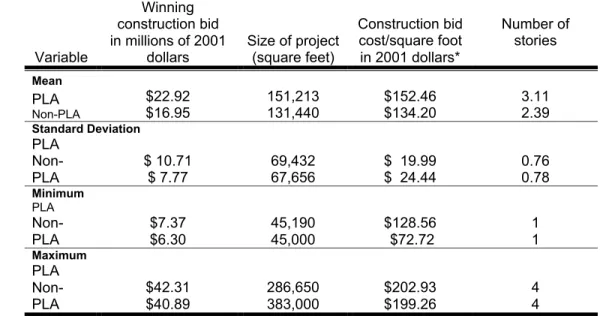
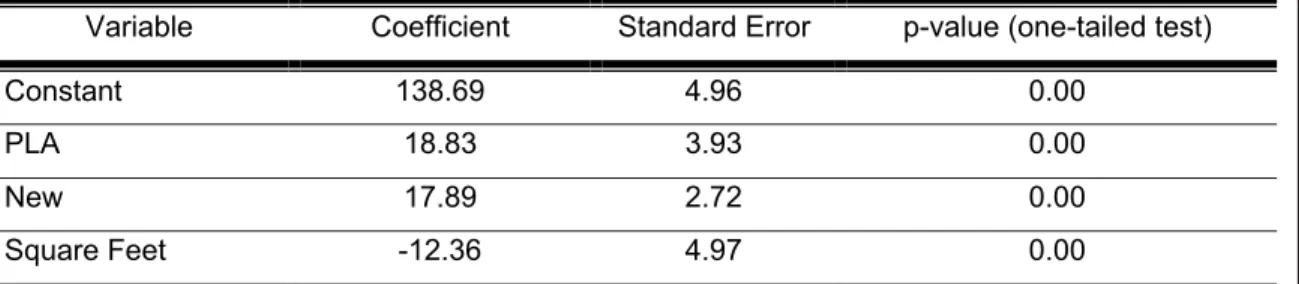
A comparison of the key characteristics of the school construction projects in towns with a PLA (“PLA projects”) with those where there was no such agreement (“non-PLA projects”) is shown in Table 1. A no-table pattern in the data is that PLA projects, on average, cost $18.26 ($152.46 minus $134.20) more per square foot (in 2001 prices) than non-PLA projects. The table shows that the cost per square foot it higher for PLA than for non-PLA projects. A formal test shows this differ-ence to be highly statistically significant, so the difference does not appear to be due to chance.32 However, this test is not con-clusive, because it is possible that PLA projects are systematically different – for instance larger, or concentrated on new buildings rather than renovations. One way to determine whether or not the difference in PLA versus non-PLA projects is robust to differences in project size and type is with a formal regression analysis. The dependent variable is the cost per square foot of construction (in 2001 prices). The independent variable of most inter-est to us is a dummy variable that is set equal to 1 for PLA projects and to 0 other-wise. We control for whether the project involves new construction or a renovation by including a dummy variable set equal to 1 for new projects and to 0 otherwise. We also control for the impact of a project’s scope on the cost per square foot by con-trolling explicitly for square footage, and for square footage squared. This is desir-able because there may be economies of scale (within reason) in school construc-tion, so that larger schools may have lower costs per square foot. The ordinary least
squares regression results are presented in Table 2.
Our regression results show that PLA projects add an estimated $18.83 per square foot (in 2001 prices) to the bid cost, control-ling for whether or not the project involves new construction, and controlling for the project’s square footage. A formal (one-tailed) test of the statistical significance of this coefficient gives a p-value of 0.000, which means that there is less than a 0.1% chance that we have accidentally found that PLA projects are more expensive than non-PLA projects. Put another way, there is at least a 99.9% probability that PLA projects really are more expensive than non-PLA projects, holding other measurable aspects of a project constant. The equation also shows that projects involving new construc-tion, rather than renovations, experience significantly higher costs per square foot, as one would expect.
With an adjusted R2 = 0.31, the equation “ex-plains” a respectable 31% of the variation in construction bid costs across towns. Clearly, other factors also influence the cost of construction – the exact nature of the site, the materials used for flooring and roofing, the outside finish, and the like. As a practi-cal matter, collecting viable information at
this level of detail, for all 126 projects, would be impossible. Thus our equation necessarily excludes these unobservable variables. However, this does not under-mine our finding of a substantial PLA ef-fect. For the PLA effect shown here to be overstated, it would have to be the case that PLA projects systematically use more ex-pensive materials, or add more enhance-ments and “bells and whistles,” than non-PLA projects. Our conversations with builders, town officials and architects sug-gest that PLA projects are not systemati-cally more upscale. This gives us confi-dence that the PLA effect shown here is real.
Robustness
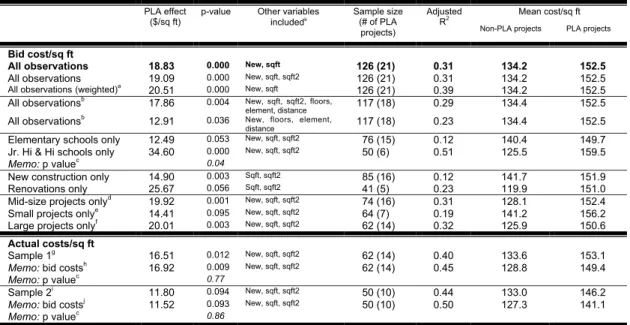
It is helpful to explore the robustness of our results. In other words, is there still a PLA effect if we only look at elementary school construction, or new projects, or mid-size projects, or if we use actual costs rather than bid costs. The results of this exercise are summarized in Table 3.
The first column indicates the sample, or sub-sample, used in estimating the regres-sion equation. The first four rows use the largest possible sample, but vary in which other variables are included in the equa-TABLE 1: SUMMARY STATISTICS FOR CONSTRUCTION PROJECTS BY PLA STATUS
Variable Winning construction bid in millions of 2001 dollars Size of project (square feet) Construction bid cost/square foot in 2001 dollars* Number of stories Mean PLA Non-PLA $22.92 $16.95 151,213 131,440 $152.46 $134.20 3.11 2.39 Standard Deviation PLA Non-PLA $ 10.71 $ 7.77 69,432 67,656 $ 19.99 $ 24.44 0.76 0.78 Minimum PLA Non-PLA $7.37 $6.30 45,190 45,000 $128.56 $72.72 1 1 Maximum PLA Non-PLA $42.31 $40.89 286,650 383,000 $202.93 $199.26 4 4
Total sample size is 126, with 21 PLA projects and 105 non-PLA projects. Costs are measured in 2001 dollars; see text for details.
tion. Our analysis proceeded by running separate regressions for
1. elementary and non-elementary schools;
2. new construction projects and reno-vations;
3. mid-size projects (100,000 to 300,000 square feet) only;
4. small projects (defined as below the median of 118,500 square feet) and large projects;
5. the largest available sample, using final costs (rather than bid costs); and
6. a smaller sample, using final costs, but excluding those cases where re-ported final costs equaled rere-ported bid costs.
The “PLA effect” column shows the esti-mate of the effect of having a PLA on the cost of construction (in dollars per square foot, in 2001 prices), and the adjoining “p-value” column measures the statistical sig-nificance of these coefficients. In every case the PLA effect is statistically significant at the 10% level or better. The size of the PLA effect differs somewhat, depending on the sample examined and the other variables that are included. The results of the “baseline” regression analysis presented in Table 2 are reproduced here in the first row; this equation has the virtue of including as many observations as possible, while be-ing parsimonious in the use of variables. In analyzing the robustness of our results, four points are worth making. First, there appears to be a significantly larger PLA ef-fect for junior high and high schools
($34.60/sq.ft.) than for elementary schools ($12.49/sq.ft.); possibly the secondary-level schools are more complex to build. Second, the PLA effect for new construction ($14.90/ sq.ft.) is smaller than for renovations ($25.67/sq.ft.); perhaps renovations are harder to predict accurately. Third, the PLA effect for mid-sized projects – defined as those between 100,000 and 300,000 square feet – is, at $19.92/sq.ft., similar to that for the sample as a whole ($18.83/sq.ft.). Fourth, and most interestingly, the PLA ef-fect is essentially the same whether one uses bid costs or actual costs of construction.33 This is important, because a construction in-dustry newsletter criticized our earlier study for using bid costs only, on the grounds that “what’s sorely needed is data that compares final construction costs on structures that are similar.”34
Of the 126 projects, information on actual construction costs was reported in only 62 cases; for this sub-sample, the PLA effect was $16.51/sq.ft. for actual costs (a 12% increase) and $16.92/sq.ft. for bid costs. For twelve cases, the project was reported to be “on bud-get,” which we took to mean that reported actual cost was the same as the reported bid cost. While this is certainly plausible, we did experiment by removing these cases and es-timating the PLA effect with the remaining 50 cases. For the restricted sub-sample the PLA effect was $11.80/sq.ft. for actual costs, which is very similar to the effect for bid costs ($11.52/sq.ft.).
TABLE 2: ORDINARY LEAST SQUARES ESTIMATION OF REAL CONSTRUCTION BID PER SQUARE FOOT
Variable Coefficient Standard Error p-value (one-tailed test)
Constant 138.69 4.96 0.00
PLA 18.83 3.93 0.00
New 17.89 2.72 0.00
Square Feet -12.36 4.97 0.00
An examination of the residuals for our preferred equation (row 2 in Table 3) showed no evidence of heteroskedasticity. A robust regression estimate of this equation, using the Huber-White estimator, also found the p-value to be 0.000 (to three decimal places).35
Following standard practice, our regres-sions use ordinary least squares, which means that each observation (here, a school building project) carries equal weight in the regression. However, we also estimated our preferred equation us-ing weights, where each project is given a weight that is in proportion to the square footage that it represents. This means that a project of 150,000 square feet, for instance, would have twice as much weight in the equation as a project of 75,000 square feet. The weighted re-gression shows a PLA effect of $20.51/ sq.ft., again highly statistically signifi-cant.
IV. CONCLUSION
It is widely believed that Project Labor Agreements add to the cost of construc-tion projects. However, there has until re-cently been no statistically robust study of whether PLAs add to construction costs in practice, and if they do, how large the effects are. By carefully constructing a da-tabase with information on the bid costs of school construction projects under-taken in the greater Boston area since 1995, and comparing the costs in towns with, and without, PLAs, we found the following:
(v) PLA projects have higher con-struction-bid costs; we are more than 99% confident of this assertion, based on the available data.
(vi) PLA projects have higher ac-tual costs; again we are more than 99% confident of this finding, based on the available data.
(vii) The finding that PLA projects have higher construction costs is robust, in that:
TABLE 3. REGRESSION ESTIMATES OF THE “PLA EFFECT” FOR DIFFERENT SUB-SAMPLES AND MODEL SPECIFICATIONS
Mean cost/sq ft PLA effect
($/sq ft)
p-value Other variables includedk Sample size (# of PLA projects) Adjusted R2
Non-PLA projects PLA projects Bid cost/sq ft
All observations 18.83 0.000 New, sqft 126 (21) 0.31 134.2 152.5
All observations 19.09 0.000 New, sqft, sqft2 126 (21) 0.31 134.2 152.5
All observations(weighted)a 20.51 0.000 New, sqft 126 (21) 0.39 134.2 152.5
All observationsb 17.86 0.004 New, sqft, sqft2, floors,
element, distance 117 (18) 0.29 134.4 152.5
All observationsb 12.91 0.036 New, floors, element,
distance 117 (18) 0.23 134.4 152.5
Elementary schools only 12.49 0.053 New, sqft, sqft2 76 (15) 0.12 140.4 149.7
Jr. Hi & Hi schools only 34.60 0.000 New, sqft, sqft2 50 (6) 0.51 125.5 159.5
Memo: p valuec 0.04
New construction only 14.90 0.003 Sqft, sqft2 85 (16) 0.12 141.7 151.9
Renovations only 25.67 0.056 Sqft, sqft2 41 (5) 0.23 119.9 151.0
Mid-size projects onlyd
19.92 0.001 New, sqft, sqft2 74 (16) 0.31 128.1 152.4
Small projects onlye
14.41 0.095 New, sqft, sqft2 64 (7) 0.19 141.2 156.2
Large projects onlyf
20.01 0.003 New, sqft, sqft2 62 (14) 0.32 125.9 150.6
Actual costs/sq ft
Sample 1g
16.51 0.012 New, sqft, sqft2 62 (14) 0.40 133.6 153.1
Memo: bid costsh
16.92 0.009 New, sqft, sqft2 62 (14) 0.45 128.8 149.4
Memo: p valuec 0.77
Sample 2i
11.80 0.094 New, sqft, sqft2 50 (10) 0.44 133.0 146.2
Memo: bid costsj
11.52 0.093 New, sqft, sqft2 50 (10) 0.50 127.3 141.1
Memo: p valuec 0.86
Notes: Maximum sample size: 126. The baseline regression is in first row (boldface) and reproduces the results shown in Table 2.
a
Weighted regression, where observations were weighted by the size (in square feet) of each project. b
Smaller sample size
because values were missing for some variables. c
Tests difference in PLA effect between the previous two rows. d
Only projects
between 100,000 and 300,000 square feet. eLess than 118,500 square feet (median project size in sample). fGreater than 118,500
square feet (median project size in sample). gLargest available sample for which actual costs were reported. hExcludes
observations where reported actual cost equaled reported bid cost. iActual costs were, on average, $4.48 higher than bid costs, for
this sample. jActual costs were, on average, $5.56 higher than bid costs, for this sample. kNew = 1 if new construction, 0 if
renovation. Sqft = number of square feet in project. Sqft2 = number of square feet squared. Floors = number of stories. Element = 1 if elementary school, 0 otherwise. Distance = miles from Boston.
a. Robust estimation tech-niques still show a strong statistically significant ef-fect;
b. A regression that weights observations by project size also shows the effect; c. The effect persists even
when the data are subdi-vided, so that the effect is evident separately for large projects and for small, for elementary schools and for secondary schools, for new construction and for reno-vations.
(viii) PLA projects add an estimated $18.83 per square foot to the bid cost of construction (in 2001 prices), representing an almost 14% increase in costs over the average non-PLA project. The low estimates find that actual project costs are raised by 8.4%;36 the high estimates find that bid costs are raised by 14.9%.37
(ix) PLA projects add an estimated $16.51 per square foot to the
actual cost of construction (in
2001 prices). This may be an underestimate, since it is based on a subsample for which the PLA effect for bid costs ($16.92/ sq.ft.) is somewhat below the full-sample PLA effect ($18.83/ sq.ft.).
In sum, the evidence that Project Labor Agreements have increased the cost of school construction in the Boston area since 1995 is strong. The effect is also substantial. Taken together, PLA projects accounted for 3.175 million square feet of construction with a combined cost of $481.4 million (in 2001 prices), based on the projects that we were able to include in our study. Our estimates show that this cost was $60 million higher than it would have been if Project Labor Agreements had not been used.38 On average, almost 70% of this
additional cost was borne by the Commonwealth of Massachusetts, through the School Building Assistance Program; the remainder was covered by the cities and towns that built schools using Project Labor Agreements. Officials at both the state and local level need to be aware of the higher costs implied by PLAs when they choose the bid requirements on future school
ENDNOTES
1 Jonathan Haughton, Darlene C. Chisholm and Paul Bachman, The Effects of Project
Labor Agreements on Publicly Funded Construction Projects in Massachusetts, (Boston:
Beacon Hill Institute, March 2003).
2 This may be an underestimate, since it is based on a subsample for which the PLA effect for bid costs ($16.92/sq.ft.) is somewhat below the full-sample PLA effect ($18.83/sq.ft.). 3 Haughton, et al., Effects of Project Labor Agreements.
4 U.S. General Accounting Office,
Project Labor Agreements: The Extent of Their Use
and Related Information,
(Washington D.C.: 1998), Publication No. GAO/GGD-98-82.
Retrieved September 25, 2002 from the General Accounting Office web site: http://
www.gao.gov/archives/1998/gg98082.pdf.
5 Ibid., p. 4 6 Ibid.,p. 4
7 Worcester Municipal Research Bureau, “Project Labor Agreements on Public Construction Projects: The Case For and Against,” Report No. 01-4, (May 21, 2001). p. 7.
8 Herbert R. Northrup and Linda E. Alario, “Government-Mandated Project Labor Agreements in Construction, The Institutional Facts and Issues and Key Litigation: Moving Toward Union Monopoly on Federal and State Financed Projects,”
Government Union Review 19, no 3, (2000): 91.
9 Ibid., pp. 12-13.
10 Amanti & Sons, Inc., and Others v. City of Lynn, Supr. Ct. Memorandum of Decision
and Order on Plantiffs for Preliminary Injunction (Civil Action No.907-2780-C, June 9,
1997): 2, as quoted in Northrup and Alario, p. 91. 11 Ibid., p.91.
12 Worcester Municipal Research Bureau, “Project Labor Agreements,” p. 9.
13 John T. Callahan & Sons, Inc., & Others v. City of Malden & Another. SJC-07959, Lexis-Nexis 493, 22 July 1999 p.2.
14 Ibid., p. 2. 15 Ibid., p. 2. 16 Ibid., p. 2. 17 Ibid., p. 6.
18 Worcester Municipal Research Bureau, “Project Labor Agreements,” p. 9.
19 Massachusetts Executive Office of Administration and Finance, Reconstructing the
School Building Assistance Program, Policy Report Series No. 3 (January, 2000): p. 1.
20 Rick Klein, “Eyes Turn to State’s $726m Reserve,” Boston Globe, September 4, 2003, p. A1.
21 Massachusetts G.L. Chapter 70B: Section 1 School building assistance program; [on-line] http://www.state.ma.us/legis/laws/mgl/70B-1.htm.
22 Massachusetts Executive Office of Administration and Finance, Reconstructing the
School Building Assistance Program Policy Report, p. 2.
23 FY 1999 refers to the period July 1, 1998 through June 30, 1999. 24 http://finance1.doe.mass.edu/doe_budget/1_doe.html.
25 Massachusetts Executive Office of Administration and Finance, Reconstructing the
School Building Assistance Program Policy Report, p.2.
26 Our earlier study incorrectly identified schools in Wilmington and Melrose as having been built under PLAs; this was based on erroneous information that was supplied to us. This is why we have taken care to double check every bit of information, in a good faith effort to ensure that no further errors remain.
27 PLA contracts were in effect in the following towns: Boston, Lawrence, Lynn, Malden, Medford, Milton, and Waltham (for two of the four schools in the data set). The Classical High School project in Lynn is considered a PLA project since our construction bid
About the Authors
Paul Bachman,MSIE. Mr. Bachman is Research Economist at the Beacon Hill Institute for Public Policy
Research at Suffolk University. He holds a Master of Science in International Economics from Suffolk University.
Darlene C. Chisholm, PhD. Dr. Chisholm is Senior Economist at the Beacon Hill Institute for Public
Policy Research at Suffolk University and Associate Professor in the Economics Department at Suffolk University. She holds a Doctorate in Economics from the University of Washington.
Jonathan Haughton, PhD. Dr. Haughton is Senior Economist at the Beacon Hill Institute for Public Policy
Research at Suffolk University and Associate Professor in the Economics Department at Suffolk Univer-sity. He holds a Doctorate in Economics from Harvard UniverUniver-sity.
David G. Tuerck, PhD. Dr. Tuerck is Director of the Beacon Hill Institute for Public Policy Research at
Suffolk University and Chairman of the Economics Department at Suffolk University. He holds a Doctorate in Economics from the University of Virginia. His dissertation director was James M. Buchanan, Nobel Laureate in Economics.
The authors would like to thank Dali Jing, Corina Murg and Hatesh Radia for their contributions to this study.
information predates the lawsuit that overturned the PLA requirement and forced the project to be re-bid without a PLA requirement.
28 These include projects in the towns of Andover, Beverly, Brockton, Haverhill, Fall River, Lancaster, Medford, Taunton, Walpole and Weston.
29 Industry professionals including architects, construction project managers, and estimators concurred with our treatment of the data.
30 The main source of wage and salary data is the Bureau of Economic Analysis web site, (http: //www.bea.gov, accessed September 10, 2003). The series used the Standard Industrial Classification (SIC) through 2001. We used the North American Industrial Classification Series (NAICS) for wages and salaries for 2001 and 2002, and employment for 2001. To get the percentage increase in construction employment in Massachusetts between 2001 and 2002 we used data from the Massachusetts Department of
Employment and Training (http://www.detma.org/lmilmi.htm#790, accessed September 10, 2003). We also used this source to measure the growth in construction wages between 2002 (first 7 months) and 2003 (first 7 months).
31 The source of the producer price index is Table B-66, “Producer Price Indexes by Stage of Processing, Special Groups, 1974-2001,” Economic Report of the President, February 2003, p. 353.We assumed no growth in this index between 2002 and 2003, in line with recent historical experience.
32 The null hypothesis is that PLA projects do not cost more than non-PLA projects. A two-sample t-test with unequal variances rejected this null hypothesis decisively (p = 0.0004).
33 Note that final base construction costs, like bid costs, contain site work and, for some projects, demolition costs.
34 “Do PLA projects raise costs? New study that supports ABC’s arguments attacked as ‘inflated and unreliable’,” Cockshaw’s Construction Labor News + Opinion 33, no. 5, (2003): 8. 35 The t-statistic for the PLA dummy variable in the equation reported in Table 2 and line two of Table 3 was 3.80; for the robust regression the t-statistic was 3.77.
36 PLA effect from sample 2 for actual costs ($11.80/sq.ft.) divided by average actual costs for this group ($135.65/sq.ft.)
37 PLA effect from weighted regression for bid costs on full sample ($20.51/sq.ft.) divided by average bid costs for this group ($137.24/sq.ft.).
38 $60 million = 3.175 million sq.ft. times $18.83 per sq.ft.