The London School of Economics and Political Science
Being white, British and Muslim:
Exploring the identity recognition, negotiation and performance of
seemingly incompatible identities
Amena Amer
A thesis submitted to the Department of Psychological and Behavioural Science of the London School of Economics and Political Science for the degree of Doctor of
Declaration
I certify that the thesis I have presented for examination for the MPhil/PhD degree of the London School of Economics and Political Science is solely my own work other than where I have clearly indicated that it is the work of others (in which case the extent of any work carried out jointly by me and any other person is clearly identified in it).
The copyright of this thesis rests with the author. Quotation from it is permitted,
provided that full acknowledgement is made. This thesis may not be reproduced without my prior written consent. I warrant that this authorisation does not, to the best of my belief, infringe the rights of any third party.
I declare that my thesis consists of 56,122 words.
Statement of conjoint work
I confirm that Chapter Four was jointly co-authored with Dr Caroline Howarth (London School of Economics) and I contributed 90% of this work.
I confirm that Chapter Six was jointly co-authored with Sleiman Halabi (Friedrich Schiller University Jena and University of Bielefeld, Germany) and Dr Ilka Gleibs (London School of Economics). I contributed 70% of this work.
Abstract
In focusing on white British Muslims, this thesis explores how their multiple, seemingly incompatible identities shape their experiences of belonging, particularly in relation to how they are seen by others. The thesis examines this through three empirical studies. The first looks at the social representations of white British Muslims within British mainstream and British Muslim newspapers and explores how representations of threat are discursively constructed, perpetuated and challenged. The second paper examines how white British Muslims perceive their identities to be recognised by relevant others. It notes how their identities interact and intersect, influencing which identities are acknowledged while others are erased. It shows that as a result, white British Muslims draw on performative strategies to regain a sense of control over their perceived (mis/non)recognition. Finally, the third paper looks at actual identity recognition by relevant others (white British non-Muslims and non-white British Muslims) and considers the role that religious markers and signifiers play in these dynamics and on intentions for social interaction. It also investigates recognition after the revelation of their multiple, seemingly incompatible identities and what this means for intergroup distinctiveness.
Drawing the findings together, the thesis makes three key contributions. Empirically, this thesis makes a novel empirical contribution to social psychological research by focusing on white British Muslims. Theoretically it, 1) emphasises that identities are contextual, interactional and intersectional, and that they need to be recognised as such in order to better understand identity-related processes in an increasingly complex world, and 2) demonstrates the significance of incorporating recognition and identity performance into the theorisation of identities. In doing so, it emphasises the central role others play in processes of identification and sheds light on
the social productions of, and challenges to, group boundaries along the lines of sameness and difference.
Acknowledgements
Coming to the end of this PhD journey has led me to think back to where this all began. It has been a roller-coaster of a ride, and as much of a cliché as it sounds, I would not have reached where I am today without the love, encouragement and support of some very special people.
Firstly, thank you to my supervisors, Ilka Gleibs and Caroline Howarth. Ilka, thank you for taking me under your wing. Your advice and support have been unwavering and have been crucial, particularly these past two years, enabling me to get to where I am today. Thank you also for the endless chats and catch ups, they’ve kept me going. Caroline, this PhD journey would not have started if it was not for you. I was inspired by your work during my MSc all those years ago, and I will forever be grateful for your belief in me, your enthusiasm for the PhD research topic I chose to undertake and for your guidance that helped shape the PhD from its start.
Thank you to my participants. To those of you I interviewed, thank you for the time you have given me and for welcoming me into your homes, your mosques and your
community centres. Thank you for the lunches, biscuits, coffees and teas as we sat for hours talking, and most of all thank you for sharing your experiences and stories. I hope I have been able to reflect your experiences in their complexity and to have done so respectfully.
A special thank you to Sandra Obradovic. Your friendship has meant a lot through the highs and lows of this journey and beyond, and I cannot imagine having gotten through it without your constructive comments, reassurances and cheerleading, and your endless chocolate supply. I will never be able to thank you enough. I can, however, promise to protect you from all birds (at home and abroad!) as we navigate our way through this bird-filled world. To Andy Stewart, Celestin Okoroji and Nihan Albayrak-Aydemir, thank you for making the department a space where I have felt I belonged. I have been able to grow and develop over the years thanks to your advice, care and friendship. Thank you also for all the laughs – they’ve always been very much needed. To my extended PhD family, Clare Coultas, Maria-Cecilia Dedios-Sanguineti, Mark Noort, Maxi Heitmayer and Natalia Concha, thank you for your encouragement and support. To Geetha Reddy, thank you for our conversations, and for your faith and positivity. To Slieman Halabi, thank you for your guidance through the confusing space that is
quantitative analysis, and for being there as a friend at all hours of the day and night. To my family, thank you for your endless love, for encouraging me to do this PhD and for enabling me to do so. I appreciate all you have done for me. Thank you to my dad for your du’aas throughout this journey. Thank you mama, for being the inspiration of this PhD, and for being the most incredibly strong woman I will ever know. Being your daughter has meant I knew I could get through anything, and it has given me the
there always, for reading endless drafts, and of course for keeping me fed as I was glued to my laptop these last few months. To Iman, thank you for making me laugh every day even when I was incredibly stressed and overwhelmed. I will never be able to truly express my gratitude for your endless strength and support.
To Sharaiz and to Fatema, thank you for cheering me on, for keeping me grounded, for reminding me there is a world beyond the PhD and for helping me escape from
constantly thinking about it!
Lastly, to Nick Hopkins and Sandra Jovchelovitch. Thank you both for agreeing to be my examiners and for taking the time to engage with my work.
Table of Contents
Abstract 3
Acknowledgements 5
List of Tables and Figures in Unpublished Work 12
List of Tables and Figures in Published Work 13
Chapter One: Introduction 14
1.1 Inspiration for the research 14
1.2 Who are white British Muslims? 15
1.2.1White British Muslims in numbers 15
1.2.2From past to present: a brief overview of white Muslims in Britain 17
1.3 The research focus 21
1.4 Thesis outline 23
Chapter Two: Theoretical Framework 25
2.1 Theorising identity: Social Identity Approach 26
2.1.1 Social Identity Theory 27
2.1.2Self-Categorisation Theory 29
2.1.3Multiple social identities 32
2.2 Constructing meaning in context: Social Representations Theory 34 2.2.1Connecting social representations and identities 36 2.3 Recognition, misrecognition and multiple identities 39
2.3.1 The role of identity performance 42
2.4 An integrated framework: recognition, performance, and interactional and
intersecting identities in context 45
2.5 Research questions 46
Chapter Three: Methodological Framework 50
3.1 Research design 50
3.1.1 Overview 50
3.2 Reflexivity 54
3.3 Ethics 56
3.4 Study 1: Mainstream British and British Muslim newspapers 56
3.4.1 Rationale for newspapers 57
3.4.2 Sampling 58
3.4.3 Procedure 59
3.4.4 Analysis 63
3.5 Study 2: Interviews 65
3.5.1 Rationale for interviews 66
3.5.2 Participants 67
3.5.3 Procedure 67
3.5.4 Analysis 69
3.6 Study 3: Experiments 70
3.6.1 Rationale for experiment 72
3.6.2 Participants 73
3.6.3 Procedure 75
3.6.4 Measures 77
3.6.5 Analysis 79
3.7 Chapter summary and final points 80
Chapter Four: Preface 81
Chapter Four: Constructing and contesting threat: Representations of white British Muslims across British national and Muslim newspapers 82
Abstract 82
Keywords: Threat, white British Muslims, social representations, critical discourse
analysis, media, power. 82
Introduction 83
White British Muslims, converts and the media 83
Threat and positioning 84
Social representations and discourse 87
SRT and CDA: a more integrated approach 89
Research design 92
Sample 92
Analytical procedure 96
Analysis and discussion 98
Security threat 99
Social and cultural threat 105
Conclusion 113
Acknowledgments 116
References 116
Chapter Five: Preface 128
Chapter Five: Between recognition and mis/nonrecognition: Strategies of
negotiating and performing identities among white Muslims in the UK 129
Abstract 129
Introduction 130
Recognition and social identity 131
Identity performance: the interconnections of power, agency and interactional
contexts 133
The current paper: white Muslims in Britain 135
Method 137
Participants 137
Data collection 137
Analytical method 138
Reflexivity: situating the researcher 139
Results and discussion 139
The cost and value of identity recognition 140 Identity presentation: transgression, identity assertion and avoiding group
exclusion 147
Conclusion 156
Acknowledgements 157
Chapter Six: Preface 164 Chapter Six: Being white and Muslim: identity recognition of white British
Muslim identities by their respective ingroups 165
Abstract 165
Introduction 167
Recognition and multiple identities 168
The present research 173
The Experiments 178
Experiment 1a 178
Experiment 1b 189
Experiment 2a 196
Experiment 2b 202
General Discussion: Overall findings and their implications 209
Acknowledgements 216
References 216
Chapter Seven: General Discussion and Conclusion 224
7.1 Summary of the findings 225
7.2 Towards an integrative framework for understanding multiple identities 231 7.2.1 Identities as intersectional, interactional and contextual 231 7.2.2 The role of recognition and identity performance 234
7.3 Thesis contributions and future directions 236
7.3.1 Contributions to theory 237 7.3.2 Empirical contribution 242 7.3.3 Methodological considerations 243 7.4 Conclusion 244 Bibliography 247 Appendices 278
Appendix 1: Coding frame for Study 1 279
Appendix 3: Participant information and consent form for Study 2 284
Appendix 4: Topic guide for Study 2 285
Appendix 5: Example of interview transcript from Study 2 287
Appendix 6: Thematic map for Study 2 306
Appendix 7: Codebook for Study 2 307
Appendix 8: Example of survey used in Study 3 (English name, no signifier
condition) 313
Appendix 9: Photographs used in Study 3 329
List of Tables and Figures in Unpublished Work
Tables
Table 3.1: Research design 50
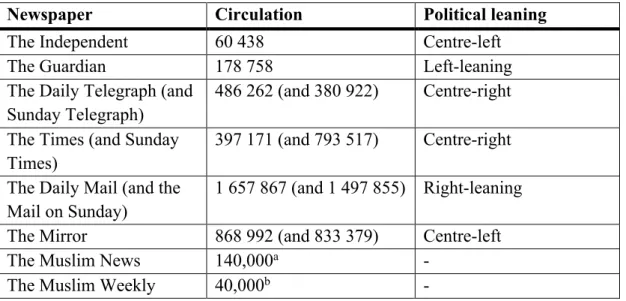
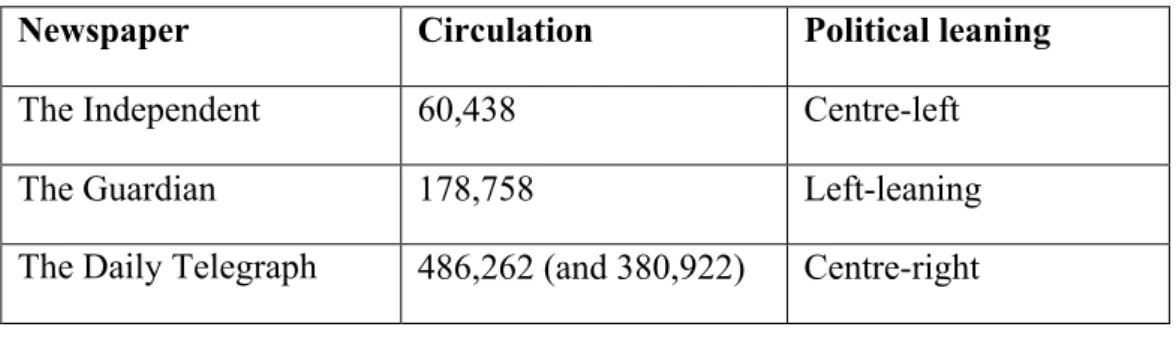
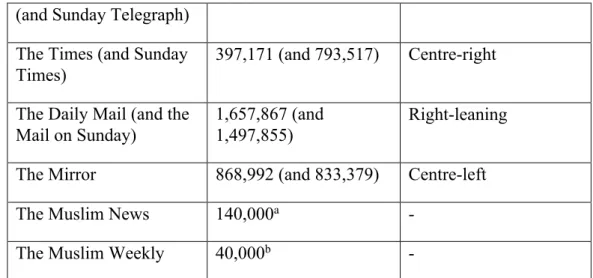
Table 3.2: Circulation rates of newspapers 58
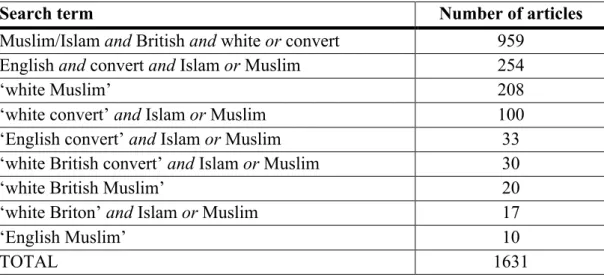
Table 3.3: Search terms and the number of article hits displayed on the LexisNexis
online database in descending order 59
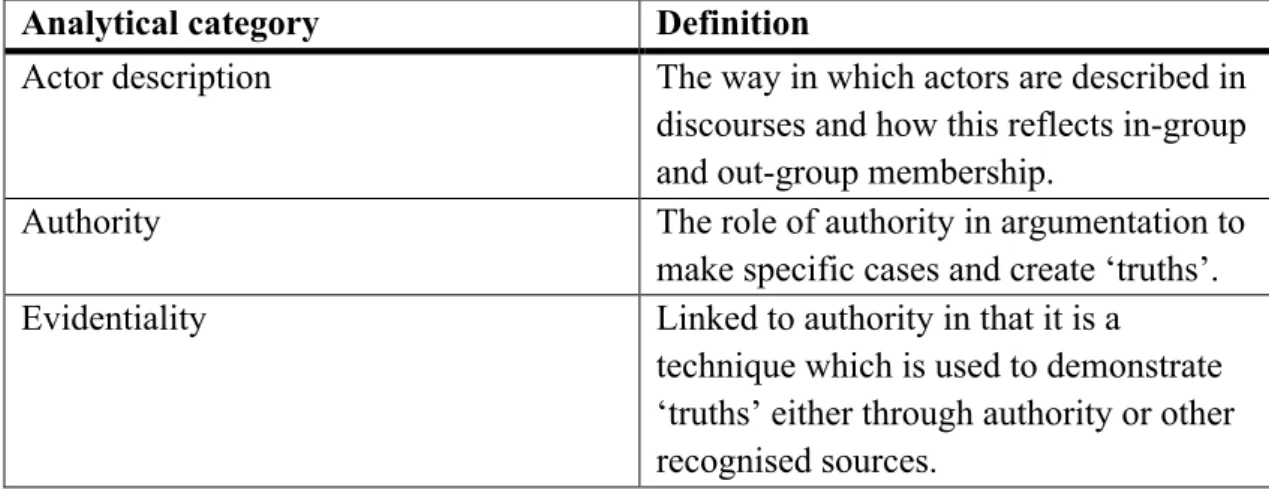
Table 3.4: Analytical categories for CDA 63
Table 6.1: Means and standard deviations for all conditions, Study 1a, N=343 183 Table 6.2: Alphas of measures for Experiment 1b 191 Table 6.3: Means and standard deviations for all conditions, Study 1b, N=164 192 Table 6.4: Alphas of measures for Experiment 2a 198 Table 6.5: Means and standard deviations for all conditions, Study 2a, N=350 199 Table 6.6: Alphas of measures for Experiment 2b 204 Table 6.7: Means and standard deviations for all conditions, Study 2b, N=168 205 Figures
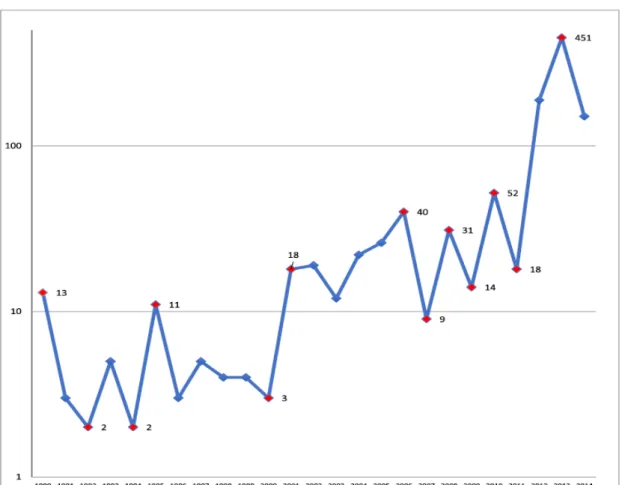
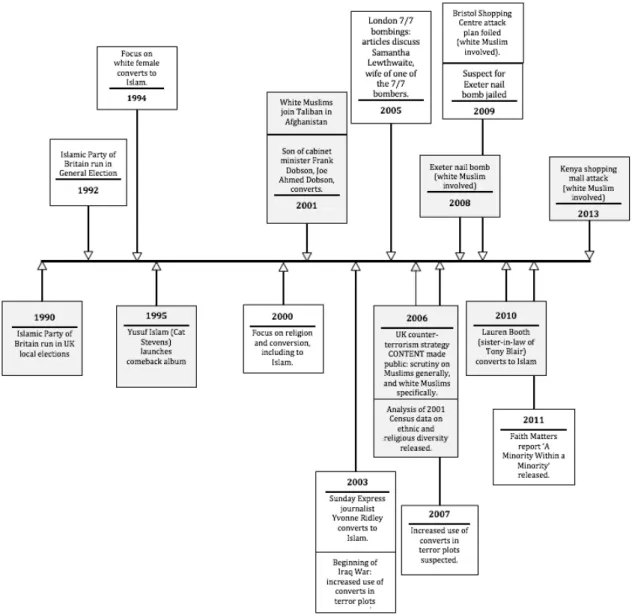
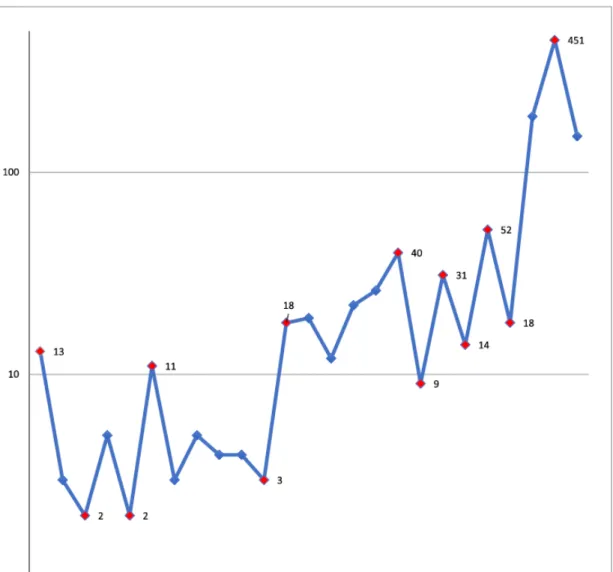
Figure 3.1: Number of articles about white Muslims using a logarithmic scale 60 Figure 3.2: Timeline of dominant topics covered in the selected years 61
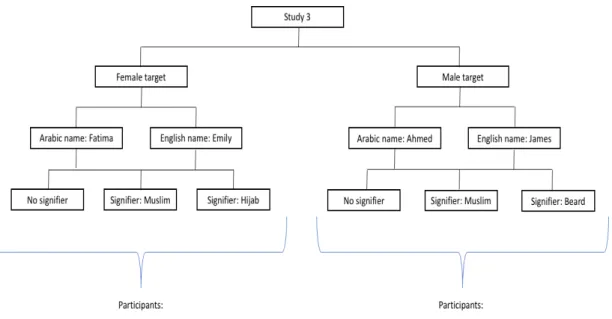
Figure 3.3: Design overview of study 3 70
Figure 6.1: Photographs of female target used in Experiment 1a 181 Figure 6.2: Interaction between name, signifier and white-Muslim recognition
differences in Experiment 1a 186
Figure 6.3: Intergroup distinctiveness significantly mediated the negative affects
towards the English-named target in the no signifier condition 187 Figure 6.4: Interaction between name and signifier and white-Muslim recognition
differences for Experiment 1b 194
Figure 6.5: Photographs of male target used in Experiment 2a 198 Figure 6.6: Interaction between name, signifier and white-Muslim recognition
differences in Experiment 2a 201
Figure 6.7: Interaction between Name, Signifier and white-Muslim recognition
List of Tables and Figures in Published Work
Tables
Table 1. Circulation rates of newspapers 90
Table 2. Search terms and the number of article hits displayed on the LexisNexis
online database in descending order 91
Table 3. Analytical categories for CDA 96
Figures
Chapter One: Introduction
1.1 Inspiration for the research
The impetus for this thesis began after my mother came home from work one day. She was a supply teacher at the time and had spent the day in an inner-city London school where at lunchtime there had been an exchange between herself and another teacher. My mother is of Polish heritage, has lived in Britain since she was 10 months old, is British by nationality and Muslim by faith. She is a white (Polish) British Muslim. At lunchtime she had realised that one of the teachers in the staffroom was also of Polish heritage. However, rather than sharing her Polishness with that teacher, my mother instead mentioned it to the teaching assistant, a British Turkish woman. The teaching assistant found my mother’s identity fascinating, and later informed the Polish teacher, who, in contrast to the teaching assistant’s reaction, seemed to question the authenticity of my mother’s claim. How could she be Polish? There were no Polish Muslims. She was definitely sure there were no Polish Muslims. It’s a Catholic country. The teacher was adamant that my mother could not be ‘authentically’ Polish due to her religion, which was clearly indicated by the hijab (headscarf) she wears. The teacher could not see beyond the marker of my mother’s Muslimness and the racialised assumptions about Islam being a foreign non-European religion, and, as a result, denied my mother recognition of her heritage. On reflection, what is more interesting was that there was strategy to my mother’s thinking and actions. She had clearly thought about who would be easiest to tell, and perhaps most accepting, of this information about her identity.
My mother had never shared any experiences like this previously, and I myself had rarely thought much about her experiences of her identity. This incident, however, sparked some questions. How are people with identities that could be termed ‘unusual’
and regarded as ‘incompatible’ be seen by different relevant others? Are their identities recognised and acknowledged or rejected and denied and what role do salient markers and racialised assumptions play in this? How do these individuals negotiate and manage their identities through performative strategies as a result? And what are the
consequences of these experiences on feelings of belonging? These questions began developing my thoughts for a PhD thesis, and while I have strayed ever so slightly from my initial inspiration – by focusing on white British Muslims of English, Scottish, Welsh and Northern Irish heritage, rather than ‘white’ as a more general ethnic category – these questions in relation to processes of identity recognition, negotiation and
performance among people within contexts that, at times, may see their identities as incompatible, have continued to guide my research throughout the PhD journey. In doing so, the thesis speaks more broadly to centring how others play a significant role in our experiences of our multiple identities and highlights the importance of studying and acknowledging identities as intersecting, interacting and increasingly complex. In addition, it illustrates how the boundaries through which identities are understood can influence how they are seen and experienced with significant repercussions on feelings of social inclusion and exclusion.
1.2 Who are white British Muslims?
1.2.1 White British Muslims in numbers
According to the latest figures from the 2011 census records, Muslims in Britain make up 4.4% of the population (Elshayyal, 2015). They are a highly ethnically diverse group, made of people of South Asian, Black, Arab, White and Mixed heritage, as well as many others (Office for National Statistics, 2011). White British Muslims constitute
just 3% of the Muslim population in England and Wales and 3.5% of Muslims in Scotland (Elshayyal, 2015; Office for National Statistics, 2011). These are individuals who had declared their ethnic group as ‘White British’ (or ‘White Scottish’ on the Scottish census) and marked their religion as ‘Muslim’. An exploration into who these ‘White British’ Muslims are suggests that the majority could be people of white
English, Scottish, Welsh or Northern Irish heritage, as those who are not tend to choose the category ‘Other White’ (Gardener & Connolly, 2005). However, a more recent examination reveals that based on data on the parents of these individuals only 53.5% had parents who were both ‘White British’, 58.3% had at least one parents who was ‘White British’ and, surprisingly, 33.7% had parents who were both ‘Asian’ (Brice, 2017). What appears to be the case is that many of those whose parents were ‘Asian’ were born and brought up in the UK (second or third generation British) and thus claimed a ‘White’ identity (Brice, 2017). With this in mind, we must be cautious of making claims about the number of Muslims of white English, Scottish, Welsh or Northern Irish heritage based on this data, and while it raises some interesting questions about the deconstruction of boundaries of identity categories and the binaries of ‘West vs Islam’ and ‘White vs Muslim’ (Brice, 2017), these questions are not the focus of this thesis and therefore are not explored here.
For the sake of ease, in this thesis when the term ‘white British Muslim’ is used, it refers to Muslims of white English, Scottish, Welsh or Northern Irish heritage. Many of these are Muslim through conversion, and although no official record exists and the census of England and Wales does not record religion at birth as the Scottish census does, in 2011 a systematically calculated estimate of the number of converts, regardless of ethnicity, placed it at between 90,000 to 100,000, with around 5,000 conversions
taking place each year (Brice, 2011)1. Yet, in addition to conversions, some white
British Muslims are undoubtedly ‘born into’ the religion as a result of being descendants of converts, for as we see in the next section, there is a long history of conversion to Islam in the UK.
1.2.2 From past to present: a brief overview of white Muslims in Britain
The first recorded English convert to Islam was John Nelson, a servant on an English ship travelling to Tripoli, Libya in the 1580s (Matar, 1998). In fact, during the 16th
Century conversion to Islam was a significant enough phenomenon for the Spanish word renegado (‘renegade’ – meaning to convert from Christianity to Islam) to enter the Oxford English Dictionary in 1583 (Gilliat-Ray, 2010). Several decades later the first ever translation of the Qur’an2 by Alexander Ross, was published in 1649. In the
introduction, Ross emphasises that his translation was “for the satisfaction of those that desire to look into the Turkish vanities”, indicating the clear interest (even if negative) in Islam at the time, given the on-going Ottoman wars in Europe.
Later, during the 18th and 19th Centuries, sailors from the Indian subcontinent
working for the British East India Company and Yemenis working in the British merchant navy began settling in port cities and marrying local English and Welsh women some of whom embraced Islam (Seddon, 2013). By the middle of the 19th
Century there were a number of converts among the middle and upper classes, such as Henry Stanley who embraced the religion in 1859 and became the first Muslim member of the House of Lords (Gilham, 2014). Two other influential English converts to Islam
1 Importantly, these figures are not specific to those of white ethnicity and do not account for
possible deconversions (Brice, 2011).
were William Henry Abdullah Quilliam (1856-1932), the first Englishman to actively propagate Islam in Britain by seeking and encouraging conversion among other Englishmen and women, and Marmaduke Pickthall (1875-1936), who was the first Muslim to translate the Quran from Arabic into English.
Quilliam converted in 1882 but did not publicly announce his conversion until 1887, the year in which he founded England’s first recorded mosque and Islamic centre, the Liverpool Muslim Institute (LMI). It was the first known Muslim missionary
organisation in Britain and Quilliam actively sought to establish a very “British” Islam, tailoring his missionary work to the customs and lives of those he hoped to convert. Gatherings at the mosque were mixed, women were not expected to cover when entering, services took place on Sundays to mirror the existing religious practices and customs to which the public were accustomed, and ‘Muslim hymns’ were either composed or Christian hymns suitably adopted in order to reflect Islamic teachings (Gilham, 2014). He also recited the call to prayer in English from the balcony of the LMI, much to the locals’ disapproval (Hewer, 2006).
Despite Quilliam’s attempts at creating a British Islam, during the lifetimes of Stanley, Quilliam and Pickthall, being Muslim was largely associated with the Ottoman Empire and should be understood within the wider context of British imperialism and the subsequent defeat of the Ottoman Empire in the First World War. Indeed, to be both Muslim and loyal to Britain was seen as impossible and fundamentally at odds with one another both politically and inherently (Gilham, 2014). British converts to Islam came to be seen as traitors to their race and country and as having abandoned their identities as British – then seen as, at its core, Christian in its values and practices (Gilham, 2014). In his book, Loyal Enemies, Jamie Gilham cites Henry Stanley’s aunt commenting on him displaying the behaviours of a “Turk” (p.26). In saying this, she reflects the way in
which Islam had become racialised3 and as a result denied him his Britishness. Stanley
was not alone in being depicted in this way. Quilliam, Pickthall and many others were also perceived as ‘alien’ and irrational in their adoption of Islam. In a feature for The Islamic Review in 1933, a female convert, Rahima Griffiths, relayed the view a colleague held of Islam as: “… a religion made for men, by a man, and for coloured men only” (Griffiths, 1933). Thus, not only was Islam viewed as undesirable and as completely separate to Britishness and indeed whiteness, it was also seen to be a religion that was oppressive towards women.
In the aftermath of World War Two and the breakup of the British Empire people from what were now known as Commonwealth countries began to arrive to the UK as students or economic migrants, and subsequently settled and established
communities across Britain (Gilliat-Ray, 2010). A significant proportion of these new migrants were from South Asia, which included Muslims from the newly established country of Pakistan. In the following decades there was a shift from associating Islam with the Ottoman Empire and Turks to Pakistanis and Pakistan. In turn, there was a change in the terminology used to describe converts and their conversion. In his research, Köse (1996, 2007) notes the way in which British converts were seen as having undone their Britishness as a result of converting to Islam and instead become “Pakistanised”. This shows how processes of racialisation and the conflation of categories with certain groups are context and time specific, reflecting the dominant ethnic association with the religion and its followers. For example, in Germany, Islam is
3 Racialisation is a sociological term seldom used in psychology (some exceptions include
(Kessi, 2013; Riggs & Augoustinos, 2005; Voelklein & Howarth, 2005). It refers to the
attribution of racial (and ethnic and/or cultural) meaning to individuals, categories, or issues that were previously not understood through this prism (Murji & Solomos, 2005). Thus, in
racialising a religion for example, it refers to the association of particular phenotypical, cultural and behavioural descriptors to a category (and the people who identify with it) that should be understood purely through its principles and system of belief (Nasar Meer, 2013; Nasar Meer &
often conflated with being Turkish (Özyürek, 2015), in France with the Maghreb and in the US with being Arab (Galonnier, 2015).
Recent studies have shown how being Muslim continues to be seen as standing in direct opposition to Britishness, with Islam being portrayed as a religion that is foreign and Other, made up of and for ‘brown bodies’ (Galonnier, 2015; Nasar Meer, 2013; Nasar Meer & Modood, 2011; Phillips, 2006). Moreover, Islam continues to be seen as a threat, both to national and international security and to Western culture. As Moore, Mason, & Lewis (2008) note, 36% of news stories about British Muslims in British newspapers between 2000 and 2008 were about terrorism and 22% were about religious and cultural differences between Islam and British culture or the West more generally. Converts were referred to in 5% of the articles, but specific details such as the ethnicity of converts and the nature of the articles in which they appear were not
recorded. In order to address the latter issue, Brice (2011) conducted a study on British newspaper reporting of converts between September 2001 and August 2010. He found that while 36% of the articles linked Muslims to terrorism, this percentage went up to 63% when considering articles about Muslim converts specifically, thus demonstrating the perception that converts to Islam are seen as a disproportionately higher threat. However, here again the specific ethnicity of the converts was not noted.
In contrast with predominately negative narratives about Muslims and
conversion to Islam, in July 2019, the long-running British soap, EastEnders, revealed they were working with the Muslim Youth Helpline on a storyline where one of the characters, Bobby Beale, converts to Islam in a bid to “challenge preconceptions and prejudices about the role of faith in young people’s lives” (Hughes, 2019). While this comes as an interesting move and seen by many as a welcomed attempt to counter dominant negative narratives, its influence and impact remains to be seen.
As noted above, discourses on Islam and being Muslim continue to be almost always associated with notions of being the ‘other’, a threat to security and culture, incompatible with Western or European values and far removed from what it means to be British, and even more so being white (Baker, Gabrielatos, & McEnery, 2013; Franks, 2000; Law, Sayyid, & Sian, 2013; Moore et al., 2008; Moosavi, 2015a;
Özyürek, 2015; D. Phillips, 2006; Poole, 2011; Razack, 2008). Indeed, a report by Hope Not Hate found that nearly 35% of people polled believed Islam was a threat to British way of life (Perraudin, 2019).
Thus, within a context which has long established such negative narratives and opinions about Muslims and Islam, white British Muslims are an interesting group through which to explore experiences of identity, particularly in relation to the demarcation of group boundaries along the lines of inclusion and exclusion, and acceptance and rejection. Their identity positioning as both white and Muslim bring up interesting questions about the extent to which they are seen as belonging or not belonging to their various identity groups, and how they negotiate their identities as a result.
1.3 The research focus
Being both members of a contextually dominant ingroup (by being white British) and a minoritised outgroup (by being Muslim) within a socio-political context that sees their identity membership as contradictory and ontologically separate, white British Muslims make for a particularly interesting group to focus on and to explore identity-related processes and experiences. In being white and Muslims, these individuals can be categorised into a stigmatised and discriminated group and seen as traitors to their ethnic and national identity (Franks, 2000). For those who have converted to Islam,
having adopted a religious identity that is intrinsically un-white and un-British causes them to often no longer be seen as “White enough” or become ‘re-racialised’ and seen as “non-White” ((Moosavi, 2015a, p.3-4). What is more, Zebiri (2008) notes how they may also be seen an unauthentic or ‘second-class’ Muslims by heritage Muslims, and therefore may experience a sense of ‘double marginality’.
Of the existing research that has been conducted on white British Muslims (some of which has been discussed above), the majority can be found to be theoretically framed within sociological and psychological theories of conversion (Al-Qwidi, 2002; Köse, 2007, 1996; Zebiri, 2008) or in drawing on theorisations of whiteness and Islamophobia (Franks, 2000; Moosavi, 2015b, 2015a). Other research, for example by Suleiman (2013, 2016), sought to understand and record the experiences of Muslims converts (including white converts) and their reasons for conversion by drawing on this existing work. While this literature is useful in that it accounts for white Muslim
experiences, this thesis aims to take a new theoretical perspective which shifts the focus away from conversion specifically, and instead considers how a social psychological approach can enrich our understanding of the processes and mechanisms that shape the experiences of people with multiple and complex ‘incompatible’ identities. In
particular, this thesis focuses on the roles that others, particularly relevant others, play in these dynamics. Moreover, by considering the individual within their social context, the research in this thesis also examines the agentic strategies drawn upon by white British Muslims as they negotiate their multifaceted identities and how this in turn shapes how they are seen, or not seen, by others. To achieve these aims, the thesis is centred around the following research questions:
How do people with multiple, and at times seemingly contradicting and incompatible identities experience their identities across various contexts with different relevant
others? And what are the consequences in relation to recognition and the boundaries of inclusion and exclusion?
As will be seen in the next chapter, social psychological literature and theory (namely the Social Identity Approach; Haslam 2004; Reicher, Spears, and Haslam 2010) on identity as well as intra- and intergroup relations are drawn upon to help us better understand not only the doing of identity but also the consequences this has on feelings of belonging and maintaining and challenging boundaries of inclusion and exclusion. The thesis emphasises the importance of incorporating how identity recognition (Hopkins & Blackwood, 2011) and strategies of identity performance (Klein, Spears, & Reicher, 2007) play a central part in this, emphasising the focus on the role of others in identity experiences and proposes a framework through which to examine identities that take these into account. It notes the interactional and
intersectional nature of identities (Crenshaw, 1989, 1991), acknowledging the
importance of studying identities in conjunction with one another as well as in relation to the contexts in which they are experienced. In acknowledging the role of context, one must also note how power dynamics are interweaved within it, and in turn how they shape and influence processes of identification, recognition, and negotiation.
1.4 Thesis outline
This thesis starts with an in-depth examination of the theorisation of identity within social psychology, incorporating the role that processes of recognition and performance can play in understanding identity dynamics further (Chapter Two). This chapter provides the literature review of the thesis. It then moves on to provide an explanation of the methodological design of each of the three studies (Chapter Three) before moving
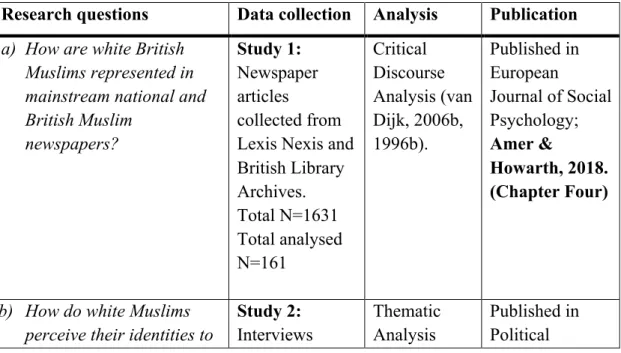
on to the three empirical papers: the first looks at the social representations of white British Muslims in British national and British Muslim newspapers (Chapter Four4); the
second examines white British Muslims experiences of identity recognition and how they negotiate and perform their identities as a result (Chapter Five5); and the last paper
explores the role of identity markers and signifiers on how white British Muslim identities are actually recognised by others and the consequences on behavioural intention towards them (Chapter Six6). The thesis ends with a general discussion,
drawing on the findings of all the empirical papers and existing literature to discuss both the theoretical and empirical contributions of the research. In proposing a framework to exploring multiple, seemingly oppositional identities and processes of identification, it illustrates the importance of acknowledging identities as interactional, intersectional and contextual and examining them in this way. It highlights how the concept of identity recognition is central to our experiences of our identities and how this enables for a re-emphasis on the significant role that others play in these dynamics. Lastly, in
empirically focusing on white British Muslims, this thesis makes a novel contribution to the literature within social psychology on British Muslims and other groups with
multiple and complex identities (Chapter Seven).
4 Published as a co-authored journal article. Amer, A. & Howarth, C. S. (2018). Constructing
and contesting threat: Representations of white British Muslims across British national and Muslim newspapers. European Journal of Social Psychology, 48 (5), pp. 614-628.
5 Published as a single-authored journal article. Amer, A. (2020). Between recognition and
mis/nonrecognition: Strategies of negotiating and performing identities among white Muslims in the United Kingdom. Political Psychology, 41(3), pp. 533-548.
6 In-preparation as a co-authored journal article. Amer, A., Halabi, S., & Gleibs, I. (in
Chapter Two: Theoretical Framework
Our identities are essential to our functioning as social beings, shaping how we make sense of ourselves and others across different contexts (Tajfel, 1978). They are multifaceted and multidimensional yet within social psychology they have been more often than not treated as discrete categories or studied in isolation (Jones & Hynie, 2017) . While there are some exceptions to this (for examples see Badea, Jetten, Iyer, & Er-rafiy, 2011; Blackwood, Hopkins, & Reicher, 2015; Héliot, Gleibs, Coyle, Rousseau, & Rojon, 2019; Hopkins & Blackwood, 2011; Jones & Hynie, 2017;
Verkuyten, 2006), as social psychologists engaging in identity research there must be a greater emphasis and value given to theoretical and empirical approaches that reflect and acknowledge the nuances and complexities of identities and experiences of identification. Just as intrinsic is ensuring that identities are examined collectively, in conjunction with one another, and in relation to our ever-diverse social world.
In this chapter, key theories and concepts that are relevant to understanding the study of multiple and complex identities are discussed and examined in detail. It begins by outlining the main theoretical model within which this PhD is situated, that is the Social Identity Approach (SIA; Haslam, 2004; Reicher, Spears, & Haslam, 2010) (section 2.1). It then discusses the relevance of the principles within the two theories that make up SIA – Social Identity Theory (Tajfel & Turner, 1979) and
Self-Categorisation Theory (Turner, Hogg, Oakes, Reicher, & Wetherell, 1987) – and explores these in relation to understanding multiple identities as complex, intersecting and interacting across contexts. Central to this is how constructed knowledge about the meaning of identity categories and their boundaries can shape the way in which multiple identities are experienced and understood in relation to one another. For a deeper
Moscovici, 1972, 1988) (section 2.2). In doing so, it highlights how social knowledge about identity groups and their compatibility or ‘fit’ with each other is constructed, shared and challenged through communicative acts e.g. discourses, and how contextual power asymmetries play a particularly significant role in these dynamics. Finally, the chapter turns its focus to how the under-researched concept of identity recognition (Hopkins & Blackwood, 2011) can contribute invaluably in developing our
understanding of how multiple, seemingly incompatible identities are not only seen by relevant others, but also experienced, managed and negotiated in relation to each other (section 2.3). Identity recognition situates the ‘other’ at the centre of these dynamics and highlights that how we are seen by others, or even how we think we are seen, shapes our experiences of acceptance and belonging. To unravel these notions further, the concept of identity performance (Klein et al., 2007) is introduced and unpacked to show how the enactment or suppression of identity can be used as a negotiating strategy to assert or indeed hide parts of our multiple and, at times, seemingly contradictory, identities. In drawing on these related but separate theories and concepts, the thesis brings them together by proposing a theoretical framework that allows for a more nuanced approach to understanding identity multiplicity (section 2.4). It allows for the examination of how processes of complex multiple identification play out in context placing the role of others within these dynamics at the centre.
2.1Theorising identity: Social Identity Approach
The Social Identity Approach (Haslam, 2004; Reicher et al., 2010) , sometimes referred to as the social identity perspective, is the combination of two major theories of identity within social psychology; the Social Identity Theory (SIT; Tajfel & Turner, 1979) and Self-Categorisation Theory (SCT; Turner et al., 1987) . The former is primarily a theory
exploring intergroup conflict and the establishment of hierarchical systems, while the latter takes a more generalised approach to understanding identity and group behaviour focusing more on the cognitive processes at work. These two theories share many theoretical assumptions, in that people see themselves and others in relation to their group membership rather than as individuals. However, there are also differences, for SIT is fundamentally a theory that focuses on intergroup relations, looking at processes of comparison and distinctiveness of the ingroup in relation to other groups, while SCT is more of an intragroup theory looking at how, through cognitive processes, people come to see themselves and others as a part of a group. To understand the theoretical underpinnings of SIA further, both SIT and SCT are discussed in detail below, highlighting their key principles, similarities and differences.
2.1.1 Social Identity Theory
Social identity, as Tajfel (1978, p.63) defines it, is the “part of an individual’s self-concept which derives from his [sic] knowledge of his [sic] membership of a social group (or groups) together with the value and emotional significance attached to that membership”. These social groups are made up of individuals who see themselves as a part of the same social category and have some emotive connection to the shared definition and evaluation of the group. Central to SIT’s claims is that the self should be understood in relation to others. Thus, others, particularly relevant others that can bear some influence on an individual or group’s well-being, are crucial to understanding processes of identification. We orientate and understand ourselves (who we are) in relation to how we see others (who they are) and use them as points of comparison, to achieve a positive sense of distinctiveness.
The theory has three basic assumptions; 1) that individuals strive to maintain or enhance their self-esteem, attaining a positive self-concept and thus a positive social
identity; 2) that a positive social identity is based on the establishment of positive differentiation or distinctiveness between one’s ingroup and relevant outgroups; and 3) if a positive identity cannot be achieved, various identity management strategies (individual mobility, social competition and social creativity) are employed in an attempt to achieve a positive sense of self and alleviate experiences of threat to intergroup distinctiveness.
The utilisation of identity management strategies set out by SIT is dependent on whether the identity group in question is permeable and/or allows for possibilities for change (Tajfel & Turner, 1979). If, for example, an identity group is permeable,
individuals may try to employ ‘individual mobility’ by either leaving the group through disidentification and joining another (or at the very least, trying to ‘pass’ as a member of a non-stigmatised group (Branscombe, Fernandez, Gómez, & Cronin, 2011). Howarth (2002) demonstrates this with research on young people living in Brixton, south London, where she found that some participants actively disassociated themselves from the area because of the negative reputation it had and instead chose to identify themselves as from surrounding boroughs. In contrast, if the group is not permeable, groups may draw on social competition to seek positive distinctiveness and challenge threats to the value of their ingroup through strategies such as ingroup favouritism or outgroup derogation. For example, in their work on organisational mergers, Gleibs, Noack and Mummendey (2010) note how it can lead to experiences of threat to one’s organisational identity leading to individuals being more favourable of their own group in comparison to the outgroup. Indeed, who we are is partly defined by who we believe we are not, thus, we become motivated to ensure intergroup differences and
distinctiveness is maintained (Branscombe, Ellemers, Spears, & Doosje, 1999). Another strategy that can be employed is social creativity whereby individuals attempt to either change the dimensions by which comparisons between one’s group and others are made
or by turning a stigmatised identity into one that is positive. An example of this can be seen in a study by Hopkins and Greenwood (2013) on British Muslim women and their choices regarding religious visibility. Their study shows that wearing the hijab7 made
them particularly vulnerable to the often negative representations of Islam (see Baker, Gabrielatos, & McEnery, 2013; Meer, Dwyer, & Modood, 2010; Moore, Mason, & Lewis, 2008; Wagner, Sen, Permanadeli, & Howarth, 2012). Yet despite this, some British Muslim women chose to wear the hijab in active opposition to these negative depictions, describing how it encouraged them to be “ambassadors of Islam”, breaking down the negative stereotypes people held through even small acts such as smiling to non-Muslims which resulted in positive identity-affirming experiences (Hopkins & Greenwood, 2013, p. 444).
These strategies of attaining a positive social identity are significant in that they shed light on the ways in which we do our identities in relation to others and how identities are managed in context through group comparisons. Indeed, Tajfel and Turner stressed that processes of identification are embedded within the social and political context in which they play out. Thus, an attempt to understand these processes and how they relate to how identities are managed while overlooking the role of context would be to ignore a key part of what shapes them (Reicher et al., 2010; Tajfel & Turner, 1986). What SIT does not do however is provide detail on how we see ourselves and others as members of groups to begin with. For this, Turner et al. (1987) developed the Self-Categorisation Theory (SCT) which we turn to next.
2.1.2 Self-Categorisation Theory
SCT focuses on understanding the cognition behind self-categorisation and the consequences of it. The theory provides important insights into the cognitive
underpinnings of identification, namely, how we come to see ourselves, and others, as part of social groups. The key process through which this occurs is depersonalisation – a process of self-stereotyping where individuals come to see themselves according to the values, norms and behaviours of an ingroup, thereby seeing themselves as more similar to other members of the group (Turner et al., 1987). In this way, this is similar to SIT’s notion of social identity; as people define themselves as part of a group there is a shift towards seeing themselves as members of a group (rather than as individuals) through their social identities and as being more prototypical of them.
There are three equally important levels of abstraction of self-categorisation, each social at their core and embedded within self-other relations (Reicher, Haslam, Spears, & Reynolds, 2012). These levels are; 1) personal self-categorisation, where one’s personal identity is different to other members of the ingroup; 2) social self-categorisation, where social identities are different to those of outgroups; and 3) human self-categorisation, which is at the human level in comparison to other living species. These levels of identification, and indeed the categorisations themselves, are unlikely to be simultaneously drawn upon. Rather, what gives rise to these categorisations is the salience of a category in context, that is, when an identity becomes important or relevant.
According to SCT, identity salience is shaped by the interaction between two dimensions: the ‘fit’ of a category and its accessibility (Oakes, 1987), with one identity eventually “ris[ing] to the top” (Ramarajan, 2014, p. 595). Fit, constitutes two elements, comparative and normative. On the one hand, comparative fit describes whether the category makes sense within understandings of the similarities and differences of groups. It draws on the notion of meta-contrasts (similar to how distinctiveness operates within SIT), whereby category salience comes about through emphasis on increased
intra-group similarity and increased intergroup differentiation. Normative fit on the other hand focuses on the content of the category and depicts whether the given attitude, action or behaviour makes sense within normative and stereotypical expectations
associated with a particular category. It thus, attempts to provide meaning through categorisation. In general, the accessibility of a category and its degree of ‘readiness’ in order to measure its fit is dependent on a number of aspects including the regularity of category activation, previous experiences of its activation, as well as the individual’s own values and beliefs through which their social world is understood (Oakes, Turner, & Haslam, 1991).
While according to SCT our social identities can become more or less salient depending on the context (e.g. our occupational identities), our membership to groups that we may deem as contextually irrelevant can remain prominent, visible and important to others across different contexts (e.g. gender or race) and be the frame through which behaviours, attitudes and values are understood (Ellemers, Spears, & Doosje, 2002). Thus, these more ‘visible’ identities can come to not only frame how we are seen by others and how others make sense of our attitudes and behaviours but can also in turn influence whether we are seen to belong or not. While how we see ourselves is important for achieving a positive identity, just as important and if not more so is the social validation of our identities by others (Hopkins, 2011). As Branscombe and
colleagues (1999) note, discrepancies between how we see ourselves and how others see us can cause a threat to our sense of self. This can occur at the intergroup level as a result of being categorised by others through non-contextually relevant categories (categorisation threat), or at the intragroup level when individuals are not accepted by one’s ingroup because of being seen as on the periphery or non-prototypical members (acceptance threat). What is more, in an ever diverse world where we are identifying with more and more groups and our identities become more complex and interwoven,
questions have been raised about SCT’s (and indeed SIT’s) suitability for understanding multiple social identities as interconnected, overlapping and at times collectively salient within a context (Ramarajan, 2014). More specifically, it has been criticised for framing identity processes in relation to only a single identity group at any given time
(Ramarajan, 2014; Roccas & Brewer, 2002; Swann, Jetten, Gómez, Whitehouse, & Bastian, 2012). As a result, a number of alternative models have been proposed to understand identity multiplicity (e.g. Intrapersonal Identity Network, Ramarajan, 2014; Social Identity Complexity, Roccas & Brewer, 2002; Identity Fusion Model, Swann et al., 2012). However, this is not to suggest that SIA does not have the scope to be used to understand multiple identities which, at times bring to the fore “contrasting meanings, competing demands and different loyalties and allegiances” (Verkuyten et al., 2019, p.393). As Haslam (2004) states, SIA is an ever-developing theory, which should be seen as an approach that continues to be developed and elaborated on, rather than as fixed. As will be discussed in the next section, SIA can contribute much to
understanding multiple identities and how they are experienced in conjunction with one another across various contexts.
2.1.3 Multiple social identities
Despite the critique of SIA’s applicability to understanding identity multiplicity, a number of researchers have in fact drawn on it in their research on dual or multiple identities (e.g. Greenwood, 2012; Hopkins & Blackwood, 2011; Hopkins &
Greenwood, 2013; Petsko & Bodenhausen, 2019b; Verkuyten, 2006). For example, in their work on multiple identities and immigrants, Verkuyten and colleagues (2019) note the way in which SIA helps us to understand how different social identities become relevant across different contexts, and how they can also at times overlap and relate to one another. They describe how the focus of SIA is on how people position themselves
in relation to their multiple group memberships within a social contexts and how they attempt to derive meaning and a sense of belonging through these positions.
Greenwood (2012) proposes a more integrated intersectional approach to the social identity literature, acknowledging that it becomes a useful way through which to see how multiple identities simultaneously “shape the meaning, experiences, and expressions of one another in an inextricably interlocking and irreducible fashion” (Greenwood, 2012, p.104). While her proposal focuses on gender identity in conjunction with other identities, its insights can be applied more broadly to understanding multiple identities and how they are experienced in relation to one another. Greenwood considers how recognising identities as co-existing and embedded within a context is central if social psychological research is to remain true to the social identity tradition.
Despite Tajfel himself discussing SIT as an approach “that takes into account social realities as well as their reflection in social behaviour through the mediation of socially shared systems of beliefs” (Tajfel & Turner, 1979, p.36), much research on identity has often failed to acknowledge the interplay of identity processes with socio-political factors within contexts (Reicher, 2004). Greenwood (2012) notes that the over-focus on the minimal group paradigm within SIT has led to a over-focus away from looking at identities as they are experienced in our social worlds, stripping them of their
multiplicity and their historical and contextual meaning. Moreover, in a return to focusing on identities within their contexts, it facilitates for an acknowledgement of the power dynamics that emerge through systems of dominance and subordination, shaping not only how multiple identities are understood and seen to connect and ‘fit’ with one another, but also how they then in turn come to be experienced. Indeed, SIA emphasises that one must examine the contextually available collective theories and ideologies that are used to “make sense of, explain, justify, and rationalise their intergroup
relationships” (Turner & Reynolds, 2003, p. 147). This is of significance in particular when examining multiple identities, for these constructions of knowledge are often influenced by social systems that legitimise inequality between groups shaping how the boundaries of identity categories are understood and experienced (Cole, 2009;
Crenshaw, 1991; Howard, 2000). Thus, drawing on a theory that explains how
contextual systems of knowledge are constructed and reproduced is fundamental. This is where Social Representations Theory (SRT; Moscovici, 1988) comes in.
2.2Constructing meaning in context: Social Representations Theory
Social representations are systems of shared knowledge based on our ideas, values and practices that are created and ratified through processes of negotiation and renegotiation between individuals through communicative exchange (Jovchelovitch, 2007;
Moscovici, 1972). They are described by Moscovici (1988, p.214), as:
“concern[ing] the contents of everyday thinking and the stock of ideas that give coherence to our religious beliefs, political ideas and the connections we create as spontaneously as we breathe. They make it possible for us to classify persons and objects, to compare and explain behaviours and to objectify them as part of our social setting”.
There are two processes of communication that are central to representations: anchoring and objectification. Anchoring is the method of attributing meaning to a new
phenomenon by grounding it within existing knowledges. Thus, it describes the process of making sense of, and removing any threat from, the unfamiliar. Objectification, on the other hand, is the active process of turning abstract notions into something more
concrete that exists within our physical space by applying frames of reference and making sense of them within our everyday (Moscovici, 1988). An example of both these processes can be seen in Kilby's (2016) research on the construction of narratives about the 9/11 terrorist attacks. She notes that these narratives were often paralleled with descriptions of World War II and the Cold War (anchoring) and that terrorism, and the idea of who a terrorist is, are associated with Islam and Muslims (objectification).
Through both of these mechanisms, social representations come to be generated, providing the structures through which we interpret and construct understandings of objects, behaviour and situations. Importantly however, it must be noted that there can be a number of contradicting representations that simultaneously exist alongside each other, often harmoniously. The contradictory nature of representations is conceptualised as cognitive polyphasia (Jovchelovitch, 2002; Moscovici, 1972, 2008; Provencher, 2011), which “captures how the dynamics of social interactions and cultural contexts is intertwined with processes of social knowledge and shifts the emphasis from
equilibrium to process, from knowledge as given to knowing as social encounter” (Jovchelovitch, 2012, p.444). In this way, the degree to which an individual shares a given social representation with others influences whether they develop a shared sense of identity and in turn accept the established group values and norms (Howarth, 2002a). This socially shared knowledge is internalised and becomes the basis on which they orient and categorise themselves in relation to others (Elcheroth, Doise, & Reicher, 2011). Thus, social representations not only shape our identities, how we see ourselves, others and our social contexts; but also influence our interactions with others within these contexts (Duveen, 1993, 2001; Howarth & Andreouli, 2014).
2.2.1 Connecting social representations and identities
Elcheroth and colleagues (2011, p.736) note, “any theory of social identities which ignores the process by which representations of social categories are constructed and assimilated is in danger of becoming mechanical and realist (by presupposing the categories which will be interiorized), while any theory of social representations that ignores the role of social identification in organizing our relations in the world is in danger of becoming descriptive and idealist (by ignoring how we orient to different types of knowledge and assimilate them to the self)". Many researchers have
acknowledged the connections between social representations more broadly and social identity by either drawing on both in their empirical research (e.g. Andreouli, 2010; Howarth, 2002; Jaspal & Cinnirella, 2010; Obradović & Howarth, 2018; Phoenix, Howarth, & Philogène, 2017; Reddy, 2019; Reddy & Gleibs, 2019), or in proposing integrative theoretical models, e.g. Identity Process Theory (IPT; Breakwell, 1993, 2001; Jaspal & Breakwell, 2014) and Social Representations Approach (SRA; Elcheroth et al., 2011).
The social identities and social representations we hold are intricately linked. They are dialogical, in constant interaction, shaping and influencing one another. Not only do social representations influence the construction and the shaping of identities, social identities too play a role in the transformation of social representations in context (Breakwell, 1993). What is more, the production of knowledge is inextricably linked to social productions of power and control, particularly in relation to what becomes widespread and accepted as mainstream (Foucault, 1977; Hall, 1997; van Dijk, 1996a). Thus, in considering the connections between social representations and identities and how they shape and inform each other, it becomes important to examine the role of power in maintaining and contesting systems of inequality (Voelklein & Howarth, 2005).
Asymmetries of power, that is the influence and control groups have over others, “shape the status and recognition of different knowledge systems” (Jovchelovitch, 2008, p.24). Discursive strategies used by groups become a useful way through which to examine how representational work is communicated through language, and how this relates to contextual power dynamics (Fairclough & Wodak, 1997; van Dijk, 2006b; van Dijk, 1996a). Groups that are more dominant and in positions of power are more able to disseminate and popularise their representations of the world around them, and in turn, do so to maintain their power and status (Jovchelovitch, 1997; van Dijk, 2006b). As such, these representations can become hegemonised, and so are seen and treated as ‘truths’ (Howarth, 2004; Howarth & Andreouli, 2014), making them difficult to be disputed and challenged on an equal level due to the lack of access to resources and platforms. In this way, minority and/or marginalised groups struggle to push forward their versions of knowledge, which inevitably has consequences for their identities (Elcheroth et al., 2011; Howarth, 2006a, 2014; Howarth, Andreouli, & Kessi, 2014).
Howarth and Andreouli (2014) discuss the relationship between social
representations, identities and power through a focus on ‘otherising’ representations of ‘race’ and ‘culture’. They describe how the essentialisation of such categories result in differences between groups along such lines, being understood as fundamentally incompatible thus shaping intergroup encounters. Indeed, dominant representations of marginalised groups are often framed along divisions of ‘us’ and ‘them’ and are
grounded in representations that can further delegitimise and even dehumanise them as 'other' (Billig, 2002; Picker & Roccheggiani, 2014; Raudsepp & Wagner, 2012; Tileagă, 2006; Wagner et al., 2010). Studies on national identity, for example, demonstrate how constructions of nationhood and national pride often exclude ethnic minorities, thus perpetuating narratives of incompatibility (Augoustinos & Riggs, 2007; Reijerse, Van Acker, Vanbeselaere, Phalet, & Duriez, 2013; Storm, 2011; Verkuyten et al., 2019).
Where ethnic minorities are included within conceptualisations of national identity however, differentiations are made between those who ‘deserve’ citizenship versus those who do not on the basis of what the individuals will provide the dominant group in return (Andreouli & Dashtipour, 2014). In fact, where minority groups may be ‘officially’ recognised as citizens of a country with equal rights, they can still be
demonised and excluded hegemonically and discursively through narratives reproduced within culture, media, schools or other institutions that make up the superstructure (Andreouli & Howarth, 2012). In this way, ideas of difference that paint a negative picture of marginalised groups can continue to be disseminated, emphasised and
concretised within a context. Such notions of incompatibility that emerge through these practices in turn effect experiences and indeed the legitimacy of, identity multiplicity (Verkuyten et al., 2019).
Despite all of this, it is important to acknowledge that power is by no means fixed, and thus the opportunity for resistance to these power structures and dominant representations across various contexts must not be discounted (Elcheroth et al., 2011; Howarth, 2006a). Indeed, individuals and groups are agents of change, contesting dominant representations and how they shape and have consequences on experiences of identities (Duveen & Lloyd, 1986; Howarth, 2006b). Dominant representations can be resisted by minorities and marginalised groups through the use of legitimate strategies of social influence (Moscovici, 1985; Gordon Sammut & Bauer, 2011). By resisting, they assert and communicate their identities on their terms and counter the ‘othering’ and dehumanising representations imposed upon them (e.g. Jaspal & Cinnirella, 2014; Wagner et al., 2012).
Such acts, while they are just as much about agency, opposition and contestation (which will be returned to later in section 2.3.2 on negotiating identities), they are also about perceptions of identity incompatibility and processes of identity recognition. We
care about how others see us, therefore having our identities fully recognised by others becomes integral to our positive sense of self (Blackwood et al., 2015; Hopkins & Blackwood, 2011). Yet, surprisingly little research on the role of recognition by relevant others has been undertaken within social psychology. Thus, it is here where this thesis makes its main theoretical contribution and proposes a framework for studying identity that is centred around the concept of recognition. In doing so, it emphasises the role of others as crucial to understandings of processes and experiences of identity and enables for an acknowledgement of how identities intersect and interact in context, influencing how they are recognised and in turn how they come to be negotiated and performed.
2.3Recognition, misrecognition and multiple identities
With its origins in political thought and philosophy, identity recognition by others is seen as central to self-realisation (Honneth, 1996; Taylor, 1992). Thus, from the outset, it explicitly centres the role of others in understanding processes related to, and
experiences of, identity. Hopkins and Blackwood (2011) define recognition as the affirmation of one’s identity by others, particularly, relevant others. How we are seen, or even how we think we are seen and what identities we feel are acknowledged play a significantly important role in the construction, negotiation and experience of our identities in context (Blackwood et al., 2015). In this way, actual, perceived and anticipated experiences of recognition highlight the power dynamics at play in these dynamics, for who we are is heavily reliant on how others see us (Brah & Phoenix, 2004). Thus conceptually, recognition fits well within SIA’s existing theorisation of identities as contextual, multifaceted, and embedded within self-other relations.
While research on recognition within social psychology has been limited, when it has been examined it has been grounded within a Social Identity Approach
(Blackwood, Hopkins, & Reicher, 2013; Blackwood et al., 2015; Hopkins et al., 2019; Hopkins & Blackwood, 2011). What is more, in line with SIA’s assumptions, having one’s identity/identities misrecognised or denied can lead to experiences of threat to one’s sense of self (Reicher et al., 2010; Tajfel & Turner, 1986). Misrecognition here, refers to the experience of one's identity as not being recognised because of stereotyped assumptions about one’s membership to a group and/or its meaning (Blackwood et al., 2013). Parallels can be drawn from other literature which can be incorporated into the broader conceptualisation of the dynamics of (mis)recognition such as, research on stigmatised identities (DeJordy, 2008; Howarth, 2002a; Sedlovskaya et al., 2013), miscategorisation (Branscombe et al., 1999; Wang, Minervino, & Cheryan, 2013), identity denial (Cheryan & Monin, 2005; Townsend, Markus, & Bergsieker, 2009; Wang et al., 2013) and identity ascription (Pehrson & Green, 2010; Reddy & Gleibs, 2019). Research by Pinto, Marques, Levine, & Abrams' (2010) on the ‘black sheep effect’ can also be brought in to highlight how processes of recognition are found in existing bodies of research. In their work they note how ingroups favour desirable and normative ingroup members but downgrade those who are undesirable and deviant, the results of which can lead to the exclusion or expulsion of those who threaten a positive and cohesive sense of ingroup identity (Marques & Paez, 1994; Marques, Yzerbyt, & Jacques‐Philippe, 1988; Pinto et al., 2010; Tajfel & Turner, 1979). In linking this back to processes of recognition, what this empirical work highlights is how one’s identity may be affirmed by their ingroup if they are seen to be in line with group norms. It also highlights how one’s identity can be denied if they are divergent from these norms or are seen as disloyal. These experiences of misrecognition and identity denial inevitably have consequences on feelings of belonging and inclusion. As Charles Taylor (1994) explains:
“our identity is partly shaped by recognition or its absence, often by the misrecognition of others, and so a person or group of people can suffer real damage, real distortion, if the people or society around them mirror back to them a confining or demeaning or contemptible picture of themselves. Nonrecognition or misrecognition can inflict harm, can be a form of oppression, imprisoning someone in a false, distorted, and reduced mode of being.” (p.25).
Importantly, when considering the recognition of multiple identities, an added
dimension that needs to be examined is how understandings and representations others have of the meanings of identity categories can shape the extent to which they are affirmed by them. Thus, how categories are seen to ‘fit’ or not ‘fit’ together, regardless of how we see our own identity multiplicity and cohesiveness, can too shape
experiences of (mis)recognition and identity denial. In a recently published study, Petsko and Bodenhausen (2019a) demonstrate how Black and Hispanic gay men are seen as less Black/Hispanic by their racial/ethnic in-group because of their sexuality. This ‘Whitening’ as they describe it, comes as a result of stereotypical associations of being gay with being economically successful, which in turn is embedded in
understandings of whiteness. Thus, being Black/Hispanic and gay are seen as a
contradiction and the recognition of one identity (gay) results in the lack of recognition of another (Black/Hispanic). In this way this research highlights an example of how multiple identities interact, shaping how they are seen or not seen and the social norms around identity boundaries that determine their compatibility and in turn their
recognition.
Thus, exploring how identity recognition plays out becomes a useful focus through which to explore group dynamics in relation to social constructions of sameness and difference, and inclusion and exclusion, especially among those who straddle