________________
* Prarthana Coffin, Aalborg University, Vestre Havnepromenade 5, 9000 Aalborg. Email: [email protected], www.ucpbl.net, www.phd.plan.aau.dk
Identifying needs to develop a PBL staff development program
Prarthana Coffin *ABSTRACT
Staff development is a crucial element for educational intervention. Recognizing the importance of staff development, this study aims to pin-point suitable methodologies in developing a Problem-Based Learning (PBL) academic staff development program for a higher education institute where PBL has become an intervention alternative. The study aims to answer the following research questions 1) how can university academic staff be assisted to acquire pedagogical competences for an initiative of the implementation of PBL curriculum? 2) What kinds of support do university academic staff need in order to maintain PBL implementation? Through a combination of a literature review, interviews with 6 PBL experts which emphasize the importance of PBL facilitators, and document analysis of reflection notes from 18 trainees of a PBL workshop, this study will produce a guideline in developing a PBL Academic Staff Development Program for an institute wishes to implement and retain PBL as the education strategy.
Keywords: educational intervention, problem-based learning (PBL), PBL staff development, framework of PBL staff development program.
INTRODUCTION
This paper is the consequence of the preparation phase of design based research which is a part of my PhD research project. The overall PhD research project aims to design, implement, and evaluate a new model of Problem-Based Learning (PBL) curriculum for English interdisciplinary studies which are designed for a traditional learning environment in Thailand. Implementing PBL with the traditional education environment is considered a big
195
change on many levels. Changing to PBL will involve changing or reshaping the mindset and practice of teachers toward educational pedagogy, the education system, and educational paradigm. Savin-Baden and Murray (2000) point out that when changing to PBL one of the important key elements which contribute to a successful implementation of PBL in any context is staff development. PBL staff development or training is very important because it provides individual teachers with opportunities and supports to improve their academic practice and consequently will enhance student learning. Therefore, academic staff is considered the very first component that needs to be developed if a university decides to implement PBL.
This paper aims to explore the existing theories and practices of PBL staff development program from the literature, to reflect on perspectives of PBL experts on the importance of PBL staff training, and to reflect the voices of PBL trainees from a Thai University. Based on data from various sources of the study, the paper continues to discuss and outline a guideline for developing a suitable PBL Academic Staff Development Program for a higher education institute. The qualitative empirical data is collected through document analysis from literatures and reflection notes of PBL trainees and from interviews with six PBL experts. Two research questions are formed in order to accomplish the objectives of the study.
1. How can university academic staffs be assisted to acquire pedagogical competences for an initiative of the implementation of PBL curriculum?
2. What kinds of support do university academic staffs need in order to maintain PBL implementation in their context?
METHODOLOGY Overview
The study comprises reviewing and analyzing PBL staff development from the literatures along with empirical studies. Through the empirical studies, qualitative data was collected from two sources:1) semi-structured interview and 2) reflection notes of PBL workshop trainees. The interviews with six PBL experts at Aalborg University and Coventry University were in the form of a semi-structured interview where each expert was interviewed face to face separately, using the same interview guide. During the process the interviews were recorded. Another set of qualitative data was from refection notes of eighteen PBL workshop trainees who participated in a one-day PBL workshop conducted at Mae Fah Luang University in Thailand. The analysis of data from three different sources is in a form of content analysis.
Definitions
PBL experts in the context of this study refer to PBL academicians divided into two categories 1) practitioners who have been involved in supervising learners for over 2 years 2)
196
researchers and trainers who have been involved in researching and training newcomers of PBL practitioners. For this study, the interviews were conducted with 6 PBL experts.
Competences in this study refer to pedagogical competences which involve knowledge, skills, awareness, engagement, and personal commitment.
Setting and participants
Data collection was done in two stages. The first set of the empirical data was from semi-structured interviews which conducted individually with five PBL experts from Aalborg University and one PBL expert from Coventry University in the UK. These participants are experienced professors and researchers in the field of PBL. The second set of data was from reflection notes collected from eighteen PBL workshop trainees at Mae Fah Luang University in Thailand. The Participants of the second group are lecturers of Mea Fah Luang University from different disciplines.
RESULT OF LITERATURE REVIEW
Literature review is a part of the methodology of this study. This review aimed to provide an overview and analysis of the existing literature on PBL staff development. The review focused on two aspects: 1) The importance of PBL staff development when introducing PBL as an education strategy or intervention; 2) a summary of forms and contents of PBL staff development from different contexts. This review of literature consisted of two steps. First, searching and screening the relevant literatures by using the following key words: PBL staff development, PBL staff training, PBL faculty development, PBL tutor training. In addition, chapter 10 of the book ‘Foundation of Problem-Based Learning’ authored by Savin-Baden and Major (2004) was also use as the basis of the review and as a guideline in searching relevant literatures. Second step involved analysis and synthesis the selected papers. The framework used in analyzing and synthesizing the relevant literatures inspired by the work of Webster and Watson (2002) called ‘concept matrix’.
The importance of PBL staff development
Implementing PBL at any level requires changes in learning and teaching methods. Dalrymple et al., 2006 advocated that when major pedagogical or curricular change takes place, there is really a need for an institution to embark on faculty development for better understanding of teaching and learning associated with the change. They described that when the University of Southern California School of Dentistry (USCSD) went through two major curricular reforms in initiating PBL with dental curriculum (D.D.S) in 1995 as a small pilot program and in 2001 as a large scale of entire school wide, both times required the initiation of faculty development programs. Especially in 2001 curricular change, PBL faculty development program “was identified as a component in the school’s Strategic Plan for education and Learning” (p. 949). In order to maintain the implementation of PBL school wide, USCSD emphasized the importance of PBL faculty development by establishing a
197
subcommittee on Faculty Development, Mentoring, and Evaluation (FDME). Members of FDME were responsible for developing a program based on educational theories to accomplish the faculty development necessary for the implementation of PBL school wide.
Aldred (2003) addressed needs and challenges associated with PBL implementation and staff development at Central Queensland University (CQU). He took part of being CQU’s Problem-Based Learning coordinator who was responsible for formulating a coordinated plan for PBL staff development. As CQU recognized that changing to PBL affected changing the learning paradigm, changing the design of courses and curricula, and changing learning and teaching methods; therefore, the CQU’s PBL team spent over one year (2001-2002) in preparing staff and materials for the PBL implementation. The CQU-PBL Unit is working to support the further development of academic staff by ensuring that they have concrete and secure models and guiding their staff to implement PBL in their context whether with new or modifying existing courses or programs. To enhance advancement and quality of staff development, CQU incorporates the usage of technology, web-based activities for PBL staff development, as an alternative.
Bouhuijs (2011) points out that faculty development is an important tool to the success of PBL implementation. He further states that PBL cannot be viewed as only a simple application of a teaching method which can be transferred directly to any context without making changes. Changing to PBL cannot be done overnight; it can be a long process which requires a thorough preparation of change agents and faculty development is the tool for that. Teacher or staff is one of the major change agents who play a significant role in making the implementation of PBL successful. Implementing PBL at any level requires teachers to acquire educational skills which are different from traditional teaching skills. When introducing a change to PBL, it is necessary to have teachers on board with the idea because it is necessary to have their collaboration in the change process. Consequently, teachers themselves first need to be well equipped with current knowledge and skills in order to prepare and involve students in a PBL environment. For this reason, staff development has become an important means to prepare lecturers for the initiative of the implementation of PBL. Bouhuijs also states in his article that PBL staff development has been mandatory at the medical school in Maastricht since 1982. This can be concluded that the medical school in Maastricht has given tremendous importance to PBL faculty development as a key factor in implementing PBL successfully. Moreover, Bouhuijs also further states that besides an initial training for several days, a continuation of monitoring and support for teachers are parcel of the success of the PBL implementation.
Zaidi et al. (2010) describe the importance of initiating PBL faculty development, in a form of two-day training workshop in their case study, when the Foundation University Medical College (FUMC) introduced PBL into the medical curriculum in 2008. Even though the experience of PBL faculty training in Pakistan is limited, the FUMC managed to offer PBL
198
training workshops at a minimal cost to its faculty members in order to facilitate the PBL implementation in the medical school .The evaluation of PBL training workshops in the FUMC context advocates that the PBL training workshops result a positive influence on the faculty members’ attitude towards PBL in terms of understanding and appreciation of PBL. Zaidi et al. further emphasize that the PBL training workshop is essential prior to the introduction of PBL in the curriculum because it helps the faculty members understand PBL, it also allow them an opportunity to practice their PBL facilitation skills.
Forms and contents of academic staff development in PBL
Savin-Baden and Murray (2000) state that in the field of PBL, staff development is perceived as the key to success to the PBL implementation. Furthermore, Kolmos et al. (2008) also pointed out that PBL staff development can be done in various forms, such as in a form of workshops, short courses, seminars, and long term pedagogical training programs; they however all have shared the same goal that is to assist individual lecturers acquires complex teaching competences which involve knowledge, skills, engagement and personal commitment.
At Mc Master University, facilitators’ role is viewed as highly important for PBL development and self-directed learning. Therefore, facilitators’ needs are identified in order to give ongoing support and training. Saarinen-Rahiika and Binkley (1997) describe PBL staff development program for Physical Therapist faculty that it involves workshops, independent reading, and faculty discussion. In addition, Saarinen-Rahiika and Binkley further explain that pairing inexperienced and experienced tutors for training, meeting with unit chair regularly to discuss unit objectives and receiving evaluation by students are important sources for tutoring skills development. Furthermore, Jung et al. (2005) state that there is a comprehensive training system which serves staff’s needs in the PBL facilitation process at Mc Master. The training system comprises an orientation meeting, small-group tutorial observation, workshops, weekly tutorial meeting, monitoring unit, and yearly update workshops.
In the Medical School at Maastricht University, PBL staff training has been compulsory since 1982. The training program is in a form of mixture between pre-service and in-service activities in order to prepare and equip teachers for PBL environment. Workshops and seminars are provided as a platform to shape new learning and teaching behavior. During the work shop sessions, new faculty members confront different scenarios of expectations about teaching and learning, so in coping with the scenarios they experience PBL in action as learners and facilitators at the same time (Bouhuijs, 2011).
At Aalborg University, in order to assist new assistant professors to become more competent in their roles as PBL supervisors, the university provides a program called ‘University Pedagogy for assistant Professors’ as a part of professional development program. Krogh
199
(2010) explains that the teacher training course for assistant professors aims to ensure that assistant professors obtain knowledge of basic university pedagogy and education theory. This program consists of 3 modules which comprise series of workshops to help sharpen their teaching skills and competences. Within these three modules which last 15 months, there are PBL workshops which train faculty members to be adequately prepared to supervise students in the PBL environment. The course is mandatory in order to obtain a position as associate professor. The course is estimated at workloads of approximately 175 working hours within 15 months or 3 semesters.
PBL faculty development in the context of Australia has been documented as follows: Brodie and Jolly (2010) also report that PBL staff training program at the University of Southern Queensland is offered through a one day workshop and online up-to-date library of reference works. Similarly, Aldred (2003) describes the PBL faculty development program at Central Queensland University (CQU) comprises faculty-based seminars and workshops and web-based or online courses for academic staff.
At the University of Southern California School of Dentistry (USCSD), PBL faculty development program is running under the subcommittee on Faculty Development, Mentoring, and Evaluation (FDME). The program also comprises a series of sequential workshops called the PBL core skills workshops. The chronicle of running the workshops is as follows: first beginning with 1) the PBL process workshop; 2) the facilitation of learning workshop; 3) the assessment and feedback workshop; and 4) the PBL in the clinical environment workshop. Participants of the workshops have an opportunity to do role-playing with subsequent criteria-based feedback from the entire workshop group. In addition to the workshops, short introductory seminars and scenario-based discussions are used as the follow-up activities (Dalrymple et al., 2006)
RESULT OF THE INTERVIEWS
Six PBL experts were interviewed on topics related to the application of PBL, skills and competences of PBL facilitators, and the importance of PBL staff training. Three PBL experts are categorized as PBL practitioners (Pp) who have been teaching and supervising at Aalborg for 2 years plus. The other three PBL experts are categorized as PBL trainers (Pt) who have been teaching, supervising, researching and training other for five years plus. Data from the interviews presented in two formats. First answer category is the exact quotations from the interviewees. Second answer category is paraphrasing the interviewees’ statements. Paraphrasing is used in the case when the answers were too long and some statements may not exactly answer the questions. The interviewer therefore asked the questions again and may add additional context to clarify the meaning of the questions. However, in paraphrasing the interviewees’ statements, the main ideas are assured to remain the same and wording used
200
in paraphrasing were from the interviewees themselves. The following table contains the results from the interviews.
Table1: Answers from PBL experts associated with PBL facilitators and PBL staff training necessity
Interviewed Questions
PBL practitioners (Pp) PBL trainers or researchers (Pt) 1) Do you think PBL can be implemented in any field? Pp1: “Yes, it can be implemented successfully in any field, but need to bend depending on what level of education.”
Pp2: “Yes, but may depend on the contexts. However, it can be difficult for some fields that require a lot of literature through lecturing.”
Pp3: “It can be applied with none science fields. I don’t see myself in a technical field. We are based on Humanities; for instance, we study problem solving in human development through IT.”
Pt1: I rather use the term PBL inspired innovative pedagogy. Contextualization of student learning should be focused in order to make change or to make learning and teaching better. In some cases we should not label the practice or the philosophy of learning and teaching.(paraphrase)
Pt2: “Yes and no, one form of PBL cannot apply to all. Each context, each discipline needs different kind of PBL.” Pt3: “Yes, it can expand in most fields, but may difficult in pure Math. Implementation is about mind set of staff. They have to be creative to use PBL with different areas”
2) What types of skills and competences are necessary for PBL facilitators to acquire in order to make their supervision successful?
Pp1: They need to have an awareness of their
communication skills, social or emotional intelligence in a relation to problem posing. They should be able to share atmosphere of research with students and help them gain competences to deal with the research process. (paraphrase)
Pp2: “Having listening skills, trying to understand students rather have students understand you. Having an interest in students and their works. And also having experience and knowledge of literature in the field is also important.”
Pt1: Depending on contexts— who are the students and who are the teachers? It also
depends on how they (teachers) care about student learning, and then they will develop ways to teach better. (paraphrase)
Pt2: “Having abilities to see and decode students. Having an interest in students’ needs.” Pt3: “Roles of facilitators change, depending on stages of where students are in the curriculum. At the beginning stage, facilitators need to be supportive and a bit more
201 Pp3: “Being enthusiastic and inspiring. Also, being
communicative—having dialogue with students.”
directive. As students make progress, they need to step back and trust their students to take risks.” 3) Will it be more beneficial to students if the PBL facilitators have background knowledge in the field they supervise?
Pp1: “At the beginning the facilitators should be more skillful in facilitation process which focuses on process and methods of the research. As the project evolves, the facilitators need to be more
knowledgeable in the field. Or at least students should have an access to a person who can give advice on content as well” Pp2: “Yes and no, the negative of the facilitators have
background knowledge in the field is that they can be too directive. And if they don’t have background knowledge in the field, if can be difficult for them to challenge students. However, being too directive can be changed or modified through the reflection process.” Pp3: “Not necessary. Because PBL is interdisciplinary, so ideally the facilitators need to be knowledgeable in more than one field. It also important that the supervisors dare to refuse to supervise the project that they don’t feel they can supervise effectively”
Pt1: “ It can be important in some cases”
Pt2: “Should have both types. Some issues can be better seen by the ones who are in the field. For myself, I will be reluctant to supervise students from other fields.”
Pt3: “From research, there is no conclusive result. But it also depends on disciplines. To me, it isn’t about the subject
experts, but it is more about being a good facilitator, is the issue” A good facilitator must be able to ask questions to guide students to solve problems. (paraphrase)
4) To what extent is staff training necessary for the PBL classrooms or institutes?
Pp1: “Staff needs to have training of some kind and they also need to have supports all the way through from the faculty or the university. It could take up to 5-10 years if consider institutional change. Institutions need to be tolerant with uncertainty with the learning process and the outcomes of change”
Pt1: “Training is important for new teaching staff. It is a systematic way to
institutionalize the teaching method. Institutions have to support to make the change in teaching and learning method happen”
Pt2: “It is very necessary, even for someone who has been in the system before. Because
202 Pp2: “Yes, new staff will need some training.” Training can help raise an awareness of facilitators to help students build a strong argument of what they are doing and why they are doing that. And aware that they should not direct students too much. Otherwise, there is a risk that students will end up doing assignments rather doing problem-based project.(paraphrase)
Pp3: “Yes, it is important, especially if you want to transform from a non- PBL university to a PBL
university.”
when they become facilitators, the contexts then change. So, they need training to help them see things in different
perspectives.”
Pt3: “You need at least a year of preparation before
implement PBL curriculum if you want staff on board properly.”
5) What can be difficulties or challenges for PBL facilitators?
Pp1: “Teachers may have a hard time to realize that teaching is not equal to
learning. They also may have a hard to admit that they don’t know and have a hard time to get students involve in the learning process. And
sometimes they don’t see that both teachers and students must share responsibility in learning.”
Pp2: “Teacher may have difficulties to understand your roles in practice as PBL
facilitators. The role of to help students learn by focusing on how to help students work rather than focusing on the result of a good project.
Pp3: “It is hard to write good problems and it is hard to know all the approaches to cope with the projects.” However, this type of difficulty can put supervisors to be on an ongoing learning mode with students, and consequently, supervisors will have to work
Pt1: “For me, the difficulty I have faced as a supervisor is to get Danish students to work with international students to develop intercultural
competences.” As for the difficulty I have faced as a trainer to university staff is to get them actually change in their perception and practice toward learning and teaching. (paraphrase)
Pt2: “Difficulty in facilitating students is that it is hard to make them feel secure enough to be independent in decision making because they tend to work on you to get a recipe. And it is hard to know when to step in when they can’t make progress and just continue to be frustrated. As a trainer, the difficulties are: 1) It is hard to make them reflect by combine theory and practice. 2) It is hard for new staff to believe that students can take responsibility of their learning.” Furthermore,
203 hard to catch up with new knowledge all the time. (paraphrase)
answers or knowledge to students because what seems to be good for students at the beginning will not be good for them in the long run.
(paraphrase)
Pt3: For new teachers who begin to implement PBL, their challenges can be how they see themselves as the teachers. It is very much about who you are as the teacher? And how you see knowledge (paraphrase)
6) How can university lecturers be assisted to acquire pedagogical competences for effective implementation of PBL curriculum?
Pp1: “Try out for themselves and also have training of some kind. Having a team of the teachers who share ideas and mission to support one another. These teachers should get support all the way through from the university or the faculty.”
Pp2: “Besides having supports from the system, teachers who have the same interest can also form a group of their own to exchange ideas and experience.
Pp3: Having supports from top managers for the ongoing process of practice is a key factor of the success. (paraphrase)
Pt1: Training is important to new teaching staff. Institutions have to support in order to make the change happen. Training can be done in many different ways, for instance, inviting external experts to give workshops or sending staff to learn about new
system. Financial support is an important issue. (paraphrase)
Pt2: “Starting with actual practice along with training. During the process, it is important to be reflective facilitator, so having a team of teachers work together to discuss pedagogical issues is also necessary. Moreover, training program should be mandatory; the manager level needs to send a signal that they take this seriously”.
Pt3: The implementation of PBL very much depends on mind-set of staff. Before the actual implementation, they need to be trained in order to be on board properly. It will need at least a year for the preparation phase before the actual implementation takes place. (paraphrase)
204
Content of the answers from six participants can be analyzed as follows:
1) The PBL experts explicitly stated that PBL can be implemented with nearly every discipline, but adjustment or modification is required depending on each context.
2) The PBL experts all agreed that PBL facilitators must possess communication and social skills, and genuine interest in students’ learning.
3) The PBL experts all agreed that during the PBL process students must have an access to a supervisor who can give advice on content but more importantly PBL supervisors must possess questioning skill which can guide students to solve problems.
4) All six PBL experts agreed that PBL staff training is very necessary for the initiation of PBL implementation. Moreover, the training should be viewed as an on-going developmental process of staff which requires a throughout support in various aspects from the university.
5) The PBL experts pointed out, from their experience, that the most challenge and difficult of becoming a PBL facilitator is that how teachers truly understand and practice their roles and functions appropriately in accordance with students’ learning. 6) Staff is one of the major factors contribute to the effective initiation and maintaining
PBL practice. Consequently, the support they need can be put into three elements. First they need a community of practice which comprises their peers who have the similar mind-set and interest associated with learning and knowledge. Second, they need a systematic training which fosters the advancement of their practice. And third, they need a long term and systematic support from the top managers of the university.
RESULTS FROM PBL WORKSHOP TRAINEES’ REFLECTION NOTES
After attending the general PBL workshop conducted for faculty members of Mae Fah Luang University from various disciplines, participants were asked to reflect what they have learned after attending the workshop and what they need in assisting the PBL implementation in their context by completing the post reflection notes. The reflections from participants can be an indicator of how useful this type of workshop is to the PBL implementation initiative and what else they need in order to initiate and retain the PBL implementation. The results are presented using concept matrix to categorize the reflection notes and the results are as follows.
Item 1, the participant were asked to identify whether or not their concept about learning and teaching has changed after attending the PBL workshop hosted by the PBL expert.
205
Category 1, the answer was yes; their concept of learning and teaching had changed. Three teachers expressed that their concept of learning and teaching had changed completely form teacher controlled everything to allowing students’ participation, as they just realized that “ teaching and learning need teachers to step back and allow open floor for students”.
Category 2, the answer was no, their concept of learning and teaching had not changed. Five teachers reported that their concept had not changed.
Category 3, no answer for this question by two teachers and one teacher said “not sure”.
Item 2, the participants were asked to identify the concept of PBL and stated the differences (if any) of their concept of PBL before and after attending the workshop.
The answers can be grouped into three categories:
Category 1, their concept of PBL had changed after attending the workshop. Three teachers stated that now I just realized that “PBL is not project based”; “PBL emphasizes process, not just gives problem(s) to students”; and “PBL emphasizes an opened floor for students to learn by themselves”.
Category 2, four teachers reported that their concept of PBL had not changed after attending the workshop, but they understood PBL principles and practices better than before attending the workshop.
Category 3, no answer; four teachers omitted this item.
Item 3, the participants were asked to explain the value of the workshop in their perspectives; what do you find most valuable about the workshop?
The answers are as follows:
“Knowing that PBL has different levels”; “PBL can be used as a motivation drive in learning”;
“getting ideas and tips to put PBL into practice”; “sharing experience”; and “increase confidence to teachers in implementing PBL”.
Item 4, the participants were asked to identify what they have learned from the workshop. The answers are as follows:
Definition of 'problem' in PBL approach (2 teachers); team aspect is considered important element of PBL (1 teacher); How to apply the theory of PBL (4 teachers);
206
PBL has limitations in some subjects (2 teachers); roles of teachers and students in PBL environment (1 teacher); PBL will be effective if the facilitator understand the concept of PBL and has some expertise in taught subjects (1 teacher).
Item 5, the participants were asked to identify strengths of the workshop. The answers were as follows:
“The speaker is an expert in the field and has an open-mind”;
“Learning strategy of the workshop allows participants comprehend PBL concepts by themselves”;
“Group discussion allows participants to exchange teaching experience”.
Item 6, the participants were asked to identify weaknesses of the workshop. The answers were as follows:
“Some content is too advance and complex”;
“The workshop is too short, workshop is held during the holiday; “There are many passive participants.”
Item 7, the participants were asked to convey what they need in order to implement PBL in their context. The answers were as follows:
Seven teachers conveyed that they “need supports and collaboration from top managers, curriculum designers, and colleagues”.
One teacher said that she “needed students to understand why teachers don't give as much lecture as before”.
Two teachers expressed that they need “PBL template more training”. One teacher did not respond on this item.
DISCUSSION
It is a huge challenge to transform a traditional teaching and learning environment into an innovative learner-centered environment, particularly what is called Problem-Based Learning system (PBL). There are so many factors that need to be taken into consideration in order to make the transformation effective. One of the key factors in transforming to PBL system is staff training or staff development. This study aims to design a framework of a new PBL staff training program for a higher education institution. Through the means of data collection by reviewing literature, interviewing PBL experts, and elicit opinions and insights from PBL workshop trainees indeed give a valuable insight for designing a framework of PBL staff
207
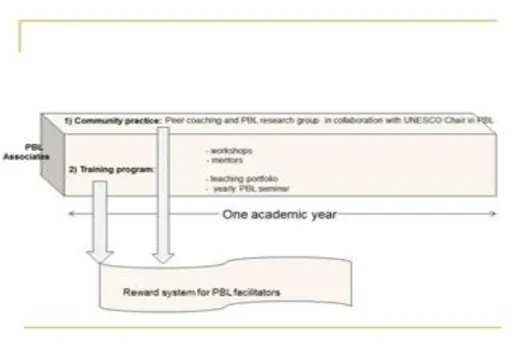
development program. Data from different sources all point out that in order to initiate an effective PBL implementation; at least a year of preparing academic staff is required. In preparing the academic staff, a PBL of community practice, a systematic training program, and a formal support from executive managers in terms of policy and financial issues are also required from the very beginning. An establishment of a systematic PBL training program and the community practice will be the platform for staff to gain in-depth understanding and competences in both theory and practice of PBL. The reflections from different studies from the literature, the PBL experts, and the PBL trainees, together inspire the proposed framework for a new systematic PBL staff development program for a higher education institution. The proposed program consists of two major elements: 1) a sequential staff training activities and 2) a PBL community practice. The figure below demonstrates parameters needed for a framework of PBL staff development program (initiative).
Figure 1: A Framework for a PBL Staff Development Program
As shown in figure 1, in order to implement PBL effectively, a unit of PBL associates should be established. Two major functions that PBL associates can provide are:
1. Provide a sequential training program for staff which consists of four elements (mandatory).
1.1 A series of PBL hands-on workshops which will be offered throughout an academic year.
1.2 PBL mentors who would help PBL practitioners reflect on both PBL theory and practice via meetings and portfolios. At the very beginning the mentors can be external and after a year of training the organization can slowly assemble its internal mentors.
208
1.3 Portfolio as a tool to reflect on the actual practice of each practitioner approved and assessed by mentors.
1.4 A yearly PBL seminar as a platform to present and share their experience.
2. Provide PBL community practice as a platform for staff to support one another informally (optional). PBL community practice consists of two elements.
2.1 Peer coaching which can be initiated and managed by the practitioners themselves. 2.2 PBL research groups which will be mentored by and collaborated with the PBL Network under the support from the UNESCO Chair in PBL. This PBL research group can be a platform to support PBL practitioners to build their research skills and connect with other PBL practitioner networks around the world.
One more important issue that needs to be included in this discussion is a reward system for PBL practitioners. Going through a change process without proper support can be very frustrating and easily result in failure. Especially considering that the change process of implementing PBL will require a long period to see significant results. This long process will require a vision in life- long learning, strong leadership and support, a commitment from both staff and executive managers, and a tolerance for the long term process. Particularly, teachers who participate in the change process will have to contribute time, energy, and intelligence throughout the process. They therefore also need concrete and structured support from the institution.
CONCLUSION
This paper supports that staff development is one of the central elements in implementing PBL initiative as well as maintaining the PBL implementation. PBL staff development needs to be put into an action plan from the very beginning when a higher education institution wants to implement PBL. Without a doubt, it will be hard work for all agents when it comes to a change of any kind. Therefore, having strong support from all levels in the organization is important and valuable. Making a change in an education system is a long process which requires support, commitment, creativity, and tolerance from all agents. As recommended by PBL experts, preparation of the staff alone can take at least a year before the actual implementation; therefore, having a well prepared staff to begin with is a good alternative. A well prepared staff can indeed come in the form of a PBL staff development program. In most case PBL staff training has been done mainly through a short workshop format; however, this study proposes that adding more a systematic long term training and support elements which will not only make a strong PBL implementation initiative, but will also maintain the PBL practice of the institution. As PBL should not be viewed as an add-on teaching approach; it should be embedded in the system. Therefore, the PBL staff development program should also be embedded in the staff evaluation system (reward system) as well. It is recommended that establishing a sequential PBL training program along with a PBL community practice can be a sustainable strategy for implementing and maintaining PBL practice because these two
209
units will be platforms for the PBL practitioners to share ideas and experiences, as well as support one another in their pedagogical stance.
References
Aldred, S. (2003). Addressing the staff development needs for Problem-Based Learning at CQU. Retrieved from http://ausweb.scu.edu.au/aw03/papers/aldred/paper.html
Brodie, L. & Jolly, L. (2010). Providing ongoing just in time professional development inengineering education. Retrieved from
http://aaee.com.au/conferences/AAEE2010/PDF/AUTHOR/AE100067.PDF
Bouhuijs, P. (2011). Implementing Problem-based Learning: Why is it so hard? Revista de Docencia Universitaria. 9(1), pp. 17-24.
Jung, B., Tryssenaar, J. & Wilkins, S. (2005). Becoming a tutor: exploring the learning experiences and needs of novice tutors in a PBL programme. Medical Teacher, 27(7), pp. 606-612.
Dalrymple, K. R., Wuenschell, C.,& Shuler, C. (2006). Development and implementation of a comprehensive faculty development program in PBL core skills. Journal of Dental Education, 70(9), pp. 948-954.
Kolmos, A., Du, X., Dahms, M., & Qvist,P. (2008). Staff Development for Change to Problem Based Learning. International Journal of Engineering Education, 24(4), pp. 772-782.
Krogh, L. (2010). Teacher Training Courses for Assistant Professors [Lecture notes]. Aalborg, Denmark: Aalborg University, Department of Education, Learning and Philosophy.
Murray, I. and Savin-Baden, M. (2000). Staff development in problem-based learning. Teaching in Higher Education. 5(1), pp. 107-126.
Saarinen-Rahiika, H.,& Binkley, J. M. (1998). Problem-based learning in physical therapy: A review of the literature and overview of the Mc Master University Experience. Journal of the American Physical Tharapy Association,78(2), pp.195-207.
Webster, J., & Watson, R.T. (2002). Analyzing the past to prepare for the future: Writing a literature review. MIS Quarterly, 26(2), pp. xiii-xxiii.
Zaidi, Z., Zaidi, S. M., Razzaq, Z., Luqman, M., & Moin, S. (2010). Training workshop in problem-based learning: Changing faculty attitudes and perceptions in a Pakistani Medical College. Education for Health, 23 (3), pp.