European Association for the
Development of Renewable Energies, Environment and Power Quality (EA4EPQ)
International Conference on Renewable Energies and Power Quality (ICREPQ’12)
Santiago de Compostela (Spain), 28th to 30th March, 2012
Cloud Computing for Renewable Power Systems
M. Geberslassie1 and B. Bitzer21
South Westphalia University of Applied Sciences Luebecker Ring 2, 59494-Soest, Germany
E-mail: 1 [email protected],2 [email protected]
Abstract—Renewable energy systems are playing a main role in the future power systems. Therefore, the future electricity infrastructure must support the integration of the existing conventional power system with varies renewable energy resources, which are widely dispersed power sources. This interconnected power pools or grid needs a real-time monitoring, controlling and high computational power. There are many devices connected to the grid enable us to exchange information with power systems. This paper discussed the computation power and the performance of the cloud computing platform by implementing a lab demonstrator which is a load forecasting application in energy management field. Moreover, it announces an insight to the application of cloud computing in the next generation power systems.
Keywords-component;Cloudcomputing;Renewable;Load forecasting.
I. INTRODUCTION
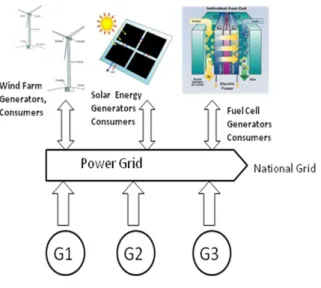
The world is looking for an economical and green energy resource due to the scarcity of the primary energy resources. In order to produce clean and on demand reliable energy, renewable energy resources and distributed generation play an important role. This global energy mix is becoming more and more complex. A small-scale power generation technology that supplies electric power to the consumer, located dispersedly near to the consumption place, is called distribution generation. The generation capacity could range up to 100 MW [1]. As shown in Figure 1, the generated power either consumed totally by the producer or sell part of it to nearby power grid. Widely dispersed distributed generation unit will be interfaced to power transmission grid, end users and local distribution systems.
The exponential growth of small-scale power generation in the last few decades gets more attention not only to its economic advantage, but also environmental impacts [1]. Renewable energy sources (RES) consist of solar, wind, fuel cells and biomass. This huge penetration of RES into the existing power system will bring big challenge in the future power system infrastructure. Moreover, restructuring and deregulation of electricity breed competitive market among power generators [1]. As a result, the future SCADA systems should integrate decentralized distribution systems to ensure
the reliability of the service in more efficient and less environmental problems.
Nowadays, energy management had made one step forward by cooperating with the smart grid and the grid computing. Since huge amount of row data are collected by smart grid from the end user to the computation system, it is often possible that the computation system would be overwhelmed and run out of computation resource. Handling a massive amount of data requires highly scalable storage and heavy-duty computation control. Moreover, in power system management field, in order to satisfy the customer needs in terms of energy consumption management and predictions, the electrical power grids which composed of power electric generator networks, wind energy farms and other electric energy grids should communicate to one another to exchange the current data. Subsequently, a considerable amount of data can flood the system and must be processed. Hence, an enormous pool of computing resource must be provided to compute these data. So far, cloud computing is being explored and recognized as a potential solution to some of computational problems mainly in data processing [2].
This paper first discussed about the cloud computing application in power system to process a large scale of data. A brief overview of cloud computing will be introduced. Characteristic and state of the art of the cloud computing will be discussed followed by cloud computing applications in the field of power systems, especially in energy management systems. Moreover, lab demonstrator is implemented for load forecasting on cloud computing platform. This implementation was qualified as important and realistic in order to determine the highly computational power and resources of the cloud computing. In this scenario Amazon Elastic Compute Cloud (EC2) was compared to the local computers in the laboratory.
I. RENEWABLE ENERGY SOURCES
Power generation depends mostly on large power plants, mainly using coal, nuclear and gas power generation [3]. The scarcity of the primary energy resources has raised the cost of electricity generation. In the recent decades, the small and medium size generation has been gaining more attention. These distributed generations are connected to the distribution
system close to the consumers’ locations. With the emergence of technologies DC grid changed to AC grid, reduce the loss in the transmission line [4], allow carrying to a far distance, and decreasing the generation cost [5]. Large generation station with the vast transmission and distribution grid come to existence. This interconnection helps to solve demand/supply balancing problems, and reliability in the supplied power by counterbalance the breakdown of one generation plant by others in the power grid.
Figure 1. Block diagram representation of renewable power grid. Distribution generation can also be defined as a small-scale power generation. The technical idea of distributed generation is not new. But from the economics point of view DG is a new concept in last decade [4]. The two main benefits of the distributed generation are structural benefits and market-related [6]. The structural benefits deal with how to minimize the cost of transmission and energy cost by combination of different source. Market related benefit deal with the electricity price volatility, improving power quality and reliability.
This horizontal structure and distributed processing gives many advantage against centralized control. For example, when the system is in the emergency state, only specific control area can be under investigation. Decentralized or distributed processing make the entire power system to be reliable, efficient, flexible and economical [1]. Some of these characters will be discussed in short below.
A. Reliability
In case of centralized control systems, all the information exchanged between control center and different nodes will be a short period of time. In this scenario the communication component should work with no error margin; if not the entire system will collapse. For example, the failure in communication to the central control center will create
problem in exchanging basic information that enable the entire power SCADA function properly. In case of distributed or decentralized control scheme the entire system is divided into different control area. And each area owns a local or virtual control center to monitor and control on real-time basis. In this case, a failure occurred in one control area have less effect in the others. With having less impact in the entire power system, it’s possible to improve reliability of the power supply.
B. Efficiency
The distribution generators are by nature widely geographically dispersed. As a result the entire power system is divided into a number of control areas. That enables the controlling computation for the whole system easier. In centralized control center the huge dataset and complex computation make the processing and communication link in the network slower. On the other hand, distributed control divide the task of monitoring and controlling of the power system into subtasks carried out by the local control center according to the control area. These subtasks are processed simultaneously in distributed computation fashion. This improves the data communication rate and response time. C. Flexibility
Dividing the entire power system into different control center help to deal with problems occurred during operation. In distributed control scheme, any failure that can be handled locally will be processed without putting influence on other control area or power systems.
D. Economy
The biggest problem in centralized control powers systems is that it needs an infrastructure that allows exchanging information between the geographically dispersed generation units and central control center. This scene shows that it needs a long distance data communication links and huge capital investment on communication systems.
II. CLOUD COMPUTING TECHNOLOGY
Cloud computing is a paradigm shift based on a collection of many old and few new concepts in several domains such as Service-Oriented Architecture (SOA), distributed and grid computing as well as virtualization [7]. Cloud computing was the result of the big advantages from these different related technologies which presenting a positive benefit over the currently under-utilized resources deployed at data centers. Moreover, several works are published concerning the gains and the obstacles about the adoption of the cloud computing in the terms of performance and computation. Cloud computing proposes to users a pay-as-you-go service which allows them to use its massive computation power ability and the scalabilities. Thus, many organizations and companies have developed their business by using the software applications, programming platforms, data-storage, computing infrastructure and hardware as services which are provided by the cloud computing providers.
“Cloud computing is a model for enabling convenient, on-demand network access to a shared pool of configurable computing resources (e.g., networks, servers, storage, applications, and services) that can be rapidly provisioned and released with minimal management effort or service provider interaction.“ [8].
Similarly, cloud computing refers to both the applications delivered as services over the internet and the hardware in the datacenters that provide those services [9]. Thus, Cloud computing is classified as a paradigm shift in how to design and deliver scalable applications [10].
In sum, it is a term used to describe a combination of a platform and a type of application. A cloud computing platform can dynamically configure and reconfigure computation resources as needed. These resources can be physical machines or virtual servers with scalable computation resources such as: CPU, Storages, Network equipment or other devices. A cloud computing can also be described as an extended application which is accessible via internet. Mostly, cloud computing application resides on a large scale datacenter or powerful servers that host the web services and web application. As referred to other technology, cloud computing can support the grid computing by providing physical or virtual resources on which the grid application can run [2].
End users and service providers can have benefits from the cloud computing. On one hand, while the service providers enjoy greatly simplified software installation and maintenance; the end users on the other hand can access the service anytime, anywhere, with any devices (only if you have browser), share the data and collaborate more easily, and keep their data stored in the infrastructure [11].
III. CLOUD COMPUTING AND FUTURE POWER SYSTEMS The convergence of the power utilities in the horizontal structure or deregulation police come up with more interest in the remote monitoring of dispersed generation unit and their local control center. And also, with the introduction of internet and communication technologies has provided for distribution network operators a feasible basis for the design and implementation of centralized structure for their distributed monitoring and control application [12]. The impressive development contributes to an increase the relevance of power systems design and operation in many research fields. One of the areas that has benefited from such technologies is energy management systems. However the centralized control approach is no longer sufficient to manage these vast distribution networks which call for more advanced smart grid management. Such a smart grid management requires an efficient and reliable communication infrastructure to enable monitoring and control the power grid, as well as accommodate other regional controllers in finding an optimal set of control actions. Accordingly, need more computational ability. Building new infrastructure to replace the existing old infrastructure should address the future computation need,
which deals with huge data by using all the available resources over the internet.
Supervisory Control and Data Acquisition systems (SCADA) technology helps the power companies to exchange information and data between different nodes in the entire network. This network comprises of Energy Management Systems (EMS) and Distribution Management Systems (DMS) [13]. Some of the activities performed by EMS are transmission control, network analysis, load forecasting, power generation and control. Distributed computation, monitoring and control will offer an efficient method for power system operators to manage modern, and complex decentralized power systems within a short period of time.
In the future, the power system will have a different scenario. Mainly the utilities will get the huge amount of power from the Renewable energy resources. This complex scenario requires a lot of data exchange between the nodes and high computational ability. Moreover, the modern power grids (smart grid) have computerized systems that give efficient and smooth information exchange for monitoring and control of the widely dispersed distributed power resources [14]. As a result, cloud computing technology can provide future power system needs, more computation power, which can be addressed by utilizing all the available computing resources. Some of the basic application of cloud computing technology in smart grid application is using the cloud to manage smart meter data for EMS.
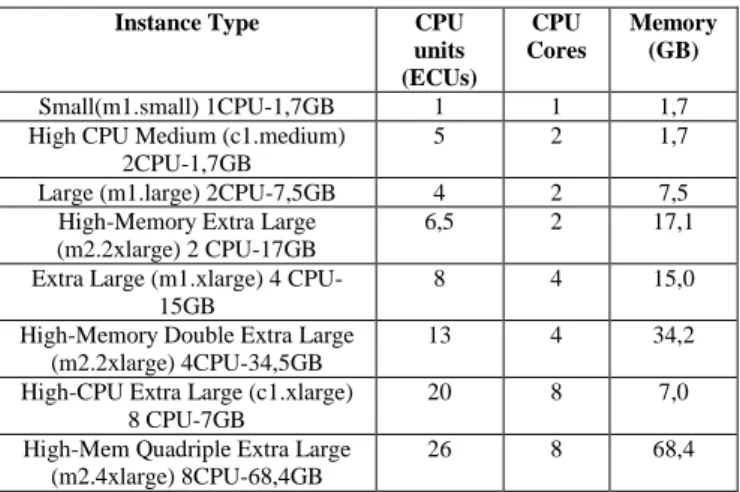
Amazon EC2 platform is designed for the developer or users who want to take the advantage of the performance offered by the cloud computing. It offers the friendly environment for the beginner to implement the first instance machine and operate it according to the requirements.
TABLE I. INSTANCE TYPE IN AMAZON EC2
Instance Type CPU
units (ECUs) CPU Cores Memory (GB) Small(m1.small) 1CPU-1,7GB 1 1 1,7
High CPU Medium (c1.medium) 2CPU-1,7GB
5 2 1,7
Large (m1.large) 2CPU-7,5GB 4 2 7,5
High-Memory Extra Large (m2.2xlarge) 2 CPU-17GB
6,5 2 17,1
Extra Large (m1.xlarge) 4 CPU-15GB
8 4 15,0
High-Memory Double Extra Large (m2.2xlarge) 4CPU-34,5GB
13 4 34,2
High-CPU Extra Large (c1.xlarge) 8 CPU-7GB
20 8 7,0
High-Mem Quadriple Extra Large (m2.4xlarge) 8CPU-68,4GB
26 8 68,4
IV. CLOUD COMPUTING FOR LOAD FORECASTING IN POWER SYSTEMS
This paper focus on implementing the power load forecasting as lab demonstrator on the Amazon EC2 which is a cloud computing platform that can provide to an environment which looks much like hardware [11]. Upon the
implementation, the computation performances, the advantages, the cost comparison and the obstacles will be evaluated accordingly in comparison to the physical hardware implementation.
This was done by implementing an energy management load forecasting application as lab demonstrator on both cloud computing and local computer platforms based on huge amount of power load data set of from a German town. This model should be able to provide a high computational and reduced processing time as compared to the local equivalent hardware computer. As result, the computation process and performances have to be compared as benchmark in order to emphasize the efficiency of the cloud computing environment.
Hardware implementation: It would be important to select the cloud computing provider according to different criteria and requirements. This step consists of selecting one provider which fulfills the project requirements. The second step is to prepare the cloud environment which consists of registering and creating the required instance. On the other hand, the local computer must also be prepared in order to host the application.
Software implementation: The software implementation consists of installing the Matlab software package “Parallel Computing Toolbox” on cloud computing platforms and local computers. And then, the next step is to prepare the program and the data set so that it is convenient for platforms and the computation.
Figure 2. Topology of local implementation.
Performance test: This process involves of evaluating the processing time of the program on cloud computing platform as well as on the Local area computer.
Analysis and Discussion: In this part, the results of the different performance according to each machine specification and platform will be analyzed and discussed.
Currently, Amazon EC2 offers five “hardware” instance types with different characteristics (CPU power, memory, disk and addressability). Amazon provides a basic measure of an EC2 Compute Unit which is equivalent to a capacity of a 1.0-1.2 GHz 2007 Opteron or 2007 Xeon processor for compute power [15]. These instance types have been classified by Amazon into three called standard instances, High memory instances and High CPU instance. Some of the instance types are shown in Table 1 above. Locally, some hardware
architectures are used in order to implement the project. The hardware is divided into 2 categories, the single core and the dual core CPU. These computers are connected together in one network which builds a local area network in a specific range of network addresses.
Local implementation means the way how the lab demonstrator is implemented in local area as compared to the cloud computing provider (in the Amazon EC2 platform). In practice, it consists of installing the Matlab package with the program on the existing architecture at the laboratory. So, two different computer specifications were designed according to the requirements which are a single core and a dual cores computer as shown below.
Single Core Specification:
Operating System: Microsoft XP Professional Microprocessor: Intel Xeon(TM) @3.06GHz Memory: 4562 MB
Dual Core Specification:
Operating System: Microsoft XP Professional
Microprocessor: Intel Dual CPU @2.20GHz (2CPU) E2200 Memory: 1024 MB
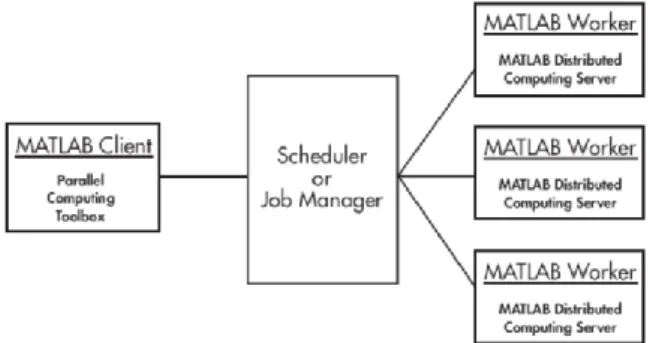
The client is a local desktop which is located in our local laboratory. It uses Matlab Parallel Computing Toolbox (PCT) software to define and distribute the jobs across workers as shown in figure 3. However, the workers are the instances which are located on the Amazon EC2 platform. The Matlab Distributed Computing Server (MDCS) is installed on every instance and performs the computation of the job and returns the result to the client session (local desktop).
To coordinate the communication between client session and the worker, PCT uses a “job Manager” as shown in Figure 3 below. Job manager is the part of the server software that coordinates the execution of jobs between the client machine and the worker nodes. Practically, the distribution of tasks to workers can also be performed by a third-party scheduler, such as Window HPC Server. Therefore, the use of job manager is optional.
Figure 3. Matlab Parallel Computing Architecture.
For Matlab algorithms that require large data set processing, PCT provides distributed arrays that can operate on it. The distributed arrays let the developers to process on large data
sets. The Matlab PCT also provides the spmd (single program multiple data) function, which is used to designate sections of code to run concurrently across workers which participate in a parallel computation. During program execution, spmd automatically splits and transfers the array of data to the workers which are on the EC2 platform.
The test was done in local computers in laboratory to check the feasibility of the performance. Since the local network is dedicated only for the test; results received from different period of time are appropriate. The computation time is the same, because there is no traffic or peak hour’s effect in the process.
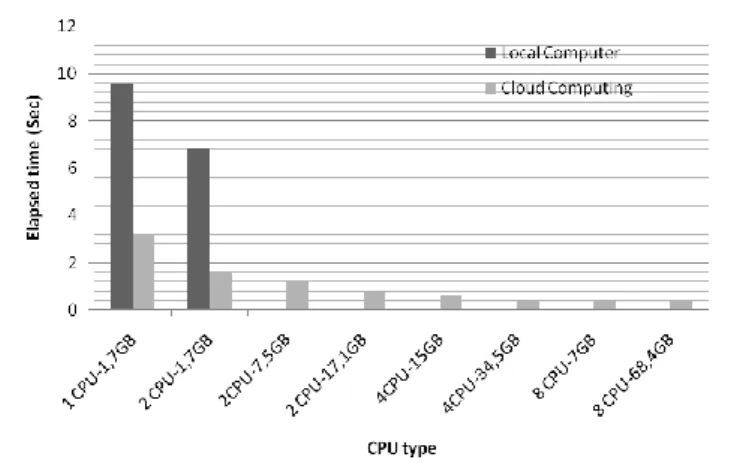
Figure 4. Cloud Computing (EC2) test result.
Each test was repeated three times on the same computer. Test 1 was done repeatedly in the morning from 9:00 am to 11:00 am; the Test 2 was done from 2:00pm to 4:00pm and the last test was at night, from 8:00 pm to 9:00 pm. It is good to mention that, after execution of the program, the computers were rebooted in order to clean the cache and restart the different services in the Matlab application so that the test would be consistent.
Testing computational power of cloud computing was done by implementing an energy systems management application. This was made by selecting the adequate cloud computing platform provider which is in our case the Amazon AWS. AWS was chosen due to its available services, features, flexibility, cost, reliability and its maturity in terms of platform providing. A lab demonstrator was based on power load forecasting application. Power load of a German town, was computed on Amazon EC2 platform and on local computers. The test consists of comparing the computation performance of existing local hardware computers which are single and dual core CPU to that of equivalent Amazon EC2 instances.
V. CONCLUSIONS
The results were optimistic and revealed the high performances of cloud computing EC2 instance in terms of computation power which is around 60% faster than the traditional equivalent hardware computer. So far, Cloud
Computing is being explored and recognized as a potential solution to some of computational problems mainly in data processing. Some improvements in terms of programming must be elaborated in order to upgrade performance. It can be concluded that cloud computing EC2 has a great asset in terms of computation power, scalability, availability and cost.
The increasing competitive among electric utilities will lead the future power system to grow both technically and economically. Accordingly, need more computational ability. Building new infrastructure to replace the existing old infrastructure should address the future computation need, which deals with huge data by using all the available resources over the internet.
In the future, the power system will have a different scenario. Mainly the utilities will get the huge amount of power from the private sectors or from the small-scale generation plants, i.e. renewable resources. This complex scenario requires a lot of data exchange between the nodes and high computational ability. Moreover, the modern power grids (smart grid) have computerized systems that give efficient and smooth information exchange for monitoring and control of the widely dispersed distributed power resources. As a result, cloud computing technology can provide future power system needs more computation power which can be addressed by utilizing all the available computing resources.
REFERENCES
[1] N. Jenkins, R. Allan, P. Crossley, D. Kirschen and G. Strbac, “Embedded Generation”, IET power and energy series 31 pp 284,2000. [2] Greg Boss, Cloud Computing, IBM, October 2007.
[3] Francesco Gullì, ”Distributed Generation versus Centralised Supply: a Social Cost-Benefit Analysis”, 2003.
[4] G. Pepermans, J. Driesen, D. Haeseldonckx, R. Belmans and W.D’haeseleer “Distributed generation: definition, benefits and issues, energy policy, 2005
[5] H. Lee Willis, Walter G.Scott; “Distributed power generation Planning and evaluation”,2004.
[6] E. Cerami. Distributed Applications with XML-RPC, SOAP, UDDI and WSDL, Web services Essentials, O’Reilly, 2002
[7] LamiaY., Toward a Unified Ontology of Cloud Computing, University of California, Santa Barbara.
http://freedomhui.com/wp- content/uploads/2010/03/CloudOntology.pdf [8] Peter Mell and Tim Grance, The NIST Definition of Cloud Computing,
Version 15, July 2009.
[9] Qi Zhang, Lu Cheng, Raouf Boutaba, Cloud computing: state-of-the-art and research challenges, The Brazilian Computer Society 2010 [10] Cloud computing with Amazon Web Services, IBM,Prabhakar Chaganti,
CTO, Ylastic, LLC, 29 Jul 2008
[11] Above the Clouds: A Berkeley View of Cloud Computing, http://www.eecs.berkeley.edu/Pubs/TechRpts/2009/EECS- 2009-28.html,February 10, 2009
[12] P.Nowotny,Smart Grids-Vision und Konkrete msetzungsmoglichkeiten”, October 2008
[13] Francesco Gullì, Distributed Generation versus Centralised Supply: a Social Cost-Benefit Analysis”, 2003
[14] T.K. Apostolopoulose, G. C.Oikonomou, A scalable, extensible framework for grid management, 22nd IASTED international conference Feb.2004, Austria
[15] http://www.mnxsolutions.com/linux/amazon-ec2-benchmark-pystone.html