Program
Review
2012
PROGRAM
TITLE:
Network
Specialist,
Network
Security
Specialist,
Windows
Specialist,
Computer
Network
Technologist.
Prepared
by:
Joliet
Junior
College,
CIOS
Dept.
David
Buckley,
Professor,
MCP,
MCSE,
MCSA,
MCITP,
Network+,
A+,
Security+,
EC
‐
CEH
Joe
Sullivan,
Associate
Professor,
CCNA,
CCNP,
CCAI,
Wireless#,
CWTS,
CWNA,
CWSP,
CWNP
Contents
Figure 1 Sample of Simulated Environment ... 11
Figure 2 Remote Access Sample ... 11
Figure 3 Degree of Support for Network Technologist Goals ... 12
Figure 4 Degrees Awarded by Major ... 14
Figure 5 Program Cost ... 15
Figure 6 Salary and Wage Data ... 17
Figure 7: Growth and Wage Data. Source: Growth and Salary figures (Bureau of Labor Statistics, 2012) 19 Figure 8 Expected Salary Levels. Source: (Illinois, State of, 2012) ... 20
Figure 9 Expected Occupation Increase. Source: (Illinois, State of, 2012) ... 20
Contents
PROGRAM TITLE: ... 1
Goal Statement Computer Network Technologist A.A.S Program ... 5
Program Highlights ‐ Network Security and Cisco Networking Academy – Computer Network Technologist ... 5
Identity ... 6
PROGRAM TITLE: ... 6
COURSE NAMES AND NUMBERS: ... 6
SECURITY ... 6
CCNA Requirements – 16 Semester Hours ... 6
CCNP Requirements ‐ 16 Semester Hours ... 7
Progress report/improvements since last review ... 7
IMPROVEMENTS: ... 7
PROGRAM OUTCOMES: ... 9
College Goals and Achievement ... 10
College Goal ... 10
Program Response: ... 10
College Goal ... 11
Program Response: ... 12
Program Quality ... 12
Certification and Hours ... 13
Qualification of Faculty/Staff ... 13
Professional Development ... 13
Student Goal Achievement ... 14
Enrollment ... 14
Facilities and Equipment ... 14
Accessibility of Information/Services ... 15
Advisory Committee Input ... 15
Survey Results ... 15
Need ... 16 Expected Salary ... 16 Student Benefit ... 17 Program Growth ... 18 Occupational Growth ... 18 Program Need ... 21 FUTURE TRENDS ... 21 Advisory Members ... 22
Suggestions from Advisory Committee... 22
Actions from Recommendations ... 22
Professional Development ... 22
Program Contribution ... 22
SWOT Analysis... 25
Strengths and Opportunities (SO). How might strengths help us take advantage of opportunities, both current and future? ... 25
Strengths and Threats (ST): How might strengths be used to avoid or counter threats? ... 26
Weaknesses and Opportunities (WO): How might we eliminate weaknesses in order to engage in new opportunities? ... 26
Weaknesses and Threats (WT): What defensive actions might we take to minimize weaknesses and avoid threats? ... 26
Ideas for program improvement. ... 26
Action Plan ... 26
ASSESSMENT PLAN ... 27
Statewide Program Issues ... 28
Works Cited ... 29
Goal
Statement
Computer
Network
Technologist
A.A.S
Program
This program provides training to configure and maintain Cisco routers and switches and their
associated networks. It leads to validated skills for installation, troubleshooting and monitoring
of network devices to maintain integrity, confidentiality and availability of data and devices and
develops competency in the technologies that Cisco uses in its infrastructure. Course content
covers Cisco Networking Academy program guidelines for the applicable class of student
enrollment. Students shall receive material and engage in active learning through a
combination of class lecture and in‐class activities. Successful completion of this goal shall be
measured by provided content in testing, lecture and in‐class activities to the goals set forth in
the Cisco Networking Academy applicable chapter goals.
Program
Highlights
‐
Network
Security
and
Cisco
Networking
Academy
–
Computer
Network
Technologist
1. Current Growth! Increase of 35% in enrollment for the Cisco Networking Computer
Network Technologist (CNT) program over the last 4 years. Enrollment in the Cisco
Networking program is up 12.1% for just 2011‐2012.
2. Strong projected growth! Network Security and Cisco Networking Computer Network
Technologist programs both have future growth projects at the local, state and national
levels. (Bureau of Labor Statistics‐ Job Outlook, 2012)
3. Increase in company sponsorship of employees for program enrollment. A paradigm
shift to increased reliance of on network infrastructure and broad exposures to security
concerns is the driving force. The trend is expected to continue.
4. The CNT and Network Security program fulfills JJC’s mission statement. The program
provides career preparation, training and workforce development which is congruent
with the college mission statement below:
Joliet Junior College enriches people's lives through affordable, accessible,
and quality programs and services. The college provides transfer and career preparation, training and workforce development, and a lifetime of learning to the diverse community it serves.
5. Work force training! Provides workforce training to residents for local, regional, state
and national in‐demand jobs!
6. Attraction for non‐traditional students to return to JJC to update job skills and enroll in
other non‐related courses.
7. Helping family’s by building careers.
8. Program contributes to community involvement by PC refurbishments and donations.
Identity
PROGRAMTITLE: Network Specialist, Network Security Specialist, Windows Specialist,
Computer Network Technologist
CIP Code: 11.0901
DEGREES AND CERTIFICATES (Indicate: 03=AAS, 20=>30ch or 30=<20 credit hours.)
03 AAS Computer Network Technologist CO237
30 Certificate of Completion ‐ CO244 ‐Cisco Network Security
03 AAS Computer and Network Security Specialist CO241
20 Network Specialist Certificate CO235
20 Computer and Network Security Specialist Certificate CO242
20 Windows Specialist Certificate CO519
COURSENAMESANDNUMBERS:
SECURITY
CIS 105 ‐ Introduction to Windows CIS 116 ‐ Introduction to the Internet
CIS 122 ‐ Computer Info. Systems Fundamentals CIS 127 ‐ Overview of Microcomputer Concepts CIS 126 ‐ Microsoft Office
CIS 130 ‐ BASIC Programming
CIS 145 ‐ Fundamentals of Networking CIS 154 ‐ Data Communications and Networks CIS 158 ‐ DOS plus UNIX ‐ Operating Systems CIS 220 ‐ Fundamentals of Web Design CIS 271 ‐ Windows Client OS
CIS 272 ‐ Windows Server I CIS 273 ‐ Windows Server II
CIS 275 ‐ PC Troubleshooting and Toolbox CNT 101 ‐ Network Fundamentals
CNT 102 ‐ Routing Protocols and Concepts CIS 263 ‐ Networking Essentials
CIS 277 ‐ Basic Home Computer Security CIS 278 ‐ Ethical Hacking
CIS 292 ‐ Computer and Network Security CIS 296 ‐ Computer Forensics
CIS 274 ‐ Advanced Server Topics
CNT 103 ‐ LAN Switching and Wireless Communication
CNT 104 ‐ Accessing the WAN
CCNPRequirements ‐ 16SemesterHours
CNT 205 ROUTE I
CNT 206 ROUTE II
CNT 207 SWITCH
CNT 208 T‐SHOOT
MISSION: The purpose of these programs is to prepare students for careers as Network
Managers, Network Security Professionals, and Computer Support Professionals by providing
them with the skills required to successfully perform these jobs.
The CNT program is a Cisco Networking Academy approved program to educate students for
networking and Information Technology careers. The academy follows strict Cisco Networking
Academy guidelines as outlined from Cisco, including but not limited to having certificated
Networking Academy Instructors and approved academy learning material.
My goal as program coordinator is to provide a learning environment to our students to
accommodate goals set forth in our contract with the Cisco networking Academy pertaining to
standards, so that students can enhance their skillset by increasing their information
technology knowledge. To educate students to fulfill requirements to complete the CCNA and
CCNP certification.
Progress
report/improvements
since
last
review
IMPROVEMENTS: The following is a list of programs improvements made since last review
and a basis for change.
A new Computer and Network Security Specialist degree and certificate have been
added. These include courses in some of the fastest growing areas of IT including Ethical
Hacking/Penetration Testing and Computer Forensics.
All the computer systems within the classroom have been upgraded to a level sufficient
to teach the classes. The standard student system includes a dual core Pentium 4
processor, 10GB of RAM memory, and a 1 Terabyte hard disk drive.
Several servers have been set up and configured for the classroom. This includes two
Windows Server 2008 R2 systems which provide DHCP, FTP, and DNS services for the
classroom, and a VMware ESXi 5 Server has been set up to provide a simulated
All Windows Operating System and Network Security Classes are now taught within a
virtualized environment using VMware workstation. Students can now develop
numerous virtual machines, running different operating systems, within one physical
computer. This allows students to construct whole networks within one physical
computer in order to understand how to plan, install, management, and secure
networks.
Extensive Hands‐On projects have been implemented in the Windows Operating System
and Network Security classes.
All Windows Operating system classes have been updated from Windows 2000 to the
current Windows operating systems; Windows 7 and Windows Server 2008.
By becoming a VMware IT academy school we are able to receive virtualization software
for use in the classes at a reduced rate ($250/Year for unlimited classroom installations
vs. $120 per machine). This also allows us to provide the software for free to CIS
students.
We have partnered with Microsoft through their IT Academy program which allows free
access to the software for classroom use and also allows us to provide the software for
free to our students.
During the past 2 semester student interns have been employed to provide open
classroom hours in the classroom used for teaching computer security and Windows
operating system classes.
Setup and facilitate the learning environment by setting up a Console Management
Server in both Cisco classrooms to provide off campus/anywhere access to equipment.
Utilize new interactive software to simulate networking environments. Students can
configure unique network topologies and run practice scenarios. Students have found
this beneficial since they are in‐touch with technology and can now work with virtual
equipment for introduction classes.
Provisioning of the interactive learning software to provide immediate feedback for
students homework activates by creating simulated network environments. The
program in use is packet tracer and activities have been deployed to every introduction
class in the program. Hundreds of students have used this program and benefited from
the environment.
Continual maintenance of the classroom environment setup to modify the environment
according to the classroom environment and student activities. Network support
activity includes, but is not limited to maintenance of the equipment operating systems,
Coordinate with our feeder school for program requirements and pathways. Design
course offerings for the new curriculum, currently working on an agreement with Lewis
University and DeVry for transfer status.
Work with external relations to promote the program by using WJOL.
Work with prior graduates to help place students in either internships or full‐time
positions.
Continuing training by achieving new certifications with Cisco including work towards
the Cisco Certified Network Professional certifications and CCNA security. Current
certifications include the Cisco Certified Network Associate (CCNA), Cisco Certified
Academy Instructor (CCAI), Wireless#, Certified Wireless Technology Specialist (CWTS),
Certified Wireless Network Associate (CWNA), Certified Wireless Security Professional
(CWSP), Certified Wireless Network Processional (CWNP).
PROGRAMOUTCOMES:
What are the outcomes for the program? How do these outcomes relate to the college’s
outcomes/strategic plan (http://www.jjc.edu/about/college‐info/Pages/strategic‐plan.aspx)?
1. Improve student success with an emphasis on enrollment, retention, graduation, and transfer rates and effective teaching strategies and learning outcomes.
The courses include extensive hands‐on exercises to provide students with real‐
world network problems and solutions
The courses utilize virtualization which is considered to be one of the fastest
growing components of IT.
2. Increase and improve partnerships with organizations that support the college's
mission.
The CIS department meets twice per year with the advisory committee to
determine industry needs.
3. Utilize technology strategically to advance teaching and learning, expand online and
alternative delivery methods, and enable effective administrative and support services.
The courses make extensive use of virtual machines to provide a flexible and
state of the art training environment.
A primary component of classes is preparation of students for Industry
certification exams in Windows Operating Systems, Computer Networking, and
Computer Security. Employment in these fields is among the fastest growing of
all careers. According to the Bureau of Classroom statistics this employment in
these fields are projected to increase by 22% (Information Security Analysts) –
28% (Network and Computer System Administrators)
College
Goals
and
Achievement
CollegeGoal
Utilize technology strategically to advance teaching and learning, expand online and alternative
delivery methods, and enable effective administrative and support services.
ProgramResponse:
This program provides advanced equipment, materials and resources to provide technically
advanced training in configuration and maintenance of Cisco routers and switches and their
associated networks. It leads to validated skills for installation, troubleshooting and monitoring
of network devices to maintain integrity, confidentiality and availability of data and devices and
develops competency in the technologies that Cisco uses in its infrastructure. The program
utilizes technology strategically to advance teaching and learning, expand online and
alternative delivery methods, and enable effective administrative and support services. The
newly used software found in Figure 1 Sample of Simulated Environment shows how the new
technology can aid students understanding of network topology and allow them to use the
software to create virtual environments. Figure 2 Remote Access Sample shows a remote
Figure 1 Sample of Simulated Environment
Figure 2 Remote Access Sample
College
Goal
ProgramResponse:
1. The Program goals specifically relate to industry need in networking to develop
programs that anticipate and respond to labor market demand. Our graduates learn
real world problem solving and provisioning techniques because of program
enhancements done each semester.
2. Conversations with the business professionals on the CIOS advisory board, labor market
predications and industry contacts have maintained that information security positions
are hard to fill and that there is a tremendous shortage of both qualified network
security persons as well networking personal. Below in Figure 3 Degree of Support for
Network Technologist Goals is a matrix of how the goals of each course pertain to the
program goals. This matrix will help direct resources to address our institutional goal of
labor market projections and help facilitate course design. Critical skill sets are outlined
below, areas of strength and weakness are identified by degree of response to each
category. One x means minimal support; whereas, four x’s means significant support.
The figure and addressed with the new addition of CNT 220 proposed network security
course.
Course Installation Trouble‐
Shooting Data Monitorin g Data Confidentiality Data Availability Security CNT 101 X CNT 102 XX X X X CNT 103 XX X X CNT 104 XX X X CNT 205 XX X X X X CNT 206 XX X X X X CNT 207 XX X X X X CNT 208 XXXX CNT 220 Security Proposed Course X X XXXX
Figure 3 Degree of Support for Network Technologist Goals
Program
Quality
The evidence below has been collected to indicate the extent to which program outcomes
CertificationandHours
Instructors for the program have relevant industry certifications as Certified Cisco
Academy instructors. Instructors must also maintain up‐to‐date industry certifications.
Each instructor both Mike Fagan and Joe Sullivan have industry experience a mix of
application development and design of telecommunications systems as well as
programming logic.
Students complete at least 3 hands‐on projects in each advanced Windows and
Computer Security class to validate that they have master both the conceptual elements
and required technical skills. These projects integrate tasks from several class chapters
to simulate real‐world network environments and problem solving. In addition, security
degree students also perform a variety of classroom assignments to develop
competency in specific topic areas
QualificationofFaculty/Staff
CIS staff teaching the Windows and Security classes have earned industry certifications
in the topics taught including:
Microsoft Certified Professional
Microsoft Certified Systems Engineer
Microsoft Certified Systems Administrator
Microsoft Certified IT Professional
Microsoft Certified Technical Specialist
Comptia Network+
Comptia A+
Comptia Security+
EC Council Certified Ethical Hacker
CCNP Faculty teaching Cisco Networking have earned the following industry
certifications: CCNA CCNP Wireless # CWNP CWTS CWSP
Cisco Certified Academy Instructor: CCNA, CCNP Switch, CCNP Route, CCNP T‐
shoot
ProfessionalDevelopment
The CIS Instructors teaching these classes have completed a variety of professional
development classes and training including:
Microsoft Server 2008 Administration
Microsoft Windows 7 Administration
Computer Forensics
Computer Forensics using Access Data’s Forensics Toolkit
Certified Ethical Hacking
VMWare Server Administration
Offensive Security Penetration Testing With Backtrack
StudentGoalAchievement
Supported by two CIS instructors, students have created a Network Security Club which
meets regularly. This club has been responsible for refurbishing and distributing
computers to several aid organizations in the Joliet area. In addition, members of the
club train for and participate in cyber security competitions such as the Midwest
Collegiate Cyber Defense Competition. CIS instructors work with the students to answer questions and help them prepare for the competitions.
Enrollment
Graduation rates per year for students in the Networking, Security and Degree
programs:
Figure 4 Degrees Awarded by Major
Facilities
and
Equipment
Cisco class facilities support a full scale enterprise environment.
Cisco Program has software which simulates networking devices and provides
0 5 10 15 20 25 2007 2008 2009 2010 2011
Degrees
Awarded
NETWORK SPECIALIST CAC 44.0 NETWORK SPECIALIST OPTION AAS 66.0 COMPUTER NETWORKING TECHNOLOGIST AAS 64.0 WINDOWS SPECIALIST CAC 41.0 COMPUTER/NETWORK SECURITY SPECIALIST CAC 45.0 COMPUTER/NETWORK SECURITY SPECIALIST AAS 64.0 Classroom computers have been replaced and upgraded to allow students to
effectively run the virtualization software used in the classes.
Students are eligible to receive free versions of Microsoft Windows Operating
Systems and Server products for home use.
Students are eligible to receive free versions of VMware Workstation for home use.
Accessibility
of
Information/Services
Open classroom hours is now provided in the classroom used for teaching computer
security and Windows operating system classes. This allows students more time to
work on class projects.
Advisory
Committee
Input
Computer Information System Advisory committee meetings are held twice per
year. These provide input from industry and education partners to ensure student
needs are met.
SurveyResults
Surveys are conducted for each cisco course. The survey measures the degree of
student confidence pertaining to the course objectives. Survey results are separated for
the both the instructor, course and equipment with a scale of 1‐5. Results of the
surveys are as follows:
o Students Rate the quality of instruction with top marks!
o Access to classroom resources can be limited during select activities.
o Students have transitioned to virtual services to substitute for physical devices.
o Students can access off‐site and remotely easily 24x7.
o Students plan to continue their network education and training.
Instructor satisfaction is has maintained outstanding performance while access to
equipment and confidence for secure deployment scenarios is less. The addition of
equipment pertaining to security should help address both these issues. Building
confidence by hand’s on activities help, but the incorporation of a security element will
enhance student’s confidence with security issues.
Cost
The program does require periodic upgrade expenditures and additional resources to
configure and maintain equipment to the standards required by the Cisco Networking
Academy. The direct intuitional cost reflects periodic equipment expenditures which
represents a significant expenditure. Equipment may be purchased in random intervals
and the associated costs may be reflective of significant outlays in capital for major
upgrades. When expenditures are averaged out the equipment costs should diminish the
direct institutional cost of the program significantly. It is recommend that a support
structure be setup to anticipate future costs of the program.
Need
Enrollment Headcount/ Credit Hours Produced
Both headcount and the number of credit hours for the program have risen steadily
between 2007 and 2010, increasing by 66%.
Expected
Salary
Figure 6 Salary and Wage Data
Source: (State of Illinois Wage Data 2010 Theresa P. Larkin, 2010)
StudentBenefit
Graduates of the course or Cisco Certified Network Associate and Cisco Certified Network
Professional students are afforded the following benefits:
In‐demand jobs!!!
Employable skills!
Government sanctioned program for U.S. Government Trade Adjustment Act
Government sanctioned program for students in the workforce development
program
Livable wages required to support a family, often in ranges from $65000‐$110,000
compensate on experience and position.
Job skills directly transferrable applicable to jobs.
World‐wide Industry recognized certifications.
Re‐training for displaced and underemployed persons
High‐tech jobs to fulfill needs of local businesses such as hospitals, shipping
terminals and major corporations like Caterpillar.
$0 $10,000 $20,000 $30,000 $40,000 $50,000 $60,000 $70,000 $80,000 $90,000 Network and Computer Systems Administration Network Systems and Data Communication Computer Support Specialists
Career and skill enhancement for non‐traditional students.
Students return to college who would otherwise remain in the workforce.
The program cost relates to the benefit a student receives upon graduation. Students who
successfully transition though the program have an opportunity to work in high‐tech areas
such as network administration, network support, network architecture and high tier
technical support positions. May students who attend the program are non‐traditional
students returning to school. The program also has many displaced workers from various
trades.
Graduates of our program are working at major corporations such as Nicor, McDonalds,
Boeing, Travelocity, FAA, and Sears, Panduit, just to name a few. Students entering the
program are also taking other courses at the college while pursuing their Associates degree
in CNT. Current students are aslo a part of the U.S. Government Trade Adjustment Act.
ProgramGrowth
The growth of the field should be tremendous with an anticipated 40.10% increase
expected according to the Standard Occupational Classification scale for both the state
and Will County. In the upcoming years, according to the data further growth is
expected. Additional growth can be included which accounts for divergent networking
fields not yet represented in the report. Enrollment Credits have increased by almost
1000 hours from 5 years ago reflecting both the bad economy pushing people to re‐tool
and an increased opportunity for networking and security positions. The program
currently produces 2799.00 credit hours.
CIP 11.0901 Computer Systems Networking and Telecommunications
OccupationalGrowth
What trends are apparent in the data regarding the NEED for the program?
How strong is the occupational demand for the program?
How has demand changed in the past 5 years and what is the outlook for the next 5 years.
Occupational demand for this program is very high. Government statistics project that
Network Administration and Computer Security jobs will be among the fastest growing
careers during the next decade:
Figure 7: Growth and Wage Data. Source: Growth and Salary figures (Bureau of Labor
Statistics, 2012)
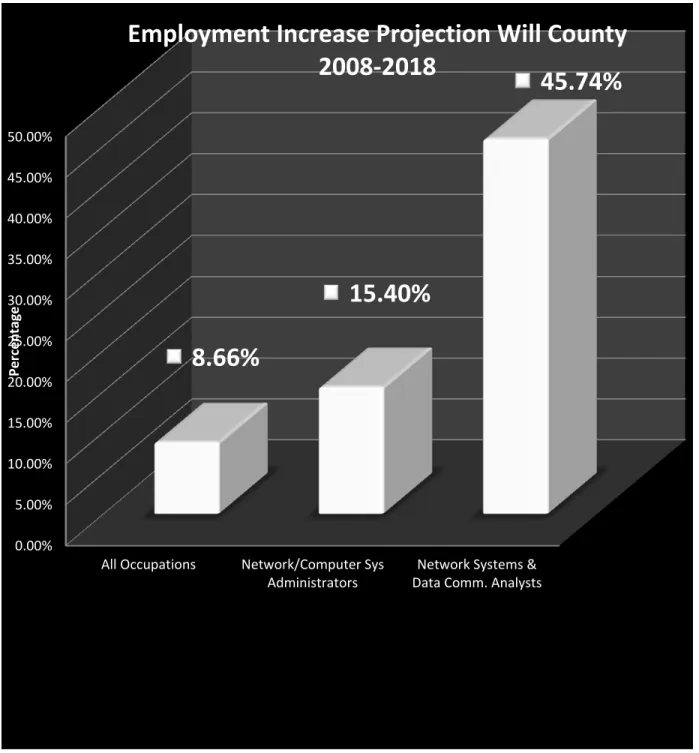
Within Illinois and Will County, the Employment prospects are equally promising for students in
Figure 8 Expected Salary Levels. Source: (Illinois, State of, 2012)
Title 2008 2018 Percent Increase
15‐1071 Network/Computer Sys Administrators 367 408 15.40%
15‐1081 Network Systems & Data Comm. Analysts 197 276 45.74%
Figure 9 Expected Occupation Increase. Source: (Illinois, State of, 2012)
0.00% 5.00% 10.00% 15.00% 20.00% 25.00% 30.00% 35.00% 40.00% 45.00% 50.00% All Occupations Network/Computer Sys Administrators Network Systems & Data Comm. Analysts
8.66%
15.40%
45.74%
PercentageEmployment
Increase
Projection
Will
County
2008
‐
2018
x Standardized assessments
Certification and licensure examination results
Writing samples
Portfolio evaluation
Course embedded questions
x Student surveys
Analysis of enrollment, demographic, and cost data
ProgramNeed
Strong occupational demand and GROWING!
Increased dependence on networking and security infrastructure within the industry is
driving growth.
Consistent and strong Labor projections for networking and security fields
Occupational demand both locally AND nationally AND internationally.
Occupational need for both district, state and federal
FUTURE
TRENDS
What needs and/or trends are you seeing in the field/profession? (Identify sources.)
The rapid increase in the number of networking careers has been previously
documented within this report. Within this field, Virtualization and Cloud computing
are the two of the most rapidly increasing and changing areas.
Virtualization allows organizations to reduce their costs by running multiple virtual
machines on a single physical system. This saves organizations money by reducing
outlays for computer hardware as well as electricity and cooling costs. Virtualization has
been shown to reduce hardware and operating costs by as much as 50% and energy costs by 80%, saving more than $3,000 per year for every server workload
virtualized(Vmware). Much of the network and security curricula are currently
presented using virtual machines, however server virtualization is an area which needs
to be increased.
Another trend expected to revolutionize networking is the movement toward cloud
computing. Cloud computing is Internet‐based computing which provides on‐demand
access to shared resources such as computing power, software, and information, Much
like the electricity grid, cloud resources are provided as needed to the client. It is
projected that By 2014, more than 50 percent of all workloads will be processed in the
cloud. This is a twelvefold over the next 5 years. Global cloud IP traffic is projected to
account for more than one‐third (34 percent) of total data center traffic by 2015 (Cisco ,
AdvisoryMembers
Our CIOS Department Advisory Committee has 5 representatives from companies IT and
network and infrastructure services. Network and database representatives
SuggestionsfromAdvisoryCommittee
There is a huge demand for Networking, Security and VoIP professionals in the market. There is
a growing demand for Cisco Security Professionals and well as Server and Client Side security.
There is also a demand for virtualization services.
ActionsfromRecommendations
The CIOS Department has begun a Computer and Network Security Degree as well as work
towards new classes in Cisco Certificated Network Associate Security and Virtualization courses.
ProfessionalDevelopment
The program requires a need to continuing education and recertification on a periodic
basis..
The program should have 2 certified full‐time faculty members teaching CNT courses.
Mike Fagan is set to retire in December 2012. In 2012 a request has been made for an
additional faculty for 2013. After a candidate is hired he/she still needs to be sponsored
by our Academy and sent to instructor training before he/she teaches class. Hiring a
candidate early provides time for the instructor to receive proper certification training
to teach the courses.
ProgramContribution
The following outlines program contributions to other areas of the college as well as
opportunities for collaboration.
Major Core and Major Elective courses contributes to many JJC general education
classes.
The following majors and certificates contribute to many credit hours earned by other
college programs assigned to the school and CIS courses:
o Computer Network Technologist A.A.S.
o Computer and Network Security A.A.S.
Student Leader of the Year 2011 was a Cisco Networking Technologist student for doing
work with the JJC Networking Security Alliance. The club has refurbished used PC’s and
given them out to community organizations identified by the United Way. This work
continues in 2012.
defensive and offensive network security. This area was identified as a high priority for US National Security interests.
4th place in a networking security competition. JJC beat many 4 year institutions. 1st and
second place winners were Northwestern University Doctoral Students, DePaul Doctoral
students and University of Illinois Chicago Doctoral students. JJC beat out many other
university’s and colleges to finish fourth place, so were very proud of our students.
SWOT ANALYSIS: Below is a SWOT Analysis to help identify program issues and priorities.
Definitions
Strengths: Strengths are internal to an organization and/or program. They are things we do
that make us stand out from the rest of the pack. We are able to use our strengths to create
an advantage over competitors. We may maintain, build and leverage our strengths.
Weaknesses: Weaknesses are also internal to an organization. They make it difficult for us
to compete or place us at a disadvantage relative to others. They hamper our ability to have
an impact on the people we serve. We may choose to remedy or exit weaknesses.
Opportunities: Opportunities are external, future‐oriented areas where we can expand
given appropriate resources. We have limited control over opportunities that may exist
outside of JJC. However, we can attempt to make an impact through our actions. We may
not be able to take advantage of all opportunities. We may prioritize and optimize
opportunities.
Threats: Threats are elements in the external environment that have the potential to
negatively impact the college or our programs. Threats are outside forces that may make
certain goals unreachable. We may choose to counter threats.
INTERNAL
Strengths (+) Weaknesses (‐)
1. Technical Knowledge of Faculty
with applicable industry
experience, certifications and
even Patents with course
Technology
1. Retirement of key personal in
department.
2. Certification and Degree
options‐ It is possible for a
student to achieve both an
associate’s degree and separate
certifications. He/she may also
take the full complement of
Cisco courses from CCNA to
CCNP and Security Courses
2. Enhance information on web
page to educate potential
students and family about
3. Use of updated equipment and
well‐designed network
topologies.
3. Schedule of equipment
replacement is unclear.
4. Motivated and Strong Student
Base to continue education and
earn certifications.
4. Replacement of Key personal
and time to train new
replacement is slow.
1. Technology varies learning
methods. Students have
Remote Access from nearly
anywhere in the world
5. On‐line courses are limited in
number.
2. Full‐time faculty for needs
analysis and consistency for
students
6. Some classroom equipment
is outdated.
3. Currently with both Microsoft
and VMware IT academies
7. External access to Security
classroom needed
4. Instructors continually improve
skills and knowledge through
training and reading
8. Virtualization Server needed
to facilitate online classes
and improved student use
from home
5. 2+2 Agreements with 4 year
institutions
9. Limited classroom availability
6. Strong Advisory Committee 10. Insufficient Staffing
7. Strong CIS department support
8. Student Computers are
adequate for needs
Opportunities (+) Threats (‐)
1. Employer and Employee
Assistance programs directed
toward enrollment.
1. Limited number of Cisco
Networking Academy Instructor
training centers and limited
class availability. Pertinent for
SWOT
Analysis
Strengths and Opportunities (SO). Howmightstrengthshelpustakeadvantageofopportunities,
bothcurrentandfuture?
Advertise and promote the technology aspects of the course from the JJC home page. The remote access and simulated environments can be advertised to drive student interest in the program to tech savvy students.
Our internal strengths and knowledge base helps students achieve the most from the course. An additional benefit with the experienced leadership can optimize equipment to allow a
maximum return on investment. As knowledgeable instructors was can utilize resources to the maximum possible effect.
limited. All Academy instructors
must have “instructor”
certification to even offer a
course. Currently there are only
3 training centers nationwide.
2. Expanded Teaching
Opportunity’s in Security,
Wireless and VoIP are potential
avenues of interest
2. Changing business environment
forces changes in program
offerings. State response to
approve new classes lags behind
market forces.
3. Full‐time faculty familiar with the
environment, students and
topology of the classroom.
3. Part‐time faculty not familiar
with classroom, teaching
procedures or resources.
4. State recognition of an in‐
demand area
4. College of DuPage Cisco course
offerings.
5. Create Online classes 5. Staff Attrition – 4 networking
instructors will be leaving in
next 3 years
6. Purchase server for online
classes
6. Insufficient staffing
7. Develop Server Virtualization
StrengthsandThreats(ST): Howmightstrengthsbeusedtoavoidorcounterthreats?
Reliance on the professionalism and insight of the instructors to foresee changes to curriculum and make appropriate adjusts to either the curriculum or equipment specifications.
Requires a committed team member. I am requesting a full‐time replacement faculty member.
WeaknessesandOpportunities(WO): Howmightweeliminateweaknessesinorderto engageinnewopportunities?
I believe that the internal weakness can be compensated by providing early training opportunities to new hires.
Weakness can also be done by setting up a estimation of purchases required to replace old equipment. Allocating x amount of funds each semester for budget projections. Although future predications are difficult, setting aside $5000 a year is recommended at a minimum.
WeaknessesandThreats(WT):Whatdefensiveactionsmightwetaketominimize weaknessesandavoidthreats?
Get a buy‐in from administration and cabinet members for a schedule of replacement. Provide an early hiring process for replacement candidates.
Ideas
for
program
improvement.
1. Maintain up‐to‐date program.2. Incorporate Additional Faculty
3. Promote On‐Line Classes
4. Remotely Accessible Virtualization Server
5. Educate and Promote the program through web content
6. Predict changes in industry and be proactive to industry need.
7. Provide a compliment of in‐demand courses in networking to include the proposed security
course. The new course work will help student retention and retain current students.
8. Provide education to potential students by enhancements made to the Cisco Web Page on
JJC.edu. http://www.jjc.edu/academics/divisions/career‐
technical/cios/cisco/Pages/default.aspx
9. Provide incentive based programs for student retention.
10. Maximize leverage of existing equipment.
ActionPlan
The following chart defines the action plan based on program improvement ideas.
Desired Change/Improvement/Goal: High‐tier Security Offerings
Goal Person of
Ownership
Timeframe Resources needed Budget
Certification. The
plan shall leverage
existing equipment
to offset capital
expenditures.
purchase.
State and Dean
approval.
b. Incentive based
capstone network
security course to
drive retention to
higher tier courses.
Coordinator <1 year Coordinator initiated.
Instructor Training.
Classroom equipment
purchase.
State and Dean
approval. Covered by item above c. Ensure equipment is up‐to‐date. Request made from coordinator when applicable Long‐ term/on‐ going Coordinator initiated. Equipment replacement budget
approval Chair and
Dean approval. $ 1 to $40,000 estimate d. Update curriculum materials as required. Coordinator Long‐ term/on‐ going Coordinator initiated. Dean approval Not applicable e. Enhance JJC Web content to provide additional information about the program.
Coordinator <1 year Coordinator initiated.
Chair approval. JJC Web team. JJC Web team hours. f. Implement Virtualization Server to allow students home access to Virtual Machines IT/CIS 6‐24 Months
New Server with
Sufficient Capacity
$15,000‐
$25000
ASSESSMENT PLAN
The assessment plan identifies:
Evidence of goal effectiveness will be the measure to what extent our 2811 series routers
can handle the proposed security package integration and how the Adaptive Security
Appliances will reside within current architecture. Effective use of the equipment shall
integrate it within the existing classroom equipment topology.
Goal
#
What evidence will be
collected? Who will collect? When/how often will it be collected? Who will analyze/ report? Who will receive the report? 1 Configuration and modification of
Coordinator Coordinator Coordinator Coordinator
classroom equipment
to dual‐task it for
different courses. equipment requests when applicable. And determines need 2 Modification of web site to incorporate informational content
and modified layout.
Coordinator Semester Coordinator
and dept.
chair
Coordinator
3 Continued support of
program assessments
for each CNT course.
Coordinator On‐going for each course Coordinator Coordinator 4 Deployment of new security program.
Coordinator N/A Coordinator Effectiveness
reported in
program
review
AS A RESULT OF THE PROGRAM REVIEW, SELECT ONE OF THE FOLLOWING
ACTIONS FOR THIS PROGRAM: (Replace the box with an “X.”)
Action
X Continued with minor improvements
Significantly modified
Discontinue/eliminate
Place on inactive status
Schedule for further review
X Other, please specify: Enhance current offerings, provide instructor training,
increase resources for instruction
Statewide
Program
Issues
(if applicable)A brief description of emerging state‐level problems and/or program issues that will eventually affect programs offered that cannot be addressed at the local level. Such problems/issues might include licensure changes, trends in
occupational demand, and developments in disciplines or modifications to university transfer policies.
The program may face risk of a sudden and significant change in technology to an extent that
shall require a restructuring or revision of the program. The risk can be minimized by
effective communication from Academy management. When program changes do occur
Works
Cited
Bureau of Labor Statistics. (2012, March 29). Information Security Analysts, Web Developers, and
Computer Network Architects. Retrieved from United States Department of Labor:
http://www.bls.gov/ooh/computer‐and‐information‐technology/information‐security‐analysts‐ web‐developers‐and‐computer‐network‐architects.htm
Bureau of Labor Statistics‐ Job Outlook. (2012, March 29). Information Security Analysists, Web
Developers, and Computer Network Architects. Retrieved from Job Outlook ‐ Bureau of Labor Statistics: http://www.bls.gov/ooh/computer‐and‐information‐technology/information‐security‐ analysts‐web‐developers‐and‐computer‐network‐architects.htm#tab‐6
Cisco . (2010). Retrieved from Cisco Global Cloud Index: Forecast and Methodology, 2010‐2015:
http://www.cisco.com/en/US/solutions/collateral/ns341/ns525/ns537/ns705/ns1175/Cloud_In dex_White_Paper.pdf
Illinois, State of. (2012). Standard Occupational Classification (SOC). State of Illinois.
State of Illinois Wage Data 2010 Theresa P. Larkin, A. D. (2010). State of Illinois Wage Data 2010. Retrieved April 4, 2012, from
http://www.ides.illinois.gov/Custom/Library/publications/Publications/WageData.pdf