CHAPTER 3
THE CASE OF INNOVATION PROJECTS
MANAGEMENT IN SUBSIDIARIES OF
MULTINATIONAL CORPORATIONS
Muriel de Oliveira Gavira1,2 Ruy Quadros31
School of Applied Sciences, University of Campinas, Rua Pedro Zaccaria, 1300, Limeira, Brazil.
2
Faculty of Sciences, University of Lisbon, Portugal.
3
Science and Technology Policy Dept., University of Campinas, R. João Pandià CalÇgeras, 51, Brazil
3.1 Summary
With continuous pressures for innovations, companies have been facing growing challenges from clients and society demands, and from technological changes. To face these challenges, companies have been investing in innovation. In this con-text, multinational corporations have improved their efforts to decentralize inno-vation responsibilities to their subsidiaries. However, the diffusion of innoinno-vation responsibilities is mainly concentrated in developed countries, and a large part of the research and development is still under the headquarter responsibility . In this
CI@PracticeDay 2014, first edition.
By Frederic Andres, Oscar Salviano Silva Filho Copyright c2015 NII
way, when in need, the headquarter puts together a global team of experts to de-velop a global product or process. In this chapter, we present case studies of two subsidiaries of multinational corporations installed in Brazil in order to demonstrate the importance of collaboration in innovation management and in developing global products and processes. Regarding the practices and tools that use collaboration to develop innovations, the two subsidiaries from the electro-electronic industry (AC and IC) have been using several practices, especially considering partnerships. AC and IC Brazilian subsidiaries have been part of international developing teams. Our research showed that the studied Brazilian subsidiaries have been improving their innovation responsibilities, but most of the projects tackle customization and adap-tation of products to the local market using technology acquired from headquarters. Also, we found out that subsidiaries with more complex responsibilities have more complex and formal innovation management practices and value more the partner-ships and collaboration.
3.2 Introduction
In the last decade, companies have been facing growing challenges from clients and society demands, and from technological changes. To face these challenges, many companies have been investing in innovation to improve business models, processes, products, etc. In the same way, multinational corporations (MNC) have improved their efforts to integrate their subsidiaries into innovation activities. To do so, those corporations have increased the decentralization of research and development re-sponsibilities in such a way each subsidiary contributes to generate knowledge and innovation for the benefit of the corporation ([3], [7], [13]). The subsidiaries, on the other hand, seek for more responsibilities, especially in activities with intense tech-nological content, in order to guarantee their survival and competitiveness. In this context, headquarter (HQ) frequently puts together an international team to develop a global product or process. Experts from several subsidiaries contribute to develop innovations that fit the expectations of different costumers in different countries. In this case, collaboration and transparency are essential to a good management of the development and to a good product or process. In this chapter, we present case stud-ies of two subsidiarstud-ies of multinational corporations installed in Brazil in order to demonstrate the importance of innovation management in collaboration in the devel-oping of global products and processes. To support that, we conducted an exploratory case study using documental, bibliographical and field research (interviews and ob-servation). The objects of this study were two MNC subsidiaries from the sectors of automation and control (AC subsidiary) and information and communication (IC subsidiary). For reasons of confidentiality we omitted the names of the subsidiaries and any information that could indicate their identities. Those two subsidiaries have innovation activities and processes and have been installed in Brazil for more than 80 years. We chose these industries because of its importance to Brazil (and worldwide) economy, and their need of innovation, represented by the high rates of technological change ([12],[18]). During the research we gathered information from the companies
ROUTINES OF INNOVATION MANAGEMENT 25
internal reports, cases, tools, etc. in order to determine the present and past capabili-ties and responsibilicapabili-ties. Also, five semi-structured, in-depth interviews were carried out between with employees directly related to the technological innovation man-agement in those subsidiaries. At the same time, we carried out direct observation activities inside both subsidiaries (100 days each). Our objective was to understand the social interactions between employees and between the subsidiary and HQ, as well as to observe the internal environment, management style and activities. The results describe subsidiaries practices and tools to manage the development of in-novation projects and partnerships, as well as explain the importance of those to collaboration and transparency in these two tasks. Our findings are useful to policy makers and managers to improve the use of collaboration and transparency practices to improve innovation management.
3.3 Routines of Innovation Management
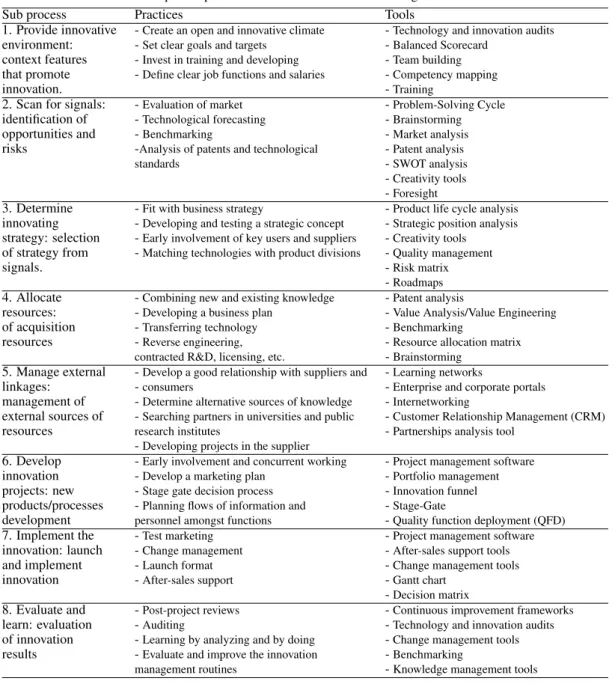
We adopted the theoretical framework that considers that innovation is a managerial process and that the successful innovation management centers in effective innova-tion routines [19]. In this study, we focused only in the technological product and process innovations, which comprise products and/or processes that are either tech-nologically new or have significant technological improvements [15]. Dr. Gavira et al. [9] proposed a framework of the innovation management process dividing the process into eight dynamic and interactive sub processes (Table 3-A.1). The frame-work suggests that the sub processes are interrelated and frame-work in an interactive cycle . The emphasis on each group will vary according organization and situation. One can see that the product development is one of those sub processes (number 6) and it is essential to the innovation. Several practices and tools can support each phase of the innovation management process. Regarding the product and process develop-ment, we found out in the bibliographical research that the main tools are checklists, innovation funnel, Stage-Gate [4], Quality function deployment (QFD), etc. But also, collaboration is very important to the sub process 5 as its practices concerning management of external sources of resources and partnerships. In this case, we found tools such as learning networks, enterprise and corporate portals, Internet working , Customer Relationship Management (CRM), Partnerships Analysis Tool, etc.
It is important to mention that many authors have criticized the use, in developing countries, of innovation models created in developed countries. For instance, Hob-day [11], states that those models do not deal properly with catch up innovation and technology transfer, usual practices in developing countries. Therefore, our findings are important to understand the uniqueness of innovation projects management in catch up countries. In the following sections we present studies about innovation management in developing countries, and about practices of developing projects and managing external linkages (mainly partners).
3.4 Innovation Management in Brazil
In this study, we use the term subsidiary to describe a half-autonomous unit capable to make its own decisions, which are restricted by conditions imposed by the corpo-rative command (headquarter-HQ) and the characteristics of the local environment [10]. Within the multinational corporation, each subsidiary have specific responsi-bilities expressed in business areas, products lines, etc. When receiving or losing responsibilities of developing of technologies and products, subsidiaries also change their innovation activities and practices. A good performance of the subsidiary in accomplishing those responsibilities is essential to its survival and to achieve more strategic responsibilities. These facts can bring more autonomy, good reputation, and competences to the subsidiary. To the country, strategic responsibilities can increase employment, attraction of skilled workers, knowledge and innovation diffu-sion, etc. ([1], [2], [8], [14]). AC and ICs MNC are global technological leaders in their sectors, have a high percentage of revenue from products up to five years old (in average 75% of all products), have high investments in R&D, and innovation is a key competitive advantage. The MNC of the subsidiaries we studied invest consid-erably in R&D. However, most of the amount stays in the HQ and in subsidiaries in developed countries. The ICs headquarter have strong internationalization strategies with responsibilities to develop global products and processes. AC has developing responsibilities but not as much decentralized as IC, in many product lines, those responsibilities are limited to adaptation and development of products to the local market.
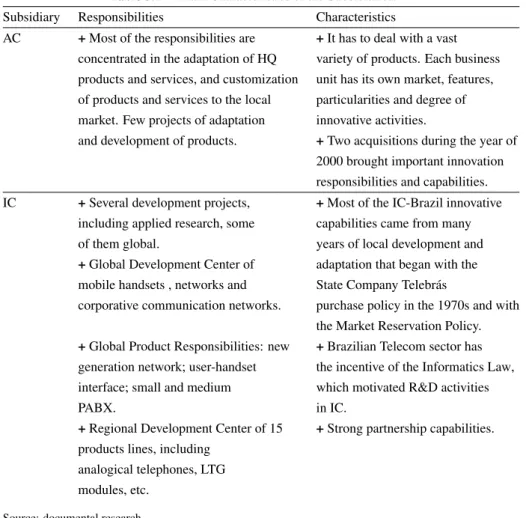
In the last years, IC and AC have gained more complex responsibilities, includ-ing regional and global responsibilities for development of products and services. However, AC and ICs decentralized projects are usually those with lower risk and investments involved. In Table 3.1 we present the main characteristics of AC and IC. According to the interviewees, trends to centralize research in the HQ are com-mon to most subsidiaries. They also revealed that there are some factors that influ-ence the migration of responsibilities: size and sophistication of the local market; local incentives and policies; and the costs and capacity of the subsidiary to man-age innovation projects. Moreover, IC has more developing projects with external partners (mainly universities and research institutes). The number of employees in-volved in innovation projects doubles when considering the external partners human resources.
External collaboration seems to directly relate to the presence of public incentives for collaboration, to the subsidiary inclination to trust partners, to the local market pressures for innovation and differentiation, and to the pressure for innovation within the industry. We found out that the most innovative areas of the subsidiaries have more external collaboration than the less innovative ones.
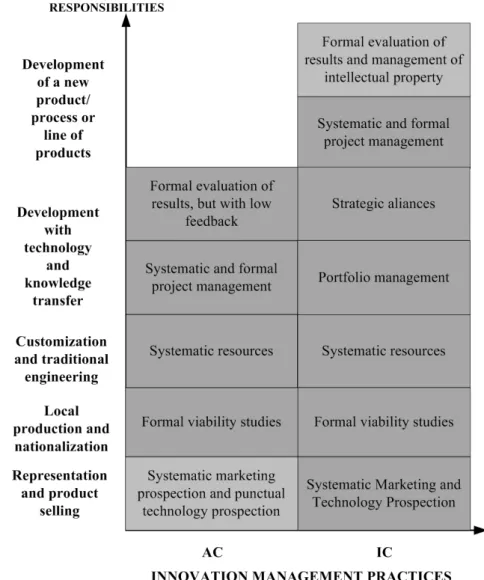
Figure 3.1 presents the innovation management routines used by the AC and IC subsidiaries in Brazil. The horizontal line shows the diffusion of innovation man-agement practices in the subsidiaries. The diagonal line shows innovation practices from the simpler and more intuitive to the more complex and structured practices.
INNOVATION MANAGEMENT IN BRAZIL 27
Table 3.1 Main Characteristics of the Subsidiaries. Subsidiary Responsibilities Characteristics
AC +Most of the responsibilities are +It has to deal with a vast concentrated in the adaptation of HQ variety of products. Each business products and services, and customization unit has its own market, features, of products and services to the local particularities and degree of market. Few projects of adaptation innovative activities.
and development of products. +Two acquisitions during the year of 2000 brought important innovation responsibilities and capabilities. IC +Several development projects, +Most of the IC-Brazil innovative
including applied research, some capabilities came from many of them global. years of local development and
+Global Development Center of adaptation that began with the mobile handsets , networks and State Company Telebr´as
corporative communication networks. purchase policy in the 1970s and with the Market Reservation Policy.
+Global Product Responsibilities: new +Brazilian Telecom sector has generation network; user-handset the incentive of the Informatics Law, interface; small and medium which motivated R&D activities PABX. in IC.
+Regional Development Center of 15 +Strong partnership capabilities. products lines, including
analogical telephones, LTG modules, etc.
Source: documental research.
The darker the cell, the more regular and formal the innovation management prac-tices.
The most common practices are those closer to the market , feasibility analysis , and management of product development. There is almost no presence of practices close to technological or radical innovation , such as technological development, ba-sic or applied research, and management of Intellectual property (IP) rights. One can see that IC has more formal, systemic and complex innovation project manage-ment practices than AC. One reason for the lack of use of more complex project and partnership practices and tools is the uncertainty of innovation activities in the subsidiaries. The innovation activities are so scarce that they do not force the use of more formal, regular and structured practices. We asked the interviewees what are the main barriers to the use of innovation practices and tools and the main responses
Figure 3.1 Innovation Management Practices
Source: Adapted from Gavira & Quadros (2011) [9]
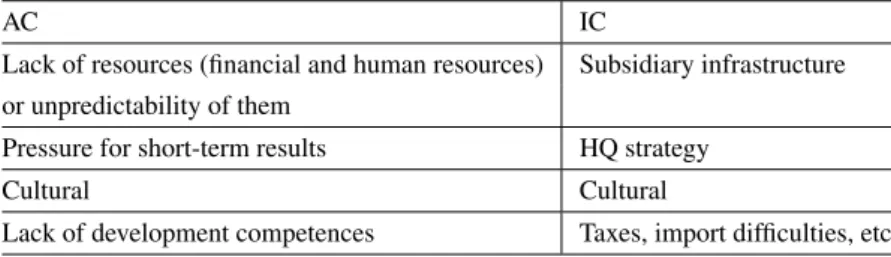
relate to the strategy and pressures from headquarter and from lack of competences and culture (Table 3.2). It is important to notice that IC did not mention lack of resources, since the sector have many sources of policy support and have benefited from competences gained during years of market reserve for the sector.
The most evident barrier is autonomy related as short-term investments pressure and R&D decentralization strategy of the HQ. Since the MNC usually establishes
PROJECT AND PARTNERSHIP MANAGEMENT IN SUBSIDIARIES IN BRAZIL 29
Table 3.2 Barriers to Innovation Practices and Tools.
AC IC
Lack of resources (financial and human resources) Subsidiary infrastructure or unpredictability of them
Pressure for short-term results HQ strategy Cultural Cultural
Lack of development competences Taxes, import difficulties, etc
Source: field research.
restrict financial and marketing annual goals, it make difficult for the subsidiary to carry out long-term projects, as those projects take more time to generate positive results and are more risky. One of the interviewees from IC cited that their biggest innovation barrier was the HQ, which often does not approve projects or slows down the decision making process. Moreover, all products and processes created by the subsidiary must be patented by the HQ. Another interviewee from AC said that The thinking part is still in the HQ, (...) all the rule is there! The HQ even manages global innovation teams despite its lack of technical and market knowledge needed to execute the project. We observed that a strong leadership is paramount to the innovation success . The competences of the directors and managers to motivate and coordinate people and projects under their responsibility and to seek governmental support are fundamental. In the studied subsidiaries, this fact is one of the most responsible for the gain of responsibilities to develop innovations.
3.5 Project and Partnership Management in Subsidiaries in Brazil In this section, we focus on the practices of project and partnership and the role of collaboration and transparency.
3.5.1 Managing External Linkages
During the sub process of allocating resources the subsidiary search for resources to conduct innovation projects. When it cannot find resources internally or when work-ing with partners is more efficient, the subsidiary seeks collaboration with clients, suppliers, local universities and research institutes. AC developed several innovation projects with clients from the sectors of oil and gas, and sugar and ethanol, resulting in two patents. Projects with suppliers also happened, and one of those projects was a monitoring relay (the imported one was not appropriate for the local market). See-ing that one of the suppliers had competences to develop the relay, AC imported the blueprint from the HQ and adopted the relay to the local market. The new relay was presented to the HQ when in phase of implementation. Despite that it was added to the HQ product line as low cost. Hiding the initial development of products and
pro-cess is common practice among subsidiaries because of low risks of retaliation and loss of reputation as well as to ease and speed the development. In this way, in order to increase its competences and lower the risks of innovation development, AC used collaboration to improve its responsibilities and reputation within the multinational corporation. However, AC has not significantly used partnerships with universities and research institutes in recent years, with exception of one of its acquired com-panies that had a partnership with a university to develop a product for the oil and gas sector. In this sub process the tools and practices are standardized, but do not have a high level of complexity. For instance, the partnerships are isolated and do not last beyond the development of the project. In the case of IC, resource alloca-tion is made through the practices of: detailing the investment needs; determining resources to implement projects; and internal search and negotiations. When the in-ternal resources are not adequate, IC use the practices of technology acquisition ; strategic alliances ; formal technical cooperation; interface with research institutes and universities ; and tax incentives analysis (which usually include local partner-ships). It is important to mention that IC has a formal R&D budged connected to the revenue of the subsidiary . This fact improves the resource planning and allocation since the subsidiarys managers know how much they can spend in developing inno-vation. Strategic alliances with universities and research institutes are very important and frequent for IC, especially for developments in landlines networks , private net-works, communication infrastructure, private automatic branch exchange systems, wireless terminals, mobile communication infrastructure and devices, etc. The num-ber of people involved in R&D projects double when considering such partnerships Moreover, in the segment of Solutions in Information Technology, part of the ser-vices is developed with clients in order to better capture their needs. One practice close to the market we found was partnership with clients to development of prod-ucts. Using the network of suppliers and previous partners, IC has partnered with retail stores and suppliers for lunching innovations. Regarding the technology acqui-sition process, HQ is essential manly for the systematization of patent analysis tools, benchmarking, interface management and evaluation of partners.
3.5.2 Project Development
Project development sub process, deals with managing projects, specifically: mon-itoring progress , managing and controlling resources and time, and planning im-plantation and lunch. In this sub process common practices are decision meet-ings, working in virtual teams, exchange of electronic communication, purchasing research and test equipments, contracting external services of testing, meting sup-pliers, etc. Regarding the new product or process per se, the activities are decision of product/process characteristics, prototype tests (quality, safety, and market), stan-dard analysis, etc. During the project development ACs employees use computer simulations to obtain the best specifications of products and processes, as well as the best equipment setup and production plan . In AC managers of the area of innova-tion management control monthly the projects using a very simple tool, consisting of presentation software that the managers fill based on information collected from
CONCLUDING REMARKS 31
the project leaders. This tool comprises deadlines, milestones and phases of devel-opment that were fulfilled or that are under work. Also, quarterly the project leaders present the results and resource needs of the projects in a meeting to the board of the subsidiary. In those meetings the leaders explain actions being taken, reasons of de-lay and postponement, etc.; and participants decide which actions to take and which projects continue to develop. The simple presentation tool facilitates the presenta-tion of the projects, but as there is no centralized tool to send project informapresenta-tion, the intermediation tasks of managers can bring interpretation mistakes, difficulties to gather information and much partial information. In this way, the interviewees men-tioned the need to update this tool that according to one of the managers is too rustic. But, we observed that the present project management tool seems to be enough for the subsidiary responsibilities. Projects that cannot be completed due to lack of resources get the category of in progress, and stay waiting for resources allocation. But, projects canceled by the board of the subsidiary or the HQ are removed from the development process. Also in this sub process we found routines of production and market planning, documenting progress, team building, quality management, check-lists, and training. IC have practices of detailing product/process requirements docu-ments; project management; creation of marketing, sales and after-sales plans, plan-ning of production and services; assessment, reporting and monitoring of projects progress; etc. To those practices we found the following matching tools: a global and virtual project monitoring tool, checklists , quality management , team building and competences analysis, computational tools (e.g. product and process simulators), and Capability Maturity Model Integration (CMMI) . Regarding monitoring projects practices, IC control human and financial resources, allocation of project leaders, and schedule evaluation. IC also uses portfolio tools to establish strategies to the whole product and process portfolios. Moreover, the subsidiary engages in more complex practices such as patent analysis and management of intellectual property rights. Throughout the development cycle, there are periodic measurements of cost, quality and timing that are accompanied by both the directors of the subsidiary as well as the HQ. In general, IC practices and tools are more complex, formal and systematic than ACs. This fact related to the more complex and strategic responsi-bilities of the Brazilian subsidiary. However it became clear to us the importance of collaboration to innovation management and in decision making in global projects.
3.6 Concluding Remarks
With continuous pressures for innovations, companies have been facing growing challenges from clients and society demands, and from technological changes. To face these challenges, multinational corporations (MNC) have been investing in in-novation and decentralizing inin-novation responsibilities to their subsidiaries. How-ever, this diffusion of responsibilities is mainly concentrated in developed countries, and a large part of the research and development is still developed by headquarter employees. In this way, when in need, the headquarter puts together a global team of experts to develop a global product or process. Thus, experts from several
sub-sidiaries contribute to develop products or processes that fit demand of clients in different countries. AC and IC Brazilian subsidiaries have been part of this kind of international teams. In this chapter, we presented the case studies of two sub-sidiaries of multinational corporations installed in Brazil in order to demonstrate the importance of collaboration in innovation management and in developing of global products and processes. Our empirical and exploratory research showed that the studied Brazilian subsidiaries have been improving their innovation responsibilities, but most of the projects tackle customization and adaptation of products to the local market using technology acquired from headquarters. IC benefited from the long term support from public support to the industry (Market Reserve , Information Law , etc.) to built management and technological competences that latter facilitate the negotiation of new innovation responsibilities to Brazil. Also, we found out that subsidiaries with more complex responsibilities have more complex and formal in-novation management practices and value more the partnerships and collaboration. The ability of subsidiaries managers to communicate competences, results and op-portunities, and to negotiate and sell projects, is very important to acquire innovation responsibilities. Those activities have particular importance in gaining global and regional projects. However, the negotiation power is closely related to the impor-tance and demand of the local market. However it is important to mention that not only the subsidiaries in developing countries need to negotiate your responsibili-ties with the HQ. The multinational corporations we studied, even the subsidiaries in developed countries have extensive negotiation meeting with the HQ. A strategy that helps to improve subsidiaries responsibilities is to exchange employees within innovating projects. According to an interviewee, people that have contact with in-novating activities are more likely to support and join this kind of activity. Another important practice is to make clear the individual innovation responsibilities in the job description, training programs, and strategic plans. In addition, managers must be able to participate in global teams, communicate subsidiaries success and com-petences, and negotiate projects and resources with the HQ and other subsidiaries. At the same time, they must request better local environment to innovate, and es-tablish a good relationship with the local environment. The Brazilian government, in its turn, should provide a supportive environment with incentives, infrastructure, skilled workers, etc., for all companies to innovate. The results describe subsidiaries practices and tools to manage the development of innovation projects and partner-ships, as well as explain the importance of those to collaboration and transparency in these two tasks. Since the research was based in case studies, we understand that the results provide a starting point to future researches in the use of collaboration in innovation management (such as open innovation), especially surveys about inno-vation in the electro-electronic industry and other industries in developing counties. Our findings are useful to policy makers and managers to improve the use of collabo-ration and transparency practices to improve innovation management. Also we hope that our findings give support to policy makers and managers to improve developing countries innovation activities and resources.
ACKNOWLEDGMENTS 33
3.7 Acknowledgments
The authors acknowledge the funding from the Coordenao de Aperfeioamento de Pessoal de Nvel Superior (Coordination for the Improvement of Personnel in Higher Education - CAPES) that made our research possible, and to all people that kindly fed our research with a wealth of useful and interesting information and suggestions.
REFERENCES
1. Arbix, G., Salerno, M. S. & De Negri, J. A. (2004), Innovation, through internationaliza-tion, is good for Brazilian exports, IPEA, Braslia, Brazil, i.1023.
2. Birkinshaw, J. & Hood, N. (1998), Multinational subsidiary evolution: capability and charter change in foreign-owned subsidiary companies, The Academy of Management Review, 23(4), 773-795.
3. Cantwell, J.A. & Mudambi, R. (2005), MNE competence-creating subsidiary mandates, Strategic Management Journal, 26(12), 1109-1128.
4. Cooper, R. G. (1990). Stage-gate systems: a new tool for managing new products. Busi-ness Horizons, 33(3), 4454.
5. COTEC - Innovation Technology Foundation (1998), TEMAGUIDE: a guide to tech-nology management and innovation for companies, COTEC - Innovation Techtech-nology Foundation, Madrid, Spain.
6. Dodgson, M. (2000). The management of technological innovation: an international and strategic approach, Oxford University Press, New York, NY.
7. Dunning, J. H. (1994). Multinational enterprises and the globalisation of innovatory ca-pacity, Research Policy, 23(1), 67-88.
8. Feinberg, S. (2000), Do world product mandates really matter?, Journal of International Business Studies, 31(1), 55-167.
9. Gavira, M.O. & Quadros, R. (2011), Innovation Management in Subsidiaries of Multi-national Corporations in the Brazilian Electro-Electronic Industry, in Proceedings of the IEEE Technology Management Conference, San Jose, CA, 666-673.
10. Gupta, A. & Govindarajan, V. (1995), Organizing knowledge flows within MNCs, Inter-national Business Review, 3(4), 443-457.
11. Hobday, M. (2005), Firm-level innovation models: perspectives on research in developed and developing countries, Technology Analysis & Strategic Management, 17(2), 121-146.
12. Nadiri, M. I., & Nandi, B. (1999). Technical change, markup, divestiture, and productiv-ity growth in the US telecommunications industry. Review of Economics and Statistics, 81(3), 488-498.
13. Narula, R. & Dunning, J. (2010), Multinational enterprises, development and global-ization: some clarifications and a research agenda, Oxford Development Studies, 38(3), 263-287.
14. Negri, J. A. D. & M.S.C. Salerno (2005), Innovations, technological patterns and perfor-mance of Brazilian firms, IPEA, Braslia, Brazil, pp.75-118. (in Portuguese)
15. Organization for Economic Co-operation and Development - OECD0 (2004), Oslo Man-ual: the measurement of scientific and technological activities, proposed guidelines for collecting and interpreting technological innovation data, OECD, Paris, France. 16. Pavitt, K. (2002), Innovating routines in the business firm: what corporate tasks should
they be accomplishing? Industrial and Corporate Change, 11(1), 117-133.
17. Quadros, R. (2007), Methodology for innovation management evaluation in private com-panies, in Research Report Patterns of technological innovation management in Brazilian companies, Unicamp Press, Campinas, Brazil. (in Portuguese).
18. Stuart, T. E. (2000). Interorganizational alliances and the performance of firms: a study of 30 growth and innovation rates in a high-technology industry. Strategic Management Journal, 21, 791911.
19. Tidd, J., Bessant, J. & Pavitt, K. (2009), Managing innovation: integrating technological, managerial organizational change, 4. ed., Wiley, Hoboken, NJ.
APPENDIX 35
Table 3-A.1 Examples of practices and tools of innovation management. Sub process Practices Tools
1. Provide innovative -Create an open and innovative climate -Technology and innovation audits
environment: -Set clear goals and targets -Balanced Scorecard
context features -Invest in training and developing -Team building
that promote -Define clear job functions and salaries -Competency mapping
innovation. -Training
2. Scan for signals: -Evaluation of market -Problem-Solving Cycle
identification of -Technological forecasting -Brainstorming
opportunities and -Benchmarking -Market analysis
risks -Analysis of patents and technological -Patent analysis
standards -SWOT analysis
-Creativity tools
-Foresight
3. Determine -Fit with business strategy -Product life cycle analysis
innovating -Developing and testing a strategic concept -Strategic position analysis
strategy: selection -Early involvement of key users and suppliers -Creativity tools
of strategy from -Matching technologies with product divisions -Quality management
signals. -Risk matrix
-Roadmaps
4. Allocate -Combining new and existing knowledge -Patent analysis
resources: -Developing a business plan -Value Analysis/Value Engineering
of acquisition -Transferring technology -Benchmarking
resources -Reverse engineering, -Resource allocation matrix contracted R&D, licensing, etc. -Brainstorming
5. Manage external -Develop a good relationship with suppliers and -Learning networks
linkages: -consumers -Enterprise and corporate portals
management of -Determine alternative sources of knowledge -Internetworking
external sources of -Searching partners in universities and public -Customer Relationship Management (CRM)
resources research institutes -Partnerships analysis tool
-Developing projects in the supplier
6. Develop -Early involvement and concurrent working -Project management software
innovation -Develop a marketing plan -Portfolio management
projects: new -Stage gate decision process -Innovation funnel
products/processes -Planning flows of information and -Stage-Gate
development personnel amongst functions -Quality function deployment (QFD)
7. Implement the -Test marketing -Project management software
innovation: launch -Change management -After-sales support tools
and implement -Launch format -Change management tools
innovation -After-sales support -Gantt chart
-Decision matrix
8. Evaluate and -Post-project reviews -Continuous improvement frameworks
learn: evaluation -Auditing -Technology and innovation audits
of innovation -Learning by analyzing and by doing -Change management tools
results -Evaluate and improve the innovation -Benchmarking
management routines -Knowledge management tools Sources: Based on [5], [6], [9], Pavitt (2002) [16], [17] and [19].