T
ABLE OF
C
ONTENTS
INTRODUCTION... 4
DATA EXPLOSION ... 6
Data Consumption ... 6
Wireless Versus Wireline ... 8
Bandwidth Management ... 11
Technology Drives Demand ... 13
Mobile Broadband Cost and Capacity Trends ... 13
WIRELESS DATA MARKET ... 14
Market Trends ... 14
EDGE/HSPA/HSPA+/LTE Deployment ... 15
WIRELESS TECHNOLOGY EVOLUTION ... 16
Transition to 4G ... 16
3GPP Evolutionary Approach ... 19
Spectrum ... 26
Architecture Evolution and Heterogeneous Networks ... 30
Service Evolution ... 31
Voice Support ... 33
Broadband-Wireless Deployment Considerations ... 33
Wi-Fi Integration and Data Offload ... 34
Network Deployment ... 35
COMPETING TECHNOLOGIES ... 38
CDMA2000 ... 38
WiMAX ... 39
COMPARISON OF WIRELESS TECHNOLOGIES ... 41
Data Throughput ... 41
HSPA+ Throughput ... 46
LTE Throughput ... 48
Latency ... 51
Spectral Efficiency... 52
Cost, Volume, and Market Comparison ... 61
CONCLUSION ... 62
APPENDIX: TECHNOLOGY DETAILS ... 64
Spectrum Bands ... 64
UMTS-HSPA ... 66
HSDPA and HSUPA ... 68
Evolution of HSPA (HSPA+) ... 73
HSPA Voice ... 84
LTE ... 86
LTE-Advanced ... 96
Heterogeneous Networks and Self-Optimization ... 106
EPC ... 111
Wi-Fi Integration ... 114
IMS ... 117
Cloud Radio Access Network (RAN) ... 118
Broadcast/Multicast Services ... 119
TD-SCDMA ... 121 EDGE/EGPRS ... 121 Evolved EDGE ... 124 TV White Spaces ... 132 ABBREVIATIONS ... 133 ADDITIONAL INFORMATION ... 139 REFERENCES ... 140
Copyright ©2012 Rysavy Research, LLC. All rights reserved.
Introduction
The mobile broadband market has continued to explode thanks to widespread adoption, powerful new networks, stunning new handheld devices, and more than a million mobile applications. Mobile broadband now represents the leading edge in innovation and development for computing, networking, Internet technology, and software.
Major developments this past year include not only 3rd Generation (3G) ubiquity, but rapid
deployment of 4th Generation (4G) networks; deepening smartphone capability; the
availability of hundreds of thousands of mobile applications across multiple device ecosystems; the maturing of new form factors such as tablets; and a better understanding of what the industry needs to do to address data demands, which are growing exponentially. Over this past year, the need for additional spectrum has become particularly urgent, resulting in a number of new initiatives by industry and government.
Through constant innovation, Universal Mobile Telecommunications System (UMTS) with High Speed Packet Access (HSPA) technology has established itself as the global, mobile-broadband solution. Building on the phenomenal success of Global System for Mobile Communications (GSM), the GSM-HSPA ecosystem has become the most successful communications technology family ever. Through a process of constant improvement, the GSM/Third Generation Partnership Project (3GPP) family of technologies has not only matched or exceeded the capabilities of all competing approaches, but has significantly extended the life of each of its member technologies.
HSPA remains strongly positioned to be the dominant mobile-data technology for the next five to ten years. To leverage operator investments in HSPA, the 3GPP standards body has developed a series of enhancements to create “HSPA Evolution,” also referred to as “HSPA+.” HSPA+ represents a logical development of the Wideband Code Division Multiple Access (WCDMA) approach and is complementary with the new 3GPP radio platform called 3GPP Long Term Evolution (LTE). LTE, which uses Orthogonal Frequency Division Multiple Access (OFDMA), is seeing widespread deployment this year, particularly in the U.S., which is leading the world in LTE deployment. Simultaneously, 3GPP—recognizing the significant worldwide investments in GSM networks—has significantly increased Enhanced Data Rates for GSM Evolution (EDGE) data capabilities through an effort called Evolved EDGE.
Important aspects of radio technology evolution are techniques and architectures that increase capacity and improve performance at the cell edge. These include ever more sophisticated “smart antennas,” heterogeneous networks (Het-nets), and user equipment communicating simultaneously with multiple base stations.
Combined with these improvements in radio-access technology, 3GPP has also spearheaded the development of major core-network architecture enhancements such as the IP Multimedia Subsystem (IMS), the Evolved Packet Core (EPC), previously called System Architecture Evolution (SAE), and more sophisticated means of integrating non-3GPP networks such as Wi-Fi. These developments will facilitate: increased capacity, new types of services, the integration of legacy and new networks, the convergence of fixed and wireless systems, and the transition to packet-switched voice.
The result is a balanced portfolio of complementary technologies that covers both radio-access and core networks, provides operators with maximum flexibility in how they enhance their networks over time, and supports both voice and data services.
This paper discusses the evolution of EDGE, HSPA enhancements, and LTE, as well as the capabilities of these technologies and their position relative to other primary competing technologies. It explains how these technologies fit into the International
Telecommunications-Advanced (IMT-Advanced) and beyond. The following are some of the important observations and conclusions of this paper:
Mobile broadband – encompassing networks, devices, and applications – is becoming one of the most-successful and fastest-growing industries of all time.
The wireless industry is addressing exploding data demand through a combination of spectrally more efficient technology, Het-nets, configuration, and self-optimization.
LTE has exploded into existence, one of the most powerful wireless technologies ever developed.
LTE has become the global cellular-technology platform of choice for both GSM-UMTS and Code Division Multiple Access (CDMA)/Evolved Data Optimized (EV-DO) operators. Worldwide Interoperability for Microwave Access (WiMAX) operators have a smooth path to LTE-Time Division Duplex (LTE-TDD).
Despite industry’s best efforts to deploy the most efficient technologies possible, overwhelming demand is already leading to isolated instances of congestion, which will become widespread unless more spectrum becomes available in the near future. The wireless technology roadmap now extends beyond IMT-Advanced with
LTE-Advanced defined to meet IMT-LTE-Advanced requirements. LTE-LTE-Advanced will be capable of peak theoretical throughput rates that exceed 1 gigabit per second (Gbps). Operators will begin deploying LTE-Advanced in 2013.
Future networks will be networks of networks, consisting of multiple-access technologies, multiple bands, widely-varying coverage areas, all self-organized and self-optimized. These Het-nets will significantly increase overall capacity.
GSM-HSPA1 has an overwhelming global position in terms of subscribers, deployment, and services. Its success will continue to marginalize other wide-area wireless technologies.
Expected to co-exist with LTE for the remainder of this decade, HSPA+ provides a strategic performance roadmap advantage for incumbent GSM-HSPA operators. Features such as multi-carrier operation, Multiple Input Multiple Output (MIMO), and higher-order modulation offer operators numerous options for upgrading their networks with many of these features (e.g., multi-carrier, higher-order modulation) being available as network software upgrades. With all planned features implemented, HSPA+ peak rates will eventually reach an astonishing peak theoretical speed of 336 Mbps on the downlink and 69 Mbps on the uplink.
GSM-HSPA will comprise the overwhelming majority of subscribers over the next five to ten years, even as LTE becomes globally available.
EDGE technology has proven extremely successful and is widely deployed on GSM networks globally. Advanced capabilities with Evolved EDGE can double and eventually quadruple current EDGE throughput rates, halve latency, and increase spectral efficiency.
1 This paper’s use of the term “GSM-HSPA” includes GSM, EDGE, UMTS, HSPA, and HSPA+.
“UMTS-HSPA” refers to UMTS technology deployed in conjunction with HSPA and HSPA+ capability. LTE is considered a successor technology to UMTS-HSPA.
EPC will provide a new core network that supports both LTE and interoperability with legacy GSM-UMTS radio-access networks and non-3GPP-based radio access networks. Policy-based charging and control provides flexible quality-of-service (QoS) management, enabling new types of applications, as well as billing arrangements. Innovations such as EPC and UMTS one-tunnel architecture will “flatten” the network,
simplifying deployment and reducing latency.
Wi-Fi offload will play an important role in addressing demand and will become progressively more seamless for users thanks to various new 3GPP technologies, as well as industry initiatives such as HotSpot 2.0.
This paper begins with an overview of the market looking at trends, EDGE and UMTS-HSPA deployments, and market statistics. It then examines the evolution of wireless technology, particularly 3GPP technologies including spectrum considerations, core-network evolution, broadband-wireless deployment considerations, and a feature and network roadmap. Next, the paper discusses other wireless technologies including Code Division Multiple Access 2000 (CDMA2000) and WiMAX. Finally, it compares the different wireless technologies technically, based on features such as performance and spectral efficiency.
The appendix explains in detail the capabilities and workings of the different technologies including WCDMA2, HSPA, HSPA+, LTE, IMT-Advanced, LTE- Advanced, IMS, EPC, Wi-Fi
integration, cloud RAN, and Evolved EDGE.
Data Explosion
Broadband communication is becoming a foundational element of the entire economy, supporting entire industries, transforming not only how people work, but how they lead their lives.
As wireless technology represents an increasing portion of the global communications infrastructure, it is important to understand overall broadband trends. Sometimes wireless and wireline technologies compete with each other, but, in most instances, they are complementary. For the most part, backhaul transport and core infrastructure for wireless networks are based on wireline approaches, whether optical or copper. This applies as readily to Wi-Fi networks as it does to cellular networks.
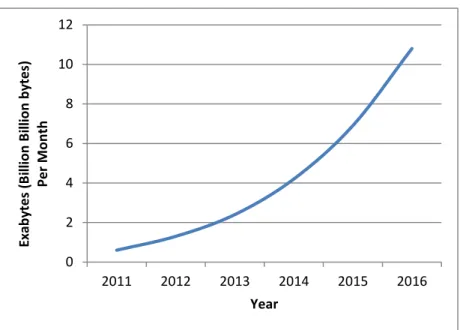
Trends show explosive bandwidth growth of the Internet at large and for mobile broadband networks in particular. Cisco projects global mobile broadband traffic to grow eighteen fold from 2011 to 2016.3
This section covers data consumption, wireless versus wireline capabilities, bandwidth management, and trends in the cost of delivering mobile broadband.
Data Consumption
There are multiple factors contributing to explosive growth in data consumption, but first and foremost is the combination of powerful mobile computing platforms and fast mobile broadband networks. Despite the number of vendors and platform types available on the
2 Although many use the terms “UMTS” and “WCDMA” interchangeably, in this paper we use “WCDMA”
when referring to the radio interface technology used within UMTS and “UMTS” to refer to the complete system. HSPA is an enhancement to WCDMA. LTE with EPC is a completely new architecture.
3 Source: Cisco, “Cisco Visual Networking Index: Global Mobile Data Traffic Forecast Update, 2011–
device side, the industry is converging on what might be considered a “standard” platform for smartphones and also one for tablets. Even if implemented differently, these platforms have the capabilities shown in Figure 1.
Figure 1: Modern Mobile Computing Platform and Data Consumption
The rich capabilities of these mobile platforms enable them to consume ever larger amounts of data through activities such as music and video streaming, social networking, cloud-based synchronization and applications, Web browsing, and content downloading. The question is how much data do streaming applications actually consume? Table 1 provides some values. Video rates are based on the use of advanced video compression schemes such as H.264.
Table 1: Data Consumed by Different Streaming Applications
With declining voice revenue, but increasing data revenue, cellular operators face a tremendous opportunity in continuing to develop their mobile broadband businesses. Successful execution, however, means more than just providing high speed networks. It means addressing demand that is growing at an extremely rapid rate. It also means nurturing an application ecosystem, delivering complementary services, providing a compelling customer experience, and supplying attractive devices. These are all areas in which the industry has done well.
Wireless Versus Wireline
Wireless technology is playing a profound role in networking and communications, even though wireline technology such as fiber has inherent capacity advantages.
The overwhelming global success of mobile telephony and now the growing adoption of mobile data conclusively demonstrate the desire for mobile-oriented communications. Mobile broadband combines compelling high-speed data services with mobility. Thus, the opportunities are limitless when considering the many diverse markets mobile broadband can successfully address. Developed countries continue to show tremendous uptake of mobile broadband services. Additionally, in developing countries, there is no doubt that 3G and 4G technology will cater to both enterprises and their high-end mobile workers and consumers for whom mobile broadband can be a cost-effective option competing with digital subscriber line (DSL) for home use.
Application
Throughput (Mbps) MByte/hour Hrs./day GB/month
Audio or Music
0.1
58
0.5
0.9
1.0
1.7
2.0
3.5
4.0
6.9
Small Screen Video
0.2
90
0.5
1.4
(e.g., Feature Phone)
1.0
2.7
2.0
5.4
4.0
10.8
Medium Screen Video
1.0
450
0.5
6.8
(e.g., Smartphone Full-
1.0
13.5
Screen Video)
2.0
27.0
4.0
54.0
Larger Screen Video
2.0
900
0.5
13.5
(e.g., Netflix Lower Def. on
1.0
27.0
Tablet or Laptop)
2.0
54.0
4.0
108.0
Larger Screen Video
4.0
1800
0.5
27.0
(e.g., Netflix Higher Def.
1.0
54.0
on Laptop)
2.0
108.0
4.0
216.0
Relative to wireless networks, wireline networks have always had greater capacity and historically have delivered faster throughput rates. Figure 2 shows advances in typical user throughput rates with a consistent 10x advantage of wireline technologies over wireless technologies.
Figure 2: Wireline and Wireless Advances
While wireless networks can provide a largely equivalent broadband experience for many applications, for ones that are extremely data intensive, wireline connections will remain a better choice for the foreseeable future. For example, users streaming Netflix movies in high definition consume about 4 Mbps. Typical LTE deployments use 10 MHz radio channels on the downlink and have a spectral efficiency of 1.4 bps/Hz, providing LTE an average sector capacity of 14 Mbps. Thus, just four Netflix viewers could exceed sector capacity. In the U.S., there are approximately 1100 subscribers on average per cell site4,
hence about 360 for each of the three sectors commonly deployed in a cell site. In dense urban deployments, the number of subscribers can be significantly higher. Therefore, just a small percentage of subscribers can overwhelm network capacity. For Blu-ray video quality that operates at around 16 Mbps, an LTE cell sector could support only one user. Even if mobile users are not streaming full-length movies in high definition, video is finding its way into an increasing number of applications including education, social networking, video conferencing, business collaboration, field service, and telemedicine.
4 Source: Dr. Robert F. Roche & Lesley O’Neill, CTIA, CTIA's Wireless Industry Indices, November 2010,
at 161 (providing mid-year 2010 results and calculating 1,111 subscribers per cell site).
2010
2000
2005
100 kbps
10 kbps
1 Mbps
10 Mbps
100 Mbps
GPRS 40 kbps
UMTS 350 kbps
HSDPA 1 Mbps
HSPA+ 5 Mbps
LTE 10 Mbps
EDGE 100 kbps
ADSL 1 Mbps
ISDN
128 kbps
ADSL 3 to 5 Mbps
ADSL2+ 25 Mbps
FTTH 100 Mbps
Over time, wireless networks will gain substantial additional capacity through all the methods discussed in the next section, but they will never catch up to wireline. One can understand this from a relatively simplistic physics analysis:
Wireline access to the premises or to nearby nodes uses fiber-optic cable.
Capacity is based on available bandwidth of electromagnetic radiation. The infra-red frequencies used in fiber-optic communications have far greater bandwidth than radio.
The result is that just one fiber-optic strand has greater bandwidth than the entire usable radio spectrum, as illustrated in Figure 3.5 Meanwhile, the mobile computing
industry currently has access to only .5% of this radio spectrum, growing to possibly 1% by 2020.6
Figure 3: RF Capacity Versus Fiber-Optic Cable Capacity
A dilemma of mobile broadband is that it can provide a broadband experience similar to wireline, but it cannot do so to all subscribers in a coverage area at the same time. Hence, operators must carefully manage capacity, demand, policies, pricing plans, and user expectations. Similarly, application developers must become more conscious of the inherent constraints of wireless networks.
The way to think of mobile broadband networks is as access to higher-capacity wireline networks. The key to improving performance and bandwidth per subscriber is reducing the size of cells and minimizing the radio path to the wireline network. This improves signal quality, and it decreases the number of people that each cell must serve. This is
5 For further explanation, see pages 15-16 of Rysavy Research, “Net Neutrality Regulatory Proposals:
Operational and Engineering Implications for Wireless Networks and the Consumers They Serve,” January 14, 2010. http://www.rysavy.com/Articles/2010_01_Rysavy_Neutrality.pdf.
6 .5% is calculated by approximating 100 GHz of usable radio spectrum and 500 MHz currently
allocated to the mobile industry. The FCC National Broadband Plan calls for doubling this amount by 2020.
Achievable Fiber-Optic Cable Capacity Per Cable (Area Denotes Capacity)
the fundamental basis for both Wi-Fi offload and small-cell architectures such as picocells and femtocells.
Despite some of the inherent limitations of wireless technology relative to wireline, its fundamental appeal of providing access from anywhere has not constrained market growth. As the decade progresses, the lines between wireline and wireless networks will blur.
Bandwidth Management
Given huge growth in usage, mobile operators are either employing or considering multiple approaches to manage bandwidth:
More spectrum. Spectrum correlates directly to capacity, and more spectrum is becoming available globally for mobile broadband. In the U.S., the FCC National Broadband Plan seeks to make an additional 500 MHz of spectrum available by 2020. Multiple papers by Rysavy Research and others7 have argued for the critical need for
additional spectrum.
Unpaired spectrum. Technologies such as HSPA+ and LTE allow the use of different amounts of spectrum between downlink and uplink. Additional unpaired downlink spectrum can be combined with paired spectrum to increase capacity and user throughputs.
Increased spectral efficiency. Newer technologies are spectrally more efficient, meaning greater aggregate throughput in the same amount of spectrum. Wireless technologies such as LTE, however, are reaching the theoretical limits of spectral efficiency and future gains will be quite modest, allowing for a possible doubling of LTE efficiency over currently deployed versions. See the section “Spectral Efficiency” for a further discussion.
Combining uplink gains with downlink carrier aggregation. Operators can increase network capacity by applying new receive technologies at the base station (e.g., large scale antenna systems) that do not necessarily require standards. This can be combined with added capacity on the downlink from carrier aggregation. This type of deployment flexibility suggests that regulators should consider licensing just downlink spectrum in some cases, since that is where it is generally most needed. Small cells and heterogeneous networks. Selective addition of picocells to
macrocells to address localized demand can significantly boost overall capacity. Het-nets, which also can include femtocells, hold the promise of achieving capacity gains of a factor of four and potentially even higher with the introduction of interference-cancellation-based devices. The actual gain realized will depend upon a number of factors including number and placement of small cells, user distribution, and any small-cell selection bias that might be applied.
Wi-Fi. Wi-Fi networks offer another means of offloading heavy traffic, especially as the number of Fi hotspots increases and connections become more seamless. Wi-Fi adds capacity since it offloads onto unlicensed spectrum. Moreover, since Wi-Wi-Fi
7 See http://www.rysavy.com/papers.html. See also this 4G Americas paper, “Sustaining the Mobile
Miracle – A 4G Americas Blueprint for Securing Mobile Broadband Spectrum in this Decade,” March 2011,
http://www.4gamericas.org/UserFiles/file/White%20Papers/4G%20Americas%20Mobile%20Broadband %20Spectrum%20Requirements%20March%202011.pdf
signals cover only small areas, Wi-Fi achieves both extremely high frequency re-use, as well as high bandwidth per square meter across the coverage area.
Off-peak hours. Operators can offer user incentives or perhaps fewer restrictions on large data transfers that occur at off-peak hours such as overnight.
Quality of service (QoS). By prioritizing traffic, certain traffic such as non-time-critical downloads can execute with lower priority, thus not affecting other active users.
Innovative data plans. Creative new data plans influencing consumption behavior including tiered pricing make usage affordable for most users, but discourage excessive or abusive use.
Explore new methods for the future. Recently there has been a considerable amount of discussion about spectrum sharing. Although a promising approach for better spectrum utilization in the long term, spectrum sharing will require new technologies, as well as spectrum coordination, items that could take ten years or more to develop and commercialize.8
It will take a creative blend of all of the above to make the mobile broadband market successful and to enable it to exist as a complementary solution to wired broadband. Figure 4 demonstrates the gains from using additional spectrum and offload. The bottom (green) curve is downlink throughput for LTE deployed in 20 MHz with 10 MHz on the downlink and 10 MHz on the uplink, relative to the number of simultaneous users accessing the network. The middle (purple) curve shows how using an additional 20 MHz doubles the throughput for each user, and the top (orange) curve shows a further possible doubling through aggressive data offloading onto Wi-Fi.
Figure 4: Benefits of Additional Spectrum and Offload
8 For further details, refer to the Rysavy Research report, “Spectrum Sharing - The Promise and the
Reality,” July 2012. 0.0 2.0 4.0 6.0 8.0 10.0 12.0 14.0 16.0 1 2 5 10 20 50 Th ro u gh p u t Per User ( M b p s)
Simultaneous Users in Cell Sector
Improved Throughputs with More Spectrum and Offload
LTE (20 MHz) LTE (40 MHz)
LTE (40 MHz), Offload
Technology Drives Demand
A common view is that a more efficient technology can address escalating demand. This view, however, fails to take into account that the more efficient technology often provides higher performance, thus encouraging new usages, hence escalating demand further, as illustrated in Figure 5. Operators have observed this already with LTE where monthly usage amounts have been higher than for 3G networks.
Not only are users more likely to use applications that consume more bandwidth when given the opportunity, but an increasing number of applications, e.g., Netflix and Skype, adapt their streaming rates based on available bandwidth. By doing so, they can continue to operate even when throughput rates drop. Conversely, they take advantage of higher available bandwidth to present video at higher resolution.
Figure 5: Enhanced Technology Creates New Demand.
Mobile Broadband Cost and Capacity Trends
While the cost of delivering data with wireless broadband remains higher than with wireline broadband, costs continue to decline rapidly. One vendor has calculated that in a blended HSPA/LTE network costs could go below 1 Euro per gigabyte (GByte) once penetration of mobile broadband reaches 40% and usage reaches 2 GByte per month.9
3GPP technologies clearly address proven market needs; hence their overwhelming success. The 3GPP roadmap, which anticipates continual performance and capacity
9 Source: Nokia Siemens Networks white paper, “Mobile Broadband with HSPA and LTE – Capacity and
Cost Aspects,” 2010. Refer to the white paper for assumptions used. For an alternative view on cost
projections, see Tellabs, “’End of Profit’ study executive summary,”
improvements, provides the technical means to deliver on proven business models. As the applications for mobile broadband continue to expand, HSPA, HSPA+, LTE and LTE-Advanced will continue to provide a competitive platform for tomorrow’s new business opportunities.
Wireless Data Market
By June 2012, more than 5.6 billion subscribers were using GSM-HSPA10—nearly three
quarters of the world’s total 7.02 billion population.11 By the end of 2017, the global mobile
broadband market is expected to include more than 5.6 billion subscribers of whom 5 billion will use 3GPP technologies, representing 90% market share.12 Clearly, GSM-HSPA has
established global dominance. Although voice still constitutes most cellular revenue, wireless data worldwide now comprises a significant percentage of average revenue per user (ARPU). In the United States, wireless data represents 40% of ARPU on average, five percent higher than a year ago and expected to reach $80 billion for the year.13
This section examines trends and deployment, and then provides market data that demonstrates the rapid growth of wireless data.
Market Trends
As stated in a Rysavy Research report for the Cellular Telephone Industries Association (CTIA) on mobile broadband spectrum demand, “We are at a unique and pivotal time in history, in which technology capability, consumer awareness and comfort with emerging wireless technology and industry innovation are converging to create mass-market acceptance of mobile broadband.”14
As a consequence, this rich network and device environment is spawning the availability of a wide range of wireless applications and content. Because of its growing size—and its unassailable potential—application and content developers are making the wireless market a high priority. The result is significantly growing usage of data on devices such as smartphones and tablets. For example, Chetan Sharma reports close to 800 Mbytes data consumed on average per month for some operators.15
Over time, data demands are expected to grow significantly. Already, data represents a much higher network load than voice. Figure 6 shows a projection by Cisco of global mobile data growth through 2016 in exabytes (billion gigabytes) per month with traffic growing at a compound annual rate of 78%.
10 Source: Informa, “WCIS+,” July 2012.
11 Source: US Census Bureau, http://www.census.gov/main/www/popclock.html, June 2012. 12 Source: Informa, “WCIS+,” July 2012.
13 Chetan Sharma, US Wireless Data Market Update - Q1 2011, Q1 2012.
14 Source: Rysavy Research, “Mobile Broadband Spectrum Demand,” December 2008. 15 Chetan Sharma, US Wireless Data Market Update - Q1 2012.
Figure 6: Global Mobile Data Growth16
The key for operators is enhancing their networks to support the demands of consumer and business applications as they grow, along with offering complementary capabilities such as IP-based multimedia. Another area that will drive wireless usage is machine-to-machine (M2M) communications. Ultimately, there are billions of machine-to-machines that could communicate, far more than people. One 4G Americas member company has forecast up to 50 billion overall connections in the world by 2020.
EDGE/HSPA/HSPA+/LTE Deployment
Most GSM networks today support EDGE, representing more than 543 networks in approximately 198 countries.17
Meanwhile, UMTS has established itself globally. Nearly all WCDMA handsets are also GSM handsets, so WCDMA users can access the wide base of GSM networks and services. There are more than 1 billion HSPA customers worldwide spanning more than 475 commercial networks. 233 networks now in 112 countries offer HSPA+.18 With HSPA+
technology maturing, deploying or upgrading to HSPA+ involves minimal incremental investment.
Worldwide there are more than 3,360 HSPA devices available.19 Devices include
handsets, data cards, modems, routers, laptops, media players, and cameras.
LTE has not only become the preferred choice for many operators as their next-generation wireless technology, but it has been chosen by national public-safety organizations in the U.S. as their broadband technology of choice. The Association of
16 Source: Cisco, “Cisco Visual Networking Index: Global Mobile Data Traffic Forecast Update, 2011–
2016,” February 14, 2012.
17 Source: 4G Americas, July 2012. 18 Source: 4G Americas, July 2012. 19 Source: GSA, July 2012.
0 2 4 6 8 10 12 2011 2012 2013 2014 2015 2016 Exab yte s (B ill io n B ill io n b yte s) Per M o n th Year
Public-Safety Communications Officials (APCO) and the National Emergency Number Association (NENA) have both endorsed LTE.20 In 2012, legislation passed in the U.S. that
allocated the D Block spectrum for a nationwide public-safety LTE network.
Though most mobile broadband growth today is still based on HSPA (with some EV-DO), LTE is now seeing rapid deployment. TeliaSonera launched the world's first commercial LTE network in Oslo and Stockholm in December 2009. Rogers is deploying LTE in Canada. In the U.S., AT&T, Sprint, MetroPCS, and Verizon have begun deploying LTE and plan on having widespread coverage by the end of 2013. Verizon indicates that by the end of 2012 that their network will cover 260 million people in more than 400 markets.21
AT&T plans to cover at least 140 million people in the same time period.22 Yankee Group
predicts 136 million LTE lines in the U.S. by 2016.23
Wireless Technology Evolution
This section discusses 1G to 4G designations, the evolution and migration of wireless-data technologies from EDGE to LTE, as well as the evolution of underlying wireless approaches. It emphasizes the most important technical developments in the industry. Progress in 3GPP has occurred in multiple phases, first with EDGE, and then UMTS, followed by today’s enhanced 3G capabilities such as HSPA, HSPA+ which is continually evolving, and LTE which is evolving to LTE-Advanced, with work already occurring on specification releases beyond the initial one for LTE-Advanced. Meanwhile, underlying approaches have evolved from Time Division Multiple Access (TDMA) to CDMA, and now from CDMA to OFDMA, which is the basis of LTE.
Transition to 4G
There is some confusion in the industry as to what technology falls into which cellular generation, especially with significant changes in marketing designations that occurred the past few years. 1G refers to analog cellular technologies; it became available in the 1980s. 2G denotes initial digital systems, introducing services such as short messaging and lower speed data. CDMA IS-95 and GSM are the primary 2G technologies, while CDMA2000 1xRTT is sometimes called a 3G technology, because it meets the 144 kbps mobile throughput requirement. EDGE, however, also meets this requirement. 2G technologies became available in the 1990s.
3G requirements were specified by the ITU as part of the International Mobile Telephone 2000 (IMT-2000) project, for which digital networks had to provide 144 kbps of throughput at mobile speeds, 384 kbps at pedestrian speeds, and 2 Mbps in indoor environments. UMTS-HSPA and CDMA2000 EV-DO are the primary 3G technologies, although recently WiMAX was also designated as an official 3G technology. 3G technologies began to be deployed last decade.
The ITU issued requirements for IMT-Advanced in 2008, which many people used as a definition of 4G. Requirements include operation in up-to-40 MHz radio channels and extremely high spectral efficiency. The ITU requires peak spectral efficiency of 15 bps/Hz
20 Source:
http://www.fiercewireless.com/story/public-safety-groups-endorse-lte-broadband-solution/2009-06-12
21 Source: http://news.verizonwireless.com/LTE/Overview.html, June 2012. 22 Source: AT&T, private communications.
and recommends operation in up-to-100 MHz radio channels, resulting in a theoretical throughput rate of 1.5 Gbps. Previous to the publication of the requirements, 1 Gbps was frequently cited as a 4G goal.
However, it will require new technologies such as LTE-Advanced (in 3GPP Release 10) and IEEE 802.16m to meet these ITU IMT-Advanced requirements. In 2009 and 2010, the term “4G” became associated with currently deployed mobile broadband technologies such as HSPA+ and WiMAX. In what seemed an acknowledgement of these developments, the ITU on December 6, 2010, stated in a press release, “As the most advanced technologies currently defined for global wireless mobile broadband communications, IMT-Advanced is considered as ‘4G’, although it is recognized that this term, while undefined, may also be applied to the forerunners of these technologies, LTE and WiMAX, and to other evolved 3G technologies providing a substantial level of improvement in performance and capabilities with respect to the initial third generation systems now deployed.”24
Table 2 summarizes the generations of wireless technology. Table 2: 1G to 4G
Generation Requirements Comments
1G No official requirements.
Analog technology.
Deployed in the 1980s.
2G No official requirements.
Digital Technology.
First digital systems. Deployed in the 1990s. New services such as SMS and low-rate data.
Primary technologies include IS-95 CDMA and GSM.
3G ITU’s IMT-2000 required 144
kbps mobile, 384 kbps pedestrian, 2 Mbps indoors
Primary technologies include CDMA2000 1X/EV-DO and UMTS-HSPA. WiMAX now an official 3G technology.
4G (Initial Technical Designation)
ITU’s IMT-Advanced
requirements include ability to operate in up to 40 MHz radio channels and with very high spectral efficiency.
No commercially deployed technology meets
requirements today. IEEE 802.16m and LTE-Advanced being designed to meet requirements. 4G (Current
Marketing Designation)
Systems that significantly exceed the performance of initial 3G networks. No quantitative
Today’s HSPA+, LTE, and WiMAX networks meet this requirement.
24 Source: ITU Press Release, “ITU World Radiocommunication Seminar highlights future
Generation Requirements Comments requirements.
Despite rapid deployments of LTE networks, it will be the middle of the decade before a large percentage of subscribers will actually be using LTE (or LTE-Advanced). During these years, most networks and devices will support the full scope of the 3GPP family of technologies (GSM-EDGE, HSPA, HSPA+, and LTE). The history of wireless-network deployment provides a useful perspective. GSM, which in 2009 was still growing its subscriber base, was specified in 1990 with initial networks deployed in 1991. The UMTS Task Force established itself in 1995, Release 99 specifications were completed in 2000, and HSPA+ specifications were completed in 2007. Although it’s been more than a decade since work began on the technology, only now is UMTS deployment and adoption starting to surge.
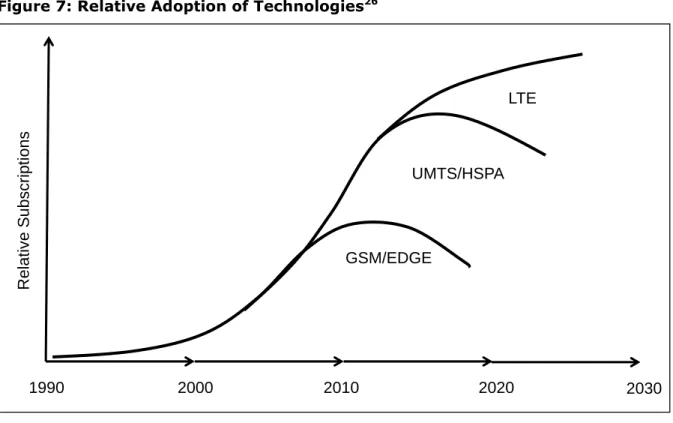
Qualcomm reports an 18- to 20-year period between introduction of a technology and its peak usage25, which is consistent with GSM technology history. Similarly, 4G technologies
coming online now may not see their peak adoption until 2030. Figure 7 shows the relative adoption of technologies over a multi-decadal period, and the length of time it takes for any new technology to be adopted widely on a global basis. The top line shows the total number of subscribers. The GSM/EDGE curve shows the number of subscribers for GSM/EDGE. The area between the GSM/EDGE curve and the UMTS/HSPA curve is for the number of UMTS/HSPA subscribers, and the area between the UMTS/HSPA curve and LTE curve is the number of LTE subscribers.
The interval between each significant technology platform has been about ten years. Within each platform, however, there is constant innovation. For example, with 2G technology, EDGE significantly improved data performance compared to initial General Packet Radio Service (GPRS) capabilities. Similarly, HSPA hugely increased data speeds compared to initial 3G capabilities. LTE and LTE-Advanced will also acquire continual improvements that include both faster speeds and greater efficiency.
25 Source: Qualcomm/4G Americas, “Building the Ecosystem: Chipsets and Devices,” page 12,
http://www.4gamericas.org/UserFiles/file/4G%20Americas%20at%204G%20World/Peter%20Carson,% 20Qualcomm,%20Building%20the%20Ecosystem-Chipsets%20and%20Devices.pdf
Figure 7: Relative Adoption of Technologies26
These technology platform shifts every ten years are similar to the computing industry, which has experienced the following major shifts:
1950s First commercial computers 1960s Mainframes 1970s Mini-computers 1980s Desktop PCs 1990s Internet 2000s Web computing 2010s Mobile Computing
3GPP Evolutionary Approach
3GPP standards development falls into three principal areas: radio interfaces, core networks, and services.
With respect to radio interfaces, rather than emphasizing any one wireless approach, 3GPP’s evolutionary plan is to recognize the strengths and weaknesses of every technology and to exploit the unique capabilities of each one accordingly. GSM, based on a Time Division Multiple Access (TDMA) approach, is mature and broadly deployed. Already extremely efficient, there are nevertheless opportunities for additional optimizations and enhancements. Standards bodies have already defined “Evolved EDGE,” which became available for deployment in 2011. Evolved EDGE more than
26 Source: Rysavy Research projection based on historical data.
1990
2000
2010
2020
LTE
UMTS/HSPA
Rel
ati
v
e
Subs
c
ripti
ons
GSM/EDGE
2030
doubles throughput over current EDGE systems, halves latency, and increases spectral efficiency.
Meanwhile, CDMA was chosen as the basis of 3G technologies including WCDMA for the frequency division duplex (FDD) mode of UMTS and Time Division CDMA (TD-CDMA) for the time division duplex (TDD) mode of UMTS. The evolved data systems for UMTS, such as HSPA and HSPA+, introduce enhancements and optimizations that help CDMA-based systems largely match the capabilities of competing systems, especially in 5 MHz spectrum allocations.
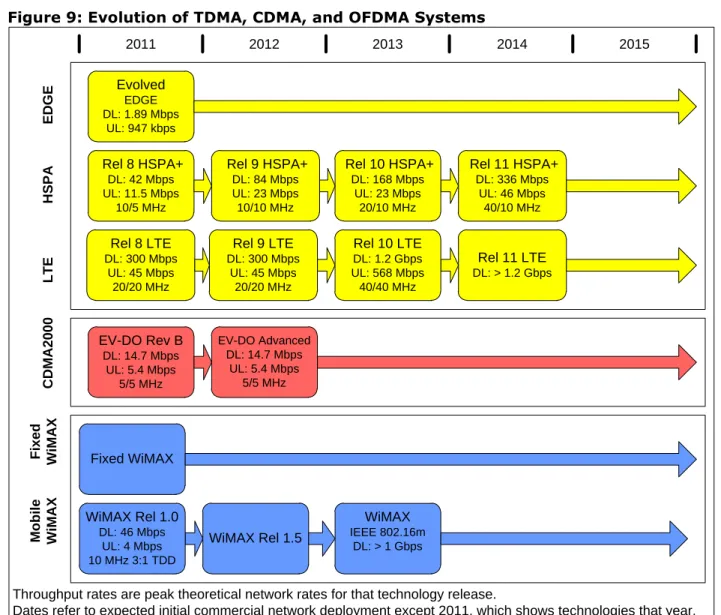
HSPA innovations such as dual-carrier HSPA, explained in detail in the appendix section “Evolution of HSPA (HSPA+),” coordinate the operation of HSPA on two 5 MHz carriers for higher throughput rates. In combination with MIMO, dual-carrier HSPA will achieve peak network speeds of 84 Mbps and quad-carrier HSPA will achieve peak rates of 168 Mbps. Release 11 capabilities such as 8-carrier downlink operation will double maximum theoretical throughput rates to 336 Mbps.
Given some of the advantages of an Orthogonal Frequency Division Multiplexing (OFDM) approach, 3GPP specified OFDMA as the basis of its LTE effort. LTE incorporates best-of-breed radio techniques to achieve performance levels beyond what may be practical with some CDMA approaches, particularly in larger channel bandwidths. In the same way that 3G coexists with 2G systems in integrated networks, LTE systems will coexist with both 3G systems and 2G systems. Multimode devices will function across LTE/3G and LTE/3G/2G. Beyond radio technology, EPC provides a new core architecture that enables both flatter architectures and integration of LTE with both legacy GSM-HSPA networks, as well as other wireless technologies. The combination of EPC and LTE is referred to as the Evolved Packet System (EPS).
HSPA+ and LTE are important to operators since these technologies provide the efficiency and capability being demanded by the quickly growing mobile broadband market. The cost for operators to deliver data (e.g., cost per GByte) is almost directly proportional to the spectral efficiency of the technologies. LTE has the highest spectral efficiency of any specified technology to date, making it one of the essential technologies as the market matures.
As market demands increase, HSPA+ is attractive to some operators since it maximizes the efficiencies in existing deployments and provides high performance with the use of new advanced techniques both in spectrum that is already being utilized and also in new spectrum. Specifically:
Large Spectrum Utilization. HSPA+ can now be deployed in wider bandwidths such as 10Mhz and 20Mhz. This functionality both increases peak data rates and also improves spectral efficiency.
Advanced MIMO. The introduction of MIMO enhancements and the addition of more transmit and receive antennas provides improved spectral efficiency in existing spectrum.
Good Coverage Performance. Soft handover and other techniques provide improved coverage, especially at the edge of the cell.
As competitive pressures in the mobile broadband market intensify and as demand for more capacity continues unabated, LTE is developing deployment momentum for the reason that it offers an extremely efficient and effective way of delivering high performance, especially in new spectrum. Specifically:
Wider Radio Channels. LTE can be deployed in wide radio channels (e.g., 10 MHz or 20 MHz). This increases peak data rates and also provides for more efficient spectrum utilization.
Easiest MIMO Deployment. By using new radios and antennas, LTE facilitates MIMO deployment compared to the logistical challenges of adding antennas for MIMO to existing deployments of legacy technologies. Furthermore, MIMO gains are maximized because all user equipment supports it from the beginning.
Best Latency Performance. For some applications, low latency (packet traversal delay) is as important as high throughput. With a low transmission-time interval (TTI) of 1 msec and flat architecture (fewer nodes in the core network), LTE has the lowest latency of any cellular technology.
LTE is available in both FDD and TDD modes. Many deployments will be based on FDD in paired spectrum. The TDD mode, however, will be important in enabling deployments where paired spectrum is unavailable. LTE TDD will be deployed in China, will be available for Europe at 2.6 GHz, and will operate in the U.S. Broadband Radio Service (BRS) 2.6 GHz band.
To address ITU’s IMT-Advanced requirements, 3GPP is developing LTE-Advanced, a technology that will have peak theoretical rates of more than 1 Gbps. See the appendix section “LTE Advanced” for a detailed explanation.
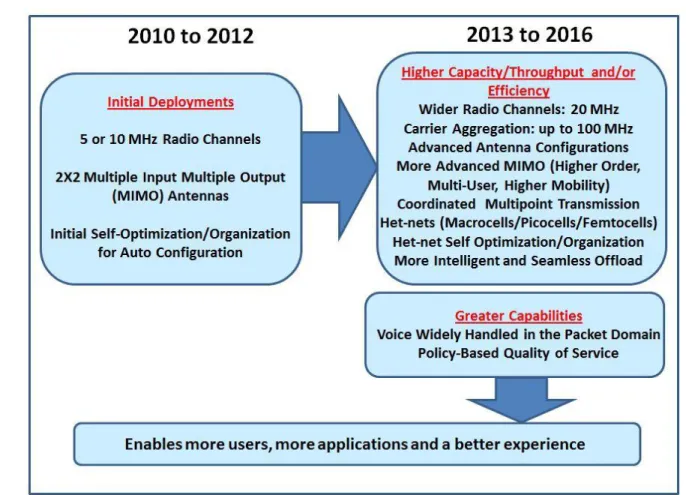
LTE is one of the most promising wireless-technology platforms for the future. The version being deployed today is just the beginning of a series of innovations that will increase performance, efficiency, and capabilities, as depicted in Figure 8. The enhancements shown in the 2013 to 2016 period are the ones expected from 3GPP Releases 10 and 11 and are commonly referred to as LTE-Advanced.27 Subsequent
releases such as Release 12 and 13, however, will continue this innovation through the end of this decade.
27 From a standards-development point of view, the term “LTE-Advanced” refers to the following
features: carrier aggregation, 8X8 downlink MIMO, and 4XN4X3 uplink MIMO with N the number of receive antennas in the base station.”
Figure 8: LTE as a Wireless Technology Platform for the Future
Although later sections quantify performance and the appendix of this white paper presents functional details of the different technologies, this section provides a summary intended to provide a frame of reference for the subsequent discussion. Table 3 summarizes the key 3GPP technologies and their characteristics.
Table 3: Characteristics of 3GPP Technologies Technology
Name Type Characteristics Downlink Typical Speed
Typical Uplink Speed
GSM TDMA Most widely deployed cellular
technology in the world. Provides voice and data service via GPRS/EDGE.
EDGE TDMA Data service for GSM networks.
An enhancement to original GSM data service called GPRS.
70 kbps
to 135 kbps 70 kbps to 135 kbps
Evolved EDGE TDMA Advanced version of EDGE that can double and eventually quadruple throughput rates, halve latency and increase spectral efficiency. 175 kbps to 350 kbps expected (Single Carrier) 350 kbps to 700 kbps 150 kbps to 300 kbps expected
Technology
Name Type Characteristics Downlink Typical Speed
Typical Uplink Speed
expected (Dual Carrier)
UMTS CDMA 3G technology providing voice
and data capabilities. Current deployments implement HSPA for data service.
200 to 300
kbps 200 to 300 kbps
HSPA28 CDMA Data service for UMTS networks.
An enhancement to original UMTS data service.
1 Mbps to 4 Mbps
500 kbps to 2 Mbps
HSPA+ CDMA Evolution of HSPA in various
stages to increase throughput and capacity and to lower latency. 1.9 Mbps to 8.8 Mbps in 5/5 MHz 3.8 Mbps to 17.6 Mbps with dual carrier in 10/5 MHz. 1 Mbps to 4 Mbps in 5/5 MHz or in 10/5 MHz
LTE OFDMA New radio interface that can use
wide radio channels and deliver extremely high throughput rates. All communications handled in IP domain. 6.5 to 26.3 Mbps in 10/10 MHz 6.0 to 13.0 Mbps in 10/10 MHz LTE-
Advanced OFDMA Advanced version of LTE designed to meet IMT-Advanced requirements.
User achievable rates and greater details on typical rates are covered in Table 4 in the section “Data Throughput” later in this paper. Figure 9 shows the evolution of the different wireless technologies and their peak network performance capabilities.
28 HSPA and HSPA+ throughput rates are for a 5/5 MHz deployment. N/M MHz in this paper means 5
Figure 9: Evolution of TDMA, CDMA, and OFDMA Systems
The development of GSM and UMTS-HSPA happens in stages referred to as 3GPP releases, and equipment vendors produce hardware that supports particular versions of each specification. It is important to realize that the 3GPP releases address multiple technologies. For example, Release 7 optimized Voice over Internet Protocol (VoIP) for HSPA, but also significantly enhanced GSM data functionality with Evolved EDGE. A summary of the different 3GPP releases is as follows: 29
Release 99: Completed. First deployable version of UMTS. Enhancements to GSM data (EDGE). Majority of deployments today are based on Release 99. Provides support for GSM/EDGE/GPRS/WCDMA radio-access networks.
Release 4: Completed. Multimedia messaging support. First steps toward using IP transport in the core network.
29 After Release 99, release versions went to a numerical designation instead of designation by year.
Evolved
EDGE DL: 1.89 Mbps
UL: 947 kbps
2011 2012 2014 2015
Throughput rates are peak theoretical network rates for that technology release.
Dates refer to expected initial commercial network deployment except 2011, which shows technologies that year. There are no public announcements of deployment of WiMAX Rel 1.5 nor IEEE 802.16m.
X/Y MHz indicates X MHz used on the downlink and Y MHz used on the uplink. 2013 Fixed WiMAX Rel 8 LTE DL: 300 Mbps UL: 45 Mbps 20/20 MHz EV-DO Rev B DL: 14.7 Mbps UL: 5.4 Mbps 5/5 MHz Rel 8 HSPA+ DL: 42 Mbps UL: 11.5 Mbps 10/5 MHz WiMAX Rel 1.0 DL: 46 Mbps UL: 4 Mbps 10 MHz 3:1 TDD WiMAX Rel 1.5 WiMAX IEEE 802.16m DL: > 1 Gbps E D G E H S P A L T E C D M A 2 0 0 0 F ix e d W iM A X M o b il e W iM A X Rel 10 LTE DL: 1.2 Gbps UL: 568 Mbps 40/40 MHz Rel 9 HSPA+ DL: 84 Mbps UL: 23 Mbps 10/10 MHz Rel 10 HSPA+ DL: 168 Mbps UL: 23 Mbps 20/10 MHz Rel 11 HSPA+ DL: 336 Mbps UL: 46 Mbps 40/10 MHz Rel 11 LTE DL: > 1.2 Gbps EV-DO Advanced DL: 14.7 Mbps UL: 5.4 Mbps 5/5 MHz Rel 9 LTE DL: 300 Mbps UL: 45 Mbps 20/20 MHz
Release 5: Completed. HSDPA. First phase of Internet Protocol Multimedia Subsystem (IMS). Full ability to use IP-based transport instead of just Asynchronous Transfer Mode (ATM) in the core network.
Release 6: Completed. HSUPA. Enhanced multimedia support through Multimedia Broadcast/Multicast Services (MBMS). Performance specifications for advanced receivers. Wireless Local Area Network (WLAN) integration option. IMS enhancements. Initial VoIP capability.
Release 7: Completed. Provides enhanced GSM data functionality with Evolved EDGE. Specifies HSPA+, which includes higher order modulation and MIMO. Performance enhancements, improved spectral efficiency, increased capacity, and better resistance to interference. Continuous Packet Connectivity (CPC) enables efficient “always-on” service and enhanced uplink UL VoIP capacity, as well as reductions in call set-up delay for Push-to-Talk Over Cellular (PoC). Radio enhancements to HSPA include 64 Quadrature Amplitude Modulation (QAM) in the downlink and 16 QAM in the uplink. Also includes optimization of MBMS capabilities through the multicast/broadcast, single-frequency network (MBSFN) function.
Release 8: Completed. Comprises further HSPA Evolution features such as simultaneous use of MIMO and 64 QAM. Includes dual-carrier HSDPA (DC-HSDPA) wherein two downlink carriers can be combined for a doubling of throughput performance. Specifies OFDMA-based 3GPP LTE. Defines EPC and EPS.
Release 9: Completed. HSPA and LTE enhancements including HSPA dual-carrier downlink operation in combination with MIMO, HSDPA dual-band operation, HSPA dual-carrier uplink operation, EPC enhancements, femtocell support, support for regulatory features such as emergency user-equipment positioning and Commercial Mobile Alert System (CMAS), and evolution of IMS architecture. Release 10: Completed. Specifies LTE-Advanced that meets the requirements set
by ITU’s IMT-Advanced project. Key features include carrier aggregation, multi-antenna enhancements such as enhanced downlink MIMO and uplink MIMO, relays, enhanced LTE Self Optimizing Network (SON) capability, eMBMS, Het-net enhancements that include enhanced Inter-Cell Interference Coordination (eICIC), Local IP Packet Access, and new frequency bands. For HSPA, includes quad-carrier operation and additional MIMO options. Also includes femtocell enhancements, optimizations for M2M communications, and local IP traffic offload.
Release 11: In development, targeted for completion end of 2012. For LTE, emphasis is on Co-ordinated Multi-Point (CoMP), carrier-aggregation enhancements, and further enhanced eICIC including devices with interference cancellation. The release includes further DL and UL MIMO enhancements for LTE. For HSPA, provides 8-carrier on the downlink, uplink enhancements to improve latency, dual-antenna beamforming and MIMO, DLCELL_Forward Access Channel (FACH) state enhancement for smart phone-type traffic, four-branch MIMO enhancements and transmissions for HSDPA, 64 QAM in the uplink, downlink multi-point transmission, and non-contiguous HSDPA carrier aggregation.
Release 12: In initial planning and discussion stages. Potential enhancements include enhanced small cells/Het-nets for LTE; LTE multi-antenna/site technologies such as 3D MIMO/beamforming and further CoMP/MIMO enhancements; new procedures and functionalities for LTE to support diverse traffic types; enhancements for interworking with Wi-Fi; enhancements for Machine Type Communications (MTC), SON, Minimization of Test Drives (MDT),
and advanced receivers; device-to-device communication; energy efficiency; more flexible carrier aggregation; and further enhancements for HSPA+ including further DL and UL improvements and interworking with LTE.
Whereas operators and vendors actively involved in the development of wireless technology are heavily focused on 3GPP release versions, most users of the technology are more interested in particular features and capabilities such as whether a device supports HSDPA. For this reason, the detailed discussion of the technologies in this paper emphasizes features as opposed to 3GPP releases.
Spectrum
Spectrum continues to be one of the most important issues facing the industry. There are two issues to consider. One is the limited amount of spectrum available to support this dynamic industry. The other is how the industry is responding to take advantage of available technology.
Given that spectrum is a limited resource, the industry is undertaking the following initiatives to leverage all available spectrum:
Increasing the spectral efficiency of technologies to continually increase the bits per second of data bandwidth for every available Hertz.
Adapting specifications to enable operation of UMTS-HSPA and LTE in all available bands.
Designing both FDD and TDD versions of technology to allow operation in both paired and unpaired bands.
Designing carrier aggregation techniques in HSPA+ and LTE-Advanced that bonds together multiple radio channels (both intra- and inter-frequency bands) to improve both peak data rates and efficiency.
Deploying as many new cells (large and small) as is feasible.
It might be thought that new technologies such as small cells and smart antennas would obviate the need for spectrum. These technologies, however, are already on the roadmap for 3GPP evolution and, by themselves, do not sufficiently increase capacity to meet growing demand.
The FCC released a report in October 2010 that projected spectrum requirements for the U.S.30 and concluded that 275 MHz of additional spectrum would be needed within five
years and 500 MHz of additional spectrum within ten years. This forecast assumes ongoing increases in spectral efficiency from improving technologies.
An important aspect of UMTS-HSPA and LTE deployment is the expanding number of available radio bands and the corresponding support from infrastructure and mobile-equipment vendors. The fundamental system design and networking protocols remain the same for each band; only the frequency-dependent portions of the radios have to change. As other frequency bands become available for deployment, standards bodies are adapting UMTS and LTE for these bands as well. This includes bands such as 450 MHz and 700 MHz. The FCC auctioned the 700 MHz band in the U.S. in 2008, and a number of
30 See FCC, “Mobile Broadband: The Benefits of Additional Spectrum,” October 2010,
http://download.broadband.gov/plan/fcc-staff-technical-paper-mobile-broadband-benefits-of-additional-spectrum.pdf.
operators are now deploying LTE in this band. Canada will auction the 700 MHz band in 2013.
The 1710-1770 uplink was matched with 2110-2170 downlink to allow for additional global harmonization of the 1.7/2.1GHz band. These new spectrum bands were reserved or allocated harmoniously across North, Central and South America. The availability of this band, the Advanced Wireless Services (AWS) band at 1710-1755 MHz with 2110-2155 MHz in the U.S. is providing operators additional deployment options and could eventually provide a means for LTE roaming in the Americas. Rogers is already deploying LTE in this band and multiple U.S. operators are expected to as well.
The forthcoming 2.6 GHz frequency band in Europe will also play an important role. An increasing number of operators are also deploying UMTS at 900 MHz, a traditional GSM band.
Unfortunately, the process of identifying new spectrum and making it available for the industry is a lengthy one, as shown in Figure 10.
Figure 10: Spectrum Acquisition Time31
The FCC is pursuing multiple avenues for making more spectrum available in the future. In the near term, there is potentially 90 MHz of Mobile Satellite Services (MSS) spectrum and 20 MHz of Wireless Communications Service (WCS) spectrum that could be available for use. Fifty MHz of the MSS spectrum, however, is owned by LightSquared and is currently off the table due to concerns about interference with Global Positioning Systems (GPS).
The two biggest opportunity areas for new spectrum beyond MSS and WCS are NTIA-identified government spectrum from 1755 to 1850 MHz and incentive auctions of TV-broadcasting spectrum (up to 120 MHz). With incentive auctions, the outcome depends on how many broadcasters choose to participate and under what compensation requirements.
The NTIA spectrum involves a large number of government systems either migrating to other spectrum or co-existing with commercial systems by using shared approaches that are not yet identified. One portion, 1755 to 1780 MHz, could potentially be paired with 2155 to 2180 MHz and could come to auction relatively soon. The 2155 to 2180 MHz portion legally must be auctioned and licensed by February 2015. A bill introduced by Stearns and Matsui in April 2012 seeks to repurpose the 1755 to 1780 MHz band from
31 Source for historical data, http://www.broadband.gov/plan/5-spectrum/; future expectations based
on Rysavy Research analysis.
1970 1980 1990 2000 2010 2020 Cellular PCS EBS/BRS AWS 700 Incentive Auctions NTIA Spectrum
federal to commercial use. To assist with making the 1755 to 1780 MHz portion available, T-Mobile has filed a request for special temporary authority with the FCC to test the deployment of commercial mobile broadband service in this band with the realization that a limited number of incumbent federal operations could remain in the band on a transitional basis.
The 3550 to 3650 MHz band in the U.S. is now also being discussed for potential licensing, although how useful this band would be due to the higher frequencies involved remains to be determined. Also, there are unknown details involving co-existence with or relocation of government radar systems that operate in this band.
Figure 11 shows a Rysavy Research projection from 2010 for the amount of spectrum that an operator will require in their busiest markets to meet anticipated demand. Given that many operators in the U.S. have about 50 to 90 MHz of spectrum, it will not be that long before additional spectrum is essential. Credit Suisse reported in 2011 that U.S. wireless networks in the U.S. were already operating at 80% of capacity.32
Figure 11: Operator Spectrum Requirement for Busiest Markets33
The spectrum situation varies by operator. Some may experience shortages well before others depending on multiple factors such as the amount of spectrum they have, their cell site density relative to population, type of devices they offer, and their service plans.
32 Source: Credit Suisse, “Global Wireless Capex Survey,“ July 2011. See
http://www.fiercemobilecontent.com/pages/credit-suisse-wireless-network-utilization-levels-globally-are-threshold-le
33 Source: Rysavy Research, “Mobile Broadband Capacity Constraints And the Need for Optimization,”
February 24, 2010. 0 50 100 150 200 250 2010 2011 2012 2013 2014 2015 2016 M H z o f Sp e ct ru m Year
Operator Spectrum Requirement
Busiest Markets
As the total amount of available spectrum does become available and as technologies simultaneously become spectrally more efficient, total capacity rises rapidly, supporting more subscribers and making many new types of applications feasible.
Refer to the section “Spectrum Bands” in the appendix for further details on specific bands for UMTS and LTE.
Different countries have regulated spectrum more loosely than others. For example, operators in the United States can use any technology in any band, whereas in Europe there are greater restrictions—although efforts are underway that are resulting in greater flexibility including the use of 3G technologies in current 2G bands.
With the projected increase in the use of mobile-broadband technologies, the amount of spectrum required by the next generation of wireless technology (that is, after 3GPP LTE in projects such as IMT Advanced) could be substantial. In the U.S., the FCC in 2010 committed itself to finding an additional 500 MHz of spectrum over the next ten years as part of its national broadband plan. This would effectively double the amount of spectrum for commercial mobile radio service.
As regulators make more spectrum available, it is important that they follow guidelines such as those espoused by 4G Americas34:
1. Configure Licenses with Wider Bandwidths 2. Group Like Services Together
3. Be Mindful of Global Technology Standards
4. Pursue Harmonized/Contiguous Spectrum Allocations 5. Exhaust Exclusive Use Options Before Pursuing Shared Use 6. Not All Spectrum is Fungible – Align Allocation with Demand
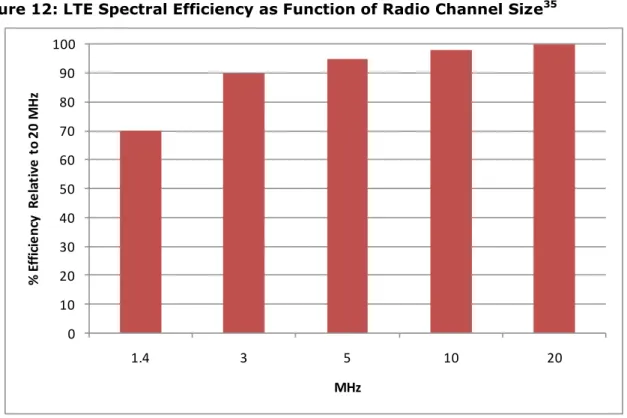
Emerging technologies such as LTE benefit from wider radio channels. These wider radio channels are not only spectrally more efficient, but offer greater capacity, an essential attribute, because typical broadband usage contributes to a much higher load than a voice user. For instance, watching a YouTube video consumes 100 times as many bits per second on the downlink as a voice call.
Figure 12 shows increasing LTE spectral efficiency obtained with wider radio channels, with 20 MHz showing the most efficient configuration.
34 Source: 4G Americas, “Sustaining the Mobile Miracle – A 4G Americas Blueprint for Securing Mobile
Broadband Spectrum in this Decade,” March 2011,
http://www.4gamericas.org/UserFiles/file/White%20Papers/4G%20Americas%20Mobile%20Broadband %20Spectrum%20Requirements%20March%202011.pdf
Figure 12: LTE Spectral Efficiency as Function of Radio Channel Size35
Of some concern in this regard is that spectrum for LTE is becoming available in different frequency bands in different countries. For instance, initial US deployments will be at 700 MHz, in Japan at 1500 MHz, and in Europe at 2.6 GHz. Thus, with so many varying spectrum bands, it will most likely necessitate that roaming operation be based on GSM or HSPA on common regional or global bands.
Architecture Evolution and Heterogeneous Networks
The architecture of wireless networks will evolve through fundamental changes to both the radio-access network and the core network.
One of the most important developments in radio-access architecture is the concept of heterogeneous networks. This is the idea of multiple types of cells serving a coverage area, varying in frequencies used, radius, and even radio technology used. Het-nets offer significant increases in capacity and improvements in user experience in the following ways:
Smaller cells such as open femtocells (home area coverage) and picocells (city block area coverage) inherently increase capacity because each cell serves a smaller number of users.
Strategic placement of picocells within the macro cell provides an avenue to absorb traffic in areas where there are higher concentrations of users. This could include areas such as business locations, airports, sports arenas, and so forth. Smaller cells can also improve signal quality in areas in which the signal from the
macro cell has difficulty reaching.
35 Source: 4G Americas member company analysis.
0 10 20 30 40 50 60 70 80 90 100 1.4 3 5 10 20 % E ff ic ie nc y R e la ti ve t o 2 0 M H z MHz