Bonner, Stephen Arthur Robert
Using Hadoop to implement a semantic method for assessing the quality of medical data
Original Citation
Bonner, Stephen Arthur Robert (2014) Using Hadoop to implement a semantic method for assessing
the quality of medical data. Masters thesis, University of Huddersfield.
This version is available at http://eprints.hud.ac.uk/23305/
The University Repository is a digital collection of the research output of the
University, available on Open Access. Copyright and Moral Rights for the items
on this site are retained by the individual author and/or other copyright owners.
Users may access full items free of charge; copies of full text items generally
can be reproduced, displayed or performed and given to third parties in any
format or medium for personal research or study, educational or not-for-profit
purposes without prior permission or charge, provided:
•
The authors, title and full bibliographic details is credited in any copy;
•
A hyperlink and/or URL is included for the original metadata page; and
•
The content is not changed in any way.
For more information, including our policy and submission procedure, please
contact the Repository Team at: [email protected].
Using Hadoop To Implement A Semantic
Method For Assessing The Quality Of
Medical Data
Author:
Stephen BONNER
Supervisor:
Prof. Grigoris ANTONIOU
A thesis submitted to the University of Huddersfield
in partial fulfilment of the requirements for the degree of Masters By Research
High Performance Computing School Of Computing and Engineering
Copyright Statement
i. The author of this thesis (including any appendices and/or schedules to this thesis) owns any copyright in it (the “Copyright”) and s/he has given The University of Huddersfield the right to use such Copyright for any administrative, promotional, educational and/or teaching purposes.
ii. Copies of this thesis, either in full or in extracts, may be made only in accordance with the regulations of the University Library. Details of these regulations may be obtained from the Librarian. This page must form part of any such copies made.
iii. The ownership of any patents, designs, trade marks and any and all other intellectual property rights except for the Copyright (the “Intellectual Property Rights”) and any repro-ductions of copyright works, for example graphs and tables (“Reprorepro-ductions”), which may be described in this thesis, may not be owned by the author and may be owned by third parties. Such Intellectual Property Rights and Reproductions cannot and must not be made avail-able for use without the prior written permission of the owner(s) of the relevant Intellectual Property Rights and/or Reproductions.
opinions drown out your own inner voice. And most important, have the courage to follow your heart and intuition.”
Steve Jobs 2005
“The secret of the mountain is that the mountains simply exist, as I do myself: the moun-tains exist simply, which I do not. The mounmoun-tains have no ”meaning,” they are meaning; the mountains are. I understand all this, not in my mind but in my heart, knowing how meaning-less it is to try to capture what cannot be expressed, knowing that mere words will remain when I read it all again, another day.”
Peter Matthiessen 1978
“If you don’t know, the thing to do is not to get scared, but to learn.”
Recent technological advances in modern healthcare have lead to a vast wealth of patient data being collected. This data is not only utilised for diagnosis but also has the potential to be used for medical research. However, there are often many errors in datasets used for medical research, with one study finding error rates ranging from 2.3% to 26.9% in a selection of medical research databases.
Previous methods of automatically assessing data quality have often relied on threshold rules. These rules can sometimes miss errors requiring complex domain knowledge to correctly identify. To combat this, a semantic framework has been developed to assess the quality of medical data expressed in the form of linked open data. Early work in this direction revealed that existing triplestores are unable to cope with the large amounts of medical data. In this thesis, a system for storing and querying medical RDF data using Hadoop is de-veloped. This approach enables the creation of an inherently parallel framework that will scale the workload across a cluster. Unlike existing solutions, this framework uses highly optimised joining strategies to enable the completion of eight separate SPARQL queries, comprising over eighty distinct joins, in only two Map/Reduce iterations. Results are pre-sented comparing both na¨ıve and optimised versions of the solution against Jena TDB, demonstrating the superior performance of the Hadoop system and its viability for assess-ing the quality of medical data.
I would like to thank the many people who have supported and helped me with this thesis. I would firstly like to thank my parents, Dr Louise Bonner and Mr Neil Bonner, for all their incredible and unwavering support during my academic career. I would also like to thank my supervisory team of Professor Grigoris Antoniou and Dr Violeta Holmes. I would also like to thank Dr Laura Moss and Dr David Corsar for their original effort in this work and for allowing me to expand upon it.
I would like to thank all of my family and friends, of which there are too many to mention in full here, but I would like to mention Holly Lewis, Joseph Luke, Olive Chittock, Liam lane, Professor Fiona Tweed, Dave Guldin, Barbara Hughes, Dr John Ambrose and Neil MacGregor.
I would like to thank all my friends and colleges at the University Of Huddersfield and specif-ically the members of the High Performance Computing Research Group: Ibad Kureshi, John Brennan, Mathew Newall, Shuo Liang and Yvonne James. I would also like to ac-knowledge the open-source software community, particularly: Apache (For their continued work on Hadoop) and the Linux Foundation. I would also like to acknowledge the use of the University of Huddersfield Queensgate Grid in carrying out this work.
Abstract 3 Acknowledgements 4 Contents 5 List of Figures 11 List of Tables 14 List of Algorithms 15 Abbreviations 16 1 Introduction 17
1.1 Errors In Medical Databases . . . 17
1.2 Current Possible Solutions Using Linked Open Data . . . 18
1.2.1 The Semantic Web and Linked Open Data . . . 18
1.2.2 Big Data and Healthcare . . . 19
1.2.3 Current Implementation . . . 20
1.3 Project Aims and Motivations . . . 21
2 Background Technologies 22 2.1 The Resource Description Framework (RDF) . . . 22
2.1.1 An RDF Statement . . . 23
2.1.2 RDF Graph Representation . . . 23 5
2.1.3 RDF Serialisation Formats . . . 24
2.2 Triplestores . . . 26
2.2.1 Jena . . . 26
2.3 Simple Protocol and RDF Query Language (SPARQL) . . . 27
2.4 Database Joins . . . 28
2.5 Hadoop And The Map/Reduce Programming Model . . . 29
2.5.1 Hadoop Cluster Components . . . 30
2.5.2 The Hadoop Distributed File System (HDFS) . . . 30
2.5.3 Map/Reduce Programming Model . . . 31
2.5.4 Sort/Shuffle, Partitioner and Combiner Stages . . . 32
2.5.5 Benefits and Drawbacks . . . 33
2.5.6 Associated Technologies . . . 34
3 Literature Review 36 3.1 Research Fields . . . 36
3.2 Distributed Native Triplestores . . . 37
3.3 Performing Dataset Joins Via Hadoop . . . 38
3.3.1 Map-Side Join . . . 39
3.3.2 Reduce-Side Join . . . 40
3.3.3 Cascade Join . . . 41
3.3.4 Broadcast Join . . . 42
3.4 Feasibility Of Using Hadoop For RDF Processing . . . 42
3.5 Strategies For Storing RDF Data On The HDFS . . . 43
3.6 Queries on RDF Data Using Map/Reduce . . . 44
3.6.1 Existing Theoretical Approaches . . . 44
3.6.2 Presented Performance Results . . . 51
3.7 Limitations Of Existing Hadoop RDF Solutions . . . 53
3.7.1 Hadoop Joining Strategies . . . 54
3.7.2 Data Upload Stages . . . 55
4 Analysis Of Current Jena TDB Implementation 57
4.1 Current Implementation . . . 57
4.2 Limitations of Existing Solution . . . 58
4.3 Current Implementation Performance Analysis . . . 59
4.3.1 Upload Time . . . 59
4.3.2 Query Time . . . 59
4.3.3 Analysis . . . 60
4.4 The Need For A New Framework . . . 61
5 Hadoop Implementation and Algorithm Design 62 5.1 Structure and Distribution Of The Real-World Medical Data . . . 62
5.1.1 Subject, Predicate and Object Distribution . . . 63
5.1.2 Distinct Triple Group Distribution . . . 63
5.2 Data Generation . . . 64
5.3 Analysis Of Current SPARQL Queries . . . 64
5.3.1 Min/Max Queries . . . 65
5.3.2 More Complex Queries . . . 66
5.4 Hadoop-Based Framework Design . . . 67
5.4.1 Required Software Functionality . . . 67
5.4.2 Why Use Hadoop As The Basis For The New Framework? . . . 68
5.4.3 The Two Approaches Taken . . . 68
5.5 Query Planning . . . 69
5.6 Approach One - Data Upload Algorithm . . . 70
5.6.1 Stage One - Compression . . . 72
5.6.2 Stage Two - Sort On Subject . . . 72
5.6.3 Algorithm Pseudocode . . . 73
5.7 Approach One - Data Query Algorithm Design and Joining Strategies . . . . 73
5.7.1 Selection Stage . . . 75
5.7.2 Join Stage . . . 78
5.8 Approach Two . . . 81
5.8.2 Join Phase . . . 82
5.9 Implementation Summary . . . 83
5.9.1 Key Theoretical Performance Advantages . . . 83
5.9.2 Summary . . . 83
6 Test Environment and Optimisations 86 6.1 Details Of Test Environments . . . 86
6.1.1 Single Machine . . . 86
6.1.2 Dedicated Hadoop Cluster . . . 87
6.2 Hadoop Cluster Performance Optimisations . . . 87
6.2.1 Benchmark Generation . . . 88
6.2.2 Optimum Number Of Map/Reduce Tasks . . . 88
6.2.3 Optimum JVM Heap Memory Allocation . . . 89
6.2.4 JVM Re-use . . . 91
6.2.5 Sort Memory Allocation . . . 92
6.2.6 Final Configuration Values . . . 92
7 Results 94 7.1 Testing Methodology . . . 94
7.2 Single Node Results . . . 95
7.3 Single Node Results - Approach One . . . 95
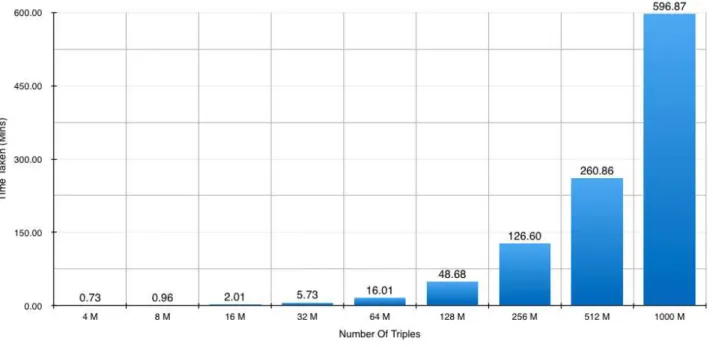
7.3.1 Upload Results . . . 95
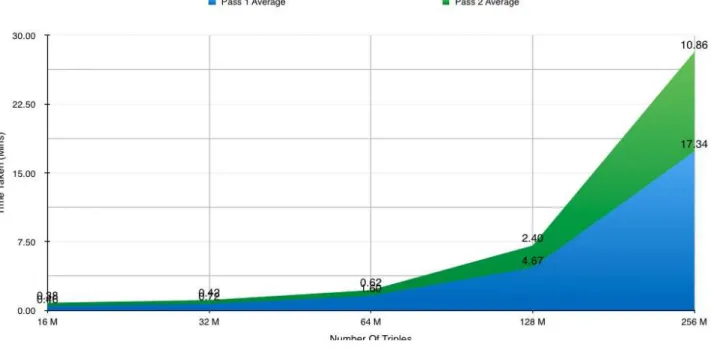
7.3.2 Upload Results Showing Breakdown Of Passes . . . 95
7.3.3 Query Results . . . 97
7.3.4 Query Results Showing Breakdown Of Passes . . . 97
7.4 Single Node Results - Approach Two . . . 98
7.4.1 Query Results . . . 98
7.4.2 Query Results Showing Breakdown Of Passes . . . 99
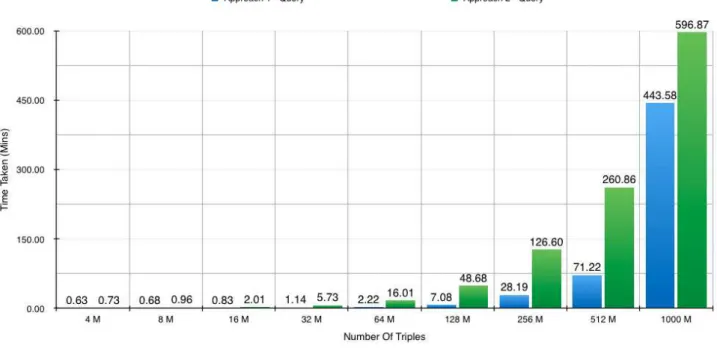
7.5 Single Node Comparison . . . 99
7.5.1 Approach Comparison . . . 99
7.6 Hadoop Cluster Results . . . 103
7.7 Cluster Results - Approach One . . . 103
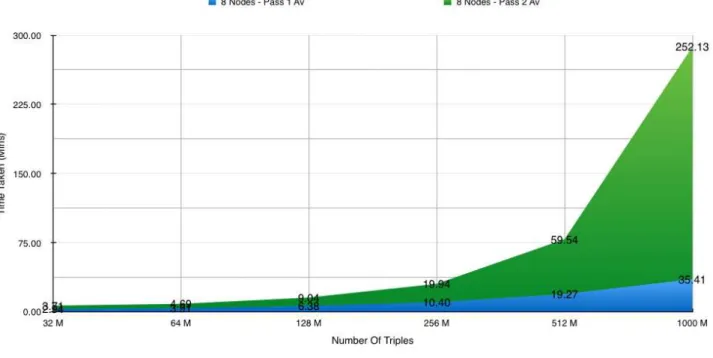
7.7.1 Upload Performance Across Eight Nodes . . . 103
7.7.2 Query Performance Across Eight Nodes . . . 104
7.7.3 Performance Scalability Across Number Of Nodes . . . 104
7.7.4 Speed-Up Analysis Of Approach One’s Query Stage . . . 105
7.8 Cluster Results - Approach Two . . . 106
7.8.1 Query Performance Across Eight Nodes . . . 106
7.8.2 Performance Scalability Across Number Of Nodes . . . 108
7.8.3 Speed-Up Analysis Of Approach Two’s Query Stage . . . 108
7.9 Cluster Approach Comparison . . . 109
7.9.1 Approach Comparison On Eight Nodes . . . 109
7.9.2 Approach Comparison On Four Nodes . . . 111
7.9.3 Approach Comparison With Jena . . . 111
7.10 Na¨ıve versus Optimised Implementation . . . 112
8 Interpretation and Discussion Of Results 114 8.1 Summary and Significance Of Results . . . 114
8.1.1 Single Node Results . . . 114
8.1.2 Cluster Results . . . 115
8.1.3 Cluster Size Versus Speed-Up Factor . . . 115
8.1.4 Approach Comparison . . . 116
8.1.5 Underlying Pass Comparison . . . 118
8.2 Comparison With Literature . . . 118
9 Conclusions And Further Work 121 9.1 Conclusions . . . 121
9.1.1 Project Summary . . . 121
9.1.2 Aims and Objectives Achieved . . . 122
9.1.3 Evaluative Conclusions . . . 122
9.2.1 Improvements To The Project . . . 124
9.2.2 Expansion Of The Project . . . 125
9.3 Final Conclusions . . . 126
References 128 A Appendix - SPARQL Queries 134 A.1 Original SPARQL Queries . . . 134
B Appendix - Hadoop Cluster Configuration Files 138 B.1 HDFS Site . . . 138
B.2 Mapred Site . . . 138
B.3 Core Site . . . 139
C Appendix - Approach One Source Code 140 C.1 Upload Algorithm . . . 140
C.1.1 Map 1 - Compressor . . . 140
C.1.2 Map 2 - Create Single Line On Subject . . . 142
C.1.3 Reduce 1 - Create Single Line On Subject . . . 143
C.2 Query Algorithm . . . 143
C.2.1 Map 1 - Pass 1 . . . 143
C.2.2 Reduce 1 - Pass 1 . . . 146
C.2.3 Map 2 - Pass 2 . . . 149
C.2.4 Reduce 2 - Pass 2 . . . 150
D Appendix - Approach Two Source Code 158 D.1 Query Algorithm . . . 158
D.1.1 Map 1 - Pass 1 . . . 158
D.1.2 Reduce 1 - Pass 1 . . . 161
D.1.3 Map 2 - Pass 2 . . . 165
D.1.4 Reduce 2 - Pass 2 . . . 165
1.1 The Semantic Web Stack . . . 18
1.2 Real World Open Linked Data . . . 19
2.1 A Sample RDF Dataset . . . 24
2.2 Graphic Representation Of RDF Data . . . 24
2.3 Basic Map/Reduce Workflow . . . 31
2.4 Full Map/Reduce Workflow . . . 33
3.1 SPARQL Map/Reduce Research Areas . . . 36
3.2 Map-Side Join . . . 39
3.3 Reduce-Side Join . . . 40
3.4 Kulkarni’s Selection Phase . . . 46
3.5 Kulkarni’s Join Phase . . . 47
3.6 Mazumdar’s Example SPARQL Query . . . 47
3.7 Mazumdar’s Query Execution Plan . . . 48
3.8 Mazumdar’s First Join . . . 48
3.9 Goasdoue’s 1-Clique Query . . . 50
3.10 Goasdoue’s Central Clique Query . . . 50
3.11 Mazumdar’s Performance Results . . . 51
3.12 Husain’s Performance Results . . . 52
3.13 Goasdoue’s Upload Performance Results . . . 53
3.14 Goasdoue’s Query Performance Results . . . 53
4.1 Current Approach For Checking Medical Data . . . 58
4.2 Jena TDB Upload Performance . . . 60 11
4.3 Jena TDB Query Performance . . . 60
5.1 Triple Group Joining Plan . . . 71
5.2 Approach One - Selection Stage Workflow . . . 75
5.3 Map-Side Join Example . . . 76
5.4 Reduce-Side Join Example . . . 77
5.5 Join Stage Workflow . . . 79
5.6 Hadoop Job Output Showing Counters . . . 81
5.7 Approach Two - Selection Stage Workflow . . . 82
6.1 Number of Map/Reduce Tasks Results . . . 89
6.2 Hadoop Memory Footprint Calculation . . . 90
6.3 Optimum Heap Size Result . . . 90
6.4 JVM Reuse Result . . . 91
6.5 Hadoop Sort IO Result . . . 92
7.1 Approach One - Single Machine Upload Time . . . 96
7.2 Approach One - Single Machine Upload Time Showing Breakdown Of Passes 96 7.3 Approach One - Single Machine Query Time . . . 97
7.4 Approach One - Single Machine Query Time Showing Selection And Join Stages . . . 98
7.5 Approach Two - Single Machine Query Time . . . 99
7.6 Approach Two - Single Machine Query Time Showing Pass Breakdown . . . 100
7.7 Single Node Query Performance Comparison Between Approaches . . . 101
7.8 Single Node Total Performance Comparison Between Approaches . . . 101
7.9 Single Node Total Performance Comparison Between Hadoop And Jena . . . 102
7.10 Approach One - Upload Performance Across 8 Nodes . . . 103
7.11 Approach One - Query Performance Across 8 Nodes . . . 104
7.12 Approach One - Upload Performance Scalability Across Nodes . . . 105
7.13 Approach One - Query Performance Scalability Across Nodes . . . 106
7.14 Approach One - Query Speed-Up Factor . . . 107
7.16 Approach Two - Query Performance Scalability Across Nodes . . . 108
7.17 Approach Two - Query speed-up Factor . . . 109
7.18 Eight Node Cluster Approach Query Comparison . . . 110
7.19 Eight Node Cluster Approach Total Comparison . . . 110
7.20 Four Node Cluster Approach Total Comparison . . . 111
7.21 Hadoop Approaches Versus Jena . . . 112
2.1 Join Example 1 . . . 29
2.2 Join Example 2 . . . 29
2.3 Join of Table 1 and 2 on Course-ID . . . 29
5.1 Subject, Predicate and Object Distribution . . . 63
5.2 Triple Group Distribution . . . 63
6.1 Specification Of The Single Machine . . . 86
6.2 Specification Of The Hadoop Cluster . . . 87
6.3 Hadoop Configuration Files . . . 88
6.4 Hadoop Memory Allocation on Cluster . . . 91
6.5 Hadoop Cluster Final Configuration Values . . . 93
8.1 Specification Of The Clique-Square Hadoop Cluster . . . 119
1 Medical Data Upload Algorithm . . . 74 2 Medical Data Query Map/Reduce Iteration 1 . . . 78 3 Medical Data Query Map/Reduce Iteration 2 . . . 85
RDF ResourceDescriptionFramework
SPARQL SimpleProtocolAndRDFQueryLanguage
URI UniformResourceIdentifiers
URL UniformResourceLocator
HDFS HadoopDistributedFileSystem
JVM JavaVirtualMachine
RAM RandomAccessMemory
BGP BasicGraphPatern
NHS NationalHealthService
LUBM LehighUniversityBenchmark
Introduction
1.1
Errors In Medical Databases
Recent technological advances in modern healthcare have led to a vast wealth of patient data being collected. This data is not only utilised for diagnosis but also has the potential to be used for medical research. For any conclusions from this research to be of worth, the underlying data needs to be of high quality. However, according to Goldberg, Niemierko, and Turchin (2008), there are often many errors in datasets used for medical research. In this study they found error rates ranging from 2.3% to 26.9% in a selection of medical research databases. Salati et al. (2011) highlight a series of metrics on which the quality of medical data can be judged. These are accuracy, completeness, consistency and believability. Salati et al. (2011) state that the errors which they find present in medical databases can have three different etiologies: firstly, errors which were present in the original data and then copied into the medical databases; secondly, errors which occur due to misinterpretation of the original data; finally, errors which occur when the data is being entered into the database. With such high error rates present in medical databases there is clear need for a system to assess the quality of data before it is used as the basis of cutting edge research.
1.2
Current Possible Solutions Using Linked Open Data
There has been an attempt to create a system which automatically assesses a given dataset to check for errors contained within (Corsar, Moss, & Piper, 2012). Such a system has been developed using Semantic Web and Linked Open Data technologies, both of which will be expanded upon in this section. The concepts relating to the emerging field of Big Data and how this relates to healthcare will also be explored.
1.2.1 The Semantic Web and Linked Open Data
The original vision of the Semantic Web was established by Berners-Lee, Hendler, and Lassila (2001). The vision was to create a machine-readable structure to supplement the pre-existing human-readable content of web pages. According to Davies, Fensel, and van Harmelen (2003) this structure consists of meta-information, defining specific properties about any given element of data. This meta-information captures some of the meaning, or semantics behind the data, leading to the concept being named the Semantic Web (Antoniou & Harmelen, 2008). The Semantic Web is implemented in a series of layers, which collectively form the Semantic Web stack illustrated in Figure 1.1. A more in-depth view of one of the fundamental layers of the Semantic Web, the Resource Description Framework (RDF), can be found in Chapter 2.
Linked Open Data is defined by Bizer, Heath, and Berners-Lee (2009) as being simply different sources of data which are inter-linked together via the web. These data sources can be geographically distributed and vary in source, content and format. To enable these datasets to be linked, Semantic Web technologies and concepts are utilised. The number of real-world datasets linked to others via the Open Linked Data philosophy is increasing rapidly as Figure 1.2 demonstrates.
FIGURE1.2: Real World Open Linked Datasets (Bizer et al., 2009).
1.2.2 Big Data and Healthcare
Big Data is a rapidly increasing area of interest within the computer science field and draws upon areas from many different disciplines. Both academic and industrial fields are gener-ating and collecting data at an unprecedented rate and scale. This data, and the analysis of it, is being used to replace models and guesswork as the basis for decision-making Agrawal et al. (2011). While there have been some early successes, the true potential of Big Data and the decisions which can be made from its analysis have, according to Agrawal et al.
(2011), have not yet been fully realised. This is due to the technical challenges which stor-ing and processstor-ing the massive volume of data present. Gartner (2011) argues that it is not only the volume of data which is challenging current technology, but also the variety (the heterogeneity of data, representation, and semantic interpretation) and velocity (data arrival and required processing rate) of the data.
The biomedical and general healthcare fields have the potential to be one of the biggest con-tributors to and benefactors from the big data phenomenon. Feldman, Martin, and Skotnes (2012) state that the volume of worldwide healthcare data as of 2012 is estimated to be over 500 petabytes. This Figure is predicted to increase by a factor of 50 to a value of 25,000 petabytes by 2020. Agrawal et al. (2011) state that one of the biggest contributors to this data explosion will be the use of continuous monitoring machines, both in hospitals and at home. Howe et al. (2008) explain that analysing this data has the potential to alter biomedical research and significantly improve healthcare diagnosis.
1.2.3 Current Implementation
A Linked Data approach to assessing the quality of medical data has been created. Corsar et al. (2012) state that this framework can be broken down into three key stages. Firstly, pre-existing medical data is converted into RDF data and stored in Jena TDB. Secondly, the data can be annotated with provenance information, such as the specification of the machines which recorded the data. Lastly, a data checking component assesses the quality of the data via a series of SPARQL rules. A more detailed look at the current implementation can be found in Chapter 4. The current implementation relies on traditional semantic web technologies which are not well-adapted to process the volume of data which healthcare entails. Due to this, the current framework suffers from performance and scalability issues when processing massive RDF datasets.
1.3
Project Aims and Motivations
Due to the potential volume of RDF-based medical records, performance issues with the current framework could limit its adoption in the wider medical community. This project will explore alternative methods for both storing medical RDF data and also assessing its quality via a series of SPARQL queries. One of the key considerations for this project will be performance and scalability of data upload and also query response time.
The specific aims and objectives of this project are as follows:
i ) To create a new storage and query framework for medical data, with specific emphasis being placed on performance. This will be implemented in Apache Hadoop Map/Reduce. ii ) To test the newly developed Hadoop framework using real-world medical data.
iii ) To compare performance and scalability of this Hadoop framework against the existing implementation of the Linked Data approach to assessing the quality of medical data and draw relevant conclusions.
Background Technologies
In this chapter the fundamental, underlying technologies utilised in this project will be intro-duced and explained. These technologies include RDF, SPARQL, Triplestores, Hadoop and the Map/Reduce programming model.
2.1
The Resource Description Framework (RDF)
The Resource Description Framework (RDF) is one of the fundamental layers of the se-mantic web stack illustrated in Figure 1.1. According to W3C (2004) RDF is a language specifically designed to express the relationship between elements on the world wide web. The philosophy behind RDF is about making statements that are easy for machines or com-puter programs to understand and process.
Antoniou and Harmelen (2008) state that the fundamental concepts of RDF can be consid-ered to be: Resources, Properties and Statements.
• Resources are objects or things, about which there is a need to express some infor-mation. Resources are represented by Uniform Resource Identifiers (URI) which is a unique way of identifying a specific Resource.
• Properties describe the relationship between different Resources. Each Property is also identified via a URI.
• Statements are the complete RDF triple. An RDF triple consists of a Resource, a Property and a Value. Values can be a Resource or literals (such as a string or inte-ger).
2.1.1 An RDF Statement
Ogbuji (2000) states that an RDF Statement comprises three distinct structural components: a Subject (about which the statement is being made), a Predicate (describing the relation-ship between Subject and Object) and an Object (an attribute of the Subject). Ogbuji (2000) expands upon the concept of an RDF Statement by drawing comparisons with the English language. For example the sentence’John Brennan is a lecturer at the University of Hud-dersfield’ can be represented in RDF with the following structure:
• Subject (’John Brennan’) • Predicate (’lecturer at’)
• Object (’University of Huddersfield’)
Resources in RDF, as previously discussed, are represented by URI’s. A Uniform Resource Locator (URL) is a subset of URI’s which is often used to locate an RDF Resource. There-fore the statement from earlier could more accurately be represented as:
• Subject (http://www.hud.ac.uk/staff/John Brennan) • Predicate (http://www.hud.ac.uk/role/lecturer) • Object (http://www.hud.ac.uk)
2.1.2 RDF Graph Representation
As RDF is used to express the relationship between resources, it is often represented as a graph. For example the RDF graph displayed in Figure 2.2 shows the relationships between different elements from the dataset displayed in Figure 2.1. RDF graphs are extremely
useful in visualising how simple RDF triple statements can be built up to express complex relationships between numerous unique resources.
FIGURE2.1: A Sample RDF Dataset (Goasdou ´e et al., 2013).
FIGURE2.2: Graphic Representation Of Sample RDF Data (Goasdou ´e et al., 2013).
2.1.3 RDF Serialisation Formats
Segaran, Evans, and Taylor (2009) explain that there are several formats in which an RDF statement can be serialised, including RDF/XML, N3 and N-Triple. The original RDF seri-alisation is RDF/XML, which builds on the XML structure of tags to represent a Triple. The earlier statement would be expressed in RDF/XML as:
<?xml version="1.0" encoding="UTF-16"?> <rdf:RDF xmlns:rdf="http://www.w3.org/1999/02/22-rdf-syntax-ns" xmlns:unidomain="http://www.hud.ac.uk/my-rdf-ns"> <rdf:Description rdf:about="http://www.hud.ac.uk/staff/John_Brennan"> <unidomain:lecturerAt rdf:resource="Univerity-of-Huddersfield"/>
</rdf:Description> </rdf:RDF>
The N-Triple notation is a simpler way of representing an RDF Triple. Each line of N-Triple contains a single RDF Statement in full, with the subject, predicate and object separated by whitespace. Both Subject and Object are represented as a full URI enclosed by angle brackets. The earlier statement would be expressed in N-Triple as:
<http://www.hud.ac.uk/staff/John_Brennan> <http://www.hud.ac.uk/role-/lecturer> <http://www.hud.ac.uk>
While the structure of N-Triple is extremely simple, it can lead to a lot of repetition with larger RDF datasets. It is common for RDF datasets to contain numerous statements that share at least one element, which the N-Triple format will repeat. The N-Triple format also expresses RDF data with the full URI, again a wasteful method.
The N3 format attempts to rectify some of the inherent inefficiencies with the N-Triple for-mat. It does this via two methods. Firstly, N3 replicates the XML namespace mechanism to allow definition of URI prefixes at the beginning of a RDF document. Secondly, N3 pro-vides a method of representing statements that share a common element. For example the statement from earlier could be expanded on in N3 as:
@prefix rdf: <http://www.w3.org/1999/02/22-rdf-syntax-ns#>. @prefix foaf: <http://xmlns.com/foaf/0.1/>.
@prefix hud: <http://www.hud.ac.uk/#>.
hud:John_Brennan rdf:type foaf:person; hud:lecture hud:uni.
Here an extra triple has been introduced. As it shares a common subject with the original statement, N3 does not repeat it; instead it uses a semi-colon to represent a shared element.
2.2
Triplestores
A triplestore is a framework designed especially to provide persistent storage of and the ability to query RDF data Haslhofer, Roochi, Schandl, and Zander (2011). According to Sequenda (2013), triplestores can be categorised into three groups based on the storage implementation. These groups are Native, RDBMS-backed and NoSQL. Native triplestores are designed specifically for, and thus optimised for, storing RDF data. These Native imple-mentations are independent of other Relational Database Management Systems (RDBMS) and store the RDF data in the local filesystem. RDBMS-backed triplestores store the RDF data in a traditional relational database such as MySQL. NoSQL triplestores are a recent development designed to exploit the advances being made in NoSQL databases such as Cassandra.
According to Weaver and Williams (2009) while many of the common native triplestores use advanced database techniques to enable fast querying of RDF data, they require a lot of pre-processing which can often lead to a prohibitively long data upload time.
2.2.1 Jena
Jena is one of the mostly widely utilised tools used to store and process RDF data and was originally developed by Hewlett-Packard(Wilkinson, Sayers, Kuno, & Reynolds, 2003). It comprises a Java API, allowing users to write programs that create or manipulate RDF data, as well as a native (Jena TDB) and also a RDBMS-backed (Jena SDB) triplestore to house and query RDF data. Jena implements a query engine called ARQ to perform SPARQL queries on the triplestore.
While Jena is extremely popular, Husain, Doshi, Khan, and McGlothlin (2009) state that it suffers from performance issues, particularly related to the initial upload of RDF data. Also due to the fact that Jena is limited to running on just a single machine, it can only process a relatively small number of triples at a time. Husain et al. (2009) report that a machine with 2GB of system memory could only store a dataset of 10 million triples.
2.3
Simple Protocol and RDF Query Language (SPARQL)
According to DuCharme (2011) the Simple Protocol and RDF Query Language (SPARQL) provides a way of querying RDF data stored in a triplestore and is the W3C standard for doing so. SPARQL can be compared to the Structured Query Language (SQL), used to query standard relational databases, as they share a similar syntax and logic. Antoniou and Harmelen (2008) expand on SPARQL by explaining that conceptually, it is based around matching graph patterns. According to W3C (2013), a query evaluates what is known as a basic graph pattern (BGP). Each BGP can contain several query patterns all resembling an RDF triple. Variables are able to substitute any part of the BGP to allow individual elements to be extracted from any input triples matching the rest of the pattern (W3C, 2013). Goasdou ´e et al. (2013) state that the normative syntax for a SPARQL query is:
SELECT ?v1...?vn WHERE {t1...tn}
with the SELECT ?v1...?vn element representing distinct variables occurring in the input data and the order in which they are to be returned. FROM is an optional element not shown, that can be utilised to determine the data source to be queried. The WHEREt1...tn element forms the BGP and is a series of triple query patterns that will match the graph of any input triples against the ones specified in the BGP.
A basic SPARQL query that selects all lecturers at the University of Huddersfield would be: PREFIX rdf: <http://www.w3.org/1999/02/22-rdf-syntax-ns#>
PREFIX hud: <http://www.hud.ac.uk/#> . SELECT ?name
WHERE {
?name hud:Lecturer hud:Uni . }
This simple query would return a list of all elements (in this case lecturers at the University) that matched the triple graph pattern, bound to the variable ?name. However, often more advanced information is required from a query. The following query would select all peo-ple who are lecturers at the University of Huddersfield and are also part of the School of Computing:
PREFIX rdf: <http://www.w3.org/1999/02/22-rdf-syntax-ns#> PREFIX hud: <http://www.hud.ac.uk/#> .
SELECT ?name WHERE
{
?name hud:Lecturer hud:Uni . ?name hud:School hud:Computing . }
In this example the BGP has two query patterns to match, both of which share a common variable. According to DuCharme (2011), replicating a variable between two triple patterns in a SPARQL query is done to join together the two patterns. When the SPARQL query engine finds a triple with the predicate of hud:Lecturer and an object of hud:Uni it would bind the subject of such a triple to the variable ?name. When processing the second pat-tern, possible matches will be limited to results containing the variable ?name. Effectively results from the first pattern will be joined to results from the second so that only elements meeting both conditions will be returned. The process of joining data comes from the world of relational databases and is explored in the next section.
2.4
Database Joins
Silberschatz, Korth, and Sudarshan (2011) explain that theory behind database joins is structured around relational algebra. They expand this point by stating that relational al-gebra encompasses a set of operations on relationships which mirror standard alal-gebraic operations. While standard algebra includes addition, multiplication and subtraction, which starts with a set of numbers as input and returns a number as output, relational algebra operations takes a set of relations for input and returns a new relation as output. The most common relational algebra operation used when discussing joins is the Natural Join (Repre-sented by⊲⊳) (Silberschatz et al., 2011). The Natural Join is the combining of two datasets by merging matching elements based on a common key, called a Foreign Key (Miner & Shook, 2012). All patterns that match are included in the result of the join.
Table 2.1 and Table 2.2 contain data that will be joined via a natural join. In this example the values of the Teaches-Course from table 2.1 will be joined to 2.2 via the values from the Course-ID.
Name School Teaches-Course
John Engineering 165
Matt Computing 132
Ibad Engineering 50
Yvonne Computing 74
TABLE2.1: Join Example 1
Course-ID Course-Name
165 DSP
50 PCA
74 CS
TABLE2.2: Join Example 2
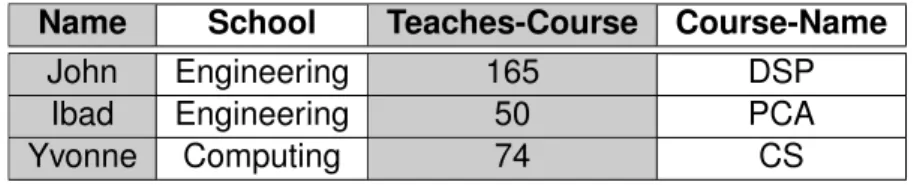
The join can be expressed as the following: (T eachesCourse ⊲⊳ CourseID) → N ewT able Joining the two datasets will create a new dataset shown in Table 2.3. All results that can join via the foreign key will be included in the table, while results not matching (for example the record for ’Matt’) will be absent.
Name School Teaches-Course Course-Name
John Engineering 165 DSP
Ibad Engineering 50 PCA
Yvonne Computing 74 CS
TABLE2.3: Join of Table 1 and 2 on Course-ID
2.5
Hadoop And The Map/Reduce Programming Model
Lam (2010) defines Hadoop as an open source framework for the storing and processing of internet-scale data in a distributed manner. Hadoop tackles the problem of ’Big Data’ by distributing the storage and processing of data to numerous machines. White (2010) states that Hadoop comprises two main components: the Hadoop Distributed File System (HDFS), used for storing data across a Hadoop cluster and the Map/Reduce programming framework, used to process the data. Hadoop has emerged as the de-facto standard for the processing of Big Data introduced in section 1.2.2.
2.5.1 Hadoop Cluster Components
According to Chandar (2010) a Hadoop cluster consists of the following components, all of which are Java Virtual Machines (JVM):
• JobTracker - Master node which controls the submission and scheduling of jobs on the cluster.
• NameNode- Controller node for the HDFS, which keeps track of which node stores what data.
• TaskTracker - These nodes are worker nodes for Map/Reduce and are where the processing happens. A TaskTracker demon does not itself run jobs, instead it controls the spawning of separate JVMs for each Map/Reduce function.
• DataNode- These nodes comprise the rest of the HDFS and house the data. Usually DataNodes are also TaskTrackers, so data can be processed on the same node in which the data resides.
2.5.2 The Hadoop Distributed File System (HDFS)
Rajaraman and Ullman (2012) state that HDFS is an open source imitation of the original Google File System (GFS). Rather than being stored as a single entity, files stored on a HDFS are divided into blocks, usually 64 megabytes in size. As the HDFS is designed to be hosted via commodity machines, each block is replicated three times, with each copy being stored on a different machine. This inherent file redundancy means that node failure has no impact on cluster functionality and is another key advantage of Hadoop. Due to the block nature of HDFS, it is not suited for the storing of files smaller than the size of the block (Rajaraman & Ullman, 2012).
2.5.3 Map/Reduce Programming Model
Hadoop’s Java implementation of the Map/Reduce programming model is based on Google’s proprietary system introduced in a 2004 paper (Lam, 2010). According to Dean and Ghe-mawat (2004) a standard Map/Reduce pass consists of two distinct phases: a Mapper and a Reducer. All inputs to a Map/Reduce task are key/value pairs, with all intermediate and final output also represented in this way.
Dean and Ghemawat (2004) explain the role of each phase in the following manner: the Map function processes the input key/value pairs, performs a user-defined algorithm, then outputs an intermediate set of key/value pairs. These intermediate results are grouped on the key to ensure that all values associated with that key are sent to the same Reduce func-tion. The Reduce function then performs the final processing and outputs the last set of key/value pairs. The basic workflow of Map/Reduce is demonstrated in Figure 2.3.
FIGURE2.3: Simplified Map Reduce Workflow (Rajaraman & Ullman, 2012).
Rajaraman and Ullman (2012) use a word count program as a method of demonstrating how Map/Reduce operates conceptually. For this example, the input to the program will be a collection of documents stored on the HDFS. The Map function processes the documents and breaks them into a sequence of individual words. The function would then emit its intermediate key/value pair with the word being the key and the value being one. So the output would be - (w1,1), (w2,1),...,(wn,1) At the grouping stage any replicated keys would have their values collated before being passed onto the Reduce function. So the input to the
Reduce function would be (w1, [1 1 1 1 1]), for a word that had five instances in the original input files. The Reduce function then would sum the values for the key and emit the total, along with the word as the final output - (w1, 5).
The pseudocode for the word-count program would be: Map:
void Map(string document) {
for each word w in document { Emit_Intermediate(w, "1"); Reduce:
void Reduce (string word, list<string> values) { int count = 0;
for each v in values { count += StringToInt(v); Emit_Final(word, count);
2.5.4 Sort/Shuffle, Partitioner and Combiner Stages
Thus far the Map/Reduce model discussed has been a simplified one, with several key stages absent. These stages include Sort/Shuffle, Partition and Combiner. Together they are what manage the crucial transfer of data from Mapper to Reducer. White (2010) states that the Sort/Shuffle stage is what sorts the numerous different values emitted from the Map stage by their key, and then passes them over the network to a Reduce function. The Partitioner is responsible for deciding how the output from a Map task is divided before being sent to a Reduce task. By default Hadoop will equally divide the intermediate Map output between the number of requested Reduce tasks, while also ensuring that all the values of a certain key are located within the same partition. However, a user can write their own Partition function if they require different processes to be performed upon the intermediate data (White, 2010). Lin and Dyer (2010) state that Combiners are an optimisation that enable intermediate results to be processed before the Shuffle and Sort phase. A Combiner can be considered a mini-reducer that process the output from each Map task before it is passed to the final Reducer. As a Combiner only operates on a single Map task, it has no
guarantee of access to all values for a specific key so they are only really utilised to reduce the amount of data to be passed to the final Reducer (Lin & Dyer, 2010).
The location of these additional stages in the Map/Reduce workflow can be seen in Figure 2.4.
FIGURE2.4: The Full Map Reduce Workflow (Lin & Dyer, 2010).
2.5.5 Benefits and Drawbacks
The word count example discussed in the previous section demonstrates the advantages of using the Map/Reduce programming model.Rajaraman and Ullman (2012) argue that be-cause the Map function performs an identical algorithm on all input data, multiple instances of the Map function can process different parts of the dataset, on different machines, simul-taneously; thus processing the complete datasets an order of magnitude faster than pro-cessing the datasets sequentially. Further, White (2010) argues that Hadoop’s approach to large scale-data processing differs from the traditional High Performance Computing (HPC) approach. HPC compute nodes usually have no access to data locally, instead they access it via a centralised shared filesystem over a network. When processing gigabytes of data,
the network bottleneck can seriously limit the performance of the system. One of the major advantages of the Hadoop framework is that it tries to ensure that the data to be processed is available on the local drive of the compute node. This bypasses the need for a time-consuming network transfer of the data. This key feature, known as data locality, is one of the main drivers of Hadoop’s performance advantage (White, 2010).
Hadoop imposes strict limits on both the Map and Reduce functions to enable it to perform the parallelisation. Map functions inherently have to work independently on one set of key/-value pairs and have no access to other pairs. The Reduce function can only access those values associated with the key used to generate the reduce function, making features such as dataset joins complicated (White, 2010). Hadoop is implemented in Java, with each of the cluster components discussed in section 2.5.1 running as a separate JVM. During a standard Map/Reduce iteration each Map and Reduce task incurs a start-up penalty asso-ciated with spawning the JVM. Due to this penalty it is usually best to limit the number of passes required to complete a set task (Joshi, 2012). Another disadvantage that is asso-ciated with Hadoop is the steep learning curve in discovering how to correctly program a Map/Reduce job. White (2010) argues that creating a new Map/Reduce task even for an experienced programer is not a quick process due the complexity of the code and number of required functions for even a simple job.
2.5.6 Associated Technologies
There are a selection of other technologies under the Apache Hadoop banner which build extra functionality onto both the HDFS and Map/Reduce layers. These technologies include: H-Base, Hive and Pig.
H-Base is an open-source implementation of Google’s Big Table design (Chang et al., 2006). Taylor (2010) states that it provides a structured, fault tolerant and scalable database layer that resides on top of the HDFS. Unlike many other projects, H-Base enables real-time random read and write access to the data contained within a table. H-Base provides no query language, so users must access the data via a standard Map/Reduce job.
Hive is a project created by Facebook to provide not only a structured data store, but also a way of querying the data via an SQL-like language called Hive QL (White, 2010). According to Taylor (2010) a query created using Hive QL is automatically translated into the required number of Map/Reduce tasks, enabling users who are familiar with SQL to easily start processing data via Hadoop. Hive will automatically perform any requested joins between data elements. However White (2010) shows that if multiple joins are required across data elements residing in different columns, Hive will perform an un-optimised and slow series of cascade joins (Cascade joins will be discussed further in section 3.3.3).
According to Taylor (2010), Pig was created to be a high-level data-flow language, com-prising two elements: The Pig data-flow language named Pig-Latin and the Pig execution environment which enables the job to run on a local or Hadoop distributed environment. Taylor (2010) further explains that the Pig-Latin language allows users to express their jobs as a series of operations and transformations to a selection of input data to create output. These operations include filtering, sorts and joins. A standard Pig-Latin job usually contains only a small selection code to complete comparatively complex tasks. In a similar fashion to Hive, Pig automatically translates these operations into a series of Map/Reduce iterations. While Pig makes creating Map/Reduce tasks simpler, the trade-off is that a natively writ-ten job will have comparatively increased performance, especially when performing joins requiring multiple passes (White, 2010).
Literature Review
3.1
Research Fields
An analysis of literature from several different fields is required in order to successfully and efficiently devise a method to perform SPARQL queries via Map/Reduce. Figure 3.1 effectively demonstrates the overlap between the different fields from which this project draws. This chapter will explore prior research conducted into area 2 highlighted in Figure 3.1: performing SPARQL queries using Map/Reduce.
FIGURE3.1: SPARQL Map/Reduce Research Areas (Myung, 2010).
3.2
Distributed Native Triplestores
According to Owens, Seaborne, and Gibbins (2008) the volume of structured RDF data is quickly outstripping the ability of native triplestores to store and query. Many of the most commonly used triplestores are designed to only utilise a single machine. However, in an effort to improve both upload and query performance, there have been attempts to create distributed native triplestores that either augment or replace existing solutions.
Weaver and Williams (2009) developed a system that is able to process and query RDF data on a selection of HPC machines, ranging from commodity Beowulf clusters to IBM Blue Gene machines. Their implementation is created using the Message Passing Interface (MPI) to enable parallelisation and requires no processing of the data to be performed before it is stored. Weaver and Williams (2009) state that while their system performs well when compared with traditional triplestores, it requires that the entire RDF data set, along with all intermediate results, fit in the main system memory. They highlight that this approach has two clear disadvantages. Firstly, any machine must have an equal or greater amount of RAM to the size of the RDF dataset. This requirement would place a finite limit on dataset size as it could never exceed the size of system memory. Secondly, as RAM is volatile storage, this would not be an ideal solution to permanently house the data, as a hardware or power failure would result in complete data loss.
Owens et al. (2008) present a distributed triple store designed as a direct replacement for Jena TDB. Their implementation draws on many of the same optimisations employed to make traditional databases efficient in a parallel environment, while also keeping specific RDF processing benefits associated with the existing Jena TDB system. The Clustered TDB divides the underlying hardware into one of two possible roles; Query Coordinators which receive queries and store the location of the data on the rest of the cluster or Data Nodes which store the data and perform any operations such as sorts or joins. Owens et al. (2008) conclude that when the clustered system is compared with the standard Jena TDB, it shows increased performance in triple load rates. However the system does not scale well when performing the joins required to complete a SPARQL query, with many of the performed tests showing a sharp drop-off in performance when running on a cluster
of three machines. On one such query, a Clustered TDB system comprising three nodes takes four times the amount of time to complete the query, compared with a standard TDB system.
Harris, Lamb, and Shadbolt (2009) introduce a distributed triplestore called 4-Store. 4-Store is designed as a complete implementation of a triplestore, handling both the storage and query requirements. A 4-Store cluster consists of a single processing node controlling a selection of data nodes on which the RDF data is stored. Two studies, one conducted by Patchigolla (2011) and one by Haslhofer et al. (2011) both find 4-Store to be one of the fastest from a selection of different triplestores. Haslhofer et al. (2011) show that even running on a single node 4-Store is often twice as fast as Jena TDB. However 4-Store has shown that query performance does not scale well, with performance remaining static once the cluster size is increased past 4 nodes (Patchigolla, 2011).
3.3
Performing Dataset Joins Via Hadoop
As a complex SPARQL query requires multiple joins, any implementation designed to pro-cess them via Map/Reduce also requires the ability to perform joins. Joins in SPARQL are handled by the underlying engine (such as Jena’s ARQ) and therefore are seamless to the user. However according to Miner and Shook (2012), performing joins in a Map/Reduce environment is potentially the most complex operation to achieve efficiently. Map/Reduce was designed to process large datasets by looking at each element in isolation and process-ing it sequentially, so joinprocess-ing two potentially massive datasets is beyond Hadoop’s design paradigm.
While joins in Map/Reduce are complicated, several different strategies have emerged that make them possible. These join strategies include: Map-Side, Reduce-Side, Broadcast and Cascade joins (Chandar, 2010). These strategies will be explored in greater detail below. For the Map-Side and Reduce-Side joins, both a Two-way (joining two items in a single Map/Reduce iteration) and Multi-way join (Joining multiple items in a single Map/Reduce iteration) will be considered.
3.3.1 Map-Side Join
According to White (2010) a Map-Side join functions by joining the datasets before they reach the Map function. This eliminates the need for the datasets to be passed to the Reduce function, as the output of the Map function is the final joined output. While avoiding the Reduce phase means that a Map-Side join is potentially the quickest join method, the datasets to be joined have to meet very strict formatting conditions for it to work. White (2010) expands on two of the fundamental formatting conditions: firstly all input data must be partitioned using the partitioner, with the number of partitions in each input dataset being identical. Secondly, all input data must be sorted via the same key to be used for the join, with all values of a certain join key residing in the same partition. According to Palla (2009) the Map-Side join uses this precise structure of the input data to enable joining without data being passed to the reduce function. Figure 3.2 shows a Map-Side join workflow.
FIGURE3.2: Map-Side Join (Palla, 2009).
The formatting conditions required for a Map-Side join often mean that for many datasets stored via their original structure, using a Map-Side join is not practical (Chandar, 2010).
However with the introduction of a pre-processing stage, comprising a single Map/Reduce iteration which simply passes the data through the framework, it can be possible to format the input data so that it is compliant with the Map-Side join input requirements (Palla, 2009).
3.3.2 Reduce-Side Join
The Reduce-Side join is a more common approach utilised to join data via Map/Reduce and is implemented using the complete Map/Reduce iteration (Palla, 2009). According to White (2010) the basic workflow for the Reduce-Side join is as follows: Firstly the Map function iterates through all records, tagging them with their source dataset and sets the Map output key as the join key. This will ensure that all values featuring that key are sent to one Reduce function. The Reduce function can then join the required elements and emit the final output. A simple two-way Reduce-Side join workflow is illustrated in Figure 3.3. Compared with a Map-Side join, Reduce-Side joins are much more flexible as there are no restrictions placed on the structure or partitioning of the input data (White, 2010). However Miner and Shook (2012) state that the major disadvantage of this method is that all data required for the join will be passed through the Map/Reduce shuffle phase, thus incurring a costly network transfer stage.
FIGURE3.3: Reduce-Side Join (Chandar, 2010).
Afrati and Ullman (2010) show the logic behind the Reduce-Side to be relatively simple. For example joining the following datasets:
(P(a, b)⊲⊳ Q(b, c))
could be achieved by first iterating through both datasetsPandQin the Map function and emitting b as the key and a as the value for P, and b as the key and c as the value for dataset Q. The values would be grouped via the common key and the Reduce function would be presented with the key/value pair of -b(an, cn)The reduce function would then join the values together to create the final join result:
(P(a, b)⊲⊳ Q(b, c)→F inalResult(a, b, c))
While this approach is suitable for joining two elements, joining multiple elements that de-pend upon the output of previous joins is not possible via this method. However using a technique called a Cascade join it is possible to process such situations (Chandar, 2010).
3.3.3 Cascade Join
The Cascade join is a method that allows multiple dependant relations to be joined via Map/Reduce. According to Afrati and Ullman (2010) a Cascade join is effectively a pre-determined set of Reduce-Side joins, processed in an iterative manner. Afrati and Ull-man (2010) verify the logic behind the Cascade Join by demonstrating the joining of three datasets:
(R(a, b)⊲⊳ S(b, c)⊲⊳ T(c, d))
Using the first of two Reduce-Side joins, it is possible to join datasetR and Svia the join keyb:
(R(a, b)⊲⊳ S(b, c)→IntermediateResult(a, b, c))
Then by employing a second Reduce-Side join it is possible to join the Intermediate result to datasetTvia the join keycto create the final result.
(IntermediateResult(a, b, c)⊲⊳ T(c, d)→F inalResult(a, b, c, d))
As the Cascade join is a set of Reduce-Side joins, it inherits many of the same advantages and disadvantages. But according to (Chandar, 2010) it has some additional benefits and drawbacks: A key advantage to Cascade joins is that the only limiting factor to the size and number of datasets that can be joined is the available HDFS space. However as each join is a complete Map/Reduce pass, the time overhead needed to setup each one will be in-curred for each required pass. Cascade joins also inherit the network shuffle costs from the Reduce-Side join, but multiplied via the number of required passes. Another disadvantage is that the intermediate join results can consume vast amounts of space on the HDFS. How-ever these intermediate results can be deleted once the final join result has been returned.
3.3.4 Broadcast Join
Blanas et al. (2010) state that if one of the datasets to be joined is of a small enough size, it could be stored in memory. This approach, entitled the Broadcast join, can be used as a performance optimisation for either a Map-Side or Reduce-Side join. A Map-Side join stands to have the largest performance gain from a Broadcast join, which comes from the lack of overhead from the Map/Reduce shuffle (Chandar, 2010). According to Lin and Dyer (2010) a Broadcast join functions by loading the smaller dataset in memory on all machines that will run a Map function. The Map function can then probe the dataset loaded in-memory to check for joins possible with the dataset passed to the Map function via the HDFS. Blanas et al. (2010) suggest the process can be optimised by storing the smaller dataset in an efficient data structure such as a Hash-Table, allowing for faster checking of element membership.
3.4
Feasibility Of Using Hadoop For RDF Processing
The need for a new and scaleable way to process the increasing amount of RDF data is apparent. Even some of the most distributed triplestores only use their parallelism to enable a larger volume of data to be stored, but do not increase the query performance (Patchigolla, 2011). This need for a new approach to parallel RDF data management has
led some researchers to consider the use of Hadoop to solve the problem. According to Soule (2011) Hadoop does not at first appear an ideal solution for processing RDF data, but if handled correctly has the potential to be a viable solution. Hadoop’s intrinsic ability to scale means it could adapt to fit as RDF data-sets continue to increase in size. Myung, Yeon, and Lee (2010) further argue that RDF’s simple data model along with potential for RDF to be rendered as text strings via the N-Triples notation, serve to enhance the case for investigating Hadoop as an RDF processing platform.
3.5
Strategies For Storing RDF Data On The HDFS
One of the first points to consider when designing any Hadoop application is how the input Data will be stored on the HDFS. As discussed in section 2.1.3, RDF has the potential to be serialised in a variety of different formats. Husain (2009) has investigated the storage of RDF data and argues that from the available formats, the least suited would be RDF/XML as it requires several lines to represent a single statement. He argues that as Hadoop processes each line of input data individually, a much more suited RDF format would be N-Triple, as it allows a complete RDF statement to be rendered in a single line of text. The ability of Hadoop to process a complete triple on each iteration has clear performance benefits, as individual triples can be extracted without the need to parse the entire input (Husain et al., 2009).
Husain et al. (2009) advocate splitting the input data on the HDFS into smaller chunks before allowing it to be processed. They propose a system whereby the original RDF input data is split into smaller and more manageable chunks. Firstly the data is divided based on the RDF Predicate, this stage is called the Predicate Split. Work conducted by Stocker, Seaborne, Bernstein, Kiefer, and Reynolds (2008) shows that many real-world RDF datasets do not contain more than twenty different predicates. Splitting the original input data into even twenty smaller chunks would enable any query to take a much more relevant selection of input data, thus decreasing the amount of time spent seeking data requested via the query (Husain, 2009). Husain (2009) further suggest splitting the data again once the Predicate
Split is complete, but this time the split, being based on the RDF Object, could further target more relevant data to a query.
Rohloff and Schantz (2010) store the RDF data as raw plain text N-Triple files, housed directly on the HDFS. However rather than storing each triple as a unique entity, a pre-processing stage is introduced, to store the RDF in a non-native representation. This rep-resentation stores every triple for a certain subject on the same line of text. Rohloff and Schantz (2010) demonstrate how this representation works by showing how their system would store three triples with the common subject of Pub1:
Pub1 :author Prof0 :name "Pub1" a :Publication
As Pub1 only needs to be printed once, this representation also acts as a rudimentary form of data compression, cutting down on the amount of HDFS space being used.
Goasdou ´e et al. (2013) store the RDF data in a novel way, exploiting the HDFS data repli-cation to enable faster query processing. As highlighted in section 2.5, by default the HDFS will replicate each block of data three times, with each replicated block being distributed to a unique node wherever possible. In the approach presented by Goasdou ´e et al. (2013), each block of RDF data is still replicated three times, but instead of each replication being identical, one is partitioned on the subject of a triple, one on the property, and the last on the object. Further to this partitioning, the system stores any identical permutations of a certain RDF subject, predicate or object on the same HDFS data node.
3.6
Queries on RDF Data Using Map/Reduce
3.6.1 Existing Theoretical Approaches
A number of different Map/Reduce-based approaches to query RDF data stored on a HDFS have been explored by various researchers. Many of the approaches are designed to pro-vide a complete SPARQL query engine that translates a given query into a series of Map/Re-duce jobs with little or no input from the user.
Rohloff and Schantz (2010) introduce a system entitled SHARD, which was one of the first coherent efforts to query RDF data using Hadoop. They designed the system to complete two goals: to serve as a persistent storage for RDF data and to provide a SPARQL end-point to query the stored data. As discussed in section 3.5 they employ a method of storing the RDF data on the HDFS so that every triple with a common subject is rendered on a single line of input data. According to Rohloff and Schantz (2010) to complete a response to any given query, the SHARD system spawns a series of Map/Reduce iterations. The first iteration maps all the input triples to a list of variable bindings denoted by the first clause in the SPARQL query. Any triples which match the clause are passed to the reduce and then saved to the HDFS. This step is repeated n number of times for each of the clauses in the query, with the input being the original data plus the output from all previous stages. Using this method allows the system to filter out any previously selected triples which do not meet the new selection criteria. These intermediate stages join the newly selected triples to the previous results via a reduce side join. This allows the system to pass only those triples which meet all the current clauses onto the next iteration. According to Rohloff and Schantz (2010) once all the clauses have been completed, the final Map/Reduce stage is used to complete the SELECT element of the query by making sure only the variables originally requested are presented to the user via the final output.
Kulkarni (2010) presents a system which expands on the Jena ARQ query engine and attempts to transfer the processing of data to Hadoop. The approach is split into two dis-tinct phases, with each phase implemented as at least one complete Map/Reduce iteration. Firstly a selection phase is run to select all the triples required to complete the query. The selection phase groups the final output based on the order of the patterns from the BGP. Figure 3.4 shows how, with a query comprising two BGP elements, the selection phase splits the reducer output into two separate files. The output is formatted with the key being equal to the pattern number and the complete triple as the value.
Kulkarni (2010) further explains that following the selection phase, the relevant triples are passed to the join phase, in which any required joins are performed in an iterative fashion. In this phase any common elements from the previously generated pattern files are joined together to complete the query. Figure 3.5 shows how the join phase mapper selects joining
FIGURE3.4: Kulkarni’s Selection Phase (Kulkarni, 2010).
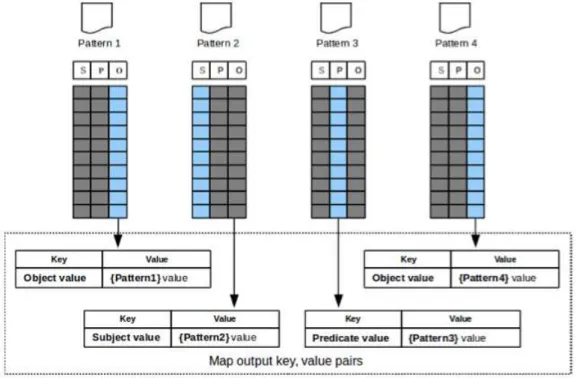
elements from the triples, setting the element to be joined as the key and the full triple as the value. Leveraging the shuffle and sort phase highlighted in section 2.5, will ensure that any common elements will be sent to the same reducer and thus can be joined together to create the final output. Joining via this method means that a large number of triples could be joined in a single pass, providing they share a common element.
Mazumdar (2011) presents a similar system with the RDF data being first processed by a selection phase and then a join phase. However this implementation introduces an addi-tional stage entitled the projection stage. While each stage is similar in role to Kulkarni’s work, there are slight variations in operation. Mazumdar (2011) states that his selection stage is used to filter out those triples not required by the query. This stage’s output is a selection of triples which match at least one of the query patterns, split into separate files on the HDFS based on the pattern number. This is then passed to the next Map/Reduce task which performs a Reduce-side join, running iterative passes of the same job if multiple joins are required. After the Join phase, the data is passed through a concluding stage, which projects the requested final output from the original query. Processing RDF data using this approach will require at least three different Map/Reduce iterations to complete any given query, expanding by one additional iteration per extra join required (Mazumdar, 2011).
FIGURE3.5: Kulkarni’s Join Phase (Kulkarni, 2010).
Mazumdar (2011) demonstrates how the join phase would iteratively process a certain SPARQL query shown in Figure 3.6. Figure 3.6 also shows how each of the different triple patterns are numbered for use later in the query planning stage.
FIGURE3.6: Mazumdar’s Example SPARQL Query (Mazumdar, 2011).
Figure 3.7 shows the query plan, represented as an RDF graph, that the rest of the join phase would follow.Mazumdar (2011) states that the query plan is generated based on triple patterns that share a common variable on which they will be joined. For example pattern 0,2
and 6 share the common variable ?article1, so they would be joined in the first Map/Reduce join pass.
FIGURE3.7: Mazumdar’s Query Execution Plan (Mazumdar, 2011).
The resulting output, with the completed join of patterns 0,2 and 6 highlighted in blue, is shown in Figure 3.8. The join phase would continue in this manner, joining all elements sharing a common variable via a single Map/Reduce task. According to Mazumdar (2011), using this method would take a further four iterations to produce the final join stage output. This would then serve as the input to the projection stage which performs the ’SELECT’ clause of the query shown in Figure 3.6, in this case outputting the request variables of ?name1 and ?name2.
FIGURE3.8: Mazumdar’s First Join Iteration (Mazumdar, 2011).
Husain, McGlothlin, Masud, Khan, and Thuraisingham (2011) have created a framework called HadoopRDF. It is highlighted in work conducted by Goasdou ´e et al. (2013) as being one of the most advanced of the current implementations created to query RDF data via Map/Reduce. Similar to the method presented by Husain et al. (2009), the HadoopRDF system splits all the input triples into separate files based on the predicate. Triples with the predicate of rdf:type, which they highlight as being the most common predicate, are again further split into separate files based on the object. To evaluate any given query firstly the