A Novel Approach to Face Recognition using
Image Segmentation Based on SPCA-KNN Method
Patrik KAMENCAY, Martina ZACHARIASOVA, Robert HUDEC,
Roman JARINA, Miroslav BENCO, Jan HLUBIK
Dept. of Telecommunications and Multimedia, University of Žilina, Univerzitná 1, 010 26 Žilina, Slovakia [email protected]
Abstract. In this paper we propose a novel method for face recognition using hybrid SPCA-KNN (SIFT-PCA-KNN) approach. The proposed method consists of three parts. The first part is based on preprocessing face images using Graph Based algorithm and SIFT (Scale Invariant Feature Transform) descriptor. Graph Based topology is used for matching two face images. In the second part eigen values and eigen vectors are extracted from each input face images. The goal is to extract the important information from the face data, to represent it as a set of new orthogonal variables called principal components. In the final part a nearest neighbor classifier is designed for classifying the face images based on the SPCA-KNN algo-rithm. The algorithm has been tested on 100 different sub-jects (15 images for each class). The experimental result shows that the proposed method has a positive effect on overall face recognition performance and outperforms other examined methods.
Keywords
Image segmentation, face recognition, PCA, KNN, SPCA-KNN, ESSEX face database.
1.
Introduction
Human face detection and recognition techniques have attracted much attention over the years and many algorithms have been developed. Face recognition has many potential applications in computer vision, surveil-lance system, semantic video analysis and automatic access control systems. The problem of automatic human face recognition can be stated as follows: given an image of a human face (test set or probe), compare it with pre-stored models of a set of face images labeled with the person’s identity (the training set or reference), and report the matching result. Face segmentation is an essential step in the face recognition system because majority of face classi-fication techniques tend to only work with labeled face images. Note that overall performance and reliability of a face recognition system relies on correctly labeled face area, thus proper face segmentation is one of the crucial
tasks in face recognition system design. Purpose of the face segmentation step is to extract the area, from given large image that contains only face. However, great variability in image appearance due to pose variation, occlusion, image orientation, illuminating condition and facial expression, generates great difficulties in algorithms implementation [1]. Hence, the human face segmentation task still remains a challenge despite of great effort in such algorithms de-velopment.
Image segmentation, in general, splits a given image into number of regions, which are of interest. This can be performed by analysis of cross-correlation between adja-cent pixels within the same feature (or descriptor) in the image. SIFT (Scale-invariant feature transform) features have been proven to be robust against face appearance variability thus they are usually applied as inputs to face segmentation algorithms [2]–[4]. The factors that notably influence the segmentation are complex background color, orientation and the distance of the device from the human face. The face segmentation method is based on geometry, color, appearance, or motion and edge information. For example, the intensity based segmentation algorithms may lead to misclassification in cases where the intensities of the background are greater than the intensities of the object being segmented [5], [6]. The final accuracy of our hybrid SPCA-KNN algorithm depends on the correctness and quality of image segmentation. The Graph Based segmen-tation algorithm is deployed in order to improve precision of the key points search and overall complexity.
The proposed hybrid method, presented in this article, employs a new feature projection - classification approach named SPCA-KNN method together with Graph Based segmentation algorithm. Our hybrid method lies in combi-nation of SPCA (SIFT-PCA) projection and KNN classifi-cation. By SPCA we demonstrate that PCA is well-suited to representing keypoint patches (once they have been transformed into a canonical scale, position and orienta-tion), and that this representation significantly improves SIFT’s matching performance. This hybrid approach com-bines advantages of both algorithms:
Scale invariant property of SIFT and decorrelation ability (towards better separability of data) of Princi-pal Component Analysis (PCA) algorithm,
As a back-end, KNN rule is applied. This algorithm is used to classify the different face images.
The experimental results are compared to those obtained with single PCA (Principal Component Analysis), CCA (Canonical Correlation Analysis) [7], PCA-CCA and KNN (K-Nearest Neighbor), SVM (Support Vector Machine) [8]. From the results, it is indicated that the pro-posed classifier is superior to some other classifier.
The outline of the paper is as follows. Section 2 gives brief overview of the state-of-the-art in face recognition. The proposed method of face recognition is described in Section 3. Finally experimental results and implementation issues are discussed in Section 4, and it is followed by conclusion in Section 5.
2.
Face Recognition System
One of the most challenging problems in face recog-nition is how to deal with is an appropriate separation of the data that must belong to the same class. In the face recognition task, a class represents all data of the same subject (i.e. all images of the same person). The goal is to implement the automated machine-supported system that (after initialization and training on a representative sample of images) recognizes person's identity in the image that has not been incorporated into the training. Possible ap-proaches and steps in face recognition system are outlined in Fig. 1.
Fig. 1. Steps and approaches in face recognition system.
The overall procedure of face recognition can be di-vided into the following steps:
First, input images are segmented. As a part of this process image features using SIFT are extracted and processed.
Second, training of the classifier followed by creation of models for each class is performed.
Finally, these classifications models [9] are used to recognize/classify unknown probe images (i.e. images from the test set).
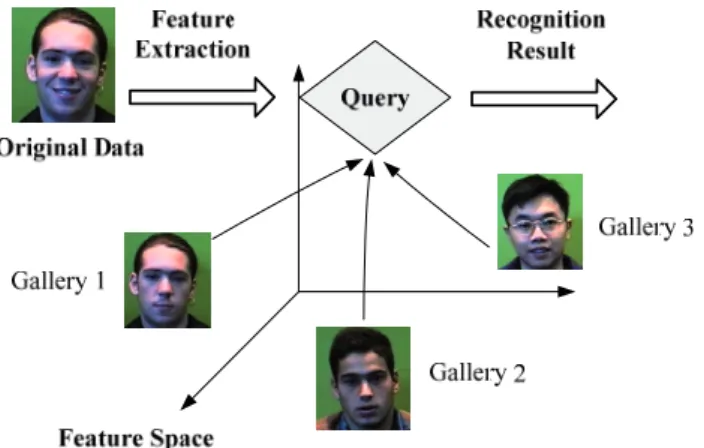
Scenario of the face recognition process is illustrated in Fig. 2. In this figure, the gallery is a set of known indi-viduals. The images used to test the algorithms are called probes. A probe is either a new image of individual in the gallery or an image of an individual, not presented in the gallery. To compute performance, one needs both a gallery and probe set.
Fig. 2. The simple example of face recognition system [10].
The probes are led to a classification algorithm, and the algorithm returns the best match between each probe and images in the gallery. The estimated identity of the probe is the best match [10].
2.1
Image Segmentation
Image segmentation (automatically partitioning an image into regions) is an important stage of the pro-posed algorithm for face recognition.
The Graph Based segmentation algorithm is deployed in order to improve precision of the key points search and overall complexity. The final results of the algorithm are dependent on the quality of the initial image segmentation. There are several techniques to measure quality of image segmentation. One of the techniques analyses similarity of pixels in the same segment, and dissimilarity if pixels over the different segments. Consequently, edges between two vertices should have low weights in the same segment and high weights if the vertices are placed in different segments [11].
The following two important issues arise if an effi-cient graph-based algorithm is to be designed:
definition of measure of difference between two com-ponents or segments,
definition of threshold function.
The algorithm starts with the step where each segment contains only one pixel. In the next step, segments are iteratively merged by using the following conditions:
C1,C2
Int
C1 T C1Diff , (1)
C1,C2
Int
C2 T C2where Diff (C1,C2) is the difference between C1 and C2 components, Int(C1) and Int(C2) are internal differences of C1 and C2 components, T(C1) and T(C2) are threshold functions of C1 and C2 components [11], [12].
2.2
SIFT Descriptor
Scale Invariant Feature Transform (SIFT) is a local descriptor of image features insensitive to illuminant and other variants that is usually used as sparse feature repre-sentation [13]. SIFT features are features extracted from images to help in reliable matching between different views of the same object [14]. Basically, in SIFT descrip-tors the neighborhood of the interest point is described as a set of orientation histograms computed from the gradient image. SIFT descriptors are invariant to scale, rotation, lighting and viewpoint change (in a narrow range). The most common implementation uses 16 histograms of 8 bins (8 orientations), which gives a 128 dimensional descriptor. [15].
2.3
Transforms of the Image Feature Space
Goal of this step is transform image features to the form which is more suitable for classification. Common transform methods are listed in the middle column of Fig. 1 (PCA, CCA and PCA-CCA).
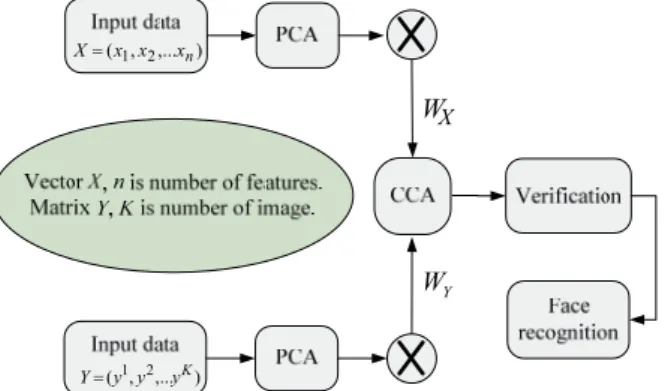
Principal Component Analysis (PCA) [16] is a stan-dard technique for dimensionality reduction and has been applied to a broad class of computer vision problems, including feature selection, object recognition and face recognition. X W Y W ) ,... , (x1x2 xn X ) ,... , (y1y2 yK Y
Fig. 3. The principle of PCA-CCA algorithm.
Canonical Correlation Analysis (CCA) is a suitable and dominant technique which can be used for exploring the relationships among multiple dependent and independ-ent variables. Therefore a powerful feature projection ap-proach for facial images is proposed based on canonical correlation analysis. CCA recognizes and measures the relationship between two sets of variables. Finally CCA finds a pair of linear combinations which has the greatest correlation [17].
Hybrid methods are also popular. PCA-CCA has been investigated by [17]. The PCA-CCA algorithm of face
recognition uses as input 2D images. The canonical corre-lation coefficient between input reference image and the test images is calculated by the PCA-CCA algorithm. The principle of PCA-CCA algorithm is shown in Fig. 3.
2.4
Feature Classification
K-Nearest Neighbor algorithm (KNN) is a method for classifying objects based on closest training examples in the feature vector. An object is classified by a majority vote of its neighbors [18]. The value of k is decided based on the size of the data used for classification. If k = 1, then the object is simply assigned to class of its nearest neighbor, larger values of k reduce the effect of noise on the classification, but make boundaries between classes less different. Among other methods, SVM, neural network and Bayesian classifiers may be mentioned [19], [20].
3.
Proposed Method
In this section we present the proposed method for fusing two approaches to face recognition: SPCA repre-sentation and KNN classification. The objective of the proposed method is to recognize a 2D object containing a human face. For recognition purpose, SPCA-KNN is used as classifier supported by the local feature. The local feature extracted from the given image is Harris-Laplace detector along with SPCA descriptor. The local features used in this study have invariance property.
3.1
PCA – based SIFT Descriptors (SPCA)
The idea of applying PCA to image patches is not novel [21], [22]. Our contribution lies in rigorously dem-onstrating that PCA is well-suited to representing keypoint patches (once they have been transformed into a canonical scale, position and orientation), and that this representation significantly improves SIFT’s matching performance.
SPCA descriptor is also based on the gradient image, the main difference with SIFT being the further compres-sion using PCA. The uncompressed dimencompres-sion of the de-scriptor is 3042 (39x39), which is reduced to 36 after applying PCA [23], [24]. SPCA can be summarized in the following steps:
pre-compute an eigenspace to express the gradient images of local patches,
given a patch, compute its local image gradient, project the gradient image vector using the eigenspace
to derive a compact feature vector.
This feature vector is significantly smaller than the stan-dard SIFT feature vector, and can be used with the same matching algorithms. The Euclidean distance between two feature vectors is used to determine whether the two vec-tors correspond to the same keypoint in different images [24].
3.2
K-Nearest Neighbor (KNN)
So far in case of KNN we always set k = 1. In Fig. 4, we would like to study the impact of k on accuracy. We observe that with the increasing value of k, accuracy gradually goes down. For example, for k = 1 KNN ob-serves 92% accuracy. On the other hand, for k = 10 KNN observes 76% accuracy. Finally, Fig. 4 demonstrates that
k = 1 is the best choice and hence, in this paper, we have used k = 1 for reporting result.
Fig. 4. Accuracy for test dataset using only KNN for different k - values.
To make a prediction for a test example the following steps are followed:
Compute the distance of test vector with all training vectors considered.
Find the k closest vectors.
Arrange the distance in ascending order and choose the closest label.
In this study KNN algorithm is used for the first stage of classification with Euclidean distance as distance meas-ure. The Euclidean distance formula is shown below:
2 1 1 2 ,
m i i i y x y x y x d (3)where x and y are Euclidean vectors [25].
3.3
SPCA-KNN
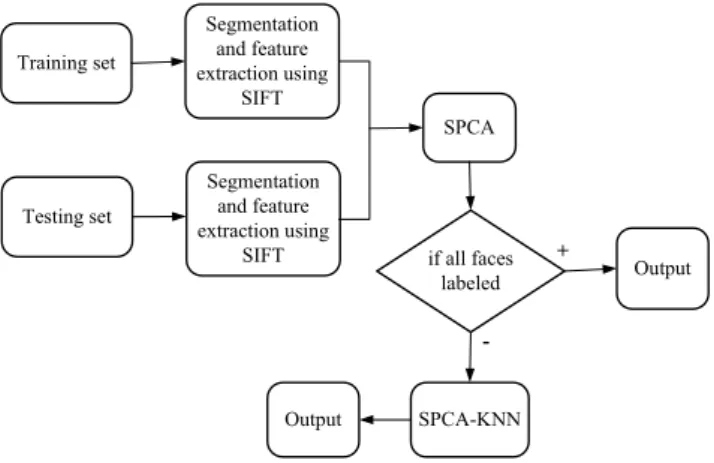
The proposed SPCA-KNN method is illustrated in Fig. 5. The input segmented images are pre-processed to extract the corners of the object (for corner extraction Har-ris-Laplace corner detection method [26], [27] is applied). The aim of segmentation algorithm is to increase the sepa-rability between skin and non-skin classes. Once the cor-ners are extracted then the feature vector is constructed using SIFT algorithm. The SIFT features are extracted from all faces in the database. Then given a new face image, the features extracted from that face are compared against the features from each face in the database. A fea-ture is considered as matched with another feafea-ture when
the distance to that feature is less than a specific fraction of the distance to the next nearest feature. This ensures that we reduce the number of false matches. The face in the database with the largest number of matching points that agrees with the spatial distributions of the keypoints is considered as nearest face and is used for the classification of the new face. SPCA is used to find the closest neighbors of the given segmented image with all the available train-ing images. If a label is found then the algorithm quits, otherwise the SPCA-KNN is applied to label the object [27], [28]. Training set Testing set Segmentation and feature extraction using SIFT SPCA if all faces labeled Output SPCA-KNN Output Segmentation and feature extraction using SIFT +
-Fig. 5. Proposed method for face recognition.
In our proposed method, training phase and testing phase are divided into the following stages:
Training phase:
Training images are selected and placed in the folder. Read the training images.
Pre-process each image by reducing the image size to 180x200 and apply image segmentation and Harris corner detection algorithm.
Local Features (Harris-Laplace and SPCA) are ex-tracted from the pre-processed image and construct the feature vector for the given image.
Feature vector is constructed by the local features of the image as row in a matrix.
Repeat steps 2 to Step 5 for all the training images. The KNN method is trained and tuned for testing
phase. Testing phase:
Read the test images.
KNN is applied first. The nearest neighbors are iden-tified using the Euclidean distance function using the training data.
If the K neighbors have all the same labels, the query is labeled and exit; otherwise, compute pair wise dis-tances between the K neighbors and construct the distance matrix.
Using the Kernel trick method, the distance matrix is converted into kernel matrix (it can be applied to multiclass SPCA-KNN for classification).
Classified object and the label are displayed.
4.
Experimental Results
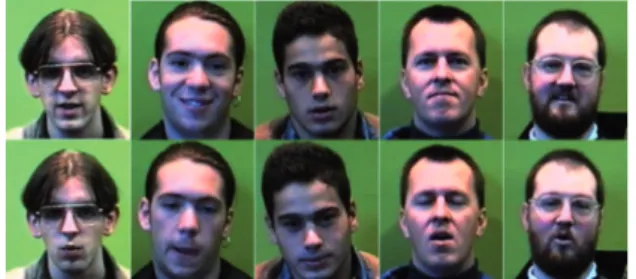
The proposed approach is implemented on the Pen-tium IV 2.8 GHz. The experiments have been done on ESSEX face databases [29] and implemented in MATLAB environment. This database consists of images of 100 dif-ferent objects with green background. Hence for every object, there are 15 images (it is 1500 images for the whole database). For some subjects, images were taken at differ-ent times varying the lighting, facial expression (open, closed eyes, smiling or not smiling) and facial details (glasses, no glasses). Each image has the size of 180 x 200 pixels. Some face images from the ESSEX database are shown in Fig. 6.
Fig. 6. A pair of face images from ESSEX database [29].
We have made two comparisons on the basis of which the impact of segmentation for face recognition has been tested (see Tab. 2 and Tab. 3). In training phase, we used segmented face images from the database [29]. We applied Graph Based segmentation algorithm for segmenting 100 objects (therefore training database contains 100 images). As test phase we used classic images from ESSEX face database [29]. Next, we have integrated this segmentation algorithm with the SPCA method. SPCA consists of two parts: SIFT part and PCA part. As already stated, our ex-perimental results proved that the SIFT descriptor is a very robust and reliable representation for the local neighbor-hood of an image point (see Fig. 9). Eigenfaces are calcu-lated by using PCA algorithm and experiments are per-formed by varying the number of eigenfaces used in face space to calculate the face descriptors of the images [30]. Eigenfaces are computed for each face in the database and the eigenface of the query face is compared with all faces in the database. Comparison is done by computing Euclid-ean distance between two eigenfaces using KNN. The Euclidean distance between the testing image feature and the training image feature is determined by finding the difference between the testing and the training feature and a distance matrix is created. Nearest neighbor of the query is retrieved which has got minimum distance. In the dis-tance matrix, first k values are considered and the majority
label of the k value is considered as the correct label of the given testing image [30], [31].
Fig. 7. Segmented face images from ESSEX database.
Fig. 8. Correct and incorrect face recognition results for segmented image database.
Fig. 9. Test images with SIFT features shown as circles.
Some resultant face images from both PCA and SPCA are shown in Fig. 8. This figure shows two false positives and one correct positive retrieved using PCA and two correct positives retrieved and one false positive using SPCA approach.
Computation time is counted for the complete proc-essing which includes feature detecting, matching and recognition. Tab. 1 shows that SPCA is the fastest one, SIFT is the slowest but it finds the most matches.
Method Total matches Total time [s] 100 matches time [s] SIFT 352 7.2 4.7 SPCA 279 3.5 1.9
SPCA-KNN 285 4.3 2.5
The performance of system is measured in terms of accuracy. The accuracy is given by
Q P
M (4)
where P is the number of correctly detected face images and Q is the total number of face images.
Number of non-segmented training images 100 300 500 700 Accuracy [%] PCA 69.5 71.7 77.3 82.4 CCA 74.6 78.8 81.7 85.9 PCA-CCA 78.2 82.5 86.2 89.1 SVM 62.7 67.1 70.4 73.2 KNN 65.9 69.6 74.8 78.5 Proposed method (SPCA-KNN) 81.5 86.4 89.7 92.2 Tab. 2. Accuracy for data sets using different classifiers.
Number of segmented training images 100 300 500 700 Accuracy [%] PCA 75.2 77.6 81.7 87.4 CCA 79.4 83.7 85.4 91.7 PCA-CCA 83.7 85.5 89.2 93.3 SVM 69.5 72.3 74.7 79.1 KNN 71.4 75.6 78.8 83.5 Proposed method (SPCA-KNN) 85.9 89.9 95.3 96.8 Tab. 3. Accuracy for segmented data sets using different
classifiers.
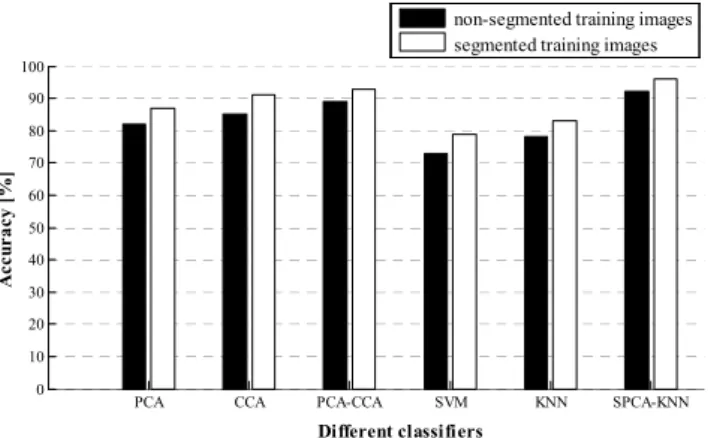
The performance of the proposed method (SPCA-KNN) compared with the traditional PCA, CCA, KNN and SVM method is shown in Tab. 2 and Tab. 3. It is evident from Tab. 3, that SIFT together with Graph Based segmentation algorithm performs better in face identification even under deliberate modifications. Moreover, in Tab. 2 and Tab. 3 a percentage of positively recognized images with and without segmentation are shown.
PCA CCA PCA-CCA SVM KNN SPCA-KNN
0 10 20 30 40 50 60 70 80 90 100 Different classifiers A ccu ra cy [% ]
non-segmented training images segmented training images
Fig. 10. Graphical representation of accuracy for test data sets using different classifiers.
In Fig. 10, we have shown the accuracy of different classifiers, namely PCA, CCA, PCA-CCA, SVM, KNN and proposed SPCA-KNN. As can be seen in Fig. 10, the
proposed SPCA-KNN algorithm is more effective classifi-cation technique than the other algorithms.
Furthermore, to speedup retrieval for KNN we advo-cate to the usage of SPCA. This algorithm achieved a near real time recognition performance and high accurate results.
5.
Conclusion
In this paper, we have proposed a combination of Graph Based segmentation algorithm and face recognition approach based on SIFT features, PCA and KNN algo-rithms. For local feature, the Hessian-Laplace detector along with SPCA descriptor is used. The classifier used to identify the face from the feature vector is SPCA-KNN. SPCA is performed to identify the object. KNN classifier is applied to identify the closest object from the trained fea-tures. In the proposed method, the object recognition is done with greater accuracy. The proposed SPCA approach is compared with eigenfaces and proved its superiority through experiments. As an extension, we are investigating the use of SIFT features and impact image segmentation for retrieval of correct face with other forms of face repre-sentatives. Test results gave a recognition rate of about 92% for non-segmented ESSEX database [28] and 96% for segmented database (700 training images) using proposed SPCA-KNN method.
We have introduced a feature extraction technique from still images, which have been evaluated on database ESSEX and our segmented database. This technique has been found to be robust against extreme expression varia-tion as it works efficiently on database. We have shown that the segmentation using SPCA-KNN has a positive effect for face recognition and accelerates the recognition KNN technique.
Future work will include the process of Kernel prin-cipal component analysis to reduce the feature vector so that high-dimensional data can be handled with less com-plexity. More work need to be performed to increase the recognition percentage. In future, we also plan to perform experiments and also tests of more complex algorithms with aim to compare the presented approach with other existing algorithms. We are also planning to investigate reliability of the proposed method by involving larger databases of images.
Acknowledgements
This work was supported by the Slovak Science pro-ject Grant Agency, Propro-ject No. 1/0705/13 "Image elements classification for semantic image description" and by pro-ject "Competence Center for research and development in the field of diagnostics and therapy of oncological
dis-eases", ITMS: 26220220153, co-funded from EU sources and European Regional Development Fund.
References
[1] BELHUNMEUR, P. N., HESPANHA, J. P., KRIEGMAN, D. J.
Eigenfaces vs. fisherfaces recognition using class specific linear projection. IEEE Trans Pattern Analysis and Machine Intelligence, 1997.
[2] ZHAO, W., CHELLAPPA, R., ROSENFELD, A. Face
recogni-tion: a literature survey. ACM Computing Surveys, 2003, vol. 35, no. 4, p. 399-458.
[3] BERND, H., KOSHIZEN, T. Components for face recognition. In Proceedings of the 6th International Conference on Automatic Face and Gesture Recognition. Seoul (Korea), 2004, p. 153 - 158. [4] MARCIALS, G. L., ROLI, F. Fusion of LDA and PCA for face
recognition. In Proc. of the Workshop on Machine Vision and
Perception. 8th Meeting of the Italian Association of Artificial
Intelligence. Siena (Italy), 2002.
[5] JIANBO, S., MALIK, J. Normalized cuts and image segmentation. IEEE Transactions on Pattern Analysis and Machine Intelligence, 2002, vol. 22, no. 8, p. 888 - 905.
[6] HE, R., ZHU, Y. A hybrid image segmentation approach based on Mean Shift and fuzzy C – means. In Asia – Pacific Conference on Information Processing. [Online] 2009.
[7] YANG, W., LEI, Z., SANG, J. 2D-3D face matching using CCA method. National Laboratory of Pattern Recognition Institute of Automation. Beijing (China), 2008.
[8] CORTES, C., VAPNIK, V. Support vector networks. Machine Learning, 1995, vol. 20, p. 273-297.
[9] PARVEEN, P., THURAISINGHAM, B. Face recognition using multiple classifiers. In 18th IEEE International Conference on
Tools with Artificial Intelligence (ICTAI). 2006, p. 179-186.
[10] KWAK, K. C., PEDRYEZ, W. Face recognition: A study in
information fusion using fuzzy integral. Pattern Recognition Letters, 2005, vol. 26, p. 719 - 733.
[11] FELENZWALB, P. F., KLETTE, R. Efficient graph-based image segmentation. International Journal of Computer Vision, 2004, vol. 59, no. 2. [Online]
[12] DONG, L., OGUNBONA, P., LI, W., YU, G., FAN, L., ZHENG, G. A fast algorithm for color image segmentation. In First
International Conference on Innovative Computing. Information
and Control (ICICIC), 2006. [Online]
[13] LOWE, D. G. Distinctive image features from scale-invariant keypoints. International Journal of Computer Vision, 2004, vol. 60, no. 2, p. 91-110.
[14] MIKOLAJCZYK, K., SCHMID, D. Scale and affine invariant interest point detectors. International Journal of Computer Vision, 2008, vol. 60, no. 1, p. 63-86.
[15] BOLECEK, L., RICNY, V. SLANINA, M. Fast method for
reconstruction of 3D coordinates. In 35th International Conference
on Telecommunications and Signal Processing (TSP), 2012, ISBN 978-1-4673-1115-1.
[16] COOLEY, W., LOHNES, W. PCA correlation. P. R. Multivariate Data Analysis. New York: John Wiley & Son. Inc.
[17] HE, Y., ZHAO, L., ZOU, C., LIPO, W., KE, C., SOON, O. Y. Face recognition based on PCA/KPCA plus CCA. In Proceedings of International Conference on Advances in Natural Computation. Heidelberg: Springer. LNCS 3611. 2005, p. 71-74.
[18] MURALIDHARAN, R., CHANDRASEKAR, C. Combining local
and global feature for object recognition using SVM-KNN. In Proceedings of International Conference on Pattern Recognition. Informatics and Medical Engineering. 2012, ISBN 978-1-4673-1039-0/12.
[19] MAZANEC, J., MELISEK, M., ORAVEC, M., PAVLOVICOVA,
J. Support Vector M achine, PCA and LDA in face recognition. Journal of Electrical Engineering, 2008, vol. 59, no. 4, p. 203 to 209.
[20] MA, Y., DING, X. Face detection based on hierarchical Support Vector Machines. Proc. ICRP, 2002, p. 222-225.
[21] MARTINEZ, A. M., KAK, A. C. PCA versus LDA. IEEE Trans. Pattern Analysis and Machine Intelligence, 2001, vol. 23, no. 2, p. 228-233.
[22] TURK, M., PENTLAND, A. Eigenfaces for recognition. Journal of Cognitive Neuroscience, 1991, vol. 3, no. 1, p. 71 - 86.
[23] JUAN, L., GWUN, O. A comparison of SIFT, PCA-SIFT and
SURF. International Journal of Image Processing, 2009, vol. 3, no. 4, p. 143-152.
[24] YAN, K., SUKTHANKAR, R. PCA-SIFT: A more distinctive
representation for local image descriptors. In Proc. IEEE Conf. Computer Vision and Pattern Recognition (CVPR). 2004, vol. 2, p. 506-513.
[25] LI, L., ZHANG, Y., ZHAO, Y. K-nearest neighbors for automated classification of celestial objects. Science in China Series G-Phys Mech Astron., 2008, vol. 51, no. 7, p. 916 - 922.
[26] KIRBY, M., SIROVICH, L. Application of the Karhunen-Loeve procedure for the characterization of human faces. IEEE Trans. Pattern Anal. Mach. Intelligence, 1990, vol. 12, no.1, p. 103 - 107.
[27] CHENNAMMA, H. R., RANGARAJAN, L., RAO, M. S. Robust
near-duplicate image matching for digital image forensics. Inter-national Journal of Digital Crime and Forensics, 2009, vol. 1, no. 3, 18 p.
[28] ZHOU, Y., MAYYAS, A., MOHAMMED, A. PCA based image
fusion routine with application to automotive stamping split detec-tion. Research in Nondestructive Evaluation, 2011, p. 76 - 91. [29] Essex Face Database. [Online] Cited 2012-01-17. Available at:
http://cswww.essex.ac.uk/mv/allfaces/index.html.
[30] CONDONE, C., RUIZ, A., CABELLO, E. PCA vs. Low
Resolution Images in face verification. In Proceedings of the 12th
International Conference on Image Analysis and Processing, 2003.
[31] BACH, F. R., JORDAN, M. I. A probabilistic interpretation of canonical correlation analysis. TR 688. University of California, Berkley, 2005.
About Authors ...
Patrik KAMENCAY received his M.Sc. and Ph.D. de-grees in Telecommunications from the University of Zilina, Slovakia, in 2009 and 2012, respectively. His Ph.D. re-search work was oriented to reconstruction of 3D images from stereo pictures. Since October 2012 he is researcher at the Dept. of Telecommunications, University of Zilina. His research interest includes holography for 3D display and construction of 3D images of the original objects.
Martina ZACHARIASOVA received her M. Sc. degree in Telecommunications from the University of Zilina, in 2010. Currently, she is a PhD. student at the Dept. of
Tele-communications and Multimedia. Her doctoral work is in area of semantic analysis of web document. Her research interests include semantic description of images.
Robert HUDEC was born in Revuca in 1974, Slovakia. He received his M.S. and Ph.D. degrees from the Technical University in Kosice, Faculty of Electrical Engineering and Informatics, Slovakia, in 1998 and 2003, respectively. Nowadays, he is an Associated Professor at the Dept. of Telecommunications and Multimedia, University of Zilina. Areas of his research include digital image filtration, seg-mentation, combined low-level description, object classifi-cation, video concealment and 3D face recognition. From 2005 his research interests cover also systems, services, terminals and intelligent textile sensors for e-/m-health applications. He received Werner von Siemens Excellent Award and Jozef Murgas Award for his research on image filtration in 2003 and 2007, respectively, and Award of „Vice premier and minister of school for science and re-search“ in the category: celebrity of research and develop-ment till 35 years old for his research on e/m-heath systems and terminals in 2006.
Roman JARINA received his Ph.D. degree in Telecom-munications from the Faculty of Electrical Engineering, University of Zilina, in 2000. In 2000-2002 he was with Dublin City University, Ireland, where he was engaged in research in the Centre for Digital Video Processing. Cur-rently, he is an Associate Professor and head of Digital
Signal Processing group at the Dept. of Telecommunica-tion and Multimedia. He has served as a naTelecommunica-tional delegate in EU Actions COST 292 „Semantic Multimodal Analysis of Digital Media“ and COST IC1003-QUALINET. His research interests also include digital signal processing, machine learning, multimedia and audio content analysis. Dr. Jarina is a member of IEEE Signal Processing Society, IET and AES.
Miroslav BENCO was born in Vranov nad Toplou in 1981, Slovakia. He received his M.Sc. degree in 2005 at the Dept. of Control and Information System and Ph.D. degree in 2009 at the Dept. of Telecommunications and Multimedia, University of Zilina. Since January 2009 he is a researcher at the Dept. of Telecommunications, Univer-sity of Zilina. His research interest includes digital image processing, semantic analysis of multimedia content, image and video classification and retrieval for MPEG-7 standard.
Jan HLUBIK was born in Humenne in 1982, Slovakia. He received his M.Sc. and Ph.D. degrees from the University of Zilina, Faculty of Electrical Engineering, Slovakia, in 2000 and 2008, respectively. Nowadays, he is an assistant lecturer at the Dept. of Telecommunications and Multime-dia, University of Zilina. Areas of his research include video and audio compression, video streaming, 3D model-ing and animation, augmented reality and multimedia technologies.