Worcester Polytechnic Institute
Digital WPI
Masters Theses (All Theses, All Years) Electronic Theses and Dissertations
2007-01-09
Developing a Cognitive Rule-Based Tutor for the
ASSISTment System
Kai Rasmussen
Worcester Polytechnic Institute
Follow this and additional works at:https://digitalcommons.wpi.edu/etd-theses
This thesis is brought to you for free and open access byDigital WPI. It has been accepted for inclusion in Masters Theses (All Theses, All Years) by an authorized administrator of Digital WPI. For more information, please [email protected].
Repository Citation
Rasmussen, Kai, "Developing a Cognitive Rule-Based Tutor for the ASSISTment System" (2007).Masters Theses (All Theses, All Years). 39. https://digitalcommons.wpi.edu/etd-theses/39
DEVELOPING A COGNITIVE RULE-BASED TUTOR FOR THE ASSISTMENT SYSTEM
By Kai Rasmussen
A Thesis
Submitted to the Faculty Of
WORCESTER POLYTECHNIC INSTITUTE In Partial Fulfillment of the Requirements for the
Degree of Master of Science In Computer Science _________________________________ December 2006 Approved: _________________________________ Professor Neil Heffernan, Thesis Advisor _________________________________ Professor Dave Brown, Thesis Reader _________________________________
Abstract
The ASSISTment system is a web-based tutor that is currently being used as an eighth and tenth-grade mathematics in both Massachusetts and Pennsylvania. This system represents its tutors as state-based "pseudo-tutors" which mimic a more complex cognitive tutor based on a set of production rules. It has been shown that building pseudo-tutors significantly decreases the time spent authoring content. This is an advantage for authoring systems such as the ASSITment builder, though it sacrifices greater expressive power and flexibility. A cognitive tutor models a student's behavior with general logical rules. Through model-tracing of a cognitive tutor's rule space, a system can find the reasons behind a student action and give better tutoring. In addition, these cognitive rules are general and can be used for many different tutors. It is the goal of this thesis to provide the architecture for using cognitive rule-based tutors in the ASSITment system. A final requirement is that running these computationally intensive model-tracing tutors do not slow down students using the pseudo-tutors, which represents the majority of ASSISTment usage. This can be achieved with remote computation, realized with SOAP web services. The system was further extended to allow the creation and implementation of user-level experiments within the system. These experiments allow the testing of pedagogical choices. We implemented a hint dissuasion experiment to test this experimental framework and provide those results.
Table of Contents ABSTRACT ... 2 TABLE OF CONTENTS ... 3 1. INTRODUCTION... 4 1.1 THESIS OBJECTIVES... 5 2. ASSISTMENT SYSTEM ... 7
2.1 EXTENSIONS TO ASSISTMENT SYSTEM... 8
3. ASSISTMENT ARCHITECTURE... 9
4. MODEL TRACING TUTORS... 13
4.1 BACKGROUND... 13
4.1.1 Cognitive Tutors... 13
4.1.2 Constraint-based Tutors ... 14
4.1.3 Pseudo-tutors ... 15
4.1.4 Comparison of Tutor Types ... 17
4.2 IMPLEMENTATION... 19
4.3 RESULTS... 21
5. WEB SERVICES ... 22
5.1 BACKGROUND... 22
5.1.2 SOAP Web Services ... 24
5.2 IMPLEMENTATION... 25
5.3 WEB SERVICE EXTENTIONS... 26
6. EXPERIMENTAL FRAMEWORK ... 28
6.1 BACKGROUND... 28
6.1.1 Runtime Experimentation ... 29
6.1.2 Learning Effects of Scaffolding ... 29
6.1.3 Gaming Behavior Prevention ... 30
6.2 EXPERIMENTAL FRAMEWORK... 31
6.2.1 Curriculum Level Experiments... 31
6.2.2 User Level Experiments... 32
6.2.2.1 User Profile ...32
6.2.2.2 Experiment Driver and Assignments ...32
6.3 HINT DISSUASION EXPERIMENT... 33
6.4 RESULTS... 35
7. CONCLUSIONS ... 39
8. REFERENCES... 42
APPENDIX I – JESS ADDITION TUTOR... 44
APPENDIX II – HINT EXPERIMENT RESULTS ... 54
1. Introduction
Intelligent Tutoring Systems (ITS) can be defined as the use of computer tutors, which mimic one-on-one human tutoring. Through the use of artificial intelligence the ITS community hopes to achieve, through the use of computer systems, tutors that are as effective as human tutors. The term Intelligent Tutoring Systems covers a wide range of possible computer-based tutors, from cognitive model tracing tutors [6], constraint-based tutors [14], to pseudo-tutors. A pseudo-tutor is a simplified cognitive model based on a state graph. State graphs are finite graphs with each arc representing a student action, and each node representing a state of the problem interface[10]. Cognitive model tracing tutors use models of possible student actions to infer the reasoning behind a student’s answer. Through this model, the system can build effective tutoring. Constraint based tutors use a series of constraints to comprise a problem. A student’s input is checked against these constraints. An action is considered correct until it violates a constraint.
The ASSISTment system is a web-based ITS used within schools throughout central Massachusetts [20]. Its goal is to both assist students while assessing them. This systems primary mission is to provide practice for 8th
and 10th
grade student for the MCAS state-wide assessment exam. Currently researchers working on this project are exploring how to best extend the ASSISTment system to allow for new and potentially more effective tutor types. In order to do this, a system must be put in place to allow for testing pedagogical choices made in development. Testing of these pedagogical choices can be made through random experimentation of the behavior of the system’s runtime behavior.
This thesis will explore the extensibility of the ASSISTment system. First the types of supported tutors will be discussed. This thesis will explain how the ASSISTment system was extended to allow cognitive tutors. Further extensions will be described through the use of web services. Finally, this thesis will describe an experiment framework for testing the ASSISTment system’s pedagogical choices. Through this experimentation, the effectiveness of one runtime behavior over another can be discovered. This is a
extensions to your system. An experiment which used this framework will be used to show its functionality and usefulness.
1.1 Thesis Objectives
The objective of this thesis is to extend an existing Intelligent Tutoring System to allow tutors that are more expressive. In order to achieve this I first looked at the different types of tutors available and compared them to the supported tutors of the ASSISTment system, a web-based math tutor. My first goal was to extend this system to allow the use of more expressive cognitive rule-based tutors. Currently the ASSISTment system and builder only support pseudo-tutors, which use no AI techniques. Pseudo-tutors are emulations of cognitive tutors. Cognitive tutors are tutors based upon a student model, realized through some production rule set. It was my goal to extend the current system to support the use of cognitive tutors as well as pseudo-tutors.
Secondly I set about putting in place the means for easily extending the ASSISTment system even further. This was accomplished with web services. I will show how web services can be used to increase an ITSs extendibility, as well as foster inter ITS collaboration.
Lastly, I put in place a framework for testing the design choices made within an ITS. There are a myriad of pedagogical choices to be made while designing an Intelligent Tutoring system. For example, a designer must make concrete choices on how and when to provide tutoring intervention to a student. Often research questions arise surrounding these design choices. We are proposing an architectural framework for dynamically changing the runtime behavior of these systems. With the proper controls, a researcher would be able to experimentally determine if their pedagogical choices are more effective then others as well as determine their tradeoffs.
In this experiment I aimed to determine if dissuading students from requesting help too quickly would affect the time student’s spent reading hint messages. Students have many
students have found in our system is requesting assistance quickly until they reach a ‘bottom-out’ hint where the answer is revealed. Students who request help unusually quickly are disengaged and are found to achieve less learning. By dissuading this behavior I found that students spent longer reading hints. I found that this effect is more significant when more obvious gamers are dissuaded. With more aggressive styles of dissuasion, we found a negative correlation and students spent less time on hints.
2. ASSISTment System
The ASSISTment system is a web-based algebra tutor that teaches 8th and 10th grade math in the state of Massachusetts. The system is used by students to prepare for the MCAS state assessment test (a test required to graduate). The goal of the ASSISTment project is to provide both assistance as well as assessment to students. It has been shown that, in addition to classroom instruction, the ASSISTment system has a significant affect on student learning [8]. In addition, we have built a range of reporting tools to provide accurate assessment for teachers.
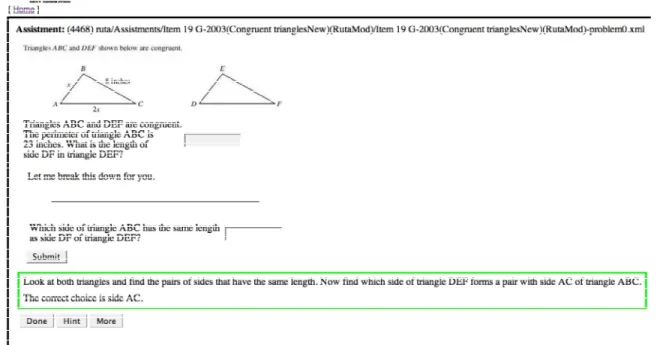
Content is given to students in a manner similar to the MCAS exam. First students are given an original question and then, if a student provided an incorrect answer, they are given follow-up scaffolding questions, which provide directed line of reasoning on the original question’s core skills. Assistance is given to students in both the form of these scaffolding questions and bug messages relating to common incorrect answers. Figure 1 shows an example of what the ASSISTment system looks like for a student. Above you see an original problem, followed by a scaffolding problem and some requested hint messages.
Figure 1: ASSISTment System 2.1 Extensions to ASSISTment System
This thesis is broken into three main sections, each describing an extension I made to the ASSISTment system. Each section has an individual background and results section as well as sections describing the work I’ve done in that area. First I will discuss extending the ASSISTment system to include cognitive Model Tracing tutors. Next, I will discuss implementing web services to extend the system even further, as well as deal with some performance issues of Model Tracing tutors. Lastly, I will discuss a framework I developed for this system for testing design choices. I will discuss a test I implemented using this framework and it’s results.
3. ASSISTment Architecture
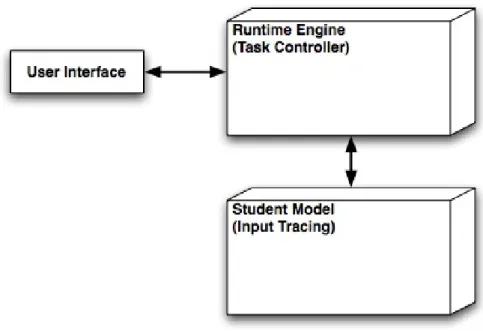
In this section, we will briefly discuss the ASSISTment runtime architecture, explaining its strengths and limitations. The ASSISTment system is a web-based math tutor built as a Java 2 Enterprise Edition (J2EE) application and was designed to assist students, using scaffolding questions and hint messages, as well as to assess students, through reporting pages and data analysis. Kodanganallur et al describes the high level ITS architecture as a system that contains a problem domain with tutor remediation through a student model component [12]. The student model could be a set of constraints in the case of a Constraint Based tutor, a set of production rules in the case of a Model Tracing tutor, or a state machine in a pseudo-tutor. The abstract view of this architecture, shown in Figure 2, has a wrapper around the Student Model to control tasks such as problem selection. The student’s actions are inputted through the user interface and evaluated against the student model. The student model would then offer tutoring back through the runtime engine and to the user interface.
Figure 2: High Level ITS Architecture
The backbone of the ASSISTment system is the eXtendable Tutor Architecture [19]. This architecture can be conceptually broken into a runtime engine component and a
the inner loop of an ITS architecture [25]. The runtime engine (outer loop) is responsible for task selection while the student model (inner loop) is concerned with evaluation of student input from within a task and for providing feedback.
The runtime engine is composed of a curriculum component and a dynamic agenda stack. Content is rooted in curriculum components, which represent a series of problems. The curriculum is composed of one or more sections, with each section containing problems or other section. The agenda controls the ordering of problems outside of the curriculum and the order of tutoring. Problems contain strategies that can change the agenda. This provides an innovative dynamic staging of problems.
The student model is comprised of problem objects. The problem component represents a problem to be tutored, including questions and answers required to solve the problem. Each of these questions are represented by a problem composed of two main pieces: an interface and a behavior. The interface definition is interpreted by the runtime and displayed for viewing and interaction to the user. The behaviors for each problem define the results of actions on the interface
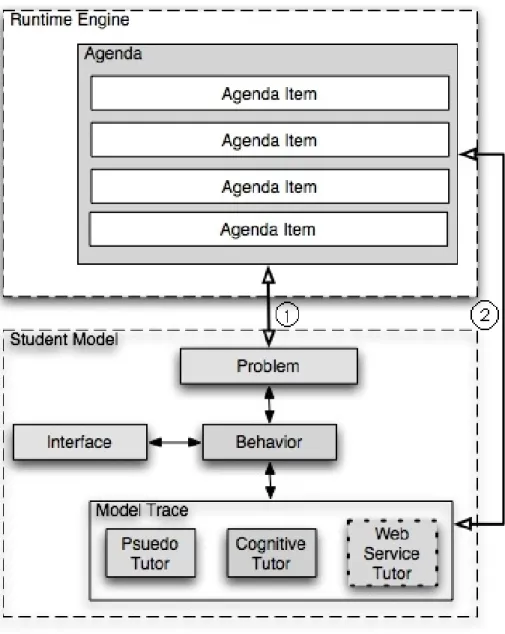
Figure 3: ASSISTment Architecture
The ASSISTment system roughly follows the same architecture as the inner loop/outer loop model. Figure 3 shows a more detailed view of this architecture. The backbone of the ASSISTment system is built upon the Common Tutor Object Platform (CTOP) objects. The task manager component is built upon an agenda stack. The agenda controls the ordering of problems and tutoring objects such as scaffolding, buggy messages, and hint messages. The runtime receives tutoring messages from the student model component, and uses to dynamically change the agenda.
Once a student’s input is passed through the runtime engine, it is sent to the current student model on the top of the agenda. This student model is problem component, which represents a problem to be tutored, including questions and answers required to solve the problem. Each of these questions are represented by a problem composed of two main pieces: an interface and a behavior. The interface represents the problem’s text, images, and various inputs while the behavior contains a model-tracing engine. The vast majority of problems within the ASSISTment system contain a pseudo-tutor student model.
Pseudo tutors are emulations of full cognitive tutors realized through a state machine. Each state represents a step in a problem and the transitions from one state to the next represent student input. Transitions can be marked as incorrect or correct and can be tagged with hint or buggy messages. These tutors can be created without AI and cognitive science training and are much less expensive to run.
4. Model Tracing Tutors
4.1 Background
In this section I will describe different tutor types including cognitive tutors such as Model Tracing and Constraint Based tutors as well as pseudo-tutors. I will then make a comparison of these tutor types and draw conclusions about their strengths and
weaknesses.
4.1.1 Cognitive Tutors
When talking about Intelligent Tutoring systems, one is describing a system that uses artificial intelligence techniques to bring computer-aided instruction to the level of human tutors. The “intelligence” is the use of cognitive theory in order to develop a model of these human tutors. The theory is that through the use of these cognitive models, computer’s can best simulate one-on-one human tutors. These models are typically based on a cognitive theory such as ACT-R [1] or SOAR [28], and realized by a production rule system.
A fundamental principle of the ACT-R theory is that “Acquiring cognitive knowledge involves the formulation of thousands of rules relating task goals and task states to actions and consequences.” This statement introduces the idea that all knowledge can be represented as either syntactic or general world knowledge. All information that can be verbally described is called declarative knowledge while all information that can be inferred from behavior or actions is called procedural knowledge. For example, consider the knowledge that composes multicolumn addition. Some pieces of declarative
knowledge would be “There is a column that has not been added” and “in that row there are two digits and no carry”. The procedural knowledge would be “In that column, add those two digits. If the sum is greater than 10, then put the carry in the next column”.
by a set of rules, though perhaps a uniquely complex one. An example of a production rule is this abstract algebra rule:
IF goal is to find an angle in an isosceles triangle ABC and AC = AB and angle A is known
THEN set the value of angle B to A
It would be said that the knowledge of the existence of the isosceles triangle, and knowing the equality of the side lengths are all declarative knowledge. Knowing to set the value of an angle in this instance is procedural knowledge. All of this combined is a production rule.
One type of tutor that is based on cognitive models is a ‘model-tracing’ [6] [2] tutor, which follows a learn-by-doing approach. These tutors represent the knowledge domain as a series of production rules using some cognitive theory, with each production rule representing an implicit or direct action that can be performed. It is important to note that these productions are generalized based on the declarative knowledge state. The student ‘learns by doing’ by taking actions within the tutor’s interface. The tutor will then track a student’s progress through the series of production rules. This is called model-tracing. Upon receiving an action, the tutor can search the set of all possible actions and
determine a series of productions that matches the student model. It is then possible to determine if it was a correct action or an incorrect action. On the case of an incorrect action the tutor has a detailed record of the reasons for that action (the set of followed productions) and can give feedback.
4.1.2 Constraint-based Tutors
Another cognitive approach is constraint-based tutors [14]. These tutors allow a student more freedom to their actions but impose subtle constraints to their inputs. An example of this is allowing a student to input any number as long as it is prime and smaller than 100. The next input would also follow another set of constraints. The student will work towards some problem goal, and will receive tutoring if they violate any constraints.
Constraints in these tutors are comprised of a pair of values. These values are the relevancy constraint (Cr) and the satisfactory constraint (Cs). Constraint satisfaction matches the formula: IF Cr THEN Cs. If in a problem step a Cr is true and a student enters a value, which invalidates Cs, then the student is said to be incorrect. Otherwise, a student is free to perform any action. An example of one of these constraint pairs is as follows:
Cr : A Base angle of an isosceles triangle is known as X and
the student has calculated the size of the other base angle as Y
Cs: The size of Y is X
If a student enters a size of Y, which is not equal to X when X is known, then the student’s answer is said to be false and the tutor will provide feedback.
4.1.3 Pseudo-tutors
A full cognitive tutor provides a great deal of flexibility and generality for intelligent tutoring systems, though they are costly to build. They require a great deal of both domain knowledge and knowledge in artificial intelligence programming and cognitive theory, often at a PhD level. It has been shown that it typically takes 200 hours to author one hour of content [16]. Because of this there was a push to develop a simpler form of tutor that can match the same behavior of a cognitive tutor. This is called a ‘pseudo-tutor’ [10] because it emulates an intelligent tutor without requiring AI code.
Where in cognitive tutors a problem’s steps are generalized among production rules that operate on a set of working memory, pseudo-tutors describe a problem with a set of states. Each state represents a step in a problem, i.e. the working memory, and the transitions from one state to the next represent student input. Transitions can be marked as incorrect or correct and can be tagged with hint or buggy messages. Figure 4 shows an example of what a tutor state-graph looks like conceptually. This is a pseudo-tutor for an algebra multi-column addition problem.
Figure 4: A Pseudo-tutor State Graph
The main advantage of pseudo-tutors is that they do not require any AI-knowledge to create. This allows domain experts to build tutors without expensive training. The Cognitive Tutor Authoring Tools application (CTAT) [10] builds pseudo-tutors by allowing the user to visually create the state diagram through the use of a behavior recorder. This recorder watches an author run through a problem, creating states at each action. The ASSISTment builder [24] creates pseudo-tutors implicitly and does not have any state editor. Because of this, the ASSISTment’s pseudo-tutors are an even more generalized state graph.
Figure 5: State Graph's interface 4.1.4 Comparison of Tutor Types
The strength of cognitive tutors is its flexibility, through production rules that generalize across problems and problem-solving states. These tutors allow subtle constraints on the ordering of problem steps as well as naturally allow many alternative paths through the problem state. This is also possible with a pseudo-tutor, but all alternative paths must be explicitly written. In a reasonably complex problem, the state diagram could become unwieldy. For example, the implementation of a constraint-based tutor would require states for each possible input of a constraint. The sub-states from these would only vary slightly, containing mostly duplication. These kinds of problems are native territory for cognitive tutors.
Cognitive tutors lend itself naturally to a more complex and flexible problem space. It is also important to note that because the ASSISTment builder only produces a simple state diagram, a full emulation of a cognitive tutor is not possible. The ASSISTment builder does not support problems with alternative inputs and paths through the problem state.
Model Tracing tutors are the most computationally expensive tutor of all the tutor types we have discussed. It requires a full search of a student model. Some would argue that this expensive a trade-off for it’s strengths including generality and flexibility. Because it is based on a student model written by, hopefully, a domain expert, it is able to give very fine-grained tutor response on student input. Also, because it is able to solve a problem, the tutor is able to give planning advice to a student. One criticism is that Model Tracing tutors force a student to follow a fixed approach.
Constraint based tutors are much less efficient to run then Model Tracing tutors. They are limited by their constraint set. Because the model has no concept of a goal, it is not possible for the tutor to provide planning advice. The best equivalent constraint based tutors can offer is a list of all unsatisfied conditions and conditions that could be satisfied. A Model Tracing tutor will mark an answer incorrect if it cannot be found in the model, while a constraint based tutor treats all answers correct until proven incorrect. Because of this, if the constraint model is incomplete then it is possible for incorrect solutions to be treated as correct. This goes against the goal of Intelligent Tutoring Systems, which is to impose correct methods for solving problems and attacking misconceptions and possible faulty productions a student may have.
The big advantage of pseudo-tutors is that an author does not need any AI programming background in order to create content. Also, the time to author pseudo-tutors is significantly less then to create cognitive tutors. There has been some work in using automatic production rule generation [9] with the CTAT tools but they are not yet at useable state.
The addition of cognitive tutors to the ASSISTment system would provide ample benefit. It is true that pseudo-tutors can provide the same behavior as cognitive tutors, but the current ASSISTment builder cannot create pseudo-tutors of this complexity. Also, cognitive tutors are general and can be used among many different problems. These are our motivations for integrating full cognitive tutors into the ASSISTment system.
4.2 Implementation
Earlier, I have pointed out some weaknesses in the ASSISTment system. A trade-off was made early on in development to support pseudo-tutors to encourage rapid-development of student content. Here in year two of the project, there is a healthy database of eighth and tenth grade problems, with a regularly used builder to author content on a daily basis. The focus now is to extend the flexibility and expressiveness of ASSISTment tutors.
I extended the system to allow the basic authoring and assignment of full cognitive tutors. This will require extending the Behavior classes to allow a cognitive model to be used instead of the current state-based behavior. A production system must be chosen that both is computationally reasonable and operates on a strong cognitive theory. A model-tracing algorithm must be developed to search this model space while tutoring. A set of authoring tools must be built to author and edit these tutors within the ASSISTment system.
The Java Expert Shell System (JESS) is a forward-chaining production system founded on a cognitive theory much like ACT-R. Knowledge is stored as declarative “facts” and procedural “rules”. The main difference between JESS and other cognitive theories is that is has no model for long-term and short-term memory, which is not a concern for the types of problems in our system. Our cognitive tutors will be written in the JESS production system.
Each CTOP unit comprises of interfaced components, and thereby naturally lends itself to extension. The Behavior interface provides the methods for performing hints and performing actions. I created a new JessRuleBehavior component, which implements the behavior interface. It contains a JESS engine for storing facts and rules. The perform action methods will run a model trace on the current state of the problem, using the incoming action from the student. Therefore a model-tracing engine must also be used by this new JessRuleBehavior to determine the correctness of a students input and provide strategies when an input is incorrect.
The model-tracing algorithm must create a full search tree of all possible actions from the current problem state. This includes possible buggy (incorrect) productions, which a student might have performed. Because this search space could become quite large, we limit our search to a certain number of productions. Also, some productions occur between explicit actions, such as “need to carry” occurs before “add with carry”, so we will end a trace when a production that produces an action is reached. The average number of productions fired until an action is performed changes between tutors. Therefore, we perform an iterative deepening search on the number of productions to fire.
To test this new addition, I created a full cognitive tutor that worked within the ASSISTment system. This tutor was a multi-column addition tutor. It forces students through each step from choosing the right column to add, to making and adding carries from column to column. I choose this tutor because it is a classical example of a cognitive tutor, supported and implemented and many Carnegie Mellon University ITSs. I had to convert the typical interface into one supported by the ASSISTment system, write the JESS rules to perform multi-column addition within this interface, write typical buggy rules. I then had to import these rules into a JessRuleBehavior object that I created for the ASSISTment system. Figure 6 shows this addition tutor. The Appendix contains the JESS rules for this problem.
4.3 Results
The ASSISTment system now supports a full Model-Trace tutor based on a cognitive model. In the ASSISTment system, the Java Expert Shell System (JESS) rule engine powers our cognitive student model. The Model Trace algorithm is not a scalable solution for web-based tutoring systems. Through the use pseudo-tutors, the ASSISTment system has been estimated to support 600 concurrent users, though the system can only support about 20 concurrent users using the Model Tracing tutors. The result of this stress test is that if a single classroom of students are using a Model Tracing tutor, no other students can use the system, whether they use Model Tracing tutors or the normal pseudo-tutors. In the next section we will look at one way of creating a scaleable solution for using cognitive tutors within a web-based ITS. The solution we found was by offloading the Model Tracing algorithm through web services. This would effectively isolate students running through cognitive tutors, leaving the performance uneffected for the majority of students using pseudo-tutors.
Also, I found because there were no tools to assist me in creating this tutor, authoring was a very difficult process. There are no tools outside of the ASSISTment builder for creating interface objects that can be used for problems. Also, testing and editing of this problem once the rules had been created was very difficult. As stated earlier, the ratio of time spent created a cognitive tutor versus tutoring time it offers is about 200:1, while the same ration for pseudo-tutors is about 20:1. I did not perform any assessment on the ratio to build cognitive tutors within the ASSISTment system (because it was all done by scratch by me with not tooling) but my estimate is a ratio of at least 200:1 or greater. The one benefit of cognitive tutors is that they are general over a large problem space. Once a tutor is created, it can be used many times. These problems will be unique, though isometric, and all use the same production rules.
5. Web Services
Existing Intelligent Tutoring Systems (ITS) are the cumulative effort of a community dedicated to the research question: can intelligent computer tutors successfully mimic human tutors? There have been many approaches such as cognitive Model Tracing tutors [2][6] and Constraint-Based tutors [14] implemented in various languages, with highly varying pedagogical methods and interfaces. With a strong community it would seem beneficial for these researchers to be able to work together by using content and tutoring methods from within other existing systems. With this collaboration, tutors can reach broader audiences. The question remains: how do two seemingly different tutors cohabitate peacefully? This paper will define a method for achieving this through remote computation implemented with web services. This section will also show the benefits of web services, such increasing a system’s scalability and extendibility.
We will briefly described remote computation and some of its benefits in terms of Intelligent Tutoring Systems and provide some examples of how web services can be used to extend systems. In the next sections we will discuss SOAP web services and their implementations in more detail. Next, we will briefly describe a high level view of the ASSISTment architecture and then provide a detailed description of how it was extended to use web services in a first step towards a full Service-Oriented Architecture. Finally, we will discuss our results, in terms of successful extensions to the ASSISTment system using web services, and our conclusions.
5.1 Background
Remote computation is the ability to offload a piece of a tutor’s runtime component to a separate system through distributed computation mechanisms. This computation could range from evaluation of student input to problem selection or even a request for content itself. This allows collaboration between two ITS researches and between an ITS researcher and content providers who do not have the background to create their own tutoring framework.
For example, there has been interest in using the front-end of the ASSISTment tutor to host content from fellow researches with unsupported tutor-types within the ASSIstment system. An example of such tutor-types is a programming language tutor, which is capable of compiling and evaluating Java or Scheme code. To achieve this new goal, structure would need to be implemented in the runtime to ensure that this service will not interfere with students working on ASSISTment content. This service must run at the collaborator’s system to maintain performance and to ensure reliability. If the service, running on a collaborator’s system, cannot be reached, or dies while in the middle of computation, the ASSISTment system (being used as a portal) could then give an appropriate error message stating that, for example, ‘Prof. Heinemann’s Java service is experiencing difficulties’. It would then allow the student to skip the problem. The ASSISTment project has also been approached by content providers with no ITS background. They wish to also use the ASSISTment’s portal for their own content, which possibly cannot be built using our authoring tools. An implementation of remote computation would allow this as well.
Additionally, remote evaluation can be used to offload potentially expensive services to external systems to provide new features without the performance trade-off. Model Tracing is an example of one of these operations. Because Model Tracing tutors are more expensive to execute, they are a prime example of the usefulness of remote computation in an ITS. This is especially true in the ASSISTment system, where cognitive Model Tracing tutors are used significantly less often then faster pseudo-tutors. External evaluation of the Model Tracing algorithm will not affect the quality of service for the majority of students using pseudo-tutors.
These forms of remote evaluation can be implemented through web services. A web service is a platform independent application that is called over Internet protocols such as HTTP and is driven by XML data. Because of its platform independence, it is possible to create web service front-ends to new and legacy systems. A large application built using
5.1.2 SOAP Web Services
Web services are defined as a piece of logic hosted somewhere on the Internet, accessible by standard protocols such as HTTP, and based upon an XML standard for communication, data transfer, service discovery, and interface publishing [17][5]. Because XML is used for the data representation layer, it remains platform and technology independent.
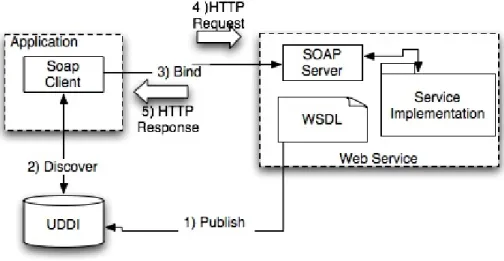
Web services are powered by three main standards-based technologies: Simple Object Access Protocol (SOAP), Web Service Description Language (WSDL), and Universal Description, Discovery, and Integration (UDDI). SOAP is an XML packaging structure for web service communication, which defines an interoperable form of data transfer between web services. WSDL is a standard description of web service interfaces, including input and output representation of methods. It also describes the binding protocols needed for connecting to a service. This allows clients to understand how to communicate to discovered services. UDDI is a set of technologies for publishing and discovering published services. Figure 7 shows an example of how these technologies are used in tandem. A typical system would interrogate a UDDI registry for information about a given web service and obtain a WSDL of the discovered service. The client would then use this WSDL to communicate to the service using SOAP messages.
A system built upon using web services is said to employ a Service Oriented Architecture (SOA). The strength of SOA is having a very loosely coupled system built upon independent and replaceable components. The web services that compose SOA can be executed without knowledge of the language that the service is written in or even where the service will run.
Figure 7: Typical Web Service Architecture
5.2 Implementation
In this section we will describe the process of implementing web services within the ASSISTment system. Because our goal was to extend the student model for remote evaluation of input, the behavior module was the choice for extension. In this new
architecture, the student input is sent to a SOAP web service and a tutor response is sent as a reply. A generic, architecture general interface is essential to ensure cross-tutor collaboration.
We added two new behavior types; a state-less web service behavior and a state-full web service behavior. The main difference is the state-full services maintains a full student model and can therefore provide tutoring over an entire problem where the state-less service can only provide tutoring over a single problem state.
The state-less service has no record of a tutoring ‘session’ and represents a single step in a full problem. It’s implementation is based upon the ASSISTment pseudo-tutor’s state machine but it’s interface is generic enough to provide a wide range of tutoring. We will show how it was used for pseudo tutors as well as a tutor on the programming language Scheme. We hope to expand these services in the near future. Through XML
and the student action. This action describes a student input and action type. The web service’s response is a generic strategy, which represents the tutor response to this input. This strategy could be a bug message, a scaffold, or a uniquely new strategy type. The web service also allows the problem step to be interrogated for available hints.
State-full web services keeps a problem ‘session’ and can therefore represent an entire problem or set of problems. Runtime engine’s that wish to use this state-full web service as their student model would be required to start a session and use that session in all subsequent communications to the web service. This is the main difference between these two web service types as both state-full and state-less services accept student action and return tutor strategies. Use of a problem session allows more complex tutors to be used in a web service. For example, the JESS Model Tracing tutors cannot be fully described without this state-full service.
Because the interfaces for these web services are platform and implementation independent, they support a wide variety of uses. The client code for these services where easily incorporated into the ASSISTment system by extending our student model component. Since SOAP web services are built upon a standard, external tools exist that consume WSDL descriptions of web services and generate skeleton code for both the service and the client. Example of these tools are the Eclipse Web Tools Platform [7] and the Apache AXIS project [3]. Once the client code is in place in an ITS, a myriad of new tutor types are available and the systems can achieve new levels of extendibility.
5.3 Web Service Extentions
In this section we will discuss three new extensions to the ASSISTment system using a web service based student model. As a proof of concept we developed a services for ASSISTment pseudo-tutors, which mimics our runtime architecture. Next the JESS Model Trace tutor was implemented as a web service to help scale the model tracing algorithm. Finally, we’ve developed an entirely new tutor type that the ASSISTment
system cannot currently support in order to show how web services can improve extendibility and collaboration between intelligent tutoring systems.
The first tutor that implemented our web service student model was a replication of the ASSISTment pseudo-tutor. This service used the state-less web service and is offered as a way to host ASSISTment content to external ITSs as well as serve as a proof of concept of web services usefulness.
As previously stated, our largest motivation for moving to SOA was the ability to run Model Tracing tutors without effecting the quality of service for the majority of students being tutored with our pseudo-tutors. With two full classrooms running a JESS tutor, our system starts to hit a bottleneck with our current server setup. With the Model Tracing engine running as a web service we have increased the number of simultaneous running students dramatically. This number can be increased even further if there are multiple services running and our runtime can load-share among them.
To show how web services can be used to provide additional extendibility and increased collaboration, we are developing an entirely new tutor previously unsupported by the ASSISTment system. At the time of writing this tutor is still in development but will soon be completed. We are working with the TeachScheme [23] program to provide a programming language tutor. The web service is wrapped around a scheme evaluator and is focused on teaching both syntax and proper coding procedures, such as test cases and pre-condition and post-condition contracts.
In the future we can foresee easily adding new types of collaborations. This includes running a Java tutor or hosting homework assignments from the physics department. Because these tutors are compartmentalized as web services, their runtime does not affect system performance of the ASSISTment system. We can also foresee wrapping a web service over the entire ASSISTment system, allowing all of our 8th
and 10th
grade math content available for us for other ITS.
6. Experimental Framework
Gaming behavior is the intentional misuse of an Intelligent Tutoring System in order for a student to proceed with as little effort as possible. Examples of this behavior include exhausting provided help and using unnecessary guesses. A designer of an ITS must walk a fine line between providing necessary tutoring for engaged students who actively need assistance when they reach an impasse, and not allowing easy exploitation of this help structure for gamers.
We wished to explore the effects of dissuading gaming behavior within our system. Recent experimentation has been performed, demonstrating that a simple delay on hint requests could dissuade students from requesting unnecessary help, and thus have a positive effect on learning [13]. We wondered if we could dissuade students in a similar way.
We implemented a dissuasion experiment that, through calculated reading rates of hint messages, prompted students to slow down and reread the previous hint. We tested the hypothesis that a dissuasion of this nature would slow students down while they are reading hint messages. In addition, we describe a framework that was built in our system for quickly implementing and controlling these kinds of randomized experiments.
6.1 Background
The use of experiments within an Intelligent Tutoring System can be used to discover the effects of changing the runtime behavior of that system. All systems must go through an iterative process of testing and evaluation. Through a process of evaluation, an ITS will evolve into more effective versions. Koedinger describes an ITS design as one that is motivated by specific pedagogical hypotheses and informed by user testing [11]. When user testing fails, it must lead first to redesign and possible change to the underlining theory. This ‘experimental manipulation of tutor components’ is described by Albert
behavior these parametric evaluations target are mostly pedagogical in nature (such as feedback and content control).
6.1.1 Runtime Experimentation
Previously, in literature, effects of pedagogical design decisions were tested through the comparisons of separate systems. In an example of this, Jeff Rickel designed four independent pedagogical agents to discover the strengths of different approaches to task-oriented tutoring [22]. Douglas Merrill compared three distinct Lisp tutors to determine which types of scaffolding guidance leads to superior performance [15]. In addition, Koedinger compared distinct versions of a prototype algebra tutor to determine the effect of algebraic symbolization [11].
We are proposing an ITS architecture for performing such experiments without the need of comparing different systems. This architecture will provide the framework for dynamically changing the behavior of the systems runtime. These changes can be randomly controlled at a user level (behavior changes depending upon the running user) or at a problem level (behavior changes depending upon the problem being tutored).
6.1.2 Learning Effects of Scaffolding
Through the lifetime of the ASSISTment system, we’ve had positive results in the effectiveness of our tutor [20]. The question remained if students were performing well because the intelligent tutoring system’s ability to give fine-grained tutoring, or was it just an effect of having more practice with math problems. Razzaq [21] ran an experiment over the ASSISTment system to help understand if our tutor was more effective then problem practice alone. Razzaq found through this experiment that students who received tutoring in form of scaffolding questions performed better then those who did not
The experiment Razzaq performed in order to determine the effectiveness of the ASSISTment scaffolding is an example of a pedagogical experiment. In this experiment, 11
items, which contained hint and bug messages but no scaffolding where the other students received the scaffolding version. It was found that students that received the scaffolding questions did better on a post-test of related problems. This is considered to be a curriculum level experiment because the behavior change of the system was determined by which problem a student was assigned.
6.1.3 Gaming Behavior Prevention
Gaming within an ITS can be defined as exploiting the feedback and help mechanisms in order to complete a task with little or no work. It has been shown that gaming behavior leads to substantially less learning [4]. Within the ASSISTment system, gaming detection and prevention were recently explored using this experiment framework. Walonoski created profiles of student gamers through a combination of classroom observation, previous literature, and logged student data; these profiles included information about the speed of hints requested, number of hints given, and speed of guesses [26].
Figure 8: Passive Intervention
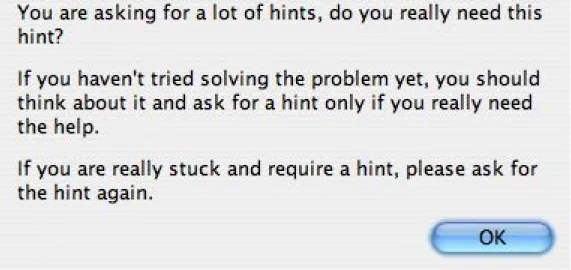
From this information, we conducted an experiment where the system intervened when it detected gamers; classes received active intervention, passive intervention, or no intervention at all. Passive intervention was provided through a chart, which was visible to students with a representation of their gaming score and effort within the system. This is shown if figure 8. Active intervention was providing through pop-up messages informing the student that they were gaming. This is shown in figure 9. It was concluded that active intervention was effective at reducing gaming behavior [27]. This is considered a student level experiment because the behavior of the system changed depending on the student that was using the system—not because of the problem currently being worked on.
Figure 9: Active Intervention
6.2 Experimental Framework
In this section, we will discuss the proposed framework within the ASSISTment system that allows for that addition of controlled experiments and provides the means for parametric evaluation of our system. We will provide examination of both experiments run at the curriculum level and experiments run at the user level.
6.2.1 Curriculum Level Experiments
Curriculum level experiments are run with a special type of curriculum section. This section contains many different sets of problems that a student could receive. On entering an experimental section for the first time, the student is randomly assigned one set of problems from the possible sets. This experimental curriculum will typically contain a set of problems, which are designed to answer a research question, and a normal control set of problems. This experiment section is also typically book-ended with a shared pre- and post-test section for correlation.
Once an experiment has been completed, an analysis tool is used for mining data related to the curriculum and the experiment. This tool collects data for all students who completed
and how much time spent on each problem. The experiment analysis tool is also able to automatically compare a student’s performance on particular items and sections
6.2.2 User Level Experiments
The differentiations between user level experiments and curriculum level experiments include a difference in the code being run for each student in the experiment; user level experiments are also assigned by a user basis and are not dependant upon the problem being tutored. Curriculum level experiments are conducted by changing a core element of the content that is presented to a student, and that content is encapsulated within an experimental curriculum section. In user level experiments, the underlying code branches for each experiment condition. This provides a dynamic change of the system’s behavior at runtime. The gaming detection and prevention experiment previously mentioned is an example of a user level experiment.
6.2.2.1 User Profile
Users within the ASSISTment system are organized within a hierarchy of groups. Students belong to a class group or a series of classes. Classes belong to a school group. School groups belong to a District, which belongs to a State, which belongs to everything. Because of this strict hierarchy, we can build a model of every group of each type to which a student belongs. User level experiments can be assigned to individual groups. The User profile is a collection of every experiment assigned to groups the student directly or indirectly belongs. This profile is used at runtime to determine which experiments to conduct for the student, as what values to assign to any experiment parameters.
6.2.2.2 Experiment Driver and Assignments
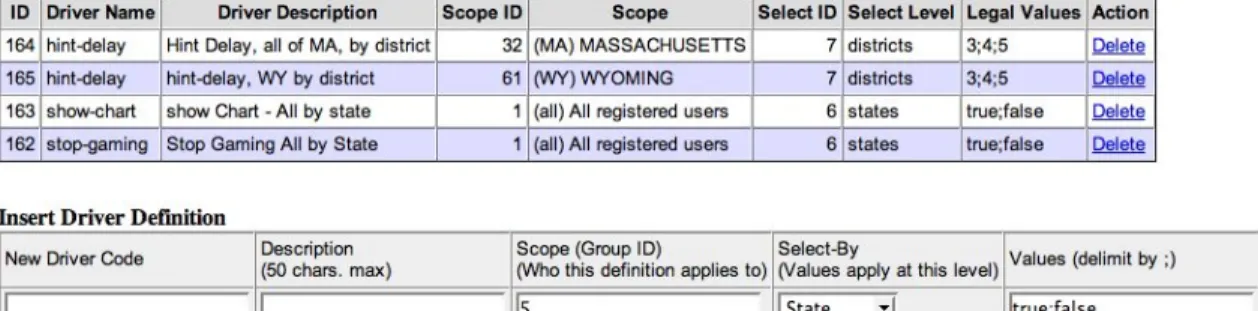
User level experiments are powered by an experiment driver. This driver specifies a driver-code, a scope, a select type, and a set of legal values for the experiment. The driver-code is a unique identifier for each experiment type, and is searched for in the user
profile during runtime at points where an experiment could be run. The scope is the group at which the experiment applies. For example, if an experiment has a scope of MA, the experiment would be activated in all of Massachusetts. The select type determines how the experiment will be controlled. If the select level is by class, then each class within the scope of the driver could have a different experiment value. This value controls the experiment; for instance, it could be as simple as true or false (in which case the experiment is either on or off), or it could be a list of permitted numbers. The tool, which can be used to control these experiment drivers, can be seen in figure 10.
Figure 10: The Experiment Driver Manager
An assignment is a particular instance of an experiment. Each assignment has an experiment value, from the driver’s list of legal values, associated with it. To which groups get an assignment is determined by the select type. When an experiment driver is added, an assignment is created for each group of the select type under the scope of the experiment. The ASSISTment system will randomly give each experiment assignment a value from the driver’s list of legal values. In this case, the creation of a driver effectively creates a random experiment. If randomness is not desired, the user can change these experiment values manually.
6.3 Hint Dissuasion Experiment
Gaming prevention has been a strong focus of the ASSISTment system. Some early work was done with the intervention experiment previously mentioned. One form of gaming
student can request hints on the current problem step at any time. In order to guarantee that student will not be ‘stuck’ on a problem, every series of hints includes a ‘bottom-out’ hint, which provides the current solution.
An example of gaming behavior with the hint system is quickly exhausting all available hint messages until the solution is provided. Gamers of this type spend little to no time engaged in the problem, and will therefore show little to no learning. We implemented an experiment to test if we could have these types of gamers spend longer on each hint, with the intent that the longer spent reading a hint message the more engaged the student will be with the help system.
This experiment is a slightly modified replication of a recently published experiment run by Charles Murray and Kurt VanLehn. In this experiment, they wished to correlate performance with the number of student hint requests [13]. Two groups of student were each given the same calculus tutor. In one class, the tutor provided a significant delay when a student requested a hint, and in the other group, there was no hint delay. The hypothesis of the experiment was that dissuaded students would ask for less unnecessary help and would therefore learn more. Their results stated that dissuaded students
requested help less often and the number of help requests were negatively correlated with post-test scores.
Our experiment is slightly different from Murray and VanLen’s. We wished to determine if dissuading ‘speed-hinting’ would cause students to spend more time reading hints. We did this by calculating a ‘words-per-minute’ reading rate on each hint request, using the number of words in a hint message, and the speed at which it took a student to ask for another hint. Problem difficulty and hint complexity were not taken into account. This reading rate is calculated for all students in the system for comparison against students who are run in this experiment. Instead of a hint delay, we decided to a use a different dissuasion tactic. If a student asks for a new hint faster then a set reading rate, the will system respond with the message, “You asked for a hint quickly. Have you read the last
hint?” rather then provide a new hint. This message will be repeated until a student slows their hint request rate.
For this experiment, we choose to aggressively penalize students for reading hints too quickly. A reading rate of 3 words-per-second was chosen as a maximum speed for reading hint messages. If a new hint was requested faster then this reading rate, the dissuasion message would be given to the student. One hundred and forty-eight students in various classrooms in the city of Worcester, MA conducted this experiment. Students were randomly selected into two groups. Either students were penalized with the
dissuasion message or no form of dissuasion was used. Reading rates were calculated and logged for all students for comparison. Of the total number of students in the experiment, 75 received dissuasion messages and 73 did not.
6.4 Results
The following data represents an aggregation of our experiment’s data. For each student we calculated his or her reading rate at a point where the student would have received our dissuasion. After completing the problem, we then calculated their reading rate when they next requested help. We have come to the following conclusions
Aggressive Dissuasion Discourages Active Students Table 1: 3 Words-per-second Results
Greater then 3 wps (Second attempt)
Dissuaded FALSE TRUE Grand Total
TRUE 28 47 75
FALSE 30 43 73
Grand Total 58 90 148
Of the 75 students who received a dissuasion message, 63% of these students continued to read hints faster then the desired rate. Of the 73 students who were not dissuaded, 51 % of the students continued to game the system. These results were weakly significant, with a p value of .64. This is the opposite effective then we wished would occur. This is shown in table 1.
We then attempted to understand this effect. We understood that three words-per-second would perhaps be too tight a definition of ‘too fast’. If we accept 3 words-per-second as an aggressive rate, then we must accept that non-gamers are being penalized. To
understand what the effect of our dissuasion on true gamers, we then looked only at students who demonstrated unusually fast hint reading rates.
Students who Read Hint Messages Faster are More Dissuaded
Figure 11: Mean Values for 6 Words per Second test
Table 2: 6 Words per Second Test Results Greater then 6 wps (Second Attempt)
Dissuaded FALSE TRUE
Grand Total
FALSE 17 19 36
TRUE 24 13 37
Grand Total 41 32 73
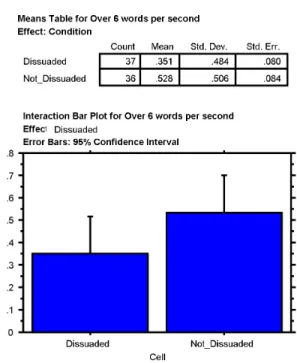
We looked at our data again, reclassifying gamers as students who had a hint reading rate of greater then 6 words-per-second. This is a looser classification of hint gamers and became a more accurate assessment of the data. Of the 148 students who were classified as gamers under the aggressive 3 words-per-second rate, 73 were classifiable under the new 6 words-per-second rate. The data shows that 64% of student’s who were given
dissuasion messages and had a reading rate greater then 6 words-per-second, slowed down below this classification. Only 47% of the students who did not receive the
dissuasion slowed their reading rate to below this new classification. This result is mildly significant with a p-value of .134. This is shown in Figure 11 and table 2.
Following this trend we looked at students would were classified as gamers with a
reading rate greater then 8 words-per-second. We found an even greater dissuasion effect for these students with unusually fast hint reading rates: 73% of the dissuaded students slowed down below this classification while only 56% of the non-dissuaded students decreased their reading rates. Though this is a stronger support to our claim, the result is less significant with a p value of .2. This is shown in table 3 and Figure 12.
Table 3: 8 Words per Second Test Results
TooFast8First TRUE
Count of
STUDENT TooFast8Second
DUSSUADED2 FALSE TRUE
Grand Total
FALSE 17 13 30
TRUE 19 7 26
7. Conclusions
The ASSISTment system allows the rapid development and deployment of pseudo-tutors. Cognitive tutors provide a more flexible, generalized tutor based on a production rule system. Cognitive tutors provide a more expressive tutor with the trade-off of increased development time and higher computational expense. One purpose of this thesis was to integrate cognitive tutors into the ASSISTment system. We were successful in extending the ASSISTment system to support full cognitive tutors implemented in the JESS production system. We performed stress testing of these tutors and found them much more expensive in terms of performance then pseudo-tutors. The ratio of simultaneous supported users for pseudo-tutors against cognitive tutors was about 10:1. We then investigated using web services in an attempt to make the use of cognitive tutors more scalable. Web services also allowed the ASSISTment system a higher level of extendibility and collaboration.
We have described the motivation and execution of changing the ASSISTment system to a Service Oriented Architecture. We showed that through its use we would be able to dampen the effect of running expensive Model Tracing in a web-based system. Also we demonstrated that SOA allowed the ASSISTment system to increase its extendibility. We illustrated these extensions with three new web service tutors. These services are platform and implementation independent which allows for a wide-variety of uses. Because they are open web services they offer a new form of collaboration in the ITS field. Through the offloading of expensive forms of evaluation, such as model tracing, were able to increase our systems scalability. We hope to expand our use of web services even further in the near future with new tutor types and collaborations.
Design of an Intelligent Tutoring System is an iterative process. Pedagogical choices in the design should be constantly evaluated and tested through experiment. If the test failed to match the theory that represents the design choice that was made, a system should go through redesign. In this paper, we have proposed an architectural framework for designing
and implementing these types of experimentation. This framework was then tested with an experiment involving hint dissuasion.
We found that students with unusually high reading rates of hints were more likely to slow down from our dissuasion message “You asked for a hint quickly. Have you read the last hint?” though this data is only mildly statistically significant. We found that using a classifier of 3 words-per-second to tag hint gamers had a negative effect on students reading rate. This leads us to the conclusion that our choice was too aggressive and dissuaded engaged students from asking for hints. Real gamers failed to slow down below this rate because it is too tight. It is an easy ready rate to exceed.
Classifying and dissuading students with looser and more unusually fast reading rates had a better effect on reading rates. We were successful in dissuading students from reading hints too quickly when looser definitions of 6 words-per-second and 8 words-per-second were used as a gamer’s reading rate.
These results are not as conclusive as we would like, though they show promise for future experiments. We’d like to rerun this experiment with different methodology to determine if we can find a stronger correlation between dissuasion and reading rates. We have discovered that a rate of 3 words-per-second is too aggressive and should no longer be used in our experiments; instead, we should perhaps look at values of 5, 6 and 8 words-per-second as the rate to classify gamers. This is still a work in progress. We will be conducting a more convincing experiment using all the experiment tools at our disposal in order to obtain more convincing results.
For the purpose of this research, we wished to test the user level experiments only and on that level, we believe that the framework is useful for evaluation of pedagogical design choices. The results of this experiment could have been stronger if used in conjunction with a curriculum level experiment where the students are given a pre and a post-test, and are given the same problem content. This is still a work in progress. We are will be
conducting a more convincing experiment using all the experiment tools at our disposal in order to obtain more convincing results.
I would like to thanks all the people associated with creating the Assistment system listed at www.assistment.org including the investigators Kenneth Koedinger, and Brian Junker at Carnegie Mellon. We would also like to acknowledge funding from the US Department of Education, the National Science Foundation, the Office of Naval Research and the Spencer Foundation.
8. References
[1] Anderson, J. R. (1993). Rules of the mind. Hillsdale, NJ: Erlbaum
[2] Anderson J.R., Pelletier, R., A developmental system for model-tracing tutors. In Lawrence Birnbaum,
editor. The International Conference on the Learning Sciences. Association for the Advancement of Computing in Education. Pages 1-8, Charlottesville, Virginia, 1991
[3] Apache Axis http://ws.apache.org/axis/
[4] Baker, R.S., Corbett, A.T., Koedinger, K.R. (2004) Detecting Student Misues of Intelligent Tutoring System. Proceedings of the 7th International Conference on Intelligent Tutoring Systems, 531-540 [5] Cappel, D., Jewell, T. (2002) Java Web Services, O’Reilly & Associates, Sebastopol, CA
[6] Corbett, A. T., Koedinger, K. R., & Anderson, J. R. (1997). Intelligent tutoring systems. In Helander, M. G., Landauer, T. K., & Prabhu, P. V. (Ed.s) Handbook of Human-Computer Interaction, (pp. 849-874). Amsterdam, The Netherlands: Elsevier Science B. V.
[7] Eclipse Web Tools Platform http://www.eclipse.org/webtools/
[8] Feng, M., Heffernan, N.T., & Koedinger, K.R. (2006). Addressing the Testing Challenge with a Web-Based E-Assessment System that Tutors as it Assesses. Proceedings of the Fifteenth International World Wide Web Conference. pp. 307-316.
[9] Jarvis, M., Nuzzo-Jones, G. Heffernan, N. T. (2004) Applying Machine Learning Techniques to Rule
Generation in Intelligent Tutoring System. Proceedings of the 7th Annual Intelligent Tutoring System Conference, Macceio, Brazil. Pages 541-553
[10] Koedinger, K.R., Aleven, V., Heffernan. T., Mclaren, B. & Hockernberry, M. (2004) Opening the
Doors to Non-Programmers: Authoring Intelligent Tutor Behavior by Demonstration. Proceedings of
7th Annual Intelligent Tutoring Systems Conference, moaceio,, Brazil. Page 162-173
[11] Koedinger, K. R., & Anderson, J. R. (1998). Illustrating principled design: The early evolution of a cognitive tutor for algebra symbolization. Interactive Learning Environments, 5, 161-180.
[12] Kodaganallur, V. Weitz, R. Rosenthal, D. (2006) Tools for Building Intelligent Tutoring System. Proceedings of the 39th Hawaii International conference on System Sciences
[13] Murray, C. VanLehn, K. (2005) Effects of Dissuading Unnecessary Help Requests While Providing Proacting Help. Proceedings of the 12th International Conference on Artificial Intelligence In Education 887-889. Amsterdam: ISO Press.
[14] Mitrovic A, Ohlsson, S. Evaluation of a constraint-based database language. Internationl Journal of
Artificial Intelligence in Eduation, 10(3-4):238-256, 1999
[15] Merrill, D., Reiser, J. (1994) Scaffolding Effective Problem Solving Strategies in Interactive Learning Environments. From the Proceedings of the 16th annual Conference of the Cognitive Science Society [16] Murray, T., Authoring Intelligent Tutoring Systems: An Analysis of the State of the Art International
[17] Newcomer, E. Lomow, G. (2005) Understanding SOA with Web Services , Pearson Education, Inc. Upper Saddle River, NJ
[18] Nuzzo-Jones., G. Macasek M.A., Walonoski, J., Rasmussen K. P., Heffernan, N.T., Common Tutor
Object Platform, an e-Learning Software Development Strategy.
http://www.assistment.org/portal/project/papers/www/nuzzojones_etal.pdf
[19] Nuzzo-Jones, G., Walonoski, J.A., Heffernan, N.T., Livak, T. (2005). The eXtensible Tutor Architecture: A New Foundation for ITS. In C.K. Looi, G. McCalla, B. Bredeweg, & J. Breuker (Eds.) Proceedings of the 12th International Conference on Artificial Intelligence In Education, 902-904. Amsterdam: ISO Press.
[20] Razzaq, L., Feng, M., Nuzzo-Jones, G., Heffernan, N.T., Koedinger, K. R., Junker, B., Ritter, S., Knight, A., Aniszczyk, C., Choksey, S., Livak, T., Mercado, E., Turner, T.E., Upalekar. R, Walonoski, J.A., Macasek. M.A., Rasmussen, K.P. (2005). The Assistment Project: Blending Assessment and Assisting. In C.K. Looi, G. McCalla, B. Bredeweg, & J. Breuker (Eds.) Proceedings of the 12th International Conference on Artificial Intelligence In Education, 555-562. Amsterdam: ISO Press.
[21] Razzaq, L., Heffernan, N.T. (2006). Scaffolding vs. hints in the Assistment System. In Ikeda, Ashley & Chan (Eds.). Proceedings of the 8th International Conference on Intelligent Tutoring Systems. Springer-Verlag: Berlin. pp. 635-644. 2006.
[22] Rickel, J., Ganeshan, R. (2000) Task-Oriented Tutorial Dialogue: Issues and Agents. In AAAI Fall Symposium on Building Dialogue Systems for Tutorial Applications, pages 52-67.
[23] TeachScheme, ReachJava! http://www.teach-scheme.org/
[24] Turner, T.E., Macasek, M.A., Nuzzo-Jones, G., Heffernan, N..T, Koedinger, K. (2005). The Assistment
Builder: A Rapid Development Tool for ITS. In C.K. Looi, G. McCalla, B. Bredeweg, & J. Breuker (Eds.) Proceedings of the 12th Artificial Intelligence In Education, 929-931. Amsterdam: ISO Press. [25] VanLehn, K. (2006) The Behavior of Tutoring Systems. International Journal of Artificial Intelligence
in Education. 16, pages not determined yet.
[26] Walonoski, J., Heffernan, N.T. (2006). Detection and Analysis of Off-Task Gaming Behavior in Intelligent Tutoring Systems. In Ikeda, Ashley & Chan (Eds.). Proceedings of the 8th International Conference on Intelligent Tutoring Systems. Springer-Verlag: Berlin. pp. 382-391.
[27] Walonoski, J., Heffernan, N. T. (2006). Prevention of Off-Task Gaming Behavior in Intelligent Tutoring Systems. In Ikeda, Ashley & Chan (Eds.). Proceedings of the 8th International Conference on Intelligent Tutoring Systems. Springer-Verlag: Berlin. pp. 722-724.
[28] Young R.M. & Lewis, R.L., The Soar Cognitive Architecture and Human Working Memory (1999), Chapter 7 of: A. Miyake & P. Shah (eds), Models of Working Memory: Mechanisms of Active Maintenance and Executive Control, 224-256. Cambridge University Press.
APPENDIX I – JESS Addition Tutor ;; FOCUS-ON-FIRST-COLUMN ;; IF
;; The goal is to do an addition problem
;; And there is no pending subgoal (i.e., we've just started the problem) ;; And C is the rightmost column of the table
;; THEN
;; Set a subgoal to process column C (defrule focus-on-first-column ; (addition ; (problem ?problem)) ?problem <- (problem (subgoals ) (interface-elements $? ?table $?)) ?table <- (table (columns $? ?right-column)) ?right-column <- (column
(cells $? ?first-addend ?second-addend ?result)) ?first-addend <- (cell (value ?num1)) ?second-addend <- (cell (value ?num2)) ?result <- (cell (value nil)) ?special-tutor-fact <- (special-tutor-fact-correct) =>
(bind ?current-sub-goal (assert (process-column-goal (column ?right-column)
(first-addend ?num1) (second-addend ?num2))))
(bind ?work-to-do (assert (finish-problem-goal (begin-rule focus-on-first-column)))) (modify ?problem
(subgoals (create$ ?current-sub-goal ?work-to-do))) (modify ?special-tutor-fact
(hint-message (construct-message [Start with the column on the right. This is the ones column ]))) ; (printout t "Focus-on-first-column." crlf)
)
;; FOCUS-ON-NEXT-COLUMN ;; IF
;; The goal is to do an addition problem ;; And there is no pending subgoal