The case for assessable in-class team-based learning
Mark Freeman, Susan McGrath-Champ, Steve Clark and Lucy Taylor, Faculty of Economics and Business, The University of Sydney, Australia
[email protected] [email protected] [email protected] [email protected]
Abstract: In-class assessable team-based learning aims to motivate students to do pre-class reading and participate
in-class via team quizzes. Pre-in-class preparation allows teachers to address learning gaps using individual quizzes, while team quizzes promote peer interaction and active learning. The pilot project replicated Michaelsen’s approach with the aim of improving learning in diverse student cohorts with minimal impact on staff time. The aim of the research was to report the replication of this approach in the Australian context and the impact on both students and staff. Academics with diverse classes wishing to explore this innovative approach to in-class team-based learning should find this research helpful.
Introduction
The objective of this paper is to report the impact on students and staff of a team-based learning approach to engaging students through a combination of in-class individual and team-based assessments. Larry Michaelsen pioneered team-based learning (TBL) in the late 1970s as a way to maintain student engagement and interaction as class sizes increase. The TBL approach was recently documented in a book (Michaelsen, Knight, and Fink 2004), enabling others to easily replicate it. Our motivation for trialling the TBL approach rose from similar origins, namely students’ flagging engagement in class, minimal prior preparation, student complaints about out-of-class group-based learning and assessment tasks and a desire to pursue innovative learning approaches that would not drain staff and distract them from their research imperative.
While Fink (2004, p.23) notes that TBL is well-suited to classes with high levels of diversity there is limited evidence of this benefit of TBL in the Australian context. 68% of the student cohort in our context are international students. More importantly perhaps, we wish to focus on the staff impact of adopting the innovation since this is an unanswered research question relating to TBL. These research questions should be of interest to other academics and academic developers facing similar challenging contexts and considering the use of in-class team-based learning as a solution. Consistent with Slappendel’s (1996, p.109) observation that innovation is a complex process achieved by the ‘interaction of structural influences and the actions of individuals’, questions about process are best addressed by case studies. Thus, this paper provides a holistic case study aimed at increasing our understanding of the diffusion and adoption of team-based learning.
By relying on students to develop their initial understanding of the content prior to class and then collaborate with their peers in-class on learning and assessment tasks, TBL attempts to overcome current out-of-class group work challenges, such as free riders and fragmented group assessment projects, which limit students opportunities to work as a true team (Fink 2004). Small group work becomes the primary in-class activity with the learning program structured so students complete specific learning activities in a specific sequence. Aligning the assessment regime ensures student motivation focuses on both self study and peer teaching. Such alignment is crucial, since ‘from our students’ point of view, assessment always defines the actual curriculum’ (Ramsden 2003; p.182). There are considerable incentives for students not to free-ride as students stay in the same groups for the duration of semester and complete in-class assessments (which may take the form of multiple choice questions) both individually and in teams. ‘When groups start functioning as a team, individuals who might be inclined to be free-riders become very uncomfortable in that role and tend to become contributing members’ (Fink 2004; p.15). Gradable team tests not only encourage strong preparation because they are structured to follow the individual test in class, but because they have an assessment value, students vigorously engage in peer teaching. Students must voice and defend their
preferred choice. The team test is therefore not just an assessment task but a student learning opportunity. ‘Thus, over time, naturally extroverted or more assertive members do more listening and less talking, quieter students become more active in team discussions, and cohesiveness increases because members develop a genuine appreciation of each other’s contribution to their group’s success’ (Michaelsen 2004, p.34). Peer teaching reduces the pressure on the academic as the primary (and often sole) knowledge expert resource for students. The TBL approach also relies on immediate feedback on test outcomes to enable students to learn. Various technologies to achieve this have been developed including a portable scanner and the IF-AT (immediate feedback assessment test) form. Student teams then have a short time to appeal any outcome on the proviso that they can reference their claim to one of the assigned readings. The final step entails the lecturer providing ‘input’ focussed on learning gaps that are highlighted through the individual and team tests. Michaelsen (2004) refers to this as the ‘readiness assurance process’. Students are now ready to spend time on application problems (mainly in class but with perhaps one out-of-class assessment project which has class time allocated occasionally for it as well). This careful approach to embedding multiple choice questions into the learning process is likely to overcome the problem identified by Scouller (1998) where students were more likely to take a surface approach to such assessments.
Study of team-based learning
Research Context
Team-based learning was introduced to a postgraduate course in international human resource management in the Faculty of Economics and Business at the University of Sydney. Being new to the course (unit of study), the instructor sought to invigorate student learning through processes that were student focussed. The people-oriented nature of human resource management and the student profile (a large international student component) rendered the course suitable for developing desirable generic graduate attributes such as teamwork and interpersonal skills. The course content included, among other things, issues of cross-cultural difference and adaptation, and the need to be conscious of one’s beliefs and values when undertaking an international (expatriate) HR assignment or working at the interface between different cultures. The learning outcomes included, among others, the ability to negotiate and create shared understandings by interacting with people from diverse backgrounds. Advice on the learning and assessment approach was available from a Faculty academic developer who had previously used the TBL approach.
Once course enrolments were finalised in the third week of semester, tutors divided 77 students into 19 teams of 4 people with the goal of including both local and international students in any team to create a cross-cultural microcosm similar to that experienced by expatriates. In addition to highlighting key teamwork factors from the relevant theoretical topics relating to effective HR systems, various team-building exercises were implemented to help students develop the skills for working effectively in teams. Consistent with Biggs (2003), the assessment regime was also aligned to encourage effective teamwork. Students’ readiness to learn in-class was tested using the TBL approach 5 times over the 13 week semester. Each fortnight at the beginning of a 1 hour class, students were tested for 30-35 minutes on their preparatory knowledge constructed from the assigned readings and weekly topic learning outcomes. Each student completed a 15 question multiple choice quiz individually and then immediately following repositioned themselves into their team to complete the same quiz. The individual and team components were weighted 10% and 15% of the grade respectively according to students’ majority vote at the outset of the course. After testing was completed, time was dedicated to providing feedback about the questions and answers. With the readiness (to learn) assurance process completed, the reminder of the class was used to explore more complex aspects of the course and further apply that knowledge to problems.
To facilitate learning, TBL relies heavily on students getting timely feedback during the readiness process. Students completed individual quizzes using a machine-scannable form in a standard quiet
invigilated format. These were then handed in and the teams embarked upon the same quiz. Meanwhile the individual quizzes were marked using a portable scanner (i.e., Apperson Scantron) that was connected to a laptop. The generated computer file contained individual results, key statistical parameters (mean, highest, lowest mark) and the proportion of students who correctly answered each question. This information highlighted any learning gaps. Learning gaps needed to be addressed prior to embarking on more complex material if peer teaching (via the team quiz) failed to correct a team member’s misunderstanding. Although the individual results were posted online for students to access later, students obtained feedback on whether they were right or wrong either through the team quiz or from the feedback from the lecturer following the team quiz.
The team quiz, as distinct from the individual quiz, was a noisy process as choices just selected in the individual quiz were vigorously defended and debated. Each team was provided with an innovative ‘scratchable’ form, on which to select their first choice, and then, if wrong, their second and subsequent choices. The latter, called IF-AT forms (Immediate Feedback Assessment Technique) were pioneered in the late 1990s by Michael Epstein (http://www.epsteineducation.com/ifat.php) and enable students (or in this case teams) to work through alternative answers by scratching the thin film off a choice until they reach the correct answer indicated by a star. Upon completing a question, they have worked through to achieving the correct answer. Lecturers are provided with the answer code for the IF-AT form in advance so they can appropriately structure their question choices to ensure the correct option is placed on the choice that will reveal a star when scratched. Partial marks can be gained for proximate knowledge with the IF-AT form since full marks are only given if there are no other choices are scratched except the one revealing the star. Any attempt to cheat by scratching the film to get a hint of the star below is obvious. Students receive feedback in several important ways with the IF-AT forms during in the in-class TBL process. First, students receive feedback through the peer teaching and discussion about the appropriate choice for a question. Second, the correctness of that first choice can be immediately tested by scratching and thus provide feedback on the choice and the proponents in the team for that choice. Feedback about vocal team members that were incorrect is immediate and is not forgotten when debating the second and subsequent choices in this and future quizzes. Well prepared students are rewarded not only with good feedback from their individual quiz but other team members are keen to draw them out in the team quiz. Finally, Dihoff, Brosvic and Epstein (2003) have shown that such immediate feedback has lasting and significant impact on subsequent testing when compared to other MCQ quiz forms where feedback is not immediate and the student completes a test not knowing whether they have gained the right or wrong answer.
After completion of the team quiz iteration, the aggregate results on the individual quizzes were fed back and discussion ensued around the questions which students had performed poorly. Students and teams that had ‘got it’ were drawn out to engage and help other students whose understanding might still be incomplete to construct such knowledge. The readiness process saved the lecturer from the traditional, more exhaustive didactic lecture often used to cover the key points in the assigned readings.
Research method
Research ethics approval was granted to the Office of Learning and Teaching in Economics and Business for this research. Several research methods were used to ascertain the impact of the team-based learning approach. The impact on students was gauged by comparison of individual and team quiz scores and by a perceptions survey. Tests for significant difference were conducted using t-tests. The survey, seeking Likert scale ratings and free responses, was administered electronically from the learning management system. Key themes from the free responses were identified.
The impact on staff involved in the innovation process was gauged by conducting interviews using questions based on the diffusion of innovation model. The latter, pioneered by Everett Rogers in 1962, noted in the fourth edition that ‘it is not an expert’s objective evaluation of the innovation that
drives adoption decisions, but rather the perceptions of five characteristics by potential adopters’ (Rogers 1995). The five factors are: relative advantage (Is the innovation perceived to be superior to the current approach?); cultural compatibility (Is the innovation perceived to be compatible with existing values, beliefs, experiences and needs?); complexity (Is the innovation perceived to be relatively difficult to use or understand?); trialability (Is the innovation perceived to be able to be used on a trial basis before confirmation and adoption must occur?) and visibility (Is the innovation perceived to have results which are visible or observable to others?). Frambach and Schillewaert (2002) extend Rogers’ framework noting that the effect of external variables (Are there external influences such as supplier marketing efforts impacting the innovation adoption?) and the characteristics of the organisation (Are there university/faculty influences, such as the organisation’s innovativeness or positioning impacting innovation adoption?) need to be considered. Consistent with Bell and Bell (2005), not only were the adopter’s perceptions of the innovation experience considered relevant, but so also the perceptions of the senior tutor, the academic developer, the person providing technical support and another academic developer that observed an in-class session in progress. Such input ‘aids the identification and dissemination of good practice’ potential for an institution-wide change (Bell and Bell 2005, p.642). To elicit these views, answers to seven interview questions, based on Rogers (2003) and Frambach and Schillewaert (2002), were transcribed and analysed thematically.
Results
Impact on students
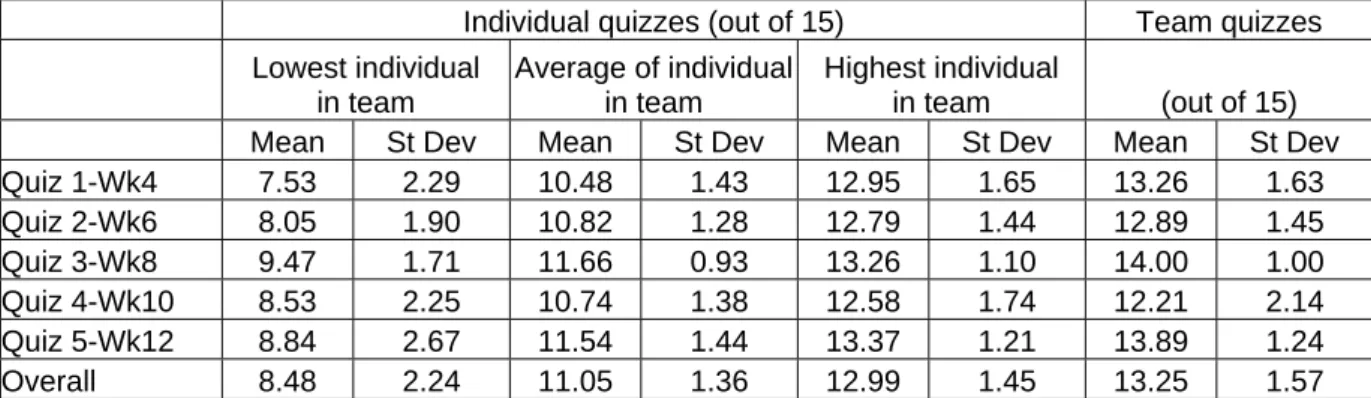
Table 1 shows the comparison of individual and team quiz scores. The impact of the team-based learning strategy on student learning resulted in the team quiz scores being higher. While the team average is marginally and insignificantly 2% higher than the best team members’ individual result (p=0.237), it is significantly higher than the average of individual students’ results by 20% (p=0.000508). The team quiz was a tremendous opportunity for peer teaching particularly for those who scored at the bottom of each quiz with an average 56% difference (p=0.000142).
Table 1. Individual and team quiz results (means)
Individual quizzes (out of 15) Team quizzes
Lowest individual in team Average of individual in team Highest individual in team (out of 15)
Mean St Dev Mean St Dev Mean St Dev Mean St Dev
Quiz 1-Wk4 7.53 2.29 10.48 1.43 12.95 1.65 13.26 1.63 Quiz 2-Wk6 8.05 1.90 10.82 1.28 12.79 1.44 12.89 1.45 Quiz 3-Wk8 9.47 1.71 11.66 0.93 13.26 1.10 14.00 1.00 Quiz 4-Wk10 8.53 2.25 10.74 1.38 12.58 1.74 12.21 2.14 Quiz 5-Wk12 8.84 2.67 11.54 1.44 13.37 1.21 13.89 1.24 Overall 8.48 2.24 11.05 1.36 12.99 1.45 13.25 1.57
The academic’s perception was that the readiness assurance aspect of TBL was extremely valuable. She observed that students were more engaged than she expected from a traditional lecture mode class and attendance was better. The team quiz was particularly engaging – students were not only enthusiastically debating and engaging in peer teaching but they also appeared to be enjoying the experience. This perception was supported by the survey results with 82% agreeing that following the individual quiz with a team quiz was important in eliminating free-riders. 84% agreed that the in-class quizzes motivated them to study before in-class and 60% students reported that quizzes helped them to learn progressively.
Bringing teamwork into the classroom, rather than expecting it to be done externally, provided students with a structure and process that helped them to develop their team skills (64%). The use of
IF-AT forms provided students with a positive approach to constructing their knowledge (75%). After the quizzes, the lecturer provided oral feedback on weak areas of students’ understanding. Students supported this approach to teaching, with 64% of students valuing the lecturer focussing on learning gaps after the individual and team quiz rather over a traditional didactic lecture. 91% of students reported that using the learning management system’s grade book (Blackboard) to access quiz results was useful to them.
Impact on staff
Transcribed interviews (of the coordinating lecturer who adopted TBL and those of the four other staff involved variously with the innovation) were summarised around the seven themes. The lecturer’s responses revealed that the TBL approach had relative advantages over a more didactic traditional approach because it did help students engage and learn without a major impact on valuable research time. The initial adoption decision was impacted also by the timely information about TBL and the prospect of ongoing support through the learning and teaching unit on a whole range of technical and academic matters. The latter two aspects were indicative of the Faculty’s positioning in terms of innovativeness and reduced the potential complexity of the innovation. In addition, the ready availability of a testbank of quiz questions and once-off additional departmental administrative support (i.e., a senior tutor to process students’ mark) during the pilot made the approach relatively attractive in terms of trialability. The fact that the approach actively engaged diverse students and that this was observable in various in-class activities, particularly the team quiz iteration of the readiness assurance process, was culturally compatible with both the lecturer’s style and course content, and also departmental teaching ethos.
Others involved in the adoption highlighted the importance of prior experience with TBL, evidenced based success of TBL, faculty willingness to foster and support learning and teaching innovations, availability of financial resources to purchase the equipment and the adopter’s commitment to student-centred learning. Further key factors for other stakeholders include the observability of the innovation to outsiders, potential benefits to students in terms of improved marks, and ease with which the innovation can be staged and trialled in new settings. The approach was considered a relatively straightforward innovation to imitate and would facilitate a further shift to student-centred learning and had great potential to enhance intercultural and communicative benefits to students.
Discussion and conclusion
This paper presented the results of a study of a pilot application of an in-class team-based learning approach, pioneered by Michaelsen (2004) that focuses on minimising didactic lecturing by motivating students’ readiness to learn. Individual quizzes at the start of a class are marked in class while the same quiz is then attempted by students in teams using an innovative paper-based ‘scratchable’ form (i.e., IF-AT) that allows for peer teaching and immediate feedback developing student-centred learning and inter-cultural competence. The motivation for this study was to ascertain if the reported student benefits appear when TBL was replicated in Australia and to investigate the effects on staff from adopting this approach.
Our results highlight that using readiness assessment has the potential to motivate students’ preparation before class and that average team-based quiz scores were higher than average individual scores, showing a potential to improve student learning. The majority of students perceived that the approach helped to stop free-riders, encouraged pre-class preparation and in-class peer teaching within diverse teams. The result was an engaged, active learning environment that was more conducive to the lecturer focussing on learning gaps.
It was evident from interviews with those who participated in the innovation that the learning and teaching approach adopted by the lecturer was supported by a number of staff with complementary
skills and experience. Faculty support via a competent group familiar with evidence-based teaching innovation and holding technical and problem-solving capacity was key to the innovation’s success. Through the collaborative efforts, significant improvements to the overall TBL process were possible during the pilot. Various processes were streamlined, such as a VBA procedure to automate the post-quiz processing of students’ marks through to online publishing, thereby reducing the processing time from two hours to thirty minutes.
Future directions
Improvements for further use of TBL include various logistical issues (e.g., student self-service of question sheets and answer forms) to save time. Further development of the TBL approach to include the team-based problem-solving activities is planned. Team-based problem-solving activities further deepen the learning of concepts students have demonstrated in both the individual and team quiz readiness process. Future research opportunities include further case studies of academics innovating with TBL. These might be analysed using various models beyond the extended Rogers diffusion of innovation model used in this pilot; the actor network theory proposed in McMaster and Wastell (2005) is one possibility. More extensive analysis of the impact of the TBL approach in supporting students developing intercultural competence and giving international students greater ‘voice’ in team activities is also a worthy research direction.
References
Biggs, J. (2003) Teaching for quality learning at university. 2nd ed. Oxford. The Society for Research into Higher
Education and Oxford University Press.
Bell, M. and Bell, W. (2005) It’s installed…now get on with it! Looking beyond the software to the cultural change. British Journal of Educational Technology,36(4), 643–656.
Bennett, R. (2001) Lecturers’ attitudes to new teaching methods. International Journal of Management Education,2(1), 42–58.
Dihoff, R.E., Brosvic, G.M. and Epstein, M.L. (2003) The role of feedback during academic testing: The delay retention effect. The Psychological Record, 53(4), 533–48.
Fink, L.D. (2004) Beyond small groups: harnessing the extraordinary power of learning teams. In L.K Michaelsen,. A.B.
Knight, and L.D. Fink (Eds) Team-Based Learning: A Transformative Use of Small Groups, Praeger Publishers,
Westport.
Frambach, R.T. and Schillewaert, N. (2002) Organizational innovation adoption: A multi-level framework of determinants and opportunities for future research, Journal of Business Research, 55, 163–76.
McMaster, T. and Wastell, D. (2005) Diffusion – or delusion? Challenging an IS tradition. Information Technology &
People, 18(4), 383–404.
Michaelsen, L.K. (2004) Getting started with team-based learning, in L.K. Michaelsen, A.B. Knight and L.D. Fink (Eds) Team-Based Learning: A Transformative Use of Small Groups, Praeger Publishers, Westport. 27–50.
Michaelsen, L.K., Knight, A.B. and Fink, L.D. (2004) Team-Based Learning: A Transformative Use of Small Groups,
Ed., Praeger Publishers, Westport.
Ramsden, P. (2003). Learning to Teach in Higher Education. 2nd Ed. London: Routledge.
Rogers, E.M. (2003). Diffusion of innovations (5th ed.). New York: Free Press.
Scouller, K.M. (1998) The influence of assessment method on students. Learning approaches: multiple choice question examination versus assignment essay. Higher Education,35, 453–472.
© 2006 Mark Freeman, Susan McGrath-Champ, Steve Clark and Lucy Taylor
The authors assign to UniServe Science and educational non-profit institutions a non-exclusive license to use this document for personal use and in courses of instruction provided that the article is used in full and this copyright statement is reproduced. The authors also grant a non-exclusive license to UniServe Science to publish this document on the Web (prime sites and mirrors) and in printed form within the UniServe Science 2006 Conference proceedings. Any other usage is prohibited without the express permission of the authors. UniServe Science reserved the right to undertake editorial changes in regard to formatting, length of paper and consistency.