ZRENJANIN REPUBLIC OF SERBIA
VII INTERNATIONAL CONFERENCE ON
INFORMATION TECHNOLOGY AND
DEVELOPMENT OF EDUCATION
ITRO 2016
PROCEEDINGS OF PAPERS
VII MEĐUNARODNA KONFERENCIJA
INFORMACIONE TEHNOLOGIJE I
RAZVOJ OBRAZOVANJA
ITRO 2016
ZBORNIK RADOVA
II Organiser of the Conference:
University of Novi Sad, Technical faculty „Mihajlo Pupin”, Zrenjanin, Republic of Serbia
Publisher:
University of Novi Sad, Technical faculty „Mihajlo Pupin”, Djure Djakovica bb, Zrenjanin, Republic of Serbia
For publisher:
Dragica Radosav, Ph. D, Professor, Dean of the Technical faculty „Mihajlo Pupin”, Zrenjanin, Republic of Serbia
Editor in chief:
Marjana Pardanjac, Ph. D, Assistant Professor, Technical faculty „Mihajlo Pupin”, Zrenjanin, Republic of Serbia
Technical treatment and design: Ivan Tasic, Ph. D, Professor Dijana Karuovic, Ph. D, Professor
Vesna Makitan, Ph. D, Assistant Professor Erika Eleven, M.Sc, Assistant
Dusanka Milanov MSc, Assistant Lecturer:
Erika Tobolka, Ph. D, Professor Printed by:
Printing office SAJNOS DOO, Momčila Tapavice 2, Novi Sad, R. of Serbia Circulation: 50 ISBN: 978-86-7672-285-3 CIP - Каталогизација у публикацији Библиотека Матице српске, Нови Сад 37.01:004(082) 37.02(082)
INTERNATIONAL Conference on Information Technology and Development of Education ITRO (7 ; 2016 ; Zrenjanin)
Proceedings of papers / VII International Conference on Information Technology and Development of Education ITRO 2016 = Zbornik radova = VII međunarodna konferencija Informacione tehnologije i razvoj obrazovanja ITRO 2016, Zrenjanin, June 2016. - Zrenjanin : Technical Faculty "Mihajlo Pupin", 2016 (Novi Sad : Sajnos). - VI, 413 str. : ilustr. ; 30 cm Tekst štampan dvostubačno. - Tiraž 50. - Introduction: str. VI. - Bibliografija uz svaki rad. ISBN 978-86-7672-285-3
a) Информациона технологија - Образовање - Зборници b) Образовна технологија - Зборници COBISS.SR-ID 306831623
III
PARTNERS INTERNATIONAL CONFERENCE
South-West University „Neofit Rilski”
Faculty of Education, Blagoevgrad,
Republic of Bulgaria
Faculty of Electrical Engineering and Informatics
Department of Computers and Informatics of Kosice
Slovak Republic
University Goce Delcev Stip
Republic of Macedonia
IV
THE SCIENCE COMMITTEE:
Dragica Radosav, Ph.D, Professor, Dean of Technical Faculty "Mihajlo Pupin" Zrenjanin, R. of Serbia
Sashko Plachkov, Ph.D, Professor, South-West University "Neofit Rilski"/Department of Education, Blagoevgrad, R. of Bulgaria
Ivanka Georgieva, Ph.D, Professor, South-West University "Neofit Rilski"/Department of Education, Blagoevgrad, R. of Bulgaria
Marina Cicin Sain, Ph.D, Professor, University of Rijeka, Croatia Anton Vukelic, Ph.D, Professor, Faculty of Philosophy, Croatia
Ion Dzitac, Ph.D, Professor, Dep. of Mathematics-Informatics, Aurel Vlaicu Un. of Arad, Romania Sulejman Meta, Ph.D, Professor, Faculty of Applied Sciences, Tetovo, Macedonia
Blagoj Delipetrev, Ph.D, Assist. Professor, Faculty of Computer Science, University “Goce Delcev” – Shtip, R. of Macedonia
Marta Takacs, Ph.D, Professor, Óbuda University, John von Neumann Faculty of Informatics, Budapest, Hungary
Nina Bijedic, Ph.D, Professor, Applied mathematics, Bosnia and Herzegovina
Viorel Negru, Ph.D, Professor, Dep. of Computer Science, West University, Timisoara, Romania Djordje Herceg, Ph.D, Professor, Faculty of Science, Novi Sad, Republic of Serbia
Mirjana Segedinac, Ph.D, Professor, Faculty of Science, Novi Sad, R. of Serbia Milka Oljaca, Ph.D, Professor, Faculty of Philosophy, Novi Sad, R. of Serbia
Dusan Starcevic, Ph.D, Professor, Faculty of Organizational Sciences, Belgrade, R. of Serbia Dobrivoje Mihailovic, Ph.D, Professor, Faculty of Organizational Sciences, Belgrade, R. of Serbia Zvonko Sajfert, Ph.D, Professor, Technical Faculty "Mihajlo Pupin" Zrenjanin, Republic of Serbia Miroslav Lambic, Ph.D, Professor, Technical Faculty "Mihajlo Pupin" Zrenjanin, R. of Serbia Miodrag Ivkovic, Ph.D, Professor, Technical Faculty "Mihajlo Pupin" Zrenjanin, R. of Serbia Zivoslav Adamovic, Ph.D, Professor, Technical Faculty "Mihajlo Pupin" Zrenjanin, R. of Serbia Momcilo Bjelica, Ph.D, Professor, Technical Faculty "Mihajlo Pupin" Zrenjanin, R. of Serbia Milan Pavlovic, Ph.D, Professor, Technical Faculty "Mihajlo Pupin" Zrenjanin, R. of Serbia Marjana Pardanjac, Ph.D, Assist. Professor, Tech. Faculty "Mihajlo Pupin" Zrenjanin, R. of Serbia Dragana Glusac, Ph.D, Professor, Technical Faculty "Mihajlo Pupin" Zrenjanin, R. of Serbia Dijana Karuovic, Ph.D, Professor, Technical Faculty "Mihajlo Pupin" Zrenjanin, R. of Serbia Ivan Tasic, Ph.D, Professor, Technical Faculty "Mihajlo Pupin" Zrenjanin, R. of Serbia
Vesna Makitan, Ph.D, Assist. Professor, Technical Faculty "Mihajlo Pupin" Zrenjanin, R. of Serbia Erika Tobolka, Ph.D, Professor, Technical Faculty "Mihajlo Pupin" Zrenjanin, Republic of Serbia Erika Eleven, M.Sc, Assistant, Technical Faculty “Mihajlo Pupin” Zrenjanin, Republic of Serbia
V THE ORGANIZING COMMITTEE:
Marjana Pardanjac, Ph.D, Assistant Professor, Technical Faculty “Mihajlo Pupin” Zrenjanin, R. of Serbia - Chairman of the Conference ITRO 2016
Dragica Radosav, Ph.D, Professor, Technical Faculty “Mihajlo Pupin” Zrenjanin, R. of Serbia Dijana Karuovic, Ph.D, Professor, Technical Faculty “Mihajlo Pupin” Zrenjanin, R. of Serbia Dragana Glusac, Ph.D, Professor, Technical Faculty “Mihajlo Pupin” Zrenjanin, R. of Serbia Ivan Tasic, Ph.D, Professor, Technical Faculty “Mihajlo Pupin” Zrenjanin, R. of Serbia
Vesna Makitan, Ph.D, Assist. Professor, Technical Faculty “Mihajlo Pupin” Zrenjanin, R. of Serbia Erika Tobolka, Ph.D, Professor, Technical Faculty “Mihajlo Pupin” Zrenjanin, R. of Serbia
Erika Eleven, MSc, Assistant, Technical Faculty “Mihajlo Pupin” Zrenjanin, R. of Serbia Dusanka Milanov, MSc, Assistant, Technical Faculty “Mihajlo Pupin” Zrenjanin, R. of Serbia
All rights reserved. No part of this Proceeding may be reproduced in any form without written permission from the publisher.
The editor and the publisher are not responsible either for the statements made or for the opinion expressed in this publication.
The authors are solely responsible for the content of the papers and any copyrights, which are related to the content of the papers.
With this publication, the CD with all papers from the International Conference on Information Technology and Development of Education, ITRO 2016 is also published.
VI
INTRODUCTION
This Proceedings of papers consists from full papers from the International conference "Information technology and development of education" - ITRO 2016, that was held at the Technical Faculty “Mihajlo Pupin” in Zrenjanin on June 10th 2016.
The International conference on Information technology and development of education has had a goal to contribute to the development of education in Serbia and the Region, as well as, to gather experts from natural and technical sciences’ teaching fields.
The expected scientific-skilled analysis of the accomplishment in the field of the contemporary information and communication technologies, as well as analysis of state, needs and tendencies in education all around the world and in our country has been realized.
The authors and the participants of the Conference have dealt with the following thematic areas:
- Theoretical and methodological questions of contemporary pedagogy - Personalization and learning styles
- Social networks and their influence on education - Children security and safety on the Internet - Curriculum of contemporary teaching
- Methodical questions of natural and technical sciences subject teaching - Lifelong learning and teachers’ professional training
- E-learning
- Education management
- Development and influence of IT on teaching
- Information communication infrastructure in teaching process
All submitted papers have been reviewed by at least two independent members of the Science Committee.
There were total of 163 authors that took part at the Conference from 15 countries, 4 continents: 96 from the Republic of Serbia and 67 from foreign countries such as: Macedonia, Bulgaria, Slovakia, Russia, Montenegro, Albania, Hungary, Italy, India, Rumania, Bosnia and Herzegovina, USA, Egypt and Nigeria. They were presented 82 scientific papers; 42 from Serbia and 40 from the above mentioned countries.
The papers presented at the Conference and published in Proceedings can be useful for teachers while learning and teaching in the fields of informatics, technics and other teaching subjects and activities. Contribution to the science and teaching development in this Region and wider has been achieved in this way.
CONTENTS
INVITED LECTURES
I. K.Georgieva
ENGINEERING EDUCATION IN THE FRAMEWORK OF EUROPEAN QUALIFICATION .... 3
D. Dobrilović
WELCOME TO THE FUTURE (OF TEACHING IT) ... 9
SCIENTIFIC PAPERS
DEVELOPMENT AND INFLUENCE OF INFORMATION TECHNOLOGY ON TEACHING ... 19
A. Kansara, Lj. Kazi
ADAPTING UNIVERSITY TEACHING TO THE NEEDS OF IT INDUSTRY ... 21
M. Adedeji Oyinloye
EDUCATION AND ICT – ITS CURRENT TREND AND OPPORTUNITIES IN NIGERIA ... 27
F. Stajković, D. Milanov, M. Ćoćkalo-Hronjec, D. Ćoćkalo
DESIGN OF USER INTERFACE FOR EDUCATIONAL PURPOSES IN ECLIPSE
ENVIRONMENT ... 30
Z. Kazi, M. Stasevic, B. Radulovic
MDX QUERIES FOR OLAP CUBE SLICING AND STATISTICAL REPORTING:
EDUCATIONAL EXAMPLE ... 35
D. Milanov, I. Palinkaš
3D PRINTING IN EDUCATION ... 41
THEORETICAL AND METHODOLOGICAL QUESTIONS OF CONTEMPORARY
PEDAGOGY ... 45
E. Petkova
INCREASING THE EFFECTIVENESS OF THE EDUCATIONAL PROCESS IN TECHNICAL SCIENCESS BY MODERN INFORMATION TECHNOLOGIES ... 47
M. Maneva, N. Koceska, S. Koceski
INTRODUCTION OF KANBAN METHODOLOGY AND ITS USAGE IN SOFTWARE
Cs. Szabó, V. Szabóová, Z. Havlice
PROS AND CONS OF SOFTWARE DEVELOPMENT TASK SHARING BETWEEN
TEACHING SUBJECTS ... 55
S. Stojanovski, N. Stojkovikj, J. Ananiev, M. Kocaleva, A. Stojanova, B. Zlatanovska
UNIVERSITY EDUCATION IN 21 CENTURY: STUDENT ATTITUDES TOWARD HIGH EDUCATIONAL PROGRAMS IN MACEDONIA ... 60
Cs. Szabó
ON THESIS SUPERVISION EXPERIENCE IN A SLIGHTLY NOT NATIVE ENVIRONMENT ... 64
B. Saliu
NEW APPROACHES ON LEARNER AUTONOMY AND LEARNING ENGLISH AS AN ADDITIONAL LANGUAGE ... 68
E. Cherkashin, S. Kharchenko, Y. Shits
VEDA BASED PSYCHOLOGICAL AND PEDAGOGICAL SUPPORT OF COLLEGE
GRADUATE STUDENTS ... 73
B. Novkovic Cvetkovic
COMPUTING INNOVATIONS IN A MODERN SCHOOL ... 76
S. Mesicki, D. Radosav, M. Lukac
PARENT’S ATTITUDES ABOUT TRADICIONAL OR MODERN TEACHING ... 80
D. Radosav, D. Nagy
THE IMPACT OF MULTIMEDIAL FORM OF PRESENTING THE TEACHING CONTENT ON PERCEPTION ... 83
D. Glušac, I. Tasić, M. Nikolić, E. Terek, B. Gligorović
LMX AS A MODERATOR ON THE CORRELATIONS BETWEEN SCHOOL CULTURAL DIMENSIONS AND QUALITY OF TEACHING DIMENSIONS ... 89
M. Blagojević, B. Kuzmanović
TEXT PROCESSING IN ANALYSIS OF STUDENTS’ ATTITUDES ... 97
I. Tasić, D. Glušac, E. Tobolka, J. Jankov
ANALYSIS OF THE STANDARDS OF PRIMARY SCHOOL STUDENTS’ ACHIEVEMENT IN THEIR FINAL EXAMINATION ... 100
E. Eleven, S. Babić-Kekez
COLLABORATION IN ACCESSING KNOWLEDGE CONTENT AT HIGHER
EDUCATIONAL INSTITUTIONS ... 104
D. Borisavljević, D. Radosav, M. Lukač
R. Lupulesku, M. Puja, M. Pardanjac
FACTORS IMPROVING TEACHING IN TECHNICAL AND IT EDUCATION ... 115
K. Đolović, M. Bruno, M. Pardanjac
INNOVATIONS IN TEACHING TECHNICAL AND IT EDUCATION ... 120
A. Lunjić, M. Kavalić, D. Karuović, S. Borić, J. Bushati, B. Markoski
SELF-EVALUATION OF WORK QUALITY EFFECTIVENESS AND EFFICIENCY FOR BILINGUAL SCHOOLS ... 123
S. Mesicki, M. Pardanjac, E. Tobolka
VISUAL TOOLS AS SUPPORT OF TEACHING ... 130
A. Lunjić, N. Petrov, M. Kavalić, М. Vlahović, S. Stanisavljev, I. Lacmanović
SELF-EVALUATION OF BI-LINGUAL SCHOOL WORK ... 133
METHODICAL QUESTIONS OF NATURAL AND TECHNICAL SCIENCES SUBJECT TEACHING ... 137
A. Stojanova, B. Zlatanovska, M. Kocaleva, M. Miteva, N. Stojkovikj
“MATHEMATICA” AS A TOOL FOR CHARACTERIZATION AND COMPARISON OF ONE PARAMETER FAMILIES OF SQUARE MAPPINGS AS DYNAMIC SYSTEMS ... 139
I. Dimovski, A. Risteska
DIDACIC PRINCIPLE OF VISUALISATION IN TEACHING MATHEMATICAL FUNCTIONS ... 145
A. Krstev, M. Kokotov, B. Krstev, D. Serafimovski
MATHEMATICAL MODELING, ANALYSIS AND OPTIMIZATION USING MMANA -
MATHEMATICAL MODELING AND ANTENNA ANALYSIS SOFTWARE ... 151
M. Kocaleva, B. Zlatanovska, A. Stojanova, A. Krstev, Z. Zdravev, E. Karamazova
ANALYSIS OF STUDENTS’ KNOWLEDGE FOR THE TOPIC "INTEGRAL" ... 155
J. Veta Buralieva
WAVELETS AND CONTINUOUS WAVELET TRANSFORM ... 159
A. Risteska, I. Dimovski, V. Gicev
RELATIONSHIP BETWEEN THE EXTREMES OF A FUNCTIONAL AND ITS VARIATION ... 165
E-LEARNING ... 171
B. Delipetrev, M. Pupinoska-Gogova, M. Kocaleva, A. Stojanova
G. Kőrösi
MOOC VS. TRADITIONAL LEARNING –POSSIBILITIES AND WEAKNESSES OF
E-LEARNING SITES ... 177
N. Koceska, S. Koceski
LEARNING SOFTWARE ENGINEERING BASICS THROUGH ROBOTICS ... 182
Esztelecki Péter
BIG DATA IN EDUCATION ... 187
E. Tosheva
WEB BASED E-LEARNING PLATFORMS ... 192
V. Cvetkovic, T. Petkovic, D. Karuović
USE OF MOODLE IN E-LEARNING FOR THE 2ND GRADE OF HIGH SCHOOL ... 195
D. Milanov, D. Glušac, D. Karuović
DIFFERENT ASPECTS OF BIG DATA USAGE IN EDUCATION ... 198
I. Vecštejn, I. Čobanov, S. B. Božović, M. Pardanjac, E. Tobolka
E-LEARNING ... 202
D. R. Todosijević, M. D. Jovanović, V. M. Ognjenović
SEMANTIC ANNOTATION OF E - LEARNING MATERIALS ON MOBILE PLATFORMS ... 206
E. Eleven, S. Babić-Kekez
INDEPENDENT LEARNING AND MODERN EDUCATIONAL TECHNOLOGY ... 210
N. Tatomirov, D. Glušac, N. Petrov
COMPARING WORDPRESS, JOOMLA AND DRUPAL ... 216
SOCIAL NETWORKS AND THEIR INFLUENCE ON EDUCATION ... 219
J. Ljucović, T. Matijević, T. Vujičić, S. Tomović
ANALYSIS OF SOCIAL NETWORK RANDOM MODEL AND COMPARISON TO TEAL COLLABORATION NETWORK ... 221
O. Iskrenovic-Momcilović, A. Momcilović
CHILDERN AND THE INTERNET ... 226
M. Bakator, E. Terek, N. Petrović, K. Zorić, M. Nikolić
INFORMATION COMMUNICATION INFRASTRUCTURE IN TEACHING PROCES ... 235
D. Serafimovski, A. Krstev, B. Panajotov
THE POTENTIAL USE OF CROSS - PLATFORM MOBILE APPLICATIONS FOR
EDUCATIONAL PURPOSES ... 237
E. Petkova
USING THE COMPUTER GRAPHICS MEANS IN THE TRAINING OF FUTURE
TECHNOLOGIES AND ENTREPRENEURSHIP TEACHERS ... 242
D. Radosav, E. Junuz, D. Music, M. Smajic, I. Karic
ELEVATOR CONTROL BY ANDROID APPLICATION ... 247
D. Bikov, I. Bouyukliev, A. Stojanova
BENEFIT OF USING SHARED MEMORY IN IMPLEMENTATION OF PARALLEL FWT ALGORITHM WITH CUDA C ON GPUS ... 250
A. Krstev, M. Kokotov, B. Krstev, S. Nushkova, D. Krstev, M. Penova
CABLE DISTRIBUTION SYSTEMS - AN ESSENTIAL ELEMENT OF THE GLOBAL
INFORMATION SOCIETY ... 257
S. Minić, D. Kreculj
THE IOT IN EDUCATION ... 261
GAMES AND SIMULATIONS IN EDUCATION ... 265
N. Stojkovikj, A. Stojanova, M. Kocaleva, B. Zlatanovska
SIMULATION OF M/M/N/M QUEUING SYSTEM ... 267
M. Gogova, N. Koceska, S. Koceski
DEVELOPMENT OF INTERACTIVE EDUCATIONAL APPLICATIONS BASED ON
TOUCHDEVELOP ... 272
E. Gjorgjieva, N. Koceska, S. Koceski
CREATING INTERACTIVE MAP WITH OPENLAYERS ... 276
A. Velinov, A. Mileva
RUNNING AND TESTING APPLICATIONS FOR CONTIKI OS USING COOJA SIMULATOR ... 279
B. Sobota, Š. Korečko, P. Pastornický, L. Jacho
EDUCATION PROCESS AND VIRTUAL REALITY TECHNOLOGIES... 286
A. Loncar, M. Kuzmanovic
GAME THEORY IN CINEMATOGRAPHY: MODEL IMPLEMENTATION IN MICROSOFT SQL ENVIRONMENT ... 292
S. Babić-Kekez, I. Antić, E. Eleven
EDUCATIONAL GAMES IN MATH CLASSES THROUGH
INFORMATION-COMMUNICATION TECHNOLOGIES ... 299
T. Petkovic, V. Cvetkovic, M. Pardanjac, E. Tobolka
THE VALIDATION OF SIMULATION MODELS ... 302
D. Čabarkapa, M. Milićević
IMPORTANCE OF REALISTIC MOBILITY SOFTWARE MODELS FOR VANETS
SIMULATIONS ... 306
D. Borisavljević, M. Pardanjac
EDUCATIONAL SOFTWARE AS A SIMULATION TECHNIQUE – EXAPLES IN TEACHING TECHNICAL AND IT EDUCATION ... 312
TEACHERS’ PROFESSIONAL TRAINING ... 317
V. Aleksić, Ž. M. Papić, M. Papić
INFORMATICS TEACHERS PROFESSIONAL COMPETENCES ... 319
EDUCATION MANAGEMENT ... 323
J. Jankov, I. Tasić, D. Milanov, D. Ćoćkalo
COMMUNICATION AND CHANGE MANAGEMENT IN SCHOOL ... 325
I. Petrov, V. Makitan, M. Malić
IT PROJECT MANAGEMENT METHODOLOGIES ... 329
CONTEMPORARY USE OF INFORMATION TECHNOLOGY ... 335
M. Hafez, Lj. Kazi
HEALTHCARE EDUCATION AT INTERNET ... 337
A. Krstev, D. Krstev, M. Kokotov, B. Krstev, S. Nushkova, M. Penova
DESIGN OF INFORMATION SYSTEMS MONITORING, RECORD AND CONTROL... 341
Cs. Szabó
FIRST ERRORS AND CORRECTIONS WHILE TEACHING EVOLUTION OF SOFTWARE SYSTEMS ... 344
S. Plachkov, V. Pavlova
3 DIMENSIONAL MODELING AND ITS INTEGRATION IN TECHNOLOGY EDUCATION ... 349
Z. Zlatev, R. Golubovski, V. Gicev
DATA PROCESSING OF DISPLACEMENTS BETWEEN THE GROUND AND THE POINT OF CRACKING AT THE SEVEN – STORY VAN NUYS HOTEL ... 352
M. Nikolić, M. Stojić, D. Radojević, S. Nikolić
ONE SUPERVISORY SYSTEM SOLUTION FOR THE PROTECTING OF PUBLIC
FACILITIES ... 359
Z. Ignjatov, D. Martinov, I. Berković, V. Brtka
INTEGRATION OF ABBOTT STANDARD INTERFACE COMMUNICATION PROTOCOL, THE HOSPITAL INFORMATION SYSTEM ... 364
D. Martinov, B. Vukov, Ž. Veličkov, V. Brtka, I. Berković
LEARNING MANAGEMENT SYSTEM MOODLE IN HEALTH CARE ... 369
V. Nikolić, B. Markoski, K. Kuk, D. Randjelović, M. Ivković
POSSIBILITIES OF INTELLIGENT SEARCH TECHNIQUES APPLICATIONS IN
E-GOVERNMENT SERVICES OF THE REPUBLIC OF SERBIA ... 374
N. Šimak
MODULE SINGLE USE OF THE INFORMATION SYSTEM ‘TREASURY’ ... 379
V. Novačić, B. Egić, J. Barbaric, M. Pardanjac
PREVENTION AS A METHOD AGAINST DIGITAL VIOLENCE ... 383
P. Sibinović, N. Ilić
INFORMATION SYSTEM AS A TOOL IN THE DEVELOPMENT OF A QUALITY ANALYSIS SYSTEM ... 386
J. Bondžić, S. Popov, T. Novaković, S. Draganić, M. Sremački
SOFTWARE FOR HAZARD SCENARIOS MODELLING ... 392
S. Marjanov, E. Brtka, V. Brtka
CHATBOTS AND POSSIBLE APPLICATIONS ... 397
B. Blagojević, P. Ivanović
SIMPLE WEB TOOLS FOR INTERACTIVE COMMUNICATION WITH CUSTOMERS WEB PORTAL APPLICATION ,,MY LAWYER,, ... 403
B. Đekić, V. Ognjenović and Ivana Berković
182
Learning Software Engineering Basics Through
Robotics
N. Koceska, S. Koceski
Faculty of Computer Science/University Goce Delchev, Shtip, Republic of Macedonia [email protected], [email protected]
Abstract – Software engineering is a scientific discipline that deals with all phases of (requirements analysis, design and modeling, implementation, evaluation and validation, as well as maintenance). Learning various concepts of software engineering is not a trivial task, and requires more than a one semester course. LEGO MINDSTORMS NXT kit is a popular and affordable education robotic platform, used as an educational tool in various areas. This paper describes how the LEGO MINDSTORMS robots can be used for teaching the basics of software engineering. We have also evaluated the outcomes of the course in order to reveal the
effects of using this off-the-shelf robot kit.
I. INTRODUCTION
In a world where technology leads the economic and social development of the countries, the significance of a good academic engineering training must be considered as a core aspect in every educational system. Such engineering training must cover both theoretical aspects as well as practical applications that show the students how to relate the abstract knowledge they learn in the lecture sessions with real world problems and their difficulties.
Robotics has been shown to be a superb tool for hands-on learning, not only of robotics itself, but of general topics in science, technology, engineering, and math (STEM) [1].
A broad spectrum of robot tools and platforms that can be used in educational process exists, but we will concentrate on the LEGO MINDSTORMS NXT kit, because it provides students and teachers with a user friendly environment and gives the students opportunities to engage in real world science through, design, construction, and testing of their own experiments. Additionally, many students are familiar with LEGO. Some have used them in their childhood, others use them in computer games and they even see them in films.
LEGO modular design allows for multiple solutions to a given assignment, and the sensors and motors allows students to engage in a very diverse set of engineering and science activities. By allowing those to solve problems based on real-life situations, the students can developed critical
thinking and learn confidence, problem-solving and teamwork.
LEGO MINDSTORMS has been used as an educational tool in various areas. Brandt and Colton [2] have used Mindstorms to teach underground students Programming, mechanics and control. Tester [3] used Mindstorms to develop skills connected with innovation and communication management. Schumacher, Welch, Raymond [4] have used Minsdstorms to teach Programming to Electrical Engineering and Computer Science freshman students from the Military Academy in the US. Caci and D’Amico [5] used Mindstorms to develop cognitive skills in children. Fabri et all.[6] have been used Mindstorms for teaching and
learning software processes and project
management. Church, Ford, Perova and Rogers in
[7] describe a successful use of LEGO
MINDSTORMS in designing robotics-based
activities for teaching physics. Cruz et all. [8] have been used LEGO Mindstorms NXT for teaching at Data Acquisition, Control Systems Engineering and Real-Time Systems undergraduate courses.
However including LEGO MINDSTORMS or other robot systems in the course syllabus does not automatically mean better results of concepts by students. In order to have a teaching value, their use must be carefully designed, which requires a higher dedication of teachers.
We have tried to use robots within the course aimed at teaching the basics of software engineering. The robots were used as tools for physical representation and visualization of object-oriented software algorithms and design patterns. Moreover, dealing with physical objects should make the learning more intuitive than just looking at in-memory object structures [9].
The main objectives of the course were to teach the students on the basics of software modeling and
development starting from a set of user
requirements. As a final outcome students should also have to gain practical experience of
183 collaborative project development in a simulated production environment.
We have evaluated the outcomes of the course in order to reveal the effects of learning software engineering in robotics environment.
The evaluation results showed that students have gained practical experience and good understanding of software engineering basics and they have appreciated the proposed methodology.
This paper is organized as follows. After a brief introduction and related work overview, the paper
continues with the description of LEGO
MINDSTORMS NXT kit. Next section describes the course curriculum and presents one pedagogical unit. The paper then discusses the results of the pilot study and presents the conclusions.
II. LEGO MINDSTORM KIT V2.0 The Lego Mindstorms NXT 2.0 kit contains software and hardware to create customizable, programmable robots.
It contains three motors, one light sensor, one ultrasonic (sonar) sensor, one sound sensor, and two touch sensors. The servo motors included in the kit are equipped with rotation encoders, returning to the
NXT the position of the shaft with 1 resolution. Rotation speed of the motors is proportional to voltage applied to them, as it can be seen on graphs in Figure 1.
Figure 1. Dependency of the rotation speed from the applied voltage.
Two motors can be synchronized as a drive unit. Ultrasonic sensor included in the kit has accuracy up to 3 centimeters and can measure up to 255 centimeters. The light sensor can distinguish between light and dark but, in the same time can be
used to recognize whether the surface color of the scanned object falls in a specific color range. Sound sensor can be programmed to give the robot the ability to hear and react. The robots can detect physical contacts with the environment and react accordingly using two touch sensors included in the kit.
The kit also contains set of 619 mechanical parts from the Technic line aimed at creating various mechanical systems and robots. The kit also includes an intelligent brick computer that controls the system.
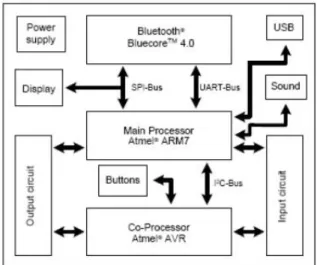
The core of the ―brickǁ is the 32-bit Atmel ARM7 processor with 256 KB Flash, 64 KB RAM operating at 48 MHz. Even without its coprocessor, which is an Atmel 8-bit AVR processor, the brick is a powerful embedded platform that can be used to build variety of applications [10].
The architecture of the LEGO Mindstorms NXT Brick is presented in Figure 2.
Figure 2. Architecture of the LEGO Mindstorms NXT Brick [11].
Mindstorms consists of a largely graphical interface for writing programs (Figure 3) and a flexible and simple means – the use of Lego blocks – for constructing the physical robots.
Both the programs, which can be recorded as they are constructed and edited, and the robots, which can be described in some detail; provide excellent artifacts of student critical thinking and problem solving.
There are several things of interest to educators – first, the program is completely graphical – this helps students focus more on the design rather than spend time on learning new tools and associated abstract syntaxes. Second, because the program is graphical, it lends itself naturally to parallel programming which is an inherently hard concept to teach with traditional tools. Third, the student can
184 configure all the parameters associated with a block at the bottom of the screen without having to navigate through multiple functions and files and finally, the software exposes key embedded
concepts such as memory and resource
management, helping teach the key concepts in a fun environment. For example, the student may have to, depending on the size of the program, remove some other files that were taking up memory on the brick
Figure 3. The Software for the LEGO MINDSTORMS NXT.
III. COURSE DECRIPTION
Fast developing society based on technological advancements is focusing on complex hardware and software solutions. Software is becoming the main driver for growth in many fields. This is valid not only for enterprise software solutions but also for industrial embedded software, consumer products (phones, smart TV’s, and robotic devices which are penetrating very fast nowadays). In order to meet the challenges of rapidly changing demands and requirements, as well as the permanent increasing of software’s size and complexity, systematic approach is needed.
Software engineering is the scientific, disciplined and quantifiable approach to developing, operating and maintaining complex software systems.
Software engineering education at undergraduate level could not satisfy the specific requirements for industrial software development. Namely, in addition to requirements for embedded software development, the industry also requires the knowledge of entire software lifecycle phases (requirements analysis, design and modeling, implementation, evaluation and validation, as well as maintenance).
Therefore, we have offered a multidisciplinary course entitled Basics of robotics that teaches both software engineering and robotics aspects.
The main objectives of this course it to enable students gaining practical experience of sensing, planning and control and apply it on a small-scale educational Lego Robot. In parallel the course should provide the students with basic software engineering methodologies, design and modeling of robotics software, implementation of control software.
The course is offered as a single semester course in the 4th year of study (8th semester) and the main topics are balanced between software engineering and robotics. They are including: design patterns, modeling methods and tools, implementation
patterns, localization and mapping, object
recognition, path planning and robot control.
During the course four different assignments were given to the students. Through the analysis of the given assignments, the students’ improvements from software engineering aspect were evaluated.
The course was attended by 35 students (22 male and 13 female). All of them were with the same software engineering and robotics knowledge gained during the previous academic years.
A. Description of line following assignment
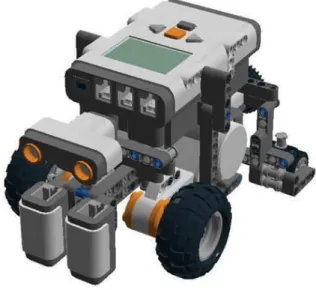
The main idea of this assignment is to understand the differences between sequential programming and state machine pattern. For this purpose the students should use the Lego Mindstorms NXT 2.0 to construct the line follower robot using two light sensors (Figure 4).
Figure 4. Line follower robot
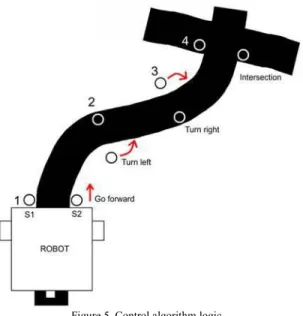
The logic besides the control algorithm could be seen from the illustration in Figure 5.
185
Figure 5. Control algorithm logic.
So, considering two light sensors (S1 and S2) attached on input ports 2 and 3 correspondingly we may have the following combinations: both S1 and S2 detect white background the action should be go straight, S1 detects white and S2 – black, the action should be turn right, S1-black and S2 – white, the action should be turn left, and finally both sensors detect black, the robot should stop due to crossroad.
The Lego software diagram that is solving this problem is given in Figure 6.
Figure 6. Four step line follower control diagram.
IV. EVALUATION
The methodological approach was evaluated in two different ways. First of all the quality of assignments during the semester was evaluated. The qualities of assignments were evaluated by two professors, one assistant and one PhD student (employed as laboratory assistant). The results have showed that all students have presented improved qualities of their software engineering approach after the second assignment. This conclusion was made unanimously by all four teaching staff members.
Besides this evaluation, the students were interviewed at the end of the course and asked to fulfill a questionnaire composed of several questions (given in the Table 1 below). The results are also presented in the Table 1 presented below.
TABLE 1.
N Question Mean STD
1 Were the practical assignments 4.32 0.35 interesting or motivating? (1-
not interesting; 5-very interesting)
2 Usefulness of Lego NXT in 3.87 1.20 learning software modeling? (1-
not useful; 5-very useful)
3 Usefulness of Lego NXT in 3.76 1.05 learning embedded software
implementation? (1-not useful; 5-very useful)
4 Usefulness of Lego NXT in 4.19 0.95 learning robotics basics? (1-not
useful; 5-very useful)
V. CONCLUSION
We have presented in this paper a teaching innovation project devoted to the use of LEGO Mindstorms NXT robots in subjects related to software engineering.
Our experience using these robots has been really positive. Our students find the lab sessions more attractive, and they solve the proposed practical exercises more enthusiastically; this perception is statistically supported by the results of the surveys we have conducted in different subjects and, more slightly, by the scores obtained by the students, which we believe comes from a higher motivation. On our behalf, we have found that the NXT is a nearly optimal education platform in terms of cost, robustness and versatility.
REFERENCES
[1] Benitti , Fabiane Barreto Vavassori ―Exploring the educational potential of robotics in schools: A systematic reviewǁ, Computers & Education 58(3):978-988, April 2012
[2] Brandt, A.M. ; Colton, M.B. ―Toys in the Classroom: LEGO MindStorms as an Educational Haptics Platform,ǁ in Haptic interfaces for virtual environment and teleoperator systems, 2008, pp. 389- 395
[3] Tester, J.T. ―Management of a large team-design and robotics-oriented sophomore design class,ǁ in Frontiers in Education Conference, 2008. FIE 2008. 38th Annual, pp. T3B-24 - T3B-29. [4] 5. Schumacher, J. ; Welch, D. ; Raymond, D. ―Teaching
introductory programming, problem solving and information technology with robots at West Pointǁ. in Frontiers in Education Conference, 2001. 31st
Annual. pp. F1B - 2-7 vol.2.
[5] Caci, B. ; D'Amico, A. ―Children's cognitive abilities in construction and programming robotsǁ, in Robot and Human Interactive Communication, 2002. Proceedings. 11th IEEE International Workshop on. pp. 189 –191.
186
[6] JA Fabri, A L'Erario, RHC Palácios, W Godoy Applying mindstorm in teaching and learning process and software project management, Frontiers in Education Conference (FIE), 2015. 32614 2015. IEEE, 1-8
[7] CHURCH, W.; FORD, T.; PEROVA, N.; ROGERS, C.. Physics With Robotics — Using LEGO MINDSTORMS In High School Education. AAAI Spring Symposium Series, North America, March, 2010.
[8] Cruz-Mart'ın, Fernández-Madrigal, C. Galindo, J. González-Jiménez, C. Stockmans-Daou, J. L. Blanco-Claraco ―A LEGO Mindstorms NXT approach for teaching at Data Acquisition, Control Systems Engineering and Real-Time Systems undergraduate coursesǁ, Computers & Education, Vol. 59, No. 3. pp. 974-988, November, 2012,
[9] I. Diethelm, L. Geiger, A. Zundorf. 2002. UML im Unterricht: Systematische objektorientierte Problemlosung mit Hilfe von Szenarien am Beispiel der Turme von Hanoi. Erster Workshop der GI-Fachgruppe Didaktik der Informatik, Bommerholz, Germany [10] Sharad, S. (2007, June). Introducing embedded design concepts to
freshmen and sophomore engineering students with LEGO MINDSTORMS NXT. In Microelectronic Systems Education, 2007. MSE'07. IEEE International Conference on (pp. 119-120). IEEE.
[11] LEGO MINDSTORMS NXT Hardware Developers Kit, http://www.lego.com/en-us/mindstorms/downloads (Accessed on 30.04.2016).
[12] Benitti , Fabiane Barreto Vavassori ―Exploring the educational potential of robotics in schools: A systematic reviewǁ, Computers & Education 58(3):978-988, April 2012
[13] Brandt, A.M. ; Colton, M.B. ―Toys in the Classroom: LEGO MindStorms as an Educational Haptics Platform,ǁ in Haptic interfaces for virtual environment and teleoperator systems, 2008, pp. 389- 395
[14] Tester, J.T. ―Management of a large team-design and robotics-oriented sophomore design class,ǁ in Frontiers in Education Conference, 2008. FIE 2008. 38th Annual, pp. T3B-24 - T3B-29.
[15] Schumacher, J.; Welch, D.; Raymond, D. ―Teaching introductory programming, problem solving and information technology with robots at West Pointǁ. in Frontiers in Education Conference, 2001. 31st
Annual. pp. F1B - 2-7 vol.2.
[16] Caci, B. ; D'Amico, A. ―Children's cognitive abilities in construction and programming robotsǁ, in Robot and Human Interactive Communication, 2002. Proceedings. 11th IEEE International Workshop on. pp. 189 –191.
[17] JA Fabri, A L'Erario, RHC Palácios, W Godoy Applying mindstorm in teaching and learning process and software project management, Frontiers in Education Conference (FIE), 2015. 32614 2015. IEEE, 1-8
[18] CHURCH, W.; FORD, T.; PEROVA, N.; ROGERS, C.. Physics With Robotics — Using LEGO MINDSTORMS In High School Education. AAAI Spring Symposium Series, North America, March, 2010.
[19] Cruz-Mart'ın, Fernández-Madrigal, C. Galindo, J. González-Jiménez, C. Stockmans-Daou, J. L. Blanco-Claraco ―A LEGO Mindstorms NXT approach for teaching at Data Acquisition, Control Systems Engineering and Real-Time Systems undergraduate coursesǁ, Computers & Education, Vol. 59, No. 3. pp. 974-988, November, 2012,
[20] I. Diethelm, L. Geiger, A. Zundorf. 2002. UML im Unterricht: Systematische objektorientierte Problemlosung mit Hilfe von Szenarien am Beispiel der Turme von Hanoi. Erster Workshop der GI-Fachgruppe Didaktik der Informatik, Bommerholz, Germany [21] Sharad, S. (2007, June). Introducing embedded design concepts to
freshmen and sophomore engineering students with LEGO MINDSTORMS NXT. In Microelectronic Systems Education, 2007. MSE'07. IEEE International Conference on (pp. 119-120). IEEE.
[22] LEGO MINDSTORMS NXT Hardware Developers Kit, http://www.lego.com/en-us/mindstorms/downloads (Accessed on 30.04.2016).