Portland State University
PDXScholar
Dissertations and Theses Dissertations and Theses
Summer 8-10-2015
The Design and Validation of a Group Theory Concept Inventory
Kathleen Mary MelhuishPortland State University
Let us know how access to this document benefits you.
Follow this and additional works at:http://pdxscholar.library.pdx.edu/open_access_etds
Part of theAlgebra Commons,Higher Education Commons, and theScience and Mathematics Education Commons
This Dissertation is brought to you for free and open access. It has been accepted for inclusion in Dissertations and Theses by an authorized
Recommended Citation
Melhuish, Kathleen Mary, "The Design and Validation of a Group Theory Concept Inventory" (2015).Dissertations and Theses.Paper 2490.
The Design and Validation of a Group Theory Concept Inventory
by
Kathleen Mary Melhuish
A dissertation submitted in partial fulfillment of the requirements for the degree of
Doctor of Philosophy in
Mathematics Education
Dissertation Committee: Sean Larsen, Chair
John Caughman Samuel Cook Andrea Goforth
Portland State University 2015
Abstract
Within undergraduate mathematics education, there are few validated instruments designed for large-scale usage. The Group Concept Inventory (GCI) was created as an instrument to evaluate student conceptions related to
introductory group theory topics. The inventory was created in three phases: domain analysis, question creation, and field-testing. The domain analysis phase included using an expert protocol to arrive at the topics to be assessed, analyzing curriculum, and reviewing literature. From this analysis, items were created, evaluated, and field-tested. First, 383 students answered open-ended versions of the question set. The questions were converted to multiple-choice format from these responses and disseminated to an additional 476 students over two rounds. Through follow-up interviews intended for validation, and test analysis processes, the questions were refined to best target conceptions and strengthen validity measures. The GCI consists of seventeen questions, each targeting a different concept in introductory group theory. The results from this study are broken into three papers. The first paper reports on the methodology for creating the GCI with the goal of providing a model for building valid concept inventories. The second paper provides replication results and critiques of previous studies by leveraging three GCI questions (on cyclic groups, subgroups, and isomorphism) that have been adapted from prior studies. The final paper introduces the GCI for use by instructors and mathematics departments with emphasis on how it can be leveraged to investigate their students’ understanding of group theory concepts. Through careful creation and extensive field-testing, the GCI has been shown to
be a meaningful instrument with powerful ability to explore student understanding around group theory concepts at the large-scale.
Dedication
To my parents for teaching me to have a strong work ethic, to live life with kindness, and to pursue a career that truly fulfills you.
Acknowledgements
I cannot begin to thank all of the people that have helped me complete this dissertation. First, and foremost, I should thank my advisor, Sean Larsen. He always pushed me to do better. He sets a high bar for his students, and I am grateful for that and the continued help, insight, and whiskey he provided. (Sean, that oxford comma was for you!) I also want to thank the other members of my committee, each of whom brought a different expertise that helped this project become what it is. Sam Cook provided valuable insight into the statistics and quantitative analyses. John Caughman brought the view of an experienced
mathematics instructor and provided generous feedback on the practitioner paper. I also must thank Andrea Goforth who stepped out of the chemistry world to patiently provide support as the outside committee member.
There are nearly a hundred current and former abstract algebra instructors who have helped me at some point in my process between the Delphi study, instructors who have given their classes the GCI, instructors that have tested GCI themselves, and those who have evaluated tasks. I especially want to thank Annie Selden who provided feedback on every one of my tasks. I also want to thank Tim Fukawa-Connelly, Keith Weber, Dorothy Zeiser, and Andrew Conner who all evaluated over twenty tasks.
Perhaps, I most need to acknowledge the people who helped me in small or large ways in a less formal manner. Carolyn James, Andy Riffel, and Dana Kirin have all been kind enough to read drafts of the papers. Annie Bergman aided me in a great deal of analysis throughout the process. I also could not have
done this without the support of my wife, Simone, who supported me through this entire stressful process. Finally, I need to thank Jodi Fasteen, my partner-in-crime this year. She has helped me during every step of the process and patiently waded through all of my papers. I had always thought of the dissertation as being on an island, but it so far from it. I have never been more grateful for all of the help, support and kindness that my friends, family, and colleagues provided.
Table of Contents
Abstract ... i
Dedication ... iii
Acknowledgements ... iv
List of Tables ... viii
List of Figures ... x
Introduction and Rationale ... 1
Importance of Assessing Concept Understanding ... 3
Purpose of Concept Inventories ... 7
Abstract Algebra Literature Review ... 10
Student Understanding in Abstract Algebra ... 11
Instruction of Abstract Algebra: Innovations ... 28
Conclusion ... 34
Concept Inventories and Theoretical Background ... 36
Concept Inventories ... 36
Conceptual Knowledge ... 37
Fundamental Topics in Group Theory ... 49
Assessments ... 52
Validity and Reliability ... 55
Conclusion ... 67
Project Methodology ... 68
Concept Domain Analysis ... 69
The Creation of the Assessment ... 82
Conclusion ... 88
Paper 1: Going from nothing to something: A Multi-faceted approach to developing questions for concept inventories as applied to introductory group theory ... 90
On Validity and Concept Inventories ... 93
The Methodology ... 101
Question Creation and Selection ... 120
Question Refinement and Field Testing ... 127
Psychometric Properties of the GCI ... 141
Conclusion ... 145
Paper 2: Scaling up and out: Reconsidering how students think about concepts in Group theory ... 149
The Need for Replication ... 150
Student Understanding in Group Theory ... 152
Methods ... 153
Replication Results and Discussion ... 156
Paper 3: A tool for unearthing student conceptions in group theory ... 193
Why Should We Care about Student Understanding of Concepts in Proof-Focused Courses? ... 195
How was the GCI Created? ... 199
How Can the GCI be Utilized? ... 201
Sample Items ... 203
Companion Website ... 206
Concluding Remarks ... 207
Conclusion ... 209
Directions For Future Research ... 211
References ... 214
Appendix A Textbook Analysis Codes ... 224
Appendix B Sample Analytic Report from Textbook Analysis ... 228
Appendix C Sample Literature Review Report ... 232
Appendix D Expert Evaluation Summary ... 233
Appendix E Item Analysis ... 234
Appendix F Principal Component Analysis - % of Variance ... 235
List of Tables
Table 1 Cognitive Behavior Associated with Calculus Exam Items. Adapted from “A characterization of Calculus I final exams in US colleges and
universities,” M.A. Tallman and M.P. Carlson, 2012, The 15th annual conference on Research in Collegiate Mathematics Education, p. 2-222.
... 45
Table 2 Item Classification Guide by Difficulty and Discrimination. Adapted from “Assessment in Health Professions Education,” S. M. Downing & R. Yudkowsky, 2009. New York, NY: Routledge, p. 108. ... 66
Table 3 Timeline of GCI Development ... 69
Table 4 Abstract Algebra Textbook Analyzed ... 74
Table 5 Important Topics in Group Theory Selected Through a Delphi Study . 104 Table 6 Representation Codes ... 108
Table 7 Percentages of Representations in Textbook Examples and Exercises 108 Table 8 Example Purpose Codes ... 109
Table 9 Types of Definitions in Textbooks ... 113
Table 10 Selectivity of Sample Institutions ... 129
Table 11. Open-ended Responses for Cyclic Question ... 130
Table 12 Open-ended responses for identity question ... 133
Table 13 Open-ended Responses for the Revised Quotient Group Question. ... 139
Table 14 Selectivity of Sample Institutions ... 155
Table 15 Previous Results: Is Z3 a Subgroup of Z6? (Dubinsky et al., 1994); A Student Wrote in an Exam, ‘Z3 is a Subgroup of Z6’. In Your Opinion is this Statement True, Partially True, or False? Please Explain Your Answer (Leron & Hazzan, 1996). ... 160
Table 16 Open-Ended Round Results: Is Z3 a subgroup of Z6? ... 162
Table 17 Closed-Form Pilot Results: Is the Set 0,1,2 a Subgroup of Z6? ... 162
Table 18 Closed-Form Large-Scale Results: Is the Set 0,1,2 a Subgroup of Z6? ... 162
Table 19 Results From Lajoie & Mura’s (2000): For each of The Following Groups, Say Whether or Not It Is Cyclic and Justify Your Answer. (a) The Set Z under Addition. ... 170
Table 20 Results from Lajoie & Mura’s (2000): The Following Remarks were Made by Students in an Algebra Course. For each One, Say Whether You Agree or Disagree and Explain Why. ... 171
Table 21 Open-ended Round Results: Is Z, the Set of Integers under Addition, a Cyclic Group? ... 172
Table 22 Closed-form Pilot Round: Is Z, the Set of Integers under Addition, a Cyclic Group ... 172
Table 23 Closed-form Large-Scale Round: Is Z, the Set of Integers under Addition, a Cyclic Group ... 172
Table 24 Weber & Alcock’s (2004) Results: Prove or Disprove: Q is Isomorphic to Z ... 181
Table 25 Open-Ended Survey Results: Are Z, the Integers under Addition, and Q, the Rationals under Addition, Isomorphic? ... 185 Table 26 Closed-Form Pilot Results Are Z, the Integers under Addition, and Q,
the Rationals under Addition, Isomorphic? ... 185 Table 27 Closed-Form Large Round Results: Are Z, the Integers under Addition,
List of Figures
Figure 1. How conceptual understanding interferes with proving. Reprinted from “Making the transition to formal proof,” by R.C. Moore, 1994,
Educational Studies in Mathematics, 27,p. 252. Copyright 1994 by
Kiuwer Academic Publishers. 7
Figure 2. Conceptual coherence in physics. Reprinted from “The Force Concept Inventory as a measure of students conceptual coherence,” by A. Savininen and J. Viiri, 2008 International Journal of Science &
Mathematics Education, 6,p. 722. Copyright 2007 by National Science
Council. 39
Figure 3. An analytic framework for reasoning-and-proving in geometry
textbooks. Reprinted from “The mathematical nature of reasoning-and-proving opportunities in geometry textbooks,” by S. Otten, N.J.
Gilbertson, L.M. Males and D.L. Clarck, 2014, Mathematical Thinking and Learning, 16, p. 58 Copyright 2014 by Taylor & Francis Group,
LLC. 43
Figure 4. Equivalence classes represented by fibers. Adapted from “Mathematics undergraduates' responses to semantic abbreviations, ‘geometric’ images and multi-level abstractions in group theory,” by E. Nard, 2000, Educational Studies in Mathematics, 43, p. 175. Copyright 2001 by the
Kluwer Academic Publishers. 46
Figure 5. A genetic decomposition of the group schema. Reprinted from APOS Theory: A framework for research and curriculum development in mathematics education by I. Arnon, 2013, Copyright 20013 by the
Springer London. 48
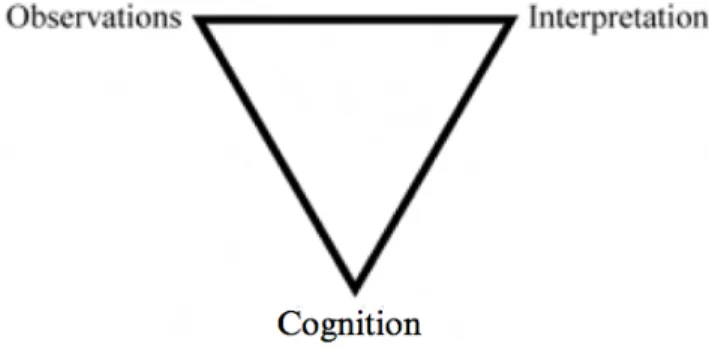
Figure 6. The assessment triangle. Adapted from “Rigorous methodology for concept inventory development: Using the 'assessment triangle' to develop and test the Thermal and Transport Science Concept Inventory (TTCI),” by R.A. Streveler, R.L Miller, A. I. Santiago-Roman, M.A. Nelson, M.R. Geist and B.M. Olds, 2011, International Journal of Engineering Education, 27, p. 969. Copyright 2011 by TEMPUS
Publications. 53
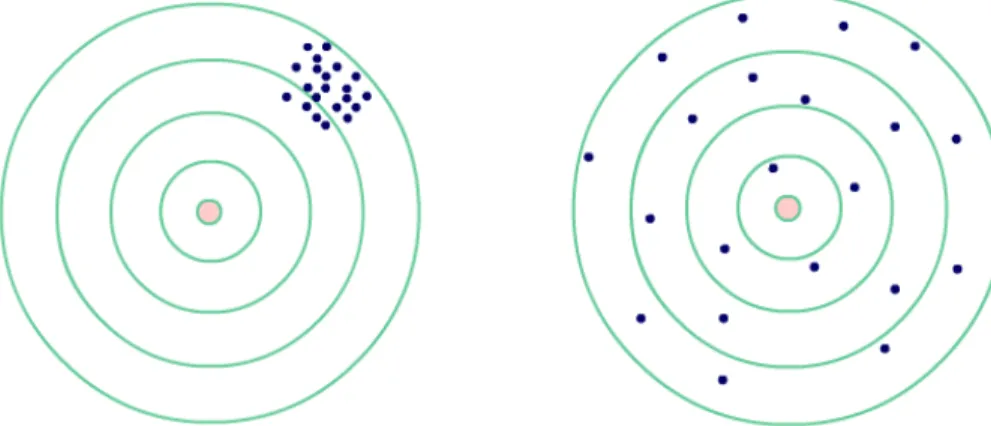
Figure 7. The target analogy for reliability (left) and validity (right). Adapted from Research Methods Knowledge Based by W. Trochim and J. P. Donnelly, 2007, Copyright 2008 by the Atomic Dog Publishing. 56
Figure 8. Scree plot. Factors vs Eigenvalues 61
Figure 9. Overall methodology. 68
Figure 10. Domain Analysis Triangle 69
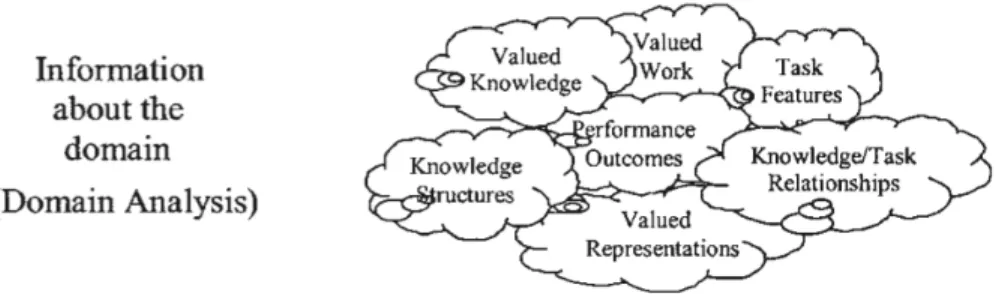
Figure 11. Components of the domain. Reprinted from “Focus article: On the structure of educational assessments,” by R.J. MisLevy, L.S. Steinberg, and R.G. Almond, 2003, Measurement: Interdisciplinary Research & Perspective, 1,p. 6. Copyright 2003 by Lawrence Erlbaum Associates,
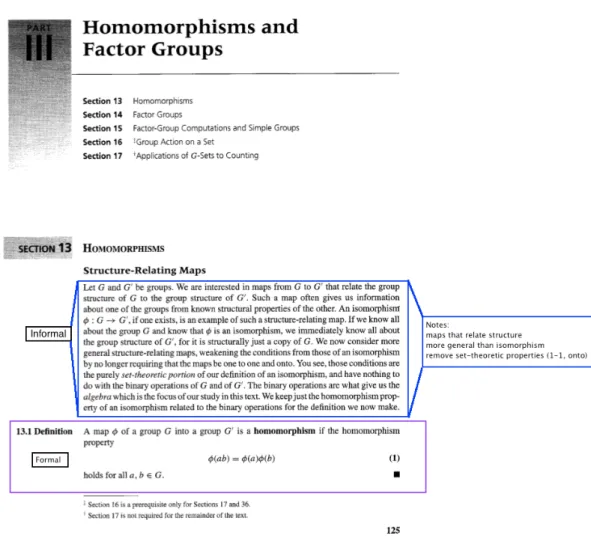
Figure 12. Example of formal and informal definition and descriptions of
homomorphism from Fraleigh (2002). 76
Figure 13. Homomorphism exercise from Fraleigh (2002). 77 Figure 14. Homomorphism example from narrative in Gallian (2009). 77 Figure 15. Overview of GCI creation methodology. 101
Figure 16. Domain analysis triangle. 102
Figure 17. Percentages of Exercises with each type of the six most prevalent
expected student activities. 111
Figure 18. Task creation and selection. 120
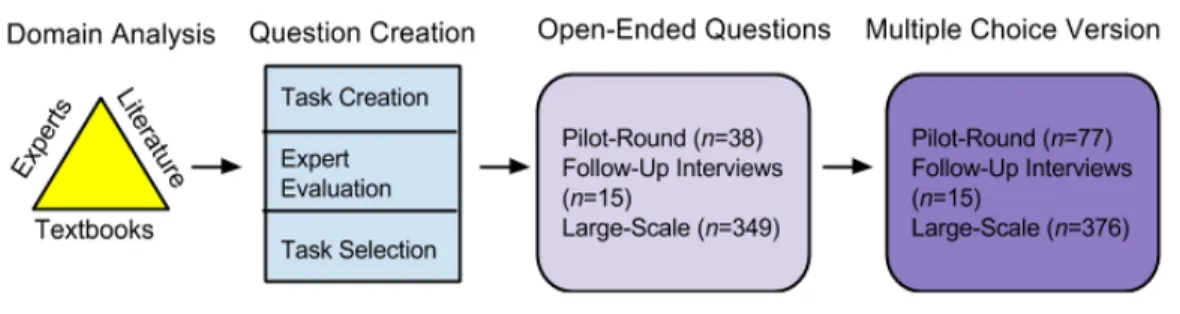
Figure 19. Open-ended (left) and multiple-choice (right) field testing. 127 Figure 20. Multiple-choice version of cyclic group question. 131 Figure 21. Open-ended version of the identity question. 132 Figure 22. Sample student work illustrating the problematic domain. 134 Figure 23. Multiple-choice question on identity. 134 Figure 24. Revised multiple-choice question on identity. 135 Figure 25. Original quotient group question. 136 Figure 26. Student with correct conception of elements in quotient groups. 137 Figure 27. Student with incorrect conception of quotient groups. 137 Figure 28. New open-ended quotient group question. 138 Figure 29. Scree plot illustrating the number of components in the GCI. 145 Figure 30. Bob’s work on the quotient group question. 165 Figure 31. Student response to subgroup question with differing element notation.
167 Figure 32. Proof that having a solution for x+x=b for all elements b in a group is
a structural property. 178
Figure 33. An ordering of the rationals to show they are countably infinite. 179
Figure 34. A bijective map from Z to Q. 179
Figure 35. Overview of GCI creation stages. 201
Figure 36. Question on Subgroups 204
Figure 37. Question of Quotient Groups 205
Introduction and Rationale
Abstract algebra is a standard course required of mathematics and mathematics education majors across the United States. For many students, this course is the first time concepts are to be reasoned about formally based on their properties (Hazzan, 1999). Dubinsky, Dautermann, Leron and Zazkis (1994) noted, “mathematics faculty and students generally consider it to be one of the most troublesome undergraduate subjects” (p. 268). While this statement is largely accepted, student understanding in the course has not been empirically evaluated on a large scale.
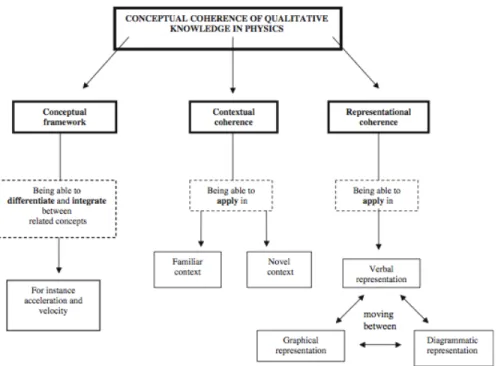
When the Force Concept Inventory (FCI) was introduced into the physics community, the state of students’ conceptual understanding was similarly not understood (Hestenes, Wells, & Swackhamer, 1992). The inventory was created to evaluate students’ conceptions of force via a validated and quick multiple-choice test. As a result, the test became widely used at the collegiate level. A concept inventory distills concepts from procedural and other knowledge to probe at a deeper level than many traditional assessments. Results from the FCI showed that students might do procedures correctly while still maintaining fundamentally flawed understandings of Newtonian force.
Advanced undergraduate mathematics education finds itself where the physics community was decades ago when the FCI was created. There is a body of research related to student understanding about abstract algebra, but it remains small scale. In general, the research falls into the categories of student
literature exists to describe mechanisms that could lead to concept acquisition (Dubinsky, 1997), student difficulties with proofs, abstraction and complexity (Dubinsky et al., 1994; Hazzan, 1999; Leron, Hazzan, & Zazkis, 1995; Selden & Selden, 1987; Weber & Alcock, 2004; Weber, 2001) and instructional innovations (Larsen, Johnson, & Weber, 2013; Dubinsky, 1997). However, these studies were primarily exploratory and often relied on in-depth interviews with small samples. Student conceptions in algebra have not been explored systematically or
comprehensively. In fact, Larsen, Johnson, and Bartlo (2014) have recently called for the “creation of validated assessment instruments” (p. 709) in group theory for the purpose of evaluating instructional innovations.
Recently, Weber (2013) similarly called for an increase of quantitative studies in the Research in Undergraduate Mathematics Education (RUME) community noting that qualitative studies dominate the undergraduate portion of the mathematics education community. Ideally, quantitative and qualitative methods could be used in a complementary fashion to establish both meaningful and generalizable results. The Group Concept Inventory (GCI) was created to address this call. The GCI is a quantitative measure created through both qualitative methods (such as interviewing students) and quantitative methods (such as item analysis and reliability - see methods section.) Ultimately, the validated tool serves a powerful purpose to complement qualitative explorations and evaluate larger populations.
Importance of Assessing Concept Understanding
The aim of the GCI is to assess conceptual understanding independent of proof skills. Proof is often the focus of assessment in advanced mathematics, ignoring the role of strong conceptual understanding. Attending to concepts is important for several reasons:
1. Understanding concepts in group theory is not trivial.
2. Understanding concepts is an essential part of advanced mathematics. 3. Understanding concepts is a necessary for a high degree of success in
proving.
The small body of literature related to abstract algebra has unanimously documents the difficulty of complete conceptual understanding of various topics. Dubinsky (1997) and his colleagues established that students frequently lacked advanced conceptions of topics in group theory ranging from groups to normality and quotient groups. Hazzan (1999) found that students struggled with abstraction level when dealing with objects in algebra defined solely by their properties. Students might use only one element of a set to evaluate a class of objects, or students might substitute information about familiar groups, such as the real numbers, to reason about unfamiliar groups such as modular arithmetic groups. Leron, Hazzan and Zazkis (1995) documented the struggles students have when coordinating the complexity of isomorphism such as differentiating between the idea of isomorphic groups and an isomorphism map. For a more complete discussion of student understanding see the literature review chapter.
Concepts play a vital role both in the formal proving process and independent from it. While formal proof may dominate assessment at the
advanced level, it is not the only important activity. Raman (1999) warned, “competence in mathematics might readily be misperceived as synonymous with the ability to create the form, a rigorous proof” (p. 60). When Weber and Mejia-Ramos (2011) explored what mathematicians did when reading proofs, they found their activities were rarely centered on verifying the formal deduction in proofs. Rather, they were testing examples, determining the big ideas and considering methods for their own use. These activities all require an understanding of concepts, instantiations, and relationships between ideas.
Even if the focus of a course is entirely on producing formal proof, conceptual understanding can be a mitigating and necessary component in the creation of valid proofs (Tall & Vinner 1981; Moore, 1994; Hart, 1994). Through a series of interviews with both students and mathematicians, Weber and Alcock (2004) found that undergraduates often relied on purely syntactic (symbol-pushing) proving strategies. Their undergraduates were limited in their approaches to proof and were unable to provide valid proofs and correct
evaluations a mathematical statement’s validity. In contrast, advanced graduate students would often utilize semantic strategies where they reasoned from instantiations. When prompted to assess whether groups were isomorphic, undergraduates were limited to trying to create a map and so failed to show groups were not isomorphic. Their graduate counterparts were able to reason about properties and easily determine when two groups were not isomorphic. Weber and Alcock identified several requirements related to concept
and concepts they represent” (p. 229). Further students need to be able to connect the formal definitions with instantiations. Having the formal definition of group and isomorphism alone was not a sufficient condition for students to be able to either describe isomorphism informally or utilize intuition to explore conjectures.
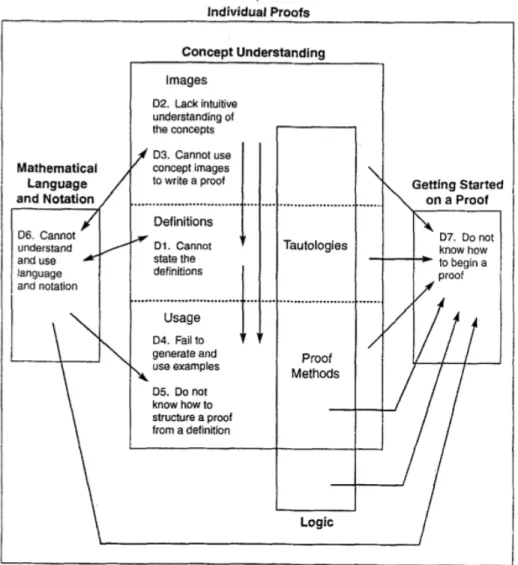
Moore (1994) explained several ways that understanding of concepts becomes important when proving. He gathered data from observing a transition to proof course and interviewing students from the class. He found the students had a multitude of concept-based errors. These include not being able to generate examples, lacking an intuitive understanding, not being able to use concept images to create formal proofs, and not knowing the appropriate definitions (See Figure 1).
Melhuish and Larsen (2015) illustrated how understanding of a particular concept (that of function) might play into the proving process. Students were prompted to prove or disprove the following claim:
Let ϕ be a 1-1 homomorphism from (G,o) to (H,*). If G is an abelian group, then H is an abelian group.
In order to prove this statement, one must show that all elements in H commute. The standard approach to the proof would be to begin by selecting arbitrary elements in H. However, Melhuish and Larsen found that many of the students began in G, ultimately failing to realize the claim was not true. During interviews, a student explained that functions must always map from the domain to range, and so starting in G was the proper way to begin the proof. This piece of their concept image seemed to be interfering with their ability to construct a valid proof.
Concepts play an important role in advanced mathematics. As objects are now defined solely on properties, students often struggle to achieve complete understanding of concepts. Understanding concepts plays a central role in mathematical activities such as using examples to make sense of formal
statements or exploring new conjectures. Furthermore, one’s concept image can interfere with the creation of valid proofs. Having syntactic strategies alone has been shown to be insufficient in many cases. For these reasons, concepts in advanced mathematics should not be neglected. Beyond their role in proof, understanding concepts themselves should be a major goal of introductory abstract algebra courses.
Purpose of Concept Inventories
Concept inventories have traditionally been used for three purposes: diagnostics, placement, and evaluating instructional innovation (Hestenes, Wells, & Swackhamer, 1992). While placement is not typically relevant at this advanced level, the other two purposes remain significant.
Figure 1. How conceptual understanding interferes with proving. Reprinted from “Making the transition to formal proof,” by R.C. Moore, 1994, Educational Studies in Mathematics, 27,p. 252. Copyright 1994 by Kiuwer Academic Publishers.
Diagnostics. As a diagnostic tool, the inventory can serve a useful purpose to establish the current state of group theory concept understanding and to provide specific feedback for instructors. Since the Force Concept Inventory was released, it has been used repeatedly to collect information about what conceptions physics students have. The inventory has been credited with helping to instigate the reform movement in physics education (Savinainen & Scott, 2002a). In the same manner, the GCI was designed for ease and widespread usage to document how students currently conceive of concepts in group theory.
The diagnostic usage also makes the GCI useful for individual instructors. Concept inventories go through careful validation to ensure the distractors for all questions are meaningful. If an instructor administered the assessment to their class, they would gain feedback as to which concepts are understood and where additional attention should be put. Further, as Svainainen and Scott (2002a) explained about the FCI:
We believe that the very conception and design of the FCI can help the teacher to come to know and to understand the conceptual terrain of this field of instruction (in terms of both conceptual learning goals and student misconceptions) and to thereby be in a much stronger position to sustain effective teaching and learning dialogues (p. 51).
Concept inventories and similar assessments can be a powerful tool as the questions themselves provide an outline of alternate conceptions. The instrument can serve to bring awareness to various student conceptions that may differ from instructor conceptions. Instructors might find insight into unexpected student conceptions that may not have been captured by traditional proof-based assessment.
Comparing groups and evaluation. Innovation efforts can be evaluated meaningfully with the GCI, a validated instrument. GCI scores in classes with differing instruction can be compared for significant differences. Furthermore, performance on individual questions may reflect the impact of varying
instruction.
With the FCI, this type of evaluation has been done at a larger scale to evaluate varying pedagogy and demographics. Docktor, Heller, Henderson, Sabella, & Hsu (2008) administered the FCI to 5,500 students to explore gender differences. Hoellwarth, Moelter and Knight (2005) compared traditional and studio classrooms looking at 6,000 students. The meaningful score from the FCI provides an easy way to compare groups. At a local level, an institution could evaluate conceptual understanding in their classes when implementing different types of instructional changes.
Conclusion. There are a few key facts that motivate the creation of this
instrument. First, conceptual understanding in abstract algebra is not trivial, but it is essential. Yet, we often fail to assess concepts and instead present formal proofs as the only means for assessing in advanced mathematics. Furthermore, within the field of abstract algebra, there are no validated instruments to try to measure student understanding. Validated instruments can serve a central role in evaluating improvement efforts, researching instructional innovations and providing insight into the current landscape of student understanding in abstract algebra.
Abstract Algebra Literature Review
Abstract algebra is traditionally considered a challenging course (Leron and Dubinsky, 1995). The difficulty with abstract algebra can be partially
attributed to the nature of the course’s content. Abstract algebra is a subject that is complex, abstract, and axiomatic. Many of the concepts such as isomorphism require a complex coordination of many ideas (Leron, Hazzan, & Zazkis, 1995). Additionally, the course is built around objects such as a groups that are discussed and argued about abstractly (Hazzan, 1999, 2001). Abstract algebra is built on an axiomatic system leading to an elevated use of definitions (Edwards & Ward, 2004) and central role of proof and logic (Hart, 1994; Selden & Selden, 1987). As noted by Weber and Larsen (2008), “For most undergraduates this course is one of their earliest experiences in coping with the difficult notions of mathematical abstraction and formal proof” (p.139).
Research on the teaching and learning of abstract algebra has only begun in earnest over the last twenty-five years. Most early work in the area can be attributed to Dubinsky and his colleagues’ who used their APOS (Action, Process, Object, Schema) framework to launch investigations into how students develop their understanding of major concepts of group theory (Dubinsky, 1997;
Dubinsky, Dautermann, Leron, & Zazkis, 1994). Since this initial research, several other researchers have expanded upon student understanding in continued efforts to improve instruction (Weber & Larsen, 2008). The majority of research on teaching and learning abstract algebra falls into one of two categories: student misconceptions and instructional innovations. In this literature review, I present
an overview of research on student conceptions within the themes of algebra as complex, abstract,and axiomatic. The review concludes with attention to the literature related to instructional innovation efforts.
Student Understanding in Abstract Algebra
The abstract nature of Abstract Algebra. As Hazzan (1999) pointed
out, “…it is in the abstract algebra course that students are asked, for the first time, to deal with concepts which are introduced abstractly” (p. 73). Being able to reason about objects exclusively from properties requires students to have
abstracted in some form. As Hazzan noted abstraction is discussed in a number of different manners in mathematics education. Abstraction can be understood in the development of objects. Tall (2004) addressed three different types of objects. Objects can arise through empirical abstraction where objects are studied in order to determine their properties, objects can arise through reflective abstraction where a process is encapsulated or compressed into an object, or objects can arise from the study of properties and their logical deductions.
Reflective abstraction. Reflective abstraction served as the underlying mechanism behind Dubinsky and colleagues’ instructional innovations and APOS framework. While other researchers have mentioned processes and objects in algebra (Harel & Kaput, 1991; Sfard & Linchevski, 1994), the APOSframework was the only theory explored empirically.
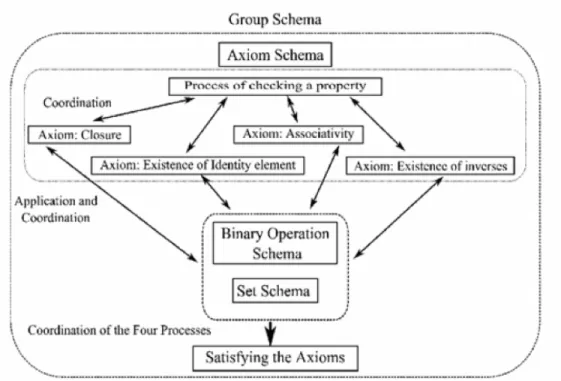
APOS provides a development sequence, or genetic decomposition,
students may use to make sense of mathematical concepts (Dubinsky et al., 1994). Dubinsky et al. summarize:
The essence of our theoretical perspective is that an individual, disequilibrated by a perceived problem situation in a particular social context, will attempt to reequilibrate by assimilating the situation to existing schemas available to her or him, or if necessary, use reflective abstraction to reconstruct those schemes at a higher level of sophistication (p. 269).
The levels of student conceptions fall into the categories of action, process, object, and schema. An action can be defined as, “any repeatable physical or mental manipulation that transforms objects in some way” (p. 270). Once the action can be understood as a whole (not each individual action needs to be taken), the action is interiorized and is now a process. A process can then be encapsulated into an object. This occurs when a process can be transformed by some action such as combining two processes. Equally important is the ability to de-encapsulate an object back to a process. An object should be more than a symbol but instead be able to be thought of as a process and object when
appropriate. A set of processes and objects are thematized to form a schema or a collection of objects and processes that can be used together.(Schemas are discussed further in the complexity section of this chapter.)
Dubinsky et al. (1994) developed genetic decompositions of various algebra topics. Consider their breakdown of coset formation. Coset formation can be an action in familiar settings. At this stage, a student might list each individual element in a coset. Dubinksy et al. used this student explaining ℤ18/<3>1, as an example of an action conception:
1 The cyclic group of 18 elements modded out by multiples of 3.
2 The eighteen topics were expanded to nineteen as cosets and quotient groups were separated to
Well, the number in front is what you add to each element inside the set. So zero added to these six elements would keep the same six. One [the number] added to each, which is in the first column, would give you the 1,4,7,10 and then you add 2 to these first the H which is 0 through
6,9,12,15. Then you add 2 to each and you get 2,5,8,11,14, and 17 (p. 16). This student began with the subgroup H={0,3,6,9,12,15} and added elements from ℤ18 one at a time to arrive at the elements in each coset. Coset construction can also be conceived of as a process where students associate each element with the subgroup without having to explicitly build the subsets. Dubinsky et al.’s process example student stated:
Ok, I interpreted this as 0+H, 3+… Every third element beginning with 0. So 1+H every third element beginning with 1 in ℤ18 and every third element beginning with 2. And that would generate all the elements that are in G (p. 16).
These students frequently noted patterns for constructing which might limit their ability to deal with less familiar groups. This example student made no progress when trying to find a quotient group of a dihedral group. At the object level, a coset could be conceived of independent of the process, becoming an object for new actions such as comparing size of cosets. Dubinsky et al. presented example students who never wrote out all of the elements of cosets and worked entirely with their representatives. Dubinsky and his colleagues also provided this type of genetic breakdown for binary operation (Brown, DeVries, Dubinsky, & Thomas, 1997), normality (Asiala, Dubinsky, Matthews, Morics, & Oktac, 1997), coset multiplication (Asiala et al., 1997), permutations (Asiala, Kleiman, Brown, & Matthews, 1998), and symmetries (Asiala et al., 1998). The researchers worked to validate the framework through analyzing student work on exams and
interviewing students. Their analyses found evidence that students were working at the various levels of sophistication. However, as noted by Hazzan (1999), reducing abstraction such as using processes over objects does not necessarily equate to misunderstanding or even a lack of understanding. Students may work at various levels in problem-solving context as a means for sense making and developing intuition.
Empirical abstraction. While reflective abstraction dominates the
literature, empirical abstraction can also be found. Simpson and Stehlíková (2006) focused on the alternate transition, or as they label shifts in attention, as students moved from examples to general reasoning. The sequence includes five shifts where students begin by seeing the elements of a set as objects to be operated on, then attend to the interrelationships between set elements, followed by attending to names and symbols defining the abstract structure, seeing other examples of the general structure and finally moving to a formal system to derive consequences. The authors noted that while the first shift may involve the reification of objects (in the APOS sense), the final three shifts “involve relating the definitional properties of the (teacher- defined) abstract algebraic structure with the
interrelationships noted in the initial example (and in subsequent instances of the structure)” (p. 352). This article focused primarily on the second shift defined as “the shift of attention from the familiarity and specificity of objects and
operations to the sense of interrelationships between the objects caused by the operations” (p. 352). The researcher presented one case study where a university student was given a non-standard definition of ℤ99 (a commutative ring). Through
extensive engagement with the context, the student was able to gain insight into structure. For example, the student confronted the idea of “opposite numbers” and was able to transition from subtraction to additive inverses arriving at 99-x being the additive inverse in ℤ99. Further, the student used this in calculations treating 3-7 as 3 +99-7. Simpson and Stehlíková claimed these shifts represent a change from focus on operations and objects to obtaining new structural properties.
This type of exploration of examples and abstracting properties is not unusual in instructional sequences. For example, Larsen et al.’s (2013) curriculum has students reinvent the group concept through exploration of a symmetry group. (A more complete discussion of this process can be found in the instructional innovation section.)
Reducing abstraction. Through interviewing algebra students from a traditional lecture-based class, Hazzan (1999) discovered that most students would work at a lower level of abstraction than what was introduced in class. Hazzan introduced a reducing abstraction framework to make sense of this activity. Within the framework are three interpretations for levels of abstraction.
The first level is Abstraction level as the quality of the relationship
between the object of thought and the thinking person. This interpretation takes an individualistic view where each person has a relationship with a concept based on a given level of familiarity. In the case of groups, students might work with familiar objects, such as a real numbers, instead of the unfamiliar concept of a newly introduced group. For example, in Hazzan’s study, a student decided that ℤ3 was not a group based on the fact that the inverse of 2, ½, was not found in ℤ3.
The student changed the operation of modular arithmetic to the familiar operation of real number multiplication. A similar error occurred when students commonly confuse normality with commutativity (Asiala et al., 1997). This type of reduction is consistent with Selden and Selden (1987) and Hart (1994) who addressed the potential errors in proofs caused by assuming that groups (or other structures) behave like real numbers or otherwise confused operations from unfamiliar to familiar.
The second interpretation is Abstraction level as reflection of the process-object duality. Hazzan (1999) asserted that conceiving of a concept as a process was at a lower abstraction level than conceiving a concept as an object. She suggested the use of first person as an indicator that the student was working in this lower level of abstraction. For example, a student explored the definition of quotient group stating, “I take all the elements [of H] and multiply them on the right with some element from G” (p. 81). In this way, she was not capturing quotient groups as a single object, but reduced the abstraction level to thinking about one step at a time.
The final interpretation is Abstraction level as the degree of complexity of the concept of thought. This type of reduction in abstraction occurred when a student would use one group when evaluating a set of groups. A non-generic example might be used to evaluate general statements about a class of objects leading the potential for overgeneralization. This type of reduction was also found in Selden and Selden’s (1987) taxonomy where students would argue about
elements when sets are appropriate such as arguing for gh=hg versus gH=Hg to establish normality.
Navigating abstraction level. Hazzan’s (1999) framework provided insight into three different ways that students may lower abstraction levels in group theory. Hazzan cautioned that reducing abstraction “should not be conceived as a mental process which necessarily results in misconceptions or mathematical errors” (p. 75). Rather, these activities serve as coping mechanisms prior to students developing the mental constructs needed to work with the abstract objects.
Lowering abstraction has also been illustrated when students reason using Cayley tables (Findell, 2002; Hazzan, 2001) and students leveraging diagrams to make sense of cosets (Nardi, 2000). Findell presented an interview case where a student used an operation table when determining if ℤ3 was a subgroup of ℤ6. The student began by creating what she called the “total table” (p. 1). After realizing she was unsure of the operation, the student made a table for multiplication, then ruled it out based on the 0 row. She then made the correct table and isolated the 0, 1, and 2 rows to correctly realize that this set was not closed. She even
spontaneously used the table to find subgroups. However, using the table limited the student to verifying one axiom at a time in an external manner (such as having to first hunt down the identity element from the table.) The use of this
instantiation might have been inefficient, but it served the purpose of reducing the abstraction level and making the properties of the group visible.
Weber and Alcock (2004) presented another important aspect of dealing with abstract objects. In their interview study with undergraduates and graduate students, they found graduate students flexibly navigating between formal, abstract representations, and concrete representations. Their undergraduate counterparts struggled to leave the formal plane. When determining whether groups were isomorphic, the undergraduates attempted to build maps using a symbol-pushing strategy labeled syntactic proof production. In contrast, doctoral students examined the groups for structural properties. The undergraduates had no intuition for what it meant for groups to be isomorphic. When asked, they stated the formal definition as equivalent to their intuition. All the experts espoused the intuition that isomorphic groups are essentially the same groups with renaming. When determining if ℚ and ℤ were isomorphic, the undergraduates (upon determining the cardinality) attempted and failed to build an isomorphism. In contrast, the doctoral students immediately determined the statement as false and largely used the cyclic nature of ℤ and not ℚ as their reasoning. The authors labeled the graduates’ attempts as semantic proof production where “the prover uses instantiation(s) of the mathematical object(s) to which the statement applies to suggest and guide the formal inferences that he or she draws” (p. 210). Weber and Alcock showed navigating between the formal language and instantiations can provide needed intuition and illustrated that undergraduates may not have developed robust images of abstract concepts to do so successfully.
Zazkis, Dubinsky and Dauthermann (1996) presented a dichotomy similar to the semantic and syntactic proof production. The researchers used student
exploration of D4 to differentiate between visual and analytic approaches. They defined visualization as “an act in which an individual establishes a strong
connection between an internal construct and something to which access is gained through the senses” (p. 441). In contrast, an analytic act “is any mental
manipulation of objects or processes with or without the aid of symbols” (p. 442). While not restricted to proof productions, the authors use analytic and visual in a parallel way to Weber and Alcock. Any diagrams or drawings constitute visual acts. In contrast, when “symbols are taken to be markers for mental objects and manipulated entirely in terms of their meaning or according to syntax rules, then we take the act to be one of analysis” (p. 442). In this way syntactic proof
production could be labeled analytical. Zazkis et al. interviewed students with the prompt to find the elements of D4. They found that some students took a visual approach: using a square. Other students took analytic approach: writing down all permutation possibilities. Zazkis et al. challenged the dichotomy explaining analysis required both visual (connecting to the square) and analytical (labeling vertices). The authors conclude by presenting a model where students flexibly move between visual and analytic acts advocating for students to move flexibly between concrete and abstract.
The complex nature of Abstract Algebra. In addition to being abstract,
concepts in abstract algebra have a high level of complexity. By complexity, I mean the number of aspects needed to be coordinated to understand and use a concept. In APOS terminology, this aligns with schemas. A person’s schema for a topic is “all of her or his knowledge connected (explicitly or implicitly) to that
topic.” A schema could be roughly equivalent to a concept image in the sense of Tall and Vinner (1981).
Even the fundamental concept of group requires an understanding of nontrivial concepts: set, binary operation (see Zaslavsky & Peled, 1996),
associative property (see Larsen, 2010), identities, and inverses. Dubinsky et al. (1994) discussed some understandings and misunderstandings of groups and subgroups based on exams and student interviews from classes using their APOS-informed curriculum. Similar to students focusing on one simple structural property preserved by isomorphism as discussed above, Dubinsky et al. found students would often only attend to the set aspect of groups. Several students thought any set of three elements was the same group and that any subset of a group would be a subgroup. The authors attributed this difficulty to students trying to relate the unfamiliar concept of group with the familiar concept of set. Students with this conception were not yet coordinating the operation and set aspects of group. Dubinsky et al. also provided a genetic decomposition for quotient groups, which required coordination of new concepts: normality, cosets, and coset operation (via representatives). Students struggled to make sense of normality (confusing it with commutativity) and struggled to build cosets even with an understanding of normality. Siebert and Williams (2003) considered some of the complexity of cosets and quotient groups in terms of modular arithmetic groups. They found students had three conceptions around the cosets in this quotient group. The cosets could be viewed as infinite sets, they could be viewed as a representative element and a set, or just as the representative element.
Dubinsky et al. concluded their paper by commenting, “It is clear from our interview transcripts that an individual’s understanding of the elementary concepts connected with mathematical groups is quite complex” (p. 294). They continued stating that even in the beginning of abstract algebra, constructing understanding is a major cognitive development.
Leron, Hazzan, and Zazkis (1995) explored the issue of complexity in the context of isomorphism. They attested that for students in their first abstract algebra course, “isomorphism is a complex and compound concept, composed of and connected to many other concepts, which in themselves may be only partially understood” (p. 53). At the basics of the definition, students must understand quantifiers, functions, and groups. There are also some important distinctions such as the concept of two groups being isomorphic and the isomorphism itself, the formal definition and the naive definition, and proving groups are isomorphic versus proving groups are not isomorphic. When asked if two groups are
isomorphic, students used the order type. The order type is the respective orders of the elements in a group, so the order type of ℤ4 would be 1, 2, 4, 4. This approach would only be valid to show two groups with different order type are not isomorphic. Two groups that are not isomorphic could have the same order type. Leron, et al. attributed this confusion to one of three causes: neglecting all other properties for the simple and comfortable one, the fact that order type is sufficient for many small finite groups, or a confusion between a statement and its converse.
Leron, et al. (1995) went on to differentiate between two types of
complexity: syntactical and computational complexity. When the students were asked what properties were preserved with isomorphism, they tended to list commutativity first and order of elements last. However, when asked to actually determine if two groups are isomorphic, students began by testing order of the elements and ended by determining if the groups are commutative.
Commutativity was identified as syntactically simpler meaning it has simpler definition. However, computationally, showing all elements commute involves a global property, which takes more work the “step-by-step nature of order-type calculations” (p. 168).
Leron, et al. (1995) presented one more aspect of the complexity of isomorphism concept by investigating how students construct isomorphisms. They found students desired a canonical procedure and would get stuck if there were more than one way to proceed. This may reflect the quantifier in the definition where “there exists a function” could be interpreted as “there exists a unique function” or simply a lack of comfort with uncertainty. Additionally, “there exists a function” was expressed in three ways: “I can find a function,” “it is possible to find a function,” and “there exists a function” (p. 170). These phrasings may represent different levels of development for quantifiers. In a parallel manner, students may express a process or object view of the map with phrases ranging from, “Each element of G to each element of G” (mapping each element individually) to a map from “G to G” (seeing the map as an object
relating the sets.) The authors established some of the many coordinations students need to make in order to properly deal with isomorphism.
Nardi (2000) also tackled some of the complexities in group theory addressing the concept of order and the First Isomorphism Theorem. Through observation of tutoring sessions, Nardi found that order applying to both groups and elements was a potential point of confusion. When working with a prompt requiring order, the student explained, “I don’t understand how an element can have an order” (p. 173). While the student was comfortable with order of a group, the concept did not make sense applied to an element even after the tutor provided the definition from class (smallest integer k such that gk=e). Further, the tutor
attempted to connect the two types of order by showing that |<g>|=|g|. To make sense of this statement, the student had to use the group generated by g evoking additional concepts such as a cyclic group and using the operation correctly. (In this case, the student struggled to transition between additive and multiplicative notation, a struggle termed notational inflexibility by Selden and Selden (1987).) At each stage, the tutor seemed to have to unpack more and more concepts that were hidden in the simple statement: |<g>|=|g|.
Nardi (2000) then identified the First Isomorphism Theorem “as a
container of compressed conceptual difficulties.” The students had to coordinate multiple mappings, concepts of isomorphism, homomorphism, quotient groups, and kernel. They struggled at nearly every stage of proving this theorem from notation (the meaning of ~) to the definition a kernel. The complexity of the order
of an element and the complexity involved in the First Isomorphism Theorem presented barriers for the students in Nardi’s study.
Strategic knowledge. Schemas are also utilized in problem solving. “When a person confronts a mathematical problem situation, he or she evokes a Schema and makes use of some of its components and some relations among them to deal with the situation” (Arnon et al., 2013, p. 112). Weber (2001) dealt with this issue in terms of strategic knowledge. Strategic knowledge can be defined as, “heuristic guidelines that they can use to recall actions that are likely to be useful or to choose which action to apply among several alternatives” (p. 111). Weber identified three types of strategic knowledge used in abstract algebra: Knowledge of the domain’s proof techniques, Knowledge of which theorems are important and when they will be useful, and Knowledge of when and when not to use ‘syntactic’ strategies. With each concept comes a set of appropriate
techniques. If one wants to show something is a group, then the group axioms should be invoked. If one wants to show groups are not isomorphic, then structural properties should be examined. Through interviewing graduate and undergraduates, Weber found undergraduates often lacked the knowledge of when to use theorems. When evaluating a prompt about surjective homomorphisms, the four doctoral students all made use of the First Isomorphism Theorem
immediately. Only two of the four undergraduates did and only after substantial struggle. The undergraduate students in Weber’s study largely reverted to syntactic strategies that did not prove fruitful. These strategic knowledge issues were consistent with Hazzan (1999) who found students misapplying Lagrange’s
theorem. Strategic knowledge is intimately tied to the complexity of the subject where when and how to use a theorem or various strategies needs to be integrated into students’ schema.
These episodes highlight just how complex some of the topics are in abstract algebra. The compactness of formal mathematics can act to obscure the complexity of concepts and theorems in introductory courses where students have yet to develop the necessary mental constructs.
The axiomatic nature of Abstract Algebra. For many students, abstract
algebra is one of their first encounters with axiomatic systems and formal proofs. Much of the research related to abstract algebra has been in the context of proof.
Definitions. Edwards and Ward (2004) reported on the role definitions play in formal mathematics. The authors distinguish between extracted and stipulated definitions. The everyday use of definition is typically extracted. The definition describes something that already exists. In contrast, stipulated
definitions can serve to create new concepts via stipulating defining properties. Through task-based interviews, the authors found students often fail to understand the role of definitions in mathematics where they are stipulated rather than
extracted. Using Tall and Vinner’s (1981) concept image and concept definition framework, Edwards and Ward illustrated that students rarely use the idealized model of development: building the concept image from the concept definition. Using the context of coset multiplication, the authors found that even when students knew the formal definition, they proceeded to operate using an incorrect concept image (such as the operation as unioning.) The students both professed an
explicit desire for definitions to describe something and failed to use definitions instead, appealing to informal concept images.
Lajoie and Mura (2000) addressed this issue in the context of cyclic groups. They found that their students were not using the formal definition to reason about cyclic groups, but rather their intuitive idea about cycles. The students largely explained the idea of generating as repeatedly operating an element with itself. As a result, students did not correctly address infinite groups. Of 28 student responses, they found 18 students thought ℤ was not cyclic. In ℤ, if one begins with an element such as 1 and operates 1 with itself, only the positive numbers are generated. The element will not “cycle” back around. Many students concluded that all cyclic groups are finite. If the students had leveraged the formal definition, which includes taking all positive and negative powers of one, they may have been able to appropriately deal with this infinite case.
This is consistent with Moore (1994) who found students were not able to use concept images to appropriately inform proofs and were unable to use
definitions to determine the structure of proofs. Students who could state the definition of one-to-one were still unable to see how to use the definition to prove that a function was one-to-one. The statement of the formal definition alone was not sufficient to make sense and leverage the definition. This result was echoed by Wheeler and Champion (2013) who found students largely unable to prove one-to-one and onto results.
Hart (1994) presented a similar definition-type proof. The prompt was to show a set and operation form a group which Hart deemed a satisfy axioms proof.
Similar to the other researchers, Hart found that beginning undergraduate students often struggled with this basic proof type. This was not the case for more
advanced students indicating that at some point a transition occurred where students do gain the requisite understanding to deal with these proofs (or potentially, these are just the students that survived to graduate studies and advanced courses).
Logic and quantifiers. Beyond not understanding the role of definitions,
some of the failure to use them correctly might be attributed to a lack of comfort with logic and deduction. Selden and Selden’s (1987) taxonomy explored many of the errors their abstract algebra students made during the proving process. Some errors included starting with the conclusion and being unaware that two
differently named elements might not be different (an important distinction when showing that cosets form a partition). Additionally, the Seldens included the use of the converse of a theorem. This mistake is frequently associated with
Lagrange’s Theorem (Hazzan & Leron, 1996) where students make claims about the existence of subgroups of various orders. Another major error found in abstract algebra proofs is weakening the theorem. Selden and Selden had observed students frequently adding assumptions such as a group being finite or cyclic without an awareness of the alteration to the conjecture they are proving. While most of these errors have not been studied extensively, Selden and Selden (1987) mentioned a major source of error that has been researched: quantifiers. As discussed in the complexity section, quantifiers are a necessary prerequisite to even make sense of definitions. Students are known to struggle
with quantifiers (Dubinsky & Yiparaki, 2000). Selden and Selden (1995)
illustrated that students were often unable to unpack informal statements- convert statements from their informal (but typical) statement of a theorem to a formal style that revels the quantification scheme. This is a key step to selecting a proof framework which Selden and Selden (1995) define as, “the ‘top-level’ logical structure of a proof.” This issue of quantification is relevant both for its necessary role in proving, and maybe more substantially, its necessary role in understanding definitions. The concept of one-to-one discussed above is often defined: A
function f: A→B is 1-1 if for all x ≠ y in A, f(x) ≠ f(y). While one might have a concept image of one-to-one (such as the horizontal line test), to use and
understand this definition in a formal way requires a firm understanding of quantification. Novotná, Stehlíková, and Hoch (2006) presented a framework addressing some quantification issues related to binary operation understanding. They addressed the role of quantification in understanding the definition of identity elements. An element e is an identity for a given operation in a set if it fulfills the property ex=xe=x for allx in the set. They provided an example operation where students may identify the identity element as an expression depending on x. An identity must be the same for all elements in the set. Without an understanding of quantification, this difference may not be apparent.
In group theory, students are not only grappling with complex, abstract objects, but often are struggling to work in a formal system.
Prior to the 1990s, there were a few scattered articles on instructional innovation related to abstract algebra. Notably, Lesh (1976) provided a
quantitative analysis comparing the influence of two types of organizers for the topic of finite groups. Through videos, four groups of students were exposed to finite groups in one of four combinations: either before the formal definition (advanced organizers) or after (poster organizers) and the organizers were either examples or counterexamples. Students did better when given advanced
organizers and when given counterexamples. Lesh argued that the typical approach of providing just examples and not counterexamples was not ideal for students to make abstractions.
APOS theory and programming. The genetic breakdowns discussed
above served as a driving force to create curriculum that would transition students through the stages to achieve advanced understanding of concepts. Dubinsky and his colleagues have proposed an instructional approach utilizing computer
programming. This instructional approach was developed through the creation of genetic decompositions that were refined through two cycles of implementations of programming-based classes and reflections on student interviews (Dubinsky 1997; Dubinsky et al., 1994).
The classes utilized the ACE teaching cycle (Activities, Class discussion, and Exercises). Students constructed computer programs to explore mathematical concepts and then worked in groups for problem solving and discussion. The computer programming language ISETL allowed for the computer to do the
processes and then for processes to be used as inputs, ideally encouraging the transition from a process conception to an object conception.
Early in the course, students programed group axioms where a set and an operation are inputs and output would be true or false for closed, associativity, identity and inverses. Then a program (is_group) would input the set and
operation into the four previous programs for each axiom to determine if they set and operation form a group (Leron & Dubinsky, 1995). Students then explored ℤn under multiplication and addition (with and without zero). Leron and Dubinsky argued that their programming language was similar to mathematical definitions where a set of axioms must be met. The quotient group concept was similarly developed through programing. Students would create a program oo:=PR(G,o) where a group and operation are inputted. Then oo would take inputs that are group elements or subgroups. Inputs of an element and subgroup would calculate a coset (Asiala et al., 1997).
Through programming, Leron and Dubinsky claim there is “a good chance that a parallel construction will occur in the their mind” (p. 230). However, the data comes from exams and interviews without analysis of what students were doing when engaging with the programing. Furthermore, although students are reported to have performed marginally better than a control group of students from a lecture class, there was no attempt to document any significant differences (Brown et al., 1997).
Guided reinvention and emergent models. Larsen has spearheaded the
concepts beginning with their own informal knowledge (Larsen, Johnson, & Weber, 2013). Larsen designed his curriculum based on the Realistic Mathematics Education design heuristics of guided reinvention and emergent models, as well as proofs and refutations (Larsen & Zandieh, 2008). Larsen aimed to leverage student strategies in such a way that they transition from using models of situated activity to models for more general activity. (See Cook (2014) for a case where RME design heuristics are used in a Ring Theory design experiment.)
The curriculum was built through iterations of development and
implementation. A series of small-scale design studies with pairs of students were conducted with the goals of discovering students’ informal knowledge and
strategies that can anticipate formal concepts. Additionally, Larsen worked to develop instructional activities to evoke these strategies and activities to help students use strategies to transition to formal concepts. The first iteration led to the development of a local instructional theory for group and isomorphism. After implemention in the classroom, a new second small-design experiment was conducted to build local instructional theories for quotient group. At this point Larsen and his team developed a full curriculum and worked to implement the curriculum in a multitude of group theory classes (Larsen, et al., 2013).
The instructional sequence begins with students working to identify the symmetries of a triangle leading to the creation of an operation table (Larsen et al., 2013). While searching for relationships and patterns to calculate
combinations of symmetries, the students discovered the group axioms and discovered the property that each symmetry appears once in each row and column
(a motiving factor to establish the inverse axiom (Larsen, 2009).) Through investigating other groups for common structure, the students arrive at the definition for group that is then used for deductive activity. A similar process occurs with isomorphism where students are given “mystery group” tables and must determine if they are the same as the order 6 dihedral group (the symmetries of a triangle.) This activity culminates in a formal definition for isomorphism.
The quotient group sequence begins with students exploring the sets of even and odd numbers. The students leverage this understanding to find partitions of the dihedral group that would behave like even and odd numbers. Dubinsky et al. (1994) illustrated that students struggle with quotient groups and their set elements. Larsen and Lockwood (2013) showed how students might overcome this challenge. Consider the following episode from Larsen’s initial teaching experiment. At this point the students are making sense of a table with two elements: flips and rotations (of a square.) Initially, the student said it had eight elements.
Teacher/Researcher: What if I said it had two? Rick: Then it wouldn’t be a group.
Sara: Well if you want to make meta-groups [student name for quotient groups]
Teacher/Researcher: Ok, let’s make meta-groups
Rick: No, wait, maybe it would be a group it would be a group now for me (p. 732).
Sara quickly agreed and when the teacher/researcher asked what the elements of the group were, Rick replied, “Rotations and flips. My identity would be
points illustrating how Larsen’s curriculum directly aims to support some of the difficulties established in prior studies.
Each concept reinvention is followed by a deductive phase where students prove conjectures and arrive at important consequences such as the normality requirement for the creation of quotient groups. Unlike Dubinsky (1997), each of the curriculum stages was illustrated with corresponding episodes providing insight into how students engage in the mathematical activities (Larsen, Johnson, & Weber, 2013).
As in the case of Dubinsky (1997), the effect of this instructional method is not well-documented. Larsen et al. (2013) did compare student responses on a quotient group survey administered to eight classes using the curriculum and six classes that did not. Students in the experimental classes were significantly more likely to correctly assess if a subgroup could be used to form a quotient group from a table. Furthermore, the students from traditional classes only used
normality as justification; the experimental class’s students were equally likely to address the set operation not being well-defined. As noted by Larsen et al., there is still a lot of evaluation work to be done.
A note on other research in Abstract Algebra classrooms. Beyond this
instructional innovation research, there also exists a body of research where the abstract algebra setting was used as a means to explore other aspects of teaching or learning. For example, Cnop and Grandsard (1998) and Grassl and Mingus (2007) implemented cooperate work in the abstract algebra classroom but did not report on the content or student learning. Other objectives such as teacher
listening (Johnson & Larsen, 2012), sociomathematical norms (Fukawa-Connelly, 2012), and student-tutor relationships (Jaworski, 2002) have been studied in an abstract algebra context. However, these papers largely lie beyond the scope of this literature review because their focus was not on student learning of algebra concepts either through exploration of their understanding or content-related instructional innovations.
Conclusion
The body of educational research in abstract algebra focuses largely on incorrect student conceptions and instructional innovations. Several studies focus on proof in the context of abstract algebra (Hart, 1994; Selden & Selden, 1987; Weber & Alcock, 2004; Weber, 2001). Another batch of studies explores aspects of student difficulty such as with abstraction (Hazzan, 1999), complexity (Leron et al., 1995), or process-object duality (Dubinsky et al., 1994). There is also literature sharing research-grounded instructional innovations, most notably Larsen et al. (2013) and Dubinsky (1997).
This leaves a lot of areas for continued research. First, APOS theory is the only thoroughly explored mechanism for concept acquisition. The sequence action, process, object, and schema may not be the only means of object construction (Tall, 1999). Of note, empirical abstraction may have a more substantial role than has been explored. The APOS framework also has the limitation of being purely cognitive. Although, recently Johnson (2013) has contributed a theoretical paper for analyzing learning in classrooms informed by