DIGITAL LEARNING OBJECTS: DESIGN FOR LEARNING
A thesis submitted in partial fulfilment of the requirements for the Degree
of Master of Education in the University of Canterbury
by Nicholas Anthony Ford University of Canterbury
iii Table of contents
Table of contents ... iii
Acknowledgements ... viii
Abstract ... ix
Glossary ... x
Chapter 1 Introduction ... 1
Chapter 2 Literature review ... 8
2.1 Introduction ... 8
2.2 Cognitive theories of multimedia learning and DLO design ... 9
2.2.1 Dual coding theory ... 9
2.2.2 Cognitive load theory ... 11
2.2.3 Cognitive theories of multimedia learning ... 13
2.3 The modality principle ... 21
2.3.1 A cognitive mechanism for the modality effect ... 27
2.3.2 A perceptual mechanism for the modality effect ... 27
2.4 Other multimedia design principles ... 29
2.4.1 Principle of spatial contiguity ... 29
2.4.2 Principle of temporal contiguity ... 30
2.4.3 The individual differences principle ... 31
2.4.4 The coherence principle ... 32
2.4.5 The redundancy principle ... 32
2.4.6 The segmenting principle ... 33
2.5 Applying the principles of multimedia design ... 34
iv
2.7 Conclusion ... 37
Chapter 3 Methodology ... 39
3.1 Introduction ... 39
3.2 Case study methodology ... 39
3.2.1 A mixed methods approach ... 40
3.3 The design phase ... 43
3.3.1 Development of the forces of flight DLO ... 43
3.3.2 Design phase participants ... 48
3.3.3 Design phase data collection ... 48
3.4 The experimental phase ... 48
3.4.1 Research phase participants ... 49
3.4.2 Data collection ... 50
3.4.3 Pre and post assessment ... 52
3.4.4 The user perception survey (UPS) ... 54
3.4.5 Interviews ... 55
3.5 Ethical considerations ... 57
3.6 Limitations ... 57
Chapter 4 Results ... 59
4.1 Introduction ... 59
4.2 Design phase results ... 60
4.2.1 Analysis of design phase results ... 62
4.3 Experimental phase results ... 63
4.3.1 Case one: Visual variant ... 63
v
4.3.3 Data collection ... 63
4.3.4 Pre- and post-test scores ... 64
4.3.5 User perception survey (UPS) ... 65
4.3.6 Interviews ... 66
4.4 Case two: Audio variant ... 77
4.4.1 Participants ... 77
4.4.2 Data collection ... 77
4.4.3 Pre- and post-test scores ... 77
4.4.4 User perception survey ... 79
4.4.5 Interviews ... 80
4.5 Case three: Audio-visual variant ... 87
4.5.1 Participants ... 87
4.5.2 Data collection ... 87
4.5.3 Pre and post-test scores ... 88
4.5.4 User perception survey ... 89
4.5.5 Interviews ... 90
Chapter 5 Discussion ... 99
5.1 Learning ... 99
5.2 Modality and learning ... 100
5.3 User perceptions ... 104
5.4 Engagement ... 106
5.4.1 Click and drag interactivity ... 107
5.4.2 Self pacing ... 109
vi
5.6 Usability ... 113
5.7 A visual model of DLO design ... 114
Chapter 6 Conclusion ... 118
6.1 Limitations of this study ... 119
6.2 Recommendations for future research ... 120
References ... 122
Appendix 1: Case 1 (visual) results of Wilcoxon signed ranked test ... 133
Appendix 2: Case 2 (audio variant) results of Wilcoxon signed ranked test ... 135
Appendix 3: Case 3 (audio-visual variant) results of Wilcoxon signed ranked test .. 137
Appendix 4: User perception survey questions ... 139
Appendix 5: Interview questions ... 140
Appendix 6: Information letters ... 141
Appendix 7: Consent form ... 143
Appendix 8: Permission to adapt DLO ... 144
Tables Table 1. Clarification of key terms ... xii
Table 2: Pre and post assessment scores for the visual variant. ... 64
Table 3: User perception survey for the visual variant. ... 65
Table 4: Pre and post assessment scores for the audio variant. ... 77
Table 5. User perception survey results for the audio variant group ... 79
Table 6. Pre and post assessment scores for the audio-visual variant group. ... 88
vii Figures
Figure 1. Cognitive processing of words and pictures ... 14
Figure 2. Cognitive-affective theory of learning with media ... 16
Figure 3. Example of the split attention effect ... 18
Figure 4. Cognitive processing for written and spoken words ... 25
Figure 5. Original forces of flight DLO ... 44
Figure 6. The DLO authoring environment ... 45
Figure 7. Visual variant of the forces of flight DLO ... 46
Figure 8. Screenshot of the research website ... 51
Figure 9. The online pre and post assessment ... 53
Figure 10. Cognitive load with spoken and written words ... 101
viii Acknowledgements
I wish to thank the many people who have contributed to the completion of this research. Firstly, I would like to acknowledge the contributions of all participants who supported this study. I am sincerely grateful to my supervisors, Doctors Chris Charleston-Astall and David Winter for their direction, contributions and challenges throughout my Masters journey. I also wish to thank my fellow post-graduate students and the University of Canterbury for supporting me in my studies. Finally, I am truly grateful to my family and friends for supporting me throughout my studies.
ix Abstract
This research investigated relationships between the information presentation modality of a digital learning object (DLO) and learning. It also investigated relationships between DLO design features and participants perceptions of learning. DLOs are a type of learning material defined for the purposes of this research as ‘digital, multimedia learning materials that support the learning of specific concepts by enhancing, amplifying, and guiding the cognitive processes of learners’. In this research participants used one of three DLO variants that presented information about the forces affecting an airplane in flight. Each variant presented identical information but used a different modality. The information presentation modalities were, on screen text and an illustration, narrated text and an illustration, and on screen text and narrated text and an illustration. Using a mixed method case study methodology, data was gathered using pre and post assessments, an online user perception survey (UPS), and one to one interviews. Within the limitations of this research, the results suggest that use of any variant of the forces of flight DLO influenced participants learning. The modality and other DLO design features, such as interactivity, also influenced learning and participants’ perceptions of learning. The researcher argues for the need to consider the cognitive and affective processes of learners when creating DLOs. A need for further research that explores the effects of different DLO designs upon learning is identified.
x Glossary
This section provides clarification of some of the key terms used in this research. Cognitive affective theory of learning
from media (CATLM) Moreno (2006)
A theory that proposes that people learn from pictures and words. This theory is based upon the assumptions; people have separate channels for processing visual and verbal information, each channel is limited in capacity, learning involves active cognitive processing and learning from words and pictures is influenced by the beliefs and emotions of learners Cognitive theory of multimedia
learning (CTML) Mayer (2005, 2014)
A theory that posits that people learn from pictures and words. This theory is based upon the assumptions; people have separate channels for processing visual and verbal information, each channel is limited in capacity, and that learning involves active cognitive processing. Cognitive load theory (CLT)
Sweller (1998, 2005)
Sweller, J., Ayres, P., & Kalyuga, S. (2011)
An instructional theory that considers the limitations of working (short-term) memory.
Cognitive capacity Mayer (2005, 2014)
The total amount of work that can be supported by a learner’s working (short-term) memory.
Coherence principle Mayer (2005, 2009, 2014)
States that people learn better when non-essential material is excluded.
xi Digital Learning Object (DLO)
Kay & Knaach (2007, 2012) Kay (2012)
Digital, multimedia learning materials that support the learning of specific concepts by enhancing, amplifying, and guiding the cognitive processes of learners.
Dual-coding theory (DCT) Paivio (1986, 2007)
Clark & Paivio (1991)
Refers to dual channels used in the sensing, mental processing and storing of visual and verbal information.
Long term memory Sweller (1998, 2005)
Sweller, J., Ayres, P., & Kalyuga, S. (2011)
A memory store that holds large amounts of information. In contrast to working (short-term) memory the long term
memory can store information indefinitely and is unlimited in its capacity.
Mental model Sweller (1998, 2005)
Sweller, J., Ayres, P., & Kalyuga, S. (2011)
A mental representation of some concept that is stored in the long-term memory.
Modality principle Mayer (2005, 2014) Sweller (2005)
Proposes that people learn better from text and pictures if the text is presented as spoken rather than written text. Multimedia instruction
Mayer (2001, 2009)
The presentation of information as pictures and words intended to promote learning.
Multimedia principle Mayer (2001, 2009)
Describes how people learn from words and pictures. The principle states that people learn better from pictures and words than from words alone. Presentation design
Churchill (2007, 2013, 2014)
The arrangement of content and screen design features of digital learning objects.
xii Prior knowledge principle
Mayer (2005, 2009, 2014)
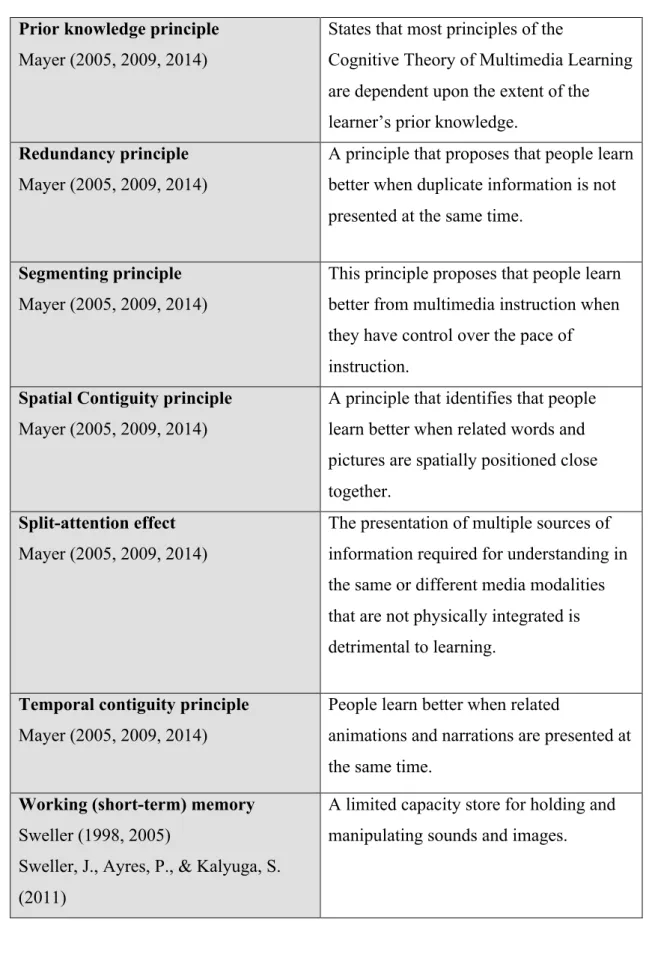
States that most principles of the
Cognitive Theory of Multimedia Learning are dependent upon the extent of the learner’s prior knowledge.
Redundancy principle Mayer (2005, 2009, 2014)
A principle that proposes that people learn better when duplicate information is not presented at the same time.
Segmenting principle Mayer (2005, 2009, 2014)
This principle proposes that people learn better from multimedia instruction when they have control over the pace of instruction.
Spatial Contiguity principle Mayer (2005, 2009, 2014)
A principle that identifies that people learn better when related words and pictures are spatially positioned close together.
Split-attention effect Mayer (2005, 2009, 2014)
The presentation of multiple sources of information required for understanding in the same or different media modalities that are not physically integrated is detrimental to learning.
Temporal contiguity principle Mayer (2005, 2009, 2014)
People learn better when related
animations and narrations are presented at the same time.
Working (short-term) memory Sweller (1998, 2005)
Sweller, J., Ayres, P., & Kalyuga, S. (2011)
A limited capacity store for holding and manipulating sounds and images.
Chapter 1 Introduction
This chapter begins by providing an overview of the context and rationale of this study and then introduces key concepts underpinning this research. The chapter concludes with the identification of the relevance of this study to learning and teaching.
Learning and teaching in the 21st Century
Prior to the 21st century, education was typically teacher centric with content transmitted from the teacher to the learner (Wan and Gut, 2011; OECD, 2009). The advent of powerful and accessible information and communication technologies (ICTs) e.g. computers and the internet in the late 20th Century, the accompanying technology driven rise of globalism and advances in psychology and the neurosciences have contributed to the emergence of a new view of learning as learner centric, active, and collaborative (OECD, 2013; Orlando, 2012; Wan and Gut, 2011; Mayer, 2001, 2005, 2009). The evolution of education from a traditional lecture-by-expert model of instruction to learner centric pedagogies requires a shift in the roles and attitudes of teachers (Wismath, 2013). Although there is contention as to the degree to which teachers are engaging in a process of evolving their teaching practice (Orlando, 2012), the impact of digital technologies upon teaching and learning is evidenced by the proliferation in the use of educational digital resources made available via the Internet. (OECD, 2013; Orlando, 2012; Wan & Gut, 2011).
Educational digital resources
Educational digital resources are digital artefacts of cultural, historical and/or scientific interest. They exist in a wide range of media formats and include artefacts such as digitalized photographs, art works, video clips, speeches, songs and digital models. In
attested to by the existence of the New Zealand Ministry of Education’s Digistore (http://Digistore.tki.org.nz/ec/p/home), an online repository of educational digital resources designed specifically for use across the New Zealand curriculum, from early childhood to senior secondary. As of April 2014, Digistore contained 3407 individual digital learning resources of which 2327 are interactive resources and the balance are film clips, videos, animations, images, sound files and historical documents. Digistore has approximately 100 unique visitors per day (T. Dobie, personal communication, March 31, 2014)). Internationally, educational digital resource repositories include MERLOT and the Commonwealth of Learning ‘Learning Object Repository’. MERLOT is managed and hosted by California State University Center for Distributed Learning (CSU-CDL at www.cdl.edu) while the Commonwealth of Learning ‘Learning Object Repository’ is headquartered in British Columbia, Canada. Collectively, such repositories’ provides teachers with free access to potentially tens of thousands of educational digital resources.
Digital Learning Objects
Digital Learning Objects (DLOs) are a type of educational resource defined for the purposes of this research as ‘digital multimedia learning materials that support the learning of specific concepts by enhancing, amplifying, and guiding the cognitive processes of learners’. DLOs exist in a myriad of forms and may function as presentation objects, practice objects, simulation objects, information objects, contextual representation objects and conceptual models (Churchill, 2014). As such, DLOs range in complexity from Microsoft PowerPoint slides created by a teacher to accompany face-to-face instruction through to interactive simulations and fully immersive virtual reality environments created by specialist computer programmers.
The affordances of contemporary computing technologies enable the creation of DLOs that utilize a wide range of multimedia e.g. animation, video, text, and illustrations, and provide for a diversity of interactive user experiences in a myriad of different combinations (Churchill 2007, 2013, 2014). Computer applications such as Microsoft PowerPoint and Microsoft Movie Maker (amongst many others) make available to educators and instructional designers the tools with which to create DLOs. Furthermore, DLO repositories’ such as Digistore and Merlot provide access to DLOs to educators worldwide. While the literature identifies that positive learning benefits can arise from the use of DLOs, the literature also identifies that poorly designed DLOs can be detrimental to learning (Mayer, 2001, 2005, 2009, 2014; Issa, Schuller, Santacaterina, Shapiro, Wang, Mayer & DaRosa, 2011; Crooks, Cheon, Inan, Ari and Flores, 2012; Issa, Mayer, Schuller, Wang, Shapiro & DaRosa, 2013; Churchill, 2014).
Media, multimedia, multimedia learning and modality
For DLOs to have positive educational outcomes, DLO designs need to be aligned with how people sense and process multimedia learning materials and how people feel about engaging with multimedia instruction (Churchill, 2014; Kim, Kim and Whang, 2013; Mayer, 2001 2005, 2009; Moreno, 2006; Issa, Schuller, Santacaterina, Shapiro, Wang, Mayer & DaRosa, 2011; Issa, Mayer, Schuller, Wang, Shapiro & DaRosa, 2013). But what are media, multimedia, multimedia learning and modality?
Moreno (2006) and Mayer (2001, 2005, 2009, 2014) use the word media to refer to the vehicle of instruction; for example, a lecture presentation, a textbook, a computer or a DLO. As such, in the context of this research the ‘forces of flight DLO’ is the media.
According to Mayer (2001, 2005, 2009, 2014) and Moreno (2006), the term multimedia has two meanings. One meaning is the form in which information is represented. For example, the representation of information as pictures or as words. The second definition of multimedia refers to the sensory mode(s) used to sense information, for example auditory, visual, tactile, olfactory and gustatory sensing.
Mayer (1997, 2001, 2005, 2009, 2014) defines multimedia learning as learning from pictures and words. This includes learning from textbooks that contain words and pictures, DLOs that contain animations and narrations and face-to-face presentations that contain spoken words and illustrations presented on slides. As such, multimedia learning does not necessarily involve DLOs or any other type of ICT (Mayer, 1997, 2001, 2005, 2009, 2014; Moreno, 2006).
Modality is the sensory channel that is used by learners when they initially process an instructional message (Moreno, 2006). Human modalities include: auditory, visual, tactile, olfactory and gustatory. Verbal information (words) may be presented in both visual and auditory modalities. For example, on-screen text (words) is verbal information presented in a visual modality, while a spoken word is verbal information presented in an auditory modality.
DLO Design and the Cognitive Theory of Multimedia Learning
DLO presentation design concerns the media modality of DLO content and other DLO design features. For DLOs to have positive educational outcomes DLO presentation design needs to be aligned with how people sense and learn from multimedia materials (Churchill, 2014). Two contemporary and relevant psychological theories pertaining to how people learn with multimedia materials are the Cognitive Theory of Multimedia Learning (CTML) (Mayer, 2005, 2014; Sweller, 2005) and Dual Coding Theory (DCT) (Paivio, 1986, 2007). Both CTML and DCT describe innate human cognitive architecture and associated processes and explain how people process different types of information and how people learn with their visual and auditory senses (Sweller, 2005; van Merriënboer & Kester 2005). These theories are of relevance to DLO presentation design as they provide a mechanism for explaining why and how presentation design can impact upon the learning efficacy of a DLO (Churchill, 2014). The Cognitive Theory of Multimedia Learning (CTML) provides empirically tested guiding principles concerning the presentation of multimedia content delivered via computer screens and the influence of multimedia materials on learning (Mayer, 2005, 2014). The CTML identifies relationships between instructional message media modality and learning, asserting that working memory can effectively be expanded if a mix of sensory modes (auditory and visual) is used rather than a single sensory modality (visual or auditory) when presenting information using computer screens. A theoretical foundation of the CTML is DCT, which posits the existence of two independent, but complementary, cognitive systems. These systems operate in an additive manner to effectively increase the processing capacity of the working memory, increasing the likelihood of learning by the reduction of cognitive load. One sensory subsystem is used for the processing of verbal
(descriptive) information. The second subsystem is used for the processing of pictorial (depictive) information (Paivio, 1986, 2007). DCT also proposes that the processing capacity of each of these subsystems is limited and that any subsystem overload can result in cognitive over-load which is detrimental to learning. The second theoretical foundation of the CTML is that learning is active and constructed rather than passive and transmitted (Mayer, 2005, 2014). Constructivism is a pedagogy that identifies learning as an active and dynamic process by which learners construct new ideas or concepts based on their current and past knowledge (Fletcher and Tobias, 2005).
Relevance of this thesis
This research investigates the proposition that DLO modality affects learning and that modality and other DLO design features, such as interactivity and usability, affect learners’ perceptions of learning. Despite extensive historical empirical evidence supporting the modality effect (Mayer, 2001, 2005, 2009, 2014; Mayer and Moreno, 2003, Ginns, 2005, Moreno, 2006), Inan, Crooks, Cheon, Ari, Flores, Kurucay and Paniukov (2015) argue that there is a lack of clear guidelines for people creating DLOs regarding modality effects. They call for further research to investigate the factors that influence the modality effect. As such, this thesis contributes to an emerging body of contemporary research investigating modality effects and the factors that influence modality effects in the context of DLO design. In this study participants used one of three variants of a digital learning object created by the researcher that provided information about the forces affecting an aircraft in flight. Each DLO variant presented learners identical information in different modalities (written text, spoken text and combined written and spoken text). Data was collected from participants before and after using a DLO variant via an online pre and post assessment intended to measure
changes in learning performance as a consequence of engaging with the DLO. Further data was gathered via an online survey to gauge participants’ perceptions of learning arising from their use of the DLO variants. One to one interviews were also conducted with six participants in order to delve deeper into perceptions of learning identified in the survey. Pre-post assessment, survey and interview data was analysed and used to answer the research questions:
1. How did the modality of instructional messages presented by the forces of flight digital learning object affect learning and perceptions of learning?
2. What properties of the forces of flight digital learning object did users perceive as supporting learning?
In this chapter, a brief overview of the research rationale and the context of this study have been provided. Chapter 2 reviews literature concerning the affects of multimedia instruction upon learning. Chapter 3 describes the research methodology, the research participants and discusses the validity and reliability of the data and ethical considerations. In Chapter 4 the findings from the pre-post assessment, user perception survey (UPS) and one to one interviews are presented. Finally, Chapter 5 concludes this thesis, by discussing the findings of the study, providing recommendations for practice and identifying areas for future research.
Chapter 2 Literature review 2.1 Introduction
DLOs present information to learners in different media modalities. For example, information may be presented as illustrations, spoken words, written words, video and/or animations. This diversity of media is commonly called multimedia (Churchill, 2014). The presentation of multimedia information to learners has been demonstrated to influence learning performance. Richard Mayer’s Multimedia Principle empirically demonstrated that people learn better from words and pictures presented together than from words alone (Mayer, 2001, 2009). Literature about learning with multimedia is situated in four separate but related domains, the cognitive, the multimedia, the curricula and the affective (Sweller 2005; Sweller, Ayres & Kalyuga, 2011; van Merrienboer & Kester, 2005; Mayer, 2001, 2005, 2009, 2014; Kim, Kim and Whang, 2013). The cognitive domain describes mechanisms of how the presentation of multimedia learning materials influences learning. The multimedia domain describes the influence of multimedia materials on learning. The curricular domain describes how DLOs are used in teaching while the affective domain considers the relationships between learner characteristics such as the extent of existing knowledge, emotions and beliefs and DLO design features. This chapter reviews literature from each of these domains. The chapter begins with a review of literature concerning cognitive theories of multimedia learning, followed by a review of the literature concerning the modality principle and other multimedia design principles arising from the cognitive theories of multimedia learning. The application of multimedia design principles to DLOs in medical education is then considered before concluding with a review of literature concerning the influence of learners’ emotions while learning from multimedia DLOs.
2.2 Cognitive theories of multimedia learning and DLO design
Cognitive theories about learning from DLOs describe the sensory and mental systems and processes that explain how people learn using their senses and how people process information. These theories are of relevance as they provide DLO designers with information about how people sense and process information. Paivio’s (1986) Dual Coding Theory (DCT) is one theory that describes how people sense and process information. Other relevant theories are; the Cognitive Load Theory (Sweller, Ayres & Kalyuga, 2011); the Cognitive Theory of Multimedia Learning (Mayer, 2005, 2014) and the Cognitive-Affective Theory of Learning from Media (Moreno, 2006).
2.2.1 Dual coding theory
Dual Coding Theory (DCT) describes how people make meaning from information presented in verbal (words) and non-verbal (pictures) modalities (Paivio, 1986). DCT proposes that people possess two sensory-cognitive systems which are independent yet complementary. One sensory-cognitive system is responsible for the sensing and cognitive processing of non-verbal (pictures) information. The other system is responsible for the sensing and cognitive processing of verbal (words) information. Information represented by words may be presented visually as written words or as spoken words. Eyes sense visual stimuli such as pictures and written words while ears sense auditory stimuli such as spoken words. . Cognitive processing of sensed information occurs in the brain, initially in the working memory and ultimately in the long-term memory. According to DCT, verbal and non-verbal information is represented and processed in the short and long term memory as two distinct codes; symbolic codes and analogue codes. Symbolic codes are verbal mental representations (spoken or written words) while analogue codes are non-verbal mental representations
(pictures). Information recalled from the long-term memory may be as non-verbal (pictures) and/or verbal (words). For example, if the word “boat” and a photograph of a boat are presented this information is stored in the long-term memory as both the word “boat” and a mental image of the photograph of the boat. When this information is recalled it may be remembered as the word “boat” and/or as a visual image of a boat.
DCT proposes that learning occurs as a consequence of the cognitive processing of sensed verbal and non-verbal information. DCT describes three types of cognitive processing. These are representational, associative and referential processing. According to Clark and Paivio (1991), representational processing concerns the formation of mental representations as words (logogens) and/or pictures (imagens) that are analogous to the presented information. Associative processing concerns the creation of connections between different pieces of information made within either the verbal or non-verbal sub-system. Referential processing concerns the creation of connections between mental representations that exist in the non-verbal and verbal sub-system. Sweller (1988, 2005) and Mayer (2001, 2009) propose that as a consequence of media modality effects on representational, associative and referential cognitive processes, the presentation of information in different modalities may act to either facilitate or impede learning. Cognitive load theory (Sweller, 2005; Sweller, Ayres & Kalyuga, 2011) proposes that ineffective referential and associative processing places an extraneous cognitive load on the learner that is detrimental to learning. For example, the presentation of an illustration about a concept of which the learner has no prior knowledge and which makes no sense if not accompanied by a verbal description (for example, visual text labels) requires the learner to invest
cognitive effort (referential and associative processing) attempting to understand the illustration. Without the required prior knowledge and the presentation of all of the information required for understanding an extraneous cognitive load is experienced by the learner, to the detriment of their learning. Conversely, the presentation of relevant words (verbal) and pictures (non-verbal) allows the learner to effectively engage in referential and associative (cognitive) processing, thus facilitating learning. As such, DLO designers need to make media modality decisions that are aligned with innate human cognitive architecture and processes as identified by DCT. Furthermore, understanding of cognitive processes enables DLO designers to create DLOs that employ novel and effective instructional design approaches. For example, the presentation to learners of pictures (non-verbal) as prompts for learners to generate verbal (words) responses. This is an example of the use of referential processing as an instructional design approach.
2.2.2 Cognitive load theory
Cognitive Load Theory (CLT) proposes that representational, associative and referential processing as described by DCT imposes a cognitive load upon the learners (Sweller, 2005; Sweller, Ayres & Kalyuga, 2011). Cognitive load is the mental effort a learner has to invest in order to make sense of presented information and representational, associative and referential cognitive processing happens in the short and long-term memory. According to CLT, the short-term memory is limited in its processing capacity and surpassing this capacity imposes a high cognitive load on learners that is detrimental to learning. Conversely, spreading the cognitive load across the verbal and non-verbal channels may facilitate learning. CLT identifies that although they are independent, the verbal and non-verbal sensory cognitive systems
can act in an additive manner to reduce cognitive load, increasing the capacity of the short-term memory by spreading the cognitive load across both sub-systems (Sweller, 2005; Sweller, van Merriënboer & Paas, 1998). According to Sweller, Ayres & Kalyuga (2011), three types of cognitive load exist. These are intrinsic, extraneous and germane cognitive load. Intrinsic cognitive load is the cognitive load imposed upon learners as a result of the complexity of the topic of instruction. Extraneous cognitive load is the load imposed upon learners as a consequence of the use of inappropriate instructional designs such as the presentation of redundant or irrelevant information and/or activities that require learners to invest cognitive energy in work not essential for learning. Germane cognitive load is the cognitive load imposed upon learners engaged in meaningful learning activities. For example, providing learners with formative assessments requires learners to invest cognitive resources in engaging with this learning activity. Intrinsic, extraneous and germane, cognitive load are additive and an aim of DLO designers is to minimize extraneous cognitive load in order to free working memory capacity to deal with intrinsic and germane cognitive loads. The media modality of information presented by a DLO could impose an extraneous cognitive load upon learners that is detrimental to learning (Mayer, 2005, 2009; Moreno, 2006; Sweller, Ayres & Kalyuga, 2011). This is a consequence of the presentation of too much information in a single mode, the limited sensing capacity of the eyes and ears and the limited processing capacity of the short-term memory. Sweller (1998, 2005) and Sweller, Ayres & Kalyuga, (2011) propose that sound instructional design requires knowledge of innate human cognitive architecture and that a lack of knowledge of human cognitive processes, such as the characteristics of short and long term memory and cognitive load, may result in designs which are
detrimental to learning. As such, an understanding of CLT is essential to DLO designers in order to create DLO’s that support rather than detract from learning.
2.2.3 Cognitive theories of multimedia learning Cognitive Theory of Multimedia Learning
The Cognitive Theory of Multimedia Learning (CTML) (Mayer, 2005, 2014), and Cognitive-Affective Theory of Learning with Media (CATLM) (Moreno, 2006) are cognitive instructional design theories from which a number of evidence based multimedia design principles’ relevant to the creation of DLOs have been derived (Issa, Schuller, Santacaterina, Shapiro, Wang, Mayer & DaRosa, 2011; Issa, Mayer, Schuller, Wang, Shapiro & DaRosa, 2013).
Mayer (2001, 2005, 2009, 2014), Moreno (2006) and Fletcher & Tobias (2005) conceptualize the theoretical foundations of CTML in Baddeley’s (1986) model of working memory, Paivio’s (1986, & 2007) Dual-coding Theory (DCT) and Sweller’s (1998, 2005) Cognitive Load Theory (CLT).
CTML is based upon three assumptions:
1. The dual channel assumption that proposes that humans have separate sensory and cognitive channels for sensing and processing auditory and visual information (as per Paivio’s Dual Coding Theory)
2. The limited capacity assumption which posits that both the auditory and visual sensing and processing channels and the working memory are limited in capacity (as per Sweller’s Cognitive Load Theory)
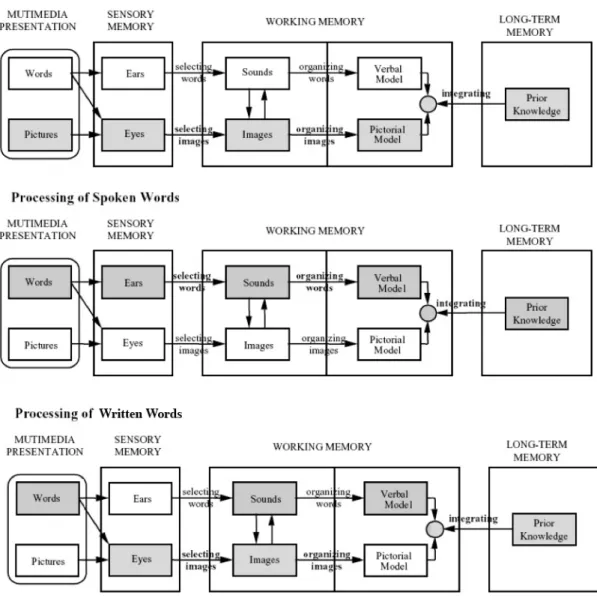
information by selecting, and organizing information within and between the two processing channels present in the working (short-term) memory and integrating this with information retrieved from the long-term memory (Clark & Paivio, 1991; Sweller, 2005; Mayer, 2009, 2014).
Figure 1. Cognitive processing of words and pictures (Mayer, 2005, p.43)
Cognitive-affective theory of learning from media
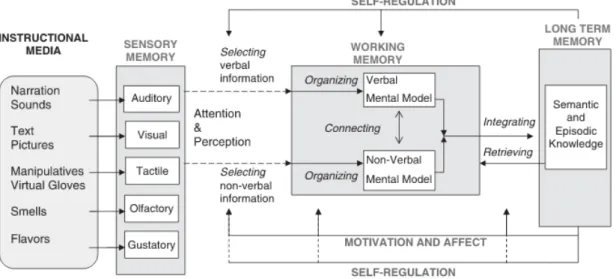
Cognitive-affective theory of learning from media (CATLM) (Moreno, 2006) is an extension of CTML that includes affective and metacognitive attributes of learners as
part of its framework. According to Mayer (2009, 2014), theories on multimedia learning have traditionally focused on cognitive processes associated with learning such as selecting relevant information, organising selected information and integrating this with existing knowledge, while the influence of the affective characteristics of learners such as motivation and emotion have not been explored to any great extent. Moreno’s (2006) CATLM includes these elements. A review of the literature concerning the influence of learner affective characteristics (emotions, beliefs, expectations) and learning from multimedia instructional messages presented by DLOs is presented later in this chapter.
As with CTML, CATLM is based upon a number of specific assumptions, some of which are common to both frameworks. The assumptions that underpin CATLM are:
1. The presence of independent yet complementary verbal and non-verbal information processing channels (Baddeley, 1986).
2. The dual channel assumption that humans have separate sensory and cognitive channels for sensing and processing auditory and visual information (Paivio’s Dual Coding Theory, 1986, 2007).
3. The limited capacity assumption which is that both the auditory and visual sensing and processing channels and the working memory are limited in capacity (Sweller’s Cognitive Load Theory, 1988, 2005).
4. The active processing assumption that learners must actively process sensed information by selecting, organizing and integrating information within and between the two processing channels (Clark & Paivio, 1991; Sweller, 2005, Mayer, 2009, 2014).
by increasing or decreasing cognitive engagement (Mayer, 2009, 2014; Moreno, 2006)
6. The metacognitive assumption proposes that learner metacognition affects learning by influencing cognitive processing (Mayer, 2009, 2014; Moreno, 2006).
7. The individual differences assumption proposes that the traits of individual learners such as preferred learning styles and the extent of existing knowledge influences learning and learning from multimedia (Mayer, 2009, 2014; Moreno, 2006).
Figure 2. Cognitive-affective theory of learning with media (Moreno, 2006, p. 151)
Moreno (2006) and Mayer (2001, 2009) propose that the benefits of multimedia learning are a consequence of the instructional techniques embedded within the media (DLO) that promote learner understanding rather than arising from the media itself. Moreno’s (2006) calls this ‘method’ or ‘instructional design’. As such, Moreno (2006) argues for a method-affects-learning over a media-affects-learning hypothesis with regards to multimedia learning. The method-affects-learning hypothesis proposes that
instructional designs embedded in media influence learning by promoting cognitive processing while the media used to deliver instruction does not (Moreno, 2006; Mayer, 2005, Clark, 1994). However, Moreno (2006) proposes that the method affects learning and the media affects learning hypotheses are not necessarily mutually exclusive. He forwards a ‘media enables method hypothesis’ that describes how the functional capabilities of different media, for example, a DLO, can enable effective instructional designs based on learning theories. This approach first requires the identification of the functional characteristics of the media, that is, what can it do, and then a description of how the identified functionality may support learning processes. The media enable method hypothesis is very relevant to DLOs as the sophistication of technologies available to educators allows for the creation of DLOs in a myriad of different forms and combinations of forms. For example, the forces of flight DLO used in this research functions simultaneously as both a practice object and as an information presentation object.
2.3 Split- attention principle
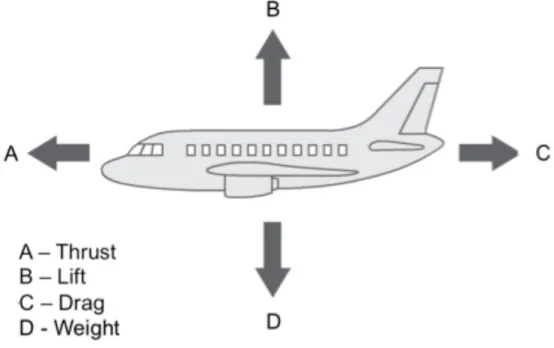
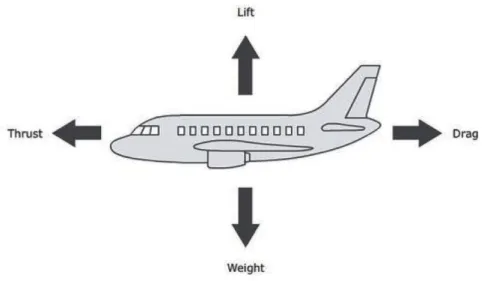
Presenting learners multiple sources of information, all of which are required for understanding, in the same or different modalities (verbal – written text, spoken text), non-verbal) is detrimental to learning when the sources of information are not physically integrated. For example, the following illustration (Figure 3) displays a version of the forces in flight illustration that could result in split attention and is an example of a non-integrated design. In this example the learners’ eye has to move between the label associated with each force direction arrow and the key that associates label identifiers with the actual force names. The extraneous cognitive load placed on the user arises from having to sense the visually presented information that
is not spatially co-located and with having to cognitively associate, for example, the upward indicating direction arrow with the letter “B” and the word “lift”. This extraneous load is reduced when the force name is spatially located beside the force direction arrow. The principles of spatial and temporal contiguity are relevant to the split-attention effect. These are discussed later in this chapter.
Figure 3. Example of the split attention effect (Science Learning Hub, The University of Waikato, www.sciencelearn.org.nz, 2011)
Tarmizi and Sweller (1988) were the first researchers to identify the existence of split-attention effects arising from the use of a learning object. Tarmizi and Sweller (1988) were investigating the effectiveness of worked examples on learning in geometry. The researchers did not obtain the results they were expecting and attributed this to the media format of the instructional materials that were presented to learners. In the initial experiment learners were presented with instructional material in the form of an illustration and separate but related written text. Tarmizi and Sweller (1988) proposed
that the presentation of information as written text and an illustration imposed a large cognitive load on learners as it required the learners to split their attention between two different sources of visually presented information, both of which were required for understanding. To test their hypothesis a second experiment was conducted in which learners were presented with either integrated instructional material (written text was spatially located beside corresponding pictorial elements) and non-integrated (written text was not integrated with the illustration). They found that learners who used the integrated multimedia learning objects outperformed learners who used the non-integrated learning objects. Subsequent researchers have tested the split-attention effect in a range of subject areas (mathematics, physics, biology) using a range of media (paper based and computer delivered). For example, research conducted by Mayer, Steinhoff, Bower and Mars (1995) conducted a series of experiments in which undergraduate students were provided instruction about how lightening forms. Participants, who had varying levels of knowledge about this topic, were randomly assigned to a group that received integrated instruction or non-integrated instruction. Integrated instruction consisted of written text on a page and five related illustrations presented on the facing page. The illustrations contained labels and captions. The non-integrated instruction consisted of the text and images being presented in different booklets. The illustrations contained no labels or captions. After receiving instruction participants had to complete a problem solving test The results of this experiment showed that students with low prior knowledge of the topic who used the integrated materials performed better on problem solving tasks than low prior knowledge students who used the non-integrated multimedia resources.
that split-attention effects might arise as a consequence of the media used to present instruction. That is, the presentation of information on paper and the presentation of information via a DLO. Cerpa, Chandler, and Sweller (1996) conducted a study investigating this. Participants received instruction in how to use a spreadsheet. One group of participants received integrated instruction delivered by a DLO. A second group received traditional non-integrated instruction delivered by a combination of paper and computer. The results showed that students who received integrated instruction presented by the DLO outperformed those who received non-integrated paper and computer instruction in text questions but only with test questions that tested knowledge on information of high element interactivity. Element interactivity refers to the number and complexity of related chunks of information that learners must comprehend in order to understand (Sweller, 2010). As such, Cerpa et al. (1996) identified that the split-attention effect is media agnostic and as such has relevance to DLOs as the presentation of information via a DLO may manifest or negate split-attention effects (Ayres & Sweller, 2005). This is dependent upon a DLOs design. Furthermore, results from Cerpa et al. (1996) identified a second factor that influences split-attention effects. This was element interactivity. Element interactivity is described later in this chapter.
Mayer (2005, 2014) describes a cognitive mechanism for the split-attention effect and argues that presenting learners with instructional information in formats and modalities that requires them to split their attention is detrimental to learning. Consequently the split-attention effect has important implications for the design of DLOs and other instructional materials. Despite the pervasiveness of the split-attention effect and the cognitive implications Ayres & Sweller (2005) observe that DLO
designers seldom considered these. The split-attention effect has implications for the use of other types of ICTs in learning and teaching. An example of this is the web conferencing tool Adobe Connect Pro ©. The default GUI configuration allows for the simultaneous audio-visual presentation of information combining an auditory narration from a presenter speaking to visually presented information, for example, PowerPoint slides. The default GUI configuration also provides a synchronous online chat window that presents participants with chat messages simultaneously with the audio-visual presentation. As a consequence, participants have to split their attention between attending to the audio-visual presentation and the online chat. A possible consequence of this is that some information may not be sensed as learners’ focus on one element to the detriment of the other. In the case of Adobe Connect it is easy to reconfigure the GUI to suit the activity and as such the chat window could be hidden until an appropriate time.
2.3 The modality principle
The modality effect is an evidence-based principle arising from CTML and CATLM (Mayer, 2005, 2014; Moreno, 2006). The modality principle proposes that spoken text is more effective than written text when presented with animations or pictures (Moreno, 2006). There is much empirical evidence for the modality principle. In an experiment conducted by Moreno (2006), seventy-eight university students viewed a multimedia presentation depicting the process of lightening formation. Forty participants’ were presented with written explanations and illustrations explaining the process and thirty-eight participants viewed the illustrations while listening to narrated explanations. After viewing the presentation participants undertook recall and transfer tests. Moreno’s results showed that learners exposed to the narration (auditory verbal
information) plus illustrations presentation outperformed those who experienced the illustrations plus written text (visual verbal information) presentation in recall and transfer tests. Further research supporting the modality principle comes from an investigation conducted by Yaghoub Mousavi, Low, and Sweller (1995). Yaghoub Mousavi et al. (1995) presented learners geometry-related instructional materials consisting of a diagram and associated statements (words). A geometry diagram was presented in visual form while the associated textual information was presented in either a visual (written) or auditory (spoken) form. The researchers found that learners who were presented information in a dual mode as spoken words and illustration consistently outperformed learners who were presented the same information in a single visual mode (written words and illustration) in recall and transfer tests. A series of experiments reported by Tindal-Ford, Chandler and Sweller (1997) also supports the modality principle. These researchers hypothesised that instructional messages that presented information using dual auditory and visual modes would result in better learning outcomes than if the identical information was presented in a single mode (e.g. as visual text and illustrations). Tindal-Ford et al. (1997) conducted a series of experiments using a variety of instructional materials. The results of these experiments showed that learning performance in recall and retention was improved when learners were presented with instructional messages that consisted of a simultaneously presented visual illustration and auditory narration (dual mode). In contrast, learners presented with identical instructional messages in the form of visual illustrations and visual text (single mode) did not perform as well on the recall and retention tests. In these experiments Tindal-Ford et al. (1997) also identified a condition that influences the modality effect. This was element interactivity. Element interactivity is the number and complexity of related chunks of information that learners must
simultaneously process in the working memory in order to understand the presented information (Sweller, 2010). Instructional materials with low element interactivity consist of chunks of information (elements) that can be processed individually and as such impose less of a cognitive load upon learners. High element interactivity instructional materials impose a high cognitive load upon learners that may exceed the capacity of working memory (Sweller, 2010). Tindal-Ford et al. (1997) predicted that low element interactivity instructional materials would not display modality effects, as the low intrinsic cognitive load did not approach the limits of the working (short-term) memory while high element interactivity instructional materials would display modality effects as the capacity of the working (short-term) memory is exceeded. In their experiments these researchers used a range of learning materials that were either high or low in element interactivity. The results supported the researchers predictions, identifying element interactivity as a condition that influences the modality effect. Further evidence of the influence of element interactivity on the modality effect, is provided by a meta-analysis conducted by Ginns (2005). He reviewed the results of forty-three independent studies that investigated modality effects across a range of instructional materials, age groups and learning outcomes. Ginns (2005) meta-analysis identified the instructional benefits’ of presenting words in an auditory modality when presenting information represented by words and pictures. His work also provided evidence of two conditions that influence modality effects, element interactivity and self-pacing. As previously described, element interactivity concerns the difficulty of the instructional content presented to learners. High element interactivity places a high intrinsic cognitive load upon learners while the presentation of low element interactivity instructional materials does not (Sweller, 2010). Ginns (2005) meta-analysis demonstrated that modality effects are larger when element interactivity is
high and, conversely, modality effects are less when element interactivity is low. The cognitive explanation for this is that under high element interactivity conditions the presentation of verbal information associated with an image in an auditory modality acts to effectively reduce the cognitive load by spreading the cognitive load across both the visual and auditory cognitive processing channels, effectively expanding the processing capacity of the short-term memory. In low element interactivity conditions modality effects were not observed, as the visual processing channel is not overloaded (Moreno, 2006; Ginns, 2005; Mayer, 2005, 2014). The second condition that influenced modality effects identified by Ginns (2005) meta-analysis was self-pacing. Self-pacing concerns the ability of learners to dictate the pace of instruction. Ginns (2005) identified that the modality principle holds when learners cannot control the pace of instruction. Moreno (2006) attributes this to the fact that under self-paced conditions learners are able to pause and take the time they require to make referential connections (Paivio, 1986) between visually presented text and illustrations, and in cases where verbal information is presented as auditory narrations learners, are able to rewind and replay sections of the presentation, providing the time required to connect associated verbal and non-verbal information.
In research conducted by Tabbers, Martens, & van Merrienboer, (2004) learners were presented with verbal information in the form of pictures and written words in self-paced multimedia lessons. Their results identified that modality effects were reduced and even reversed under conditions in which learners were able to control the pace of instruction. More recent research by Crooks, Cheon, Inan, Ari and Flores (2012) also supports the proposition that the ability of learners to self-pace when engaging with multimedia DLOs can influence modality effects. Inan, Crooks, Cheon, Ari, Flores,
Kurucay and Paniukov (2015) randomly assigned 151 undergraduate students to one of two variants of a DLO providing instruction on articulation in human speech. Each variant presented participants identical instructional messages. One variant presented information in the form of an illustration and associated on-screen text. The second DLO variant presented identical information using the same illustration but with verbal information presented as spoken text. The results showed a reverse modality effect. That is, learning was superior under written, rather than spoken text, conditions. Crooks, Cheon, Inan, Ari, & Flores (2012) conducted a similar experiment also using a DLO that provided instruction in speech articulation. These researchers found that learners studying from a DLO variant that presented information as written text and a related illustration outperformed learners who used a DLO variant that presented identical information as spoken text and an illustration. Both of these experiments required learners to recall spatial information, that is, associate verbal information with specific spatial locations on an illustration. Consequently, Inan et al. (2015) propose spatial learning as a factor that may influence the modality effect. These authors identified a lack of research in this area and call for more research to be conducted. The illustration below (Figure 4) depicts the proposed mechanism for the modality effect. The grey coloured boxes indicate cognitive load.
As depicted in the illustration, when pictures are presented simultaneously with written words a cognitive load is in both visual and auditory sensory memory and the associated verbal and non-verbal cognitive processing components of the working (short-term) memory. Kalyuga, Chandler and Sweller (2000) were the first researchers to report reverse modality effects. Kalyuga et al. (2000) conducted two experiments investigating the role of prior knowledge as a boundary condition of the modality effect. The results of their experiments showed that when learners possessed high prior knowledge the modality effect was reversed. In their first experiment, novice trade apprentices were presented with one of four alternative DLOs providing (identical) instruction on a drill’s cutting speed graph. The DLOs presented information in the following modalities: a diagram with visual text, a diagram with auditory text, a diagram with both visual and auditory text, and the diagram alone. In recall tests participants who used the diagram plus auditory text outperformed those who used the visual only DLO variants and the diagram-only variant. In the second experiment the same group of novice trade appendices were assigned to different DLO variant groups but only after having received prior training in the topic of instruction presented by the DLOs. Under these conditions the diagram only group out performed the auditory and visual text groups, thus identifying that high prior knowledge acted to reverse modality effects. Kalyuga et al. (2000) concluded that after additional training the cognitive advantage of presenting auditory text disappeared due to redundancy of the information presented as auditory text. In other words, the participants possessed enough knowledge to understand the diagram alone with no verbal explanations of the diagram, either written or spoken, required. Kalyuga et al. (2000) called this effect ‘expertise reversal’ and attribute a cognitive element interactivity mechanism for the effect when associated with learners existing knowledge. According to these authors,
the working memory is limited in the number of interacting elements it can process at any given time. On the other hand, the long-term memory can hold an unlimited number of interacting elements organised as schema – mental hierarchal representations of specific knowledge which are treated as a single element when being recalled and processed.
2.3.1 A cognitive mechanism for the modality effect
Mayer (2005, 2014) and Moreno (2006) propose a cognitive mechanism for the modality effect. A cognitive explanation argues that presenting information in a single visual modality (as written text and pictures) overloads the visual channel located in the working memory. This imposes an extraneous cognitive load on learners to the detriment of their learning. The modality principle proposes that the simultaneous presentation of information in dual visual and auditory modes reduces the extraneous cognitive load experienced by learners by spreading the cognitive load across both channels, effectively expanding the processing capacity of the working memory.
2.3.2 A perceptual mechanism for the modality effect
Some recent research findings challenge cognitive explanations for the modality effect (Crooks, Cheon, Inan, Ari & Flores, 2012; Rummer, Schweppe, Furstenberg, Schieter & Zindler, 2011; Rummer, Schweppe, Furstenberg, Seufert, & Brunken, 2010). These authors propose a perceptual resources explanation for modality effects. Arguments against cognitive explanations are based upon tensions between Baddeley’s (1986) working memory model and CTML with respect to how learners process written text. According to CTML, the visual sensory input channel is linked to the visual cognitive processor and the auditory sensory input channel is linked to the auditory cognitive
processor. This is the dual channel assumption derived from DCT (Paivio, 1986). From a CTML perspective, visual text competes with visual images for cognitive resources as both are sensed and processed via the single visual sensory cognitive channel. However, according to Baddeley’s (1986) working memory model, visual text is not restricted to the visual channel. According to this model, all words, both written and spoken, are processed in the phonological loop that is analogous to the auditory channel. According to Baddeley (1986), phonological processing does not consume resources from the visual processing channel. As such, a perceptual explanation for modality effects is not consistent with cognitive explanations as proposed by CTML and CLT. A perceptual explanation argues that limitations at the visual sensory perceptual level are responsible for modality effects. In other words, if visual information is too transient in nature or complex, requiring learners to search for and associate many written words and images, modality effects arise (Crooks, Cheon, Inan, Ari & Flores, 2012).
The picture that emerges from the literature is that the modality effect is not a unitary phenomenon. The effect appears to be caused and moderated by a range of mechanisms. According to Inan et al. (2015) there is a lack of clarity in regarding the mechanisms responsible for the modality effect and the conditions that influence it. As such, there is a lack of clear guidance for people creating DLOs regarding modality and reverse modality effects.
2.4 Other multimedia design principles
CTML research has yielded further multimedia design principles relevant to DLO design. As with the modality principle, these multimedia design principles act to either increase germane cognitive load or decrease extraneous cognitive load and consequently affect learning performance. As such, the multimedia design principles of CTML may be applied as evidenced based guidelines for the design of DLOs.
2.4.1 Principle of spatial contiguity
The spatial contiguity principle identifies that learning performance is improved when corresponding pictures and visual text of an instructional message are close together rather than far apart. Experiments conducted by Mayer & Anderson (1991), Mayer (1989), Mayer & Gallini (1990), empirically identified this improvement in performance. Instructional messages presented as visual text and illustrations require learners to attend to and relate two instructional items, both of which are sensed visually, entering the learners’ short-term memory via the visual channel. If the visual text and associated pictures are not located physically close together (low spatial contiguity) the learner is forced to visually scan the content of the instructional message, reading the visual text, looking at the picture and then deciding which given piece of visual text is associated with which specific illustrative item. This disrupts cognitive processing and information acquisition, as the learner has to spend time locating and associating spatially distant yet instructionally related items. Presenting related visual text and illustrations close together (high spatial contiguity) allows for more efficient visual sensing (representational processing) and more efficient cognitive processing (associative and referential processing) of information consisting of conceptually related visual text and pictures. Understanding the principle of spatial
contiguity is important for people creating DLOs by informing DLO graphic design decisions that support learning.
2.4.2 Principle of temporal contiguity
According to the principle of temporal contiguity, the simultaneous presentation of the auditory and visual information improves learning compared to the non-simultaneous presentation of the same information. In experiments conducted by Mayer & Anderson (1991) and Mayer & Anderson (1992), and Mayer (1992) learners’ were presented with instructional messages as visual animations and related auditory narrations. In these experiments the narrations were provided either simultaneously with the animation (high temporal contiguity) or either before or after the animation (low temporal contiguity). The experimental results showed that learners performed better when the auditory narration was simultaneously presented with the visual animation. Presentation of the narration either before or after the animation resulted in decreased performance in recall and retention. A reason for this could be that the presentation of information of low temporal contiguity does not exploit the dual channel processing capability described by DCT. The auditory words and visual animation of the instructional message need to be mentally organised and integrated to form a coherent representation. A consequence of the non-simultaneous presentation of the auditory and visual components was that not all of the information required to build a mental representation was available simultaneously in the short-term memory. As a consequence the organising and integration of the information was less efficient than if the all of the information had been available simultaneously. In contrast the presentation of information of high temporal contiguity improves the efficiently of cognitive processing and better supports learning. Knowledge of the principle of
temporal contiguity has relevance to DLO design as it identifies specific conditions under which the presentation of related visual and auditory information can act to support learning.
2.4.3 The individual differences principle
Experiments by Mayer & Gallini (1990), Butcher (2006) and Mayer (2001, 2009) presented high and low prior knowledge learners with identical multimedia instructional messages using different modalities. The results of these experiments show that low prior knowledge participants exhibited larger increases in learning performance compared with high prior knowledge participants. Mayer (2001) proposes that the reason for this is that high prior knowledge learners already possess in their long-term memory coherent mental representations of the subject domain of the instructional message. Unless the instructional message contains new information that is not part of their existing schema construct (mental representation) the existing mental representation will remain unchanged. Low prior knowledge learners exhibit lower pre-test scores and greater positive differences between pre and post-test scores with exposure to the instructional messages. The individual differences principle is important in DLO design as it identifies that the instructional content presented by a DLO needs to be at a suitable curricular level for the intended users of a DLO. If the instructional content is at too high a level learning performance is degraded due to the imposition of an inappropriate intrinsic cognitive load. Conversely, if the curricular level is too low learners may not engage with a DLO, as they already know the presented information.
2.4.4 The coherence principle
The coherence principle proposes that learning is improved when extraneous material is removed from instructional messages. Experiments conducted by Butcher (2006) in which low prior knowledge learners were presented with complex visual diagrams and detailed text identified decreases in recall and retention. In the study, the presentation of simplified learning materials to low prior knowledge learners resulted in improvements in their learning performance compared to their learning performance after the presentation of more complex learning materials. The presentation of more information than is required for understanding imposes an extraneous cognitive load upon learners as they seek to identify the information they require for understanding. This results in inefficient cognitive processing as the learner is cognitively split between attending to instructional and non-instructional information. With the presentation of extraneous material the learner is forced to spend time attending to and cognitively processing information only to realise that it is not relevant. Another danger in the presentation of irrelevant content in instructional messages is that the learner may mistakenly believe that such content is relevant and as a consequence begin to construct flawed metal representations based on misconceptions. The coherence principle is of relevance to DLO design as it identifies the importance of only presenting information to learners that is essential to achieving the learning outcomes. The presentation of information not required for understanding imposes an extraneous cognitive load that is detrimental to learning.
2.4.5 The redundancy principle
The redundancy principle concerns the presentation of duplicate information or information that learners already know. Research reported by Mayer (2001, 2009)