THE WEAK LINK IN THE LANGUAGE TEACHING SYSTEM AND WHAT TO DO ABOUT IT
by
ERIC MOORE
B.S., Kansas State University, 2001 B.S., Kansas State University, 2001
A THESIS
submitted in partial fulfillment of the requirements for the degree
MASTER OF ARTS
Department of Modern Languages College of Arts And Sciences
KANSAS STATE UNIVERSITY Manhattan, Kansas
2009
Approved by: Major Professor Dr. Doug Benson
Copyright
ERIC MOORE 2009
Abstract
This thesis answers the questions: How should the terms interaction, individualization, and personalization be applied to Computer Aided Language Learning (CALL) software? What progress has been made in their implementation? How can CALL software developers better incorporate them in the future? For each of the three terms, I explain how it is applicable to the CALL software environment by defining it, describing the pedagogical research supporting it, and then giving general guidelines for incorporating it into a CALL software program. I measure the progress of the implementation of the three terms in CALL software through compiling and analyzing data from reviews of 44 software titles. The publication dates of the software titles are from 1981 to 2008. I propose through description and a proof-of-concept software program ways to improve the incorporation of the terms in question into CALL software. As a result of answering the three questions, this thesis shows that the current accepted definitions and ways of implementing interaction, individualization, and personalization need to be improved in order to comply with pedagogical research and make full use of current technology. The general
guidelines given in the explanation of each term relative to CALL and the attributes under each term in the analysis of the compilation data provide examples of areas on which to focus
development. Additionally, I specifically comment on pedagogically supported attributes within each term that have a weak representation in the software compilation and therefore need more development.
In addition, this thesis is accompanied by “Mis vacaciones”, a proof-of-concept software program, which demonstrates ways to improve the incorporation of interaction,
individualization, and personalization into CALL software. In “Mis vacaciones”, the learner takes a virtual trip to Nuevo Leon, Nicaragua. The multimedia sent to the learner by a previous traveler shows Nicaraguan city people and the La Gigatona festival. After visiting, the learner is asked to describe the Nicaraguans that they saw. If the learner needs help, Structured Input activities lead the learner to develop the third person singular imperfect form. Buttons in the software environment provide access to internet sources. The learner is able to draw and take
Table of Contents
List of Figures ... vi
List of Tables ... vii
Acknowledgements ... ix
CHAPTER 1 - Introduction ... 1
Some Useful Definitions ... 2
Input ... 2 Comprehensible Input ... 2 Structured Input ... 3 Processing Instruction ... 3 Tasks ... 3 Communicative Competence ... 5 Grammar-Translation Method ... 5 Behaviorist Theory ... 5 Audiolingual Methodology ... 6
Communicative Language Teaching ... 6
Total Physical Response ... 7
Learning Styles and Strategies ... 7
Constructivism ... 8
Cognitive Map ... 9
Evolution of Language Pedagogy ... 9
Brief History of Technology in the Classroom ... 10
CHAPTER 2 - Definition of Terms and Their Applications to CALL... 12
Interaction ... 14
Individualization ... 18
Personalization ... 20
CHAPTER 3 - Software Compilation... 29
CHAPTER 4 - “Mis vacaciones” (My CALL Software Program) ... 40
Individualization ... 42
Personalization ... 44
CHAPTER 5 - Conclusion ... 45
References ... 47
Appendix A - Reviews of Software Titles ... 54
Appendix B - Compilation Data ... 60
Appendix C - Learning Strategies Categories ... 67
Appendix D - Attributes with Software Titles and Years ... 69
List of Figures
Figure 1.1 Second Language Acquisition Process (Lee & VanPatten, 2003, p. 142) ... 2
Figure 2.1 Basic Model of Communication ... 14
Figure 2.2 A Detail of Input Processing (VanPatten, 2004b, pp. 5-31) ... 27
Figure 2.3 An Expanded Model of Second Language Acquisition Showing the Roles of Some Learning Principles and Universal Grammar (VanPatten, 1996, p. 144) ... 28
Figure C.1 Oxford‟s Strategy Classification System Part 1(Ehrman & Oxford, 1990) ... 67
Figure C.2 Oxford‟s Strategy Classification System Part 2 (Ehrman & Oxford, 1990) ... 68
Figure E.1 A View of the “Mis vacaciones” Self-Extracting file ... 82
Figure E.2 A View of the Files and Directories that the Self-Executable Installs... 82
Figure E.3 The Main Screen of “Mis vacaciones” ... 83
Figure E.4 A View of the Task for Nuevo León de León, Nicaragua ... 84
Figure E.5 A View of the Introduction of the Camera Feature. ... 84
Figure E.6 The Drawing application in Nuevo León´s Comprehensible Input Section ... 85
Figure E.7 WordReference.com on January 8, 2009 ... 86
List of Tables
Table 1.1 Structured Input Activity Guidelines (Lee & VanPatten, 2003, p. 154; VanPatten 1996)
... 3
Table 1.2 Tenets of Behaviorist Theory (Hadely, 2001, p. 57) ... 5
Table 1.3 Tenets of the Audiolingual Methodology (Savignon, 1997, pp. 25-26) ... 6
Table 1.4 Tenets of Communicative Language Teaching (Savignon, 1997, pp. 28-29) ... 7
Table 1.5 Common Cognitive Maps (Inspiration Software Inc, 2008a, 2008b, 2008c) ... 9
Table 1.6 History of Language Learning (Hadley, 2001; Larsen, 1987; Oxford & Madeleine, 1993; Oxford, 1997; Wang & University of Central Florida, 2005) ... 9
Table 1.7 Progression of Classroom Technology (Popham, 1969, pp. 334-35; Fought, 1987; National Education Association, 1992, pp. 53-55; National Education Association, 2001, p. 65; Manuelvuelta, 2006; Enlaces Centro de Educación y Tecnología Chile, 2007; Means, Roschelle, Penuel, Sabelli, & Haertel, 2003; Selene486, 2007) ... 11
Table 2.1 Overview of the History of CALL Software (info taken from Appendix B) ... 13
Table 2.2 Combinations of Sender and Receiver Interests in the Messages They Send and Receive ... 16
Table 2.3 Reasons for the First Through Fourth Interactive Situations in Table 2.2 ... 17
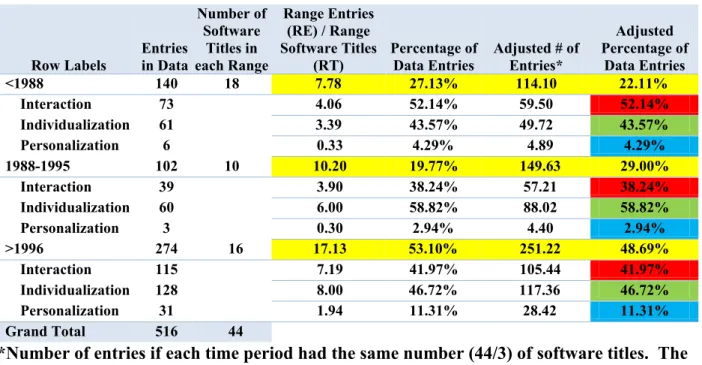
Table 3.1 Overview of the Software Compilation ... 30
Table 3.2 Comparison of the Interaction Category ... 32
Table 3.3 Comparison of the Individualization Category ... 36
Table 3.4 Comparison of the Personalization Category ... 38
Table 4.1 Learning Strategy Types that My CALL Software Program Allows ... 43
Table B.1 Interaction Category From All Periods Part 1 ... 60
Table B.2 Interaction Category From All Periods Part 2 ... 61
Table B.3 Interaction Category From All Periods Part 3 ... 62
Table B.4 Individualization Category From All Periods Part 1... 63
Table B.7 Personalization Category From All Periods ... 66 Table E.1 Xml Code Examples and the Functions of Tags and Attributes for Sections ... 88 Table E.2 Part 2 Xml Code Examples and Functions of Tags and Attributes for Sections... 89
Acknowledgements
I would like to thank my wife, April, for her patients and support during the formation of this thesis. Her parents, Art and Sherry Cordry, as well as my parents Richard and Grace Moore have also been encouraging and helpful. In addition to my family and friends, my thesis would not be in its current form without the effort of my thesis committee, Dr. Doug Benson, Dr. María Teresa Martínez-Ortiz, and Dr. Bradley Shaw.
CHAPTER 1 - Introduction
I refer to the language teaching system (LTS) in the title although the reader is free to generalize the information in this paper to other subsets of the superset, the teaching system. The teaching system is a subset of the education system. Which element is the weak link in the LTS? I define the weak link as the element that has not kept up with the progression of the other
elements.
The LTS presently consists of teachers, language pedagogy, technology, and computer aided language learning (CALL) software. Not all of the elements in the LTS have always been the same as they are now. For example, ancient Roman teachers wore togas while teachers now commonly wear business casual attire. The “Evolution of Language Pedagogy” section of this paper presents the progression of pedagogy in the language teaching system. As the “Brief History of Technology in the Classroom” section shows, the technologies used in the classroom have progressed in their potential for student-centered use. For example, in 1967, most
classrooms had phonographs and silent filmstrip projectors (Popham, 1969, pp. 334-35). Today, most classrooms or students have access to laptops. Technology is consequently not the weak link. In the early 1980s, personal computers became affordable enough to include in school systems beyond the engineering programs of universities. The introduction of computers as one of the technologies available to teachers also introduced software into the teaching system. Because teachers and learners delegate some or most of the role of teacher to CALL software when learners use it inside and outside of the classroom, they place emphasis on three common instructional practices: interaction, individualization, and personalization. These three attributes of teaching thus become the standard to measure the progress of CALL software. The
“Definition of Terms and Their Applications to CALL” section of this paper explains these terms and relates them to CALL software.
The “Software Compilation” section dissects 44 CALL software titles published from 1981 to 2008 (Appendix A) in order to establish the progression of interaction, individualization, and personalization. Based on the progress shown in the following sections, I conclude that CALL software has not progressed as much as the other elements in the LTS. Therefore, it is the weakest link. However, being the weakest link is not fatal in the LTS. The “Software
Compilation” section also describes ways that software developers can improve CALL software. In Chapter 4, I present my own CALL software program, “Mis vacaciones”, which addresses some of the issues concerning interaction, individualization, and personalization described in the “Software Compilation” section. I present it as a proof-of-concept rather than a model.
Some Useful Definitions
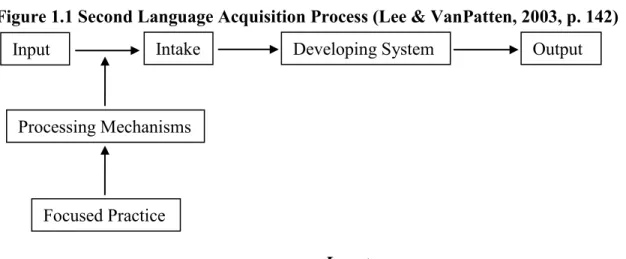
The following definitions offer a brief overview of some terms that this thesis will use and cover more in depth. Figure 1.1 is a general model of the second language acquisition (SLA) process to which some of the definitions will refer in order to contextualize their information.
Input
According to Lee and VanPatten (2003), “input is the language learners hear [and read] that is meant to convey a message” within a communicative exchange (p. 16). Input, as Figure 1.1 shows, is the root of the SLA process.
Comprehensible Input
Comprehensible input (CI) is input that the learner understands sufficiently to be able “to figure out what the speaker [writer] is saying” (Lee & VanPatten, 2003, p. 26). CI increases the chances that learners will process elements of the language found in the input (pp. 26-27). Input can be made comprehensible by slowing the rate of the input and modifying its vocabulary, syntax, flow, and setting (pp. 29-30). Interaction can also modify input, making it
comprehensible (pp. 31-32). Input Focused Practice Processing Mechanisms Output Developing System Intake
Structured Input
Lee and VanPatten (2003) define structured input (SI) as:
input that is manipulated in particular way to push learners to become dependent on form and structure to get meaning and/or to privilege the form or structure in the input so that learners have a better chance of attending to it (i.e., learners are pulled away from their natural processing tendencies toward more optimal tendencies). (p. 142)
In Figure 1.1, SI activities make up part of the category marked “Focused Practice.” Table 1.1 indicates the six guidelines for developing SI activities that VanPatten (1996) establishes.
Processing Instruction
Processing instruction (PI) is grammar instruction developed by VanPatten with the goal to guide and focus learners‟ attention when they process input. In Figure 1.1, PI falls into the “Focused Practice” category. PI has three components: learners are given information about a linguistic structure or form, “learners are informed about a particular processing strategy [behavior] that may negatively affect their picking up the form or structure during comprehension” and learners participate in SI activities (Lee & VanPatten, 2003, p. 154; VanPatten, 1996, pp. 1-11).
Tasks
The word “task” has many definitions. David Nunan (2004) and Rod Ellis (2003), two of the sources used for the task related information in this thesis, refer to seven and nine versions respectively in the process of discussing their own definitions of a pedagogical task. Nunan addresses the issue in this way:
Table 1.1 Structured Input Activity Guidelines (Lee & VanPatten, 2003, p. 154; VanPatten 1996)
Guidelines
Present one thing at a time Keep meaning in focus
Move from sentences to connected discourse. Use both oral and written input.
Have the learner do something with the input.
A pedagogical task is a piece of classroom work that involves learners in comprehending, manipulating, producing or interacting in the target language while their attention is focused on mobilizing their grammatical knowledge in order to express meaning, and in which the intention is to convey meaning rather than to manipulate form. The task should also have a sense of completeness, being able to stand alone as a communicative act in its own right with a beginning, a middle, and an end. (2004, p. 4)
The definition that Ellis (2003) arrives at is more specific than Nunan‟s:
A task is a work plan that requires learners to process language pragmatically in order to achieve an outcome that can be evaluated in terms of whether the correct or appropriate propositional content has been conveyed. To this end, it requires them to give primary attention to meaning and to make use of their own linguistic resources, although the design of the task may predispose them to choose particular forms. A task is intended to result in language use that bears a resemblance, direct or indirect, to the way language is used in the real world. Like other language activities, a task can engage productive or receptive, and oral or written skills, and also various cognitive processes. (p. 16) These two definitions inform the tasks that I incorporate into “Mis vacaciones”, the proof of concept CALL software program that accompanies this thesis.
I use a combination of the two definitions because both do not exactly fit what a task can be in the CALL environment. An example of this is that Nunan refers to a task as “a piece of classroom work” (2004, p. 4). It is, however, difficult to define a classroom when using CALL. A classroom could be typical physical classroom, a learner‟s home, a learner‟s office, a bus, a virtual environment or any number of other arrangements. In Nunan‟s defense, he does specify more thoroughly than Ellis what the learners will do during a task. Ellis defines the learners actions as “process[ing] language pragmatically in order to achieve an outcome” (2003, p. 16). The term “processing” as Ellis uses it refers to comprehending and not to the processing that occurs during SI activities. Ellis also refers to linguistic resources in his definition but fails to mention that learners can and should use nonlinguistic resources such as objects, body language, gestures, and facial expressions. Finally, with CALL, one learner may be performing the task with non-learners (natives, computer simulations or virtual persons); however, both definitions assume that only learners are actors in the task.
Communicative Competence
Communicative competence is composed of four sub-competencies: grammatical, sociolinguistic, discourse, strategic (Savignon, 1997, p. 40). Each of these sub-competencies has extra-linguistic, listening comprehension, reading, socio-cultural, speaking, and writing
components. This thesis refers to these components in the software compilation section under the “Works on these competencies” attribute.
Grammar-Translation Method
The Grammar-Translation method was used to teach modern languages in the late nineteenth and early twentieth centuries. Hadley states that, “its primary purpose was to enable students to access and appreciate great literature, while helping them understand their native language better through extensive analysis of the grammar of the target language and translation” (Hadley, 2001, p. 106).
Behaviorist Theory
In the 1940s and 1950s, behaviorist psychology influenced how researchers conceived that language learning occurred (Hadely, 2001, p. 57). This influence carried over into language teaching with the advent of the audiolingual methodology. Table 1.2 is a list of the key tenets of behaviorism.
Table 1.2 Tenets of Behaviorist Theory (Hadely, 2001, p. 57) Num Tenet
1 Human learning and animal learning are similar.
2 The child‟s mind is a tabula rasa. There is no innate pre-programming specifically for language learning at birth.
3 Psychological data should be limited to that which is observable.
4 All behavior is viewed as a response to stimuli. Behavior happens in associative chains; in fact, all learning is associative in nature.
5 Conditioning involves the strengthening of associations between a stimulus and a response through reinforcement.
6 Human language is a “sophisticated response system” acquired through operant conditioning.
Audiolingual Methodology
In the 1940s and 1950s, descriptive linguistics was influential along with behaviorist psychology (see Behavorist Theory). Descriptive linguistics is concerned with the structure of languages based on their phonemes and morphemes. Together these two fields of study
generated the audiolingual methodology (ALM) of language learning (Hadley, 2001, pp. 57, 110; Lee & VanPatten, 2003, p. 9; Savignon, 1997, pp. 23-26). Table 1.3 indicates the tenets of the ALM. Common types of activities in ALM were memorizing dialogues until the learner achieved perfect pronunciation and intonation, repetition and transformation drills, and
application activities (Hadley, 2001, pp. 111-112; Lee & VanPatten, 2003, p. 9; Savignon, 1997, p. 25). The application activities the learner “worked mainly with memorized material, repeating it, manipulating it, or transforming it to meet minimal communicative needs” (Hadley, 2001, p. 112).
Communicative Language Teaching
Communicative Language Teaching (CLT) developed in the 1970s as a reaction to and a rejection of the ALM that had been popular from the 1940s through the 1960s. Table 1.4 lists the principle tenets of CLT. This approach to language teaching is more student-centered than the ALM. The types of activities that fit into the CLT approach are interactive language games including simulations and role-plays, information sharing activities, task-based activities, social
Table 1.3 Tenets of the Audiolingual Methodology (Savignon, 1997, pp. 25-26) Num Tenets
1 Language learning is habit formation.
2 Language performance consists of four basic skills: listening, speaking, reading and writing.
3 L2 learning, like L1 learning, should begin with listening and speaking, regardless of the end goal of the learner.
4 A contrastive analysis of the phonological and structural differences between L1 and L2 provides the most effective basis for materials development and sequence. 5 The basic unit practice should always be a complete structure. Production should
proceed from repetition to substitution and continue until responses are automatic. Spontaneous expression should be delayed until the more
advanced levels of instruction. Production errors in structural or phonological features mean that the patterns have not received sufficient prior drilling. 6 The teacher is the center of all classroom activity and is responsible for maintaining
Total Physical Response
James J. Asher developed Total Physical Response (TPR) in the early 1970s. Hadley indicates that Asher based this approach:
on the belief that listening comprehension should be developed fully, as it is with
children learning their native language, before any active oral participation from students is expected. Further, it is based on the belief that skills can be more rapidly assimilated if the teacher appeals to the students‟ kinesthetic-sensory system. (2001, p. 118)
Learners doing TPR activities carry out actions as directed by the instructor‟s oral commands to show their language comprehension. After an initial period of listening and acting, the instructor encourages the learners to give commands when they are ready. The teacher and learners repeat the sequence of listening and then producing with increasingly complex material. As the class advances, learners prepare and perform skits and problem solving situations (pp. 117-118).
Learning Styles and Strategies
In the late 1980s and early 1990s, learning styles and strategies became increasingly important in educational planning. Hadley notes that before this time period, “conventional wisdom…[was] that second-language acquisition theories should attempt to explain how „the learner‟ develops competence, as though learners were a relatively homogenous lot” (2001, p. 75). Learning styles (LSs) are “the general approaches students use to learn any subject,
Table 1.4 Tenets of Communicative Language Teaching (Savignon, 1997, pp. 28-29) Num Tenets
1 Language use is creative. Learners use whatever knowledge they have of a language system to express their meaning in an infinite variety of ways.
2 Language use consists of many abilities in a broad communicative framework. The nature of the particular abilities needed is dependent on the roles of the
participants, the situation and the goal of the interaction.
3 L2 learning, like L1 learning, begins with the needs and interests of the learner. 4 An analysis of learner needs and interests provides the most effective basis for
materials development.
5 The basic unit of practice should always be a text or a chunk of discourse. Production should begin with the conveyance of meaning. Formal accuracy in the beginning stages should be neither required nor expected.
6 The teacher assumes a variety of roles to permit learner participation in a wide range of communicative situations.
including a second language” (Oxford, Ehrman & Lavine, 1991, as cited in Oxford & Ehrman, 1993, p. 196). LSs have dimensions such as sensory preference(s), intuitive vs. sensing, and global vs. analytic.
Oxford (1993) defines learning strategies as being “more specific than learning styles. Strategies are the particular behaviors that learners employ, usually intentionally, to enhance their understanding, storage, retrieval, and ultimate use of information” (Riney, 1978, as cited in Oxford, 1993, p. 65). In SLA, “examples include note-taking, seeking conversation partners, developing empathy with the target culture, skimming, previewing, and guessing to understand what is read or heard.” (p. 65). More than one strategy can map to a particular LS. Appendix C gives more examples of learning strategies.
Constructivism
In 1954, Piaget became the first constructivist when he wrote The Construction of Reality in the Child, a book in which he depicts a child as a scientist constructing meaning from the surrounding environment (Oxford, 1997, p. 39). Constructivism, however, remained an obscure philosophy until the 1990s when it became part of the movement for active and experiential learning. This movement is against teacher-centered classrooms and the lecture-plus multiple-choice tests structure of education (p. 46).
There are two general schools of constructivism: “those considering…the knowledge constructor to be the individual…and those viewing the…knowledge constructor as the whole society or group or as the individual as firmly embedded in the group” (p. 45). Independent of these schools of thought:
constructivism is a philosophy of learning founded on the premise that, by reflecting on our experiences, we construct our own understanding of the world we live in. Each of us generates our own "rules" and "mental models," which we use to make sense of our experiences. Learning, therefore, is simply the process of adjusting our mental models to accommodate new experiences. (On Purpose Associates, 2001)
Cognitive Map
I use the term “cognitive map” in this thesis to refer to a written visualization of how items such as concepts, ideas, pictures, and grammar items connect or relate to one another. Concept maps, webs, and idea maps are specific examples of cognitive maps. See Table 1.5 for more information.
Evolution of Language Pedagogy
Table 1.6 presents a brief history of language pedagogy. To make a clear sketch, I have included the approaches, methodologies, and concepts that researchers and professionals stressed during each period. The items that appear in each period may or may not extend into subsequent periods. The time-periods represent approximately when the items became popular as indicated by the sources listed in the table‟s caption.
Table 1.6 History of Language Learning (Hadley, 2001; Larsen, 1987; Oxford & Madeleine, 1993; Oxford, 1997; Wang & University of Central Florida, 2005)
Year Range Methods, Concepts, Approaches Emphasized
<=1960s Behaviorism, Grammar-Translation method, Audiolingual Methodology, drills 1970s Communicative competency, Communicative Language Teaching, TPR, how
to correct errors, contextualizing language learning
Mid 1980s Teaching grammar in meaningful context, oral proficiency, structure drills so that they approximate normal exchange, comprehensible input, role of input and output, tasks
Late 1980s & Early 1990s
Communicativeness, interaction, learning styles and strategies, cooperative learning, multi-modal lessons
Mid 1990s &
Late 1990s Teacher as a facilitator, scaffolding, constructivism, how to focus-on-form & communication Early 2000s Constructivism, problem solving, learning as an active and collaborative
process
Table 1.5 Common Cognitive Maps (Inspiration Software Inc, 2008a, 2008b, 2008c) Cognitive Maps Description
Concept map Two or more concepts are linked by words that describe their relationship Webs Webs are visual maps that show how different categories of information
relate to one another. Webs provide structure for ideas and facts and give students a flexible framework for organizing and prioritizing information.
Idea maps Idea maps help students brainstorm, solve problems and plan their work. Using word and idea association, idea maps connect keywords, symbols, colors and graphics to form nonlinear networks of potential ideas and thoughts.
The table (Table 1.6) shows a progression in various language-teaching areas having to do with making language learning more learner-centered. For example, from the 1960s to the early 2000s, there is a shift in the learner‟s role in the classroom. In the 1960s, language
teaching is mainly teacher-centered. The employment of audiolingualism, mechanical drills, and instruction on grammar and translation is evidence of a teacher-centered classroom because the learner is a recipient of the teacher‟s knowledge (Hadley, 2001). However, in the early 2000s, Table 1.6 indicates that the learner produces and constructs knowledge in the classroom because of movements like CLT and constructivism. One of the principles of constructivism indicates that learners must take an active role in the learning process. Further evidence of the progression from teacher-centeredness to learner-centeredness is exhibited by the emphasis on the
communicativeness of lessons, the effects of different error correction methods on learners, comprehensible input, learning styles and strategies, and the teacher as a facilitator after the 1960s. Finally, from the 1960s to the present, Table 1.6 shows that the importance of receiving input in relation to producing output has increased.
Brief History of Technology in the Classroom
Teachers can incorporate many different technologies into current classrooms. Table 1.7 shows a list of most of the technologies available to teachers for their classrooms. The list is in chronological order according to when a particular technology started appearing in classrooms. The progression of technology shown in Table 1.7 indicates that technology is becoming more learner-centered. I demonstrate this by an analysis of who uses the technology and when that technology is used. For example, teachers use instructional audio cassettes and film
projectors during class time. Teachers also create and use transparencies for overhead projectors during class time. The learner does not play a major role in the educational use of technology until audio laboratories become popular. Audio laboratories, however, allow limited oral interaction. When personal computers (PCs) appear in the early 1980s, they increase learner-usage of educational technology, first in laboratories and then in the classroom. The space necessary for desktop systems, however, makes it impractical to have more than a few computers in a classroom. The increasing popularity of PCs means that learners can also use educational technology at home. As time moves forward, technologies such as clickers, digital projectors,
with each other and teachers. Laptops, handheld devices, and tablet PCs also make it possible for learners to transport technology to and from the classroom. Thus, technology has historically been teacher-centered, but recent advances in technology are enabling the teacher to shift the focus to the learner.
Table 1.7 Progression of Classroom Technology (Popham, 1969, pp. 334-35; Fought, 1987; National Education Association, 1992, pp. 53-55; National Education Association, 2001, p. 65; Manuelvuelta, 2006; Enlaces Centro de Educación y Tecnología Chile, 2007; Means, Roschelle, Penuel, Sabelli, & Haertel, 2003; Selene486, 2007)
Year Technology in the Classroom
2007 Tablet PCs in classrooms
Students bring their own laptops Handheld devices (e.g. Pocket PC)
Electronic “chalk” boards (e.g. Smartboards, Ebeam, Interwrite, etc) Clickers
Cellular telephones
1985
1960s
Laptops for students Laptops for Teachers Digital Projectors ELMOS
Desktop computer for teacher
Student desktop computers in classrooms Student desktop computers in laboratories Listening Laboratories (cassettes y CDs) Video Cassette Recorders (VCRs) Televisions
Transparency projectors
Motion picture projector (8mm & 16mm) Film strip projectors with or without audio Audio cassettes
CHAPTER 2 - Definition of Terms and Their Applications to CALL
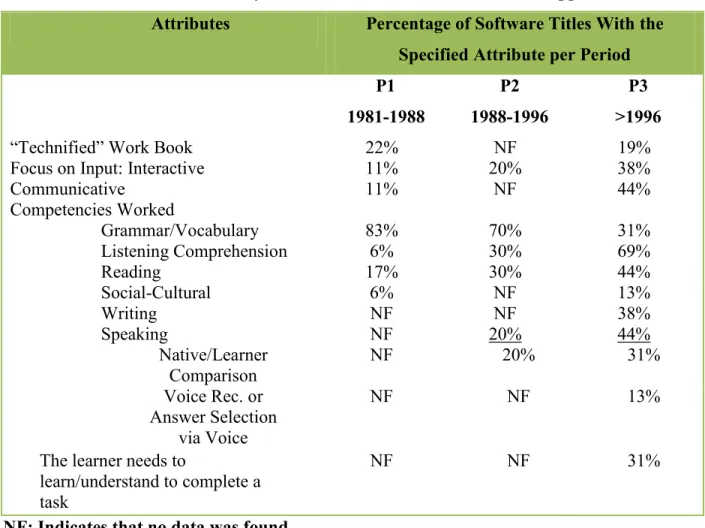
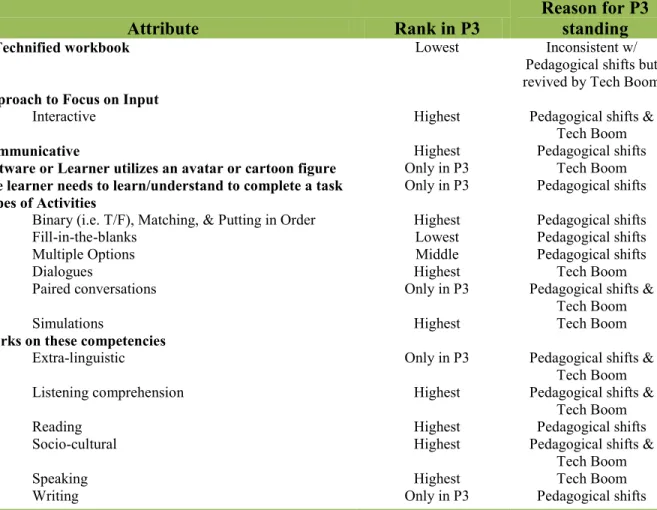
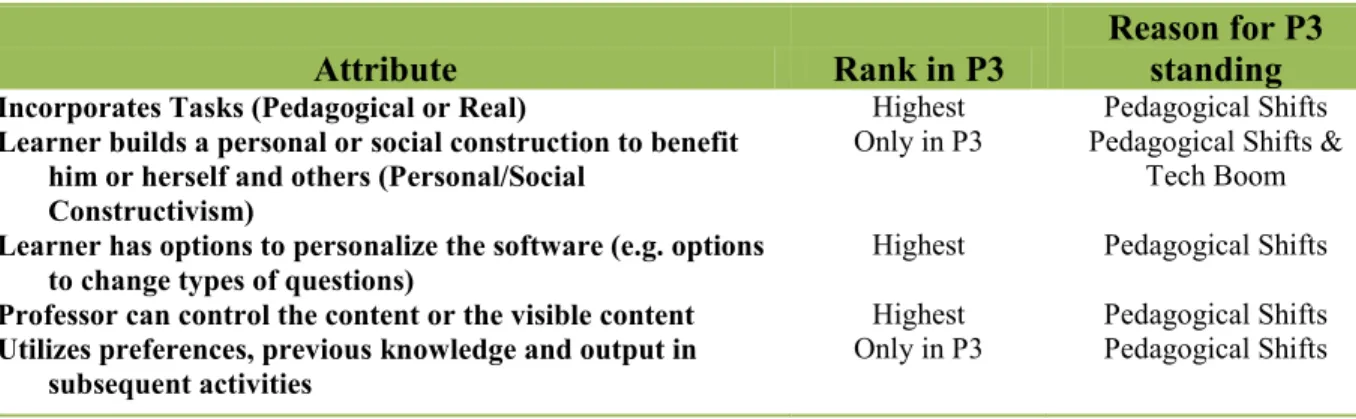
The history of software developed for language learning as shown in Appendix B reveals an ignorance or misinterpretation of accepted terminology and methodology in the field of language acquisition. As an example, Table 2.1 on the following page shows a set of data from the tables of Appendix B. I based the data on CALL software titles published after the 1970s, so based on the data in Table 1.6 (History of Language Learning) the values of the “Focus on Input: Interactive”, “Communicative”, “Social-Cultural”, “Speaking”, and “The learner needs to
learn/understand…” attributes should be higher throughout all the periods. While overall there is consistent improvement, none of the attributes in question are found in 50 percent or more of the CALL software of any period. On the contrary, in P1 and P2, an emphasis on grammar and vocabulary dominates. Additionally, 20 percent of the software titles in P3 were digital versions of grammar workbooks. In P2 and P3, the “Speaking” attribute, at first glance, appears to be a great addition to the troubled mixture, but the technology is applied mainly for learner vs. native voice comparison, which is ALMish. The absence of the “The learner needs to
learn/understand…” attribute in the first two periods and the weak emphasis placed on it in P3 is also reminiscent of the repetition drills associated with ALM. Therefore, the majority of the CALL software from 1981 to 2008 is stuck in a quagmire of grammar practice and translation mixed with ALM, the tenets of which do not correspond to those expressed in post 1970s language learning methodology and terminology.
The proponents, reviews, and names of CALL software frequently indicate that the product is an interactive software program that provides individualized and personalized language learning. Enredos Interactivos, Pueblo Ingles in Second Life, Pasos vivos Español Interactivo 1.01, Correct Behavior: The Mexican Way, and Spanish Bargaining are examples of such software. Very few of the programs I found fill the big shoes that their advertising creates. Appendix D indicates the attributes that each of the CALL software programs in the compilation actually have with respect to interaction, individualization, and personalization. All of the programs have parts that fit into the advertised categories, but unlike their use in literature, synecdoches (using a part to describe a whole) do not adequately describe a software program. The advertised characteristics of a language learning software program must be motifs
throughout its design and content. Therefore, the following section defines interaction,
individualization, and personalization. It also explains how software developers can incorporate them into CALL software programs.
Table 2.1 Overview of the History of CALL Software (info taken from Appendix B)
Attributes Percentage of Software Titles With the
Specified Attribute per Period
P1 P2 P3
1981-1988 1988-1996 >1996
“Technified” Work Book 22% NF 19%
Focus on Input: Interactive 11% 20% 38%
Communicative 11% NF 44% Competencies Worked Grammar/Vocabulary 83% 70% 31% Listening Comprehension 6% 30% 69% Reading 17% 30% 44% Social-Cultural 6% NF 13% Writing NF NF 38% Speaking NF 20% 44% Native/Learner Comparison NF 20% 31% Voice Rec. or Answer Selection via Voice NF NF 13%
The learner needs to
learn/understand to complete a task
NF NF 31%
Interaction
In her 1987 book, Interactive Language Teaching, Rivers defines interaction as the “…conveying and receiving [of] authentic messages (that is, messages that contain information of interest to speaker [sender] and listener [receiver] in a situation [environment] of importance to both)” (4). Rivers‟ definition suggests a basic model of communication (Figure 2.1).
Therefore, interaction needs a sender, listener, at least two messages of interest to both parties and at least one channel through which the messages can travel, all of which are located in an environment important to the sender and the receiver. There must be at least two messages because the sender may send a message but not receive anything in return, which is a null
message. The plausible situation that, upon perceiving a null message, the sender may resend the original message, redirect the original message, or do nothing confirms that a null message is a valid message. Sending an email is an example of such a situation. When there is no response from the receiver, the sender may send another message, send the message to a different email address or not do anything.
In the computer age, the interactionist approach to language teaching has expanded into the use of CALL software programs. In fact, Carol A. Chapelle, a prolific author on the subject of computer aided language learning (CALL), deals with the topic in her article entitled
“Multimedia CALL: Lessons to be learned from research on instructed SLA.” She states, “When addressing applied questions such as design and evaluation of multimedia CALL, it is necessary Figure 2.1 Basic Model of Communication
Situation/Environment Receiver’s Message Sender’s Message Sender Receiver
interface with teaching…” into three types: coexists, collaborates, and complements. Research into SLA that coexists with language teaching has “little if any intellectual interface” (21). Studies done on the effect that learning a language has on the learner fall into the “coexists” category. Collaborative research occurs when researchers and teachers work together to achieve the same goal in the classroom. An example of this is research into ways to teach
communicatively. Research that complements language teaching studies the impact of
complementarity, the utilization of “theoretically grounded learning materials and strategies to facilitate L2 learning” in the classroom (22). The supporting research for contextualization of and interaction with language materials falls in this category. Table 1.7 suggests that software is now a complimentary component in the language classroom as many of the technologies listed utilize it. Therefore, Chapelle reasons that the interaction approach is relevant to its design and content.
The interaction approach is different from the human-machine interaction approach inherent in many of the CALL software programs of which I read reviews. The environment in those programs as it pertains to interaction is the content that the software program is showing or has displayed for the user. For instance, if the questions are grammatical in nature, the user commonly conjugates a verb to reflect a certain tense, person, and number dictated by the instructions or by the context given by a few words in the sentence. In both situations, the environmental part of the definition of interaction is only important to the learner because the software already knows the correct answer without consulting the learner or the environment. Additionally, the environment is not important to the software because it usually does not plan on doing anything with the answer except indicating its correctness according to the given instructions. If the answer is correct, the lesson will continue; an incorrect answer will at best trigger an error correction subroutine. Consequently, it is possible for a software program to display information on present tense and then test on the use of preterit tense. Software
programs that ignore the environment only test the performance of the learner and do not interact with the learner.
In addition to the importance of the environment (situation) to both sender and receiver, Rivers‟ definition of interaction also asserts that the messages exchanged must be of interest to both parties. This role of interest in interaction is not complete, however. Her definition allows the learner not to be interested in his own message. The definition of interaction, therefore,
should specify that both participants are interested in the messages they send and receive
respectively. The information in Table 2.2 and Table 2.3 supports this stricter definition. Table 2.2 lists the 16 combinations of a sender and a receiver being interested in the messages they receive and send. Combinations five through sixteen are not valid interaction scenarios according to Rivers‟ definition because either the sender or the receiver is not interested in the received message. Rivers‟ definition, however, does accept the first four combinations. They are those in which the sender and receiver are interested in the messages they receive
respectively. Her definition, therefore, does not mean that one or both parties must also be interested in the messages they send because combinations two through four permit lack of interest in the message sent. This looseness in the definition allows for breakdowns (items 2-4 in Table 2.2) in the first scenario of Table 2.2, the only truly interactive scenario. Table 2.3
explains possible reasons for the decomposition of the first scenario into items two through four. Table 2.2 Combinations of Sender and Receiver Interests in the Messages They
Send and Receive
Sender‟s interest in Receiver‟s interest in Own message Receiver‟s message Sender‟s message Own message
1 + + + + 2 - + + + 3 + + + - 4 - + + - 5 + - + + 6 - - + + 7 + + - + 8 + - - + 9 - + - + 10 - - - + 11 + - + - 12 - - + - 13 + + - - 14 + - - - 15 - + - - 16 - - - -
Research on using feedback in language learning also supports the need for the stricter definition of interaction. Similarly to the concept of “importance,” to exhibit “interest” means the sender and receiver must do something with the messages they receive. They must process the received messages in order to respond or give feedback. If a participant does not respond or responds inappropriately as has happened in situations two through four of Table 2.2, the interaction between the participants weakens (decomposes). In the case of interaction in
language learning, it is important that participants in interactive activities respond to the content of the messages and not just to its syntax or grammar (Hadley, 2001, p. 263). A language learner may feel overly scrutinized by an inappropriate emphasis on form. Therefore, interacting
participants have to process both the form and the meaning of the messages received. Table 2.2, which lists the possible interactive combinations derived from Rivers‟ definition, is also useful in explaining why sender and receiver should process both content and form. Assuming that at the start of interaction, the first situation in Table 2.2 is present, the situation becomes a Type 2 situation if the sender loses interest in his own message. Number 2 of Table 2.2 offers some learner perceptions or reasons for a Type 1 to Type 2 situation decomposition. The receiver that pays too much attention to grammar and gives more feedback on it than on the message‟s content may generate these perceptions, which lead the sender to stop interacting out of frustration. The reasons in Number 2 of Table 2.2 also indicate that the sender and receiver have taken on roles associated with the Atlas complex as described by Lee and VanPatten (2003, p. 6). The sender-receiver relationship is a generalized version of a teacher-student relationship so the roles of authoritative transmitter and receptive vessel are applicable (pp. 6-7). To maximize language Table 2.3 Reasons for the First Through Fourth Interactive Situations in Table 2.2
Situation # Possible Reasons for the Situations 1 This is the ideal interactive situation.
2 Sender wants the receiver to talk, thinks the receiver is not interested or valuing the message, or wants only to know the right answer from the receiver.
3 Receiver is being rude, lying, tiring of the material, not accounting for learner strategies or styles, or trying to keep the learner talking (ALM or other methods that are output based).
4 This is the worst scenario classifiable under River‟s definition. Both participants, through a combination of the reasons in situations two and three, have lost
learning and the learning of other subjects, the communicative approach to SLA advises teachers and, in this case, any interacting participants to avoid Atlas complex roles (Hadley, 2001, p. 95).
Another way for a CALL software program to show that it is interested in the responses that it gives is for CALL software developers to keep learning strategies (LSs) in mind in the design and content of the program. Some authors even suggest that a CALL program should test or inform the learner on LSs (Oxford & Ehrman, 1993, pp.188-190; Ehrman & Oxford, 1990 pp. 312, 323-324). However, there is no agreed upon learning strategies test (i.e. a biographical questionnaire, Modern Language Aptitude Test (MLAT), Motivation and Strategies
Questionnaire (MSQ), the Ehrman and Leaver Learning Style Questionnaire (E&L), the Myers-Briggs Type Indicator (MBTI), or the Hartmann Boundary Questionnaire (HBQ)) or even a consensus that one test can accurately inform someone about a person‟s LSs (Oxford & Ehrman, 1993; Ehrman, 2001; Clark, 2007). In addition, there is no context under which to separately test or teach LSs in a CALL software program. It is a language-learning program, not a self-help program. The key, then, is to keep in mind that using LSs helps generate a positive perception of interest, which decreases the chance of a breakdown in interaction. Consequently, the activities in CALL software should incorporate LSs but not directly teach or test them.
Individualization
Individualization is the changing, modifying, or forming of a resource by an outside force (e.g. teacher, software developer, artisan) to fit the perceived needs, uses, or preferences of an individual. For example, individualized attention describes the modification of the resource "attention" to suit an individual. One-at-a-time access is usually inherent in a system where a one-resource-to-many-individuals relationship and a desire to individualize exist. However, an outside force also individualizes a resource if it is sufficiently efficient at multi-tasking and distributing said resource in the form in which each individual requires and each individual perceives a one-to-one relationship between him or herself and the resource in question. An application server is an example of this preservation of individualization. It allows many users to access a program simultaneously, and each user can operate his program instance as he or she desires. Ideally, the user is unaware of any other individuals operating the same program or accessing other resources on the server.
With CALL, individualization is no longer solely the responsibility of the teacher or curriculum developer. The software developer should provide tools that allow the teacher or learner to replace the outside force (curriculum developer or teacher) traditionally involved in individualization. Additionally, no one has to play the role of an application server trying to fulfill requests. Given the right tools like a content importer, the teacher and the leaner can replace individualization with personalization. However, individualization can still occur. For instance, if a teacher were to personalize the software by inserting his or her own, but different, content for each learner, then this would be individualization of the software´s content.
Due to the time-consuming nature of individualization even with CALL, differentiation or the modification of design, content, or both for groups of students is more popular and practical. Since the mid 1990s, CALL software developers have typically used two methods to address individualization and differentiation. The first method makes the flow of the program less strict. This approach allows the learner to arrive at the same knowledge through different pathways, branches or tracts. When developers have implemented this well, the pathways are not fixed, so the learner creates or personalizes the path instead of the software dictating it (Hadley, 2001, pp. 163; Fought, 1987).
In addition to tools and designs that allow for multiple tracts, developers integrate tools to take into account learning styles and strategies (LSS). In the CALL software (Appendix A) published before the year 2000, CALL takes an input modality approach to covering LSS. It relies on combinations of text, images, sound, and occasionally videos. This represents a visual, audio, and kinesthetic (VAK) approach to LSS (Clark, 2008). These software programs rely on the “interaction” of typing and mouse clicking to satisfy the kinesthetic part.
After the year 2000, CALL takes a different approach to working with LSS. It starts allowing for memory, cognitive, compensation, meta-cognitive, affective, and social strategies (Ehrman & Oxford, 1990, pp. 314-315). To apply this approach to LSS, software developers include in CALL software tools that allow for content interpretation, control over content, and discovery (Hadley 161-163; Kahn, 1991). Some examples of these tools are note taking features, audio and video control, advanced-feedback, and immersion environments. Note taking allows the learner to personalize and process the content through the learner‟s schemata. A common feature also in this period is allowing the learner to control (stop, start, pause, and replay) video and sound content, as he or she would be able to do in a non-pedagogical environment.
Advanced feedback points the learner to the section of a video that contains the answer so that the learner discovers the answer instead of being told the answer (Kahn, 1991). Similarly, immersion enables learners to discover through the exploration of a virtual environment.
As CALL software incorporates more of the principles of the communicative and the constructivism movements in language learning, personalization will dominate over
individualization. Even though, as my review of the history of CALL software suggests, the evolution of CALL software is slow, it still approximates “the changing goals of language education and the shifting conditions in our postindustrial society” (Wang, 2005, p. 2). Soon CALL software will leave behind the behaviorist approaches and embrace the fact that “Language is a living thing, so the best way to learn a language is in interactive, authentic environments” (1). Humans are famous for personalizing rather than individualizing their environments, so CALL software developers will create more tools to increase the
personalization of learning. Individualization will evolve to mean incorporating those tools into a CALL platform to suit different learning styles and strategies.
Personalization
In the concrete business, individualization is constructing the frames, mixing the concrete, and pouring the concrete into the framing. For the average concrete pad,
personalization occurs when the owner(s) put their initials, date, hand or foot print into the fresh concrete. The same relationship between individualization and personalization exists with CALL. Individualization tools (ITs) and multiple path designs in the software are how CALL developers individualize the software. Personalization is how much of the teacher, if applicable, and the learner the ITs allow to enter the concrete. In the case of CALL software, the superficial rights of ownership that occur with a normal concrete pad represent a small part of what ITs should allow a teacher and learner to do. ITs should allow the whole teacher and learner to jump into the concrete, inhale it, exhale it, and become part of the product, like an accident while building a dam or a bad date with the Mafia.
With CALL software, there are two types of personalization: teacher and learner. Typically, the learner is the focus of personalization; however, software designers should also give teachers the tools to personalize the software, to change the content and to adjust other
expectations in the field of teaching. Some recent evolutions include placing greater emphasis on differentiation and individualization, changing acceptable methodologies, and emphasizing the use of technology in classrooms.
The greater emphasis on differentiation and individualization has made it important for teachers to be able to personalize CALL software since they know their students better than software developers do. In addition, the characteristics of their students including gender, age, background, interests, and other demographic aspects can change from class to class and from year to year. There is evidence to suggest that male and females may prefer different content. Cultural values and gender roles played by the learners can also affect what content is interesting to the learner (Oxford & Ehrman, 1993). Independent of culture and gender, the age of the learner can affect the material in which the learner is interested and how the teacher should present it (Oxford & Ehrman, 1993; Oxford, 1993; Schleppegrell, 1987; Schulz & Elliott, 2000). Research that supports this also suggests that many classroom activities that involve speed and repetition bias the language classroom against older adults (Schulz & Elliott, 2000).
Another evolution in teaching is the “shift in educational paradigms from a behavioral to a constructivist learning approach” (Wang, 2005). Many teachers no longer view
audiolingualistic drills and activities as being as pedagogically sound as they once were. They are replacing mechanical and meaningful drills of traditional instruction as defined by Lee and VanPatten with communicative activities (2003, pp. 120-123). There are many types of communicative activities such as drills, group work, and tasks from which teachers can choose (Hadley, 2001). Within each type, there is an assortment of kinds of activities such as
pedagogical and real life tasks (Ellis, 2003, p. 6; Nunan, 2004). Additionally, as constructivism becomes stronger, “the teacher‟s role should shift from „sage on the stage‟ to „guide on the side‟,” which means teachers will choose activities in which problem solving is the focus and CALL software acts as a facilitator in the process (Wang, 2005, p. 2). The broader range of activities from which a teacher can choose indicates that CALL software that is not
personalizable by the teacher may not fit as a facilitator in the changing style(s) of many teachers. This is especially evident given the rapid technological growth towards more student-centered devices suggested by Table 1.7 and surveys done by the National Education Association (1992, 2001). Devices such as electronic dry erase boards, digital projectors, laptops, and tablet PCs favor the changing teacher-student paradigm, but CALL software that is not personalizable
resists being taken out of the fixed environment of the language laboratory and used in the dynamic environment of teaching.
As the communicative and constructivist movements take hold and evolve in the teaching field, the vision of the ideal environment for language learning evolves. Currently, “the best way to learn a language is in interactive, authentic environments” because language is viewed as a living thing (Wang, 2005, p. 2). For CALL software, the authenticity requirement means that the learner has to be present in the environment in order to receive the maximum benefit. Using the concrete analogy, the accident while building the dam and the bad encounter with the Mafia would not have the same affect if the learner watched it on television as it would if the learner participated in the ordeals. This is because while participating in a situation the learner applies three systems to personalize it: the learner‟s mind, social awareness and input processing system. For example, in the concrete analogy, the learner might be thinking that he or she does not like the feeling of half-dried blood on his or her arms, wondering what his or her mother will think and trying to decode what the person with the accent is saying. Since participation involves personalization by the learner‟s mind, social awareness, and input processing system, CALL software should incorporate these systems into itself to create the affect of participation.
The aspects of the learner‟s mind that are especially valuable to CALL software are the learner‟s preferences, previous knowledge, and output (PPkO). These are important because “Learning is an active process,” and “Learning is a natural, integral, and ubiquitous part of living; not something handed as a package to somebody else” (Wang, 2005, p. 2). Consequently, the learner must work to learn. Many factors affect whether work or, in this case,
learning/acquisition takes place. Some of these factors are motivation, anxiety, and self-esteem (Oxford & Ehrman, 1993; Schulz & Elliott, 2000). Allowing the learner to personalize CALL software with PPkO enhances motivation, lowers anxiety, and improves self-esteem.
According to Oxford and Ehrman, motivation consists of four internal constructs that lead the learner to demonstrate decision-making, persistence, and activity level in a beneficial manner (1993, pp. 190-192). These four internal constructs are interest, relevance, expectancy, and outcomes. Personalization by PPkO enhances motivation because the learner intercalates into the software information that is interesting and relevant to him or herself. This means the leaner must instantiate schemata as defined by Hadley in order to relate enough to the content to
example, when a learner elects preferences like colors, characters, places, and clothing in response to some aspect of a lesson, the selection is based on what is relevant and interesting according to the learner´s schemata concerning the lesson´s content. Since the learner is now part of the lesson, the experience will be more fun, entertaining, and emotionally involving. Results like the three behavioral attributes I just mentioned help keep the learner‟s attention and help him or her remember (Kahn, 1991, p. 1144). Consequently, the learner, unknowingly, becomes a source of positive motivation to learn the content.
The third and fourth internal constructs of motivation; that is, expectancy and outcomes, relate closely to anxiety and self-esteem. Expectancy is the belief that a behavior done by oneself will result or not result in some desired outcome(s) (Kelly, n.d.; Oxford & Ehrman, 1993). The “outcomes refer [to] the intrinsic or extrinsic rewards felt by the learner while learning” (Oxford & Ehrman, 1993, pp. 191). These outcomes, which I will call sub-outcomes for clarity, are not limited to the desired outcome(s) set by expectancy. The learner experiences many sub-outcomes during a non-CALL or CALL language lesson. These sub-outcomes include but are not limited to answers to questions both spoken and unspoken, paralinguistic data, and receiving or giving information and feedback. Without personalization by PPkO, the focus of a language lesson is on getting correct answers; therefore, many of the sub-outcomes are of the type right/wrong. Personalization by PPkO shifts the focus of the lesson onto the learner and expressing oneself. The learner‟s sub-outcome(s), therefore, are of the type successful
communication/non-successful communication. These sub-outcomes are more meaningful to the learner and more interactive (using the stricter definition). Thus, as VanPatten suggests, this focus is more congruent with the current input, communicative and constructivist movements in language teaching (1996, p. 59).
Anxiety is a facilitating or debilitating state of apprehension and a vague, sometimes undefined, fear. There are global and situational anxieties (Oxford & Ehrman, 1993, pp. 193-194). Debilitating anxiety can affect motivation by inserting overwhelming fear as an element to overcome when a learner is deciding expectancy. The fear attacks a learner‟s self-efficacy or “perception of one‟s own competence” by leading a learner to believe that a behavior or a task is too difficult; thus, a learner may feel a negative expectancy for behavior that would result in the desired outcome(s) (Kelly, n.d.). Facilitating anxiety works on a learner by encouraging
behaviors such as studying, interacting, and asking for assistance in order to enhance the learner‟s self-efficacy.
Improving self-efficacy is important because it is a component of self-esteem. Self-esteem is a “self-judgment of worth or value based on feelings of „[self-] efficacy‟” (Oxford & Ehrman, 1993, p. 194). Like anxiety, self-esteem is global and situational (194). This means that a learner could feel not good at anything, not good at learning a language, or just not good at certain tasks like public speaking.
As was suggested in the section about interest and relevance, personalization by PPkO directs a learner to focus on the input and expression, thereby generating positive sub-outcomes or successes at the start of and throughout a lesson. These small successes can alleviate anxiety and improve low self-esteem in addition to raising interest and relevance levels. Therefore, learners who feel that they are not good at learning languages such as some older adults can benefit from the early success that personalization by PPkO offers (Schleppegrell, 1987).
The generation of successes involves the creation of constructs, form meaning
connections (FMCs), or both. According to cognitive and constructivist theories respectively, these are part of how knowledge is acquired (Hadley 2001, p. 70; Lee & VanPatten, 2003, pp. 38-39; Oxford, 1997, pp. 41-43; VanPatten, 1996 p. 10). Apart from creating constructs and FMCs, with CALL software, a learner should utilize these FMCs and constructs to create personal constructions such as stories, comic strips, interviews, songs, and photo sequences. These are concrete representations of the learner‟s knowledge. The constructions are beneficial to a learner because while the learners are interacting they become comprehensible input
anchored in the here-and-now (Lee & VanPatten, 2003, p. 33). A learner can refer back to them in order to assuage debilitating anxiety or boost self-esteem, similar to how teachers utilize the constructions mentioned above to keep input comprehensible, non-confusing, and non-stressful.
The effect that personal constructions can have on self-esteem is described by the theory that self-esteem is affected by where an individual attributes the locus of control to be in a
situation (Ehrman & Oxford, 1990, pp. 320-322; Kelly, n.d.). Through personalization by PPkO, the software and any learner constructions contain learner-produced and learner-controlled content, so for the learner, the locus of control of that content is internal. The belief that one‟s locus of control is at least partially internal helps build at least situational self-esteem through
Constructs and constructions can be social as well as personal (Oxford, 1997). Humans are social animals, so CALL software should allow personalization with social data (SD) in order to allow the learner to put himself fully into the concrete. For example, with personalization by PPkO, a learner could apply a personal construct of cool/not cool to an interesting object. This, according to Kelly‟s personal construct theory, is the learner giving a personal, idiosyncratic meaning to the encountered object (41). Additionally, as the learner gains more experience and processes the object actively and other objects, he or she will apply more complex and specific constructs to differentiate the object cognitively from other objects and thereby understand it better (42). However, the idiosyncratic meaning the isolated learner develops may not be the final meaning the learner accepts. Prawat suggests with his idea-based social constructivism that the learner is expressing an idea (cool/not cool) about the object created by perceptual schemata and that “an idea continually evolves because of its use in new [social] situations and activities” (43). For instance, the learner‟s friends may think the same object is gross rather than cool; therefore, the social construct is cool/gross. This social construct could influence the learner because “most learners want to have other people available with whom they can compare their strategies and interpretations…” (Raschio, 1990, p. 539). Consequently, the learner is likely to accept the social construct about the object if he learns negative information about it from his friends. The modification effect on the learner that SD can bring indicates that CALL software should have personalization implemented by SD.
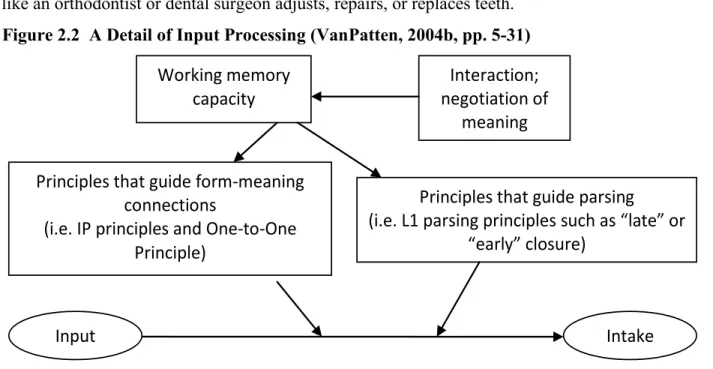
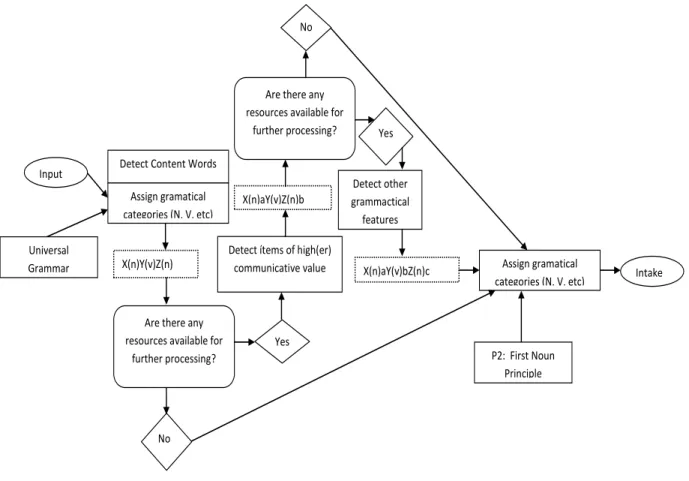
Returning to the concrete metaphor, through the methods of personalization already described, a learner should be able to put him or herself into the concrete. Personalization has made the mixture look appealing and taste appetizing. In addition, when the learner enters the concrete, he or she will not suffer a gag reflex due to stress or anxiety because personalization has made the mixture‟s temperature acceptable. CALL software should still be prepared for one more type of personalization: input processing (IP). When a learner ingests the concrete (input), the learner must chew it. Chewing is the process of applying teeth (IP behaviors) in order to perceive or notice a form in the input and link it with meaning(s), functions(s), or both. Forms are either lexical like the word “gato” (cat in Spanish) or grammatical like the Spanish verbal inflections -ó/-é (VanPatten, 2004b, pp. 6-7; VanPatten, Williams, & Rott, 2004, pp. 1-4). The connections formed during chewing are form-meaning connections (FMCs). See Table 2.4 for VanPatten´s list of theoretical IP behaviors that create FMCs (2004b, pp. 7-18). In Figure 2.2,
VanPatten illustrates how some of these IP behaviors digest input (2004b, p. 144). As Figure 2.2 also shows, the information that IP yields is the intake for the developing system. IP is,
therefore, beneficial and necessary so that accommodation and restructuring can occur in the developing system. Accommodation is the inserting of a new FMC into the developing system. Restructuring takes place if an accommodation or a new grammatical awareness causes a
cascading effect that changes other elements in the developing system (VanPatten, 2004a, pp. 33-35; VanPatten, 2004b, pp. 25-26; VanPatten et al., 2004, pp. 8-9).
However beneficial and necessary IP is, it does not always process all of the input (modified or not) efficiently and correctly. VanPatten and other authors suggest that working memory capacity, interaction, L1, universal mechanisms like the One-to-One Principle (initially one form is mapped to one meaning) and a universal grammar play a role in IP behaviors and their success (Lightbown, 2004, p. 69; VanPatten, 1996, 2004a, 2004b; VanPatten et al., 2004). VanPatten graphically depicts his ideas about this in Figure 2.2 and Figure 2.3. In essence, the learner‟s teeth are not always appropriate and perhaps some mechanisms influence them while they discern and connect the forms and meanings in the input. Therefore, the information in the intake is a subset of the information available in the input, and it may not be correct (Lee & VanPatten, 2003, p. 132; VanPatten, 1996, pp. 13-53; VanPatten, 2004a; VanPatten, 2004b, pp. 5-24).
Because it is possible that learner´s existing IP behaviors and other mechanisms
“variously support, fail to support, or actively hinder the initial establishment of FMCs,” CALL software should not be created to accommodate these as would be the case if IP was considered under individualization (VanPatten et al., 2004, p. 12). The accommodation of a deficient or harmful IP behavior would limit or impair the success of the learner in learning the L2.
Similarly, CALL software programs that ignore the IP of learners would frustrate some learners, as they would never seem to pick up the L2 or understand what they are doing wrong. Only one option remains for CALL software, and that is to attempt to adjust the learner‟s IP mechanisms like an orthodontist or dental surgeon adjusts, repairs, or replaces teeth.
Figure 2.2 A Detail of Input Processing (VanPatten, 2004b, pp. 5-31) Working memory
capacity
Intake Principles that guide form-meaning
connections
(i.e. IP principles and One-to-One Principle)
Principles that guide parsing
(i.e. L1 parsing principles such as “late” or “early” closure)
Interaction; negotiation of
meaning
Figure 2.3 An Expanded Model of Second Language Acquisition Showing the Roles of Some Learning Principles and Universal Grammar (VanPatten, 1996, p. 144)
P2: First Noun Principle Detect ítems of high(er)
communicative value X(n)aY(v)Z(n)b
Are there any resources available for
further processing? No Yes Detect other grammactical features
X(n)aY(v)bZ(n)c Assign gramatical
categories (N, V, etc) Intake Are there any
resources available for further processing? X(n)Y(v)Z(n)
Yes
No Input Detect Content Words
Assign gramatical categories (N, V, etc) Universal
CHAPTER 3 - Software Compilation
CALL software has been produced since at least 1981 when the personal computer was starting to trickle into domestic life from the business world. Technological advances along with the pedagogical advances previously mentioned have occurred since those early PCs and
software programs. The advances have broadened and deepened the potential of CALL. How CALL software developers have taken advantages of these advances is a factor that I measure in terms of the breadth, depth and density of the features offered in the software programs. I establish the breadth of CALL software features to fall into the three categories of interaction, individualization, and personalization because, as I have mentioned, these terms are fundamental for teachers and learners. In Tables 3.1, 3.2, 3.3, 3.4 and Appendices B and D, I have compiled and divided the data that I found in reviews of CALL software from 1981 to 2008 into those three categories. These categories existed in all the software that I reviewed. I selected the CALL software for this compilation from reviews in the publications Hispania and the CALICO Journal (The Computer Assisted Language Instruction Consortium). The analysis of the
compilation will demonstrate the depth and the density of CALL software and opportunities for change or further development. In the analysis, I define depth as the number of attributes in each range of data. The density of the data is the number of software entries in each attribute or sub-attribute divided by the number of software titles in that range (RE/RT). The ranges are the periods into which I have divided the data. I explain the periods in the following paragraph.