46
J, E~To\tOL Soc, BHIT, COI
,l'stBIA III (1084). DEc, 31. 10114DAMAGE BY TWO DOUGLAS-FIR CONE AND SEED INSECTS:
CORRELATION WITH CONE CROP SIZE
C.
E.
MILLEH,A.
F.
HEDLIN A;"\iDD
.
S.
RUTHCanadian Forestry Sen'ice. Pacific Forest Rcsearch Centre. 50R W, Burnside TIoad. Victoria. B,C" V8Z IM5
ABSTRACT
Damage b,' thc Douglas-fir conc moth, Barbara ('o/jaxialla (Kearfott), in ,'car N was significantly related to the size of the cone crop the preceding ycar (N-I) in the interior of British Columbia but not at the coast. Damage I)\' tbe Douglas-fir
cone gall midge. COlltarillia oregoll('lIsis Foote, at the coast was also significant'" related to cone crop size the preceding !'ear, Fluctuations in cone crop size appt'ar to limit populations of these cone insects,
RESUME
L'ampleur des dommagcs causes par Ie perce-cone du Douglas (Barbara ('a/-,
jaxialla
l
Kearfott]) au cours de l"annce Nest ctroitement liee it l"importanee de la rccoltc de cones de l"annee precedcnte (N-I) en Colombic-Brittani4uc. exception faite de la region cotiere, II cn va de meme pour les dommages causes par la cecidomyie des concs du Douglas (Colltarinia oregonellsis Foote) sur la cote, II SCrll-ble Y avoir un rapport entre l"importance de la rccolte de cones et les populations deces insectes,
INTRODUCTION
Douglas-fir cone moth, Barbara ("oljaxiallo (Kearfott) (Lepidoptera: Olethrcutidae). and Douglas-fir cone gall midge. C(Jlltari,jia oregollclIsis Foote (Diptera: CecidomYiidae), are the two most frc4uent and damaging seed pests of Douglas-fir.
i'selu/otsll{!.a IlIcl1::i(,.I'ii ('.1irb,) Franco. in Britisb Columbia, Douglas-fir cone moth occurs most
com-mon'" in dn' interior areas whereas Douglas-fir gall
midg~ is m,;st common in wet coastal ar('a,s (IIt·dlin et 0/, 1980),
Both insect species are uni\'Oltine although in
-di,'iduals may diapause for more than one winter
(prolonged diapause) (Hedlin IU60. 1961), Adults of each species emerge and O\'iposit whcn seed cones
are open to rcceive pollen, in April and earh' Mav, Feeding h,' cone moth laryae begins in Ma,' and is completed b,' mid Jul~' at which time pupation takes place. The cone moth o"er\\'inters as a pharate adult (Sahota I't 0/, 1982) in the cones, Lan'al feeding b,' cone gall midge, which causes gall for-mation on cone scales, occurs from '.1 a" to September. \Vhen the matured and dried cones arc
wetted b,' rain in September the ful"'-developed
lan'ae leave them to O\'erwinter in the duff, Damage b,' cone moth is the result of direct co n-sumption of seeds (lledlin 19(0) while gall forma-tion b,' cone gall midge inhibits m'ule de,'elopment and impairs seed extractability (Johnson and He ik-kenen 1958),
Cone and seed production b,' Douglas-fir varies wideh' O\'er a period of ,'ears, For example. in the Vancouver Forest Region between 1935 and 1974. threc heavy crops. five medium crops, 10 lights
crops, nine very light crops. andl2 crop failures oc-curred (Dobbs £'t 0/, 1976), Variations in cone and seed abundance affect both populations of and
damage bv cone and seed insects attacking pines, PillllS 'pp .. and :\orwav spruce. Picco abies (L.) Karst. (Mattson 1971, 1980: Forcella 1978, 1080; Annila 1981), but relationships bet\\'een cone crop size and damage bv Douglas-fir cone moth and cone gall midge have not been reported, The objective of this study was to determine whether or not damage
bv these insect species was related to cone
abundance,
MATERIALS AND METHODS Cones were collected in August or September in the interior near Kcremeos.
H,C
..
between 19.59 and 1982 and at the coast near Lake Cowichan.l3,C .. between 1957 and 1982, No cone collections werc made in I U71 and 1972 at the coa,st or in 1972 and 1076 in the interior. The number of cones col -lected each Year depended on the size of the cone
crop and raogcd from 20 to 1080, The number of
sample trees ranged from 3 to 40, The cones were sliced longitudinall,' along their axes (Winjum and Johnson 1960) and the numbers of filled and damaged seed.s per axial slice were determined,
Cone crops were rated at the time of collection as nil. Yer" light, light. moderate or heavy: tbe criteria for each rating were similar to those of Dobbs ct 0/, (I m6), The num bers of damaged set'(:h per axial slice were grouped according to crop rating in the year of cone collection (:\) and in the previous ,'ear (N-I). then submitted to analvsis of variance and Duncan's New Multiple Range Test. Damage counts were also grouped b,' ,'ears since preYious heavv or moderate crops and analyzed, Damage counts were
transformed b,' log (x + I) prior to analysis to cor-rect for heterogeneity of ,'ariance (Sakal and Rohlf 1969), Damage bv conc gall midge near Keremeos
was not anal!'zed because of thc low incidence of damage,
J.
E:--:To\IOI.. SOc. RIlIT. COLDtnlA 8 I (198-1). DEC. :31. I !J8-1 14 B colfaxlOfJo (INTERIOR I 12 CONE 10 CROP RATING 8 HEAVY 6 MEDIUM 4 2 1/,
I,
I LIGHT VERY LlGf NIL 195760 65 70 75 80 B. colfoxiona (COAST) 12 UJ CONE u :J 10 CROP <f) -' RATING <t X 8 HEAVY <t ,"
<f)"
0"
"
UJ 6 I"
,
11•
MEDIUM UJ II II II"
""
<f)"
I ."
/I 0 4 II I UJ I I I <.:> <t ::; LIGHT'"
,
0 I VERY LlGt NIL 1957 60 65 80 C oreqonensis CONE 10 (COAST) CROP RATING 8 HEAVY II"
6 II Ii MEDIUM I"
I 4 I. I I,' .1.,
2.
,
"
"
\I LIGHT".
,
\-
,
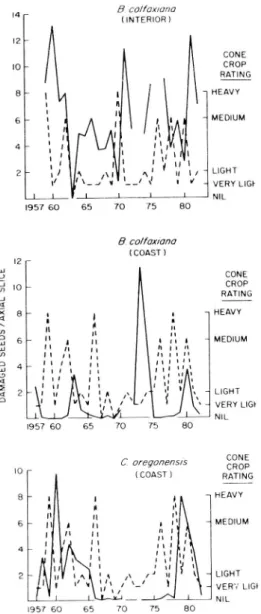
! VEW' LlGI II \ I NIL 1957 60 65 70 75 80Fig. 1. Cone crop rating (dashed line) and damage (solid line) by B. colfaxialla and C. oregollellsis ncar
i-.:crcmeos (interior) and Lake Cowichan (coast) from 1958 to 1982.
RESULTS AND DISCUSSION
Damage by Douglas-fir cone moth and Dougl as-fir cone gall midge fluctuated widely from ,'ear to
year at both locations (Fig. 1). Average number (±
S.E.) of damaged seeds per axial slice associated
with heavy, medium. light and
''C['
'
light conecrops were 3 . .59 (± 2.57), 3.S6 (± 2.17) . .5.7.5
(± O.SO). and 7.90 (± 1.02) respectively for
Douglas-fir cone moth near Keremeos; 0.13
(± 0.06).2.00 (± 16S). 1.21 (± 0.84). and 2.0S (±
1.23) respective'" for cone moth near Lake
Cowichan; and 0.21 (±0.0.5). 4.S9 (±0.4S), 2.-19 (± 1.04). and 2.04 (± 1.17) respective'" for
Douglas-fir cone gall midge near Lake Cowiehan.
Diffcrences in damage among categories of cone
crop size in the year damage occurred (:\) ,,:ere not
significant (P = 0.12) in either species. Contrary to
our results with cone moth and cone gall midge, an
inverse relationship between seed abundance and
damage b,' the Douglas-fir seed chalcidoid,
Megasligllllls sperlllolrOphl1s spennolrop!zlls
Wachtl (H"menoptera: Torymidae), has been
reported in Britain (Hussey 19.56).
Damage by Douglas-fir cone moth ncar
Keremeos and Duglas-fir cone gall midge near Lake
48
J
.
E:-:TO,\lOI.. SOC.BBIT. C()j.l'~IBIA 8\ (\984). DI-:{:. 31. 1984 z a:: <l w >-Z w if) +/ Z <l w ~ w u -' if) -' <I x <l "-if) o w w if) o w <.:> <l ~ <l o 14 /2 10 8 6 4 2 4 2 10 8 6 4 2 a~
ab
n = 2 3t
a~
a c:b n = 2 5 a n = 2 5B
co/fox/ana ( INTERIOR)b
e
i1-
+
c
5 10 B co/fax/ona (COAST) a a~
m
a r h 4 5 8 2C.
oregonens/s (COAST) b 7 2HEAVY MED. LIGHT VERY NIL
LIGHT
CONE CROP RATING IN YEAR N-I
Fig. 2. Number of seeds damaged by B. m/faxilJlj(J and C. urq!,ollclisis in relation to the size of the cone crop of the preceeding \·ear. Bars under the same letter are not significanth' (P
<
0.05) different. Duncan'smultiple range test.
the size of the crop the pre\'ious \'ear (N-I) but near Lake Cowichan no relationship between cone moth
damage and cone abundance the previous ~'ear
could be detected (P = 0.85) (Fig. 2). Damage b\ cone moth near Lake Cowichan was generalh' light
but heaV\' damage occurred periodicalh' (e.g., an
a\'erage of 11.5 damaged seeds per axial slice in
1973). Reasons for the periodic occurrenccs of heav\' damage are not known.
In all instances in this stud\'. abundant crops
(heavv or moderate ratings) were followed the next
vear b\· light crops or crop failures. Abundant cone
crops allowed the insect populations to increase and
the light crops which followed were usuall\' hea\'ih'
damaged due to the high ratio of insects to cones.
Damage by both Douglas-fir cone moth near
Keremeos and Douglas-fir cone gall midge near
Lake Cowichan was significantl\, (P<O.OI) higher
in the year following abundant crops than in other
years (Fig. 3). Others ha\'e also noted this effect
(Hedlin 1964: 'vIattson 19S0: Annila 1981).
Dif-ferences in insect-caused damage among other years
were not significant, although there was a tendenc\' for damage to decrease as the period since the last
abundant-crop increased. These results suggest that
fluctuating cone abundance limits Douglas-fir cone moth in interior areas and Douglas-fir cone gall
J,
E"TO\IOL. Soc:. Bnrr. CUI.u"I1IA 81 (1 DS4), DEC. 31, HJIl4 4!) 12 10 w 8 (/) +1 z 6 <I w ::< 4 w u 2 --' (/) --' ~ x <I....
(/) 0 w 8 w (/) 0 w 6 l? <I ::< 4 <I 0 2a
b n = 6 4 a b n = 5 4 HEAVY lsI OR MED,8.
colfox/ono ( INTERIOR) ab b 4 8 C oreqonens/s ( COAST) 4 7 2 nd 3 rd AND MORE NO, OF YEARS SINCE A HEAVY OR MEDIUM CONE CROPFig, 3, :-.lumber of seeds damaged b,' B, coljaxialla and C, oregollellsis in relation to the number of ",:ars since the last occurrence of a hean' or medium crop, Bars under the same letter are nut signific~nt'"
(P<0,05) different, Duncan's multiple range rest,
Pinus resino.'HI Aiton. and pinyon pines. {lillll."· pdulis
Engelm, and p, mOllophylla Torr, & Frem" also
showed that insect-caused cone damage "'as limited
IJ\' cone abundance the preceding ,'car (Lester 1967:
Mattson 1971: Forcella 1878, 1980),
Emergence of insects from prolonged diapause can result in hem'ier damage than expected in some
,'ears (Hedlin 1964: Annila 1981), Induction of
pro-longed diapause is im'erse'" correlated "ith cone
abundance the ,'ear following feeding Iw DOllglas
-fir cone moth larvae at Keremeos (Hedlin cf ai,
1982), :\0 correlation between prolonged diapause
and crop size was apparent for Douglas-fir cone gall
midge at Lake Cowichan (Hedlin 1964), Emergence from prolonged diapause in relation to
sizes of subsequent crops has not been examined in
Douglas-fir cone moth or Douglas-fir cone gall
midge but such emergence appears to be related to
crop size in Douglas-fir seed ehalcidoid (Annila
1982) and some insects attacking Nor"a,' spruce
(Annila 19S1),
Janzen (lD71) 1l\"\1othesized that erratic seed pro
-duction in plants has e,'olved in response to seed
predation bv animals, Such ma\' be the case in
Douglas-fir. T"picall\', moderate and hean' cone
crops arc preceded b,' crop failures or light crops, Sharp increases in cone production can outstrip the reproducti\'e capabilities of the insect populations
and allow for production of large quantities of seed,
There are fewer crop failures and more cones arc
usual", produced in ,'ears of light production at Kcremeos than at Lake Cm\"ichan which ma,' ac
-count for the consistnth' hea\'ier damage oecu'rring at the former location, Damage to pine cones tends
to be greatest where cone production is most consi
s-tent ('v1attson Unl; Forcella (980), Consistent cone production frolll "ear to \'ear could result in loss of
most seed even' "ear due to build up of cone and
seed insect populations,
ACKNOWLEDGEMENTS
\Ve thank the Forest Insect and Disease Surve,' Pacific Forest Research Centre, for
~,aking soni~
50
J
.
E:-':TO.\fOI.. Soc. BlnT C()(X~fBI.·\ HI (HJ84). DEC. 31. iD84REFERENCES
Annila. E. 1981. Kausen kap,'-ja siementuholaisten kannam·aihtcili. Commlln. I :lSt. For. Fenn. 10 1.32 pp.
Annila, E. 1982. Diapallse and population fluctuations in Megastigmus specularis Walk,\· and Megasligmus
spermotrophus Wachtl (lI\'lnenoptera. Tornnidae). Ann. Ent. Fcnn. -11\:33-36.
Dobbs. R.
c.,
D. G. W. Edwards. J. Konishi and D. Wallinger. Inl6. Guideline to collecting cones of B.C.conifers. B.C. For. Sen·.ICan. For. Sen'. Joint nep. No.3, Victoria. B.C .. 9H pp.
Forcella, F. 1978. Irregularit\· of pill\'on cone production and its relation to pinl'()Il cone moth predation.
Madrono 25:170-172.
Forcella, F. 1980. Cone predation of pin\'on mne beetle (Conopthorus edulis) production. Am. I'\at.
116:594-598.
Hedlin. A. F. 1960. On the life histon' of the Douglas-fir cone moth. Barbara colfaxiana (Kft.)
(Lepidoptera: Olethreutidae), and Ol1e of its parasitcs. Glvpta evetriac Cush. (H\'lnC11optera:
Ichneulllonidae). Can. Ent. 92:826-834.
Hedlin, A. F. 1961. The life histon' and habits of a Illidge. Contarinia oregonensis Foote (Diptera:
Cecidomyiidae) in Douglas-fir cones. Can. Enl. 93:9.'52-!J67.
Hedlin. A. F. 1964. nesults of a six-veal' plot studs' on Douglas-fir cone insect population fluctuations. For.
Sci. 10: 124-128.
Hedlin, A. F .. II. O. Yates Ill. D. Cibrian, 13. II. Ebel, T. W. Kocrber and E. P. \1erkel. 1980. Cone and
seed insects of :\orth American conifers. Can. For. Sen·.IU.S.D.A. For Sen·./Secrct. Agric. Recur.
Hidraul., Mexico. Victoria. BC .. 122 pp.
Hedlin, A. F .. G. E. Miller and D. S. Ruth. 1!J82. Induction of prolonged diapal.lse in Barhara eolfaxiana
(Lepidoptera: Olethreutidae): correlations with cone crops and weather. Can. Ent. )j4:465-471.
Husse\', N. W. 1956. The extcnd of seed-loss in Douglas-fir causeelll\' Megastigmus. Scot. For. 10: 101-107.
Jansen, D. H. 1971. Seed predation b,' animals. Ann. Re\,. Ecol. S,·stemat. 2:46.5-492.
Johnson. l\. E .. anel II. J. lIeikkenen. 1951\. Damagc to seed of Douglas-fir b,' the Douglas-fir cont' miJge.
For. Sci. 4:274-282.
Lester, D. T. 1967. Variation in cone production of red pine in relation to \\·cather. Can.
J
.
Bot.45: 1683-1691.
Mattson, \Y. J., Jr. 1971. Helationship between cone crop size and cone damage by insects in red pine seed
production-areas. Can. Ent. 103:617-621.
Mattson, \.\,.
J
.
,
J r. 1980. Cone resources and the ceology of the red pine cone bectle. Conopthorus resinosac(Coleoptera: Scol,·tidae). Ann. Enl. Soc. Am. 73:380-.3D6.
Sahota. T. S., D. S. Ruth. A. Ibaraki. S. H. Farris and F. G. Pect. HJH2. Diapause in the pharatc aelult
stage of insect development. Can. Ent. 114:117!J-III\3.
Sokal, R. R .. and F. J. Rohlf. 196!). Biometry. W. H. Freeman & Co .. San francisco. 776 p.
Winjulll,