DUI DRYSUIT OWNER’S MANUAL
Congratulations on purchasing a DUI drysuit. It has been carefully
manufactured to exacting standards using high quality materials.When used properly, it will make your diving more comfortable and enjoyable.
DUI’s drysuits are intended for use by certified divers trained in the use of drysuits, or individuals under the direct supervision of a qualified instructor. Even if you are an experienced drysuit diver, we urge you to take the time to read this manual. It includes many important safety techniques and information that can help you extend the useful life of your drysuit.
If the owner’s manual is unavailable or lost, you can download a copy from the DUI Website at www.DUI-Online.com or a copy may be obtained by
contacting DUI at:
Diving Unlimited International, Incorporated 1148 Delevan Drive
San Diego, CA 92102-2499 USA 800-325-8439 619-236-1203 619-237-0378 Fax [email protected] Manual Part# 550414 EN 14225-2:2005
TÜV Rheinland Product Safety GmbH Taubenholzweg
D-51105 Köln Notified Body 0197
Table of Contents...
Definitions . . . .4
Definitions of Important Words Used in This Manual . . . .4
Technical Support . . . .4
Safety . . . .5
Important Safety Information . . . .5
Important Safety Precautions and Drysuit Guidelines . . . .7
DUI Drysuits . . . .8
Intended Use and Function of a Drysuit . . . .8
Selecting and Fitting a Drysuit . . . .8
Before putting on a Drysuit . . . 10
Put the Drysuit on over your divewear . . . 10
DUI Drysuit Features . . . 11
Drysuit Valves . . . 12
Neck & Wrist Seals . . . 12
Socks & RockBoots™ . . . 12
Turbo Sole Boots . . . 12
Waterproof Zipper . . . 13
Common Features of QuickZip™ & Classic-Style Self-Donning Drysuits . . . 13
Suspenders . . . 13
Telescoping Torso . . . 13
Crotch Strap . . . 13
Warm Neck Collar . . . 13
Zipper Guard . . . 13
Accessories for Drysuit Diving . . . 14
Divewear . . . 14
Hoods . . . 14
Weight & Trim Systems . . . 14
Necklace . . . 14
Dry Glove Systems . . . 15
Other Accessories . . . 15
Ankle Weights . . . 15
Sizing Seals . . . 16
Latex Seals & Trimming Guides . . . 16
Neoprene Seals . . . 17
Putting the Drysuit Seals On . . . 18
Wrist Seals . . . 18
Neck Seals . . . 19
Ankle Seals . . . 20
Taking the Drysuit Seals Off . . . .21
Wrist Seals . . . .21
Neck Seals . . . .22
Ankle Seals . . . 22
DUI ZipSeals™ & ZipGloves™ . . . 23
Installing & Using ZipSeals & ZipGloves . . . 23
Installing ZipSeals-Wrist . . . 23 Removing ZipSeals-Wrist . . . 25 Installing ZipSeals-Neck . . . .25 Removing ZipSeal-Neck . . . .27 ZipGloves™ . . . 28 Installing ZipGloves . . . .28 Removing ZipGloves . . . 29
ZipGloves-WD™ . . . 28
Trimming Wrist Dams . . . 30
Checking Wrist Dams for Proper Fit . . . 31
Checking Wrist Dams for Proper Function . . . 32
Installing ZipGloves-WD . . . .33
Putting on a Drysuit with ZipGloves-WD Installed . . . 33
Diving with ZipGloves-WD . . . .34
ZipGlove-WD Maintenance & Repair . . . 35
Preparation . . . .36
Connecting the Drysuit Hose to your Regulator . . . .36
Before Your First Drysuit Dive . . . .37
Preparing to Dive with your DUI Drysuit . . . .37
Pre-Dive Inspection . . . .37
Putting Your Drysuit On . . . .38
QuickZip™ Design . . . .38
Classic-Style Self-Donning Design . . . 40
Shoulder-Entry Design . . . 40
RockBoots™ . . . 41
Turbo Sole Boot Option . . . 42
Diving with your DUI Drysuit . . . 43
Preparing to Dive . . . 43
Entering the Water . . . 44
Achieving Neutral Buoyancy at the Surface . . . 44
Estimated Changes in Cylinder Weight . . . 45
Maintaining Buoyancy Control During the Dive . . . 46
Diving With a Single Tank . . . 46
Diving With More Than a Single Tank . . . 47
Starting Your Dive . . . 47
Descending . . . 47
Obtaining Neutral Buoyancy at Depth . . . 48
Ascending in Your Drysuit . . . 48
Surface Swimming . . . 49
Emergency Procedure Skills . . . 50
Inverted Position (Air in Feet) . . . 50
Inflator Valve Stuck Open . . . 51
Inflator Valve Stuck Closed . . . 52
Leaking Exhaust Valve . . . 52
Exhaust Valve Stuck Closed . . . 53
Slow Air Leak in Inflator Valve . . . 53
Loss/Interruption of Air Supply . . . 53
Flooded Drysuit . . . 53
Dropped/Lost Weight Belt . . . 54
Adjusting you DUI Drysuit Between Dives . . . 54
Taking Off Your DUI Drysuit . . . 55
QuickZip™ and Original Self-Donning Drysuits . . . 55
Shoulder-Entry Drysuits . . . 57
Removing the Drysuit from your Body . . . 57
Troubleshooting . . . 57
Care and Maintenance of your DUI Drysuit . . . 59
Drysuit Storage . . . 59
Folding your DUI Drysuit in Drysuit Bag for Transporting . . . 59
Hanging Drysuit For Storage . . . 60
Long Term Storage (Longer than two months) . . . 60
Method for Disposing of Drysuit . . . 60
Warranty . . . . 61
DEFINITION OF IMPORTANT WORDS USED
IN THIS MANUAL
Throughout this manual, we will use certain words to call your attention to conditions, practices, or techniques that may directly affect your safety. Pay particular attention to information introduced by the following signal words:
!!! DANGER !!!
Indicates an imminently hazardous situation which, if not avoided, will result in death or serious injury.
!! WARNING !!
Indicates a potentially hazardous situation, which if not avoided, could result in death or serious injury.
! CAUTION !
Indicates a potentially hazardous situation, which, if not avoided, may result in minor or moderate injury. It may
also be used to alert against unsafe practices.
TECHNICAL SUPPORT
If any portion of this manual is unclear, or if you are unable to obtain satisfactory answers from your dive store or instructor, contact DUI at: 800-325-8439 619-236-1203 Fax 619-237-0378 [email protected] www.DUI-Online.com
Definitions ...
IMPORTANT SAFETY INFORMATION
This drysuit is intended for use by certified SCUBA divers who have successfully completed a course in the use of drysuits or divers in training under the supervision of a qualified instructor.
!! WARNING !!
Follow all instructions and heed these safety precautions. Improper use or misuse of the drysuit could result in
serious injury or death.
!! WARNING !!
This owner’s manual is NOT a substitute for drysuit instruction by a qualified instructor. DO NOT USE a drysuit until you have practiced and mastered practical
drysuit diving skills, including emergency skills, in a controlled environment under the supervision of a dive instructor, certified by a nationally recognized instructional
organization and knowledgeable in the use of drysuits.
!! WARNING !!
Improper use or misuse of this DRYSUIT could result in loss of buoyancy control, including uncontrolled descents
and uncontrolled rapid ascents, resulting in drowning, decompression sickness, or air embolism.
!! WARNING !!
Improper use or misuse of this DRYSUIT could result in exposure to thermal hazards, including rapid body overheating (hyperthermia) or cooling (hypothermia),
resulting in stroke or seizure.
!! WARNING !!
Do not use the drysuit as a lift bag. If you use the drysuit as a lift bag and lose your grip on the object, you may
become excessively buoyant. This may result in a rapid ascent.
!! WARNING !!
Rapid ascent is dangerous and may cause air embolism or decompression sickness, either of which can result in
serious injury or death.
!!! DANGER !!!
Diving in an environment which is chemically, biologically, or radiologically contaminated is extremely
hazardous. Although some DUI equipment can be adapted for use in some contaminated environments, special training, equipment and procedures are required.
Do not dive in a contaminated environment unless you have been thoroughly trained and specially equipped.
!!! DANGER !!!
Ice diving (diving in water 40°F (5°C) or less) is extremely hazardous. Do not engage in ice diving
unless you have been thoroughly trained and specially equipped.
!! WARNING !!
Only especially configured equipment should be used in contaminated water diving operations. The configuration is dependant upon, but not limited to, type of contamination, length of exposure, operator
training, operator experience levels, and operator work rate.
Read this entire manual before using the drysuit, even if you have experience in the use of drysuits. Keep the manual for future reference.
If you resell or loan the equipment to someone, be sure that this manual accompanies the drysuit and is read and understood before the drysuit is used.
Failure to follow all warnings and instructions for use and maintenance of the drysuit may result in serious injury or, in extreme situations, death.
This manual is supplied to the original purchaser of a DUI drysuit. If you have
any questions about the use or maintenance of your DUI drysuit, or if you need another copy of this manual, contact DUI:
Diving Unlimited International, Inc.
1148 Delevan Drive, San Diego, CA 92102-2499 USA 1-800-325-8439
[email protected] www.DUI-Online.com
IMPORTANT SAFETY PRECAUTIONS
AND DRYSUIT GUIDELINES
The following DRYSUIT GUIDELINES have been adopted and endorsed by several manufacturers of drysuits, including DUI:
• Complete a drysuit diving course from an instructor and stay current by practicing your skills often.
• Use a buoyancy compensation device for surface flotation and back up. • Know your equipment and emergency procedures.
• Practice your drysuit diving skills under controlled conditions until they become second nature.
• Dive with a dive partner who understands your drysuit system.
• Use the correct amount of insulation for the water temperature in which you are diving and exercise rate.
• Do not weight yourself heavier than neutral buoyancy with an empty tank. Your weighting should allow you to make a safety stop at ten feet upon completion of your dive with a tank containing 500 psi (34 Bar) of air or less.
• Check your valves, zipper and seals before each dive.
• Perform preventive maintenance and repairs on your drysuit and valves regularly, or have them serviced by a qualified individual.
• Know your limitations and do not exceed them.
• Water or air temperatures below 70°F (21°C) constitute cold water diving. • Water or air temperatures below 40°F (5°C) constitute ice diving. Ice diving
is very dangerous and requires special equipment, training, preparation and procedures.
INTENDED USE AND FUNCTION
OF A DRYSUIT
DUI drysuits are shell drysuits and provide minimal thermal protection.The drysuits are designed to be used in combination with insulated undergarments as well as head and hand protection.The shell drysuit provides a dry air layer around the covered portions of the body. A similar example is a raincoat. As with a raincoat, the coat keeps you dry and what you wear under it keeps you warm. This approach provides you with a versatile drysuit which can be used in a wide range of diving conditions by adjusting the insulation and accessories to your personal needs.
!!! DANGER !!!
Diving in an environment which is chemically, biologically, or radiologically contaminated is extremely
hazardous. DUI offers a line of drysuits specifically for these types of diving operations. However, even with these specialized drysuits, special training, equipment
and procedures are required.
SELECTING AND FITTING A DRYSUIT
DUI builds and inventories several different sizes of drysuits which fit a large percentage of the population. Special production sizes are available for those individuals who do not fit an inventoried size.
When selecting the size of a drysuit start with the sizing tables for the drysuit style.The size given will represent a starting point.The key to getting the correct size is to first put on the maximum amount of insulation/divewear you anticipate using.
DUI Drysuits ...
FIG-1 MEN’S AND WOMEN’S DRYSUIT SIZE TABLES, STOCK SIZESMen’s CF200X Inches S M LS L XL-S XL Height 60 68 62 70 62 70 64 72 54 72 66 74 Chest 34 37 38 40 41 43 41 43 44 46 44 46 Girth 64 68 68 72 68 72 70 74 70 74 72 76 Floor-Crotch 32 34 33 35 33 35 34 36 34 36 35 37 mm S M LS L XL-S XL Height 1524 1727 1575 1778 1575 1778 1626 1829 1372 1829 1676 1880 Chest 864 940 965 1016 1041 1092 1041 1092 1118 1168 1118 1168 Girth 1626 1727 1727 1829 1727 1829 1778 1880 1778 1880 1829 1930 Floor-Crotch 813 864 838 889 838 889 864 914 864 914 889 940 Men’s CLX450, FLX50/50,TLS350, CLXSE,TLSSE, CNSE, CF200SE, 30/30 and 30/30SE Inches S M L XL XX Height 60 68 62 70 64 72 66 74 68 76 Chest 34 37 38 40 41 43 44 46 47 49 Girth 64 68 68 72 70 74 72 76 74 78 Floor-Crotch 32 34 33 35 34 36 35 37 35 37 mm S M L XL XX Height 1524 1727 1575 1778 1626 1829 1676 1880 1727 1930 Chest 864 939 965 1016 1041 1092 1118 1168 1194 1245 Girth 1626 1727 1727 1829 1778 1880 1829 1930 1880 1981 Floor-Crotch 813 864 838 889 864 914 889 940 889 940 Women’s CLX450, FLX50/50,TLS350, CLXSE,TLSSE, 30/30 and 30/30SE Inches S M ML L XL XX Height 60 66 62 68 64 70 64 70 65 70 66 72 Chest 30 33 32 34 35 37 35 38 39 41 71 43 Girth 61 63 63 65 65 67 65 67 67 69 71 73 Floor-Crotch 31 33 32 34 32 34 33 35 34 36 35 37 mm S M ML L XL XX Height 1524 1676 1575 1727 1626 1778 1626 1778 1651 1778 1676 1829 Chest 762 838 813 864 889 940 889 965 991 1041 1803 1092 Girth 1549 1600 1600 1651 1651 1702 1651 1702 1702 1753 1803 1854 Floor-Crotch 787 838 813 864 813 864 838 889 864 914 889 940
BEFORE PUTTING ON A DRYSUIT:
• Check the fit of the divewear. Ill-fitting divewear insulation can affect the fit of the drysuit.
• Check the fit of the seals - see the seal sizing portion of this manual • Review the instructions in this manual on how to put on the drysuit
PUT THE DRYSUIT ON OVER YOUR DIVEWEAR &
COMPLETE THE FOLLOWING FIT EVALUATION:
The drysuit should not restrict breathingFeet should not be cramped
Ease of breathing:There should be no restriction when taking a deep breath Complete the range of motion exercises:
Overhead reach: Reach up with both hands as if you were trying to reach the valve on your tank; you should be able to do this without the drysuit pulling up tight in the crotch
Cross your arms reach: Reach across the chest with both arms (like you were hugging yourself.) You must be able to reach and operate the exhaust valve on the left shoulder
Crouch and reach: Kneel down, sit back over your heals and lean forward. This position checks the leg length and torso length at the same time.The drysuit should not be restrictive or binding
FIG-2 RANGE OF MOTIONS EXERCISES
The fit of a drysuit is important and, if you are between sizes, the larger size is the better choice. If problems are noted in any of these areas a different stock size or a Special Production (made-to-order) should be selected.
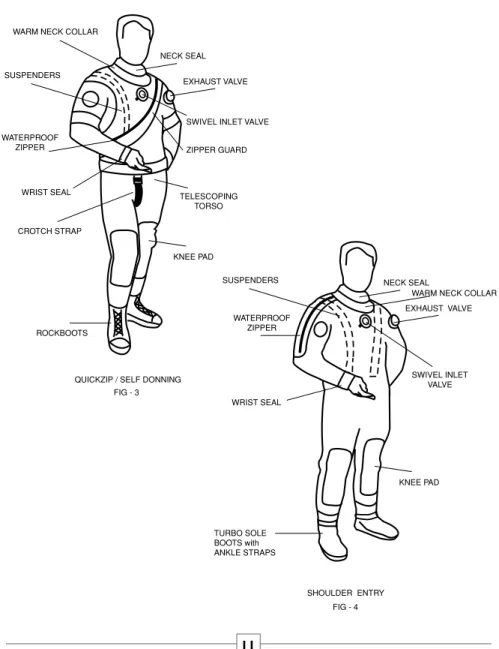
COMMON DUI DRYSUIT FEATURES
The following features are found on most QuickZip™ and Classic-style self-donning drysuit models and shoulder-entry drysuit models.
FIG 3 & 4 DRYSUIT FEATURES
Drysuit Features ...
WARM NECK COLLAR
SUSPENDERS WRIST SEAL CROTCH STRAP TELESCOPING TORSO KNEE PAD
SWIVEL INLET VALVE
ZIPPER GUARD EXHAUST VALVE NECK SEAL
ROCKBOOTS
QUICKZIP / SELF DONNING FIG - 3 WATERPROOF ZIPPER KNEE PAD SWIVEL INLET VALVE EXHAUST VALVE NECK SEAL TURBO SOLE BOOTS with ANKLE STRAPS WRIST SEAL SHOULDER ENTRY FIG - 4 WATERPROOF ZIPPER
WARM NECK COLLAR SUSPENDERS
DRYSUIT VALVES
Your drysuit is equipped with an inlet and exhaust valve for controlling the air volume inside your drysuit.The inlet valve allows you to put air into your drysuit during descent as needed or to inflate the drysuit while at the surface for additional flotation.The inlet valve body swivels and allows the drysuit inflation hose to be routed around the right or left side of the diver. The exhaust valve is used to vent unnecessary air from the drysuit.The exhaust valve can be used to release air automatically or can be manually operated. Most diving is done with the exhaust valve in the automatic mode at the lowest opening pressure which keeps the smallest amount of air in the drysuit. Set the valve to the lowest opening pressure by rotating the valve body completely counterclockwise until you reach a stop (see the section on MAINTAINING BUOYANCY CONTROL DURING THE DIVE for more information.) To vent air from the drysuit in the automatic mode make the valve the highest point in the drysuit; i.e., lift your left elbow up so that the valve is at the highest point on your arm.
The manual exhaust mode is used primarily on the surface when additional flotation is needed. In the manual mode, the valve is set at the highest opening pressure by rotating the exhaust valve body fully clockwise until a stop is reached. To vent air from the drysuit, position the valve at the highest point and fully press down on the valve.The valve can be manually operated to vent air from the drysuit even in the automatic or partially closed mode.
NECK,WRIST & ANKLE SEALS
The neck and wrist seals provide a watertight seal around the neck and wrist. Sizing adjustments must be made to get a proper fit and seal. Latex seals are most common, however neoprene seals are available.
DUI’s 30/30 & 30/30SEdrysuits are equipped with latex ankle seals.
SOCKS & ROCKBOOTS™
Each drysuit is provided with dry socks attached to the drysuit to keep the feet dry.The socks are sized to provide room for insulated accessory boots. RockBoots™ are then worn over the socks to provide protection, ankle support and improved traction.
TURBO SOLE BOOTS WITH ANKLE STRAPS
This option is selected when the diver prefers a completely attached boot.
Drysuit Features ...
The sock has a sole similar to a sneaker, has a softie-sole installed on the inside of the sock and has an ankle strap.
WATERPROOF ZIPPER
The waterproof zipper provides a watertight closure and allows for putting the drysuit on and removing it.The waterproof zipper is one of the most important parts of your drysuit. Read the instructions on the use and care of the waterproof zipper before using. Misuse could result in permanently damaging the zipper.
COMMON FEATURES ON QUICKZIP™
& CLASSIC-STYLE SELF-DONNING DRYSUITS
SUSPENDERS
Suspenders hold the crotch of the drysuit up which improves leg movement. The suspenders also allow the upper half of the drysuit to be worn down around the waist before or between dives.
TELESCOPING TORSO
The telescoping torso section provides extra room for putting the drysuit on or removing it. The extra material then folds over at the hips when the extra length is not needed.
CROTCH STRAP
The crotch strap holds the telescoping torso section in place when the drysuit is in use.
WARM NECK COLLAR
The warm neck collar is used in combination with the warm neck hood.The bib on the warm neck hood is tucked under the warm neck collar.The design minimizes water circulation around the neck and helps to keep the neck warm.
ZIPPER GUARD
Drysuit Accessories ...
ACCESSORIES FOR DRYSUIT DIVING
There are several accessories that will make diving with your DUI drysuit easier and more enjoyable.
The following drysuit accessories are available from your DUI dealer. For additional information contact your DUI dealer, visit DUI’s website at www.DUI-Online.com or contact DUI Customer Service.
DIVEWEAR (INSULATION)
DUI has a complete line of insulation garments specifically designed for the diving environment. See DUI Thermal Guidelines for help in selecting the best combination of garments for your diving needs.
HOODS
Warm Neck Hood:The warm neck hood provides additional thermal protection to the neck area and is designed work in conjunction with the warm neck collar available on most DUI drysuits.
Standard Hood:This hood is used with drysuits not equipped with warm neck collars.
WEIGHT & TRIM SYSTEMS
DUI produces two styles of Weight & Trim Systems that have a 40 lb (18 kg) capacity, an easy to adjust harness and patented weight drop system. Weight & Trim Classic: Heavy webbing harness, maximum size range adjustability, weight pockets adjust forward and back, up and down
Weight & Trim II:The harness is made of 1000 Denier Cordura® and is more streamlined, weight pockets adjust only forward and back
NECKLACE
The necklace is used before or between dives for topside comfort. Folding the neck seal over the necklace relieves the seal tension around the neck and also allows moisture in the drysuit to be vented. Remember to remove the necklace before entering the water.
DRY GLOVE SYSTEMS
Dry glove systems should be considered when diving in water temperatures below 54°F (12°C) to minimize the risk of non-freezing cold injures. Current options include:
ZipGloves™: A ZipRing is permanently attached to your drysuit and the glove attaches to your drysuit with that ring. No wrist seal is used and liners are used on your hands for insulation.
Dry-5 Non-Integrated Glove System: Insulated dry gloves with latex wrist seals attached and worn over the top of the drysuit wrist seals.
OTHER ACCESSORIES
ANKLE WEIGHTS
Many newcomers to drysuit diving find that ankle weights are helpful in adjusting trim while in the water. Experienced drysuit divers often consider ankle weights as “training wheels” to be removed as soon as possible because of the additional effort required to swim. It is recommended that recreational divers wear no more than 2.5 Lb (1 kg) on each ankle.
! CAUTION !
Do not wear fins that are too tight. If you block the blood flow to the feet, you may suffer cold and disabling
foot cramps.
Sizing Seals ...
LATEX SEALS & TRIMMING GUIDES
The sizing guide below is for regular latex seals only. Do not use these guidelines for heavy-duty or RS-style latex wrist seals.
If you have any questions, please contact your local DUI dealer or DUI Customer Service at 800.325.8439, 619.236.1203 or
FIG 5 - NECK SEAL DRYSUIT SIZING TABLE
When trying on a neck ZipSeal that is not on a drysuit, be sure to trim it at least one ring size too small.Then try on the neck ZipSeal again after it is installed in the drysuit.The weight of the drysuit can pull on the neck seal making it feel looser.Trim additional rings if necessary.
Trim Line Neck (in) Neck (mm)
Trim Line 11 13 330 Trim Line10 13.5 343 Trim Line 9 14 356 Trim Line 8 14.5 368 Trim Line7 15 381 Trim Line 6 15.5 394 Trim Line 5 16 406 Trim Line 4 16.5 419 Trim Line 3 17 432 Trim Line 2 17.5 445 Trim Line 1 18 457
FIG 6 - WRIST SEAL DRYSUIT SIZING TABLE (FOR STANDARD LATEX SEALS ONLY)
NOTE: Do not use this guideline for heavy-duty or RS-style latex wrist seals. Trim Line Wrist (in) Wrist (mm)
Trim Line 10 4.5 114 Trim Line 9 5 127 Trim Line 8 5.5 140 Trim Line 7 6 152 Trim Line 6 6.5 165 Trim Line 5 7 179 Trim Line 4 7.5 191 Trim Line 3 8 203 Trim Line 2 8.5 216 Trim Line 1 8.75 222 Line 1 Line 1
Note:If your latex seals are not new with 11 trimlines on the neck and 10 trimlines on the wrist contact customer service at DUI for assistance.
Latex neck and wrist seals are trimmed to fit to provide a comfortable water-tight seal. Latex seals are tapered and have a series of trim lines (small raised lines running around the outside surface of the seal.) The trim lines start at the seal opening and with each line gets progressively bigger.These lines can be used as a guide when trimming the seals to keep the line even. A good pair of scissors is needed to make smooth cuts. Use the Seal Sizing Table to determine the best starting point for you.
Start by measuring the circumference of your neck and wrists and compare these measurements to the Seal Sizing Table.This will establish a starting point. If your wrists are different sizes you can trim each seal to match each wrist. Try on the seal (it isn’t necessary to put the entire drysuit on to try the neck seal.) For the neck seal, position the seal as low on your neck as possible. It should be snug, but not tight. If you are new to drysuit diving, a snug neck seal may feel a bit uncomfortable out of the water. Once in the water, a properly timed neck seal is comfortable.
Wrist seals should be worn just above the wrist bone*.They should be snug but not tight and should not restrict blood flow to the hands. If you
experience tingling in your hands, trim seals further.
If this is the first time you have trimmed seals and you are concerned about over trimming the seals, start by moving down two sizes smaller than on the Seal Sizing Table. If the table recommends trimming at line 5, start by trimming at line 7 and check the fit. If the seal is overly snug you can trim on line 6.You can even trim between the lines.
*A percentage of divers have a tendon that causes an indentation when the wrist is flexed. This may cause leakage when the wrist is flexed during the dive. In this case the diver should wear the seal higher on the wrist (up the arm) past the tendons.
Special Note on Latex Ankle Seals: There is only one trim line on latex ankle seals. In the event you receive a drysuit and the ankle seal has not been trimmed, trim the ankle seal on the trim line.
!! WARNING !!
Compounds and additives to neoprene and latex can cause allergic reactions in some people.
NEOPRENE SEALS
Neoprene seals are made from the same material used to make wetsuits.The seal material is normally 1/8"-3/16" (3-5 mm) in thickness. Though neoprene
neck and wrist seals are provided in different sizes, size adjustment may still be needed (keep in mind that a neoprene seal will stretch and become slightly larger with use.) If your seals are too tight, you can stretch them yourself by pulling the seal over something a little larger than your neck or wrist. For a neck seal, a SCUBA tank is common and for wrist seals, a bottle or can is often used. Once the seal(s) are stretched over the item, leave them for about twelve hours. If they are still too tight after this they may need to be trimmed. To trim the seal use a good pair of scissors and trim off only 1/8" (3 mm) of length at a time checking the fit between cuts. As with latex seals the neoprene seal should not be overly tight or restrict blood flow.
!! WARNING !!
A neck seal that is too tight can restrict the blood flow to your brain, resulting in serious injury or death.
!! WARNING !!
A wrist seal that is too tight can restrict the blood flow to the hand resulting in discomfort, loss of sensation and
predispose the hands to cold injuries.
Note: Remove all jewelry which can damage or get caught in the seals.
WRIST SEALS
LATEX
• To prevent the Divewear from bunching up in the drysuit sleeve, place the thumb loops located inside the divewear sleeve openings over the thumb or grasp the cuff of the garment with the finger tips
• Pull on the sleeve to where your fingers are sticking out of the seal by 1" -2"
• Bring the fingertips of the hand together forming a point
• With two fingers from the other hand stretch the seal sideways and pass the hand through the seal
• The latex seal should lay flat against the skin and there should be no wrinkles in the sealing surface. Make sure the thumb loops and/or divewear material is not under the sealing surface
Lubricating seals: This is a matter of preference. Common lubricants include talc, soapy water and Liquid KY. Do not use silicone lubricants which can build up on the suit resulting in problems when repairs are needed.
Special Tip: Soapy water is an excellent lubricant for putting the wrist seals on and off. Use one part dishwashing soap to ten parts water and put in a spray bottle. Spray a small amount of the soapy water on the inside and outside of the wrist seal before putting your hand inside the sleeve.
NEOPRENE CONE (SMOOTH SEALING SURFACE
INSIDE SEAL)
• Put on using the same method as the latex wrist seals
• Neoprene Fold Under Cone (Smooth Sealing Surface on outside of seal to be folded under to create a seal)
• Put on using the same method as the latex wrist seals
• Fold under a minimum of 1" (25 mm) of the seal opening so that the smooth sealing surface is against your skin
NECK SEALS
LATEX
• Place the seal on top of your head
• From the outside of the suit, grasp the neck seal by placing both hands on the inside of the neck opening
• Stretch the seal wide with your hands flat (do not dig your fingernails into the neck seal.) Your thumbs should remain on the outside of the seal • Spread the neck seal as wide as you can, turn your head to the side and pull
the neck seal over your head
• The seal should lay downwards, flat against your neck. There should be no wrinkles or folds or any items under the seal, i.e. divewear collar
NEOPRENE
• Place the seal on top of your head
• From the outside of the suit, place your hands flat on the outer surface of the seal
• Push your head up through the neck seal while using your hands to slide the neck seal over your head. Stop when the top edge of the neck seal reaches your chin
• To make a seal fold the top edge of the neck seal under while the seal is still at your chin. Fold the top edge of the seal down and in around the neck. Approximately 2" of the smooth surface of the seal should be flat against the neck
• The seal should lay flat against your skin. There should be no wrinkles or folds or any items under the seal, i.e. divewear collar
ANKLE SEALS
Some DUI drysuit models are equipped with latex ankle seals:
• If the drysuit has a protective ankle cuff, undo the velcro and pull back the protective cuff completely exposing the ankle seal
• Put the foot all the way through the leg but not into the ankle seal • With both hands, insert your fingers into the seal from the outside of the
suit
• Stretch the seal as wide as possible while pulling it over your foot
• The ankle seal should lay flat against your skin right above the ankle bone. Be sure there are no wrinkles or folds or any items under the seal, i.e. divewear
WRIST SEALS
LATEX
• Insert the index and middle fingers of the left hand under the right wrist seal. Slide the fingers along the inside of the wrist, keeping your fingernails against the wrist and away from the seal
• Grasp the sleeve material between your fingers and thumb and pull your arm out of the seal but not out of the sleeve. Slide the drysuit off the right shoulder
• Put your right arm around your back and, with your left hand, grasp the material of the right sleeve. Pull the sleeve off your right shoulder and arm. Remove your left wrist seal in the same way and pull the left arm free of the sleeve
NEOPRENE CONE (SMOOTH SEALING SURFACE
INSIDE SEAL)
• Pull the sleeve up as far as you can on your arm
• Pull the sleeve down to invert the seal so the nylon lays flat against your forearm
• Insert the fingers of your opposite hand, grasp the sleeve where the wrists seal meets the sleeve and pull seal and sleeve off
NEOPRENE FOLD UNDER CONE (SMOOTH
SEALING SURFACE ON OUTSIDE OF SEAL)
• Unfold the end of the seal so that it is no longer turned under (nylon is laying against your skin)
• Insert the fingers of your opposite hand and pull the seal down and over your hand
NECK SEALS
LATEX
• From the outside of the suit, reach through the top of the neck seal with both hands
• Spread the latex neck seal as wide as you can with your hands flat (do not dig your fingernails into the neck seal)
• While spreading the neck seal, lift with your arms as you tuck your head to your chest. Put your head under the seal and out of the drysuit
• Should you require assistance, have your dive partner put his/her hand inside the zipper opening under the inlet valve. Gently lift the front of the drysuit until it is over your head. Do not strain the drysuit zipper
NEOPRENE NECK SEAL
• Unroll the neck seal so it is no longer turned under (nylon is laying against your skin)
• Grab the neck seal with your hands on either side of your head and pull it up until the leading edge is at chin level
• Slide your fingers down inside the seal until the edge of the seal and grab with your fingers and thumb. Tuck your chin into your chest and, while turning your head slightly to the side, pull up on the seal
ANKLE SEALS
• If the drysuit has a protective ankle cuff, undo the velcro and pull back the protective cuff completely exposing the ankle seal
• From the outside of the suit, reach through the bottom of the ankle seal with your fingers from both hands
• With your fingers inside the seal and thumbs on the outside, reach through and grab the fabric of the suit
• Carefully pull the suit over the foot
INSTALLING & USING DUI ZIPSEALS™ &
ZIPGLOVES™
!! WARNING !!
Improper use or misuse of ZipSeals and/or ZipGloves could result in suit flooding and loss of buoyancy
control, including uncontrolled descents and uncontrolled rapid ascents, resulting in drowning, decompression sickness, or air embolism. Always check
ZipSeals attachment prior to every dive.
Improper use or misuse of ZipSeals and/or ZipGloves could result in suit flooding and exposure to thermal hazards, including rapid body cooling and hypothermia.
Always check ZipSeals attachment prior to every dive.
WRIST ZIPSEALS
INSTALLING WRIST ZIPSEALS1.Your drysuit must be equipped with ZipRings on the sleeves
2. Apply a small amount of soapy water into the grooves on the wrist ZipSeal (1 part mild dish soap to 10 parts water)
3. Invert the seal so you can get your fingertips on the inside of the ZipRing (this will help you press the rings together)
4. Insert the entire ring of the ZipSeal into the sleeve
5. Line up the grooves on the wrist ZipSeal with the grooves on the sleeve. Press together.You should feel the grooves “click” together
6. Repeat the procedure on the other sleeve
Remember: ALWAYS double check each ZipSeal before every dive to ensure the grooves are securely snapped together
REMOVING WRIST ZIPSEALS
1.While holding onto the ring on the sleeve, gently insert the tip of your finger into the groove on the ZipSeal
2. Gently peel back the wrist ZipSeal while pulling the ring on the sleeve outward. Remove the rest of the wrist ZipSeal from the sleeve
3. Repeat on the other sleeve
NECK ZIPSEALS
INSTALLING A NECK ZIPSEAL1.Your drysuit must be equipped with a ZipRing on the neck.Turn the suit inside out
2. Spray a small amount of soapy water into the grooves on both sides of neck ZipSeal (1 part mild dish soap to 10 parts water)
DUI ZipSeals™ & ZipGloves™ ...
3. Pull the double ring on the drysuit slightly apart
4. Completely insert the neck ZipSeal into the ZipRing on the drysuit and line up the grooves
5. Press the grooves together with your fingertips until you feel the grooves “click” together
Remember:There are two sides of the drysuit neck ZipSeal and both sides need to be locked in place
6. After pressing them together run your fingers around the neck ZipSeal once more to ensure it is secure on both sides of the neck seal
REMOVING A NECK ZIPSEAL
Removing a neck ZipSeal can be more difficult as it is locked between two rings
1. Insert your fingertip between the ZipRing on the neck seal and the ZipRing on the drysuit
2. Insert your thumb between the ZipRing on the neck seal and the ZipRing on the drysuit to loosen the ring
3. Gently pull the neck ZipSeal out of the ZipRing on the drysuit
STORAGE OF ZIPSEALS
Not going to be using your drysuit for a while? Removing the ZipSeals from the drysuit and placing them in an airtight container will help them last longer. Be sure to remove as much air from the container as possible. As the latex seals used in DUI’s ZipSeals are natural rubber, storing the ZipSeals in this manner will help reduce deterioration by ozone.
ZIPGLOVES™
THERE ARE TWO TYPES OF ZIPGLOVES: ZIPGLOVES AND ZIPGLOVES-WD.
INSTALLING ALL ZIPGLOVES
1.Your drysuit must be equipped with ZipRings on the sleeves. Remove the wrist ZipSeal from the sleeve (see Removing Wrist ZipSeals on page 25)
2. Apply a small amount of soapy water into the grooves on the ZipGlove (1 part mild dish soap to 10 parts water)
3. Invert the ZipGlove so you can get your fingertips on the inside of the ZipRing (this will help you press the rings together)
DUI ZipSeals™ & ZipGloves™ ...
4. Line up the palm of the ZipGlove with the seam on the arm of the drysuit
(make sure you are putting the correct hand on the sleeve - i.e. left glove on the left arm)
5. Line up the grooves on the ZipGlove with the grooves on the sleeve
6. Press together.You should feel the grooves “click” together
7. Run your fingers along the entire ring to ensure they are secure
REMOVING ZIPGLOVES
Remove ZipGloves the same way as removing wrist ZipSeals. Please see page 25.
DIVING WITH ZIPGLOVES
Put on the liner before putting your hand in the gloves. More than one liner can be worn at a time for colder water applications.The liners are made with fast drying insulation which is used in a wide variety of industrial cold/wet applications.
After putting on the drysuit with ZipGloves, secure the wrist strap on the gloves. Do not over tighten the wrist strap as this could restrict blood flow to the hands.
ZIPGLOVES-WD™
This unique system is intended for dives where the risk of a glove leaking as a result of damage is high or the diver prefers to have a redundant seal on their wrist.To provide this redundant seal, ZipGloves-WD are equipped with a WristDam™; a donut-shaped wrist seal.
When properly fitted, the WristDam allows air to travel between the suit and gloves during the dive for added warmth and comfort.The WristDam will also mitigate water intrusion should the glove become damaged during the dive.
TRIMMING THE WRISTDAM
1.Turn the opening of the ZipRing inside-out as it will make it easier to get to the inside WristDam
2. Use the trim lines for fitting the WristDam to your wrist size.The lines on the WristDam are only a guide.You can make smaller adjustments to the opening size by trimming less on the WristDam
3.The rings are counted from the outside in.The ring farthest from the opening is ring 1. A new pair of gloves has the WristDam trimmed on line 8
Wrist Size Trim Ring 5.5" 8 (untrimmed) 6" 7-8 6.25"-6.5" 6-7 6.75" 6 7" 5-6 7.25" 4-5
CHECKING THE WRISTDAM FOR A PROPER FIT
You want to try on the gloves first (when they are not attached to a drysuit) to ensure you have a proper fit. A proper fit means the WristDam is snug enough to keep water out yet allows air to flow underneath it when the hand is flexed.
1.With the gloves not attached to a drysuit, put on a liner
2. Bring your fingers together in a pointed cone and put them through the WristDam on the ZipGlove-WD
3. Position the glove on the hand. Make sure the liner does not lie under any portion of the WristDam.The WristDam should be positioned at the small of the wrist
Correct
Not correct
CHECKING THE WRISTDAM FOR PROPER FUNCTION
While putting the glove on, excess air will become trapped in the glove.You will notice this when you close your hand making a fist, the glove will balloon. If the WristDam is properly trimmed, the glove will vent the excess air when the hand is closed into a fist and the wrist is flexed.
If the WristDam is too loose, the glove will not trap the air and could allow water to leak into the drysuit if the glove is punctured. No ballooning is noted when the hand is closed into a fist.
If a WristDam is too tight, the glove will not properly vent air when the hand is closed into a fist and the wrist is flexed. A seal that is too tight can restrict blood flow to the hands. Additional trimming may be required if the WristDam is too tight.
INSTALLING ZIPGLOVES-WD
Installation of the ZipGloves-WD is the same as installing ZipGloves.
PUTTING ON A DRYSUIT WITH ZIPGLOVES-WD INSTALLED
1. Put on the drysuit as outlined in the DUI Drysuit Owner’s Manual 2. Put on liners before putting your arms into the drysuit sleeve. It is best to hold the thumb loop on the divewear insulation between the thumb and index finger and release it as soon as your fingers touch the WristDam.This keeps the divewear insulation thumb loops from getting under the WristDam and rendering them ineffective
3. Bring your fingers together in a pointed cone and put them through the WristDam on the ZipGlove
4.To get the WristDam in the correct position on the wrist, push the wrist ZipRing down towards the hand to insure that the WristDam is at the small of the wrist
5. Check the WristDam for proper sealing and venting by closing the hand into a fist.When you do this, the glove should balloon. Check that the air can be vented from the glove by flexing the wrist (bring it toward you) while the hand is still in a fist.The air should vent into the drysuit sleeve. If the glove does not balloon when the hand is closed into a fist, something is interfering with the WristDam sealing.The glove should be removed and put on again
6. Secure the wrist straps. Do not over tighten as this could restrict blood flow
7. Repeat the process with the other arm/hand
DIVING WITH ZIPGLOVES-WD
1. During the descent or during the dive, gas can be added to the gloves by simply raising your hand above the high point in the suit - above the exhaust valve.You may need to close your hand and flex your wrist to get them to inflate slightly
2.To vent gas from the gloves simply place the hands lower than the suit exhaust valve.You may need to close the hand and flex the wrist inward 3. If for some reason you are experiencing difficulty getting gas to move between the glove and the drysuit, you can position the glove low or high as needed and, with your other hand, pinch the ZipGlove and pull the ZipRing away from the wrist.This will open a path between the glove and drysuit allowing air into or out of the ZipGlove-WD
DUI ZipSeals™ & ZipGloves™ ...
ZIPGLOVE & ZIPGLOVE-WD - MAINTENANCE1. After diving, rinse the exterior of the glove with fresh water along with the rest of the drysuit.
2. If any moisture got into the glove (i.e. puncture or perspiration), remove the gloves to ensure that the inside of the gloves dry completely.
ZIPGLOVE & ZIPGLOVE-WD - REPAIR
If you think you have a puncture or leak in your glove: 1. Remove the glove from your drysuit.
2.Turn the glove inside out and fill with water. 3.Water will drip from the hole.
4. Mark a 1" diameter circle around the hole. 5. Allow to dry completely.
6. Apply AquaSeal to this 1" area. Follow the instructions provided by AquaSeal. 7. Allow to dry completely.
8.Turn right side out and attach to drysuit.
REMEMBER: Before diving, ALWAYS check that your ZipRings are locked in place. HINT: Do not let anything come between the WristDam and the wrist. Clothing can cause leaking and/or flooding should the glove become damaged.
Before using other makes of gloves as a liner, check that they do not interfere with the function of the WristDam.
Preparation...
CONNECTING THE DRYSUIT INFLATOR
HOSE TO YOUR REGULATOR
The drysuit comes with an accessory pressure (LP) hose to provide low-pressure air to the drysuit inlet valve.The hose needs to be installed by your DUI dealer in one of your regulator’s LP 3/8" (9.5 mm) ports.The swivel inlet valve allows the hose to be routed under the right or left arm.
NOTES TO INSTALLER:
!! WARNING !!
Never connect the low-pressure inflator hose to a high-pressure port on your regulator. If the hose is connected
to a high-pressure port, it may fail without warning causing severe personal injury.
Regulator first stages have LP ports which are 3/8" (9.5mm) and are smaller than the high-pressure (HP) port(s) which are 7/16" (11 mm.) However, care must be taken with older regulators where the HP and LP ports are all 3/8" (9.5mm). In most cases, HP ports are marked HP. However, if the output pressure of the port is in question it should be checked.The maximum output pressure of a LP port should be 200psi (13.8 bar.) Once an LP port has been located and the plug removed, check that the O-ring is present and in good condition on the hose. Also check the hose fitting to ensure the threads and O-ring are free from dirt or debris. Install the threaded end of the hose into the port using a 9/16" (14 mm) wrench. Do not over tighten.The fitting should be tightened to 3.3 ft-lb (14.7 N.)
!! WARNING !!
Do not substitute a short hose for the DUI hose supplied with your drysuit. If the hose is bent, kinked or
restricted when worn, the inflator valve of the drysuit may not operate correctly.
BEFORE YOUR FIRST DRYSUIT DIVE
Before using your drysuit for the first time: • Complete a drysuit diving training course
• Completely read the manual and become familiar with diving and emergency procedures
• Complete the fit check
• Adjust the neck and wrist seals to insure proper fit
• Select the correct insulation/divewear and accessories for the planned dive • Have the drysuit inflation hose connected to your regulator
• Check for proper fitting of all other equipment such as fins, weight system, BCD, etc.
PREPARING TO DIVE WITH YOUR
DUI DRYSUIT
PRE-DIVE INSPECTION OF YOUR DUI DRYSUIT
Inspect the seals on your drysuit before diving. If a seal is cracked, sticky or worn, replace it before diving.Check your drysuit zipper before diving. If you cannot close the zipper with two fingers, lubricate it with DUI ZIPWAX or ZIPPEREASE.To do this, close the zipper and lubricate the outside of the zipper only. Inspect the zipper for damaged teeth, or teeth out of alignment.These signs indicate a damaged zipper. If such signs are evident take your drysuit to the nearest DUI dealer for inspection and repair.
! CAUTION !
Do not use silicone spray on your zipper. A build up of silicone can make your drysuit difficult to repair.
If your drysuit has been in storage for over a month, perform the above inspections well before your scheduled dive. Allow sufficient time to obtain necessary materials and repairs. Before each dive, check the inflator valve and the exhaust valve.The inflator valve should be tested by hooking up your regulator to a full air cylinder and pressing the inflate button.The inflator valve
should be lubricated by spraying a small amount of silicone spray into the valve stem. Use a spray can with a plastic applicator tube so that you can get the silicone directly into the small holes on the inflator valve inflator stem. To check the exhaust valve, tie off the wrist and neck seals with rubber bands and inflate the drysuit until air exhausts through the exhaust valve. Grasp the exhaust valve; press it to check the manual override function.
PUTTING YOUR DRYSUIT ON
Note: If the weather is warm, set up all of your other equipment before putting on your divewear and drysuit.
• Remove all jewelry that can damage or get caught in the drysuit or seals • Review Putting the Drysuit Seals On.The fit of wrist and neck seals should
have been checked and seals trimmed if needed
Note: Make sure the zipper guard and waterproof zipper is completely open when putting on your taking off the drysuit.
QUICKZIP™ DESIGN
FIG-7 STEPS FOR PUTTING ON YOUR DRYSUIT
1. Open up the zipper guard and the waterproof zipper completely
Preparation...
2. Open up the drysuit by folding it at the waist exposing the suspenders.The suspenders should be completely exposed and laying outside the fold 3. Make sure the crossover in the suspenders is in the back of the drysuit.
Pick up the drysuit as if it is pair of pants
4. Step into the lower half of the drysuit just like a pair of pants. If footing is not stable such as on a rocking boat it is best to sit down to start the process
5. Pull the drysuit completely up around the waist. Be sure to pull the suit up by the material and not the suspenders. Pull the suspenders up over the shoulders. Adjust the suspenders length with the slide on the two front straps.The suspenders are to keep the crotch in place and do not need to be tight
6. Pull the excess drysuit length up under the arms (this will give you the maximum amount of material to pull over your head)
7. Carefully insert your left arm into the left sleeve using the appropriate method of putting the seal on for the type of seal that is on the drysuit. Adjust the seal so that it seals properly
8. Bring the sleeve no higher than the middle of your upper arm 9. Repeat the process with the right arm and adjust the wrist seal 10. Bring the suit up so that it is now on your shoulders
11. Bring the shoulders of the drysuit on top of your head and pull the seal down over the head using the appropriate method of putting the seal on for the type of seal that is on the drysuit
12. Fold the excess drysuit length at the hips and connect the crotch strap 13. With the zipper now laying smoothly around the body check that nothing
is sticking out and there are no twists in the zipper
14. Using the left hand grasp the suit in the center of the back at the fold and, with the right hand, grasp the waterproof zipper pull handle and pull it around the side
15. Only a minimal amount of force should be required to close the
waterproof zipper. If resistance is high or increases, stop, backup the slider and check the zipper. The zipper track should lay flat with no twist and there should be nothing caught in it. Proceed once the problem has been corrected. The waterproof zipper is one of the most important parts of the drysuit. Do not force it
Preparation...
16. Pull the waterproof zipper up flush with the stop at the end of the zipper 17. Once the waterproof zipper is closed, grasp the slider on the zipper guard
on the left shoulder and pull it down until closed
CLASSIC-STYLE SELF-DONNING DESIGN
1. Complete steps 1-13 listed on page 292. Grasp the waterproof zipper pull on the left shoulder and pull the zipper closed. Do not use force. If resistance is high or increases, stop, backup the slider and check the zipper. The zipper track should lay flat with no twist and there should be nothing caught in it. Proceed once the problem has been corrected. The waterproof zipper is one of the most important parts of the drysuit. Do not force it
3. Pull the waterproof zipper down flush with the stop at the end of the zipper. Note: It is easier to do this if you pull the slider with the right hand and at the same time grasp the closed end of the zipper in the front of the chest with your left hand to provide resistance.
4. Once the waterproof zipper is closed, grasp the slider on the zipper guard on the left shoulder and pull it down closed
SHOULDER-ENTRY DESIGN
Note: The following directions will work on all shoulder-entry DUI drysuits, with or without suspenders
1. Open the waterproof zipper completely, then open up the drysuit by folding it down to the waist.
2 Open up the drysuit by folding it down to the waist exposing the suspenders.The suspenders should be completely exposed and laying outside the fold.
3. Check the boot alignment to determine the front of the drysuit.
4. Step into the lower half of the drysuit like a pair of pants. If footing is not stable such as on a rocking boat it is best to sit down to start the process. 5. Pull the drysuit completely up around the waist. Be sure to pull the suit up
by the material and not the suspenders. Pull the suspenders up over the shoulders. Adjust the suspenders length with the slide on the two front
Preparation...
straps.The suspenders are to keep the crotch in place and do not need to be tight.
6. Pull the excess drysuit length up under the arms (this will give you the maximum amount of material to pull over your head)
7. Carefully insert your left arm into the left sleeve using the appropriate method of putting the seal on for the type of seal that is on the drysuit. Adjust the seal so that it seals properly
8. Repeat the process with the right arm and adjust the wrist seal 9. Pull the shoulders of the drysuit over your head and put your head
through the seal using the appropriate method of putting the seal on for the type of seal that is on the drysuit
10. Have your dive partner close the zipper while holding your arms out straight and to the side
11. Look over your shoulder and check that the zipper pull is pulled up flush with the zipper stop
ROCKBOOTS™
Special Note: It is recommended you select the maximum amount of insulation you will require for your coldest diving needs and wear this whenever you dive. This will ensure that your drysuit sock, RockBoots and fins will always fit the same.
To have the DUI RockBoots fit properly, it is important to get the drysuit sock and insulation pushed all the way forward into the toes of the DUI RockBoot. Pressure on the toes from both the drysuit sock and the insulation can result if this is not done correctly. It could be uncomfortable until it works loose. To insure maximum comfort, use the following procedure:
1. After putting on your drysuit, insert your foot (with maximum insulation) into the DUI RockBoot
2. Push your toes as far into the boot as possible. Should you find you are unable to get your foot into the boot completely, simply grab the sole of your boot with your hand and, while pushing the DUI RockBoot on your foot, pull up on the tab on the heel. By using this method you will be able to get the DUI RockBoot on your foot. Your toes may feel pressure at this point
4. Lift up your foot and hit the back of the heel against the ground. This pulls the foot out of the DUI drysuit sock and insulation and into the back of the boot. This will alleviate any pressure on the toes
5. Tug on the laces to the preferred tightness and secure them using the cord lock
6. Wrap the excess lace ends around the ankle at the top of the boot. Tuck the Velcro® “pile” flap at the end of the laces under the Velcro® “hook” tab on the back of the boot.
TURBO SOLE BOOT OPTION
Turbo soles are a tennis shoe style sole attached to the bottom of a DUI drysuit sock. This is an option provided on some special order drysuits.These hard sole boots are attached to the drysuit and are not used with the
RockBoots™. Putting on turbo sole boots: 1. Loosen the Velcro® ankle straps
2. Slip feet into boots when pulling on the drysuit 3. Secure Velcro® ankle straps snugly around ankle
Diving ...
DIVING WITH YOUR DUI DRYSUIT
!! WARNING !!
This owner’s manual is NOT a substitute for drysuit instruction by a qualified instructor. DO NOT USE a drysuit until you have practiced and mastered practical
drysuit diving skills, including emergency skills, in a controlled environment under the supervision of a dive
instructor certified by a nationally recognized instructional organization and knowledgeable in the use
of drysuits.
Drysuit diving is an acquired skill that requires specialized training, practiced under controlled conditions and adequate exposure time for the diver to adapt to open water diving in a drysuit system.
Complete the fit check and seal sizing before preparing to dive. Practice putting on and taking off the drysuit and seals so it becomes second nature.
PREPARING TO DIVE
!! WARNING !!
Maximum workrate levels vary due to the individual diver tolerance when combining water temperature,
exposure to high ambient air temperatures and personal metabolic rate.
• Assemble all diving gear and have it ready to dive • Put on your drysuit and RockBoots™
• Open drysuit exhaust valve fully by turning counterclockwise
• Vent excess air from drysuit: Place a finger under the neck seal and squat down venting all the air from the drysuit. Remove your finger from under seal and stand up
Diving ...
ENTERING THE WATER
!! WARNING !!
Do not jump in the water with excess air in the drysuit. The excess air in the drysuit is forced upward in the drysuit when entering the water. This excess can collect
around the neck seal or up the sleeves where it has no outlet. Jumping from significant heights with excess air in
the drysuit can produce a blow to the chin sufficient to render the diver unconscious.
• Partially inflate your BCD before entering the water
• A giant stride entry is the most common water entry from a boat.When entering the water feet first, the excess air in your drysuit will be forced into the upper parts of the drysuit. Make sure that the exhaust valve is completely open before entering the water
ACHIEVING NEUTRAL BUOYANCY AT THE SURFACE
Diving safely requires a precautionary safety stop at 10-15 feet (3-5 m) before surfacing. Additional weight is needed to allow neutral buoyancy with 500 psi (35 Bar) or less remaining in the cylinder. After achieving neutral buoyancy at the surface with a full tank of air, add an amount of weight equal to the weight of the air in your full cylinder. Use the following procedure to check your buoyancy while using single or double cylinders.! CAUTION !
Your weight requirements will change from fresh water to salt water.
! CAUTION !
Weight requirements are different for different cylinder sizes and combinations and a buoyancy check should be
done with the configuration with which you plan to dive.
! CAUTION !
Your weight requirements will change with changes in the amount of divewear worn under the drysuit.
• To check your weighting, enter controlled water fully dressed in your scuba unit, drysuit and insulation
• Vent all of the air from your drysuit by assuming a vertical position in the water and opening the drysuit exhaust valve completely by turning it counterclockwise until it stops. Lift your left elbow to make the exhaust valve the highest point in the drysuit
• Vent air from your BCD until you become neutrally buoyant with your lungs full of air.When you exhale you will start to descend. When you are neutrally buoyant only the top of your head remains above the surface • If you are not neutrally buoyant and continue to descend adjust your weight
until you are neutral with your BCD fully deflated
• Once you have reached neutral buoyancy with a full tank and your BCD is fully deflated, add additional weight to compensate for a near empty tank. See the table below for the estimated weight to be added
ESTIMATED CHANGES IN CYLINDER WEIGHT
The following table provides an estimate as to the change in the weight of a single cylinder during the course of a dive assuming 80% of the air is consumed. For double cylinders, multiply by two.FIG-8 TABLE SHOWING CHANGES IN CYLINDER WEIGHT
Volume Air in Cylinder Approximate Weight Change Cu-ft liters Weight lbs Weight kg
40 1452 2.6 1.2 50 1815 3.2 1.5 60 2178 3.8 1.7 72 2614 4.6 2.1 80 2904 5.1 2.3 95 3449 6.1 2.8 100 3630 6.4 2.9 120 4356 7.7 3.5
Diving ...
Diving ...
MAINTAINING BUOYANCY CONTROL DURING
THE DIVE
Diving with a drysuit requires both buoyancy and trim control. Both of these require controlling the drysuit’s free-air-volume.The free-air-volume is the bubble of air which can freely move around inside the drysuit.This volume of air is not part of the air trapped in the undergarments.The free air volume contributes little or nothing to the overall insulation value. However, this roving bubble is always moving to the highest point of the drysuit as you change your attitude in the water. If the roving bubble is too big, it can lead to trim problems such as the feeling your feet are floating up.The diver can measure the size of this bubble by rotating the body to a vertical position and holding one arm up over the head thus allowing the free air to move up this arm. The drysuit will be collapsed around the arm up to the bottom of the bubble.When the bubble is larger then half the length of the forearm it is getting too big. It is best to keep the bubble small and, if it starts to grow, vent the excess volume off and add air to the BCD to attain neutral buoyancy. Once on the surface in a vertical posture with your head out of the water, you will notice that there is more pressure on your legs than on your chest.This is normal any time you are in the water and have your head higher than your feet.The drysuit should feel as though it is squeezing you gently all over your body. Though the sensation is quite different than that experienced when wearing a wetsuit, you won’t notice it after a few dives or when you are in a horizontal position.
! CAUTION !
User has to adjust the amount of air in the drysuit to adequately loft insulation. Insufficient air can result in
the diver being cold.
! CAUTION !
Different tank sizes and different tank materials will require different amounts of weight to compensate for the
change in buoyancy from a full tank to an empty tank.
DIVING WITH A SINGLE TANK
As the diver consumes air from a single tank during the dive, the diver will become more buoyant. Depending on the size of the cylinder, this weight change can be as much as 5-6 lbs (2-3 kgs) over the course of the dive. To offset this weight change, a volume of the air totaling 4-6 pts (2-3 l) is needed.
Diving ...
This volume of air can be placed in the drysuit or BCD or distributed between both. Many divers are able to maintain neutral buoyancy during the dive by simply adding air to their drysuit. However some prefer to add air to their BCD keeping a smaller free-air-volume bubble in the drysuit for better trim control.
DIVING WITH MORE THAN A SINGLE TANK
Because of the greater weight change during the course of a dive, the diver should keep the free-air-volume bubble in the drysuit to a minimum and do most of the buoyancy compensation with the BCD.
STARTING YOUR DIVE
At the start of your dive, make sure that the exhaust valve is completely open by turning the valve fully counterclockwise.To automatically exhaust any air in the drysuit, lift your left elbow to raise the valve to the highest point of your body. Keep your wrist lower than your elbow.With your mask on, you may not be able to see the valve, but you should be able to hear the air exiting from the valve. Descend by venting all of the air from your BCD.
DESCENDING
Once you drop past ten feet (3 m), you will start to descend faster. Leave the exhaust valve all the way open. Do not close the exhaust valve. Add air to your drysuit in short bursts, a little bit at a time.The short bursts will control the volume of air going into your drysuit and will help keep the valve from freezing open when air or water temperatures are below 40°F (5°C). Add just enough air to eliminate any uncomfortable squeeze. If you add too much air, your descent will stop.
To equalize a foot squeeze, you must get air into your boots. Air can only enter the boots if you are parallel to the surface or in a slight feet-up attitude.
!! WARNING !!
Some drysuit materials can change buoyancy with depth.
!! WARNING !!
Do not close the drysuit exhaust valve all the way while you are underwater.The valve has been designed to vent automatically whenever the valve is at the highest point of
trapped in the drysuit and may lead to a loss of control. Rapid ascent is dangerous and may cause air embolism or
decompression sickness, either of which can result in serious injury or death.
OBTAINING NEUTRAL BUOYANCY AT DEPTH
When you reach the desired depth, add just enough air to the drysuit and/or BCD to make yourself neutrally buoyant. Remember to add only small amounts of air. Check the results before adding more. One of the keys to drysuit diving is to dive with the minimum volume of air in your drysuit. Proper weighting is essential to dive with a minimum volume of air in the drysuit.Use your drysuit and/or BCD to adjust your buoyancy. If you pick up
additional weight during your dive (game, salvage items), use a lift bag to raise the additional weight to the surface. A small lift bag can be attached to a goody bag if necessary. If the lift bag becomes too buoyant and you are unable to control it, you can always release it.
!! WARNING !!
Any gas mixes other than air such as Argon and oxygen enriched air to inflate a drysuit requires specialized
training.
!! WARNING !!
Do not use your drysuit as a lift bag. If you do, and you lose your grip on the object, you may become excessively buoyant.This may result in a rapid ascent.
!! WARNING !!
Maximum operating depth is determined by the users training and experience levels.
ASCENDING IN YOUR DRYSUIT
At the end of your dive, take a moment to check your drysuit exhaust valve before beginning your ascent. Make sure that the exhaust valve is completely open by turning it counterclockwise until it stops.
Your ascent must be slow and controlled. As you start toward the surface, you will become positively buoyant because the air in your drysuit and/or BCD is expanding.Vent air from the drysuit exhaust valve and/or BCD as needed to