Edinburgh Research Explorer
Exploiting Semantics in Neural Machine Translation with Graph
Convolutional Network
Citation for published version:
Marcheggiani, D, Bastings, J & Titov, I 2018, Exploiting Semantics in Neural Machine Translation with Graph Convolutional Network. in The 16th Annual Conference of the North American Chapter of the Association for Computational Linguistics: Human Language Technologies. Association for Computational Linguistics, New Orleans, Louisiana , pp. 486-492, 16th Annual Conference of the North American Chapter of the Association for Computational Linguistics: Human Language Technologies, New Orleans, United States, 1/06/18. DOI: 10.18653/v1/N18-2078
Digital Object Identifier (DOI): 10.18653/v1/N18-2078
Link:
Link to publication record in Edinburgh Research Explorer Document Version:
Peer reviewed version
Published In:
The 16th Annual Conference of the North American Chapter of the Association for Computational Linguistics: Human Language Technologies
General rights
Copyright for the publications made accessible via the Edinburgh Research Explorer is retained by the author(s) and / or other copyright owners and it is a condition of accessing these publications that users recognise and abide by the legal requirements associated with these rights.
Take down policy
The University of Edinburgh has made every reasonable effort to ensure that Edinburgh Research Explorer content complies with UK legislation. If you believe that the public display of this file breaches copyright please contact [email protected] providing details, and we will remove access to the work immediately and investigate your claim.
Exploiting Semantics in Neural Machine Translation with
Graph Convolutional Networks
Diego Marcheggiani1,2 Joost Bastings2 Ivan Titov1,2 1ILCC, School of Informatics, University of Edinburgh
2ILLC, University of Amsterdam
[email protected] [email protected] [email protected]
Abstract
Semantic representations have long been ar-gued as potentially useful for enforcing mean-ing preservation and improvmean-ing generalization performance of machine translation methods. In this work, we are the first to incorporate in-formation about predicate-argument structure of source sentences (namely, semantic-role representations) into neural machine transla-tion. We use Graph Convolutional Networks (GCNs) to inject a semantic bias into sentence encoders and achieve improvements in BLEU scores over the linguistic-agnostic and syntax-aware versions on the English–German lan-guage pair.
1 Introduction
It has long been argued that semantic represen-tations may provide a useful linguistic bias to machine translation systems (Weaver,1955;
Bar-Hillel, 1960). Semantic representations provide
an abstraction which can generalize over differ-ent surface realizations of the same underlying ‘meaning’. Providing this information to a ma-chine translation system, can, in principle, im-prove meaning preservation and boost generaliza-tion performance.
Though incorporation of semantic information into traditional statistical machine translation has been an active research topic (e.g., (Baker et al.,
2012;Liu and Gildea,2010;Wu and Fung,2009;
Bazrafshan and Gildea, 2013; Aziz et al., 2011;
Jones et al.,2012)), we are not aware of any previ-ous work considering semantic structures in neu-ral machine translation (NMT). In this work, we aim to fill this gap by showing how information about predicate-argument structure of source sen-tences can be integrated into standard attention-based NMT models (Bahdanau et al.,2015).
We consider PropBank-style (Palmer et al.,
2005) semantic role structures, or more
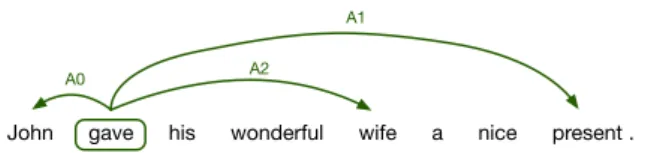
specifi-John gave his wonderful wife a nice present . A0
A1
A2
Figure 1: An example sentence annotated with a semantic-role representation.
cally their dependency versions (Surdeanu et al.,
2008). The semantic-role representations mark se-mantic arguments of predicates in a sentence and categorize them according to theirsemantic roles. Consider Figure1, a predicategavehas three argu-ments:1 John(semantic roleA0, ‘the giver’),wife
(A2, ‘an entity given to’) and present (A1, ‘the thing given’). Semantic roles capture commonali-ties between different realizations of the same un-derlying predicate-argument structures. For exam-ple,presentwill still beA1in sentence“John gave a nice present to his wonderful wife”, despite quite different surface forms of the two sentences. We hypothesize that semantic roles can be especially beneficial in NMT, as ‘argument switching’ (flip-ping arguments corresponding to different roles) is one of frequent and severe mistakes made by NMT systems (Isabelle et al.,2017).
There is a limited amount of work on incor-porating graph structures into neural sequence models. Though, unlike semantics in NMT, syntactically-aware NMT has been a relatively hot topic recently, with a number of approaches claiming improvements from using treebank syn-tax (Sennrich and Haddow,2016;Eriguchi et al.,
2016;Nadejde et al.,2017;Bastings et al.,2017;
Aharoni and Goldberg,2017), our graphs are
dif-ferent from syntactic structures. Unlike syntac-tic dependency graphs, they are not trees and thus
1We slightly abuse the terminology: formally these are
cannot be processed in a bottom-up fashion as in
Eriguchi et al. (2016) or easily linearized as in
Aharoni and Goldberg(2017). Luckily, the
mod-eling approach ofBastings et al.(2017) does not make any assumptions about the graph structure, and thus we build on their method.
Bastings et al. (2017) used Graph
Convolu-tional Networks (GCNs) to encode syntactic struc-ture. GCNs were originally proposed by Kipf
and Welling (2016) and modified to handle
la-beled and automatically predicted (hence noisy) syntactic dependency graphs by Marcheggiani
and Titov (2017). Representations of nodes (i.e.
words in a sentence) in GCNs are directly influ-enced by representations of their neighbors in the graph. The form of influence (e.g., transition ma-trices and parameters of gates) are learned in such a way as to benefit the end task (i.e. transla-tion). These linguistically-aware word represen-tations are used within a neural encoder. Although recent research has shown that neural architectures are able to learn some linguistic phenomena with-out explicit linguistic supervision (Linzen et al.,
2016;Vaswani et al., 2017), informing word
rep-resentations with linguistic structures can provide a useful inductive bias.
We apply GCNs to the semantic dependency graphs and experiment on the English–German language pair (WMT16). We observe an im-provement over the semantics-agnostic baseline (a BiRNN encoder; 23.3 vs 24.5 BLEU). As we use exactly the same modeling approach as in the syn-tactic method of Bastings et al. (2017), we can easily compare the influence of the types of lin-guistic structures (i.e., syntax vs. semantics). We observe that when using full WMT data we ob-tain better results with semantics than with syntax (23.9 BLEU for syntax GCN). Using syntactic and semantic GCN together, we obtain a further gain (24.9 BLEU) that suggests the complementarity of syntax and semantics.
2 Model
2.1 Encoder-decoder Models
We use a standard attention-based encoder-decoder model (Bahdanau et al.,2015) as a start-ing point for constructstart-ing our model. In encoder-decoder models, the encoder takes as input the source sentence x and calculates a representa-tion of each word xt in x. The decoder outputs a translation y relying on the representations of
the source sentence. Traditionally, the encoder is parametrized as a Recurrent Neural Network (RNN), but other architectures have also been suc-cessful, such as Convolutional Neural Networks (CNN) (Gehring et al.,2017) and hierarchical self-attention models (Vaswani et al., 2017), among others. In this paper we experiment with RNN and CNN encoders. We explore the benefits of incor-porating information about semantic-role struc-tures into such encoders.
More formally, RNNs (Elman,1990) can be de-fined as a functionRNN(x1:t) that calculates the hidden representationhtof a wordxtbased on its left context. Bidirectional RNNs use two RNNs: one run in the forward direction and another one in the backward direction. The forwardRNN(x1:t) represents the left context of wordxt, whereas the backward RNN(xn:t) computes a representation of the right context. The two representations are concatenated in order to incorporate information about the entire sentence:
BiRNN(x, t) = RNN(x1:t)◦RNN(xn:t). In contrast to BiRNNs, CNNs (LeCun et al.,2001) calculate a representation of a wordxtby consid-ering a window of wordswaroundxt, such as
CNN(x, t, w) =f(xt−bw/2c, .., xt, .., xt+bw/2c), where f is usually an affine transformation fol-lowed by a nonlinear function.
Once the sentence has been encoded, the de-coder takes as input the induced sentence repre-sentation and generates the target sentencey. The target sentence y is predicted word by word us-ing an RNN decoder. At each step, the decoder calculates the probability of generating a wordyt conditioning on a context vectorctand the previ-ous state of the RNN decoder. The context vector
ctis calculated based on the representation of the source sentence computed by the encoder, using an attention mechanism (Bahdanau et al., 2015). Such a model is trained end-to-end on a parallel corpus to maximize the conditional likelihood of the target sentences.
2.2 Graph Convolutional Networks
Graph neural networks are a family of neural ar-chitectures (Scarselli et al., 2009; Gilmer et al.,
2017) specifically devised to induce representa-tion of nodes in a graph relying on its graph struc-ture. Graph convolutional networks (GCNs) be-long to this family. While GCNs were introduced
John gave his wonderful wife a nice present WA0 WA1 WA2 WA0’ WA2’ WA1’ W self W self W self W self W self W self W self W self BiRNN/ CNN Semantic GCN Semantic GCN WA0 WA1 WA2 WA0’ WA2’ WA1’ W self W self W self W self W self W self W self W self
Figure 2: Two layers of semantic GCN on top of a (not shown) BiRNN or CNN encoder.
for modeling undirected unlabeled graphs (Kipf
and Welling,2016), in this paper we use a
formu-lation of GCNs for labeled directed graphs, where the direction and the label of an edge are incor-porated. In particular, we follow the formulation
of Marcheggiani and Titov (2017) and Bastings
et al. (2017) for syntactic graphs and apply it to
dependency-based semantic-role structures (Hajic et al.,2009) (as in Figure1).
More formally, consider a directed graph G = (V,E), whereV is a set of nodes, andEis a set of edges. Each nodev ∈ V is represented by a fea-ture vectorxv ∈ Rd, where dis the latent space
dimensionality. The GCN induces a new repre-sentation h0v ∈ Rd of a node v while relying on representationshuof its neighbors:
h0v=ρ X
u∈N(v)
gu,v Wdir(u,v)hu+blab(u,v)
,
where N(v) is the set of neighbors of v,
Wdir(u,v) ∈ Rd×d is a direction-specific
param-eter matrix. There are three possible directions (dir(u, v) ∈ {in, out, loop}): self-loop edges were added in order to ensure that the initial rep-resentation of nodehvdirectly affects its new rep-resentation h0v. The vectorblab(u,v) ∈ Rd is an
embedding of a semantic role label of the edge
(u, v) (e.g., A0). The functions gu,v are scalar gates which weigh importance of each edges,ρis a non-linearity (ReLU).2
As with CNNs, GCN layers can be stacked in order to incorporate higher order neighborhoods. In our experiments, we used GCNs on top of a standard BiRNN encoder and a CNN encoder (Figure 2). In other words, the initial represen-tations of words fed into GCN were either RNN states or CNN representations.
2Refer to Marcheggiani and Titov(2017) and Bastings
et al.(2017) for further details.
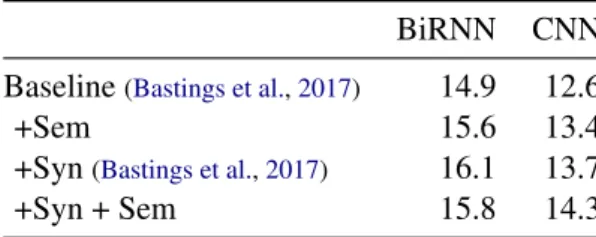
BiRNN CNN Baseline(Bastings et al.,2017) 14.9 12.6
+Sem 15.6 13.4
+Syn(Bastings et al.,2017) 16.1 13.7
+Syn + Sem 15.8 14.3
Table 1: Test BLEU, En–De, News Commentary.
BiRNN Baseline(Bastings et al.,2017) 23.3
+Sem 24.5
+Syn(Bastings et al.,2017) 23.9
+Syn + Sem 24.9
Table 2: Test BLEU, En–De, full WMT16.
3 Experiments
We experimented with the English-to-German WMT16 dataset (∼4.5 million sentences pairs for training). We use its subset, News Com-mentary v11, for development and additional ex-periments (∼226.000 sentence pairs). For all these experiments, we usenewstest2015 and newstest2016as a validation and test set, re-spectively.
We parsed the English partitions of these datasets with a syntactic dependency parser (
An-dor et al., 2016) and dependency-based
seman-tic role labeler (Marcheggiani et al., 2017). We constructed the English vocabulary by taking all words with frequency higher than three, while for German we used byte-pair encodings (BPE) (
Sen-nrich et al.,2016). All hyperparameter selection
was performed on the validation set (see Appendix
A). We measured the performance of the models with (cased) BLEU scores (Papineni et al.,2002). The settings and the framework (Neural Monkey
(Helcl and Libovick´y,2017)) used for experiments
are the ones used inBastings et al.(2017), which we use as baselines. As RNNs, we use GRUs (Cho et al.,2014).
We now discuss the impact that different ar-chitectures and linguistic information have on the translation quality.
3.1 Results and Discussion
First, we start with experiments with the smaller News Commentary training set (See Table1). As
in Bastings et al. (2017), we used the standard
base-line.
We tested the impact of semantic GCNs when used on top of CNN and BiRNN encoders. As expected, BiRNN results are stronger than CNN ones. In general, for both encoders we observe the same trend: using semantic GCNs leads to an improvement over the baseline model. The im-provements is 0.7 BLEU for BiRNN and 0.8 for CNN. This is slightly surprising as the potentially non-local semantic information should in principle be more beneficial within a less powerful and lo-cal CNN encoder. The syntactic GCNs (Bastings
et al.,2017) appear stronger than semantic GCNs.
As exactly the same model and optimization are used for both GCNs, the differences should be due to the type of linguistic representations used.3 When syntactic and semantic GCNs are used to-gether, we observe a further improvement with respect to the semantic GCN model, and a sub-stantial improvement with respect to the syntactic GCN model with a CNN encoder.
Now we turn to the full WMT experiments. Though we expected that the linguistic bias should more valuable in a resource-poor setting, the im-provement from using semantic-role structures is larger here (+1.2 BLEU). It is surprising but per-haps more data is beneficial for accurately model-ing influence of semantics on the translation task. Interestingly, the semantic GCN now outperforms the syntactic one by 0.6 BLEU. Again, it is hard to pinpoint exact reasons for this. One may spec-ulate though that, given enough data, RNNs were able to capture syntactic dependency and thus re-ducing the benefits from using treebank syntax, whereas (often less local and harder) semantic de-pendencies were more complementary. Finally, when syntactic and semantic GCN are trained to-gether, we obtain a further improvement reaching 24.9 BLEU. These results suggest that syntactic and semantic dependency structures are comple-mentary information when it comes to translation. 3.2 Ablation and Syntax-Semantics GCNs We used the validation set to perform extra exper-iments, as well as to select hyper parameters (e.g., the number of GCN layers) for the experiments presented above. Table3presents the results. The
3
Note that the SRL system we use (Marcheggiani et al.,
2017) does not use syntax and is faster than the syntactic parser ofAndor et al.(2016), so semantic GCNs may still be preferable from the engineering perspective even in this setting.
BiRNN CNN Baseline(Bastings et al.,2017) 14.1 12.1
+Sem (1L) 14.3 12.5
+Sem (2L) 14.4 12.6
+Sem (3L) 14.4 12.7
+Syn (2L)(Bastings et al.,2017) 14.8 13.1
+SelfLoop (1L) 14.1 12.1 +SelfLoop (2L) 14.2 11.5 +SemSyn (1L) 14.1 12.7 +Syn (1L) + Sem (1L) 14.7 12.7 +Syn (1L) + Sem (2L) 14.6 12.8 +Syn (2L) + Sem (1L) 14.9 13.0 +Syn (2L) + Sem (2L) 14.9 13.5
Table 3: Validation BLEU, News commentary only
annotation 1L, 2L and 3L refers to the number of GCN layers used.
First, we tested whether the gain we observed is an effect of an extra layer of non-linearity or an effect of the linguistic structures encoded with GCNs. In order to do so, we used the GCN layer without any structural information. In this way, only the self-loop edge is used within the GCN node updates. These results (e.g., BiRNN+SelfLoop) show that the linguistic-agnostic GCNs perform on par with the baseline, and thus using linguistic structure is genuinely beneficial in translation.
Since syntax and semantic structures seem to be individually beneficial and, though related, cap-ture different linguistic phenomena, it is natural to try combining them. When syntax and seman-tic are combined together in the same GCN layer (SemSyn), we do not observe any improvement with respect to having semantic and syntactic in-formation alone.4 We argue that the reason for this is that the two linguistic signals do not in-teract much when encoded into the same GCN layer with a simpler aggregation function. We thus stacked a semantic GCN on top of a syntactic one and varied the number of layers. Though this ap-proach is more successful, we manage to obtain only very moderate improvements over the single-representation models.
4 Conclusions
In this work we propose injecting information about predicate-argument structures of sentences in NMT models. We observe that the semantic structures are beneficial for the English–German language pair. So far we evaluated the model per-formance in terms of BLEU only. It would be in-teresting in future work to both understand when semantics appear beneficial, and also to see which components of semantic structures play a role. Ex-periments on other language pairs are also left for future work.
Acknowledgments
We thank Wilker Aziz for its suggestions and com-ments. The project was supported by the Eu-ropean Research Council (ERC StG BroadSem 678254), and the Dutch National Science Foun-dation (NWO VIDI 639.022.518). We gratefully acknowledge the support of NVIDIA Corporation with the donation of two Titan X Pascal GPUs used for this research.
References
Roee Aharoni and Yoav Goldberg. 2017. Towards string-to-tree neural machine translation. In Pro-ceedings of the 55th Annual Meeting of the Asso-ciation for Computational Linguistics, ACL. pages 132–140. https://doi.org/10.18653/ v1/P17-2021.
Daniel Andor, Chris Alberti, David Weiss, Aliaksei Severyn, Alessandro Presta, Kuzman Ganchev, Slav Petrov, and Michael Collins. 2016. Globally nor-malized transition-based neural networks. In Pro-ceedings of the 54th Annual Meeting of the Asso-ciation for Computational Linguistics, ACL. pages 2442–2452. https://doi.org/10.18653/ v1/P16-1231.
Wilker Aziz, Miguel Rios, and Lucia Specia. 2011.
Shallow semantic trees for SMT. InProceedings of the Sixth Workshop on Statistical Machine Transla-tion, WMT@EMNLP. pages 316–322. http:// aclanthology.info/papers/W11-2136/ shallow-semantic-trees-for-smt. Dzmitry Bahdanau, Kyunghyun Cho, and Yoshua
Ben-gio. 2015. Neural Machine Translation by Jointly Learning to Align and Translate. In Proceedings of the International Conference on Learning Rep-resentations, ICLR. http://arxiv.org/abs/ 1409.0473.
Kathrin Baker, Michael Bloodgood, Bonnie J. Dorr, Chris Callison-Burch, Nathaniel Wesley Filardo,
Christine D. Piatko, Lori S. Levin, and Scott Miller. 2012.Modality and negation in SIMT use of modal-ity and negation in semantically-informed syntac-tic MT. Computational Linguistics 38(2):411– 438. https://doi.org/10.1162/COLI_a_ 00099.
Yehoshua Bar-Hillel. 1960. The present status of au-tomatic translation of languages. Advances in Com-puters1:91–163.
Joost Bastings, Ivan Titov, Wilker Aziz, Diego Marcheggiani, and Khalil Simaan. 2017. Graph convolutional encoders for syntax-aware neu-ral machine translation. In Proceedings of the 2017 Conference on Empirical Methods in Natural Language Processing, EMNLP. pages 1957–1967. https://www.aclweb.org/ anthology/D17-1209.
Marzieh Bazrafshan and Daniel Gildea. 2013. Se-mantic roles for string to tree machine transla-tion. In Proceedings of the 51st Annual Meeting of the Association for Computational Linguistics, ACL. pages 419–423. http://aclweb.org/ anthology/P/P13/P13-2074.pdf.
Kyunghyun Cho, Bart van Merrienboer, Caglar Gul-cehre, Dzmitry Bahdanau, Fethi Bougares, Hol-ger Schwenk, and Yoshua Bengio. 2014. Learn-ing Phrase Representations usLearn-ing RNN Encoder– Decoder for Statistical Machine Translation. In
Proceedings of the 2014 Conference on Empirical Methods in Natural Language Processing, EMNLP. pages 1724–1734. http://www.aclweb.org/ anthology/D14-1179.
Jeffrey L Elman. 1990. Finding structure in time. Cog-nitive science14(2):179–211.
Akiko Eriguchi, Kazuma Hashimoto, and Yoshimasa Tsuruoka. 2016. Tree-to-sequence attentional neu-ral machine translation. InProceedings of the 54th Annual Meeting of the Association for Computa-tional Linguistics, ACL. pages 823–833. http:// www.aclweb.org/anthology/P16-1078. Jonas Gehring, Michael Auli, David Grangier, and
Yann Dauphin. 2017. A convolutional encoder model for neural machine translation. In Proceed-ings of the 55th Annual Meeting of the Associ-ation for ComputAssoci-ational Linguistics, ACL. pages 123–135. https://doi.org/10.18653/ v1/P17-1012.
Justin Gilmer, Samuel S. Schoenholz, Patrick F. Ri-ley, Oriol Vinyals, and George E. Dahl. 2017.
Neural message passing for quantum chemistry. In Proceedings of the 34th International Confer-ence on Machine Learning, ICML. pages 1263– 1272. http://proceedings.mlr.press/ v70/gilmer17a.html.
Jan Hajic, Massimiliano Ciaramita, Richard Johans-son, Daisuke Kawahara, Maria Ant`onia Mart´ı, Llu´ıs
M`arquez, Adam Meyers, Joakim Nivre, Sebastian Pad´o, Jan Step´anek, Pavel Stran´ak, Mihai Surdeanu, Nianwen Xue, and Yi Zhang. 2009. The conll-2009 shared task: Syntactic and semantic depen-dencies in multiple languages. In Proceedings of the Thirteenth Conference on Computational Natu-ral Language Learning: Shared Task, CoNLL. pages 1–18. http://aclweb.org/anthology/W/ W09/W09-1201.pdf.
Kaiming He, Xiangyu Zhang, Shaoqing Ren, and Jian Sun. 2016. Deep residual learning for im-age recognition. InProceedings of the IEEE Con-ference on Computer Vision and Pattern Recog-nition, CVPR. pages 770–778. https://doi. org/10.1109/CVPR.2016.90.
Jindˇrich Helcl and Jindˇrich Libovick´y. 2017. Neural monkey: An open-source tool for sequence learn-ing. The Prague Bulletin of Mathematical Lin-guistics (107):5–17. https://doi.org/10. 1515/pralin-2017-0001.
Pierre Isabelle, Colin Cherry, and George F. Fos-ter. 2017. A challenge set approach to eval-uating machine translation. In Proceedings of the 2017 Conference on Empirical Methods in Natural Language Processing, EMNLP. pages 2486–2496. https://aclanthology.info/ papers/D17-1263/d17-1263.
Bevan Jones, Jacob Andreas, Daniel Bauer, Karl Moritz Hermann, and Kevin Knight. 2012.
Semantics-based machine translation with hyper-edge replacement grammars. In Proceedings of the 24th International Conference on Computa-tional Linguistics, COLING. pages 1359–1376.
http://aclweb.org/anthology/C/C12/ C12-1083.pdf.
Diederik P. Kingma and Jimmy Ba. 2015. Adam: A method for stochastic optimization. InProceedings of the International Conference on Learning Rep-resentations, ICLR. http://arxiv.org/abs/ 1412.6980.
Thomas N. Kipf and Max Welling. 2016. Semi-supervised classification with graph convolutional networks. InProceedings of the International Con-ference on Learning Representations, ICLR. http: //arxiv.org/abs/1609.02907.
Yann LeCun, Leon Bottou, Yoshua Bengio, and Patrick Haffner. 2001. Gradient-based learning applied to document recognition. InProceedings of Intelligent Signal Processing.
Tal Linzen, Emmanuel Dupoux, and Yoav Goldberg. 2016. Assessing the ability of lstms to learn syntax-sensitive dependencies. Transactions of the Association for Computational Linguistics 4:521– 535. https://www.transacl.org/ojs/ index.php/tacl/article/view/972.
Ding Liu and Daniel Gildea. 2010. Semantic role fea-tures for machine translation. In Proceedings of the23rd International Conference on Computational Linguistics, COLING. pages 716–724. http:// aclweb.org/anthology/C10-1081. Diego Marcheggiani, Anton Frolov, and Ivan Titov.
2017. A simple and accurate syntax-agnostic neural model for dependency-based semantic role labeling. In Proceedings of the 21st Confer-ence on Computational Natural Language Learning, CoNLL. pages 411–420. https://doi.org/ 10.18653/v1/K17-1041.
Diego Marcheggiani and Ivan Titov. 2017. En-coding sentences with graph convolutional net-works for semantic role labeling. In Proceed-ings of the 2017 Conference on Empirical Methods in Natural Language Processing, EMNLP. pages 1506–1515. https://aclanthology.info/ papers/D17-1159/d17-1159.
Maria Nadejde, Siva Reddy, Rico Sennrich, Tomasz Dwojak, Marcin Junczys-Dowmunt, Philipp Koehn, and Alexandra Birch. 2017. Predicting target lan-guage CCG supertags improves neural machine translation. In Proceedings of the Second Con-ference on Machine Translation, WMT. pages 68– 79.http://aclanthology.info/papers/ W17-4707/w17-4707.
Martha Palmer, Paul Kingsbury, and Daniel Gildea. 2005. The proposition bank: An annotated cor-pus of semantic roles. Computational Linguistics
31(1):71–106. https://doi.org/10.1162/ 0891201053630264.
Kishore Papineni, Salim Roukos, Todd Ward, and Wei-Jing Zhu. 2002. Bleu: a method for au-tomatic evaluation of machine translation. In
Proceedings of the 40th Annual Meeting of the Association for Computational Linguistics, ACL. pages 311–318. http://www.aclweb.org/ anthology/P02-1040.pdf.
Franco Scarselli, Marco Gori, Ah Chung Tsoi, Markus Hagenbuchner, and Gabriele Monfardini. 2009. The graph neural network model. IEEE Trans. Neu-ral Networks20(1):61–80. https://doi.org/ 10.1109/TNN.2008.2005605.
Rico Sennrich and Barry Haddow. 2016.Linguistic In-put Features Improve Neural Machine Translation. InProceedings of the First Conference on Machine Translation, WMT. pages 83–91. http://www. aclweb.org/anthology/W16-2209. Rico Sennrich, Barry Haddow, and Alexandra Birch.
2016.Neural machine translation of rare words with subword units. InProceedings of the 54th Annual Meeting of the Association for Computational Lin-guistics, ACL. pages 1715–1725. http://www. aclweb.org/anthology/P16-1162.
Mihai Surdeanu, Richard Johansson, Adam Meyers, Llu´ıs M`arquez, and Joakim Nivre. 2008. The CoNLL 2008 shared task on joint parsing of syn-tactic and semantic dependencies. In Proceed-ings of the Twelfth Conference on Computational Natural Language Learning, CoNLL. pages 159– 177. http://aclweb.org/anthology/W/ W08/W08-2121.pdf.
Ashish Vaswani, Noam Shazeer, Niki Parmar, Jakob Uszkoreit, Llion Jones, Aidan N. Gomez, Lukasz Kaiser, and Illia Polosukhin. 2017. Attention is all you need. InAdvances in Neural Information Pro-cessing Systems 30: Annual Conference on Neural Information Processing Systems, NIPS. pages 6000– 6010. http://papers.nips.cc/paper/ 7181-attention-is-all-you-need. Warren Weaver. 1955. Translation. Machine
transla-tion of languages14:15–23.
Dekai Wu and Pascale Fung. 2009. Semantic roles for SMT: A hybrid two-pass model. In Proceedings of the Human Language Technologies: Conference of the North American Chapter of the Association of Computational Linguistics, NAACL. pages 13– 16.http://www.aclweb.org/anthology/ N09-2004.
A Hyperparameters
For experiments on the News Commentary data we used 8000 BPE merges, whereas we used 16000 BPE merges for En–De experiments on the full dataset. For all the experiments, we used bidi-rectional GRUs and we set the embedding size to 256, we used word dropout with retain probability of 0.8 and edge dropout with the same probabil-ity, we used L2 regularization on all the parame-ters with value of10−8, translations are obtained using a greedy decoder. We placed residual con-nections (He et al.,2016) before every GCN layer. For the experiments on News Commentary data, we set GRU (for both encoder and decoder) and CNN hidden states to 512, we use Adam (Kingma
and Ba,2015) as optimizer with an initial learning
rate of 0.0002, and we trained the models for 50 epochs. For large scale experiments on En–De, we set the GRU hidden states to 800, and instead of greedy decoding we employed beam search (beam 12). We trained the model for 20 epochs with the same hyperparameters.
B Datasets Statistics
Train Val. Test English–German 226822 2169 2999 English–German (full) 4500966 2169 2999
Table 4: The number of sentences in our datasets.
Source Target English–German 37824 8099 (BPE) English–German (full) 50000 16000 (BPE)