0022-538X/81/060952-06$02.00/0
Analysis
of the
Myeloproliferative
Sarcoma Virus
Genome:
Limited Changes
in the
Prototype
Lead to Altered
Target Cell
Specificity
I. B. PRAGNELL,l* A. FUSCO,' C. ARBUTHNOTT,' F. SMADJA-JOFFE,2 B.KLEIN,3 C. JASMIN,2 ANDW. OSTERTAG'
Beatson InstituteforCancerResearch,GarscubeEstate,Bearsden, Glasgow,G61 1BD,
Scotland';
InstitutdeCancerologieetd'Immunogenetique, 94800Villejuif,France2; andDepartmentd'Immunologie,Centre
PaulLamarque, 34033Montpellier, France3
Received 20 November 1980/Accepted 13 March 1981
Themyeloproliferativesarcomavirus (MPSV) derivedfromMoloneysarcoma virus (MSV-Mol) is a unique sarcoma virus which causes expansion of the hematopoietic stem cellcompartmentas well asthe erythroidandmyeloid cell
lineages. MPSV also induces spleen focus formation in adult miceasdo Friend and Rauscher viruses. Analysisof the MPSVgenome on methyl mercury gels showed that the genomesize is7.0kilobases, which is largerthan thedefective genome of any known MSV-Mol isolate. Hybridization analysis with specific cDNAprobes showed that MPSV isamodifiedsarcomavirus withnosequences
in the unique region of the defectivesarcoma genomerelatedtounique Friend virus sequences. The only viralsequences in the defective genome other than
helper virus-related sequences are derived from the Moloney sarcoma virus genome with no new cellular sequences added. There was no evidence for induction of xenotropic virus sequences in MPSV-infected spleens ofDBA/2J mice, indicating that spleen focus formationcanbe obtainedby different mech-anisms.
We have described a myeloproliferative sar-comavirus[MPSVorMPV(MSV)] (15),derived from aMoloneysarcoma virus preparation (3). This virusinduces spleen foci, erythroblastosis, and myelofibrosis in adult mice (11, 15) while
retaining the sarcoma virus property of
trans-forming fibroblastsinvitro. We haveshownthat
MPSV consistsof twoseparable entitieswhich
havebeencloned(15).The MPSVcomplex con-sists of areplication-competent helpervirus, mu-rine leukemia virus (MuLV), and a defective sarcomavirus. Thefibroblast-transformingand
spleen focus-forming properties reside in the
defective virusgenome(15).
There is considerableevidence which suggests thattransforming retroviruses contain different specific sequences which are related to genes in the normal cellular DNA (5-7, 18, 19, 22-25). Theancestralvirus ofMPSV derived from Mo-loney sarcoma virus, MSV-Mol, has been dem-onstratedtocontainsequences (src) homologous to cellular DNA (6), and these sequences are
presumablyinvolved inboth the transformation offibroblastsin vitro and the induction of sar-coma tumors in newborn mice. MSV-Mol was itself derived from MuLV-Mol. Similarly, Kir-stensarcomavirus (KiSV) and Harvey sarcoma virus (HaSV) have been derived bypassage of
murineerythroblastosisvirus in rats(10).Ithas been demonstrated that the HaSV and KiSV sequences are derived partly from rat cellular sequences and partly from helper virus se-quences(21).Someofthe ratcellularsequences arerequired for transforming potential (29).
Since MPSV both transforms fibroblasts in vitro and affects the hematopoietic compart-ment invivo, weanalyzed the MPSV genome in somedetail,todelineate thespecificparts of the genome and their homology to other known
transforming viruses. The molecular analysis
suggests a hypothesis to explain the complex nature of the disease inducedby MPSV in sus-ceptible mice.
MATERLALS AND METHODS
Cell culture and viruses.Allcelllinesweregrown
in modified Eagle medium supplemented with 10%
fetal calfserum (15). The cell lines used in these
studies and referredtointhefiguresand text are as
described below.Unlessstated otherwise we have used
the samenomenclature forboth the cell lineand the
virus released bythatparticular cell line.
MPSV has been cloned on normal rat kidney
(NRK)cells (15).We have usedtwoclonesofMPSV
in these studies, 6-6#3+F (cloned once) and
p5-8#1+F(cloned twice) (15). Clone 6-6#3+Fisreleased
by6-6#3+Fproducer cells whichwere obtained by
952
on November 10, 2019 by guest
http://jvi.asm.org/
GENOME ANALYSIS OF MPSV
rescue of transformed cloned 6-6#3 nonproducer
NRKfibroblasts with Friend helper virus (MuLV-F).
The helper virus used to rescue MPSV was 643/22N
(15). Similarly, clone p5-8#1+F is virus released by
p5-8#1+F producer cells which were obtained by
res-cue of cloned p5-8#1 nonproducer NRK cells with
helper virus643/22N. Friend virus (17) was cloned on
SC1 cells to give an SFFV-nonproducer cell line,
SC204. Cloned Friend virus SC204+F was rescued
from SC204cells with helper virus 643/22N. Cloned
MuLV-Mol wasreleased bycell line a2, an NIH/3T3
cell line infected with MuLV-Mol. The murine
sar-comavirusMSV-Mol used was the Ball variant virus
released by the murine TB cell line (G8-124) of
CFW1D micecoinfected with MSV-Mol and
MuLV-Mol. The Abelson virus used here was an uncloned
isolate whichwasreleasedby transformed murine B
cells (Steinheider and Ostertag, unpublished data).
The xenotropicvirus-infectedcell lines were provided
by J.Bilello, Hamburg (NZB xenotropic virus) and N.
Teich, London(BALB-2 xenotropic virus). The KiSV
usedwasthatreleased byaratNRKcell line which
containsboth Friend helper virus (643/22N) and KiSV
(obtained from J. Bilello, Hamburg). MSV-Harvey
wasthe Harvey strain of murinesarcomavirus, with
643/22Nashelper virus.
Isolation of viral andcytoplasmic RNA. Viral
RNAwasextracted from virionspurified onsucrose
gradients. Total virion RNA was precipitated with
ethanol and desalted by dialysis through Sartorius
Collodiondialysis bags. RNA (50to70S)wasisolated
from the variousvirionpreparationsasdescribed(14).
Cytoplasmic RNAwasisolated from cells inculture
by methods described previously (2). Total cellular
RNA fromnormal DBA/2J and virus-infectedmouse
spleen cellswasextractedby theguanidinium
thiocy-anate-cesium chloride method(28).
Molecular size determination. Genomic viral
RNA(50to70S)wasisolatedfrom thesupernatant of
cells labeled with sodium[32P]phosphateasdescribed
previously (14).Electrophoretic analysisof30to 35S
subunit RNAswascarriedouton5mM
CH3HgOH-1.5% agarose gels (4). Gelswere run and dried, and
autoradiographywasperformedwithX-ray
intensify-ingscreens.
Synthesis of cDNA. (i) Total representative
cDNA for the viruses used in thisstudywas
synthe-sized with the endogenous enzyme inalysed virion
incubation,inallcaseswithcalfthymusDNA
hydrol-ysate as primer (16). Theprobes wereshown to be
uniformlyrepresentativeof the MPSV genomebythe
fact that 65% of the 32P-labeled MPSV genome is
protectedatacDNA-RNA ratio of2:1(14). (ii)Total
representative MPSV-specific cDNA from the two
independently cloned isolates 6-6#3+F and
p5-8#1+Fwashybridizedto excess viral RNA isolated
from theclonedhelpervirus643/22N (seeabove),and
thenonhybridizedmaterialwasseparatedon
hydrox-ylapatite (16). (iii) Total representative MSV-Mol
cDNAwasprepared.MSV-specificcDNAwasisolated
by subtractivehybridizationasdescribedabove,with
MuLV-Mol viralRNA asthe source ofhelpervirus
RNA. (iv) SFFV-specific cDNA was isolated from
totalrepresentative cDNAby using F4-6 virus.The
sourceofhelpervirus RNAwasvirus clone643/22N.
This SFFV-specific cDNA contains xenotropic
virus-related sequences, in agreement with data published
by Troxler et al. (26). In contrast, when Friend helper
virusclone 643/22F or a mixture of 643/22N and 643/
22F isused, as in previous studies (16), then the
SFFV-specific cDNA does not contain xenotropic
virus-re-lated sequences, since they are removed during the
subtractive hybridization to viral RNA from clone
643/22F, whichcontains recombinant sequences.
Hybridization analysis with specific cDNA
probes. (i) Formeasurement of expression of specific
sequences, cytoplasmic or total cellular RNA was
mixed with 0.2 ng(2,200 cpm) of specific cDNA at a
cDNA-RNA ratio of 1:20,000 and incubated in 0.36 M NaCl-0.025 M
N-2-hydroxyethylpiperazine-N'-2-eth-anesulfonic acid (pH 7.0)-0.005MEDTA-0.1% sodium
dodecyl sulfate at 60°C for various times. The amount
of cDNA hybridized was determined by S1nuclease
digestion (17). The percentage of virus-specific RNA incellularRNAs was calculated on the basis of the
Crot ofa standard curve, made with specific cDNA
and purified genomic 50 to 70S RNA. The rate of
reaction was 2.3-fold faster than the standard
condi-tionswith0.18M Na+ and wastherefore normalized.
(ii) For measurement of genome relatedness, specific
cDNAprobeswerehybridizedtovariouspreparations
of viral RNA in conditionsof largeRNAexcess (500:
1 and 1,000:1 RNA-cDNA ratios in molar amounts).
Thevalues obtained represent saturation values and
arethemeansof thetworatiosin anumber of
exper-iments.There wasnomore thana5%variation in the
valuesobtained in these experiments,whichis normal
for this typeofplateau hybridization analysis.
RESULTS
Molecular size
of the MPSVgenome. Ourprevious studies have shown that MPSV con-tainsadefectivetransformingvirus and a
repli-cation-competent helper virus (15). The
prop-erties offibroblast transformation in vitro and
spleen focus formationinvivohave beenshown to reside in the same defective viral genome subunit. Since MPSV wasderived from MSV-Mol, an analysis of the genome size and its relatedness to MSV-Mol and other defective transformingviruseswascarriedout.32P-labeled genomicRNAwasanalyzedonmethylmercury
gels (Fig. 1). Lane 1 shows cytoplasmic RNA
extractedfromG8-124cellsusedas amarker in this experiment. Lane 2 shows genomic RNA fromMSV-Mol virus; thesize of the major ge-nomic RNAspeciesis 30S (6.0 kilobases [kb]),
in agreement with data
published
previously(12). There is anotherbandat5.6kb which may representadeletion in the 6.0-kb genome. Lane 3 shows that the 6-6#3+F virus has a major
bandat7.0kb
(33S
RNA) andaminorbandat 8.5kb (35S RNA).The other MPSVclone,
p5-8#1+F,alsodisplaysbandsat33and 35S(lane
4). We can assign the 8.5-kb subunit to the
helpervirus, since cloned helpervirus
genomic
RNA has a major band at 8.5 kb
(lane
5). We 38,on November 10, 2019 by guest
http://jvi.asm.org/
954 PRAGNELL ET AL.
-z~ ORIGIN
* 8.5kb (35s)
7.0kb(33s)
6.0 kb(30s) 5.6kb (29s) 5.1 kb(28s)
- 2.0kb (18s)
FIG. 1. Analysis of genomicRNAonmethylmercurygels.32P-labeledgenomicRNAswererun onmethyl
mercurygelsasdescribed in the text. Lane1, CytoplasmicRNAfromG8-124 cells used as a marker. Lanes2
to5containgenomicviral RNA. Lane2, MSV-Mol(Ball variant).Lane3,MPSV clone 6-6#3+F. Lane4,
MPSV clonep5-8#1+F.Lane5,MuL V-F clone643/22N.Alongerexposureoflanes2, 3, and 4 is shownon
theright,toenhance the MPSVdefectivegenomeandhelpervirusgenomeofMPSVclonep5-8#1+F. Lengths
werecalculatedfromasemilogarithmic plot ofthe distanceofeach bandfromtheoriginofthegel, usingthe
ribosomal 28S(5.1kb)and 18S(2.0 kb)RNAsasmarkers. Theplotislinear in therange0.85 to 7.05kb.
therefore conclude that the MPSV genome is about 7.0kb. There isanexcessofgenomicRNA from defective virus overhelper virus RNA in both clones. This ratio variedwith eachinfection ofthenonproducer cells.
Characterization of MPSV-specific cDNA. Weisolated specific cDNAprobes and determined their relatedness to the viral ge-nomesof othertransformingviruses. Aspecific cDNA probe containing only nonhelper virus-related sequences was prepared from MPSV clonep5-8#1. Saturation of MPSV representa-tive cDNA with excesshelper virus RNA gave a plateau hybridization valueof70% compared with 100% for the template viral RNA. Thus, approximately one-third of the MPSV genome isMPSV specific. The specificity of the probes wasshown by hybridization togenomic MPSV viral RNA which completely protected the cDNA's andtohelper virus RNA (both MuLV-F and MuLV-Mol) which did not show any
significant hybridization (Table 1). Thus, the specific cDNA doesnotcontainanyhelper
virus-relatedsequences, but does contain thespecific sequences of MPSV clones p5-8#1+F and 6-6#3+F.
RelatednessofMPSVto MSV-Mol. Since MPSV was derived from MSV-Mol itwas
im-portant todetermine, first, whether the unique
(nonhelper-related) part of the MSV genome
had been retained and, second, whether there wereany sequencespresentinMPSVnotrelated
TABLE 1. Relatednessof MPSVtoother viral
genomesa
%SpecificcDNAhybridized Viral RNA MPSV
p5-8#1 MSV SFFV
MuLV-F 9 4 7
MuLV-Mol 4 8 10
MPSVp5-8#1+F 75 89 11
6-6#3+F 71 85 7
MSV-Mol 70 93 NT
KiSV 4 NT NT
HaSV 6 NT NT
A-MuLV 6 NT NT
F4-6 10 NT 79
SC204+F 5 NT 81
NZB-X 6 NT 57
BALB-2-X 8 NT 54
aSpecific cDNA (0.2ng,2,200cpm)washybridized
withalargeexcessof viralRNA(seetext) in1 ,ulof
hybridization buffer at 60'C for 4 days. Thevalues
shownrepresentsaturation valuesand are the means
ofthetworatios (seetext) in anumber ofexperiments.
NT,Not tested.
to MSV-Mol. MSV-Mol-specific cDNA was
completely protected by MSV-Mol viral RNA, whereas hybridization to both MuLV-Mol and MuLV-F (clone 643/22N) showed that there were no helper virus-related sequences in this
probe (Table 1).
TheMSV-Mol-specificcDNA was completely protected with excess MPSV viral RNA (Table
on November 10, 2019 by guest
http://jvi.asm.org/
[image:3.495.109.394.65.251.2] [image:3.495.256.449.341.503.2]GENOME ANALYSIS OF MPSV 955
1).Thus,the complete uniquepartofthe MSV-Molgenomeis retained in both clones ofMPSV. It can be seen that most or all of the MPSV-specific cDNA of clone p5-8#1+F could be
pro-tected withexcessMSV-Mol viral RNA(Table 1),indicating thatmostor allofthe specificpart of the MPSV genome (p5-8#1) is MSV-Mol
derived.
Relatedness ofMPSV to other viral ge-nomes. KiSV and HaSV inducesplenomegaly and erythroblastosis in newborn mice, but no
KiSV- or HaSV-related sequences could be found in p5-8#1 specific cDNA (Table 1), and veryfew contaminating NRK cytoplasmic RNA sequences were found in this probe (data not shown).
A-MuLV is adefective retrovirus which,like MPSV, transforms fibroblasts in vitro (19), but
in contrast to MPSV, A-MuLV transforms
B-type lymphoid cells (24). There was no signifi-cantrelatedness of A-MuLVtothe specificpart ofthe MPSV genome (Table 1). These results confirm that sarcoma virus-specific sequences
arenotpresentinthe A-MuLVgenome (20).
Both MPSV and SFFV induce spleen foci and erythroblastosis in susceptible mice. Both vi-ruses aresubjecttorestriction by the Fv-2gene
(13). Hybridization of MPSV-specific cDNAto excessFriendvirusRNA (F4-6 virus,seeabove) didnotresultinanysignificant hybridformation
(Table 1). In a reciprocal experiment, SFFV-specific cDNAwasnotprotected by MPSV viral RNA(Table 1). Therewas nosignificant hybrid-ization ofMPSV-specific cDNAtoRNA oftwo isolates ofxenotropic virus NZB and BALB-2. In the same experiment the presence of
xeno-tropic virus sequences was detected in SFFV-specific cDNA (Table 1,seeabove). The SFFV-specific cDNA could be completely protected by viral RNA from two FV isolates (F4-6 and
SC204+F) and containednohelper virus-related sequences (Table 1). We conclude that there is nodetectablehomology between the non-helper virus-relatedsequencesof MPSV and SFFV.
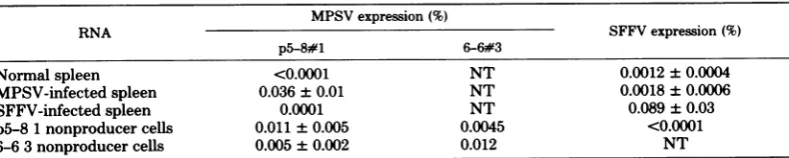
The expression ofMPSV in transformed nonproducer cells and in infected spleens invivo. We have measured the levels of MPSV-specific RNA in two clones of MPSV nonpro-ducer-transformed fibroblasts (Table 1). The levels detected are somewhatlower than those found in infectedspleencellsin vivo.
TotestwhetherMPSV induces SFFV-related sequencesduring infection of the spleen cells in vivo, we measured MPSV- and SFFV-related expression in both MPSV- and SFFV-infected spleens (Table 2) with specific cDNA. The rel-ativeamountof MPSVRNAwassimilartothat detected in infected spleens with SFFV-specific cDNA. We didnotfindany increasein
SFFV-related expression in MPSV-infected spleensoverthe levelsdetected in normal spleen cells with SFFV-specific cDNA. We conclude that there isnot detectable induction of xeno-tropic virus or SFFV-related sequences in MPSV-infectedspleens.
DISCUSSION
Apart from induction of myeloproliferation in susceptible DBA/2J and BALB/c mice, MPSV alsoinduces spleenfocus formation and eryth-roblastosis (15). MPSV, like SFFV, does not inducespleen foci in C57BL mice, and increased expression of SFFV-relatedsequencesin normal DBA/2J mice has been linked to the suscepti-bility of these micetoSFFV infection (1). SFFV has also been shown to be a recombinant
be-tweenanecotropic murine provirus and theenv
gene region ofaxenotropic virus (27). We did notfindanyevidencefor thepresence of
xeno-TABLE 2. Expressionof MPSV- andSFFV-specificsequencesa
MPSV expression(%)
RNA SFFVexpression (%)
p5-8#1 6-6#3
Normalspleen <0.0001 NT 0.0012+0.0004
MPSV-infectedspleen 0.036±0.01 NT 0.0018±0.0006
SFFV-infectedspleen 0.0001 NT 0.089±0.03
p5-81nonproducercells 0.011±0.005 0.0045 <0.0001
6-6 3nonproducercells 0.005 ± 0.002 0.012 NT
aInfectedDBA/2Jmiceweresacrificed9daysafterinjectionof 103spleenfocus-formingunitsof SFFVor2
x103 spleenfocus-formingunits of MPSV into the tailvein,atwhichtime therewasmarkedsplenomegaly.The
spleen weightsin bothcases wereabout1g.Injectionofhigherdilutionsof SFFVorMPSVgaverisetospleen
focus formationin theseconditions. TotalcellularRNAandcytoplasmicRNAwereextracted from normal and
infected spleens asdescribed in the text. Cytoplasmic RNAwas extracted from MPSVnonproducer NRK
fibroblastsasdescribedin thetext.MPSV- andSFFV-specificcDNA'swereusedtodeterminethepercentage
of theRNA which is virus related asdescribedin the text. Exceptincases wherevalues of <0.0001% were
obtained, thespecific cDNAprobeswere completely protected (70%)at highCrot values. The values shown
constitutethemeansofanumber ofexperiments.NT,Nottested.
VOL. 38, 1981
on November 10, 2019 by guest
http://jvi.asm.org/
[image:4.495.56.451.486.565.2]tropic virus recombinant sequences in the MPSV genome(Table1). We conclude from our measurements ofMPSV and SFFV expression
insusceptiblemice(Table 2)thatalthoughthere may be arelationship betweensusceptibilityto SFFV and expression ofendogenous SFFV-re-lated RNA innormal, susceptiblemice(1),there is nosuchlinkinthecaseof MPSV.Ourresults show inadditionthatxenotropicvirus recombi-nant sequences are not induced in
MPSV-in-fected spleens. The mechanism of
transforma-tionbyMPSV is thereforelikelytobe mediated in a mannerdifferent fromthatby SFFV.
Molecular sizeanalysisof the MPSV genome has shown it to be 7.0kb(this paper),in contrast to the 6.0-kb size of the MSV-Mol genome (12 and this paper). Thus, the MPSV genome is larger than the MSV-Mol sarcoma virus ge-nome. It is therefore possible that sequences have been added to the original MSV-Mol ge-nome to giverise to thedifferent biological
ac-tivity. However, sincewedonothave the
ances-tral MSV-Mol available, it is
equally
possiblethat MPSV is derived from an MSV-Mol pro-totype with a larger genome, or even from
MuLV-Mol itself. The original experiments by Chirigos etal. (3) employed MSV with
MuLV-Mol ashelper virus.
It is clear that most, if not all, of the
non-helper virus-relatedpartofthedefective
MSV-Mol genome is present in theMPSVsinceall of
the MSV-specific cDNA is protected by viral RNA from both MPSV clones. Since most of clone MPSVp5-8#1-specificcDNA canbe pro-tected by MSV-Mol viral RNA, we conclude
that the specific part of the MPSV genome in clone p5-8#1 is almost wholly MSV-Mol de-rived. Thisshows that
MPSV
is not a new virusgenerated fortuitously during infection ofmice withMSV-Mol,but mustbe derived from MSV-Mol or MuLV-Mol by some kind of genomic
alteration.
We found no rat cellular RNA-, KiSV-, or
HaSV-related sequences in clone
p5-8#1-spe-cific cDNA (Table 1). We did, however, detect NRK RNA-related sequences in the specific cDNA prepared from MPSV clone 6-6#3+N
(data notshowxi). Since both virus clones have similar biological activities, we assume that the ratcellularRNA sequnces are not present in the genome of MPSV clone 6-6#3+F, but are for-tuitously included in virus particles during virus release and therefore have no significance
re-gardingthepathology of MPSV.
Preliminary evidence from oligonucleotide
fingerprintdata(Pragnell,Nunn, and Duesberg,
unpublished data) suggests that all of the se-quences in the defective genomes of both MPSV clones arerelatedto MSV-Mol and helper virus
(MuLV-Mol) sequences. Thus, we can conclude that the MPSV genome does not contain alarge
section of sequences which are not related to the
MSV-Mol genome. It is likely, therefore, that thelargersizeoftheMPSVgenome in compar-ison to
AMSV-Mol
is afforded by MuLV-Mol-derived sequences. We cannot exclude the at-tractive hypothesis that the additional 1.0-kbsequences arelocatedadjacenttothe MSV-Mol-specific sequences in MPSV, assuming in fact thatthese sequences are related to MuLV-Mol. The diseasecausedbyMPSVinadultmice is
complex and involvesanumber ofdifferent cell types in thehemopoietic compartment (9, 11), whereas MSV-Mol does not have thisbiological activity. The molecular analysis of the MPSV genome and itsexpressionin spleen cells leads us topropose a molecular basis for the induction ofmyeloproliferativediseasebyMPSV. We sug-gest thatMPSV, by virtueoflimitedchangesin the MSV-Mol genomeinvolvingnonew cellular sequences or non-MuLV-Mol viral sequences, hasbecome a potent sarcomaviruswhich will
transformawide rangeof cells. The broad range
of target cell
specificity
could be investigated usinganin vitro transformation system(8).In summary, MPSV is the first murine retro-virus not containing xenotropic virus
recombi-nant sequences which induces spleen foci in mice. Spleen focus formation can thus be
ob-tained in adult mice
by
two different mecha-nisms. Ithas been observed that avian and mu-rine retroviruses can act togive rather similar diseasepatterns,yet havedifferenttransforminggenes (5). MPSV isalsothefirstsarcomavirus which hasgainedanalteredtargetcell specificity
without the addition of new cellularsequences or non-helpervirus-related sequences. This
in-dicatesamechanismwherebyavirus with mul-tipletargetcellspecificitymaydevelop.
ACKNOWLEDGMENTS
These studiesweresupported bygrantsfrom the Medical Research Council andtheCancer ResearchCampaign.
WearegratefultoM.O'Kaneand R. McFarlane for tech-nicalassistance.
LITERATURE CITED
1. Bernstein, A., C. Gamble,D.Penrose,and T. W.Mak. 1979.Presenceandexpression of Friend erythroleukae-mia virus-related sequences in normal and leukaemic mousetissues. Proc. Natl. Acad. Sci. U.S.A. 76:4455-5549.
2. Bilello,J.A., G.Colletta, G. Warnecke, G.Koch, D. Frisby,I.B. Pragnell, and W. Ostertag. 1980. Anal-ysisof the expression of SFFV-related RNA and gp 55, aFriendand Rauscher virus specific protein. Virology 107:331-344.
3. Chirigos,M.A., W. Scott,W.Turner,and K.Perk. 1968.Biological, pathological and physical characteri-sationof apossiblevariant of a murine sarcoma virus (Moloney).Int. J.Cancer3:223-237.
on November 10, 2019 by guest
http://jvi.asm.org/
GENOME ANALYSIS OF MPSV 957
4. Dube, S. K., H. J.Kung, W.Bender, N.Davidson, and W.Ostertag.1976.Size,subunitcomposition,and secondary structure of the Friend virus genome. J. Virol.20:264-272.
5. Duesberg, P. H. 1980. Transforming genes of retrovi-ruses. ColdSpring HarborSymp. Quant. Biol. 44:13-29.
6. Frankel,A.D.,and P. J.Fischinger.1976.Nucleotide
sequences inmouseDNAand RNAspecificfor Molo-ney sarcomavirus. Proc. Natl. Acad. Sci. U.S.A. 73: 3705-3709.
7. Graf, T.,and H. Beug.1978. Avianleukaemia viruses:
interaction with their target cells in vivoapdinvitro. Biochim.Biophys. Acta 516:269-299.
8. Hankins, W. D., T. A.Kost, M. J.Koury,and S. B. Krantz. 1978. Erythroid bursts produced byFriend leukaemia virus in vitro. Nature(London)276:506-508.
9. Jasmin, C.,M. C. Le-Bousse-Kerdiles, B. Klein,F.
Smadja-Joffe,K. J.Mori,B.Fagg,W.Ostertag,K.
Vehmeyer, andL.B.Pragnell. 1980.The physiopa-thology of the disease induced in DBA/2 mice by MPSV, p.183-192.InG. B. Rossi(ed.),Invivo and in vitroerythropoiesis.Elsevier/North Holland, Amster-dam.
10. Kirsten, W.H., and L A. Mayer. 1967.Morphologic responses to amurineerythroblastosisvirus. J.Natl. Cancer Inst.39:311-335.
11.Le-Bousse-Kerdiles,M.C.,F.Smadja-Joffe,B.Klein,
B.Caillou, and C. Jasmin.1980. Studyofa
virus-inducedmyeloproliferative syndrome associated with tumorformation in mice. Eur. J.Cancer 16:43-51.
12. Maisel,J.,D. Dina, and P. Duesberg. 1977. Murine
sarcomaviruses:thehelper independence reported for
aMoloney variantisunconfirmed;distinct strains differ
inthe sizeof their RNAs.Virology76:295-312.
13. Ostertag, W., T. Odaka, F. Smadja-Joffe, and C.
Jasmin.1981.Inheritance ofsusceptibilitytothe my-eloproliferativesarcomavirus: effect of the Fv-2 locus and evidence fora myeloproliferative sarcoma virus resistance locus. J.Virol.37:541-548.
14. Ostertag, W., and L. B. Pragnell. 1978. Changes in
genome composition of the Friend viruscomplex in erythroleukaemia cellsduringthecourseof differentia-tion inducedbyMe2SO. Proc. Natl. Acad. Sci. U.S.A. 75:3278-3282.
15. Ostertag,W.,K.Vehmeyer,B.Fagg,L.B.Pragnell,
W. Paetz,M. C. Le-Bousse, F. Smadja-Joffe, B.
Klein,C.Jasmin,and H. Eisen. 1980.
Myeloprolif-erativevirus,acloned murinesarcomaviruswithspleen
focus-formingpropertiesinadult mice. J. Virol.
33:573-582.
16. Pragnell, I. B.,A. McNab, P. R.Harrison, and W.
Ostertag. 1978. Are spleen focus forming virus
se-quencesrelatedtoxenotropicvirusesandexpressedin normalerythroidcells? Nature(London)227:456-458.
17. Pragnell, I. B., W. Ostertag, and J. Paul. 1977. The expression of virus and globin genes during differentia-tion of theFriend cell.Exp. Cell Res.108:269-276.
18. Roussel,M., S.Saule, C. Langrou, C. Rommens, H.
Beug, T. Graf, and D. Stehelin. 1979. Three new typesof viral oncogene ofcellular origin specific for haematopoietic cell transformation. Nature (London) 281:452-455.
19. Scher,C. D., and R. Siegler. 1975. Direct transformation of 3T3cells by Abelson murine leukaemia virus. Nature (London) 253:729-731.
20. Scolnick, E. M., R. S. Howk, A. Anisowiez, P. R. Peebles, C. D. Scher, and W. P. Parks. 1975. Sepa-rationof sarcoma virus specific and leukaemia virus-specific genetic sequences of Moloney sarcoma virus. Proc. Natl. Acad. Sci. U.S.A. 72:4650-4654.
21. Scolnick, E. M., E. Rands, D.Williams, and W. P. Parks. 1973. Studies on the nucleic acid sequences of Kirsten sarcoma virus: a model for formation of a mam-malianRNA-containing sarcoma virus. J. Virol. 12:458-463.
22.Sheiness, D., and J. M. Bishop. 1979. DNA and RNA from uninfected vertebrate cells contain nucleotide se-quencesrelated to the putative transforming gene of avianmyelocytomatosisvirus. J. Virol. 31:514-521. 23. Shields, A., S. Goff, M. Paskind, G. Oho, and D.
Baltimore. 1979.Structure of the Abelson murine leu-kaemia virus genome.Cell 18:955-962.
24.Sklar, M. D., B. M. White, and W. P. Rowe. 1974. Initiation of oncogenic transformation of mouse lym-phocytes in vitro by Abelson leukaemia virus. Proc. Natl. Acad. Sci. U.S.A. 71:4077 4081.
25. Stehelin, D., H. E. Varmus, J. M. Bishop, and P. K. Vogt. 1976. DNA related to the transforming gene(s) of avian sarcoma viruses is present in normal avian DNA.Nature (London) 260:170-173.
26. Troxler,D.H.,J. K.Boyars,W. P.Parks,and E. C.
Scolnick. 1977.Friend strain of spleenfocus-forming
virus:a recombinant between mouse type C ecotropic viral sequences and sequences related to xenotropic virus. J. Virol. 22:361-372.
27.Troxler, D. H., D. Lowy, R. Howk, H. Young, and E.
M.Scolnick.1977.Friend strain of spleen focus forming
virus isarecombinant between ecotropicmurine type C virusand the env gene region of xenotropic type C virus.Proc. Natl. Acad. Sci. U.S.A. 74:46714675.
28. Ullrich, A., J. Shine, J. Chirgwin, R. Pictet, E.
Tischer,H. J. Rutter, and H. M. Goodman. 1977.
Rat insulin genes: construction ofplasmidscontaining
thecodingsequences.Science 196:1313-1317.
29.Wei,C.-M.,D.Lowy,and E. M.Scolnick.1980.
Map-ping of thetransformingregionof the Harvey murine sarcomavirusgenomebyusing insertion-deletion mu-tantsconstructed in vitro. Proc. Natl. Acad. Sci. U.S.A. 77:4674-4678.
VOL. 38, 1981