City, University of London Institutional Repository
Citation: Henry, L., Messer, D. J., Luger-Klein, S. and Crane, L. (2012). Phonological,
visual and semantic coding strategies in short-term picture memory span: How do they develop?. Quarterly Journal of Experimental Psychology, 65(10), pp. 2033-2053. doi: 10.1080/17470218.2012.672997This is the accepted version of the paper.
This version of the publication may differ from the final published
version.
Permanent repository link: http://openaccess.city.ac.uk/5821/
Link to published version: http://dx.doi.org/10.1080/17470218.2012.672997
Copyright and reuse: City Research Online aims to make research
outputs of City, University of London available to a wider audience.
Copyright and Moral Rights remain with the author(s) and/or copyright
holders. URLs from City Research Online may be freely distributed and
linked to.
City Research Online: http://openaccess.city.ac.uk/ [email protected]
1 Phonological, visual and semantic coding strategies and children’s short-term picture memory span
Henry, L.A.¹, Messer, D.², Luger-Klein, S.¹ & Crane, L.1
¹ London South Bank University
² Open University
Correspondence:
Lucy A. Henry
Department of Psychology
London South Bank University
103 Borough Road
London, UK SE1 0AA
00 44 7771 626936 [email protected]
Other contact details:
David Messer: ([email protected]):
Scarlett Luger-Klein ([email protected]): LSBU address
Laura Crane ([email protected]): LSBU address
Running Head: Coding strategies in picture memory span
Keywords: picture memory span; phonological, visual and semantic similarity effects; word length
2 Acknowledgements:
We would like to thank Willowbrook Primary School, Oval Montessori nursery, St John’s Upper
Holloway CE Primary School, Clerkenwell Parochial CE Primary Schooland several other schools and
nurseries who very kindly gave their time to help with this project. We would also like to thank Jess
Darby, Kathy Filer, Sally Marlow, Gilly Nash and Shelley Revell for their help with recruitment; and
3 Phonological, visual and semantic coding strategies and children’s short-term picture memory span
Abstract
Three experiments addressed controversies in the previous literature on the development of
phonological and other forms of short-term memory coding in children, using assessments of picture
memory span that ruled out potentially confounding effects of verbal input and output. Picture
materials were varied in terms of phonological similarity, visual similarity, semantic similarity, and
word length. Older children (6/8-year-olds), but not younger children (4/5-year-olds), demonstrated
robust and consistent phonological similarity and word length effects, indicating that they were using
phonological coding strategies. This confirmed findings initially reported by Conrad (1971), but
subsequently questioned by other authors. However, in contrast to some previous research, little
evidence was found for a distinct visual coding stage at 4 years, casting doubt on assumptions that this
is a developmental stage that consistently precedes phonological coding. There was some evidence
for a dual visual and phonological coding stage prior to exclusive use of phonological coding at around
5-6 years. Evidence for semantic similarity effects was limited, suggesting that semantic coding is not
4 Children’s ability to use verbal mediation for phonological recoding and rehearsal of non-verbal
information has long been of interest (Conrad, 1971; Flavell, Beach & Chinsky, 1966; Flavell, Green,
Flavell & Grossman, 1997) and represents a major cognitive advance that may be linked to reading
development (Palmer, 2000b) and other cognitive skills. For example, Zelazo and colleagues have
focussed on the way that non-verbal information and strategies become coded into a
phonological/verbal form, which facilitates problem-solving and executive functioning in pre-school
children (e.g. Marcovitch & Zelazo, 2009; Zelazo, 2004). In older children, the ability to use verbally
coded, explicit information has been an important aspect of the representational redescription model
of Karmiloff-Smith (1992) and of subsequent research supporting this model (Messer, Pine & Butler,
2008; Pine & Messer, 2003). Importantly, phonological coding and self-regulatory private speech
seem to be related. Al-Namlah, Fernyhough and Meins (2006) argued that both skills underpin the
important developmental transition to verbal mediation in the early school years, and Winsler and
Naglieri (2003) provided an in-depth account of the development of ‘private speech’ and
problem-solving strategies in school-age children, concluding that children’s verbal strategies became
internalised with age.
This paper revisits classic research on the phonological coding of non-verbal information, but takes
into account important methodological considerations overlooked in previous studies. According to
the working memory model (Baddeley, 1986; 2000; 2007; Baddeley & Hitch, 1974), phonological
coding occurs within the phonological loop, which consists of two components: the phonological store
and the articulatory rehearsal process. For auditorily presented items there is direct access to the
phonological store because phonological codes are created by the vocal input itself. Visually
presented items such as nameable pictures can only enter the phonological store indirectly after a
phonological code has been created; this is achieved by recoding visual material using the articulatory
rehearsal process (subvocal articulation). Unless prevented by articulatory suppression, adults use
5 similarity effects whereby the recall of similar-sounding letters/words is poorer than the recall of
dissimilar sounding items (e.g. Baddeley, 1966; Conrad & Hull, 1964). Baddeley (1986, 2007)
suggested that phonological similarity effects are attributable to confusion in the phonological store,
but there may also be confusion at the recall or reconstruction/redintegration stage (Cowan, Saults,
Winterowd & Sherk, 1991; Hasselhorn & Grube, 2003).
Conrad’s (1971) classic finding was that children developed ‘speech’ coding by the mental age of 5-6
years: i.e. they used phonological coding to remember lists of nameable pictures, hence became
sensitive to phonological similarity. However, subsequent work by Hulme (1987) contradicted these
findings, showing that all children of 4, 7 and 10 years showed modest effects of phonological similarity, and that the magnitude of these effects did not change with age. Similarly, Cowan et al.
(1991) found effects of phonological similarity in 4-year-olds, questioning whether phonological
coding followed the developmental progression put forward by Conrad. Yet close inspection of the
methods used in these studies indicates that some form of ‘naming’ occurred as pictures were
presented, either by the experimenter or the child, introducing auditory input and making the results
difficult to interpret. To examine whether children spontaneously use phonological coding, auditory input should be avoided. Naming pictures at presentation could produce a verbal representation of
the items, due to the ‘obligatory’ phonological coding of heard materials in the phonological store
(Baddeley, Lewis & Vallar, 1984).
Halliday, Hitch, Lennon and Pettipher (1990) replicated Conrad’s findings using ‘silent’ presentation,
finding phonological similarity effects in 10- but not 5-year-olds. Hitch, Halliday, Schaafstal and
Heffernan (1991) went on to underline the importance of auditory input, demonstrating that
phonological similarity effects emerged in 5-year-olds when either the child or the Experimenter ‘labelled’ pictures during presentation (see also Ford & Silber, 1994; but note Palmer, 2000b, who
6 argued that overt speech ‘primed’ the use of phonological representations in young children who
would not otherwise use phonological coding with visual items. More recently, Al-Namlah et al.
(2006) reported phonological similarity effects in children below the age of 6 years using ‘silent’
presentation conditions, but like all of the previous studies, they employed spoken recall, which makes it necessary for the child to plan and execute speech output. This could affect the use of phonological
coding, encouraging the use of a speech code in preparation for a verbal response. The current
studies, therefore, always required a non-verbal response.
Span procedures determine the longest lists a child can recall in serial order, whereas fixed list length
procedures involve administering groups of same-aged children the same list lengths chosen to be at
or around their ability level (e.g. Hulme, 1987, used lists of four items for four-year-olds, five items for
seven-year-olds and six items for 10-year-olds). One problem with fixed list length procedures is that
task difficulty is not the same for individual children: some receive "supra span" lists beyond their span
level; some receive lists at span level; and some receive lists below span level. The mechanisms
underlying span and supra-span performance cannot be assumed to be identical. For example,
strategic approaches may differ when span capacity is overloaded: McGilly and Siegler (1989) found
more evidence for rehearsal when shorter lists were presented to young children. Two further methodological issues are as follows: Hitch et al. (1991) noted that evidence for ‘similarity’ effects is
enhanced by blocking lists of each type together (i.e. not alternating similar and dissimilar picture
types across trials), to increase proactive interference. Jarrold, Cocksey and Dockerill (2008)
recommended full recall over probed recall methods, as the latter produce high recency on later serial
positions, increasing ceiling effects and reducing task sensitivity to detect phonological similarity
effects.
The current studies revisited the development of phonological similarity effects in children between
7 coding reflected deliberate strategy choices. Purely visual presentation of pictures was achieved by
avoiding naming or labelling from either the experimenter or the child. Non-verbal recall via pointing
to pictures in serial order removed any requirement for verbal output. Span procedures with full
recall ensured that all children were assessed sensitively at their own individual span level
(Experiments 1 and 2) or at a level just above span (Experiment 3) and picture type was always
blocked, rather than alternated, to maximise the evidence for similarity effects.
Word length effects, whereby items with long names are less well recalled than items with short
names (Baddeley, Thomson & Buchanan, 1975; Hulme, Thomson, Muir & Lawrence, 1984), may also
indicate phonological coding in picture span tasks (Gathercole & Hitch, 1993; Henry & Millar, 1993).
Current theories assume that the phonological characteristics of longer words are more
difficult/complex to deal with than short words (e.g. spoken duration or differences in phonological
complexity – see Hulme, Neath, Stuart, Shostak, Surprenant & Brown, 2006; Lewandowsky &
Oberauer, 2008; Mueller, Seymour, Kieras & Meyer, 2003; Romani, McAlpine, Olson, Tsouknida &
Martin, 2005). Word length effects in picture span tasks emerge at 7-9 years (Halliday et al., 1990;
Henry, Turner, Smith & Leather, 2000; Hitch, Halliday, Dodd & Littler, 1989; Hitch et al., 1991),
although there is debate about the precise cognitive processes responsible for this development in
relation to verbal rehearsal and verbal output (Cowan, Day, Saults, Keller, Johnson & Flores, 1992;
Henry, 1991; Henry et al., 2000; Yuzawa, 2001). Others doubt that word length effects require
articulatory processes (e.g. Hulme et al., 2006; Romani et al., 2005), but for current purposes, word
length effects were examined as an additional indication of phonological coding.
Picture span methods also constitute a useful means of identifying visual coding, which is assumed to
be present if an individual has better memory for visually dissimilar than visually similar items. This is
attributed to interference caused in the memory trace when trying to store and retrieve items with
8 Logie, Della Sala, Wynn & Baddeley, 2000). Visual coding has often been reported in samples of
five-year-olds but not in older children (Brown, 1977; Hayes & Schulze, 1977; Hitch et al., 1988; Hitch,
Woodin & Baker, 1989; Hitch et al., 1991; Longoni & Scalisi, 1994; Palmer, 2000a). Palmer (2000a)
outlined a stage-like development in strategy use, noting that 3-4-year-old children used neither visual
nor phonological strategies, and may rely on semantic representations or “automatic activation of
representations in long-term memory” (although this was not directly tested). Palmer argued that by
5 years, children utilised visual coding, and that phonological coding emerged after the age of 5 or 6
years. Between the ages of 6 and 8 years children used both visual and phonological coding strategies
(dual coding), before predominantly phonological coding strategies emerge by 10 years (Hitch et al.,
1988; Hitch et al., 1989; 1991). However, such conclusions about phonological and other forms of
coding may be weakened by methodological confounds, so the present studies were designed to shed
further light on this stage model.
Finally, Palmer's speculation that semantic coding may be an early developing strategy could be
incorrect; most models of the lexicon suggest connections between semantic and phonological
representations (e.g. Levelt, Roelofs & Meyer, 1999; Messer & Dockrell, 2006), so semantic coding
could be a later developing strategy in children already using phonological coding. Adults do use
semantic coding: Baddeley (1966) found that semantic similarity had a small but negative effect on
recall. Yet Purser and Jarrold (2010) reported that typical 4-6-year-old children used both
phonological and semantic storage in a ‘matching span’ task. Given this lack of clarity, the current
studies tested two opposing views of the use of semantic codes: (1) They are used by developmentally
less mature children in the stage prior to phonological coding (Palmer, 2000a); or (2) semantic coding
is a more mature strategy, closely tied to the development of phonological coding because of
automatic links between semantic and phonological information in long-term memory (e.g.
Huttenlocher & Lui, 1979). We defined semantic similarity in terms of concrete, highly imageable
9
In summary, this paper addresses a number of controversies in the previous literature on phonological
and other forms of coding in a series of methodologically sound and carefully controlled experiments.
Potential confounds in interpreting developmental changes in memory coding in picture memory span
tasks were avoided by eliminating auditory input and removing verbal output. Individual differences
with respect to strategic development within age groups (Palmer, 2000b) could also make
generalisations based on age problematic, so traditional ‘age differences’ analyses were followed by
cluster analyses to identify groups of children with similar abilities and explore the memory coding
strategies used in each resulting cluster. Potentially reduced task sensitivity due to low span levels
was tackled in Experiment 3 with a new procedure to improve task sensitivity and reliability. ‘Span’
assessments were retained, but children were pre-assessed for baseline picture memory span level and then tested on ‘experimental’ picture types using span level “plus 1” (span+1) length lists to
ensure that all experimental lists were equally demanding across participants, but slightly longer than
they would have been using a typical span procedure. Some span+1 assessments were repeated one
week later to test reliability.
It was expected that younger children (4-5 years) would use visual coding strategies (visual similarity
effects), and older children (6-8 years) would use dual coding, namely, both visual and phonological
strategies (visual similarity, phonological similarity and word length effects). We tentatively predicted
that semantic similarity effects would be more likely to be found in our older group because of
automatic links between semantic and phonological information in long-term memory.
Experiment 1
Method
10 Picture memory span for four types of pictures (phonologically similar, visually similar, long names,
semantically similar) and a control set of pictures was assessed in two age groups of children (4/5, 6/8
years). Age level was a between participants factor, and picture type was a within participants factor.
Participants
The sample comprised 18 children of 4-5 years (mean age 4 years 11 months, SD 10 months, 8 boys)
and 27 children of 6-8 years (mean age 7 years 5 months, SD 8 months, 12 boys). Children attended
mainstream schools and nurseries in London and South East England and had no special needs
identified. In all three experiments, written informed consent from both parents and children (using a
specially worded consent form) was obtained prior to testing and ethical approval was given by the
Research Ethics Committee of London South Bank University.
Apparatus / Materials
Each set of pictures comprised nine 10cm x 15cm white cards with black on white line drawings of
familiar, highly imageable objects. All pictures were hand drawn in pencil and black ink on white
paper using the same straightforward style of depiction (for examples please see Henry, 2008), then
scanned as images for reproduction. Copies of all picture materials are available on application from
the first author.
Control items were neither phonologically, semantically nor visually similar (cake, chair, shoe, bus, leaf, frog, ring, clown, drum).
Phonologically similar items (can, lamp, hat, van, pan, ant, cat, bat, fan) shared the same vowel, [æ], regarded as the most important factor for phonological similarity (Nimmo & Roodenrys, 2004).
Visually similar items (bed, fish, nail, key, sock, tie, pen, knife, brush) were similar in terms of shape (all were depicted as very long thin objects drawn at the same 45° angle).
11
Semantically similar items (thumb, neck, hair, leg, arm, eye, teeth, ear, lips) all came from the same conceptual category.
All objects in the long-named stimulus set had three/four-syllable names, whereas the items for all
other conditions had one-syllable names. Except for the phonological similarity condition, all sets
contained objects with phonologically dissimilar names. Apart from the visual similarity condition,
objects in each set were visually dissimilar. Apart from the semantically similar items, objects from
each set represented a diverse range of categories. Item sets were matched as closely as possible in
terms of mean age of acquisition of object names, imageability, frequency, familiarity, and name
agreement (Morrison, Chappell & Ellis, 1997). Note that ratings were not available for two items in
the phonologically similar set (fan, can), two items in the semantically similar set (neck, teeth), and
one item in the long name list (teddy bear); but due to constraints in selecting appropriate materials,
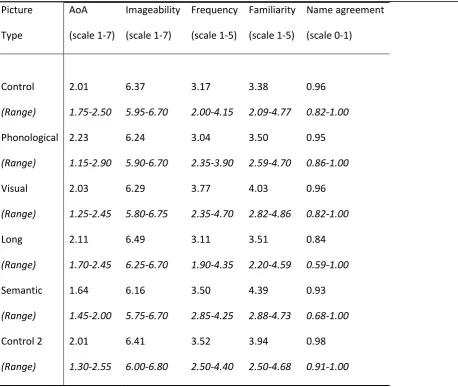
they were included. Table 1 shows the mean ratings (and ranges) available for each set. It proved
difficult to obtain semantically similar body part names that were closely matched to the other sets on
age of acquisition and familiarity; however, for this reason, the items ‘neck’ and ‘teeth’ were included
as they were regarded as slightly less familiar. Similarly, it proved difficult to select longer items with
the highest levels of name agreement (i.e. 1), but all items chosen were as close to this as possible,
given other constraints.
Table 1 about here
There were 25 21cm x 30cm response boards, with five for each set of picture stimuli. The response
boards all differed, with each containing a random arrangement of the nine objects from that set in a
3 x 3 array. The response boards were changed after each trial; this prevented participants from
12 Procedure
Children were tested in a classroom at school or a room in their family home. The testing took place
in one long session of approximately 30-40 minutes or in two shorter sessions of approximately 15-20
minutes, depending on the child's and/or the parents' choice. Participants were asked to look at a
series of picture cards, presented one at a time, and to point to the same pictures in the same order
on the response board. The importance of serial order report has been documented by a number of
researchers (Avons, 1998; Avons & Mason, 1999; Avons, Ward & Melling, 2004).
Each picture card was presented for 1.5 seconds directly in front of the child, and then removed from
view. In previous research, pictures have typically been presented in a fixed horizontal row, turning
each card face down in turn (Hitch et al., 1988; Hitch et al., 1989; Hitch, Halliday et al., 1989; 1991;
Longoni & Scalisi, 1994). This provides the potential for spatial cues to assist performance, so cards
were always presented in the same spatial location (Henry, 2008) to make the task comparable to
verbal span tasks. The experiment began with a set of four practice pictures and span trials of one and
two items; once the child understood the task he/she moved on to experimental trials.
The order of experimental picture memory span tasks was counterbalanced according to a Latin
square. Before each span task, the child was presented with the nine cards of the set, and objects
were named for them by the experimenter to ensure that children were familiar with all presented
items and their names; none of the children appeared unfamiliar with any of the items in the pictures.
Children did not name the pictures to reduce priming for phonological strategies.
To determine the maximum number of items a child could recall on each span task, up to six lists were
administered at any given list length. For the youngest participants, experimental trials started with a
list length of one item, but lists of one were omitted for the oldest children or those whose spans were
13 four trials, they were deemed not to have passed that span level, and testing ceased. If the child
passed at least four of six trials, list length was increased by one item and another set of trials started.
Each time a higher list length was introduced, children were informed about how many pictures would
be shown to them next, and they were reminded each time to point to them in the correct order.
Children were instructed not to name items out loud during presentation of pictures in order to avoid
adding overt verbal input (Hitch et al., 1991). If they were observed to do so, they were reminded
again. Most children followed this instruction from the beginning, and no child needed more than two
reminders.
Results
Mean memory spans for each picture type at each age level are given in the top part of Table 2. A
mixed analysis of variance (ANOVA) including the repeated factor 'picture type' (five levels) and the
between participants factor 'age group' (4/5 years, 6/8 years) revealed main effects of picture type,
F(4,172) = 11.70, p < .001, partial η² = .21, and age group, F(1,43) = 35.99, p < .001, partial η² = .46; and a significant picture type by age group interaction, F(4,172) = 3.95, p < .01, partial η² = .08.
Given the significant interaction and our predictions, one-way ANOVAs were used to explore the
effects of picture type in each age group, followed by planned contrasts to test between ‘control’ item
performance and performance on all other picture types. In this and all subsequent analyses of
picture type effects using planned contrasts/comparisons, significance levels were adjusted to reflect
14 length effect’ (WLE). Visually similar and semantically similar item recall did not differ from that for
control items.
Table 2 about here
It is possible that variability in strategy use among younger children concealed the expected visual
similarity effects. Therefore, a hierarchical cluster analysis was carried out using performance across
the five sets of pictures to assess whether distinct clusters could be identified and, if so, the nature of
any group differences between them. The cluster analysis was carried out in SPSS16. A between
group linkage method was used that involved squared Euclidean distance. The cluster analysis was
based on five standardised z-scores derived from each of the five span scores. An initial analysis was run with a limit of four clusters as this corresponded to the ‘stages’ that have been identified in the
development of picture span strategies. Only six children were identified in the smallest cluster, this
together with an inspection of the dendrogram, resulted in the decision to base our analyses on a
three cluster solution. Inspection of the profiles of the three cluster solution revealed differences in
the proportion of correct responses across the three clusters, with the lowest performing cluster
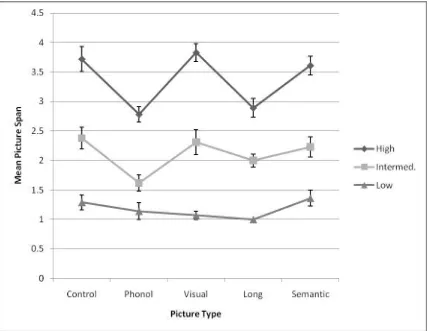
having a flat profile (data illustrated in Figure 1).
The mean ages of children in the clusters matched their performance (mean age for the cluster with
the highest performance was 93.7 months, SD 8.5, N = 18; mean age for the cluster with intermediate
performance was 71.3 months, SD 8.4, N = 14; and mean age for the cluster with the lowest
performance was 60.6 months SD 12.0, N = 13). These age differences were significant
(F(2,42) = 49.03, p < .001), and Bonferroni post hoc tests indicated that all comparisons involved significant differences (p < .001, except for the comparison of the intermediate and low clusters where
15 A 3 (cluster) x 5 (picture type) mixed ANOVA on the picture memory span scores revealed main effects
of cluster, F(2,42) = 148.11, p < .001, partial η² = .88, and picture type, F(4,168) = 13.46, p < .001, partial η² = .24, and a significant interaction, F(8,168) = 3.23, p < .002, partial η² = .13. To investigate whether there were differences in performance according to picture type, one-way repeated
measures ANOVAs were carried out on the span data from each cluster. Figure 1 illustrates the
findings.
For the highest performing cluster there was a significant effect of picture type, F(4,68) = 15.00,
p < .001, partial η² = .47. Planned comparisons indicated significant reductions in recall for
phonologically similar items (p < .001, PSE) and long named-items (p < .01, WLE). For the intermediate cluster, there was a significant effect of picture type, F(4,48) = 3.38, p < .05, partial η² = .22, and planned comparisons showed significant reductions in performance for phonologically similar items
(p < .01, PSE). In the lowest performing cluster there were no significant differences in performance across picture types.
Figure 1 about here
Summary. Analyses of age differences in picture span scores indicated that 4/5-year-olds did not
show visual similarity, phonological similarity, semantic similarity or word length effects; whereas
6-8-year-olds showed phonological similarity and word length effects. These findings suggested that
younger children used no particular form of coding and older children used phonological coding (and
possibly verbal rehearsal strategies). When the results were assessed in relation to clusters of
performance rather than age, a slightly more nuanced picture emerged. The highest performing
children showed phonological similarity and word length effects consistent with phonological coding
(and possibly verbal rehearsal); the middle performing children showed phonological similarity effects
consistent with phonological coding; and the lowest performing children showed no effects,
16 Experiment 2
Experiment 1 raised several issues concerning the use of different forms of coding in picture span
tasks. The lack of evidence for visual coding in the youngest groups was similar to some previous
reports (Henry, 2008; Hitch et al., 1989b), but dissimilar to other positive findings of visual similarity
effects (Hitch et al., 1988; 1989a; 1991; Palmer, 2000a). The differing findings could be accounted for
by the more stringent methodology employed here, but replication with a slightly larger sample of
4/5-year-old children was deemed desirable.
Method
Participants
Fifty-nine children were recruited: 44 from two primary schools in North London, and a further 15
children via social contacts of the experimenter. Three children were excluded from the study
because they did not spontaneously use English as their primary language of communication. The
final sample comprised 26 children aged 4-5 years (mean age 5 years 0 months, SD 6 months, 12 boys)
and 30 children aged 6-7 years (mean age 6 years 9 months, SD 5 months, 14 boys).
Apparatus/materials/procedure
These were identical to Experiment 1 with two exceptions. First, three trials per list length were
administered instead of up to six in order to reduce testing time. Span was scored as the total number
of trials correct, as this measure may be more sensitive than span (Ferguson, Bowey & Tilley, 2002).
Secondly, to minimise the effects of physical enactment strategies, which had occasionally been noted
in Experiment 1, children were told “this is not a game where we use our body or our hands”, and
17 Results
The means and standard deviations of the five picture span measures (total number of trials correct)
for children in each age group are presented in the middle part of Table 2. A mixed two-way ANOVA
with 'age group' as the between-participants factor and 'picture type' as the within-participants factor
was carried out. Age group had a significant effect on memory scores, F(1, 54) = 20.49, p < .001, partial η² = .28, indicating that older children had higher scores than younger ones. The effect of
picture type was significant, F(4, 216)= 10.21, p < .001, partial η² = .16; as was the interaction between age group and picture type, F(4, 216)= 2.92, p < .05, partial η² = .05 (Greenhouse-Geisser corrections for violation of sphericity, p =.04, gave the same results).
The interaction between age and picture type was, again, of interest, so separate one-way ANOVAs
were carried out for the two age groups. For 4/5-year-olds, picture type had no significant effect on
memory span (F=1.90). For 6/7-year-olds, picture type had a significant effect on memory span, F(4, 116) = 9.96, p < .001, partial η² = .26. Planned contrasts revealed memory span reductions for phonologically similar items (PSE), F(1, 29) = 26.14, p < .001, partial η² = .47; visually similar items (VSE), F(1, 29) = 13.20, p < .001, partial η² = .31; and long-named items (WLE), F(1, 29) = 18.17,
p < .001, partial η² = .39.
The same cluster analysis was run as for Experiment 1. The four cluster solution produced two
clusters that contained 7 and 8 participants respectively, and consequently, a three cluster solution
was selected as this was supported by inspection of the dendrogram to give larger numbers in fewer
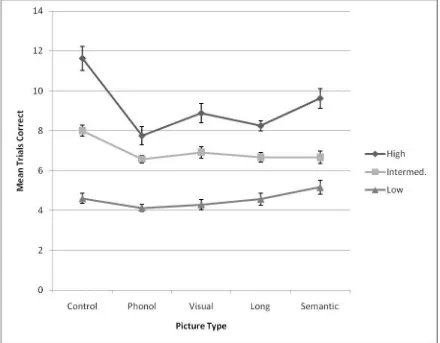
groupings. The performance of children in the three clusters is shown in Figure 2. An ANOVA revealed
there was a significant difference in the ages of the children in the three clusters, F(2,52) = 6.20,
18 = 24, mean age 72.7 months, SD = 11.6; lowest performing cluster, N = 23, mean age 66.1 months, SD
11.4).
A 3 (cluster) x 5 (picture type) mixed ANOVA on the picture span scores showed main effects of
cluster, F(2, 52) = 127.43, p < .001, partial η² = .83, and picture type, F(4, 208) = 17.36, p < .001, partial η² = .25; and a significant interaction, F(8, 208) = 7.42, p < .001, partial η² = .17. Post-hoc Bonferonni tests showed all the differences between groups to be significant at p < .001.
One-way ANOVAs were then carried out to assess the effects of picture type in each cluster. For the
highest performing cluster there was a significant effect of picture type, F(4,28) = 10.221, p < .001, partial η² = .59; and planned comparisons revealed significant performance reductions on
phonological (p < .01, PSE), visual (p < .01, VSE), and long-named (p < .01, WLE) pictures. For the cluster with intermediate performance there was an effect of picture type, F(4,92) = 5.51, p < .01, partial η² = .19; and planned comparisons revealed significant performance reductions on
phonological (p < .01, PSE), long-named (p < .01, WLE), and semantic (p < .01, SSE) pictures (this approached significance for visual pictures, p = .016). For the lowest performing cluster there was a modest overall effect of picture type, F(4,88) = 3.40, p < .05, partial η² = .13; however, planned comparisons did not identify any significant differences.
Figure 2 about here
Summary. In Experiment 2, the least mature children, by age or cluster, showed no evidence for any
form of coding; whereas more mature children showed clear evidence for phonological coding (PSE,
WLE). There was some evidence for visual and semantic coding, but only in more mature children.
19 Experiment 3 explored an alternative method for assessing picture span performance that reduced
insensitivity to task differences at low levels of performance, yet still avoided the drawback of fixed list
lengths (too easy or difficult for many participants). "Baseline" span was assessed for every participant
and subsequently 10 trials for each ‘experimental’ picture type were administered at a level of
baseline span plus one (span+1). This equated difficulty levels for all participants whilst delivering
slightly longer and ‘more confusable’ lists for lower performing children. We also asked children how
they had remembered the pictures to try to detect self-reported phonological coding. Finally, the
reliability of control and phonologically similar span scores was calculated from a retest one week
later.
Method
Participants
The sample consisted of 31 children of 4-5 years (mean age 5 years 4 months, SD 6 months, 19 boys)
and 35 children of 6-8 years (mean age 7 years 3 months, SD 9 months, 17 boys). The children
attended mainstream schools and nurseries in Greater London and had no special needs identified.
Apparatus/materials/procedure
These were the same as previous experiments with the following exceptions. First, all children were
assessed for baseline picture memory span using an alternative set of ‘control’ pictures with the same
characteristics as the other picture sets (bell, clock, tree, dog, comb, moon, bread, glass, shirt; see
Table 1). There were six trials per list length and ‘baseline’ span scores represented the longest list at
which the child obtained at least four trials out of six entirely correct (age 4/5 years, mean span = 1.35,
range 1-2; age 6/8 years, mean span = 2.6, range 2-4). All subsequent picture memory span tests were
administered at a list length of baseline span+1 (if a child's picture memory span was two, all
20 picture type in counterbalanced order were administered over two testing sessions. Scores reflected
the number of pictures recalled in the correct order (if one picture was left out, the remainder were
counted as incorrect; if the order of two pictures became reversed, subsequent and prior pictures
could be counted as correct) and were expressed as proportions correct for each picture type.
Approximately one week later, children were retested for their baseline span+1 performance on
control and phonological pictures to examine the reliability of these measures. At the end of this
session children were also asked how they had remembered the pictures using a series of questions
(see Appendix). Children were classified as self-reporting phonological coding if they reported that
they ‘said the names of the pictures inside their head’.
Results
The lower part of Table 2 includes the proportion correct scores for each picture type. An age group (4/5-year-olds, 6/8-year-olds) by picture type (control, phonological, visual, long, semantic) mixed
ANOVA revealed significant effects of picture type, F(4, 256) = 3.56, p < .01, partial η² = .053; and a significant interaction between picture type and age, F(4, 256) = 3.60, p < .01, partial η² = .053. The effect of age group was not significant, suggesting that our new method had succeeded in equating
task difficulty, a necessary precondition for equivalent task sensitivity across age (although younger
children still obtained marginally lower scores, F(1, 64) = 3.1, p < .10, partial η² = .046).
Given the predictions, one-way ANOVAs were used to explore the effects of picture type in each age
group. There were no significant effects of picture type for 4/5-year-olds (F < 1). Picture type was, however, significant for 6/8-year-olds, F(4, 136) = 6.86, p < .001, partial η² = .17. Planned contrasts indicated 6/8-year-olds showed reduced performance in the phonological condition, F(1, 34) = 8.58,
21 The same cluster analysis as used in previous experiments was carried on the data from Experiment 3.
Both the four and three cluster solutions identified groups with only 3 members, so a two cluster
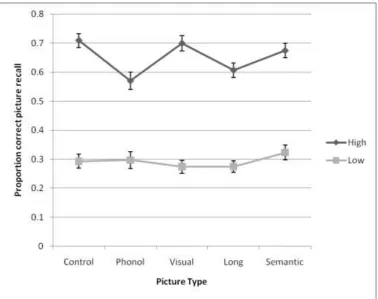
solution was used for analysis (see Figure 3). A 2 (cluster) x 5 (picture type) mixed ANOVA showed
main effects of cluster, F(1, 64) = 256.29, p < .001, partial η² = .80, and picture type, F(4,256) = 4.29,
p < .01, partial η² = .06, and a significant interaction between the two, F(4,256) = 4.03, p < .01, partial η² = .06.
One-way ANOVAs explored picture type differences for each cluster. For the higher performing
cluster, picture type was significant, F(4,129) = 6.43, p < .001, partial η² = .18; and planned
comparisons revealed significant performance reductions on phonological (PSE, p < .001) and long -named pictures (WLE, p < .01). For the cluster with lower performance there was no overall effect of picture type (F < 1).
Figure 3 about here
Self-reported phonological coding. Thirty children reported phonological coding (mean age 84.4
months, SD=12.3 months, range 65-101 months) and 36 did not (mean age 69.6 months, SD=12.3,
range 53-105 months). Age differences between these groups were significant, t(64) = 5.12, p < .001, but the overlap in age ranges was considerable. This indicated that self-reported phonological coding
was not perfectly related to age (point biserial correlation between age and phonological coding was
in the moderate range, r = .54).
A comparison was made of picture recall in the two groups. A phonological coding group (yes, no) by
picture type (control, phonological, visual, long, semantic) mixed ANOVA revealed a significant effect
22 One-way ANOVAs on the two self-reported coding groups indicated that self-reported
non-phonological coders showed no significant effects of picture type (F=1.16). Phonological-coders showed significant effects of picture type, F(4, 116) = 5.88, p < .001, partial η² = .169, and planned contrasts revealed significant performance reductions on phonologically similar, F(1, 29) = 8.41,
p < .01, partial η² = .225 (PSE), and long-named pictures, F(1, 29) = 10.45, p < .01, partial η² = .265 (WLE).
Re-test data. This was available for phonological and control picture types. A three-way mixed
ANOVA including the factors of age (4/5, 6/8-year-olds), picture type (control, phonological), and test
session (time one, retest) was carried out on the proportion correct scores. There was a significant
effect of picture type, F(1, 63) = 9.78, p < .01, partial η² = .13. Inspection of the means indicated that performance was higher for both age groups combined on control items (time one mean = .49,
SD = .25; retest mean = .51, SD = .26) than phonological items (time one mean = .43, SD = .21; retest
mean = .46, SD = .22). There were no effects of age or test session and no interactions. The
correlation between performance in the control condition at time one and retest was moderately high
(r = .72); as was the correlation between performance in the phonological condition at time one and retest (r = .72). These data suggest that proportion correct scores on the span+1 task were reliable.
Finally, some studies have reported data on difference scores between control and phonological performance in individual children as an indication of phonological coding. However, such methods
may increase error variance, because the difference score involves the error variance from two
variables. In fact, the correlation between difference scores at time one and retest was low and
non-significant (r = .17), suggesting that such difference measures are unreliable.
23 It is possible that subtle differences in strategy use are masked by combining groups that differ in
developmental level or age (Henry, 2008). In order to check whether using combined age groups
concealed picture type effects that might emerge in each age group separately, we conducted an
additional analysis of the span scores from Experiments 1 and 2 combined, increasing our power to
look at developmental trends in four separate age groups (24 4-year-olds, 20 5-year-olds, 29
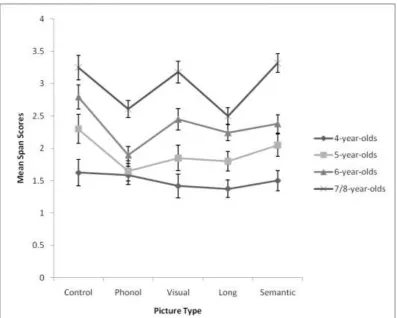
6-year-olds, 28 7/8-year-olds). See Figure 4 for an illustration of this data. Note that span scores were based
on six trials per list length in Experiment 1 and three trials per list length in Experiment 2, so the
results should be treated with caution.
An age (4, 5, 6, 7/8 years) by picture type (5 levels) ANOVA revealed significantmain effects (with
Greenhouse-Geisser corrections for violation of sphericity where relevant) of picture type, F(3.7, 359.9) = 16.22, p < .001, partial η² = .14, and age group, F(3, 97) = 25.36, p < .001, partial η² = .44. There was also a significant picture type by age group interaction, F(11.13, 359.9) = 2.96, p < .01, partial η² = .08.
Subsequent one-way ANOVAs for each age group showed an absence of picture type effects in
4-year-olds (F = 1.64), but such effects were significant in all other age groups [5-year-olds: F(4, 76) = 4.05,
p < .01, partial η² = .17; 6-year-olds: F(4, 112) = 7.67, p < .001, partial η² = .22; 7/8-year-olds: F(4, 108) = 10.75, p < .001, partial η² = .29]. Planned contrasts indicated 5-year-olds showed a PSE, F(1, 19) = 12.79, p < .01, partial η² = .40; a WLE, F(1, 19) = 8.64, p < .01, partial η² = .31, and a marginally significant VSE, F(1, 19) = 5.15, p = .035, partial η² = .21. Six-year-olds showed a PSE, F(1, 28) = 34.92,
p < .001, partial η² = .56; a WLE, F(1, 28) = 11.67, p < .01, partial η² = .29; a marginally significant VSE,
24 WLE, F(1, 27) = 24.65, p < .001, partial η² = .48 (Fs for VSE and SSE were virtually zero: .16 and .19 respectively). Findings are discussed below.
Figure 4 about here
General Discussion
The present experiments addressed controversies in the previous developmental literature on
phonological and other forms of coding, using assessments of picture memory span that controlled for
potentially confounding effects of verbal input in children of 4-8 years. Clear and robust support was
found for Conrad's (1971) contention that verbal mediation in the form of phonological coding
develops gradually in typical children from age 5-6 years. Children in the current samples who were
older (6-8 years), more mature in terms of performance levels (more mature "clusters"), and who
‘self-reported’ the use of phonological coding showed significant phonological similarity and word
length effects. By contrast, children who were younger (4-5 years), less mature in terms of
performance levels, and who did not self-report the use of phonological coding showed no evidence of
strategy use (no negative effects of different picture types). These findings were consistent across
three experiments that used different methods of assessing ‘span’ performance (‘traditional’ span
measures, measures of total trials correct on span tasks, percentages correct on span level+1 lists) and
different ways of dividing our groups (based on age, or level of performance). In a combined
age-difference analysis of span scores from Experiments 1 and 2, the findings were slightly more nuanced:
4-year-olds showed no evidence of strategy use, but 5- year-olds resembled older children, with
evidence emerging for phonological coding.
Theoretically, these findings add to the evidence of a "profound change in the use of verbal
mediation" (Al-Namlah et al., 2006, p. 117) over the age of 5 years in typically developing children.
25 private speech for behavioural regulation and problem-solving is a closely related process (Al-Namlah
et al., 2006; Winsler & Naglieri, 2003). Further investigation of both of these important skills will
contribute to our understanding of verbal mediation, perhaps confirming that it emerges from the
gradual internalisation of social speech as proposed by Vygotsky (1934/1986).
Experiment 3 suggested that the average age of self-reported phonological coding was exactly 7 years. Flavell et al. (1997) found, similarly, that 6- to 7-year-olds have a reasonable knowledge and
awareness of inner speech, possibly because experience of reading, writing and arithmetic in the early
school years requires such skills. Children who said they used phonological coding were able to recall
longer lists of items, suggesting that use of this strategy was positively related to the level of recall.
Note that early strategy use is not always related to improvements in recall as illustrated by work on
‘utilisation deficiencies’, whereby children use a strategy but gain no resultant benefit (e.g. Miller,
1994). In Experiment 1, there was some evidence of an ‘intermediate’ strategy stage of phonological
coding on its own (phonological similarity effects) followed by a later stage of phonological coding plus
verbal rehearsal (phonological similarity and word length effects) in the cluster analysis. However,
given the difficulties of interpreting word length effects as evidence for verbal rehearsal (Cowan et al.,
1992; Henry, 1991; Henry et al., 2000; Yuzawa, 2001), the cautious conclusion is that both of these
effects indicated phonological coding. In all other relevant analyses, phonological similarity and word
length effects coincided in the older and more mature children.
The findings provide evidence that picture span measures do index the development of phonological
coding in children and should be of value in future investigations exploring links between phonological
coding and related academic skills such as reading, spelling, writing and arithmetic (e.g. Palmer,
2000b). Picture span methods are also useful tools to investigate the development of phonological
coding in atypical populations of children who may have weak language skills and limited abilities to
26 & Jarrold, 2008; Williams & Jarrold, 2010). However, our results emphasise that ‘difference’ scores
between span performance on control versus phonologically similar items should be used with
caution. In Experiment 3, such measures were not found to be reliable when children were retested
after one week.
Experiments 1 to 3 did not offer clear support for the transition from visual to phonological coding between four and six years described in previous research (e.g. Palmer, 2000a). Visual similarity
effects were not detected in the youngest children, and these children showed no evidence of
alternative strategy use (phonological or semantic coding). Some previous research employing
span-based assessments has indicated a similar lack of strategy use in young children (Henry, 2008; Hitch et
al., 1989), but studies employing fixed list length picture span assessments with verbal recall tend to
reveal visual similarity effects in 4/5-year-olds (Hitch et al., 1988; Hitch et al., 1989; 1991; Palmer,
2000a). We will return to this point shortly in discussing the combined analysis of span scores for
Experiments 1 and 2.
There was some evidence for the presence of dual phonological and visual coding, an interim stage proposed by Palmer (2000a), amongst the more mature children in Experiment 2. Given the variability
in the identification of visual and dual coding here and in previous research (Henry, 2008; Palmer,
2000a), we conducted an additional analysis of the span scores from Experiments 1 and 2 combined,
increasing the power to examine strategy use in four separate age groups ( 4-year-olds, 5-year-olds,
6-year-olds, 7/8-year-olds). Although we still found no significant effects of picture type in 4-6-year-olds,
5-year-olds showed evidence of using phonological coding (significant PSE and WLE) and visual coding
(marginally significant VSE). This evidence for dual visual and phonological coding was repeated in the
6-year-olds (significant PSE and WLE, marginally significant VSE). By 7/8 years, visual similarity effects
had disappeared, and children showed only phonological coding (PSE, WLE), concurring with our
27 These analyses should be treated with caution because we have combined data over two experiments
that did not measure span in exactly the same way. However, the findings highlight several points.
First, phonological coding may emerge earlier than our separate experimental results had indicated (at
5 years rather than 6 years). Combining groups of 4- and 5-year-olds may mask differential effects at
each age level, an important point for future research hoping to track developmental changes in
phonological and visual coding strategies. Second, the findings provided some evidence for a dual
phonological and visual coding stage at 5 to 6 years, although the VSE remained marginally significant.
It is not clear why some samples of children fail to show consistent and reliable effects of visual
similarity, but differences in teaching methods, perhaps in relation to visual versus phonological
reading strategies, could affect the use of pure phonological versus dual coding. Finally, the findings
give reassurance that picture type effects with span tasks can be found at low levels of recall.
Five-year-olds recalled on average 1.6 to 2.3 pictures, yet still showed significant effects of picture type in
line with previous reports of similarity effects in children with performance levels of 2 or less (e.g.
Hitch et al., 1988; Hitch et al., 1989). Even so, some children still had spans of just one picture. For
this reason the span+1 methodology adopted in Experiment 3 offers the advantage of never testing
children on lists of less than two pictures.
Although the current findings suggest that visual coding strategies were not a dominant feature of
span performance in 4-year-olds, it remains possible that the current experiments were unable to
detect them. Ideally our findings would be confirmed using even larger samples of 4-year-olds and
greater numbers of trials at the span+1 level. Such data is important to assess properly existing
models of short-term memory development based on a hypothesised transition from visual to dual
and then exclusive phonological coding (Hitch et al., 1988; Hitch et al., 1989; 1991; Palmer, 2000).
Future research could also compare non-verbal with verbal recall methods, to test whether this
28 Finally, the present results offered little evidence for children’s use of semantic coding. Younger
children were not found to show semantic similarity effects in any of the analyses across the three experiments, providing no direct evidence for a developmentally early ‘semantic coding’ phase
(Palmer, 2000a). There was limited evidence for semantic similarity effects in the intermediate cluster
of children in Experiment 2, and in 6-year-olds in the combined analysis of Experiments 1 and 2. These
findings imply that semantic coding may be used by some children, but the lack of consistency
indicates that the presence of this type of coding is variable and difficult to detect.
The results of Experiment 3 also suggested that self-report measures of phonological coding in young
children might be a reliable way of assessing these skills. Orderly effects of phonological similarity and
word length were found in children who reported the use of phonological coding and these effects
were absent in those who did not report the strategy. Of additional interest was the imperfect
relationship between age and self-reported phonological coding, implying that the development of
phonological coding may only be broadly related to chronological age.
In summary, three experiments addressed a number of controversies in the previous developmental
literature on phonological and other forms of coding, using methodologically sound, sensitive and
reliable assessments of picture memory span that controlled for potentially confounding effects of
verbal input and output. We demonstrated that the emergence of verbal mediation in the form of
phonological coding strategies is a robust and reliable stage of development in typical children,
occurring from the age of five or six years. This confirmed findings initially reported by Conrad (1971),
but subsequently questioned by other authors. However, in contrast to some previous research, little
evidence was found for a distinct visual coding stage at 4 years, casting doubt on assumptions that this
is a developmental stage that consistently precedes phonological coding. There was, however, some
29 at around 5-6 years. Evidence for semantic similarity effects was limited, suggesting that semantic
coding is not a key method by which young children recall lists of pictures. Consequently, the findings
provide new information about the fundamental ways in which children’s representations and
30 References
Al-Namlah, A.S., Fernyhough, C. & Meins, E. (2006). Sociocultural influences on the development of
verbal mediation: Private speech and phonological recoding in Saudi Arabian and British
samples. Developmental Psychology, 42:1, 117-131. doi: 10.1037/0012-1649.42.1.117 Avons, S. E. (1998). Serial report and item recognition of novel visual patterns. British Journal of
Psychology, 89, 285–308. doi: 10.1111/j.2044-8295.1998.tb02685.x
Avons, S. E. & Mason, A. (1999). Effects of visual similarity on serial report and item recognition.
Quarterly Journal of Experimental Psychology, 52A, 217–240. doi: 10.1080/027249899391296 Avons, S. E., Ward, G. & Melling, L. (2004). Item and order memory for novel visual patterns assessed
by two-choice recognition. Quarterly Journal of Experimental Psychology, 57A, 865–891. doi: 10.1080/02724980343000521
Baddeley, A. D. (1966). Short-term memory for word sequences as a function of acoustic, semantic
and formal similarity. Quarterly Journal of Experimental Psychology, 18, 362–365. doi: 10.1080/14640746608400055
Baddeley, A. D. (1986). Working memory. Oxford: Oxford University Press.
Baddeley, A. D. (2000). The episodic buffer: A new component of working memory? Trends in Cognitive Sciences, 4, 417–423. doi:10.1016/S1364-6613(00)01538-2
Baddeley, A. D. (2007). Working memory, thought, and action. Oxford: Oxford University Press.
Baddeley, A. D. & Hitch, G. J. (1974). Working memory. In G. A. Bower (Ed.), The psychology of learning and motivation (Vol. 8, pp. 47–89). New York: Academic Press.
Baddeley, A. D., Thomson, N. & Buchanan, M. (1975). Word length and the structure of short-term
memory. Journal of Verbal Learning and Verbal Behavior, 14, 575–589. doi: 10.1016/S0022-5371(75)80045-4
31 Brown, R. M. (1977). An examination of visual and verbal coding processes in preschool children. Child
Development, 48, 38–45. doi: 10.2307/1128878
Conrad, R. (1971). The chronology of the development of covert speech in children. Developmental Psychology, 5, 398–405. doi: 10.1037/h0031595
Conrad, R. & Hull, A. J. (1964). Information, acoustic confusion and memory span. British Journal of Psychology, 55, 429–432. doi: 10.1111/j.2044-8295.1964.tb00928.x
Cowan, N., Day, L., Saults, J. S., Keller, T. A., Johnson, T. & Flores, L. (1992). The role of verbal output
time in the effects of word length on immediate memory. Journal of Memory and Language,
34, 1–17. doi: 10.1016/0749-596X(92)90002-F
Cowan, N., Saults, J. S., Winterowd, C. & Sherk, M. (1991). Enhancement of 4-year-old children’s
memory span for phonologically similar and dissimilar word lists. Journal of Experimental Child Psychology, 51, 30–52. doi: 10.1016/0022-0965(91)90076-5
Ferguson, A.N., Bowey, J.A. & Tilley, A. (2002). The association between auditory memory span and
speech rate in children from kindergarten to sixth grade. Journal of Experimental Child Psychology, 81, 141–156. doi: 10.1006/jecp.2001.2646
Flavell, J. H., Green, F. L., Flaevell, E. R. & Grossman: J. B. (1997). The development of children's
knowledge about inner speech. Child Development, 68:1, 39-47. 10.1111/j.1467-8624.1997.tb01923.x
Ford, S. & Silber, K.P. (1994). Working memory in children: A developmental approach to the
phonological coding of pictorial material. British Journal of Developmental Psychology, 12, 165-175. 10.1111/j.2044-835X.1994.tb00626.x
Frick, R. W. (1988a). Issues of representation and limited capacity in the visuospatial sketchpad. British Journal of Psychology, 79, 289–308. doi: 10.1111/j.2044-8295.1988.tb02289.x
Frick, R. W. (1988b). Representation, recovery, and limited capacity in an auditory short-term store.
32 Gathercole, S. E. & Hitch, G. J. (1993). Developmental changes in short-term memory: A revised
working memory perspective. In A. Collins, S. E. Gathercole, M. A. Conway and P. E. Morris
(Eds.), Models of short-term memory. Hove, UK: Psychology Press.
Halliday, M. S., Hitch, G. J., Lennon, B. & Pettipher, C. (1990). Verbal short-term memory in children:
The role of the articulatory loop. European Journal of Cognitive Psychology, 2, 23–38. doi: 10.1080/09541449008406195
Hasselhorn, M. & Grube, D. (2003). The phonological similarity effect on memory span in children:
Does it depend on age, speech rate, and articulatory suppression? International Journal of Behavioral Development, 27, 145–152. doi: 10.1080/01650250244000146
Hayes, D. S. & Schulze, S. A. (1977). Visual encoding in preschoolers’ serial retention. Child Development, 48, 1066–1070. doi: 10.2307/1128362
Henry, L. A. (1991). The effects of word length and phonemic similarity in young children’s short-term
memory. Quarterly Journal of Experimental Psychology, 43A, 35–52. doi: 10.1080/14640749108400998
Henry, L. (2008). Short-term memory coding in children with intellectual disabilities. American Journal of Mental Retardation, 113, 187–200. doi:
10.1352/0895-8017(2008)113[187:SMCICW]2.0.CO;2
Henry, L. A. & Millar, S. (1993). Why does memory span improve with age? A review of the evidence
for two current hypotheses. European Journal of Cognitive Psychology, 5, 241-287. doi: 10.1080/09541449308520119
Henry, L. A., Turner, J. E., Smith, P. T. & Leather, C. (2000). Modality effects and the development of
the word length effect in children. Memory, 8, 1–17. doi: 10.1080/096582100387678
Hitch, G. J., Woodin, M. E. & Baker, S. (1989). Visual and phonological components of working memory
33 Hitch, G.J, Halliday, M.S., Dodd, A. & Littler, J.E. (1989). Development of rehearsal in short-term
memory: Differences between pictorial and spoken stimuli. British Journal of Developmental Psychology, 7, 347–362. doi: 10.1016/0022-0965(91)90033-O
Hitch, G. J., Halliday, M. S., Schaafstal, A. M. & Heffernan, T. M. (1991). Speech, “inner speech” and the
development of short-term memory: Effects of picture labeling on recall. Journal of Experimental Child Psychology, 51, 220–234. doi: 10.1016/0022-0965(91)90033-O Hitch, G. J., Halliday, S., Schaafstal, A. M. & Schraagen, J. M. C. (1988). Visual working memory in
young children. Memory & Cognition, 16, 120–132. doi: 10.3758/BF03213479
Hulme, C. (1987). The effects of acoustic similarity on memory in children: A comparison between
visual and auditory presentation. Applied Cognitive Psychology, 1, 45-51. doi: 10.1002/acp.2350010107
Hulme, C., Thomson, N., Muir, C. & Lawrence, A. (1984). Speech rate and the development of
short-term memory span. Journal of Experimental Child Psychology, 38, 241–253. doi: 10.1016/0022-0965(84)90124-3
Hulme, C., Neath, I., Stuart, G., Shostak, L., Surprenant, A.M. & Brown, G.D.A. (2006). The
distinctiveness of the word-length effect. Journal of Experimental Psychology: Learning, Memory, and Cognition, 32(3), 586–594. doi: 10.1037/0278-7393.32.3.586
Huttenlocher, J. & Lui, F. (1979). The semantic organisation of some simple nouns and verbs Journal of Verbal Learning and Verbal Behavior, 18, 141–162. doi: 10.1016/S0022-5371(79)90091-4 Jarrold, C., Cocksey, J. & Dockerill, E. (2008). Phonological similarity and lexicality effects in children’s
verbal short-term memory: Concerns about the interpretation of probed recall data.
Quarterly Journal of Experimental Psychology, 61 (2), 324-340. doi: 10.1080/17470210701202210
34 Levelt, W. J. M., Roelofs, A. & Meyer, A. S. (1999). A theory of lexical access in speech production.
Behavioural and Brain Sciences, 22, 1–38.
Lewandowsky, S. & Oberauer, K. (2008). The word-length effect provides no evidence for decay in
short-term memory. Psychonomic Bulletin & Review, 15 (5), 875-888. doi: 10.3758/PBR.15.5.875
Logie, R. H., Della Sala, S., Wynn, V. & Baddeley, A. D. (2000). Visual similarity effects in immediate
serial recall. Quarterly Journal of Experimental Psychology, 53A, 626–646. doi: 10.1080/713755916
Longoni, A. M. & Scalisi, T. G. (1994). Developmental aspects of phonemic and visual similarity effects:
Further evidence in Italian children. International Journal of Behavioral Development, 17, 57– 71. doi: 10.1177/016502549401700104
Marcovitch, S. & Zelazo, P.D. (2009). A hierarchical competing systems model of the emergence and early
development of executive function. Developmental Science, 12(1), 1–25. doi: 10.1111/j.1467-7687.2008.00754.x
McGilly, K. & Siegler, R.S. (1989). How children choose among serial recall strategies. Child Development, 60, 172-182. doi: 10.2307/1131083
Messer, D.J. & Dockrell, J. (2006). Children’s naming and word-finding difficulties: Descriptions and
explanations. Journal of Speech, Language, and Hearing Research, 49, 309-324. doi: 10.1044/1092-4388(2006/025)
Messer, D.J., Pine, K. J. & Butler, C. (2008). Children's behaviour and cognitions across different
balance tasks. Learning and Instruction, 18, 42–53. doi: 10.1016/j.learninstruc.2006.09.008
Miller, P.H. (1994). Individual differences in children's strategic behaviour: utilisation deficiencies.
35 Morrison, C. M., Chappell, T. D. & Ellis, A. W. (1997). Age of acquisition norms for a large set of object
names and their relation to adult estimates and other variables. Quarterly Journal of Experimental Psychology, 50A, 528–559. doi: 10.1080/027249897392017
Mueller, S.T., Seymour, T.L., Keiras, D.E. & Meyer, D.E. (2003). Theoretical implications of articulatory
duration, phonological similarity, and phonological complexity in verbal working memory.
Journal of Experimental Psychology: Learning, Memory, and Cognition, 29(6), 1353-1380. doi: 10.1037/0278-7393.29.6.1353
Nimmo, L. M. & Roodenrys, S. (2004). Investigating the phonological similarity effect: Syllable
structure and the position of common phonemes. Journal of Memory and Language, 50, 245– 258. doi: 10.1016/j.jml.2003.11.001
Palmer, S. (2000a). Working memory: A developmental study of phonological recoding. Memory, 8, 179–193. doi: 10.1080/096582100387597
Palmer, S. (2000b). Development of phonological recoding and literacy acquisition: a four-year
course-sequential study. British Journal of Developmental Psychology, 18, 533–555. doi: 10.1348/026151000165841
Pine, K. & Messer, D. (2003). The development of representations as children learn about balancing.
British Journal of Developmental Psychology, 21:2, 285–301. doi: 10.1348/026151003765264093
Purser, H. & Jarrold, C. (2010). Short- and long-term memory contributions to immediate serial
recognition: Evidence from serial position effects. Quarterly Journal of Experimental Psychology, 63(4), 679-693. doi: 10.1080/17470210903067635
Romani, C., McAlpine, S., Olson, A., Tsouknida, E. & Martin, R. (2005). Length, lexicality, and
36 Vygotsky, L.S. (1986). Thought and language (A. Kozulin, Trans.). Cambridge, MA: MIT press. (Original
work published 1934).
Whitehouse, A.J.O., Maybery, M.T. & Durkin, K. (2006). Inner speech impairments in autism. Journal of Child Psychology and Psychiatry, 47:8, 857-865. doi: 10.1111/j.1469-7610.2006.01624.x
Williams, D. & Jarrold, C. (2010). Predicting inner speech use amongst children with autism spectrum
disorder (ASD): The roles of verbal ability and cognitive profile. Journal of Autism and Developmental Disorders, 37, 1413-1429 doi: 10.1007/s10803-010-0936-8
Williams, D., Happé, F. & Jarrold, C. (2008). Intact inner speech use in autism spectrum disorder:
Evidence from a short-term memory task. Journal of Child Psychology and Psychiatry, 49:1, 51-58. doi: 10.1111/j.1469-7610.2007.01836.x
Winsler, A. & Naglieri, J. (2003). Overt and covert verbal problem-solving strategies: Developmental
trends in use, awareness, and relations with task performance in children aged 5 to 17. Child Development, 74:3, 659-678. doi: 10.1111/1467-8624.00561
Yuzawa, M. (2001). Effects of word length on young children’s memory performance. Memory & Cognition, 29, 557–564. doi: 10.3758/BF03200457
37 Table 1. Mean age of acquisition (AoA), imageability, frequency, familiarity and name agreement for
each of the six sets of experimental picture span materials (from Morrison et al., 1997). Each line in
italics gives the range of values for the preceding set. Lower AoA values refer earlier rated age of
acquiring the word; for imageability, frequency and familiarity, higher values indicate higher ratings;
perfect name agreement is given by a value of 1.00.
Picture
Type
AoA
(scale 1-7)
Imageability
(scale 1-7)
Frequency
(scale 1-5)
Familiarity
(scale 1-5)
Name agreement
(scale 0-1)
Control 2.01 6.37 3.17 3.38 0.96
(Range) 1.75-2.50 5.95-6.70 2.00-4.15 2.09-4.77 0.82-1.00
Phonological 2.23 6.24 3.04 3.50 0.95
(Range) 1.15-2.90 5.90-6.70 2.35-3.90 2.59-4.70 0.86-1.00
Visual 2.03 6.29 3.77 4.03 0.96
(Range) 1.25-2.45 5.80-6.75 2.35-4.70 2.82-4.86 0.82-1.00
Long 2.11 6.49 3.11 3.51 0.84
(Range) 1.70-2.45 6.25-6.70 1.90-4.35 2.20-4.59 0.59-1.00
Semantic 1.64 6.16 3.50 4.39 0.93
(Range) 1.45-2.00 5.75-6.70 2.85-4.25 2.88-4.73 0.68-1.00
Control 2 2.01 6.41 3.52 3.94 0.98