City, University of London Institutional Repository
Citation
:
Kotlarsky, J., Scarbrough, H. and Oshri, I. (2014). Coordinating Expertise Across
Knowledge Boundaries in Offshore-Outsourcing Projects: The Role of Codification. MIS
Quarterly, 38(2), pp. 607-627.
This is the published version of the paper.
This version of the publication may differ from the final published
version.
Permanent repository link:
http://openaccess.city.ac.uk/4375/
Link to published version
:
Copyright and reuse:
City Research Online aims to make research
outputs of City, University of London available to a wider audience.
Copyright and Moral Rights remain with the author(s) and/or copyright
holders. URLs from City Research Online may be freely distributed and
linked to.
C
OORDINATING
E
XPERTISE
A
CROSS
K
NOWLEDGE
B
OUNDARIES IN
O
FFSHORE
-O
UTSOURCING
P
ROJECTS
:
T
HE
R
OLE OF
C
ODIFICATION
1
Julia Kotlarsky
Aston Business School, Aston University, Aston Triangle, Birmingham, B4 7ET, UNITED KINGDOM {[email protected]}
Harry Scarbrough
Keele Management School, Keele University, Staffordshire, ST5 5BG, UNITED KINGDOM {[email protected]}
Ilan Oshri
Centre for Global Sourcing and Services, Loughborough School of Business and Economics, Loughborugh, Leicestershire, LE22 3TU, UNITED KINGDOM {[email protected]}
The coordination of effort within and among different expert groups is a central feature of contemporary organizations. Within the existing literature, however, a dichotomy has emerged in our understanding of the role played by codification in coordinating expert groups. One strand of literature emphasizes codification as a process that supports coordination by enabling the storage and ready transfer of knowledge. In contrast, another strand highlights the persistent differences between expert groups that create boundaries to the transfer of knowledge, seeing coordination as dependent on the quality of the reciprocal interactions between groups and individuals. Our research helps to resolve such contested understandings of the coordinative role played by codification. By focusing on the offshore-outsourcing of knowledge-intensive services, we examine the role played by codification when expertise was coordinated between client staff and onsite and offshore vendor personnel in a large-scale outsourcing contract between TATA Consultancy Services (TCS) and ABN AMRO bank. A number of theoretical contributions flow from our analysis of the case study, helping to move our understanding beyond the dichotomized views of codification outlined above. First, our study adds to previous work where codification has been seen as a static concept by demonstrating the multiple, coexisting, and complementary roles that codification may play. We examine the dynamic nature of codification and show changes in the relative importance of these different roles in coordinating distributed expertise over time. Second, we reconceptualize the commonly accepted view of codification as focusing on the replication and diffusion of knowledge by developing the notion of the codification of the “knower” as complementary to the codification of knowledge. Unlike previous studies of expertise directories, codification of the knower does not involve representing expertise in terms of occupational skills or competences but enables the reciprocal interrelating of expertise required by more unstructured tasks.
1
Keywords: Offshore-outsourcing, codification, expertise coordination, knowledge boundaries, qualitative case study, outsourcing transition
1Ola Henfridsson was the accepting senior editor for this paper. Emmanuelle Vaast served as the associate editor.
The appendices for this paper are located in the “Online Supplements” section of the MIS Quarterly’s website (http://www.misq.org).
Introduction
The coordination of effort within and among different expert groups is a central feature of contemporary organizations (Carlile 2002; Majchrzak et al. 2007). Indeed, support for such coordination is viewed as one of the most important contributions that information systems can make to organiza-tional performance (Aral et al. 2012; Kellogg et al. 2006). Such systems achieve their coordinative effects not only by enabling expert groups to become better connected through improved communications, but also by reducing the depen-dencies between them through the codification of knowledge (Leonardi and Bailey 2008; Levina and Vaast 2006).
Within the existing literature, however, a dichotomy has emerged in our understanding of the role played by codifica-tion in coordinating expert groups. In one strand of literature, studies emphasize that codification supports such coordina-tion by externalizing knowledge (i.e., by making it more explicit and accessible through improved storage and ready transfer). In this view, where knowledge can be codified, the effect is to reduce the need for close, reciprocal interactions between different individuals and groups as they are able to follow the same defined procedures, apply shared tools, and draw on the same centralized knowledge stores (e.g., Espinosa et al. 2007; Kanawattanachai and Yoo 2007; Kan-kanhalli et al. 2005). Thus, codification supports coordination by spreading common knowledge and reducing dependencies between groups (Vaast and Levina 2006).
In contrast, work within another strand of the literature emphasizes the limitations on the role of codification in coor-dinating expert groups. Studies here question the coordina-tive benefits of the ready storage and transfer of knowledge. They highlight instead persistent differences between expert groups, and the boundaries they pose to the sharing of knowl-edge (e.g., Leonardi and Bailey 2008; Levina and Vaast 2008). The coordination of different groups is, therefore, seen as much more reliant on the intensity and quality of their reciprocal interactions (Vlaar et al. 2008).
These dichotomized views in the literature provide an impor-tant impetus for research to help resolve our contested understanding of the coordinative role played by codification. The need for such research is also driven by growing evidence that the dichotomy in current work may be based on too rigid a conceptualization of the different roles that codification may play in coordinating expert groups (Leonardi and Bailey 2008; Vaast and Levina 2006; Zollo and Winter 2002). The overarching theoretical concern for our study, then, was to deepen our understanding of the implications of codification for the coordination of expert groups, exploring both its limits and its coordinative effects.
An appropriate arena in which to ground these concerns is provided by the spread of offshore-outsourcing and its impact on the distribution of expertise between different organiza-tions. Offshore-outsourcing2 raises important new questions
for Information Systems theory and practice concerning the ability of organizations to manage the handover of their busi-ness activities from in-house to outsourcing vendors based at offshore locations (e.g., Srikanth and Puranam 2008; Tiwari 2009), particularly where the activities involved are not simple and repetitive tasks but high-value, knowledge-intensive services (e.g., Levina and Vaast 2008). The in-house to offshore handover involves a significant coordina-tion effort between multiple expert groups, including, typi-cally, client employees, onsite vendor staff, and offshore vendor staff (Srikanth and Puranam 2008) to allow the vendor organization to rapidly acquire the ability required to take over client systems and maintain continuity of service (Vlaar et al. 2008).
In our study, we applied the theoretical lens of expertise coor-dination to offshore-outsourcing as a way of addressing our overarching research concerns (Faraj and Sproull 2000; Faraj and Xiao 2006; Majchrzak et al. 2007). This lens highlights the way in which knowledge-related interdependencies are managed among groups.3 Much of the previous work on
expertise coordination has focused on the dynamic inter-actions in collocated teams where mutual awareness and adjustment of different individuals’ expertise is developed informally through a shared history of interactions and co-presence (e.g., Faraj and Sproull 2000; Hollingshead 2000). Compared to the teams highlighted in previous work, the expertise coordination in the groups involved in the offshore-outsourcing setting is distinctive in a number of ways, including their geographically distributed character, the impli-cations of organizational boundaries, and the impact of national and cultural differences between teams (Cummings et al. 2009; Espinosa et al. 2003; Espinosa et al. 2007; Levina and Vaast 2005). One result of these distinctive features is that expertise coordination in this setting typically lacks the informal mechanisms present in collocated teams, and is highly reliant on the use of communication and storage
tech-2Offshore-outsourcing implies contracting with a third party (vendor) based at an offshore location (which usually means in a developing country and separated from the client by an ocean) to accomplish some work for a specified length of time, cost, and level of service (Oshri et al. 2011).
3In line with Faraj and Xiao (2006), we conceptualized expertise
nologies to support the codification and transfer of knowledge between sites (Oshri et al. 2008; Vlaar et al. 2008). This makes offshore-outsourcing an extreme case, providing opportunities for theory development centered on the role of codification in coordinating of expertise (Eisenhardt and Graebner 2007).
In addressing our overarching theoretical concerns, we devel-oped the following research question to guide our empirical study: What role does codification play in the coordination of expertise within the offshore-outsourcing setting, when knowledge boundaries are present?
A number of theoretical contributions flow from the analysis of our empirical study, helping to move our understanding beyond the dichotomized views outlined above. First, our study adds to previous work where codification has been seen as a static concept by demonstrating the multiple, coexisting, and complementary roles that codification may play. We examine the dynamic nature of codification and show the changes in the relative importance of various codification roles over time when coordinating distributed expertise. Second, we reconceptualize the commonly accepted view of codification as focusing on the replication and diffusion of knowledge by developing the notion of the codification of the “knower” and highlighting its complementary role to the codification of knowledge within the offshore-outsourcing setting.
Theoretical Background
The dichotomous view of codification outlined above reflects a major epistemological divide in existing literature on the nature of knowledge and expertise. In broad terms, this can be summarized as a divide between an epistemology of possession, which views knowledge as something that can be “abstracted, explicitly represented, codified and accessed” (Faraj and Sproull 2000, p. 1555), and an epistemology of practice, in which knowledge emerges through situated learning from the patterned interactions and practices within particular groups or communities (Cook and Brown 1999). These epistemological positions are echoed and elaborated, with some variation, by many accounts, including work in the field of knowledge management as well as IS (Leonardi and Treem 2012; Levina and Vaast 2005; Orlikowski 2002). In line with Cook and Brown’s (1999) analysis, we sought to reconcile the competing epistemologies at play by distin-guishing between the knowledge used by an individual or group, and the learned expertise of that individual or group (the “knowers” in Polanyi’s (1962) terms). In line with this view, expertise is defined here as a “knower’s capacity to
act,” and is differentiated from knowledge, which is viewed as a tool used by knowers to solve problems (Cook and Brown 1999), or to transform their own expertise (Gherardi and Nicolini 2000).
In the following sections, we build on the contrasting views outlined above in developing our understanding of expertise coordination in the offshore-outsourcing setting.
Expertise Coordination and
Knowledge Codification
In the existing literature, we find a close affinity between work on codification and the epistemology of possession outlined above. Put simply, codification, defined as “the compression of knowledge and experience into a structure, involving the use of codes and models to translate rules and actions into procedures, guidelines, specifications, and docu-ments” (Whitaker et al. 2010, p. 19), is widely seen as the means by which knowledge is made explicit and hence readily stored or transferred between groups. Hansen et al. (1999) exemplify the dichotomy in existing views by differentiating between a codification strategy, which allows people to search and retrieve codified knowledge without having to contact the person who originally developed it, and a person-alization strategy, which is associated with the sharing of knowledge through personal contacts (Boh 2007; Hansen et al. 1999; Scheepers et al. 2004). These are viewed as alter-native not complementary strategies. Thus, firms that adopt a codification strategy are able to make knowledge an organi-zational resource by depersonalizing it and making it readily available, either as a transferrable object or through storage in centralized databases. With this view of expertise, codifi-cation is seen as helping to significantly reduce the challenges of coordinating expertise by reducing any knowledge-related dependencies between groups. It gains support from, for example, Faraj and Xiao’s (2006) study of expertise coordi-nation in an emergency trauma center which found that the codification of knowledge or knowledge externalization
helped to reduce information-sharing problems.
A further aspect of the codification of knowledge emphasized in existing work is the routinization of actions and roles. Nelson and Winter (1982) describe the coordinative benefits of such organizational routines, as follows:
The effect of such routines on the coordination of expertise is further evidenced by Faraj and Xiao’s (2006) study which found that trauma protocols—standard operating procedure— helped to streamline work and reduce process uncertainty.
There are, however, strict limits on the role of codification in supporting expertise coordination. Some studies argue at a practical level that the tacit knowledge which resists codifi-cation may need to be transferred through face-to-face inter-actions (Hansen 1999; Rottman and Lacity 2004; Santhanam et al. 2007). Other studies, though, identify more profound limitations arising from the situated or practice-based nature of knowledge and learning (Levina and Vaast 2006). Even in the seminal work of Nelson and Winter, the notions of tacit and explicit are not presented as distinct forms of knowledge in an absolute sense, but rather as relative to their context. It follows that attempts to codify knowledge into an explicit form may not succeed in making it universally accessible or usable (Bechky 2003), but rather risks decontextualizing it (Majchrzak et al. 2005; Vlaar et al. 2008). As a result, individuals who later retrieve the knowledge may struggle to apply it appropriately and to integrate it into their actions (Leonardi and Bailey 2008). Indeed, even codified protocols and standardized training programs need to be fully learned by the individuals concerned, if they are to be applied effectively (Faraj and Xiao 2006; Hansen 1999).
Knowledge Boundaries and
Expertise Coordination
The studies discussed above suggest that the role of knowl-edge codification in expertise coordination can only be fully grasped by relating it to the formation and distribution of expertise among the different groups involved. In particular, it involves acknowledging the difficulties of transferring knowledge across what Carlile (2002) terms “knowledge boundaries,” by which he means differences in knowledge that is localized, embedded and invested in different prac-tices,4 and which inhibit coordination between expert groups
possessing different forms of expertise (Majchrzak et al. 2012). It follows that coordination between such groups may involve the creation of shared understandings (Vlaar et al. 2008), and the transformation rather than the transfer of knowledge (Bechky 2003; Carlile 2004).
A further implication which emerges from these more practice-oriented studies is the distributed character of exper-tise: that is, expertise cannot be readily centralized as an organizational resource because it emerges from the practices in which groups and individuals engage (e.g., Jarvenpaa and Majchrzak 2008; Majchrzak et al. 2007). The implication of this distributed character, as argued by Tsoukas (1996), is that
the key to achieving coordinated action does not so much depend on those “higher-up” collecting more and more knowledge as on those “lower-down” finding more and more ways of getting connected and interrelating the knowledge each one has (p. 21).
In some studies, this interrelating of knowledge and expertise is described in terms of the relationships within and between communities of practice (e.g., Faraj and Xiao 2006). In other work, the emphasis is rather on social networks or virtual professional networks (e.g., Faraj et al. 2011; Jarvenpaa and Majchrzak 2008). In all of these instances, however, the social or electronic links between groups and individuals pro-vide an important means of accessing certain forms of expertise.
The Role of Codification in
Offshore-Outsourcing
Much previous work in the offshore-outsourcing setting has highlighted the capacity of the codification of knowledge to mitigate the lack of easy interpersonal interaction in this setting and reduce knowledge dependencies between groups (Kanawattanachai and Yoo 2007; Leonardi and Bailey 2008; Vlaar et al. 2008). Within that emphasis on codification, a number of studies highlight the importance of externalizing knowledge by embedding it within artefacts such as appli-cation manuals, descriptions of systems architectures, func-tionalities, presentation slides (Chua and Pan 2008; Leonardi and Bailey 2008; Vaast and Levina 2006; Vlaar et al. 2008), and other documents that would capture knowledge that could be explicitly put on paper (Chua and Pan 2008). In addition to this embedding of knowledge, a further aspect of codifi-cation encompasses routinization. This has been seen as especially relevant to the offshore-outsourcing arena since it helps to establish clear rules and responsibilities for the specification of services (Vaast and Levina 2006), encom-passing relationships between onsite and offshore teams that rely on a well-specified division of work and a predefined workflow (Carmel and Tjia 2005; Kotlarsky et al. 2008; Oshri et al. 2008; Vlaar et al. 2008).
In contrast to these benefits ascribed to codification, however, other studies of this setting highlight the limitations on its role
in expertise coordination. Vlaar et al. (2008), for example, argue that “the exchange of documents is generally insuffi-cient for making the rationale behind a code transparent to others” (p. 231). In this vein, a number of studies suggest that the value of codification is limited by the knowledge bound-aries that arise between teams distributed between onshore and offshore sites that are likely to have varying levels of attainment within the same domain of expertise (Espinosa et al. 2003; Espinosa et al. 2007). These differences may not only encompass different levels of competence between client and vendor personnel (Levina and Vaast 2005), but may also arise within the vendor organization itself as a result of asymmetries in the expertise of onsite versus offshore team members (Carmel 1999; Oshri et al. 2008; Vlaar et al. 2008). Leonardi and Bailey (2008) note, for example, that a disparity in expertise between technical experts at the home site and less experienced individuals offshore “raises the strong possi-bility that individuals who receive work offshore may not be able to interpret the knowledge embedded in artefacts by their expert and distant colleagues” (p. 415).
While routinization may assist in coordinating expertise between onsite and offshore locations, these coordinative efforts are also subject to the emergence of knowledge bound-aries between groups. Under such contrasting conditions, in the following section we examine the role that codification played in coordinating expertise in one offshore-outsourcing project. In the case study, we examine how the expertise coordination process unfolds over time, as different parties (onsite and offshore team members, and client personnel) interact during the period when client systems are handed over to the vendor. In the light of our research question, our focus was on studying the connection between expertise coordination and codification practices.
Design and Methods
Design and Case Selection
In line with past studies suggesting that case studies can be used to advance understanding of a particular phenomenon (e.g., Eisenhardt 1989; Lee and Baskerville 2003), we based our qualitative and interpretive research approach on an in-depth case study of an offshore-outsourcing project. In order to explore major challenges for the coordination of expertise in the offshore-outsourcing setting, our primary case selection criterion was the size and complexity of projects. As a result, a key project of TATA Consultancy Services (TCS) was selected for in-depth study. This project involved the offshore-outsourcing of the IT infrastructure support for a major European bank—ABN AMRO—and the concurrent
development of new systems within TCS. While the out-sourcing contract between TCS and ABN AMRO lasted five years, our study focused on the transition stage as it is con-sidered to be the most challenging phase in the offshore-outsourcing project in terms of expertise coordination between onsite and offshore groups (Srikanth and Puranam 2008).
Data Collection
Evidence was collected during the period 2006–2008, mainly from interviews and internal documents (Yin 1994). Inter-views were conducted with members of the onsite-offshore team at both sites: at the onsite location in Amsterdam (The Netherlands) and the offshore location in Mumbai (India). Interviewees were chosen to include (1) team members working closely together from these remote locations, and (2) diverse roles such as executives, top and middle managers, team leaders, and developers. Data was triangulated through interviews with team members based both onsite and offshore. In particular, team counterparts onsite and offshore were asked to either confirm or challenge the patterns emerging from the data. We started by interviewing onsite staff, and as our understanding of the organizational structure of the project developed, we moved to interview team members based offshore, and managers from supporting functions. While the main effort to collect data was in 2006 during the transition stage, we went back to the onsite location in 2007 and 2008 and conducted additional interviews with key personnel for additional information. In total, we interviewed 52 individuals (including three ABN AMRO executives and managers); their roles are included in Appendix A. Inter-views lasted on average one hour; they were recorded and transcribed in full. A semi-structured interview protocol was applied to allow the researchers to clarify specific issues and follow up with questions (see the interview protocol in Ap-pendix B). The unit of analysis is a globally distributed pro-ject team that involves members both onsite and offshore. We focused on understanding how expertise was coordinated between client, onsite, and offshore specialists.
Data Analysis
Data was analyzed by the first and third author independently. The interpretation of selective codes (those that seemed to have dual meaning), the consolidation of codes into categories and subcategories, and the examination of empirical findings (in particular, new categories or subcategories that emerged from the data) against the literature were performed by all researchers together.
During the first step in our data analysis, we examined the concepts of expertise coordination and codification in the onsite-offshore setting. This involved reading through the interview transcripts and coding the statements that illustrated activities related to (1) expertise coordination between client, onsite, and offshore members, and (2) codification efforts that took place.
The initial coding stage was followed by an analysis of the coded statements and involved looking for themes emerging from the data, and revising these themes through the theo-retical lens. Themes that emerged from the data were com-pared with predefined categories, subcategories, and concepts. New themes that described (1) expertise coordination and (2) codification were added as new categories or subcate-gories to the relevant concepts (Miles and Huberman 1994). In Appendix C, we use grey-scale to differentiate between the literature-driven (predefined) themes and those that emerged from the data.
Through the analysis of TCS experts’ actions in acquiring knowledge and solving incidents, we found that two modes of expertise coordination emerged from the data: a structured coordination mode that relied on roles, routines, and protocols, and an improvised coordination mode that relied on
ad hoc (as opposed to prescribed) ways to find and apply rele-vant expertise (Faraj and Xiao 2006).5 As we illustrate later
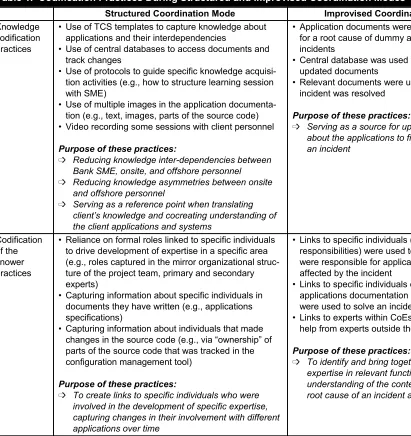
(in Figure 2), the first part of the transition relied on struc-tured coordination, while problem-solving at the later stage relied on improvised coordination. Figure C2 and Table C1 in Appendix C present evidence in support of the two coor-dination modes.
When analyzing codification, we distinguished between two
different codification practices: first, knowledge codification, which corresponds to the notion in widespread use within the literature on knowledge management reviewed earlier (e.g., Hansen 2002; Kogut and Zander 1992). And second, codifi-cation of the knower, which involves codifying links to individuals by documenting their characteristics. As evidence of various codification activities emerged from the data, we turned back to the literature to deepen our understanding of the concept of codification (in line with the principle of dialogical reasoning suggested by Klein and Myers 1999). Through the iterative cycle between literature review and data analysis we confirmed that the traditional view of codification as seen in the IS and knowledge management literature corresponds with the knowledge codification practice we observed taking place in the offshore-outsourcing project, while codification of the knower is a new category of codi-fication that emerged from the data (both are depicted as categories of the concept “codification in an onsite-offshore team” in Appendix C, Figure C1).
The analysis of our data presented a challenge in as much as we needed to relate our detailed analysis of codification and expertise coordination between different actors involved in the transition to the wider process of expertise coordination that spanned the boundaries of the two organizations. To address this challenge, we adopted the data analysis method developed by Nicolini (2009) which involves zooming in to certain practices while pushing others to the background, and
zooming out to capture links between the practices within a wider context. This allows us to simultaneously explore particular practices at a detailed level, while allowing us to “see the connection between the here-and-now of the situated practicing and the elsewhere-and-then of other practices” (Nicolini 2009, p. 1392).6
In this paper, zooming in involved studying expertise coordi-nation in the different settings7 that constitute the
offshore-outsourcing endeavor. Zooming in allowed us to examine, through the use of vignettes, how expertise is coordinated between counterparts and the role that codification played in this regard. Zooming out involved mapping the connections between coordination and codification practices by following
5Structured coordination, encompassing a range of predefined formal mechanisms, has long been the focus of coordination theory (Okhuysen and Bechky 2009). Recent work has questioned the relevance of this established theory to knowledge-intensive work in high-velocity environments, sug-gesting that new forms of coordination are required (e.g., Kanawattanachai and Yoo 2007; Majchrzak et al. 2007). However, a study by Faraj and Xiao (2006) suggests that these modes may continue to coexist within such settings. As they observe, “The empirical record shows that formal modes of coordination do not melt away in favor of more improvised ways of coor-dinating” (pp. 1156-1157).
6Nicolini described several alternative approaches for zooming in and zooming out. In our research, we followed Nicolini’s “re-presenting practice through foregrounding the active role of tools and materials” (p. 1402) for zooming in, and his “following the associations between practices” approach (p. 1408) for zooming out.
them in space and time. We developed a temporally ordered view of the expertise coordination process as it unfolded and changed over time across the client, onsite, and offshore experts (as depicted in Figure 2). Zooming out enabled us to trace how the role of codification has changed over time during expertise coordination (depicted in Figure 3).
Case Background
The outsourcing deal between ABN AMRO Bank (hereafter, the Bank) and TCS was announced in late 2005. In this €1.8bn contract, the Netherlands-based bank contracted five vendors, among them TCS, to provide support and application enhancement services for hundreds of applications. Under this contract, TCS was contracted to provide such services to the Bank’s business unit based in The Netherlands from its offshore Global Delivery Center in Mumbai. (Appendix D shows schematically the organizational structure of the project.) The project was divided into two major phases:
transition followed by steady state. The transition stage8
involved the transfer of applications from ABN AMRO to TCS and was planned to be completed in three waves9 within
three months (as depicted in Figure 1).
The focus of the transition was on learning about client systems and services. By the end of this stage, TCS was expected to develop sufficient expertise to be able to support client systems and applications in the future. Toward the end of the transition stage, TCS staff observed how Bank person-nel resolved incidents. This was followed by TCS assuming the primary support role whereby onsite and offshore experts jointly engaged in solving incidents and providing support, under the observation of the Bank experts, until they were confident that TCS employees could support applications without help from the Bank. This signaled the completion of the transition stage and a shift to a steady state, which meant that the Bank was running “business as usual” with TCS resolving all incidents (e.g., when the Bank’s systems stopped working or malfunctioned causing disruptions to the Bank’s business processes), and providing maintenance and enhance-ments for the Bank’s systems. In this paper, we focus on the transition stage.
As this offshore-outsourcing project required TCS to take over hundreds of applications from the Bank, developing the expertise required to support these applications appeared to be a critical issue to the TCS team. TCS management was chal-lenged by the extent of the gap in expertise and experience between the Bank experts and the TCS onsite-offshore project team. The transition plan was to acquire hundreds of applica-tions from the Bank within a three-month period. To be able to accomplish this task, the TCS onsite-offshore team had to demonstrate great efficiency in coordinating expertise, both when learning about the client’s systems, and later on when solving “dummy” and real incidents. In the following section, we present TCS’s approach to expertise coordination through-out the transition stage and we use vignettes to convey a rich account of what activities were carried out during these specific episodes, and the role of codification in supporting these activities.
Findings and Analysis
Given the high level of uncertainty regarding the knowledge that TCS needed to acquire from the Bank’s subject matter experts (SMEs), TCS initially adopted a structured approach to managing the knowledge interdependencies between the Bank’s SMEs and the onsite and offshore staff. During the earlier stages of the transition, expertise coordination relied to a great extent on formal and well-structured mechanisms such as roles, routines, and protocols. However, when it came to resolving dummy and real-life incidents in the later stage of the transition, onsite and offshore experts came to rely to a much greater extent on an improvised mode of coordination (Donaldson 2001; Faraj and Xiao 2006; Majchrzak et al. 2007). Before exploring expertise coordination in detail, Figure 2 figuratively represents how different settings bet-ween client, onsite, and offshore personnel are connected, thereby helping to zoom out to the temporally unfolding process of expertise coordination.
Structured Coordination Mode
All TCS employees, onsite and offshore, were familiar with its transition methodology, which was a highly codified, canonical body of knowledge that was widely applied and followed by the offshore-outsourcing project teams. This methodology defined the workflows for the process of the transition that included high-level steps, deliverables, and quality measures, as well as corresponding fine-grained routines that defined the sequence of interactions between remote parties. Specific TCS templates (e.g., TCS standard
8In the outsourcing literature, the transition stage is associated with transfer of processes to an offshore location (Srikanth and Puranam 2011).
Figure 1. Stages of the Outsourcing Project Life Cycle (Schematic)
Figure 2. The Temporal View of the Expertise Coordination and Coordination Modes
forms to capture application specifications) and protocols (e.g., for quality checks and structuring interactions with client personnel) were part of this methodology. The transi-tion methodology also established as an organizing principle that the organizational structure of the onsite-offshore team should “mirror” the client firm’s structure at both the onsite and the offshore locations (see Appendix D). In accordance with this principle, TCS mirrored the Bank’s three portfolios of applications by allocating separate subteams for each. Within this organizational structure, explicit correspondences were established between the roles of Bank, onsite, and offshore personnel.
In following the TCS methodology, however, it was clear that TCS employees were not simply seeking to replicate or copy the knowledge of the Bank’s SMEs. Only rarely did the TCS onsite and offshore experts seek to document knowledge exactly as it was communicated to them by the Bank’s SMEs.
As one onsite expert explained, “We hear what they say, but for us it is like—what does it mean?” In particular, onsite experts typically rephrased the information provided to them by the Bank SME and put it into TCS terminology, as this helped them (and other TCS staff) to understand it. Docu-menting existing knowledge involved interactions and nego-tiations between the different groups to ensure that what was being codified was also understood and agreed. As Amit, an onsite portfolio manager, put it:
These face-to-face learning sessions between onsite members and Bank SMEs were driven by the onsite members who led SMEs to focus on specific aspects of the applications that it was important to capture, based on the protocol intended for capturing relevant client knowledge. The knowledge acquired was also reorganized to suit TCS templates, which sought to capture application specifications, as well as identify and capture interdependencies and interfaces between multiple applications. TCS experts then documented the information in the relevant templates based on the fields required, such as business functionality, technical functionality, and program-ming language.
Below we present five vignettes that describe expertise coor-dination from the point of view of two counterparts, Sreekrishna (based onsite) and Shilpa (based offshore), who were involved in the transfer of several applications from the Bank to onsite and then offshore. Each vignette zooms into different settings under which expertise coordination took place: between the Bank SME and the onsite team member (vignette 1), between onsite and offshore members (vignette 2), between offshore staff and the Bank SME (vignette 3), and between offshore and onsite staff and the Bank SME (vignettes 4 and 5).
Vignette 1: Client–Onsite
Sreekrishna, a TCS onsite module leader, was responsible for acquiring the knowledge of six Bank applications. Although he had previously implemented the TCS transition methodo-logy several times, the start of the transition process put him in a difficult position. He knew little or nothing about each application while the Bank SME brought with her extensive knowledge (over 20 years experience) of the applications, as well as an understanding of their relevance to the broader con-text of business services. Sreekrishna had had six years of ex-perience in similar offshore-outsourcing projects at TCS be-fore being selected to join the TCS–ABN AMRO onsite team.
Sreekrishna began the learning process to perform his role by following the steps in the TCS transition methodology. First, he requested and received from the Bank numerous docu-ments that described the applications’ functionality and other technical aspects. Sreekrishna spent several days going over these documents. As the next step, he arranged for a face-to-face session with the Bank SME in order to get a better overview of the applications. TCS refers to these as “learning sessions”; they rely on TCS protocols. One portfolio manager stated:
One of the very important things that we’ve learned during transition is that TCS associates ask a lot of questions; they drive the ABN AMRO SMEs into
giving knowledge because the SMEs are not really aware as to where they should actually start out first. I mean, “Do I start from the technicalities, is it business, is it the risks involved, is it the users?” ....So ABN AMRO SMEs have all the applications knowledge but getting it out in the right fashion is something that is driven by TCS.
Following the face-to-face session with the Bank SME, Sreekrishna prepared summary documentation to capture what he had learned so far. He filled the TCS template forms with what he learned about his applications. There were several types of media that Sreekrishna incorporated in the documen-tation, including screenshots of application functionality, the text which was taken from the Bank’s applications documents (after they were translated from Dutch to English), and his own description of the business purpose and technical functionality of the applications.
While Sreekrishna used TCS terminology to fill the templates based on what he had learned from the Bank documentation and SME, he also drew on his own expertise based on past projects to enrich the codified applications documentation. We sought clarifications from Sreekrishna about what he learned from the Bank SME. An example follows:
S: There were many details that she [Bank SME] shared with me, but at some point I was thinking, hey, this is exactly like the system I was working on before.
Q: Why was it important for you to relate to the system you worked on before?
S: Because in that system we had an incident with new accounts. After you enter all the details of the account, a check had to be done to play safe. But we had a prob-lem with the date of birth. It was not entered so there was some logic problem. The functionality to check date of birth was not there. So later on we developed one new process which checks for date of birth and, when that cycle runs and if it doesn’t find the date of birth, we know that there is a problem with the new account.
Q: I am still not clear about this. How does this relate to ABN AMRO?
S: I put this story in the application documentation because I suspected we will have similar problems with the ABN AMRO new account application. I’ve seen this before.
However, Sreekrishna was not intending to capture all the knowledge held by the Bank SME. According to him, only “the most critical concepts of the applications” were captured. In addition to the business and technical aspects, other critical elements captured by Sreekrishna were interfaces or inter-dependencies with other applications and the future roadmaps for the applications. The summary documentation was then shared with the Bank SME to be checked and approved. Once the Bank SME approved the summary documentation, Sreekrishna uploaded it onto CASCADE, a configuration management tool that offshore experts could access. [End of vignette 1.]
Vignette 2: Onsite–Offshore
Shilpa was the offshore team member in Mumbai whose responsibility was to capture the applications knowledge from Sreekrishna. In response to the high attrition level that many IT vendors experience in India, each application was assigned both a primary and secondary expert to ensure that application knowledge was retained. Shilpa was a secondary expert for the four out of six applications that Sreekrishna was responsible for as a primary expert. Shilpa joined TCS seven months before joining the ABN AMRO project and had 3.5 years of work experience in similar offshore-outsourcing projects for another Indian IT vendor. Shilpa spent three months in Amsterdam (during wave 1 of the transition) prior to starting the transition of applications with Sreekrishna on an assignment where she transferred a different set of applica-tions from onsite to offshore acting as the TCS onsite expert. As she returned to Mumbai, the transition of four applications from Sreekrishna had started. At that point, Shilpa’s knowl-edge of the four applications was limited, but she had hands-on experience with the TCS transitihands-on methodology from working on her previous assignment in an onsite role. She had also acquired business and technical knowledge of other applications when she acted as an onsite expert. Shilpa’s interactions with her counterpart began when Sreekrishna informed her that the applications documentation was ready for her to review on CASCADE and arranged for a telephone conversation with Shilpa in order to “walk her through” the details. During this telephone conversation, Sreekrishna explained to Shilpa the business and technical functionality of the applications, using images included in the documentation.
Offshore experts, such as Shilpa, typically echoed the onsite experts’ view that the maintenance of an application does not require extracting all of the in-house knowledge from the Bank SMEs. However, as they were remote from the SMEs, their ability to assess whether they were acquiring the critical knowledge was more limited. Shilpa’s manager, who was a portfolio manager, explained:
It’s really just an act of understanding rather than transferring the tacit knowledge… because you’re going to change the maintenance and the develop-ment processes anyway.
Shilpa’s challenge was, therefore, to understand the basic functionality in order to allow her to deal with incidents and make changes in the application in the future. After the first walk-through, Shilpa was given the opportunity to further examine the documents, engage with the “live” application site (source code), see how the application reacted to inputs, and examine how the source code behaved as a result of changes in input. According to Shilpa’s portfolio manager,
Using the documents that we have got “as is” from them [ABN AMRO] is the big job that involves validating if this system really exists and how it functions. Because for applications which have not seen any incident in the past six years, there’s a big possibility nobody ever touched those documents. So we ensure that if we have to support those appli-cations, we would look into those documents and see if they are in sync with the existing system; that’s where questions and query logs will come into it.
Shilpa studied the documents that Sreekrishna had created and uploaded the revised version onto CASCADE. She made some changes based on what she had learned from the docu-mentation supplied by the Bank and from experimenting with the applications’ source code. As she was working with these multiple artefacts, Shilpa prepared a set of queries for Sreekrishna to address. The nature of the queries Shilpa posted to Sreekrishna varied from requests for additional information about the functionality of the applications to queries related to the application behavior that she observed which was not covered in the documentation. Shilpa logged these queries onto CASCADE and waited for Sreekrishna’s response. This back-and-forth of clarifying issues in the applications documentation continued until all queries had been resolved and both Sreekrishna and Shilpa were ready to progress to the next stage in the transition methodology in which Shilpa needed to demonstrate her knowledge to the Bank’s team. [End of vignette 2.]
Vignette 3: Offshore–Client
the concept of such sessions was not new as it was one of the procedures in the transition methodology. A video conference was set up between Shilpa and the Bank SME (accompanied by Sreekrishna) during which Shilpa explained to them the functionality, technical aspects, and business purpose of the applications. In doing so, Shilpa was using the application documentation she and Sreekrishna developed over the course of numerous interactions. Once the Bank SME was satisfied with the level of knowledge demonstrated by Shilpa, the transition process moved to the following stage, where Shilpa and Sreekrishna were assigned to solve the dummy incidents that were engineered by the Bank SME. [End of vignette 3.]
Improvised Coordination Mode
The applications that TCS acquired from the Bank had varying levels of stability. Applications where the Bank’s own maintenance had involved few changes or incidents were classified as stable applications, while applications that had experienced a high number of changes or incidents were considered unstable. An unstable application was actually considered to be more helpful to the transition process because, first, the application documentation that the Bank had developed was usually up to date, including records of the latest changes. Second, the Bank SMEs’ recollection of the business and technical functionality of the application was still fresh. These factors were highly relevant to expertise coordination, because having demonstrated to the Bank their ability to acquire and retain application knowledge offshore, the team now needed to demonstrate its ability to solve dummy incidents in these applications. Thus coordination was no longer about playing back the acquired knowledge, but rather demonstrating the ability to integrate the knowledge developed onsite and offshore so as to derive expert conclu-sions with regard to the source of the incident, as well as possible means of fixing it. In effect, solving these dummy incidents tested TCS’s ability to respond in a timely manner to the problems that the client would be facing in the future, during the steady state period, after transition.
In the following two vignettes, we describe how Sreekrishna and his offshore counterpart, Shilpa, dealt with incidents in both unstable (vignette 4) and stable (vignette 5) applications and the implications for expertise coordination. Both vignettes zoom into the client and onsite-offshore setting within which expertise coordination took place.
Vignette 4: Solving Dummy Incidents in Unstable Applications Using Codified Knowledge
The Bank SME started the incident phase by sending across a dummy problem. In unstable applications, a dummy
inci-dent is a problem that the team has experienced in the past. Three of the four applications that Shilpa acquired offshore were considered to be unstable. The messages about dummy incidents were not sent directly to Shilpa or Sreekrishna but rather to head of the transition stage, who needed to (1) identify which specific application(s) were affected by the incident, and (2) identify and contact the primary and secon-dary experts of the affected application(s) and notify them about the incident. In the case of an easy incident, if one of the applications that Sreekrishna and Shilpa were responsible for was affected (e.g., an application was not functioning as expected), the head of the transition stage notified Shilpa and Sreekrishna. Their names and contact details were recorded in the knowledge base portal of the project and linked to the applications documentation stored in the same portal. Shilpa and Sreekrishna initiated a problem-solving web session (using text- and voice-chat online). Both Sreekrishna and Shilpa used the updated documentation stored on CASCADE when discussing the root cause and when considering the effect on the system. As they gradually realized the scope of the incident and identified the problematic application, the application’s documentation became central to their subse-quent actions. They needed this documentation to assess which other applications might be affected by the incident, as well as to identify in the portal the primary and secondary experts for these applications and notify them. As they worked their way through the solution, understanding the implications for the system and contacting colleagues to warn them about the implications for their applications, Shilpa and Sreekrishna successfully completed the dummy incident test. [End of vignette 4.]
Vignette 5: Solving a Real Incident in a Stable Application by Bringing in Expertise
Dummy incidents provided by Bank SMEs were typically based on real incidents that the Bank SMEs faced in the past. But, as ST applications lacked such incidents, Sreekrishna’s and Shilpa’s problem-solving expertise could only be tested by solving real incidents. One example of this came when Shilpa and Sreekrishna were contacted by a pair of experts, Ravi (onsite) and Manish (offshore), who were analyzing an incident in their application (hereafter, RM application). Ravi and Manish’s efforts had identified the ST application as a possible source of the incident. Sreekrishna and Shilpa received information from Ravi and Manish about the nature of the problem and, following this, started looking for the root cause of the incident in their application. However, the docu-mentation of the ST application was somewhat limited, and examination of the source code was proving to be time-consuming and futile. As this was a real incident, there was a sense of urgency to resolve it quickly.
To resolve the problem, Sreekrishna and Shilpa decided to seek help outside the onsite-offshore team. In seeking the most appropriate person within TCS who could help, they were guided initially by the way their documenting efforts had classified the ST application’s specific technology. Using this information, Sreekrishna and Shilpa were able to use the TCS knowledge portal tool to identify and contact an expert from one of TCS Centers of Excellence10 (CoEs) that specialized in
this technology. Working together with this external expert, Shilpa and Sreekrishna (as well as Ravi and Manish) were able to resolve the incident and get the RM application working again. As a result, Shilpa and Sreekrishna enhanced their understanding of the ST application and could augment the documentation with additional characteristics of the application and its interfaces with the RM application. The incident itself and the way it was resolved (including the identification of specific individuals involved) was then documented in the knowledge portal. [End of vignette 5.]
On this occasion (vignette 5), the use of the codified artefacts, such as documentation and the source code, enabled Ravi and Manish first to find the link between the failure of their RM application and the ST application. Second, information linked to the ST application in the knowledge portal pointed Ravi and Manish to the primary and secondary experts of the ST application, so that they contacted Shilpa and Sreekrishna directly. Later on, as Shilpa and Sreekrishna could not solve the incident, they used information about the relevant tech-nology to identify the appropriate expert from the relevant CoE. This link between the ST application and the specific
technology was captured in the standard TCS template used to create specifications for these applications.
Vignettes 4 and 5 describe the typical patterns of expertise coordination as onsite and offshore members engaged in problem-solving. As we observed, onsite and offshore ex-perts responded to real incidents by initially having recourse to the application documentation they developed. Failing this, they drew on their own expertise, or, if necessary, accessed the expertise of primary and secondary experts responsible for other applications that they suspected might have been affected. As a last resort, they identified and involved appro-priate experts from the relevant CoE.
In the following section, we zoom out to the temporally unfolding process of expertise coordination (as depicted in Figure 2), aiming to understand how the codification practices we have described in the vignettes above changed over time, and how they supported expertise coordination efforts.
Zooming out to Understand the
Changing Role of Codification
As the multiple actors involved in offshore-outsourcing (client, onsite, and offshore personnel) coordinated their expertise, they engaged in various codification activities that helped them deal with knowledge boundaries and geographi-cal distance. First, in the efforts made by TCS staff to acquire and document the knowledge possessed by Bank SMEs, their codification efforts encompassed translation across knowl-edge boundaries; that is, translating the Bank’s knowlknowl-edge into a form and language meaningful within the terms of TCS expertise, and thus helping to overcome both syntactic and semantic differences between the groups involved. As we noted, the knowledge acquired from SMEs was reorganized by onsite staff into the TCS templates. Then, these templates were used by onsite and offshore counterparts who engaged in a back-and-forth interaction aiming to synchronize their knowledge and reach an agreed understanding of what was being codified.
Focusing on Sreekrishna’s interactions, first with the Bank SME and then with Shilpa, we observed how, initially, TCS’s codification efforts supported learning, thereby transforming expertise and reducing the knowledge asymmetry between Sreekrishna and the Bank SME, and then between Sree-krishna and Shilpa. This learning benefit highlights the way in which codification, by, in effect, externalizing knowledge, allows individuals to rearrange, manipulate, and examine symbols and symbolic relationships in order to transform the underlying knowledge represented in such systems (see Foray and Steinmueller 2001). As we noted, this symbolic manipu-lation also enabled individuals like Sreekrishna to draw on
their own expertise when codifying knowledge, thus making it more accessible and relevant to others. Furthermore, during these codification efforts, the TCS team captured links to experts who developed codified artefacts (e.g., source code, documentation). Later on, when solving real incidents, these documents were consulted in order to identify the person with relevant expertise.
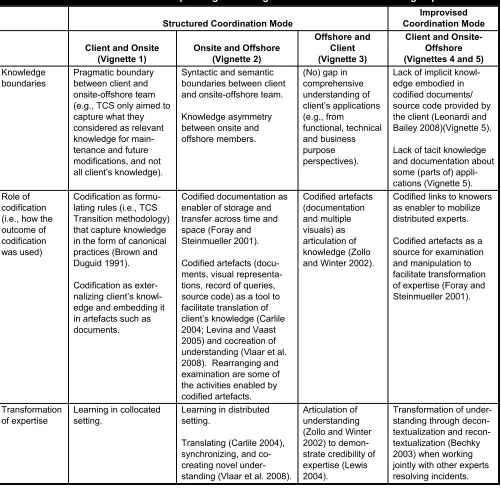
These observations based on zooming into specific settings suggest that codification efforts may play a variety of roles in supporting expertise coordination. However, when zooming out and relating these different roles to the mode of coor-dination, we find a shift in emphasis in both (1) codification practices and (2) how their outcomes are supporting coor-dinative action. As outlined in Table 1, in the structured mode of coordination, the codification of knowledge (we refer to such efforts as knowledge codification practices) supports the spread of common knowledge and hence the implemen-tation of routinized practices between onsite and offshore members. In the improvised mode, however, this body of codified knowledge is deployed more as a tool or resource to enable individual experts to address dummy and emergent problems. In a similar vein, in the structured mode, we see the establishment of codified links between applications and identified individual experts. Reflecting on our previous dis-cussion of expertise, this group represents the knowers whose expertise—localized and situated in practice—transcends the substantive content of the codified knowledge contained in these artefacts. We refer to the codification efforts that focus on codifying the characteristics of individuals as codification of the knower practices.11 In the improvised coordination
mode, we find that these practices are activated by the need to draw on more widely distributed expertise in resolving emergent or dummy incidents.
As outlined in Table 1, knowledge codification and codifica-tion of the knower emerge as complementary practices from our study. But, while knowledge codification practices were central to expertise coordination during the transition process as a whole, we found that the codification of the knower practice emerged as particularly significant to improvised coordination, when unanticipated problems (i.e., not en-compassed by existing canonical knowledge) needed to be addressed. These observed changes in the relative importance of different codification practices prompted us to carry out a further phase of data analysis, aiming to understand the dynamics between codification, knowledge boundaries, and
transforming expertise, which we discuss below and link to our theoretical contributions.
Discussion and Theoretical
Contributions
The Multiple Roles of Codification
The shifts in codification practices across coordination modes can be understood by tracing the emerging relationship bet-ween the transformation of expertise and the coordination task at hand. As evident from the vignettes associated with the structured coordination mode, the codification of knowledge was initially deployed in the service of establishing routinized actions. Individual experts were following a prescribed methodology, and were heavily reliant on codified knowledge in the form of routines, protocols, and templates for appli-cations documentation. Through the development and use of this documentation, however, TCS employees were also learning and transforming their own expertise, as they were integrating the knowledge of Bank applications with their own experience from previous assignments.
When the mode of coordination became more improvised in order to address unpredictable problems, as with the need to solve dummy and real incidents, the limits of codification as routinized action were reached (Nelson and Winter 1982), and individuals were required to apply their transformed expertise in a flexible, improvisational fashion. This enabled them, as outlined in Vignette 4, to move beyond the enactment of rou-tines, and to use the codified knowledge of such applications as a tool to solve problems. Where it was possible, the onsite-offshore team sought to solve these problems themselves. As outlined in Vignette 5, however, the more intractable prob-lems could not be resolved by this combination of codified knowledge and local expertise but required access to the wider expertise of the TCS organization as a whole. At this point, the practice of codification of the knower becomes important as the identity of relevant individuals emerges as critical to accessing relevant expertise.
This relationship between the transformation and distribution of expertise (i.e., between client, onsite, offshore, and the wider TCS organization) on one hand, and the role of codifi-cation on the other is summarized in Table 2. It is important to note, however, that this table cannot capture the dynamic nature of the interplay between expertise and codification ob-served in our study. As we have outlined, codification efforts supported learning by individuals, and thereby enhanced the expertise of teams and the wider TCS organization. This expertise was, in turn, represented in the codified knowledge,
Table 1. Codification Practices During Structured and Improvised Coordination Modes
Structured Coordination Mode Improvised Coordination Mode
Knowledge codification practices
• Use of TCS templates to capture knowledge about applications and their interdependencies
• Use of central databases to access documents and track changes
• Use of protocols to guide specific knowledge acquisi-tion activities (e.g., how to structure learning session with SME)
• Use of multiple images in the application documenta-tion (e.g., text, images, parts of the source code) • Video recording some sessions with client personnel
Purpose of these practices:
, Reducing knowledge inter-dependencies between
Bank SME, onsite, and offshore personnel
, Reducing knowledge asymmetries between onsite
and offshore personnel
, Serving as a reference point when translating
client’s knowledge and cocreating understanding of the client applications and systems
• Application documents were consulted to look for a root cause of dummy and real-life incidents
• Central database was used to access most updated documents
• Relevant documents were updated after an incident was resolved
Purpose of these practices:
, Serving as a source for updated information
about the applications to find a root cause of an incident
Codification of the knower practices
• Reliance on formal roles linked to specific individuals to drive development of expertise in a specific area (e.g., roles captured in the mirror organizational struc-ture of the project team, primary and secondary experts)
• Capturing information about specific individuals in documents they have written (e.g., applications specifications)
• Capturing information about individuals that made changes in the source code (e.g., via “ownership” of parts of the source code that was tracked in the configuration management tool)
Purpose of these practices:
, To create links to specific individuals who were
involved in the development of specific expertise, capturing changes in their involvement with different applications over time
• Links to specific individuals (roles and responsibilities) were used to find those who were responsible for applications that were affected by the incident
• Links to specific individuals captured within applications documentation and source code were used to solve an incident
• Links to experts within CoEs were used to get help from experts outside the project team
Purpose of these practices:
, To identify and bring together individuals with
expertise in relevant functional domains and understanding of the context to jointly find a root cause of an incident and resolve it
which TCS experts developed to support the transition pro-cess by incorporating links to individuals in the development of documentation (as shown in Table 1). It was made more visible and representable by being acquired through a codified methodology, and by being applied within an explicit struc-ture of roles and responsibilities, which mirrored the client organization. These cumulative developments thus enabled teams to relate the problems they were experiencing to the expertise developed by specified individuals at an unusually fine-grained level of detail.
As shown in Table 2, our analysis suggests that codification plays multiple roles in expertise coordination; that is, the
Table 2. The Role of Codification in Spanning Knowledge Boundaries and Coordinating Expertise
Structured Coordination Mode
Improvised Coordination Mode
Client and Onsite (Vignette 1)
Onsite and Offshore (Vignette 2)
Offshore and Client (Vignette 3)
Client and Onsite-Offshore (Vignettes 4 and 5)
Knowledge boundaries
Pragmatic boundary between client and onsite-offshore team (e.g., TCS only aimed to capture what they considered as relevant knowledge for main-tenance and future modifications, and not all client’s knowledge).
Syntactic and semantic boundaries between client and onsite-offshore team. Knowledge asymmetry between onsite and offshore members.
(No) gap in comprehensive understanding of client’s applications (e.g., from functional, technical and business purpose perspectives).
Lack of implicit knowl-edge embodied in codified documents/ source code provided by the client (Leonardi and Bailey 2008)(Vignette 5). Lack of tacit knowledge and documentation about some (parts of) appli-cations (Vignette 5). Role of
codification (i.e., how the outcome of codification was used)
Codification as formu-lating rules (i.e., TCS Transition methodology) that capture knowledge in the form of canonical practices (Brown and Duguid 1991). Codification as exter-nalizing client’s knowl-edge and embedding it in artefacts such as documents.
Codified documentation as enabler of storage and transfer across time and space (Foray and Steinmueller 2001). Codified artefacts (docu-ments, visual representa-tions, record of queries, source code) as a tool to facilitate translation of client’s knowledge (Carlile 2004; Levina and Vaast 2005) and cocreation of understanding (Vlaar et al. 2008). Rearranging and examination are some of the activities enabled by codified artefacts. Codified artefacts (documentation and multiple visuals) as articulation of knowledge (Zollo and Winter 2002).
Codified links to knowers as enabler to mobilize distributed experts. Codified artefacts as a source for examination and manipulation to facilitate transformation of expertise (Foray and Steinmueller 2001).
Transformation of expertise
Learning in collocated setting.
Learning in distributed setting.
Translating (Carlile 2004), synchronizing, and co-creating novel under-standing (Vlaar et al. 2008).
Articulation of understanding (Zollo and Winter 2002) to demon-strate credibility of expertise (Lewis 2004).
Transformation of under-standing through decon-textualization and recon-textualization (Bechky 2003) when working jointly with other experts resolving incidents.
TCS experts encountered the limitations of codified knowl-edge for various reasons (e.g., lack of implicit knowlknowl-edge embodied in codified documents/source code received from the client (Leonardi and Bailey 2008), and lack of tacit knowledge and documentation about some stable applica-tions), it became imperative to quickly find relevant experts or knowers. Faraj and Sproull (2000) term this aspect of expertise coordination “knowing expertise location.”
environ-ment, such as offshore-outsourcing, codification practices enable teams of dispersed experts to learn and transform their expertise over a short period of time, between the start and completion of the transition. As presented in Table 2, the coordinative role of codification evolved during the transition, from a guiding role through canonical practices, to enabling remote collaboration, facilitating translation of the client’s knowledge through written and visual representations, and, finally, to enabling the mobilization of dispersed expertise through links to experts. Figure 312 depicts (schematically)
how these multiple roles of codification rely on and reinforce each other over time in the efforts to coordinate distributed expertise.
Here, our attention to the practices of codification, and not simply their observable outcomes, help to show their multiple and dynamic effects on expertise coordination. Thus, while the different roles of codification have been acknowledged in past research (we refer to specific roles and the major sources that have highlighted these roles in Table 2), such studies have shed little light on the dynamic nature of codification as expertise evolves. Our research extends the previously com-mon view of codification as a static concept by decom-monstrating the multiple, coexisting, and complementary roles that codifi-cation may play, as well as the changes in the relative impor-tance of various codification roles when coordinating distributed expertise.
The multiple codification roles supporting expertise coordina-tion took place through two codificacoordina-tion practices, knowledge codification and codification of the knower (depicted in Table 1). The distinction between these two complementary practices is the core of our second theoretical contribution, as discussed below.
From Codification of Knowledge to
Codification of the Knower
This contribution involves reconceptualizing the commonly accepted view of codification as facilitating replication and diffusion of knowledge (Nonaka 1994; Winter 1987; Zander and Kogut 1995). While past research considered knowledge to be the main focus of codification efforts, the role of the codification of the knowerrepresents a novel contribution to the literature on codification, and expertise coordination.
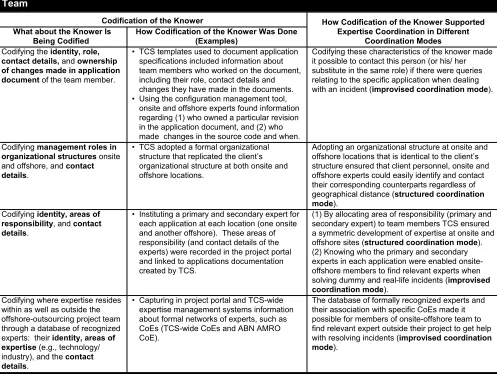
In our analysis, codification of the knower emerged as an important mechanism for the coordination of expertise as it provided links to knowledgeable individuals (experts) in situations when tacit and personalized expertise was required. This refers to the standardized representation of expertise that enables it to be identified and accessed remotely by a range of organization members. In practical terms, it involved devel-oping representations for the following features that were associated with specific individuals in the onsite-offshore team and wider organization: identity, area of responsibility, role within the organizational structure of the project team, area of expertise for individuals recognized as formal experts in specific area, and a contact link to the expert for ready communication. In Table 3, we summarize what was codified about the knower (i.e., the combination of which charac-teristics), and how it was codified (e.g., in what type of arte-fact or by which organizational mechanism). Furthermore, this table illustrates how this information about the knower enables expertise coordination processes.
At one level, the codification of the knower highlighted above may not be viewed as qualitatively different from the codifi-cation of knowledge, in as much as it produces lists of objects with defined attributes. However, these practices can be dis-tinguished if we focus not on the way knowledge is being embedded in an artefact, but rather on how it is to be used. Codification of the knower in this sense does not provide a guide for action, or a tool to be immediately applied to solving a problem. It identifies a person with expertise relevant to that problem.
The importance of making this distinction is amply underlined by the problems organizations have experienced in seeking to develop more elaborate directories in which the generalized expertise of individuals is represented (Alavi and Tiwana 2002). For example, experts may seek to stage-manage the information that is given about them to achieve personal goals (Leonardi and Treem 2012). Equally, as a study of a compe-tence directory at Volvo found, attempts to impose stan-dardized competence definitions may be found wanting for being too generic, and based on past experience or qualifi-cations rather than current performance. As one manager at Volvo observed,
If I search for competence, the system should sup-port me in identifying the appropriate person. Such features are missing in the system. Instead, I have to talk to someone who is familiar with the employees (Lindgren et al. 2004, p. 450).
What these experiences show is the difficulty of codifying expertise in a meaningful way when its embodied and dynamic