Aggregation of model asphaltenes – a
1
Molecular Dynamics study
2
J L L F S Costa1§, D Simionesie2, Z J Zhang2* and P A Mulheran1*
3
1Department of Chemical and Process Engineering, University of Strathclyde, James Weir Building,
4
75 Montrose Street, Glasgow G1 1XJ, UK
5
2 School of Chemical Engineering, University of Birmingham, Edgbaston, Birmingham, B15 2TT, UK
6
§ Curso de Engenharia Química, Universidade Federal de Alagoas, Campus A.C. Simões, Maceió - AL
7
57072-900, Brazil
8
Emails: [email protected] and [email protected]
9
Abstract
10
11
Natural asphaltenes are defined as polyaromatic compounds whose chemical composition and
12
structure is dependent on its geological origin and production history, hence are regarded as complex
13
molecules with aromatic cores and aliphatic tails that occur in the heaviest fraction of crude oil. The
14
aggregation of asphaltenes presents a range of technical challenges to the production and processing of
15
oil. In this work we study the behaviour of the model asphaltene-like molecule
hexa-tert-butylhexa-16
peri-hexabenzocoronene (HTBHBC) using molecular dynamics simulation. It was found that the
17
regular arrangement of the tert-butyl side chains prevents the formation of strongly-bound dimers by
18
severely restricting the configurational space of the aggregation pathway. In contrast, a modified
19
molecule with only 3 side chains is readily able to form dimers. This work therefore confirms the
20
influence of the molecular structure of polyaromatic compounds on their aggregation mechanism, and
21
reveals the unexpected design rules required for model systems that can mimic the behavior of
22
asphaltenes.
23
Keywords: asphaltenes, polyaromatic, aggregation, GROMACS
24
25
1. Introduction
26
Crude oil is generally categorised into four different groups based on their solubility: saturates,
27
aromatics, resins and asphaltenes (SARA) (Burya et al., 2001). Asphaltenes are referred as a class of
28
complex polyaromatic compounds without a defined chemical structure and composition, that are
29
soluble in aromatic solvents, such as toluene, whilst insoluble in n-alkanes, such as n-heptane and
30
pentane (Wang et al., 2012). Asphaltenes, consisting of multiple aromatic rings and various
31
proportions of aliphatic chains, comprise the heaviest fraction of crude oil (Mullins et al., 2007).
32
Due to their tendency to form aggregates upon changes in temperature, pressure, solvent quality,
33
and chemical structure, asphaltenes contribute significantly to technical challenges that plague the oil
34
and gas industry. For example, the aggregation of asphaltenes often results in wellbore clogging and
35
fouling of pipelines (Sheu and Mullins, 2013); and coke formation in crude oil has been identified as
36
the consequence of asphaltenes aggregation in the pyrolysis process of petroleum thermal degradation
1
(García Barneto et al., 2015). Additionally, studies confirmed that asphaltenes play a significant role in
2
stabilizing water-in-oil emulsion where natural asphaltene molecules form a densely packed layer at
3
the liquid interface to prevent coalescence of water droplets (Kokal, 2007, McLean and Kilpatrick,
4
1997, Sedghi et al., 2013). Concerns related to asphaltenes are particularly important in the locations
5
where Enhanced Oil Recovery strategies (EOR) are required (Alvarez et al., 2009, Hu et al., 2016).
6
The chemical structure and composition of asphaltenes vary with the origin of crude oil as well as
7
the method used for extraction. It is recognised that these compounds have an average molecular
8
weight between 500 and 750 Da, with aromatic cores of 4 to 10 aromatic rings, and aliphatic tails
9
ranging from 3 to 7 carbons. The aromaticity factor (fa)of asphaltenes, which is the ratio of the number
10
of aromatic carbons to the total number of carbons in the molecule, is usually in the range 0.35 to 0.65.
11
In typical asphaltene molecules, in addition to hydrogen and carbon atoms (H/C atomic ratios from 1.0
12
to 1.2), there are heteroatoms such as N, O, S, and traces of metals like nickel and vanadium (Spiecker
13
et al., 2003, Sheremata et al., 2004). As such, they are a complex and ill-defined group of different
14
compounds with no known rules to interpret their behaviour. Therefore, it is highly desired to acquire
15
a thorough understanding of the complex behaviour of asphaltenes in order to address the
16
aforementioned challenges.
17
Experimental results confirmed that there are various heteroatoms contained in natural asphaltenes
18
(Spiecker et al., 2003, Sheremata et al., 2004). In the Yen model, because of their critical aggregation
19
concentration, asphaltenes are compared to surfactants that have critical micelle concentration (Dickie
20
and Yen, 1967). However, the driving forces of the asphaltenes aggregation are still not well
21
understood (Subirana and Sheu, 1995). Van der Waals interactions are believed to be one of the key
22
factors that explain the stacking of the polyaromatic units. However, it is recognised that the π
-23
electron binding competes with the steric repulsion caused by the alkane chains, which can increase
24
solubility to a considerable extent (Teklebrhan et al., 2012). Polar interactions may also play an
25
important role, depending on the polarizability of the molecular structure. This effect can be evaluated
26
when comparing the increased solubility in very polar solvents such as acetone (Mullins et al., 2007).
27
On the other hand, variables such as pressure, temperature, and composition of the environment
28
around the asphaltene molecules cannot be neglected, adding even more complexity to the topic
29
(Diallo et al., 2000).
30
Despite the range of experimental methodologies that have been employed (Mullins et al., 2007, H.
31
Ali et al., 1990, Spiecker et al., 2003, Sheu and Mullins, 2013), there remains a significant knowledge
32
gap in understanding precisely the parameters that determine the aggregation mechanism of natural
33
asphaltenes (Mullins et al., 2007). Molecular simulations have a pronounced impact in the petroleum
34
industry, owing to the fact that the computational approach can provide a route from the microscopic
35
properties of a model molecule (atomic composition, molecular geometry, intermolecular interactions,
36
and so on) to macroscopic outcomes that can be compared with real experiments (Allen and Tildesley,
1
1989). In other words, one can simulate the influence of each variable involved in the system of
2
interest (e.g. number of aromatic rings within a polyaromatic core) in similar conditions to those of
3
practical interest.
4
Of the available atomistic modelling approaches, molecular dynamics (MD) simulation has shown
5
great potential to predict the molecular aggregation mechanisms of asphaltenes. Boek et al. used a
6
quantitative molecular representation (QMR) algorithm to generate a range of molecular
7
representations, which showed that the consistency between MD simulation and experimental data
8
when the island model was implemented (Boek et al., 2009). Moreover, the behaviour of model
9
asphaltenes in toluene or heptane is being widely studied, with the conclusion to date that heptane
10
permits stronger interactions between the model molecules, although both solvents frequently exhibit
11
similar trends (Kuznicki et al., 2008, Headen et al., 2009). In these studies, Potential of Mean Force
12
(PMF) of association have confirmed the role of van der Waals interactions as a key property for the
13
aggregation of asphaltene-like molecules (Sedghi et al., 2013).
14
In an attempt to isolate the various chemical components of asphaltenes and to create a link
15
between molecular structure and observable behaviour, chemical compounds have been synthesized to
16
replicate the asphaltene molecules behaviour for both experimental and computational methodologies.
17
The synthetic polyaromatic molecules, with well characterized chemical structure, will enable us to
18
identify the driving force for molecular aggregation. Synthetic compounds, with a controlled range of
19
molecular structures, shapes, and sizes, have been used in both simulation and experimental studies to
20
develop better understanding of the behaviour of natural asphaltenes. The polyaromatic compound
21
examined in this study, hexa-tert-butylhexa-peri-hexabenzocoronene (HTBHBC), was selected due to
22
the aromatic core that could potentially promote π-π stacking interaction between the molecules
23
(Breure et al., 2013). HTBHBC and its derivatives have been studied extensively for their applications
24
in organic photovoltaics research, as they form self-organized columnar structures (liquid crystals) due
25
to π-π stacking (Schmidt-Mende et al., 2001). Hexabenzocoronene (HBC) molecules with tert-butyl
26
functional groups, prefer a monomeric state when suspended in organic solvents (tetrachloroethane-d2
27
and dichloromethane-d2), while its derivatives (with long aliphatic tail-groups) will aggregate (Kastler
28
et al., 2005). In other computer simulation studies, HBC derivatives are found to not only aggregate,
29
but self-organize into columnar structures, however the nature of the solvent is rarely taken into
30
consideration and more attention is given to HTC derivatives with aliphatic tails (Andrienko et al.,
31
2006).
32
Constructing model molecules to represent natural asphaltenes, a number of studies focus on
33
measuring the hydrodynamic radii of clusters suspended in a toluene/heptane mixture that appear to
34
have recorded the aggregation of HTBHBC with dynamic light scattering (Breure et al., 2013).
35
Heptane is known to force aggregation and precipitation within asphaltene/toluene suspensions, and
1
will be used in this study. Such computational approach will also provide generic guideline for
2
experimental work that is focused on how structural variations influence the aggregation mechanism
3
of HTBHBC.
4
In order to explore the possibility of using synthesized molecules to model asphaltene aggregation,
5
a molecule with aromatic cores and short side-groups was chosen to explore one of the driving
6
mechanisms of asphaltene aggregation. Here, the molecular model for HTBHBC is constructed,
7
suspended in n-heptane, and used in MD simulations. The extent of the aggregation, and the pathways
8
that lead to aggregation, are explored. In particular, we study the behaviour of contrasting molecules to
9
reveal the role that molecular structure plays in the aggregation process.
10
2. Methods
11
2.1. MD Simulations
12
MD simulations were performed with the GROMACS v4.6.5 simulation package that has been
13
widely used to examine biological systems, such as lipids and proteins in aqueous environments (D.
14
van der Spoel, 2013). The Optimised Potential for Liquid Simulation / All Atoms (OPLS/AA) force
15
field was employed due to its precision in the representation of aromatic compound properties, such as
16
enthalpy of vaporization and density (Jorgensen et al., 1996). The same force field had been used in
17
previous work where asphaltene molecules were examined (Boek et al., 2009, Headen et al., 2009,
18
Sedghi et al., 2013).
19
Different simulation strategies were used to analyse the ability of the synthetic molecules to mimic
20
the behaviour of real asphaltenes: (1) The HTBHBC molecules were explicitly solvated in heptane at a
21
7% weight concentration to verify any natural tendency to form aggregates (see section 2.2); (2)
22
Pulling simulations were performed to generate the PMF profiles for asphaltene dimers through the
23
umbrella sampling technique (see section 2.3); (3) Unconstrained simulations were executed using
24
some of the initial configurations of the PMF windows to study in detail the stability of the molecular
25
dimers (section 2.4).
26
The force field parameters used in these simulations were validated through preliminary MD
27
simulations for an organic solvent (toluene) at average pressure and temperature conditions. The
28
standard methodology (Caleman et al., 2012) adopted to calculate the enthalpy of vaporization and
29
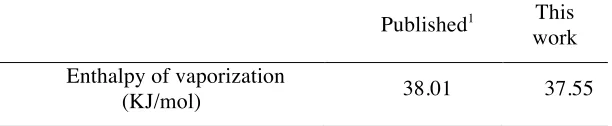
[image:4.595.160.466.714.777.2]density agrees well with experimental data, as shown in table 1.
30
Table 1. Toluene properties from this work and published data.
Published1 This work
Enthalpy of vaporization
(KJ/mol) 38.01 37.55
Liquid density (kg/m3) 864 866
1(PubChem Compound Database; CID=1140, 2015)
1
A 3-D model of the HTBHBC compound was designed for use in MD simulations. Furthermore, in
2
order to examine how tert-butyl groups influence the aggregation process of HTBHBC, half of the
3
tails was removed to construct a mHTBHBC compound. The effect the missing tails would have on
4
the aggregation will underpin the driving forces, and hence provide insight to interpret experimental
5
study (Simionesie et al.). Detailed features of the HTBHBC model and its modification are shown in
6
table 2 and all relevant information concerning asphaltenes and solvent molecules used are included in
7
the Supplementary Materials. While the aromaticity factor of mHTBHBC is rather high to be
8
considered as a model asphaltene, it does serve to illustrate the role of the side groups as discussed
9
below. In a previous study (Breure et al., 2013), HTBHBC molecules were suspended in toluene, with
10
different amount of heptane introduced. By monitoring the effect the heptane has on the HTBHBC and
11
the mHTBHBC, a more direct link between the synthetic, model asphaltenes and the natural ones may
12
be drawn.
13
Table 2. Characteristics of the polyaromatic compounds used in the present work.
Model No. aromatic carbons
No. aliphatic
tails Mw (g/mol)
Aromaticity factor (fa)
H/C
HTBHBC 42 6 859.2 0.64 1
mHTBHBC 42 3 690.9 0.78 0.78
14
Figure 1. Molecular structure of (a) HTBHBC and (b), mHTBHBC.
15
16
The first stage in the construction of the models consists of obtaining the chemical structure, then
17
generating 3-D coordinates for the atoms, and lastly setting up the parameters required by the force
18
field (bond lengths and angles, etc.). The Accelrys Draw package was employed to connect the atoms
19
to their correct positions (Accelrys, 2007). These were then translated to three-dimensional models
20
according to the force field parameterization. The MKTOP application was used to generate the
21
appropriate OPLS topologies for the HTBHBC, mHTBHBC and heptane molecules, with the
1
exception of the partial charges (Ribeiro et al., 2008). These were manually inserted following the
2
strategy adopted elsewhere (Hibi et al.) that requires the constructor to assign the charge of individual
3
atoms by linking them to the OPLS/AA library to ensure that the total charge of the molecule is still
4
neutral.
5
2.2. Asphaltene aggregation
6
The aggregation process of the HTBHBC molecules in heptane was studied through standard MD
7
simulations. A 7.0 nm cubic box was initially employed to accommodate 6 HTBHBC molecules
8
surrounded by heptane molecules, replicating a 7% weight concentration. Energy minimization was
9
then performed to ensure a stable initial configuration. Short equilibration step (100 ps) was performed
10
to prepare the simulation for the production trajectory. The velocity-rescaling thermostat was used for
11
the NVT simulations, and the Berendsen algorithm was adopted to relax the systems to 298 K and 1
12
atm pressure. Once steady fluctuations reached the average volume, 100 ns simulations were
13
performed with an integration time step of 2fs. The Nose-Hoover thermostat was used alongside with
14
the Parrinello-Rahman barostat to couple both asphaltene and solvent molecules.
15
Particle-Mesh Ewald (PME) algorithm was used to compute the long range electrostatic
16
interactions (Darden et al., 1993). A cut-off of 1.0 nm was used for van der Waals interactions and
17
periodic boundary conditions were also applied to the systems. Radial distribution functions (RDF)
18
were used to analyse the occurrence of aggregation events in this case. Both .pdb and .itp files for the
19
asphaltenes and solvent models are provided in the Supplementary Material, as well as the .mdp files
20
containing information about the parameters used.
21
2.3. Umbrella Sampling
22
Estimation of the dimerization free energies for the synthetic asphaltenes was obtained from the
23
potential of mean force profile. Two HTBHBC molecules were simulated in explicit solvent through
24
the umbrella sampling technique. The pull code implemented within the GROMACS simulation
25
package was applied for this purpose, pulling the Centre-of-Mass (COM) of one of the HTBHBC
26
molecules while the COM of the other one was restrained at a fixed position. A 1.0 nm/ns pulling rate
27
was used and the distance between each subsequent umbrella window was approximately 0.25 nm.
28
Each window was simulated for 10-20 ns to enable the dimers to explore different configurations. The
29
g_wham tool was used to generate the energy profiles and the Bayesian bootstrap algorithm was
30
chosen to compute the histograms (Hub et al., 2010).
31
2.4. Unconstrained simulations
32
Unconstrained simulation was performed to examine the behaviour of the HTBHBC molecules and
33
their propensity to aggregation. The windows adopted from the pulling simulation were used as
34
different starting configurations for standard MD simulations. This work will verify how the initial
1
distances between the aromatic cores would affect their subsequent behaviour in unconstrained
2
simulations. These unconstrained simulations lasted for 2 ns, since this proved adequate to reveal the
3
behaviour. The same simulation parameters from the standard MD simulations were adopted for this
4
case. Afterwards, radial distribution functions were generated for all these simulations in order to
5
verify whether the two molecules would keep their initial distance or change to a different
6
configuration.
7
2.5. Analysis tools
8
Visual Molecular Dynamics (VMD) software (Humphrey et al., 1996) was used to investigate the
9
characteristics of the molecular models during the simulations. Further information, such as RDF and
10
PMF profiles, were generated by GROMACS built-in analysis tools.
11
3. Results and discussion
12
Different simulation strategies were used to observe how the HTBHBC model would behave in an
13
organic solvent. The strength of the interaction between the synthetic molecules is similar to that of
14
other models, reported in the literature. However, in this particular case, the repulsion of the tails is
15
very pronounced and affects considerably the propensity to aggregation. Details obtained from each
16
simulation are described below.
17
3.1. Asphaltene Aggregation
18
To examine the aggregation mechanisms, MD simulations were performed for both HTBHBC and
19
mHTBHBC in heptane. The HTBHBC asphaltene simulation showed signs of weak aggregation as the
20
simulation proceeds, as illustrated in Figure 2. A video of this trajectory is provided in the
21
Supplementary Materials. The RDFs presented in figure 3 show that no signs of aggregation events
22
were observed throughout the first 20 ns of the simulation. Nonetheless, as the simulations progressed
23
it could be seen that HTBHBC molecules have a preferred COM separation of 0.8 nm. However, this
24
does not represent the strong dimer formation we might have anticipated, since it is apparent in Figure
25
2 that the molecules are interspersed with solvent molecules and hence are not strongly bound by the
26
van der Waals interactions between the aromatic cores. During the simulation, the HTBHBC
27
molecules are free to diffuse and often approach one another to form loosely bound aggregates that
28
subsequently break apart. Such process has been observed for multiple times during the trajectory, as
29
shown in the video provided in the Supplementary Material. We hypothesise that the lack of strong
30
dimerization in this system is attributed to the steric repulsion, caused by the symmetric distribution of
31
the tert-butyl chains illustrated in Figure 1, which severely restricts the path by which two identical
32
molecules can form a unit structure, without the loss of atoms, by non-covalent interactions.
33
Figure 2. Standard MD Simulation of HTBHBC in heptane. The simulations lasted for a) 20, b) 50 and c) 100 nanoseconds respectively. Solvent molecules are represented in green (left) and are then removed for clarity (right).
1
Figure 3. Radial distribution functions at 20, 50, 100 ns for the original HTBHBC system (red, blue and green curves) and the mHTBHBC system at 20 ns (black curve).
2
To investigate the influence of this chemical structure, more specifically the number and
3
configuration of the tert-butyl side groups, on the aggregation of HTBHBC, the modified chemical
4
structure was designed as described above. In the modified molecule mHTBHBC, only three tert-butyl
5
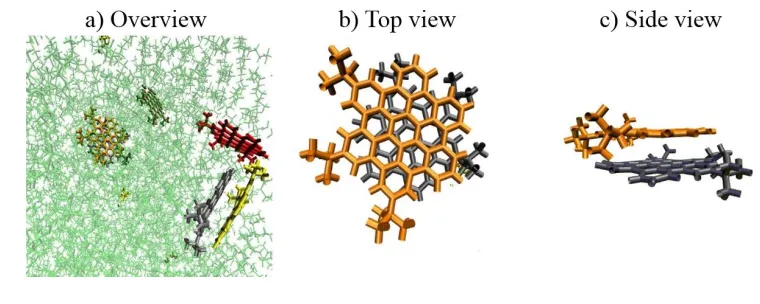
groups are present on one side of the aromatic core as illustrated in Figure 1. As shown in Figure 4,
6
[image:8.595.195.444.512.690.2]after 20 ns of simulation we already observe a significant difference in their aggregation
1
characteristics, suggesting that the mHTBHBC show behaviour expected from real asphaltenes where
2
the longer side chains have more flexibility than the butyl chains used here. A movie for this trajectory
3
(mHTBmv.mp4) is also provided in the Supplementary Materials, and shows the very strong tendency
4
for stacking with this modified molecule. As well as the stacking of the aromatic cores into dimers
5
with no solvent interspersing the molecules, we observe T-shaped aggregations as previously reported
6
for similar systems (Headen et al., 2009). T-stacking or T-shape aggregation occurs when a dimer has
7
a metastable (or even stable) configuration where the cores are perpendicular to each other rather than
8
parallel as with π stacking. The RDFs of Figure 3 show the strong preference for the mHTBHBC
9
dimer formation, with a marked peak at the separation 0.45 nm between the molecular cores.
10
Figure 4. Details of mHTBHBC simulation after 20 ns. a) Overall details of the simulation box, illustrating the formation of dimers and T-shaped interactions. The dimer formation is displayed in (b) and (c), highlighting the opposition of the tert-butyl side chains.
11
3.2. Umbrella Sampling Simulations
12
The absence of the dimer formation with tightly bound aromatic cores in the original HTBHBC
13
system suggests that the tert-butyl side chains provide significant repulsion between the molecules.
14
However, for a simulation starting with pre-formed HTBHBC dimers with an inter-core separation of
15
0.45 nm, similar to those found in the modified molecular system, it was observed observe that these
16
dimers are in a stable state, with the side chains inter-digitated to minimise the steric repulsion. It is
17
therefore unclear why such strongly-bound species do not form spontaneously during an unconstrained
18
simulation.
19
To probe this further, we performed pulling simulations as described above to create the Potential
20
of Mean Force (PMF) between HTBHBC molecules, starting from the tightly-bound dimer and pulling
21
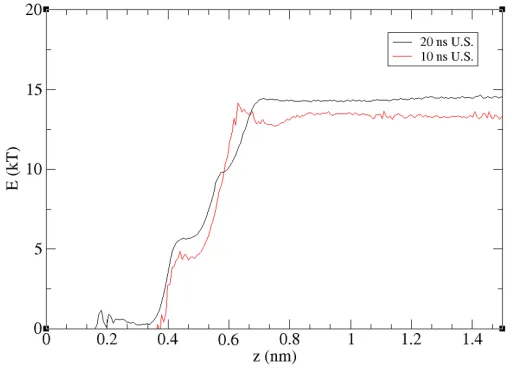
the COMs apart. In Figure 5, results from the calculations, using 10 ns and 20 ns duration trajectories
22
are presented in each window to examine the degree of convergence and hence uncertainty on these
23
curves. From the PMF profile, it is clear that the dimer formation is strongly favoured energetically
24
(by ~14 kT). However, it was also noted that the inter-molecule separation needs to be less than ~0.7
25
nm for the dimer to form. In the HTBHBC unconstrained simulation, we did not observe such a close
26
[image:9.595.113.493.327.479.2]approach, as confirmed by the RDFs of Figure 3. For separation beyond ~0.7 nm the PMF profile has
1
a plateau, suggesting the molecules are free to diffuse. This suggests that the diffusive motion is
2
unlikely by chance alone to allow freely-moving molecules to find the pathway that leads to the strong
3
dimerization. We explore this explanation further in the next section.
4
Figure 5 Free energy of HTBHBC molecules in heptane with 10ns (red) and 20ns (black) of simulation time in each window.
5
3.3. Unconstrained Simulations
6
We perform further, unconstrained simulations of the HTBHBC dimer starting with configurations
7
taken from the various umbrella sampling simulations. In this way, we probe the behaviour of the
8
molecules starting from different initial COM separations. We observed that for distances below 0.75
9
nm between the HTBHBC cores, there was a very pronounced propensity to return to the dimer
10
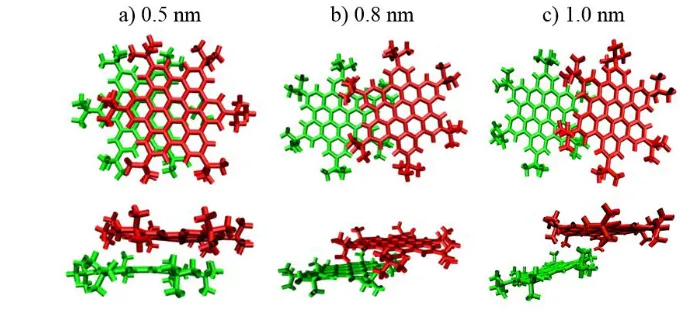
conformation with 0.45 nm COM separation, as illustrated in Figure 6(a). However, for distances
11
beyond ~0.8 nm, the molecules diffused apart and did not form the dimer. At this separation,
12
illustrated in Figure 6(b), there is enough exposed HTBHBC core surface to permit a solvent molecule
13
to ‘wet’ the cores. This seems to be an important driver for the molecules to be unable to reconnect as
14
a dimer, since it requires cooperative motion of the solvent molecules. The side-chain configuration of
15
the HTBHBC also provide very limited scope for the relative orientations of the molecules if they are
16
to successfully form the strongly-bound dimer. The pulling simulation shows that the pathway requires
17
careful packing of the tert-butyl side chains along the pathway of Figure 6(a)-6(c). Together with the
18
solvent wetting effect, this makes the formation of the dimer a rare event unlikely to be spontaneously
19
observed in unconstrained simulations.
20
[image:10.595.189.445.208.392.2]Figure 6. Top and side view of key positions according to the umbrella potentials: a) Stable dimers formed at 0.5 nm COM separations; b) At 0.8 nm the steric effects start to prevent dimer formation; c) At 1.0 nm the interaction between the polyaromatic cores is no longer relevant.
1
2
4. Summary and Conclusion
3
In the present work, several MD simulation approaches were employed to investigate the molecular
4
interactions between HTBHBC polyaromatic compounds, designed to mimic natural asphaltenes, in
5
heptane. We summarise the behaviour of the HTBHBC simulations as follows:
6
i. In the simulated time window, the unconstrained trajectories show that the HTBHBC do not
7
spontaneously form strongly bound dimers;
8
ii. Trajectories starting with dimers show they are stable, and the potential of mean force curves
9
generated from pulling simulations confirms the stability;
10
iii. However the free energy profile plateaus at longer separations, so there is no long-range
11
driving force for dimer formation;
12
iv. Consequently, dimer formation appears to be kinetically limited, with the HTBHBC
13
molecules required to diffuse together in a very particular relative orientation before dimer
14
formation can proceed;
15
v. Such rare events are difficult to probe – longer, larger unconstrained simulations could be
16
performed, but it is difficult to know how much computational power would be required to
17
have a reasonable chance of seeing such a kinetically limited event.
18
Even though it seems counterintuitive that the π-π stacking interaction and van der Waals forces
19
between aromatic rings did not result in significant aggregation, we ultimately attribute this to the
20
steric repulsion between tert-butyl functional groups surrounding the aromatic core. Such a result is in
21
general agreement with the parallel experimental measurements underway in our laboratories in which
22
the aggregation of HTBHBC molecules is monitored by dynamic light scattering (DLS) as a function
23
of concentration and solvent quality (Simionesie et al.).
24
Comparison of the aggregation results between HTBHBC and mHTBHBC molecule further
1
confirm the rationale that tert-butyl groups influence significantly the aggregation mechanism of this
2
specific polyaromatic compound. With only 3 tert-butyl groups along one side of the molecule, they
3
stack much more readily, showing the kinetic constraints on how the molecules must approach one
4
another to form dimers are greatly reduced.
5
This underpinning knowledge offers a strong foundation to develop more polyaromatic compounds
6
that could effectively be used to understand the behaviour of natural asphaltenes. Furthermore, we
7
have shown how a combination of traditional, PMF and unconstrained simulations that start from the
8
umbrella windows provide a useful methodology to probe the interaction between the molecules.
9
Supplementary Materials
10
Supplementary materials used in the present work are also available at DOI:
10.15129/bbd7ee68-11
2b55-4c75-8c9c-0db2154371b2
12
Acknowledgement
13
Brazilian government, with special reference to the National Council for Scientific and Technological
14
Development (CNPq), is thanked for the support to JLLFSC through the ‘Science without Borders’
15
exchange programme. DS thanks University of Strathclyde and University of Birmingham for
16
scholarship.
17
References
18
ACCELRYS 2007. Accelrys draw 4.2 - academic version. San Diego: Accelrys Software
19
ALLEN, M. P. & TILDESLEY, D. J. 1989.
Computer Simulation of Liquids
, Clarendon
20
Press.
21
ALVAREZ, G., POTEAU, S., ARGILLIER, J.-F., LANGEVIN, D. & SALAGER, J.-L.
22
2009. Heavy Oil
−
Water Interfacial Properties and Emulsion Stability: Influence of
23
Dilution.
Energy & Fuels,
23
,
294-299.
24
ANDRIENKO, D., MARCON, V. & KREMER, K. 2006. Atomistic simulation of structure
25
and dynamics of columnar phases of hexabenzocoronene derivatives.
J. Chem. Phys.,
26
125
,
124902.
27
BOEK, E. S., YAKOVLEV, D. S. & HEADEN, T. F. 2009. Quantitative Molecular
28
Representation of Asphaltenes and Molecular Dynamics Simulation of Their
29
Aggregation†.
Energy & Fuels,
23
,
1209-1219.
30
BREURE, B., SUBRAMANIAN, D., LEYS, J., PETERS, C. J. & ANISIMOV, M. A. 2013.
31
Modeling asphaltene aggregation with a single compound.
Energy & Fuels,
27
,
172-32
176.
33
BURYA, Y. G., YUDIN, I. K., DECHABO, V. A., KOSOV, V. I. & ANISIMOV, M. A.
34
2001. Light-scattering study of petroleum asphaltene aggregation.
Applied Optics,
40
,
35
4028-4035.
36
CALEMAN, C., VAN MAAREN, P. J., HONG, M., HUB, J. S., COSTA, L. T. & VAN DER
37
SPOEL, D. 2012. Force Field Benchmark of Organic Liquids: Density, Enthalpy of
38
Vaporization, Heat Capacities, Surface Tension, Isothermal Compressibility,
39
Volumetric Expansion Coefficient, and Dielectric Constant.
J. Chem. Theory Comput.,
1
8
,
61-74.
2
D. VAN DER SPOEL, E. L., B. HESS, AND THE GROMACS DEVELOPMENT TEAM
3
2013. GROMACS User Manual version 4.6.5.
4
DARDEN, T., YORK, D. & PEDERSEN, L. 1993. Particle mesh Ewald: an N.log(N) method
5
for Ewald sums in large systems.
J. Chem. Phys.,
98
,
10089.
6
DIALLO, M. S., CAGIN, T., FAULON, J. L. & GODDARD III, W. A. 2000. Chapter 5
7
Thermodynamic Properties of Asphaltenes: A Predictive Approach Based on
8
Computer Assisted Structure Elucidation and Atomistic Simulations.
In:
TEH FU, Y.
9
& GEORGE, V. C. (eds.)
Developments in Petroleum Science.
Elsevier.
10
DICKIE, J. P. & YEN, T. F. 1967. Macrostructures of the asphaltic fractions by various
11
instrumental methods.
Anal. Chem.,
39
,
1847.
12
GARCÍA BARNETO, A., CARMONA, J. A. & BARRÓN, A. 2015. Thermogravimetric
13
Monitoring of Crude Oil and Its Cuts in an Oil Refinery.
Energy & Fuels,
29
,
2250-14
2260.
15
H. ALI, L., A. AL-GHANNAM, K. & M. AL-RAWI, J. 1990. Chemical structure of
16
asphaltenes in heavy crude oils investigated by n.m.r.
Fuel,
69
,
519-521.
17
HEADEN, T. F., BOEK, E. S. & SKIPPER, N. T. 2009. Evidence for Asphaltene
18
Nanoaggregation in Toluene and Heptane from Molecular Dynamics Simulations†.
19
Energy & Fuels,
23
,
1220-1229.
20
HIBI, R., TAGAMI, K., KOBAYASHI, K., LIANG, Y., HONDA, H., MURATA, S.,
21
MATSUOKA, T., MORIMOTO, M., UETANI, T. & BOEK, E. S. Investigation of
22
Asphaltene-Asphaltene Association and Aggregation for Compositional Reservoir
23
Simulators By Quantitative Molecular Representations. International Petroleum
24
Technology Conference.
25
HU, C., GARCIA, N. C., XU, R., CAO, T., YEN, A., GARNER, S. A., MACIAS, J. M.,
26
JOSHI, N. & HARTMAN, R. L. 2016. Interfacial properties of asphaltenes at the
27
heptol-brine interface.
Energy & Fuels,
30
,
80-87.
28
HUB, J. S., DE GROOT, B. L. & VAN DER SPOEL, D. 2010. g_wham—A Free Weighted
29
Histogram Analysis Implementation Including Robust Error and Autocorrelation
30
Estimates.
Journal of Chemical Theory and Computation,
6
,
3713-3720.
31
HUMPHREY, W., DALKE, A. & SCHULTEN, K. 1996. VMD: Visual molecular dynamics.
32
Journal of Molecular Graphics,
14
,
33-38.
33
JORGENSEN, W. L., MAXWELL, D. S. & TIRADO-RIVES, J. 1996. Development and
34
testing of the OPLS all-atom force field on conformational energetics and properties
35
of organic liquids.
J. Am. Chem. Soc.,
118
,
11225-11236.
36
KASTLER, M., PISULA, W., WASSERFALLEN, D., PAKULA, T. & MÜLLEN, K. 2005.
37
Influence of alkyl substituents on the solution- and surface-organization of hexa-
peri
-38
hexabenzocoronenes.
J. Am. Chem. Soc.,
127
,
4286.
39
KOKAL, S. 2007. Crude oil emulsions.
In:
FANCHI, J. R. (ed.)
Petroleum Engineering
40
Handbook.
Society of Petroleum Engineers.
41
KUZNICKI, T., MASLIYAH, J. H. & BHATTACHARJEE, S. 2008. Molecular Dynamics
42
Study of Model Molecules Resembling Asphaltene-Like Structures in Aqueous
43
Organic Solvent Systems.
Energy & Fuels,
22
,
2379-2389.
44
MCLEAN, J. D. & KILPATRICK, P. K. 1997. Effects of asphaltene solvency on stability of
45
water-in-crude-oil emulsions.
J. Colloid Interface Sci.,
189
,
242-253.
46
MULLINS, O. C., SHEU, E. Y., HAMMAMI, A. & MARSHALL, A. G. 2007.
Asphaltenes,
47
heavy oils, and petroleomics,
New York, Springer
48
RIBEIRO, A. A. S. T., HORTA, B. A. C. & ALENCASTRO, R. B. D. 2008. MKTOP: a
1
program for automatic construction of molecular topologies.
Journal of the Brazilian
2
Chemical Society,
19
,
1433-1435.
3
SCHMIDT-MENDE, L., FECHTENKÖTTER, A., MÜLLEN, K., MOONS, E., FRIEND, R.
4
H. & MACKENZIE, J. D. 2001. Self-organized discotic liquid crystals for
high-5
efficiency organic photovoltaics.
Science,
293
,
1119.
6
SEDGHI, M., GOUAL, L., WELCH, W. & KUBELKA, J. 2013. Effect of asphaltene
7
structure on association and aggregation using molecular dynamics.
J. Phys. Chem. B,
8
117
,
5765-5776.
9
SHEREMATA, J. M., GRAY, M. R., DETTMAN, H. D. & MCCAFFREY, W. C. 2004.
10
Quantitative Molecular Representation and Sequential Optimization of Athabasca
11
Asphaltenes.
Energy & Fuels,
18
,
1377-1384.
12
SHEU, E. Y. & MULLINS, O. C. (eds.) 2013.
Asphaltenes: Fundamentals and Applications
:
13
Springer.
14
SIMIONESIE, D., MULHERAN, P., SEFCIK, J. & ZHANG, Z. J.
to be published
.
15
SPIECKER, P. M., GAWRYS, K. L. & KILPATRICK, P. K. 2003. Aggregation and
16
solubility behavior of asphaltenes and their subfractions.
Journal of Colloid and
17
Interface Science,
267
,
178-193.
18
SUBIRANA, M. & SHEU, E. Y. 1995.
Asphaltenes: Fundamentals and Applications
,
19
Springer US.
20
TEKLEBRHAN, R. B., GE, L., BHATTACHARJEE, S., XU, Z. & SJÖBLOM, J. 2012.
21
Probing Structure–Nanoaggregation Relations of Polyaromatic Surfactants: A
22
Molecular Dynamics Simulation and Dynamic Light Scattering Study.
The Journal of
23
Physical Chemistry B,
116
,
5907-5918.
24
WANG, J., VAN DER TUUK OPEDAL, N., LU, Q., XU, Z., ZENG, H. & SJÖBLOM, J.
25
2012. Probing Molecular Interactions of an Asphaltene Model Compound in Organic
26
Solvents Using a Surface Forces Apparatus (SFA).
Energy & Fuels,
26
,
2591-2599.
27
28
29
3Supplementary Material
Aggregation of model asphaltenes – a
Molecular Dynamics study
J L L F S Costa1§, D Simionesie2, Z J Zhang2* and P A Mulheran1*
1Department of Chemical and Process Engineering, University of Strathclyde, James Weir Building,
75 Montrose Street, Glasgow G1 1XJ, UK
2 School of Chemical Engineering, University of Birmingham, Edgbaston, Birmingham, B15 2TT,
UK
§ Curso de Engenharia Química, Universidade Federal de Alagoas, Campus A.C. Simões, Maceió - AL 57072-900, Brazil
Emails: [email protected] and [email protected]