Analysis of doping concentration and
composition in wide bandgap AlGaN:Si by
wavelength dispersive x-ray spectroscopy
Gunnar Kusch
1, Frank Mehnke
2, Johannes Enslin
2, Paul R Edwards
1,
Tim Wernicke
2, Michael Kneissl
2,3and Robert W Martin
11
Department of Physics, SUPA, University of Strathclyde, Glasgow G4 0NG, United Kingdom
2
Institute of Solid State Physics, Technische Universität Berlin, Hardenbergstr. 36, D-10623 Berlin, Germany
3
Ferdinand-Braun-Institut, Leibniz-Institut für Höchstfrequenztechnik, Gustav-Kirchhoff-Str. 4, D-12489 Berlin, Germany
E-mail:[email protected]
Received 16 September 2016, revised 16 December 2016 Accepted for publication 11 January 2017
Published 13 February 2017
Abstract
Detailed knowledge of the dopant concentration and composition of wide band gap AlxGa1-xN layers is of crucial importance for the fabrication of ultra violet light emitting diodes. This paper demonstrates the capabilities of wavelength dispersive x-ray(WDX)spectroscopy in accurately determining these parameters and compares the results with those from high resolution x-ray
diffraction(HR-XRD)and secondary ion mass spectrometry (SIMS). WDX spectroscopy has
been carried out on different silicon-doped wide bandgap AlxGa1-xN samples(xbetween 0.80 and 1). This study found a linear increase in the Si concentration with the SiH4/group-III ratio,
measuring Si concentrations between3 ´1018cm−3and ´
2.8 1019cm−3, while no direct correlation between the AlN composition and the Si incorporation ratio was found. Comparison between the composition obtained by WDX and by HR-XRD showed very good agreement in the range investigated, while comparison of the donor concentration between WDX and SIMS found only partial agreement, which we attribute to a number of effects.
Keywords: nitrides, Si doping, WDX, AlGaN, SEM analysis
(Somefigures may appear in colour only in the online journal)
1. Introduction
Wide bandgap group-III nitride semiconductors are of sig-nificant current interest due to the numerous possible appli-cations of ultra violet(UV)light emitting devices, including: water purification [1], gas sensing, and medical diagnostics. High quality AlxGa1-xN:Si layers are needed for the n-type layers in multi-quantum well based UV light emitting devices, but the growth of these still presents challenges. AlxGa1-xN layers with a high AlN content (x>0.80) suffer from a
nonlinear increase in the activation energy of the silicon
donor from 12–17 meV in GaN [2] up to 238–255 meV in
AlN[3,4]. This is due to formation of donor bound excitons at the Si site as well as a reduction in the formation energy of compensating and self-compensating defects [5,6]resulting in a reduced carrier density at room temperature. Furthermore, it is not yet understood to what extent the incorporation of the Si donor depends on the alloy composition, and no exper-imental observation of a possible Si solubility limit has been made.
As small variations in the composition as well as doping and impurity concentration can have a strong effect on the performance of a device, reliable methods for determining these variables are required to underpin the optimization of growth conditions and achieve high efficiency devices. In this Semicond. Sci. Technol.32(2017)035020(7pp) https://doi.org/10.1088/1361-6641/aa58cf
paper we report on the determination of composition and doping concentration in wide band gap AlxGa1-xN:Si layers using wavelength dispersive x-ray(WDX)spectroscopy in an
electron probe microanalyzer (EPMA) and compare the
results with: x-ray diffraction(XRD)and secondary ion mass spectrometry(SIMS).
XRD measurements are widely used to obtain composi-tional information of semiconductor structures. This is achieved by measuring the lattice constant of a given layer and requires prior knowledge of the strain state of the semi-conductor in order to precisely determine the composition. Due to the negligible effect of impurity atoms and dopants on the lattice spacing, their concentration cannot be obtained by XRD. In order to quantify these, SIMS is usually used in tandem with XRD.
Using WDX-EPMA to measure the composition and dopant concentration offers some distinct advantages. Unlike SIMS, WDX is non-destructive and can readily be used for quantitative multi-element analysis, allowing determination of the composition and doping concentration at the same time. Furthermore the calibration standards used for WDX are less costly than the ion-implanted standards required for the calibration of SIMS measurements determining the dopant concentration. WDX also allows for correlation with other
scanning electron microscope (SEM) based techniques like
secondary/backscattered electron imaging,
cathodolumines-cence(CL), electron beam induced current, or electron back scattered diffraction (EBSD), measuring multiple intrinsic properties at the same time[7–10]. WDX furthermore enables one to perform qualitative and quantitative element maps, obtaining information about compositional variations on a lateral scale with submicron spatial resolution [11]. The capability to reliably determine the dopant concentration using WDX in group-III nitrides has been demonstrated by
Deatcheret al[12]who measured Mg concentrations in GaN
as low as1.8´1019cm−3with very good agreement between WDX and SIMS. The main disadvantages of using WDX instead of SIMS for the analysis of semiconductor materials are the higher detection limit and only a very limited ability to probe the atomic concentration as a function of depth. Additionally, the characterization of very thin films is chal-lenging due to the requirement of a minimum electron energy to excite characteristic x-rays, depending on the elements under investigation.
2. Experimental
A number of samples have been characterized in order to determine the incorporation properties of the Si-donor in wide band gap AlxGa1-xN layers (see table 2). Each sample was
grown by metalorganic vapor phase epitaxy(MOVPE)on a
defect-reduced AlN/sapphire template [13] offering a
threading dislocation density down to 5 ´108cm−2 [14]. The AlN composition of the samples characterized by WDX
and XRD was varied from 80% to 100% and the SiH4/III
ratio during growth between 9.7´10-6 and 1.8´10-4.
The AlN composition of the very similar set of samples
characterized by SIMS was varied from 50% to 100% and the
SiH4/III ratio during growth between 2.34´10-5 and
´
-2.84 10 4. TMAl, TMGa, NH
3 and SiH4 were used as
precursors. The thickness of the doped layers is between 1000 nm and 1600 nm, but the AlN is 3000 nm thick. More details on the growth of the AlxGa1-xN:Si layers is given elsewhere[15].
All WDX measurements in the EPMA(Cameca SX100)
were conducted with the incident electron beam normal to the sample surface, with an acceleration voltage of 10 kV and a beam current of 40 nA. At this acceleration voltage 90% of
the beam energy is deposited in the first 600 nm of an AlN
sample, according to Monte Carlo simulations using the
CASINO software [16]. The beam energy is well above the
minimum energy needed to excite the selected x-ray lines while containing the interaction volume within the desired layer, as for lower AlN% the penetration depth of the electron beam will be smaller due to the higher material density (e.g. for Al0.82Ga0.18N90% of the beam energy is deposited in the
first 500 nm of the sample).
For the WDX characterization the peak-background signals were compared with those from AlN:Si and GaN standards to give the experimentalk-ratios(sample intensity/ standard intensity). The GaLa and AlKasignals were
recor-ded using a large TAP crystal (thallium acid phthalate,
= d
2 25.75Å) while for the NKα signal a synthetic pseu-docrystal(PC1,2d =60Å)was used. The measuredk-ratios were converted to atomic percentages using correction rou-tines on the EPMA.
In order to accurately determine the AlN content of AlxGa1-xN layers grown on top of AlN/sapphire templates by XRD, it is necessary to take the strain state in these layers
into account. Therefore XRD reciprocal space maps(RSMs)
near the asymmetric(10.5)reflection of AlN were recorded.
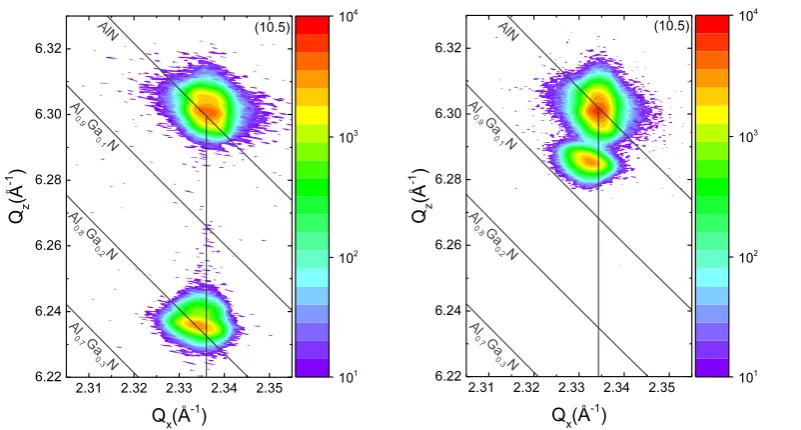
Figure 1 shows the RSMs obtained for AlxGa1-xN layers
with x = 0.80 (a) and x = 0.94 (b) grown on AlN. The
diagonal lines in figure 1 indicate a strain-dependent move-ment of the reflection of a layer of fixed composition. The lattice constants in the basal plane (alayer)and in the growth
direction(clayer)are determined from the peak position of the
AlxGa1-xN reflection.
Using the condition for biaxial strained layers(equation(1)) and the definition of isotropic strain (equations (2) and (3)) Schusteret alderived equation(4)[17]. By applying Vegard’s law to thea, andclattice parameters as well as the elastic moduli C13and C33(see table1)equation(4)can be solved analytically in order to determine the AlN mole fractionxcorresponding to the measuredalayer andclayer lattice parameters
= - C C
2 biaxial strained layers, 1
33
13
33
11 ( )
= = a -a
a isotropic strain, 2
11 22
layer AlGaN
AlGaN
( )
= c -c
c isotropic strain, 3
33
layer AlGaN
AlGaN
( )
= - - ´ +
c x C
C
a a
a c c
2 . 4
The measurement error due to a tilt of the sample in the XRD sample holder was corrected by determining the tilt from a (00.2)omega scan after aligning the goniometer for the(10.5) reflex and correcting the measured RSM by the measured tilt value. The error was calculated using the sum of the weighted derivations of the tabulated material constants, as given in table 1 [18–20] as well as the measured lattice parameters (Dalayer= 0.005Å,Dclayer = 0.005Å). An absolute error of±1% in AlN fraction was obtained for all samples.
For the WDX characterization of the Si-dopant con-centration in the different sample series, a pure Si wafer was used as a standard to determine thek-ratios with a large TAP
crystal used to acquire the Si (Ka) signal. The detector
counting time was doubled compared to the counting times for Ga and Al due to the lower Si concentration. Each of the plotted WDX measurement points consists of the mean of 10 measurements performed along a line on each of the samples. The WDX errors shown consist of the standard error and an estimated systematic error of 3% of the measured signal(to account for matrix effects, difference between standards and
samples, surface contamination, etc.) which is above the
deviation from the weight total which was at(1002 %) for each investigated sample.
The Si concentration was also measured by SIMS, which (like WDX) is insensitive to either the elements site in the crystal lattice or to lattice distortions. During SIMS of high band gap AlxGa1-xN two effects influence the measurement. Firstly, matrix effects[21,22]have an important effect on the relative ion yield as only a few percent of the sputtered species
are ionized. Therefore, a range of reference samples with dif-ferent AlxGa1-xN composition were used with different sput-tering ions to determine the relative sensitivity factors (RSF) and the sputter rate. Secondly the accumulation of surface
charges due to ion bombardment can strongly influence the
secondary ion yield [23]. This was partially mitigated by deposition of a conductive metal layer and electron beam irradiation. The Si concentration was determined by the point-by-point correction protocol. The RSF are adjusted at each data point based on the AlxGa1-xN composition.
The SIMS detection limit, i.e. the lowest concentration measured of an element for a given set of analysis conditions, depends strongly on the AlN concentration. For example, in GaN the Si detection limit is1´1016 atoms cm–3compared
with3 ´1017atoms cm–3in AlN. In Al
0.5Ga0.5N the
detec-tion limit for Si is ~ ´6 1016 atoms cm–3– ´
9 1016
atoms cm–3. The errors of the SIMS measurements were
estimated by the companies who executed the measurements as 20% and 50% respectively, largely due to errors introduced by sample charging and possible matrix effects.
3. Results and discussion
3.1. Comparison of Al composition as determined by WDX and XRD
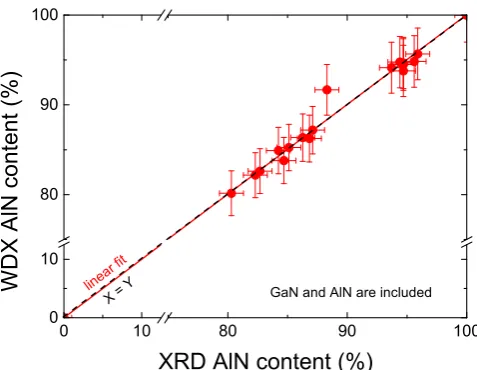
In figure 2 the AlN content determined by WDX is plotted
[image:3.595.108.509.65.280.2]versus the AlN content determined by XRD(10.5)RSMs of all samples. Neglecting the one sample at a XRD aluminum Figure 1.Reciprocal space maps near the asymmetric AlN(10.5)reflection of AlxGa1-xNlayers withx=0.80±0.01(a)and
[image:3.595.163.435.339.385.2]x=0.94±0.01(b).
Table 1.Material constants used for the XRD analysis[18–20].
a(Å) c(Å) C13(GPa) C33(GPa)
nitride content of x=0.88 (WDXx = 0.92), there is very good agreement between all of the WDX- and XRD-deter-mined AlN compositions. In addition to the Si-doped AlxGa1-xN samples, a GaN sample was investigated (see
table 2). The WDX technique enables a non-destructive
determination of the composition of wide bandgap AlxGa1-xN alloys and is in good agreement with XRD measurements, well below the margin of error(2.5%–3% AlN%, see table2). Note that one can also quantify the composition of quaternary
InAlGaN alloys using WDX, as demonstrated by Bejtkaet al
[24], which present further difficulties for XRD measurements due to the uncertainty of uniquely attributing lattice constants to compositions and strain.
3.2. Determination of the doping concentration by WDX
Figure3 shows the Si concentration as determined by WDX
measurements on all investigated samples (see table 2) and how this depends on their AlN concentration as well as the SiH4/III ratio. As indicated by the horizontal lines, this result shows that the Si incorporation of the investigated samples is independent of the composition of the sample and only
depends on the SiH4/III ratio that was used during the
growth. Junxue et al [25] proposed an increasing Si incor-poration with increasing Al content, which they attributed to an increasing rate of parasitic prereactions in the gas phase with increasing TMAl partial pressure. However, as the TMAl partial pressure was kept constant for the samples in the present study and the variation of the composition was achieved by varying TMGa partial pressure, a negligible change in the amount of gas phase prereactions is expected, leading to a Si incorporation independent of the Al composition.
In figure 4 the measured Si concentration (log scale) is plotted against the SiH4/III ratio for all investigated samples.
The WDX wasfitted to a linear function with a gradient of
´
1.45 1023cm−3and an intercept with the concentration axis of1.89´1018cm−3
. The very goodfit of the measurement
data to a linear function shows that the Si incorporation in
wide band gap AlxGa1-xN layers increases linearly with the SiH4/group-III ratio. This is in good agreement withfindings by other groups [26–28]. For the range of SiH4/group-III ratios under investigation no saturation could be observed.
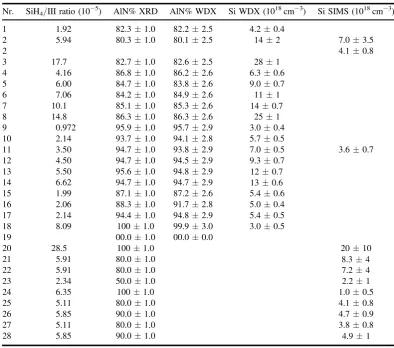
Comparing the WDX results for the Si concentration with commercially performed SIMS results(seefigure4)we found that both measurement methods show the same general trend: a linear increase in the Si concentration with increasing SiH4/III ratio. Comparing the Si concentration values wefind only partial agreement in the absolute concentration values
between the two measurement methods. The linearfits of the
two series show that the measured Si concentration differs by a factor of approximately 2. For example for an Al0.95Ga0.05N
layer with a SiH4/III ratio of3.5´10-5the Si concentration
was determined to be (3.60.7)´1018 cm−3 by SIMS,
whereas the Si concentration determined by WDX is
´
7.0 0.5 1018
( ) cm−3. For an Al0.80Ga0.2N layer with a
SiH4/III ratio of5.94´10-5the discrepancy increases even
further, for the measurements done by the same company,
giving Si concentrations of (142)´1018cm−3
and
´
4.1 0.8 1018
( ) cm−3for WDX and SIMS, respectively.
The SIMS measurements carried out by another employed company on the same sample yielded a Si concentration of
´
7.0 3.5 1018
( ) cm−3 demonstrating that the values
obtained by SIMS are very sensitive to the measurement setup and calibration standard.
The disagreement between the two measurement
meth-ods(and the two SIMS measurements)could be caused by a
variety of effects including the matrix effect and sample charging. The matrix effect is a well known problem for SIMS measurements, changing the secondary ion yield depending on the matrix(i.e. composition of the sample)the ions are embedded in. To compensate for this SIMS standards with a known composition close to the investigated samples are needed. Standards fulfilling this criteria were utilized in
these measurements reducing the possible influence of the
matrix effect. The same effect can also influence WDX
measurements [29]. To reduce the influence of the matrix effect on the measured Si concentration a software correction was applied. It has to be noted that in previous measurements of Mg in GaN very good agreement between WDX and SIMS
was found [12]. The difference between the SIMS
measure-ments of both companies might stem from the use of different standards for the Si determination.
Sample charging provides another challenge to overcome in acquiring precise concentration measurements utilizing charged particles for the group-III nitride system, and this proves especially challenging in undoped AlxGa1-xN layers with high AlN concentrations. Although the investigated samples are all Si doped, charging effects were still observed, influencing the measured concentrations. An estimate of the charging on the WDX measurements can be gained by ana-lyzing the weight total, where a deviation from the optimum
value (100%) can indicate that the obtained data has been
influenced by effects like sample charging. In this sample
series all WDX measurements resulted in a weight total of
100 2 %
( ) , with no dependence on composition, indicating
[image:4.595.50.289.65.250.2]that sample charging had a negligible effect on the WDX Figure 2.AlN content of samples determined by WDX plotted
measurement. SIMS measurements are expected to show a stronger dependence on sample charging effects than WDX as both the primary as well as the secondary ions will be affected by a build-up in surface charge. To reduce the effect of sample charging, Au coating and electron bombardment were used for the SIMS measurements. However, even with the discrepancy of a factor of 2 between SIMS and WDX mea-surements(and no clear indication which technique is right) WDX provides accurate measurements with small errors and
is capable in measuring impurity concentrations as low as 3×1018cm−3.
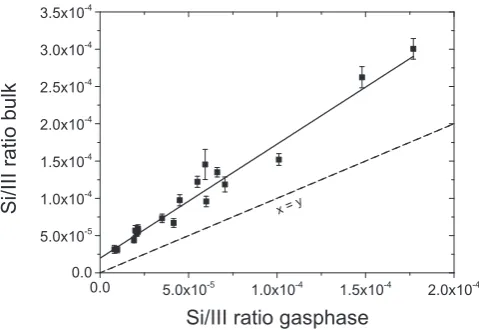
In figure 5the Si/III ratio in the bulk is plotted against
the SiH4/III ratio in the gas-phase. The Si incorporation
increases as expected linearly with the SiH4/III ratio, with a gradient of 1.45, showing that no saturation of the Si Table 2.Overview of the analyzed samples, values are rounded to the last significantfigure.
Nr. SiH4/III ratio(10−5) AlN% XRD AlN% WDX Si WDX(1018cm−3) Si SIMS(1018cm−3)
1 1.92 82.3±1.0 82.2±2.5 4.2±0.4
2 5.94 80.3±1.0 80.1±2.5 14±2 7.0±3.5
2 4.1±0.8
3 17.7 82.7±1.0 82.6±2.5 28±1
4 4.16 86.8±1.0 86.2±2.6 6.3±0.6
5 6.00 84.7±1.0 83.8±2.6 9.0±0.7
6 7.06 84.2±1.0 84.9±2.6 11±1
7 10.1 85.1±1.0 85.3±2.6 140.7
8 14.8 86.3±1.0 86.3±2.6 25±1
9 0.972 95.9±1.0 95.7±2.9 3.0±0.4
10 2.14 93.7±1.0 94.1±2.8 5.7±0.5
11 3.50 94.7±1.0 93.8±2.9 7.0±0.5 3.6±0.7
12 4.50 94.7±1.0 94.5±2.9 9.3±0.7
13 5.50 95.6±1.0 94.8±2.9 120.7
14 6.62 94.7±1.0 94.7±2.9 130.6
15 1.99 87.1±1.0 87.2±2.6 5.4±0.6
16 2.06 88.3±1.0 91.7±2.8 5.0±0.4
17 2.14 94.4±1.0 94.8±2.9 5.4±0.5
18 8.09 100±1.0 99.9±3.0 3.0±0.5
19 00.0±1.0 00.0±0.0
20 28.5 100±1.0 20±10
21 5.91 80.0±1.0 8.34
22 5.91 80.0±1.0 7.24
23 2.34 50.0±1.0 2.21
24 6.35 100±1.0 1.0±0.5
25 5.11 80.0±1.0 4.1±0.8
26 5.85 90.0±1.0 4.7±0.9
27 5.11 80.0±1.0 3.8±0.8
[image:5.595.100.495.80.428.2]28 5.85 90.0±1.0 4.91
Figure 3.The dependence of the Si concentration measured by WDX on the AlN content and the SiH4/III ratio.
[image:5.595.105.538.90.635.2]incorporation can be observed in the investigated range. As the Si incorporation on group-III lattice sites is strongly preferred over the incorporation on a N site, one can conclude that the incorporation of Si atoms is slightly preferred over the incorporation of group-III atoms[30,31]. This is most likely a result of pre-reactions in the gas-phase which reduce the amount of available Ga and Al atoms for incorporation[32]. Additionally desorption of Ga adatoms from the surface could further decrease the amount of III-atoms. All parameters as determined by WDX, XRD, and SIMS are summarized in table2.
4. Summary
We have successfully demonstrated the use of WDX spectroscopy in a commercially available EPMA for the characterization of Si doped wide bandgap AlxGa1-xNlayers, determining the Si concentration as well as the composition of the investigated layers. Very good agreement in the deter-mination of the composition was found between WDX and XRD, while comparison between SIMS and WDX measure-ments of the Si concentration showed only partial agreement which has been attributed to possible charging effects during
the SIMS measurements and matrix effects influencing both
SIMS and WDX characterization.
It was found that the Si concentration increases linearly
with the SiH4/III ratio, and no solubility limit of Si in
AlxGa1-xN could be found within the measurement range
investigated(up to(281)´1018cm−3).
The ability of WDX to determine the composition as well as the Si doping concentration, in the concentration regime important for the fabrication of devices(demonstrated in the
range of (3 0.5)´1018cm−3 - ´
28 1 1018 ( ) cm−3), offers distinct advantages over XRD and SIMS measurements which can only reliably provide the information on one of these parameters. Furthermore, WDX allows the correlation with other SEM-based techniques such as cathodolumines-cence and electron channelling contrast imaging, possibly
providing information about interactions between threading dislocations, luminescence properties, and compositional or doping concentration variations.
Acknowledgments
We are grateful to Dr Stuart Kearns of Bristol University for insightful advice regarding the WDX analysis. The authors would like to thank Dr Arne Knauer and Dr Viola Kueller( Ferdinand-Braun-Institut, Leibniz-Institut für Höchstfrequenztechnik) for
providing ELO AlN/sapphire templates. We acknowledge
funding from the Engineering and Physical Sciences Research Council(EPSRC) (EP/M003132/1)of the UK. The data asso-ciated with this research is available at doi:10.15129/ fe2ea4ed-235c-4f7e-9301-4c9677bffddb. The research was partially sup-ported by the Deutsche Forschungsgemeinschaft (DFG) within
the collaborative Research Center ‘Semiconductor
Nanopho-tonics’(SFB 787)and the German Federal Ministry of Education and Research (BMBF) within the ʻUltraSensʼ project under
contract number 13N12587 and‘Advanced UV for Life’under
contract numbers 03ZZ0105B, 13N12587 and 03ZZ0103.
References
[1] Würtele M A, Kolbe T, Lipsz M, Külberg A, Weyers M, Kneissl M and Jekel M 2011Water Res.451481–9 [2] Götz W, Johnson N M, Chen C, Liu H, Kuo C and Imler W
1996Appl. Phys. Lett.683144
[3] Collazo R, Mita S, Xie J, Rice A, Tweedie J, Dalmau R and Sitar Z 2011Phys. Status Solidic82031–3
[4] Trinh X T, Nilsson D, Ivanov I G, Janzén E,
Kakanakova-Georgieva A and Son N T 2014Appl. Phys. Lett.105162106
[5] van de Walle C G and Neugebauer J 2004J. Appl. Phys. 953851
[6] Yan Q, Janotti A, Scheffler M and Van de Walle C G 2014 Appl. Phys. Lett.105111104
[7] Edwards P R, Martin R W and Lee M R 2007Am. Mineral.92
235–42
[8] Kusch Get al2015Appl. Phys. Lett.107072103 [9] Wallace M J, Edwards P R, Kappers M J, Hopkins M A,
Oehler F, Sivaraya S, Oliver R A, Humphreys C J, Allsopp D W E and Martin R W 2015J. Appl. Phys.117
115705
[10] Edwards P R and Martin R W 2011Semicond. Sci. Technol.26
064005
[11] Edwards P R, Martin R W, Bejtka K, O’Donnell K P, Fernandez-Garrido S and Calleja E 2009Superlatt. Microstruct.45151–5
[12] Deatcher C J, Bejtka K, Martin R W, Romani S, Kheyrandish H, Smith L M, Rushworth S A, Liu C, Cheong M G and Watson I M 2006Semicond. Sci. Technol. 211287
[13] Knauer A, Kueller V, Zeimer U, Weyers M, Reich C and Kneissl M 2013Phys. Status Solidia210451–4 [14] Mogilatenko A, Küller V, Knauer A, Jeschke J, Zeimer U,
[image:6.595.50.290.67.232.2]Weyers M and Tränkle G 2014J. Cryst. Growth402222–9 [15] Mehnke F, Wernicke T, Pingel H, Kuhn C, Reich C, Kueller V, Knauer A, Lapeyrade M, Weyers M and Kneissl M 2013 Appl. Phys. Lett.103212109
Figure 5.Comparison between SiH4/III ratio in gas-phase and bulk:
[16] Drouin D, Couture A R, Joly D, Tastet X, Aimez V and Gauvin R 2007Scanning2992–101
[17] Schuster M, Gervais P O, Jobst B, Hösler W, Averbeck R, Riechert H, Iberl A and Stömmer R 1999J. Phys. D: Appl. Phys.32A56
[18] Polian A, Grimsditch M and Grzegory I 1996J. Appl. Phys.79
3343–4
[19] McNeil L E, Grimsditch M and French R H 1993J. Am. Ceram. Soc.761132–6
[20] Piprek J 2007 (Weinheim: Wiley-VCH Verlag GmbH & Co. KGaA)
[21] Blaise G and Bernheim M 1975Surf. Sci.47324–43 [22] Deline V R, Katz W, Evans C A and Williams P 1978Appl.
Phys. Lett.33832–5
[23] Wittmaack K 1979J. Appl. Phys.50493–7
[24] Bejtka K, Edwards P R, Martin R W, Fernández-Garrido S and Calleja E 2008J. Appl. Phys.104073537
[25] Ran J, Wang X, Hu G, Li J, Wang J, Wang C, Zeng Y and Li J 2006Phys. Status Solidic3490–3
[26] Parish G, Keller S, Denbaars S P and Mishra U K 2000 J. Electron. Mater.2915–20
[27] Taniyasu Y, Kasu M and Kobayashi N 2002Appl. Phys. Lett. 811255–7
[28] Kakanakova-Georgieva A, Nilsson D, Trinh X T, Forsberg U, Son N T and Janzén E 2013Appl. Phys. Lett.102132113 [29] Ro C-U, Osán J and Van Grieken R 1999Anal. Chem.71
1521–8
[30] StampflC, Neugebauer J and Van de Walle C G 1999Mater. Sci. Eng.B59253–7
[31] Hevia D F, StampflC, Viñes F and Illas F 2013Phys. Rev.B 88085202
[32] Stellmach J, Pristovsek M, SavaşÖ, Schlegel J,
Yakovlev E V and Kneissl M 2011J. Cryst. Growth315