REGULARIZATION
OF
LINEAR
OPERATOR EQUATIONS
by
M.A
.
Lukas
A thesis submitted to the Australian National University for the degree of Doctor of Philosophy
PREFACE
A large proportion of the material presented in chapters 2 and 3 has been published under the title of Regularization in the proceedings of a one-day seminar held at the Australian National University in November, 1978 on
The Application and
Numerical
Solution of Integral Equations
[30].
In recent correspondence with' Professor G. Wahba, my attention was drawn to the equivalent definition of
a
'
given at the end of section 5.4. For this I am very grateful.Elsewhere in this thesis, unless another source is acknowledged, the work described is my own.
ii
ACKNOWLEDGEMENTS
The research for this thesis was undertaken in the Department of Pure Mathematics of the Australian National University. Initially, my thesis topic was in topology but, for various reasons, I decided to change to the present one. I would like to thank Dr N.F. Smythe and Professor N.S. Trudinger for making the transition so smooth. Then I was closely associated with the computing Research Group (formerly the Computer Centre), until its unfortunate demise. I am grateful for the support given to me by both groups.
I wish to express my sincere gratitude to my supervisor, Bob Anderssen. His dynamic enthusiasm for many areas of computational mathematics has been a great motivating force. I am very grateful for his sound and constructive criticism of many aspects of my work, in particular the presentation of this
thesis.
Throughout my period of study, I have benefited greatly from discussions with staff and fellow students. In particular, I look back on many
stimulating talks with Graeme Chandler. I would also like to thank Frank de Hoog for his interest in my work.
I wish to thank Dorothy Nash for her care and effort in producing an excellent typescript. Thanks are also due to Anna Zalucki who persevered in the difficult task of typing much of chapters 4 and 5.
I am deeply grateful for the support given to me by my wife Carolyn. In practice, her careful proof-reading of the entire manuscript has been
invaluable. I am indebted to my parents for their consistent encouragement
in my pursuit of further studies.
1
AB
STRACT
In this thesis, we examine regularization for the approximate solution of a class of bounded linear operator equations Ku = f , where f need not be given exactly. We are particularly interested in Fredholm integral
equations of the first kind and the problem of data smoothing.
In chapter 2, we consider Tikhonov regularization and regularization with differential operators. Existing results concerning the existence, uniqueness, convergence and construction of the regularized solution are reviewed and extended, and some new results are proved. We also derive the important filtering property of these forms of regularization.
In chapter 3, we consider regularization with discrete and possibly
noisy data d. = f(x.) + E.
~ ~ ~
minimize
uEw
i = l,2, ... , n , i .e. n
1
I
n i=l2
(Ku(x.)-d.)
+
002(u) ~ ~Here W
=
W m ' 2 [0,1] and ~ (u) = Ilullw 22
or ~(u) =
Ii
Tul12 ' where T linear differential operator of order rn Two existing methods for constructing the regularized solution ua
are described and related. is aUp to date most authors have implemented regularization by arbitrarily fixing the order of regularization m and then choosing
a
by some known method. In chapter 4, we show that better results are obtained if m is determined first. An optimal value of m is defined in terms of an optimal filtering criterion obtained by minimizing1 2
- EllKu -fll
n
a,m1 E n
n
I
i=l2 (Ku (x.)-f(x.))
a ,m ~ ~
iv
In chapter 5, we define a class of optimal regularization parameters
a
o
,ll'
which includes the minimizer of 1 EllKu_
f11
2n a We derive some
properties of
a
o
'
,ll including its asymptotic behaviour as
Relating earlier work, i t is shown that for a reasonable statistical estimate
l
EIIKu(3_
f
11
2n ,m should be close to the minimum for the optimal filtering order of regularization m . We derive an almost unbiased estimate
a
'
II ofin particular, an estimate
a
'
of and some of its statistical p~operties. The estimate a ' is shown to have a strongconnection with the weighted cross-validation estimate.
Chapter 6 is concerned with some practical aspects of regularization.
Numerical results are presented which demonstrate the viability of the
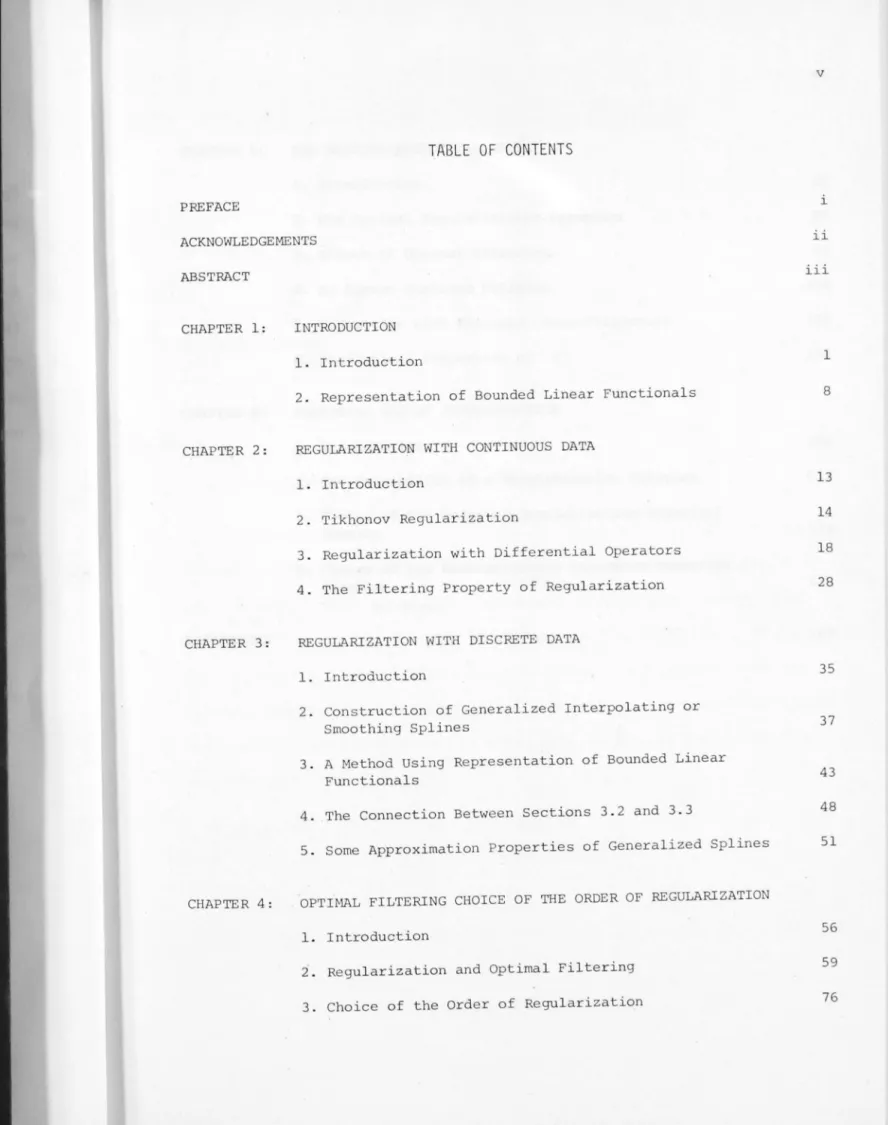
TABLE
OF
CONTENTS
PREFACE i
ACKNOWLEDGEMENTS ii
ABSTRACT iii
CHAPTER 1: INTRODUCTION
1. Introduction 1
2. Representation of Bounded Linear Functionals 8
CHAPTER 2: REGULARIZATION WITH CONTINUOUS DATA
1. Introduction 13
2. Tikhonov Regularization 14
3. Regularization with Differential Operators 18
4. The Filtering Property of Regularization 28
CHAPTER 3: REGULARIZATION WITH DISCRETE DATA
1. Introduction 35
2. Construction of Generalized Interpolating or
Smoothing splines 37
3. A Method using Representation of Bounded Linear
Functionals 43
4. The Connection Between Sections 3.2 and 3.3 48
5. Some Approximation Properties of Generalized Splines 51
CHAPTER 4: OPTIMAL FILTERING CHOICE OF THE ORDER OF REGULARIZATION
1. Introduction 56
i
.
Regularization and Optimal Filtering 59CHAPTER 5:
CHAPTER 6:
REFERENCES
THE REGULARIZATION PARAMETER
1. Introduction
2. The Optimal Regularization Parameter
3. Effect of Optimal Filtering
4. An Almost Unbiased Estimate
5. Connection with Weighted Cross-Validation
6. statistical Properties of a '
PRACTICAL USE OF REGULARIZATION
1. Introduction
2. The Feasibil ity of a Regularization Solution 3. Choice of the Order of Regularization-Numerical
Results
4. Choice of the Regularization Parameter-Numerical Results
vi
85
87
97
100
103
106
116
117
123
135
CHAPTER
1
INTRODUCTION
1.
INTRODUCTION
Many applications require the approximate solution of a bounded linear
operator equation
Ku
f , where f need not be given exactly. We areparticularly interested in Fredholm integral equations of the first kind
Ku(x)
f:
K(x,t)u(t)dt f(x) xE [0,1]
(1.1)as well as the problem of data smoothing, where
K
I .Applications of equation (1.1) are discussed in [19], [22], [49] and the references given there. They include remote atmospheric sensing [59],
correction for finite resolution of instruments (e.g. spectrometers [12]) and degraded image restoration [8] . Some classical applications of
(1.1)
are in potential theory [22], analytic continuation of harmonic functions [13] and the solution of the backward heat equation [51]. The problem of finding the first or higher derivatives of a function can also be formulated as anequation of the form (1.1) [3] .
An operator equation (or problem)
K
x +
y
Ku f ,where X and Yare complete metric spaces, is
well posed
in the sense ofHadamard if:
(i) For each fEY , a solution u E X exists.
2
(ii i) The solution u depends continuously on the right hand side f .
Otherwise the equation (or problem) is said to be
inproperly
posed
orill
-
posed
.
Of course this definition depends crucially on the choice ofthe metric spaces X and Y (see [23]). In practice however this choice
is either dictated by the application or by numerical considerations. The
usual choices are L 2 [a,b] or C[a,b] .
In the equation (1.1) , we take X Y L2[O,1] and assume that the
kernel K(x,t) satisfies
f
l fl
o
0 \K(x,t)\2
dxdt < 00 •Then the linear operator
K
:
L2[O,1] + L2[O,1] is bounded and compact [38] .Hence, either
K
is not invertible or i t has an unbounded inverse. Thus(1.1) is improperly posed.
To see the impact this property has on an approximate solution of (1.1) ,
consider a perturbation E (x)
n in f given by
--
fol
E (x) K(x,t)cos(nt)dt . n
By the Riemann-Lebesgue Lemma, E (x) + 0 as n + 00 . Thus, in solving the
n
equation
K
u
=
f , an arbitrarily small perturbationrise 'to an err0r cos (nt) in the solution of order one.
E (x)
n f gives
The degree of ill-posedness of (1.1) can be assessed by examining the
solution in terms of its singular value expansion. Let A, ~ i = 1,2,. .. be
the decreasing singular values of
K
and <p.~ and 1jJ. ~ the corresponding
orthonormal singular functions, such that
[
42]
00
K(x,t)
L
i=l
A.<p. (x)ljJ. (t)
The A
,
lj). and 1jJ. are related byi ~ ~
*
KIjJ.
~ A.lj) ~ ~ . K lj)~ . A.IjJ. ~ ~ or equivalently
*
2*
2K KIjJ. A.IjJ.
KK
lj). A.lj) .~ ~ ~ ~ ~ ~
If f belongs to the range of
K
,
K(L2[0,1]) then A. = 0 implies that ~where
furthermore
2
denotes the L [0,1]
2
00 (f ,lj)i) 2
I
<
00,
i=l
A~
~inner product. I f
then the solution of (1.1) exists in L2[0,1] and can be written as
00
I
(1. 2)i=l
From Hilbert-Schmidt theory,
o
is the only limit point ofA.
~ i = 1,2, ... If A.=
0 for i ~ N then the solution is not unique. If not, then the~
perturbation lj). in f will lead to an error 1jJ./A. in the solution, which
~ ~ ~
becomes arbi trari·ly large in norm as i -+ 00 • Thus the rate at which A. ~ -+ 0 determines the degree of ill-posedness of (1.1). Results relating the
smoothness of K(x,t) to the rate of decay of the have been obtained
by Weyl
[60]
and smithies[41].
Basically, the smoother the kernel, thefaster is the decay rate of A. l
and the more ill-posed is the problem. See
de Hoog [22] for examples.
The importance of the smoothness of K(x,t) is evident if a direct
quadrature approximation is applied to (1.1). That is
n
I
j=li 1,2, . . . ,m
K(x. ,x.)a.u(t.)
4
where the O. are quadrature weights. For a very smooth kernel K(x,t)
J
the rows (and columns) of the matrix [K(X. ,x.)] will be almost dependent,
l J
resulting in an i l l-conditioned matrix equation. For a more detailed discussion of direct discretization schemes for (1.1) see de Hoog [22].
In general, direct methods for (1.1) do not give satisfactory results, especially if the right hand side contains some error. It is now accepted that some extra condition, which restricts the class of possible approximate solutions, must be imposed on (1.1). This effectively stabilizes the problem.
One such approach, which has proved effective for a wide class of problems, is
r
egula
riz
ation
.
In regularization, instead of solving (1.1), the class of possible
solutions is restricted by minimizing
2
IIKu-fll subject to
st
(u)
< E: • (1. 3) Herest
is some non-negative stabilizing functional, e.g.2
st
(u) = IIul12 or 2st
(u)=
Ilu" 112 . The value of E: will depend on the problem, but the
condition
st
(u)
S E: expresses ana priori
belief that the solution will notbe excessively noisy.
By introducing a Lagrangian multiplier a in (1.3), one derives the more usual form of regularization
minimize
uE~v
2
IIKu-fll +
an
(u)where W is some space of smooth functions and
a
>
0 is called the(1.4)
regularization
pa
r
amete
r
.
The stabilizing functionalst(u
)
will usually betaken to be the square of either a norm or seminorm, involving derivatives
of u The highest order derivative appearing in
st
(u)
is called the--I
order of reguZarization
.
The norm used in(1.4)
will either be theL
2
[O,1)
norm or a weighted Euclidean norm.
The choice of norm II-II and stabilizing functional n in (1. 4)
determine a natural framework in which an explicit representation for the
regularized solution u
a
can be derived. In chapter 2, we will considerregularization with continuously defined data. In this case, the norm is the is either the square of a weighted Sobolev norm,
m
I
i=l
r
o
or
(i) 2
w. (x) (u (x)) dx 1
w.
1
E C[O,l)
w. > 0 , 1
n (u)
I
I
Tull~
,
where T: W + L2
[O,1)
is a linear differential operator of order m. We review and relate existing treatments of existence, uniqueness and convergenceof for these forms of regularization, as well as presenting a new method
for the case of n(u) =
IIT
u
ll~
.
Special attention is given to the role of boundary values. We derive conditions under which these or other linearfunctional values may be imposed on u
a
In section 2.3 we show howregularization accomplishes a filtering of high frequency singular function
components.
In chapter 3 we consider regularization with discrete data
d.
1 f(x.) 1 + E. 1 i
where E. (if non-zero) are random errors.
1
1,2, . . . ,n ,
The appropriate norm in this
case is a weighted Euclidean norm and the n(u) we consider are the same as above. The problem then is to find u
6
n
I
(Ku(x.) - d.) 2 w.+
an(u)~ ~ ~
i=l
The're are two different approaches to characterizing u
a.
one due toAnselone and Laurent [5] and another due to Wahba [52]. These will be (1.5)
examined in sections 3.2 and 3.3 respectively and a comparison between them made in section 3.4. It turns out that u is an element of a certain
a.
finite dimensional space of generalized splines. In section 3.5, we derive
some of their approximation properties.
It is clear that (1.5) defines a tradeoff between minimizing the
residual and stabilizing the solution, and the parameter
a.
determines theweighting between the two. If
a.
is too small, then the original improperly posed problem (1.1) will dominate, resulting in a greatly magnified error inu
a.
If on the other handa.
is too large, thenu
a.
although quitesmooth and stable, will not adequately satisfy (1.1) . This suggests that
there may be an optimal
a.
.
At the same time, i t is intuitively clear that the stabilizing effect of
Q is directly related to the sensitivity of Q to oscillations in u . This sensitivity is determined by the highest order derivative present in Q ,
suggesting that there may also be an optimal order of regularization. To
further illustrate the importance of the order, consider zero order
regularization with Q(u) = IIul12 2 . This has the undesirable effect of pulling
any solution toward the zero function.
Up to date most authors have implemented regularization by arbitrarily
-7
certain filtering of high frequency noise from the data, we derive an optimal
filtering criterion for the choice of ~(u) and W. This is used as the
basis of a practical strategy for estimating the optimal order of
regularization.
In chapter 5 we define the optimal regularization parameter a
O
'
andderive some of its properties. Relating earlier work, i t is shown that,
given a reasonable statistical estimate
6
ofa
O
'
the expected errorwill be close to the minimum for the optimal filtering choice of the order of regularization. In section 5.4 we derive an (almost) unbiased estimate
a
'
of
a
o
.
In another form,a
'
was suggested independently by Craven andWahba
[10].
It is defined by an equation of the formg(a')
and is almost unbiased in the sense that the equation
E(g(a) )
has the unique solution a
O . Furthermore i t is shown that the relative error of a' is likely to be small. A strong connection is shown to exist
between a ' and the weighted cross-validation estimate [55].
In chapter 6, we examine some practical aspects of the use of
regularization in the solution of first kind equations. In section 6.2 we
describe some means of assessing in advance the feasibility of a particular
regularized solution. In addition, we demonstrate how, in the case of
a certain convolution integral equation or data smoothing with
periodic splines, the eigenvalues and eigenvectors of the continuous problem
8
may be used in the regularized solution. Section 6.3 is concerned with the
choice of the optimal order or regularization. We describe numerical
1 k
experiments performed with the equation
J
Jx-tJ 2 U(t) = f(x) and datao
smoothing. Numerical results for the optimal filtering method of chapter
4 are compared with those of existing methods. In section 6.4, we
present numerical results for the different regularization parameters
considered in chapter 5. Given the variance 02 the estimate a' compares favourably with the weighted cross-validation estimate.
2
.
REPRESENTATION
OF
BOUNDED LINEAR
FUNCTIONALS
In the regularization formulation (1.4), the stabilizing functional
~
is usually associated with a natural Hilbert space W of r,eal-valued
functions, which is just the largest on which ~ can be defined. For
example if then W will be the Sobolev space
defined as
2
{u
E
L[0
,
1]
weak derivatives (i)u exist and
with any inner product equivalent to the usual one
m
J:
(i) (i)(u,v)
wm,2
[0,1]
L
u v (1. 6)
i=O
The properties of Hilbert space can then be exploited in the analysis
of (1.4). Let ( - , -) wand
11
-
lI
w denote the inner product and norm in W, respectively. If the linear functional
W + JR , u + Ku (x)
alternative representation as
Ku(x)
for some n E w . This may be substituted into (1.4) to obtain an x
equivalent formulation. The representer nx can be written down explicitly, if W has the following additional property.
A
r
ep
r
od
ucin
g ke
rn
e
l Hi
l
bert s
pace
(RKHS) W is a Hilbert space of real-valued functions on [0,1] in which, for each x E [0,1] , there exists R E W such that (R ,u)=
u(x) for all u E Wx x W
(see [ 6 ] ). The kernel R(x,y) = R (y) is called the
reproducing
kernel
(RK) of W .x
Because
R (y) = (R ,R )W
x Y x (R x ,R )W
Y
R Y (x)the RK is symmetric. Furthermore i t is unique, for if S(x,y) is also a
RK of W , then for all x,y E [0,1]
S (y)
=
(R ,S )=
(S ,R )x Y x x Y R Y (x)
By the Riesz representation theorem, an equivalent definition of a RKHS is a Hilbert space of real-valued functions on [0,1] in which, for each x E [0,1] , the linear evaluation functional W +m , u + u(x) is bounded.
Furthermore, the norms of these functionals can easily be found as follows.
For all u E W
and for u = R
x
lu(x) I
IR
(x)I
10
Thus the norm of the evaluation functional u + u(x) is IIR)iw = (R(x,x)) h: Z
This property is very important for numerical analysis in W , because
convergence in W implies pointwise convergence. In this thesis we will
assume that R(x,y) E C([O,l] x [0,1]) Since then R(x,x) is bounded,
convergence in W impl ies uniform convergence. This condition on R(X,y)
also implies that W ~ C[O,l] (see
[33]).
Let L: W
+m,
u+
Lu be an arbitrary bounded linear functional.Its representer r
E
W , defined by Lu=
(u,r) for all uE
W, can befound by letting u = R
t That is
r(t)
Thus for a bounded linear functional of the form u + Ku(x) the representer is given by
n
(t) xWe now consider important examples of operators
K
and RKHS W . Notethat L 2
[0,1]
is not a RKHS. By contrast, the Sobolev space wm, 2[0,1]
m~
1
with any of its equivalent inner products is a RKHS. This was proved byTippenhauer [48] by determining the RK. For the usual inner product (1.6),
the RK is
R(x,y)
2.m g(x,y)
+
I
i=l
8 (x)8. (y)
i 1
where g(x,y) is the Green's function of the following linear differential
operator of order 2m
m
A
I
(_l)i02ii=O
u(i) (0)
=
u(i) (1)=
0 isi = 0,1, ... ,m-l "
j, .... s.s of ~ "",,1/ 5f""''''
The RK for
w
m,2[0,1] with other inner products, equivalent to (1.6), will be considered in chapter 3.Let
K
be the operator in (1.1), given byKu(x)
=
fl K(x,t)u(t)dt ,o
where K(x,t) E L2([0,1] x [0,1])
".I ... ost ... 1(
Then for
m 2
W ' [0,1] + ill. , u + Ku(x)
is bounded. This follows since
IKu(x) I
I
fl K(X,t)u(t)dtlo
s
IIK(x,·) 11211ull
2x
E
[0,1] the functionaland IIK(X,·)11
2
<
00 by Fubini's theorem. Hence the representer nx ofu + Ku(x) is given by
n
(t)x
f:
K(x,s)R(t,s)dsFrom above i t is clear that the linear functional u + Ku(x) is also bounded from L 2 [0,1] to ill.. In this case the representer is evidently
n
(t)12
For the operator
K
= I and a RKHS W with RK R(x,t) the linearfunctionals W +N , u + Ku(x) = u(x) are just the bounded evaluation
functionals. From above these have representers
n
(t)x R(x,t) .
Additional useful examples of RKHS are given in [21] and [52]. For
further properties of RKHS to be used later, see [ 6] and [33] .
CHAPTER 2
REGULARIZATION WITH CONTINU
OU
S DATA
1. INTRODUCTION
In this chapter we assume that in the equation
Ku
= f , the functionf is given analytically. Applications of this exist in potential theory, where for example, in the interior Dirichlet problem, f is the value of
the solution on the boundary [22] . Another application exists in the work
of Anderssen [4] on estimating moment functionals, in which f(x) = xn .
The form of regularization considered in this chapter is
minimize
uEW
2
IIKu-fI12 + oil (u) (2.1)
where 110 11
2 is the L2[O,1] norm. Although in order to solve (2.1) in practice, i t may be necessary to discretize f , i t is important that the properties of this form of regularization be understood first.
In section 2.2 we consider regularization as introduced by Tikhonov
[45],
[46]
,
where ~ is the square of a weighted Sobolev norm. The degree 'of well posedness of (2.1) is determined and known properties of the regularizedsolution are discussed. A method of Hilgers [19] is used to generalize the problem to ~ being the square of an arbitrary RKHS norm.
In section 2.3, is the squared seminorm
2
~ (u) = IITUl12 where
a linear differential operator. Existing results for this form of
T
regularization are reviewed. A new method is used to derive the solution
u of (2.1) and some of its properties. Another result shows that
a
is
regularization may be viewed as a least squares procedure. As in sectidn 2.2,
14
In section 2.4 we use the RKHS solutions from sections 2.2 and 2.3 to derive singular value expansions of Ku
a
These expansions demonstrate the important filtering property of both forms of regularization.2
.
TI
K
H
ONO
V RE
GU
LA
RIZ
A
TION
The technique of regularization was introduced by Tikhonov [45] , [46] in the following way. For a given first kind Fredholm integral equation (1.1) , replace i t by the variational problem
minimize
uEW
2
IIKu-fI12 + <ill(u) ,
where
Sl(u) m
I
fl
wi (x) (u (i) (x) )2
dx i=O 0w. E crO,l] l
w. (x) > 0 l
(2.2)
Let W be either the Sobolev space Wm,2[O,1]
(m
~
l)
or L2[O,1] (m=O) , with the inner productm
I
i=O Then (2.2) can be written as
minimize
uEW
(i) (i)
w. (x)u (x)v (x)dx
l
It is not hard to show that the W norm is equivalent to the usua·l Sobolev norm for m
~
1 and to the L2[O,1] norm for m O .For this space W , (2.2) is equivalent to the Euler-Lagrange equation
*
K Ku +
a
mI
K
*
f (2.3)m
L
i=j
(-1) i-j (w u (i)) (i-j)
I
i 0,1
o
j l ,2, ... ,m .Here
X*
L 2 [O,l]~
L2[O,l] is the adjoint operator given by*
Jl
X f(x)
=
K(t,x)f(t)dto
By using the Green's function G(x,t) for the boundary value problem
m
Lu
L
fi=O
o
j l ,2, ... ,m ,which exists if w. (x) > 0 , Tikhonov transforms (2.3) into the second kind 1
Fredholm integral equation
*
(
GX X
+
a.
)u
G
X
*
f (2.4)where
Gv(x)
fO
l
G(x,t)v(t)dt .
Since
GX X
*
:
L 2 [0,1] ~ L 2 [0,1] is compact with no negative eigenvalues, i tfollows from the Fredholm alternative that the equation (2.4) and hence (2.2)
has a unique solution u
a.
for everya.
> 0 .Because of the generally good behaviour of solutions to second kind
Fredholm integral equations, we expect that (2.4) or equivalently (2.1) is a
well posed analogue of the original improperly posed problem (1.1). This is
indeed the case. Let X = Cm-l[O,l] be the space of m - 1 times
continuously differentiable functions on [0,1] with norm
max
O:::i:::m-l
Il
u
(i)11
00
(. )
max sup lu 1 (x)
I
O:::i:::m-l xE[O,l]
,-I
I
,
16
By defining a certain compact set in X, Tikhonov shows that for some
constant C
!!u(i) _
~(i)
!!
::: C!!f-f!!20'. 0'. 00
i 0,1, ... ,m-l ,
where and UO'. are the regularized solutions corresponding to functions
-f and f respectively (see
[
30]
for details). Thus Tikhonov regularization,m-l 2
C [0,1] + L [0,1] ,
considered as a map is well posed. It is possible to
extend this result so that actually Tikhonov regularization is well posed as
THEOREM 2.1
The
r
e e
xis
t
s
a
c
on
s
tant
Cs
uch that
~ uand
ua
r
e
-r
eg
ulariz
ed solution
s
co
rr
esponding to
fand
f ~t
h
e
n
Proof From above, u is defined by
0'.
*
*
(
K K
+
O'.
L)u
K
f 0'.0'. 0'.
Letting v
0'.
Lu or equivalently
0'.
u
0'.
G
v
0'. this becomes*
K KG
v
0'.*
+ O'.V =
K
f0'.
Similarly, let v
0'.
be the solution corresponding to Then, since
*
2 2K KG
:
L [0, 1] + L [0, 1 ] is compact,and
v
0'. and v 0'.
Now, since
G
L2 [O,l] + u is bounded!!GvO'. -GvO'.!!u
::: IIGII Il vO'.-vO'.11 2
::: IIGIIC(O'.) IIf-
f
11 2are elements of
Assume that U
o
Ew
is the unique solution ofKu
= f Then Tikhonovregularization has the desirable property that u
a
+ Uo
in W asa
+ 0(see Tikhonov
[46]
and Ribiere[37]).
Based on[14], [37]
and[46],
thefollowing more practical convergence result can also be obtained. Let u a be the solution of (2.2) with f replaced by £ where 11£-fI12 S
0
I f a a(o) satisfies 0 < B S a(o) /o2 S C,
then ua(o) + U
o
in W as0
+ 0.
Note that i f a tends to 0 independently of0
,
·then u needa
not converge to u
o
.
In fact, if £ . R(K) ffiR(K)~
where R(K) is the range of the compact operatorK
w
+ L2
[O,l] , then (see Strand[43])
Ilu II + ex>
a
w
as a + 0 .Since the smoothness of the functions in R(K) is determined by the smoothness of the kernel K(x,t) there is a whole class of sufficiently non-smooth functions £ such that £ . R(K) ffi
R(K)~
If f
E
R(K) ffi R(K)~ , then similar convergence results to those above can be obtained when the null space N(K) ~0
(see Hilgers[19]
,
Nashed andWahba
[34]
and Strand[43]).
The solution is replaced by theZeast
squares minimum norm
(LSMN) solution K+f ofK
u
= f . That is, K+f is the unique element of minimal W norm which solves the least squares problemNote that if N(K)
minimize
IIK
u-f
ll
~
.uEw
o
and f E R(K) then K+fIt is not hard to see that Tikhonov regularization 2.2 .can be applied to 2
K
:
W + L [0,1] . The space W is an an arbitrary bounded linear operator18
If W is actually a RKHS and the functionals W
+m
,
u+
Ku(x) arebounded, then an explicit representation of the regularized solution
be obtained in terms of the RK R(x,y) of W . For example, if
W i=O,l , ... ,m-l}
with the inner product
f
l(m) ( ) (m) ( ) d
u x v x x ,
o
then 'Hilgers [19] showed that
* *
*
*
-1u
CL
=
(KSS ) (KSS K +CJ.I) f ,u can
CL
where
S
is the integral operator with kernel the Green's function of i = O,l, ... ,m-l. using the representation ofu + Ku(x) in section 1.2, i t is not hard to show that this result generalizes
to the following.
THEOREM 2.2
If
Wis a
RKHSwith
RK R(x,y) ~then the
r
egularized
sol
uti
on o
f
(2.1)w
ith
~(u)lI
u
ll
w
2 -z..s*
*
-1u
CL = (KR) (KRK +CLI) f ,
w
he
r
e R i
s
the integ
r
al operator with kernel
R(x,y) .3.
REGULARIZATION
WITH
DIFFERENTIAL
OPERATORS
For the problem Ku f , another form of regularization is
where T
minimize
uEW
W + L2[O,1] is a linear differential operator
m Tu
L
i=O w·u
1.
(i) 1
w
m
E C[O,l] .
(2.5)
This is a generalization of Tikhonov regularization in the sense that if
for w, (x)
>
°
1 then u =
°
,
whereas
ii
TUii
22 =
°
for all u in the nullspace of T . Thus the stabilising functional is now the square of a seminorm.
This is a very useful variation on Tikhonov regularization because in many problems a good measure of the smoothness of a trial solution u is
its mean square slope
"
u
'
''
~
or linearized curvature"
u"
"
~;
i.e. Tu = u'or Tu = u" above. In addition, the term
f
l 2
°
wOu in the Tikhonovstabilizer has the undesirable effect of pulling the regularized solution
toward the zero function.
In [47], Tikhonov and Glasko considered the use of Tu = u' for the regularization of (1.1) , but ':lith the restr'ictive assumption that
K(x,t) ~KO
>
°
We now use a simple method, using a Green's functionsimilar to that used in section 2.2, to derive the regularized solution for
general K and T .
Let W be the space of smooth functions
W {u
E
L 2[0,1]
u (m) exists weakly andwhich is just the maximal domain of definition of
2
Tu E L [O,l]} ,
2 2
T : W ~ L
[0,1]
-+ L[0,1]
.
Since T : W -+ L 2
[0,1]
is closed (see Goldberg [16]), with the inner product(u,v)2 + (Tu,TV)2
W is a Hilbert space. It is not hard to show that in fact W
u
20
THEOREM 2.3
If
K
:
L2[O,l] + L2[O,l]~s
a bounded linear operator then
(2.5)
has a solution which is
unique iff
N(K) n N(T)=
{oJ
.
Proof A minimum will exist at u iff the function
M(E,n)
satisfies
d~
M(E,n)10
o
for all nEW .This is equivalent to
(Ku-f ,Ku)2 + a(Tu,Tn)2 0
or
*
*
(K Ku-K f,n)2 -o.(Tu,Tn)2
*
for all nEW. Thus u is a mi imum iff u E dom(T T) and
*
*
*
(
K
K+aT T)uK
fThis is the same as
*
*
[(
K
K-aI) + a(T T+I)]uK
*
f (2.7)Now because T is closed with dense domain
2
W ~ L [0,1] the operator
*
*
2T T + I : dom(T T) + L [0,1] has a bounded inverse
G
:
L [02 ,1] + dom(T T)*
which is symmetric and positive (see [38]). FurthermoreG
L
2[0,1]
+L [0,1]
2is compact since i t is an integral operator whose kernel is a Green's function.
Hence (2.7) is equivalent to
*
*
Since G(K K-cJ.I) L2 [O,1] + L2[O,1] is compact, by the Fredholm
alternative, (2.8), and therefore (2.5) , has a unique solution
*
u
E
R(G) = dom(T T)a
unless the homogeneous equation*
G(K K-aI)u + au 0
has anon-zero solution. Of course this equation is the same as
*
.
*
K Ku -aT Tu
which implies
(Ku,Ku) 2 -a (Tu,Tu)2 .
For a > 0 , this yields Ku
Conversely if u
E N(
K)n
N(T)o
and Tuo
oru E N(K) n N(T)
*
then clearly K Ku -aT Tu
*
If the homogeneous equation has a non-zero solution, then (2.8) still has a(non-unique) solution if
*
(GK f,v) 2
o
for all vE
N([G(K*
K-aI)+aI] )*
But from above
*
(K K-aI)Gv + av 0
impl ies that
*
v E (T T+I) (N(K) n N(T)) .
Therefore
*
rl.
Thus the regularized solution has been constructed, and, if
N(K)
n N(T)=
{O} , i t can be written asu
a
22
(2.9)
III
From the proof of Theorem 2.3, i t is clear that the regularized solution
*
u satisfies some natural boundary conditions defined by u
E
dom(T T) .a
These are
Dj(TU) (0) m
L
(w.u(i)) (j) (0)l
o
j 0,1, . . . ,m-l i=O
and (2.10)
Dj(TU) (1)
m
L
i=O
(w.u(i)) (j) (1)
l
o
j 0,1, . . . ,m-l .It is interesting to compare this regularized solution and its
boundary values with that of Tikhonov regularization. If Tu = u' , then
u satisfies
a
with boundary conditions
*
K K
u
-.,(u"u' (0) U '(1)
*
]( f
o
.
The corresponding solution for Tikhonov regularization with
2 2
~(u) = IIul12 + IIul l1
2 satisfies
*
K
fwith boundary conditions
*
Note that in this case the formation of (T T+I)u = -U" + u in the proof of
Theorem 2.3 is inherent in the Tikhonov method. Though for the above
example, the boundary conditions are identical, this is not the case for higher orders. I f Tu = u (m) , then the natural boundary conditions are
u (i) (0) u (i) (1)
o
i m,m+l, ... ,2m-lm
However for Tikhonov regularization with n(u)
I
II
u ( i)II
~
,
they are i=Om
I
(-1) i-ju (2i-j) (0)m
I
(-1) i-ju (2i-j) (1) = 0 j l ,2, ... ,m .i=j i=j
Note that for j 1 , these boundary conditions involve the terms u ' (0) and u ' (1) This may introduce unrealistic behaviour at the endpoints, w.hereas the conditions u(i) (0) = u(i) (1) = 0 i = m,m+l, ... ,2m-l are
unlikely to.
In a given problem, i t may be desired to specify some different set of boundary conditions to (2.10). For instance, if Tu = u ' then instead of u' (0) = u ' (1) = 0 , i t may be required that the solution satisfy u(O) = 0 This can be incorporated into the regularized solution (2.9) using the following result.
COROLLARY 2. 1
Let
{Fe}be
a
set
of bounded
linear functionals on
w
~-1 2 2
M =
n
Fe (0)is
dense in
L [0,1] .If
T : M + L [0,1]is
e
for which
defined as
before
~n (2.6)~then
(2.5)has a
solution
in
M ~which
~sunique iff
N(K) n N(T) ={oJ
.
Proof It suffices to show that T: M + L2[O,l] is closed, as then the proof will proceed exactly as for Theorem 2.3. Let un
E
M satisfy un + u ,Tu + f
n in for some u ,
T
w
+ L2[O,l] is closed, u E Wand Tu = f24
+ 0 .
Hence, since M is closed in W , u EM. Thus T M + L 2 [0,1] is closed.
III
Because the W norm is equivalent to the usual Sobolev norm, it is not
difficult to show that the boundary value functionals
Uti) (0) B
I
' iU 1 u(i) (1) i O,l, ... ,m-l
are bounded. Hence any linear combination is also bounded. For the example
above with Tu = u ' and Bu u(O) = 0 specified, the condition u E dom(T T)
*
is now equivalent to u(O)=
0 and u' (1)=
0 .A more general but less constructive existence and uniqueness result
than Theorem 2.3 was proved by Ribiere [37]. He also proved the following
continuity theorem. I f N(K) n N(T)
=
{oJ
and u , u are regularizeda
a
solutions corresponding to f and f , then there exists a constant eta) such that
As in section 2.2, i t is possible to extend this result to show that regularization with a differential operator is in fact well posed when considered as a map W2m,2[O,l] + L2[O,l] The proof is similar to that in Theorem 2.1 and may be found in [30].
25
convergence result is that u
a converges to some element U
o
E W in the W*
norm as
a
+ 0 if and only if f ER(
Kl
w)
ffiN(
K
)
in which case isthe unique least squares solution which minimizes Locker and Prenter
show by examples that the rate of convergence of to varies with the
particular problem.
Next we prove a general result which shows that regularization in the
form (2.5) is really a least squares problem in an appropriate product space.
THEOREM 2.4
Let
K
:
L2[O,l] + L2[O,l]be a bounded Zinear operator and
Zet
T : W~
L2[O,l] + L2[O,l]be a cZosed Zinear operator which is onto and
has finite
dimensiona Z nu U space
N (T). .Then the prob Zem
minimize
IIK
u-f
ll~
+ali
Tu
ll~
uEw
has
a
soZution~which
~sunique iff
N(K)
n N(T)Proof Define a norm on L [0,1] 2 ffi L 2 [0,1] by
Then (2.11) is equivalent to the following:
minimize uEw
2 IIKu ED Tu-f ED 011
{O}
.
(2.11)
This is now a standard problem in a Hilbert space which has a solution if the
2 2
subspace {]{uEDTu: u E W} ~ L [0,1] Ef.) L [0,1] is closed. The theorem
follows by the 1 mma below.
III
LEMMA 2.1
Let
the
same
assumptions as
~nthe
theorem
hoZd
.
If~for
u E w ~
K
u
ED Tu + f $ gin
L2[O,l] ED L2[O,l] ~then
f EB g =K
u
Ell Tun n n
for some
u E W ~which is
unique iff
N(
K
)
n N(T) = { O}E .1 E N(T) Then
Proof Let u = v + w where v N(T) n W and w
n n n n n
ilKu
_f112 + allTu-gll~
+ 0 IITU _gll-2 =2
implies that IITVn - g11 2 + 0 By the
:
26
open mapping theorem [16] , there exists c such that
Ilv n -v m
11
2
s
cllTv n -Tv m II 2so that
Ilv -v
11
2
-r 0 as n,m -r 00n m
Hence there exists a unique v E
N(T)~
~
L2[O,1] such that v + v inn
Now, because T is closed, v
E
dom T Wand Tv = g . Also,because
K
is continuous, Kv + Kv in L2[O,1]n
Ku + f ,
n
In addition, since
IIKw -Kw
112
S IIK[ (w -w ) + (v -v )]11
2
+ IIK(v -v )11
2
n m n m n m nm
IIKu n -Ku m
112
+ IIXv n -Kv m11
2
+ 0 as n,m + 00 •
Hence there exists a unique h E L2[O,1] such that Kw n + h . But, since N(T) and hence K(N(T)) is finite dimensional, h E K(N(T)) . That is
h = Kw for some w E N(T) which is unique iff
K
1-1 or equivalently N(K) n N(T) {O} . Hence
Ku
n Kv n + Kw n + Kv + Kw K(v+w)
with v E N(T)~ n Wand w E N(T) . Thus, setting u = v + w , we have
Ku
=
Kv + Kw=
f and Tu Tv + Tw = g .III
An example of the operator T in Theorem
2
.
4
is the linear differential operator(2.6).
Hence for this T, Theorems2
.
3
and2
.4
are equivalent.A very similar result to Theorem
2
.
4
was proved independently byLocker and Prenter [28]. In [29] they use splines as basis functions to obtain a continuous least squares problem approximating (2.5), for which a
rigorous error analysis is developed.
-Finally, in this section, as in section 2.2, we give an explicit
representation of the regularized solution u when W
a
is a RKHS and thefunctionals W
~m
,
u~
Ku(x) are bounded. For the RKHS W =w
m,2[0,1]with the inner product
f
l m-l
(u,v)W = u(m) (x)v(m) (x)dx +
L
u(i) (O)v(i) (0)o
i=OHilgers [19] showed that the solution of (2.5) with T = Om , N (K) n N (T) = 0 is
u
a
m
(KSS*/(l(SS*K*+aI) -l(f -
L
i=l
c .K8.) +
1. 1.
m
L
i=lc.8.
1. 1.
where 8. i
1. 1,2, ... ,m is a basis for N(T) and the coefficients c1. .
satisfy
m
*
*
-1*
*
1L
c. ((KSS K +aI) K8. ,K8 .) 2 ((KSS K +aI) - f ,K8].) 2i=l 1. 1. ]
j 1,2, ... ,m .
Here S is again the integral operator with kernel the Green's function of
i = 0,1, ... , m-l .
More general ly, let T be given by (2.5) with N(K) n N(T)
W
w
m,2[0,1] with the inner productwhere
(u,v) (Tu,Tv)2 + (u,v)N(T) ,
m
(U,V)N(T)
L
i=lB.uB.v
1. 1.
{O} . Let
Here the B.
1.
i = 1,2, ... ,m are bounded linear functionals on
w
m,2[O,1]such that the problem Tu = 0 with B.u = 0 i = 1,2, ... ,m has only the
1.
-zero solution. Then W is a RKHS with RK R(x,y) = R(x,y) + RO(X,y)
where R(x,y) and RO(X'y) are the RK's of N(T).L and N(T)
respectively (see [ 6 ]) . Let
8.
be a basis for N(T) satisfying....
28
(S.
,
S .)
( )
==6..
.
using the representation of u -+ Ku (x) in section 1. 2,1 J N T 1J
it is not difficult to generalize the result of Hilgers to the following.
THEOREM 2.5
With
the assumptions on K and
w
above
,
the
regularized
solution
of
(2.5)is
m (KR)
*
(KRK* +cn) -1 (f -I
i==l
whe
r
e
the
c .satisfy
1
c .KS.)
+
1 1
m
I
i==l
c.S.
1 1 (2.12)
m * - 1
I
c.((KRK +0.1) KS. ,KS·)2 j 1,2, ... ,m .i==l 1 1 J
4. THE FILTERING PROPERTY OF REGULARIZATION
and ~(u) ==
II
u
l12
2 in (2.1), the filtering property ofregularization is well known (see e.g.
[31]).
In this case the Euler-Lagrangeequation (2.3) is
Therefore if
:\.
>
01
*
*
(
K
K+a.I)uK
fa.
are the decreasing singular values and <jl.
1 and tjI. 1
the corresponding orthonormal singular functions of the integral operator
K
:
L2
[o,1]
-+ L2
[
O
,1],
then it is not hard to show that(cf. (1. 2)) and
Noting that :\./2 (:\.+2 0.)
1. 1
u
a.
Ku
a. 00
I
i==l
00
I
i=l
:\~
(f ,<jl.)1 1 2
tjI.
2 :\. 1
:\.+0. 1 1
:\2
1.
(f ,<jl.) 2<jl.
2
:\.+0. 1 1.
1.
is decreasing, i t is clear that this form of
regularization performs a low pass filtering of the singular function
components.
-29
We now derive the filtering effect of regularization in the general
case of ~ in sections 2.2 and 2.3. From Theorem 2.2 the regularized
solution of (2.2). is
*
*
-1RK (KRK +ar) f .
Let
Q
be the compact operator KRK*
L [0
2,
1]
+L [0
2,
1]
.
be written as
THEOREM 2.6 If
Ku
a
-1
Q(Q+ar) f .
are the
dec
r
easing eigenvalues and
corresponding
orthonormal eigenfunctions of
Q
then
00 A2
K
U
a
L
i (f ,<p . ) 2<P . 2i=l A.+a l l l
<p. l
Then
the
K
u
a
Proof From Hilbert-Schmidt theory, the compact, positive, self-adjoint
operator
Q
:
L2[
0
,1]
+ L2[0,1]
has a decreasing sequence of eigenvaluescan
and corresponding orthonormal eigenfunctions (j> • •
l Now from [33],
K
(w)
Q~ 2(L 2[0,1])
and hence fE
K
(w)
has the representationwhere the sum may be finite.
K
u
a
f00
L
(
f , <p . ) 2<P . ,l l
i=l
Therefore
-1
Q(Q+ar) f
00
A~
L
l (f,<P')2<P,2
A.+a l l i=l
l
III
Thus the filtering for the general form of regularization in section 2.2
has the same form as for Since in both cases <p. l are
orthonormal functions, the most significant difference in the filtering is in
the factor A./2 (A.+a2 )
l l
30
R(x,y) = G(x,y) the Green's function of a differential operator of order
2m . If
K
is an integral operator, then so isQ
with the kernel*
Q(x,y) = KGK (x,y) Therefore Q(x,y) can be expected to be smoother than
*
KK (x,y) and, from the results of Weyl
[60]
and Smithies[41]
mentioned insection 1.1, the eigenvalues of Q should decay more rapidly than those of
*
KK
This can be quantified to some extent as follows. Since R is the
Green's function of a differential operator of order 2m , the eigenvalues
of Hence, if K , with eigenvalues
eigenfunctions as R, then
More generally, because Q can be represented as Q
*
L2and K are kernels, i t follows that
1
(Xl
I
(A~) m+l<
(Xli=l ~
v.
~2m
*
KS K*
(see [ 9 ]). In general, for KK we can only guarantee that
I
< (Xl • i=lhas the same
where S, K
Hence, the decay faster as m increases. Thus the fil ter
2 2
A./
(
A.+o.
)
~ ~
effectively cuts out more high frequency components as the order m of
regularization is increased. This is not surprising due to the greater
sensitivity of ~(u) for larger m.
There is a corresponding filtering property for regularization with
THEOREM 2.7
Let
ube the regulariz
ed
solution
(2.12) .There exist
a
dec
r
ea
s
ing eigenvalues
O. 2and
corr
esponding orthonormal eigenfunctio
ns
~. Jl l
which
ar
e
also
o
rthonormal to
Ke.
l l = 1,2, . . . ,msuch that
wher
e
a. lProof From
where c.
l
CX)
L
. 1 2 l= o.+al
a. (f)
i
s
given
by
l
m
L
a.(Ke. ,Ke·)2i=l l l J
(2.12)
(f, ~.) 2~' + l l
m -1
L
c.Ke
.)
Ku Q(Q+aI)
(f-a l l
i=l
i 1,2, . . . ,m are given by
Then / : JRm + L2[O,1] is given by
Also define y +JR m
*
X r
by
m
L
i=l
r.Ke.
l l
-1 X (i)+aI) u.
- l
m
L
i=l
j
+
a.Ke.
l l
1,2, . . . ,m .
m
L
c.Ke.
i=l l l
Therefore c is given by
c
=
and in (2.12)
m
L
i=lc.K6.
~ ~
*
X cNow let B be the orthogonal projection
32
and then
*
.
*
B is the injection
.L 2
sp{K6.} +
L
[
0
,1] .
Note that BB is the identitysp{K6 . }.L ~
on
p of L2[0,l] by
Then clearly
or
~
*
2 2B B : L
[
0
,
1]
+ L[0,1]
is the andonto sp{K6.} .L .
~ Define an operator
L B (B(Q+aI)B)
*
*
-1 B.B(Q,+aI)L B
B ( (Q+aI) L-I) O.
orthogonal projection
2 2
L : L
[0,1]
+ L[0,1]
Hence the range of (Q,+aI)L - I is contained in sp{K6.}
~
and therefore,
for some S : L 2
[0,1]
+JR m ,*
(Q+aI)L - I X S
or
In addition, since XB* 0 , XL
a
and henceSolving for S we get
Therefore, from above,
*
X c f - (Q+aI)Lf
and hence
f - a.Lf .
*
*
From the definition of L , L has the inverse B B(Q+a.I)B B = P(Q+aI)P
Now pQp : L2[0,1] + L2 [0,1] is a compact, positive, self-adjoint operator and hence has a decreasing sequence of eigenvalues a2 .
4-
01 and corresponding .1
sp{K8.} .
1
Iji.
1
Then L has the same
orthonormal eigenfunctions in
eigenfunctions with eigenvalues Furthermore, since k 2
PK(W) = (pQp)- 2(L [0,1]) [33] , pf has the representation
00
Pf
L
i=l
(f ,Iji.) 2tj!.
1 1
where the sum may be finite. Hence
where a. 1 i
00
f
L
i=l
m
(f,tj!.) 2tj!· +
L
1 1 i=l
1,2, ... ,m are given by
a. (K8 . ,K8 . ) 2
1 1 J
a.K8.
1 1
j 1,2, ... ,m .
34
00 m 00
KU
a
L
(f,ljJi)2IjJi +L
a.K8.L
1(f, 1jJ.) 21jJ.
- a
i=l i=l 1. 1. i=l
o
~+a
1. 1.1.
00 02 m
I
1.(f, 1jJ.) 21jJ. +
L
a.K8.o~+a
I
II
i=l 1. 1. i=l 1. 1.
1.
Thus, for regularization with differential operators, filtering occurs
only on the span of 1jJ.
1. with filter
2 2
0./(0.+0.)
1. 1. of the same form as before.
No filtering occurs on the span of K8.
1. That is if there were some error
E{x) f which belonged to sp{K8.}
1. then it would be passed on fully in
to This is also clear since
IiK(u+8) -
(f+
K8
)
1i
~
+aIl
T(u+
8
)
1I
~
for any 8 E sp{8.}
1.
However in practice the error E(x) is likely to be
of high frequency. Thus for small m, the span of the smooth functions K8. i = 1,2, ... ,m will not contain a great deal of the error.
CHAPTER
3
REGU
L
ARIZATION WITH DISCRETE
DATA
1.
IN
T
RODU
C
TION
In many applications, the function f in the equation
Ku
f is onlyavailable as discrete and possibly noisy data
d.
1
f (x.) + E.
1 1 i 1,2, ... ,n .
Even if, as in chapter 2, f is known analytically, in order to obtain an
approximate solution it is usually necessary to discretize f Furthermore, if the approximate solution is carried out on a computer then the data
actually used is d . = f(x.) + E·
1 1 1 where E. 1 is roundoff error.
In this chapter the appropriate regularization formulation is n
minimize
I
u
E
W
i=l2
(Ku(x.)-d.) w. + aD(u)
1 1 1
(3.1)
where ~(u) is the stabilizing functional used in chapter 2. This can be interpreted as a discretization of the first term in (2.1), where
w. i = 1,2, ... ,n are quadrature weights. For simplicity and without loss
1
of generality, we will take w.
1
I f ~ (u) = IITu/l2
2 where
1 i
=
1,2, ... ,n . nT is the linear differential operator (2.6), then there are two seemingly different approaches to characterizing the regularized solution of (3.1). The first, due to Anselone and Laurent [ 5],
is described in section 3.2 followed by the method of Wahba [52] in section 3.3. In section 3.4, we derive the connection between the two approaches.
The case when
section 3.3.
2
36
It will be seen that the regularization problem 3.1 is closely related
to the interpolation problem
minimize st (u)
u
EW
subject to Ku(x.)
~ d. ~ i 1,2, ... , n . (3.2)
For instance, a simple argument by contradiction shows that if u = s(x;{x.,d.})
~ ~
solves the interpolation problem then v = s(x;{x. ,d.}) solves the
~ ~
regularization problem for some d. i = 1,2, ... ,n Thus, the two
~
solutions, i f they are unique, have the same form.
The methods used for these problems are best illustrated when
K
= I andst(u) =
lI
u(m)
II~
.
In this case, i t is well known that the solutions to (3.1)and (3.2) are natural polynomial splines. For general
K
and st , thesolutions of (3.1) and (3.2) lie in a finite dimensional space of generalized
splines.
In section 3.5, we examine some approximation properties of these
generalized splines. Assume that u is the unique solution of
K
u
= fLet be the solution of (3.2) with d. ~ = f(x.) ~ i 1,2, ... ,n and let
Pf =
K
u
I
Under certain conditions, if f
E
w
p,2[O,1] then for someconstant C
This result will be needed in chapter 4, since