White Rose Research Online URL for this paper: http://eprints.whiterose.ac.uk/136759/
Version: Accepted Version
Article:
Carr, RM, Prestwich, A orcid.org/0000-0002-7489-6415, Kwasnicka, D et al. (5 more authors) (2019) Dyadic interventions to promote physical activity and reduce sedentary behaviour: systematic review and meta-analysis. Health Psychology Review, 13 (1). pp. 91-109. ISSN 1743-7199
https://doi.org/10.1080/17437199.2018.1532312
This is an Accepted Manuscript of an article published by Taylor & Francis in Health Psychology Review on 04 October 2018, available online:
http://www.tandfonline.com/10.1080/17437199.2018.1532312. Uploaded in accordance with the publisher's self-archiving policy.
[email protected] https://eprints.whiterose.ac.uk/
Reuse
Items deposited in White Rose Research Online are protected by copyright, with all rights reserved unless indicated otherwise. They may be downloaded and/or printed for private study, or other acts as permitted by national copyright laws. The publisher or other rights holders may allow further reproduction and re-use of the full text version. This is indicated by the licence information on the White Rose Research Online record for the item.
Takedown
If you consider content in White Rose Research Online to be in breach of UK law, please notify us by
This is an Accepted Manuscript of an article published by Taylor & Francis in Health Psychology Review on 4/10/18 (date posted online), available online:
https://www.tandfonline.com/doi/figure/10.1080/17437199.2018.1532312
Dyadic Interventions to Promote Physical Activity and Reduce Sedentary Behaviour: Systematic
Review and Meta-Analysis
Carr, R.M1., Prestwich, A2., Kwasnicka, D1., Thøgersen-Ntoumani, C1., Gucciardi, D.F1., Quested, E1., Hall, L.H2., & Ntoumanis, N1.
1Curtin University, Perth, Western Australia
2University of Leeds, UK
Abstract
Several interventions have targeted dyads to promote physical activity (PA) or reduce
sedentary behaviour (SB), but the evidence has not been synthesised. Sixty-nine studies were
identified from MEDLINE, PsycINFO, and Web of Science, and 59 were included in the main
meta-analyses (providing 72 independent tests). Intervention details, type of dyadic goal,
participant characteristics, and methodological quality were extracted and their impact on the
overall effect size was examined. Sensitivity analyses tested effect robustness to (a) the effects
of other statistically significant moderators; (b) outliers; (c) data included for participants who
were not the main target of the intervention. Dyadic interventions had a small positive, highly
heterogeneous, effect on PA g = .203, 95% CI [0.123–0.282], compared to comparison
conditions including equivalent interventions targeting individuals. Shared target-oriented
goals (where both dyad members hold the same PA goal for the main target of the
intervention) and peer/friend dyads were associated with larger effect sizes across most
analyses. Dyadic interventions produced a small homogeneous reduction in SB. Given dyadic
interventions promote PA over-and-above equivalent interventions targeting individuals, these
interventions should be more widespread. However, moderating factors such as the types of
PA goal and dyad need to be considered to maximise effects.
Keywords: Randomised control trials, Dyads, Transactive Goal Dynamics Theory,
Regular Physical Activity (PA) is associated with reductions in the risk of chronic diseases
(e.g., diabetes, overweight and obesity, bone and joint diseases, certain types of cancer) and
improvements in mood and well-being (Craft & Perma, 2004; Warburton, Charlesworth, Ivey,
Nettlefold, & Bredin, 2010; Warburton, Nicol, & Bredin, 2006). There is also a positive association
between Sedentary Behaviour (SB) (defined as sitting or lying down, except when sleeping;
Department of Health, 2017b) and the risk of chronic disease and obesity (Department of Health,
2017a). Current public health recommendations specify that adults should achieve 150 minutes of
moderate (e.g., walking) or 75 minutes of vigorous PA (e.g., running) per week (World Health
Organization, 2010). SB guidelines suggest minimizing the amount of time in prolonged sitting and
breaking up long periods of sitting as often as possible (Department of Health, 2017b). However,
worldwide 31.3% of adults have been classified as physically inactive (Hallal et al., 2012).
Furthermore, 2 in 3 children and 5-17 year olds have 2 or more hours of screen-based entertainment
every day (Department of Health, 2017a). The National Health Survey found that watching
television was the most prevalent SB and, on average, adults watch close to 13 hours of television
per week, peaking at 19 or more hours per week for people aged 75 and over (Department of
Health, 2017a). Interventions aimed at fostering and sustaining adequate levels of PA, as well as
reducing SB, are thus key public health priorities.
Individuals often attempt to change their health behaviours, such as PA and SB (or refrain
from doing so), while being embedded in social networks comprising, amongst others, friends,
romantic partners, and family (Scholz & Berli, 2014). However, interventions to promote PA and/or
reduce SB are typically focused on individuals or groups. Given that there is both theoretical (e.g.,
role of others in influencing an individual’s behaviour, including their level of PA, there is a need to
consider, systematically, the potential impact of dyadic interventions to promote PA and reduce SB.
Dyads are defined as two individuals (such as husband and wife, or two friends) maintaining
a socially significant relationship (“Dyad,” n.d.). Although there are several group-based
interventions to promote PA (e.g., Leahey et al., 2010; Leahey, Kumar, Weinberg, & Wing, 2012),
only a subset of these target dyads. There has been some evidence suggesting that interventions
targeting the promotion of PA through dyads can be effective (e.g., Castro, Pruitt, Buman, & King,
2011; Prestwich et al., 2012; Winters-Stone et al., 2016). However, other randomised controlled
trials indicate that dyadic-based interventions have little influence on PA (Boutelle, Norman, Rock,
Rhee, Crow, 2013; Brown et al., 2015; Burke et al., 1999). One potential reason for the
inconsistency of these findings is that the nature of the dyadic intervention, and in particular the
goals held by each member of the dyad, can vary across interventions. Our review addresses this
possibility by systematically categorising and synthesising the different types of PA goals and their
effects on PA levels. In addition, studies have flagged the impact that dyadic relations can have on
sedentariness. For example, data from 431 parent child dyads shows that parents can have a
significant influence on the amount of television viewed by their children (Jago et al., 2011) and
that mother’s SB is strongly associated with father’s SB (Wood, Jago, Sebire, Zahra, & Thompson,
2015). This has led to calls for and applications of dyadic interventions to reduce SB (e.g. Ostbye et
al., 2012), but there has been no synthesis of the available empirical evidence. There is some
evidence from two family-based treatments that targeting dyads can be effective in reducing SB
(Epstein, Paluch, Kilanowski, & Raynor, 2004). However, there was little effect on SB from a
Transactive Goal Dynamics Theory
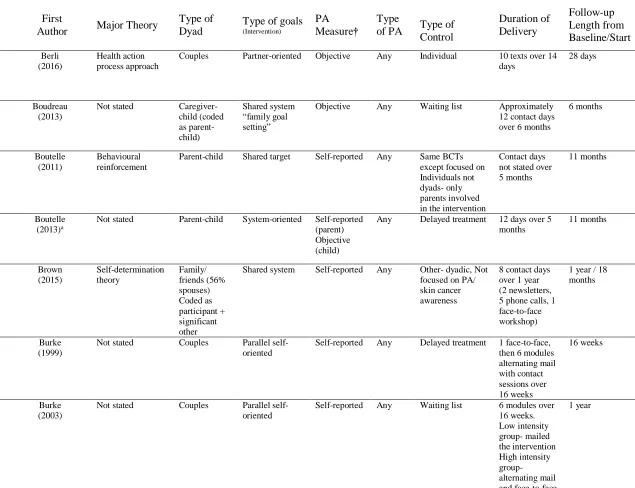
Numerous theoretical approaches have been applied to dyadic interventions (see Table A1,
Supplementary Materials 1). However, none of the applied theoretical approaches were developed
explicitly for dyads. In this review we use the Transactive Goal Dynamics theory (TGD), which;
Fitzsimons, Finkel, and vanDellen (2015), applied specifically to dyads. Alas, this theory can be
used to explain the types and processes by which PA and SB goals in dyad members are set and
pursued. As such, it provides a useful framework within which to synthesise the existing literature.
TGD theory adopts a relational perspective on “self-regulation”. Rather than conceptualizing
a given pair of individuals as two independent self-regulating agents, the theory identifies the dyad
as the regulating unit, with the partners as subunits of a single system of goal dynamics, a system in
which resources are shared. According to TGD, dyadic goal pursuit should become more effective
with increasing levels of transactive density (the extent to which the dyad members’ goals, pursuits
and outcomes are linked) as long as there is sufficient goal coordination (the extent to which the
dyad members’ goal pursuits facilitate each other). For example, if one dyad member is aiming to
run a marathon and their partner wants to lose weight, these goals are linked (thus they have high
transactive density) and the dyad members can run together to fulfil both their goals (good goal
coordination). Fitzsimons et al. (2015) identified seven types of dyadic goals: 1) shared
system-oriented goals (both members have the same goal for their own and for their partner’s outcomes; for
example, if the goal is to increase PA, both dyad members want for themselves and for each other to
increase their PA); 2) shared target-oriented goals (both dyad members have the same goal for one
person in the dyad); 3) system-oriented goals (one dyad member has the same goal for their own
and their partner’s outcomes); 4) parallel self-oriented goals (both dyad members have the same
their partner’s outcomes); 6) partner-oriented goals (one dyad member has a goal for their partner,
their partner does not have a goal for themselves); 7) self-oriented goals (one dyad member has a
goal for themselves).
According to the TGD theory, dyads sharing goals for the same target dyad member (shared
system-oriented and shared target-oriented goals) should have a smooth division of goal-related
effort, because both dyad members should be motivated to maximise goal-related outcomes, and
thus, they are more likely to effectively divide goal-related effort. Coordination is easier when
dyads agree about the desired outcomes for each partner. In line with TGD theory, interventions that
encourage dyads to create shared system-oriented and shared target-oriented type-goals should be
more effective in increasing PA than interventions that encourage dyads to create parallel
self-oriented, parallel partner-self-oriented, system-self-oriented, partner-self-oriented, or self-oriented type-goals.
TGD theory also indicates that the extent to which dyads are dedicated to the relationship
can also influence goal coordination, with stronger dedication enhancing goal coordination. Given
that under high levels of goal coordination transactive density improves goal outcomes (Fitzsimons
et al., 2015), stronger relationship dedication should also increase goal outcomes. According to the
TGD theory, a dense transactive system (e.g., developed after many years of marriage), results in
the dyad’s goals and pursuits being interdependent. In such a system, there are diverse, frequent,
and strong effects of dyads on each individual’s goals, pursuits, and outcomes. Thus, interventions
that target dyads with a strong bond, that is a dense transactive system (e.g., close family members,
very close friends), are more likely to be effective than dyads with a weaker bond (e.g., work
colleagues), as long as goal coordination is sufficient. In corroboration of this hypothesis, there is
evidence suggesting that a person’s PA is associated with close others (i.e. their romantic partners
2011). Such evidence is in line with research showing that health behaviours are concordant across
couples (Arden-Close & McGrath, 2017) and if a partner adopts a healthier behaviour, the other
partner is more likely to make a positive health behaviour change (Jackson, Steptoe, & Wardle,
2015).
The Present Review
The overarching goal of this study was to conduct the first systematic review and
meta-analysis of dyadic interventions aiming to increase PA via a randomised controlled trial design on
PA and SB outcomes. We tested the effect of dyadic interventions against different types of control
conditions including, importantly, interventions utilising the same behaviour change techniques
(Michie et al., 2011) but focusing on individuals as opposed to dyads. We also examined the type of
goals manipulated within the intervention (using TGD theory to categorise such goals) as well as the
type of relationship between the dyad members. In keeping with the basic tenets of TGD, we
hypothesised that: 1) dyadic interventions would increase PA and reduce SB more than non-dyadic
interventions; 2) dyadic interventions will be most effective if dyads have the same goal for the
same target dyad member (shared system-oriented and shared target-oriented goals); and 3) dyadic
interventions targeting dyads with a close bond (e.g., long-term partners, close friends) would yield
larger effects than interventions targeting dyads with weaker bonds (e.g., participants assigned a
role model). There is a risk that the effects of seemingly important moderators may be confounded
(Peters, de Bruin, & Crutzen, 2015), thus we adopted an approach used in recent reviews (e.g.,
Caperon et al., in press; Prestwich et al., 2014, 2016) to address this issue. Specifically, the
robustness of these moderator effects was examined via a series of sensitivity analyses which a)
removed study outliers; and c) combined the effect sizes for the participants who were the main
target of the intervention with the effect sizes for their study partner (if available).
Method
We conducted a systematic search across three databases MEDLINE, PsycINFO, and
Web of Science (limited to studies published from 1996 onwards as that was the earliest date
available in the Medline database). The review protocol was published in the International
Prospective Register of Systematic Reviews, and can be accessed from
http://www.crd.york.ac.uk/PROSPERO/display_record.asp?ID=CRD42016038231.
Inclusion and Exclusion Criteria
Patient, population or problem. Studies were included if they tested a dyadic
intervention to increase PA. Studies were excluded if one member of the dyad was a health
professional instructing the other member. There were no restrictions on the age of the
participants, setting, or location of the study.
Intervention or exposure. Studies were included if they randomised participants to an
experimental group or a control group. Systematic reviews of randomised trials are the ‘gold
standard’ for judging whether a treatment does more good than harm (Sackett, Rosenberg,
Gray, Haynes, & Richardson, 1996).
Comparison. The only restriction was that the comparison could not be an equivalent
dyadic intervention aimed at PA promotion. Dyadic interventions in which the comparison
group(s) were allocated to another dyadic intervention (not focused on PA) were included.
Outcome. Studies were included if they assessed PA post-intervention. Studies which
measured SB in addition to PA were also included. Studies were excluded if relevant PA
authors did not respond to two requests for further information. If studies did report outcome
data but did not report relevant statistical information to calculate effect sizes, they were
included in the qualitative synthesis but not in the meta-analysis. The included studies had to
have a quantitative methodology.
Studies were only included if they were published in the English language.
Search Strategy
A search strategy was developed, with three groups of search terms based around a)
randomised controlled trials (Baker, Francis, Soares, Weightman, & Foster, 2015); b) dyads
(Brandão, Schulz, & Matos, 2014; Park, Tudiver, & Campbell, 2012); and c) PA (Baker et
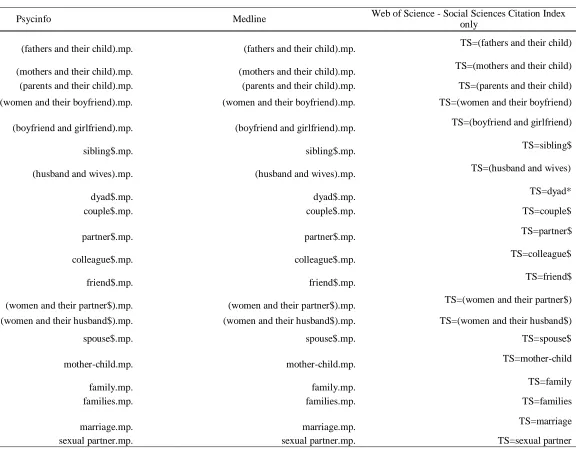
al., 2015); see Supplementary Material 2. The search was conducted by the lead author
between May 26th 2016-June 2nd 2016 and updated on December 7th 2017. Additional studies
were identified via searches of reference lists of included studies and from reading journal
articles. The ‘grey’ literature search included contacting the corresponding authors of
included studies for any unpublished data on the same topic (no additional studies were
identified) and through locating full texts of dissertation abstracts listed in the databases (six
additional studies were found).
Data Extraction
The type of dyad for each study was coded into 6 different types – parent and child,
peers/friends, romantic couples, participant and any significant other (i.e., no set criteria for
who that significant other had to be), participant and a personal carer, or participant and a
confederate. The types of goals were coded according to the TGD theory. As none of the goals
reported in the studies were explicitly categorised using the TGD framework, two coders
presented in the text. For instance, when the text suggested that both dyad members had the
same goal but they were not interdependent and each partner was not requested to support the
other, the type of goal was coded as ‘parallel self-oriented’. Both the type of dyad and type of
goals analyses were pre-specified in the review protocol. The major theory underpinning each
study, the type of control group, duration of intervention delivery and follow-up, type of PA –
strength, walking, bike or any activity (i.e., no mention of a specific PA), were coded for each
study. Some samples engaged in more than one type of exercise (e.g. aerobic-strength) and
were allocated into a ‘combined PA’ group. Measures of physical functioning (e.g.,
difficulties in bathing/showering), mobility (e.g., gait), fitness (e.g., O2max) and light PA were not coded. SB (e.g., time spent watching screens/sitting) was included as a secondary outcome
measure.
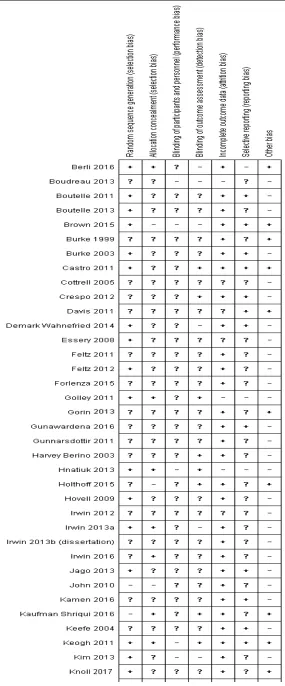
Two raters judged the methodological quality of the included studies as either
high/unclear (1) or low bias (2) on seven dimensions of bias (Higgins et al., 2011; see Figure
A1, Supplementary Materials 3). Studies rated as having ‘high’ or ‘unclear’ bias were
combined into one category and then compared with the ‘low’ category, as described in the
Cochrane Collaboration guidelines (Higgins & Green, 2011). A random number generator was
utilized to select 40% of the studies (24 studies) from the initial search for double coding for
the risk of bias (non-blind). Following the example of Kwasnicka, Presseau, White and
Sniehotta (2013), the first 20% of coding was deemed appropriate as a test round to
operationalise and check consistency in applying the criteria. Following the test round,
agreement between two coders on the next 20% of studies was almost perfect (Cohen’s Kappa
= .82). With regard to the coding of moderators, the moderators of the type of goal and type of
judgements), as we had specific hypotheses for those and they were of central focus to the
study. All other moderators were coded by one reviewer.
Meta-Analysis Strategy
Effect sizes (Hedges’s g) for a random-effects model were calculated for each study
using the Comprehensive Meta-Analysis Software (Version 3, Borenstein, Hedges, Higgins,
& Rothstein, 2015). Wherever possible, the effect sizes were calculated based on the
post-baseline means and standard deviations rather than scores reflecting change from post-baseline to
follow-up, as the latter are not independent of each other (Cuijpers, Weitz, Cristea, & Twisk,
2017). When authors did not report analyses accounting for clustering either within the dyad
or within larger clusters (i.e., within cluster randomised controlled trials), corrections were
applied by calculating effective sample sizes (when effect sizes were based on means and
standard deviations or proportions) or inflating standard errors of the effect sizes (e.g., when
effect sizes were based on p-values) based on the larger cluster (see Higgins & Green, 2011).
The moderator analyses were conducted using meta-regression in STATA (Version 13.1,
Statacorp, 2013). The I2 statistic was used to describe the percentage of variation across
studies attributable to heterogeneity rather than chance.
Dealing with multiple intervention groups. If studies included multiple dyadic
interventions for PA, all such interventions were included in the analysis. To ensure
independence of participants, the number of intervention group participants was divided by
the number of interventions (Borenstein, Hedges, Higgins, & Rothstein 2009). This method
was also applied when two comparison groups (e.g., an individual-level intervention and a
Sensitivity Analyses. Sensitivity analyses were conducted to establish the degree to
which the key findings were robust when (a) significant moderators were co-varied; (b)
outliers were removed; and (c) data were included for participants who were not the main
target of the intervention. The Sample-Adjusted Meta-analysis Deviance (SAMD) statistic
(Huffcut & Arthur, 1995) was calculated to produce a scree plot which was used to detect
outlier studies. Egger, Smith, Schneider, and Minder’s (1997) test of funnel plot asymmetry
and trim and fill analyses assessed publication bias.
Results
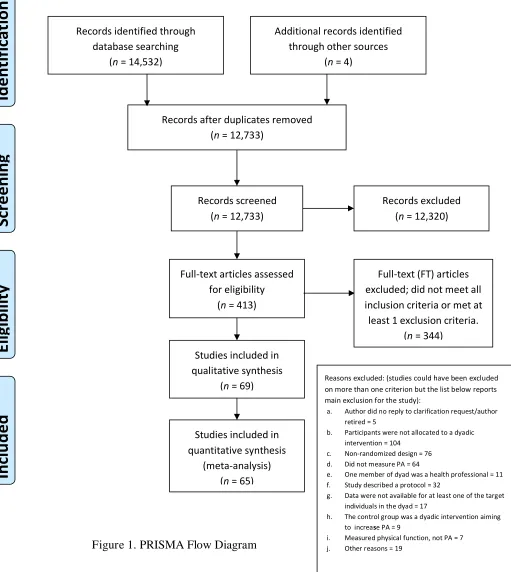
In total, 14,532studies were identified via the search terms, of which 413 were
full-text screened. Of these, 69 studies were eligible, with 65 studies initially included in the
meta-analysis (k = 82 comparisons, see Figure 1). Throughout this paper k refers to the number of
comparisons. The studies by Boutelle et al. (2013), Holthoff et al. (2015) and Tymms et al.
(2016) were not meta-analyzed, as they did not provide sufficient statistical information to
allow their inclusion. The study by Gunnarsdottir, Sigurdardottir, Njardvik, Olafsdottir, and
Bjarnason (2011) was not meta-analyzed as the authors pooled data from two independent
groups to increase statistical power and we did not have the data from each group.
Of the 65 included studies, 16 targeted participants with a current or previous health
issue, such as significant cardiac event (Sher et al., 2014), osteoarthritic knee pain (Keefe et
al., 2004), breast cancer (Demark-Wahnefried et al., 2014), stroke (Kim, Lee, & Kim, 2013)
or any type of cancer except squamous or basal cell skin cancers (Kamen et al., 2016); the
other 49 studies targeted participants without any history of significant illness. Forty-four
studies targeted healthy weight participants and 21 studies recruited overweight or obese
participants. The majority of comparisons (k = 38) targeted parent-child dyads and were
no-intervention or minimal intervention (e.g. received a book/newsletter; k = 26). The median
intervention duration of the 65 studies was 84 days, hence, intervention duration of 84 days or
longer was classified as “longer”, whereas duration of less than 84 days was deemed as
“shorter”. The majority of studies had low risk of bias relating to random sequence generation
(62%) and incomplete outcome data (83%). Most studies had high or unclear risk of bias
pertaining to lack of: allocation concealment (72%), blinding of participants and personnel
(97%), blinding of outcome assessors (68%), selective outcome reporting (71%), and other
risks of bias (60%) (see Figure A1, Supplementary Materials 3).
Effects of Dyadic Interventions on PA and SB
Comparisons that included a confederate within the dyad for the experimental group
(an actor playing the role of an exercise partner) (k = 10, g = 1.05) produced much larger
effect sizes than comparisons that did not use a confederate in the experimental group (k = 72,
g = 0.20), B = 0.84, SE = 0.13, t = 6.53, p < .001. The confederate and non-confederate studies
were fundamentally different with 5 out of 6 (representing 9 of 10 comparisons) of the former
being lab-based studies, and all 6 testing the Köhler effect (i.e., how the presence of a superior
partner may increase motivation to exercise). Given the confederate studies also yielded
generally homogeneous effect sizes I2 = 31.8%, 2(9) = 13.19, p = .15, the 10 confederate
comparisons were excluded from all the analyses henceforth.
Following removal of the confederate studies, dyadic interventions were found to have
a small positive effect on PA, relative to control groups, g = 0.20, 95% CI [0.12 – 0.28], K =
72 comparisons (see Figure 2). However, there was significant heterogeneity, I2 = 61.5%,
Dyadic interventions targeting PA outperformed comparison conditions which: a)
comprised the same intervention techniques but targeted individuals, g = .17, k = 13, p = .01,
or b) reflected usual care, g = .32, k = 26, p < .001. Dyadic interventions targeting PA
performed marginally better (but the effect was not statistically significant) than comparison
groups which were dyadic but not directed at PA, g = .13, k = 14, p = .09. This effect was
similar when an extra comparison was added (Spouse assisted pain coping skills training +
exercise vs. Spouse assisted pain coping skills training from Keefe et al. 2004, which was
omitted from the main analyses because it only reported sufficient statistics to accurately
calculate effect sizes for 2 out of 3 outcomes; the effect size for the third outcome was
conservatively estimated as g = 0), g = .15, k = 15, p = .05. Dyadic interventions were not
meaningfully different from waiting list, g = .09, k = 16, p = .17, or miscellaneous, g = .06, k =
3, p = .61, comparison conditions.
Dyadic interventions also had a small positive effect, relative to comparison
conditions, on reducing SB (total SB and TV viewing), g = .19, 95% CI [0.10 - 0.28], k = 20.
Dyadic interventions outperformed waiting list, g = .22, k = 7, p = .049, and usual care, g =
.16, k = 8, p = .006, comparison groups. Dyadic interventions did not outperform dyadic
interventions not directed at PA, g = .22, k = 4, p = .17 or equivalent interventions targeting
individuals, g = .23, k = 1, p = .17, but the number of datasets for such comparisons was small.
As a consequence, such findings should be interpreted with caution and require more studies
for a more precise estimate of the effect sizes. Given the overall effect of dyadic interventions
on SB was homogeneous, I2 = 19.4%, 2(19) = 23.56, p = .21, no further moderator analyses
were conducted for this outcome.
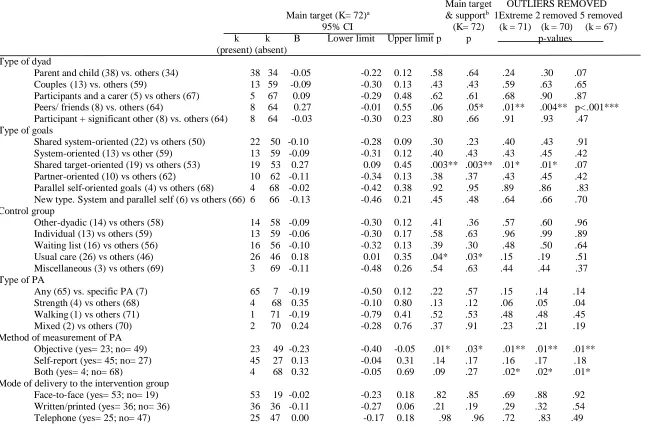
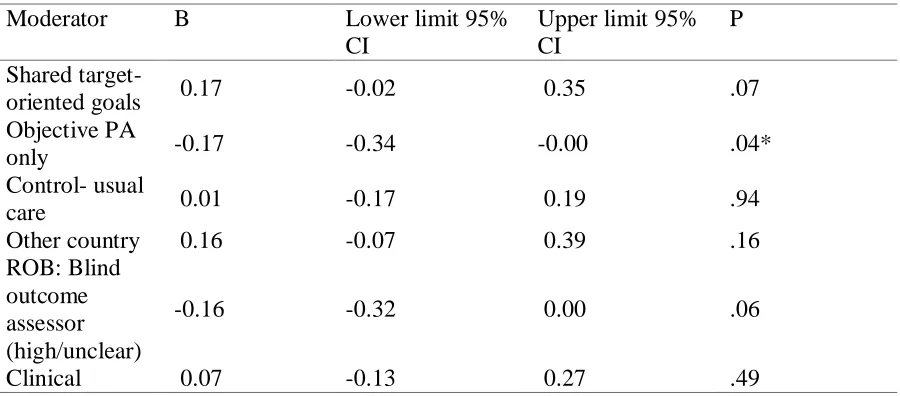
Type of goals. As shown in Table 1, shared target-oriented goals were associated with
significantly larger PA effect sizes than studies which manipulated other types of goals. Goals
which were shared system-oriented, system-oriented, partner-oriented or parallel self-oriented,
yielded similar effect sizes. Parallel partner-oriented goals and self-oriented goals were not
manipulated in any dyadic intervention condition.
Type of dyad. In the main analyses, the effect sizes did not significantly vary
depending as a function of the type of dyad. Specifically, comparisons that were based on
parents and child dyads, couples, participants and their carer/caregiver, or participants and a
significant other yielded similar effect sizes. Utilising Cafri, Kromfey, and Brannick’s (2009)
SAS macro we estimated the power for the type of dyad comparison to be .94. This gives
more reliability to our null findings, as high power reduces the probability of accepting a type
II error (i.e. accepting a false negative result). Effect sizes were marginally larger when based
on peers/friends and significantly larger in several of the sensitivity analyses.
Other moderators. Studies that targeted clinical samples, conducted outside
Australia/New Zealand, UK, Germany, US and Canada (labelled as ‘other countries’ and
comprised of studies conducted in Sri Lanka, Israel, Mexico, Korea and Iran, Switzerland,
Sweden, Ireland, Finland and the Netherlands), as well as studies that utilised a usual care
control group, were associated with larger effects. Studies that assessed PA using objective
measures only were associated with smaller effects, as were studies that had a non-blinded
outcome assessor or did not specify if this blinding occurred. None of the other moderators
were significantly associated with PA effect sizes (see Table 1).
(Please insert Table 1 here)
Controlling for the effect of other significant moderators. Shared target-oriented
goals produced marginally larger effects than dyadic interventions using other types of goals
from the TGD theory, even after controlling for the effects of other statistically significant
moderators in a multivariate meta-regression (see Table A3, Supplementary materials 4).
Studies that utilised shared target-oriented goals were more likely to be conducted outside the
UK, Germany, Australia, New Zealand, United States, and Canada, 2(1) = 11.37, Fisher’s p =
.002, and to be used within a greater proportion of studies targeting clinical populations, 2(1)
= 8.08, Fisher’s p = .01. A second multivariate meta-regression that co-varied only these 2
potential confounders resulted in a similar effect. Specifically, studies using shared
target-oriented goals produced marginally larger effects than studies that used other types of goals
(see Table A4, Supplementary materials 4).
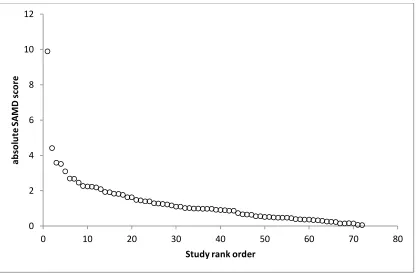
Outliers. Based on the scree-plot (see Figure 3), there was clearly 1 extreme outlier.
However, it was not clear whether there were 0, 1 or 4 additional outliers (i.e., 1, 2 or 5
outliers in total). Thus, we examined the impact of removing outliers under these three
scenarios (see Table 1). Across these 3 scenarios, the results were largely unchanged. In
particular, shared target-oriented goals significantly increased effect sizes when the single
extreme outlier was removed and when 2 outliers were removed (they marginally increased
effect sizes when 5 outliers were removed). Studies that targeted peer/friends produced larger
effects than studies targeting different types of dyad across all outlier analyses.
Data based on participants not targeted for behaviour change. The original
analysis was based on the effect sizes for participants who were the main target of the
intervention (in some instances, both members of the dyad were targeted equally). However,
not being the main target of the intervention. When the analyses were conducted including
these additional data and comparing the new results to the original effect sizes the results from
the moderator analyses remained largely unchanged. Aside from dyadic interventions
targeting peers/friends now yielding significantly larger effects, the other non-significant
moderators remained non-significant and all of the significant moderators remained
significant.
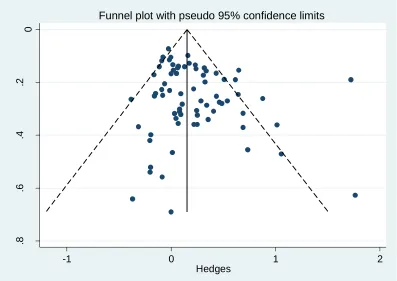
Tests for publication bias. A funnel plot was employed to test for publication bias
(see Figure 4). The funnel plot appears only somewhat symmetrical on visual inspection, and
the effect sizes from studies with larger standard errors appear only slightly more scattered
than for studies with more precise estimates of effect size. However, funnel plots can be
interpreted differently by different observers (Villar, Piaggio, Carroli, & Donner, 1997).
Consequently, Egger et al.’s (1997) test of funnel plot asymmetry was conducted and
indicated a modest risk of publication bias, Intercept B0 = 0.89, 95% CI [0.08 – 1.71], p = .03.
However, trim and fill analysis suggested that the effect of dyadic interventions on PA
remained significant when accounting for ‘missing studies’, g = 0.14, 95% CI [0.04 - 0.23]. In
addition, studies reported within dissertations generated similar sized effects compared to
studies published in peer reviewed journals B = 0.02, p = .93.
Discussion
The overarching goal of this study was, for the first time, to systematically review and
meta-analyse dyadic randomised controlled interventions aiming to increase PA or reduce SB.
Sixty nine randomised controlled trials were eligible, with 59 studies included in the final set
of meta-analyses generating 72 comparisons. Drawing from the TGD theory (Fitzsimons et
PA will increase PA significantly more than participants not in a dyadic intervention, with
similar effects on reducing SB. We found some support for these predictions in that dyadic
interventions had on average a small positive effect on PA, and a similar sized, but
homogeneous, effect in reducing total SB and TV viewing. Importantly, dyadic interventions
outperformed interventions that targeted an individual when these conditions were otherwise
matched. In addition, studies testing dyadic interventions targeting clinical populations
generated larger effect sizes than studies testing dyadic interventions targeting non-clinical
populations.
With regard to the type of goal, although it was predicted that shared goals (shared
system-oriented and shared target-oriented) would generate larger effects than non-shared
goals, only shared target-oriented goals produced larger effect sizes, compared to non-shared
target-oriented goals. This comparison remained significant even after controlling for other
significant moderators. This finding was surprising as it was anticipated that these types of
goals would be equally beneficial. Our expectation was based on the hypothesis that dyads
sharing goals for the same target should facilitate smooth division of goal-related effort as
both parties should be motivated to maximise outcomes, and thus, would be more likely to
divide the task effectively. However, it appears that setting goals for both partners to increase
PA may not always be effective. Possible reasons for this finding are that generating these
types of goals may reduce the number of appropriate opportunities to act, or there may be
more barriers to performing these activities together rather than alone, or the reason (e.g., a
medical necessity) for increasing PA may only apply to one partner (see Benyamini, Ashery,
As well as proposing that the type of goal could influence dyadic outcomes, the TGD
theory also indicates that the type of dyad could also be a contributing factor. It has been
suggested by Fitzsimons et al. (2015) that dyads which have a close bond/ high transactive
density (e.g., couples) have diverse, frequent, and strong effects on each other’s goals,
pursuits, and outcomes. Whether these strong effects are positive or negative on goal success
is dependent on the level of goal coordination, which itself is influenced by the type of goal
and goal responsiveness (Fitzsimons & Finkel, in press). Goal responsiveness is higher when
partners provide the appropriate level of support (i.e., high support when in need; low support
when there is low need) and when the support is not interpreted as pressurising (cf. Fitzsimons
& Finkel, in press). Perceptions of being pressured could be more likely in transactively dense
relationships, especially if they are asymmetric (e.g., parents-child). On the basis that
transactively dense relationships can promote goal success but also be hindering (e.g., in cases
where goal responsiveness is inadequate), it is perhaps not surprising that many of the types of
dyads produced similar effects. The exception was peer/friend dyads which yielded larger
effect sizes than other types of dyad. It may be that peers/friends, at least in the context of PA,
combine both the positive effects of relatively high interdependence with high levels of goal
responsiveness. Indeed, sociocultural and communication theories suggest people are more
receptive to assistance when it is delivered by someone of a similar age and background (see
Castro et al., 2011). Nevertheless, further research is needed to directly measure or manipulate
all of these constructs (interdependence, goal coordination, type of goal and goal
responsiveness) to establish their direct, moderating, and mediating roles in achieving goal
success. In the present review, we only measured the type of goal and inferred
coordination, see Tenet 4, Fitzsimons et al., 2015) based on the type of dyad. We assumed that
opportunity and motivation (the two key determinants of transactive density, Fitzsimons &
Finkel, in press), as well as relationship commitment, were likely to be higher for certain
dyads (e.g., romantic couples) than others (e.g., work colleagues).
With regard to romantic couples, there was no main effect on effect sizes (i.e., the
magnitude of effects of PA interventions targeting couples were similar in size as those
targeting other types of dyads). Perhaps in shorter periods of cohabitation, couples pursue
more solo activities and/or their goals are less well co-ordinated and thus, benefit equally from
individually tailored interventions as they do from dyadic interventions. As only 13
comparisons in the main analysis involved couple dyads, with little variation in their
cohabitation history, we did not test this hypothesis as a moderator. Future studies could
explore whether length of cohabitation influences the choice and effectiveness of different
types of couples-based interventions for PA promotion.
Regarding the larger effect sizes in studies targeting peer and friend dyads than studies
targeting different types of dyad, it should be noted that only six studies (yielding 8
comparisons) targeted peers or friends. In a relatively high proportion of these studies,
participants were allocated a PA role model/mentor and the participants were in their mid-50s
(Pinto, Stein, & Dunsiger, 2015; Ungar, Sieverding, Weidner, Ulrich, & Wiskemann, 2016) or
over 50 years old (Castro et al., 2011). It could be that older participants benefit more from
being allocated an exercise partner or mentor; however, this hypothesis warrants further
investigation. An alternative explanation is that, as 3 out of the 8 comparisons involved
participants setting shared target-oriented goals, the beneficial effects of the peer/friend dyad
effective than non-shared goals. Regarding the larger effect sizes in studies targeting dyads
from clinical populations than studies targeting dyads from non-clinical populations, this
seems to be consistent with TGD. In such populations, where there is a clinical need for
change, one may expect strong commitment to the PA goal for both dyadic members and,
hence, strong goal coordination (see Tenet 4 of the TGD, Fitzsimons et al., 2015) which aids
goal success.
It should be noted that six comparisons involved a type of goal which did not fit into
any of the TGD categories. The related studies involved one dyad member having a goal for
their partner to increase PA, while their partner was aiming to increase their own PA, but not
the activity of the other dyad member. There were no differences in effect sizes between this
discordant type of dyadic goal and the other types of goals.
There are several ethical and methodological issues to consider when designing and
testing dyadic interventions. First, several studies in our review involved asymmetric
relationships (e.g. parent-child, participants and a carer) raising issues as to whether both dyad
members were equally motivated and engaged in the intervention. While ensuring high goal
responsiveness is important, in line with TGD (Fitzsimons et al., 2015; Fitzsimons & Finkel,
in press), it is also important to promote amongst both members of a dyad self-determined
(autonomous) motivation for activity engagement, by fostering the three needs of autonomy
(having choice and pursuing activities that suit one’s values), competence (being able to
achieve mastery) and relatedness (feeling connected to other people) (Ryan & Deci, 2000).
Second, dyads are non-independent. Indeed, health behaviours are concordant across couples
(Arden-Close & McGrath, 2017; Jackson et al., 2015). Consequently, analysing the PA or SB
activity. The actor-partner interdependence model (Cook & Kenny, 2005) retains the
individual scores of participants, while treating them as being nested in a dyad. This allows for
the estimation of both individual and dyadic factors, taking into consideration that each person
influences the other. Such analysis should be used wherever possible in dyadic research.
However, none of the studies in our review use this approach. We attempted to account for
clustering following Cochrane guidelines although there appears to be no definitive rule as
how to adjust for clustering in dyadic interventions. Thus, there may be alternatives to our
approach.
Limitations and Future Research Directions
There are a number of potential limitations that need to be acknowledged. First, there
is a possibility that studies that should have been included in the review were omitted. Several
attempts were made to minimise this risk, including generating broad search terms based on
previous reviews, and utilising multiple databases, including dissertations. Second, there is a
risk that there were coding errors. To minimize this risk, key elements of the data extraction
(including effect size calculations) were double-checked by second coders. Third, given the
results of the Egger et al.’s test and trim and fill analyses, it is not possible for us to rule out
the possibility of publication bias. However, while the results of these analyses estimate the
likelihood of publication bias and its impact, there is some evidence supporting the possibility
of no publication bias: 1) there were no differences in effect sizes between studies reported in
dissertation versus journal articles; and 2) we contacted all corresponding authors of included
studies and none stated that they had any unpublished studies meeting the eligibility criteria.
There may be differences (e.g.., in terms of statistical significance or direction of group
which authors are not willing to share (see Prestwich et al., 2017). Pre-registering of protocols
and subsequent publication regardless of result is thus particularly warranted in future
research. Fourth, we did not code the behaviour change techniques (Michie et al., 2011) used
in the included studies. Future studies should explore whether certain behaviour change
techniques e.g., goal-setting (behaviour) are more effective when used amongst different types
of dyads who pursue different types of goals. Further research should also directly compare
interventions with shared target-oriented goals and interventions with shared system-oriented
goals and identify the reasons why such interventions may differ in terms of their impacts on
behaviour. While studies have compared dyadic interventions targeting PA against equivalent
interventions targeting individuals, we are unaware of any studies that compare dyadic PA
interventions against equivalent PA interventions targeting larger groups (i.e, more than 2
members). Finally, only 16 studies provided separate data on SB that could be included in the
meta-analysis, thus there is scope for more empirical research in this area.The number of
studies for each moderator comparison was small, such findings, particularly those for SB,
should be interpreted with caution and require more studies for a more precise estimate of the
effect sizes. Our review focused on dyadic interventions that aimed to promote PA, and in
some cases, to reduce SB. Future interventions could utilize a dyadic design focusing on SB
only and testing the effects of different strategies to reduce it (Manini et al., 2015).
Study Implications and Conclusions
We found that dyadic interventions had a small, positive effect on PA, even when
compared against equivalent interventions targeting individuals. Given this, and the possibility
that positive PA or SB changes in one dyadic member could induce positive changes in the
such interventions (relative to those targeting individuals) should be compared, along with
their acceptability, to further ascertain the feasibility of such approaches. Shared
target-oriented goals produced larger effect sizes than non-shared target-target-oriented goals. This finding
suggests it might be more effective to target one person and encourage their partner to support
them to increase PA, ensuring they both hold the same PA goal for the main target. There was
also some evidence that dyads comprising peers/friends may be particularly effective but this
effect could have been confounded with the effect of shared target-oriented goals. Dyadic
interventions produced a small and homogeneous reduction in SB. In conclusion, utilizing a
dyadic based approach to behaviour change is a promising research area, thus, we hope that
Figure 1. PRISMA Flow Diagram
Studies included in quantitative synthesis
(meta-analysis) (n = 65)
Records excluded (n = 12,320) Records screened
(n = 12,733)
Records after duplicates removed (n = 12,733)
Id
e
n
ti
fi
ca
ti
o
n
E
li
g
ib
il
it
y
In
cl
u
d
e
d
S
cr
e
e
n
in
g
Additional records identified through other sources
(n = 4) Records identified through
database searching (n = 14,532)
Full-text articles assessed for eligibility
(n = 413)
Full-text (FT) articles excluded; did not meet all inclusion criteria or met at least 1 exclusion criteria.
(n = 344) Studies included in
qualitative synthesis
(n = 69) Reasons excluded: (studies could have been excluded on more than one criterion but the list below reports main exclusion for the study):
a. Author did no reply to clarification request/author retired = 5
b. Participants were not allocated to a dyadic intervention = 104
c. Non-randomized design = 76 d. Did not measure PA = 64
e. One member of dyad was a health professional = 11 f. Study described a protocol = 32
g. Data were not available for at least one of the target individuals in the dyad = 17
h. The control group was a dyadic intervention aiming to increase PA = 9
Figure 2. Continued… Knowlden (2015) Lowery (2014) Maddison (2014) Marmo (2013) Marquez (2013) Martinez-Andrade (2014) Minneboo (2017) Morrison (2013) O'Connor (2013) Ostbye (2012)
Pakpour (2015) MI + parent vs control Pakpour (2015) MI + parent vs MI without Pinto (2015)
Pisu (2017)
Prestwich (2012) II + partner vs control Prestwich (2012) Partner vs control Prestwich (2012) II + partner vs imps only Samuel-Hodge (2017) Santos (2014) Schneider (2013) Schwinn (2014) Sher (2014) Skouteris (2016)
Stark (2011) Launch-clinic Stark (2011) Launch-HV St George (2014) Teri (2003) Tuominen (2017) Ungar (2016) Van Allen (2015) Voils (2013) Werch (2008) Wesson (2013) Williamson (2005) Winters-Stone (2016) Yates (2015)
Grand Total Effect Size
Berli (2016) Dyadic vs Individual action control Boudreau (2013)
Boutelle (2011) Brown (2015) Burke (1999)
Burke (2003) High intensity Burke (2003) Low intensity Castro (2011)
Cottrell (2005)
Crespo (2012) Family+ community vs control Crespo (2012) Family-only vs control
Crespo (2012) Family+ community vs community-only Davis (2011)
Demark-Wahnefried (2014) Individual Demark-Wahnefried (2014) Team Essery (2008) Booklet
Essery (2008) Newsletter Golley (2011) P + DA Golley (2011) P Gorin (2013) Gunawardena (2016) Harvey-Berino (2003)
Hnatiuk (2013) / Campbell (2013) Hovell (2009)
Irwin (2016) Group: high Irwin (2016) Group: low Irwin (2016) Standard Jago (2013)
John (2010) Kamen (2016)
Kaufman-Schriqui (2016)
Keefe (2004) Spouse assisted CST+ exercise vs control Keogh (2011)
Kim (2013)
Knoll (2017) Dyadic vs control Knoll (2017) Dyadic vs individual
Figure 2. Effect size distribution of dyadic interventions for promoting PA.
Figure 3. Scree plot indicating study outliers based on the SAMD statistic
0 2 4 6 8 10 12
0 10 20 30 40 50 60 70 80
a
b
so
lu
te
S
A
M
D
s
co
re
Figure 4. Funnel plot to determine publication bias in the included studies
0
.2
.4
.6
.8
-1 0 1 2
Hedges
Table 1
Meta-Regressions Showing Moderators of the Effect of Dyadic Interventions on PA
Main target OUTLIERS REMOVED
Main target (K= 72)a & supportb 1Extreme 2 removed 5 removed
95% CI (K= 72) (k = 71) (k = 70) (k = 67)
k k B Lower limit Upper limit p p p-values
(present) (absent) Type of dyad
Parent and child (38) vs. others (34) 38 34 -0.05 -0.22 0.12 .58 .64 .24 .30 .07
Couples (13) vs. others (59) 13 59 -0.09 -0.30 0.13 .43 .43 .59 .63 .65
Participants and a carer (5) vs others (67) 5 67 0.09 -0.29 0.48 .62 .61 .68 .90 .87
Peers/ friends (8) vs. others (64) 8 64 0.27 -0.01 0.55 .06 .05* .01** .004** p<.001***
Participant + significant other (8) vs. others (64) 8 64 -0.03 -0.30 0.23 .80 .66 .91 .93 .47
Type of goals
Shared system-oriented (22) vs others (50) 22 50 -0.10 -0.28 0.09 .30 .23 .40 .43 .91
System-oriented (13) vs other (59) 13 59 -0.09 -0.31 0.12 .40 .43 .43 .45 .42
Shared target-oriented (19) vs others (53) 19 53 0.27 0.09 0.45 .003** .003** .01* .01* .07
Partner-oriented (10) vs others (62) 10 62 -0.11 -0.34 0.13 .38 .37 .43 .45 .42
Parallel self-oriented goals (4) vs others (68) 4 68 -0.02 -0.42 0.38 .92 .95 .89 .86 .83
New type. System and parallel self (6) vs others (66) 6 66 -0.13 -0.46 0.21 .45 .48 .64 .66 .70
Control group
Other-dyadic (14) vs others (58) 14 58 -0.09 -0.30 0.12 .41 .36 .57 .60 .96
Individual (13) vs others (59) 13 59 -0.06 -0.30 0.17 .58 .63 .96 .99 .89
Waiting list (16) vs others (56) 16 56 -0.10 -0.32 0.13 .39 .30 .48 .50 .64
Usual care (26) vs others (46) 26 46 0.18 0.01 0.35 .04* .03* .15 .19 .51
Miscellaneous (3) vs others (69) 3 69 -0.11 -0.48 0.26 .54 .63 .44 .44 .37
Type of PA
Any (65) vs. specific PA (7) 65 7 -0.19 -0.50 0.12 .22 .57 .15 .14 .14
Strength (4) vs others (68) 4 68 0.35 -0.10 0.80 .13 .12 .06 .05 .04
Walking (1) vs others (71) 1 71 -0.19 -0.79 0.41 .52 .53 .48 .48 .45
Mixed (2) vs others (70) 2 70 0.24 -0.28 0.76 .37 .91 .23 .21 .19
Method of measurement of PA
Objective (yes= 23; no= 49) 23 49 -0.23 -0.40 -0.05 .01* .03* .01** .01** .01**
Self-report (yes= 45; no= 27) 45 27 0.13 -0.04 0.31 .14 .17 .16 .17 .18
Both (yes= 4; no= 68) 4 68 0.32 -0.05 0.69 .09 .27 .02* .02* .01*
Mode of delivery to the intervention group
Face-to-face (yes= 53; no= 19) 53 19 -0.02 -0.23 0.18 .82 .85 .69 .88 .92
Written/printed (yes= 36; no= 36) 36 36 -0.11 -0.27 0.06 .21 .19 .29 .32 .54
Online/PC (yes= 10; no= 62) 10 62 0.00 -0.25 0.26 .97 .99 .97 .78 .76
Video (yes= 10; no= 62) 10 62 -0.06 -0.31 0.20 .66 .84 .32 .17 .34
Duration of delivery
Longer duration (longer= 41; shorter= 31) 41 31 0.11 -0.06 0.28 .19 .26 .26 .19 .16
Number of sessions
Multiple session (yes= 59; no= 13) 59 13 -0.00 -0.23 0.23 .999 .93 .91 .87 .90
Assessment periods compared
From baseline or the start to the follow-ups n/a n/a 0.00 -0.00 0.00 .61 .54 .59 .51 .47
From end of intervention to the follow-ups n/a n/a -0.00 -0.00 0.00 .46 .57 .46 .46 .48
Clinical population or non-clinical population
Clinical (yes= 17; no= 55) 17 55 0.22 0.02 0.42 .04* .05* .01** .01* .01**
The participants were overweight/obese†
Overweight/obese (yes= 25; no= 47) 25 47 0.02 -0.16 0.20 .84 .95 .46 .51 .51
ROB: randomization
High/unclear (25); low (47) 25 47 0.10 -0.08 0.28 .27 .25 .04* .03* .12
ROB: allocation concealment
High/unclear (49); low (23) 49 23 0.07 -0.11 0.25 .45 .46 .63 .67 .80
ROB: blinding of participants and personnel
High/unclear (70); low (2) 70 2 -0.12 -0.59 0.35 .61 .59 .63 .61 .66
ROB: blinding of outcome assessors
High/unclear (46); low (26) 46 26 -0.20 -0.37 -0.03 .02* .03* .04* .03* .01**
ROB: incomplete outcome da
High/unclear (12); low (60) 12 60 -0.07 -0.32 0.18 .58 .42 .58 .59 .53
ROB: selective outcome reporting
High/unclear (48); low (24) 48 24 -0.05 -0.23 0.13 .59 .60 .12 .09 .08
ROB: other bias
High/unclear (41); low (31) 41 31 0.05 -0.12 0.23 .53 .57 .15 .18 .47
Setting of the study
Australia/New Zealand (yes= 9; no= 63) 9 63 -0.14 -0.40 0.12 .28 .32 .20 .20 .16
UK/ Germany (yes= 9; no= 63) 9 63 -0.12 -0.36 0.13 .34 .43 .37 .38 .36
USA/ Canada (yes= 44; no= 28) 44 28 -0.04 -0.22 0.13 .62 .48 .71 .61 .20
Other (yes= 10; no= 62) 10 62 0.27 0.05 0.48 .02* .01* .17 .24 .71
References
*Studies which were also included in the meta-analysis or systematic review
Arden Close, E., & McGrath, N. (2017). Health behaviour change interventions for couples: A
systematic review. British Journal of Health Psychology, 22, 215-237. doi:10.1111/bjhp.12227 Baker, P.R., Francis, D.P., Soares, J., Weightman, A.L., & Foster, C. (2015). Community wide
interventions for increasing physical activity. Cochrane Database of Systematic Reviews, 1, CD008366. doi:10.1002/14651858.CD008366.pub3
Benyamini, Y., Ashery, L., & Shiloh, S. (2011). Involving husbands in their wives’ health behaviour:
Does it work? Applied Psychology: Health and Well-Being, 3, 66-86. doi:10.1111/j.1758-0854.2010.01041.x
Borenstein, M., Hedges, L.V., Higgins, J. P. T., & Rothstein, H. R. (2009). Introduction to meta-analysis. Chichester, UK: Wiley. doi:10.1002/9780470743386
Borenstein, M., Hedges, L., Higgins, J., & Rothstein, H. (2015). Comprehensive meta-analysis (Version 3). Englewood, NJ: Biostat.
*Boutelle, K. N., Norman, G. J., Rock, C. L., Rhee, K. E., & Crow, S. J. (2013). Guided self-help for the treatment of pediatric obesity. Pediatrics, 131, e1435-1442. doi:10.1542/peds.2012-2204 Brandão, T., Schulz, M. S., & Matos, P. M. (2014). Psychological intervention with couples coping
with breast cancer: A systematic review. Psychology & Health, 29, 491-516. doi:10.1080/08870446.2013.859257
*Brown, D. L., Conley, K. M., Sanchez, B. N., Resnicow, K., Cowdery, J. E., Sais, E., . . .
Morgenstern, L. B. (2015). A multicomponent behavioral intervention to reduce stroke risk factor behaviors: The stroke health and risk education cluster-randomized controlled trial. Stroke, 46, 2861-2867. doi:10.1161/STROKEAHA.115.010678
Burkert, S., Scholz, U., Gralla, O., Roigas, J., & Knoll, N. (2011). Dyadic planning of health-behavior change after prostatectomy: A randomized controlled planning intervention. Social Science & Medicine, 73, 783-792. doi:10.1016/j.socscimed.2011.06.016
Cafri, G., Kromrey, J. D., & Brannick, M. T. (2009). A SAS macro for statistical power calculations in meta-analysis. Behavior Research Methods, 41, 35-46. doi:10.3758/BRM.41.1.35
Caperon, L., Sykes-Muskett, B., Clancy, F., Newell, J., King, R., & Prestwich, A. (in press). How effective are interventions in improving dietary behaviour in low and middle income countries? A systematic review and meta-analysis. Health Psychology Review. doi:10.1080/17437199.2018.1481763
*Castro, C. M., Pruitt, L. A., Buman, M. P., & King, A. C. (2011). Physical activity program delivery by professionals versus volunteers: The TEAM randomized trial. Health Psychology, 30, 285-294. doi:10.1037/a0021980
Craft, L. L., & Perna, F. M. (2004). The benefits of exercise for the clinically depressed. Primary Care Companion to the Journal of Clinical Psychiatry, 6, 104-111. doi:10.4088/pcc.v06n0301 Cook, W. L., & Kenny, D. A. (2005). The actor–partner interdependence model: A model of
bidirectional effects in developmental studies. International Journal of Behavioral Development, 29, 101-109. doi:10.1080/01650250444000405
Cuijpers, P., Weitz, E., Cristea, I. A., & Twisk, J. (2017). Pre-post effect sizes should be avoided in meta-analyses. Epidemiology and Psychiatric Sciences, 26, 364-368.
doi:10.1017/S2045796016000809
Darlow, S. D., & Xu, X. (2011). The influence of close others’ exercise habits and perceived social
support on exercise. Psychology of Sport and Exercise, 12, 575-578. doi:10.1016/j.psychsport.2011.04.004
outcomes of a randomized controlled trial of weight loss in overweight mothers with breast cancer and their overweight daughters. Cancer, 120, 2522-2534. doi:10.1002/cncr.28761 Department of Health. (2017a). Research and statistics. Retrieved from
http://www.health.gov.au/internet/main/publishing.nsf/content/health-pubhlth-strateg-active-evidence.htm
Department of Health. (2017b). Sedentary behaviour. Retrieved from
http://www.health.gov.au/internet/main/publishing.nsf/content/sbehaviour Dyad. (n.d.). In Merriam-Webster’s online dictionary (11th ed.). Retrieved from
https://www.merriam-webster.com/dictionary/dyad
Egger, M., Smith, G. D., Schneider, M., & Minder, C. (1997). Bias in meta-analysis detected by a simple, graphical test. British Medical Journal, 315, 629-634. doi:10.1136/bmj.315.7109.629 Epstein, L. H., Paluch, R. A., Kilanowski, C. K., & Raynor, H. A. (2004). The effect of reinforcement or stimulus control to reduce sedentary behavior in the treatment of pediatric obesity. Health Psychology, 23, 371-380. doi:10.1037/0278-6133.23.4.371
Fitzsimons, G. M., & Finkel, E. J. (in press). Transactive goal dynamics theory: A discipline-wide perspective. Current Directions in Psychological Science. doi:10.1177/0963721417754199 Fitzsimons, G.M. Finkel, E.J. vanDellen, M.R. (2015). Transactive goal dynamics. Psychological
Review, 122, 648-673. doi:10.1037/a0039654
*Gunnarsdottir, T., Sigurdardottir, Z. G., Njardvik, U., Olafsdottir, A. S., & Bjarnason, R. (2011). A randomized-controlled pilot study of Epstein's family-based behavioural treatment for childhood obesity in a clinical setting in Iceland. Nordic Psychology, 63, 6-19. doi:10.1027/1901-2276/a000024
Higgins, J. P., Altman, D. G., Gøtzsche, P. C., Jüni, P., Moher, D., Oxman, A. D., ... & Sterne, J. A. (2011). The Cochrane Collaboration’s tool for assessing risk of bias in randomised
trials. British Medical Journal, 343, d5928. doi:10.1136/bmj.d5928
Higgins, J. P., & Green, S. (Eds.). (2011). Cochrane handbook for systematic reviews of interventions (Vol. 4). Chichester, UK: John Wiley & Sons.
*Holthoff, V. A., Marschner, K., Scharf, M., Steding, J., Meyer, S., Koch, R., & Donix, M. (2015). Effects of physical activity training in patients with alzheimer’s dementia: Results of a pilot RCT study. PloS One, 10, e0121478. doi:10.1371/journal.pone.0121478
Huffcutt, A. I., & Arthur, W., Jr. (1995). Development of a new outlier statistic for meta-analytic data. Journal of Applied Psychology, 80, 327-334. doi:10.1037/0021-9010.80.2.327
Jackson, S. E., Steptoe, A., & Wardle, J. (2015). The influence of partner's behavior on health behavior change: The English Longitudinal Study of Ageing. JAMA International Medicine, 175, 385-392. doi:10.1001/jamainternmed.2014.7554
Jago, R., Davison, K. K., Thompson, J. L., Page, A. S., Brockman, R., & Fox, K. R. (2011). Parental sedentary restriction, maternal parenting style, and television viewing among 10-to 11-year-olds. Pediatrics, 128, e572-e578. doi:10.1542/peds.2010-3664
*Kamen, C., Heckler, C., Janelsins, M. C., Peppone, L. J., McMahon, J. M., Morrow, G. R., . . . Mustian, K. (2016). A dyadic exercise intervention to reduce psychological distress among lesbian, gay, and heterosexual cancer survivors. LGBT Health, 3, 57-64.
doi:10.1089/lgbt.2015.0101
*Keefe, F. J., Blumenthal, J., Baucom, D., Affleck, G., Waugh, R., Caldwell, D. S., . . . Lefebvre, J. (2004). Effects of spouse-assisted coping skills training and exercise training in patients with osteoarthritic knee pain: A randomized controlled study. Pain, 110, 539-549.
*Kim, J. I., Lee, S., & Kim, J. H. (2013). Effects of a web-based stroke education program on recurrence prevention behaviors among stroke patients: A pilot study. Health Education Research, 28, 488-501. doi:10.1093/her/cyt044
*Knoll, N., Hohl, D. H., Keller, J., Schuez, N., Luszczynska, A., & Burkert, S. (2017). Effects of dyadic planning on physical activity in couples: A randomized controlled trial. Health Psychology, 36, 8-20. doi:10.1037/hea0000423
Kwasnicka, D., Presseau, J., White, M., & Sniehotta, F. F. (2013). Does planning how to cope with anticipated barriers facilitate health-related behaviour change? A systematic review. Health Psychology Review, 7, 129-145. doi:10.1080/17437199.2013.766832
Leahey, T. M., Crane, M. M., Pinto, A. M., Weinberg, B., Kumar, R., & Wing, R. R. (2010). Effect of teammates on changes in physical activity in a statewide campaign. Preventive Medicine, 51, 45-49. doi:10.1016/j.ypmed.2010.04.004
Leahey, T. M., Kumar, R., Weinberg, B. M., & Wing, R. R. (2012). Teammates and social influence affect weight loss outcomes in a team based weight loss competition. Obesity, 20, 1413-1418. doi:10.1038/oby.2012.18
Lewis, M. A., McBride, C. M., Pollak, K. I., Puleo, E., Butterfield, R. M., & Emmons, K.
M. (2006). Understanding health behavior change among couples: An interdependence and communal coping approach. Social Science and Medicine, 62, 1369-1380.
doi:10.1016/j.socscimed.2005.08.006
Manini, T. M., Carr, L. J., King, A. C., Marshall, S., Robinson, T. N., & Rejeski, W. J. (2015). Interventions to reduce sedentary behavior. Medicine and Science in Sports and Exercise, 47, 1306. doi:10.1249/MSS.0000000000000519
*Ostbye, T., Krause, K. M., Stroo, M., Lovelady, C. A., Evenson, K. R., Peterson, B. L., . . . Zucker, N. L. (2012). Parent-focused change to prevent obesity in preschoolers: Results from the KAN-DO study. Preventive Medicine, 55, 188-195. doi:10.1016/j.ypmed.2012.06.005 Park, E. W., Tudiver, F. G., & Campbell, T. (2012). Enhancing partner support to improve smoking
cessation. Cochrane Database of Systematic Reviews, 7, CD002928. doi:10.1002/14651858.CD002928.pub3
Peters, G. J., de Bruin, M., & Crutzen, R. (2015). Everything should be as simple as possible, but no simpler: towards a protocol for accumulating evidence regarding the active content of health behaviour change interventions. Health Psychology Review, 9, 1-14.
doi:10.1080/17437199.2013.848409
*Pinto, B. M., Stein, K., & Dunsiger, S. (2015). Peers promoting physical activity among breast cancer survivors: A randomized controlled trial. Health Psychology, 34, 463-472.
doi:10.1037/hea0000120
*Prestwich, A., Conner, M. T., Lawton, R. J., Ward, J. K., Ayres, K., & McEachan, R. R. (2012). Randomized controlled trial of collaborative implementation intentions targeting working adults' physical activity. Health Psychology, 31, 486-495. doi:10.1037/a0027672
Prestwich, A., Kellar, I., Conner, M., Lawton, R., Gardner, P. & Turgut, L. (2016). Does changing social influence engender changes in alcohol intake? A meta-analysis. Journal of Consulting and Clinical Psychology, 84, 845-860. doi:10.1037/ccp0000112
Prestwich, A., Kellar, I., Parker, R., MacRae, S., Learmonth, M., Sykes, B., . . . Castle, H. (2014). How can self-efficacy be increased? Meta-analysis of dietary interventions. Health Psychology Review, 8, 270-285. doi:10.1080/17437199.2013.813729
Ryan, R. M., & Deci, E. L. (2000). Self-determination theory and the facilitation of intrinsic motivation, social development, and well-being. American Psychologist, 55, 68-78. doi:10.1037/0003-066X.55.1.68
Sackett, D. L., Rosenberg, W. M., Gray, J. M., Haynes, R. B., & Richardson, W. S. (1996). Evidence based medicine: What it is and what it isn't. BMJ, 312, 71-72. doi:10.1136/bmj.312.7023.71 Scholz, U., & Berli, C. (2014). A Dyadic Action Control Trial in Overweight and Obese Couples
(DYACTIC). BMC Public Health, 14, 1321. https://doi.org/10.1186/1471-2458-14-1321 *Sher, T., Braun, L., Domas, A., Bellg, A., Baucom, D. H., & Houle, T. T. (2014). The Partners for
Life program: A couples approach to cardiac risk reduction. Family Process, 53, 131-149. doi:10.1111/famp.12061
StataCorp. (2013). Stata statistical software: Release 13. College Station, TX: StataCorp LP. *Tymms, P. B., Curtis, S. E., Routen, A. C., Thomson, K. H., Bolden, D. S., Bock, S., . . . Kasim, A.
S. (2016). Clustered randomised controlled trial of two education interventions designed to increase physical activity and well-being of secondary school students: The MOVE Project. Bmj Open, 6, e009318. doi:10.1136/bmjopen-2015-009318
*Ungar, N., Sieverding, M., Weidner, G., Ulrich, C. M., & Wiskemann, J. (2016). A self-regulation-based intervention to increase physical activity in cancer patients. Psychology, Health & Medicine, 21, 163-175. doi:10.1080/13548506.2015.1081255
Villar, J., Piaggio, G., Carroli, G., & Donner, A. (1997). Factors affecting the comparability of meta-analyses and largest trials results in perinatology. Journal of Clinical Epidemiology, 50, 997-1002. doi:10.1016/S0895-4356(97)00148-0
Warburton, D. E. R., Charlesworth, S., Ivey, A., Nettlefold, L., & Bredin, S. S. D. (2010). A
systematic review of the evidence for Canada’s physical activity guidelines for adults.
Warburton, D. E. R., Nicol, C., & Bredin, S. S. (2006). Health benefits of physical activity: the evidence. Canadian Medical Association Journal, 174, 801-809. doi:10.1503/cmaj.051351 Wood, L., Jago, R., Sebire, S. J., Zahra, J., & Thompson, J. L. (2015). Sedentary time among spouses:
a cross-sectional study exploring associations in sedentary time and behaviour in parents of 5 and 6 year old children. BMC Research Notes, 8, 787. doi:10.1186/s13104-015-1758-8 *Winters-Stone, K. M., Lyons, K. S., Dobek, J., Dieckmann, N. F., Bennett, J. A., Nail, L., & Beer, T.
M. (2016). Benefits of partnered strength training for prostate cancer survivors and spouses: results from a randomized controlled trial of the Exercising Together Project. Journal of Cancer Survivorship, 10, 633-644. doi:10.1007/s11764-015-0509-0