Unless otherwise indicated, the views expressed are attributable only to the authors in a personal capacity and not to any institution with which they are associated.
ISBN 92-9079-535-2
Available for free downloading from the CEPS website (http://www.ceps.be) © Copyright 2004, Karel Lannoo and Almudena de la Mata Muñoz
Thinking ahead for Europe
Integration of the EU Consumer
Credit Market
Proposal for a More Efficient
Regulatory Model
Karel Lannoo and Almudena de la Mata Muñoz
Abstract
Since the adoption of the current Consumer Credit Directive 87/102/EC in 1986, the EU consumer credit market has changed significantly in terms of size and structure. Although amendments were introduced in 1990 and 1999, the Directive no longer addresses the market’s needs. Cross-border lending in the EU has been estimated to be only 2 to 5% of total EU lending, partly owing to variations in the applicable legislation across member states. The reason for the persistent legal differences is that the current regulatory model is based on a minimum harmonisation approach (together with the rules of Art. 5 of the Rome Convention) and national regulators have different perspectives concerning consumer protection.
To move towards greater consistency, the Commission sought to change the regulatory approach from minimum to total harmonisation in its proposed new Consumer Credit Directive. Yet this regulatory method presents several difficulties. The EU legislative process is too long and rigid for a fast-changing market. Further, member states do not wish to lose regulatory powers on issues that may need rapid adaptations to meet social or economic needs.
This paper argues that one way forward is to draw from the experience of the strategies used to achieve integration of EU financial markets and adapt it to the field of consumer credit. A variation of the Lamfalussy approach, in which comitology procedures are used in the legislative process, would radically improve the regulatory process for consumer credit. By involving the member states to a greater extent and allowing for quick adaptations, such an approach would ultimately lead to a greater level of market integration.
Karel Lannoo is CEPS Chief Executive and head of the Financial Markets research programme. Almudena de la Mata Muñoz is a CEPS research fellow responsible for the management of ECRI and a lecturer at Humbolt University in Berlin.
Policy
Introduction ... 2
1. The need to achieve an integrated EU consumer credit market... 2
1.1 Lack of market integration ... 2
1.2 Reasons for seeking market integration ... 3
2. Obstacles to integration ... 4
3. Harmonising EU consumer credit legislation: Improving the effectiveness of the regulatory process ... 6
3.1 The general competence of the EU to harmonise consumer credit laws... 6
3.2 Using the total harmonisation approach in EU directives as the method to achieve legal harmonisation ... 7
3.3 Difficulties in the application of total harmonisation... 8
Practical difficulty: Finding one common law for a very heterogeneous market... 8
Cultural difficulty: Total harmonisation downplays local traditions... 10
Legal difficulty: The competence to regulate consumer protection through market integration... 10
Modifying lobbying activities... 11
European legislation: Lengthy law-making procedures for a fast-moving market.. 11
3.4 An alternative way to achieve legal harmonisation: The Lamfalussy approach... 11
4. Conclusions ... 15
| 2
C
ONSUMER
C
REDIT
M
ARKET
PROPOSAL FOR A MORE EFFICIENT
REGULATORY MODEL
CEPS
W
ORKING
D
OCUMENT
N
O
.
213/N
OVEMBER
2004
K
AREL
L
ANNOO AND
A
LMUDENA DE LA
M
ATA
M
UÑOZ
Introduction
A new legal framework for consumer credit is needed in the EU. Since the adoption of the current Consumer Credit Directive 87/102/EC in 1986, the EU consumer credit market has changed significantly in terms of size and structure. Although amendments were introduced in 1990 and 1999, the Directive no longer addresses the market’s needs.
Further, integration of the EU consumer credit market across borders has not been achieved. Cross-border lending in the EU has been estimated to be only 2 to 5% of total EU lending. One of the reasons for this lack of integration is the difference in the national legislation that applies to consumer credit in the EU member states. In this respect, we argue that the achievement of a single consumer credit market in the EU requires the harmonisation of national laws on consumer credit.
We also present the key changes that must be introduced into the EU regulatory process to accomplish the legal harmonisation needed for an integrated consumer credit market in the longer term. The use of comitology procedures for regulation in the field of consumer credit could introduce a high level of flexibility and the capacity to react quickly to market needs. As member states could contribute actively to the legislative process, an increasing level of legal harmonisation would thus be more easily achieved.
1. The need to achieve an integrated EU consumer credit market
1.1
Lack of market integrationEuropean consumer credit markets are far from being integrated (Mopa, 2003, p. 6). The picture of consumer credit in the EU today is that of a segmented market with almost insignificant cross-border activity. This fact is derived from different integration indicators: interest differentials, price differentials, the provision of cross-border credit and the expansion behaviour of banks (Jentzsch, 2003, p. 6). According to available data, cross-border consumer lending in the EU is still in its infancy, estimated to be between 2 and 5% of consumer loans in 2002.1
The lack of cross-border lending is not owing to a lack of interest by the industry to expand into new national markets. In the last few years, banks have shown an increasing
determination to operate in foreign markets.2 Yet the way to enter these markets has not been
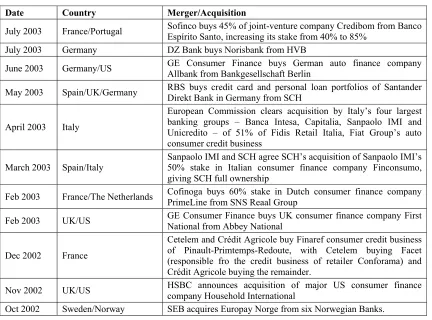
[image:4.612.93.525.149.469.2]through cross-border lending but by establishing branches, creating networks or instigating joint-ventures, mergers or acquisitions of foreign banks (Table 1).3
Table 1. Examples of mergers and acquisitions
Date Country Merger/Acquisition
July 2003 France/Portugal Sofinco buys 45% of joint-venture company Credibom from Banco Espírito Santo, increasing its stake from 40% to 85%
July 2003 Germany DZ Bank buys Norisbank from HVB
June 2003 Germany/US GE Consumer Finance buys German auto finance company Allbank from Bankgesellschaft Berlin
May 2003 Spain/UK/Germany RBS buys credit card and personal loan portfolios of Santander Direkt Bank in Germany from SCH
April 2003 Italy
European Commission clears acquisition by Italy’s four largest banking groups – Banca Intesa, Capitalia, Sanpaolo IMI and Unicredito – of 51% of Fidis Retail Italia, Fiat Group’s auto consumer credit business
March 2003 Spain/Italy
Sanpaolo IMI and SCH agree SCH’s acquisition of Sanpaolo IMI’s 50% stake in Italian consumer finance company Finconsumo, giving SCH full ownership
Feb 2003 France/The Netherlands Cofinoga buys 60% stake in Dutch consumer finance company PrimeLine from SNS Reaal Group
Feb 2003 UK/US GE Consumer Finance buys UK consumer finance company First National from Abbey National
Dec 2002 France
Cetelem and Crédit Agricole buy Finaref consumer credit business of Pinault-Primtemps-Redoute, with Cetelem buying Facet (responsible fro the credit business of retailer Conforama) and Crédit Agricole buying the remainder.
Nov 2002 UK/US HSBC announces acquisition of major US consumer finance company Household International
Oct 2002 Sweden/Norway SEB acquires Europay Norge from six Norwegian Banks.
Note: Mergers and acquisitions may take several months from announcement to completion (or not) and then
integration. A precise merger date is therefore not always possible. In most cases, the date given above is the date of the merger announcement.
Source: BankEcon (2003).
1.2
Reasons for seeking market integrationThe achievement of an EU internal market is one of the essential foundations of the European Union. Reflecting the construction of Europe in the broadest sense, the idea of unifying the
2 For instance, French banks (Cetelem, Cofinoga and Sofinco) have become particularly strong in southern,
Central and Eastern Europe. Barclays Bank has issued a credit card in Germany, France, Greece, Italy and Spain. Another example is SCH in Spain, Germany, Italy and Portugal with CC Bank and Finconsumo in Italy. RBS owns Comfort Card, which also operates in Austria, Belgium and Germany, and recently acquired the credit card and personal loan portfolio of Santander Direkt Bank in Germany from SCH. The US lenders Citigroup and CE consumer finance have been very active in several European markets (Belgium, Germany, Greece, Poland, Spain and the UK).
3 For a list of recent mergers and acquisitions as well as joint ventures in the field of EU consumer credit, see
internal markets ties in with the objective of economic and political integration.4 In this
context, the achievement of a functioning internal consumer credit market needs to be considered as an ongoing objective of the EC, as stated in Art. 14 of the EC Treaty,5since it has not yet been accomplished. For this purpose, the obstacles to market integration in the field need to be identified and eliminated using the measures foreseen in the EC Treaty (Art. 3 of the EC Treaty).
Further, a benefit of market integration in any field is the increase of competition, which translates into better conditions for consumers. The achievement of a functioning, single consumer credit market would enable all lenders to borrow directly throughout the EU, facilitating the full exploitation of the EU market, a better allocation of resources and a better response to the needs of a very heterogeneous market in terms of size and structure. The level of competition would thereby increase, which would lead to a reduction of costs and the extension of consumers’ choices.6
2. Obstacles to integration
The reason for the lack of integration in the EU consumer credit market is the existence of a number of barriers of varying nature (legal and natural) inherent to the consumer credit market.
On one side there are still a number of natural barriers such as language, geographical distance, cultural differences, consumers’ preferences for local banks, etc. These are realistic obstacles that limit market integration even if the legal framework grants the same conditions to all banks for entering foreign markets.7 Such barriers are often based on habits, tradition and feelings of trust and confidence. An appropriate legal framework can certainly contribute to the reduction of natural barriers, mainly providing certainty and confidence to the contracting parties. Nevertheless, the full elimination of such barriers needs to occur through marketing strategies and the policies of lenders.
According to research performed in the field,8 the low level of cross-border consumer credit throughout the EU is also explained by the existence of different regulations that apply to the consumer credit market, i.e. the legal barriers. As in any other field of business, such diversity of law increases the costs of entering foreign markets for financial institutions, reduces the consumers’ confidence in foreign banks and creates an enormous level of uncertainty about the law governing each contract.
The diversity in the national legislation applicable to consumer credit has been partly a result of the application of Directive 87/102/EC. In this sense, the current Consumer Credit Directive has not contributed to the integration of the EU consumer credit market. This consequence is mainly owing to the combination of the minimum harmonisation approach
4 See the article on the europa website, “Internal Market: Introduction”, Summaries of Legislation, 17 October
2001 (retrieved from http://europa.eu.int/scadplus/leg/en/lvb/l70000.htm).
5 According to Art. 14 of the EC Treaty, the internal market shall comprise an area without internal frontiers in
which the free movement of goods, persons, services and capital is ensured in accordance with the provisions of the EC Treaty.
6 See Heinemann & Jopp (2002); the results of this study are only valid for the EU consumer credit market.
7 See Buch (2000) and also Weill (2002) pp. 201-22.
8 See the econometric study on the principal determinants for a bank’s international expansions in Buch (2002);
and the introduction of several consumer protection elements in the Directive. Under minimum harmonisation, EU member states are entitled to provide a stricter national legislation than that established in the Directive, as long as the minimums set in it are respected in the transposed law.
At the same time, consumer protection is an area in which member states have different sensitivities and approaches. Certain EU countries are very keen to guarantee the highest level of consumer protection to their citizens and do not restrict themselves to the standards set in EU legislation.
The introduction of a minimum harmonisation clause in Directive 87/102/EC allowed member states to provide a higher level of consumer protection in the field of consumer credit than that established in the Directive. In many cases, national legislators have used this opportunity and consumer credit legislation has largely been re-nationalised. This move has resulted in a complex fragmentation of consumer credit regulations throughout the EU. Examples of the diversity among the national laws include the different kinds of formalities used with regard to the written form and certification that applies to consumer credit agreements in addition to those prescribed by EU law. In Belgium, handwriting is required for the conclusion of a consumer credit agreement. Consumers must sign the credit agreement and write under their signature the words “read and approved for…euros on loan”9 (Art. 17, Consumer Credit Act of 12 June 1991). Lenders must add, adjacent to the borrower’s signature, the following warning: “never sign an incomplete contract” (Art. 14 § 4, No. 2, Consumer Credit Act of 12 June 1991).10 In the UK, consumers must be warned prior to the conclusion of an agreement with the statement that “be sure you can afford the repayments before entering into a credit agreement” (Consumer Credit [Quotations] Regulations 1989, Schedule 1, No. 18). Art. 313-7 of the French Code de la Consommation requires a handwritten declaration, whose text is prescribed by law, in order for the guarantee to take effect. The provision is mandatory and failure to observe this requirement renders the guarantee null and void. Under § 498 (1)(1) No. 2 of the German Civil Code, lenders must allow borrowers a two-week suspension period in the event of a delay in payments of a consumer loan before terminating the contract.
The differences in the laws applicable to consumer credit among the EU member states increase the difficulties in cross-border transactions. This is because the Consumer Credit Directive, like other EU directives on the harmonisation of private laws, follows the minimum-harmonisation approach but does not provide for mutual recognition in non-harmonised fields. Art. 5 of the 1980 Convention on the law applicable to Contractual Obligations (the Rome Convention) follows the ‘country-of-destination’ approach for consumer contracts. The law of the state of the consumer’s habitual residence governs, unless he or she travelled abroad on personal initiative (the so-called ‘active’ consumer) (Art. 5 (3) of the Rome Convention). Moreover, the application of the protection rules that are mandatory in the ‘passive’ consumer’s state-of-habitual-residence cannot be prevented by choice of law. An exception is made, however, when the chosen law provides a higher level of consumer protection than the mandatory laws that normally apply to that consumer. In such cases, the chosen law will apply to those parts of the contracts for which higher protection is provided. Accordingly, different parts of a contract are ruled by different laws! (See Art. 5 (2) of the Rome Convention.)
9 “Lu et approuvé pour…euros à crédit”or “Gelezen en goedgekeurd voof…euro op krediet”.
This phenomenon essentially creates a barrier to market integration that must be removed. Business suppliers with cross-border activities or aspirations are obliged to know the law of all the countries in which they wish to operate (potentially 25 different legal systems) and adapt their contract terms and business strategies accordingly.
The choice of the law of one member state only helps to the extent that the regulations in the consumer’s state-of-reference do not provide a higher level of protection. Further, in certain cases it is not even clear which law grants a higher level of consumer protection. For instance, consumers have the right to cancel a consumer credit contract within seven working days in Belgium, ten calendar days in Ireland and two days in Luxembourg for credit agreements granted by a supplier.11 Which of these laws provides higher protection to the consumer? It will certainly depend on each individual case, since holidays within the concrete period of performance of each contract play a decisive role.
Consequently, with Directive 87/102/EC, the legislation on consumer credit under the minimum harmonisation clause has limited the development of the EU internal market and reduced the possibilities of expanding the consumer credit business across member state frontiers.
Yet diversity in national consumer protection laws is certainly not the only legal impediment to market integration. National differences in other regulations and practices that directly affect the business of consumer lending and do not come under the scope of the Consumer Credit Directive also create important obstacles to market integration, for example in bankruptcy law. Some member states such as France and Germany have introduced the concept of personal bankruptcy and regulated it within their bankruptcy legislation while in other member states an individual can never become bankrupt (Spain). The same is true regarding credit collection techniques, which differ from one country to the other.
These and other laws and practices directly affect a lender’s strategies in a market. The integration of consumer credit markets can only be achieved through a major reform of the EU legal framework to reduce such differences in the national laws applicable to consumer lending – through harmonisation of those regulations affecting consumer lending in the EU.12
3. Harmonising
EU
consumer credit legislation: Improving the
effectiveness of the regulatory process
3.1
The general competence of the EU to harmonise consumer credit lawsIn order to achieve an EU single market, the EC Treaty provides the legal basis for the Community to attain “the approximation of the laws of the member states to the extent required for the functioning of the common market” (Art. 3 (1)(h)) and to include “a system ensuring that competition in the internal market is not distorted” (Art. 3 (1)(g)). On this basis, “the Council…shall adopt the measures for the approximation of the provisions laid down by
11 The cooling-off period for the cancellation of a distance-selling contract is seven working days in Spain,
England, the Netherlands and Belgium and ten days in Italy.
12 For further discussion, see Kleimer & Sander (2002) and Jentzsch (2003), p. 9.
law, regulation or administrative action in Member States which have as their object the establishment and functioning of the internal market” (Art. 95 (1)).
Therefore, according to the EC Treaty, the EU has the competence to adopt a Consumer Credit Directive to harmonise national rules on foundations that engender mutual confidence among the member states and contribute to the achievement of a functioning internal market (on the basis of Art. 95).
With regard to other legal barriers to cross-border consumer credit lending, the EU also has regulatory competence. But it is not always easy to identify such legal barriers or achieve full legal harmonisation through EU law. Hence it is important to adapt the regulatory framework to facilitate harmonisation and ensure that it progresses in a smooth manner, taking into account the views of member state experts.
3.2
Using the total harmonisation approach in EU directives as the method toachieve legal harmonisation
It is evident that the diversity of national laws on consumer credit, as one important obstacle to market integration, derives from the current combination of the minimum harmonisation clause and the motivation of several member states to grant a higher level of consumer protection to its citizens.
On this basis, in its proposal for a new Consumer Credit Directive the Commission has considered that the elimination of legal obstacles requires a change in the approach of the existing Consumer Credit Directive from the current minimum harmonisation clause towards total harmonisation. This change means that member states must exactly transpose the terms of the Directive and be prevented from modifying its terms to grant more strict or protective legislation at the national level.13
The EU legislator is increasingly using the method of total harmonisation as it is deemed to serve the purposes of the internal market better than minimum harmonisation. Some recent directives have been adopted as total harmonisation directives.14 Moreover, according to recent European Court of Justice (ECJ) case law, EC directives adopted under Art. 95 of the EC Treaty may not fail to reach a degree of legal harmonisation that improves the establishment and functioning of the EU internal market.15 In this respect, some experts have even pleaded for a restrictive interpretation of the minimum harmonisation clause where it has been used, in such a way that in fact it only allows for more stringent provisions outside the core of the directive.16 The result of such a restrictive interpretation would be the same as using a maximum or total harmonisation clause.
13 The total harmonisation approach introduced in the Commission’s proposal for a new Consumer Credit
Directive has since been revised towards minimum harmonisation in the amendments voted upon by Parliament. Currently, the text as amended by Parliament is pending the outcome of the vote by the Council.
14 See Directive 2000/31/EC on Electronic Commerce and Directive 2002/65/EC on the Distance Marketing of
Consumer Financial Services.
15 See Case C-376/989, Germany v. European Parliament and Council (Tobacco advertising), [2000] ECR
I-8419, para. 82.
16 See Rott (2003), pp. 1119, 1122 and 1123, concerning Art. 8 (2) of the Directive 1999/44/EC. Rott bases his
Restrictions to the member states’ freedom to adopt more stringent provisions for the protection of consumers are justified on the legal basis of Art. 95 of the EC Treaty, by the need to achieve an internal market. Art. 153 (5) of the EC Treaty, by which member states shall not be prevented from maintaining or introducing more stringent protective measures, does not apply to the measures adopted pursuant to Art. 95 in the context of the completion of the internal market. Consequently, according to EU law, the Consumer Credit Directive can be adopted as a total harmonisation directive. Yet the total harmonisation approach itself presents various difficulties that clearly reduce the efficiency of this approach.
3.3
Difficulties in the application of total harmonisationPractical difficulty: Finding one common law for a very heterogeneous market
[image:9.612.95.494.386.595.2]The EU national consumer credit markets are significantly heterogeneous. First, the relative importance of consumer credit in the national economies differs considerably. The value of outstanding consumer credit in the EU in 2003 was around €800 billion, from which €500 billion came from the eurozone alone (equivalent to 7% of eurozone GDP). As Figure 1 shows, there are major differences among EU countries. While in the UK consumer credit represents between 14 and 16% of GDP, in some countries consumer credit does not even reach 6% of GDP (Belgium, Finland, Italy, Luxembourg and the Netherlands). Germany, Sweden and Austria range between these figures, with consumer credit up to 14% of GDP.17
Figure 1. Consumer credit as percentage of GDP (1998-2002)
0% 2% 4% 6% 8% 10% 12% 14% 16% 18% 20%
A B¹ D E EL F FIN I¹ IRL NL P DK UK¹ EE HU MT PO US JP
2000 2001 2002 2003
Source: ECRI Statistical Package (2004).
17 Compared to the US, consumer lending in the EU remains at a considerably lower level. The outstanding
Looking at the aggregate figures, it is evident that the EU consumer credit market is fragmented across national markets with significant variations in size and structure. Regarding size, the UK is the largest market with 30% of the total consumer credit outstanding in the EU, while the German market represents 40% of the eurozone market. The French market represents 30% and the Italian and Spanish markets represent 9% and 10% respectively.
[image:10.612.93.471.235.645.2]Considering the consumer credit per capita across the EU member states, a wide variation also appears. Outstanding consumer credit per capita in 2002 varied from around €600 in Finland to over €4000 in the UK (Figure 2) (BankEcon, 2003, pp.4-5).
Figure 2. Consumer credit outstanding per capita
0 500 1,000 1,500 2,000 2,500 3,000 3,500 4,000 4,500 UK¹
IRL D A DK F FIN E B¹ NL EL S I¹ P PO HU MT CZ BL LV SK EE LT
Source: ECRI Statistical Package (2004).
reflected in the different compositions of credit at the national level. For example, Ireland and the UK remain the major European markets for bank-issued credit cards, although there are pockets of activity elsewhere (for instance Greece, Portugal and to some extent Italy) (BankEcon, 2003, p. 5). Overdrafts are a more important source of readily accessible revolving credit in Germany but less important in the UK. In some markets consumers look to banks for consumer credit; in other markets, there is a greater willingness to consider non-bank suppliers (BankEcon, 2003, p. 21).
Correspondingly, the impact that legislation on consumer credit may have in EU countries will differ according to their market diversity, the relative importance of consumer credit in their economies and social needs, which could vary depending on conjunctural situations. It is difficult to find a common model that fits all markets. Moreover, rapid reaction to specific situations or problems in a specific country is rendered more difficult.
Cultural difficulty: Total harmonisation downplays local traditions
Total harmonisation tends towards a one-size-fits-all solution, which downplays local traditions and eliminates competition among national regulations. As member states are prevented from extending regulations, legislative power is lost as is the possibility of contributing creatively to the legislative procedure. Especially in the field of consumer credit, national legislators have developed different protection standards for consumer credit. In many cases these different national solutions do not differ fundamentally from each other but only superficially and common standards could be found. Compared with other fields of law, the differences in consumer law have developed in recent times, and are not the result of long and diverse legal traditions. The divergences in the laws should not be seen as the expression of fundamental cultural values but as national particularities.
In any case, competition between national regulations is eliminated under total harmonisation. The development of new regulatory provisions is exclusively left to the EU institutions, where a small number of EU civil servants work on each piece of legislation. It seems difficult to believe that the Commission, Parliament and Council together can achieve, despite great efforts, a greater degree of creativity as 25 different legislators.
Legal difficulty: The competence to regulate consumer protection through market integration
The EC Treaty does not give full competence to the EC to regulate consumer law and when consumer protection measures are taken it is not obliged to adopt the highest level of consumer protection that can be found in any particular member state.18 The proposed new Consumer Credit Directive is intended as an internal market measure under Art. 95 of the EC Treaty.19 The consumer protection provisions in it are supposed to serve market integration. But given that under total harmonisation, member states cannot provide any further protection to their consumers, the Directive must also guarantee the highest level of consumer protection found in national laws, independent of internal market policy.20 Otherwise, those member
18 See Case C-233-94, Germany v. European Parliament and Council, [1997] ECR I-4205, para. 48 and Case
C-52/00, Commission v. France, [2002] ECR I-3827, Opinion of AG Geelhoed, para. 55, note 10; see also Rott (2003), p. 1108.
19 All consumer law directives (with the sole exception of Directive 98/6/EC on the indication of prices) have
been adopted under Art. 95 of the EC Treaty, i.e. as internal market measures.
20 The aim of the high common level of consumer protection has been expressed in the Community consumer
states with higher levels of consumer protection would not accept new legislation that reduces their own protection standards.21 As a consequence, EU institutions are assuming legislative powers in an area in which they are not fully competent according to the EC Treaty.
Modifying lobbying activities
Another effect that would result from the total harmonisation approach is that national consumers associations would be forced to modify their activities and redefine their role. They would no longer affect national legislation as they do now, especially in certain countries where they are particularly strong and influential, such as Germany. Nevertheless, this would not downplay the sense and relevance of their function for society as key contributors to the protection of consumer borrowers through other measures (Reifner, 2004, p. 17). The same is applicable to lenders’ lobbies.
European legislation: Lengthy law-making procedures for a fast-moving market
Legislating at the EU level is a burdensome process that usually takes years, where different institutions and 25 different countries are involved. Taking the proposal for a Consumer Credit Directive as an example, it is now more than two years since the proposal was presented by the Commission (and much longer since the discussion on modifying the Consumer Credit Directive began). We are still in the first reading of the co-decision procedure. Parliament has voted on the amendments to the Commission’s proposal and at the time of writing the Council still has to vote on the amended version. It will take some time before the Directive is finally approved. Such long procedures prevent quick responses and make it difficult to adapt legislation to the needs of the market. This is especially important to the field of consumer credit, as it is in constant evolution: markets develop fast, new products are offered and consumers’ behaviour also changes depending on general economic parameters and social factors.
Under minimum harmonisation, member states can react at the national level to modify their own legislation. They would be prevented from doing that if a directive is agreed that embraces total harmonisation. This is one of the biggest dangers of using such an approach when legislating at the EU level.
3.4
An alternative way to achieve legal harmonisation: The Lamfalussyapproach
Three conclusions can be drawn so far: a) consumer credit legislation should be harmonised in order to eliminate one of the barriers to market integration; b) minimum harmonisation in the field of consumer protection has proved not to be convenient for the achievement of market integration; and c) the maximum harmonisation method presents major difficulties that could render legislation inefficient and stagnant.
An alternative approach towards the smooth harmonisation of laws is needed, which involves a modification to the legislative procedures to grant greater flexibility, so that member states 2003, C 11/1 and the Commission’s Communication on consumer policy strategy 2002-2006, OJ 2002, C 137/2, No. 3.1.
21 Micklitz (2003) explains the introduction of minimum harmonisation clauses in consumer law directives as a
play a direct role from the beginning of the process. In this sense the experience drawn from the strategies to achieve the integration of financial markets must be considered and adapted to the field of consumer credit: 22 a variation of the Lamfalussy (comitology) approach.
The Lamfalussy approach began in July 2000, when the EU’s French presidency initiated the appointment of a Committee of Wise Men chaired by Alexandre Lamfalussy, charged with the task of drafting proposals for improving the effectiveness of the EU’s securities market regulatory process. In February 2001, the Committee of Wise Men proposed a new four-level legislative process, in which significant powers are delegated to implementing committees. The four levels are defined as follows:
1. Broad framework principles for legislation (level 1 legislation) are agreed at the EU level. The Commission, after wide consultations, makes a legislative proposal to the Council and Parliament using co-decision procedures (Figure 3). In order to speed up the adoption process, existing fast-track procedures are used if possible. In addition, the preferred instrument should be regulations, i.e. a legislative act that is binding in its entirety and directly applicable in all member states, rather than directives, which can take up to 18 months for national authorities to implement.
2. The detailed rules (level 2 legislation) on how to implement the principles are developed at the EU level through the use of comitology procedures. Under this procedure, the Council delegates the power to execute EU legislation to the Commission. Representatives of the member states assist the Commission by participating in comitology committees. Parliament has little direct influence at this level and acts more as an external supervisor.
3. Enhanced and strengthened cooperation and networking among national regulators ensures that implementation of Community law at the member state level becomes more consistent (level 3).
4. More attention is devoted to the enforcement of Community law. This is essentially the task of the Commission, but member states and their regulators are expected to enhance their cooperation as well (level 4).
These proposals were endorsed by the heads of state and government at the Stockholm European Council in March 2001, following a commitment by the Commission to avoid going against the predominant views that might have emerged within the Council. After a delay of almost one year, caused by the dissatisfaction of Parliament over its limited role, a solemn declaration was made by Commission President Romano Prodi with the pledge that the Commission would take the utmost account of the position of the European Parliament within the scope of the current institutional arrangements. In February 2002 Parliament approved the new approach in exchange for a promise to review the situation in 2004.
22 Since 1998, the EU has pursued the objective of achieving a more integrated internal market for financial
Figure 3. The Lamfalussy procedure – Levels 1 and 2
Consultation Commissionproposal Co-decision
yDiscussion in ECON (EP)
yDraft report by rapporteur
yFirst reading EP
yCommission Working Party reaction
yPotential agreement by Ecofin Council
yIf not agreement, up to two more ‘readings’.
yConsultation paper
yComment and summary of replies
yOpen hearings
yFocus on framework principles
yConsultation with ESC “The split between framework principles (level 1) and implementing measures (level 2) should be determined on a case-by-case basis in a clear and transparent way.” Conclusions of Stockholm European Council, Annex 1.
Level 1 Primary Legislation
yThe Commission, after consulting ESC, requests advice from CESR
yAwaits outcome of first reading before issuing provisional mandate to CESR
yInforms ECON of provisional mandate.
Level 2 Implementing
Measures
y Transmission of draft measure to ESC and ECON (EP). ECON 3 months to react.
y Discussion and vote in ESC (regulatory committee)
y If ESC agrees with draft, EP 1 month to pass resolution.
y If ESC disagrees, draft goes to Council for decision and EP for consultation. “The Commission has
committed itself… to avoid going against predominant views which might emerge within the Council, as to the appropriateness of such measures. This commitment shall not constitute a precedent”
Stockholm European Council
(March 2001)
yCESR consults on provisional mandate
yHearing
yProvides provisional technical measures to Commission
yAfter adopting level 1 legislation, same procedure for final advice
Commission CESR Commission ESC
European Parliament kept fully informed
Abbreviations:
COM European Commission
EP European Parliament
ESC European Securities Committee
CESR Committee of European Securities Regulators ECON Economic and Monetary Committee of the EP
Directive Regulation
Sources: Committee of Wise Men (2001) and IIMG (2003).
this approach have been agreed upon in the meantime, such as the Market Abuse, Prospectus, Financial Instruments, Markets and Transparency Directives, although work on the implementing measures is still in progress.23
In order to improve the enforcement of EU rules, the Council set up a monitoring group composed of representatives from the Council, Commission and Parliament. The group released its first report in May 2003 (IIMG, 2003).
In summary, the changes to the regulatory structure following the Lamfalussy recommendations are largely aimed at improving the efficiency of the legislative process. The Lamfalussy procedure offers plenty of scope for member states to make an impact on future legislation. Nevertheless, the Commission’s role has been reinforced and it now has the sole capacity to set the legislative agenda. The main loser appears to be Parliament, which so far has no role once a framework directive has been adopted by co-decision.
The Lamfalussy approach, which has been in operation since 2002, is considered to be the right approach for financial services legislation at the EU level. After its introduction for securities markets legislation, it was rapidly extended to cover all financial services legislation. Hence, EU financial services legislation is now drafted as framework legislation, with implementation details left to be worked out and decided upon by committees. Applying this approach to consumer financial services law would not only ease the legislative process, but also strongly stimulate market integration, as member state officials would jointly propose and discuss details of implementing the law.
The Lamfalussy approach was introduced in an attempt to achieve more harmonised EU financial services legislation. Additional, non-harmonised host-country requirements were often numerous, so as to seriously prevent the cross-border provision of services. Moreover, the traditional EU legislative procedure (co-decision) is often too complex and slow to allow for quick changes to account for market developments. The new legislative approach therefore sets out that only framework principles are to be agreed upon at the political level (level 1), whereas details are to be worked out by member state experts (levels 2 and 3). Although it is still early to judge, this new approach has already clearly proven its merits. It has brought supervisory authorities closer together, led to a realignment of supervisors’ competences across member states and increased the degree of harmonisation in EU financial markets legislation.
The new Lamfalussy-style directives require the competent authorities in member states to provide advice to the Commission as to the possible implementing measures. EU-wide committees have therefore been created by the Commission, covering securities markets, banking and insurance. These committees have started working groups, composed of representatives of the national supervisory authorities, which deal with the details of the various implementing measures. This has allowed specialists from the member states to meet regularly to discuss implementing legislation, whereas before, this was essentially limited to the presidents of the supervisory commissions. Moreover, as previously mentioned, it has often led to a realignment of supervisory competences, to make sure that experts with comparable roles and responsibilities were meeting. In the area of securities markets for example, about 50 different authorities could be in charge of dealing with a specific matter for the EU-15, be it the securities commission, the ministry of finance, the stock exchange or even another specialised body (Lannoo, 2001). The requirement of the recent securities
23 It should be recalled that these four Directives are the only ones among the 42 Financial Services Action Plan
markets directives for member states to appoint independent supervisory authorities to deal with the matters addressed in a particular directive, as well as the need to be in a position to face similar authorities from other member states, has contributed to this process.
The degree of harmonisation has also increased, although it is too early to say whether it is already working. The first legislative measures following the new procedure, the Market Abuse (2003/6/EC) and Prospectus (2003/71/EC) Directives, have yet to come into effect, but member states, acting in the European Securities Committee, have already managed to agree on implementing measures. Given the degree of involvement of the member states, as well as the previous adoption by the ‘level 2’ committee, it is expected that these measures should be enacted fairly harmoniously. Moreover, not only the Commission, but also the new committees of supervisors should make sure that the implementing legislation that they have worked out is effectively enforced.
4. Conclusions
Legal diversity in the field of consumer credit is one of the obstacles to market integration in the EU and a higher level of harmonisation would contribute to more integration. The reason for the persistent legal diversity in the field is that the current regulatory model is based on minimum harmonisation (together with the rules of Art. 5 of the Rome Convention) and national regulators have different perspectives with respect to consumer protection. Therefore, in order to avoid differences in the consumer credit laws of the EU member states, the Commission has changed the regulatory approach from minimum towards total harmonisation in the proposal for a new Consumer Credit Directive. Yet this regulatory method presents several difficulties, which are especially acute for the field of consumer credit. First, legislative procedures are too long and rigid for a fast-changing market and member states are only involved in the very last part of this lengthy procedure (in the Council). Moreover, consumer credit is a field that involves different economic, financial and cultural aspects. Member states do not wish to lose regulatory powers on issues that may need quick adaptations to react effectively to social or economic needs.
We therefore recommend applying comitology procedures in the new proposal. This would radically improve the regulatory process by involving the member states to a much greater extent, while allowing for quick adaptations. Consumer credit legislation should thus follow the framework model, with implementing measures left to be elaborated by a committee and open for adaptation in response to changing market circumstances. This framework would allow member states’ technical experts to meet on a regular basis and discuss implementing measures, which will lead to greater market integration than the method suggested in the 2002 consumer credit proposal. A procedure based on comitology can follow either the total or minimum harmonisation approach. The effectiveness of such a system with regard to legal harmonisation and market integration would certainly need some time to evaluate. But once achieved it would be the result of a smooth, balanced process where all the participants have been involved and in which the legislation can be amended as required by the markets.
| 16 BankEcon (2003), Guide to consumer lending in Europe, December (retrieved from
www.bankecon.com).
BEUC (2003), Consumer credit: A fair deal for consumers?, BEUC/X/022/2003, BEUC – The European Consumers’ Association (retrieved from www. beuc.org).
Buch, C.M. (2000), Information or Regulation: What is Driving the International Activities of Commercial Banks?, Kiel Working Paper No. 1011, Kiel Institut of World Economics, Kiel, November.
Committee of Wise Men (2001), Final Report of the Committee of Wise Men on the Regulation of European Securities Markets, presented to the ECOFIN Council 15 February, rapporteur: D. Wright, Brussels.
Europa website (2001), “Internal Market: Introduction”, Summaries of Legislation, 17 October (retrieved from http://europa.eu.int/scadplus/leg/en/lvb/l70000.htm).
European Credit Research Institute (ECRI) (2004), Consumer Credit and Lending to Households in the EU and CEECs, ECRI 2004 Statistical Package, compiled and annotated by Albena Krastanova, ECRI, Brussels, October.
European Savings Banks Group (2003), Position paper on the Commission’s Proposal for a Directive on Harmonization of laws, regulation and administrative provisions of Member States concerning credit for consumers, DOC 1131/02, Vers 02, 7 March (retrieved from www.savings-banks.com).
Heinemann, F. and M. Jopp (2002), The Benefits of a Working European Retail Market for Financial Services, Report to European Financial Services Round Table, Institut für Europäische Politik (IEP), Berlin.
Inter-Institutional Monitoring Group (IIMG) (2003), First Interim Report Monitoring the New Process for Regulating Securities Markets in Europe (The Lamfalussy Process), Brussels, May.
Jentzsch, N. (2003), The implications of the new consumer credit directive for EU credit market integration, Position Paper, FU Berlin – John F. Kennedy Institute, Berlin, 22 April.
Kleimer, S. and H. Sander (2002), Consumer Credit Rates in the Eurozone, Evidence on the Emergence of a Single Retail Banking Market, ECRI Research Report No. 2, ECRI, Brussels.
Kösters, W., S. Paul and S. Stein (2004), An economic analysis of the EU Commission’s proposal for a new Consumer Credit Directive, RWI: Materialien, Heft 9.
Kösters, W., S. Paul and S. Stein (2004), Ruhr Universität Bochum-Gutachten über neue EU-Richtlinie (Bochum Report) (retrieved from http://www.bankenfachverband.de /Artikel/Download/Verbraucherkredit-RL_Gutachten.pdf).
Lannoo, K. (2001), Updating EU Securities Market Regulation: Adapting to the Needs of a Single Capital Market, CEPS Task Force Report No. 34, CEPS, Brussels, March.
McCarthy, J. (1997), “Debt, delinquency and consumer spending”, Current Issues in Economics and Finance, Vol. 3, Federal Reserve Bank of New York, February.
Micklitz, H.-W. (1997), “Ein einheitliches kaufrecht für Verbraucher in der EG?”, Europäische Zeitschrift für Wirtschaftsrecht (EuZW), pp. 229-237.
Micklitz, H.-W. (2003), “Zur Notwendigkeit eines neuen Konzepts für die Fortentwicklung des Verbraucherrechts in der EU”, Verbraucher und Recht, 11 (retrieved from http://www.vur-online.de/beitrag/36.html).
Mopa, A. (2003), Activité bancaires transfrontalières en Europe: l´importance des barrières naturelles, Centre d’analyse et de recherche economie (CARE), Université de Rouan, November.
OXERA Consulting (2003), Assessment of the economic impact of the proposed EC Consumer Credit Directive, OXERA Consulting Ltd, Oxford, July.
Reifner, U. (2003), Report on the Proposal for a Directive of the European Parliament and of the Council on the harmonization of the laws, regulations and administrative provisions of the Member States concerning credit for consumers. Expertise and alternatives developed for the Federation of German Consumer Organisation, Institut fur Finanzdienstleistungen e.V., Hamburg, 11 September, p. 18 (retrieved from
http://www.money-advice.net/admin/media.php/file/media/721/iff_comment
CCD_2003.final.pdf).
Reifner, U. (2004), “Konsumentenkreditrichtlinie im Europaparlament – Zurück zu den Siebzigern?”, Verbraucher und Recht, p. 4 (retrieved from http://www.vur-online.de/beitrag/65.html).
Rott, P. (2003), “Minimum harmonisation for the completion of consumer sales law”, Common Market Law Review, No. 40, p. 1108.
Souza de Jesus, A. (2004), EU Data Protection in the Context of Financial Services, ECRI Research Report No. 6, ECRI, Brussels, April.
Van Lierde, B. (2004), La proposition de directive sur le crédit aux consommateurs. Quelques considérations sur la responsabilité du prêteur et l´endettement des consommateurs, Seminar 30–31 March, International Faculty for Executives (IFE), Brussels (www.eurofinas.org).
Verbraucherzentrale Bundesverband e.V [The Federation of German Consumers’ Organisations’] (vzbv) (2003), Notwendiger Korrektur- und Ergänzungsbedarf zum Entwurf einer neuen Verbraucherkreditrichtlinie, vzbv, Berlin, September (retrieved from http://www.vzbv.de/go/).
Vissol, T. (2001), Updating and revising the consumer credit directive (87/102). A General commented approach (retrieved from http://www.eurofinas.org/working_meetings/ speeches.pdf/Vissol.pdf).
C E
P S
CENTRE FOR EUROPEAN POLICY STUDIES
Place du Congrès 1 ▪ B-1000 Brussels Tel: (32.2) 229.39.11 ▪ Fax: (32.2) 219.41.51
www.ceps.be ▪ [email protected]
Website:
www.
ce
ps.b
e
Bookshop:
http:
//shop
.ce
ps
.be
About CEPS
Founded in 1983, the Centre for European Policy Studies is an independent policy research institute dedicated to producing sound policy research leading to constructive solutions to the challenges facing Europe today. Funding is obtained from membership fees, contributions from official institutions (European Commission, other international and multilateral institutions, and national bodies), foundation grants, project research, conferences fees and publication sales.
Goals
• To achieve high standards of academic excellence and maintain unqualified independence.
• To provide a forum for discussion among all stakeholders in the European policy process.
• To build collaborative networks of researchers, policy-makers and business across the whole of
Europe.
• To disseminate our findings and views through a regular flow of publications and public
events.
Assets and Achievements
• Complete independence to set its own priorities and freedom from any outside influence.
• Authoritative research by an international staff with a demonstrated capability to analyse policy
questions and anticipate trends well before they become topics of general public discussion.
• Formation of seven different research networks, comprising some 140 research institutes from
throughout Europe and beyond, to complement and consolidate our research expertise and to greatly extend our reach in a wide range of areas from agricultural and security policy to climate change, JHA and economic analysis.
• An extensive network of external collaborators, including some 35 senior associates with
extensive working experience in EU affairs.
Programme Structure
CEPS is a place where creative and authoritative specialists reflect and comment on the problems and opportunities facing Europe today. This is evidenced by the depth and originality of its publications and the talent and prescience of its expanding research staff. The CEPS research programme is organised under two major headings:
Economic Policy Politics, Institutions and Security
Macroeconomic Policy The Future of Europe
European Network of Economic Policy Justice and Home Affairs
Research Institutes (ENEPRI) The Wider Europe
Financial Markets, Company Law & Taxation South East Europe
European Credit Research Institute (ECRI) Caucasus & Black Sea
Trade Developments & Policy EU-Russian/Ukraine Relations
Energy, Environment & Climate Change Mediterranean & Middle East
Agricultural Policy CEPS-IISS European Security Forum