City, University of London Institutional Repository
Citation
:
Wittleder, S., Kappes, A. ORCID: 0000-0003-0867-6630, Oettingen, G., Gollwitzer, P. M., Jay, M. and Morgenstern, J. (2019). Mental Contrasting WithImplementation Intentions Reduces Drinking When Drinking Is Hazardous: An Online Self-Regulation Intervention. Health Education & Behavior, doi: 10.1177/1090198119826284
This is the accepted version of the paper.
This version of the publication may differ from the final published
version.
Permanent repository link:
http://openaccess.city.ac.uk/22343/Link to published version
:
http://dx.doi.org/10.1177/1090198119826284Copyright and reuse:
City Research Online aims to make research
outputs of City, University of London available to a wider audience.
Copyright and Moral Rights remain with the author(s) and/or copyright
holders. URLs from City Research Online may be freely distributed and
linked to.
City Research Online: http://openaccess.city.ac.uk/ [email protected]
Mental Contrasting with Implementation Intentions (MCII) Reduces Drinking When
Drinking is Hazardous: An Online Self-Regulation Intervention
Sandra Wittleder1, Andreas Kappes2, Gabriele Oettingen1,3, Peter M. Gollwitzer3,4,
Melanie Jay1, and Jon Morgenstern5
1NYU School of Medicine 2University of Oxford 3New York University 4University of
Konstanz 5Northwell Health
Author Note
Sandra Wittleder, Department of Internal Medicine and Clinical Innovation, New
York University School of Medicine; Andreas Kappes, Department of Experimental
Psychology, University of Oxford; Gabriele Oettingen, Psychology Department, New York
University and Institute of Psychology, University of Hamburg; Peter M. Gollwitzer,
Psychology Department, New York University and Department of Psychology, University of
Konstanz; Melanie Jay, Departments of Medicine and Population Health, New York
University School of Medicine; Jon Morgenstern, Center for Addiction Services and
Psychotherapy Interventions Research, Northwell Health.
Correspondence concerning this article should be sent to Sandra Wittleder,
Departments of Medicine and Population Health, New York University School of Medicine,
Author Contributions
All authors developed the study hypotheses and contributed to the study design. S.
Wittleder performed the data collection, analysis and interpretation under the supervision of
A. Kappes, G. Oettingen, and P. M. Gollwitzer. S. Wittleder, A. Kappes, and G. Oettingen
drafted the manuscript, and P. M. Gollwitzer, M. Jay, and J. Morgenstern provided critical
revisions. All authors approved the final version of the paper for submission.
Abstract
Drinking alcohol has detrimental health consequences and effective interventions to reduce
hazardous drinking are needed. The self-regulation intervention of Mental Contrasting with
Implementation Intentions (MCII) promotes behavior change across a variety of health
behaviors. In this study, we tested if online delivery of MCII reduced hazardous drinking in
people who were worried about their drinking. Method: Participants (N = 200, female = 107)
were recruited online. They were randomized to learn MCII or solve simple math problems
(control). Results: Immediately after the intervention, participants in the MCII condition (vs.
control) reported an increased commitment to reduce drinking. After one month, they
reported having taken action measured by the Readiness to Change drinking scale (RTC).
When drinking was hazardous (AUDIT ≥ 8, n = 85), participants in the MCII condition
indicated a decreased number of drinking days (exp(β) = 0.47, CI [-1.322, -.207], p = .02) and drinks per week (exp(β) = 0.57, CI [0.94, 5.514], p = .007) compared to the control condition. Discussion: These findings demonstrate that a brief, self-guided online
intervention (Mdn = 28 minutes) can reduce drinking in people who worry about their
drinking. Our findings show a higher impact in people at risk for hazardous drinking.
Conclusion: MCII is scalable as an online intervention. Future studies should test the
cost-effectiveness of the intervention in real-world settings.
Keywords: Mental Contrasting with Implementation Intentions (MCII),
Excessive alcohol use is the third leading preventable cause of death in the United
States (Stahre, Roeber, Kanny, Brewer, & Zhang, 2014) and has detrimental health
consequences (National Institute on Alcohol Abuse and Alcoholism, 2000) that cost the
United States billions of dollars each year (Sacks, Gonzales, Bouchery, Tomedi, & Brewer,
2010). Therefore, effective interventions to reduce hazardous drinking1 are needed (World
Health Organization, 2014); online interventions could save costs while increasing
dissemination. Although they have promise as alternative treatments (Elliot, Carey, & Bolles,
2008; Riper et al., 2014; Rooke, Thorsteinsson, Karpin, Copeland, & Allsop, 2010), the
evidence for the success of online interventions is still mixed (Bewick et al., 2008). The best
framework for delivering online alcohol reduction interventions remains unknown (Balhara
& Verma, 2014). Mental Contrasting with Implementation Intentions (MCII) (Oettingen,
2012, 2014; Oettingen & Gollwitzer, 2010) entails two complementary self-regulation
strategies: Mental Contrasting (MC) and Implementation Intentions (II). Successful behavior
change involves committing to goals, actively striving to reach them, and planning how to
overcome potential obstacles to attaining those goals. MCII targets all of these tasks and thus
promotes greater behavior change compared with the use of either strategy alone (Adriaanse
et al., 2010; Kirk, Oettingen, & Gollwitzer, 2011), and is an auspicious strategy to reduce
drinking.
Mental contrasting comprises three steps. People first name a desired and feasible
future wish (e.g., becoming the person I was before I started drinking). Second, they identify
the best outcome of fulfilling this wish and vividly imagine this best outcome (e.g., not being
dependent, feeling energetic and accomplishing more tasks each day). Third, they identify a
critical obstacle in themselves that stands in the way of realizing their wish and experiencing
the best outcome; and then vividly imagine this inner obstacle (e.g., feeling pressured to drink
saying no when feeling pressured to drink) and energizes people to commit to and actively
strive for their desired future (Oettingen, 2012). Even though mental contrasting on its own
promotes successful goal pursuit and behavior change, people may struggle – particularly if
the obstacle is challenging, as is often the case when people try to change a bad habit
(Adriaanse, Gollwitzer, De Ridder, de Wit, & Kroese, 2011; Webb & Sheeran, 2006).
Implementation intentions are if-then plans that help people to specify a goal-directed
behavior in response to a critical situation (e.g., a good opportunity, a temptation, or a
particular challenge or threat). In the framework of MCII, implementation intentions are
geared towards overcoming difficult obstacles by forming an “if…obstacle, then I will….
behavior or thought to overcome obstacle” plan. For example, people might say to
themselves: “If I feel pressured by my friends to order another drink, then I will tell them:
Not today, maybe tomorrow!” Gollwitzer, 1993, 1999, 2014). Implementation intentions
unfold their effects when goal commitment is high, the situation specified in the “if” part is
critical for behavior change, and the behavior specified in the “then” part is instrumental to
behavior change (Sheeran, Webb, & Gollwitzer, 2005). Mental Contrasting establishes all
three prerequisites. It heightens goal commitment (Oettingen, 2012) and helps to identify
inner obstacles that can be specified as the situational cue for the “if” part (Kappes, Wendt,
Reinelt, & Oettingen, 2013). Mental Contrasting also helps to find a means to overcome these
obstacles, which can consequently be specified in the “then” part (Kappes, Singmann, &
Oettingen, 2012).
We and others have elucidated the mechanisms of MCII through experimental
research. For instance, we discovered that changes in implicit cognition are critical mediators
for the effects of mental contrasting as well as implementation intentions. After mental
contrasting of feasible wishes, people interpret the current reality as a clear obstacle to
cognitive associations between the desired future and the obstacle of current reality (Kappes
& Oettingen, 2014), as well as between these obstacles and instrumental means to overcome
them (Kappes et al., 2012). These cognitive processes, outside of people’s awareness,
conjointly mediate changes in energization (Kappes & Oettingen, 2014; Oettingen et al.,
2009), in commitment and performance (Kappes et al., 2012) as well as in the readiness to
plan how to overcome the obstacles of the current reality (Kappes et al., 2013; Oettingen,
Pak, & Schnetter, 2001).
Implementation Intentions increase the accessibility of the situational cue specified in
the “if” part (Achtziger, Bayer, & Gollwitzer, 2012; Parks-Stamm, Gollwitzer, & Oettingen,
2007; Webb & Sheeran, 2007). Once this critical situation is encountered, they foster the
automatic initiation of the goal-directed response specified in the “then” part (i.e., the
specified response is executed fastly, efficiently, and no conscious intent is needed; Bayer,
Achtziger, Gollwitzer, & Moskowitz, 2009; Brandstätter, Lengfelder, & Gollwitzer, 2001;
Gollwitzer & Brandstätter, 1997; Miles & Proctor, 2008; Webb & Sheeran, 2007, 2008).
Past studies have demonstrated that MCII has promoted healthy behaviors such as
regular exercise continued for over four months and following a healthy diet for up to two
years (Stadler, Oettingen, & Gollwitzer, 2009, 2010). It has also promoted vigorous exercise
and weight loss in stroke patients for over one year (Marquardt, Oettingen, Gollwitzer,
Sheeran, & Liepert, 2017). Notably, MCII was particularly effective when behavior change
was challenging rather than easy (Gollwitzer, 2014; Oettingen, 2012; Oettingen, Kappes,
Guttenberg, & Gollwitzer, 2015). For example, MCII enhanced self-regulation for
schoolchildren at risk for ADHD, thereby demonstrating its value for those who might need it
the most (Gawrilow, Morgenroth, Schultz, Oettingen, & Gollwitzer, 2013).
For people who need help with an alcohol disorder or for those who are at risk, to date
Brief Intervention, and Referral to Treatment (SBIRT). Commonly SBIRT is delivered by a
trained healthcare provider or other interventionist. There is evidence, however, that the
SBIRT approach can also be extended to electronic screening and brief intervention (eSBI)
(US Preventive Services Task Force, 2013).
One of the components of SBIRT is Motivational Interviewing (MI) (Miller &
Rollnick, 1991). In MI, an interventionist utilizes a set of communication strategies (e.g.,
affirmations or reflective listening) to help people overcome their ambivalence and increase
their motivation to change. Another intervention using MI is the national alcohol helpline in
Sweden (Ahacic, Nederfeldt, & Helgason, 2014). It is a telephone-based intervention
delivered by counselors who have received comprehensive training in MI and basic training
in the use of elementary Cognitive Behavior Therapy (CBT) tools (e.g., positive
reinforcement or gradual exposure) (Beck, 2011).
One common characteristic of MI, CBT and MCII is that they are highly
individualized, and people can create their own specific goals. One main difference to MCII
is that MI and CBT require conversation between two people—the patient/client and the
interventionist. In contrast, MCII does not require any trained health professional or
interventionist. Further, while MI and CBT approaches aim, for example, at eliciting change
talk or increasing self-efficacy beliefs, MCII directly initiates behavior change through
non-conscious cognitive mechanisms (e.g., a person forms strong automatic associations between
their desired outcome and their personal obstacle). MCII entails a set order of 4 steps, which
involve distinct goal-related concepts (i.e., wish, outcome, obstacle, plan). It assists people to
identify a wish or desired future, identify and imagine the best outcome, identify and imagine
the main inner obstacle, and finally formulate and imagine an if-then plan of how to
their own. This autonomy makes the procedure of MCII potentially highly scalable and
accessible to the general population.
The present research explored the feasibility of online delivery of MCII and addressed
the need for additional evidence to determine the best framework for alcohol
consumption-related online interventions. We predicted that MCII would increase commitment to reduce
one’s drinking and it would increase readiness to take action, as measured by the Readiness
to Change Drinking Scale (RTC), relative to a control condition. We also predicted that MCII
would reduce drinking at a follow-up assessment. MCII should particularly help when
behavior change was difficult (i.e., for people who reported hazardous drinking at baseline),
relative to control participants. Finally, we also explored whether commitment to reduce
drinking and taking action on the Readiness to Change drinking scale (RTC) mediate MCII
effects.
Methods
Participants
We conducted a randomized controlled trial of online delivery of MCII vs. control in
participants recruited online from the general community. Participants responded to the
advertisement “Are you worried about your drinking? Is alcohol a problem for you?” posted
via Amazon’s MTurk website, a crowdsourcing Internet marketplace that researchers have
utilized to recruit participants for online experiments (Buhrmester, Kwang, & Gosling, 2011).
Participants had to be at least 18 years old, which is required in order to get access to
Amazon’s MTurk website. There was no additional screening. The Institutional Review
Board of a large American University approved this study. Participants were asked to
complete assessments at two time points, baseline, and one month later. In part one, we
assessed baseline drinking behavior, delivered the MCII intervention or control, and assessed
the first part required about half an hour (Mdn = 28 minutes). Participants’ MTurk worker
IDs were collected for follow-up invitations and to link responses across time. We stored
MTurk worker IDs separately to ensure anonymity. After one month, we re-assessed
dependent variables (e.g., motivation and drinking outcomes). Compensation was $3 for
completing both portions of the study. Delivery of MCII vs. control and all data assessments
were completed online using the Qualtrics online survey software. Participants were evenly
randomized to one of the two groups using the survey flow randomization of the Qualtrics
software. Participants were blind to condition throughout the study.
Intervention
MCII condition. The intervention was self-guided, and instructions were delivered
online (details are provided in the supplemental materials). For all steps, participants typed
their answers into the online survey. To familiarize themselves with MCII, participants
started by identifying an important wish that pertained to any life domain and could be
achieved in the next four weeks (e.g., finishing an application). Participants then identified
the best outcome associated with realizing their wish (e.g., feeling free and satisfied). They
were instructed to imagine this best outcome and write down all of their related thoughts.
Thereafter participants identified the most important inner obstacle that prevents them from
realizing their wish (e.g., getting distracted at night). They imagined this obstacle and wrote
down all of the associated thoughts. Next, participants identified an action to overcome the
inner obstacle and formed an implementation intention according to the following format: “If
(here you name your obstacle), then I will (here you name your action).” Finally, participants
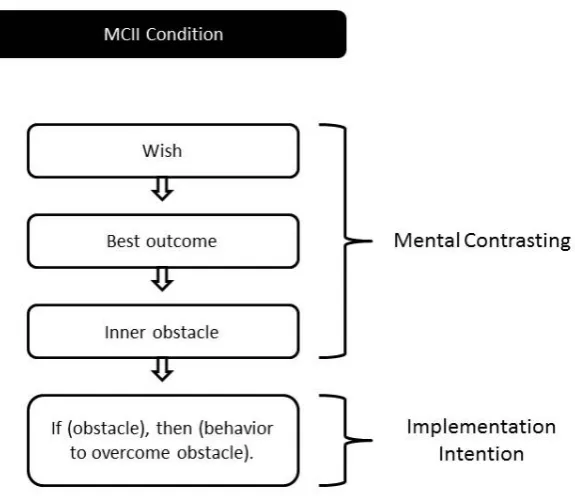
reviewed the steps of MCII: (a) formulate a wish, (b) identify and imagine the best outcome,
(c) identify and imagine the most important inner obstacle, and (d) formulate an if-then plan.
They learned that people could use this strategy to realize their wishes (see Figure 1).
(instructions delivered to participants online, see Appendix A). To demonstrate everyday
applicability, participants finally performed an MCII exercise for a wish they wanted to
realize within the next 24 hours (Stadler et al., 2009, 2010; Oettingen, 2014), one that could
pertain to alcohol or any other wish or goal.
Control condition. Participants in the control condition read a cover story stating that
realizing wishes is related to the ability to focus attention. To help train this ability, they
solved 19 arithmetic problems modified from the “Concentration Achievement Test” (Düker
& Lienert, 1965). For each of these problems, participants first solved two mathematical
equations (e.g., 7-3 and 4+5), remembered the results, subtracted the lower number from the
higher number, and entered the answer. This light placebo intervention required intense
concentration and therefore prevented participants from spontaneously using self-regulation
strategies.
Measures
Commitment to reduce drinking. Participants indicated their commitment to reduce
or stop drinking immediately after the intervention at baseline (8 items; α = .98; e.g., How
committed are you to reduce or stop drinking?) on a scale from 1 (Not at all) to 7 (Very)
(Oettingen et al., 2009).
Readiness to change drinking. Participants completed the Readiness to Change
Drinking Scale (RTC; Rollnick, Heather, Gold, & Hall, 1992) twice. The first time was
immediately after the intervention at baseline and the second time was at the 1-month follow
up. RTC comprises three stages: precontemplation, contemplation, and action (the most
advanced stage). Answers were combined for each of the three stages (4 items each) at both
time points (αs = .78 to .89).
Drinking outcomes. At baseline and the 1-month follow-up, we administered the
14 days. The TLFB shows psychometrically sound properties when administered online
(Pedersen, Grow, Duncan, Neighbors, & Larimer, 2012). Participants retrospectively reported
their drinking events and the number of standard drinks consumed for each day. The number
of drinking days per week served as a measure of frequency and the number of drinks per
week as a measure of quantity2. To assess drinking-related problems, participants completed
the Alcohol Problems Questionnaire (APQ; Williams & Drummond, 1994) at both the
baseline (α = .88) and the 1-month follow-up(α = .80), again referencing the past 14 days.
Perceived change. At the end of the 1-month follow-up, participants indicated how
much their alcohol consumption had changed (i.e., To what extent do you feel that your
alcohol consumption changed over the past 4 weeks?) and how much their everyday life had
changed (i.e., To what extent do you feel that your everyday life changed over the past 4
weeks?) on a scale from 1 (Not at all) to 7 (Very).
Moderator variable: Hazardous drinking. Before the intervention, participants
completed the Alcohol Use Disorders Identification Test (AUDIT; Babor, Higgins-Biddle,
Saunders, & Monteiro, 2001). Scores of 8 and higher indicated hazardous alcohol use (α =
.88)3.
Data Analytic Plan
Analyses were performed using SPSS. A p value <.05 was regarded as statistically
significant, two-tailed. To explore differences between completers and non-completers and
baseline differences between intervention and control participants, we performed a series of
univariate ANOVAs and χ2 tests. To examine differences in commitment, readiness to
change and perceived change between conditions, we performed univariate ANOVAs. To test
whether MCII reduces drinking particularly for people experiencing hazardous drinking, we
used the Generalized Estimating Equation (GEE) approach (Liang & Zeger, 1986). The GEE
drinking indicators were drinking days, drinks per week, and alcohol-related problems. These
variables were not normally distributed and displayed overdispersion. Therefore, we used
negative binominal GEE models. We re-coded AUDIT scores into a dichotomous variable,
with 1 coding non-hazardous drinking (AUDIT < 8) and 0 coding hazardous drinking
(AUDIT ≥ 8). The MCII condition was coded as 0 and the control condition was coded as 1. A series of 2 x 2 negative binominal GEE models with Condition (MCII vs. control), and
AUDIT (non-hazardous vs. hazardous) were used to compare MCII effects for non-hazardous
and hazardous drinkers. Baseline levels of each drinking indicator were covariates. Before
analyses, we corrected outliers by changing values greater than or equal to 3.29 standard
deviations above the mean to be one unit greater than the greatest non-outlier value
(Tabachnick & Fidell, 2012). To test our mediation hypothesis, we computed a composite
score of frequency and quantity of alcohol consumption and performed serial multiple
mediator analyses using ordinary least squares path analysis (Model 6 in the PROCESS
macro; Hayes, 2013).
Results
Sample
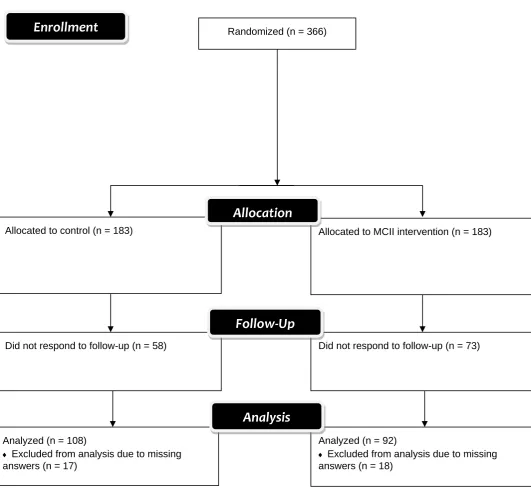
A total of 366 participants were randomly assigned to the MCII condition (n = 183) or
the control condition (n = 183). Out of these participants, 131 participants (35.79%) did not
respond to 1-month follow-up invitations and 35 participants (10.02%) had incomplete data4.
For detailed participant flow see Figure 2. Attrition was not significantly different across
conditions, χ2(1, N = 131) = 1.72, p = .19. Completers vs. non-completers did not
significantly differ in gender, χ2(1, N = 328) = 3.18, p = .08, AUDIT, APQ baseline, age, income, or education, Fsunivariate(1,252) = .002 to 3.20, ps > .07, ηp2s < .02.
The final sample of N = 200 (MCII = 92; control = 108) consisted of 107 females
Caucasian. Table 1 represents participants’ demographics. Drinking was hazardous for 85
participants (42.5%) using the cut-off point of 8 on the AUDIT (M = 8.15, SD = 6.93) (Babor
et al., 2001). Participants experienced an average of 4 out of 23 alcohol-related problems
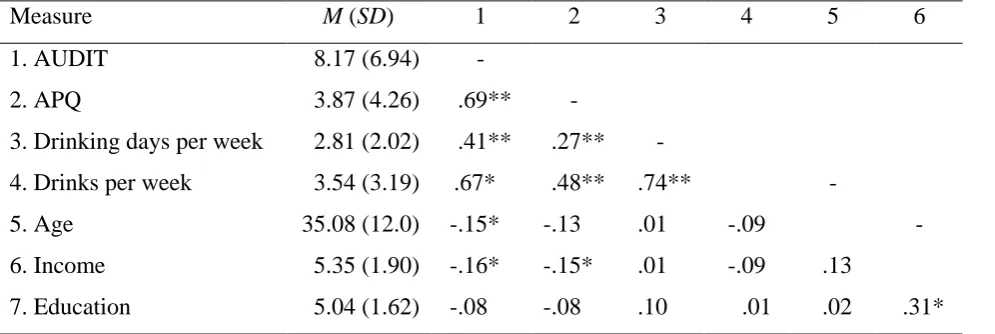
within the past two weeks (APQ: M = 3.83, SD = 4.09). Table 2 shows means, standard
deviations, and correlations for baseline measures. Conditions did not significantly differ in
gender, χ2(1,N = 200) = .26, p = .61, AUDIT, APQ baseline, age, income, or education,
Fsunivariate(1,184) = .02 to 1.39, ps > .23, ηp2s < .009.
Commitment
MCII increased commitment to reduce drinking. Results of a univariate ANOVA
showed that participants in the MCII condition reported stronger commitment to reduce or
stop drinking (M = 3.70, SD = 1.94) than the control condition (M = 2.99, SD = 2.06),
F(1,198) = 6.35, p = .02, ηp2= .03.
Readiness to Change (RTC)
After four weeks, participants reported to have taken more action towards changing
their drinking in the MCII (M = .11, SD = 1.08) than in the control group (M = -.27, SD =
1.02). Condition had a significant effect on the action score (e.g., “I am actually changing my
drinking habits right now”), F(1,198) = 6.42, p = .01, ηp2 =.03. There was no significant
effect of Condition on the precontemplation or the contemplation score, Fsunivariate(1,198) =
.62 to 3.37, ps > .06, ηp2s < .02. Similarly, there was also no significant effect of Condition on
the RTC stages (i.e., precontemplation, contemplation, and action) when RTC was measured
directly after the manipulation, Fsunivariate(1,193) = 1.02 to 1.51, ps > .21, ηp2s < .009.
Drinking Behavior
Based on past research demonstrating that MCII is particularly effective when
behavior change is challenging (Gollwitzer, 2014; Oettingen, 2012), we expected that MCII
we observed the predicted interaction effects of Condition by AUDIT on drinking days per
week (frequency), exp(β) = 0.57, 95% CI [0.94, 5.514], p < .001, and drinks per week
(quantity), exp(β) = 0.47, 95% CI [-1.322, -.207], p = .007. For the group of participants who
reported hazardous drinking at baseline (i.e., AUDIT ≥ 8), participants in the MCII condition were 43% less likely to report drinking days at 1-month follow-up than the control condition,
and 53%less likely to report drinks consumed at follow-up than the control condition.
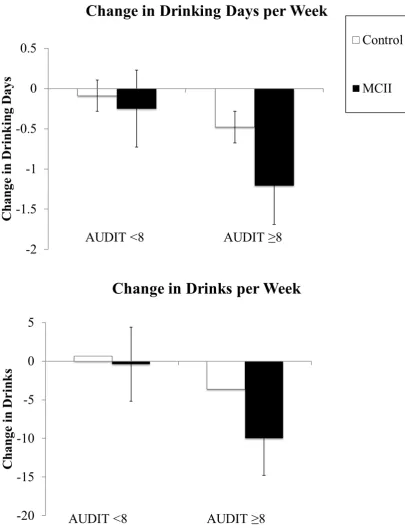
Moreover, when drinking was hazardous, participants in the MCII condition decreased their
alcohol consumption from baseline to follow-up by 37% (M = 1.21) for drinking days, and by
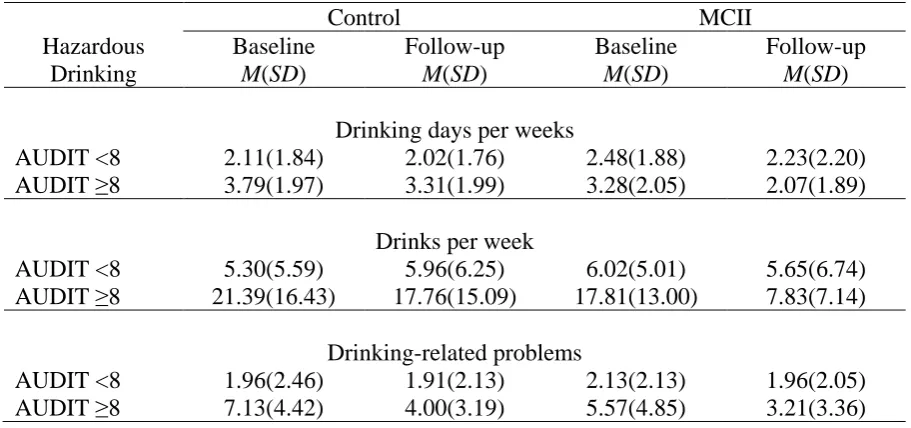
55% (M = 9.98) for drinks per week. Figure 3 depicts mean changes in drinking days and
drinks per week by Condition and AUDIT.
In contrast, for drinking-related problems, GEE analyses revealed no significant
interaction effect, p = .48, of Condition and AUDIT. Table 3 contains means and standard
deviations at baseline and 1-month follow-up by Condition and AUDIT for drinking days,
drinks per week, and drinking-related problems.
MCII Affects Drinking Reduction via Commitment and Readiness to Change
Serial multiple mediation analyses adjusting for baseline drinking revealed that
condition indirectly influenced follow-up drinking (adb = -.023; 95% CI [-.055, -.001])
through its effect on commitment and action score (RTC). Participants in the MCII condition
(versus the control condition) heightened commitment to reduce or stop drinking, which in
turn predicted increased reported action on the RTC scale, which finally predicted reduced
drinking at follow-up.
Perceived Change
MCII increased perceived change in alcohol consumption. Results of a univariate
ANOVA showed that participants in the MCII condition perceived more change (M = 3.41,
= .05. MCII also helped to change their everyday life. Results of a univariate ANOVA
showed that participants in the MCII condition reported higher perceived change in life (M =
3.10, SD = 2.13) than the control condition (M = 2.52, SD = 1.98), F(1,198) = 3.92, p < .05,
ηp2 = .02.
Discussion
We examined MCII as a brief online intervention to help people recruited online who
wished to reduce their drinking. In line with previous research on MCII benefitting various
indicators of health behavior (Oettingen & Gollwitzer, 2018), our participants benefitted from
MCII more compared to the control condition. We found that MCII immediately boosted
commitment to reduce drinking and one month later fostered taking action to change
drinking. Our finding that MCII only affected the action score of the Readiness to Change
Scale, rather than the precontemplation and contemplation scores, suggests that (a) we were
successful in recruiting participants who indeed wanted to reduce or stop their drinking, and
(b) participants in the MCII condition took action to reduce their drinking over the course of
that month. Importantly, participants whose drinking was hazardous (i.e., AUDIT ≥ 8) and who were in the MCII condition reported drinking less one month after the intervention than
respective participants in the control condition.
There are several limitations to our study. First, even though we recruited people who
worried about their drinking, we did not pre-screen study participants for hazardous drinking.
Still, more than 40% of the sample met the hazardous drinking threshold (i.e., AUDIT ≥ 8). Moderation analyses indicated that MCII was especially valuable for these drinkers. Future
research should determine whether the present results replicate in a sample of even more
hazardous drinkers than the ones in the present sample. Second, we found that MCII did not
reduce alcohol-related problems (i.e., APQ scale). This finding might have been due to a
reported a low number of alcohol-related problems at baseline (M = 3.87, SD = 4.26). Third,
our measures relied on participants’ self-reported answers Future studies should replicate the
present findings utilizing more objective measures of alcohol consumption. Fourth, we only
had a brief follow-up period of one month – thus efficacy of MCII on long-term drinking
reduction still needs to be established. Finally, even though our dropout rate of 35.79% is
common for studies on MTurk, it is high compared to retention observed in clinical trials.
Moreover, although our analyses indicate that attrition was not dependent on condition, there
is still a possibility that certain participants (e.g., more conscientious individuals) may have
been more likely to respond to follow-up invitations than others (Zhou & Fishbach, 2016).
Given the majority of our sample identified as Caucasian, future studies need to
confirm the applicability to the general population. Furthermore, elaborating on wishes to
reduce drinking in the MCII condition might have enhanced social desirability to report
success. However, we advertised the control condition as an exercise to help to reach
personal goals; this should have spurred similar feelings of social desirability. Still, MCII
produced its beneficial effects on drinking reduction as compared to the control group. Also,
various studies found that enhanced social desirability could not explain MCII effects
(Christiansen, Oettingen, Dahme, & Klinger, 2010; Stadler et al., 2009, 2010).
Despite these limitations, benefits of MCII include its easy-to-learn structure and
timesaving use. It can be self-administered without the help of a coach or therapist. These
attributes are in contrast to other interventions such as MI (Miller & Rollnick, 1991), CBT
(Beck, 2011), or providing normative feedback (Walters & Neighbors, 2005), which requires
gathering individual behavior and comparing it to relevant norms. Furthermore, many
hazardous drinkers shy away from seeking professional help and prefer online self-help
2009; Koski-Janne & Cunningham, 2001). MCII is auspicious, as it might reach drinkers who
otherwise would not seek treatment.
In conclusion, a brief self-guided online MCII intervention (Mdn = 28 minutes)
reduced drinking in an online community sample of Amazon’s MTurk website users for
persons at risk for hazardous drinking. MCII, therefore, has promise to help those who want
to reduce their hazardous drinking. Future studies should test the cost-effectiveness of the
References
Achtziger, A., Bayer, U. C., & Gollwitzer, P. M. (2012). Committing to implementation
intentions: Attention and memory effects for selected situational cues. Motivation &
Emotion, 36, 287–303.
Adriaanse, M. A., Oettingen, G., Gollwitzer, P. M., Hennes, E. P., De Ridder, D. T. D., & De
Wit, J. B. F. (2010). When planning is not enough: Fighting unhealthy snacking habits
by mental contrasting with implementation intentions (MCII). European Journal of
Social Psychology, 40, 1277–1293.
Adriaanse, M. A., Gollwitzer, P. M., de Ridder, D. T. D., de Wit, J. B. F., & Kroese, F. M.
(2011). Breaking habits with implementation intentions: A test of underlying processes.
Personality and Social Psychology Bulletin, 37, 502–512.
Ahacic. K., Nederfeldt, L., & Helgason, A. R. (2014). The national alcohol helpline in
Sweden: an evaluation of its first year.Substance Abuse Treatment, Prevention, and
Policy, 9: 28.
Babor, T. F., Higgins-Biddle, J. C., Saunders, J. B., & Monteiro, M. G. (2001). AUDIT - The
Alcohol Use Disorders Identification Test: Guidelines for use in primary care. World
Health Organization Department of Mental Health and Substance Dependence, Geneva.
Balhara, Y. & Verma, R. (2014).A review of web based interventions focusing on alcohol
use. Annals of Medical and Health Sciences Research, 4, 472–480.
Bayer, U. C., Achtziger, A., Gollwitzer, P. M. & Moskowitz, G. (2009). Responding to
subliminal cues: Do if-then plans facilitate action preparation and initiation without
conscious intent? Social Cognition, 27, 183–201.
Beck, J. S. (2011). Cognitive behavior therapy: Basics and beyond. New York: Guilford
Bewick, B. M., Trusler, K., Barkham, M., Hill, A. J., Cahill, J., & Mulhern, B. (2008). The
effectiveness of web-based interventions designed to decrease alcohol consumption—A
systematic review. Preventive Medicine, 47, 17–26.
Brandstaetter, V., Lengfelder, A., & Gollwitzer, P. M. (2001). Implementation intentions and
efficient action initiation. Journal of Personality and Social Psychology, 81, 946–960.
Buhrmester, M., Kwang, T., & Gosling, S. (2011). Amazon's Mechanical Turk: A new source
of inexpensive, yet high-quality, data? Perspectives on Psychological Science, 6,3–5.
Christiansen, S., Oettingen, G., Dahme, B., & Klinger, R. (2010). A short goal-pursuit
intervention to improve physical capacity: A randomized clinical trial in chronic back
pain patients. Pain, 149, 444–452.
Cunningham, J. A., & Breslin, F. C. (2004). Only one in three people with alcohol abuse or
dependence ever seek treatment. Addictive Behaviors, 29, 221–223.
Cunningham, J. A., & van Mierlo, T. (2009). Methodological issues of Internet-based
interventions for problem drinking. Drug and Alcohol Review, 28, 12–17.
Düker, H., & Lienert, G. A. (1965). Konzentrations-Leistungs-Test : K-L-T Handanweisung
für die Durchführung und Auswertung. Göttingen: Verlag für Psychologie, Hogrefe.
Edwards, G., Arif, A., & Hodgson, R. (1981). Nomenclature and classification of drug and
alcoholrelated problems: a WHO memorandum. Bulletin of the World Health
Organization, 59, 225–242.
Elliot, J. C., Carey, K. B., & Bolles, J. R. (2008). Computer-based interventions for college
drinking: a qualitative review. Addictive Behaviors, 33, 994–1005.
Fishbein, M., & Ajzen, I. (2009). Predicting and changing behavior: The reasoned action
Gawrilow, C., Morgenroth, K., Schultz, R., Oettingen, G., & Gollwitzer, P. M. (2013).
Mental contrasting with implementation intentions enhances self-regulation of goal
pursuit in schoolchildren at risk for ADHD. Motivation and Emotion, 37, 134–145.
Gollwitzer, P. M. (1990). Action phases and mind-sets. In E. T. Higgins & R. M. Sorrentino
(Eds.), The handbook of motivation and cognition: Foundations of social behavior (Vol.
2, pp. 53–92). New York: Guilford Press.
Gollwitzer, P. M. (1993). Goal achievement: The role of intentions. European Review of
Social Psychology, 4, 141–185.
Gollwitzer, P. M. (1999). Implementation intentions: Strong effects of simple plans.
American Psychologist, 54, 493–503.
Gollwitzer, P. M. (2014). Weakness of the will: Is a quick fix possible? Motivation and
Emotion, 38, 305–322.
Gollwitzer, P. M., & Brandstaetter, V. (1997). Implementation intentions and effective goal
pursuit. Journal of Personality and Social Psychology, 73, 186–199.
Hayes, A. F. (2013). Introduction to mediation, moderation, and conditional process
analysis: A regression-based approach. New York: Guilford Press.
Kappes, A., & Oettingen, G. (2014). The emergence of goal pursuit: Mental contrasting
connects future and reality. Journal of Experimental Social Psychology, 54, 25–39.
Kappes, A., Singmann, H., & Oettingen, G. (2012). Mental contrasting instigates goal pursuit
by linking obstacles of reality with instrumental behavior. Journal of Experimental
Social Psychology, 48, 811–818.
Kappes, A., Wendt, M., Reinelt, T., & Oettingen, G. (2013). Mental contrasting changes the
meaning of reality. Journal of Experimental Social Psychology, 49, 797–810.
Kirk, D., Oettingen, G., & Gollwitzer, P. M. (2011). Mental contrasting promotes integrative
Koski-Janne, A., & Cunningham, J. A. (2001). Interest in different forms of self-help in a
general population sample of drinkers. Addictive Behaviors, 26, 91–99.
Liang, K.-Y., & Zeger, S. L. (1986). Longitudinal data analysis using generalized linear
models. Biometrika, 73, 13–22.
Marquardt, M. K., Oettingen, G., Gollwitzer, P. M., Sheeran, P., & Liepert, J. (2017). Mental
contrasting with implementation intentions (MCII) improves physical activity and
weight loss among stroke patients over one year. Rehabilitation Psychology.
Miles, J. D., & Proctor, R.W. (2008). Improving performance through implementation
intentions: Are preexisting response biases replaced? Psychonomic Bulletin & Review
15, 1105–1110.
Miller, W. R., & Rollnick, S. (1991). Motivational interviewing: Preparing people to change
addictive behavior. New York: Guilford Press.
National Institute on Alcohol Abuse and Alcoholism (2000). 10th special report to the U.S.
Congress on alcohol and health: Highlights from current research from the Secretary of
Health and Human Services. U.S. Department of Health and Human Services.
Oettingen, G. (2000). Expectancy effects on behavior depend on self-regulatory thought.
Social Cognition, 18, 101–129.
Oettingen, G. (2012). Future thought and behavior change. European Review of Social
Psychology, 23, 1–63.
Oettingen, G. (2014). Rethinking positive thinking: inside the new science of motivation. New
York, NY: Penguin Random House.
Oettingen, G., Kappes, H. B., Guttenberg, K. B., & Gollwitzer, P. M. (2015). Self-regulation
of time management: Mental contrasting with implementation intentions. European
Oettingen, G., Mayer, D., Sevincer, T. A., Stephens, E. J., Pak, H.-J., & Hagenah, M. (2009).
Mental contrasting and goal commitment: The mediating role of energization.
Personality and Social Psychology Bulletin, 35, 608–622.
Oettingen, G., & Gollwitzer, P. M. (2010). Strategies of setting and implementing goals:
Mental contrasting and implementation intentions. In J. E. Maddux & J. P. Tangney
(Eds.), Social psychological foundations of clinical psychology (pp. 114–135). New
York: The Guilford Press.
Oettingen, G., & Gollwitzer, P. M. (2018). Health behavior change by self-regulation of goal
pursuit. In D. de Ridder, M. Adriaanse, & K. Fujita (Eds.), The Routledge international
handbook of self-control in health and well-being (pp. 418-430). New York: Routledge.
Oettingen, G., Pak, H., & Schnetter, K. (2001). Self-regulation of goal setting: Turning free
fantasies about the future into binding goals. Journal of Personality and Social
Psychology, 80, 736-753.
Parks–Stamm, E. J., Gollwitzer, P. M., & Oettingen, G. (2007). Action control by
implementation intentions: Effective cue detection and efficient response initiation.
Social Cognition, 25, 248–266.
Pedersen, E. R., Grow, J., Duncan, S., Neighbors, C., & Larimer, M. E. (2012). Concurrent
validity of an online version of the timeline followback assessment. Psychology of
Addictive Behaviors, 26, 672–677.
Riper, H., Blankers, M., Hadiwijaya, H., Cunningham, J. A., Clarke, S., Wiers, R., Ebert, D.,
& Cuijpers, P. (2014). Effectiveness of guided and unguided low-intensity internet
interventions for adult alcohol misuse: A meta-analysis. Public Library of Science ONE,
Rollnick, S., Heather, N., Gold, R., & Hall, W. (1992). Development of a short “readiness to
change” questionnaire for use in brief, opportunistic interventions among excessive
drinkers. British Journal of Addiction, 87, 743–754.
Rooke, S., Thorsteinsson, E., Karpin, A., Copeland, J., & Allsop, D. (2010).
Computer-delivered interventions for alcohol and tobacco use: A meta-analysis. Addiction, 105, 1–
10.
Sacks, J. J., Gonzales, K. R., Bouchery, E. E., Tomedi, L. E., & Brewer, R. D. (2010). 2010
national and state costs of excessive alcohol consumption. American Journal of
Preventive Medicine, 49, e73–e79.
Sheeran, P., Webb, T. L., & Gollwitzer, P. M. (2005). The interplay between goal intentions
and implementation intentions. Personality and Social Psychology Bulletin, 31, 87–98.
Sobell, L., & Sobell, M. (1992). Timeline follow-back: A technique for assessing
self-reported alcohol consumption. In J. Allen & R. Z. Litten (Eds.). Measuring alcohol
consumption psychosocial and biochemical methods (pp. 41–72). Totowa, NJ: Humana
Press.
Stadler, G., Oettingen, G., & Gollwitzer, P. M. (2009). Physical activity in women. American
Journal of Preventive Medicine, 36, 29–34.
Stadler, G., Oettingen, G., & Gollwitzer, P. M. (2010). Intervention effects of information
and self-regulation on eating fruits and vegetables over two years. Health Psychology,
29, 274–283.
Stahre, M., Roeber, J., Kanny, D., Brewer, R. D., & Zhang, X. (2014). Contribution of
excessive alcohol consumption to deaths and years of potential life lost in the United
States. Preventing Chronic Disease, 11, E109.
Tabachnick, B. G., & Fidell, L. S. (2012). Using multivariate statistics. Boston, MA: Pearson
US Preventive Services Task Force (2013). Screening and behavioral counseling
interventions in primary care to reduce alcohol misuse: U.S. Preventive Services Task
Force recommendation statement Annals of Internal Medicine, 159, 210–218.
Walters, S. T., & Neighbors, C. (2005). Feedback interventions for college alcohol misuse:
What, why and for whom? Addictive Behaviors, 30, 1168–1182.
Webb, T. L., and Sheeran, P. (2006). Does changing behavioral intentions engender behavior
change? A meta-analysis of the experimental evidence, Psychological Bulletin, 132,
249–68.
Webb, T. L., and Sheeran, P. (2007). How do implementation intentions promote goal
attainment? A test of component processes, Journal of Experimental Social Psychology,
43, 295–302.
Webb, T.L., and Sheeran, P. (2008) Mechanisms of implementation intention effects: the role
of goal intentions, self-efficacy, and accessibility of plan components. British Journal of
Social Psychology, 47, 373–95.
Williams, B. T. R., & Drummond, C. D. (1994). The Alcohol Problems Questionnaire:
Reliability and validity. Drug and Alcohol Dependence, 35, 239–243.
World Health Organization (2014). Global status report on noncommunicable diseases 2014.
Geneva, Switzerland: WHO Press.
Zhou, H., & Fishbach, A. (2016). The pitfall of experimenting on the web: How unattended
selective attrition leads to surprising (yet false) research conclusions. Journal of
Footnotes
1In WHO terminology hazardous drinking confers the risk of physical and/or
psychological harm (Edwards, Arif, & Hodgson, 1981).
2 If participants had missing responses for more than two days, drinking indicators were
not calculated.
3 Additional covariates were incentive, short and long-term expectations, normative
beliefs, perceived control, with respect to reduced drinking (see Fishbein & Ajzen, 2009).
Completers vs. non-completers and conditions did not differ on these measures.
4 Inclusion versus exclusion of participants with incomplete data did not affect the
significance levels of results.
5 The drinking indicators were correlated at r = .74, and thus we included a Bonferroni
Table 1
Demographics of Participants
Demographics Control (n = 108) MCII (n = 92)
Gender
Female 56 (52%) 51(55%)
Male 52 (48%) 41 (45%)
Annual household income
No income 6 (6%) 2 (2%)
< 5 K 4 (4%) 9 (10%)
5,000 – 11,999 9 (8%) 3 (3%)
12,000 – 19,999 4 (4%) 7 (8%)
20,000 – 39,999 33 (31%) 31 (34%)
40,000 – 59,999 14 (13%) 18 (20%)
60,000 – 79,999 9 (8%) 10 (11%)
> 80 K 24 (22%) 10 (11%)
Education
Less than high school 2 (2%) 1 (1%)
High school diploma or GED 10 (11%) 9 (10%)
Some college 36 (33%) 31 (34%)
College degree 32 (30%) 20 (22%)
Associates degree 2 (2%) 12 (13%)
Some graduate or professional training 5 (5%) 6 (7%)
Graduate or professional degree 17 (16%) 12 (13%)
Employment status
Disabled - 2 (2%)
Homemaker 16(15%) 2 (2%)
Retired - 2 (2%)
Self-employed 3 (3%) 11 (12%)
Student 11 (10%) 11 (12%)
Unemployed not seeking work 13 (12%) 2 (2%)
Unemployed seeking work 7 (6%) 9 (10%)
Working part time 10 (11%) 5 (5%)
Working full-time > 35h/w 44 (41%) 47 (51%)
Race
African American, Black, of African descent 4 (4%) 5 (5%)
American Indian (Native American) 1 (1%) 1 (1%)
Asian/Pacific Islander 6 (6%) 5 (5%)
Hispanic/Latino 3 (3%) 6 (7%)
White, Caucasian, European descent 94 (87%) 80 (87%)
Other/Unknown - -
Hazardous drinking
AUDIT < 8 67 (62%) 48 (52%)
AUDIT ≥ 8 41 (38%) 44 (48%)
Table 2
Means, Standard Deviations, and Correlations for Baseline Measures
Measure M (SD) 1 2 3 4 5 6
1. AUDIT 8.17 (6.94) -
2. APQ 3.87 (4.26) -.69** -
3. Drinking days per week 2.81 (2.02) -.41** -.27** -
4. Drinks per week 3.54 (3.19) .67** -.48** -.74** -
5. Age 35.08 (12.0) -.15** -.13** -.01** -.09 -
6. Income 5.35 (1.90) -.16** -.15** -.01** -.09 -.13
7. Education 5.04 (1.62) -.08** -.08** -.10** *-.01 -.02 -.31*
Note. AUDIT = Alcohol Use Disorder Identification Test; APQ = Alcohol Problems
Questionnaire.
Table 3
Means for Drinking Days per Week, Drinks per Week, and Drinking-Related Problems at Baseline and Follow-up by Condition and Hazardous Drinking (i.e., AUDIT)
Control MCII
Hazardous Drinking
Baseline
M(SD)
Follow-up
M(SD)
Baseline
M(SD)
Follow-up
M(SD)
Drinking days per weeks
AUDIT <8 2.11(1.84) 2.02(1.76) 2.48(1.88) 2.23(2.20)
AUDIT ≥8 3.79(1.97) 3.31(1.99) 3.28(2.05) 2.07(1.89)
Drinks per week
AUDIT <8 5.30(5.59) 5.96(6.25) 6.02(5.01) 5.65(6.74)
AUDIT ≥8 21.39(16.43) 17.76(15.09) 17.81(13.00) 7.83(7.14)
Drinking-related problems
AUDIT <8 1.96(2.46) 1.91(2.13) 2.13(2.13) 1.96(2.05)
Figure 2. Participant flow.
Randomized (n = 366)
Analyzed (n = 108)
♦ Excluded from analysis due to missing answers (n = 17)
Did not respond to follow-up (n = 58) Allocated to control (n = 183)
Did not respond to follow-up (n = 73) Allocated to MCII intervention (n = 183)
Analyzed (n = 92)
♦ Excluded from analysis due to missing answers (n = 18)