‘Efficacy of a non-drinking mental simulation intervention for reducing student alcohol consumption’
Dominic Conroy, Paul Sparks, and Richard de Visser
Objectives. To assess the impact of a mental simulation intervention designed to reduce student alcohol consumption by asking participants to imagine potential positive outcomes of and/or strategic processes involved in not drinking during social occasions. Design. English university students aged 18-25 years (n = 211, M.Age = 20 years) were randomly allocated to one of four intervention conditions. The dependent variables were weekly alcohol
consumption, heavy episodic drinking (HED) and frequency of social occasions at which participants did not drink alcohol when others were drinking alcohol ('episodic
non-drinking'). Measures of alcohol-related prototypes (i.e., prototypical non-drinker, prototypical regular drinker) were used to compute sociability prototype difference scores as a potential mediator of any intervention effects. All measures were taken at baseline and at two- and four-week follow-up. Methods. Participants completed one of four exercises involving either: imagining positive outcomes of non-drinking during a social occasion (outcome
condition); imagining strategies required for non-drinking during a social occasion (process
Excessive alcohol consumption among English university students carries risks of both personal injury and impaired academic performance (Cherpitel, Bond, Ye, Borges,
MacDonald, & Giesbrecht, 2003; Thombs, Olds, Bondy, Winchell, Baliunas, & Rehm, 2009). This is in addition to the longer-term health risks and risk of addiction posed from cultivating habitually high risk patterns of drinking behaviour during early adulthood (de Wit, Adlaf, Offord, & Ogborne, 2000; Meyerhoff, Bode, Nixon, Bruin, Bode, & Seitz, 2005). It is therefore important to identify effective strategies for encouraging moderate alcohol use. Evidence for the effectiveness of brief web-based alcohol interventions to reduce student alcohol consumption is mixed (Bewick, Trusler, Barkham, Hill, Cahill, & Mulhern, 2008; White et al., 2010), yet their promise of anonymity and low cost make it important to fully ascertain their applied potential. Efforts to promote safer drinking behaviour among young people primarily target awareness of what constitutes low-risk alcohol consumption
different ways of encouraging higher levels of health-adherent yet self-directed drinking behaviour has been highlighted in recent research concerning perceptions of non-drinkers and experiences of non-drinking behaviour.
Perceptions of non-drinkers and non-drinking behaviour
Several studies have demonstrated that less favourable attitudes towards non-drinkers, or perceptions of the prototypical non-drinker as relatively unsociable predict greater alcohol consumption among students (e.g., Regan & Morrison, 2013; Zimmermann & Sieverding, 2011). Recent research suggests that a key challenge for efforts to reduce consumption is to oppose normative beliefs that are broadly permissive of heavy drinking at University (Conroy & de Visser, 2014; Herring, Bayley, & Hurcombe, 2014). Although abstinence from alcohol may be an unrealistic health promotion goal, non-drinking during single social situations where peers may be drinking alcohol (‘episodic non-drinking’) is arguably an overlooked target in campaigns to promote moderate drinking. This approach would tie in with prior theoretical and empirical contributions to the promotion of health-related behaviour change. For example, empirical evidence has indicated that lower levels of anticipated regret are a strong independent predictor of excessive intentions to limit alcohol consumption among students (Cooke, Sniehotta, & Schüz, 2007). It is suggested that promoting episodic non-drinking as a desirable health promotion objective would provide one way in which potential regret about binge drinking episodes might be constructively evoked to promote lower overall levels of alcohol consumption. Similarly, a body of evidence supports the view that
bolstering coping appraisals is likely to play a central role in promoting health-adherent behaviour change (Floyd, Prentice-Dunn, & Rogers, 2000; Milne, Sheeran, & Orbell, 2000). Arguably, supporting students to develop personally effective coping strategies to not drink alcohol during social situations holds the possibility of encouraging health-adherent
which recommend two alcohol-free days per week (National Health Service, 2014). By promoting the advantages and achievability of episodic non-drinking among university students, more moderate overall alcohol consumption might be assisted, without rebuking students about their personal drinking levels and without drawing attention to well-known risks of high levels of alcohol consumption.
Mental simulations
There are various means by which episodic non-drinking might be promoted: mental
simulation interventions provide one such framework. Mental simulations require individuals to imagine positive outcomes (outcome simulations) and/or strategic requirements (process
simulations) of enacting a target behaviour and are understood to strengthen links between thought and behaviour (Taylor, Pham, Rivkin, & Armor, 1998). Mental simulation
interventions have been demonstrated as successful in the context of increasing individuals’ intention to donate blood and to increase physical activity levels (Armitage & Reidy, 2008; Chan & Cameron, 2012). However, mixed evidence of efficacy exists in the alcohol domain. One UK-based study suggested efficacy particularly among students who drink more heavily (Hagger, Lonsdale, Chatzisarantis, 2012a), while a cross-national dataset provided no support for the efficacy of mental simulation interventions to reduce alcohol use (Hagger et al.,
2012b). Given the potential cost-effectiveness of mental simulations as health promotion tools (Lairson, Newmark, Rakowski, Tiro, & Vernon, 2004; Noar, Benac, & Harris, 2007), it is important to explore whether imagining benefits and/or imagining strategies of not
(hereafter referred to as sociability prototype differences), mediate intervention effects on behavioural outcomes.
Rationale and hypotheses
The rationale for this study was to explore whether asking individuals to imagine possible benefits and/or potential obstacles involved in not drinking during situations where other people were drinking would lead to lower levels of alcohol consumption. Because drinking behaviour is associated with various health risks, consumption was assessed in two ways. First, in terms of overall drinking levels for the previous week. Second, in terms of the
number of occasions of heavy episodic drinking (HED), meaning occasions where double the recommended daily intake maxima (i.e., men = 4 units, women = 3 units, National Health Service, 2014) had been consumed in the previous week. This is consistent with alcohol-related behavioural measures widely used in other research (e.g., Hagger et al., 2012a; Purshouse, Meier, Brennan, Taylor, & Rafia, 2010).
Study hypotheses stemmed from the rationale described above and the background literature relating to perceptions of non-drinkers included in the introduction. Accordingly, the following hypotheses were formulated:
(1) Significantly greater rates of decrease in (a) weekly unit consumption and (b) HED will be found among those completing single outcome or process mental simulation exercises (vs. control participants).
(2) The greatest rate of decrease in weekly unit consumption and HED would be found among combined condition participants (i.e., individuals completing both outcome and
process exercises).
unit consumption or (b) mediate rates of decrease in HED among participants in any mental simulation condition.
Method Design
An experimental design was adopted using online data collection. Participants were randomly allocated to receive either an outcome, process, or combined (outcome + process) mental simulation exercise or were assigned to the control condition. Participants were randomly assigned to conditions using a scripting procedure. Randomisation did not follow any pre-set restriction (e.g., particular block sequence or block size): at the point of participation, each individual had a one in four chance of being allocated to any condition at random. The
prospective study involved collection of data at three time-points including baseline, two- and four week follow-up times (also referred to as T1, T2 and T3), permitting an advanced
structural equation modelling approach for understanding longitudinal effects. A complete case analysis approach was taken: survey responses were only included if participants had provided data at all time-points (i.e., T1−T3). All behavioural measures were participant self-reports.
Sample and procedure
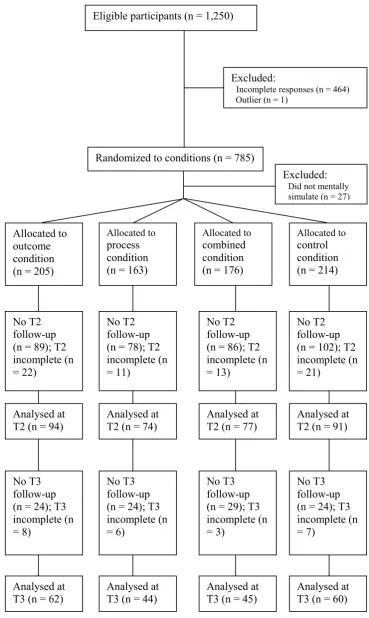
variation in British alcohol consumption, including irregularly high consumption during festive periods (Uitenbroek, 1996). Individuals who identified as English, were aged 18-25 and were currently studying at University were eligible to participate. As an incentive to participate, individuals were automatically entered into a draw to win one of four £25 prizes. Once students had completed the baseline survey, follow-up data were collected via two additional online surveys sent as a URL link embedded in an email message. Restricting participation to students with an English national identity was important given the distinct socio-cultural context in which drinking practices, beliefs and norms are embedded, also reflected in alcohol production, distribution and policy (Furtwängler & de Visser, 2013; Gefou-Madianou, 2002). Overall 1,250 eligible individuals began the survey. In total, 27.8% (n = 212) of the eligible sample completed surveys at both T2 and T3; a completion rate that was comparable across outcome (30.2%), process (27.0%), combined (25.6%)and control
(28.5%) conditions. The flow of participants through the intervention is indicated in Figure 1. <INSERT FIGURE 1 ABOUT HERE>
Individuals who did not access all survey web pages at all three time-points (n = 564, 70% eligible sample), who did not complete the mental simulation exercise (n = 27, 3.4% eligible sample), and an outlier who self-reported T1 weekly unit consumption almost 50% more than the next highest value (n = 1, 0.1% eligible sample), were excluded from the study.
Following removal of the outlier, the final sample consisted of 211 18-25 year old university students who provided data at three time points: 54 men (Mage = 20.53, SD = 1.99) and 157
women (Mage = 19.78, SD = 1.74). Notably, male participants were significantly older than
power calculations were conducted using the G*Power software package (Faul, Erdfelder, Lang, & Buchner, 2007). These analyses revealed, at a p = .05 error level for a one-sided test, power of 0.90 to detect medium-small effect sizes (0.08) for each outcome variable.
Manipulations
All mental simulation tasks were preceded by a brief vignette describing a non-drinking individual with the uni-sex name Alex. Varied lines of evidence suggest that gender-specific stereotypes hold links with a wide range of health-related behaviours including alcohol consumption (Courtenay, 2000; de Visser & McDonnell, 2012; Lyons, 2009). For example, drinking alcohol has been demonstrated to provide an important resource for both reinforcing and resisting gendered identities (de Visser & Smith, 2007). For this reason, it was important from the outset to try to limit evocation of sex-specific stereotypes associated with non-drinking behaviour which might have skewed subsequent engagement with the mental simulation exercise in line with sex-specific behavioural expectations, and away from a more personal response.
Outcome simulation tasks were preceded by a vignette displaying possible positive outcomes of periodic non-drinking during social occasions (e.g., saving money; increased willpower). Participants were then asked to “think about the possible short-/long-term positive benefits associated with increasing the number of occasions where you do not drink” and were asked to list these benefits in a free-text survey box. Following this, participants were asked to imagine having successfully managed not to drink during one or more social occasions each week as part of their life routine. Finally, participants were asked to list these benefits in a second free-text survey box.
drinks; choosing to be around friends who are likely to be supportive of non-drinking). Participants were then asked to “think about the kinds of strategies that you might
use during social occasions where you do not drink” and were asked to list these benefits in a free-text survey box. Following this, participants were asked to imagine having successfully managed not to drink during one or more social occasions each week as part of their life routine. Finally, participants were asked to list these strategies in a second free-text survey box.
Participants in the combined condition were asked to complete both mental simulation and written exercise tasks just described in the order outcome, process. This sequence was chosen as a practical step to overcome potential confusion conveyed by encouraging reflection on the behavioural steps involved in achieving a behavioural outcome prior to reflection with regards the outcome itself.
At one- and three-week post baseline measures, participants in all three mental simulation conditions received an individually-tailored email message containing their self-generated positive outcomes and/or required strategies for non-drinking during social situations and were asked to continue practicing this mental simulation.
Participants in the control condition completed a “drinks diary” in which they recorded daily consumed alcohol units over the four week study duration.
Measures
Self-reported drinking behaviour
episodes in which participants had socialised without drinking alcohol was obtained via responses to a grid containing days (i.e., Sunday-Monday) and associated drinking behaviour in social contexts (i.e., Did not socialise; I drank, others did NOT; I did NOT drink, others did; We ALL drank; NO-ONE drank).
Alcohol prototypes
Perceptions of the sociability of both prototypical regular drinkers and prototypical non-drinkers were assessed using 6 adjective pairs (popular-unpopular; easy-uptight; open-reserved; willing to take risks-unwilling to take risks; sociable-unsociable; able to enjoy-unable to enjoy) based on previous research (Zimmermann & Sieverding, 2011). All responses were given on a 5-point Likert-type scale. A stem statement (“For each pair of words, indicate which best describes your image of the person your age who [regularly drinks alcohol/does not drink alcohol]”) was followed by semantic differential adjective pairs (e.g., 1 = extremely sociable; 5 = extremely unsociable). Sociability prototype difference scores were computed by subtracting non-drinker prototype scores from drinker prototype scores. Scores above zero indicated more sociable ratings of prototypical non-drinkers and scores below zero indicated more sociable ratings of prototypical regular drinkers.
The data analytic approach
To assess whether there were effects of the intervention, a latent growth curve (LGC) approach was taken, based on similar analytic approaches reported in the broader health intervention literature (e.g., Schumann et al., 2008). LGCs provide a specific application of structural equation modelling to investigate longitudinal changes over time using data collected at multiple time points. LGCs offer statistical and conceptual advantages over conventional methods for exploring longitudinal effects, including their scope for modeling time-specific measurement error and to demonstrate both average baseline levels
This technique provides a dynamic means of assessing patterns of change by establishing two characteristics of a dataset. First, an ‘unconditional growth model’ can be specified to assess whether inter-individual variability in an outcome variable over time is present. Second, ‘time-invariant’ factors including demographic variables (e.g., age, sex) or experimental manipulations can be assessed as potential predictors of change over time (Singer & Willett, 2003). As a structural equation model, a specified LGC can be assessed in terms of how adequately it models the obtained dataset using conventional goodness-of fit indicators. Five indicators are reported in the current study: model χ2; the comparative fit index (CFI,
desirable values ≥ 0.95); the root mean square error of approximation (RMSEA, desirable values ≤ 0.05) and the standardised root mean square residual (SRMR, desirable values ≤ 0.05) following conventional recommendations (Hu & Bentler, 1999). LGC models were evaluated using AMOS version 21.0 and estimated for the three linear outcome variables (weekly unit intake; HED frequency; sociability prototype differences) using measures taken at three time point including baseline (T1), two week up (T2) and four week follow-up (T3).
Results
Preliminary analyses
Differences between those included in the analysis, those lost to follow-up and those who provided incomplete responses were assessed via a series of ANOVAs with Games-Howell post hoc tests using a Bonferroni correction. Participant age, participant sex, sociability prototype differences, weekly drinking, HED and episodic non-drinking were assessed as dependent variables. The sample included for the final analysis was significantly younger (M
= 20.0 years, SD = 1.84) than those who provided incomplete responses (M = 21.4 years, SD
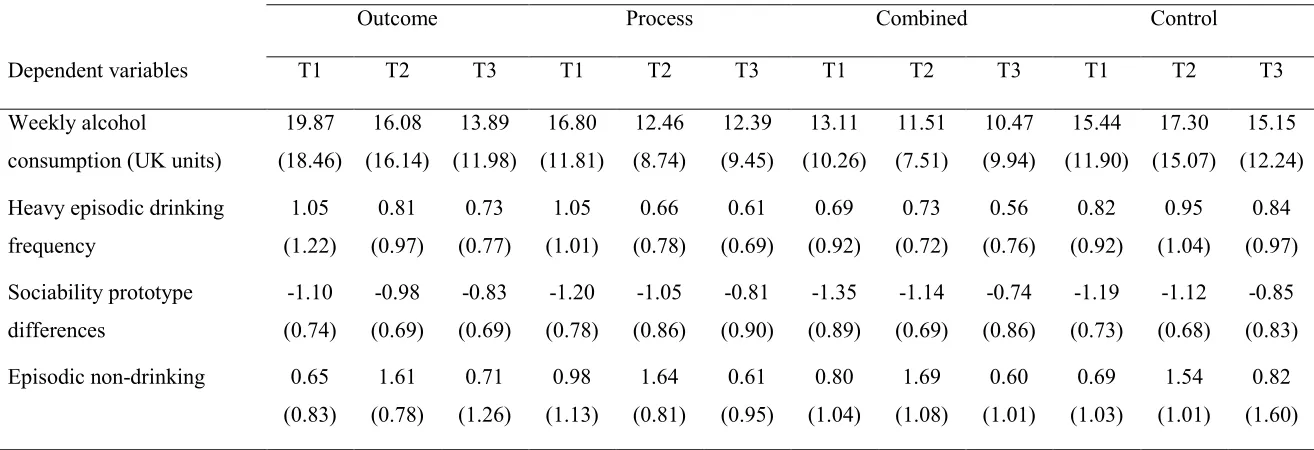
HED once or more in the preceding week. This compared with national averages among 16-24 year olds (Office for National Statistics, 2013) and suggested that a sub-sample among whom health-adherent behaviour change might be successfully promoted had been secured. Baseline outcome variable data by intervention group is included in Table 1.
<INSERT TABLE 1 ABOUT HERE> Randomization check
Although differing participant numbers were allocated to each condition, between-condition analyses revealed non-significant differences in age, or in baseline behavioural and
psychological measures, Fs = ≤ 2.25, p = ≥ .08, and non-significant sex differences across conditions, χ2(3) = 0.63, p = .89. On this basis, participants were understood to have been
successfully randomized. Manipulation check
Responses to mental simulation exercises were content analysed by the first author to assess whether not drinking during social occasions was considered to hold benefits or/and to require strategic management (an inherent assumption of the exercises). Responses were dichotomously coded according to whether participants had identified potential
benefits/strategies of episodic non-drinking (example of ‘yes’ code = “I would save money, avoid dangerous situations and have more meaningful conversations with peers…”). The vast majority (97%) generated responses consistent with the target behavioural premise. Line graphs supported linear change modelling over time for all outcome variables, except episodic non-drinking which displayed a quadratic trend (see Figures 2-5).
Effects of the intervention
Unconditional growth models
As an initial step, inter-individual differences in change were modelled via a series of unconditional growth models in which baseline and rate of change in each variable were assessed. Significant variability terms in an unconditional growth model would provide a basis for assessing the possible influence of time invariant variables. By incorporating a covariance term between T2 indicator residuals for weekly unit consumption and HED, a well-fitting growth model was specified, χ2(17) = 29.35, p = .03, CFI = 0.99, RMSEA = 0.06,
SRMR = 0.05. Significant variances of both intercepts and slopes for weekly unit intake (Z =
≥ 7.17, p = <.001); HED frequency (Z = ≥ 6.19, p = < .001) and sociability prototype differences (Z = ≥ 2.49, p = ≤ .05) provided a statistical rationale for evaluating inter-individual change in key dependent variables over time.
Time invariant analyses
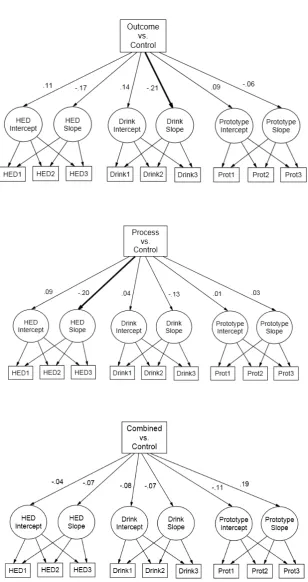
To gauge time invariant intervention effects on growth trajectories, three dummy variables were created coding intervention conditions (i.e., outcome, process, or combined) in relation to the control condition. Predictive paths were hypothesised between dummy variables and all intercepts/slopes. Covariance terms were added between all intercept/slope residual terms. Participant age was treated as a covariate based on preliminary correlational analyses. Non-significant hypothesised paths or covariance terms were removed. Excellent support was provided for the data fit of the final model both alone, χ2(43) = 61.12, p = .04, CFI = 0.99,
RMSEA = 0.05, SRMR = 0.05, and relative to the measurement model, ∆χ2(26)=31.77, p =
(Z = -2.17, p = .03). Being in the combined condition rather than the control condition had no influence over rate of change in weekly unit intake or HED frequency (Zs = ≤ -1.01, p = ≥
.41). At T3 follow-up, lower weekly unit intake and episodes of HED were found among
outcome (M. level = 13.89 units/week, SD = 11.98; M = 0.73 episodes/week, SD = 0.77),
process (M. level = 12.39 units/week, SD = 9.45; M = 0.61 episodes/week, SD = 0.69), and
combined condition participants (M. level = 10.47 units/week, SD = 9.94; M = 0.56 episodes/week, SD = 0.76) relative to control condition participants (M. level = 15.15 units/week, SD = 12.24; M = 0.84 episodes/week, SD = 0.97). Changes in sociability prototype differences were found in all conditions: at T3 participants in all conditions rated the prototypical non-drinker as more sociable relative to the prototypical regular drinker than they had done at T1 (see Figure 4). However, analyses did not indicate that rates of change in sociability prototype differences for participants in any of the mental simulation conditions were significantly greater than for participants in the control condition (Zs= ≤ 1.49, p = ≥
.14).
The results of the analysis suggest that the single exercise outcome and process
mental simulations were somewhat effective in reducing high levels of weekly unit
consumption and HED (respectively) at four week follow-up. The results therefore provided good support for hypotheses 1(a) and 1(b). However, with regards hypothesis 2, that greatest decreases in weekly drinking and HED would be found among combined condition
participants, no support was found.
Mediator effects
pathways were found, (ps = ≥ .33). Therefore, there was no evidence in support of hypotheses 3(a) or 3(b).
Complete case analysis vs. Intention to treat analysis
Analyses to this point have included only participants who provided data at all three time-points: in this way effects of the intervention have been assessed using a ‘complete case analysis’ approach involving participants who had provided responses at all three time-points. To assess for potential bias involved in a complete case approach, analyses were re-run in an intention to treat analysis, meaning that all randomized participants, including those who had provided no follow-up data, follow-up data at only a single time-point, or who had provided responses inconsistent with the mental simulation premise, were also included. Intention to treat analyses can be conducted via different methods and for convenience, the last
observation carried forward approach (LOCF) was adopted. Using LOCF, the last previous available value for a given case is imputed to represent the missing data value (Shao & Zhong, 2003). While LOCF has attracted criticism for its potential to introduce biases to statistical analyses (Shih, 2002; Streiner, 2008), it is also noted that the magnitude of this bias remains unknown (Koog et al., 2013). Given that wide variation in study completion across conditions had not been found, LOCF provided a straight-forward means of assessing effects of the intervention in a more representative cross-section of the eligible sample. All
Participants in the outcome condition reported significantly lower levels of weekly unit intake (M = 15.75, SD = 17.27) compared with control condition participants (M = 17.15, SD = 16.37). No other significant between-group contrasts were found on either dependent variable, ps ≥ .21. These additional analyses using the intention to treat sample provided some additional support for hypothesis 1(a).
Episodic non-drinking – sub-analyses
Associations between episodic non-drinking and weekly unit intake were explored. Across conditions, relative to baseline levels of episodic non-drinking (M = 0.76, SD = 1.00),
participants reported increased frequency of episodic non-drinking at T2 (M = 1.61, SD = 0.92), followed by a decreased frequency of episodic non-drinking at T3 (M = 0.70, SD = 1.26). Time-point difference scores were computed for episodic non-drinking frequency and weekly consumption and HED frequency to explore potential associations between time-point decreases in drinking behaviour and increases in episodic non-drinking. Pearson’s correlations with an applied Bonferroni correction demonstrated a single significant
association between episodic non-drinking frequency differences (T1 minus T2) and weekly unit intake differences (T1 minus T2): among outcome condition participants, lower levels of T2 weekly unit intake, were positively associated with increased frequency of episodic non-drinking at T2 (r = -0.37, p = < .001). The possibility that increases in episodic non-drinking would correspond with (compensatory) increases in HED was rejected, r = ≤ 0.07, p = ≥ .32. Evidence suggested that increased episodic non-drinking reflected decreases in weekly unit intake among some participants.
Discussion
Results from this study demonstrate that, relative to the control condition, completing an
1(b). Analyses based on the intention to treat sample provided further support for hypothesis 1(a) alone. Results from neither the LGC nor intention to treat analyses offered support for hypothesis 2: completing both mental simulation exercises did not lead to steeper rates of change in drinking behaviour than completing either outcome or process simulations on their own and were, in fact, no better than the drinks diary control condition. Across conditions, diminished sociability prototype differences were demonstrated. However, contrary to
hypotheses 3(a) and 3(b), ratings of prototypical non-drinkers as comparatively more sociable did not mediate intervention effects related to the reduction of weekly unit intake or HED for any condition.
Findings in support of hypotheses 1(a) and 1(b) that predicted greater rates of decrease in weekly drinking and HED among those completing single mental simulation exercises compared with those completing control condition exercises help corroborate. These results support the recent success of outcome mental simulations for reducing alcohol consumption reported in one study (Hagger et al., 2012a). The current study also provides two novel contributions to the alcohol-related mental simulation literature. First, a full factorial design was tested for the first time, to the authors’ knowledge, in the alcohol domain. Second,
successfully challenging threat perceptions (in this case related to non-drinking during social situations) which might otherwise inhibit motivations to modify personal drinking behaviour (Prentice-Dunn & Rogers, 1986). The finding that the process simulation exercise produced steeper decreases in HED frequency relative to control, matches findings from the broader social resistance skills literature: for example, increasing drink refusal self-efficacy can diminish the amount of alcohol consumed during a single occasion (Botvin, 2000; Scheier, Botvin, Diaz, & Griffin, 1999). These dual effects support the possibility that different non-drinking mental simulations may affect different aspects of non-drinking behaviour. Both simulations are supported as effective ways of teaching adherence to safe consumption thresholds. The current study provides tentative evidence in favour of both single mental simulation exercises as a novel route toward promoting lower levels of alcohol consumption among campus-based university students. It is suggested that both outcome and process
approaches have their merits. Encouraging individuals to consider possible advantages in not drinking during some social occasions seems likely to offer one way in which more moderate drinking might be more successfully promoted among university students. However,
imagining how non-drinking might be most successfully achieved within social situations seems likely to be integral to developing the necessary drink refusal self-efficacy skills required to be socially present as a non-drinker, a behaviour that has been suggested to carry unique and significant social challenges (Conroy & de Visser, 2014).
Churchill, 2014). This failure of the combined condition might be most simply explained in terms of the potential deleterious impact of online survey task length on study engagement, as recently demonstrated in one study (McCambridge et al., 2011). On this evidence, the
combined condition in the current study may have been ineffective given that it required the completion of two reasonably time-consuming tasks containing rather similar and repetitious content, leading to a somewhat more negative impression of the exercise, lower levels of engagement, and disinterest in heeding the intended health-promoting effects of the mental simulation exercise. It is acknowledged here that Hagger et al. (2012a) did report an
interaction effect in their combined mental simulation + implementation intention condition among the heaviest drinkers in the sample, suggesting that drinking history might be an important moderator to examine in mental simulation research involving combined conditions (an option not possible in the current sample due to low levels of statistical power). It may be advisable for future studies to employ an alternative, relevant behaviour change technique (e.g., prompting barrier identification, or providing instruction: see, for example, Abraham & Michie, 2008) alongside a single mental simulation exercise to maximise health-adherent behaviour change. However it should also be instructive to explore, as per Hagger et al. (2012a; 2012b), whether inclusion of exercises based on both motivational and volitional arms of Heckhausen and Gollwitzer’s (1987) ‘action-phase’ model would lead to more a more effective combined condition in a revised version of the current study.
form of the measure would also benefit from further investigation. As a novel way of
understanding mechanisms underlying the effects of future non-drinking mental simulations, episodic non-drinking warrants further operational assessment and empirical exploration as a behavioural measure.
anticipated that a longer follow-up period would have had a potentially negative impact on response rates. Given the study’s already reasonably high attrition level, this appears to have been a prudent decision.
In conclusion, the data presented here indicate that a theoretically supported mental simulation using an ‘episodic non-drinking’ behavioural framing was successful in reducing alcohol consumption and HED among students at multiple institutions over a four week period. Further empirical validation of mental simulation interventions containing a non-drinking behavioural frame is now required to clarify the precise mechanisms of action and the extent to which behaviour change is maintained over time.
This research was supported by the ESRC (ES/J500173/1)” to read “This research was supported by a studentship grant from the Economic and Social Research Council
(ES/J500173/1) awarded to Dominic Conroy. The authors would like to thank Rod Bond, Martin Hagger, Donna Jessop and two anonymous reviewers for their helpful comments on a draft manuscript
References
Abraham C., & Michie, S. (2008). A taxonomy of behavior change techniques used in interventions. Health Psychology, 27, 379-387. doi: 10.1037/0278-6133.27.3.379 Armitage, C. J., Reidy, J. G. (2008). Use of mental simulations to change theory of planned
behaviour variables. British Journal of Health Psychology, 13, 513-524. doi: 10.1348/135910707X227088
Botvin, G. J. (2000). Preventing drug abuse in schools: Social and competence enhancement approaches targeting individual-level etiologic factors. Addictive Behaviors, 25, 887-897. doi: 10.1016/S0306-4603(00)00119-2
Chan, C. K., & Cameron, L. D. (2012). Promoting physical activity with goal-oriented imagery: a randomized controlled trial. Journal of Behavioural Medicine, 35, 347-363. doi: 10.1007/s10865-011-9360-6
Cherpitel, C., Bond, J., Ye, Y., Borges, G., MacDonald, S., & Giesbrecht, N. (2003). A cross-national meta-analysis of alcohol and injury. Addiction, 98, 1277–1286.
doi: 10.1046/j.1360-0443.2003.00459.x
Connor, J. P., George, S. M., Gullo, M. J., Kelly, A. B., Young, R. M. (2011). A prospective study of alcohol expectancies and self-efficacy as predictors of young adolescent alcohol misuse. Alcohol and Alcoholism, 46, 161-169. doi: 10.1093/alcalc/agr004 Conroy, D., & de Visser, R.O. (2014). Being a non-drinking student: An interpretative
phenomenological analysis. Psychology & Health, 29, 536-551. doi: 10.1080/08870446.2013.866673
Cooke, R., French, D. P., & Sniehotta, F. F. (2010). Wide variation in understanding about what constitutes ‘binge drinking’. Drugs: Education, Prevention and Policy, 17, 762-775. doi: 10.3109/09687630903246457
Cooke, R., Sniehotta, F. F., & Schüz, B. (2007). Predicting binge-drinking behaviour using an extended TPB: Examining the impact of anticipated regret and descriptive norms. Alcohol and Alcoholism, 42, 84-91. doi: 10.1093/alcalc/agl115
de Visser, R.O. (2015). Personalized feedback based on a drink pouring exercise may improve knowledge of, and adherence to, government guidelines for alcohol
consumption. Alcoholism: Clinical and Experimental Research. Manuscript submitted for publication
de Visser, R.O. & Birch, J. (2012). My cup runneth over: Young people’s lack of knowledge of low-risk drinking guidelines. Drug & Alcohol Review, 31, 206-212.
doi: 10.1111/j.1465-3362.2011.00371.x
de Visser R. O., McDonnell, E. J. (2012). 'That's OK. He's a guy': a mixed-methods study of gender double-standards for alcohol use. Psychology & Health, 27, 618-639. doi: 10.1080/08870446.2011.617444
de Visser, R. O., & Smith, J. A. (2007). Alcohol consumption and masculine identity among young men. Psychology & Health, 22, 595-614. doi: 10.1080/1476832
0600941772
de Wit, D. J., Adlaf, E. M., Offord, D. R., & Ogborne, A. C. (2000). Age at first alcohol use: a risk factor for the development of alcohol disorders. American Journal of
Psychiatry, 157, 745-750. Doi: 10.1176/appi.ajp.157.5.745
Faul, F., Erdfelder, E., Lang, A. G., & Buchner, A. (2007). G*Power 3: A flexible statistical power analysis program for the social, behavioral, and biomedical sciences. Behavior Research Methods, 39, 175-191. doi: 10.3758/BF03193146
Floyd, D. L., Prentice-Dunn, S., & Rogers, R. W. (2000). A meta-analysis of research on protection motivation theory. Journal of Applied Social Psychology, 30, 407-429. doi: org/10.1111/j.1559-1816.2000.tb02323.x
Furtwaengler, N. A., & de Visser, R. O. (2013). Lack of international consensus in low-risk drinking guidelines. Drug & Alcohol Review, 32, 11-18. doi:
Gefou-Madianou, D. (2002). Introduction: alcohol commensality, identity transformations and transcendence. In Gefou-Madianou, D. (Ed.). (2002). Alcohol, gender and culture. (pp. 1-34). London: Routledge.
Hagger, M. S., Lonsdale, A., Chatzisarantis, N. L. (2012a). A theory-based intervention to reduce alcohol drinking in excess of guideline limits among undergraduate students.
British Journal of Health Psychology, 17, 18-43. doi: 10.1111/j.2044-8287.2010.02011.x
Hagger, M. S., Lonsdale, A., Koka, A., Hein, V., Pasi, H., Lintunen, T., & Chatzisarantis, N. L. (2012b). An intervention to reduce alcohol consumption in undergraduate students using implementation intension and mental simulations: A cross-national study.
International Journal of Behavioral Medicine, 19, 82-96. doi: 10.1007/s12529-011-9163-8
Ham, L. S., & Hope, D. A. (2003). College students and problematic drinking: a review of the literature. Clinical Psychological Review, 23, 719-759. doi: 10.1016/S0272-7358(03)00071-0
Heckhausen, H., & Gollwitzer, P. M. (1987). Thought contents and cognitive functioning in motivational versus volitional states of mind. Motivation and emotion, 11, 101-120. Herring, R., Bayley, M., & Hurcombe, R. (2014). “But no one told me it’s okay to not drink”:
a qualitative study of young people who drink little or no alcohol. Journal of Substance Use, 19, 95-102. doi: 10.3109/14659891.2012.740138
Hu, L. T., & Bentler, P. M. (1999). Cut-off criteria for fit indexes in covariance structure analysis: Conventional criteria versus new alternatives. Structural Equation
Modeling: A Multidisciplinary Journal, 6, 1-55. doi: 10.1080/10705519909540118 Jessop, D. C., Sparks, P., Buckland, N., Harris, P. R., & Churchill, S. (2014). Combining
behavioral outcomes. Annals of Behavioral Medicine, 47, 137-147. doi: 10.1007/s12160-013-9536-0
Koog, Y., Gil, M., We, S., Wi, H., & Min, B. (2013). Barriers to participant retention in knee osteoarthritis clinical trials: a systematic review. Seminars in Arthritis and
Rheumatism. 42, 346-354. doi: org/10.1016/j.semarthrit.2012.07.006
Lairson, D. R., Newmark, G. R., Rakowski, W., Tiro, J. A., & Vernon, S. W. (2004). Development costs of a computer-generated tailored intervention. Evaluation and Program Planning, 27, 161-169. doi: 10.1016/j.evalprogplan.2004.01.004
Lyons, A. C. (2009). Masculinities, femininities, behaviour and health. Social and Personality Psychology Compass, 3, 394-412. doi: org/10.1111/j.1751-9004.2009.00192.x
McCambridge, J., Kalaitzaki, E., White, I. R., Khadjesari, Z., Murray, E., Linke, S., ... &
Wallace, P. (2011). Impact of length or relevance of questionnaires on attrition in
online trials: randomized controlled trial. Journal of Medical Internet Research, 13,
e96. doi:10.2196/jmir.1733
Meyerhoff, D. J., Bode, C., Nixon, S. J., Bruin, E. A., Bode, J. C., & Seitz, H. K. (2005). Health risks of chronic moderate and heavy alcohol consumption: How much is too much? Alcoholism: Clinical and Experimental Research, 29, 1334-1340.
doi:10.1097/01.alc.0000171488.63823.09
Milne, S., Sheeran, P., & Orbell, S. (2000). Prediction and intervention in health-related behavior: A meta-analytic review of protection motivation theory. Journal of Applied Social Psychology, 30, 106-143. doi: org/10.1111/j.1559-1816.2000.tb02308.x Moss, A., Dyer, K., & Albery, I. (2009). Knowledge of drinking guidelines does not equal
National Health Service (2014). Alcohol units and guidelines: the lower risk daily guidelines. Retrieved 3 Oct 2013 from http://www.nhs.uk/change4life/Pages/alcohol-lower-risk-guidelines-units.aspx
Noar, S. M., Benac, C. N., & Harris, M. S. (2007). Does tailoring matter? Meta-analytic review of tailored print health behaviour change interventions. Psychological Bulletin, 133, 673-693. doi: 10.1037/0033-2909.133.4.673
Office for National Statistics (2013). Statistics on Alcohol: England, 2013. Retrieved 3 Jan 2014 from http://www.hscic.gov.uk/catalogue/PUB10932/alc-eng-2013-rep.pdf Pavey, J. L., & Sparks, P. (2010). Autonomy and reactions to health-risk
information. Psychology and Health, 25, 855-872. doi: 10.1080/08870440902929528 Prentice-Dunn, S., & Rogers, R. W. (1986). Protection motivation theory and preventive
health: beyond the health belief model. Health & Education Research, 1, 153-161. doi: 10.1093/her/1.3.153
Purshouse, R. C., Meier, P. S., Brennan, A., Taylor, K. B., & Rafia, R. (2010). Estimated effect of alcohol pricing policies on health and health economic outcomes in England: an epidemiological model. The Lancet, 375, 1355-1364. doi:
10.1016/S0140-6736(10)60058-X
Raistrick, D., Heather, N., & Godfrey, C. (2006). Review of the Effectiveness of Treatment for Alcohol Problems. Retrieved 14May 2014
from http://www.nta.nhs.uk/uploads/nta_review_of_the_effectiveness_of_treatment_f or_alcohol_problems_fullreport_2006_alcohol2.pdf
Riper, H., Kramer, J., Smit, F., Conijn, B., Schippers, G., & Cuijpers, P. (2008). Web-based self-help for problem drinkers: a pragmatic randomized trial. Addiction, 103, 218-227. Doi: 10.1111/j.1360-0443.2007.02063.x
Schafer, G., & Graham, J. W. (2002). Missing data: our view of the state of the art.
Psychological Methods, 7, 147-177. doi: 10.1037/1082-989X.7.2.147
Scheier, L. M., Botvin, G. J., Diaz, T., & Griffin, K. W. (1999). Social skills, competence, and drug refusal efficacy as predictors of adolescent alcohol use. Journal of Drug Education, 29,251-278. doi:10.2190/M3CT-WWJM-5JAQ-WP15
Schumann, A., Stein, J. A., Ullman, J. B., John, U., Rumpf, H. J., & Meyer, C. (2008). Patterns and predictors of change in a smoking intervention study: Latent growth analysis of a multivariate outcome model. Health Psychology, 27, S233-S242. doi: 10.1037/0278-6133.27.3(suppl.).s233
Schwarzer, R. (2008). Modeling health behavior change: How to predict and modify the adoption and maintenance of health behaviors. Applied Psychology, 57, 1-29. doi: 10.1111/j.1464-0597.2007.00325.x
Shao, J., & Zhong, B. (2003). Last observation carry-forward and last observation analysis. Statistics in Medicine, 22, 2429-2441. doi:10.1002/sim.1519
Shih, W. J. (2002). Problems in dealing with missing data and informative censoring in clinical trials. Trials, 3, 1-7. doi:10.1186/1468-6708-3-4
Singer, J. D., & Willett, J. B. (2003). Applied Longitudinal Data Analysis: Modeling Change and Event Occurrence. Oxford: Oxford University Press.
Taylor, S. E., Pham, L. B., Rivkin, I.D., & Armor, D. A. (1998). Harnessing the imagination: mental simulation, self-regulation, and coping. American Psychologist, 53,429-439. doi: 10.1037/0003-066X.53.4.429
Thombs, D. L., Olds, R. S., Bondy, S. J., Winchell, J., Baliunas, D., & Rehm, J. (2009). Undergraduate drinking and academic performance: a prospective investigation with objective measures. Journal of Studies on Alcohol & Drugs, 70, 776-786.
Uitenbroek, D. G. (1996). Seasonal variation in alcohol use. Journal of Studies on Alcohol and Drugs, 57, 47-52.
White, A., Kavanagh, D., Stallman, H., Klein, B., Kay-Lambkin, F., Proudfoot, J., Drennan, J., Connor, J., Baker, A., Hines, E., & Young, R. (2010) Online alcohol interventions: a systematic review. Journal of Medical Internet Research, 12, e62.
doi: 10.2196/jmir.1479Zimmermann, F., & Sieverding, M. (2011). Young adults’ images of abstaining and drinking: prototype dimensions, correlates and assessment methods. Journal of Health Psychology, 16, 410–420. doi:
10.1177/1359105310373412
Figure 1. Participant recruitment flow diagram Eligible participants (n = 1,250)
Excluded:
Incomplete responses (n = 464) Outlier (n = 1)
Randomized to conditions (n = 785)
Allocated to control condition (n = 214) Allocated to
combined condition (n = 176) Allocated to
process condition (n = 163) Allocated to
outcome condition (n = 205)
No T2 follow-up (n = 102); T2 incomplete (n = 21)
No T2 follow-up (n = 86); T2 incomplete (n = 13)
No T2 follow-up (n = 78); T2 incomplete (n = 11)
No T2 follow-up (n = 89); T2 incomplete (n = 22)
Analysed at
T2 (n = 94) Analysed at T2 (n = 74) Analysed at T2 (n = 77) Analysed at T2 (n = 91)
No T3 follow-up (n = 24); T3 incomplete (n = 7)
No T3 follow-up (n = 29); T3 incomplete (n = 3)
No T3 follow-up (n = 24); T3 incomplete (n = 6)
No T3 follow-up (n = 24); T3 incomplete (n = 8)
Analysed at
T3 (n = 62) Analysed at T3 (n = 44) Analysed at T3 (n = 45) Analysed at T3 (n = 60) Excluded:
Did not mentally simulate (n = 27)
[image:29.595.122.492.82.701.2]Figure 2. Trends in weekly unit consumption by condition
Figure 4. Trends in sociability prototype differences by condition
Table 1. Mean scores for dependent variable measures by study condition at T1, T2 and T3 Intervention condition
Outcome Process Combined Control
Dependent variables T1 T2 T3 T1 T2 T3 T1 T2 T3 T1 T2 T3
Weekly alcohol
consumption (UK units)
19.87 (18.46) 16.08 (16.14) 13.89 (11.98) 16.80 (11.81) 12.46 (8.74) 12.39 (9.45) 13.11 (10.26) 11.51 (7.51) 10.47 (9.94) 15.44 (11.90) 17.30 (15.07) 15.15 (12.24) Heavy episodic drinking
frequency 1.05 (1.22) 0.81 (0.97) 0.73 (0.77) 1.05 (1.01) 0.66 (0.78) 0.61 (0.69) 0.69 (0.92) 0.73 (0.72) 0.56 (0.76) 0.82 (0.92) 0.95 (1.04) 0.84 (0.97) Sociability prototype differences -1.10 (0.74) -0.98 (0.69) -0.83 (0.69) -1.20 (0.78) -1.05 (0.86) -0.81 (0.90) -1.35 (0.89) -1.14 (0.69) -0.74 (0.86) -1.19 (0.73) -1.12 (0.68) -0.85 (0.83) Episodic non-drinking 0.65
(0.83) 1.61 (0.78) 0.71 (1.26) 0.98 (1.13) 1.64 (0.81) 0.61 (0.95) 0.80 (1.04) 1.69 (1.08) 0.60 (1.01) 0.69 (1.03) 1.54 (1.01) 0.82 (1.60)