Appliance Electrical Consumption Modelling at Scale
using Smart Meter Data
D.M. Murraya,∗, L. Stankovica, V. Stankovica, N.D. Espinoza-Oriasb
aDepartment of Electronic and Electrical Engineering, University of Strathclyde, 204
George St., Glasgow, United Kingdom
bNestl´e Research Center, Nestec S.A., Vers-Chez-Les-Blanc, 1000 Lausanne 26, Switzerland
Abstract
The food industry is one of the world’s largest contributors to carbon emissions,
due to energy consumption throughout the food life cycle. This paper is focused
on the residential consumption phase of the food life cycle assessment (LCA),
i.e., energy consumption during home cooking. Specifically, while much effort
has been placed on improving appliance energy efficiency, appliance models used
in various applications, including the food LCA, are not updated regularly. This
process is hindered by the fact that the cooking appliance models are either very
cumbersome, requiring knowledge of parameters which are difficult to obtain or
dependent on manufacturers’ data which do not always reflect variable cooking
behaviour of the general public. This paper proposes a methodology for
gen-erating accurate appliance models from energy consumption data, obtained by
smart meters that are becoming widely available worldwide, without detailed
knowledge of additional parameters such as food being prepared, mass of food,
etc. Furthermore, the proposed models, due to the nature of smart meter data,
are built incorporating actual usage patterns reflecting specific cooking practice.
We validate our results from large, geographically spread energy datasets and
demonstrate, as a case study, the impact of up-to-date models in the
consump-tion phase of food LCA.
∗Corresponding author
Email addresses: [email protected](D.M. Murray ),
Keywords: Appliance modelling, Appliance usage, Energy savings, Life cycle
assessment
1. Introduction
The food industry worldwide accounts for a significant fraction of carbon
emissions. For example, in the United Kingdom (UK) alone, the food industry
is responsible for about 14% of the energy consumption of the entire industry
sector, equivalent to 7 million tonnes of carbon emissions per year [1]. The food
Life Cycle Assessment (LCA) estimates material and energy input and output
at all stages of the food product’s life cycle−from acquisition of raw materials,
production, processing, and packaging, to consumer use, and waste/recycling.
For many food products, including ready meals, domestic cooking takes up a
significant fraction of the total energy consumption of the product’s LCA [2], [3],
[4]. Although the energy consumption of domestic cooking in developed
coun-tries has decreased by 31% from 1991 to 2008 [3], mainly due to improved energy
efficiency of cooking appliances, cooking and beverage preparation in domestic
settings still consume a substantial amount of energy, or approximately 7Mega
Joule (MJ)/Kilogram (kg) [5, 6]. For example, according to [7], in the United
States, domestic cooking accounts for 8-16% (equivalent to 6.9×10⁸Giga Joule
per year) of the total national annual energy consumption [8]. Similarly, the
report on Energy Consumption and Efficiency Trends in the European Union
(EU) [9] estimates the energy consumption for ovens and hobs in private
house-holds in the EU-27 to be approximately 60 Tera-Watt hour (TWh) and states
that for cooking appliances, there is still potential for energy savings. The
situ-ation is worse in many developing countries, where cooking consumes up to 90%
of the overall residential energy consumption [10, 11], and it is mainly based on
non-renewable energy.
Jungbluth [12] provides an early inventory of data for cooking at home using
various appliances, so that food LCA studies can accurately quantify the food
energy output) shows that the type of vessels used, type of electrical appliance
used (grill, oven, microwave oven, cast iron plate, induction stove), and the
preparation method, have a large influence, resulting in the conclusion that there
are large differences between efficiencies. Lakshmi et al. [13] tested different
methods to cook rice in a microwave with different power levels, including the
influence of soaking the rice prior to cooking. It was concluded that an electric
rice-cooker is more energy efficient despite a longer cooking time compared to
the microwave, but microwave cooking is as energy efficient as using a pressure
cooker. A similar study on energy efficiency of cooking rice is presented in Das
et al. [14], but only an electric rice cooker and a pressure cooker are tested.
Zufia and Arana [15] carried out the LCA of an industrially cooked dish,
namely cooked tuna with tomato sauce, to assess the environmental impact of
the production and distribution. However, the electricity consumed at home by
a microwave for heating the ready meal is not considered. Calder´on et al. [16]
model the microwave consumption using its power rating, and focus on LCA
of a canned ready meal, a stew product based on cooked pulses and pork meat
cuts, highlighting subsystems with the highest environmental loads, concluding
that 11% of the total energy consumption in the product life cycle is attributed
to the domestic level. More recently, in [17], environmental burdens of the same
dish at four production scales is considered, including canned food (reheated at
home), the restaurant (cooked and heated in a traditional way and served), and
the home-made dish with electricity consumption at household level estimated
from electrical appliance specifications.
Oberascher et al. [18] highlight the variability of behaviour of consumers in
using electrical appliances at the domestic level and provides empirical data on
electricity consumption for a number of cooking processes, including heating
water, baking potatoes and boiling eggs, concluding that the energy
consump-tion of the microwave for heating water is lower than stove with a pot with and
without a lid, but higher than kettle. Experiments conducted by Vattenfall [19]
show that using the most energy efficient appliance in the kitchen for a specific
However, Fechner shows differences of up to 50% in energy consumption when
six chefs all cooked the same meal with the same equipment (cited as per [20]),
which agrees with the findings of DeMerchant [21]. Kemna [22] expects no
fur-ther energy-saving potential possible for electric ovens from 2010 to 2020 from a
purely technical design point of view; however, with a change to more
sustain-able consumer behaviour, the additional potential for energy savings is expected
to be about 10% [22].
The literature survey above demonstrates a clear need to capture the effect of
different cooking styles, and consequently variable appliance usage, and explore
the impact of the consumer phase, particularly at domestic level, in food LCA
studies. This requires wider studies that can only be enabled via accurate
and scalable models for computing the energy aspect of end-user cooking at
home, and not relying on appliance manufacturer’s specifications to estimate
the consumption.
To this end, in [4], general models for quantifying energy consumption related
to the food preparation in private households are proposed, including frying,
boiling, oven roasting and microwave cooking. This is achieved via appliance
load modelling, through exhaustive tests in laboratory conditions using different
appliances and cooking settings. However, the models generated require a large
number of variables to be known, such as type of food, its mass, the evaporation
mass of food, which is not possible at scale. Similarly, the modelling of the
combined oven in a restaurant setting, proposed recently in [23], also includes a
large number of parameters which are not approachable at scale. Industrial scale
applications already have a number of studies conducted, which model industrial
versions of household appliances, such as modelling the cooking properties of
industrial bread ovens [24]. These, however, are very specific to the industry in
question and therefore non transferable methodologies are applied.
This paper is inspired by some of the work done over a decade ago [4], and
the appliance modelling performed, albeit in a different context, e.g., [25] where
lines of best fit are applied for each setting of washing machines and [26] that use
consumption of refrigerators. This paper proposes a methodology for generating
general appliance modelsin a scalable manner to quantify energy consumption
related to the usage of cooking appliances at domestic level. Specifically, our
research hypothesis is that only smart meter data, comprising active power
mea-surements with at least 60 second sampling in a similar format to the UK Smart
Metering Equipment Technical Specifications v2(SMETS2) [27], is sufficient for
building accurate major cooking appliance models. To prove our hypothesis,
the paper draws upon load profiling, appliance mining and user activities
assess-ment methodologies related to energy demand literature [28, 29]. For example,
in [28], smart meter data is used to assess energy efficiency and sustainability
of electric kettle usage. In [29], energy demand of different energy consuming
domestic activities such as cooking and laundering is quantified. Load profiles
of 11 major domestic appliances is studied in [30] showing that the majority of
cooking load profiles are single state even when there may be large variation
during the operation of the appliance.
While the proposed methodology is generic to all cooking appliances, in this
paper, for ease of understanding, the methodology is illustrated on two electric
cooking appliances with wide ownership in most countries, namely the electric
oven and microwave. According to [31], almost 70% of households with ovens
in England have electric ovens and just under 30% have gas ovens. Thus, in
our study we chose to focus only on electrical appliances as they have a market
dominance and the eventual move away from fossil fuels should increase the
ownership of electrical appliances.
The appliance models proposed have a two-fold advantage over existing
mod-els: (i) models reflect current, more energy efficient and wider capacity
appli-ances and (ii) models are not reliant on parameters that are difficult to estimate
by non-specialists in large field studies. The proposed models are validated with
existing literature, as well as on large electrical measurements datasets where
electrical consumption of the two appliances in question was recorded.
Further-more, in order to demonstrate applicability and impact on food LCA, a case
calculated for frozen ready meals and compared with recent LCA for the same
food [32].
Note that smart meter data is now abundant for many countries allowing
for many different applications such as non-intrusive load monitoring (NILM)
(see [33] and [29] and references therein), consumption forecasting, demand
re-sponse, load scheduling and energy saving feedback. Currently, there are many
smart meter datasets openly accessible from different countries, providing
do-mestic consumption patterns for geographically specific locations [34–37]. The
proposed models can facilitate usage of these existing datasets to study
sustain-ability in geographically spread households, e.g., by quantifying energy wastage
and efficiencies due to different cooking appliances and practices.
The paper is organised as follows: Section 2 briefly reviews relevant
appli-ance energy consumption models, Section 3 provides an overview of the proposed
methodology and details of the field study carried out to build the appliance
models, Section 4 describes the proposed models for oven and microwave,
Sec-tion 5 shows the results of validating the proposed models on large-scale datasets
and Section 7 presents a food LCA case study showing the viability of the
pro-posed models. Section 8 concludes the work and highlights opportunities for
future work.
2. Existing Energy Consumption Models
In this section, existing models for the microwave and electric oven are
re-viewed for quantifying energy consumption related to food preparation in the
domestic sector. Both appliances have some functionality overlap, but use
com-pletely different heating methods.
The state-of-the-art microwave (MW) energy consumption model [4] requires
knowledge of the food being cooked as well as water content, infeasible to collect
at scale. It is given by:
where the following parameters are required:
mf ood= mass of product (in grams [g])
telev= difference in food temperature (in Celsius degrees [oC])
cp= heat capacity of the food product [M J/(g×oC)]
mevap= mass of water evaporated [g]
eew= 2.26×10⁻³[MJ / g water evaporated]
etotmw=esupport×etrans×emagn×emwcoup
esupport= 0.95 (efficiency for fan & lamp & controls)
etrans= 0.86 (efficiency for transformation)
emagn= 0.73 (efficiency for the magnetron)
emwcoup= 0.57 + 3.8×10⁻⁴×mf ood(for 200< mf ood<1000g)
emwcoup= 0.95(formf ood>1000g).
A similar microwave model is used in [13]. We note that other studies, briefly
reviewed in Section 1, such as [18], [17], [16], [13], rely on heuristic measurements
in laboratory conditions, or focus on preparation of particular dishes, or rely on
power rating of the appliances and cooking recipes with the risky, and sometimes
wrong assumption, that they will be followed.
The model for oven, validated in [4] using 23-59 litre ovens and data supplied
by The Swedish Consumer Agency (http://www.konsumentverket.se) which had
oven volumes ranging between 18-65 litres, is given by:
EOV EN(M J) =Ehu×V ×T +Emt×V ×T×t
+Ehp×mtot×∆T+ 2.26×10⁻³×mwevap
+ 3.34×10⁻⁴×mf rozen.
(2)
Ehu= 2.0∗10−4
Energy for heating one litre of oven volume. [(MJ/(litre×oC))]
V = volume of the oven in [litres]
T = temperature the oven is heated to (−20oC start temp)[oC]
Emt= 4.2∗10−6
Energy for maintaining a certain oven temperature in
one litre for one minute [M J/(litre×minutes)]
t= time for cooking (excluding preheating) [minutes]
mtot= mass of product [g]
mwevap= mass of water evaporated [g]
mf rozen= mass of the product if frozen [g]
ehp= heat capacity of the food product [MJ/(kg×oC)].
Obviously, many of these parameters cannot be easily collected during a field
study, since collecting some of these parameters requires information or devices
not widely available, such as scales, thermometer, heat capacity of foods etc.
Furthermore, the collection is often timely, cumbersome, expensive and cannot
be expected to be conducted at scale by untrained volunteers in field studies.
Thus, to the best of our knowledge, scalable appliance consumption models,
suitable to estimate accurate energy consumption that captures varied cooking
styles in a longitudinal study, is missing.
3. Methodology
Our aim is to provide models which can be easily applied to numerous
ex-isting smart meter energy datasets (see [35] for partial list) or used in large
longitudinal consumer and energy studies, where information may be lacking
with regards to specialised knowledge such as cooking settings, food
smart meter energy data we can build accurate models of major cooking
appli-ances. To prove this hypothesis we first conducted a small field study to collect
data for building mathematical energy consumption models, and then, validate
the developed models using state-of-the-art models that use many parameters,
difficult to collect in practice.
Data Acquisition
Data Pre-Processing
Signature Detection
Signature Validation
[image:9.612.145.479.217.256.2]Appliance Modelling
Figure 1: Proposed methodology.
The methodology, from data acquisition to mathematical modelling, is
sum-marised in Fig. 1. The input required is either total household energy
consump-tion, which can be obtained directly from a household smart energy meter, or
energy consumption of the appliance of interest, that can be measured using
commercial plug meters [35]. Note that collected energy measurements are not
readily usable for appliance modelling, requiring (1)Data pre-processingto
fil-ter out outliers, erroneous samples and noise, synchronise samples, and fill-in
missing values; (2)Signature detection via edge detection or other NILM
tech-niques [33] to isolate individual appliance power loads from the total household
consumption (unless plug energy monitors are used at appliance level); (3) to
acquire a relatively ‘clean’ or usable set of load signatures,signature validation
is performed by using expert knowledge or an appliance database, to confirm
that the signature belongs to a particular appliance of interest and remove
sig-natures that were wrongly detected by NILM. The appliedappliance modelling
procedure is similar to that of [28].
3.1. Data Acquisition
Electrical consumption data for building the proposed appliance models,
was collected during a field trial. Four households were recruited and
moni-tored using a combination of Raspberry Pi (https://www.raspberrypi.org/) and
the off-the-shelf Smappee (http://www.smappee.com/uk/home) real-time
days. At the beginning of the study, all four households filled an Appliance
Usage Survey containing information about appliance ownership and general
patterns of appliance usage, again for the purposes of signature validation. The
survey confirmed that all houses owned a microwave and all but one was likely
to use it daily; ovens are most likely to be used in the afternoon and evenings.
In addition, for the purposes of validation, time diaries were also kept by
household participants, including recording the start time of each appliance use
along with settings of the appliance in use. Recorded start times in time diaries
are in general accurate to around 1-2 minutes of the actual usage time. It was
found that the recording of the recipe or type of food prepared using an electrical
appliance did not affect the energy consumption in a significant way and thus
did not affect the appliance consumption models.
3.2. Data Pre-processing
The first step is making sure the measurements are suitable for use by
fil-tering out outliers and erroneous measurements, including spikes, following a
similar methodology to [35].
The second step is synchronisation of readings. Raw data generally does
not have a uniform sampling rate and therefore isolating appliance signatures
becomes more complex when varying time frequencies are involved. Re-sampling
timestamped data to one second intervals helps to achieve this uniformity; each
sample is rounded to the nearest second (in this case removing the millisecond
component). Once this is completed, forward filling using a previous sample fills
any gaps which have arisen. Forward filling however should be limited (in our
case we chose 2 seconds) to avoid skewing electrical signatures. These methods
are generic regardless of the data source.
3.3. Signature Detection and Validation
Smart meters measure only the household’s total energy consumption. To
appliance usage, which is commonly done via NILM [33]. For this study, we
develop a simple, supervised, edge-detection based method given in Algorithm 1.
The input to the algorithm are smart meter active power readings
col-lected at time t, powt in Watts (W), which are used to calculate edges, as
∆powt=powt−powt−1, defined as difference in power value between
sequen-tial timestamps. An edge could be either a rising or a falling edge: aRisingEdge
is a positive change in power (e.g., when an appliance is switched on or goes to
a high consuming state) and aFallingEdge is a negative change in power (e.g.,
an appliance going to a low consuming state or is switched off).
The appliance metadata are data gathered from time diaries and individual
appliance monitoring (IAM); these include instantaneous maximum and
mini-mum observed power draw for the appliance of interest (powmin andpowmax)
and time durations (durmin anddurmax), and the number of states. Since the
power draw of the appliances of interest oscillates between high power state
(e.g., heating state) and low power state (maintaining the heat), to avoid
pick-ing up low power state as switchpick-ing off the appliance (that is, as aFallingEdge),
we also estimateswitching timeas the time between an appliance going to a low
power state (where it may appear to be off) before returning to a high powered
state.
After all candidateRisingEdgeandFallingEdgeare detected, eachRisingEdge
is matched with the closest in time FallingEdge if the time duration between
these two edges is within the acceptable limits, that is, between durmin and
durmax, minimum and maximum appliance operation time duration observed
from the Appliance metadata. Next, by comparing the time difference between
the rising and falling edges withswitching time, a check is performed to ensure
Input :Data(Time(t), Power(powt)), Appliance Metadata
Load Appliance Metadata:
Minimum & Maximum Time Duration (durmin;durmax) ;
Minimum & Maximum Power (powmin;powmax);
switching time;
Output:Time Durationtsecs& Energy ConsumptionEapp
RisingEdge ={}, FallingEdge ={}, Edges ={}, Signature ={};
for(t,powt) in Datado
Calculate:∆powt=powt−powt−1;
Store:RisingEdge{(t,|∆powt|)}IFpowmin≤∆powt≤powmax;
Store:FallingEdge{(t,|∆powt|)}IF-powmax≤∆powt≤-powmin;
end
i=0;
fortRE in RisingEdgedo
fortF Ein FallingEdge do
ifdurmin≤tF E−tRE≤durmaxthen
Store:Edges{(tRE,∆powRE), (tF E,∆powF E)};
Calculate:
Eappi= (∆powRE+ ∆powF E)×(tF E−tRE)/(2×10 6) ;
i=i+ 1 ;
end
end
end
for(tRE, tF E) in Edgesdo
if|tF E−tRE+1| ≤switching timethen
(tF E,∆powF E) = (tF E+1,∆powF E+1) ;
Calculate:EappF E=EappF E+EappF E+1;
iftF E+1−tRE≤durmaxthen
Store:Signature{(tF E,∆powF E, tRE,∆powRE, EappF E)};
end
end
end
for(tF E, tRE) in Signaturedo
CalculateDuration as:tsecs[sec]=tF E-tRE;
end
Algorithm 1: Signature Detection Pseudocode. The MatLab code
is available at https://github.com/David-Murray/MatLab-Appliance_
The proposed edge detection algorithm is limited by multiple simultaneous
appliance uses and appliances with similar-valued consumption and duration.
More sophisticated NILM methods can be used to provide higher disaggregation
accuracy [33, 34, 38].
Algorithm 1 is run for each appliance of interest separately, and it returns
the time duration and energy consumption of each detected appliance-of-interest
use. To ensure that none of these detected uses comes from another appliance
with similar load, or with multiple appliances being switched on/off at the
same time, for each paired output Rising/Falling edge, we perform check with
time diary or IAM measurements, if available, or validate it against known
appliance signatures, e.g., [39], to check if they fall within a valid range of
values (e.g., similar consumption, duration, time of day). This is done to ensure
that incorrectly disaggregated signatures are not used for the modelling stage.
All correct, labelled appliance signatures, namely the durationtsecs[sec] and
energy consumption (Eapp[M J]) per use, are then fed to the Appliance
Mod-elling stage in Section 4 whereapprefers to the appliance being modelled, e.g.,
MW for microwave.
4. Appliance Modelling
In this section, we perform curve fitting on the processed and cleaned energy
measurements, namely time duration and energy consumption, to construct
gen-eralised models of appliance consumption based only on information gathered
from smart energy meters as described in Section 3 and are widely available in
numerous existing smart meter datasets that have been made public (see Table
1 in [35]). Note that other parameters such as temperature, food weight etc.,
which are difficult to gather during a large-scale longitudinal energy and
con-sumer studies, are excluded. Resulting mathematical models for the microwave
4.1. Microwave Consumption Model
The microwave’s power consumption over time is pulsed as microwaves are
typically run at either 100% power, or variations on this at 20% intervals (20, 40,
60, 80%). To develop a model, the time duration (tsecs) and energy
consump-tion (EM W) values were obtained using the Signature Detection algorithm (i.e.,
Algorithm 1) as explained in Section 3.3. The other two parameters used in the
model are: powerwatts, that is, the rated magnetron power of the microwave,
obtained from the appliance manual or information labels of the respective
mi-crowaves, which is fixed for each microwave; andsettingpercentage, which denotes
the power setting of the microwave (e.g., 60% ofpowerwatts), as set by the
con-sumer per run and, for the purpose of model development, was obtained from
time diaries.
Following curve fitting on the output of Section 3.3, which isolated 584 valid
microwave signatures, the following mathematical linear model for the consumed
energy is obtained:
EM W(M J) = (0.0010899×tsecs) + (powerwatts×5.8681×10⁻⁶). (3)
It should be noted that the above microwave model is limited by the
availabil-ity of consumption data, and thus it is inadvertently biased towards the tested
microwaves, which ranged between 700W and 900W. Reduced power band
set-tings, e.g., 80% of 700W (560W), will be estimated well while, 60% of 700W
will be over estimated. To reduce errors of predicting lower powered microwaves
and, as such give a better overall range, 700W uses were weighted appropriately
to help improve model predictions. This resulted in a more accurate quadratic
EM W(M J)Quadratic= (0.0015893×powerwatts)
+ (−1.4823×settingpercentage)
+ (0.0001032×tsecs)
+ (0.0020663×(powerwatts×settingpercentage))
+ (−9.9386e−08×(powerwatts×tsecs))
+ (0.0012324×(settingpercentage×tsecs))
+ (−2.237e−06×(power2watts))
+ (0.018915×(setting2percentage))
+ (−5.1134e−07×(t2secs)).
(4)
Compared to the previous linear model, this quadratic model incorporates
the power percentage setting (settingpercentage) of the microwave as a variable
(e.g., 60%, 80%). Note that, in contrast to previous models (see Section 2),
our model predicts the amount of consumed energyEM W based purely on the
duration tsecs, power rating powerW atts (which is a fixed parameter for each
microwave, e.g., 900, 800W, etc.), andsettingpercentageof the microwave, which
can be easily recorded. Alternatively, the model can predict microwave setting,
based on the measuredEM W andtsecs, that is, purely from the Algorithm 1’s
output.
We first validate our proposed model visually by comparing the predicted
energy consumption values from the model with actual energy consumption
values, as shown in Figure 2. Six distinct power settings were used in the time
diaries gathered, resulting inpowerwatts×settingpercentageconsumption bands
of 900W, 800W, 700W, 560W, 420W, and 280W of which, there were 28, 6,
148, 185, 208, 9 uses, respectively. The normalised root mean squared error
(NRMSE), calculated using Eq(7), for these 6 settings is 0.44, 0.15, 0.002, 0.04,
0.05, and 0.04, respectively.
It can be seen from Figure 2, that the Predictions from the quadratic model
includ-ing the 900W settinclud-ing that shows the highest NRMSE. Therefore, we conclude
that the NRMSE between actual measurements and predicted values from the
model of the microwave of around 0.5 is acceptable.
0 50 100 150 200 250 300
Duration (Seconds) 0
0.05 0.1 0.15 0.2 0.25 0.3 0.35 0.4
Consumption
(MJ)
Microwave Consumption vs Duration
[image:16.612.132.477.188.355.2]900W 800W 700W 560W 420W 280W Predictions
Figure 2: Detected microwave consumptions and predicted values using the proposed
quadratic model Eq. 4.
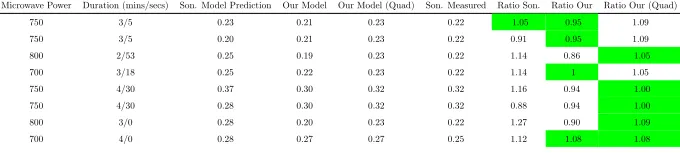
Furthermore, Table 1 shows how our model output compares to that of the
state of the art [4], described in Section 2. As in [4], the ratio, measured as the
predicted energy usage from the model divided by the measured energy usage,
is used for assessing the accuracy, i.e., the results closer to 1 indicate better
prediction. The better performing method is highlighted in green.
Microwave Power Duration (mins/secs) Son. Model Prediction Our Model Our Model (Quad) Son. Measured Ratio Son. Ratio Our Ratio Our (Quad)
750 3/5 0.23 0.21 0.23 0.22 1.05 0.95 1.09
750 3/5 0.20 0.21 0.23 0.22 0.91 0.95 1.09
800 2/53 0.25 0.19 0.23 0.22 1.14 0.86 1.05
700 3/18 0.25 0.22 0.23 0.22 1.14 1 1.05
750 4/30 0.37 0.30 0.32 0.32 1.16 0.94 1.00
750 4/30 0.28 0.30 0.32 0.32 0.88 0.94 1.00
800 3/0 0.28 0.20 0.23 0.22 1.27 0.90 1.09
700 4/0 0.28 0.27 0.27 0.25 1.12 1.08 1.08
Table 1: Comparison of the model prediction of Sonesson [4] (abbreviated to Son.) and our
proposed linear Eq. 3 & quadratic model Eq. 4 using the values recorded by [4] given in [MJ].
We can see that the proposed quadratic model is more accurate than the
[image:16.612.136.476.508.585.2]knowl-edge of the food being prepared does not impact the consumption phase of the
microwave in a significant manner.
In [16], it claimed that an 800W rated microwave at 100% for approx 8
min-utes consumes 0.1kWh (0.36 MJ). Using our linear model the same microwave
would be expected to consume 0.1394kWh (0.5 MJ), and our quadratic model
would be consuming 0.1919kWh (0.69 MJ).
4.2. Oven Consumption Model
Oven-baking is still one of the most used cooking practices in Europe, with
electric ovens present in most homes [4, 23]. The oven operates in two stages: (i)
preheating/restoring heat, when the oven typically draws a constant power load,
and (ii) maintaining heat. The set temperature, type and amount of food being
baked, affects only the time the oven will be in each of the two states. Within
this section, to build a model, the time duration (tsecs) and energy consumption
(EOven) were obtained from the edge detection algorithm (i.e., Algorithm 1) as
described in Section 3.3; the set temperature (tempOven) of the oven has been
obtained from time diaries, or if this is not available, estimated based on the
initial preheating duration, which is close to linear for each oven.
Most cooking recipes require the oven to be pre-heated to a set temperature.
During this phase, the oven door is usually kept shut meaning that the time to
reach temperature will be linear with the assumption that the oven is in good
working order and condition. The cooking phase may consist of door openings
as food is introduced and later checked or taken out. When the door is opened
the oven will lose temperature and require another heating stage to return to the
set temperature. Different oven settings produce different signatures; however,
they still retain the general heating/maintenance cycle with adjusted timings.
In our models we assume that the door is not opened frequently or unnecessarily
and that only one dish is added for the cooking stage. Note that the model is
limited by the available oven data, that is, we expect that the model will not
accurately represent very large (≥80 litres) or very small ovens (≤50 litres).
model given by Eq.(2) and attempt to remove dependency of the model on
parameters that are difficult to acquire.
First, using the data collected from smart meters (see Subsection 3.1) we
estimate two static parameters of Eq.(2) -EhuandEmt. As the values reported
in [4] were set back in 2003, our obtained estimates differ from Eq.(2) due to
the newer and more energy efficient oven designs. This situation further
moti-vates our proposal for appliance modelling methodologies that can be updated
regularly, without significant effort and cost.
In our field study, the 58-litre oven is the oldest and worst performing from an
energy point of view. The average energy values given by Eq.(2) forV = 58 litre
oven, for energy needed for heating and maintaining the heat, respectively, are
Ehu= 2.0×10⁻⁴[M J/(litre×oC)] andEmt= 4.3×10⁻⁶[M J/(litre×minutes)]. Our experiments show that this value should be lowered to around
1.1055×10⁻⁴[M J/(litre×oC)] for E
hu. Our recommendation is to increase
slightly theEmt value from Eq.( 2) to 1.7288×10⁻⁵[M J/(litre×minutes)] due
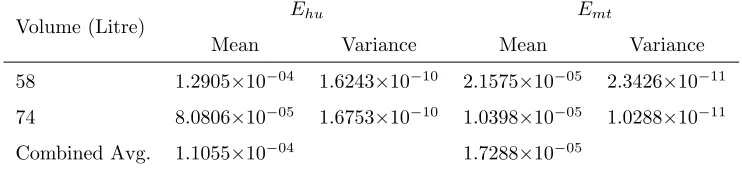
to the increase in the size of oven cavities. Table 2 summarises the mean and
variance of the values obtained from our models from the detailed field study of
two ovens, where the combined average is the recommended value forEhu and
Emt.
Volume (Litre) Ehu Emt
Mean Variance Mean Variance
58 1.2905×10−04 1.6243×10⁻¹⁰ 2.1575×10−05 2.3426×10⁻¹¹
74 8.0806×10−05 1.6753×10⁻¹⁰ 1.0398×10−05 1.0288×10⁻¹¹
[image:18.612.132.503.478.563.2]Combined Avg. 1.1055×10−04 1.7288×10−05
Table 2: Experimentally obtained values for the energy needed for heating and maintaining
the heat, for the two ovens in the study.
Table 2 is an update to the model of [4] described in Section 2; however
in large-scale studies. Instead, we propose the following scalable model, if the
oven volume is unknown:
EOven[M J] = (0.0037372×tempOven[oC]) + (0.0011084×tsecs[s]). (5)
The difference in the volume of the oven causes variations resulting in an
NRMSE between predicted and actual values of 0.25, as calculated by Eq.(7).
We conclude that volume is important for estimating power consumption,
espe-cially with the current large variation in oven volumes on the market. A revised
model that incorporates time duration, set temperature and oven volume is
given by the following equation:
EOven[M J] =
(−0.064859×V[Litre])
+ (0.028626×tempOven[oC])
+ (0.00094777×tsecs[sec]).
(6)
With the addition of the Volume (V) component, Eq. (6) has a reduced
NRMSE of 0.19 when compared to Eq.(5). Fig. 3 shows the validation results for
the energy consumption vs. operation time for the two ovens, this time showing
a much better agreement between the predicted values from the revised model
from Eq.(6) and the actual measured values. Therefore, we define an acceptable
value for NRMSE between actual measurements and predicted values from the
0 500 1000 1500 2000 2500 3000 3500 4000 4500 5000 Duration
(Seconds) 0
1 2 3 4 5 6 7
Consumption
(MJ)
Oven Consumption vs Prediction Models
[image:20.612.139.472.129.292.2]Measured Model Incl. Volume Model Excl. Volume
Figure 3: Oven Total Energy Consumption against time: actual (black circles) vs. Predicted
(red diamond & blue circle).
5. Model validation using publicly available datasets
To further validate our models at scale and investigate the effect of variability
of consumer behaviour, as reported in Oberascher et al. [18], on the proposed
ap-pliance models, we use data from several publicly available datasets, including:
(a) REFIT dataset [35], that comprises aggregate readings and individual
appli-ance power consumption from 20 UK households taken over a period of 2 years
where householders were going about their normal day-to-day routines under no
test conditions; (b) eco dataset from Switzerland [36]; (c) REDD dataset from
the United States [40]. The datasets were chosen to validate against geographic
variability in appliance type ownership and patterns of use, and experiments
were conducted over hundreds of uses for statistical accuracy.
We use NRMSE as a measure of the error. NRMSE was chosen as large errors
are more heavily weighted than Mean Absolute Error (MAE); this is desirable,
as a lower NRMSE shows that the model is less prone to inaccurate
estima-tions and therefore when performing LCA or yearly consumption estimates the
model is proven to be a reliable guide. The NRMSE captures the error in the
was calculated as:
N RM SE= 1 1
N
PN
i=1Eappmeasuredi
s
PN
i=1(Eappmodeli−Eappmeasuredi)
2
N (7)
whereEappmodeli andEappmeasuredi denote the energy consumption estimated by
the model and measured, during thei-th use, respectively, of the appliance in
question (microwave or oven), andN is the number of appliance uses detected
in the dataset.
5.1. Microwave
Table 3 shows the NRMSE results for microwave from the REFIT dataset
where microwave model, i.e., its power rating, is known. Note that, in the
REFIT dataset, the readings were collected at 6-8 sec interval. At the time of the
REFIT study, the measurements were made with a less accurate electricity meter
than the one used to build our model, and this resulted in higher acquisition
noise and synchronization issues. Out of 20 households monitored, the make
and model number of 7 microwaves were collected during the REFIT study,
which means that the output power, i.e.,powerwatt, for these seven microwaves
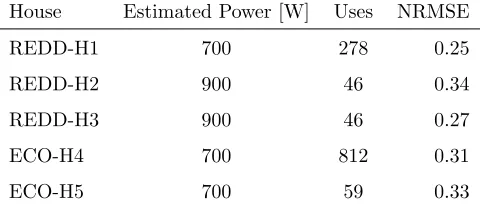
was known. Table 4 shows the equivalent results for eco and REDD datasets,
where the make and model of the microwaves are unknown.
The small NRMSE values for all microwaves in both Tables 3 and 4 (below
the acceptable boundary of 0.5) confirm that the proposed microwave model
of Eq. (4) accurately estimates the energy consumption without any knowledge
about the type of food being cooked or the food temperature, and also that
the proposed model is accurate even with variable consumer behaviour across
different households and countries. NRMSE was only large for Houses 9 and 17
REFIT House Known Power [W] Uses NRMSE
House 3 1000 611 0.28
House 4 700 1395 0.35
House 5 1000 2442 0.47
House 8 1000 1429 0.27
House 9 700 146 0.53
House 17 850 715 0.55
[image:22.612.184.428.128.271.2]House 20 800 755 0.36
Table 3: Model (Eq. 4) NRMSE when predicted for 7 microwaves from the REFIT dataset,
where output power is known. House numbers correspond to the numbers in the REFIT
dataset. Known Power refers to the known power rating of the microwave, i.e.,powerwattis
known.
House Estimated Power [W] Uses NRMSE
REDD-H1 700 278 0.25
REDD-H2 900 46 0.34
REDD-H3 900 46 0.27
ECO-H4 700 812 0.31
ECO-H5 700 59 0.33
Table 4: Model (Eq. 4) NRMSE when predicted for microwaves from eco and REDD datasets.
House numbers correspond to the numbers in the REDD and Eco datasets. Estimated Power
refers to the guessed power rating of the appliance, i.e.,powerwattis assumed based on the
[image:22.612.186.426.364.471.2]0 50 100 150 200 250 300 Duration
(Seconds) 0
0.05 0.1 0.15 0.2 0.25 0.3 0.35 0.4 0.45
Consumption
(MJ)
Prediction (Quadratic Model) for REDD House 1
RDD H1 700W 700W
@40%
Figure 4: Prediction of microwave from REDD House 1, where powerW atts and
settingpercentageis unknown. The consumed power is predicted using the quadratic model
Eq. (4). The actual readings are denoted by RDDH1.
Fig. 4 shows energy consumption vs. duration for REDD House 1 -
mea-sured values (in black) and predicted consumption using the proposed quadratic
model (Eq. 4). It can be seen that the model estimates the load measurements
accurately, despite the fact that power ratingpowerwatt is unknown.
Assum-ing a 700W power settAssum-ing (taken from Table 4) at 100% and 40% (280W) the
NRMSE for the house drops from 0.25 to 0.17.
5.2. Oven
The proposed oven model is validated using the REDD dataset, which
in-cludes an oven monitored at plug level (no disaggregation needed) and the
RE-FIT dataset, where oven uses were extracted from the aggregate data using the
methodology described in Section 3.3. Fig. 5 shows the energy consumption vs.
time duration, for House 1 from the REDD dataset and Houses 1 and 10 from
the REFIT dataset. Oven make and model for both datasets are unknown, as is
the target temperature. Consumption measurements obtained from three ovens
with 53 uses using the aforementioned datasets are plotted using red markers.
The proposed model, Eq. (6), showing prediction consumption values, is
temperatures of 160oC and 180oC.
Figure 5: Oven predictions using the proposed model and reference model [12] for House 1
from REDD (RDD) dataset and Houses 1 and 10 from REFIT (RFT) dataset.
It can be observed that the actual measurements (RDDH1, RF TH10, RF TH1)
fall within the predicted consumption using our model for four different oven
volume and temperature combinations (where values are specified by Vol for
Volume given in Litres and Temp for Temperature given inoC). Visually Fig. 5
confirms that the models are accurate and that knowledge of the type of food
being prepared does not impact on the accuracy of the model. The model is
especially accurate when the duration is up to 45 mins. A lower accuracy of the
model for durations greater than an hour is probably due to a lower
tempera-ture setting used, or the oven door being opened too many times, resulting in
an NRMSE of 0.2868, 0.5208, 0.3260, and 0.2873, for the four cases shown in
Fig. 5, respectively, because the temperature and volume for the oven
measure-ments are unknown so cannot be matched to each usage scenario. We also show
how the actual measurements compare with those predicted by the reference
model of [12] from 1997, shown as dotted lines in Fig. 5. As expected, the latter
model (Jungbluth) overestimates the actual consumption, predicting it in the
range 0.132 MJ/min to 0.234 MJ/min. We can conclude that ovens now come
contemporary ownership.
6. Limitations of the study and threats to the validity of results
In this section, we summarise two limitations of the proposed models, namely
detection of appliance signatures from the smart meter aggregate load
intro-duced in Section 3.3, and availability of appliance models used for model
gen-eration in Sections 4.1 and 4.2.
Algorithm 1, proposed in Section 3.3, uses edge detection to isolate usages of
appliances of interest (i.e., oven and microwave). The edge detection algorithm
is limited by multiple simultaneous appliance uses and appliances with
similar-valued consumption and duration. Appliance uses in these circumstances are
excluded from modelling due to uncertainty. More sophisticated NILM methods
can be used to provide higher disaggregation accuracy [33, 34, 38]. Alternatively,
individual appliance power measurement sensors can be used to directly measure
power consumption of the appliances of interest.
Secondly, limitations arise from the availability of appliance models, namely
microwaves and ovens in our case. Indeed, the microwave model, proposed in
Section 4.1, is limited by the availability of consumption data, and thus it is
inadvertently biased towards the microwaves used in the study, which ranged
between 700W and 900W. Therefore, the accuracy of the model is expected to
be lower for microwaves rated at greater than 1000W. Similarly, the oven model,
proposed in Section 4.2, is limited by the available ovens used in the study, that
is, we expect that the model will not accurately represent very large (≥80 litres)
or very small ovens (≤50 litres). At the time of the study, we endeavoured to
include most commonly available microwave power ratings and oven volumes in
the market. Models proposed in the study are validated on publicly available,
recent (to reflect contemporary appliance ownership) UK, Swiss and USA smart
meter datasets in Section 5 resulting in very good accuracy. The oven model is
7. Application to food life cycle assessment
In order to demonstrate the impact of accurate appliance models developed
previously in food LCA applications, we provide a case study to assess the
environmental impact of a frozen ready meal that is to be cooked at home.
Re-sults obtained are compared with the assessment reported by Schmidt Rivera
et al. [32]. In this section, unlike previous sections, the energy consumption
variable (EM W & EOven) is unknown and needs to be calculated, given the
knowledge of all other variables, such as time duration, power rating and
tem-perature settings.
7.1. System set-up for the assessment of a frozen ready meal
The goal of the assessment is to evaluate the environmental impact of one
frozen ready meal consisting of chicken, vegetables (potato, peas and carrots)
and tomato sauce, and cooked at home in the UK using a microwave oven or an
electric oven, as directed by the cooking instructions printed in the packaging.
The mass of the ready meal, as sold, is 360g. Figure 6 shows the scope of the
assessment and the various life cycle stages taken into account, from agricultural
production of ingredients, consumption, to end of life of packaging and food
[image:26.612.134.478.476.559.2]waste.
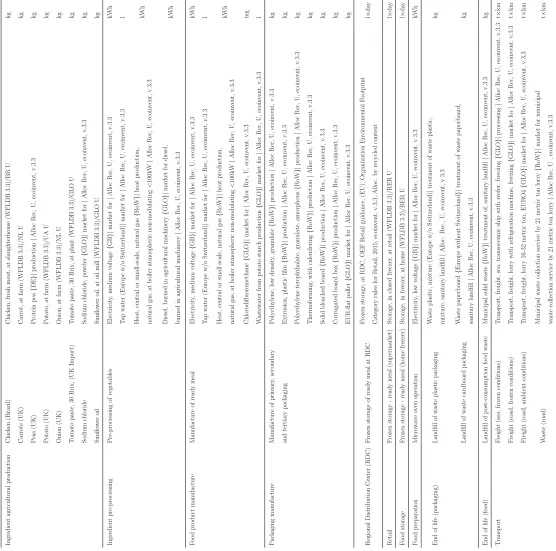
Figure 6: System boundaries in the life cycle assessment of a frozen ready meal. T: Transport;
RDC: Retail Distribution Centre.
Transport of raw ingredients, processed ingredients, packaged ready meal
and waste materials (food and packaging) are all included, accounting for
(local, regional or imported). Primary, secondary and tertiary packaging of
the ready meal is included. Food waste along the value chain as well as
post-consumer waste is also taken into account.
In particular, cooking of the frozen ready meal is modelled as detailed in
Table 5, for six scenarios considered in this assessment. The home cooking
stage is modelled using three different sources of data: the appliance models
proposed in the paper, the World Food LCA Database (WFLDB) [41], and the
energy consumption models by a microwave oven and an electric oven developed
by Jungbluth [12] and used in [32].
Scenario Appliance Cooking Parameters Appliance model Energy Consumption [MJ] Source
1 Electric oven 200oCfor 40min 0.183 MJ/min(Heat up + maintenance) 7.32 [12][32]
2 Electric oven 200oCfor 40min, Oven volume: 67Litre Eq. (6) 3.65 This paper
3 Electric oven 10min preheat, 200oCfor 40min Oven calculator of WFLDB (Heat up + maintenance) 2.16 + 1.44 = 3.6 [41]
4 Microwave oven 9min 0.0435 MJ/min 1.41 [12][32]
5 Microwave oven 800W for 9min Eq. (4) 0.56 This paper
[image:27.612.135.479.292.354.2]6 Microwave oven 800W for 9min 0.088 MJ/min (standby & heating) 0.79 [41]
Table 5: Description of home cooking of one frozen ready meal. Six different scenarios are
considered: 3 with electric oven and 3 with microwave.
The precise details of the inputs to the life cycle inventory of the study
are detailed in [32] and were reproduced here (quantities, distances, cooking
instructions, etc.). Background life cycle inventories (LCI), as shown in Table
6, are taken from publicly available databases: ecoinvent v.3.3 (SCLCI, 2016)
and World Food LCA Database [41], and further detailed in [32]. The energy
sources are regionalised for the elements considered key in this study, namely
pre-processing of vegetables in the UK, manufacturing of ready meals in the UK,
and use of the microwave oven in the UK. The other inputs contain electricity
at either a European level or at global level. Two environmental impact
indi-cators are evaluated: (1) greenhouse gas emissions [42] and (2) abiotic resource
depletion - fossil fuels (CML, 2014) [43], which provide a suitable overview of
the environmental impacts arising from energy consumption. The assessment
7.2. Results
Figs. 7 and 8 present the environmental impacts of the scenarios modelling
the life cycle of the frozen ready meal. In turn, Tables 7 and 8 summarise the
relative contributions of each life cycle stage to the overall results.
Life cycle stage Scenario 1 Scenario 2 Scenario 3 Scenario 4 Scenario 5 Scenario 6
Ingredients 31.8% 39.8% 37.2% 46.9% 50.3% 48.5%
Pre-Processing 0.8% 1.0% 0.9% 1.2% 1.2% 1.2%
Manufacture 15.6% 19.4% 18.2% 22.9% 24.6% 23.7%
Packaging 5.2% 6.4% 6.0% 7.6% 8.2% 7.9%
Distribution & storage 4.1% 5.2% 4.8% 6.1% 6.6% 6.3%
Consumption 39.8% 24.8% 29.6% 11.3% 4.8% 8.2%
[image:29.612.136.476.211.320.2]End of life (EOL) 2.7% 3.4% 3.2% 4.0% 4.3% 4.2%
Table 7: Relative contribution of life cycle stages to overall results for greenhouse gas
emis-sions.
Life cycle stage Scenario 1 Scenario 2 Scenario 3 Scenario 4 Scenario 5 Scenario 6
Ingredients 16.8% 22.1% 20.7% 27.3% 30.0% 28.8%
Pre-Processing 1.1% 1.4% 1.3% 1.7% 1.9% 1.8%
Manufacture 19.1% 25.1% 23.5% 31.0% 34.1% 32.6%
Packaging 10.6% 13.9% 13.0% 17.2% 18.9% 18.1%
Distribution & storage 4.4% 5.8% 5.5% 7.2% 7.9% 7.6%
Consumption 47.6% 31.2% 35.5% 14.9% 6.5% 10.5%
[image:29.612.136.476.385.493.2]End of life (EOL) 0.3% 0.5% 0.4% 0.6% 0.6% 0.6%
Table 8: Relative contribution of life cycle stages to overall results for abiotic resource depletion
−fossil fuels.
7.2.1. Greenhouse gas (GHG) emissions
The results, presented in Table 7 and Fig. 7, show that microwaving the
frozen meal is associated with lower greenhouse gas emissions than cooking it in
an electric oven, irrespective of the model used to represent the operation of the
appliance. As can be seen from Fig. 7 (Consumption phase), Scenario 1, which
uses the model of [12], shows results 14% to 20% higher (3.4 kg CO2−equivalent
in this paper and the World Food LCA Database [41], respectively. This can
be attributed to the fact that the latter models, especially the proposed model,
represent more recent and more energy efficient oven technology. Similar results
are observed for Scenarios 4 to 6 (2.1−2.3 kg CO2−eq per frozen ready meal),
where microwaving is the cooking option.
The life cycle stage contributing the most to the overall results varies
de-pending on the cooking method and the model used to represent the operation
of the appliances. Except for Scenario 1 where the consumption stage is the
largest contributor, in Scenarios 2 and 3 the consumption stage is the second
contributor. Similarly, for microwaving scenarios−except for Scenario 4 where
the consumption phase is the third largest contributor, in Scenarios 5 and 6,
the consumption stage using microwave is the 4th or 5th largest contributor.
7.2.2. Abiotic resource depletion (ARD) - fossil fuels
In the case of ARD - fossil fuels, the overall results, shown in Table 8 and
Fig. 8, follow a pattern similar to the one observed for the GHG emissions.
However, the stages contributing the most to the results follow a different order.
Scenario 1 continues to show the highest results for the option of cooking with
an electric oven (32.3 MJ per frozen ready meal); this is between 19% and
24% higher than Scenarios 2 and 3. The option of microwaving, represented by
Scenarios 4 to 6, shows again similar results (18.1 MJ−19.9 MJ). The largest
contributor to the overall results for the option of cooking with an electric
oven continues to be the consumption stage (ranging between 31% to 48%),
the second largest contributor is now the manufacturing stage (19% to 25%)
and the ingredients stage comes in the third place (17% to 22%). When the
microwaving option is assessed, it is the manufacturing stage which takes the
first place (31% to 34%), whereas the ingredients stage is second (27% to 30%)
and the packaging stage is third (17% to 19%). These different rankings can be
explained by the fact that this environmental impact indicator focuses on fossil
fuels employed in the generation of electricity for the UK grid, fuel fed to boilers
materials (plastic tray, plastic lid, shrinking film).
Figure 7: Greenhouse gas emissions associated with the life cycle of a frozen ready meal.
Scenarios 1 to 3 model home cooking using an electric oven; Scenarios 4 to 6 model home
Figure 8: Abiotic resource depletion (ARD) - fossil fuels associated with the life cycle of a
frozen ready meal. Scenarios 1 to 3 model home cooking using an electric oven; Scenarios 4
to 6 model home cooking using a microwave oven. See Table 5.
7.3. Validation of Results
Table 9 compares our results to those of [32] and [41]. The difference in
results can be explained twofold: a) the use of different life cycle inventory
background databases by both studies, and b) the different models used to
characterize the operation of microwave ovens and electric ovens. In particular,
the higher energy consumption calculated using the model reported by
Jung-bluth [12] is representative of technology available at the time (at least 20 years
old to date). Nevertheless, despite these differences, the results tend to fall into
a close range, thus validating the purpose of this assessment: to obtain good
quality results considering a minimum number of parameters to model home
Scenario Cooking Method
GHG emissions (kg CO2-eq/frozen ready meal)
Abiotic resource depletion fossil fuels (MJ/frozen ready meal)
Overall
Consumption
Stage Overall
Consumption Stage
1
Electric Oven
3.4 1.4 32.3 15.4
2 2.7 0.7 24.6 7.7
3 2.9 0.9 26.2 9.3
RM-8 3.6 1.4 34.0 19.7
4
Microwave Oven
2.3 0.3 19.9 3.0
5 2.3 0.3 19.9 3.0
6 2.2 0.2 18.9 2.0
[image:33.612.133.478.122.299.2]RM-7 2.4 0.2 17.7 2.7
Table 9: Environmental impacts associated with a frozen ready meal. Comparison of results
using the proposed model and the model of Schmidt Rivera et al. [32]. RM-8 and RM-7 refer
to two scenarios studied in [32] (see Table 15 in [32]).
8. Conclusion
The conclusions drawn from validating our proposed models in large,
geo-graphically spread datasets, and demonstration in the Food LCA, confirm our
hypothesis that by using only smart meter energy data, without resorting to
other, difficult to obtain, parameters, such as food type, temperature, and
weight, we can build accurate energy consumption models of major cooking
appliances. In Section 4 the models for electric microwaves and ovens were
gen-erated from real consumption data, that implicitly incorporate user behaviour
in usage of the appliances, contrary to relying on manufacturer’s assumptions on
how the appliances should be used and their resulting models. As user behaviour
can impact the amount of energy an appliance consumes, by proposing a model
which uses consumption data from (and is validated on) real homes (unlike
pre-vious studies which have used laboratory tests which do not take into account
inefficient and unusual use cases), we show that, although human behaviour
can cause variations at scale, it is possible to account for this via
and scaled easily. In Section 5 we demonstrate that the proposed mathematical
models are suitable to estimate appliance energy usage and are generally more
accurate than previous models, reflecting recent trends in market availability
and ownership of more efficient cooking appliances, and possibly more
energy-efficient approaches in cooking practices by households. As these trends will
continue, it is necessary to have a scalable approach to large-scale food LCA as
well as other large longitudinal consumer and energy studies, where information
may be lacking with regards to specialised knowledge such as cooking settings,
food temperature and weight, appliance makes and models. In Section 7, where
the proposed models are compared with other state-of-the-art models used in
the Consumption of Food LCA, we show that our models fall within a close
range of contemporary energy efficient appliance technology consumption
com-pared to non-scalable models proposed 20 years ago. Furthermore, we show that
the Consumption phase of Food LCA is a significant contributor to greenhouse
emissions and abiotic resource depletion. Therefore, the need arises to develop
and update appliance consumption models on a regular basis and at relative
low cost to reflect new technology. In turn, these models provide data that
can satisfy LCA data quality requirements on time-related coverage, technology
coverage, precision and representativeness.
The applicability of the proposed methodology for developing scalable
ap-pliance models from pervasive smart meter data embedding user behaviour is
wide and goes beyond Food LCA. Indeed, from an energy-efficiency
perspec-tive, targeted energy feedback can be provided on consumers appliance usage
habits and activities [29] leading to informed energy savings programmes and
retrofit strategies for replacing appliances. Appliance manufacturers can get a
better understanding of the actual consumption of appliances by customers and
hence improve appliance design and life expectancy and consumption phase of
appliance LCA. In relation to this, our study can augment consumer studies
to identify habits and practices towards appliance repair and second-hand
pur-chases, such as [45], and help meet targets within the waste policy framework.
enabling recommendations for the development of eco-design regulations in the
EU, e.g., see [46].
Acknowledgements
This project was partly supported by Nestec S.A and carried out at the
University of Strathclyde.
Bibliography
[1] B. Note, BNCK06 : Kettle trends (2006).
[2] G. Edwards-Jones, K. Plassmann, E. H. York, B. Hounsome, D. L. Jones,
L. Mil`a i Canals, Vulnerability of exporting nations to the development of
a carbon label in the United Kingdom, Environmental Science and Policy
12 (4) (2009) 479–490. doi:10.1016/j.envsci.2008.10.005.
[3] C. Thim, Domestic Appliances, in: H.-J. Bullinger (Ed.), Technology
Guide, Principles ??? Applications ??? Trends, Springer US, 2009, pp.
458–461. doi:10.1007/978-3-540-88546-7.
[4] U. Sonesson, H. Janestad, B. Raaholt, Energy for Preparation and Storing
of Food - Models for calculation of energy use for cooking and cold storage
in households, no. 709, 2003.
[5] T. J. Hager, R. Morawicki, Energy consumption during cooking in the
residential sector of developed nations: A review, Food Policy 40 (2013)
54–63. doi:10.1016/j.foodpol.2013.02.003.
URLhttp://dx.doi.org/10.1016/j.foodpol.2013.02.003
[6] C. E. Dutilh, K. J. Kramer, Energy Consumption in the Food Chain,
AM-BIO: A Journal of the Human Environmentdoi:10.1579/0044-7447-29.
[7] A. D. Cuellar, M. E. Webber, An updated estimate for energy use in U.S.
food production and policy implications, in: Proceedings of the ASME 4th
International Conference on Energy Sustainability, Vol. 1, 2010, pp. 35–44.
doi:10.1115/ES2010-90179.
[8] M. C. Heller, G. Keoleian, Life cycle-based sustainability indicators for
assessment of the U.S. food system, Report - Center for Sustainable
Sys-tems, School of Natural Resources and Environment, University of
Michi-gan (CSS00-04) (2000) 59 pp.
[9] P. Bertoldi, B. Atanasiu, Electricity consumption and efficiency trends in
the enlarged European Union - Status Report 2009, 2009.
[10] International Energy Agency, World Energy Outlook 2006, World Energy
Outlookdoi:10.1787/weo-2006-en.
URL http://books.google.com/books?hl=en{&}lr={&}id=
JAcuHqDnI6gC{&}oi=fnd{&}pg=PA3{&}dq=World+Energy+Outlook+
2006{&}ots=NCadW-C961{&}sig=5wr-ct{_}hWTzqi4Rlwo8Gl8L6Ax0
[11] D. K. De, N. M. Shawhatsu, N. N. De, M. I. Ajaeroh, Energy-efficient
cooking methods, Energy Efficiency 6 (1) (2013) 163–175. doi:10.1007/
s12053-012-9173-7.
[12] N. Jungbluth, Life-Cycle-Assessment for Stoves and Ovens (1997) 1–52.
[13] S. Lakshmi, A. Chakkaravarthi, R. Subramanian, V. Singh, Energy
con-sumption in microwave cooking of rice and its comparison with other
do-mestic appliances, Journal of Food Engineering 78 (2) (2007) 715–722.
doi:10.1016/j.jfoodeng.2005.11.011.
[14] T. Das, R. Subramanian, A. Chakkaravarthi, V. Singh, S. Z. Ali, P. K.
Bordoloi, Energy conservation in domestic rice cooking, Journal of Food
Engineering 75 (2) (2006) 156–166. doi:10.1016/j.jfoodeng.2005.04.
[15] J. Zufia, L. Arana, Life cycle assessment to eco-design food products:
in-dustrial cooked dish case study, Journal of Cleaner Production 16 (17)
(2008) 1915–1921. doi:10.1016/j.jclepro.2008.01.010.
[16] L. A. Calder´on, L. Iglesias, A. Laca, M. Herrero, M. D´ıaz, The utility of Life
Cycle Assessment in the ready meal food industry, Resources,
Conserva-tion and Recycling 54 (12) (2010) 1196–1207. doi:10.1016/j.resconrec.
2010.03.015.
[17] L. A. Calder´on, M. Herrero, A. Laca, M. D´ıaz, Environmental impact
of a traditional cooked dish at four different manufacturing scales: from
ready meal industry and catering company to traditional restaurant and
homemade, International Journal of Life Cycle Assessment (2017) 1–
13doi:10.1007/s11367-017-1326-7.
[18] C. Oberascher, R. Stamminger, C. Pakula, Energy efficiency in daily food
preparation, International Journal of Consumer Studies 35 (2) (2011) 201–
211. doi:10.1111/j.1470-6431.2010.00963.x.
[19] Vattenfall, Energiesparen macht Spaß und spart Geld, Tech. rep. (2008).
[20] G. Wood, M. Newborough, Dynamic energy-consumption indicators for
do-mestic appliances: Environment, behaviour and design, Energy and
Build-ings 35 (8) (2003) 821–841. doi:10.1016/S0378-7788(02)00241-4.
[21] E. A. DeMerchant, User’s Influence on Energy Consumption with Cooking
Systems Using Electricity, Virginia Polytechnic Institute and State
Univer-sity (1997) 1–155.
URLhttp://hdl.handle.net/10919/29838
[22] R. Kemna, Energy Consumption of Domestic Appliances in European
Households, Tech. rep. (2010).
[23] F. Burlon, Energy Efficiency of Combined Ovens, in: Energy Procedia,
Vol. 82, Elsevier B.V., 2015, pp. 986–993. doi:10.1016/j.egypro.2015.
[24] D. Papasidero, S. Pierucci, F. Manenti, Energy optimization of bread
baking process undergoing quality constraints, Energy 116 (2016) 1–6.
doi:10.1016/j.energy.2016.06.046.
URLhttp://dx.doi.org/10.1016/j.energy.2016.06.046
[25] A. Milani, C. Camarda, L. Savoldi, A simplified model for the electrical
energy consumption of washing machines, Journal of Building Engineering
2 (2015) 69–76. doi:10.1016/j.jobe.2015.04.007.
URLhttp://dx.doi.org/10.1016/j.jobe.2015.04.007
[26] J. Geppert, Modelling of domestic refrigerators’ energy consumption under
real life conditions in Europe (2011) 145.
[27] P. Jason, I. Cooper, Smart metering implementation programme
govern-ment response to the consultation on the second version of the smart
me-tering equipment technical specifications part 1 (January) (2013) 14.
[28] D. Murray, J. Liao, L. Stankovic, V. Stankovic, Understanding usage
patterns of electric kettle and energy saving potential, Applied Energy 171
(2016) 231–242. doi:10.1016/j.apenergy.2016.03.038.
URL http://www.sciencedirect.com/science/article/pii/
S0306261916303579
[29] L. Stankovic, V. Stankovic, J. Liao, C. Wilson, Measuring the energy
in-tensity of domestic activities from smart meter data, Applied Energy 183
(2016) 1565–1580. doi:10.1016/j.apenergy.2016.09.087.
URLhttp://dx.doi.org/10.1016/j.apenergy.2016.09.087
[30] M. Pipattanasomporn, M. Kuzlu, S. Rahman, Y. Teklu, Load Profiles of
Selected Major Household Appliances and Their Demand Response
Oppor-tunities 5 (2) (2014) 742–750.
[31] J. Riley, J. Hulme, Report 9: Domestic appliances, cooking & cooling
equipment, Tech. rep., BRE, Department of Energy and Climate Change
[32] X. C. Schmidt Rivera, N. Espinoza Orias, A. Azapagic, Life cycle
envi-ronmental impacts of convenience food: Comparison of ready and
home-made meals, Journal of Cleaner Production 73 (2014) (2014) 294–309.
doi:10.1016/j.jclepro.2014.01.008.
URLhttp://dx.doi.org/10.1016/j.jclepro.2014.01.008
[33] B. Zhao, L. Stankovic, V. Stankovic, On a Training-Less Solution for
Non-Intrusive Appliance Load Monitoring Using Graph Signal Processing, IEEE
Access 4 (2016) 1784–1799. doi:10.1109/ACCESS.2016.2557460.
[34] J. Kelly, W. Knottenbelt, The UK-DALE dataset, domestic appliance-level
electricity demand and whole-house demand from five UK homes., Scientific
data 2 (2015) 150007. arXiv:1404.0284,doi:10.1038/sdata.2015.7.
URLhttp://arxiv.org/abs/1404.0284
[35] D. Murray, L. Stankovic, V. Stankovic, An electrical load measurements
dataset of United Kingdom households from a two-year longitudinal study
4463 (2016) 1–12. doi:10.1038/sdata.2016.122.
[36] C. Beckel, W. Kleiminger, R. Cicchetti, T. Staake, S. Santini, The ECO
Data Set and the Performance of Non-Intrusive Load Monitoring
Algo-rithms, Proceedings of the 1st ACM Conference on Embedded Systems for
Energy-Efficient Buildings (2014) 80—-89doi:10.1145/2674061.2674064.
[37] N. Batra, M. Gulati, A. Singh, M. B. Srivastava, It’s Different:
In-sights into home energy consumption in India, Proceedings of the 5th
ACM Workshop on Embedded Systems For EnergyEfficient Buildings
-BuildSys’13 (November) (2013) 1–8. doi:10.1145/2528282.2528293.
URLhttp://dl.acm.org/citation.cfm?doid=2528282.2528293
[38] K. He, L. Stankovic, J. Liao, V. Stankovic, Non-Intrusive Load
Disaggre-gation using Graph Signal Processing, IEEE Transactions on Smart Grid
3053 (c) (2016) 1–1. doi:10.1109/TSG.2016.2598872.
[39] H. Altrabalsi, V. Stankovic, J. Liao, L. Stankovic, Low-complexity energy
disaggregation using appliance load modelling, AIMS Energy 4 (1) (2016)
1–21. doi:10.3934/energy.2016.1.1.
[40] J. Z. Kolter, M. J. Johnson, REDD : A Public Data Set for Energy
Disaggregation Research, SustKDD workshop xxxxx (1) (2011) 1–6.
URL http://users.cis.fiu.edu/{~}lzhen001/activities/
KDD2011Program/workshops/WKS10/doc/SustKDD3.pdf
[41] X. Bengosa, T. Nemecek, V. Rossi, J. Lansche, S. Humbert, P. Mouron,
World Food LCA Database (August).
[42] Intergovernmental Panel on Climate Change, Climate change 2013: The
physical science basis, CLIMATE CHANGE 2013 - They Physical Science
Basis.
[43] L. van Oers, CML-IA Characterisation Factors, Tech. rep.
URLhttp://cml.leiden.edu/software/data-cmlia.html
[44] P. Sustainability, SimaPro Life Cycle Assessment software (2016).
[45] V. P´erez-Belis, M. Braulio-Gonzalo, P. Juan, M. D. Bovea, Consumer
at-titude towards the repair and the second-hand purchase of small
house-hold electrical and electronic equipment. A Spanish case study, Journal of
Cleaner Production 158 (2017) 261–275. doi:10.1016/j.jclepro.2017.
04.143.
[46] A. Gallego-Schmid, H. K. Jeswani, J. M. F. Mendoza, A. Azapagic, Life
cycle environmental evaluation of kettles: Recommendations for the
de-velopment of eco-design regulations in the European Union, Science of the
Total Environment 625 (2018) 135–146.doi:10.1016/j.scitotenv.2017.
12.262.


![Figure 5: Oven predictions using the proposed model and reference model [12] for House 1from REDD (RDD) dataset and Houses 1 and 10 from REFIT (RFT) dataset.](https://thumb-us.123doks.com/thumbv2/123dok_us/1401714.93188/24.612.137.473.156.312/figure-predictions-proposed-reference-dataset-houses-refit-dataset.webp)