The Generalized Assignment Problem
with Minimum Quantities
Sven O. Krumkea, Clemens Thielena,∗
a
University of Kaiserslautern, Department of Mathematics Paul-Ehrlich-Str. 14, D-67663 Kaiserslautern, Germany
Abstract
We consider a variant of the generalized assignment problem (GAP) where the amount of space used in each bin is restricted to be either zero (if the bin is not opened) or above a given lower bound (aminimum quantity). We provide several complexity results for different versions of the problem and give polynomial time exact algorithms and approximation algorithms for restricted cases. For the most general version of the problem, we show that it does not admit a polynomial time approximation algorithm (unless P= NP), even for the case
of a single bin. This motivates to study dual approximation algorithms that compute solutions violating the bin capacities and minimum quantities by a constant factor. When the number of bins is fixed and the minimum quantity of each bin is at least a factorδ >1 larger than the largest size of an item in the bin, we show how to obtain a polynomial time dual approximation algorithm that computes a solution violating the minimum quantities and bin capacities by at most a factor 1− 1δ and 1 + 1δ, respectively, and whose profit is at least as large as the profit of the best solution that satisfies the minimum quantities and bin capacities strictly. In particular, forδ= 2, we obtain a polynomial time (1,2)-approximation algorithm.
Keywords: assignment problems, combinatorial optimization, approximation algorithms, computational complexity
1. Introduction
The generalized assignment problem (cf., for example, [1, 2]) is a classical generalization of both the (multiple) knapsack problem and the bin packing problem. In the classical version of GAP, one is givenmbins, a capacityBj for
each binj, andnitems such that each itemihas sizesi,j and yields profitpi,j
when packed into binj. The goal is to find a feasible packing of the items into
∗Corresponding author. Fax: +49 (631) 205-4737. Phone: +49 (631) 205-4590
Email addresses: [email protected](Sven O. Krumke), [email protected](Clemens Thielen)
the bins that maximizes the total profit. Applications of GAP include fixed charge location problems, grouping and loading for flexible manufacturing sys-tems, vehicle routing, scheduling projects, allocating storage space, scheduling payments on accounts, designing communication networks, assigning software development tasks to programmers, assigning jobs to computers in networks, scheduling variable length TV commercials, and assigning ships to overhaul fa-cilities. For details on these applications, we refer to [2] and the references therein.
In this paper, we consider a variation of the problem where the amount of space used in each bin is restricted to be either zero (if the bin is not opened) or above a given lower bound (aminimum quantity). This additional restriction is motivated from many practical packing problems where it does often not make sense to open an additional container (bin) if not at least a certain amount of space in it will be used. For example, in the classical application of GAP where the bins correspond to workers and the items correspond to jobs that can be assigned to them, it may be unreasonable to hire an additional worker if not at least a certain amount of work will be assigned to him.
Another motivation for adding minimum quantities to GAP is its application in unrelated machine scheduling [3]. Here, the bins correspond to machines and the items to jobs. In practice, it may be that running a machine is only feasible if a prescribed minimum load is attained on the machine. In a foundry or steel works, for example, a machine can only be used if it has a certain minimum amount of metal to process.
Formally, the generalized assignment problem with minimum quantities (GAP-MQ) is defined as follows:
Definition 1 (GAP with Minimum Quantities (GAP-MQ)).
INSTANCE: m bins with capacities B1, . . . , Bm ∈ N and minimum
quan-tities q1, . . . , qm ∈ N (where qj ≤ Bj for all j = 1, . . . , m),
andn items. For each itemiand bin j, a sizesi,j ∈Nand a
profitpi,j∈N.
TASK: Find a packing of a subset of the items into a subsetS of the bins such that the total space used in each binj∈Sis at least qj and at mostBj and the total profit is maximized.
In the decision version of the problem, a bound P ∈N on the total profit
is given and the question is whether there exists a feasible packing with total profit at leastP. When stating results about the computational complexity of an optimization problem such as GAP-MQ, we will always mean the complexity of the corresponding decision problem.
Note that, in the above definition and throughout the paper, we always assumeNto contain zero and denote the positive integers byN+. Moreover, we
always assume that qj ≤ Pni=1si,j for each bin j in an instance of GAP-MQ
(otherwise, there does not exist any feasible solution that packs a nonempty set of items into binj, so the bin can be removed from the instance).
Two important special cases of GAP-MQ motivated from the problem of assigning students to seminars at a university are theseminar assignment prob-lem(SAP) and theparticipant maximization problem(PMP). SAP is the special case of GAP-MQ in which all item sizes are one. It can be motivated from the problem of assigning students (items) to seminars (bins) such that the number of participants in each seminarjis betweenqj andBjand the total satisfaction
(profit) of the students is maximized. PMP is the special case of SAP in which all profits are one, so the objective is simply to maximize the number of students that receive a place in one of the seminars (the total number of participants). In these applications, the minimum quantities are a very natural restriction since holding a seminar only make sense if there is at least a certain minimum number of students giving a talk in the seminar.
By a polynomial time α-approximation algorithm for a maximization prob-lem such as GAP-MQ, we mean an algorithm that, for any given instanceI of encoding length|I| ∈N+, finds a feasible solution with objective value at least
1
αtimes optimal in time bounded by a polynomial in|I|if the instanceIadmits
a feasible solution, and outputs infeasibility of the instance after a number of steps bounded by a polynomial in|I|if no feasible solution for instanceIexists. For problems which do not admit polynomial time approximation algo-rithms, a common approach is to study dual approximation algorithms that compute solutions violating some constraints of the problem by at most a con-stant factor. By a polynomial time (α, β)-approximation algorithm for a max-imization problem, we mean an algorithm that, for any given instance I of encoding length |I| ∈ N+, achieves the following: If the instance I admits a
feasible solution, the algorithm requires only time bounded by a polynomial in |I|to find a solution that violates the constraints of the problem by at most a factorβ and whose objective value is at least α1 times as large as the objective value of the optimal solution that satisfies the constraints strictly. If the in-stanceI does not admit a feasible solution, the algorithm outputs infeasibility of the instance after a number of steps bounded by a polynomial in|I|.
1.1. Previous Work
The classical GAP is well-studied in literature. A comprehensive introduc-tion to the problem can be found in [1]. A survey of algorithms for GAP is given in [2]. For a survey on different variants of assignment problems studied in literature, we refer to [4].
GAP is known to beAPX-hard [5], but there exists a 2-approximation
algo-rithm [3, 5]. Cohen et al. [6] showed how any polynomial timeα-approximation algorithm for the knapsack problem can be translated into a polynomial time (1 +α)-approximation algorithm for GAP. A (1,2)-approximation algorithm for the equivalent minimization version of GAP, assigning itemito bin j causes a costci,j, was provided by Shmoys and Tardos [3]: For every feasible instance
of GAP, their algorithm computes a solution that violates the bin capacities by at most a factor of 2 and whose cost is at most as large as the cost of the best solution that satisfies the bin capacities strictly.
GAP is a generalization of both the (multiple) knapsack problem (cf. [1, 5, 7]) and the bin packing problem (cf. [8, 9, 10]). The multiple knapsack problem is the special case of GAP where the size and profit of an item are independent of the bin (knapsack) it is packed into. The bin packing problem can be seen as the special case of the decision version of GAP in which all bins have the same capacity and all profits are one. The question of deciding whether a packing of total profit equal to the number of items exists is then equivalent to asking whether all items can be packed into the given number of bins.
A dual version of bin packing (often calledbin covering) in which minimum quantities are involved was introduced in [11, 12]. Here, the problem is to pack a given set of items with sizes that do not depend on the bins so as to maximize the number of bins used, subject to the constraint that each bin contains items of total size at least a given thresholdT (upper bin capacities are not considered due to the nature of the objective function). Hence, the bin covering problem can be seen as a variant of GAP-MQ in which the minimum quantity is the same for each bin and the objective is to maximize the number of bins used. Since any approximation algorithm with approximation ratio strictly smaller than 2 would have to solve theNP-complete partition problem when applied to
instances in which the sizes of the items sum up to two, it follows that (unless
P=NP) no polynomial time (2−ǫ)-approximation for bin covering exists for any
ǫ >0. In contrast, the main result of Assmann et al. [12] is anO(nlog2n) time algorithm that yields anasymptoticapproximation ratio of 4/3 for bin covering, while easier algorithms based on next fit and first fit decreasing are shown to yield asymptotic approximation ratios of 2 and 3/2, respectively. Later, an asymptotic PTAS [13] and an asymptotic FPTAS [14] for bin covering were developed.
Minimum quantities have recently been studied for minimum cost network flow problems [15, 16, 17]. In this setting, minimum quantities for the flow on each arc are considered, which results in the minimum cost flow problem becoming stronglyNP-complete [16]. Moreover, it was shown in [16] that (unless P=NP) no polynomial timeg(|I|)-approximation for the problem exists for any
polynomially computable functiong:N+→N+, where|I|denotes the encoding
length of the given instance.
1.2. Our Contribution
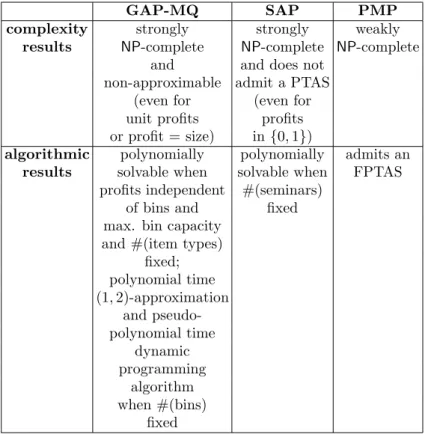
We prove several complexity and approximation results on GAP-MQ and its special cases (see Table 1 for an overview).
We show that PMP is weakly NP-complete and admits a fully polynomial
time approximation scheme (FPTAS). In contrast, we prove that SAP is strongly
NP-complete and (unlessP=NP) does not admit a polynomial time
approx-imation scheme (PTAS) even if all profits are in {0,1}. We show, however, that SAP can be solved in polynomial time by linear programming (or, more efficiently, by minimum cost flow computations) when the number of seminars (bins) is fixed. For the general case of GAP-MQ (which, by our results on SAP, is stronglyNP-complete even if all item sizes are one), we show that the problem
also remains stronglyNP-complete if all profits are one or if the profit obtained
from packing an item into any bin equals the size of the item. Both results hold even for the case that the size of an item is independent of the bin it is packed into. Moreover, we prove that (unlessP=NP) no polynomial time
ap-proximation algorithm exists for GAP-MQ even for these restricted profit values and only one bin. We show, however, that GAP-MQ can be solved optimally in polynomial time when the profit of an item is independent of the bin it is packed into and the maximum bin capacityBmaxas well as the number of different item types (s1, . . . , sm, p) are fixed.
For the case that the number of bins is fixed, we present a pseudo-polynomial time dynamic programming algorithm for GAP-MQ. More importantly, when the number of bins is fixed andqj ≥δsi,j for all i, j and someδ >1, we show
how to obtain a polynomial time dual approximation algorithm that computes a solution violating the minimum quantities and bin capacities by at most a factor 1−1δ and 1 + 1δ, respectively, and whose profit is at least as large as the profit of the best solution that satisfies the minimum quantities and bin capacities strictly. In particular, forδ= 2, we obtain a polynomial time (1, 2)-approximation algorithm for the problem for the case that the number of bins is fixed andqj ≥2si,j for alli, j. Moreover, we provide computational results,
which show that, on average, this (1,2)-approximation algorithm produces al-most feasible solutions with superoptimal profit.
2. The Participant Maximization Problem
In this section, we consider the participant maximization problem (PMP), which is the special case of GAP-MQ in which all item sizes and profits are one. It can be thought of as the problem of assigning students to seminars at a university such that the number of participants in each seminarj is betweenqj
andBj and the maximum possible number of students receive a place in one of
the seminars. Formally, the problem is defined as follows:
Definition 2 (Participant Maximization Problem (PMP)).
INSTANCE: The number n of students and m seminars with capaci-ties B1, . . . , Bm ∈ Nand minimum quantities q1, . . . , qm ∈N
(whereqj ≤Bj for allj= 1, . . . , m).
TASK: Find an assignment of a subset of the students to a subsetS of the seminars such that the number of students in each sem-inarj∈S is at leastqj and at mostBj and the total number
of students assigned to seminars is maximized.
We start by showing that PMP is weakly NP-complete. To show NP
-hardness, we use a reduction from the (weakly)NP-complete subset sum
prob-lem (cf. [18]). An instance of SUBSET SUM consists of l+ 1 positive inte-gers a1, . . . , al, B ∈ N and the question is whether there exists a subset S of
{1, . . . , l}such thatP
GAP-MQ SAP PMP
complexity strongly strongly weakly
results NP-complete NP-complete NP-complete
and and does not
non-approximable admit a PTAS (even for (even for unit profits profits or profit = size) in {0,1})
algorithmic polynomially polynomially admits an
results solvable when solvable when FPTAS profits independent #(seminars)
of bins and fixed max. bin capacity
and #(item types) fixed; polynomial time (1,2)-approximation and pseudo-polynomial time dynamic programming algorithm when #(bins) fixed
Theorem 1. PMP is weaklyNP-complete even if the capacity and the minimum quantity of each seminar are the same (i.e.,Bj=qj for each j= 1, . . . , m).
Proof. Membership in NP is obvious as the number of students assigned to
seminars in a given solution can be calculated easily in polynomial time. To showNP-hardness, we reduce SUBSET SUM to PMP in polynomial time. Given
an instance a1, . . . , al, B of SUBSET SUM, we construct an instance of PMP
as follows: The number of students isn:= B and there are m :=l seminars. The capacity and minimum quantity of seminarj areBj :=qj :=aj for each
j= 1, . . . , l.
It is now easy to see that there exists a subset S of {1, . . . , l} such that P
i∈Sai = B if and only if all students can be assigned to seminars: Given
such a subsetS, we can assign exactlyai =Bi =qi students to seminar ifor
eachi∈S to obtain an assignment of all students to seminars that respects the seminar capacities and minimum quantities. Conversely, given an assignment of all n = B students to a subset S ⊆ {1, . . . , l} of the seminars, it follows that exactlyai =Bi =qi students must be assigned to each seminari∈S, so
P
i∈Sai=B.
Note that the encoding length of an instance of PMP is polynomial in logn, whereas encoding an instance of SAP or the general version of GAP-MQ requires a number of bits that is a polynomial in n. Thus, Theorem 1 has no direct implications for the complexity of these more general versions of the problem.
Even though solving PMP optimally is NP-complete, the following easy
greedy algorithm obtains an approximation ratio of 2 for the problem: We first sort the seminars by nonincreasing minimum quantities, so thatq1≥q2≥ · · · ≥qm. Then we assign exactly qj students to each seminar j = 1,2, . . . , m
until one of the following conditions is fulfilled: 1. All students have been assigned,
2. Less thanql students remain unassigned after considering seminarl−1,
3. Each seminarj∈ {1, . . . , m} has been assigned exactlyqj students.
In Case 1, we have found an optimal assignment. In Case 3, we continue filling all seminarsj = 1,2. . . , mto their capacitiesBj until all students are assigned or
all places in these seminars are filled, which again yields an optimal assignment. In Case 2, we must havel≥2, and the ordering of theqj implies that
ALG OPT ≥ Pl−1 j=1qj Pl j=1qj ≥ l−1 l ≥ 1 2,
whereOPTdenotes the number of students assigned to seminars in an optimal
assignment andALGdenotes the number of students assigned by the algorithm.
Hence, the algorithm obtains an approximation ratio of 2 for PMP.
We now show how to obtain a fully polynomial time approximation scheme (FPTAS) for PMP. To do so, we will show how an arbitrary instance of PMP can
be solved by solving a suitable instance of the 0-1-knapsack problem (cf. [18]). Moreover, this reduction is polynomial time and preserves approximations, so it follows that we obtain an FPTAS for PMP by simply applying the well-known FPTAS for the knapsack problem (cf. [9]) to the corresponding knapsack instance.
An instance of the 0-1-knapsack problem (0-1-KP) consists oflobjects with sizess1, . . . , sl ∈Nand profits p1, . . . , pl∈N, and a knapsack capacityB ∈N
and the task is to find a subsetSof{1, . . . , n}such thatP
i∈Ssi≤B and such
that the total profitP
i∈Spi is maximized.
Now consider an arbitrary instance of PMP. Given the numbernof students, the seminar capacitiesB1, . . . , Bm, and the minimum quantitiesq1, . . . , qm, we
define an instance of 0-1-KP as follows: There arel :=mobjects. The size of object i is si := qi and its profit is pi := Bi for i = 1, . . . , m. The knapsack
capacity isB:=n. Applying the FPTAS for 0-1-KP to this instance, we obtain, for anyǫ >0, a setS⊆ {1, . . . , n} of objects such that
X i∈S qi= X i∈S si≤B=n (1) X i∈S Bj = X i∈S pi≥(1−ǫ)·OPTKP, (2)
where OPTKP denotes the optimal profit possible for the knapsack instance.
Moreover, any assignment of k ≤ n students to a set S of seminars directly yields a feasible packing of the knapsack with profit at leastk: When packing exactly the objects inS, we obtain that
X i∈S si= X i∈S qi ≤k≤n=B and X i∈S pi= X i∈S Bi≥k,
where the first line holds since the assignment of students respects the minimum quantities and the second line holds since it respects the seminar capacities. Hence, it follows thatOPTKP≥OPTholds for the optimal objective valueOPT
of the given instance of PMP, so (1) and (2) show that the setS obtained from the FPTAS for the knapsack instance yields a set of seminars that can all be filled to at least their minimum quantities (by (1)) and that provide enough places for at least (1−ǫ)·OPTKP≥(1−ǫ)·OPTstudents (by (2)). Filling each
of the seminars in S to its minimum capacity and distributing the remaining students arbitrarily to the remaining places in the seminars inS, thus, yields a feasible solution for the given instance of PMP in which at least (1−ǫ)·OPT
students are assigned, so we have proved the following theorem:
3. The Seminar Assignment Problem
In this section, we consider the seminar assignment problem (SAP), which is the special case of GAP-MQ in which all item sizes are one. It can be thought of as the problem of assigning students to seminars at a university such that the number of participants in each seminarj is betweenqj andBj and the and the
total satisfaction (profit) of the students is maximized. Formally, the problem is defined as follows:
Definition 3 (Seminar Assignment Problem (SAP)).
INSTANCE: The number n of students, m seminars with capaci-ties B1, . . . , Bm ∈ Nand minimum quantities q1, . . . , qm ∈N
(where qj ≤ Bj for all j = 1, . . . , m), and a profit pi,j ∈ N
resulting from assigning studentito seminarj fori= 1, . . . , n andj= 1, . . . , m.
TASK: Find an assignment of a subset of the students to a subsetS of the seminars such that the number of students in each sem-inarj ∈S is at leastqj and at mostBj and the total profit is
maximized.
We start by showing that SAP does not admit a PTAS. More specifically, we show that there existsǫ >0 such that it is stronglyNP-hard to approximate
SAP within a factor larger than (1−ǫ). In particular, this implies strongNP
-hardness of the problem. For the proof, we use a reduction from the 3-bounded 3-dimensional matching problem (3DM-3) defined as follows:
Definition 4 (3-Bounded 3-Dimensional Matching Problem (3DM-3)).
INSTANCE: A set T ⊆ X ×Y ×Z, where |X| = |Y| = |Z| = n and each element ofX∪Y ∪Z appears at most three times as a coordinate of an element ofT.
TASK: Find a matching inTof maximum cardinality, i.e., a maximum cardinality subsetM ⊆T such that no two elements ofMagree in any coordinate.
3DM-3 is known to be APX-complete [19]. For our proof, we use a result
of Petrank [20] who showed that 3DM-3 has a hard gap at location 1, i.e., there existsǫ0>0 such that it is (strongly)NP-hard to decide whether a given
instance of 3DM-3 has a matching of sizenor if every matching has size at most (1−ǫ0)n.
Theorem 3. Let ǫ0 be such that it is strongly NP-hard to decide whether a given instance of 3DM-3 has a matching of sizenor if every matching has size at most (1−ǫ0)n. Then it is strongly NP-hard to approximate SAP within a factor larger than (1−1
3ǫ0) even if the capacity and the minimum quantity of
each seminar are fixed to 3 (i.e., Bj = qj = 3 for each j = 1, . . . , m) and all profitspi,j are in {0,1}. In particular, SAP does not admit a PTAS.
Proof. Given an instance of 3DM-3 specified byT ⊆X×Y ×Z with|X|= |Y|=|Z|=nand|T|=m, we construct an instance of SAP as follows: There are 3nstudents corresponding to the 3nelements ofX∪Y∪Z andmseminars corresponding to the triples inT. The capacity and minimum quantity of each seminar areBj :=qj := 3 for eachj = 1, . . . , m. The profitpi,j resulting from
assigning studenti to seminar j is one if element i is a coordinate of triple j and zero otherwise.
If the given instance of 3DM-3 has a matching of sizen, we obtain an assign-ment of students to seminars with profit 3n by assigning exactly the students corresponding to the coordinates of each triple in the matching to the corre-sponding seminar. Conversely, if every matching has size at most (1−ǫ0)n, any feasible assignment of students to seminars can contain at most (1−ǫ0)n seminars that yield a profit of 3. With the remaining 3nǫ0 students, at most nǫ0 additional seminars can be opened, each of which can yield a profit of at most 2. Hence, the profit of any feasible solution is no larger than
3(1−ǫ0)n+ 2nǫ0= 3n(1−ǫ0+2
3ǫ0) = 3n(1− 1 3ǫ0),
which shows that it isNP-hard to approximate SAP within a factor larger than
(1−1 3ǫ0).
We now show how SAP can be solved optimally in polynomial time when the numbermof seminars is fixed. To this end, first assume that the subsetSof the seminars used in an optimal solution for a given instance of SAP is known. GivenS, we can solve the given instance of SAP by solving the following integer linear program (ILP):
max n X i=1 X j∈S pi,jxi,j (3) s.t. qj ≤ n X i=1 xi,j≤Bj ∀j∈S (4) 0≤X j∈S xi,j ≤1 ∀i∈ {1, . . . , n} (5) 0≤xi,j ≤1 ∀i∈ {1, . . . , n}, j∈S (6) xi,j∈Z ∀i∈ {1, . . . , n}, j∈S (7)
It is now easy to see that the coefficient matrix of the variablesxi,j in the
inequalities (4) and (5) is totally unimodular. Hence, the Integrality-Theorem of Hoffman and Kruskal (cf. [21]) implies that the polyhedron defined by the inequalities (4) to (6) is integral, so we can solve the ILP by solving the corre-sponding linear program (LP), which can be done in polynomial time.
Since we assumed that the numbermof seminars is fixed, we directly obtain a polynomial time algorithm for SAP in this case by solving the LP for every one of the at most 2mpossible choices of the setS⊆ {1, . . . , m}of seminars to
use and then taking the solution obtaining the highest profit. Hence, we proved the following theorem:
Theorem 4. SAP can be solved optimally in polynomial time when the num-berm of seminars is fixed.
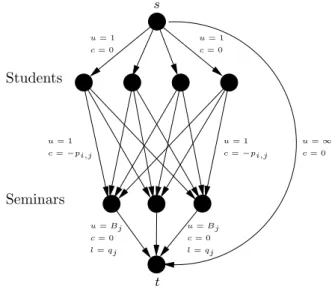
Note that, when requiring the linear program above to be solved in poly-nomial time, one needs to make use of a polypoly-nomial time algorithm for linear programming such as the ellipsoid method, which is rather inefficient in prac-tice. We now show, however, that the subproblem of computing an optimal assignment for a given set S of seminars can be solved more efficiently by for-mulating it as a minimum cost flow problem. We consider the directed graphG shown in Figure 1. Here, the upper row of nodes corresponds to the students and the lower row corresponds to the seminars in the current test-setS and, for each studentiand each seminarj, there is an arc (i, j) with costc=−pi,jand
upper capacityu= 1 from the node corresponding toito the node correspond-ing toj. Additionally, there is a source nodesthat is connected by an arc (s, i) with costc = 0 and upper capacity u= 1 to each node i corresponding to a student and a sink nodet connected by an arc (j, t) with costc= 0 and upper capacityu=Bj and lower capacityl =qj to each node j corresponding to a
seminar. Finally, there is an arc (s, t) with costc= 0 and upper capacityu=∞ connecting the source directly to the sink. All arcs except for the arcs (j, t) have lower capacityl= 0. Students Seminars t s c= 0 c= 0 c= 0 c= 0 c= 0 c=−pi,j c=−pi,j u= 1 u= 1 u= 1 u= 1 u=Bj u=Bj u=∞ l=qj l=qj
Figure 1: The graphGforn= 4 students andm= 3 seminars.
We now compute a minimum cost (s, t)-flow of flow value n in G (which can be done in strongly polynomial time, e.g., by the enhanced capacity scaling algorithm, cf. [22, 23, 24]). Since all capacities inGare integer, this minimum cost flow will be integer as well and, by construction ofG, it corresponds exactly to an optimal assignment of students to seminars by assigning each student i
to the unique seminarj for which the flow on the arc (i, j) is 1 if such an arc exists, and leavingiunassigned otherwise. The number of unassigned students corresponds to the flow on the arc (s, t) and the cost of the flow equals minus the profit of the corresponding assignment. Hence, we can solve SAP by computing a minimum cost flow inGfor every subsetS⊆ {1, . . . , m} and then taking the solution obtaining the highest profit.
4. GAP-MQ and GAP-MQ with Unit Profits
In this section, we consider the general case of GAP-MQ as well as the special case in which all profits are one and the item sizes do not depend on the bins. For the case of unit profits, we show that (just like SAP, the case of unit sizes) the problem is stronglyNP-complete. Moreover, we show that it is
weaklyNP-hard to approximate the problem within any factor. In addition, we
show that the same results also hold for the special case of GAP-MQ in which the profit obtained from packing an item into any bin equals the size of the item. In contrast, we show how the general version of GAP-MQ can be solved optimally in polynomial time when the profit of an item is independent of the bin it is packed into and the maximum bin capacityBmax as well as the number of different item types (s1, . . . , sm, p) are fixed. This approach generalizes methods
which are well-known for the classical bin packing problem.
We start by provingNP-completeness of GAP-MQ with unit profits. To show NP-hardness, we use a reduction from theNP-complete problem 3-PARTITION
(cf. [18]). An instance of 3-PARTITION consists of l = 3k (k ∈ N) positive
integersa1, . . . , aland a boundL∈Nsuch thatL/4< ai< L/2 for eachiand
Pl
i=1ai = kL. The question is whether there exists a partition of {1, . . . , l}
intokdisjoint subsetsS1, . . . , Sk such thatPi∈Sjai=Lfor eachj∈ {1, . . . , k}
(which is only possible if eachSj contains exactly 3 elements).
Theorem 5. GAP-MQ with unit profits (i.e., pi,j = 1for all i, j) is strongly
NP-complete, even if the item sizes are independent of the bins (i.e., si,j =si for alli, j).
Proof. Membership in NP is obvious as the total profit of a given solution
can be checked easily in polynomial time. To show NP-hardness, we reduce
3-PARTITION to GAP-MQ with unit profits. Given an instancea1, . . . , al, L
withl= 3kof 3-PARTITION, we construct an instance of GAP-MQ as follows: There aren:=l items and the size of itemi issi :=ai for eachi∈ {1, . . . , l}.
There arek bins with Bj :=qj :=L for j = 1, . . . , k. All profitspi,j are one.
Then, sinceL/4< ai < L/2 for eachiandPli=1ai=kL, it follows immediately
that there exists a feasible packing of all items (which yields a total profit of n) into thekbins (where each bin must contain exactly 3 items) if and only if there exists a 3-partition ofa1, . . . , al(i.e., the given instance of 3-PARTITION
Note that, when defining the profit pi,j obtained from packing item i into
any bin j in the proof of Theorem 5 to be equal to the size si of item i, the
same argumentation shows that there exists a 3-partition of a1, . . . , al if and
only if there exists a feasible packing (of all items) that yields a total profit of Pl
i=1ai =kL. Hence, we obtain the following result on the complexity of the
special case of GAP-MQ in which the profit obtained from packing an item into any bin equals the size of the item:
Corollary 6. GAP-MQ remains strongly NP-complete if if the item sizes are independent of the bins and the profit obtained from packing an item into any bin equals the size of the item (i.e., pi,j=si,j=si for alli, j).
We now consider the question of approximability of GAP-MQ with unit profits and show that approximating the problem within any factor is weakly
NP-hard. For the proof, we use a reduction from SUBSET SUM (cf. Section 2). Theorem 7. Unless P=NP, there does not exists a polynomial time approx-imation algorithm for GAP-MQ with unit profits even for instances in which there is only one bin.
Proof. Given an instancea1, . . . , al, B of SUBSET SUM, we construct an in-stance of GAP-MQ as follows: There arel items with sizes si := ai and one
bin with B1 := q1 := B. All profits are one. It is then clear that the given instance of SUBSET SUM has a solution if and only if there exists a solution of the GAP-MQ instance with positive profit. Hence, any approximation algo-rithm for GAP-MQ could be used to solve the weaklyNP-complete subset sum
problem.
Again, the same argumentation can be used for the case that the profit ob-tained from packing an item equals its size, which yields the following corollary:
Corollary 8. UnlessP=NP, there does not exists a polynomial time approx-imation algorithm for GAP-MQ even for instances in which there is only one bin and the profit obtained from packing an item into the bin equals the size of the item.
We now consider the general case of GAP-MQ and show how it can be solved optimally in polynomial time when the profit of an item is independent of the bin it is packed into and the maximum bin capacityBmaxas well as the number of different item types (s1, . . . , sm, p) are fixed.
So assume that the profit of an item is independent of the bin it is packed into and the maximum bin capacityBmax as well as the numberz of different item types (s1, . . . , sm, p) are fixed independently of the input size. For any given
instance with m bins (B1, q1), . . . ,(Bm, qm), we let N ={(s11, . . . , s1m, p1), . . . ,
(sz
1, . . . , szm, pz)}denote the set of different item types and letn1, . . . , nzbe the
numbers of items of each type.
Definition 5. A(feasible) packingof binj is a vectorT = (T1, . . . , Tz) of
non-negative integers such thatTl≤nlfor eachl∈ {1, . . . , z}andqj≤Pzl=1Tlslj ≤
Since each item size si
j is at least one, at most Bmax = maxj=1,...,mBj
items fit into any bin. Hence, since there are z possible item types, the num-berδof possible packings satisfiesδ≤(z+1)BmaxBmax! and a solution can be specified by providing the numbers x1, . . . , xδ of bins of each of the δ possible
pack-ings T1, . . . , Tδ used. However, not every integral vector (x1, . . . , x
δ)
corre-sponds to a feasible solution of the problem. Denoting the set of bins for which packingTtis feasible byJ(t), we need to make sure that the following conditions
are satisfied: δ X t=1 xtTlt≤nl ∀l∈ {1, . . . , z} (8) X t∈S xt≤ | ∪t∈SJ(t)| ∀S⊂ {1, . . . , δ} (9) xt≥0 ∀t∈ {1, . . . , δ} (10)
Here, constraint (8) ensures that at most the available numbernlof items of the
lth type are used. Constraint (9) ensures that every packing can be assigned to a bin it is feasible for such that no bin is assigned to more than one packing:
Lemma 9. Given any integer solution (xt)t to (9) and (10), it is possible to assign all packingsTtused by (x
t)t(where xt determines the number of copies of packing Tt that are used) to the bins such that no bin is assigned to more than one packing.
Proof. Consider the following bipartite graph G = (U∪V, E): The set of˙ vertices is U∪V˙ , where U = {u1, . . . , um} corresponds to the m bins and
V =∪t=1,...,δ{vt1, . . . , vtxt} contains xt vertices v t
1, . . . , vxtt for each packingT t.
There are edges between all verticesvt
1, . . . , vxtt and the vertexujcorresponding
to binj if and only if packingTtis feasible for binj.
For every subset S′⊆V, we denote the set of vertices inU adjacent to the
vertices in S′ by Adj(S′) and denote the set of packings to which the vertices
inS′ belong by P(S′). Since (x
t)tsatisfies (9), we then have
|S′| ≤ X
t∈P(S′
)
xt≤ | ∪t∈P(S′)J(t)|=|Adj(S′)| ∀S′⊆V.
Hence, Hall’s Theorem (cf. [25]) implies that there exists a matching ofV into U in the bipartite graph G, i.e., a matching that matches each vertex in V to exactly one vertex in U. By construction of the graph G, this proves the claim.
linear program (ILP): max δ X t=1 z X l=1 xtTltpl s.t. δ X t=1 xtTlt≤nl ∀l∈ {1, . . . , z} X t∈S xt≤ | ∪t∈SJ(t)| ∀S⊂ {1, . . . , δ} xt∈N ∀t∈ {1, . . . , δ}
This ILP hasδ variables and z+ 2δ+δ constraints. Thus, as δ ≤ (z+1)Bmax
Bmax! with z and Bmax fixed, the ILP has constant size and can be solved in time only depending on the encoding length of the numbers occurring in the ILP. Given an optimal solution (xt)t, Lemma 9 implies that there exists a matching
of packings to bins, which can be computed in time O(m2.376) by applying a suitable matching algorithm (cf. [25]) to the bipartite graphG with at most 2m vertices defined in the proof of Lemma 9. Hence, we proved the following theorem:
Theorem 10. GAP-MQ can be solved optimally in time O(m2.376) when the
profit of an item is independent of the bin it is packed into and the maximum bin capacity Bmax as well as the number of different item types(s1, . . . , sm, p) are fixed.
5. GAP-MQ with Fixed Number of Bins
In this section, we present a pseudo-polynomial time dynamic programming algorithm and a polynomial time dual approximation algorithm for GAP-MQ in case that the numbermof bins is fixed.
We start by deriving the dynamic programming algorithm. For a given instance of GAP-MQ, integersP, S1, . . . , Sm∈N, andi∈ {1, . . . , m}, we define
T(P, S1, . . . , Sm, i) to be one if there exists a packing of the items 1, . . . , i into
thembins that yields a profit of exactlyP and packs items of size exactly Sj
into bin j for each j = 1, . . . , m. If such a packing does not exist, we define T(P, S1, . . . , Sm, i) to be zero.
Fori= 1, each valueT(P, S1, . . . , Sm,1) can then be calculated inO(m) time
as T(P, S1, . . . , Sm,1) = 1 ifP =S1=· · ·=Sm= 0 or ∃j:P =p1,j, Sj=s1,j, Sk= 0 fork6=j 0 else
The valuesT(P, S1, . . . , Sm, i) fori >1 can then be computed recursively as T(P, S1, . . . , Sm, i+ 1) = max T P, S1, . . . , Sm, i), max j=1,...,mT(P−pi+1,j, S1, . . . , Sj−1, Sj−si+1,j, Sj+1, . . . , Sm, i , so computing each value takes timeO(m).
In order to obtain an optimal solution of the given instance of GAP-MQ, the algorithm computes the values T(P, S1, . . . , Sm, i) for 0 ≤ P ≤ n·pmax,
0≤Sj ≤Bj forj= 1, . . . , m, and 1≤i≤n, where pmax:= maxi,jpi,j denotes
the maximum profit achievable from packing a single item. The optimum profit is then given as
max{0≤P ≤n·pmax:∃S1, . . . , SmwithT(P, S1, . . . , Sm, n) = 1
andqj≤Sj ≤Bj∀j}
and the corresponding packing is an optimal solution of the instance.
Denoting the maximum bin capacity byBmax:= maxjBj, the total number
of valuesT(P, S1, . . . , Sm, i) computed in the algorithm can be upper bounded
by (n·pmax+ 1)·(Bmax+ 1)m·n=O(n2·pmax·Bm
max). Since each value can be computed in time O(m), the algorithm computes an optimum solution of the given instance of GAP-MQ in timeO(n2·m·pmax·Bm
max).
When the number of bins is fixed andqj ≥δsi,j for alli, j and someδ >1,
we now show how to obtain a polynomial time dual approximation algorithm that computes a solution violating the minimum quantities and bin capacities by at most a factor 1− 1
δ and 1 +
1
δ, respectively, and whose profit is at least
as large as the profit of the best solution that satisfies the minimum quantities and bin capacities strictly. In particular, forδ= 2, we obtain a polynomial time (1,2)-approximation algorithm.
Our algorithm works by testing all 2mpossible subsets of bins that could be
opened in a feasible solution, which are only a fixed number sincemis assumed to be fixed. For a given subset S ⊆ {1, . . . , m} of bins, we then consider the following linear program:
max n X i=1 X j∈S pi,jxi,j s.t. X j∈S xi,j ≤1 ∀i∈ {1, . . . , n} qj≤ n X i=1 si,jxi,j≤Bj ∀j∈S xi,j≥0 ∀i∈ {1, . . . , n}, ∀j∈S (LP(S))
Note that adding the constraintxi,j ∈ {0,1} to (LP(S)) would yield a
fea-sible integer programming formulation of the problem of finding a packing of maximum profit that uses exactly the bins inS. Hence, infeasibility of (LP(S)) implies that no feasible packing using exactly the bins inS exists. Our main result will be the following theorem:
Theorem 11. Given a feasible solutionxof (LP(S)) of profitP, we can com-pute in polynomial time an integer solutionx¯ ∈ {0,1}n×|S| of profit at least P for which (1−1
δ)qj≤
Pn
i=1si,jx¯i,j ≤(1 + 1δ)Bj for each j∈S.
Theorem 11 directly implies that we obtain a dual approximation for the given instance of GAP-MQ by computing an optimal solution of (LP(S)) for every possible subset S ⊆ {1, . . . , m} and then computing the corresponding integer solution for the fractional solution of highest profit. Hence, we obtain:
Theorem 12. Let the number of bins be fixed and letδ >1 such thatqj≥δsi,j for alli, j. Then there exists a polynomial time algorithm for the given instance of GAP-MQ that computes a solution violating the minimum quantities and bin capacities by at most a factor 1−1
δ and 1 +
1
δ, respectively, and whose profit is at least as large as the profit of the best solution that satisfies the minimum quantities and bin capacities strictly.
In particular, forδ= 2, the solution computed by the algorithm from The-orem 12 violates the minimum quantities by at most a factor 12 and the bin capacities by at most a factor 32, so we obtain a (1,2)-approximation algorithm. This shows the following result:
Corollary 13. There exists a(1,2)-approximation algorithm for GAP-MQ for the case that the number of bins is fixed and qj ≥2si,j for all i, j.
For the proof of Theorem 11, we need the following result about feasible solutions of (LP(S)):
Lemma 14. Ifxis a feasible solution to (LP(S)), thenPn
i=1xi,j>1for each
j∈S. Proof. IfPn
i=1xi,j ≤1 for somej∈S, then
qj≤ n
X
i=1
si,jxi,j≤ max i=1,...,nsi,j· n X i=1 xi,j ≤ max i=1,...,nsi,j.
Asδ >1, this contradicts the assumption thatqj ≥δsi,j for alli, j.
We now present the proof of Theorem 11 by providing an explicit algorithm that constructs the desired integer solution ¯x from a given solution x. Our proof uses the same weighted bipartite graphG(x) constructed from the given (fractional) solutionxof (LP(S)) as in [3], where a (1,2)-approximation algo-rithm for the classical GAP was presented. We repeat the construction here for completeness. We note that our overall approach is similar to the one in [3],
but we need to modify the computation of the matching in the graph in order to ensure that the minimum quantities are only violated by certain factors.
In the bipartite graphG(x) = (V, W, E), there is a vertexwi ∈W for each
item i, so we have W = {wi : i = 1, . . . , n}. For each bin j ∈ S, there are
kj :=⌈Pni=1xi,j⌉vertices vj,l, soV ={vj,l :j= 1, . . . , m, l = 1, . . . , kj}. Note
that Lemma 14 implies thatkj ≥2 for eachj∈S.
The edges ofG(x) incident to the verticesvj,lcorresponding to binj∈Sand
their weightsx′ are constructed as follows: We sort the items by nonincreasing
size in binj, so thats1,j ≥s2,j ≥ · · · ≥sn,j. We then let ˆi be the minimum
index such thatPˆi
i=1xi,j≥1 (such an index exists by Lemma 14).
There is an edge (vj,1, wi) for each i ∈ {1, . . . ,ˆi−1} for which xi,j > 0,
and for each of these edges, we set x′(v
j,1, wi) := xi,j. Moreover, there is
an edge (vj,1, wˆi) with x′(vj,1, wˆi) := 1−
Pˆi−1
i=1x′(vj,1, wi) (so the sum of the
components ofx′ for edges incident tov
j,1 is exactly 1). IfPˆi
i=1xi,j>1, a fraction ofxˆi,jis still unassigned, so there is an edge (vj,2, wˆi)
with x′(vj,2, wˆi) :=xˆi,j−x ′(v j,1, wˆi) = ˆi X i=1 xi,j −1.
We then continue with the itemsi >ˆiof smaller size and construct edges (vj,2, wi)
until the sum of the components ofx′ for edges incident tov
j,2 have a weight of exactly 1, and so on. At the end, the definition ofkj implies that, for each of
the verticesvj,1, . . . , vj,kj−1, the sum of the components ofx
′ for edges incident
to the vertex is exactly one, but this sum may be less than one forvj,kj.
It now follows that the vectorx′on the edges ofG(x) is afractional matching,
i.e., all components are nonnegative and the sum of the components of x′ on
edges incident to each vertex is at most 1. Moreover, as we saw above, this fractional matchingexactly matches each vertexvj,l for l = 1, . . . , kj−1, i.e.,
for each of these vertices, the sum of the components of x′ on edges incident
to it is exactly 1. Moreover, if we define theprofit of each edge (vj,l, wi) to be
pi,j, the profit of x′ is exactly equal to the profit P of x. Denoting, for each
vertexvj,l, the maximum and minimum size of an itemiwith (vj,l, wi)∈Eby
smax
j,l ands
min
j,l , respectively, this shows the following lemma:
Lemma 15. The vectorx′ is a fractional matching inG(x)of profit at leastP. It exactly matches each vertex vj,l for j ∈ S andl = 1, . . . , kj−1. Moreover,
smin
j,l ≥smaxj,l+1 forj ∈S andl= 1, . . . , kj−1.
Our algorithm for constructing the desired integer solution ¯xfrom x now works as follows:
Algorithm 1(Constructing an Integer Solution ¯xfrom a Fractional Solutionx). Step 1: Construct the bipartite graphG(x) and the fractional matchingx′. Step 2: Compute a maximum profit (integer) matching M that exactly
matches all vertices vj,l for j∈S andl= 1, . . . , kj−1.
Step 3: For each edge(vj,l, wi)∈M, assign itemito binj, i.e., setx¯i,j := 1 if (vj,l, wi)∈M andx¯i,j := 0, otherwise.
We are now ready to prove Theorem 11. Here, the arguments used to show that the bin capacities will be violated by at most a factor of (1 +1
δ) are similar
to the ones used in the proof of the main result in [3]. Additionally, we need to ensure that the minimum quantities of all bins containing items are also violated by a factor of at most (1−1δ). For this reason, we choose a matching that exactly matches all verticesvj,lforj∈Sandl= 1, . . . , kj−1 in Step 2 of our algorithm,
while the algorithm presented in [3] used a matching that exactly matches all the item verticeswi in order to ensure that all items are packed (which is not
required in our problem).
Proof of Theorem 11. We show that the integer solution ¯x computed by Al-gorithm 1 is as desired. By Lemma 15, the vector x′ is a fractional
match-ing in G(x) of profit at least P and matches all vertices vj,l for j ∈ S and
l = 1, . . . , kj−1 exactly. The polytope of all fractional matchings in G(x) is
defined by the following constraints:
n X i=1 y(vj,l, wi)≤1 ∀j∈S, l= 1, . . . , kj, X j∈S,l=1,...,kj y(vj,l, wi)≤1 ∀i= 1, . . . , n, y(vj,l, wi)≥0 ∀j∈S, l= 1, . . . , kj, i= 1, . . . , n
Writing these constraints asAy ≤1, y ≥0, the corresponding matrixA is to-tally unimodular (cf., for example, [8]). Moreover, the requirement that the vertices vj,l for j ∈ S and l = 1, . . . , kj−1 are matched exactly only means
adding the constraint−Pn
i=1y(vj,l, wi)≤ −1 for each such vj,l, and the
coef-ficient vector of this constraint is exactly the negative of the coefcoef-ficient vector of the constraintPn
i=1y(vj,l, wi)≤1. Hence, the matrix including these
addi-tional constraints is also totally unimodular (cf., for example, [8]), so the poly-tope of all fractional matchings that exactly match the verticesvj,l for j ∈S
and l = 1, . . . , kj−1 is integral. Consequently, we can compute a maximum
profit (integer) matching in Step 2 of the algorithm in polynomial time and this matching has profit at leastP. Since the integer solution ¯x has exactly the same profit, this shows that ¯xhas profit at leastP.
We now consider the total size of the items assigned to bin j for each j= 1, . . . , mand first show that this size is at most (1 +1
δ)Bj. There arekj
ver-ticesvj,l corresponding to binjinG(x) and, for each of these, at most one item
size of the items assigned to binj is at mostPkj
l=1smaxj,l . SinceBj≥qj ≥δsi,j
for alli, we havesmax
j,1 ≤ 1δBj. Moreover, Lemma 15 and the construction ofx ′ imply that kj X l=2 smaxj,l ≤ kj−1 X l=1 sminj,l ≤ kj−1 X l=1 X i:(vj,l,wi)∈E si,jx′(vj,l, wi) ≤ kj X l=1 X i:(vj,l,wi)∈E si,jx′(vj,l, wi) = n X i=1 si,jxi,j ≤Bj,
where the last inequality holds sincexis a feasible solution for (LP(S)). Con-sequently, we obtain that the total size of the items assigned to binjis at most (1 +1δ)Bj.
It remains to show that the total size of the items assigned to bin j is at least (1− 1
δ)qj. Since the matching M computed in Step 2 of the algorithm
matches all verticesvj,l forl = 1, . . . , kj−1 exactly, the total size of the items
assigned to binj is at leastPkj−1
l=1 sminj,l and, by Lemma 15, kj−1 X l=1 sminj,l ≥ kj X l=2 smaxj,l = kj X l=1 smaxj,l −smaxj,1 ≥ kj X l=1 X i:(vj,l,wi)∈E smaxj,l x′(vj,l, wi)−smaxj,1 ≥ kj X l=1 X i:(vj,l,wi)∈E si,jx′(vj,l, wi)−smaxj,1 = n X i=1
si,jxi,j−smaxj,1 ≥qj−smaxj,1 ≥qj−
1
δqj= (1− 1 δ)qj,
where we used that qj ≥ δsmaxj,1 . This shows that the total size of the items assigned to binj is at least (1−1
δ)qj, which finishes the proof.
6. Computational Results
In this section, we present computational results that provide insights into the average quality of the solutions obtained by our dual approximation al-gorithm presented in Section 5. For our tests, we choose instances for which qj ≥ 2si,j for all i, j, so by choosing δ := 2 our algorithm is guaranteed to
provide a (1,2)-approximation on these instances.
Note that, since the algorithm has to solve the linear program (LP(S)) for all 2m possible subsets of bins that could be opened, the running time is of
course prohibitive for large values ofm. Hence, we tested only instances with at most 10 bins. The running time of our algorithm on each of these instances was less than 5 minutes on a standard desktop computer equipped with an Intel Core 2 Quad Q6700 CPU (2.66 GHz) and 8 gigabytes of memory.
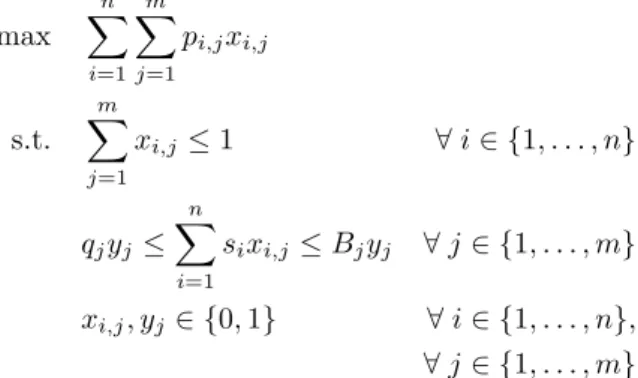
In order to compute the optimum profit of a solution that respects all bin capacities and minimum quantities, we use the natural integer programming formulation of the problem:
max n X i=1 m X j=1 pi,jxi,j s.t. m X j=1 xi,j≤1 ∀i∈ {1, . . . , n} qjyj≤ n X i=1 sixi,j≤Bjyj ∀j∈ {1, . . . , m} xi,j, yj∈ {0,1} ∀i∈ {1, . . . , n}, ∀j∈ {1, . . . , m}
Here, variablexi,jis one if and only if itemiis packed into binjand variableyj
is one if and only if binj is opened.
The random instances in our computational experiments are generated as follows: The size of each item in each bin is chosen uniformly at random in {1, . . . ,20}. For each bin j, we then choose the bin capacityBj uniformly at
random in {2·smax(j), . . . ,2·smax(j) + 50}, where smax(j) denotes the max-imum size of an item in bin j. The minimum quantity qj of bin j is chosen
uniformly at random in{2·smax(j) + 25, . . . ,2·smax(j) + 50}, where the values ofBj and qj are exchanged in case that qj > Bj. For the profits, we choose a
profit parameterpj uniformly at random from{0, . . . ,100}for each binj. The
profitpi,j obtained from packing itemi into bin j is then chosen uniformly at
random from{0, . . . , pj} (hence, pj can be interpreted as the “attractiveness”
of binj).
For every combination ofn∈ {10,20,30,40,50}andm∈ {5,7,10}, we sam-pled 100 instances in this way and solved the integer program obtained from the formulation above using CPLEX 12.4. Our dual approximation algorithm was implemented as an OPL model in IBM ILOG CPLEX Optimization Stu-dio 12.4. An optimal solution of the linear program (LP(S)) for each possible subsetS of bins and the maximum profit matchingM in Step 2 of Algorithm 1 were computed using CPLEX 12.4.
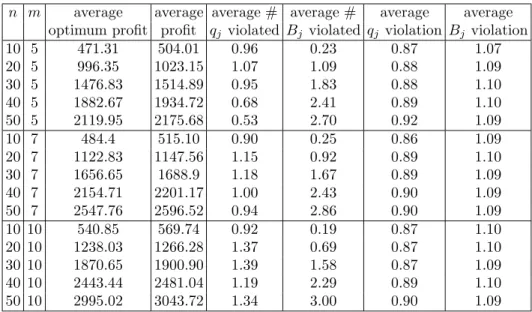
Table 2 shows the results of our computational experiments. For each in-stance size, the table shows the average values of the optimum profit of a solution that respects all bin capacities and minimum quantities (calculated by solving the integer program), the profit obtained by the dual approximation algorithm, the number of bins with violated minimum quantity, and the number of bins with violated bin capacity. Moreover, the last two columns provide the average factor by which the minimum quantity or the bin capacity are violated, each averaged over the violated values only.
n m average average average # average # average average optimum profit profit qj violated Bj violated qj violation Bj violation
10 5 471.31 504.01 0.96 0.23 0.87 1.07 20 5 996.35 1023.15 1.07 1.09 0.88 1.09 30 5 1476.83 1514.89 0.95 1.83 0.88 1.10 40 5 1882.67 1934.72 0.68 2.41 0.89 1.10 50 5 2119.95 2175.68 0.53 2.70 0.92 1.09 10 7 484.4 515.10 0.90 0.25 0.86 1.09 20 7 1122.83 1147.56 1.15 0.92 0.89 1.10 30 7 1656.65 1688.9 1.18 1.67 0.89 1.09 40 7 2154.71 2201.17 1.00 2.43 0.90 1.09 50 7 2547.76 2596.52 0.94 2.86 0.90 1.09 10 10 540.85 569.74 0.92 0.19 0.87 1.10 20 10 1238.03 1266.28 1.37 0.69 0.87 1.10 30 10 1870.65 1900.90 1.39 1.58 0.87 1.09 40 10 2443.44 2481.04 1.19 2.29 0.89 1.10 50 10 2995.02 3043.72 1.34 3.00 0.90 1.09
Table 2: Computational results.
As the results show, our dual approximation algorithm produces solutions in which the minimum quantity is violated only for a very small number of bins on average. The bin capacity is violated slightly more often for the instances with larger numbers of items, but it is still respected for most bins. More importantly, the results show that the minimum quantities and bin capacities of the violated bins are only violated by about 9-14% on average for every instance size tested. Hence, the algorithm produces solutions with superoptimal profit that violate the constraints of the problem only by a small factor.
7. Future Research
An interesting theoretical question is whether there exist good polynomial time approximation algorithms for SAP or whether the problem is inapprox-imable (which we proved for GAP-MQ). We suspect that such approximation algorithms exist, but achieving a constant factor may be hard as most standard techniques for designing approximation algorithms fail for this problem.
References
[1] S. Martello, P. Toth, Knapsack Problems: Algorithms and Computer Im-plementations, John Wiley & Sons, Chichester, 1990.
[2] D. G. Cattrysse, L. N. Van Wassenhove, A survey of algorithms for the gen-eralized assignment problem, European Journal of Operational Research 60 (3) (1992) 260–272.
[3] D. B. Shmoys, ´E. Tardos, An approximation algorithm for the generalized assignment problem, Mathematical Programming 62 (1993) 461–474. [4] D. W. Pentico, Assignment problems: A golden anniversary survey,
Euro-pean Journal of Operational Research 176 (2) (2007) 774–793.
[5] C. Chekuri, S. Khanna, A PTAS for the multiple knapsack problem, SIAM Journal on Computing 35 (3) (2006) 713–728.
[6] R. Cohen, L. Katzir, D. Raz, An efficient approximation algorithm for the generalized assignment problem, Information Processing Letters 100 (4) (2006) 162–166.
[7] H. Kellerer, U. Pferschy, D. Pisinger, Knapsack Problems, Springer, 2004. [8] G. L. Nemhauser, L. A. Wolsey, Integer and Combinatorial Optimization,
Wiley-Interscience, New York, 1988.
[9] V. V. Vazirani, Approximation Algorithms, Springer, 2001.
[10] E. G. Coffman Jr., M. R. Garey, D. S. Johnson, Approximation algorithms for bin packing: A survey, in: Hochbaum [26], pp. 46–93.
[11] S. F. Assmann, Problems in discrete applied mathematics, Ph.D. thesis, Massachusetts Institute of Technology (1983).
[12] S. F. Assmann, D. S. Johnson, D. J. Kleinman, J. Y.-T. Leung, On a dual version of the one-dimensional bin packing problem, Journal of Algorithms 5 (4) (1984) 502–525.
[13] J. Csirik, D. S. Johnson, C. Kenyon, Better approximation algorithms for bin covering, in: Proceedings of the 12th ACM-SIAM Symposium on Dis-crete Algorithms (SODA), 2001, pp. 557–566.
[14] K. Jansen, R. Solis-Oba, An asymptotic fully polynomial time approxi-mation scheme for bin covering, Theoretical Computer Science 306 (2003) 543–551.
[15] H. G. Seedig, Network flow optimization with minimum quantities, in: Op-erations Research Proceedings 2010: Selected Papers of the Annual Inter-national Conference of the German Operations Research Society, Springer, 2011, pp. 295–300.
[16] S. O. Krumke, C. Thielen, Minimum cost flows with minimum quantities, Information Processing Letters 111 (11) (2011) 533–537.
[17] X. Zhu, Q. Yuan, A. Garcia-Diaz, L. Dong, Minimal-cost network flow problems with variable lower bounds on arc flows, Computers and Opera-tions Research 38 (8) (2011) 1210–1218.
[18] M. R. Garey, D. S. Johnson, Computers and Intractability (A Guide to the Theory of NP-Completeness), W.H. Freeman and Company, New York, 1979.
[19] V. Kann, Maximum bounded 3-dimensional matching is MAX SNP-complete, Information Processing Letters 37 (1) (1991) 27–35.
[20] E. Petrank, The hardness of approximation: Gap location, Computational Complexity 4 (2) (1994) 133–157.
[21] A. J. Hoffman, J. B. Kruskal, Integral boundary points of convex polyhedra, in: Kuhn and Tucker [27], pp. 223–246.
[22] J. B. Orlin, A faster strongly polynomial minimum cost flow algorithm, in: Proceedings of the 20th ACM Symposium on the Theory of Computing (STOC), 1988, pp. 377–387.
[23] S. Plotkin, ´E. Tardos, Improved dual network simplex, in: Proceedings of the 1st ACM-SIAM Symposium on Discrete Algorithms (SODA), 1990, pp. 367–376.
[24] R. K. Ahuja, T. L. Magnanti, J. B. Orlin, Network Flows, Prentice Hall, 1993.
[25] A. Schrijver, Combinatorial Optimization, Vol. 24 of Algorithms and Com-binatorics, Springer, 2003.
[26] D. S. Hochbaum (Ed.), Approximation Algorithms for NP-Hard Problems, PWS Publishing, Boston, 1997.
[27] H. W. Kuhn, A. J. Tucker (Eds.), Linear Inequalities and Related Systems, Princeton University Press, 1956.