Copyright ©1988, American SocietyforMicrobiology
Mutations in the
Phosphorylation
Sites of Simian Virus 40
(SV40)
T
Antigen
Alter Its Origin DNA-Binding
Specificity
for
Sites I
or
IIand
Affect
SV40
DNA Replication Activity
JENS SCHNEIDERtAND ELLEN FANNING*
InstituteforBiochemistry, Karlstrasse 23,8000Munich 2, Federal Republic of Germany Received 27 August1987/Accepted 2 February 1988
Aseries ofmutantsof simianvirus 40wasconstructedbyoligonucleotide-directed mutagenesis tostudythe role of phosphorylation in the functions oflarge T antigen. Each of the previouslymapped phosphorylated serine andthreonine residuesinlargeTantigenwasreplaced byanalanineorcysteine residueor,inonecase,
by glutamicacid. Mutant DNAs wereassayed forplaque-forming activity, viral DNAreplication, expression
of T antigen, and morphological transformation ofrat cells. Viable mutants were isolated, suggesting that
modification ofsomeresidues isnotessential for the biological functions ofTantigen. Twoofthesemutants replicatedmoreefficientlythan didthe wildtype.Sevenmutantswerepartiallyorcompletelydeficientinviral
DNA replication but retained cell transformation activity comparable with that ofthe wild-type protein. Biochemical analysis of themutantT antigensdemonstratednoveloriginDNA-binding properties ofseveral mutant proteins. The results are consistent with the idea that differential phosphorylation defines several
functionalsubclasses ofT-antigen molecules.
Protein phosphorylation isan importantregulatory
mech-anism ineucaryotic cells. Forexample,it hasbeen shownto modulatetheactivityofenzymes,such asthoseinvolved in glycogen metabolism, and proteins involvedin thecontrol of gene expression, suchas hormone receptors (fora review, seereference8). More recently, proteinphosphorylationhas
beenpostulated to playa regulatory role in the reorganiza-tion of thenuclearlaminsduringmitosis(3, 40,60). Finally, proteinphosphorylation, particularly tyrosine phosphoryla-tion catalyzed by oncogene and proto-oncogene products, has been associated with altered growth control (for a
review, seereference28).
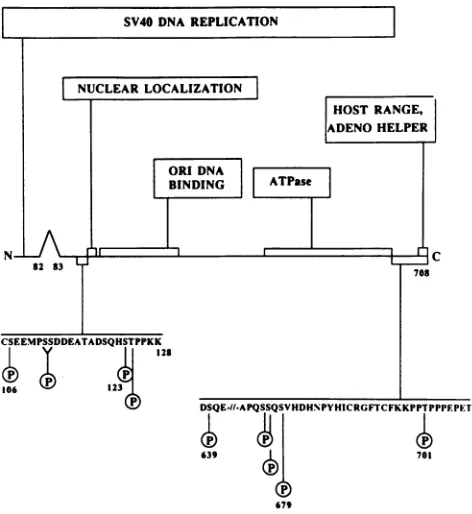
Simian virus 40(SV40) large tumorantigen(large T anti-gen), a multifunctional regulatory protein encoded by the viral genome, is a phosphoprotein (66). Multiple sites of phosphorylation, i.e., serine and threonine residues, have beenmappedto two regionsin theprimarysequence of the protein (Fig. 1; 33, 56, 69). A subset of these sites can be phosphorylated by cytoplasmic protein kinases,whereas full phosphorylationalsorequires nuclearkinases(58).
Further-more,Tantigenmaturesaftersynthesisinatime-dependent
fashion, becoming phosphorylated in discrete stages and forming oligomersthat differ in level ofphosphorylation (16, 23, 57, 61). The phosphate groups associated with the proteinwerefoundto turnoverfaster than theproteinitself (14, 70), raisingthe question ofwhetherphosphorylation is involved in the regulationofT-antigenfunction.
An investigation of the role of phosphorylation in the biologicalfunctions of Tantigeninvirus replicationandcell transformation would require a way to specifically inhibit modification of the protein in the cell. Oligonucleotide-directedmutagenesis of the DNAencodingTantigenoffers
ameanstosubstitute the modified serines andthreoninesby residuesthataresimilar in size andchargebut thatcannotbe phosphorylated. Asimilar approachhasbeen used
success-* Corresponding author.
t Present address: Division of Biology, California Institute of
Technology, Pasadena, CA 91125.
fullytoinvestigatethe role ofproteinphosphorylationinthe biological activity of several viral oncogenes,
proto-onco-genes,andgrowth factorreceptors(4, 5, 19, 32, 47). We mightexpectthebiological properties ofsuchmutant T antigens to fall into two classes. If the modification is dispensable for protein function, we would expect a
wild-type phenotype. If either the modification or the residue
itself is essential, a mutant phenotype should result. Bio-chemical characterization of such mutant proteins should then reveal whatpropertyof theproteinis defective. Thus,
wehave usedoligonucleotide-directed mutagenesisto create
aset of mutations in theT-antigen-coding region, suchthat each phosphorylated serine and threonine residue is con-servatively substitutedbyalanineorcysteine. Inthepresent communication,wedescribetheconstruction andbiological
characterization of these mutants and present an initial
characterization of the DNA-binding properties of T
anti-gensencoded bythe mutants.
(This research was conducted by J. Schneider in partial fulfillmentof the requirements for the doctoraldegree from theUniversity of Munich.)
MATERIALS AND METHODS
Plasmids and strains. pSVwt is wild-type SV40 DNA (strain SV-S)cloned inthe BamHI site ofpAT153DNA(17). pSDL13 (1,890 base pairs) carries a suppressor (supF), ColEI and M13 origins ofreplication, and the polylinker from pUC13 (35). pSDL13-1.13 consists of the SV40 se-quencesfrompSVwtcloned in the BamHI site ofpSDL13. Escherichia coliXS127 (35)carries the F' from JM103 and the RP1 plasmid p3 [Kanr tet(Am)bla(Am)]. pONwtcarries
a synthetic 19-base-pair sequence from T-antigen binding site I (51, 53, 54). p1097 carries a 31-base-pair deletion
encompassing allof site I (12, 27).
Oligonucleotide-directed mutagenesis. A modified
proce-dure based on that ofZoller and Smith (72) was developed
for use with the pSDL13 vector. Single-stranded template DNA was isolated by M13 wild-type infection of E. coli
XS127 carrying the wild-type SV40 parent DNA pSDL13-1598
on November 10, 2019 by guest
http://jvi.asm.org/
679
FIG. 1. Map of functional domains ofTantigenandlocation of known phosphorylation sites. The sequences necessary and suffi-cient for each of the designated properties of T antigen were
compiled from analyses of previously characterized SV40 mutants
(7, 9, 31, 43, 48, 63; Arthuretal., in press). The phosphorylation sites shown ®) arethosemapped by Scheidtmannetal.(56).
1.13. Oligonucleotides (Table 1) were synthesized by hand (13)orby usinganautomatic DNAsynthesizer (model 380A; Applied Biosystems GmbH, Pfungstadt, Federal Republic of Germany), and they were purified by polyacrylamide gel electrophoresis. A 1-pmol amount of single-stranded
tem-plate was annealed with 5 pmol of phosphorylated primer oligonucleotide (Table 1), filled in by Klenow DNA polymer-ase(New England BioLabs, Beverly, Mass.) and deoxynu-cleoside triphosphates, and ligated (72). Covalently closed circular DNAwastransfected intocompetentE.coli XS127. Colonies resistanttoampicillin and tetracyclinewere
hybrid-ized with the 32P-end-labeled mutantprimer oligonucleotide as described previously (11, 20). Mutant colonies were
then identified by autoradiography. The fraction of colonies positive by hybridization varied widely, from 1 to 45% depending on the mutant sequence, but was remarkably
reproducibleforaparticularsequence(datanotshown). The introduction of the mutationwas confirmed by digestion of
plasmid DNA with diagnostic restriction endonucleases (Table 1) and by supercoil DNA sequencing (6, 55). The carboxy-terminal mutations were further confirmed by re-cloning the mutant PstI DNA fragment into the wild-type pSDL13-1.13 DNA and then sequencing the mutant
frag-ments.
Cells and antibodies. TC7monkey cells (50), COS-1 cells (21), and Rat2 cells(68) were grown in Dulbecco modified Eagle medium (GIBCO Laboratories, Grand Island, N.Y.) supplemented with 8% newborn calf serum (Boehringer
Mannheim Biochemicals, Indianapolis, Ind., or Biochrom,
Berlin, Federal Republic of Germany) and antibiotics. Monoclonalimmunoglobulin G antibodies Pab 416, Pab 419 (25), and Pab 108 (24)were purifiedaspreviously described
(15).
DNA transfection. (i) DEAE-dextran method. One method of transfection usedwasthatof McCutchan andPagano (39).
Mutant or wild-type plasmid DNA was excised from the
pSDL13 vectorby BamHI digestion. Input DNA was visu-alized by ethidium bromide staining after agarose gel elec-trophoresis to ensure that equal amounts of each DNA
wereused. TC7orCOS-1 monkey cells (5 x
105
in 100-mmdishes)werewashed with Tris-saline andexposedto1ml of DEAE-dextran (500 ,ug/ml) in Tris-saline containing the digested DNA (1
jig).
After 1 h at 37°C, the dishes werewashed thoroughly with Tris-saline, and fresh medium was
added.
(ii) Calcium phosphate method. Another method of
trans-fection used was that of Graham and van der Eb (22).
Plasmid DNAwas cleaved with EcoRI to release the SV40 early region from pSDL13. Rat2 cells (5 x 10⁵ in 60-mm
dishes) were fed 2 h before transfection. Medium was
aspirated, and 0.5 ml of a calcium phosphate suspension
containing 5 ,ug of plasmid DNA was added to the cells. After 30minat37°C, 5 ml of mediumwasadded. After 4 h
at37°C, the cellswereglycerol shocked, washed thoroughly
[image:2.612.59.295.67.324.2]withTris-saline, and fed with fresh medium.
TABLE 1. Oligonucleotide-directed mutagenesis of the SV40 early region
Substitution(wild Newrestriction
Mutanta type:mutant) site/nucleotideno.b Mutant DNAsequences'
SV106 Ser:Ala HhaI/4502 CTGTTTTGCgCAGAAGAA
SV111/112 Ser/Ser:Ala/Cys AluI/4486 AATGCCAgCTtGTGATGATG
SV120 Ser:Ala HhaIl4460 CTGCTGACgCgCAACATTC
SV123-1 Ser:Ala TCTCAACATgCTACTCCTCCA
SV123-2 Ser:Ala TCAACATgCTACTCCTC
SV124 Thr:Ala CTCAACATTCcgCTCCTCC
SV124E Thr:Glu CTCAACATTCggaaCCTCCAAAAAAG
SV639 Ser:Ala HhaIl2903 GATGAAGACgcgCAGGAAAAT
SV676 Ser:Ala AluI/2791 CCCCTCAagCtTCACAGTCT
SV677 Ser:Ala AluI/2788 CTCAGTCagCtCAGTCTGTTC
SV679 Ser:Ala AluIl/2782 CCTCACAagCTGTTCATGA
SV701 Thr:Ala HhaI/2715 AACCTCCCgCgCCTCC
aThenameof themutantindicates theaminoacid residue number of Tantigenthat has beenmutated.
bIn many constructions, silent mutationswerecreated, in addition to the desired amino acidsubstitution, tofacilitate confirmationof the mutation by
restrictiondigestion.
'Thesequenceoftheprimerusedformutagenesisisshown5'to3' in the senseoftheearlymRNA(BBBnumbering[67]).The mutantnucleotides are shown
in lowercaseletters.
on November 10, 2019 by guest
http://jvi.asm.org/
[image:2.612.57.562.536.681.2]Extraction of T antigen, quantitation of T antigen by immune blot, immunoprecipitation, and specific DNA-bindingassayswerecarriedoutasdescribed previously (16,
27, 42, 51, 71).
RESULTS
Oligonucleotide-directed mutagenesis. A modified muta-genesis procedure basedonthatof Zoller and Smith (72)was
developed for use with the suppressor plasmid vector pSDL13 (35). This vector offers advantages for rapid
pro-duction andidentification of specific point mutations, i.e., its small size and stability, evenwith large inserts such asthe
SV40 genome, and the presence of both M13 and ColEl
replication origins. With few exceptions, the colonies iden-tified by hybridization to the mutant primer carried the expected restriction site (Table 1 and Fig. 2) and had the expected sequencein the plasmid DNA (data not shown).
Biological activity ofSV40 mutants. (i) Viability of virus. Theability of the SV40mutantstoproduceinfectious virions
wastested by plaqueassayafter DNAtransfection into TC7
monkey cells (Table 2). Of the 11 mutant DNAs tested, 7 produced detectable infectious virus, although SV111/112 and thecarboxy-terminal mutantswere slightly defective.
Toensurethatthe induced mutation-andnotan
inadver-tently introduced second mutation elsewhere in the ge-nome-was responsible for the phenotype, a second round
ofmutagenesiswasperformed using template DNA from the
amino-terminal mutants and a wild-type oligonucleotide as
theprimer. Revertants were identifiedby colony
hybridiza-tiontothe wild-typeprimer. Therevertantswerethentested
for plaque-forming activity and viral DNA replication. As expected, the defective amino-terminal mutants were
re-storedto thewild-type phenotype by this procedure (Table 2, SV120MR, SV123MR, and SV124MR).
(ii) Cell transformation. The ability of the SV40mutants to transform Rat2 fibroblasts was tested in a focus formation
(~0a T
OJ r
N _
CN4
--(0 .-. O)
3a,- (DCOtD
[image:3.612.319.558.80.235.2]A
B
FIG. 2. Restriction endonuclease digestion of putative mutant
DNAs identified by colony hybridization. DNA prepared from purified single colonies of the indicated mutantswas digestedwith
HhaI(A)orAluI (B) (Table 1) under the conditionsspecified by the
[image:3.612.100.269.445.671.2]manufacturerandanalyzed byagarosegelelectrophoresis.
TABLE 2. Biological activitiesofmutant Tantigens"
Mutant %oViability' %Transformation
Mutant % Viability
~~~~~~~activity"
SV106 98 105
SV111/112 44 92
SV120 0 88
SV123 0 103
SV124 0 107
SV124E NTd 100
SV120MR" 93 NT
SV123MR' 96 NT
SV124MR' 90 NT
SV639 59 209
SV676 48 177
SV677 67 7
SV679 70 36
SV701 78 94
"Viabilityandtransformation activityvalues were0%and<0.1%,
respec-tively,inexperimentsperformed withthe vector alone andwithno DNA.
bBaniHI-cleavedplasmidDNA (100ng/60-mm dish)wastransfectedinto
TC7cells in duplicate by using the DEAE-dextran method. Plaques were
scored 10 to 12dayslater asdescribedpreviously(1). Results areexpressed
as apercentage of the wild-type value in the same experiment(53 and 57
PFU/100ngof DNA).
'Transformation assays were performed as previously described (10).
Briefly,EcoRl-cleavedplasmidDNA wastransfected intoRat2cellsby the
calciumphosphate technique. Cellsweresplit1:6 24 h later.Fociwerestained
withGiemsaandcounted after10, 15, and 20days.Theresultsare expressed
as apercentageof theactivity of wild-typeDNAin thesameexperiment (930,
132.180, and252fociper 5 ,ugofDNAin four differentexperiments).
"NT,Nottested.
e Awild-type oligonucleotide MR (5'-CTGCTGACTCTCAACATTCTAC
TCCTCAA) was used as aprimerto marker rescue thedefective mutants
SV120, SV123,and SV124byrepeatingtheoligonucleotide mutagenesis(see
text).
assay. Allof the mutantsformedfoci, although slight
differ-ences in frequency of focusformation were observed rela-tiveto wild-typeDNAin the sameexperiment. The amino-terminalmutantsandSV639, SV676,andSV701 formed foci
atabout wild-type frequency (Table 2). The other
carboxy-terminalmutantsSV677 and SV679transformedRat2cellsat somewhat less than wild-type frequency (Table 2). The
significance of these variations in the frequency of focus formationisnotclear, sincetheactivityofwild-typeDNAin this assay varied between experiments, as also noted in other transformation studies (30). Nevertheless, all of the mutantstested here retained focus-forming activity in Rat2
cells,andfoci obtained witheachof themutantsalso formed colonies in softagar. For each mutant,singlecolonies were
picked and expandedto cell lines.
(iii) SV40DNAreplication. Theability oftheSV40mutants to replicate their DNA was analyzed after transfection of plasmid DNA into monkey cells. To ensure that equal
amounts ofDNA were used fortransfection, the restricted input DNA was visualized by agarose gel
electrophoresis
and ethidium bromide staining. Except for SV677, SV679,
and SV701,all of themutants defectivein plaque formation
were also defective in SV40 DNA replication (Fig. 3A). DNA replication of the marker rescue mutants SV120MR, SV123MR, and SV124MRwas notdetectablydifferent from thatofwild-typeSV40 (resultsnotshown). It isinteresting
that substitution of Thr-124 in T antigen by
glutamic
acid(SV124E) permitted a low level of replication, whereas substitutionbyalanine (SV124)eliminatedreplication
activ-ity(Fig. 3B). ThemutantSV679wasunusual in its enhanced
ability to replicate SV40 DNA (Fig. 3A and C). When
parallel cultures of TC7 cells were infected with equal multiplicities of SV40 wild type and SV679,a similar
on November 10, 2019 by guest
http://jvi.asm.org/
i LL
A
3°
; " "5.2 kb 40 4 -ow
C')C- cl- C-- C)
z 0
-4
B
2kbb
WIM"-
5 7 9 DAYSFIG. 3. Replication of mutant SV40 DNA in TC7 cells. BamHl-digested plasmid DNA was transfected into TC7 cells by the DEAE-dextran method.Low-molecular-weightDNA(26)wasisolated 9days later ([A and B]or asindicatedontheabcissa[C]), cleaved with BamHIandDpnI, andanalyzed by agarosegelelectrophoresis, ethidium bromide staining, and Southern blot hybridizationto 32P-nick-translated pSVwtDNA(49,64).BamHI-digested pSDL13-1.3DNAservedas amarker andwasvisualized by ethidium bromidestaining. The position of the 5.2-kilobase SV40 band is indicated. (A) Autoradiography for30mini. (B) Autoradiography for5 h. (C) Bands ofnewly replicatedSV40DNA wasquantitated by microdensitometry of the autoradiograms. 0,pSDL13-1.13 wild type;0,SV679DNA. replication of SV679 DNA (two- to fivefold) was observed
(B. Schnierle, A. Arthur, and E. Fanning, unpublished data).
Marginally enhanced replication wasalso observedin some
experiments with the mutantSV677 (results not shown).
COS-1 cells constitutively express a wild-type T antigen
that should complement the mutant T antigens to allow
replication of the mutant DNA (21). Thus, replication of mutantandwild-typeDNA wastestedaftertransfection into COS-1 cells (Fig. 4). In these cells, the mutant DNAs
replicatedtoaboutthesamelevel as did thewild-typeDNA. The apparently weak
repli-qation
of SV639 DNA was not observed in otherexperiments and can beexplainedby low recovery ofthe DNA in this experiment, as shownby the weak band of cellular DNA above the 5.2-kilobase SV40 band(Fig. 4).(iv) T-antigen expression and subcellular localization. Expression of mutant T antigen after transfection of plasmid DNAinmonkey cellsandin themutant-transformedratcell lines wasmonitoredby immunoperoxidase stainingby using
several different monoclonal antibodies as first antibody. Expression of the mutant T antigens in the nucleus resem-bled that of thewild-type protein (data not shown).
The T antigens expressed by the mutant SV40-trans-formed Rat2lineswereanalyzed byimmuneblot(Fig. 5) and
by immunoprecipitation of[35S]methionine-labeled proteins (data not shown). Each of the lines expressed large T antigen ofwild-type size and variousamountsof the 100-kilodalton T
111/
M WT 106 112 120 123124 124E
180-
116-84
-58 -48
- 36-
27-~0TQr
C')N t r- 0) N Da)N co (0(0( :::
[image:4.612.96.526.71.226.2]4
FIG. 4. Replication of mutant SV40 DNA in COS-1 cells. BamHI-digested plasmid DNAwastransfected intoCOS-1 cells by
the DEAE-dextran method. Low-molecular-weight DNA (26)was
isolated 6days later, cleavedwithBamHI andDpnI, separated by
agarosegel electrophoresis, and stained with ethidium bromide. M, BamHI-cleaved pSDL13-1.13 DNA; WT, wildtype. Linear SV40
DNA is indicatedby the arrowheads.
701 679677 676 639 WT M
-180
-116
_
. -84
-58 -48
-36
-27
FIG. 5. Expression ofTantigen in mutantandwild-type (WT) SV40-transformed Rat2cells. Extractfrom about 3 x 10⁵ cellsof each linewasanalyzed byelectrophoresis on10%sodiumdodecyl sulfate-polyacrylamide gelsandimmunoblotting (34, 71).Tantigen wasstainedwith Pab 416immunoglobulin Gandalkaline phospha-tase-conjugated anti-mouse antibody (Promega Biotec, Heidelberg, FederalRepublic of Germany). Themigration of prestained molec-ular size markers (M), (Sigma Chemical Co., Munich, Federal Republic of Germany) is indicated. Molecular sizes are shown in kilodaltons.
on November 10, 2019 by guest
http://jvi.asm.org/
[image:4.612.361.517.401.627.2] [image:4.612.77.282.500.654.2]antigen (36) (Fig. 5). Super T-antigen polypeptides (for a review, see reference 48) were not observed. The cellular tumor antigen p53 was associated with largeTantigen in all of the lines, as judged by immunoprecipitation of
[35S]
methionine- or32PO4-labeled cell extracts (data not shown). SV40 DNA-binding properties of mutant T antigens. We
and others have reported that phosphorylation of large T
antigen is inversely correlated with its origin DNA-binding
activity(2, 17, 51, 57). Indeed, partialdephosphorylation in vitro was reported to enhance the origin DNA-binding activity of wild-type T antigen (41, 65). However, which of the phosphorylation sitesis important for origin DNA bind-ing remains unknown. Thus, the origin DNA bindbind-ing of T
antigens expressed in the mutant- and wild-type
SV40-transformed Rat2 lines was investigated (Fig. 6). A mono-clonalantibodythathad no detectable effect on the DNase I
footprint of purifiedTantigen(54; E. Vakalopoulou and E.
Fanning, unpublished data) was used to immunoprecipitate
Tantigen fromcell extracts. Thepurified immunocomplexed proteinwasthen assayedfor DNAbindingatequilibriumby
usingexcessSV40 plasmidDNAfragmentsin theabsenceof nonspecific competitor DNA. Three templates were used: pSVwt, pONwt, and p1097DNA(Fig. 6C).Plasmid pONwt
served to assay binding to site I independently of site II,
MsVwt
r'ONwt_.. am- 4
pSVwt pONwt
p1097
I1
-..: MV -7, Z,,:
A SITE li SITE E
1-ZIFY - - --EiT
-{E}{>
[image:5.612.61.299.316.619.2]E=:GAGGC CONSENSUS PENTANtCLEOTIDE
FIG. 6. Specific binding of immunopurifiedmutantandwild-type (WT) T antigens toSV40 DNA. Assayswereperformed exactlyas
describedpreviously (51, 71). Briefly, equalamounts ofTantigen
(about 100 ng)werepurified fromextractsofSV40-transformed Rat2
cells byimmunoprecipitation with Pab 108 immunoglobulinG and
fixedStaphylococcusaureusand thenassayed for specific bindingto
excess (250 ng) end-labeled DNA fragments. M, 5% of the input
DNA. Theorigin-containing fragment is indicated by arrowheads.
(A) HindIll-cleaved pSVwt and EcoRI-SalI-cleaved pONwt. (B) HindIll-cleaved p1097 DNA. (C) Diagram of templates for SV40 origin DNA-bindingassays.
whereas plasmid p1097 served to measure binding to the lower affinity site II. Each of the template DNAs was digested with appropriate restriction endonucleases, and binding to end-labeled fragments was assayed as previously
described (51, 71).
Binding of most of the mutant T antigens to the SV40 origin DNA fragment of pSVwtwas indistinguishable from that of the wild-type protein (Fig. 6A). However, specific
binding was markedly reduced with SV677 T antigen and
slightly reduced with SV676 T antigen. This result was surprising since both mutants were able to replicate viral DNA(Fig. 3).Therefore, theability ofthe mutant Tantigens to bind independently to sites I and II was investigated. Binding studies with pONwtDNAdemonstrated that SV677 Tantigenwasunabletobind specificallytosite I;bindingof SV676 Tantigen to site Iwasslightly reduced compared with
binding of the wild-type protein and the other
carboxy-terminal mutants (Fig. 6A). The other mutant T antigens
boundtositeI atwild-type levels (Fig.6A;data notshown). Analysis of site II DNA binding ofthe mutant proteins
revealed more extensive heterogeneity (Fig. 6B). SV679
and, less strikingly,SV106 andSV123 Tantigens
reproduc-ibly bound more site II DNA than did an equal amount of
wild-type T antigen. Specificbinding of SV124 and SV124E T antigens to site II was not detectable. SV677 T antigen
boundspecificallytosite II DNAat alevelcomparablewith that of wild-type T antigen, accounting for its ability to
replicate SV40DNAatwild-typelevels.Binding oftheother
mutant proteins to site II DNA resembled that of the wild-type protein.
DISCUSSION
Several lines ofevidence, reviewed above, suggest that
phosphorylation of SV40 large T antigen modulates the
multiple regulatory functions of this protein. Since the
protein is heterogeneously phosphorylated, thequestion of
therelationshipbetween individual sites ofphosphorylation
and protein function, especially in vivo, is difficult to
ad-dress. Inthis study, weused
oligonucleotide-directed
muta-genesis to specifically alter each ofthepreviously mapped phosphorylated residues. The phenotypes ofthis series of
mutants imply that the phosphorylation states of certain individualsites, orperhapssubsetsofsites,couldbe
impor-tant for the regulatory functions of the
protein,
whereasmodification ofotherresiduesmaybe simply fortuitous.
For example, SV106 and SV701 constitute a class of
mutantswhosephenotypewassimilarto or
indistinguishable
from the wild-type
phenotype.
This result demonstratesclearlythatmodification oftheseresiduesisnotessential for
T-antigenfunction.However, thenonconservative substitu-tionofSer-106by
phenylalanine
wasreportedtogenerateareplication-defectiveTantigen (30),
suggesting
that noncon-servativesubstitutionsthatresult inconformationalchanges
in thisregionof theprotein cannotbetolerated.
Many of themutants were
partially
or completely defec-tive inviralDNAreplication,although
theytransformedrat cells with frequenciescomparable
with that ofwild-type
SV40 DNA.Manyexamples ofthissecondclassofmutants havebeen observed in earlier studies(18, 30,38,44,46,52).
One of these mutants, SV120, carries the substitution at residue 120, which isnotknowntobephosphorylated in the
wild-type protein(56). Nevertheless, this conservative sub-stitution created a replication-defective
protein,
againsug-gestingthatthisregionof theproteinisparticularlysensitive to conformation changes. Similarly, although changes in
m .- a
-.7"r.,.- ., !-.- -.-I, :i-.U.3 .X. J.--!
4--Ill..:r.a
on November 10, 2019 by guest
http://jvi.asm.org/
phosphorylation of the mutant residues in the SV111/112,
SV123, SV124, SV639, and SV676 T antigens may be
involved in generating the mutant phenotypes, the present results do not rule out other explanations for the mutant
phenotypes. Other amino acid substitutions at these sites
could
conceivably permit
normalT-antigen
functiondespitethe
inability
ofthe amino acids to be phosphorylated. Forexample,
substitution ofglutamic
acid for Thr-124 did nottotally abolish replication activity, suggesting that in this case, a
negative change
may be moreimportant
thanphos-phorylation
per se. Exhaustivemutagenesisof each site willbe
required
to address this question.Initialbiochemicalanalysis of this secondclassofmutants to discover the nature oftheir
replication
defects revealedonly
that diminishedbinding
of SV124 and SV124E Tantigens
to site II DNA may be responsible fortheirrepli-cation
deficiency. Preliminary
results indicatethat all ofthe mutant Tantigens
have ATPaseactivity
(A.Schmid,
J.Schneider and E.
Fanning, unpublished data);
thus, furtheranalysis
of this class ofmutantproteins
will berequired
toidentify
their defects.Mutants SV677 and SV679
provide
moreinsight
into thepotential regulatory importance
of Tantigen
phosphoryla-tion. The mutations in SV677and SV679are localized in a region of the genome that is not essential for viral DNA
replication (Fig.
1)(9, 45), but SV677andSV679replicatedsomewhat more
efficiently
than did wild-type SV40. Adouble
mutant carrying both substitutions also replicatedbetter than did the wild type (B. Schnierle, A. Arthur, E.
Fanning, unpublished
data). The origin DNA-bindingdo-main ofT
antigen
is localizedbetween residues 131 and259and appearstobe
sufficient
for siteIaswellassite IIbinding
(Fig.
1) (43, 63; A. Arthur, A.Hoss,
and E. Fanning, J.Virol,in press; D. Lane, personalcommunication; Y.
Gluz-man,
personal communication).
This domainthus does notinclude the
phosphorylated
sites.Indeed,
Tantigen
ex-pressed
in bacteria andlacking
detectable phosphorylationbinds to both sites
(Arthur
etal.,
in press). Yetmutation ofthe
phosphorylation
sites at residues 677 and, to someextent,
106, 123,
and 124 hadremarkably
diverse effects onthe
origin DNA-binding properties
ofTantigen,
alteringitsspecificity
foronesite
orthe other.These two
binding
sitesplay
different rolesin the control of the virallifecycle by
Tantigen. T-antigen-binding
site II is essential for viral DNAreplication,
whereas site I is involvedprimarily
inautoregulation
of early transcription(12).
Both sites harbor the same pentanucleotide bindingsignals,
albeit in different arrangements (Fig. 6C). Eachpentanucleotide
directsthebinding
ofa monomer massofTantigen,
and Tantigen
appears to interact with individualnucleotidesinsites I and II in much the samefashion,sothat
it
remains
to bedeterminedhowthe protein recognizestwodifferent sites
(29, 54).
Since subunit interactions betweenprotein
molecules bound to the pentanucleotides appear tobe essentialfor efficient
binding
(53, 54),wesuggest that thephosphorylation
status ofT antigen determines a minimumof two basic types of
protein-protein
interactions betweensubunits on the DNA. These effects must be mediated
indirectly
through
induction of subtle conformationalchanges
in theorigin
DNA-binding domain of the protein.Indeed, heterogeneous phosphorylation
of T antigen maydefine differentfunctional subclassesofprotein. For
exam-ple,
aTantigen
unabletobind site Imightbeexpectedtobedefective in
autoregulation
ofearly transcription (12);infact, SV677Tantigen
appearstobeoverproduced (B. Schnierle,A.
Arthur,
E.Fanning, unpublished
data). Phosphorylationof residue 677 may thus defineasubclass of Tantigen active in autoregulation. Conversely, phosphorylation of Ser-679 and, to a lesser extent, Ser-106 and Ser-123 may down-regulate site II DNA binding and, hence, viral DNA repli-cation. A subclass of molecules active in replication may thus be distinguished by lack of modification at these sites, coupled withphosphorylation ofThr-124. Sucha delicately balanced and rapidly adjustable control mechanism could explain how this single protein fulfills multiple regulatory functions. This interpretationis further supported by phos-phopeptide mapping of wild-type T antigen of high and low specific activities of DNA binding (57) and by phosphopep-tide mapping ofour mutantTantigens (K.-H. Scheidtmann et al., manuscript in preparation).
Consistent with this proposal, alkaline phosphatase-treated Tantigen is moreactive than untreated Tantigen in
bindingto site II DNA and inreplicationof SV40 DNA ina cell-free system (41, 65). Although dephosphorylation of residues 106, 123, and 679 was not directly demonstrated, alkaline phosphatase has been shown previously to hydro-lyze phosphoserine but not phosphothreonine residues ofT antigen (59). It will be interesting to see whether SV679 T antigen also shows enhanced replication activity in vitro.
In summary, a series of mutants carrying conservative amino acid substitutions in the phosphorylated domains of SV40 Tantigen displays adiverse set ofproperties ranging from wild-type to novel phenotypes not observed
previ-ously. The results suggest how differential phosphorylation
ofT antigen could modulate its biological and biochemical
activities.
ACKNOWLEDGMENTS
We thank RonaldMertz andErnst Winnacker, Genzentrum, for oligonucleotides; Ed Harlow and WolfgangDeppertfor hybridoma cells; Martin Lipp forRat2cells; Brian Seed formakingthepSDL13 system available to us; Cornelia Fischer for construction of pSDL13-1.13; Barbel SchnierleandAvril Arthurfor help withthe reconstructionsand criticismofthemanuscript; PeterHeinrich for introducing us to supercoil DNA sequencing; Silke Dehde, Birgit Posch, and Andrea Schmid for excellent technical assistance; and SabineDomrath and Maria Ihmsenforhelp with the manuscript.
Thefinancial support for the Bundesministeriumfur Forschung undTechnologie, Genzentrum,and Fonds derChemischen Indus-trieisgratefully acknowledged.
LITERATURECITED
1. Baumgartner, I.,C.Kuhn,and E.Fanning. 1979.Identification and characterization of fast-sedimenting SV40 nucleoprotein complexes. Virology96:54-63.
2. Burger, C.,and E.Fanning.1983.SpecificDNAbinding activity of T antigen subclasses varies among different SV40-trans-formed cell lines.Virology 126:19-31.
3. Burke, B., and L. Gerace. 1986. A cell free system to study reassemblyof the nuclearenvelope atthe endof mitosis. Cell 44:639-652.
4. Carmichael, G.,B. S.Schaffhausen,G.Mandel,T.J.Liang,and T. L. Benjamin. 1984. Transformation by polyoma virus is drastically reduced by substitution of phenylalanine for tyrosine atresidue315of middle-sizedtumorantigen. Proc.Natl. Acad. Sci.USA 81:679-683.
5. Cartwright,C.A.,W.Eckhardt,S.Simon,and P.Kaplan. 1987. Celltransformation ofpp60c"rcmutated in thecarboxy-terminal regulatory domain. Cell 49:83-91.
6. Chen, E.J.,and P. H.Seeburg. 1985. Supercoil sequencing: a fast and simple method for sequencing plasmid DNA. DNA 4:165-170.
7. Clark, R., K. Peden, J. M. Pipas, D. Nathans, and R. Tjian. 1983. Biochemical activities ofT-antigen proteinsencodedby simian virus 40 A gene deletion mutants. Mol. Cell. Biol. 3:
on November 10, 2019 by guest
http://jvi.asm.org/
220-228.
8. Cohen, P. 1982. The role of protein phosphorylation in neural andhormonal control ofcellular activity.Nature(London) 296: 613-620.
9. Cole,C. N., J. Tornow, R. Clark, and R. Tjian. 1986.Properties of thesimian virus 40(SV40)large Tantigensencoded bySV40 mutantswith deletions ingene A. J. Virol. 57:539-546. 10. Crowe, R., H. Ozer' and D. Rifkin. 1978. Experiments with
normaland transformed cells: a laboratory manual for working with cells in culture. Cold Spring Harbor Laboratory, Cold SpringHarbor, N.Y.
11. Dalbadie-McFarland, G. L., L. W. Cohen, A. D. Riggs, C. Marin, K. Itakura, and J. H. Richards. 1982. Oligonucleotide-directed mutagenesis as a general and powerful method for studies of protein function. Proc. Natl. Acad. Sci. USA 79: 6409-6413.
12. DiMaio,D., and D. Nathans. 1982. Regulatorymutants of simian virus 40.Effect of mutations at a T antigen binding site on DNA replication and expression ofviral genes. J. Mol.Biol. 156:531-548.
13. Dorper, T., and E. L. Winnacker. 1983. Improvements in the phosphoamidite procedure for the synthesis ofoligodeoxy ribo-nucleotides. Nucleic Acids Res. 11:2575-2584.
14. Edwards, C. A. F., G. Khoury, and R. G. Martin. 1979. Phosphorylation of T-antigen and control ofT-antigen expres-sion incells transformed bywild-type and tsA mutants of simian virus 40.J. Virol. 29:753-762.
15. Ey, P. L., S. J. Prowse, and C. R. Jenkin. 1978. Isolation of pure IgG 1,IgG 2a, IgG 2b immunoglobulins from mouse serum using proteinA-Sepharose. Immunochemistry 15:429-436.
16. Fanning, E., B. Nowak, and C. Burger. 1981. Detection and characterization of multiple forms of simian virus 40 large T antigen. J. Virol. 37:92-102.
17. Fanning, E., K.-H. Westphal, D. Brauer, and D. Corlin. 1982. Subclasses of simian virus 40 large T antigen: differential binding of two subclasses of T antigen from productively infectedcells to viral and cellular DNA. EMBO J. 1:1023-1028. 18. Farber, J. M., K. W. C. Peden, and D. Nathans. 1987. trans-dominant defective mutants of simian virus 40 T antigen. J. Virol. 61:436-445.
19. Gallis,B., A. Lewis, J. Wignall, A. Alpert, D. Y.Mochizuki, D. Cosman, T. Hopp, and D. Urdal. 1986. Phosphorylation ofthe human interleukin-2 receptor and a synthetic peptide identical to itsC-terminal, cytoplasmic domain. J. Biol. Chem. 261:5075-5080.
20. Gergen, J. P., R. H. Stern, and P. C. Wensink. 1979. Filter replicas and permanent collections of recombinant DNA plas-mids. Nucleic Acids Res. 7:2115-2136.
21. Gluzman, Y. 1981. SV40-transformed simian cells support the replication of early SV40 mutants. Cell 23:175-182.
22. Graham, F. L., and A. van der Eb. 1973. A newtechnique for the assay of infectivity ofhuman adenovirus5DNA. Virology 52:456-467.
23. Greenspan, D. S., and R. B. Carroll. 1981. Complex of simian virus 40 large tumor antigen and 48,000-dalton host tumor antigen. Proc. Natl. Acad. Sci. USA 78:105-109.
24. Gurney, E. G., S. Tamowski, andW. Deppert. 1986. Antigenic bindingsites of monoclonal antibodiesspecific for simian virus 40 large Tantigen.J. Virol. 57:1168-1172.
25. Harlow, E., L. V. Crawford, D. C. Pim, and N. M. Williamson. 1981. Monoclonal antibodies specific for simian virus40 tumor antigens. J. Virol. 39:861-869.
26. Hirt, B. 1967. Selective extraction of polyoma DNA from infected mouse cell cultures. J. Mol. Biol. 26:365-369. 27. Huber, B., E. Vakalopoulou, C. Burger, and E. Fanning. 1985.
Identification and biochemical analysis of DNA replication-defective large T antigens from SV40-transformed cells. Virol-ogy 146:188-202.
28. Hunter, T., and G. A. Cooper. 1985. Protein-tyrosine kinases. Annu. Rev. Biochem. 54:897-930.
29. Jones,K., andR.Tjian. 1984. Essential contact residueswithin SV40 large T antigen binding sites I and II identified by alkylation-interference. Cell 36:155-162.
30. Kalderon, D., and A. E. Smith. 1984. In vitromutagenesisofa putative DNA binding domain of SV40large-T. Virology 139: 109-137.
31. Kalderon, D., W. D. Richardson, A. F. Markham, and A. E. Smith. 1984. Sequence requirements for nuclear location of simian virus40largeTantigen. Nature(London)311:33-38. 32. Kmiecik, T. E., and D.Shalloway. 1987. Activation and
suppres-sion ofpp6Oc-sr transforming abilityby mutation of itsprimary sites oftyrosinephosphorylation. Cell49:65-73.
33. Kress,M.,M.Resche-Rigon,andJ. Feunteun. 1982. Phosphor-ylation patternoflargeTantigens in mouse cells infectedby simian virus 40 wild type of deletionmutants.J. Virol. 43:761-771.
34. Laemmli,U.K.1970. Cleavage of structuralproteins duringthe assembly of the head ofbacteriophage T4. Nature (London) 227:680-685.
35. Levinson, A., D. Silver,and B. Seed. 1984. Minimal size plas-midscontaining an M13originfor productionofsingle-strand transducing particles.J. Mol. Appl. Genet. 2:507-517. 36. Levitt, A., S. Chen, G. Blanck,D. George, and R. E. Pollack.
1985.Twointegrated partialrepeatsof simian virus 40together code forasuper-Tantigen. Mol. Cell Biol. 5:742-750. 37. Luthman,H.,andG.Magnusson. 1983.Highefficiency polyoma
DNA transfection ofchloroquine-treated cells. Nucleic Acids Res. 11:1295-1308.
38. Manos, M.M., and Y.Gluzman. 1985. Geneticand biochemi-cal analysisoftransformation-competent, replication-defective simian virus40largeTantigenmutants.J. Virol.53:120-127. 39. McCutchan, J. H.,andJ.S.Pagano.1968. Enhancementof the
infectivity of simian virus40deoxyribonucleic acidwith dieth-ylaminoethyl-dextran. J.Natl. CancerInst. 41:351-357. 40. Miyake-Lye, R.,and M. W. Kirschner.1985. Inductionofearly
mitoticeventsinacell-freesystem. Cell 41:165-175.
41. Mohr, I. J., B. Stillman,and Y.Gluzman. 1987. Regulationof SV40DNAreplication byphosphorylationofTantigen.EMBO J. 6:153-160.
42. Montano, X., and D. P. Lane. 1984. Monoclonal antibody to
simian virus40smallt. J.Virol. 51:760-767.
43. Paucha, E., D. Kalderon, R. Harvey, and A.E. Smith. 1986. Simianvirus 40origin DNA-bindingdomainonlargeTantigen. J. Virol.57:50-64.
44. Peden,K. W.C.,andJ.M.Pipas. 1985. Site-directed mutagen-esis of the SV40 large T antigen gene: replication-defective
amino acid substitutionmutantsthat retaintheabilitytoinduce morphological transformation. J. Virol. 55:1-9.
45. Pipas, J.M.1985. Mutationsnearthecarboxylterminusofthe simian virus 40 large tumor antigen alter viral host range. J. Virol. 54:569-575.
46. Pipas, J. M.,K. W.C.Peden,and D. Nathans.1983. Mutational analysisof simian virus40 Tantigen: isolation and characteri-zation ofmutants with deletions in the T-antigengene. Mol. Cell. Biol. 3:203-213.
47. Piwnica-Worms,H., K.Saunders, T. M.Roberts, A.E.Smith, andS. H.Cheng.1987. Tyrosinephosphorylation regulatesthe biochemicalpropertiesofpp60c-sc. Cell49:75-82.
48. Rigby, P., and D. Lane. 1983. The structure and function of SV40largeTantigen. Adv.ViralOncol. 3:31-57.
49. Rigby, P. W.J.,M.Dieckmann, C.Rhodes,andP.Berg. 1977. Labelingdeoxyribonucleicacidtohighspecific activityin vitro by nick-translation with DNA polymerase I. J. Mol. Biol. 98: 503-515.
50. Robb, J., and K. Huebner. 1973. Effect of cell chromosome numberon simian virus 40replication. Exp. CellRes. 81:120-126.
51. Runzler, R.,S. Thompson, andE. Fanning. 1987. Oligomeriza-tion andoriginDNA-binding activityof simianvirus 40largeT antigen. J.Virol. 61:2076-2083.
52. Rutila, J. E., M. J. Imperiale, and W. W. Brockman. 1986. Replication and transformation functionsofin vitro-generated simian virus 40large Tantigenmutants. J. Virol. 58:526-535. 53. Ryder, K.,S.Silver,A.DeLucia,E.Fanning,and P.Tegtmeyer.
1986. An altered DNA conformation in origin region I is a
determinant for thebinding ofSV40 large T antigen. Cell 44:
on November 10, 2019 by guest
http://jvi.asm.org/
719-725.
54. Ryder, K., E. Vakalopoulou, R. Mertz, I. Mastrangelo, P. Hough, P. Tegtmeyer, and E. Fanning. 1985. Seventeen base pairsofregion I encode a novel tripartitebinding signal forSV40 Tantigen. Cell42:539-548.
55. Sanger, E., S. Nicklen, and A. R. Coulson. 1977. DNA sequenc-ing with chain-terminating inhibitors. Proc. Natl. Acad. Sci. USA74:5463-5467.
56. Scheidtmann, K.-H., B. Echle, and G. Walter. 1982. Simian virus 40 large T antigen is phosphorylated at multiple sites clusteredintwo separateregions. J.Virol. 44:116-133. 57. Scheidtmann, K. H., M. Hardung, B. Echle, and G. Walter.
1984. DNA-binding activity ofsimian virus40large T antigen correlates with a distinct phosphorylation state. J. Virol. 50: 1-12.
58. Scheidtmann, K. H., J. Schickedanz, G. Walter, R. E. Lanford, and J. S. Butel. 1984. Differential phosphorylation of cytoplas-mic and nuclear variants of simian virus 40 large T antigen encoded by simian virus 40-adenovirus 7 hybrid viruses. J. Virol. 50:636-640.
59. Shaw, S. B., and P. Tegtmeyer. 1981. Binding of dephosphory-latedA proteintoSV40DNA.Virology 115:88-96.
60. Simanis, V., and P. Nurse. 1986. The cell cycle control gene cdc2+ of fission yeast encodes a protein kinase potentially regulated by phosphorylation. Cell45:261-268.
61. Simmons, D. 1984. Stepwise phosphorylation of the NH,-ter-minal region of the simian virus 40 large T antigen. J. Biol. Chem. 259:8633-8640.
62. Simmons,D.T., W. Chou, and K. Rodgers. 1986. Phosphoryla-tiondownregulates the DNA-bindingactivity ofsimian virus 40
Tantigen. J. Virol. 60:888-894.
63. Simmons, D. T. 1986. DNA-binding region of the simian virus 40 tumorantigen. J. Virol. 57:776-785.
64. Southern, E. 1975. Detection ofspecificsequences amongDNA fragments separated by gel electrophoresis. J. Mol. Biol. 98: 503-515.
65. Stillman, B., R. D. Gerard, R. Guggenheimer, and Y.Gluzman. 1985. T antigen and template requirements for SV40 DNA replicationin vitro. EMBO J. 4:2933-2939.
66. Tegtmeyer,P., K. Rundell, and J. K. Collins. 1977.Modification of simian virus 40proteinA. J. Virol. 21:647-657.
67. Tooze, J. 1981. Molecularbiology of tumor virus, part 2. DNA tumor viruses, 2nd ed. Cold Spring Harbor Laboratory, Cold SpringHarbor, N.Y.
68. Topp, W. C. 1981. Normal rat cell lines deficient in nuclear thymidinekinase. Virology 113:408-411.
69. Van Roy, F., L. Fransen, and W. Fiers. 1983. Improved local-ization of phosphorylation sites in simian virus 40 large T antigen. J. Virol. 45:315-331.
70. Van Roy, F., L. Fransen, and W. Fiers. 1983. Metabolic
turn-overofphosphorylation sites in simian virus 40 large T antigen. J. Virol. 45:442-446.
71. Vogt, B., E. Vakalopoulou, and E. Fanning. 1986. Allosteric control of simian virus 40T-antigen bindingtoviraloriginDNA. J. Virol. 58:765-772.
72. Zoller, M. J., and M. Smith. 1982. Oligonucleotide-directed mutagenesis using M13-derived vectors: anefficient and general procedure for theproduction of point mutations in any fragment of DNA. Nucleic Acids Res.10:6487-6500.