o
D Ui 00
σι
en
European St3tÍStlCS
on accidents at w o r k
2 . Ü
Methodology
* *
* E U R O P E A N
C O M M I S S I O N
r | r | . THEME 3
e u r o s t a t STATISTICAL O F F I C E O F T H E E U R O P E A N C O M M U N I T I E S
L-2920 Luxembourg — Tél. 4301-1 — Télex COMEUR LU 3423 B-1049 Bruxelles, rue de la Loi 200 — Tél. 299 11 11
© European Communities, 1999
Introduction
The ESAW (European Statistics on Accidents at Work) project was launched in 1990 in order to draw up a methodology for the collection of comparable data in the European Union. The methodology has been developed in close co-operation with the Member States of the European Union. The ESAW Working Group was established in order to follow the work and give recommendations to the European Commission in developing this field of statistics. A Task Force with national experts has also been established in order to give technical advice to the Commission in developing a methodology which takes into account - as far as possible - , the extant reporting procedures and methodologies in the various Member States. The Task Force and the national bodies involved in the collection of ESAW data have contributed substantially in setting up the methodology and providing the data sets. The work in the Commission has been jointly co-ordinated by the Directorate-General Employment, Industrial relations and Social Affairs (Directorate Public Health and Safety at Work - DG V/F) of the Commission of the European Communities and EUROSTAT (E3 "Education, Health and other Social Domains" - Johnny Dyreborg and Didier Dupré).
From the reference year 1993 onwards data on accidents at work have been collected and published by Eurostat on an annual basis. From the reference year 1993 to 1995 the data have been collected in conformity with phase 1 of the ESAW project. From the reference year 1996 the data have been collected in accordance with ESAW phase 2.
The present publication describes the methods and definitions used for the collection of the ESAW phase 2 data (which includes ESAW phase 1) and the status of the implementation of the ESAW methodology in the 15 Member States and Norway. It also provides an outline of the results of the ESAW data for the reference year 1994. Finally, the classifications used for the ESAW phase 2 methodology are shown in Appendix B.
Eurostat E-3 April 1999
Table of Contents
Introduction 1
Background and aims for the ESAW project 4
Background for ESAW project 4 Aims of the ESAW project 4
Basic concepts and definitions 5
Particulars concerning the definition of an accident at work 5 Accident at work with more than 3 days' absence from work 7
Fatal accident at work 7
Variable characterisation 8
Indicators and methods of standardisation of data 11
Incidence rates 11 Correction factors and standardisation methods 11
Data collection 13
Reporting procedures in the Member States 13
Definition of an accident at work 14 Groups covered by the national reporting systems 15
National reporting levels 17
Reference population (based on LFS) 18
Reference year 18 Establishment of filters 18 Estimated reference population for 1994 18
Future developments 19
Definitions and classifications for the new variables in preparation 19 Ad hoc module on Health and Safety at Work in the 1999 LFS 22
Improvement of data quality 30
References 32
Appendix A: ESAW 1994 data - key figures 33
Appendix B: classifications and formats used for ESAW phase 2 35
Classifications 35 Aggregated formats 48
Appendix C: methodology for commuting accidents 50
Introduction 50 Methodology 50 Evaluation questionnaire 50
Appendix D: national ESAW data providers 51
B A C K G R O U N D A N D AIMS FOR THE E S A W PROJECT
Background and aims for the ESAW project
Background for ESAW project
The Framework Directive on Health and Safety in the Workplace(1) requested the Commission to proceed with the harmonisation of data on accidents at work. It specified that " . . . the employer shall keep a list of occupational accidents resulting in a worker being unfit for work for more than three working days" and "draw up, for the responsible authorities and in accordance with national laws and/or practices, reports on occupational accidents suffered by his workers ...".
On this basis, the ESAW project was launched in 1990, aiming at harmonised data on accidents at work for all accidents entailing more than three days' absence from work. A "Methodology for the Harmonisation of European Occupational Accident Statistics" was published in 1992 by Eurostat and DG V/F(2). The ESAW project has been an integral part of the framework programme for priority actions in the field of statistical information 1993 to 1997(3).
In addition the Council Resolution 95/C 168/01 (4) furthermore calls upon the Commission: "to complete the work in progress on harmonising statistics on accidents at the workplace...". The Programme concerning Safety, Hygiene and Health at Work (1996-2000) also foresees the continuation of the implementation of this project.
Furthermore, the European Community Statistical Programme 1998-2002, which defines the main fields and objectives of the community statistics, foresees the establishment of consistent series of data on a European level in order to provide the means for the monitoring of health and safety at work and the efficiency of regulation in this field(5).
Aims of the ESAW project
The aim of the ESAW project is "to collect Union-wide comparable data on accidents at work and establish a database. " Comparable data on work accidents are a prerequisite for monitoring trends in health and safety at work in the Union and for promoting accidents prevention both at Community level and in the individual Member States.
The aims are to provide data on high-risk groups and sectors, and at a later stage indicators on either the causes and the social cost of accidents at work. Consistent series of data should be established to provide the means for the monitoring of health and safety at work and the efficiency of regulation in this field.
It is also an aim of the ESAW project to develop a methodology which is as far as possible comparable with other international statistics and to participate in the co-ordination of such work. The ESAW methodology is in accordance with the ILO Resolution of 1998 concerning "Statistics of Occupational Injuries: resulting from Occupational Accidents'^6).
(1) Council Directive 89/391/EEC of 12 June 1989 on the introduction of measures to encourage improvements in the safety and health of workers at work, OJ L183, 29.06.1989. Hereinafter, Framework Directive (on health and safety at work). (2) Office for Official Publications of the European Communities, Theme 3 Series E, ISBN 92-826-4100-7, Catalogue number
CÄ-74-92-257-EN-C.
(3) Council Decision 93/464/EEC of 22 July 1993 on the framework programme for priority actions in the field of statistical information 1993 to 1997, OJ L219, 28.08.93.
(4) OJ C168 of 4.07.95, pp 1-2.
BASIC CONCEPTS AND DEFINITIONS
Basic concepts and definitions
ESAW Phase 2 data are collected for the reference period 1996 onwards. The reference period is defined as the
year of notification of the accident. All cases of accidents at work leading to an absence of more than three
calendar days{7) are included in the ESAW data. In practice it means that an accident at work is included in ESAW
if the person is unfit for work for more than 3 days even if these days include Saturdays, Sundays or other days where the person is not usually working.
An accident at work is defined as "a discrete occurrence in the course of work which leads to physical or mental harm". This includes cases of acute poisoning and wilful acts of other persons but excludes deliberate self-inflicted injuries and accidents on the way to and from work (commuting accidents). The phrase "in the course of work" means whilst engaged in an occupational activity or during the time spent at work. This includes cases of road traffic accidents in the course of work.
A fatal accident is defined as an accident which leads to the death of a victim within one year of the accident.
Particulars concerning the definition of an accident at work
Inclusions
The following types of accidents are covered by the above definition of an accident at work (summary in Table 1).
Road (traffic) accidents and other transport accidents
The road traffic accidents in the course of work are included in the ESAW methodology. Road accidents concern not only persons whose occupational activity is exerted mainly on public highways, e.g., lorry or coach drivers, but also those occupational activities which frequently or occasionally imply journeys on public roads.
These occupational activities include, e.g., repairing, commercial activities or other service activities carried out at the premises of the customers. This includes also a car accident, say, of a manager who occasionally goes, in the course of work, from his office to an external meeting. Such an accident would still be considered as a work accident to be included in the ESAW methodology, even if the place belongs to his company or a client, another company or institution. Road traffic accidents as described above also include incidences in car parks and the internal carrier-ways at the premises of the enterprise.
The expression "whilst engaged in an occupational activity or during the time spent at work" should therefore be understood in broader terms. Thus, other types of accidents on public highway or places should also be included. This concerns, for example, slips on the pavement or falls on staircases, or even aggressions from other persons, provided that the victim is still in the course of work.
This will also apply to accidents on board any means of transport, e.g., underground train, tramway, train, boat, plane, etc. This includes also accidents in the arrival and starting points of any means of transport, e.g., stations, airports, ports, etc., provided that the victim is still in the course of work.
It should be noted that commuting accidents, i.e., road accidents during the journey between home and the workplace, are not included in the ESAW methodology(8).
(7) The Framework Directive (Article 9) speaks about working days. However, it has been decided for ESAW methodology to
follow the most common practice in the Member States, which is to use calendar days in calculating the number of days with an absence from work.
(8) Nevertheless, an additional data collection on Commuting Accidents has also been set up using the same methodology as the
ESAW project. The specification for this data collection, which only involve 8 Member States for the time being, is shown in Annex C.
[Mi
BASIC CONCEPTS AND DEFINITIONS
Other accidents outside the company
Accidents that have occurred within the premises of a company other than the one that employs the victim should also be regarded as an accident at work. Such activities include all kind of meetings and services which takes place outside the premises of the company provided that the victim is still in the course of work. This includes also the following examples: Accidents that occur in the course of meetings or visits out of the company; accidents during the delivery of goods on customers' premises (company or private individual) or while carrying out other services such as repairing, maintenance, errands, etc. on clients' premises; more permanent secondments in another company, or during activities at home which are in the course of work; accidents caused by other work activities not related to the course of the victims work activities, etc..
In summary, all the accidents corresponding to all risks the employed person is exposed to in the course of his/her work are included in the ESAW methodology. This applies not only to the specific risks he is exposed to in the premises of the employer, but also the risks outside the premises which he can be exposed to in the course of work, for example on public highways, means of transport or risks caused by third parties. This is irrespective of whether or not his employer can prevent or reduce partially, the level of these risks outside his own premises.
Table 1- Types of accidents included / excluded in the ESAW methodology
Type of accidents Included
■ YES / NO
Definition: "A discrete occurrence in the course of work which leads to a physical ormental harm". The phrase "in the course of work" means "whilst engaged in an occupational activity or during the time spent at work'.
Acute poisoning YES
willful acts of other persons YES
Accidents in public places or means of transport during a journey in the course of work: YES Road traffic accidents in the course of work (public highways, car parks, internal ways inside the YES premises of the enterprise)
Other accidents (slips, falls, aggressions, etc.) in a public place (pavement, staircases, etc.) or in YES the arrival and starting points (station, port, airport, etc.) of any mean of transport, during a
journey in the course of work
Accidents on board of any mean of transport used in the course of work (underground railway, YES tram, train, boat, plane, etc.)
Accidents occurred within the premises of another company than that which employs the victim, or in YES a private individual, in the course of work
Deliberate self-inflicted injuries NO
Accidents on the way to and from work (commuting accidents see Annex C) NO
Accidents having only a medical origin in the course of work NO
Members of public, outside any occupational activity NO
Exclusions
The following types of accidents are not covered by the above definition of an accident at work (summary in Table 1).
Members of the public
BASIC CONCEPTS AND DEFINITIONS
Accidents from strictly natural causes
Accidental injuries from strictly natural causes are also excluded from the ESAW methodology. This applies to, for example, cardiac or cerebral incidents, or any other sudden medical disorders, which have occurred during work, but having a priori no link with the occupational activity of the victim and the injury being only related to the medical disorder.
Nevertheless, such cases should only be excluded if there is no other work-related causal element identified. For example, if a bricklayer felt faint (medical cause) and fell down from scaffolding (work-related causal element), the accidental injury should be included in the ESAW methodology. This is the case, even if the fall would not have occurred without the discomfort of the worker, because the gravity of its consequences was sharply increased by the presence of the person on scaffolding, which is a purely work related causal element.
Accident at work with more than 3 days' absence from work
The Framework Directive retained the concept of "absence from work of more than 3 working days".
However, as a large number of Member States can not make a distinction between working days or not, because the work stops are prescribed in calendar days, the concept of "3 calendar days", i.e. more simply "3 days", was retained for ESAW.
The concept of "more" than 3 days of absence from work has been implemented in the following way in the ESAW methodology (summary in Table 2):
Only full working days of absence from work of the victim have to be considered excluding the day of the accident. Consequently, "more than 3 days" means "at least 4 days", which implies that only accidents with a resumption of work not before the fifth day after the day of the accident or later should be included.
[image:9.595.34.558.504.571.2]Following on from this, the " number of days lost " has to be counted beginning with 4 days lost if the resumption of work takes place the fifth day following the day of the accident, 5 days lost if the resumption of work takes place the sixth day, etc..
Table 2 - Concepts of "accidents with more the ESAW methodology
Resumption of work the:
Accident included in ESAW Number of days lost
same day of the accident
NO
not included
than 3 days' absence from work'
First to fourth days after the accident
NO not included
1 and of numbers of
fifth day after the accident
YES 4
counted "days lost" in
Sixth day after the accident / or beyond
YES
5 / or more
Fatal accident at work
The definition adopted by the ESAW project is that of "accidents at work leading to the death of the victim within a year (after the day) of the accident". In practice the majority of the Member States send the cases of fatal accidents at work counted in their national statistics.
In fact, the majority of the accidental deaths occur either immediately at the time of the accident, or within a few days or a few weeks after the accident.
V A R I A B L E C H A R A C T E R I S A T I O N
Variable characterisation
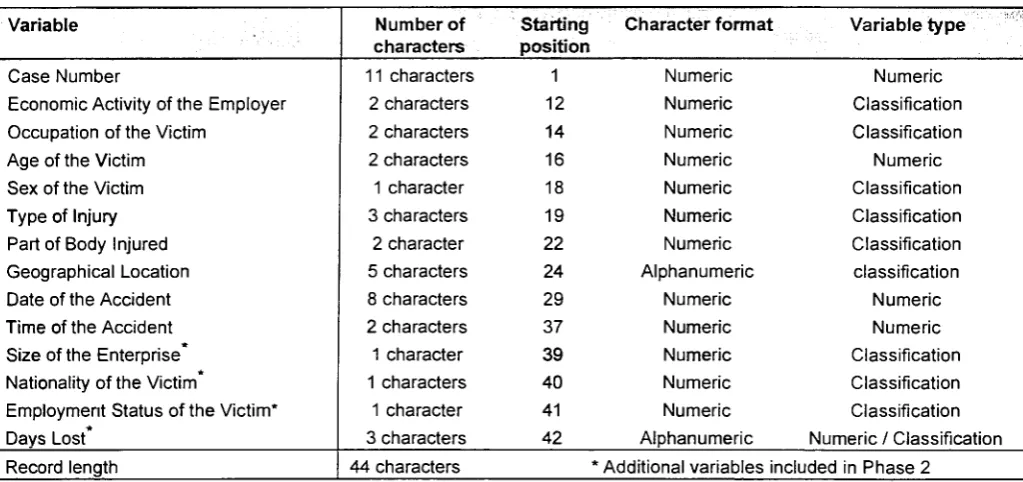
[image:10.595.56.568.189.430.2]Each case of an accident at work, which meets the above mentioned criteria, is included in the ESAW methodology and will be analysed according to the types of variables given in Table 3. The corresponding classifications and formats are specified in Appendix B. A short definition of each of the variables is provided below.
Table 3 - Record structure for the ESAW phase 2 data
Variable
Case Number
Economic Activity of the Employer Occupation of the Victim
Age of the Victim Sex of the Victim Type of Injury Part of Body Injured Geographical Location Date of the Accident Time of the Accident Size of the Enterprise Nationality of the Victim
Employment Status of the Victim* Days Lost Record length Number of characters 11 characters 2 characters 2 characters 2 characters 1 character 3 characters 2 character 5 characters 8 characters 2 characters 1 character 1 characters 1 character 3 characters 44 characters Starting position 1 12 14 16 18 19 22 24 29 37 39 40 41 42 * Character format Numeric Numeric Numeric Numeric Numeric Numeric Numeric Alphanumeric Numeric Numeric Numeric Numeric Numeric Alphanumeric Variable type Numeric Classification Classification Numeric Classification Classification Classification classification Numeric Numeric Classification Classification Classification Numeric / Classification Additional variables included in Phase 2
Case Number
A unique case number must always be supplied when case-by-case data are transmitted. This is required by Eurostat to identify each individual record, and for the Member State to ensure that each record represents a separate accident at work to avoid double counting. The case number is also necessary in order to answer any queries which involve the retrieval and correction of a single record. The format for the case number is determined by the Member State, although, the chosen case number must be prefixed by the 4 digits of the year where the accident is notified to the authorities. It should be noted that the year of notification, which is also the reference period for the ESAW data, is not necessarily the same as the year when the accident occurred. For that reason, the first two digits of the case number represent the reference year for the collected data.
Economic Activity of the Employer
The term economic activity of the employer covers the main "economic" activity of the local unit of the enterprise of the victim. The loca! unit of an enterprise means the geographical location of a business, professional practice, farm, manufacturer, public corporation, etc., (see below). The main activity is defined here as the most important kind of activity in terms of highest number of employees. It is classified according to a short version (2 digit level) of the NACE Rev.1.
Occupation of the Victim
The victim's occupation at the time of the accident is classified according to a short version (2 digit level) of the ISCO-88 (COM).
Age of the Victim
V A R I A B L E CHARACTERISATION
Sex of the Victim
Sex is a simple categorical variable.
Type of Injury
The variable type of injury describes the physical consequences for the victim e.g. bone fracture, wounds etc. The 3
digit version of the ESAW classification for 'Type of injury' should be used for encoding of information on this variable. The current classification is a new one used from the ESAW 1997 data, in accordance with the ILO recommendation mentioned above.
Part of Body Injured
This variable describes the part of the body injured. The current 2 digit version of the classification of "part of body
injured", introduced from the reference year 1995, should be used. It is on the whole in accordance with the ILO recommendation mentioned above. The classification allows only one choice, i.e. only one code can be chosen to describe the injured part(s) of the body. In cases where several parts of the body have been injured, the site which has been most seriously injured should be chosen e.g. an amputation precedes bone fracture, which precedes
wounds etc. In other cases a code for multiple sites should be used at the appropriate level of the classification,
e.g., broken hand and foot. In cases where larger parts of the body have been affected, e.g., injuries caused by
burns or skalds, a code for multiple sites should be used as well.
Geographical Location of the Accident
The variable geographical location is considered to be the territorial unit where the accident has occurred. The
specified level for the NUTS classification in Appendix Β should be used (NUTS 95 version, including the 1998 revision). This classification describes the country in question and the defined regions in this country.
Date of the Accident
This variable describes the dafe when the accident occurred. This is a numeric variable which is defined as year,
month and day (YYYYMMDD).
Time of the Accident
This variable describes the time of the day when the accident occurred. This is a numeric variable describing whole
hours (HH), e.g. 2 p.m. gives 14 which covers the time from 2 p.m. to 2:59 p.m..
Size of the Enterprise
The size of the enterprise is defined here as the number of employees (full time equivalents) working at the local
unit of the enterprise of the victim. For a specification of the local unit please see below.
Nationality of the Victim
This variable is defined as the country of citizenship. If a person has more than one citizenship, the citizenship of
the country where the person has notified the accident should be used. An aggregated format is used for this variable(9).
Employment Status of the Victim
This variable concerns the employment status (professional status) of the victim, for example employee,
self-employed, family worker, etc.(9).
(9) The variables Nationality and Employment Status are included on a pilot basis and the reliability of these variables will be
the subject of an evaluation.
Ξ £
V A R I A B L E C H A R A C T E R I S A T I O N
Days Lost
The variable days lost means the number of calendar days where the victim is unfit for work due to an accident at work. This number is provided using a 3 digit level format. When this information is only available using classes of days lost, 6 classes with codes A01 to A06 should be used. Nonetheless, the number of days lost will be considered to be in accordance with the ESAW methodology, which means that only cases of accidents at work where the person is unfit for work more than three full calendar days should be included. Specific codes should be used to define permanent incapacity (997) and fatal accidents (998). In that case the days lost before the recognition of the permanent incapacity or death are not considered.
Definition of the Local unit of an enterprise
This definition has relevance for the variables "Economic Activity of the Employer" and "Size of the Enterprise". If the following concept of "local unit of the enterprise" is not directly applicable in a country, the national definition should be used as a proxy.
The "local unit" to be considered is a geographically identified location where the job is mainly carried out or can said to be based. If a person works in more than one place (transport, construction, maintenance, surveillance, peripatetic work) or at home, the local unit is taken to be the place from where instructions emanate or from where the work is organised.
Normally, it consists of a single building, part of a building, or, at the most, a self-contained group of buildings. The local unit of the enterprise is therefore the group of employees of the establishment who are geographically located at the same site.
INDICATORS AND METHODS OF STANDARDISATION OF DATA
Indicators and methods of standardisation of data
Incidence rates
The ESAW methodology considers 2 main types of indicators on accidents at work: the numbers of accidents and the incidence rates. Obviously, the numbers of accidents have to be related to the reference population of persons in employment (persons exposed to the risk of accident at work) in order to establish the incidence rates (frequency).
The incidence rate is defined as the number of accidents at work per 100 000 persons in employment. It can be calculated for Europe, a Member State, or any sub-population breakdown according to one or more of the variables above characterising the victim of the accident (economic activity, age, etc.). It can be established for all accidents or breakdowns according to one or more of the variables above characterising the accident (part of body injured, etc.). Separate incidence rates are calculated for fatal accidents and accidents leading to more than 3 days' absence.
Furthermore, an additional incidence rate is calculated for fatalities at the European level, which excludes road traffic accidents, in order to provide comparable incidence rates for all Member States. This is due to the fact that road traffic accidents in the course of work are not recorded as accidents at work in a few Member States. Fatalities caused by road traffic accidents represent an important share of the number of fatal accidents. For this reason, comparisons of national incidence rates for fatalities would introduce a serious bias without this adjustment of the rates. This applies also to accidents on board of any means of transport during a journey in the course of work, which are also excluded from this adjusted rate of fatalities.
It should be noted that only this adjusted incidence rate on fatalities is used for the breakdown by Member States The standard formula is the following:
Number of accidents (fatal or non-fatal)
Incidence rate = X 100 000. Number of employed persons in the studied
population
Correction factors and standardisation methods
Correction
For the Member States where the accidents at work with more than 3 days' absence are only partly reported, reporting levels are estimated mainly by breakdowns by branches of economic activity for these Member States. On the basis of these reporting levels Eurostat correct the submitted data on the accidents and deduce from it an estimate of the number of accidents at work occurred.
Standardisation
It is a fact that the frequency of work accidents is much higher in some branches compared to others. For this reason the industrial structure of a country will influence its total frequency of work accidents depending on the share of high risk sectors. For example, a country where high risk branches like agriculture, construction or transport represent a higher share of the total workforce compared to another Member State, but with the same frequency of accidents for each branch, the first Member States would have a higher total national incidence rate. To correct for this effect a "standardised" number of accidents at work per 100 000 persons in employment is calculated per Member State by giving each branch the same weight at national level as in the European Union total ("standardised" incidence rate). This standardisation method is used in current ESAW publications on accidents at work.
INDICATORS AND METHODS OF STANDARDISATION OF DATA
It is considered to improve this standardisation method in the future. Depending on the reliability and coverage of the information provided by the Member States the following improvements could be implemented:
— standardisation of the industrial structure by sector (NACE sub-section or division) and not only by the aggregated NACE branches (section); indeed, the relative weight of the sectors inside the major branches also differ from one country to another while the risk levels vary distinctly between sectors;
— standardisation according to working time and therefore to the time of exposure to the risk (part-time work, short term contracts, legal length of work, etc.), which varies from one country to another.
DATA COLLECTION
Data collection
Reporting procedures in the Member States
Insurance and non-insurance based systems
Eurostat receives the ESAW data from the Member States' national registers or other national bodies responsible for the collection of data on accidents at work. The ESAW data are occurrence-related and based on administrative sources in the Member States. Compared to surveys the harmonisation prospects of ESAW data therefore depend on the operative reporting procedures, the possibility of modifying these or adapting their data to ESAW concepts and specifications.
Mainly, two types of reporting procedures can be identified in the various Member States of the European Union. The insurance based systems, which can be found in 10 Member States, have reporting procedures mainly based on the notification of the accidents to the insurer, public or private according to the case. On the other hand the reporting procedures of the five other Member States (Denmark, Ireland, the Netherlands, Sweden and the United Kingdom) are mainly based on the legal obligation of the employer to notify the accidents to the relevant national authorities, which is often the National Labour Inspection Service. Norway, which also provides data to Eurostat, belongs to the latter group.
In the insurance based systems, the supply or the refunding of care benefits and the payment of benefits in cash (daily subsistence allowances, rents where applicable, etc.) resulting from accidents at work, are conditioned in its report to the public or private insurer. Additionally, in a number of these countries, the benefits thus paid under the accidents at work insurance legislation are higher than in the case of non-occupational accidents. Thus, there is an
economic incentive for the employer and the employee to notify an accident at work in the insurance based systems. Due to these various factors, the reporting levels for accidents at work are in general very high in the insurance based systems and considered to be about 100 percent.
The five other Member States and Norway have in general a system of universal social security " coverage ". In such systems the benefits provided to the victim of an accident at work are not depending on a preliminary reporting of the accident, except for the specific benefits paid for the most serious accidents (rents for permanent disability, etc.). Consequently, the economic incentive for notifying accidents at work is not very strong in the non-insurance based systems. Nevertheless, there is a legal obligation for the employer to notify an accident at work. In practice only a part of work accidents are actually reported and the systems based on the employers liability to notify work accidents to the authorities have only a medium reporting level usually ranging from 30 to 50 percent on average for all branches of economic activity taken together.
Evaluation of national reporting procedures
The initial evaluation of the data sources is a prerequisite for a correct interpretation of the data received from the various Member States. This is in particular important taking into account the differences in the national reporting procedures as mentioned above. A detailed evaluation is carried out by the way of an evaluation questionnaire. The national replies to this questionnaire are submitted to Eurostat together with the annual ESAW data.
The main issues covered by the evaluation questionnaire are the following: — definition of an accident at work
— coverage of groups — reporting levels
The definition of an accident at work, in particular the categories of fatal and non-fatal accidents reported, can vary slightly from country to country (Tables 4 and 5). For example, for some reporting procedures a fatal accident is only registered as fatal when the victim died within a certain time limit after the accidental injury. In some Member States all non-fatal accidents are covered irrespective of whether the victim was absence from work or not. In this case it is important that the cases with more than 3 days' absence can be identified and that only these are submitted to Eurostat.
DATA COLLECTION
It is also asked whether certain types of accidents are included or excluded from the data submitted, for example, road traffic accidents (Table 8) or accidents to members of the public.
Another part of the questionnaire concerns the groups covered by the national data (by professional status, economic activity and occupational groups). This information is very important in order to establish an adequate reference population for the calculation of frequencies (tables 6 and 7).
An estimation of the national reporting levels should also be provided to Eurostat by category of accident, economic activity, occupation, professional status and size of the enterprise (Table 9). Questions on the national concepts for
the local unit of an enterprise are also covered by the questionnaire, but the results are not included in this
publication.
The results of the evaluation of the current national reporting procedures are provided below.
Definition of an accident at work
Non-fatal accidents
The definition of what constitutes a notifiable work accident ranges from any work accident, whether it results in an interruption of work or not, to a minimum absence of more than three days. As can be seen from Table 4 below all Member States cover accidents with more than 3 days' absence from work, which is also the definition for the ESAW project.
[image:16.595.53.569.437.569.2]It is considered that accidents with more than 3 days' absence from work have a higher reporting level than accidents with less than 3 days' absence from work. Only accidents with more than 3 days' absence (resumption of work the fifth day or later after the day of the accident) are considered by the ESAW methodology.
Table 4 - Categories of non-fatal accidents at work reported
Accidents are notifiable in case of:
No absence or resumption of work the
same day of the accidenti3)
Resumption of work the first, second or third day after the day of the accident^) Resumption of work the fourth day after the day of the accidente)
Resumption of work the fifth day or later after the day of the accident
Other Β Y Y Y Y DK Ν Y Y Y D YD YO YO Y EL Y Y Y Y
in the European Union E Y Y Y Y F Y Y Y Y IRL Ν Ν Y Y 1 Ν Ν Ν Y L Y Y Y Y NL Ν Ν Ν Ν
(2)
Α Υ Υ Υ Υ Ρ Υ Υ Υ Υ FIN Ν Ν Υ Υ
s
Υ Υ Υ Υ UK NO Ν Ν Ν Υ ΥC) D: The accidents with less than 4 days' absence are covered by the compensation system but are not included in the national statistics.
(2) NL: Only "serious injuries " are reported.
(3) Accidents without work absence or with a work absence of less than 4 days (resumption of work from the same
day to the fourth day after the day of the accident) are not covered by the ESAW methodology. Legend: Y = Yes, reported; Ν = No, not reported.
Fatal accidents
Fatal accidents should in principle be notified in all Member States. However, some countries only register accidents as fatal if the victim died within a certain time limit after the accidental injury. The notification of an accident as fatal ranges from registration procedures where the accident is registered as fatal in the statistics when the victim died the same day (the Netherlands) or within 30 days after the accident (Germany) to cases where no
time limits are laid down (B, GR, F, I, L and S). For the other Member States the time limit is within 1 year after the
date of the accident (Table 5).
D A T A COLLECTION
Table 5 - Categories Of fatal accidents at work reported in the European Union Accidents are registered as fatal when the
victim died:
Within a year after the day of the accident At any time after the day of the accident After a prior recognition of permanent disability
Other Β Y Y Y DK Y Ν Ν D YO YO YO 0 EL E
Y Y(2)
Υ Ν
Y
F IRL
Y Y
Y Ν
NO YO
I Y Y Y L Y Y Y NL Ν Ν Ν 0 A Y Y -Ρ Y Ν YO FIN Y Ν Ν S Y Y Y ÜK Y Ν YO
O D: Only those within 30 days after the day of the accident are included in the national statistics and ESAW data. Ο E: Fatalities are only compensated and thus included in the statistical data if the victim died within 18 months
after the day of the accident.
O F: The deaths due to an accident at work but occurred after the recognition of a permanent disability are covered by the insurance if they are due to the occupational injury, but they are not included as fatal accidents in the statistics.
O IRL, Ρ & UK: The deaths due to an accident at work but occurred after the recognition of a permanent disability are included in the statistics only if they occur within a year after the day of the accident.
O NL: Only " sudden deaths " are registered.
Legend: Y = Yes, reported; Ν = No, not reported.
Groups covered by the national reporting systems
All groups or sectors should in principle be covered by national legislation or other statutory arrangements that require cases of accidents at work to be notified to the authorities, or to a private or public insurance body in accordance with the law. However, not all data are compiled for statistical purposes. Either the data are kept in a format that does not allow for statistical analyses or the data files are not for the moment available for the ESAW
project. For this reason the term coverage in the following should be understood as the coverage of the accidents data that actually have been sent to Eurostat in accordance with the ESAW methodology.
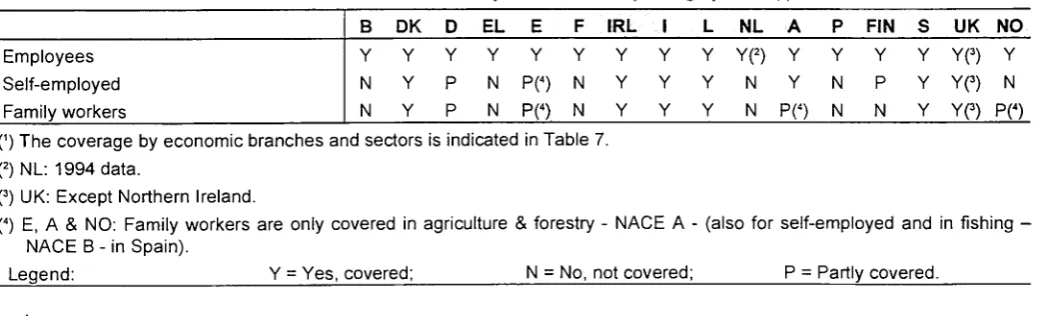
Coverage of self-employed and family workers
The coverage of groups varies from one Member States to another. Self-employed and family members are not covered by some national reporting systems. In particular the agricultural sector is affected by the lack of coverage of the self-employed. Furthermore, the coverage of the data for some Member States, which have a large group of self-employed as, for example, Greece, is affected by the exclusion of this group from the reporting and registration procedures. In Table 6 the groups covered by the national reporting systems by professional status are presented.
Table 6 - ESAW 1995 data: Professional status covered by the national reporting systemsO
Employees Self-employed Family workers
Β Y Ν Ν DK Y Y Y D Y Ρ Ρ EL Y Ν Ν E Y PO PO F Y Ν Ν IRL Y Y Y I Y Y Y L Y Y Y NL YO Ν Ν A Y Y PO P Y Ν Ν FIN Y Ρ Ν S Y Y Y
UK NO
YO Y
Y O Ν
YO
POO The coverage by economic branches and sectors is indicated in Table 7. O N L : 1994 data.
O UK: Except Northern Ireland.
Ο E, A & NO: Family workers are only covered in agriculture & forestry - NACE A - (also for self-employed and in fishing NACE Β - in Spain).
Legend: Y = Yes, covered; Ν = No, not covered; Ρ = Partly covered.
ML
eurostat
[image:17.595.35.559.535.693.2]DATA COLLECTION
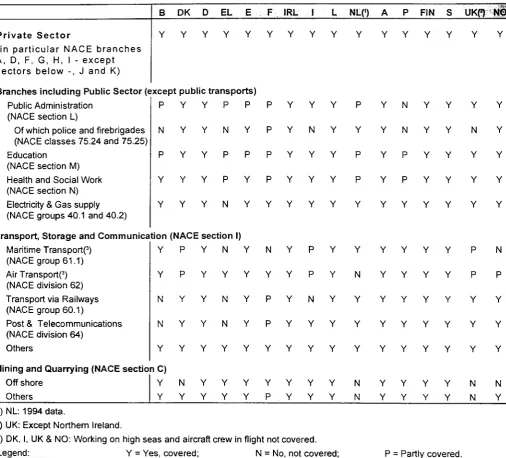
Sectors
[image:18.595.59.566.205.663.2]In general the private sector is covered by all national reporting systems. However, some important sectors are not covered by all Member States. Particularly parts of the Public Sector (in particular Public Administration), Mining and Quarrying and parts of the Transport, Storage and Communication branch are not or only partly covered by the national reporting systems. This includes also Education and Health and Social Work as these branches are partly public in most countries. Some high risk groups such as off-shore miners or police and firebrigades are not covered by all countries.
Table 7 - ESAW 1995 data: Branches
P r i v a t e S e c t o r
(in particular NACE branches A, D, F, G, H, I - except sectors below -, J and K)
covered by the national reporting systems
Β DK D EL E F IRL I L
Υ Υ Υ Υ Υ Υ Υ Υ Υ
NLO Y A Y Ρ Y FIN Y S Y UKf) Y NO Y Ρ Ν Ρ Y Y Y Y Y Y Y Y Y Y Y Y Ρ Ν Ρ Ρ Ν Ρ Υ Ρ Υ Υ Ρ Ρ Ρ Ρ Υ Υ Υ Υ Υ Υ Υ Ν Υ Υ Υ Υ Υ Υ Υ Υ Ρ Υ Ρ Ρ Υ Branches including Public Sector (except public transports)
Public Administration (NACE section L)
Of which police and firebrigades (NACE classes 75.24 and 75.25) Education
(NACE section M) Health and Social Work (NACE section N) Electricity & Gas supply (NACE groups 40.1 and 40.2)
Transport, Storage and Communication (NACE section I)
Maritime Transporto Y P Y N Y N Y P Y Y
(NACE group 61.1)
Air Transporto Y P Y Y Y Y Y P Y Ν
(NACE division 62)
Transport via Railways N Y Y N Y P Y N Y Y
(NACE group 60.1)
Posts Telecommunications N Y Y N Y P Y Y Y Y
(NACE division 64)
Others Υ Υ Υ Υ Υ Υ Υ Υ Υ Y
Y Ν Y Y Y Y
Y Ν Y Y Ν Y
Y Ρ Y Y Y Y
Y Ρ Y Y Y Y
Y Y Y Y Y Y
Y Y Y Y Ρ Ν
Y Y Y Y Ρ Ρ
Y Y Y Y Y Y
Y Y Y Y Y Y
Y Y Y Y Y Y
Mining and Quarrying (NACE section C) Off shore Others Y Y Ν Y Y Y Y Y Y Y Y Ρ Y Y Y Y Y Y Ν Ν Y Y Y Y Y Y Y Y Ν Ν Ν Y O NL: 1994 data.
O UK: Except Northem Ireland.
O DK, I, UK & NO: Working on high seas and aircraft crew in flight not covered.
Legend: Y = Yes, covered; Ν = No, not covered; Ρ = Partly covered.
DATA COLLECTION
Coverage of road traffic accidents
[image:19.595.32.548.176.233.2]Some countries, Germany, Ireland, United Kingdom and Norway, are not in a position to provide data on road traffic accidents in the course of work (from 1996 ESAW data, Germany will cover this type of accidents). The lack of coverage for this type of accidents has a significant impact on the national numbers of fatalities and for this reason Eurostat makes an adjustment for this in the official statistics.
Table 8 - ESAW 1995 data: Coverage of road traffic accidents in the course of work
Road traffic accidents in the course of work
Β DK D EL E F IRL I L NL A Ρ FIN
Y Y N Y Y Y N Y Y Y Y Y Y
S Y
UK NO Ν Ν
Legend: Y = Yes, covered; N = No, not covered.
National reporting levels
As indicated above, the reporting levels of accidents at work with more than 3 days' absence are in some countries or sectors lower than 100%. The table below shows the differences in reporting levels for the national ESAW 1995 data. As explained previously, Eurostat corrects the submitted data on accidents on the basis of the reporting levels and deduces from it an estimate of the number of accidents at work occurred. For the mainly insurance based systems the reporting level is considered to be very close to 100%, i.e., all accidents to persons covered by the statistics are considered to be reported.
For the reporting systems which are mainly based on a legal obligation to notify, only a part of the accidents is reported. In this case estimates of the reporting levels are provided by the Member States, based either on an evaluation of the reporting procedures or on the basis of other data sources, e.g., surveys. In the table below only the minimum and maximum values for the main sectors are provided for each of those Member States which have not 100% reporting. Member States have provided more detailed information which is used for the estimates of the total number of accidents published by Eurostat.
TABLE 9 - ESAW 1995 data: National reporting levels for accidents at work with more than 3 days' absence from work
100% reporting level for all
sectors
Β DK D EL E F IRL 1 L NL
Ν N Y Ν Υ Υ Ν P(1) Y N(2)
Estimations of reporting levels for those countries which have not 100 percent reportingO : Minimum (%)
Maximum (%)
70(5) 10 30(5) 7 10(5)
100(5) 90 70O 100 70O
A Ρ
YO γ
FIN S UK
Y Ν Ν
30(5) 11
100(s) 86
NO Ν
25 25
O I: The reporting level is less than 100 % only for the craft professions. 0 NL: 1994 data.
O A: Except agriculture for which the reporting level is less than 30%.
O The reporting level for each sector is provided to Eurostat on the basis of national evaluations. The reporting level for the sectors representing respectively the lowest (minimum) and highest (maximum) percentage is shown.
(5) Provided using the classes: "low"<30%; 30% <"Medium" < 70%; "High">70%.
Legend: Y = Yes; Ν = No; Ρ = Partly.
ML
17 [image:19.595.32.555.476.564.2]REFERENCE POPULATION (BASED ON LFS)
Reference population (based on LFS)
A reference population for the ESAW data is established in order to calculate incidence rates for accidents at work. The reference population is established from the data of the Labour Force Survey (LFS) and corresponds to the national coverage of the ESAW data in each country. The advantages of using the European Labour Force Survey are the comparability of this source and the possibility for establishing more detailed information on the national labour forces. However, this source does not provide information on employment in full-time equivalents. This is a problem for countries with a high share of part-time work and particularly for women. Also the LFS only covers persons aged 15 years or more, which makes it difficult to establish incidence rates for accidents occurred among children and young persons.
Reference year
The reference year used for the extraction of the reference population from the LFS is the same as the reference year of the ESAW data.
Establishment of filters
To calculate appropriate incidence rates, the reference population of persons in employment should cover the same field as the ESAW data on accidents. For that purpose, Eurostat establishes filters annually on the basis of the answers from the Member States to the questions of the Evaluation Questionnaire on the coverage of the data (by professional status, economic activity, occupational groups).
Estimated reference population for 1994
The population of persons covered by the ESAW data, established from the LFS, was in 1994 almost 132 million persons in employment, which represented almost 90% of the total European workforce.
FUTURE DEVELOPMENTS
Future developments
A last step of the ESAW project, ESAW phase 3 on the causes and circumstances of accidents at work, is being developed. Eurostat and the DG V of the European Commission are working together with the Member States until the end of 1999 in order to prepare the ESAW phase 3 methodology, specifications and schedule of implementation. This work is based on a project carried out jointly by the Institutions of 4 Member States (Denmark, France, Germany and Italy) led by Eurogip. The aim of the project is to set up a codification system of the causes and circumstances of accidents at work.
A progressive implementation of the causation variables is foreseen for the collection of the data on accidents at work in the Member States from the reference year 2001 to be submitted to Eurostat in 2003. Currently, a whole set of 8 variables has been defined, and draft classifications are being discussed. If necessary, priorities will be established for the implementations of the variables.
Moreover, an ad hoc module on Health and Safety at Work will be implemented in the 1999 Labour Force Survey (LFS), as a complementary data source to ESAW.
Finally, Eurostat and DG V/F, together with the Member States and Norway, will continue their efforts to improve the quality of the ESAW data and their comparability between countries.
Definitions and classifications for the new variables in preparation
In ESAW Phase 3, eight new variables will supply additional information to identify where the accident occurs and especially how the accident occurs in order to design a prevention policy. The corresponding system of variables and classifications has been set up by a Group of Institutions of 4 Member States (Denmark, France, Germany and Italy) lead by Eurogip. The list of new variables in ESAW phase 3 is detailed in Table 10.
The system is registering the chain of events with three sets of two variables. Usually an accident comprises a chain of events. Having prevention in mind, the description of this event cycle's moment where something went wrong and the description of what the victim was doing at the time of the accident is very important. The three levels of information are as follows :
(a) Specific Physical Activity and associated Material Agent (b) Deviation and associated Material Agent
(c) Contact - Mode of injury and associated Material Agent
Each level combines an action and an object. This gives a very flexible and very precise registration because the possible combinations are numerous without having to use huge classifications. At each level a Material Agent is coded, but the same classification of Material Agent is used for all three levels. This does not mean that the same Material Agent has to be coded three times. For most of the cases different codes for Material Agent will be used for each level. In this way the various Material Agents in the sequence of events will be identified.
(a) The « Specific Physical Activity » and its associated Material Agent tell what the victim was doing when the accident happened. This activity is very precise and thus differs from the « Working Process » which is giving the broad picture.
Ex. : while cleaning (Working Process) the victim was climbing (Specific Physical Activity ) the stairways
(associated Material Agent),
Ex. : while manufacturing a piece of furniture (Working Process), the victim was lifting (Specific Physical Activity ) a
piece of wood (associated Material Agent) in his hands.
(b) The « Deviation » and its associated Material Agent tell about the deviant event which led to the accident. The deviant event does not describe the causes or why the accident happened. It is just a description of the event. One has to look for what occurred in an abnormal way, or when there is a chain of abnormal events, what is the last element of this chain.
Ex. : the victim was falling (Deviation) on the stairs (associated Material Agent),
Ex. : the victim lost control (Deviation) of a hand held screwdriver (associated Material Agent).
[LM¡
19
FUTURE DEVELOPMENTS
(c) The « Contact - Mode of Injury » and its associated Material Agent tell about the way, the manner the victim came in contact with the Material Agent causing the injury. It describes how the victim was injured.
Ex. : the victim hits (Contact - Mode of Injury) against the floor (associated Material Agent) when falling, Ex. : the victim was hit (Contact - Mode of injury) by a falling screwdriver (associated Material Agent).
Table 10 - ESAW phase 1, 2 and 3 variables
PHASE
Year of submission
Reference year
Information on the employer Economic Activity of the Employer Size of the Enterprise
Information on the victim Occupation of the Victim Age of the Victim Sex of the Victim Nationality of the Victim
Employment Status of the Victim Information on the injury Type of Injury
Part of Body Injured Days Lost
Information on circumstances Geographical Location
Date of the Accident Time of the Accident Working Environment Working Process
Causation detailed information Specific Physical Activity
- > Material Agent of the Specific Physical Activity Deviation
- > Material Agent of the Deviation
Contact - Mode of Injury - > Material Agent of the
Contact - Mode of Injury Case number
Total number of digits
1 1995 1993 2 2 2 1 2 2 5 6 2 9 33 2 from: 1998 1996 number of digits:
2 1 2 2 1 1 1 3 2 3 5 8 2 11 44 3 2003 2001
2 / 4 1 2 2 1 1 1 3 2 3 5 8 2 2 2 2 2 2 2 2 2 11 6 0 / 6 2
Classification used
(if specific for ESAW, Classification = ESAW)
NACE ESAW
ISCO
(Country - EU - other)
ESAW-ESAW ESAW ESAW ESAW NUTS in development^) in development1)
in development1) in development1) in development1) in development^) in development1) in development^)
Year + 7 digits
FUTURE DEVELOPMENTS
The definitions established by the Eurogip Group for these ESAW phase 3 causation variables are the following ones.
The Working Environment
The type of working area where the victim was present or was working just before the accident. This is the place of work, general area, work premises, where the accident happened.
The Working Process
The main type/kind of work, task (generic/broad activity) done by the victim at the time of the accident. This describes the main type of work done by the victim at the time of the accident. This is not the occupation of the victim, neither the victim's precise Specific Physical Activity at the moment of the accident. This concerns the description of the task, work, broadly speaking, undertaken by the victim during a period of time ending at the instant of the accident.
The Specific Physical Activity
The activity being done by the victim just before the accident. This is the Specific Physical Activity the victim was doing at the very moment of the accident. One must consider exactly what the victim was doing at the time of the accident. The activity may be undertaken for a very short period of time.
The Material Agent of the Specific Physical Activity
The principal Material Agent associated/linked with the Specific Physical Activity of the victim just before the accident. The Material Agent associated with the Specific Physical Activity is describing the tool, the object, the agent used by the victim when the accident happened. The Material Agent may be or may not be implicated in the accident.
The Deviation
The last deviant event from normal which leads to the accident. This is the description of what occurred in an abnormal way. This is a deviation from the normal way of working, from the normal process. The Deviation is the event leading to the accident. If there are several connected events, the last deviation must be recorded (the closest deviation, in time, to the Contact - Mode of Injury).
The Material Agent of Deviation
The principal Material Agent associated/linked with the deviant event. The Material Agent associated with the Deviation describes the tool, the object, the agent linked to the abnormality of the process, linked with what occurred in an abnormal way.
The Contact - Mode of Injury
The contact that injured the victim. It is describing how the victim was hurt (physical or psychological contact) by the Material Agent that caused the injury. If there are several Contacts - Modes of Injury, the one causing the most serious injury must be recorded.
The Material Agent of the Contact - Mode of Injury
The principal Material Agent associated/linked with the contact that injured. The Material Agent associated with the Contact - Mode of Injury describes the object, the tool, the agent the victim came into contact with or the psychological Mode of Injury.
FUTURE DEVELOPMENTS
Ad hoc module on Health and Safety at Work in the 1999 LFS
To have a broader view on Health and Safety at work, it has been decided to insert an ad hoc module on Health and Safety at Work in the 1999 Labour Force Survey (LFS), as a complementary data source to ESAW. This module will bring an important added value to the information already collected by the ESAW project on the accidental injury and the victim. The LFS data enable Eurostat to link information on the accident with information on the situation of the persons on the labour market, the characteristics of their job, their working conditions or training. Additionally, it will allow to compare figures between Member States on the basis of the same data source, contrary to the problems of comparability related to the two different types of sources (insurance and non-insurance based system) used for the ESAW data.
The Commission Regulation (EC) No 1571/98 of the 20/07/1998(10) indicates in its Annex III the detailed list of information
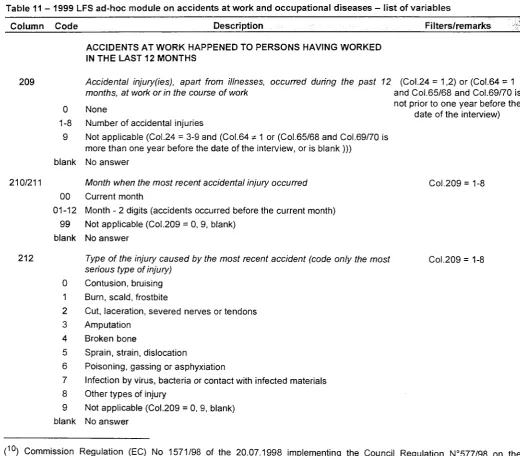
to be collected in the 1999 ad hoc module on Health and Safety at Work ("Accidents at work and occupational diseases"). The specifications provided in this Regulation for the 1999 ad hoc module in the LFS are as follows:
1. All Member States are covered except Belgium, France and Austria.
[image:24.595.42.563.318.774.2]2. Germany can provide Eurostat with data concerning accidents at work and work related health problems for a period of reference of 4 weeks. The variables that can be provided are: accidents at work, time off work due to the work accident, existence of a work related health problem and time off work due to the work related health problem. 3. The variables will be coded as follows.
Table 11 - 1999 LFS ad-hoc module on accidents at work and occupational diseases- list of variables
Column Code Description Filters/remarks
ACCIDENTS AT WORK HAPPENED TO PERSONS HAVING WORKED IN THE LAST 12 MONTHS
209 Accidental injury(ies), apart from illnesses, occurred during the past 12 (Col.24 = 1,2) or (Col.64 = 1 months, at work orin the course of work and Col.65/68 and Col.69/70 is
not prior to one year before the date of the interview) 1-8 Number of accidental injuries
9 Not applicable (Col.24 = 3-9 and (Col.64 * 1 or (Col.65/68 and Col.69/70 is more than one year before the date of the interview, or is blank )))
blank No answer
210/211 Month when the most recent accidental injury occurred Col.209 = 1 -8 00 Current month
01-12 Month - 2 digits (accidents occurred before the current month) 99 Not applicable (Col.209 = 0, 9, blank)
blank No answer
212 Type of the injury caused by the most recent accident (code only the most Col.209 = 1-8 serious type ofinjury)
0 Contusion, bruising 1 Burn, scald, frostbite
2 Cut, laceration, severed nerves or tendons 3 Amputation
4 Broken bone
5 Sprain, strain, dislocation
6 Poisoning, gassing or asphyxiation
7 Infection by virus, bacteria or contact with infected materials 8 Other types of injury
9 Not applicable (Col.209 = 0, 9, blank) blank No answer
FUTURE DEVELOPMENTS
Column Code Description Filters/remarks
213 Work status after the most recent accidental injury Person has started work again
1 - Resumption of usual work activities
2 - Change of work or workplace because of the accidental injury 3 - Part time work or on reduced hours because of the accidental injury
Person has not started to work again
4 - Person has not yet recovered from the accidental injury and is not working at the date of the interview
5 - Person expects never to do paid work again because of the accidental injury
6 - Other reasons
9 Not applicable (Col.209 = 0, 9, blank) blank No answer
214 Date when the person was able to start to work again after the most recent accidental injury
0 On the same day as the accident or on the first day after the accident 1 From the second to the fourth day after the accident
2 From the fifth to the seventh day after the accident 3 From one week but before two weeks after the accident 4 From two weeks but before one month after the accident 5 From one month but before three months after the accident 6 Three months or later after the accident
7 No time off work
9 Not applicable (Col.213 = 4, 5, 9) blank No answer
215 Job done when the accidental injury occurred (code first that applies) 1 Main current (first) job
2 Second current job
3 Last job (person not in employment) 4 Job one year ago
5 Some other job
9 Not applicable (Col.209 = 0, 9, blank) blank No answer
Col.209 = 1-8
Col.213 = 1-3, 6, blank
Col.209 = 1-8
216
0 1-8
9 blank
WORK-RELATED HEALTH PROBLEMS SUFFERED DURING THE LAST 12 MONTHS (apart from accidental injuries)
lllness(es), disability(ies) or other physical or psychic health problem(s), apart from accidental injuries, suffered by the person during the past 12 months (from the date of the interview) and that was (were), caused or made worse by the work
None
Number of different complaints
Not applicable (Col.24 = 3-9 and Col.64 *1) No answer
(Col.24 =1,2 or Col.64 = 1)
[Mi
eurostatFUTURE DEVELOPMENTS
Column Code Description Filters/remarks
217 Type of the most serious complaint caused or made worse by work Col.216 = 1 -8 0 Bone, joint or muscle problem
1 Breathing or lung problem 2 Skin problem
3 Hearing problem
4 Stress, depression or anxiety 5 Headache and/or eyestrain
6 Heart disease or attack, or other problems in the circulatory system 7 Infectious disease (virus, bacteria or other type of infection) 8 Other types of complaint
9 Not applicable (Col.216 = 0, 9, blank) blank No answer
218 Number of days off work due to the most serious complaint caused or Col.216 1-8 made worse by work during the last 12 months
0 Less than one day 1 One to three days 2 Four to six days
3 At least one week but less than two weeks 4 At least two weeks but less than one month 5 At least one month but less than three months 6 Three months or more
7 Expects never to do paid work again due to this illness 9 Not applicable (Col.216 =0, 9, blank)
blank No answer
219 Job that caused or made worse the most serious complaint (code first that Col.216= 1-8 applies)
1 Main current (first) job 2 Second current job
3 Last job (person not in employment) 4 Job one year ago
5 Some other job
9 Not applicable (Col.216= 0, 9, blank) blank No answer
220/221 Economic activity of the local unit of the job that caused or made worse the most serious complaint (when not defined in another part of the survey) NACE Rev.1
(2 digits)
00 Not applicable (Col.219= 1-2, 4, 9 or (Col.219= 3 and the person last worked within the last 8 years))
blank No answer
Col.219=5, blank or (Col.219= 3 and the person
FUTURE DEVELOPMENTS
The corresponding explanatory notes for this ad-hoc module on Health and Safety at Work are as followings.
Accidents at work happened to persons having worked in the last 12 months
Col.209: Accidental injury(ies), apart from illnesses, occurred during the past 12 months, at work or in the course of work
Only those accidents occurred at work or in the course of the work of the interviewed person are considered. All other types of accidents, as accidents occurred in the course of travelling between home (usual place of meals also) and the workplace (commuting accidents), home and leisure accidents or road traffic accidents in the course of private activities are excluded. Occupational diseases or illnesses are also excluded.
The term "in the course of work" means "whilst engaged in an occupational activity or during the time spent at work". Any accident occurred during working time, even if it has not occurred during the usual work or in the usual workplace of the person, has to be taken into consideration, including cases of acute poisoning and willful acts of other persons. However, deliberate self-inflicted injuries are excluded. From this follows that all types of accidents in a public place or means of transport, either if it is the usual workplace or during a journey in the course of work, should be considered as an accident at work and are included.
This apply also to the following types of accidents: road traffic accidents in the course of work; slips, falls, aggressions, etc., in public places (pavement, staircases, etc.) or in the arrival and starting points (station, port, airport, etc.) of any means of transport occurred in the course of work; accidents on board of any means of transport used in the course of work (underground railway, tram, train, boat, plane, etc.) and accidents occurred within the premises of another company than the one which employs the victim, or in a private individual in the course of work. Finally, accidents at lunch time, or any other break, inside the premises of the enterprise should also be included. All cases of accidents corresponding to these examples are also considered as "accidents at work".
The last 12 months are taken into consideration from the date of the interview (ex: accidents between the 15 April N-1 and the 14 April N for an interview the 14 April N).
When the person suffered more than one accident of this type during the last 12 months, the total number of accidents has to be indicated.
Finally, it should be noted that the filter (Col.24=1,2 or (Col.64=1 and ...)) induced that are only covered by the module people aged 15 years or more, but on the opposite there is no limit of age for old people.
Col.210/211 Month when the most recent accidental injury occurred
If the person suffered more than one accident at work during the last 12 months, only the most recent of these is considered for this and the following variables in the section on "accidents at work".
The date (month) when this accident occurred will be useful to link to other variables of the survey and to breakdowns of the data by month from the European Statistics on Accidents at Work. It will also be useful for adjustments concerning memory recall problems.
In the example above (column 209), the accident could have occurred between the 15 April N-1 and the 14 April N date of the interview. It is then necessary to distinguish the month of the interview (April N in the example) from the same month of the previous year (April N-1) when the accident could also have occurred. Consequently, the code '00' indicates that the accident occurred in the same month as the interview (current month), and the codes '01' to '12' correspond to the month of the accidents occurred before the current month.