PATHOGEN
DETECTION
SYSTEMS
BY
REAL
TIME
PCR
Results
Interpretation
Microbial offers real time PCR‐based systems for the detection of pathogenic bacteria in food and environmental samples. This technique is fast and robust, allowing the user to obtain confident and unequivocal results in less than two hours. Despite the operative simplicity of real time PCR, an accurate interpretation of the results might
be complex without previous experience. Results are graphically expressed by the software accompanying all
thermocyclers. A correct interpretation of the amplification curves will help the Laboratory Head to deliver
reliable results.
With this guide Microbial provides some basic guidelines to interpret the results obtained by real time PCR when
using Microbial pathogen detection systems.
(Revised on September 2009)
CONTENTS
1. REAL TIME PCR FUNDAMENTALS ... 3
2. THE INTERNAL AMPLIFICATION CONTROL ... 5
3. DETECTION SYSTEMS WITH 2 FLUOROPHORES ... 6
4. DETECTION SYSTEMS WITH 3 FLUOROPHORES ... 8
5. DETECTION SYSTEMS WITH SYBRGREEN ... 10
6. QUANTIFICATION BY REAL TIME PCR... 12
7. CONTAMINATION OF REAL TIME PCR ... 13
8. ATYPICAL AMPLIFICATION CURVES ... 14
1.
REAL
TIME
PCR
FUNDAMENTALS
Real time PCR is based on the exponential amplification of a specific DNA fragment, used as a template to generate
millions of copies. Real time PCR differs from conventional PCR because it allows the continuous monitoring of the
DNA produced in each cycle by using fluorophore dyes. Fluorescence is released every time a new DNA copy is
synthesized, and therefore, the amount of fluorescence is proportional to the quantity of DNA produced.
Furthermore, real time PCR systems provide higher sensitivity and robustness, with the additional possibility to
quantify the initial amount of target DNA present in a sample.
Real time PCR results are visualized in an amplification plot. Fluorescence is represented on the Y axis, whereas the
number of PCR cycles is plotted in the X axis. The amplification curve consists of an initial phase where the
produced fluorescence is below the detection level of the thermocycler, a second phase in which the fluorescence
increases (being this increment exponential at the beginning of the phase), and a third phase (plateau) where the
reaction ends and the fluorescence is stabilized (Figure 1). Within the second phase, it is possible to set a threshold value, which indicates the area of exponential increase. This value is represented in the graph by a horizontal line.
Threshold
1
ststage
2
ndstage
3
rdstage
Plateau
Exponential increase
Figure 1. Real time PCR amplification plot showing the three phases.
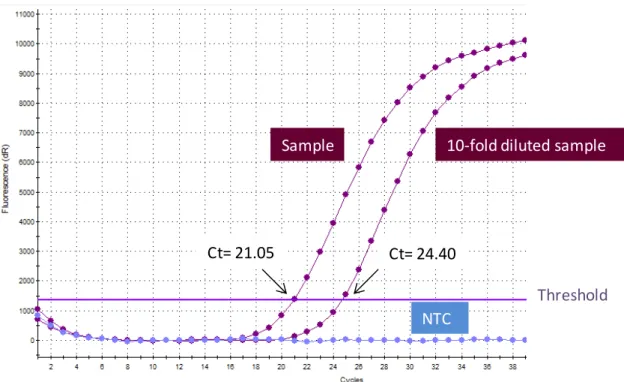
The intersection point between the amplification curve and the threshold line is called Ct (Threshold Cycle). This
point indicates the cycle in which the fluorescence reaches the threshold value. The higher the initial DNA amount,
the lesser number of cycles are needed (low Ct values) to reach the threshold (Figure 2). As a general rule,
considering optimal reaction efficiency, every time a sample is 10‐fold diluted, the Ct value will increase in c.a. 3.3 cycles.
Results interpretation guide
NTC
Threshold
Sample
10
‐
fold
diluted
sample
Ct=
21.05
Ct=
24.40
Figure 2. Amplification plot in which a diluted sample crosses the threshold line later than the non‐diluted sample. Note that the
NTC (non template control) does not reach the threshold because it contains no initial template DNA to amplify.
Amplification plots can be visualized either with the two axes in lineal scale (Figure 3A), or with the Y axis in
logarithmic scale (Figure 3B), being both presentations suitable to interpret the results. The semi logarithmic graph
may be useful to manually adjust the threshold value within the exponential fluorescence increase in the second
phase, since this increase appears as a straight line using this visualization mode (Figure 3B). Several mathematical
methods may be used to calculate the best position of the threshold but, in any case, it should be located within
the exponential area of the second phase. Today, all thermocyclers include in their software a system to
automatically calculate the position of the threshold, although it is also possible to manually adjust it within the
recommended parameters.
NTC Positive sample
LINEAL AMPLIFICATION PLOT
A
NTC Positive sample
SEMI‐LOGARITHMIC AMPLIFICATION PLOT
B
Figure 3. Amplification plot in lineal scale (A) and in semi logarithmic scale (3B). Note that although the amplification curves
display different shape the threshold value is the same in both cases.
2.
THE
INTERNAL
AMPLIFICATION
CONTROL
The reliability of the detection kits developed by Microbial is guaranteed by means of an internal amplification
control (IAC) included in the Reaction Mix. The IAC system has been specifically designed to validate the accuracy
of the test, enabling the distinction of true negative results from false negative results caused by PCR malfunction (due to inhibition, spoilage of the PCR reagents, etc.).
The IAC system consists of the independent amplification of an artificial DNA sequence, which is co‐amplified with
the pathogen target DNA during the PCR run. The IAC is incorporated into the Reaction Mix to a concentration that
has been carefully adjusted. Thus, the low concentration of the IAC ensures that the specificity and sensitivity of
the test are not affected by competitive amplification of both DNAs. Consequently, the IAC amplification signal
may disappear in positive samples where the pathogen DNA is present in high amounts. Nevertheless, the IAC
signal should always be detected in negative samples (absence of the pathogen). When no IAC or pathogen signal
is produced, the cause of the PCR failure should be elucidated by checking the integrity of the PCR reagents or
applying alternative solutions to overcome inhibitory problems.
Most inhibition problems are due to the presence of particles or substances that remain in DNA extractions from
complex samples. These problems may be solved by simply repeating the analysis using a 1/10 or 1/100 dilution of
the extracted DNA with nucleic acid free sterile distilled water, as while diluting the extracted DNA of a sample,
inhibitors will become also diluted. Higher dilution factors are not recommended since they could lead to an
excessive dilution of the target DNA under the detection limit. When inhibitions cannot be solved by diluting,
comprehensive DNA extraction methods including several purification steps (i.e. silica gel column‐based methods)
should be used.
Results interpretation guide
3.
DETECTION
SYSTEMS
WITH
2
FLUOROPHORES
Microbial pathogen detection kits based on the use of 2 fluorophores include real time PCR systems for the
detection of Salmonella spp. (Salmofast®), Listeria monocytogenes (Listerfast®), thermophilic Campylobacter
(Campylofast), and Legionella pneumophila (Legiofast® ENVIRON). These are based on two probes stained with two
different fluorophore dyes, FAM and JOE. The probe stained with FAM indicates the presence of the pathogen in
the sample, whereas the JOE‐stained probe indicates a correct amplification reaction through the use of the IAC,
which allows the detection of PCR inhibitors, avoiding false negative results.
The typical result of a real time PCR analysis with a detection system based on two dyes is an amplification plot with a curve for each detector (Figure 4). Since the level of fluorescence signal is variable depending on the dye, a
threshold value will be independently set for each curve. The amplification signal for each dye will be considered
positive whenever the detector curve crosses its threshold value. Therefore, samples will be considered positive
(presence of the pathogen) whenever they display a FAM positive signal. By contrast, samples will be considered
negative (absence of the pathogen) only when the FAM signal is negative but the JOE signal is positive.
FAM (positive samples)
FAM (NTC) JOE (positive samples and NTC)
FAM threshold
JOE threshold
Figura 4. Amplification plot obtained with 2 fluorophores: FAM for the pathogen and JOE for the IAC (internal amplification control). Note that
the scale of the two fluorophores is very different, since due to optical reasons FAM fluorescence level is higher than that of JOE.
The recommended strategy to easily analyze the results consists of a first visualization of FAM curves. All samples
with a FAM positive signal are positive for the pathogen regardless of the JOE curve behavior. In samples with a
negative FAM signal the presence of inhibitions should be ruled out by checking the JOE curve, which should show
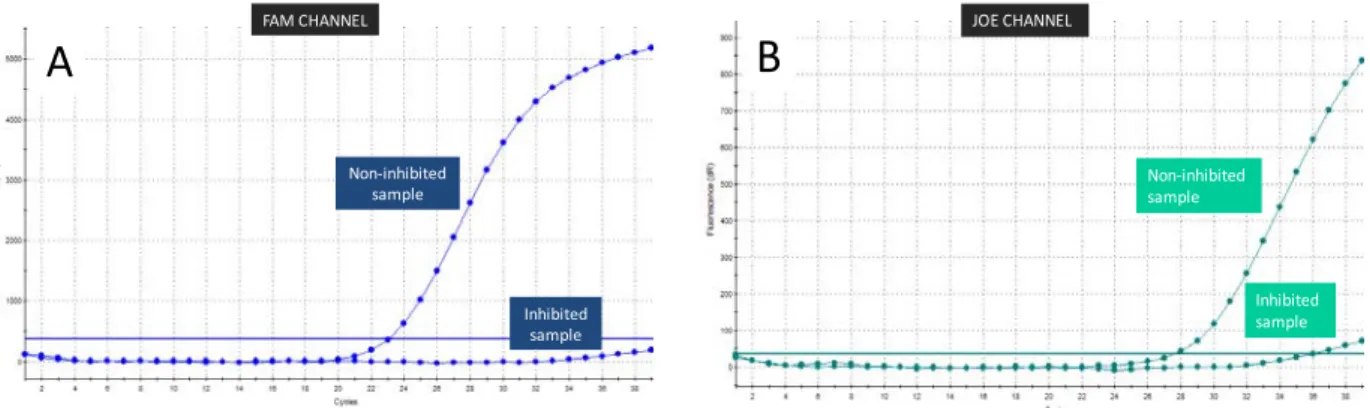
a positive signal and exhibit Ct values similar to those of the non template control (NTC). In samples where neither FAM nor JOE signals are positive, or if only the JOE signal is detected but the Ct is sensibly higher than in NTC, the PCR reaction will be considered to be inhibited (Figure 5).
Non‐inhibited
sample
Inhibited
sample FAM CHANNEL
A
Non‐inhibited
sample
Inhibited
sample JOE CHANNEL
B
Figure 5. PCR inhibition. A. Amplification plot for the FAM channel where a positive non‐inhibited sample and an inhibited sample are shown.
B. Amplification plot for the JOE channel where the signal of the inhibited sample appears significantly later (if the inhibition problem was
greater, it would not even cross the threshold).
It must be taken into account that high Ct values or negative signals for JOE may also be due to the presence of
high initial amounts of DNA from the pathogen in positive samples, which might cause a bias in the PCR reaction
favoring the amplification of the FAM detector (Figure 6).
Sample 2
Sample 1 JOE CHANNEL
A
Sample 1
Sample 2 FAM CHANNEL
B
Figure 6. Bias of the PCR amplification in samples containing high initial amounts of pathogen DNA. A. Amplification plot for the JOE channel
where the signal in Sample 1 appears much later than in Sample 2, similar to what would be expected in case of inhibition. B. Amplification plot
for the FAM channel where the signal in Sample 1 appears considerably sooner than in sample 2, indicating that the high initial abundance of
pathogen DNA has caused a bias in the PCR reaction favoring its amplification over the IAC (JOE).
The interpretation of the results for determining the presence/absence of a pathogen in a sample can be
summarized in Table 1.
Table 1. Results interpretation for 2 fluorophore‐based Microbial detection systems
Pathogen detector (FAM) IAC detector (JOE) Interpretation
Positive signal Irrelevant Positive sample (presence of the pathogen)
Negative signal Positive signal, Ct not delayed compared to NTC Negative sample (absence of the pathogen)
Negative signal Negative signal / Ct delayed compared to NTC Inhibited sample
Results interpretation guide
4.
DETECTION
SYSTEMS
WITH
3
FLUOROPHORES
Bactoplex is the Microbial multiplex system for the simultaneous detection of Salmonella spp. and Listeria
monocytogenes based on the use of three dyes: FAM for the detection of Listeria monocytogenes, JOE for the
detection of Salmonella spp., and CY5 for the detection of the IAC. This system allows the differential and
simultaneous detection of two pathogens in a single reaction, with a third channel dedicated to the IAC (Figure 7).
FAM
FAM threshold
JOE
CY5
JOE threshold
CY5 threshold
Figure 7. Amplification plot obtained with a detection system based on the use of three fluorophores: FAM for the detection of
pathogen 1, JOE for the detection of pathogen 2, and CY5 for IAC. Note that the scale for each of the three dyes is very different.
In this example the sample is positive for both pathogens and for the IAC.
As in the case of detection systems with two fluorophores, FAM fluorescence signal may be higher than that of
JOE, which, in turn, can be higher than CY5 fluorescence. Therefore, analyzing every detector separately can help
interpret the results (Figure 8).
FAM
A
JOE
B
CY5
C
Figure 8. Amplification plot for the fluorophores FAM (A), JOE (B) and CY5 (C).
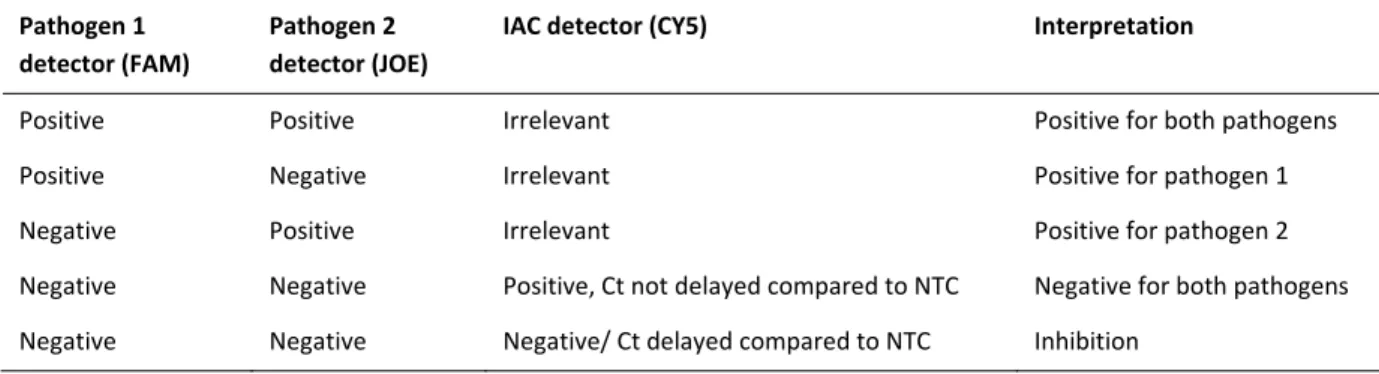
The interpretation of the results to determine the presence/absence of two distinct pathogens in the same sample
when using a three‐fluorophore‐based system is summarized in Table 2. As commented above, high initial
amounts of target DNA (of one or both pathogens) in positive samples may cause a bias in the amplification
reaction favoring the pathogen detection against the amplification of the IAC. Thus, a sample will be considered
negative (absence of both pathogens) only when FAM and JOE signals are negative but the CY5 signal is positive
and not delayed with respect to the NTC. Samples without a positive signal of FAM, JOE and CY5 (or with a CY5 signal delayed with respect to the NTC) will be considered to be inhibited.
Table 2. Results interpretation for 3 fluorophore‐based Microbial detection systems
Pathogen 1 detector (FAM)
Pathogen 2 detector (JOE)
IAC detector (CY5) Interpretation
Positive Positive Irrelevant Positive for both pathogens
Positive Negative Irrelevant Positive for pathogen 1
Negative Positive Irrelevant Positive for pathogen 2
Negative Negative Positive, Ct not delayed compared to NTC Negative for both pathogens
Negative Negative Negative/ Ct delayed compared to NTC Inhibition
Results interpretation guide
5.
DETECTION
SYSTEMS
WITH
SYBRGREEN
Microbial’s Legionella spp. detection system (Legiofast) is based on the use of the SYBRGreen dye, which emits
fluorescence when it is attached to double stranded DNA. Using Legiofast® SPECIES is a single amplification curve
that integrates both the IAC and the pathogen DNA signals (Figure 9).
Legionella106
Legionella104
NTC
Threshold
AMPLIFICATION PLOT
Figure 9. Amplification plot with SYBRGreen, where the amplification of the NTC appears later than the amplification of samples
with 106 and 104 copies of the pathogen.
In this case, target DNA amplification is distinguished from IAC DNA amplification by means of a dissociation curve,
performed by continuous reading of the fluorescence while gradually increasing the temperature until complete
DNA denaturation is achieved. As a result, the dissociation plot will contain as many peaks as different DNA
fragments are produced during the PCR. This process also allows the analysis of the Tm (melting temperature) of
each of the originated DNA fragments, which is greater for the pathogen than for the IAC peak since its
amplification product is longer (Figure 10). Reference Tm values for the IAC and the pathogen should be
determined in NTC and positive control reactions respectively.
Summarizing, the dissociation curve reveals whether the obtained signal corresponds to the pathogen, the IAC, or
both. In negative samples, only the peak corresponding to IAC is expected, whereas in positive samples both peaks
(pathogen and IAC) should appear, although the IAC peak could disappear when high initial amounts of pathogen
template DNA are present. Inhibition of the PCR reaction will be considered to occur when no signal is detected in the amplification plot or when it shows a Ct clearly delayed compared to the NTC.
If none of the peaks corresponding to the IAC or the pathogen appear in the dissociation plot, the analysis will be considered not conclusive, even if a positive signal is detected in the amplification plot. Peaks other than those of the pathogen or the IAC in the dissociation plot will not be taken into account in the interpretation of the results.
Legio 10
6Legio 10
4NTC
Legionella
IAC
DISSOCIATION
PLOT
Figure 10. Dissociation plot of samples with 106 and 104 copies of pathogen target gene. Two peaks are shown: the peak at greater
temperature corresponds to the pathogen, and the other at lower temperature corresponds to the IAC. On the contrary, the NTC
displays only one peak corresponding to the IAC.
The interpretation of the results to determine the presence/absence of the pathogen is summarized in Table 3.
Table 3. Results interpretation for SYBRGreen‐based Microbial detection systems
Amplification Curve Dissociation Curve Interpretation
Positive Pathogen + IAC peaks Positive sample
Positive Pathogen peak Positive sample (biased PCR)
Positive, CT not delayed compared to NTC IAC peak Negative sample
Negative/ Ct delayed compared to NTC Irrelevant Inhibited sample
Results interpretation guide
6.
QUANTIFICATION
BY
REAL
TIME
PCR
Real time PCR allows the quantification of samples, which means to determine the number of copies of the target
gene present in a given sample. To use this application of the technique a standard curve is needed, which can be
simply built with serial 10‐fold dilutions of a sample of known concentration of pathogen DNA (i.e. using the
Microbial PCR Quantification Standard or a purified, quantified solution of genomic DNA from the pathogen). In
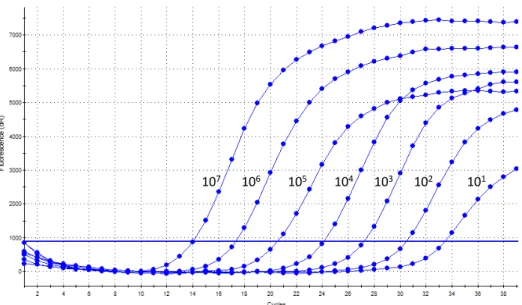
the amplification plot of the serial dilution of a DNA solution, the Ct value is inversely proportional to the initial
template DNA concentration (Figure 11).
107 106 105 104 103 102 101
Figure 11. Amplification plot of a 10‐fold serial dilution with a range from 107 to 101 copies of the target gene. Note that final
fluorescence is not always proportional to the initial amount of template DNA. In contrast, the Ct values are always inversely
proportional to the initial number of target genes in the sample.
The Ct values can be plotted against the DNA concentration (usually as gene copies/µl) in logarithmic scale (Figure
12). Then, the initial number of copies of the target gene in an unknown sample can be obtained by interpolating its Ct value to the standard curve equation. It should be taken into account that, according to the quantification
system used, the number of gene copies is equivalent to the number of pathogenic bacteria only when single copy
genes are used as targets (all Microbial kits are based on single copy genes except Legiofast® SPECIES). It should be noticed that the result of the quantification of an unknown sample might also depend on the efficiency of the DNA
extraction.
107
106
105
104
103
102
101 Figure 12. Standard curve
showing the Ct values in relation
to the concentration of initial
target gene copies, obtained by a
serial 10‐fold dilution of a sample
containing 107 copies/µl of the
target gene. By the interpolation
in the standard curve of the Ct of
an unknown sample it is possible
to calculate the number of copies
7.
CONTAMINATION
OF
REAL
TIME
PCR
Contamination of real time PCR is detected when the pathogen signal crosses the threshold line in NTC or, in the
case of detection systems based on SYBRGreen, when the peak corresponding to the pathogen appears in the
dissociation plot in NTC. The presence of contamination invalidates the obtained results, since it makes impossible
to distinguish a true positive result from a positive result caused by contamination. Then, the analysis should be
repeated taking all the possible measures to avoid new contamination incidences.
Because of the great sensitivity of the PCR technique, it is not uncommon that some negative samples or NTC cross
the threshold line beyond cycle 35 (Figure 13). This weak signal may correspond to a small contamination caused
by target DNA aerosols produced while preparing the PCR plate, or also to a minimum presence of the pathogen in
the sample. If it is considered that this weak signal is due to a contamination effect of little importance, the head of the laboratory, always on its own responsibility, may decide that this does not affect the results and therefore,
consider the analysis valid. Nevertheless, in case of doubt, the analysis should be repeated improving, if possible,
the preparation of the sample and the loading of the PCR with the extracted DNA.
Positive sample
Positive sample ?
Positive sample ? NTC
Figure 13. Amplification plot showing a clear positive sample and two doubtful samples which, together with the NTC, cross the
threshold between cycles 35 and 38. It is not possible to ascertain whether these samples are really positive or if they are caused
by a weak aerosol contamination. In the case of NTC it is obvious that the positive signal is caused by aerosol contamination, since
it is not expected to contain target DNA. It is important to be aware of the fact that the effect of this weak contamination is
negligible in clearly positive samples.
Results interpretation guide
8.
ATYPICAL
AMPLIFICATION
CURVES
Occasionally, atypical amplification curves may be obtained. This might happen if the extracted DNA contains
substances that alter the fluorescence emission by the fluorophore dyes or the fluorescence detection by the
thermocycler. Some atypical curves may also be caused by a wrong configuration of the reading system of the
thermocycler. Any curve that does not present the three phases previously described in Figure 1 must be discarded
and the sample should be analyzed again. Figure 14 shows two examples of atypical amplification curves.
A
Positive sample
IAC Positive samples ?
Figura 14. Curve with a double plateau
shape (A) and curve with a roller
coaster shape which crosses the
threshold several times (B).
B
Positive sample
IAC Positive samples ?
Legal Note
The present guide is intended only for the users of Microbial products. Microbial declines any responsibility derived from an incorrect use of
this guide, or from the application of this guide to kits and/or detectors from other manufacturers. The figures presented in this document have
been obtained with an Mx3005P thermocycler (Stratagene), so they can be different from those obtained by the same detectors in other
platforms. The guidelines presented in this document are only informative, and are not intended to create binding or legal obligations on
Microbial S.L.
© Microbial S.L.
Parc Científic de la UdG
Edifici J. Casademont, E
C/ Pic de Peguera, 15
E‐ 17003 Girona
Tel. 972 183236
Fax. 972 183256
http://www.microbial‐systems.com
info@microbial‐systems.com