0
•
->
><
..
w
w
EUROPEAN COMMISSION
DIRECTORATE GENERAL XV Internal Market and Financial Services General matters and coordination
External dimension of the internal market and financial services
INDONESIA
Brussels, 5 April 1995 Ref: PHP - worknote\tcrindo · XV.A.2
0 Rue de la Loi 200, B-1049 Brussels, Belgium - Office: C107 - 8/47.
Introduction
GDP measured in current prices reached 298 trn. rupiahs (IRD) in 1993 (125.5 bn ECUI).
With a population of 189 million inhabitants, GDP per capita amounted to 1.53 mn. IRD (664 ECU). Real GDP growth in 1993 was 4.5%.
CREDIT INSTITUTIONS
A package of deregulation measures was passed in the financial sector in late 1988. This led to a significant expansion of bank credit as well as a mobilisation of deposits and an increase in the number of bank offices. On the other hand, a large number of speculative loans have since failed, primarily in the areas of real estate and share dealing.
A comprehensive set of banking supervisory guidelines was therefore passed in February I
1991, aimed at improving the soundness and efficiency of the Indonesian banking system. These regulations included a phase-in adoption of international capital adequacy standards recommended by the Bank for International Settlements. This required the banks to increase their capital to risk-weighted assets to 8%. Initially set for the end of 1993, the target date has been delayed to December 1994, though at that time only 10%
of the banks were unable to meet the
8%
target.The banking sector continued a process of consolidation in 1993. In an effort to simplify the market~ the Banking Act of 1992 decreed that only two categories of banks are allowed to operate: commercial banks and people's credit banks. The only functional distinction remaining is between those banks that offer cheque accounts and much smaller ones that do not. Non-bank financial institutions (which engaged in the merchant banking, securities aqd lending business). had to dissolve themselves within a year of the implementation of the act. Each non-bank institution, most of which foreign jciint-ventures, had the option of transforming itself into a securities firm or a joint-venture bank, or of splitting into one of each.
In 1993, there were 234 banks and 5838 branches in Indonesia.
Indonesian banks tend to be classified according to their ownership structure: state banks, private banks and foreign banks.
The banking sector is dominated by the seven state commercial banks. Despite a significant fall of their market share between 1989 and 1993, the state banks still controlled 52. 7 % of all outstanding credits at the end of 1993 ( compared to 65% in 1989).
l Exchange rates:
3 Indonesia
Private
commercial banks have been at the origin of mostof
the expansion of the banking system since 1988, with 95 new private domestic banks being established within the last five years. Indonesian private banks are commonly part of a corporate family of companies and constitute an important means for the group to raise finance. The failure of one such medium-sized privat bank in May 1993 triggered another spate of reforms. Recognizing the danger of such intragroup overlending, the new rules call for a reduction in the maximum percentage of bank capital that can be lent to customers within a single group. The current 50% maximum will apply to existing lending until the end of December 1995, when the limit will fall to 35%. The maximum will decline to 20% from the end of March 1997. The maximum for lending to a single customer will remain unchanged, at 20%.Indeed, lending has not always been sound, and there continue to be many non-performirtg assets in bank portfolios. This is a problem from which the banking sector is only beginning to recover. By October 1993, according to government estimates, 15% of Indonesia's outstanding loans were considered non-performing and 3 .5% bad.
Indonesian interest rates remain among the highest in the region. The spread between deposit and lending rates can be as much as ten percentage points, as banks strain to cover non-performing loans and strenghten their capital-adequacy ratios. Bank Indonesia, the central bank, has attempted to force interest rates lower by reducing . rates on its certificates. But most banks have not been persuaded to follow.
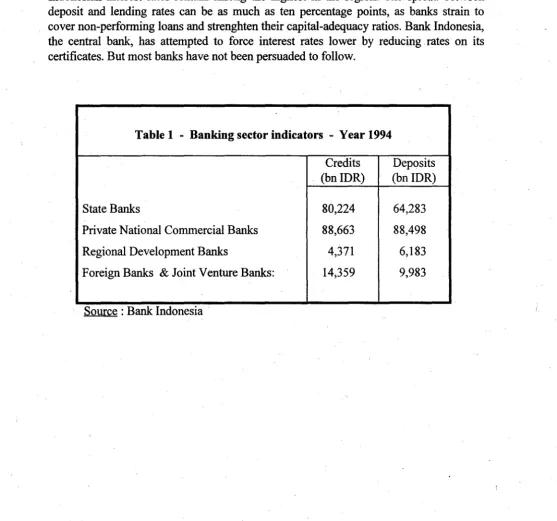
Table 1 - Banking sector indicators - Year 1994
Credits Deposits
(bnlDR) (bn IDR)
State Banks 80,224 64,283
Private National Commercial Banks 88,663 88,498
Regional Development Banks 4,371 6,183
Foreign Banks & Joint Venture Banks: 14;359 9,983
[image:3.599.21.578.340.861.2]Foreign Presence
Foreign banks and joint-venture banks have kept pace with the expanding sector. A total of 39 foreign banks are present in Indonesia.
11 foreign banks hold branches in Jakarta, three of which have their headquarters in EC countries. The three European banks, like some other foreign banks, have subbranches in the city of Surabaya. A total of 29 joint venture banks have been formed in Indonesia since 1988, nine of them associate a European partner.
Out of the 168,947 bn Rp in total time and savings deposits held by the Indonesiru:i banking system at end of 1994, 9,983 bn Rp (5,9%) were deposited with foreign and joint-venture banks. Foreign banks recorded credits of 14,359 bn Rp (i.e. 7,6% of all banks' credits of 187,617 bn Rp ).
MARKET ACCESS PROBLEMS FACED BY EU BANKS
Establishment
A restrictive policy of granting banking licences to foreign banks is pursued in Indonesia. The 1988 reform measures however permitted entry of new foreign banks through establishment of joint ventures with local banks. In such case, the maximum share of foreign ownership is 85% of the paid-up capital. Indonesia examines closely whether Indonesian banks receive reciprocal treatment in the bank's country of origin. Reciprocity is also an important consideration in permitting foreign ownership of finance companies. Furthermore, branches of foreign banks and joint venture banks are only allowed to open new sub-branches in Jakarta and seven other cities (Medan, Bandung, Surabaya, Batam, Denpasar, Semarang and Unjung Pandang) and only one office for each location is permitted.
Although foreigners may acquire stock in Indonesian banks listed on the stock exchange, they may not gain a controlling interest (maximum ceiling 49%).
Branches are no longer aHowed as a mode of entry.
Activity
Foreign banks are required to restrict most of their lending to export-related business; at least 50% of their activity has to be committed to export trade financing.
5 Indonesia
"Indonesianisation" of the economy will touch banking as well as insurance: the current policy line is to reduce existing foreign participation in joint-ventures from its current level (80/85%) to the legal ceiling of 49%. However, unlike in non-financial areas, no
/ calendar has been set for effective divestment in the financial sector.
Community credit institutions have ~so drawn attention to the fact that interest payments made to banks or other financial institutions located abroad are subject to taxation at
source of up t~ 20%. ·
INSURANCE
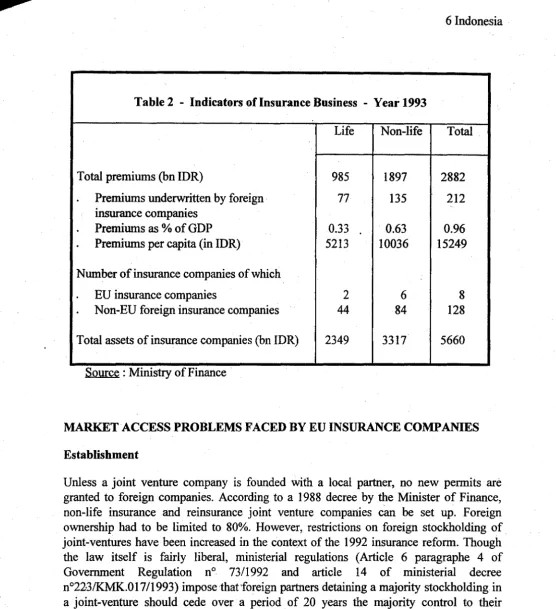
The insurance industry has grown steadily after the sector was deregulated in December 1988. As reflected by the increase in the number of companies and total assets, insurance activity expanded significantly since 1990. The number of insurance companies rose from 130 at the end of 1990 to 142 at the end of 1993, comprising 46 life insurance, 5 social insurance, 90 indemnity· insurance, and 4 reinsurance companies. The total assets of insurance companies ( excluding social insurance) reached 5,666 bn Rp at the end of
1993, which constituted an average 27% yearly increase compared to end of 1990. Of total assets, non-life insurance companies held 3,317 bn Rp (58.5% ), while life insurers .counted with 2,349bn Rp (41.5%).
Foreign presence
Table 2 - Indicators of Insurance Business - Year 1993
Life Non-life Total
Total premiums (bn IDR) 985 1897 2882
.
Premiums underwritten by foreign 77 135 212insurance companies
.
Premiums as % of GDP 0.33 0.63 0.96.
Premiums per capita (in IDR) 5213 10036 15249Number of insurance companies of which
EU insurance companies 2 6 8
Non-EU foreign insurance companies 44 84 128
Total assets of insurance companies (bn IDR) 2349 3317 5660
Source :
Ministry of FinanceMARKETACCESS PROBLEMS FACED BY EU INSURANCE COMPANIES
Establishment
Unless a joint venture company is founded with a local partner, no new permits are granted to foreign companies. According to a 1988 decree by the Minister of Finance, non-life insurance and reinsurance joint venture companies can be set up. Foreign ownership had to be limited to 80%. However, restrictions on foreign stockholding of . joint-ventures have been increased in the context of the 1992 insurance reform. Though
the law itself is fairly liberal, ministerial regulations (Article 6 paragraphe 4 of
Government Regulation n° 73/1992 and article 14 of ministerial decree
n°22-3/KMK.O 17 /1993) impose that foreign partners detaining a majority stockholding in a joint-venture should cede over a period of 20 years the majority control to their Indonesian partners.
[image:6.600.6.562.31.640.2]7 Indonesia
Activity
75% of reinsurance business has to be placed in the country itself. Government property may only be insured by state insurance companies or local companies.
Community insurance institutions have also drawn the attention to the following:
There is a ban on US Dollar denominated insurance policies. Government regulations require 75% of a life insurance company's outstanding premiums to be invested inside Indonesia. Insurance joint ventures must keep most of their reserves in the form of bank deposits, therefore being particularly affected by the 35% tax on interest paid on bank deposits.
In practice, foreign companies cannot provide credit insurances on credits issue~ by state-owned banks. However, they can act as re-insurers in this respect.
In the context of the new tax regulation entered into force in January 1995, .payments of insurance and reinsurance premiums to foreign insurance companies are subject to a 20% tax deduction on the estimated net income. The estimated net income of the policy holder amounts to around 50% of the premiums paid to a foreign insurance firm and the estimated net income of the insurance firm is 10% of premiums piad to , a foreign insurance companies (5% for a foreign re-insurance company).
SECURITIES
Stock and bond financing has expanded greatly since the 1988 deregulation of the capital markets. Factors contributing to this development were the permission given to foreign investors to buy stocks listed in the stock exchange as well as the imposition of income tax on interest earned from time and savings deposits.
Capital market supervision is carried out by an agency of the Ministry of Finance. The
Capital Markets Executive Board, or Bapepam, supervises the exchange. It is modeled
after the US Securities and Exchange Commission. Bapepam's approach is to ensure that the market is developed with strong foundations. In the 1993 · boom, it had placed a ceiling on price-earnings multiples at initial public listings as a means of protecting investors from overly inflated forecasts and consequent drop in share price thereafter. This ratio was set at 15 at March 1994.
The Jakarta Stock Exchange (JSE) was privatised in 1992 and management handed over to Bursa Efek Jakarta, a company owned by exchange members. The exchange is engaged in an overhaul of technical procedures such as settlement, clearing and real-time screen information to improve the exchange's attractiveness, especially to foreign investors. The JSE continues to work on regulations aimed at protecting minority investors, improving accounting and disclosure requirements and increasing market liquidity.
From just 24 listings and little trading in 1988, the stock exchange blossomed to include 173 listed companies and total capitalization of more than $3 8 billion by the end of 1993.
This compares with 153 listed companies with a total market capitalization of $12 billion at the end of 1992. Average trading volume more than doubled, from $16m a day in 1992 to over $30m in 1993. 70 percent of the trading is driven by foreign investors (mainly mutual funds and pension funds), although foreign ownership of shares listed on the JSE is limited to a ceiling of 49%. About a third of foreign investors are Americans, a third European, and a third from the Asia-Pacific region .
. There were 19. new listings in 1993 compared with 14 in 1992. Rights issues w~re made by 26 companies. Total equity financing raised in 1993 came to about $1.75 billion. The JSE expects a lot from the privatization of major state-owned companies for its
development in future years. However, it remains to be seen whether these companies
will be floated on the local stock market. or abroad. Recently, Indosat, the large
state-owned telecommunications company went to the New York Stock Exchange for its privatisation.
Bonds are now a common means of raising funds through the local capital market. Bonds must be traded through the stock market even if the company shares are not listed. Since 1992 bonds have been much more attractive to investors because of declining time deposit rates. New laws that allow pension funds and insurance companies to diversify their investments have created greater interest in the bond market. There are no restrictions on foreign ownership of debt instruments. Foreigners are being drawn by yields as high as 19%, surpassing banks' long-term deposits of 15%. However, the secondary market for bond is still weak.
Table 3 - Securities Market Indicators - Jakarta Stock Exchange
1992 1993
Turnover in equity shares (IDR bn) 7909 19086
Turnover as % of GDP 2.6 6.4
Capitalisation equity shares (MYR bn) 24839 103835
Number of listed companies 155 217
· Source : FIBV and Jakarta Stock Exchange
MARKET ACCESS PROBLEMS FACED BY EU SECURITIES FIRMS
Foreign investment in the securities business is only possible by establishing a joint venture with foreign participation of less than 85%. The minimum paid-up capital of
national underwriters is 5 billion Rp; for brokerages, traders and investment managers the
[image:8.600.36.570.279.785.2]