.. c::,
..
...>
-)( .
..
14,.1·=-DIRECTORATE GENERAL XV Internal Market and Financial Services
General matters and coordination, free movement of persons and direct taxation External dimension of the internal market and financial services
ARGENTINA
Brussels, 12 June 1995
Ref: Nigg- jv\tcr\argentin
r I
I I . I I:
5%. With a population of 33.5 mn this represented 7,622 pesos per capita (ECU 6,850).
Overview
In 1991, the· Argentine government began to pursue a clear policy of stabilisation of the economy and launched the Convertibility Plan, which included setting a fixed exchange rate with the US dollar coupled with 100% complete backing in reserves. The success of the Convertibility Plan has been underwritten by sufficient capital inflows mitigating the effects of an increasingly overvalued peso.
In 1992, Argentina joined The Brady Plan which signalled its return to the international financial community. Since 1991, the overall economy has significantly strengthened both in the private and public sectors.
CREDIT INSTITUTIONS
Argentina has made considerable efforts to restore international confidence in its banking ·. industry following the pyriod of economic mis-management in the 1980's. The Central Bank adopted appropriate prudential requirements including revised minimum capital requirements which exceed Basle recommendations in some instances.
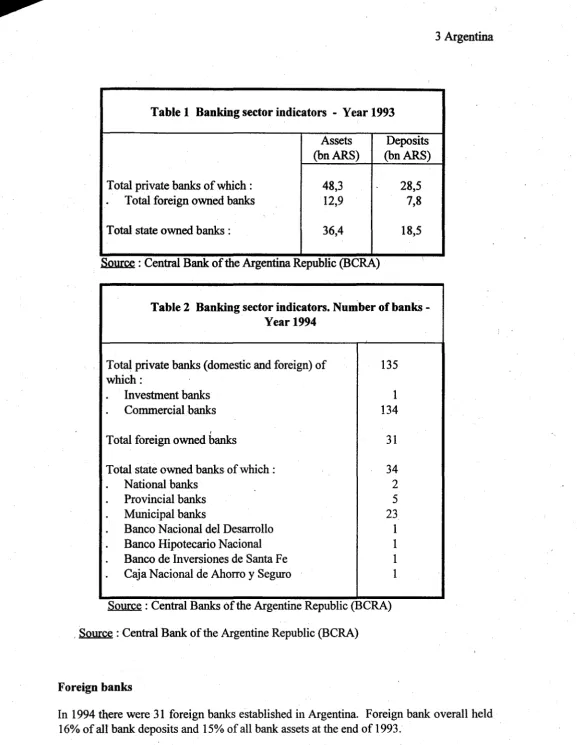
Forty-six percent of deposits in Argentina are held by the public sector banks. These are heavily regulated vis-a-vis the private sector banks which remain relatively modest in size, with an average share of deposits of around 6%. · Public sector banks enjoy significant advantages in the form of exclusive rights to public sector deposits as well as the right to administer public funds.
The market structure in Argentina is concentrated, as can be seen in the statistic that 40% of deposits are held by three public sector banks. The total number of banks in Argentina is 169.
The result of the government's policy on re-negotiation and normalisation of its external debt, combined with privatisations, have resulted in a structural fiscal surplus of the consolidated public sector, although considerable provincial debt remains. The public sector has therefore ceased to be a major user of new credit.
Exchange rates :
Table 1 Banking sector indicators - Year 1993
Assets Deposits
(bnARS) (bnARS)
Total private banks of which: 48,3 28,5
.
Total foreign owned banks 12,9 7,8Total state owned banks : 36,4 18,5
Source :
Central Bank of the Argentina Republic (BCRA)Table 2 Banking sector indicators. Number of banks -Year 1994
Total private banks (domestic and foreign) of 135 which:
.
Investment banks 1.
Commercial banks 134I
Total foreign owned banks 31
Total state owned banks of which: 34
.
National banks 2Provincial banks 5
Municipal banks 23
.
Banco Nacional del Desarrollo 1.
Banco Hipotecario Nacional 1.
Banco de Inversiones de Santa Fe 1Caja Nacional de Ahorro y Seguro 1
Source: Central Banks of the Argentine Republic (BCRA)
, Source : Central Bank of the Argentine Republic (BCRA)
Foreign banks
[image:3.596.13.590.17.762.2]..
I Establishment
In 1994, the Argentine Central Bank reversed a ten year policy-and withdrew the ban on
issuing new bank licenses. In addition, the legal differences between domestic and foreign banks were eliminated, allowing foreign banks to set up either branches or subsidiaries. No legal restrictions subsist, since 1994, in respect of establishment, branching or acquisitions of foreign banks.
Activity
Lending transactions are limite~ for prudential reasons, to the capital of Argentinean branch but ther~ are no restrictions other than prudential on foreign banks on funding activities or their introduction of new financial products.
Once established in Argentina, a foreign bank becomes eligible to apply to the Central Bank to open branches in other parts of the country.
The overall effect of the changes has allowed greater competition to be introduced into the market notwithstanding a high level of concentration. Most EU owned or controlled credit institutions report that the conditions for operation in Argentina allow administrative and management flexibility and are generally fair and transparent, but note nonetheless that the public sector banks· enjoy privileges and rights not available to · private sector banks.
INSURANCE
Introduction
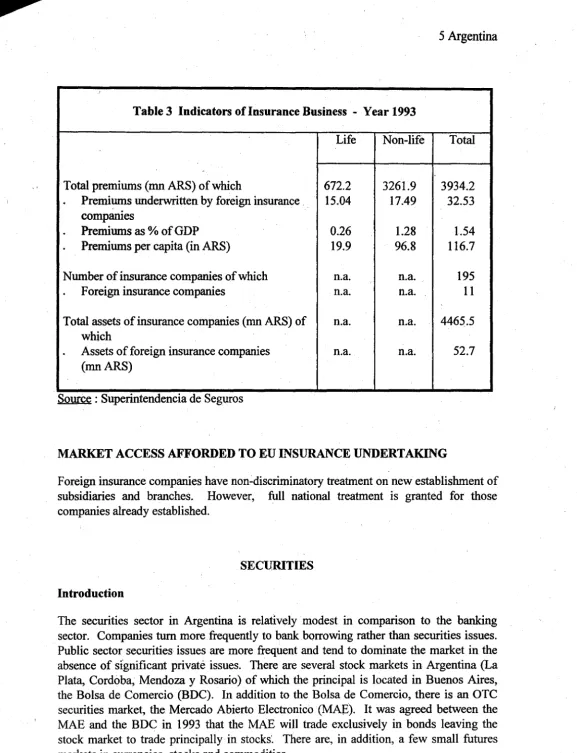
Table 3 Indicators of Insurance Business - Year 1993
Life Non-life Total
-Total premiums (mn ARS) of which 672.2 3261.9 3934.2
.
Premiums underwritten by foreign in~urance 15.04 17.49 32.53 companies.
Premiums as% of GDP 0.26 1.28 1.54.
Premiums per capita (in ARS) 19.9 96.8 116.7Number of insurance companies of which n.a. n.a. 195
.
Foreign insurance companies .n.a. n.a . 11Total assets of insurance companies (mn ARS) of n.a. n.a. 4465.5 which
Assets of foreign insurance companies n.a. n.a. 52.7
(mnARS)
Source : Superintendencia de Seguros
MARKET ACCESS AFFORDED TO EU INSURANCE UNDERTAKING
Foreign insurance companies have non~discriminatory treatment on new establishment of subsidiaries and branches. However, full national treatment is granted for those companies already established.
SECURITIES Introduction
[image:5.601.12.589.19.772.2]MARKET ACCESS AFFORDED TO EU INVESTMENT FIRMS
In 1994, there were 197 licensed brokerage houses and securities firms.
[image:6.594.17.594.31.618.2]Foreign investors may purchase shares in firms quoted on the stock exchange without prior government approval and with no limits on volume.
Table 4 Securities Market Indicators. Buenos Aires Stock Market ·
1992 1993
Turriover in equity sliares (ARS bn) 15.7 49.6
Turnover as % of GDP 6.9 19.4
Capitalisation equity shares (ARS bn) 18.6 43.9
Number of listed companies 170 165
Source : FIBV
Establishment
In the evolving markets of bond issuance, mutual funds and pension fund management, there are no restrictions on acc~ss ; no distinction is drawn between domestic and foreign firms.
Activity
In bonds, the Argentine market is dominated by public sector securities. The 1993 applications for corporate bonds totalled $427.8 million from 19 companies. Argentina places no restrictions on the bonds which may be sold or underwritten.
.
"I'
.
\.
'! '
\ '
'. ~
" \
[;