University of Florida Levin College of Law University of Florida Levin College of Law
UF Law Scholarship Repository
UF Law Scholarship Repository
UF Law Faculty Publications Faculty Scholarship
2019
Disrupting the Wealth Gap Cycles: An Empirical Study of Testacy
Disrupting the Wealth Gap Cycles: An Empirical Study of Testacy
and Wealth
and Wealth
Danaya C. Wright
University of Florida Levin College of Law, [email protected]
Follow this and additional works at: https://scholarship.law.ufl.edu/facultypub
Part of the Estates and Trusts Commons
Recommended Citation Recommended Citation
Danaya C. Wright, Disrupting the Wealth Gap Cycles: An Empirical Study of Testacy and Wealth, 2019 Wis. L. Rev. 295 (2019)
This Article is brought to you for free and open access by the Faculty Scholarship at UF Law Scholarship
Repository. It has been accepted for inclusion in UF Law Faculty Publications by an authorized administrator of UF Law Scholarship Repository. For more information, please contact [email protected].
EMPIRICAL STUDY OF TESTACY AND WEALTH
DANAYA C. WRIGHT*
Introduction
...
295
I.
Effect of Succession Law on Wealth Accumulation... 298
H.
The Widening Wealth Gaps and the Importance of
Intergenerational Transmission of Property ...
... 301
III.
Alachua County Probate Records and Wealth...
... 304
IV.
Findings: Intestacy Correlates Across All Demographic
Categories to Less Wealth...
308
A . A ge...
308
B . R ace...
311
C . Sex ...
3 15
D . M arital Status
...
320
C onclusion
... 322
INTRODUCTIONWhen many of us think about the wealthy, we assume that they
have inherited wealth, trust funds, or at least a history of knowing the
right people. There are always a few stories of the hard-working
immigrants who pulled themselves up by their bootstraps, as well as the
spendthrift scions of wealthy families who manage to squander vast
riches in a remarkably short period of time. But we rarely hear about
the vast numbers of modest and obscure families that grow wealth
carefully from generation to generation, keeping their wealth and their
family skeletons away from the spotlight. How those families grow and
maintain their wealth is through judicious use of tax mechanisms to
minimize income and estate taxes, judicious use of trusts to reduce
squandering wealth by irresponsible children and grandchildren, and
* Clarence J. TeSelle Professor of Law, University of Florida Levin
College of Law. I would like to thank Carla Spivak and the rest of the critical trusts and estates scholars who participated in the third biannual Race, Class, and Gender Meets Wills and Trusts. I would also like to thank the bevy of Wisconsin Law Review students
who organized this conference, edited and provided cite-checking for this Article, and for their kind hospitality at the Wisconsin Law Review Annual Conference. I would also like to thank Howard Erlanger for encouraging me as a junior scholar to work in trusts and estates, and to the faculty and dean of the University of Florida Levin College of Law for their support of my research.
WISCONSIN LAW REVIEW
through estate plans that channel property to those who will protect it, use it wisely, and pass it on in ways that maintain the wealth.'
In early-modem England, estate planning was usually done earlier than we do it today, when children were young enough to be influenced and when parents had a good sense of their children's personalities.2
It was done when the patriarch had sons about to marry and he could convince them to accept limitations on family property in exchange for access to income immediately to allow him to start a family. When the son's children came of marrying age, the hope was that he would have imbibed the spirit of protecting the family property and would willingly accept continued constraints, impose them on his children and, if everyone played along, the family dynasty would be protected through a strict settlement renegotiated at each generation.' The use of trusts and conservative trustees was crucial to keep wayward family members in line by denying them access to income if they bucked the system.
1. Income taxes can be reduced by transferring a portion of income-earning property during life, or to trusts, and estate taxes can be reduced by using trusts to skip generations or limit access to trust principal to take advantage of tax credits and deductions. See, for example, Iris J. Goodwin, How the Rich Stay Rich: Using a
Family Trust Company to Secure a Family Fortune, 40 SETON HALL L. REv. 467
(2010); Steve R. Akers, Sophisticated Transfer Planning Strategies and Update
Regarding Use of FLPs and LLCs in Transfer Planning, ALI-CLE COURSE MATERIALS,
SX007 ALI-CLE 1037 (2015); Robert G. Alexander & Dallas E. Klemmer, Creative
Wealth Planning with Grantor Trusts, Family Limited Partnerships, and Family Limited Liability Companies, 2 EST. PLAN. & COMMUNITY PROP. L.J. 307 (2010) all discussing complex ways to protect wealth through a variety of legal mechanisms.
2. See generally Danaya C. Wright, Inheritance Equity: Reforming the Inheritance Penalties Facing Children in Nontraditional Families, 25 CORNELL J.L. &
PUB. POL'Y 1, 3-4 (2015); EILEEN SPRING, LAW, LAND AND FAMILY: ARISTOCRATIC
INHERITANCE IN ENGLAND, 1300 TO 1800 at 124-30 (1993).
3. The typical strict settlement used by the landed classes involved estate planning when children were about to marry. SPRING, supra note 2, at 129, 132. A father (for it was almost always the patriarch) would transfer income-producing land into trust, with the income payable to himself for life, then to his eldest son for life, then the remainder out of trust to his eldest grandson or the heirs of his body, with various provisions to pay dower to his widowed mother, his wife when he dies, and his daughter-in-law when his son dies. Id. at 133-35. When the father dies, the son likely would be middle-aged with children of his own. The son would continue to receive the income off the land, but at his death his own son would take the estate outright in fee simple ownership. Id. at 124-25. Thus, when the grandson was about to marry, the son and grandson would agree to put the land back into a new trust, with the son now in the position of the father, the grandson in the position of the son, and the grandson's children entitled to the remainder. Id. at 135-37. The grandson would agree to this because it was often better to receive income immediately to permit him to marry, and in the flush of young love he would be willing to tie the property up again for his children and heirs, rather than wait perhaps many decades for his father to die and for him to take the property outright. Id. at 126-27. Provisions would also be made for younger sons, daughters, and various widows to prevent them from destitution. See id. at 124-30.
For those in Jane Austen's day, estate planning came at mid-life, when new families were being formed. In our day, estate planning comes at the end of life, as each generation usually hangs on to property, especially earned wealth, perhaps to lord it over neglectful children, but more often because the best way to deal with the uncertainty of the future is to retain control as long as possible. But hanging on to property until the end puts the owner at risk that he will die without making appropriate plans and his estate will be dissipated through family squabbles, probate delays and expenses, and that dreaded of all wealth-destructors: the estate tax.
The common denominator for most people who want to grow and protect wealth has been capable estate planning, planning that provides
adequate resources for the current generation, protects the principal for the future, and provides flexibility so that each generation gets what it needs without constraining the property too severely. The trust is the most common mechanism for preserving wealth, but it is not the only mechanism. Life estates, pre-nuptial contracts, powers of appointment, and joint tenancies have provided ways to protect assets while providing for basic needs of future generations. More recently, living and asset-protection trusts, beneficiary designations, and TOD real-estate deeds have made estate planning even easier for the wealthy and the not-so-wealthy alike.
This panoply of estate planning options, however, seems to have passed by many who could really benefit from it. The person of modest wealth who dies without.any estate planning risks having her property be dissipated to pay for guardianships, probate, and shares for heirs, regardless of their need or ability to manage property. Those who die young, before they have amassed much wealth, and those who die without proper estate planning will often leave little for their dependents, heirs who themselves will suffer from lack of investment in human capital by their parents and grandparents, thus leaving them less likely to earn significant wealth and less likely to have sufficient wealth to pass on to the next generation. The cycle of wealth-building by those who already have wealth is enhanced by probate and tax laws, while the cycle of wealth-destruction is perpetuated by administration costs, onerous legal requirements, and everyday inequalities.' While many structural factors may contribute to the dissipation of wealth by some and the accumulation of wealth by others, one factor that seems to correlate closely to the various wealth gaps is dying intestate and having one's property pass by the default statutory rules of intestate succession, and dying testate and having one's property pass according
4. Alexander & Klemmer, supra note 1, at 310-11; Beverly Moran & Stephanie M. Wildman, Race and Wealth Disparity: The Role of Law and the Legal
WISCONSIN LAW REVIEW
to the wealth-saving mechanisms and procedures of planned wills and will-substitutes.'
In an empirical study of all decedents dying in 2013 in Alachua County, Florida whose estates were probated, either testate or intestate, the data show striking correlations between intestacy and lower wealth, and testacy and greater wealth.' And the demographics of those who died intestate correspond to the demographics of those people at risk of falling into the cycle of wealth-dissipation. To explore the possible effects of intestacy and testacy on wealth and property succession, I analyzed 408 estates (293 testate and 115 intestate) across a variety of categories, including wealth, age, race, sex, and marital status. All of these lines of inquiry support the claims by many economists that wealth gaps between men and women, white and black, or married and unmarried couples are growing and should be of great concern to lawmakers. This study supports those claims and ends by calling for more focus on how to bring estate planning services to the populations most vulnerable to dying intestate.
I. EFFECT OF SUCCESSION LAW ON WEALTH ACCUMULATION Dying intestate rather than testate can have drastic consequences for some estates. Under the default rules of intestate succession in all states, the principal heirs are a surviving spouse and/or the children.' Sometimes the spouse and children share at a decedent's death; at other times the spouse takes it all, with the assumption that at the spouse's death the property will then pass equally to the children. Although this sounds like a perfectly natural estate plan, there are numerous obstacles that can make the succession of the property more costly.
First, if both spouses die intestate, a portion of both spouses' estates might pass to step-children if the survivor remarries and then dies leaving the new spouse as his or her legal heir.' With the rate of blended families these days, it is almost malpractice to not suggest a comprehensive estate plan that will protect the property of the first spouse to die from passing away from the children because of the survivor's remarriage.' If property passes outside the family altogether because of remarriage, the next generation essentially starts well behind
5. Palma Joy Strand, Inheriting Inequality: Wealth, Race, and the Laws of
Succession, 89 OR. L. REv. 453, 465, 495-96 (2010).
6. See infra Part III.
7. Erez Aloni, The Marital Wealth Gap, 93 WASH. L. REv. 1, 41 (2018). 8. See UNIF. PROBATE CODE §§ 2-101(a) & 2-102(l)(A) (1990).
9. According to the Pew Research Center, fewer than 50% of children are being raised in first marriage families. Parenting in America, Pew Res. Ctr. (Dec. 17,
2015), http://www.pewsocialtrends.org/2015/12/17/1-the-american-family-today/
[https://perma.ccl5CM3-U5HW].
298
the children of single-marriage families in the cycle of wealth accumulation.
Second, fractionation of real property can result in forced sales and ultimate dissipation of real property wealth when it passes to multiple legal heirs in tenancy in common.'0
If a decedent's main source of
wealth is the family home, and he dies intestate and his three children take the home equally, any one child can force a partition which likely will result in a sale. Sales of real property come with realtor and closing fees as well as the likelihood that the smaller cash bequests will be dissipated by the heirs more quickly than a real property bequest would. Not wanting to treat the children unequally, even many testate decedents ordered sales of all real property and equal division among children. While this may sound fair, such a direction precludes the flexibility to consider the state of the real estate market, the economic needs of beneficiaries, or other facts that militate against selling assets at a particular time. If the family does not have the resources to sell the home, which will require probate to clean up the title documents, then the real estate often remains titled in the decedent's name and heirs are unable to take out mortgages to maintain the property, cannot prove title for FEMA or insurance purposes, and at their deaths the property will further fractionate and descend to distant legal heirs who might not even know one another.1 The problem of heirs' property has become so ubiquitous in certain communities that some valuable land sits idle or deteriorates because lack of probate and settling title means no one can take the legal steps necessary to utilize or maintain it.1 2 It can take hundreds of hours of legal time to clear up the mess."
Intestate descent is also a problem if the heirs are minors, which will then entail court-supervised guardianships that terminate when the heir is eighteen, usually not an age old enough to be responsible with managing property, and with the requisite accountings and court supervision that accompany guardianships. The common sense solution is to use a trust, with a trustee who has discretion to pay income to a young adult or on that person's behalf, without giving the beneficiary unfettered control over an inheritance, but trusts require advance planning. Moreover, if a decedent dies intestate leaving minor and adult
10. Strand, supra note 5, at 493.
11. See Joan D. Flocks, Sean P. Lynch II & Andrea M. Szabo, The Disproportionate Impact of Heirs' Property in Florida's Low-Income Communities of Color, 92 FLA. B.J., no. 8, 2018, at 57-58.
12. See generally id.
13. The Uniform Partition of Heirs Property Act was promulgated to deal precisely with the administrative difficulties of situations like this. See Thomas W. Mitchell, Growing Inequality and Racial Economic Gaps, 56 How. L.J. 849, 887-90
WISCONSIN LAW REVIEW
children, the family home may have to be sold if an adult child demands her portion of an inheritance.
There are also procedural factors that encumber intestate estates,14 such as probate and administration delays. Testate estates that take advantage of beneficiary designations, joint tenancies, and even revocable trusts can be quickly and efficiently distributed. A bank account can be shifted into the names of beneficiaries with only a death certificate, usually available within a week of a decedent's death, and the cash can then be used to maintain other property or provide for bequests. A bank account that has to go through probate is likely to sit idle for months, if not years, and the beneficiaries will not be able to use that money for protecting the estate's property. Securities accounts and retirement accounts, such as IRAs or 401(k)s, can be quickly and conveniently retitled and made available to beneficiaries without delay if there are beneficiary designations. If the same accounts have to go through probate, the property is tied up for months at the least. These intangible assets can also be more easily subdivided than real property and most brokerage houses provide free consulting services and assist in rolling the accounts into the names of beneficiaries, thus reducing the risk that the accounts will sit idle or will be cashed out and spent."
Unquestionably, property that is caught up in litigation or must be sold in a hurry to pay debts or devises, as well as property that is immediately necessary for the survivors' living expenses, is much better managed with a sound estate plan than through emergency, unexpected intestacy. Something as simple as knowing in advance who the executor will be, giving that person a power of attorney to manage the property during the decedent's incapacity, and providing guidance in advance for survivors as to who gets what property, what property should be used to pay debts, and how it should be divided will help reduce risks and costs to the estate caused by intestacy and court-supervised probate. Just these basic structural costs caused by intestacy impose barriers and make it more difficult for wealth to be consolidated and protected. These costs are compounded as generations pass, with some families seeing the loss of family property and others using legal mechanisms to protect it.
14. See, e.g., Strand, supra note 5, at 495-99.
15. See, e.g., Laura McCarthy, Note, Digital Assets and Intestacy, 21 B.U.
J. ScI. & TECH. L. 384, 394 (2015).
II. THE WIDENING WEALTH GAPS AND THE IMPORTANCE OF
INTERGENERATIONAL TRANSMISSION OF PROPERTY
Economists and statisticians have explored a variety of wealth
gaps: the racial wealth gap,
16the sex wealth gap," the marital wealth
gap,
18and more. The biggest concern among all seems to be the
widening wealth gap between the haves and the have-nots, where
38.6% of wealth in the U.S. is controlled by the top 1% of the
population, the top 10% of the population controls 75% of the wealth,
and the bottom 90% control only the remaining 25% of wealth.1
9As the
gap grows, people at the top get richer and people at the bottom get
poorer, and those in the middle shrink as they climb up or fall down the
wealth ladder with each economic recession, financial crisis, or policy
windfall.20
There is no shortage of research on the wealth gap between white
Americans and Americans of color, either Hispanic or
African-American.
2 1Studies show that the wealth of the typical black or Latino
16. See, e.g., Daria Roithmayr, Them That Has, Gets, 27 Miss. C.L. REV.
373, 373-74 (2008); Moran & Wildman, supra note 4; Mitchell, supra note 12, at
889-90; THOMAS M. SHAPIRO, THE HIDDEN COST OF BEING AFRICAN-AMERICAN (2004);
Olatunde C.A. Johnson, Inclusion, Exclusion, and the 'New' Economic Inequality, 94 TEX. L. REV. 1647, 1650-52 (2016); Thomas M. Shapiro, Race, Homeownership and
Wealth, 20 WASH. U. J.L. & POL'Y 53 (2006).
17. GWENDOLYN GRIFFITH, The Evolution of Women's Wealth: Implications
for Wealth Planners, in ESTATE PLANNING CLIENT STRATEGIES (2014), 2014 WL
4160088; see also MARIKo LIN CHANGE, SHORTCHANGED: WHY WOMEN HAVE LESS
WEALTH AND WHAT CAN BE DONE ABOUT IT (2010); Carmen Diana Deere & Cheryl R. Doss, The Gender Wealth Gap: What Do We Know and Why Does It Matter?, 12 FEMINIST EcON. 1 (2006).
18. See Erez Aloni, The Marital Wealth Gap, 93 WASH. L. REV. 1, 13, 9-10
(2018); see also GRIFFITH, supra note 17, at *6.
19. Aloni, supra note 18.
20. See, e.g., Goodwin, supra note 1; Akers, supra note 1; Alexander &
Klemmer, supra note 1.
21. See, e.g., DARIA ROITHMAYR, REPRODUCING RACISM: How EVERYDAY CHOICES LOCK IN EVERYDAY ADVANTAGE (2014); Mitchell, supra note 13, at 851-52;
Beverly Moran & William Whitford, A Black Critique of the Internal Revenue Code,
1996 Wis. L. REV. 751; Philip C. Aka, Aref A. Hervani & Elizabeth Arnott-Hill,
Protection Against the Economic Fears of Old Age: Six Micro and Macro Steps for Bridging the Gap in Retirement Security Between Blacks and Whites, 40 VT. L. REV. 1,
WISCONSIN LAW REVIEW
family is 10-20% of the wealth of a typical white family.22 In 1999, the average black family had a net worth of $8,000 compared to $81,000 for a white family.23 By 2009, the wealth gap had increased to twenty-to-one for black families and eighteen-twenty-to-one for Latino families.2 4 Between 2007 and 2013, black homeownership declined sharply, as did Latino homeownership.2 5 Despite the fact that the median white household declined in net worth by 16% (nearly $22,000) between
2005 and 2009, black and Hispanic households experienced a 53% and
a 66% drop over the same period ($6,400 and $12,000 respectively).2 6 Scholars have speculated widely about the many causes of the widening wealth gap. Some attribute it to family transfers of assets,
including financial support for education, help making down-payments on a home, and inheritances.27 Laurence Kotlikoff and Lawrence Summers have estimated that U.S. wealth would decline by as much as
50% if inter-generational transfers were eliminated.28 To the extent intestacy creates barriers to inter-generational transfers of wealth, we should be concerned if, as is the case, black and Latino decedents are far more likely to die intestate than white decedents.
The sex gap is also notable, although it plays out quite differently than the racial wealth gap. While women control overall less wealth than men, of those women who do control significant wealth, roughly three-quarters report their wealth was generated primarily from their families or their husbands.29 Only about one-quarter of the wealthiest females report their wealth was self-created."o However, as one looks lower down the social scale where earned wealth is more evenly allocated, the sex-wealth gap grows significantly, with female households having about two-thirds of the wealth of male households,3 1 and single-mother households comprising the highest number of people
22. Roithmayr, supra note 16, at 381-82.
23. Id.
24. Mitchell, supra note 13, at 858.
25. Id. at 858-59.
26. Id. at 859-60; see also SHAPIRO, supra note 16, at 63.
27. Roithmayr, supra note 16, at 381-85.
28. Laurence J. Kotlikoff & Lawrence H. Summers, The Role of
Intergenerational Transfers in Aggregate Capital Accumulation, 89 J. POL. EcON. 706,
730 (1981); see also Suzanne D. Withers & Carolina K. Reid, Racial Differences in
Intergenerational Wealth Transfers and Access to Homeownership (unpublished manuscript), https://paa2005.princeton.edu/papers/51443
[https://perma.cc/9ZS7-6E6F] (intergenerational wealth transfers significantly influence the transition into
homeownership for first-time homebuyers).
29. See GRiFTH, supra note 17, at *9. 30. See id.
31. Id. at *4.
with the lowest levels of wealth.32 Some studies also show that women are more risk-averse in their investments, meaning that growing what wealth they have is likely to be slow.33
Not surprisingly, marriage correlates strongly with wealth as married couples receive both the benefits of numerous tax and family law benefits as well as the efficiencies of scale that arise from working together to amass wealth.34 Even compared to unmarried couples, married couples experience more favorable laws to help preserve and pass on their wealth than any other group.3 5 If married couples can stay married, which is a big if, they will most certainly do better than similarly-situated single men and women. And if they do not stay married, women will take the bigger financial hit from divorce than men.36
There are countless other factors besides estate planning that contribute to the various wealth gaps, including income inequality, racism, housing segregation, and lack of education about how to protect and grow wealth.3
' Tax policy contributes to the wealth gap by privileging certain types of investments and protecting certain kinds of gains and not others .38 Even something as straightforward as the income tax privileges wealth because the tax rate on income is higher than the tax rate on capital gains, thus privileging those with assets beyond wages.39 And of course, time will exacerbate the wealth gap if parental wealth and behavior create positive feedback loops for white or male wealth, and negative feedback loops for black and Hispanic or female
32. Robert Verbruggen, Poverty and Single Mothers in the New York Times,
NAT'L REV. (Feb. 13, 2018, 1:15AM),
https://www.nationalreview.com/corner/poverty-and-single-mothers-new-york-times/
[https://perma.cc/C5ZL-EYUR].
33. Griffith, supra note 17, at *17. 34. Aloni, supra note 18, at 3.
35. Cf. id. at 27-28.
36. Griffith, supra note 17, at *9, *15.
37. Women are reported to be less knowledgeable about financial investments, make less risky investments, and worry more about losing their wealth
than men. See id. at 2; see also Olatunde Johnson, Inclusion, Exclusion, and the "New"
Economic Inequality, 94 TEx. L. REv. 1647 (2016) (analyzing how spatial and
geographic inequality intersect with legal and regulatory responses to inequality).
38. See Thomas Piketty, Property, Inequality, and Taxation: Reflections on Capital in the Twenty-First Century, 68 TAX L. REv. 631 (2015) (discussing optimal tax
policy to combat wealth inequality); see also Carlyn S. McCaffrey & John C. McCaffrey, Our Wealth Transfer Tax System - A View From the 100th Year, 41 ACTEC L.J. 1, 38-39 (2015) (suggesting that private wealth concentrations may
counter the political advantages of incumbent elected officials who have an advantage in being able to speak from their offices); see also Moran & Whitford, supra note 21.
WISCONSIN LAW REVIEW
wealth.' The wealth impact of slavery and coverture in the nineteenth century are still felt today as inheritances for the past century have been smaller among women and black decedents.41
My goal here is not to wade into the debates as to whether income
inequality, substandard education, housing segregation, or racism and sexism are the main causes of the wealth gap, or whether they are caused by law, tax policy, zoning, family law, or other institutional mechanisms.42 It seems to me that they are all at play. My focus here is on one axis, and that is the effect of estate planning on inter-generational transfers of wealth, especially when the principal asset of most people in the bottom two-thirds will be real property, a form of wealth that is particularly difficult to transfer at death without the costs of probate, and is even more eroded if it fractionates when it passes by intestacy.
Focusing on how succession laws can dissipate or help consolidate wealth is important, even if we cannot say for certain exactly how much of any wealth gap is attributable to inheritance practices, succession law, or everyday discrimination or privilege.
III. ALACHUA COUNTY PROBATE RECORDS AND WEALTH
In an effort to better understand how wealth transmission and estate planning correlate, I looked at all estates probated in Alachua County, Florida for 2013. Those included 293 testate estates and 115 intestate estates. Together, these 408 estates comprised only 22.7% of the 1799 people who died in the county in that year.4 3 Obviously we don't know anything about the estates of the 77% that were not probated. Naomi Cahn's study of how families cope with death and property transmission provides likely clues, from informally distributing personal property to family members to letting one person take it all because the rest of the family doesn't feel like dealing with the emotional trauma." And although not all of a decedent's property is 40. Richard R.W. Brooks, The Banality of Racial Inequality, 124 YALE L.J. 2626, 2647 (2015).
41. See Angela Onwuachi-Willig, Class, Classes, and Classic Race-Baiting: What's in a Definition?, 88 DENV. U. L. REv. 807 (2011); Brooks, supra note 40, at
2646.
42. See, e.g., Moran & Wildman, supra note 4 (disputing claims that income
and wealth disparity are not the result of a legal system that aspires to racial neutrality);
see also Roithmayr, supra note 16.
43. Alachua County, FL, CENSUS REPORTER,
https://censusreporter.org/profiles/05000US12001-alachua-county-fl/ (last visited Apr.
1, 2019).
44. Naomi Cahn & Amy Ziettlow, "Making Things Fair": An Empirical
Study of How People Approach the Wealth Transmission System, 22 ELDER L.J. 325, 329 (2015).
necessarily probated even when a family does go through court-supervised probate, one can still glean valuable information from the public records filed by family members trying to settle property left by a decedent at death.
In this study, I examined death certificates for all 408 decedents, which identified race, age, occupation, and marital status. I also examined all petitions for probate filed by the personal representative. These petitions identified the names of legal heirs for those who died intestate, as well as all designated beneficiaries for those who died testate. They also identified names of surviving spouses and children.45 For the testate files, I examined the wills and codicils to discover how a decedent distributed. his or her estate, who was named as personal representative, and other relevant tidbits. In many cases, the estate was distributed along the same lines as the default rules of intestate succession to spouse and children. But in many other cases, the decedent used a will to deviate from the default rules, often explaining why one child was left out or a non-family member was included.
Most importantly, most petitions gave a threshold value to the estate. This value is particularly slippery, however, because property passing outside probate-through joint tenancies, POD/TOD accounts with beneficiary designations, trust property, and other non-probate forms-does not need to be listed in the probate petitions.' Consequently, there were many estates in which only a single item of property was included, like the proceeds in a bank account. It is likely that for these decedents, the probated property was a small subset of property owned at death, but the bank account, the small piece of real estate, or the proceeds from a wrongful death suit were not adequately titled to avoid probate. In some cases, a piece of real estate or a partial interest in real estate might have been recently acquired through inheritance and was not titled to pass smoothly to successors. In other estates, the only property being probated was the homestead. Florida has a generous homestead provision that allows for the passing of an estate of unlimited value directly to protected beneficiaries.4 If a decedent dies with minor children and/or a surviving spouse, the homestead must pass by intestacy, unless there is only a surviving spouse in which case it can be devised only to the spouse." These probate limitations often confuse non-Florida estate planners who write a will simply leaving all property to certain beneficiaries, only to
45. If the children were not beneficiaries, however, they might not be listed. 46. Not all personal representatives realized this and thus listed all the property of a decedent's estate although only a portion needed to be probated. Estates with the assistance of attorneys did not generally make this error.
47. FLA. CONST. art. X, § 4; FLA. STAT. §§ 732.401, .4015, .4017 (2018). 48. FLA. CONST. art. X, § 4(c).
WISCONSIN LAW REVIEW
discover that the family home cannot pass as designated, thus requiring probate. Many probate petitions, therefore, simply listed "homestead" as the probate property without providing a value. Or, they might list a value, like "$15,000 plus homestead." We cannot know for certain the value of the homestead without looking to property tax records, which is the next phase of this research. But some petitions did include a value for the homestead. This meant that some petitions included fairly complete values for all property, while others appeared to be significantly underinclusive.
Florida also has a $75,000 threshold for summary administration.4 9 Many probate petitions, therefore, simply listed "less than $75,000" or
"$75,001" as the value of the probate estate. When determining wealth
values, I omitted all estates that had as a value $74,999, $75,000, or
$75,001. There were not too many of these and omitting them does not
seem to have significantly altered any of the wealth calculations discussed below. However, there were a number of cross comparisons,
by age and race for instance, where the total numbers in a given group
might be fewer than five, and omitting these estates could affect the reliability of my conclusions. In those cases, I indicated where the numbers were so low that they ceased being reliable.
Nevertheless, the vast majority of the probate petitions, whether testate or intestate, listed a dollar value that was not simply drawn from a hat. There were estates that listed a property value, and the value appeared to be fairly accurate and complete. An estate that listed property worth $83,500, for instance, likely was not using a random number, and 91 out of 115 of the intestate estates and 246 of the 293 testate estates had a non-arbitrary amount provided for the estate's value. Thus, even though the listed values are likely to be underinclusive, and it is more likely that the testate estates will be more underinclusive than the intestate estates,so the differences between the testate and intestate estates are striking. Table 1 lists the value of property being probated for the testate and intestate estates.
49. FLA. STAT. § 732.201 (2018).
50. It is reasonable to infer that people who wrote wills were more active in
using other will substitutes to pass some additional property outside probate than those who did not plan well in advance for the succession of property, thus indicating that testate decedents are likely to have more non-probate property than intestate decedents.
Table 1: Wealth of Probate Estates for Testate and Intestate Decedents
Dollars Testate % Intestate %
<500 0 0 9 10 501-1,000 3 1 2 2 1,001-5,000 30 12 14 15 5,001-10,000 23 9 13 14 10,001-50,000 53 21.5 24 26 50,001-75,000 29 12 6 7 75,001-100,000 20 8 7 8 100,001-150,000 28 11 9 10 150,001-250,00 24 10 4 4 250,001-500,000 18 7 1 1 500,001- 11 4 2 2 1,000,000 1,000,000< 7 3 0 0 Total 246 - 91
-The median wealth of testate estates was $67,000, but was only $17,400 for the intestate estates. Only one testate estate indicated that estate taxes would be due, indicating an estate of $11 million. Seven testate estates were over $1 million while no intestate estate was that large. And nine intestate estates were under $500 while no testate estates were that small. At first glance, there is a significant difference between testate and intestate estates, with the latter being significantly smaller, although there were some sizable intestate estates, and many relatively small testate estates.
On the one hand, this data is not unexpected. People with less wealth are less likely to think of succession planning as a priority, especially if the cost of a will or trust exceeds the value of the estate. Intestacy often falls on people who die unexpectedly and therefore did not have time to plan. But, even with the slipperiness of the numbers on the valuation of these estates, the testate estates on average are considerably larger in value. The fact that the median testate estate was nearly four times larger than the median intestate estate supports
WISCONSIN LAW REVIEW
common assumptions that people with less property are less likely to engage in estate planning, though there are exceptions at each extreme." The upward and downward wealth spirals are engrained in the fabric of a class-based society, where certain families focus their entire lives on maintaining family wealth. They are also engrained in the culture of the working class who are lucky if a small bequest allows them to weather the next bad harvest, recession, or war. But the forces that exacerbate wealth dissipation or promote wealth protection are also the result of succession laws that provide ways to limit control over property by succeeding generations and a culture of learning the importance of protecting family property through estate planning.
IV. FINDINGS: INTESTACY CORRELATES ACROSS ALL DEMOGRAPHIC CATEGORIES TO LESS WEALTH
To see the extent of the wealth gaps between the different demographic groups of my study, I broke down the testate and intestate estates by age, race, gender, and marital status and then examined how each category might contribute to cycles of wealth accumulation or dissipation. All correlated to the wealth gaps identified in the literature, although not always in the ways or to the extent predicted.
A. Age
It is not difficult to see how age might affect wealth. People who die in their thirties or forties, often suddenly, are unlikely to have amassed as much wealth as those who work until retirement. For most people, peak earnings come in the last decade before retirement. That is also a decade when the children are likely grown, the house and student loans are paid off, and that retirement nest egg is growing. After retirement, people begin to live off their pensions, social security earnings, and interest off their investments. If they don't have enough wealth to support themselves, they dip into the principal, they may take out a reverse mortgage, or they spend down their investments and sell off assets. Although there is no formula for identifying that sweet spot when a person has maximized her wealth, living to retirement is key to maximizing earned wealth. When we look at the data on testate and intestate decedents by age, again there are striking differences. Figure 1 shows the age breakdown of the two groups.
51. For instance, there were two intestate estates worth over $500,000 and three testate estates worth under $1,000.
Figure 1: Ages of Testate and Intestate Decedents
140 120 100 80 60 40 20 0 -Testate -Intestate 0-19 20-24 25-34 35-44 45-54 55-64 65-74 75-84 > 80Intestate decedents were distributed along a bell curve with the highest number in the 65-74 age range. Testate decedents, however, increased exponentially. The median age of testate decedents was 84 while the median age of intestate decedents was 65. This nearly twenty-year gap has profound consequences for building wealth. Consider the intestate decedent who died in 2013. He likely bought a home in the 1980s, when the price of homes was relatively high," the interest rates were over 12%," and wages were low.' He would likely spend about 40% of his annual salary on home mortgage payments and, assuming he took out a 30-year mortgage, would die just as he paid it off.s" He
52. See MEDIAN AND AVERAGE SALES PRICES OF NEw HOMEs SOLD IN UNITED
STATES, CENSUS.GOV, https://www.census.gov/const/uspricemon.pdf [https://perma.cc/L56Q-7F9V].
53. See Here's WWt the Major Interest Rate Cycles Since the 1970s Have
Looked Like, Bus. INSIDER: THE ALERT INVESTOR (Dec. 19, 2015, 8:57AM), https://www.businessinsider.com/every-interest-rate-cycle-since-1970s-2015-12#mid-june-1981-to-late-may-1983-7 [https://perma.cclGBV6-HTKC].
54. See Paul Solman, What Led to the High Interest Rates of the 1980s?, PBS
NEWsHOUR (May 29, 2009, 12:02PM EST),
https://www.pbs.org/newshour/economy/what-led-to-the-high-interest [https://perma.cc/5H58-VRFD].
55. If his annual salary was $20,000, the median priced home was $76,000,
and he took out a 30-year mortgage at the low end of 12%, he would pay $281,000 over the life of the loan, or nearly four times the cost of his house. His loan payment
-WISCONSIN LAW REVIEW
would not receive the benefit of twenty years living in a paid-for home. The average testate decedent, however, would have bought his home twenty years earlier, when interest rates were only 6%, home prices were lower compared to salary, and he would have paid his mortgage off twenty years before he died.' With higher interest rates, the intestate decedent would pay nearly four times the price of his home, while the testate decedent would pay a little over twice the price of his home. And although both homes might be worth the same at the decedents' deaths, the testate decedent will likely have had more disposable income to invest in his home or to invest and save in other forms, thus allowing him to leave a much larger estate at his death.
The mere fact that the median age of intestate decedents was nearly twenty years younger than the testate decedents tells us that they are unlikely to have amassed as much wealth to pass on to their descendants and, all things otherwise being equal, they paid the price for the rising inflation of the 1980s. When their estates pass equally to all their descendants, those children and grandchildren are likely to receive significantly less wealth than the children and grandchildren of the testate decedents who died in their 80s and 90s, and that wealth will be fractionated by equal heirship. There is clearly a fine line between living too long and spending down one's assets, and dying too soon before one has had time to grow one's wealth or collect the value of investments." How these other factors play into the wealth gap is a puzzle best left to economists. For my purposes, the question is whether dying testate rather than intestate would have made much of a difference. Assuming intestate decedents die younger and with less wealth, they will have less to pass on to their descendants than those who die older. Correlation is not causation, but if the decedent has less
would be around $780/month which would be at least 40% of his salary. See supra note
55.
56. If the testate decedent's annual salary was $7,000 in 1963 when he decided to purchase a home, the median priced home was $18,000 and, with a mortgage of 6%, he would pay a total of $38,851 over the life of his loan. He would be able to comfortably make his loan payments of $108/month and would only pay a little over twice the cost of the home. See supra note 55.
57. In fact, our testate decedent probably had a defined benefit pension plan while the intestate decedent had a defined contribution retirement plan. These factors matter if one lives a long time and the other does not. Of course, the benefit of defined contribution plans is that the assets can pass to successors if the plan holder dies early, before depleting his investments. If the testate decedent had died early and been vested in a defined benefit plan, his surviving spouse and possibly his minor children would be entitled to benefits, but he risked losing the value of his investment if he died too early. As it turned out, the testate decedent probably benefitted more by having a defined benefit plan, and the intestate decedent benefitted more by having a defined contribution plan. Nevertheless, these are considerations that can affect each decedent differently and are such important factors in wealth succession that it is hard to make any generalized assumptions about which is better at preserving wealth.
wealth, the beneficiaries are going to take less wealth, and thus their ability to pass wealth to their descendants decreases accordingly. Now imagine the difference if our testate decedent is white and our intestate decedent is black, and their homes are in predominantly white or predominantly black neighborhoods.
B. Race
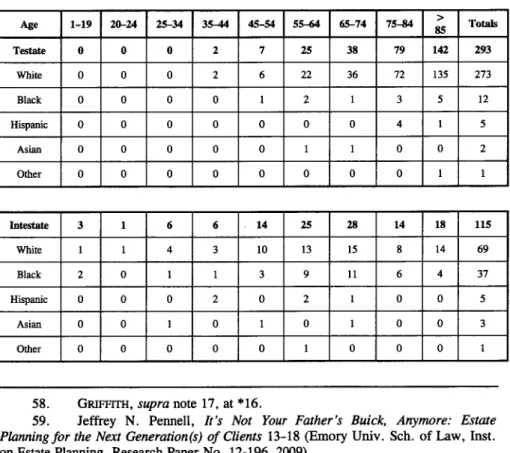
Not surprisingly, race and sex both play a role here. There were higher percentages of intestate decedents of color than testate decedents, and they were more likely to be male while testate decedents were more likely to be female. There are numerous ways one could speculate about why white women dominate the testate estates, everything from their longer life expectancy" to the fact that they remarry after widowhood at far lower rates than men, thus dying as widows and not as married spouses." The intestate estates are almost exactly opposite, as men predominate and tend to die younger than women. The following data illustrate the breakdown of the testate and intestate estates by race and age.
Table 2: Testate and Intestate Decedents by Race and Age Age 1-19 20-24 25-34 35-4 45-54 55-64 65-74 75-84 Totals Testate 0 0 0 2 7 25 38 79 142 293 White 0 0 0 2 6 22 36 72 135 273 Black 0 0 0 0 1 2 1 3 5 12 Hispanic 0 0 0 0 0 0 0 4 1 5 Asian 0 0 0 0 0 1 1 0 0 2 Other 0 0 0 0 0 0 0 0 1 1 Intestate 3 1 6 6 14 25 28 14 18 115 White 1 1 4 3 10 13 15 8 14 69 Black 2 0 1 1 3 9 11 6 4 37 Hispanic 0 0 0 2 0 2 1 0 0 5 Asian 0 0 1 0 1 0 1 0 0 3 Other 0 0 0 0 0 1 0 0 0 1
58. GRIFFrTH, supra note 17, at *16.
59. Jeffrey N. Pennell, It's Not Your Father's Buick, Anymore: Estate
Planning for the Next Generation(s) of Clients 13-18 (Emory Univ. Sch. of Law, Inst.
WISCONSIN LAW REVIEW
When we identify the decedents by race, the testate group is dramatically different from the intestate group. Testate and intestate white decedents predominate, followed by intestate black decedents.
Figure 2: Testate and Intestate Decedents by Age and Races
160 140 120 - Testate White 100 - Testate Black 80 - Testate Other 60 - Intestate White 40 - Intestate Black 20 - Intestate Other
0
25-34 35-44 45-54 55-64 65-74 75-84 > 85Ninety-three percent of the testate decedents are white in a county where whites comprise only 61% of the population.6 1 Similarly, only 12 testate decedents were black (4% of testate decedents) in a county where the black population is 20%.62 Intestate statistics were quite different. Sixty percent of the intestate decedents were white in a county where whites comprise 61% of the population. And 32% of intestate decedents were black, in a county where the black population is only 20%. Perhaps even more striking is that Hispanics comprise
10% of the county's population, yet they represented less than 1% of
intestate decedents and 1.7% of testate decedents.6 3 Clearly, decedents of color do not have their estates probated at a rate proportionate to their population, and black decedents in particular are 8 times more likely to die intestate than testate.
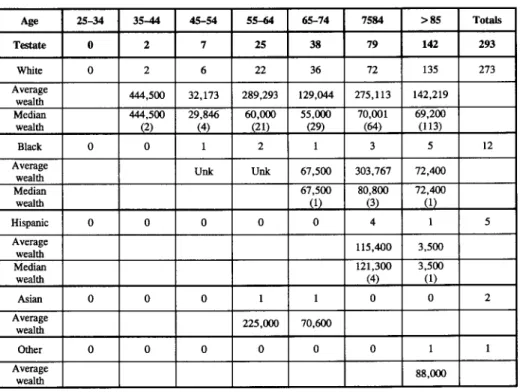
Although the racial wealth gap is one of the largest wealth gaps identified in the literature, the average wealth gap between black and white decedents was not as significant as other studies have shown. When we cross reference wealth to race, we find that the wealth gap
60. I omitted the data of the under 25 groups as there are so few of either testate or intestate decedents as to provide little relevant points of comparison.
61. CENsus REPORTER, supra note 43. 62. Id.
63. Id.
plays out as expected across both intestate and testate decedents but not to such a large extent. Table 4 shows the median and average wealth of
black and Latino decedents compared to white decedents.
Unfortunately, the numbers for Latino decedents is too small to make any useful comparisons, and even the numbers for black decedents is unfortunately small. Nonetheless, there were some well-off black decedents that skewed the numbers upward, lessening the apparent wealth gap that has been identified in other studies.
Table 3.1: Median and Average Wealth for Testate Decedents by Race' Age 25-34 35-44 45-54 55-64 65-74 7584 >85 Totals Testate 0 2 7 25 38 79 142 293 White 0 2 6 22 36 72 135 273 Average 444,500 32,173 289,293 129,044 275,113 142,219 wealth Median 444,500 29,846 60,000 55,000 70,001 69,200 wealth (2) (4) (21) (29) (64) (113) Black 0 0 1 2 1 3 5 12
Average Unk Unk 67,500 303,767 72,400
wealth _____ __ Median 67,500 80,800 72,400 wealth (1) (3) (1) Hispanic 0 0 0 0 0 4 1 5 Average 115,400 3,500 wealth Median 121,300 3,500 wealth (4) (1) Asian 0 0 0 1 1 0 0 2 Average 225,000 70,600 wealth Other 0 0 0 0 0 0 1 1 Average 88,000 wealth
64. The numbers in parentheses are the total number of decedents in each category. Unfortunately, some categories are quite small.
314
WISCONSIN LAW REVIEW
Table 3.2: Median and Average Wealth for Intestate Decedents by
Race
Age 25-34 35-44 45-54 55-64 65-74 75-84 >85 Totals Intestate 6 6 14 25 28 14 18 115 White 4 3 10 13 15 8 14 69 Average 43,400 17,950 22,000 42,344 99.558 42,957 83,000 Wealth Median 43,400 15,360 11,650 50,000 70,250 41,000 20,000 Wealth (2) (3) (8) (10) (12) (8) (13) Black 1 1 3 9 11 6 4 37 Average 700 unk 72,167 39,200 24,600 16,480 41,000 wealth Median 700 unk 50,000 23,300 9,000 7,000 30,000 Wealth 73) (7) (11) (5) (4) Hispanic 0 2 0 2 1 0 0 5 Average 228,500 249,000 3,700 Wealth Median 228,500 249,000 3,700 Wealth (1) (1) (1) Asian 1 0 1 0 1 0 0 3 Average/ Median 3,600 550,000 5,500 Wealth I I I I Other 0 0 0 1 0 0 0 1 Average 57,500 WealthThis comparison shows that overall intestate decedents have less
wealth than testate decedents. black intestate decedents have the highest
amount of wealth in the 45-54 age group while black testate decedents
have the highest in the 75-84 age group. This thirty-year gap between
intestacy and testacy confirms that the younger a decedent is at death,
the less wealth he was likely to have. Intestate black decedents had
some of the lowest wealth in those critical early retirement years from
ages 55-85.
Testate black decedents had median wealth significantly higher
than their intestate counterparts for all age groups.
65For instance, for
the 65-74 age group, black testate median wealth was $67,500 while
black intestate median wealth was $9,000; and for the 75-84 age group,
black testate median wealth was $80,800 while black intestate median
wealth was $7,000. The data revealed that black testate wealth was
nearly ten times greater than black intestate wealth. The same was not
true for white testate and intestate wealth. For the 65-74 age group,
white testate median wealth was $55,000 while white intestate median
65. Because there were no black testate decedents younger than 65, there are only three age ranges for which meaningful comparisons can be made.
wealth was $70,250. For the 75-84 age group, white testate median wealth was $70,001 while white intestate median wealth was $41,000. For white decedents, the wealth gap between testacy and intestacy was never more than four-to-one, and in some cases white intestate decedents had more median wealth than white testate decedents. The gap for black decedents was much higher, closer to ten-to-one.
The gap between black and white decedents was also significant. Among intestate decedents, white decedents had roughly twice the average wealth as black decedents, except in the 45-54 age group, where black decedents had significantly greater wealth (roughly four times). Among intestate decedents, however, the total numbers for each age group are quite small, making comparisons difficult. Among testate decedents, white decedents also had roughly twice the average wealth as black decedents, except among the 75-84 age group where black decedents had slightly more. Again, however, these numbers are somewhat unreliable because there were only nine black testate decedents whose estates could be valued.
Although the racial wealth gap clearly appears in this data, the more significant wealth gap is between testacy and intestacy. The fact that most of the testate decedents were white suggests that estate planning is more predominant among wealthy and moderately-wealthy
whites than among poor whites or blacks. The almost complete lack of estate planning by blacks and Latinos is striking and problematic. Because the racial wealth gap between black and white decedents was not as large as the literature suggests, we can infer that the very small numbers of black decedents whose estates were probated were probably somewhat wealthier than the overall black population. But the mere fact that they did have comparable wealth and were not benefitting from estate planning should raise alarms.
C.
SexThe sex composition of the two groups is equally stark. Testate decedents are 57% female and 43% male, while intestate decedents are 42% female and 58% male. This is so even though in the oldest age group, those over age 85, women outnumber men in both categories by nearly two to one (12 women to 6 men intestate and 96 women to 46 men testate). Thus, in the intestate group, men under age 85 outnumber women considerably, by almost two to one (61 men to 36 women).
316
WISCONSIN LAW REVIEW
Table 4: Testate and Intestate Decedents by Age and Sex
Age 1-4 5- 10- 25- 35- 45- 55- 65- 75- 85 < Totals ge 9 24 34 44 54 64 74 84 Testate 0 0 0 0 2 7 25 38 79 142 293 Male 0 0 0 0 1 4 13 24 39 46 127 Female 0 0 0 0 1 3 12 14 40 96 166 Intestate 2 1 1 6 6 14 25 28 14 18 115 Male 2 0 0 5 4 7 17 18 8 6 67 Female 0 1 1 1 2 7 8 10 6 12 48
Numerous important studies have found female wealth is around
80% that of male household wealth' and that female household wealth
is only about 66% of male household wealth when home equity is
excluded.
67Even though women have less wealth on average than men,
a significant portion of their wealth comes from inheritances. And
women face different obstacles to building wealth than men. Women
live longer and earn less over their lifetimes, which reduces their total
wealth. Women also tend to defer investments in their own human
capital, thus reducing their lifetime earnings potential, through
68
childrearing and caretaking of parents.
Women's childbearing falls
directly at the age when a professional worker is broadening her
experience and making contacts that will set her on a trajectory to being
a higher-paid worker.
69By missing those crucial years from ages
30-45,
a woman will have difficulty maximizing her earning potential in
later years.
70Women also invest heavily in their children, being willing
to invade their nest eggs to pay for braces, a college education, or other
financial emergencies.
Furthermore, women tend to have more "bad" debts on average
than men. They carry more credit card debt, have a higher debt load
than men from education loans one year out, and women at the lowest
economic levels rely on payday loans in far greater numbers than
66. See, e.g., GRIFTr, supra note 17 at *4.
67. Id.
68. Id. at *12-13.
69. Id. at *13.
70. Id. 71. Id.
men.72 When we add up the lower earning potential, higher bad debt
ratios, and women's willingness to forego their own wealth to support their children, it is surprising that the gender wealth gap is only at
60%. Moreover, women are more susceptible to financial shocks than
men, in part because of their lower wealth, but also because most financial shocks hit just as they are rebounding from childrearing responsibilities. Thus, divorce and widowhood in their fifties have a tremendous impact on women's ability to save. Also, the differential costs and effects of health events for themselves and their parents negatively affect women. Because women live longer than men, and they report higher degrees of disability after age 75 than men, women's healthcare costs can easily eat up the smaller nest eggs they have amassed.7 3 That is, assuming they have a nest egg after foregoing employment prospects to take care of aging parents once they get the kids out of the house.
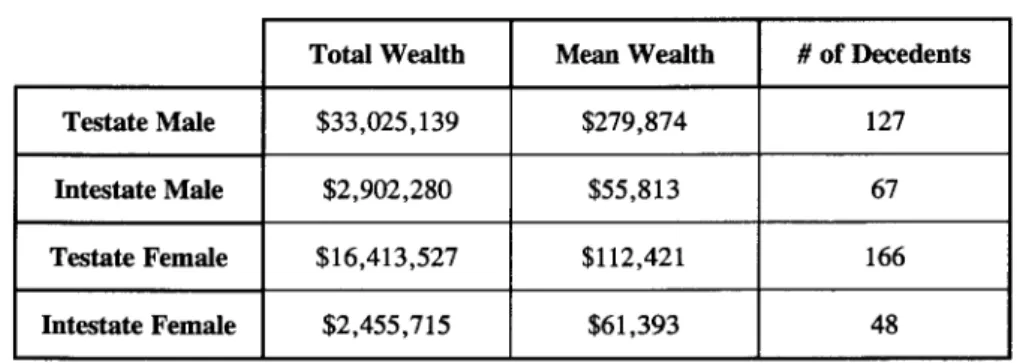
How does intestacy or testacy affect women differently when they approach property succession from such different positions? Clearly the high percentage of widowed white women who die testate testifies to the standard narrative that these women most likely inherited marital property from their husbands and will leave their property to their children.74 Comparing levels of wealth across this dimension shows that widowed women hold a sizable amount of family wealth. But breaking it down further, we see that women as a group have far less wealth than men, across both the testate and intestate divides.
When we compare median wealth for men and women, male wealth is significantly greater than female wealth in almost every age group. What is notable, however, is that after age 65, male testate wealth increases while female testate and male and female intestate wealth stays the same or decreases.
72. Id. at *14.
73. Id. at *16.
74. This was borne out by my earlier study of the testate estates which showed that the vast majority of widowed women died with wills that gave all to their husbands, and then to their children if their husbands predeceased them. These estate plans were standard joint-reciprocal wills which passed all individual wealth to the surviving spouse, and then upon the spouse's death to the children. See Danaya C. Wright & Beth Sterner, Honoring Probable Intent in Intestacy: An Empirical
Assessment of the Default Rules and the Modern Family, 42 ACTEC L.J. 341, 367