i>'l\>1\> -lr 'II> 'II> 'II>
'II> 'II>
11>-~r-lr
EUROPEAN COMMISSION
WORKING
NOTES
Working notes on the
Common Agricultural Policy
WINE
1996/97 edition
EUROPEAN COMMISSION Directorate-General for Agriculture
Information, reports, publications, studies and documentation 130, rue de la Loi, B - 1049 Brussels
A great deal of additional information on the European Union is available on the Internet.
It can be accessed through the Europa server (http://europa.eu.int).
Cataloguing data can be found at the end of this publication.
Luxembourg: Office for Official Publications of the European Communities, 1996 ISBN 92-827-7564-X
© ECSC-EC-EAEC, Brussels - Luxembourg, 1996
Reproduction is authorized, except for commercial purposes, provided the source is acknowledged.
CONTENTS
Introduction
The situation of the market
1. General situation
2. The situation for table wines
The common market organisation
1. The price arrangements
2. Trade with non-member countries
3. Private storage aid for table wine and grape must 4. Intervention via the distillation of wine
5. Taking over of alcohol derived from compulsary distillation 6. Aid for the use of grape must
7. Permanent abandonment premiums in respect of areas under vines
Annexes
1. Monetary assumptions made when drawing up the 1997 preliminary
draft budget
2. Definition of main terms
3. Measures to promote grape juice
4. Main factors in determining requirements for appropriations in 1997
Page
5
7
7
14
17
18
19
20 20 24
25 25
27
27
28 29
INTRODUCTION
This text on wine is one of a series produced by the Directorate-General for Agriculture
of the European Commission known as "CAP Working Notes" which is published towards
the end of each year in French, English and German. These documents contain the most recently available information on the current marketing year, particularly the decisions on prices and related measures and the planned budget expenditure for the market organisation of the product in question.
The document is in two parts with a set of annexes. The first part consists mainly of the contributi9n made by the Directorate-General for Agriculture's Unit "Wine,alcohol and
derived prod~cts" to the 1996 Report on the Agricultural Situation in the European Union.
The second is taken from the working document "Section III - Commission - Sub-section
B 1" which accompanies the Preliminary Draft General Budget of the European
Communities for the financial year 1997 which was originally published in May 1996 and
has now been updated for inclusion in this text which was completed on 31 October 1996.
THE SITUATION OF THE MARKET
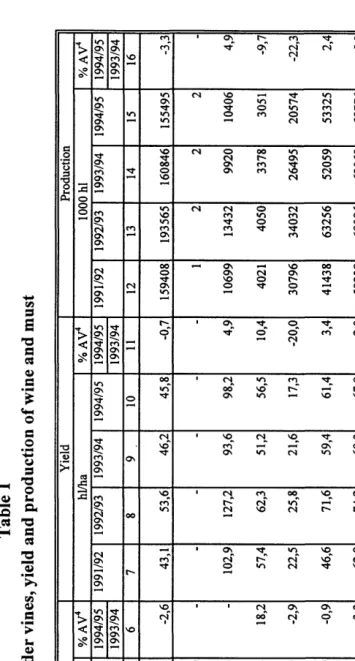
The Community area under vines decreased from 3.640 million hectares in 1991/92 to 3.345 million hectares in 1994/95, representing a loss of more than 8% (see Table1).
The largest reductions occurred in Greece (-23%), Spain (-13%) and Italy (-8%).
This is mainly due to the grubbing-up policy which the Commission has been implementing since 1988. At the end of the programme (1996), the abandoned wine-growing area may be estimated provisionally at about 490 000 ha. The programme has been prolonged for another two years.
Yields varied during the same period from country to country. On a Community level, after a drop in 1991/92 to 42.9 hl/ha and a rise in 1992/93 to 53.7 hl/ha, yields dropped again during the following two years to 46.3 hl/ha and 45.7 hl/ha (see Table 1 ).
Production has been low over the last three years. Whereas production totalled 190 977 000 hectolitres in 1992/93, it only amounted to 158 981 000 hectolitres in 1993/94 and 152 848 000 hectolitres in 1994/95. Production is estimated at 151 million hectolitres in 1995/96. Compared with the low production level of the last three years, which gave the impression that a stable balance had been reached, total production for 1996/97 is forecast at the beginning of the season at 172 million hectolitres, equivalent to average production between 1989/90 and 1993/94.
The European Union is the world's leading wine economy with on average 60% of world production and 55% of world consumption (in 1994 60% and 56o/o). The other main producers are in descending order Argentina, the United States, Eastern Europe (Bulgaria, Hungary, Romania, ex-Yugoslavia and the Czech and Slovak Republics) and South Africa (no recent statistics are available for the ex-Soviet Union).
International trade in wine (imports and exports together) involves around 34o/o of world production of some 270 million hi (1992-94 average). Annual consutnption of some 224 hl (1992-94 average) gives a world surplus of 46 million hl, about 25o/o of which is produced by the Union and goes mainly for distillation.
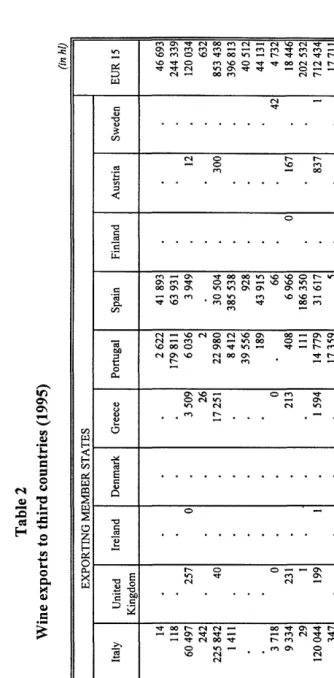
In 1995 owing chiefly to very poor Spanish production exports from the Union fell to 9 793 060 hl from 11 748 000 hi in 1994. Italy (3 244 293 hl), France (3 122 808 hl) and Spain (1 877 516 hl) were the main exporters. The biggest destinations were the United States (23%), Canada (9%), Russia and Japan (7o/o) (see Table 2).
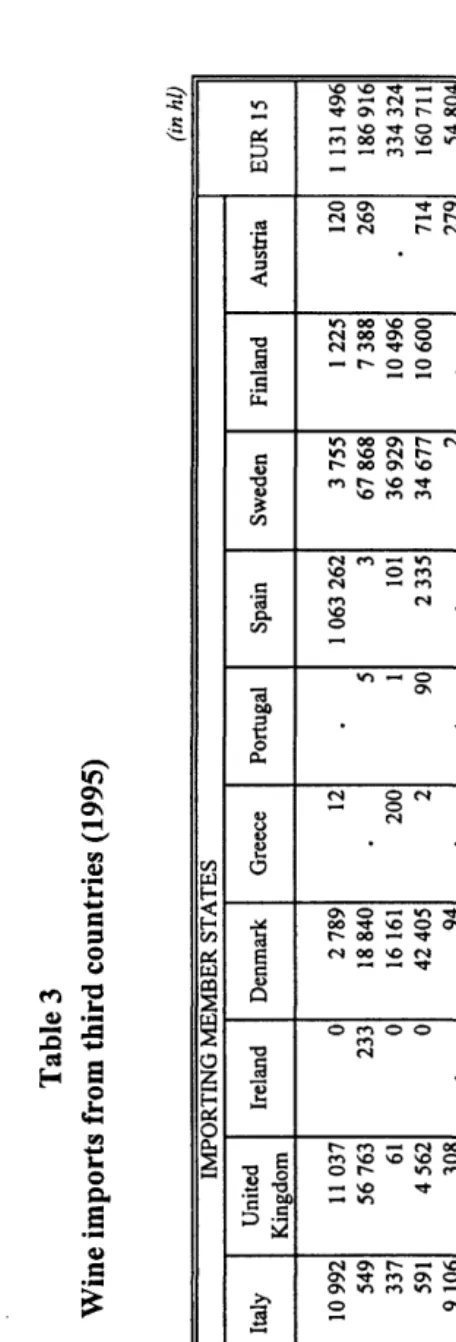
The Union's 1995 imports of 3 651 041 hl were 33% higher than in 1994. The main importers were Spain (29%), Germany (26%) and the United Kingdom (14%) (see Table 3). The exceptional Spanish import volume was due to a drought-induced shortage. The main suppliers were Argentina (31 %) and Eastern Europe (35%), with the United States at 9%. Argentina's exports were chiefly to Spain (1 063 262 hi).
The Union's production for the 1995/96 wine year is estimated provisionally at 151 million hi for all wines (table wine, quality wine produced in specified regions, other wine), down on the 1994/95 harvest of 153 million hi.
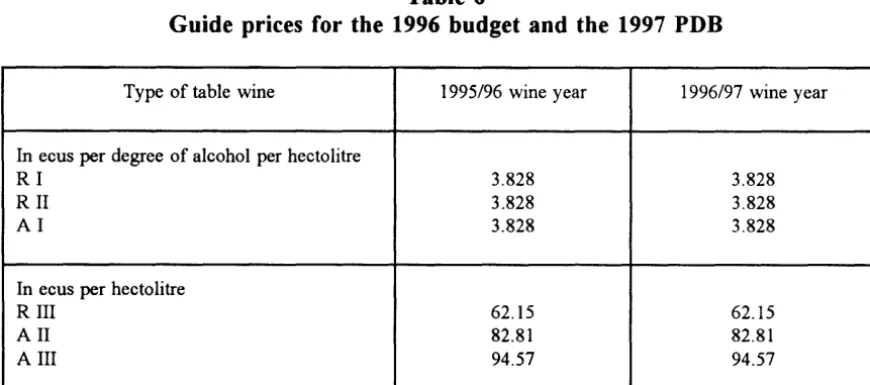
Guide prices for table wine of types AI, RI and RII were kept unchanged from 1994/95 at 3.828 ECU/% vol/hl.
Table wine prices varied very widely by production region from 66% to 155% of guide prices (see Table 4).
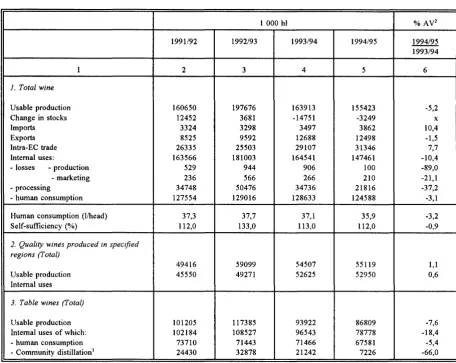
Direct human consumption of wine, although showing a tendency to fall, should be little changed from previous wine years (127 million hl ) (see Table 5), as should industrial use for vermouth and vinegar production (3.8 million hl).
Producers' and traders' stocks were 103 million hl at the beginning of the marketing year and by its end should be substantially lower at around 97 million hl.
Greatly reduced production (151 million hl and stocks at the beginning of the 1995/96 marketing year down to 103 million hl) allowed recourse to both compulsory and support distillation to be avoided in 1995/96. Only preventive distillation was opened. About 3 .I million hl was distilled (5.3 million hl in 1994/95).
Between 16 December 1995 and 15 February 1996 long-term storage contracts (nine months) were taken out for 6 500 000 hl (table wine 4 826 000 hl, must 1 331 000 hl, concentrated and rectified concentrated must 343 000 hl). The 1994/95 figure was 5 909 000 hl.
Table 1 Area under vines, yield and production of wine and must Area 1000 ha 1991192 1992/93 1993/94
1 EUR
15
1
~elgium Gennany Greece
2
Spain France
3
Italy .LJUXembourg Austria
1
Portugal United
Kingdom
EUR12
Source
:
Eurostat.
1 Estimates.
2 3695
0
104 70 1370 889 943
1 55 262 1 3640 2 1994/95: area under production.
3 Area
under
production.
4 A
V = annual variation. 3 4 3608 3485 0 0 106 106 65 66 1317 1225 883 877 917 896 1 1 54 50 264 263 1 1 3554 3435 %AV' 1994/95
1994/95 1993/94
5 6 3394 -2,6 0
-106 -54 18,2 1189 -2,9 869 -0,9 866 -3,3 1 -49 -2,0 259 -1,5 1 -3345 -2,6 Yield hllha %AV' 1991/92 1992/93 1993/94 1994/95 1994/95 1991192 1993/94 7 8 9 10 11 12 43,1 53,6 46,2 45,8 -0,7 159408 -1 102,9 127,2 93,6 98,2 4,9 10699 57,4 62,3 51,2 56,5 10,4 4021 22,5 25,8 21,6 17,3 -20,0 30796 46,6 71,6 59,4 61,4 3,4 41438 62,8 74,2 69,3 67,9 -2,0 59238 86,0 271,0 170,0 175,0 2,9 86 56,2 47,9 37,3 54 44,8 3093 38,2 29,4 18,5 25,2 35,9 10021 15,0 27 18,0 18 -15 42,9 53,7 46,3 45,7 -1,3 156315 Production 1000 hi %AV' 1992/93 1993/94 1994/951994/95 1993/94
[image:9.840.100.455.56.717.2]Table 3 Wine imports from third countries (1995) (in hi) IMPORTING MEMBER STATES Origin France Belgium/ Netherlands Germany Italy United Ireland Denmark Greece Portugal Spain Sweden Finland Austria EUR 15 Luxemb. Kingdom Argentina 25 120 127 6 441 6 6I7 10992 II 037 0 2 789 I2 I 063 262 3 755 I 225 I20 I 13I 496 Australia 2 934 I 07I 9 05I 2I 941 549 56 763 233 18 840 5 3 67 868 7 388 269 186 916 ~ulgaria 93 811 3 838 68 264 104 126 337 61 0 16 161 200 1 101 36929 IO 496 334 324 Chile 8 34I 15 599 21904 18 89I 591 4 562 0 42 405 2 90 2 335 34 677 10 600 714 I60 711 ~roatia 187 775 171 43 884 9106 308 94 2 279 54 804 ~YROM 1 7 258 534 302 599 22 519 230 280 109 333 529 !Hungary 9 716 2 I36 1 762 156 230 502 98 625 0 2 568 658 129 27 078 33 345 899 333 648 !New Zealand 158 4 1 169 439 49 827 0 162 5 149 220 57 I29 !Romania 928 493 5 143 143 269 10 55 444 I8 1 942 18 0 12 702 3 451 223 4I8 Slovenia 89 339 57 3 571 262 7 950 70 1 986 2 599 so 16 973 South Africa 27 700 20 489 43 I26 45 655 2 487 2 178 7 21906 0 5 0 13 573 4 941 365 I82 432 Tunisia 2 999 73I 35 532 414 39676 USA 22 029 10 827 16 754 26 155 2 689 161 517 37 47 023 3 50 1265 39 873 9 314 330 337 867 OTHERS I22 201 6900 11049 52 I31 387 33 358 0 2 896 I 448 49 11 621 8 965 5 601 1 509 258 117 TOTAL 323 470 63 330 185 425 961 042 27 912 504 150 296 157 501 2 620 200 I 078 716 252 664 89 181 4 534 3 651 041 Source : OSCE -Comext 2.
1 FYROM:
[image:11.840.179.407.51.722.2]Table 4
Production prices 1 of table wines
ECU %AV2
1992/93 1993/94 1994/95 199596 ~
1994/95
1 2 3 4 5 6
Type RJ: Red, 10 to 12°,
% vol.lh/
Greece - 2,130 - -
-Heraklion - 2,130
-
--Patras - -
-
--Spain 1,723 1,824 2,850 4,482 57,3
Requena 1,718 1,831 2,850 4,482 57,3
Reus 1,642 1,674 -
-
-Villafranca, del Bierzo 1,834 1,686
-
-
-France 3,005 3,004 3,464 4,181 20,7
Bastia 2,912 3,158 3,389 4,157 22,7
Beziers 2,989 3,014 3,424 4,142 21,0
Montpellier 3,016 3,090 3,527 4,212 19,4
Narbonne 3,059 3,096 3,49 4,202 20,4
Nimes 2,998 3,043 3,46 4,197 21,3
Perpignan 2,716 3,023 3,413 4,074 19,4
~ta/y 2,043 2,299 2,812 5,27 87,4
Asti - 2,716
-
--Firenze 1,754 1,656 2,101 -
-Leece -
-
-
--Pescara 2,103 2,031 2,526 -
-Reggio Emilia 2,845 2,366 3,518 5,93 68,6
Treviso 2,144 2,104 2,617 4,736 81,0
Verona (local wines) - 2,496 2,944 5,499 86,8
EU 2,849 2,499 3,432 4,237 23,5
TypeR II: Red, 12.5 to 15°, % vo/./h/
Greece
-
-
--
-Heraklion - - - -
-Patras
-
-
- --Spain 1,962 1,873 3,205 4,457 39,1
Calatayud -
-
-
-
-Falset 1,852 1,966 3,307 4,296 29,9
Jumilla 2,028 1,927 2,973 3,822 28,6
Navalcamero 1,840 2,284 2,570 3,983 55,0
Requena -
-
-
--Toro 1,431 ·- - - -
-Villena 2,015 2,385 3,416 5,11 49,6
France 2,979 2,848 3,152 4,006 27,1
Bastia 2,979 2,848 3,152 4,006 27,1
Brignoles
-
- - --Italy 2,193 1,889 2,422 3,902 61,1
Bari 2,108 1,861 2,438 3,748 53,7
Barletta 2,118 1,978 2,301 3,766 63,7
Cagliari 3,092 2,703 3,344 5,2 55,5
Leece - - -
-
-Taranto -
-
- --EU 2,306 2,113 2,596 4,092 57,6
1992/93
1
Type R Ill: Red, Portuguese type, hi
Germany
Rheinpfalz-Rheinhessen (HOgelland)
EU
Type A 1: White, 10 to 13°, % vol.lhl
Greece
Athenes Heraklion Patras ~pain
Alcazar de San Juan Alrnedralejo Medina del Campo Ribadavia
Villafranca del Penedes Villar del Arzobispo Villarrobledo
IF ranee
Bordeaux Nantes Italy Bari Cagliari Chieti
Ravenna (Lugo, Faenza) Trapani (Alcamo) Treviso
EU
Type A II: White, ~ylvaner type, hi
Germany
Rheinpfalz (Oberhaardt) Rheinhessen (HOgelland) EU
Type A Ill: White, !Riesling type, hi
Germany
Mosel/Rheingau EU
Source: European Commission, DG for agriculture. 1
Weighted average market price. 2 A V
= annual variation.
2
-1,379 1,366 1,376 -2,077 -1,469 -1,985 1,918 2,655 2,051 2,010 1,796 2,195 1,783 33,543 34,579 32,686 33,600 -13ECU %AV2
1993/94 1994/95 199596 .lmL22 1994/95
3 4 5 6
51,328 81,03 118,254 45,9 51,328 81,03 118,254 45,9
51,328 81,03 118,254 45,9
-
-
-
--
-
-
--
-
-
--
-
-
-2,159 2,801 3,343 19,4 2,159 2,759 2,729 -1,1 1,631 2,719 2,918 7,3
-
-
5,303--
-
-
-2,496 3,407 2,542 -25,4
-
--
-2,068 2,937 3,176 8,1
-
--
--
-
-
--
--
-1,865 2,714 3,602 32,7 1,902 2,562 3,302 28,9 2,198 2,914 3,535 21,3 1,741 2,718 3,363 23,7 1,973 2,845 3,770 32,5 1,642 2,348 2,991 27,4 2,129 2,821 5,055 79,2 1,790 2,725 3,522 29,2
40,309 52,495 69,559 32,5 39,944 48,472 67,565 39,4 40,548 55,449 71,302 28,6 40,309 52,495 69,557 32,5
40,834 50,973
-
-40,834 50,973
-
-Table 5
Supply balance - wine
1 000 hi % AV2
1991/92 1992/93 1993/94 1994/95 1994/95 1993/94
1 2 3 4 5 6
1. Total wine
Usable production 160650 197676 163913 155423 -5,2
Change in stocks 12452 3681 -14751 -3249 X
Imports 3324 3298 3497 3862 10,4
Exports 8525 9592 12688 12498 -1,5
Intra-EC trade 26335 25503 29107 31346 7,7
Internal uses: 163566 181003 164541 147461 -10,4
- losses - production 529 944 906 100 -89,0
-marketing 236 566 266 210 -21,1
- processing 34748 50476 34736 21816 -37,2
- human consumption 127554 129016 128633 124588 -3,1
Human consumption (1/head) 37,3 37,7 37,1 35,9 -3,2
Self-sufficiency (%) 112,0 133,0 113,0 112,0 -0,9
2. Quality wines produced in specified regions (Total)
49416 59099 54507 55119 1,1
Usable production 45550 49271 52625 52950 0,6
Internal uses
3. Table wines (Total)
Usable production 101205 117385 93922 86809 -7,6
Internal uses of which: 102184 108527 96543 78778 -18,4
- human consumption 73710 71443 71466 67581 -5,4
- Community distillation' 24430 32878 21242 7226 -66,0
Sources: Eurostat and European Commission, Directorate-General for Agriculture
Excluding distillation for the production of wine spirits bearing a designation of origin and national. A V = annual variation.
2. The situation for table wines
Table wines are defined in Annex III to the Basic Regulation [Council Regulation (EEC) No. 822/87] and qualify for financial support from the Community under Article 27 of the Regulation.
The production of table wine has tended to fall over the last ten years. The figures for the most recent years in the European Union are relatively low (see Table 5) with estimates of around 80 million hl in 1995/96 . The last two marketing years cannot be used as reference years for forecasts as their very low yields make them atypical. Estimates suggest that the Union will produce 95 million hl in 1996/97.
[image:14.576.72.528.85.448.2]Demand for table wine in the Community continues to fall. Human consumption, which accounts for about 90% of the total, has fallen from over 90 million hi per year in the early eighties to less than 70 million hl in 1994/95. Estimates put Union consumption (taking account of the adhesion of the three new Member States) at about 72 million hi in 1996 and 71.5 million hi in 1997.
Even if the structural surplus which characterises the sector and which led to the Commission's proposal for a reform of the common market organization still exists, it was camouflaged in 1994/95 and 1995/96 by harvests that were, due to exceptional climatic conditions, clearly deficit ones. This surplus is disposed of in part through trade with non-member countries, so making the Union a net exporter of table wine. The balance of the
15 is estimated at about 3.3 million hi in 1996 and should reach 4 million hi in 1997.
Distillation measures remain the main means of disposing of the surplus. In 1994/95 and 1995/96 only preventive distillation (see 4.a) was opened. The quantity was 5.3 million hi in 1994/95, with a quantity under contract of 5.9 million hl. For 1995/96, preventive distillation has been authorized in two stages:
at the beginning of the year for 6.3 million hi (distilled quantity: 1.9 million hl); at the end of the year for 2. 7 million hi (distilled quantity: approximately 1.2 million
hi.
There are no costs incurred by the EAGGF apart from distillation aid since the cost of taking over the alcohol is not covered. The Commission has continued its policy of disposing of alcohol derived from wine in the fuel sector.
Wine
(million hl)
---,.---..,.---r---.
---
...
...
( million hl )
r
Distillation (1)
30
...
• •
10
:-
.
~•
;..
•
..
..
...
~..
..
~..
...
f-1
..
;.
•
r-
•
• •
;.
•
•
• •
•
•
•
•
~-
•
.:-
...
.:
=-·
..
'•,;,.
•
20
,o
~-·~
II...
~
...
.-~
...
•
•
~ ~•
•
• •
• •
•
•
• •
~• •
:.
.
:.
.
•
•
•
•
•
~-~
.~-~
..
•
••
•
••
•
••
.,
.
...
..
.
...
~.
..
..
.~ ;.• • •
•
• •
• • •
~·.
• • •
~·
•
...
..
;.·~ ~
•
..
~ ~•
=-·
87/88 88/89 89/90 90/91 91/92 92/93 93/94 94/95
Source: European commission. DG for Agriculture.
(1) Compulsory and optimal distillation (Portugal excluded 1979- 1991)
1992 figures include Portugal.
THE MARKET ORGANIZATION
This chapter covers principally wine made from fresh grapes but also includes:
grape juice and must, with or without added sugar;
grape must, in fermentation or with fermentation arrested; fresh grapes other than table grapes;
wtne vtnegar;
other products (piquette, wine lees, grape marc ).1
By Regulation No 24 of 4 April 1962, the Council provided for the progressive establishment of a common organization of the market in wine. The basic Regulation is currently Council Regulation (EEC) No 822/87, as last amended by Regulation (EC) No 1592/96. The wine year runs from 1 September to 31 August.
The organization of the market in the wine sector includes arrangements for trade with non-member countries, price arrangements and rules on intervention and other measures to regulate the market, rules on production and control of the development of wine-growing potential, practices and treatment in wine making and the circulation and marketing of wine.
To tackle the structural imbalance on the market in wine, stabilizing measures have been in operation since 1988. They include the abandonment of vineyards and reinforcement of the system of compulsory distillation for which the minimum price is below that guaranteed for other types of distillation. The aims of these measures are to reduce wine-growing potential and discourage high yields in anticipation of the expected fall in
demand. The Commission is also reducing optional intervention measures by stages. It has,
accordingly, not granted restorage aid for table wines since 1988 and has also abolished distillation under the special price support guarantee for long-term storage contract holders with effect from 1991/92 (see 4.e). These measures have not produced the desired results and so the Commission has proposed, in 1994, a thorough reform of the sector. However, this has not yet been adopted by the Council.
1
See the definitions of products of the vine-growing sector in Annex 2.
1. The price arrangements
The price arrangements concern only table wines, which are divided into several types:
1. Red table wines:
(a) Type R I: red table wine, other than of type R III, of an actual alcoholic strength by volume of not less than 10o/o vol and not more than 12% vol; (b) TypeR II: red table wine, other than of type R III, of an actual alcoholic strength by volume of not less than 12.5% vol and not more than 15% vol; (c) TypeR III: red table wine obtained from vine varieties of the Portugieser
type.
2. White table wines:
(a) Type A I: white table wine, other than of types A II and A III, of an actual alcoholic strength by volume of not less than 10% vol and not more than
13o/o vol~
(b) Type A II: white table wine obtained from vine varieties of the Sylvaner type or of the Muller-Thurgau type~
(c) Type A III: white table wine obtained from vine varieties of the Riesling type.
Each year the Council fixes:
a guide price for each type of table wine. This was fixed before 1 August at a level which ensures a fair income for producers, on the basis of the average of prices recorded during the two preceding marketing years and the trend of prices during the current marketing year. The guide price for wine is currently subject to the same changes as the Council is considering for all agricultural products~
an activating price, which is the threshold for activating the intervention mechanism and corresponds to 92% of the guide price.
For each type of wine for which a guide price exists, the Commission establishes two types of price each week:
an average producer price for each representative market in respect of the type of wine in question;
a representative price equal to the weighted mean of all the average prices fixed for types R III, A II and A III and to the weighted mean of half the average prices fixed for types R I, R II and A I.
In May 1994, the Commission sent the Council and Parliament a proposal to reform the
[image:19.581.59.494.178.371.2]organization of the market in wine intended to lay down new rules for the sector. This proposal would make the guide price superfluous. However, since it could not be adopted in time, the Council decided to extend the guide prices for 1995/96 shown in the table below in 1996/97. The 1997 preliminary draft budget (PDB) assumes that the sector has not been reformed.
Table 6
Guide prices for the 1996 budget and the 1997 PDB
Type of table wine 1995/96 wine year 1996/97 wine year
In ecus per degree of alcohol per hectolitre
RI 3.828 3.828
RII 3.828 3.828
AI 3.828 3.828
In ecus per hectolitre
R III 62.15 62.15
All 82.81 82.81
A III 94.57 94.57
2. Trade with non-member countries
Completion of the single market entails the introduction of a single set of arrangements for trade at external frontiers. A single duty based on the alcohol content of the product is intended to stabilize the Community market and prevent prices in non-member countries and fluctuations in such prices from destabilizing the Community market.
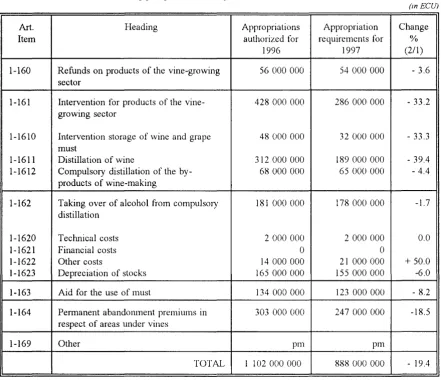
To the extent required to permit exports of the products in question (excluding piquette, wine lees and grape marc), the difference between world prices and those in the Union may be covered by an export refund (Article 1-160 in Table 7). The refund is the same throughout the Union and may vary depending on destination. Refunds are fixed in the light of the situation and likely trends of the world and Union markets, marketing and transport costs and the aims of the market organization. A refund may also be granted to raw and white sugar in the form of certain products of the vine-growing sector.
Under the GATT Agreement, the Union undertook to respect limits on subsidized exports
of these products2. These were set at 2.85 million hl for the 1996 budget and 2. 74 million
hl for the 1997 budget; the limit will fall to 2.16 million hl in 2000. Forecast expenditure in the established budget for 1996 and the 1997 PDB was based on these volumes and on a proposed average refund of ECU 18.86/hl and ECU 19.05/hl. This means that expenditure on refunds under Article 1-160 will fall by 3.6%.
3. Private storage aid for table wine and grape must
The aim of private storage aid is to encourage wine producers to use storage to freeze existing surplus supplies on the market for a certain period. There are two possibilities for concluding private storage contracts:
(a) long-term contracts where supplies of wine available at the beginning of the marketing year exceed foreseeable requirements by four months. Storage for must is available when long-term storage for wines is decided on. Aid is conditional on the conclusion of storage contracts valid for a period of nine months. Contracts must be concluded between 16 December and 15 February;
(b) when long-term contracts expire but market prices fail to match the activating price for three successive weeks, four-month contracts may be concluded.
The amount of aid expected to be paid in 1997 in the PDB is the same as for last year, an average of ECU 4.56/hl for wine and ECU 5.43/hl for must. However, the quantities concerned are lower: 5 million hi of wine and 1.5 million hl of must in 1997 as opposed to 8 million hl of wine and 2 million hl of must in 1996. As a result, appropriations requested for Item 1-1610 are 33.3% lower.
4. Intervention via the distillation of wine
Distillation is triggered at the beginning of the wine year in order to withdraw production surpluses from the market. Distillation payments are scaled to penalize high yields which could educe the quality of the wine. A forecast balance is established in December on the basis of information provided by the Member States and the Advisory Committee on Wine. This balance sets out resources and the use made of them and so permits the stocks at the end of the year to be predicted. The surplus to be distilled is established by comparing forecasts of final stocks with those desired (the equivalent of about four to five months' consumption).
2
For a detailed description of the GA 1T Agreement see the CAP Working Notes special edition "GA 1T and European agriculture".
Art.
Item
1-160
1-161
1-1610
1-1611 1-1612
1-162
1-1620 1-1621 1-1622 1-1623
1-163
1-164
1-169
Table 7
Appropriations authorized in 1996 and appropriation requirements for 19971
Heading Appropriations Appropriation
authorized for requirements for
1996 1997
Refunds on products of the vine-growing 56 000 000 54 000 000
sector
Intervention for products of the vine- 428 000 000 286 000 000
growing sector
Intervention storage of wine and grape 48 000 000 32 000 000
must
Distillation of wine 312 000 000 189 000 000
Compulsory distillation of the by- 68 000 000 65 000 000
products of wine-making
Taking over of alcohol from compulsory 181 000 000 178 000 000
distillation
Technical costs 2 000 000 2 000 000
Financial costs 0 0
Other costs 14 000 000 21 000 000
Depreciation of stocks 165 000 000 155 000 000
Aid for the use of must 134 000 000 123 000 000
Permanent abandomnent premiums in 303 000 000 247 000 000
respect of areas under vines
Other pm pm
TOTAL 1 102 000 000 888 000 000
(mECUJ
Change % (2/1)
- 3.6
- 33.2
- 33.3
- 39.4 -4.4
-1.7
0.0
+ 50.0 -6.0
- 8.2
-18.5
- 19.4
1
See Annex 4: Main factors in determining requirements for appropriations in 1997. See Annex 1 for
conversion rates to national currencies. The appropriation requirements arc contained in Letter of
Amendment No 1 to the Preliminary Draft Budget for 1997. However, the Conununity authorities appear to be moving towards a reduction of about 2-3% for each budget item and this position is reflected in the same Letter of Amendment.
Producers of table wine who comply with the obligations of the market organization for the vine-growing sector may receive a guaranteed minimum price when they deliver wine for distillation. This minimum buying price varies depending on the type of distillation. A distiller who respects these minimum prices when purchasing from producers receives aid for disposing of the alcohol produced or, in the case of compulsory distillation, may deliver that alcohol to the intervention bodies.
[image:21.577.60.501.96.476.2]The minimum guaranteed price for wine for each type of distillation (except in the case of the distillation of wines other than table wines) is reduced for producers who have enriched their harvest with sucrose or concentrated must on which the aid provided for in Article 45 of the basic Regulation has been paid.
Item 1-1611 covers various types of distillation.
(a) Voluntary preventive distillation (Article 38 of the basic Regulation). If justified by harvest forecasts, the Commission may, at the start of each wine year, introduce preventive distillation at 65% of the guide price for each type of wine. The producer may then voluntarily use this facility if he considers that it will be difficult to market all his harvest. The quantities distilled in this way are limited to part of the production of each holding and concern, in principle, wines of inferior quality.
(b) Compulsory distillation of table wine (Article 39 of the basic Regulation). The Commission normally decides on this distillation in December and at the end of February at the latest if there is a severe imbalance on the market, that is when the wine available exceeds four months of normal demand, when production exceeds normal demand by more than 9o/o or when the weighted average of the representative prices of all types of table wines remains at the beginning of a wine year at less than 82% of the guide price. In practice, these conditions are normally met. However, for a number of years, the small quantities of wine produced have raised representative prices on the production markets to levels exceeding the threshold, at least in the case of the current wine year (1995/96).
The Commission allocates the total quantity to be distilled to the various regions of production in the Union grouped by Member State on the basis of the gap between production in the region during the wine year in question and 85% of average production in the years 1981/82, 1982/83 and 1983/84 in that region. Each producer subject to compulsory distillation distils a proportional quantity of his production in accordance with an annual scale drawn up by the appropriate national authorities of the Member State in cooperation with the Commission. The quantities distilled under preventive distillation for each producer may be deducted from the requirements of compulsory di sti II ati on.
The minimum price guaranteed to producers varies depending on the wine year but is always well below that for other types of distillation.
(c) Market support distillation (Article 41 of the basic Regulation). The Commission opens support distillation automatically once compulsory distillation has been decided on but may authorize it in any event. The minimum guaranteed price to producers is 82% of the guide price for each type of wine. The quantities to be distilled may not exceed 6.2 million hl without authorization from the Council. In order to maintain the guaranteed price, appropriate measures other than distillation may be used.
(d) Compulsory distillation of wines other than table wines (Article 36 of the basic Regulation). This distillation measure applies to surplus wine in the Cognac area, to wines made from table grapes or from grapes for drying, etc.
(e) Distillation complementa1y to long-tern1 contracts ("special price support guarantee distillation") (Article 42 of the basic Regulation) has not been used since the 1991/92 wine year.
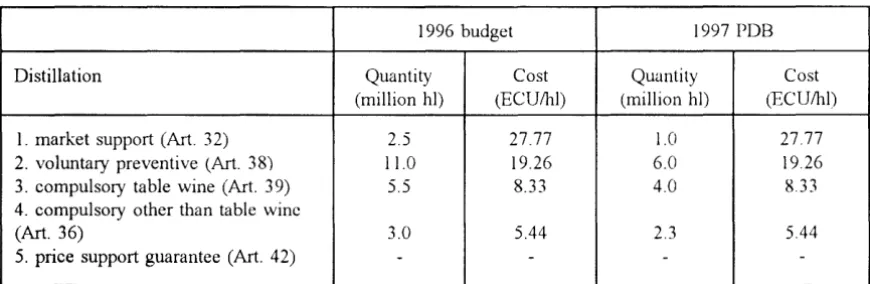
Expenditure under Item 1-1611 varies from one year to another depending on the surplus production to be distilled and the rate of aid paid to the distiller who provides proof that he has paid the minimum price to the producer. The fall in expenditure expected from 1996 to 1997 results from the quantities expected, as shown in the following table.
Table 8
Assumptions regarding distillation of wine used to calculate expenditure, 1996 and 1997
1996 budget 1997 PDB
Distillation Quantity Cost Quantity Cost
(million hi) (ECU/hl) (million hi) (ECU/hl)
I. market support (Art. 32) 2.5 27.77 1.0 27.77
2. voluntary preventive (Art. 38) 11.0 19.26 6.0 19.26
3. compulsory table wine (Art. 39) 5.5 8.33 4.0 8.33
4. compulsory other than table wine
(Art. 36) 3.0 5.44 2.3 5.44
5. price support guarantee (Art. 42) - - -
-Another type of distillation falls under Item 1-1612: compulsory distillation of the by-products of wine-making (Article 35 on by-product deliveries).3 This compulsory distillation of mares and lees is intended to prevent their overpressing and the marketing of inferior-quality wines with a low natural alcohol content. A slight fall in both the quantities expected to be distilled and the rate of aid to be used explains the fall of 2.9% in expenditure under this item in the 1996 budget and the 1997 PDB, which is based on
1 300 000 tonnes of product receiving aid at the rate of ECU 0.495/o/o vol/hl.
3
See definition in A1mex 2.
f.___,
[image:23.578.64.499.306.448.2]5. Taking over of alcohol derived from compulsory distillation
Distillers receive aid for disposing of alcohol produced (see 4) from wine delivered under Community distillation schemes. In the case of alcohol manufactured as the result of compulsory distillation, distillers may receive aid or deliver the alcohol to a Community intervention body, which is the procedure normally fo1lowed in practice.
Disposal of alcohol taken over by the intervention bodies may not disturb the Community market in alcohol and spirits. Where necessary, disposal is directed to other sectors, particularly fuel. Alcohol is sold mainly to the Caribbean and Central America exclusively to be used as processed alcohol in the fuel sector in the Untied States. In 1995 alcohol was also sold to Brazil for use as fuel.
These operations give rise to four types of expenditure:
- technical costs of public storage (Item 1-1620)~ - financial costs of public storage (Item 1-1621 );
- other storage costs, i.e. losses or profits on sales (Item 1-1622);4 - depreciation of stocks (Item 1-1623).
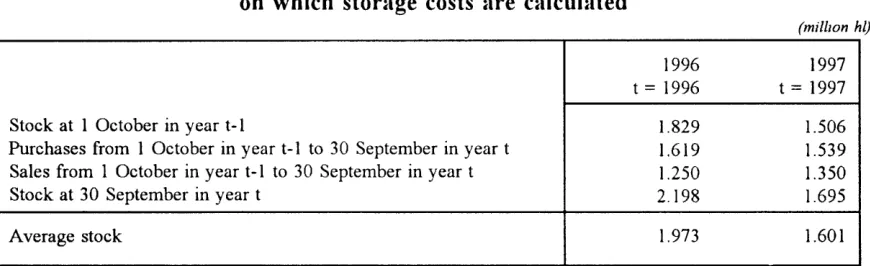
Table 9
Assumptions underlying the main factors on which storage costs are calculated
1996 t = 1996
Stock at 1 October in year t-1 1.829
Purchases from 1 October in year t-1 to 30 September in year t 1.619
Sales from 1 October in year t-1 to 30 September in year t 1.250
Stock at 30 September in year t 2.198
Average stock 1.973
(millwn hl)
1997 t = 1997 1.506 1.539 1.350 1.695
1.601
N.B. The stocks at the end of 1996 may differ from those at the beginning of 1997 because estimates were made on different dates, May 1995 and April 1996 respectively.
4
Items 1-1622 and 1-1623 are the reflection in the budget of the deprecation of stocks. Until 1988, that depreciation was calculated in the year when the stock was disposed of as the difference between the value of the goods when they were taken into storage and their value when taken out of storage. Since 1988, for stocks built up during a wine year, depreciation has been calculated as the difference between the value of the goods when taken into storage and their estimated value at the end of the financial year (1-1623). Item 1-1622 represents the difference between that estimated value and the value when the goods were taken out of storage, normally during a year subsequent to that during which they were taken into storage.
[image:24.575.79.514.385.518.2]The factors used to calculate requirements for appropriations in 1996 and 1997 are shown in the table below. Lower stocks at the beginning of the year and lower provision for purchases in the 1997 PDB than in the 1996 budget mean that the appropriations required in 1997 are less than in 1996, particularly as far as costs relating to the depreciation of stocks are concerned.
6. Aid for the use of grape must
This aid is intended to improve the competitive posttton of must produced in the Community. It is granted for the utilization of grape must and concentrated grape must to enrich certain wines or for the production of juice or 'British', 'Irish' and 'home-made' wtnes.
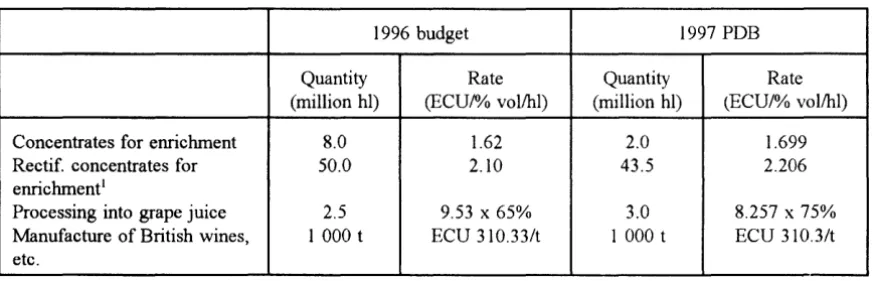
The amount of the aid is fixed annually before 31 August for the following wine year and may not be more than that paid for preventive distillation. Part of the aid for grape juice is used for the organization of promotional campaigns, research into new outlets, etc. (see Annex 3). The Commission's aid proposals and the quantities concerned in the table below show that the expected reduction in expenditure under Article 1-163 from 1996 to 1997 is the result of a fall in both aid and quantities.
Table 10
Assumptions and proposals regarding aid for the utilization of grape must for 1996 and 1997
1996 budget 1997 PDB
Quantity Rate Quantity Rate
(million hl) (ECU/0/o vol/hl) (million hl) (ECU/% vol/hl)
Concentrates for enrichment 8.0 1.62 2.0 1.699
Rectif. concentrates for 50.0 2.10 43.5 2.206
enrichment1
Processing into grape juice 2.5 9.53 X 65% 3.0 8.257 X 75%
Manufacture of British wines, 1 000 t ECU 310.33/t 1 000 t ECU 310.3/t
etc.
Rectified concentrated grape must- see definition in Annex 2.
7. Permanent abandonment premiums in respect of areas under vines
The very large structural surplus in the vine-growing sector has resulted in restrictions on the Union's production potential in the form of limits on the replanting of vines and a temporary ban on new planting (Council Regulation (EEC) No 1442/88). Virtually all areas under vines may be permanently abandoned, that is, grubbed up, and so attract a premium.
[image:25.578.60.496.421.561.2]These premiums vary depending on the yield, the type of crop and the varieties, from ECU 1 449 to ECU 12 317 per hectare. In addition, a producer who has permanently abandoned an area used for the production of table wine and whose wine-producing potential has fallen by at least 20% is exempted from the compulsory distillation of table wine (Article 39 of the basic Regulation).
The attraction of this measure to producers is falling as time goes by. To offset this, the Commission has proposed a thorough revision of the arrangements as part of the reform of this sector.
According to the PDB, the areas abandoned in 1995/96 and earlier wine years should be lower in 1997 than in the previous year so reducing the appropriations required for Article 1-164.
The system as defined by the Regulation came to an end on 31 August 1996. It has been
prolonged for two years, 1996/97 and 1997/98. The new measures include a maximum threshold for the area eligible for the premiums (25 000 hectare for the whole of the Union). A breakdown by Member States can be found in Regulation (EC) No 1595/96 of 30 July 1996. Table grapes have been excluded from this system.
Member State
B!L
DK
D
EL
E
F
IRL
I
NL
A
p
FIN
s
UK
ANNEX 1
Monetary assumptions made when drawing up the 1997 preliminary draft budget
1 ECU = ... national currency
Agricultural conversion rate Assumed market
rate 1
Direct aid for arable crops, beef and sheepmeat
premiums and accompanying measures 40,8337 38,8905
Other 39,5239
Direct aid for arable crops, beef and sheepmeat
premiums and accompanying measures 7,74166 7,31008
Other 7,49997
Direct aid for arable crops, beef and sheepmeat
premiums and accompanying measures 1,94962 1,89272
Other 1,90616
All products 311,761 309,136
All products 165,198 159,037
All products 6,61023 6,48239
All products 0,829498 0,816196
Beef premiums 2164,34 2 003,05
Other 2 096,38
Direct aid for arable crops, beef and sheepmeat
premiums and accompanying measures 2,19672 2,11827
Other 2,14021
Direct aid for arable crops, beef and sheepmeat
premiums and accompanying measures 13,7190 13,3110
Other 13,4084
All products 198,202 195,465
All products 5,88000 5,89704
Direct aid for arable crops, beef and sheepmeat
premiums and accompanying measures 9,24240 8,49346
Other 8,93762
All products 0,856563 0,841589
1 Assumed market rates for the financial year equal to market rates on 25 March 1996.
Average dual rate
coefficient 2
1,050 1,016
1,059 1,026
1,030 1,007
1,008
1,039
1,020
1,016
1,081 1,047
1,037 1,010
1,031 1,007
1,014
0,997
1,088 1,052
1,018
2 The average dual rate coefficient is obtained by dividing the agricultural conversion rate by the market rate.
For further explanations on monetary questions, see the special edition of CAP Working Notes entitled
The Agrimonetary System in the Single Market.
ANNEX 2
Definition of the main terms
5- Grape juice: the unfermented but fermentable liquid product obtained by appropriate
treatment rendering it fit for consumption as it is.
- Grape must: the liquid product obtained naturally or by physical processes from fresh
grapes.
- Grape must in fermentation: the product obtained from the fermentation of grape must
and with an actual alcoholic strength by volume of more than 1% vol but less than three-fifths of its total alcoholic strength.
- Fresh grapes: the fruit of the vine used in making wine, ripe or even slightly raisined, which may be crushed or pressed by normal wine-cellar means and which may spontaneously produce alcoholic fermentation.
- Wine vinegar: vinegar which is obtained exclusively by acetous fermentation of wine and
has a total acidity of not less than 60 grams per litre expressed as acetic acid.
- Piquette: the product obtained by the fermentation of untreated grape marc macerated
in water or by leaching fennented grape marc with water.
- Wine lees: the residue accumulating in vessels containing wine after fermentation, during
storage or after authorized treatment and the residue obtained from filtering or centrifuging this product. Some other residues may also be considered to be wine lees.
- Grape marc: the residue from the pressing of fresh grapes, whether or not fermented.
- Actual alcoholic strength by volume: the number of volumes of pure alcohol contained
at a temperature of 20.,C in 100 volumes of the product at that temperature.
- By-product deliveries: the obligation on wine producers to deliver to the intervention
body a quantity of alcohol corresponding to the presumed alcohol content of the by-products of wine-making
- Concentrated grape must: uncaramelized grape must obtained by partial dehydration of
grape must.
- Rectified concentrated grape must: the liquid uncaramelized product obtained by partial
dehydration of grape must and subjected to authorized treatment for deacidification and elimination of constituents other than sugar.
5
Extract from Annex I to Regulation (EEC) No 822177 - see that Annex for fuller definitions.
ANNEX 3
Measures to promote grape juice
(ECU million)
Appropriations Appropriations 0/o change
authorized 1996 requested 1997
Commitments Payments Commitments Payments Commitments
Payments-11 11 6 6 -45 -45
1. TITLE OF THE MEASURE
Promotion of the consumption of grape juice.
2. BUDGET HEADING
B1-38
3. LEGAL BASIS
Article 46(4) of Regulation (EEC) No 822/87, Annex VII to Regulation (EC) No 2000/94 and Regulation (EEC) No 3461/85.
4. GENERAL DESCRIPTION OF THE MEASURE
4.1. General aim of the measure
To increase the consumption of grape juice obtained from Community raw materials throughout the Community in order to reduce the quantity of wine to be distilled.
4.2. Period covered by the measures and procedure for renewal
Permanent measure - annual programmes
5. CLASSIFICATION OF THE EXPENDITURE
5.1. Compulsory expenditure
5.2. Non-differentiated appropriation
6. TYPE OF EXPENDITURE
100% financed by the Community.
7. FlNANCIAL IMPACT
7.1. Method of calculating the cost of the measure
Detailed budget by item in accordance with the criteria for eligibility laid down in Annex III to the specimen contract for indirect management.
7.2. Breakdown of the measure by components
(ECU million)
Breakdown Appropriations Appropriations 0/o change
1996 1997
Germany 2.1 2.1 0
France 1.7 1.7 0
Netherlands 0.6 0.6 0
Spain 1.5 1.5 0
Italy
-Austria 0.3
-Reserve
-11 6 - 45
The appropriations allocated have been reduced pending an appraisal of the effectiveness of these programmes.
8. ANTI-FRAUD MEASURES PLANNED (AND RESULTS
OF THEIR IMPLEMENTATION)
- Monitoring of measures by the supervisory bodies in the Member States supplemented, where appropriate, by audits and on-the-spot inspections by the Cmnmission.
- Advance security (110%) and performance guarantee (15%).
9. COST/EFFECTIVENESS ANALYSIS
9.1. Specific quantifiable aims, target population
To increase the consumption of grape juice obtained from Community raw materials throughout the Community in order to reduce the quantity of wine to be distilled.
To this end, the campaign seeks to make grape juice an item of everyday consumption by promoting its image and stressing nutritional aspects (presence of calcium, potassium and magnesium).
Final target: households with children (housewives under 50).
Intermediate targets: Distributors and consumer motivators Gournalists, dieticians, etc.)
9.2. Reasons for the measure
The vine-growing sector is facing a structural over-production of wine. Before the measure began, processors were purchasing a large part of their raw materials outside the EEC. Since then, there has been an increase in consumption of about 20% from Community raw materials and an equivalent reduction in surplus wine.
9.3. Monitoring and assessment of the measure
Article 5 of the contract provides for quarterly reports on the work carried out and a final report (summary of achievements and assesstnent of results).
ANNEX 4
Main factors in determining requirements for appropriations in 1997
Expenditure in this sector concerns only table wine. It varies substantially from year to year because of fluctuating production. In a normal year, it accounts for 2.5% to 5.5% of EAGGF Guarantee Section expenditure. It accounted for 2.8% in 1995 and should account for 2.7% in 1996 and 2.2% in 1997.
Technical and economic factors determining forecast eXJlenditure 1997
1-160 Refunds for products of the vine-growing sector
Refund rate: ECU 19.05/hl
Quantity: 2.74 million hi
1-161 Intervention for products of the vine-growing sector 1-1610 Intenrention in the form of storage of wine and grape must
Rate of assistance for wine: ECU 4.56/hl
Quantity of wine: 5 million hl
Rate of assistance for must: ECU 5.43/hl
Quantity of must: 1.5 million hi
1-1611 Distillation of wine
Quantity Rate of aid Alcohol content
(million hi) (ECU/%vollhl) (%volume)
Market support 1.0 2.415 11.5
Voluntary preventive 6.0 1.751 11.0
Compulsory table wine 4.0 0.833 10.0
Compulsory other wine 2.3 0.640 8.5
1-1612 Compulsory distillation of the by-products of wine-making 1.28 million hl x 100o/o vol (quantity) x ECU 0.495/%vol/hl (aid rate)
1-162 Taking over of alcohol from compulsory distillation
1-1620 Technical costs
1-1621 Financial costs
1-1622 Other costs
1-1623 Stock depreciation
Initial stock: Purchases Sales Final stock
32
1 506 hl 1 539 hi 1 350 hl 1 695 hl
Appropriations requested 1997
(ECU)
54 000 000
286 000 000 32 000 000
189 000 000
65 000 000
178 000 000
2 000 000
0
21 000 000
1-163 Aid for the utilization of must 123 000 000
Quantities Rate of aid
(million % vol/hl) (ECU/% vol/hl)
Concentrates for enrichment 2.0 1.699
Rect. concentrates for enrichment
Concentrates for animal feed 43.5 2.206
Processing into grape juice 0.0 0.0
Manufacture of British wines etc 3.0 8.257 l 000 tonnes ECU 31 0.3/tonne
1-164 Permanent abandonment of areas under vines 247 000 000
1-169 Other pm
TOTAL 888 000 000
EUROPEAN COMMISSION
WINE
Luxembourg: Office for Official Publications of the European Communities
1996- 33 p.- 21 x 29,7 em
Venta • Salg • Verkauf • nwAftat•c; • Sales • Vente • Vendita • Verkoop • Venda • Myynti • Forsaljning
BELGIQUE/BELGIE
Moniteur belge/Belgisch Staatsblad
Rue de Louvain 40-42/ Leuvenseweg 40-42 B-1 000 Bruxelles/Brussel Tel. {32-2) 552 22 1 f
Fax {32-2) 511 01 84
Jean De Lannoy
Avenue du Roi 202/ Koningslaan 202 B-1 060 Bruxelles/Brussel Tel. (32-2) 538 51 69 Fax (32-2) 538 OS 41
·e-mail: [email protected]
librairie europeenne/ Europese Boekhandel
Rue de Ia Loi 244/ Wetstraat 244 B-1 040 Bruxelles/Brussel Tel. (32-2) 295 26 39 Fax {32-2) 735 08 60
DAN MARK
J. H. Schultz Information AJS
Herstedvang 1 0-12 DK-2620 Albertslund Tlf. (45) 43 63 23 00 Fax (45) 43 63 19 69 e-mail: [email protected]
DEUTSCHLAND
Bundesanzeiger Verlag
Breite StraBe 78-80 Postfach 1 0 05 34 D-50667 Koln Tel. (49-221) 20 29-0 Fax {49-221) 20 29 278
GREECE/ELLADA
G.C. Eleftheroudakis SA
International Bookstore Panepistimiou 17 GR-105 64 Athens Tel. (30-1) 331 41 82 Fax (30-1) 323 98 21
ESPANA
Mundi Prensa Libras, SA
Castello, 37 E-28001 Madrid
Tel. (34-1) 431 33 99/431 32 22/435 36 37 Fax (34-1) 575 39 98
e-mail: [email protected]
Boletin Oficial del Estado
Trafalgar 27-29 E-2801 0 Madrid
Tel. (34-1) 538 22 95/538 22 97 Fax (34-1) 538 22 67 Sucursal:
Mundi Prensa Barcelona
Consell de Cent, 391 E-08009 Barcelona Tel. (34-3) 488 34 92 Fax (34-3) 487 76 59
libreria de Ia Generalitat de Catalunya
Rambla dels Estudis, 118 Palau Moja
E-08002 Barcelona
Tel. (34-3) 302 68 35/302 64 62 Fax (34-3) 302 12 99
FRANCE
Journal officiel
Service des publications des CE 26, rue Desaix
F-75727 Paris Cedex 15 Tel. (33-1) 40 58 77 01/31 Fax (33-1) 40 58 77 00
IRELAND
Government Supplies Agency
Publications Section 4-5 Harcourt Road Dublin 2
rei. (353-1} 661 31 11
=ax (353-1} 475 27 60
IT ALIA
Licosa SpA
Via Duca di Calabria 1/1 Casella postale 552 1-50125 Firenze Tel. (39-55) 64 54 15 Fax (39-55) 64 12 57 e-mail: [email protected]
GRAN~DUCH~DELUXEMBOURG
Messageries du livre Sari
5, rue Raiffeisen L-2411 Luxembourg Tel. (352) 40 10 20 Fax (352) 490 661 e-mail: [email protected] Abonnements:
Messageries Paul Kraus
11 , rue Christophe Plantin L-2339 Luxembourg Tel. (352) 499 88 88 Fax (352) 499 888 444 e-mail: [email protected]
NEDERLAND
SOU Uitgeverijen
Externe Fondsen Christoffel Plantijnstraat 2 Postbus 20014 2500 EA 's-Gravenhage Tel. {31-70) 378 98 80 Fax (31-70) 378 97 83
QSTERREICH
Manz'sche
Verlags-und Universitiitsbuchhandlung Gmbh
Siebenbrunnengasse 21 Postfach 1
A-1050 Wien
Tel. (43-1) 53 161 (334 oder 340) Fax (43-1) 53 161 (339) e-mail: [email protected]
PORTUGAL
lmprensa Nacionai-Casa da Moeda, EP
Rua Marques de Sa da Bandeira, 16 A P-1 050 Lisboa Codex
Tel. (351-1) 353 03 99 Fax (351-1) 353 02 94/384 01 32
Distribuidora de llvros
Bertrand Ld.1
Grupe Bertrand, SA Rua das Terras dos Vales, 4-A Apartado 60037
P-2700 Amadora Codex Tel. (351-1) 495 90 50/495 87 87 Fax (351-1) 496 02 55
SUOMI/FINLAND
Akateeminen Klrjakauppa I Akademiska Bokhandeln
Pohjoisesplanadi 39/ Norra esplanaden 39 PUPS 128
FIN-001 01 Helsinki/Hels1ngfors Tel. (358) 121 41
Fax (358} 121 44 35
e-mail: akatilaus@stockmann. mailnet. fi
SVERIGE
BTJ AB
Traktorvagen 11 PO Box 200 S-221 00 LUND Tel. (46) 18 oo oo Fax (46) 18 01 25
UNITED KINGDOM
HMSO Books (Agency Section)
HMSO Publications Centre 51, Nine Elms Lane London SW8 5DR Tel. (44-171) 873 9090 Fax (44-171) 873 8463
ICELAND
Bokabud Larusar BIOndal
Skolavordustig, 2 IS-101 Reykjavik Tel. (354) 55 15 650 Fax (354) 55 25 560
NORGE
NIC Info AJS
Bertrand Narvesens vei 2 Boks 6512 Etterstad N-0606 Oslo Tel. (47-22) 57 33 34 Fax {47-22) 68 19 01
SCHWEIZ/SUISSE/SVIZZERA
OSEC
StampfenbachstraBe 85 CH-8035 ZOrich Tel. (41-1) 365 54 54 Fax (41-1) 365 54 11
e-mail: [email protected]
BALGARIJA
Europress Klassica Bk Ltd
76, Gurka Street BG-1463 Sofia Tel. (359-2) 81 64 73 Fax (359-2} 81 64 73
CESKA REPUBLIKA
NIS CR - prodejna
Konviktska 5 CZ-113 57 Praha 1
Tel. (42-2) 24 22 94 33/24 23 09 07 Fax (42-2} 24 22 94 33
e-mail: [email protected]
HRVATSKA
Mediatrade Ltd
Pavia Hatza 1 HR-4100 Zagreb Tel. (38-1} 43 03 92 Fax (38-1} 44 40 59
MAGYARORSZAG
Euro Info Service
Europa Haz Margitsziget H-1138 Budapest
Tel. (36-1} 1116061/1116216 Fax (36-1) 302 50 35
POLSKA
Business Foundation
ul. Krucza 38/42 PL-00-512 Warszawa Tel. (48-22} 621 99 93/628 28 82 Fax (48-22} 621 97 61- Free line (0-39} 12 0077
ROMANIA
Euromedia
Str. G-ral Berthelot Nr 41 R0-70749 Bucuresti TeL (41) 210 44 011614 o6 64 Fax (41) 210 44 01
RUSSIA
CCEC
9,60-letiya Oktyabrya Av. 117312 Moscow Tel. (095} 135 52 27 Fax (095} 135 52 27
SLOVAKIA
Slovenska Technicka Kniznlca
Namestie slobody 19 SL0-81223 Bratislava 1 Tel. (42-7) 53 18 364 Fax (42-7) 53 18 364
e-mail: [email protected]
MALTA
Miller Distributors Ltd
Malta International Airport PO Box 25
LOA 05 Malta Tel. (356) 66 44 88 Fax (356} 67 67 99
TORKIYE
DOnya lnfotel A.S.
lstiklal Caddesi No 469 TR-80050 TOnel-lstanbul Tel. (90-212) 251 91 96 I 427 0210
Fax (90-212) 251 91 97
ISRAEL
R.O.Y.International
17, Shimon Hatarssi Street PO Box 13056
61130 Tel Aviv Tel. (972-3} 546 14 23 Fax (972-3} 546 14 42 e-mail: [email protected] Sub-agent for the Palestinian Authority:
Index Information Services
PO Box 19502 Jerusalem Tel. (972-2) 27 16 34 Fax (972-2) 27 12 19
EGYPT
The Middle East Observer
41 , Sherif Street Cairo
Tel. {20-2} 39 26 919 Fax (20-2) 39 39 732
UNITED STATES OF AMERICA
Unipub
4611-F Assembly Drive MD20706 Lanham
Tel. (800) 274-4888 (toll free telephone} Fax (800} 865-3450 (toll free fax}
CANADA
Uniquement abonnements/ Subscriptions only:
Renouf Publishing Co. Ltd
1294 Algoma Road K1 B 3W8 Ottawa, Ontario Tel. (1-613} 741 73 33 Fax (1-613} 741 54 39 e-mail: renouf@fox .nstn .ca For monographs see: Unipub
AUSTRALIA
Hunter Publications
PO Box 404
3167 Abbotsford, Victoria Tel. (3} 9417 53 61 Fax{3)94197154
JAPAN
PSI-Japan
Kyoku Dome, Tokyo Kojimachi P.O. Tokyo 102
Tel. (81-3} 3234 69 21 Fax (81-3) 3234 69 15 e-mail: [email protected] URL: www.psi-japan.com
SOUTH AND EAST ASIA
legal library Services limited
Orchard PO Box 0523 912318 Singapore Tel. (65} 243 24 98 Fax (65} 243 24 79
e-mail: [email protected]
SOUTH AFRICA
Safto
5th Floor Export House, CNR Maude & West Streets PO Box 782 706 2146 Sandton Tel. (27-11} 883 37 37 Fax (27-11} 883 65 69
ANDERE LANDER OTHER COUNTRIES AUTRES PAYS
Bitte wenden Sie sich an ein BOro lhrer Wahl
Please, address yourself to the sales office of your choice
Veuillez vous adresser au bureau de vente de votre choix
***
*
EUR*
*
Of)**
***
*
OFFICE FOR OFFICIAL PUBLICATIONS OF THE EUROPEAN COMMUNITIES
L - 2985 Luxembourg
ISBN 92-827-7564-X
1111111111111111111111~
9 789282 775646
>
0 w0 I
I
co
%
%
0 01
I
m