EFFECTIVENESS OF PEER MEDIATED TEACHING
ON KNOWLEDGE REGARDING HAZARDS OF
PLASTIC USE AMONG SCHOOL CHILDREN
IN A SELECTED SCHOOL, SALEM.
By
Mr. ABIN PETER Reg.No: 30109411
A DISSERTATION SUBMITTED TO
THE TAMILNADU DR. M.G.R. MEDICAL UNIVERSITY, CHENNAI, IN PARTIAL FULFILMENT OF THE REQUIREMENT FOR THE
DEGREE OF MASTER OF SCIENCE IN NURSING
(CHILD HEALTH NURSING)
CERTIFICATE
Certified that this is the bonafide work of Mr. ABIN PETER, Final year M.Sc(Nursing) Student of Sri Gokulam College of Nursing, Salem, submitted in partial fulfilment of the requirement for the Degree of Master of Science in Nursing to The TamilNadu Dr.M.G.R.Medical University, Chennai under the Registration No.30109411.
College Seal:
Signature: ………..
Prof. Dr. A. JAYASUDHA, Ph.D (N)., PRINCIPAL,
SRI GOKULAM COLLEGE OF NURSING, 3/836, PERIYAKALAM,
NEIKKARAPATTI,
EFFECTIVENESS OF PEER MEDIATED TEACHING
ON KNOWLEDGE REGARDING HAZARDS OF
PLASTIC USE AMONG SCHOOL CHILDREN
IN A SELECTED SCHOOL, SALEM.
Approved by the Dissertation Committee on: 20.12.2011
Signature of the Clinical Specialty Guide ……….………...………... Mrs.E.NAGALAKSHMI, M.Sc (N)., Associate Professor and HOD,
Department of Child Health Nursing, Sri Gokulam College of Nursing, Salem.
Signature of the Medical Expert ……….
Dr. R . RAMALINGAM, M.D., DCH., F.A.A.P.,
Consultant Pediatrician,
Sri Gokulam Hospital,
Salem.
ACKNOWLEDGEMENT
We are thankful for the blessings, Lord, you give as day by day; now help us show our gratitude by walking in your way……
As a prelude I give thanks to the Lord God Almighty, for acknowledging that I am poor and needy and blessing me with strength and knowledge to endure throughout the completion of this study.
I am grateful to Dr.K.Arthanari, M.S., Managing Trustee, Sri Gokulam College Of Nursing for giving me an opportunity to study in this esteemed institution.
I express my sincere thanks to the dynamic personality Prof.Dr.A.Jayasudha,Ph.D.(N)., Principal, Sri Gokulam College of Nursing, Salem who affects eternity and can never tell when her influence stops, for her guidance and support throughout the study.
My heartfelt thanks to Prof.Dr. K Tamizharasi, Ph.D (N)., Vice Principal, Sri Gokulam College of Nursing, Salem who views young people not as empty bottles to be filled but candles to be lit, for her patient guidance and valuable suggestions.
A heart that never hardens, a temper that never tries, a touch that never hurts are the attributes of my guide Mrs. E.Nagalakshmi, M.Sc (N).,Associate Professor and HOD, Department of Paediatrics who with fortitude helped me throughout this study.
I express my heartfelt thanks to Dr.R.Ramalingam, M.D., DCH., FAAP., Consultant Paediatrician, Sri Gokulam Hospital, Salem for his guidance and contribution to the study.
Mrs.K.Kala, M.Sc(N)., Mr.Sudhakar A, M.Sc (N)., Ms.Benita, M.Sc(N)., and Mrs. Sagunthala R, M.Sc(N)., for their novel guidance and support.
I am obliged to thank our class co-ordinator Prof. Lalitha P Vijay, M.Sc(N)., HOD, Department of Psychiatry, a truly special teacher who is very wise and sees tomorrow in every child’s eyes.
My convivial thanks to the Medical and Nursing Experts who validated the tool and gave me constructive suggestions.
One can pay back the loan of gold, but one dies forever in debt to those who are kind. I am indebted to All the Faculty of Sri Gokulam College Of Nursing for the kindness they showed, in helping me complete this study.
Its my privilege to thank the Dissertation Committee for their valuable suggestion and approval of my study.
I am thankful to Mr.Jayaseelan, M.Sc Librarian of Sri Gokulam College Of Nursing and the Librarians of The Tamilnadu Dr.M.G.R Medical University, Apollo College Of Nursing and Anna Centinary Library for their cooperation in helping me collect the literature.
I express my wholehearted thanks to the Headmistress and the Students of Government Elementary School, Palampatti without whom this study would not have been possible.
My genial thanks to Mr.Sam Babu, Correspondent and Mr.Sam Jesudasan, Principal of St.Peter’s Matriculation Higher Secondary School, Kodaikanal for editing the study.
A very heartwarming gratitude goes to V.Murugesan, Shri Krishna Computers, and Mr.Periyasamy, Golden Computers, Mr.Rajesh, Olympic Xerox, Salem for their tireless novel venture in bringing my study into form.
To my father Mr. Peter Joseph, my mother Mrs. Gracy Peter, my brother Mr.Bibin Peter, and my grandfather Mr.P.A.John, my beloved grandmother Mrs.Mary John, thank you for being my constant support , when I didn’t think, I could cope, thank you for lifting my spirits and letting me know there is hope. Thank you for being the best support.
Friendship is the only cement that will ever hold the world together. I render my deep sense of gratitude to my dear friend, Ms. Mercy Suguna E for her patience, support and encouragement through out my study.
TABLE OF CONTENTS
CHAPTER CONTENT PAGE NO
I INTRODUCTION 1-9
• Need for the Study 3
• Statement of the Problem 4
• Objectives 5
• Operational Definitions 5
• Assumptions 5
• Hypotheses 5
• Delimitations 6
• Projected Outcome 6
• Conceptual Framework 8
II REVIEW OF LITERATURE 10-17
III METHODOLOGY 18-25
• Research Approach 18
• Research Design 18
• Population 20
• Description of Setting 20
• Sampling 20
• Variables 21
• Description of the Tools 21
• Validity and Reliability 22
• Pilot Study 23
• Method of Data Collection 23
• Plan for Data Analysis 24
IV DATA ANALYSIS AND INTERPRETATION 26-47
V DISCUSSION 48-50
VI SUMMARY, CONCLUSION, IMPLICATIONS
AND RECOMMENDATIONS
51-55
BIBILIOGRAPHY 56-61
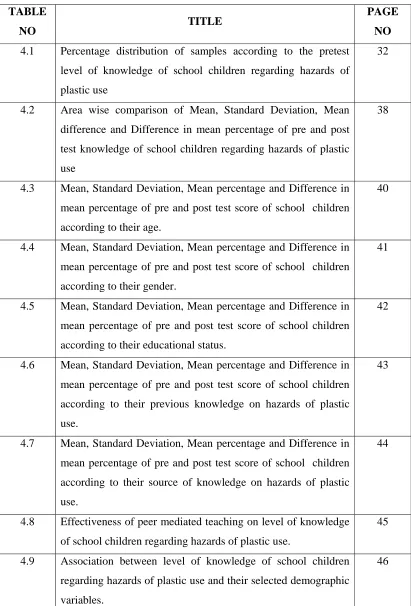
LIST OF TABLES
TABLE
NO TITLE
PAGE NO 4.1 Percentage distribution of samples according to the pretest
level of knowledge of school children regarding hazards of plastic use
32
4.2 Area wise comparison of Mean, Standard Deviation, Mean difference and Difference in mean percentage of pre and post test knowledge of school children regarding hazards of plastic use
38
4.3 Mean, Standard Deviation, Mean percentage and Difference in mean percentage of pre and post test score of school children according to their age.
40
4.4 Mean, Standard Deviation, Mean percentage and Difference in mean percentage of pre and post test score of school children according to their gender.
41
4.5 Mean, Standard Deviation, Mean percentage and Difference in mean percentage of pre and post test score of school children according to their educational status.
42
4.6 Mean, Standard Deviation, Mean percentage and Difference in mean percentage of pre and post test score of school children according to their previous knowledge on hazards of plastic use.
43
4.7 Mean, Standard Deviation, Mean percentage and Difference in mean percentage of pre and post test score of school children according to their source of knowledge on hazards of plastic use.
44
4.8 Effectiveness of peer mediated teaching on level of knowledge of school children regarding hazards of plastic use.
45
4.9 Association between level of knowledge of school children regarding hazards of plastic use and their selected demographic variables.
[image:8.612.123.534.96.702.2]LIST OF FIGURES FIGURE
NO TITLE
PAGE NO 1.1 Conceptual Framework based on J.W.Kenny’s Open System
Model for Peer Mediated Teaching on Level of Knowledge of School Children Regarding Hazards of Plastic use.
8
3.1 Schematic Representation of Research Methodology. 19 4.1 Percentage distribution of school children according to their
age.
27
4.2 Percentage distribution of school children according to their sex.
28
4.3 Percentage distribution of school children according to education.
29
4.4 Percentage distribution of school children according to their previous knowledge on hazards of plastic use.
30
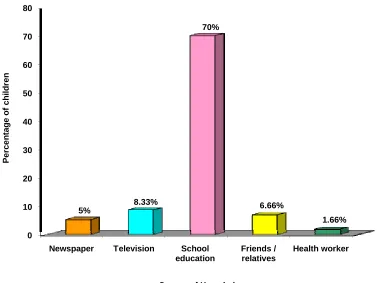
4.5 Percentage distribution of school children according to the Source of Knowledge.
31
4.6 Percentage distribution of school children according to their pre and post test level of knowledge regarding hazards of plastic use.
33
4.7 Line graph showing comparison between pre and post test knowledge of school children regarding hazards of plastic use.
34
4.8 O-Give curve showing comparison between pre and post test knowledge of school children regarding hazards of plastic use.
LIST OF ANNEXURES
ANNEXURE. TITLE PAGE
NO. A. Letter seeking permission to conduct a research study. i
B. Letter granting permission to conduct a research study. Ii
C. Letter requesting opinion and suggestion of experts for
content validity of the research tool. Iii
D. Tool for data collection and scoring key. iv
E. Lesson Plan. xxii
F. Flash cards. xxxvii
G. Certificate of validation. xlvi
H. List of Experts. xlvii
I. Certificate of editing. xlviii
ABSTRACT
A Study was done To Assess the Effectiveness of Peer Mediated Teaching on Knowledge regarding Hazards of Plastic use among School Children in a Selected School, Salem. A quantitative evaluative research approach with pre-experimental (one group pre test post test) design was conducted among 66 school children in 5th and 6th standard, who were selected by Non probability convenience sampling technique from Government Elementary School, Palampatti, Salem. Data was collected from 11.7.2011 to 07.08.2011. A closed ended questionnaire was used to assess the knowledge of the school children and based on the pre test scores the top 6 children were selected as the peer educators and were taught about the hazards of plastic use by the investigator and they in turn taught their peer group from the next day onwards under the direct supervision of the investigator. On the 7th day post test was conducted to assess the knowledge of the school children on hazards of plastic use. Data was analyzed by using descriptive and inferential statistics.
CHAPTER I INTRODUCTION
“Thank God, Men Cannot Fly and Lay Waste the Sky as Well as the Earth” - Henry David Thoreau Man was in search of luxury in life and wanted something that would make his life more comfortable. In this progress he invented plastic. Plastic bags are so light and strong that they can carry normal weight, they are cheap and can be used in all types of shops like bakeries, medical shops, grocery stores, hotels, etc in our daily life. People are so used to it, that they find it very difficult to part with it. Plastic was then used in large scale and started to replace natural resources like jute. (Stein R.S, 2002)
Plastic bags have made it possible for people to go without bags to the market or to work place as these bags are available when for asking and can be thrown without a second thought. The next time you do shopping and carry home the things in a cute, comfy plastic carry bag, think you are contributing your share to a deadly pollution whose ill effects are irreversible and capable of reaching out to numerous generations to come. ( Thomas Ann, 2006)
Reviewing close to 700 studies, the scientists determined that people are regularly exposed to Bisphenol A (BPA) levels that exceed those harmful to lab animals, singling out infants and foetuses as the most vulnerable. National Institute of Health conducted a study and found at uterine damage caused by BPA exposure in newborn animals which is predicted to host of reproductive disorders in women.
(Elton Jeremy, 2008)
"Stop Using Plastics, and create a greener environment". Plastic bags and bottles, like other types of plastic, create significant environmental and economic burdens. They use huge amounts of energy and other natural resources, degrading the environment in numerous ways. In addition to using up fossil fuels and other resources, plastic products generate waste, hurt marine life, and threaten the basis of life on earth. There is over 45 million tons of plastic wastes per year, a trivial fraction of which is getting recycled. All of us can take some steps that can take to reverse the tide of toxic, non-biodegradable pollution so that it will not overtake our planet. (Karmayog, 2011)
Chemical contamination in the environment affecting public health is increasing in number of communities across the world. The role of the community health nurse is vital in creating awareness to public about the hazards of the environmental pollutants. (Yadav, 2002)
Need for the Study
The concept of peer mediated or child to child teaching was started in the Institute of child health, London. Peer approach is a powerful idea. It rests on the belief that children can have the skill and the motivation to educate and assist to each other and can be trusted and encouraged to do so. This is a radically new view of the potential for education. Such helping and caring activities are called child to child activities. So this programme will change one’s views of the educational processes and systems we have. It helps the child to make learning a relevant meaningful and enjoyable experience for the children. It enables the children in making qualitative improvements in the life of their siblings, parents, and neighbors. Schools must make fundamental changes in the way children learn. (David Morley, 2009)
The number of children being enrolled in schools has increased considerably over 2009 .In India 96.5% of children between 6-14 years are enrolled in schools while in Tamilnadu the rate has increased from 19.6% in 2004 to 25% in 2011. (Annual Survey Report, 2011)
The World Wide Fund for Nature 2010 reported that, roughly 1.5 million tons
of plastic are expended in the bottling of 89 billion liters of water cans each year.
(Mumbai Times, 2010)
Plastic bags are destructing the life of India and that’s just how the plastic industry wants it. Non degradable plastic bags are poisoning and clogging up India’s towns and cities. But solutions are hard to come by largely due to political influence of India’s plastic industry. ( Robert Edwards, et.al., 2009)
bags sometimes even die. Plastic goes into the ocean which is already a plastic infested body of water ways, sea animals misunderstanding plastic garbage as food items and swallow them. ( Krishnamoorthy.V, 2009)
Plastic bags have harmful effects on soil, air and water. Plastic causes infertility of the soil and also helps the bacteria to flourish, when burnt it lets out noxious flames and poisonous gases and also has disastrous effects on the species living underwater. Plastic which are picked up from garbage’s are recycled but they retain a lot of bacteria which cannot be destroyed at all. (The International Rice Research Institute, 2009 )
Childhood is the prime time of life, children explore and learn many things around them and they try to impart many things into practice. Peers and friends are also an important asset for the children. Children are the future adults. They can very well be stated as the miniature adult. As responsible adults we need to preserve the beauty of the environment with a safe atmosphere for the future generations. Concerning children’s environmental health, the expanded role of the nurse includes a wide range of activities, such as anticipatory guidance, health education, mass health campaigns, school health programs and environmental health research. Education aims at behaviour modification and peer influence makes it more influential hence teaching the little children about the hazards of plastic use and its prevention we can help them to bring about changes and thereby have a safer and greener world to live in.
Statement of the Problem
Objectives
1. To assess the existing knowledge on hazards of plastic use among school children.
2. To determine the effectiveness of peer mediated teaching on the knowledge regarding hazards of plastic use among school children.
3. To associate the knowledge regarding hazards of plastic use among school children with their selected demographic variables.
Operational Definitions Effectiveness:
Significant gain in knowledge of school children regarding hazards of plastic use as determined by significant difference in pre and post test scores measured using a closed ended questionnaire.
Peer Mediated Teaching:
It is a program where trained students teach the students of the same age group on hazards of plastic use using flash cards.
School Children:
Children studying in the selected school between 10 to 12 years of age group. Assumption
1. School children may have some knowledge on hazards of plastic use. 2. Knowledge will vary from individual to individual.
3. Peer mediated teaching may have some effect on the knowledge of hazards of plastic use among the school students.
Hypotheses
H2: There will be a significant association between the level of knowledge of school children regarding hazards of plastic use and their selected demographic variables at P < 0.05 level.
Delimitations
The study will be limited to
1. Children in the age group of 10 – 12 years.
2. School children available at the time of data collection at a selected school Salem.
3. Data collection period is limited to 4 weeks. Projected Outcome
This study was conducted to assess the effectiveness of a peer mediated teaching on knowledge regarding hazards of plastic use among school children. Findings of this study will help the nurses practicing in the community during the school health programme to create awareness in the little minds and to make a better earth for the future children.
Conceptual Framework
Conceptual framework is a type of intermediate theory that has the potential to connect all aspects of enquiry. They take different forms depending upon the research question of problem.
Input:
Input can be matter, energy and information from the environment. In the present study the environment refers to school setup and input refers to the collection of demographic data from samples and assessing the level of knowledge on hazards of plastic use by using questionnaire.
Throughput
The matter, energy and information are continuously processed through the system which is also called complex transformation, known as throughput process is used for input (i.e.) energy and information for the maintenance of homeostasis of system. It refers to the different operational products in the overall programme implementation and includes factors that facilitate or block implementation at various stages. In the present study the throughput refers to pre test, education to the peer educators, peer mediated teaching to the recipients and post test.
Output
After processing the input and throughput, the system returns to the output matter, energy and information to the environment in an altered state. Change is a feature of the process that is observable and measurable as output which should be different from that which is entered into the system. In the present study gain in level of knowledge regarding hazards of plastic use is considered as output.
Feedback
FIGURE- 1.1: CONCEPTUAL FRAMEWORK BASED ON J.W.KENNY’S OPEN SYSTEM MODEL FOR PEER MEDIATED TEACHING ON LEVEL OF KNOWLEDGE OF SCHOOL CHILDREN REGARDING HAZARDS OF PLASTIC USE DEMOGRAPHIC
VARIABLES
• Age
• Gender
• Educational status
• Previous knowledge on hazards of plastic use
• If yes, source of knowledge
INPUT
• Closed ended questionnaire
• Flash card on hazards of plastic
Hazards of plastic use in human beings
Hazards on costal region
Hazards in the environment
Hazards for animals
Preventive aspects of hazards of plastic use
THROUGHPUT
• Pretest
• Teaching on hazards of plastic use to peer educators
• Peer educators teach their peers using the same flash cards
• Posttest OUTPUT Posttest knowledge score Adequate Moderately adequate Inadequate
Difference in mean percentage (Y – X = E) Testing hypothesis
Key
Summary
CHAPTER II
REVIEW OF LITERATURE
This chapter presents review of related literature relevant to the present study. Review of literature is an important step in the development of the research project in broadening, understanding and developing an insight into the problem area. It further helps in the problem fits, methodology instruction of tool, development of evaluative approach and analysis of data.
Literature was reviewed theoretically, empirically and is organized under the following headings,
• Literature related to hazards on plastic use.
• Studies related to hazards on plastic use.
• Literature related to peer mediated teaching.
• Studies related to peer mediated teaching.
Literature Related To Hazards On Plastic Use:
The hazards that plastics pose are numerous. The land gets littered by plastic bags, and the plastic wastes present an ugly and unhygienic seen. The "Throw away culture" results in these bags getting in to the city drainage system and blocking the drains causing inconvenience, difficult in maintaining the drainage with increased cost, creates unhygienic environment resulting in health problems and spreads diseases. These water also reduces rate of rain water percolating, resulting in lowering of already low water levels everywhere. The fertility of soil deteriorates as the plastic bags from part of manure remains in the soil for years. (Bhatia, 2009)
producing plastic materials also release plastic waste materials into the land and water sources.Plastic causes many setbacks for human beings and environment by creating an unaesthetic appearance in the public places and residential areas. They re lightweight and hence fly and land in garbage’s and drains and thereby causing distress during monsoon. the colouring element of plastics even disperse in to the ground water and contaminate it. (Kamala V, 2009 )
Amidst the 47 chemical plants ranked highest in carcinogenic emissions by the Environmental Protection Agency (EPA), 35 are said to be involved in plastic production. Certain plastics such as polyvinyl chloride (PVC), used for indoor and outdoor plumbing, electrical cables and countless other products. The municipal incinerators and fire accidents are potential sources of the highly toxic dioxin. Polystyrene foam products are often made with chlorofluorocarbons (CFCs) and hydro chlorofluorocarbons (HCFCs), both of which are dangerous to the ozone layer. (Chandresekar Sunil, 2009)
When burned, plastic releases lots of poisonous chemicals into the air, including dioxin, the most poisonous substance known to science. Apart from these troubles, recycling of plastic is very harmful uneconomical, dirty and labour-intensive, this has been revealed by a study conducted by the Public Interest Research Group, based in Delhi, India. Recycling of plastic causes skin and respiratory problems, resulting from exposure to and inhalation of these toxic fumes, especially hydrocarbons and residues released during the process of manufacturing plastics. What is worse, the recycled plastic degrades in quality and requires the production of more new plastic to make the original product. (Yadav Kumar, 2005)
“Plastics” derived their name from their properties to be transformed into a variety of forms, including solid objects, films and toys. These properties arise from their chemical structure. Plastics are polymers with very long chain molecules that further have subunits (monomers) linked together by chemical bonds. The components of plastics are inorganic materials such as styrene and are not biodegradable. (V.Krishnamoorthy, 2003)
Studies Related To Hazards On Plastic Use
A descriptive study about the hazards of plastics to the marine environment was conducted at South America and the findings (90%) reveal that the marine life is at the peak of destruction due to the tons of plastics that are thrown as wastes into the seas. (Kurdi, 2006)
A quantitative study at Boston was conducted to determine the incidence and severity of plastic hazards among industrial workers in a polymer factory. 90 samples were collected over a period of 12 months. The investigator concluded that multiple hazards such as skin (6.5 +0.87) and gastric problems (7.33+1.27) can arise with the use of plastic polymers. (Campbell, 2004)
A descriptive study was conducted about the incidence of complications and their potential risks of hazards of plastics among 72 workers of a factory at Houston. Convenience sampling was used to select the samples. Data analysis was done using descriptive and inferential statistics. Results revealed that about (6.2 +2.48) 15.4% of them developed skin disorders. (Horwood, 2003)
A study was conducted to assess the effectiveness of peer mediated teaching using videos on plastic hazards at Tokyo among 88 students at a junior college and concluded that the peer mediated teaching was more effective (t=3.19 at P<0.001 level) in creating awareness on hazards of plastic use. (Gluk, 2002)
Literature Related To Peer Mediated Teaching.
School-based peer mediation program is one of the most popular and effective approaches to implement the practice of conflict resolution into schools. From the beginning of the modern “conflict resolution in education” (CRE) movement in the early 1980’s, peer mediation has been one of its masterpieces. Many thousands of schools around the globe have implemented peer mediation programs, and these efforts serve almost every conceivable student population (Bethesda, 2010)
taught roles in the instructional episode, to be systematic, elicit responses, and provide feedback. Research supports the use of these approaches as alternative practice activities, however it does not condone the use of peers for providing instruction in “new” instructional content. (Hall Tracey, et.al., 2009)
Peer-mediated interventions have several advantages. A well set up intervention mediated by a peer can free up the teacher to engage in other teaching activities. Instead of cueing and delivering feedback to target students, teachers can focus on academic tasks, help other students in need, or simply have uninterrupted teaching time. Students with a peer support plan actually receive an increase in individualized attention, especially when partnered with a same age appropriate peer. Well-trained peer mediators actually allow the target student to receive more immediate feedback, more often as the mediator is often assigned one student and a teacher usually has several to monitor at one time. Additionally, when the target student is assigned several peer mediators across settings, maintenance and generalization of social skills being reinforced is more likely. (DuPaul, et.al., 2009)
Students respond to peer feedback more often than an adult initiated contact in intermediate grades and up. Educators have utilized role reversal interventions where a student who may have behavioral issues acts as a mentor or tutor for a younger student with promising results. Because this capitalizes on the tutor’s strengths and promotes responsibility, positive behavioral changes occur through the reverse role tutoring. (Criscitiello, et.al., 2008)
approaches according to peer expectancies to promote interaction: (a) manipulation of the situation or contingencies, (b) peer instruction in social interaction strategies, and (c) instruction of target child in initiation strategies. (Oswald, et.al., 2003)
Child to child work is based on the belief that children, a large proportion of the world’s citizens, can play a positive role in raising the health of the others and by doing so improve their own knowledge and self belief and develop attitudes of caring responsibility for others. (Patrica Pridome, 2002)
Studies Related To Peer Mediated Teaching
An evaluation study was conducted to evaluate the effectiveness of child to child programme on level of knowledge regarding prevention of worm infestation among 40 school children selected by simple random sampling in a selected school at Salem. The calculated ‘t’ value was 26.72 which is highly significant at P<0.001 level which shows that, child to child programme was effective in increasing the knowledge of the school children. (Malarvizhi, 2010)
An ethnographic study on health education with reference to peer mediated teaching was conducted at a selected school in Lucknow. The purpose of the study was to identify specific application of the peer mediated approach in promoting health education among school children. The results (t = 30.12 at P<0.05 level) indicated that the peer mediated teaching approach can be applied to primary school children to enable pupil to translate the health education knowledge (13.13+1.09) gained at classroom into health promoting practices (18.42+1.16) both at home and at school.(Chada.M.Gupta, 2008)
Peer educators were given training on healthy habits. Children in the intervention group had shown greater gain in the mean knowledge 30.33 than children of the control group with a mean knowledge 21.40. it also revealed that peer mediated teaching was effective (t=3.72 at p<0.001 level). (Stowell Joe, 2007)
An experimental study was conducted to assess the effectiveness of peer to peer approach in promoting the learning efficacy among school children between 6-12 years of age studying at the Vasantham School, Chennai. Quasi experimental study was used and 50 samples were selected. Organized training was given to peer educators. The mean improvement of the level of knowledge mean score, 17.74+0.69 (61.10%) was highly significant at p<0.05 level and thereby peer to peer approach showed a definitive improvement. (Swarnakumari, 2005)
A two group simple randomized experimental study was conducted to assess the effectiveness of child to child programme on worm infestation among primary school children at a selected school in Coimbatore. 50 samples were selected randomly from fifth and sixth standard. The study findings revealed that the paired ‘t’ test value for the experimental group was 4.66 and the control group was 4.75 at 5% significant level. The effectiveness of child to child programme was also proved with ‘z’ score (z=3.3 at P<0.05 level). This shows that there was a significant difference between the knowledge scores of children in experimental and control group and child to child programme was an effective approach in increasing the knowledge of the school children. (Nagalakshmi, 2004)
and posttest knowledge scores were analyzed using descriptive and inferential statistics, (t=4.12 at p<0.05 level) which indicated that children revealed more positive attitude with a higher difference in mean percentage of 64% after the peer mediated teaching. (Anjela, 2003)
An evaluative study was conducted to create better schools for 200 extraordinary students in which the investigator noted that, peer group plays an important role in child socialization and acceptance by peers can help a child to become well adjusted to the school environment. The investigator also emphasized that classmates usually help each other to resolve big and small problems. (Deepti Agarwal., 2002)
There is a vast area of research literature in the areas of peer mediation and tutoring. A meta-analysis on peer mediated teaching was conducted at Armenia, in which over 900 studies on social interdependence were analyzed. It was found that, 164 studies evaluated the impact of a peer mediated teaching procedure on student achievement and concluded that peer mediated teaching had better outcome. (Stanne, et.al., 2002)
Summary
CHAPTER III METHODOLOGY
The methodology of research indicates the general pattern of organizing the procedure for gathering valid and reliable data for the purpose of investigation. (Polit,
D.F, and Hungler, 2003)
The present study aims to assess the effectiveness of peer mediated teaching on knowledge regarding hazards of plastic use among school children in a selected school, Salem.
Research Approach
Quantitative evaluative research approach was used in this study. Research Design
Research design is a master plan specifying the methods and procedures for collecting and analyzing the needed information. (Basavanthappa. B.T, 2003)
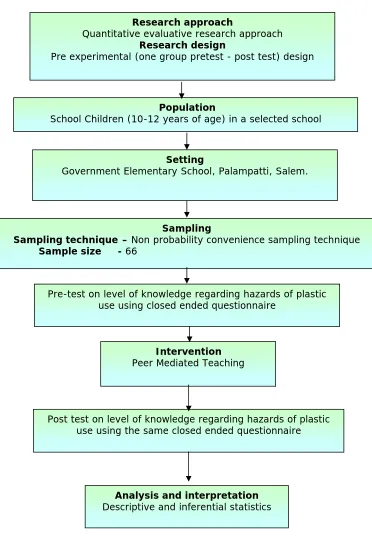
Pre experimental (one group pre test – post test) research design was adopted for this study.
E O1 X O2
E: Experimental group O1: Pre-test
Fig –3. 1: Schematic Representation of Research Methodology Population
School Children (10-12 years of age) in a selected school
Sampling
Sampling technique – Non probability convenience sampling technique Sample size - 66
Pre-test on level of knowledge regarding hazards of plastic use using closed ended questionnaire
Intervention Peer Mediated Teaching
Post test on level of knowledge regarding hazards of plastic use using the same closed ended questionnaire
Analysis and interpretation Descriptive and inferential statistics
Setting
Government Elementary School, Palampatti, Salem. Research approach
Quantitative evaluative research approach Research design
Population
Population is the entire aggregation of cases in which a researcher is interested. (Polit and Beck, 2004)
The population of this study were school children aged 10-12 years. There were 74 children studying in 5th and 6th standard in selected school.
Description of the Setting
Setting is the general location and condition in which data collection takes place for the study. (Polit, F.D, and Hungler. 2003)
The study was conducted in Government Elementary School, Palampatti, Salem. In this school there are classes from I st standard to VI th standard with a total of 212 students. In the V th and VI th standard there were 74 students. It is 7 km away from Sri Gokulam College of Nursing, Salem. This school was selected based on,
1. Geographical proximity 2. Availability of subjects
3. Economy of time and money access
4. Feasibility in terms of cooperation extended by the headmistress, the school teachers and the school children
Sampling
Sampling is the process of selecting a portion of the population to represent the entire population. (Polit and Beck, 2004)
Sample
Sample size
The sample size was 66 school children from Government Elementary School, Palampatti, Salem.
Sampling technique
Sampling refers to the process of selecting the portion of population to represent the entire population. (Polit, D.F, and Hungler, 2003)
Non-Probability convenience sampling is also known as accidental sampling. The major reason is administrative convenience and the sample is chosen with ease of access being the sole concern. Non-Probability convenience sampling technique was adopted for selecting the samples for the study. The samples were selected based on the availability.
Criteria for Sample Selection Inclusion criteria
• Children between 10 – 12 years of age
• Available during data collection period
• Willing to participate in the study
Exclusion criteria
• Children in the educating peer group
Variables
Independent variable: Peer Mediated Teaching Dependent variable: Knowledge on hazards of plastic use Description of the tool
Section-A
It consists of demographic variables such as age, sex, educational status, previous knowledge on hazards of plastic use, if yes the source of previous knowledge.
Section-B
It consists of knowledge items regarding hazards of plastic use under two major divisions such as General aspects on hazards of plastic use and common hazards of plastic use which is further split into 5 sections like hazards on human beings, Hazards on coastal region, Hazards on environment, Hazards on animals and Preventive aspects of hazards of plastic use.
Scoring procedure for level of knowledge
Totally there were 22 items in which general information of hazards of plastic use had 6 items and Hazards on human beings had 4 items, Hazards on coastal region had 3 items, Hazards on animals had 2 items, hazards on environment had 4 items and Preventive aspects had 3 items. Each item had four options of which one is the correct response. All the correct answers were given the score of one and the wrong answers were given the score of zero. The total score for each sample was calculated, converted into percentages and interpreted as follows
Level of knowledge Score Percentage
Inadequate
Moderately adequate Adequate
0 – 7 8 – 14 15 – 22
Validity and Reliability Validity
Validity refers to the degree to which an instrument measures what is supposed to be measured (Polit and Hungler, 1998).
The questionnaire constructed by the investigator was sent along with statement of the problem, objectives and hypothesis to 8 experts in the field of Medicine and Nursing (1 Pediatrician, 1 Public Health Medicine Expert, 4 Child Health Nursing Specialists, 1 Community Health Nursing Specialists) for validating the tool. Minor modifications were given and incorporated. The tool was translated to Tamil with the help of language experts. Retranslation of the tool was done to establish language validity.
Reliability
Reliability refers to the degree of consistency or dependability with which an instrument measures an attribute. (Polit and Hungler, 1998).
Reliability of the tool was established by split half method. It was found r1=0.9 which showed that the tool was reliable.
Pilot Study
questionnaire. The tools administered were checked for its feasibility, language and appropriateness. The children chosen were similar in characteristics to those of the population under the study. The time taken for teaching was 30 minutes. The tool was found feasible, practicable. It also helped to select suitable statistical method.
Method of Data Collection Ethical consideration
The permission was obtained from Assistant Elementary Educational Officer, Veerapandi, Salem to conduct the study. The study was conducted in Government Elementary School, Palampatti, Salem. The investigator visited the school and got permission from Headmistress and selected the school children who are meeting the inclusion criteria. The verbal consent was obtained from the school children to participate in this study.
Period of data collection
The data collection was done over a period of 4 weeks from 11.07.2011 to 07.08.2011.
Data Collection Procedure
The investigator selected 66 children from 5th and 6th standard students through Non probability convenience sampling technique. Good rapport was maintained with the children. The pre test was conducted with the help of questionnaire to assess the level of knowledge of school children regarding hazards of plastic use which took about 30 minutes.
educator taught to their 10 assigned students. The time taken to conduct one peer mediated teaching was 30 minutes. The post test was conducted on 7th day after peer mediated teaching.
Plan for Data Analysis
Data will be collected, arranged and tabulated. Frequency and percentage distribution will be used for demographic variables. Paired ‘t’ test will be used to evaluate the effectiveness of peer mediated teaching. Chi-square test will be used to associate the level of knowledge of school going children and their selected demographic variables.
Summary
CHAPTER IV
DATA ANALYSIS AND INTERPRETATION
Analysis is the process of organizing and synthesizing in such a way that question can be answered and hypothesis tested. (Polit & Hungler, 2003)
This chapter deals with analysis and interpretation of data collected to evaluate the effectiveness of peer mediated teaching on level of knowledge of school children regarding hazards of plastic use, Salem.
The findings are presented under the following sections Section-A:
Distribution of school children according to their demographic variables. Section-B:
Pre test level of knowledge of school children regarding hazards of plastic use. Section-C:
a) Comparison of pre and posttest level of knowledge of school children regarding hazards of plastic use.
b) Area wise comparison of Mean, SD, Mean percentage and difference in mean percentage of pre and post test knowledge of school children regarding hazards of plastic use.
c) Comparison of Mean ,SD, Mean percentage and difference in mean percentage of pre and post test knowledge scores of school children with their selected demographic variables.
Section-D: Hypotheses Testing
a) Effectiveness of peer mediated teaching on knowledge of school children regarding hazards of plastic use.
Section-A
[image:38.612.166.428.137.342.2]Distribution of school children according to their demographic variables
Fig-4.2. Percentage distribution of school children according to their sex
Fig-4.4: Percentage distribution of school children according to their previous knowledge on hazards of plastic use
0 10 20 30 40 50 60 70 80
Newspaper Television School
education Friends / relatives Health worker 5% 8.33% 70% 6.66% 1.66% P e rc e n ta g e of c h il dr e n
[image:42.612.136.514.109.392.2]Source of Knowledge
Fig-4.5: Percentage distribution of school children according to the Source of Knowledge
Section-B
[image:43.612.121.517.268.385.2]Level of knowledge of school children regarding hazards of plastic use before administration of peer mediated teaching
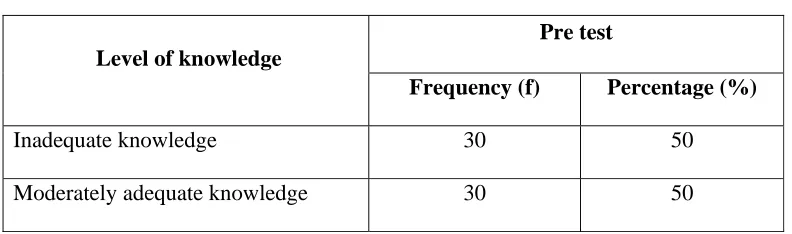
Table-4.1:
Percentage distribution of samples according to the pretest level of knowledge of school children regarding hazards of plastic use
n=60
Level of knowledge
Pre test
Frequency (f) Percentage (%)
Inadequate knowledge 30 50
Moderately adequate knowledge 30 50
Section-C
[image:44.612.140.520.177.455.2]a) Comparison of Pre and Post test level of Knowledge of School children regarding Hazards of Plastic use.
Fig-4.6: Percentage distribution of school children according to their pre and post test level of knowledge regarding hazards of plastic use
Line graph showing the comparison of pre and posttest knowledge shows that the lowest score of pretest is below 4, where as for posttest, it is below 16, During pre test highest percentage (31.66%) of children’s score ranged between 6 -8 where as during the posttest 40% of children’s score ranged between 16 – 18. Further the lowest score of post test is higher than the highest score of pre test.
Fig. 4.8: O-Give curve showing comparison between pre and post test knowledge scores of school children regarding hazards of plastic use.
Knowledge Score
Cum
u
lative Pe
rce
nta
g
O-give curve showing the comparison of pre and posttest cumulative percentage of knowledge among school children about hazards of plastic use shows that O-give curve of posttest score lies to the right of the pretest scores over the entire range, showing that the posttest scores are higher than pretest scores.
Table 4.2:
b) Area wise comparison of Mean, Standard Deviation, Mean difference and Difference in mean percentage of pre and post test knowledge of school children regarding hazards of plastic use.
n=60 Sl. No Areas Of Knowledge Max. score
Pretest Posttest Difference
in mean percentage Mean S.D Mean
%
Mean S.D Mean %
1 General Hazards 6 3.13 1.09 52.17 5.17 0.62 86.17 34 2 Hazards on
Human Beings 4 2.13 0.93 53.25 3.45 0.62 86.25 33 3 Hazards on
Coastal Areas 3 0.75 0.6 25 2.47 0.50 82.23 57.23
4 Hazards on
Environment 4 1.1 0.82 27.5 3.32 0.65 83 55.5
5 Hazards on
Animals 2 0.43 0.53 21.5 1.6 0.56 80 58.5
6 Preventive
Aspects 3 0.4 0.72 24 2.35 0.73 78.33 54.33
Overall 22 7.11 0.99 32.31 18.35 0.04 83.40 51.09
The above table shows that during pretest the highest mean score (2.13±0.93)
which is 53.25% of the maximum score was obtained in the area of “Hazards on
human beings” where the post test mean score was also highest (3.45±0.62) revealing
a lowest difference in mean percentage(33%).However highest difference in mean percentage (58.5%) was obtained in the area of “Hazards on animals” might be due to
lowest pre test mean score (0.43±0.53) which is 21.5% of maximum score. More or
coastal areas” (57.23%), “Hazards on environment” (55.5%) and “Preventive aspects” (54.33%) where the pre and post test mean scores were also more or less similar.
Further the overall pre test mean score was 7.11±0.99 which is 31.3% and the
post test mean score was 18.35±0.04 which is 83.4% revealing a difference of
c) Comparison of Mean, Standard Deviation, Mean percentage and Difference in mean percentage of pre and post test score of school children regarding hazards of plastic use with their selected demographic variables
Table 4.3:
Mean, Standard Deviation, Mean percentage and Difference in mean percentage of pre and post test score of school children according to their age.
n=60
Age (in years)
No. of samples
Pre test Post test- Difference
in mean% Mean S.D Mean
%
Mean S.D Mean %
10-11 39 7.59 1.82 34.5 18.28 1.53 83.09 48.59
11-12 21 6.62 1.96 30.09 18.42 1.6 83.72 53.63
Overall 60 7.11 0.99 32.31 18.35 0.04 83.40 51.09
The above table shows that, during pre test a higher mean score (7.59±1.82)
which is 34.5% of the total score was obtained by children in 10-11 years age group when compared to children in 11-12 years age group who obtained a mean score of
6.62±1.96 which is 30.09%. However during post test, the mean scores of children in
10-11 years (18.28±1.53) and 11-12 years (18.42±1.6) were more or less similar with
Table 4.4:
Mean, Standard Deviation, Mean percentage and Difference in mean percentage of pre and post test score of school children according to their gender.
n=60
Gender No. of samples
Pre test Post test- Difference
in mean% Mean SD Mean% Mean SD Mean%
Male 26 7 2.06 31.81 18.42 1.48 83.72 51.91
Female 34 7.44 1.81 33.81 18.26 1.59 83 49.19
Overall 60 7.11 0.99 32.31 18.35 0.04 83.40 51.09
The above table shows that, during pretest the more or less similar mean score
of 7.44±1.81, which is 33.81% and 7.0± 2.06, which is 31.81% of the total score was
obtained by female and male children respectively. During posttest also the mean
scores of male children (18.42±1.48) which is 83.72% and female children 18.26 ±
Table 4.5:
Mean, Standard Deviation, Mean percentage and Difference in mean percentage of pre and post test score of school children according to their educational status.
n=60
Educational status
No. of samples
Pre test Post test- Difference
in Mean %
Mean SD Mean
% Mean SD
Mean %
5thstd 29 7.31 1.76 33.22 18.03 1.63 81.95 48.73
6thstd 31 7.19 2.08 32.68 17.93 5.17 81.5 48.82
Overall 60 7.11 0.99 32.31 18.35 0.04 83.40 51.09
The above table shows that, during pretest more or less similar mean score of
7.31±1.76 which is 33.22% 7.19±2.08 which is 32.68% of the total score was
obtained by children studying 5th and 6th standard respectively.
During posttest also the mean score of children studying in 5th standard
18.03±1.63, which was 81.95% of the total score and children in 6th standard which is
17.93±5.17 were more or similar with difference in mean percentage of 48.73% and
Table 4.6:
Mean, Standard Deviation, Mean percentage and Difference in mean percentage of pre and post test score of school children according to their previous knowledge on hazards of plastic use.
n=60
Previous knowledge
No. of samples
Pre test Post test- Difference
in mean%
Mean SD Mean
% Mean SD
Mean %
Yes 55 7.21 1.82 32.77 18.25 1.58 82.95 50.18
No 5 7.6 0.49 34.54 19.2 0.75 87.27 52.73
Overall 60 7.11 0.99 32.31 18.35 0.04 83.40 51.09
The above table shows that, during pretest more or less similar mean score of
7.21±1.82 which is 32.77% and 7.6±0.49 which is 34.54% of the total score was
obtained by children on previous knowledge on hazards of plastic use.
However, in posttest the mean score 19.2±0.75, which was 87.27% of the total
score was obtained by children who did not have previous knowledge when compared
to children who had previous knowledge with the mean score of 18.25±1.58 which
Table 4.7:
Mean, Standard Deviation, Mean percentage and Difference in mean percentage of pre and post test score of school children according to their source of knowledge on hazards of plastic use.
n=55 Source of knowledge No. of samples Pretest Posttest Difference Mean %
Mean SD Mean
% Mean SD
Mean %
Newspaper 3 7.33 1.27 33.31 18.33 1.73 83.31 50
Television 5 6.2 2.48 28.18 18 1.09 81.81 53.63
School education 42 7.45 2.01 33.86 18.35 1.63 83.40 49.54
Friends/relatives 4 6.5 0.87 29.55 18 1.22 81.81 52.26
Health worker 1 5 0 22.73 16 0 72.72 49.99
Overall 55 7.11 0.99 32.31 18.35 0.04 83.40 51.09
The above table shows that, during pretest a more or less similar mean score
of 7.45±2.01 which is 33.86% and 7.33±1.27 which is 3.33% of the total score was
obtained by children who gained information through newspapers and school education.During post test also the mean scores of children who gained information
from newspapers 18.33±1.73 which is 83.31% and through school education
18.35±1.63 which is 83.40% of the total score were more or less similar with a
Section-D Hypotheses testing
[image:56.612.125.524.259.503.2]H1: There will be significant difference between pretest and posttest knowledge scores of school children regarding hazards of plastic use at p < 0.05 level. Table-4.8:
Effectiveness of peer mediated teaching on level of knowledge of school children regarding hazards of plastic use.
n=60 Sl.
No Area of knowledge
Pretest Posttest t value
Mean SD Mean SD
1 General Hazards 3.133 1.096 5.166 0.615 13.33**
2 Hazards on Human Beings 2.125 0.925 3.45 0.622 15.38** 3 Hazards on Coastal Areas 0.75 0.600 2.466 0.503 11.2**
4 Hazards on Environment 1.1 0.817 3.316 0.650 13**
5 Hazards on Animals 0.433 0.532 1.6 0.558 13.22**
6 Preventive Aspects 0.4 0.717 2.35 0.732 18**
7 Overall 6.50 0.97 17.74 0.69 33.58**
** Highly Significant at p<0.001 level, df=59, table value=3.46
The above table shows that, highly significant difference found between pre and post test scores of level of knowledge in all the areas and in the overall level of knowledge.
H2: There will be significant association between the level of knowledge of school children regarding hazards of plastic use and their selected demographic variables at p < 0.05 level.
Table-4.9:
Association between level of knowledge of school children regarding hazards of plastic use and their selected demographic variables.
n = 60
S.No Demographic variables df Table
value
Pretest Posttest
χ2 χ2
1 Age in years 2 5.99 3.56 2.16
2 Sex 2 5.99 2.32 1.82
3 Educational 2 5.99 0.59 0.92
4 Previous knowledge on hazards of plastic use
2 5.99 0.22 0.62 5 Source of previous Knowledge 8 15.51 6.31 8.91 * Significant at p<0.05 level
Summary
CHAPTER V DISCUSSION
The aim of this study was to Assess the Effectiveness of a Peer Mediated Teaching on Knowledge regarding Hazards of Plastic use among School Children in Selected School, Salem.
Description of demographic variables
• Majority of the school children 39(65%) were in the age group of 10-11 years
and 21 children (35%) were in the age group of 11-12 years • Majority of the children 34(56.7%) were females.
• More or less similar percentage of children 31(51.66%) were in the sixth
standard and 29 (48.33% ) were in the fifth standard. • The school enrolment rate between the ages 7-13 is 98.6%
• Most of them 55(92%) had previous knowledge on hazards of plastic use
• Among the children who has previous knowledge on hazards of plastic use
(n=55), majority 42(70%) of them gained by school education. • The literacy rate in 2011 in Tamilnadu is 80.33%
To assess the existing knowledge on hazards of plastic use among school children.
The pre test level of knowledge regarding hazards of plastic use, shows that similar percentage of children 30(50%) had inadequate and moderately adequate knowledge and none of them had adequate knowledge.
showed that children had only a moderate level of awareness about hazards of plastic use.
To determine the effectiveness of peer mediated study on the knowledge regarding hazards of plastic use among school children
During post-test all of the children 60(100%) had adequate knowledge. Highly significant difference found between pre and post test scores of level of knowledge in all the areas and in the overall level of knowledge (t=33.58*). This reveals that peer mediated teaching was effective in increasing the knowledge regarding hazards of plastic use at P<0.001 level.
The present study was supported by Bhardwaj A.K., et.al, (2002) who conducted a study on peer mediated teaching a gainful experience in school children of Shimla. The samples were 189 students of 8th, 9th and 10th class, exposed to 10 selected topics of various vital facts. Pre test knowledge was very poor, only 7.7%. After peer mediated teaching the knowledge possession went to 68.9% and there was a clear increase of 61.2% knowledge among children. The peer mediated teaching at school was a gainful experience for the students.
To associate the knowledge regarding hazards of plastic use among school children with their selected demographic variables
The present study was supported by Lithner, (2011) at the University of Gothenberg, Sweden studied the knowledge of school children regarding harmful effects of plastics among high school students and found that there was no association on the level of knowledge and the selected demographic variables.
Summary
CHAPTER VI
SUMMARY, CONCLUSION, IMPLICATIONS AND RECOMMENDATIONS
This chapter consists of summary, conclusion, implications in nursing service, nursing education, nursing administration and nursing research and recommendations for further study.
Summary
A pre-experimental (one group pre test - post test) study was conducted at government elementary school, Palampatti, Salem to assess the effectiveness of peer mediated teaching on knowledge of school children regarding hazards of plastic use. J.W.Kenny’s Open System Model was used as the conceptual framework for the study. 66 children were selected by non probability convenience sampling technique and the top 6 peer educator were trained to teach their 60 peers. A closed ended questionnaire was used to assess the pre test and post test score on effectiveness of peer mediated teaching in increasing the level of knowledge of school children regarding the hazards of plastic use. The data were analyzed using descriptive and inferential statistics.
The Major Findings are summarized as follows, • 39(65%) were in the age group of 10-11 years.
• Majority of the children 34(56.7%) were females.
• 31(51.66%) were in the sixth standard.
• Most of them 55(92%) had previous knowledge on hazards of plastic use .
• Majority 42(70%) of them gained knowledge on hazards of plastic use by
• Distribution of children according to the pre test level of knowledge regarding
hazards of plastic use, shows that similar percentage of children 30(50%) had inadequate knowledge and moderately adequate knowledge and none of them had adequate knowledge.
• Distribution of school children according to their level of knowledge peer
mediated teaching depicts that, during post-test all of the children 60(100%) had adequate knowledge.
• Highly significant (P<0.001 level) difference found between pre and post test
scores of level of knowledge in all the areas and in the overall level of knowledge.
• There is no significant association between the level of knowledge of school
children and their selected demographic variables. Conclusion
Implications
The health of children reflects the prosperity of the nation. A large number of diseases could be prevented with little or no medical interventions if people are adequately informed about the likely complications and encouraged to take necessary precautions in time. The present study helps to prevent hazards of plastic use through peer mediated teaching.
Nursing practice
• All the students and teachers can be taught about hazards of plastic use in
order to enrich the knowledge.
• Use peer mediated teaching on other health habits such as personal hygiene,
oral hygiene, cleanliness of surroundings.
• School health nurses can teach the school children with the help of peer
mediated teaching on different aspects.
• Training programme can be arranged for school teachers in order to emphasize
the healthy life style to the students. Nursing education
• The students can be involved in health education process through peer
mediated teaching.
• Staff development programme can be arranged on peer mediated teaching
related to hazards of plastic use.
• Nursing students can make use of available literature and studies on methods
of conducting peer mediated teaching.
• Nurses can use various methods like role play, quiz, puppets show to teach the
Nursing administration
• The nurse administrator coordinates her work along with the school teachers,
to encourage them to teach the children in the schools.
• Nursing administrator should organize educational programme regarding
hazards of plastic use especially environmental sanitation.
• Nurse administrator can participate in formulating polices for implementation
of peer mediated teaching.
• Provide opportunities for school health nurse to attend training programme.
Nursing research
• Educational institution and service organization can motivate researchers for
implementing peer mediated teaching on various topics related to health of school children.
• The findings can be used as evidence based practice by school health nurse to
increase awareness among school children.
• Disseminate the research findings on effect of peer mediated teaching through
conferences, seminar and by publishing the article in nursing journals and national and international journals.
Recommendations
• A similar study can be conducted for a large sample to generalize the findings.
• A similar study can be done on various topics such as environmental
sanitation, accident prevention and personal hygiene through peer mediated teaching.
• A comparative study can be conducted between urban and rural school
children.
• A similar study can be done by using various teaching methods.
• A study can be conducted as child to family programme and child to
community programme. Summary
BIBLIOGRAPHY Books
• Basavanthappa, B.T. (1998). Community health nursing (1st edition.). NewDelhi:
Jaypee Brothers.
• Basavanthappa. B.T. (2003). Nursing Research (1st edition). NewDelhi: Jaypee Brothers.
• Bonita. E. Broyles. (2009). Clinical comparison for pediatric Nursing (1st edition) New York: Clifton Park.
• Caroline Bunker Rosdahl, Mary T.Kowalski. (2008). Textbook of basic nursing
(9th edition). Philadelphia: Lippincott Williams & Wilkins.
• Christinsan.P.J. and KennyJ,W. (1990). Nursing process application of conceptual models (3rd edition). Philadelphia: Mosby Company.
• Debra.L.Price, Julie F.Gwin. (2008). Pediatric Nursing and introductory text, (10th edition) St.Louis: Saunders/ Elsevier.
• Hiremath. (2006). Essentials of community medicine- A practical approach. (1st edition). New Delhi: Jaypee Brothers.
• HockenBerry.M.J. (2005). Wong’s Essentials of Paediatric Nursing (7th edition).
Missouri: Mosby Publication.
• Janice.E. Witchcock, et.al., (2010). Community health nursing: caring in action,
(1st edition). Toronto: Nelson education.
• Johnson, Joyce Young, et.al., (2010). Pediatric Nursing demystified, (1st edition).
New York: McGraw Hill Medical.
• Lundy.K.S. and Janes.S. (2003). Essentials of community based nursing. Singapore: Jones and Bartlett publishers.
• Lynn Betz, Linda.A. Sowden. (2008). Mosby’s pediatric nursing reference (6th edition). St. Louis : Mosby/ Elsevier.
• Mahajan. B.K. and Gupta, M.C. (1995). The text book of preventive and social medicine, (2nd edition). New Delhi: Jaypee Brothers.
• Marlow.D. (2007). Text book of pediatric nursing (6th edition). Philadelphia: Elsevier, a division of reed Elsevier India private limited.
• Mary Ann Cantrel. (2011). Schaum’s Outline of Pediatric Nursing. New York: McGraw Hill.
• Mary E. Muscari. (2005). Paediatric Nursing (4th edition). Philadelphia: Lippincott Williams & Wilkins.
• Mary Jo. (2008). Community health nursing, advocacy for population health (5th
edition). Upper Saddle River: Pearson Prentice Hall.
• Naomi E. Ervin. (2002). Advanced community health nursing practice; population
–focused care (1st edition). Upper Saddle River, N.J; Prentice hall.
• Park.K. (2009). Textbook of preventive and social medicine. Jabalpur: Bhanot
Banarsidas.
• Parthasarathy.A. (1999). IAP Text book of pediatrics (1st edition). New Delhi: Jaypee brothers.
• Polit and Hungler. (1999). Nursing research principles and methods (6th edition). Philadelphia: Lippincott.
• Sundar Rao, Richard. J. (1999). An introduction and biostatics annual for students in health science. India: Prentice Hall.
• Susan Clemenstone, et.al., (2002). Comprehensive Community Health Nursing (6th edition). St Louis: Mosby Publication.
• Tony Thompson and Peter Mathias. (1998). Standards and Learning disability
(2nd edition). London: Bailliere Tindall.
• Vidya Ratan. (2002). Hand book of preventive and social medicine (9th edition). New Delhi: Jaypee Brothers.
Journals
• Anjela. (2002). Peer influence on creating health awareness. Indian Journal of Pediatrics, 68, 568-572.
• Campbell. (2004). Plastic Hazards Among Industrial Workers. World Journal Of Environmental Pollution, 2, 55-61.
• Chade.M.Gupta. (2008). Assessing effectiveness of peer approach. Health action,
55, 25-28.
• Deepthi Agarwal. (2001). Creation Of Better Schooling. The Journal Of Mentally
Challenged, 42, 21-25.
• Freeman.R and Bunting.G. (2003). A child to child approach to promoting
healtheir snacking in primary school children; a randomized trail in Northern Ireland. Health Education, 103(1), 17-27.
• Gluk. (2001). A peer approach to hazards of plastic; a randomized trail in Tokyo.
Environmental Pollution, 103(1), 17-27.
• Horwood. (2003). Potential Risks Of Plastics. International Journal Of Environmental Pollution, 31(4), 277.
• Kurdi. (2006). Threat to Marine Life. Cutting Edge Research Papers, 12, 23-26. • Mishra.G. (2006). When child becomes a teacher- The child to child programme.
Indian Journal of Community Medicine, 31(4), 277.
• Nagalakshmi.E. (2004). Effectiveness of child to child programme on worm
infestation among primary school children in a selected School, Coimbatore.
Indian Journal of Holistic Nursing, 5(1), 25-28.
• Rayana. (2001). Child to child approach. Health action, 12, 23-26.
• Stowell Joe. (2007). Worm infestation and anemia a public health problem among
tribal pre-school children of Madhya Pradesh. Journal of communicable diseases, 34(2), 149-152.
• Velkoff. V.A. (1998). Women’s Education in India. Women of the world, 98-1(1),
22-24.
• Walveker .P.R., Naik. V.A., Wantamutte.A.S and Mallpur. M.D. (2006). Impact
on child to child programme on knowledge, attitude, practice regarding diarrhea among rural children. Indian Journal of Community Medicine,
31(2), 12-18. Unpublished Thesis
• Kalyani.J. (2008). A Study To Assess The Effectiveness Of Structured Teaching