THE ADOPTION AND IMPLEMENTATION OF BEST
PRACTICE IN BIOTECH INDUSTRY
JAMAL BIN TUKIMAN
UNIVERSITI TEKNIKAL MALAYSIA MELAKA
THE ADOPTION AND IMPLEMENTATION OF BEST PRACTICE
IN BIOTECH INDUSTRY
Thesis submitted in accordance with the requirements of the Universiti Teknikal Malaysia Melaka for the Bachelor Degree of Manufacturing Engineering in
Manufacturing Management
By
JAMAL BIN TUKIMAN
oval
UTeM Library (Pind.1/2007)
UNIVERSITI TEKNIKAL MALAYSIA MELAKA (UTeM)
BORANG PENGESAHAN STATUS TESIS*
JUDUL: THE ADOPTION AND IMPLEMENTATION OF BEST PRACTICE IN BIOTECH INDUSTRY.
SESI PENGAJIAN: 2007/2008
Saya JAMAL BIN TUKIMAN
mengaku membenarkan tesis (PSM/Sarjana/Doktor Falsafah) ini disimpan di Perpustakaan Universiti Teknikal Malaysia Melaka (UTeM) dengan syarat-syarat kegunaan seperti berikut:
1. Tesis adalah hak milik Universiti Teknikal Malaysia Melaka.
2. Perpustakaan Universiti Teknikal Malaysia Melaka dibenarkan membuat salinan untuk tujuan pengajian sahaja.
3. Perpustakaan dibenarkan membuat salinan tesis ini sebagai bahan pertukaran antara institusi pengajian tinggi.
4. **Sila tandakan (√)
SULIT
TERHAD
√ TIDAK TERHAD
(Mengandungi maklumat yang berdarjah keselamatan atau kepentingan Malaysia yang termaktub di dalam AKTA RAHSIA RASMI 1972)
(Mengandungi maklumat TERHAD yang telah ditentukan oleh organisasi/badan di mana penyelidikan dijalankan)
(TANDATANGAN PENULIS)
Alamat Tetap: NO.103, BLOK 5, FELDA LAKUM, 28500 LANCHANG, PAHANG. Tarikh:09/05/2008 Disahkan oleh: (TANDATANGAN PENYELIA) Cop Rasmi: Tarikh: _______________________
DECLARATION
I hereby, declared this thesis entitled “The Adoption and Implementation of Best Practice in Biotech Industry” is the result of my own research except as cited in
references.
Signature : ……… Author’s Name : Jamal Bin Tukiman
APPROVAL
This thesis submitted to the senate of UTeM and has been accepted as fulfillment of the requirements for the Degree of Bachelor of Manufacturing Engineering (Manufacturing Management) with Honours. The members of the supervisory committee are as follow:
………. Mr. Nor Akramin Bin Mohamad
Project Supervisor
Faculty of Manufacturing Engineering
Official stamp : ……….
ABSTRACT
This research is about the best practice in biotech sector in Malaysia. Best practice is a management idea which stated there is a technique, method, process, activity, incentive or reward that is more effective at delivering a particular outcome than any other technique, method, process, and others. However in Malaysia, there is not much research done in biotech industry and they also need the information on the practice that they need to adopt and implement. In recognition of the best practice, this project is to collect data on current practice that biotech industries are applying and to determine the best practice for adoption and implementation. To achieve the objectives, 67 set of questionnaires was distribute to collect and analyze the practice used in Biotech Company. The questionnaires are the core of this research which all the feedback analyzes are basically on the result from the questionnaires. The questionnaires were developed base on the current practice used, advantage, disadvantage, impediment and the successful of the practice implementation. Based on the analysis of the questionnaires, there are 4 practices which are 5S, Kaizen, TPM and Kanban that is highly used by Biotech Company. The findings on the study can be adopt or implement by biotech industry to improve manufacturing activities.
ABSTRAK
Kajian ini adalah mengenai ”amalan terbaik” di Malaysia di dalam sektor biotek. ”Amalan terbaik” adalah satu idea pengurusan di mana dinyatakan bahawa terdapat teknik, cara, proses, aktiviti, galakan atau ganjaran yang membuatkan lebih efektif dalam mengeluarkan hasil daripada cara-cara atau teknik yang lain. Walaubagaimanapun di Malaysia, kajian di sektor biotek adalah sedikit tetapi sektor ini juga memerlukan informasi mengenai amalan yang perlu diterap dan dilaksanakan. Dalam pengenalan “amalan terbaik” ini, projek ini akan mengumpulkan data tentang amalan yang diamalkan oleh industri biotek pada masa ini dan menentukan amalan terbaik untuk diterap dan dilaksanakan. Untuk mencapai objektif ini, sebanyak 67 set soalan telah diedarkan untuk mengumpul dan menganalisa amalan yang digunakan oleh syarikat biotek. Set soalan ini adalah teras kepada kajian ini di mana semua maklum balas yang dianalisa adalah jawapan daripada set-set soalan yang telah diedarkan. Soalan-soalan ini dibina berdasarkan amalan yang digunakan pada masa ini, kelebihan, kelemahan, halangan dan keberjayaan amalan tersebut dilaksanakan. Berdasarkan analisis daripada se-set soalan yand diedarkan, empat amalan aitu 5S, Kaizen, TPM, dan Kanban adalah yang digunakan paling tinggi oleh syarikat biotek. Hasil perolehan daripada kajian ini boleh diterap atau dilaksanakan oleh industri biotek untuk memajukan lagi aktiviti pembuatan.
DEDICATION
ACKNOWLEDGMENTS
Firstly of all I would like to thankful to Allah S.W.T that was give me permission to complete and finish my Final Year Project. Allah have gives me life and chance to do the job that was given to me. Next, I want to regard my thankful to my family for their support and give me spirit in doing these jobs. With bless of them, I was complete my thesis and do the task.
Then, with my great respect, I would like to thank Mr. Nor Akramin Bin Mohamad who has excellently supervised me, given good and existing suggestions and criticism to the process of the work and motivate me in a good way which makes me improve in this study.
Not forgotten, I would like to thank to all my friends for continuously supporting, motivating and helping me in completing this study.
Lastly, to all people that involve in this study, thanks for your cooperation and kindness.
TABLE OF CONTENTS
Declaration... i
Approval ...ii
Abstract ...iii
Abstrak... iv
Dedication... v
Acknowledgement ... vi
Table of Contents...vii
List of Figures ...xii
List of Tables ...xiii
List of Abbreviations, Symbols, Specialized Nomenclature ... xv
1.0INTRODUCTION ... 1
1.1 Introduction ... 1
1.2 Statement of Problem... 2
1.3 Objectives ... 3
1.4 Scope of Study ... 3
1.5 Potential Benefits of Study ... 4
1.6 Report Outline... 4
1.7 Report Structure... 5
2.0 LITERATURE REVIEW ... 6
2.1 Introduction... 6
2.2 Biotechnology... 6
2.2.1 What is Biotechnology... 7
2.2.3 Application... 9
2.3 Introduction of “Best Practice”... 13
2.3.1 Overview of “Best Practice”... 13
2.3.2 Significant of “Best Practice” ... 14
2.3.3 The Evolution of “Best Practice”... 15
2.3.4 Adoption of “Best Practice” ... 16
2.3.5 “Best Practices” Fields... 17
2.3.6 Example of “Best Practice ... 18
2.3.6.1 5S ... 17
2.3.6.2 Kanban ... 25
2.3.7 Manufacturing “Best Practice” and Benchmarking... 29
2.4 Introduction of Benchmarking... 31
2.4.1 The Benchmarking Wheel ... 34
2.4.2 Procedure to Benchmark... 37
2.4.3 Benchmarking and “Best Practice ... 38
2.5 Questionnaires ... 40
2.5.1 How to design questionnaires ... 40
2.5.1.1 Don’t write a book ... 40
2.5.1.2 Avoid two part questions ... 41
2.5.1.3 Keep each question as brief as possible... 41
2.5.1.4 Avoid leading questions... 41
2.5.1.5 Provide clear, to the point, instructions at the top of the survey... 42
2.5.1.6 Do not limit yourself to one type of question throughout the entire survey... 42
2.5.1.7 Provide the survey in a way that is most convenient to your client ... 43
2.5.2 From the questionnaire, there are three form of question... 44
2.5.2.1 Open-ended question ... 44
2.5.2.2 Close ended question ... 44
2.5.2.3 Likert Scale ... 44
2.6 Precedent Studies ... 45
3.0 RESEARCH METHODOLOGY ... 47
3.1 Introduction... 47
3.2 Research Methodology ... 47
3.3 Methodology of Study ... 49
3.4 The Questionnaire... 50
3.5 Data Collecting Method... 50
3.6 Research Sample... 51
3.7 Analysis Data Method ... 51
4.0 DISCUSSION AND CONCLUSION ... 52
4.1 Analysis of Respondent ... 52
4.1.1 Job Title ... 53
4.1.2 Year of Working Experience ... 55
4.1.3 Company’s Status and Ownership ... 57
4.1.4 Company Main Business Operation ... 59
4.1.5 Product Characteristic... 60
4.1.6 Company’s Year of Establishment ... 61
4.1.7 Type of Manufacturing Industry... 63
4.1.8 Major Process Type in Manufacturing System... 64
4.1.9 Major Layout in Manufacturing System... 66
4.1.10 Major Type of Operation System ... 68
4.2 Analysis Practice System... 69
4.2.2 System program that company used ... 71
4.2.3 Parts of corporation participate in the practice system program ... 72
4.2.4 Impediment to Practice System ... 73
4.2.5 Employee Access to Perform Their Function and Make Good Decision ... 74
4.2.6 Responsible For Support above Action ... 74
4.2.7 Current Practice That Are Used ... 75
4.2.8 How Business Processes Managed ... 76
4.2.9 Embedded In IT Systems Above ... 77
4.2.10 Portion of Employees Who Access Computer Daily ... 78
4.2.11 Production Management or MES System ... 78
4.2.12 Reason on Production Management Needed ... 79
4.2.13 Software Technology to Enhance Practice System ... 80
4.2.14 Concerns of Technology ... 81
4.2.15 Technology Viewed As an Impediment ... 82
4.2.16 Objectives of the Practice ... 83
4.2.17 Reason for Implementing Current Practice System ... 84
4.2.18 Advantages of Practice System ... 85
4.2.19 Disadvantage of Practice System ... 86
4.2.20 Practice System Implementation Success ... 87
4.2.21 Relative Importance of the Financial-Related Criteria ... 88
4.2.22 Relative Importance of Customer-Related Criteria ... 89
4.2.23 Relative Importance of Business Process-Related Criteria ... 90
4.2.24 Relative Importance of Learning and Growth Criteria ... 91
4.2.25 Difficulties Occurred During the Practice System Implementation ... 92
4.2.26 Most Significant Obstacles to Overcome ... 93
4.3 Questionnaire Analysis ... 94
5.0 CONCLUSION AND RECOMMENDATION ... 100
5.1 Conclusion ... 100
5.2 Recommendation ... 101
REFERENCES... 103
APPENDIX
LIST OF FIGURES
1.1 Report Structure 5
2.1 Biotechnology Activities in United State 10
2.2 Kanban System 26
2.3 Example of Kanban Card 27
2.4 Example of Kanban Board System 28
2.5 Benchmarking wheel 35
3.1 Flow chart of research study 49
4.1 Pie Charts of Questionnaire Distribution and Valid Questionnaire
for the Study 53
4.2 The Percentage of Job Title 54
4.3 Bar Chart of Working Experience 56
4.4 Chart of Company’s Status vs. Ownership 58
4.5 Bar Chart of Company Main Business Operation 59
4.6 The Pie Chart of Product Characteristic 61
4.7 The Percentage Pie Chart of Company’s Year of Establishment 62
4.8 Pie Chart of Type of Biotech Industry 64
4.9 Percentage of Process Type 65
4.10 Bar Chart of Major Layout Percentage 67
4.11 Bar Chart of Major Operation System Percentage 69
LIST OF TABLES
2.1 Distribution of Firms by Firm Size Categories and Relative Number of
Biotech full-time employee equivalents (FTE 11
2.2 The 5S Element in Three (3) Different Languages 18
2.3 Sort Action Plan 20
2.4 Set in Order Action Plan 20
3.1 Fraction Items According to the Types of Question 50
4.1 Type of Job Title 53
4.2 Year of Working Experience 55
4.3 Company’s Status vs. Ownership 57
4.4 Company Main Business Operation 59
4.5 The Characteristic of Product 60
4.6 Company’s Year of Establishment 62
4.7 Type of Biotech Industry 63
4.8 Major Process Type in Manufacturing System 65
4.9 Major Layout in Manufacturing System 66
4.10 Major Type of Operation System 68
4.11 Duration of Current Practice Implementation 70
4.12 The System Program Used 71
4.13 Parts of Corporation 72
4.14 Impediment to Practice System 73
4.15 The Employee Access 74
4.16 The Responsible Supporter 74
4.17 The Current Practice Used 75
4.19 The Embedded In IT Systems 77
4.20 Portion of Employees 78
4.21 The Production Management or MES System 78
4.22 The Reason on Production Management Needed 79
4.23 The Software Technology 80
4.24 The Concern of Technology 81
4.25 The Impediment 82
4.26 The Objectives of the Practice 83
4.27 The Reason Implementing Current Practice 84
4.28 The Advantages of Practice System Used In the Organization 85 4.29 The Disadvantage of Practice System Used In the Organization 86
4.30 The Practice System Implementation Success 87
4.31 The Relative Importance of the Financial-Related Criteria 88 4.32 The Relative Importance of Customer-Related Criteria 89 4.33 The Relative Importance of Business Process-Related Criteria 90 4.34 The Relative Importance of Learning and Growth Criteria 91 4.36 The Difficulties Occurred During the Practice System Implementation 92 4.36 The Most Significant Obstacles to Overcome To Successfully
LIST OF ABBREVIATIONS, SYMBOLS, SPECIALIZED
NOMENCLATURE
CEO - Chief Executive Officer
FRS - Fix Repeating Schedule
GDP - Gross Domestic Product
IT - Information Technology
JIT - Just in Time
KPI - Key Process Indicators
MBWA - Management by Walking Around
MIDA - Malaysian Industrial Development Authority
MTTR - Mean Time to Repair
NPC - National Productivity Corporation OEE - Overall Equipment Effectiveness OEM - Original Equipment Manufacturing
PDCA - Plan Do Check Act
QA - Quality Assurance
ROI - Return on Investment
Sd - Standard Deviation
SMED - Single Minute Exchange of Die
SMT - Self Managing Team
SPSS - Statistical Package Social Sciences TPM - Total Productive Maintenance
TPS - Toyota Production System
UTeM - Universiti Teknikal Malaysia Melaka
Vs. - Versus
APQC - American Productivity and Quality Centre
MOM - Marketing Operations Management
ERP - Enterprise Resource Planning
HRM - Human Resource Management
PDCA - Plan, Do, Check, Act
R&D - Research and Development
PSM - Final Year Project (Projek Sarjana Muda) SPSS - Statistical Package for Social Science
BPM - Business Process Management
SCM - Supplier Relations Management
PLM - Product Lifecycle Management
OEE - Overall Equipment Effectiveness
CHAPTER 1
INTRODUCTION
1.1 Introduction
Biotechnology is the use of microorganisms, such as bacteria or yeasts, or biological
substances, such as enzymes, to perform specific industrial or manufacturing processes (Hawkins, et al. 1998). Biotechnology has applications in four major industrial areas, including health care, crop production and agriculture, non food uses of crops and environmental uses. Biotechnology is also used to recycle, treat waste and clean up sites contaminated by industrial activities and produce biological weapons. Others applications include the production of certain drugs, synthetic hormones, and bulk foodstuffs as well as the bioconversion of organic waste and the use of genetically altered bacteria in the cleanup of oil spills. The most practical use of biotechnology, which is still present today, is the cultivations of plants to produce food suitable to humans.
Best Practice can be defines as planning or operational practices that have proven
incentive or reward that is more effective at delivering a particular outcome than any other technique, method, and process. The idea is that with proper processes, checks, and testing, a desired outcome can be delivered with fewer problems and unforeseen complications.
Benchmarking is a process used in management and particularly strategic management,
in which organizations evaluate various aspects of their processes in relation to “best practice”, usually in same field and industry. This then allows organizations to develop plans on how to adopt such “best practice”, usually with the aim of increasing some aspect of performance. Benchmarking may be a one-off event, but is often treated as a continuous process in which organizations continually seek to challenge their practices.
1.2 Statement of Problem
1.3 Objectives
The objectives of this research are:
a. To collect data on current “practice” that biotech are applying.
b. To analyze the feedback data of the “best practice” for adoption and implementation on the biotech company.
c. To determine the “best practice” on biotech industry as a result to increase productivity, can indeed generate for the company considerable profits of performance.
1.4 Scope of Study
1.5 Potential Benefits of Study
This study will give benefits to the industry and also to the student by:
a. The findings on the study can be adopt or implement by the industry to improve manufacturing activities.
b. The study may enhance student’s skills in making questionnaire on a topic and improve their attitudes and soft skills when developed this study.
c. Improves the current practices used by all company to one practice that called “best practice” that can increase their performance.
d. As a reference for academic studies related to “best practice” especially in biotech industry.
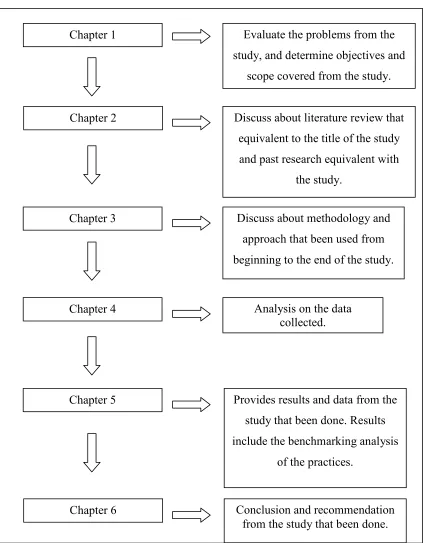
1.6 Report Outline
This study is divided into six (6) chapters.Chapter 1 is generally about the introduction which consists of problem statements, objectives, scope of study, potential benefits of study and the study outlines. Chapter 2 is the literature review. Based on the reference gathered, this chapter discusses the definition and the introduction to the key words which are the biotech, “best practice” and. benchmarking. Chapter 3 describes the methodology adopted in the study in order to collect the data. In this chapter, it discussed the project methodologies that were used to collect the relevant data to support the development and analysis of the study.
1.7 Report Structure
Figure 1.1: Report Structure
Analysis on the data collected.
Evaluate the problems from the study, and determine objectives and
scope covered from the study.
Discuss about literature review that equivalent to the title of the study and past research equivalent with
the study.
Provides results and data from the study that been done. Results include the benchmarking analysis
of the practices.
Discuss about methodology and approach that been used from beginning to the end of the study.
Conclusion and recommendation from the study that been done. Chapter 1
Chapter 2
Chapter 3
Chapter 4
Chapter 5