Accuracy of national key performance indicator reporting
from two Aboriginal medical services: potential to underestimate
the performance of primary health care
Isaac Hill
1,4BHSc, Statewide Data & IT CoordinatorDavid Johnson
1MBBS, MPH, FRACGP, FAFPHM, Public Health Medical OfficerDavid Scrimgeour
2MBBS, MPH, FAFPHM, Medical DirectorRobyn McDermott
3MBBS, MPH, PhD, FAFPHM, Professor of Public Health Medicine1Aboriginal Health Council of South Australia Inc., 220 Franklin Street, Adelaide, SA 5000, Australia. Email: [email protected]
2
Spinifex Health Service, PMB 88, Kalgoorlie, WA 6430, Australia. Email: [email protected] 3
College of Public Health, Medical and Veterinary Sciences, James Cook University, PO Box 6811, Cairns, Qld 4870, Australia. Email: [email protected]
4Corresponding author. Email: [email protected]
Abstract
Objective. The aim of the present study was to assess the accuracy of extracting national key performance indicator (nKPI) data for the Online Community Health Reporting Environment for Health Services (OCHREStreams) program using the Pen Computer Systems (Leichhardt, NSW, Australia) Clinical Audit Tool (CAT) from Communicare (Telstra Health Communicare Systems, Perth, WA, Australia), a commonly used patient information management system (PIMS) in Aboriginal primary care.
Methods. Two Aboriginal Community-Controlled Health Services (ACCHSs) were recruited to the present study. A sample of regular clients aged55 years from each ACCHS was selected and a subset of 13 nKPIs was examined. A manual case note audit of the nKPI subset within Communicare was undertaken by a clinician at each participating ACCHS and acted as a‘gold standard’comparator for three query methods: (1) internal Communicare nKPI reports; (2) PenCS CAT nKPI manualfiltering (a third-party data-extraction tool); and (3) nKPI data submitted to the Improvement Foundation qiConnect portal.
Results. No errors were found in nKPI data extraction from Communicare using the CAT and subsequent submission to the qiConnect portal. However, the Communicare internal nKPI report included deceased clients and past patients, and we can be very confident that deceased clients and past patients are also included in the qiConnect portal data. This resulted in inflation of client denominators and an underestimation of health service performance, particularly for nKPIs recording activity in the past 6 months. Several minor errors were also detected in Communicare internal nKPI reports.
Conclusions. CAT accurately extracts a subset of nKPI data from Communicare. However, given the widespread use of Communicare in ACCHSs, the inclusion of deceased clients and past patients in the OCHREStreams nKPI data program is likely to have resulted in systematic under-reporting of health service performance nationally.
What is known about the topic? There has been limited validation of health data exported via data-extraction tools in Australia. More specifically, there are no current published data describing the accuracy of the CAT in mapping health data extracted from Communicare or the accuracy of internal nKPI reports generated by Communicare. Further, no systematic review has been undertaken to assess the accuracy of the nKPI data submission pathway from PIMSs at the health service level to the OCHREStreams qiConnect portal using the CAT.
What does this paper add? The CAT accurately extracts a subset of nKPI data from Communicare and accurately submits this to the qiConnect portal. Minor errors exist in some Communicare internal nKPI reports. The inclusion of deceased clients and past patients in the nKPI reporting system for ACCHSs is likely to have resulted in systematic under-reporting of health service performance nationally through this program.
What are the implications for practitioners? The inclusion of deceased clients and past patients in the OCHREStreams nKPI program limits the usefulness of these data for local quality improvement activities and national monitoring of
Journal compilationAHHA 2018 Open Access CC BY-NC-ND www.publish.csiro.au/journals/ahr
health service performance for participating ACCHSs. The use of the CAT by ACCHSs independently from the OCHREStreams program can enable deceased clients and past patients to be excluded from reports that can provide more accurate nKPI data from Communicare for local quality improvement and planning purposes.
Received 7 November 2016, accepted 28 March 2017, published online 9 May 2017
Introduction
Electronic patient information management systems (PIMSs) have grown in popularity over recent decades as health services transition from paper-based clinical record keeping.1As well as recording clinical information, PIMSs are increasingly being used for a range of other purposes, including continuous quality improvement (CQI) and monitoring of health service performance.2
In South Australia (SA), all Aboriginal Community-Con-trolled Health Services (ACCHSs) have been using the PIMS Communicare (Telstra Health Communicare Systems; Perth, WA, Australia)3for several years. More so than ever, ACCHSs are looking for new and innovative ways to extract health data from their PIMSs in an accurate and timely manner4to facilitate CQI processes. To enable this, several data-extraction tools (DETs) have been developed. DETs are software programs that run alongside PIMSs to extract clinical datasets. Currently, the most commonly used DET by ACCHSs nationally is the Clinical Audit Tool (CAT; Pen Computer Systems; Leichhardt, NSW, Australia).5,6
In 2010, the then Department of Health and Ageing initiated the Online Community Health Reporting Environment for Health Services (OCHREStreams) program7 in which ACCHSs are required to submit health data against a set of national key performance indicators (nKPIs) on a biannual basis.8Until June 2015, this process involved extraction of nKPI data from PIMSs using the CAT and submission to the Australian Institute of Health and Welfare (AIHW) via the Improvement Founda-tion.9,10For the December 2015 nKPI data submission, the CAT was replaced by the Canning Tool (Arche Health; Perth, WA, Australia) (an alternative DET used for submission of nKPI data to the Improvement Foundation),9,11,12but both the Canning Tool and the CAT were used for the June 2016 submission due to several technical issues with the Canning tool.13There was no nKPI submission in December 201614and the nKPI submission process for 2017 is currently under review.15Nationally, over 320 primary health care organisations delivering services to Aborig-inal and Torres Strait Islander people submit nKPI data via the OCHREStreams program.16
In 2014, an independent review funded by the Department of Health (DoH) was undertaken to comprehensively assess the data submission pathway of the OCHREStreams program.17 Importantly, this review did not assess the accuracy of the nKPI data extraction and submission pathway from PIMSs at the health service level to the OCHREStreams Improvement Foun-dation portal. However, the report did recommend that a data audit exercise be undertaken as a high priority to check the integrity of the extraction process from all compatible PIMSs.17 Within the Aboriginal community-controlled health sector there is a perception that there are inaccuracies in the nKPI data submitted to the AIHW via the OCHREStreams program. It is
important to assess the accuracy of these data given that they are used for individual health service planning and quality improve-ment activities, and may also be used in the future by the Commonwealth for benchmarking, in addition to informing Aboriginal health policy more broadly. Therefore, the aim of the present study was to assess the accuracy of the extraction and submission pathway for nKPI data for the OCHREStreams program using the CAT from Communicare, the PIMS used by all ACCHSs in SA and up to 60 ACCHSs nationally.18 The accuracy of the internal Communicare nKPI reporting function was also assessed given the current local use of these reports by ACCHSs for quality improvement as well as for validating nKPI data submitted via the OCHREStreams program.
Methods Participants
Two ACCHSs were recruited to the study. Site A is located in a small community classified as very remote and Site B is located within a large town classified as outer regional. Both health services actively participate in the OCHREStreams program.
Data sources
Given the limited resources available to undertake this project, a sample of OCHREStreams-defined regular clients aged 55 years was used; client numbers for this age group were equivalent for both sites. A subset of 13 nKPIs was selected covering risk factor measurement, preventive care and chronic disease management (Appendix I).
Data collection Case note audit
A manual case note audit of the nKPI subset within Commu-nicare (version 14.2.168) was undertaken by a clinician at each participating ACCHS. This case note audit acted as the‘gold standard’measure against which three automated data extraction (query) methods (detailed below) were compared.
2015, which remained constant for all reference dates mentioned below.
De-identified patient data were recorded by the respective clinicians within a‘case note audit’Microsoft Access database. Fields consisted of date of birth, gender, Communicare ID and their qualification for numerator (denoting the number of clients with an item recorded) and denominator (denoting the number of clients within the population) for any of the 13 nKPIs.
Automated nKPI query methods
Data from Communicare were collected for three automated nKPI query methods, namely an internal Communicare nKPI report, manualfiltering of nKPI data within the CAT and nKPI data from the Aboriginal Health Council of South Australia (AHCSA) Improvement Foundation qiConnect portal, and com-pared with the case note audit.
Internal Communicare nKPI Reports. Internal nKPI Com-municare reports were run for each of the indicators within the nKPI subset by a clinician at each service for OCHREStreams-defined regular clients with the‘last report date’set to 31 March 2015. Totals for the combined age groups of 55 years were recorded within a‘query methods’Microsoft Access database formatted to record aggregated numerator and denominator totals for all three query methods.
CAT Export was used to export a health data subset (dated 31 March 2015) from Communicare into an eXtensible Markup Language (XML)file. This ensured that both the consistency and integrity of the comparative data remained intact because data entered into Communicare after this date by the health service would not affect the XMLfile.
Manualfiltering of nKPI data within the CAT. The XMLfile was imported into the CAT (version 3.14.2.0) and totals for this query method involved individually constructing the subset nKPIs via the CAT Filter tab. This tab uses cascading filter parameters until the desired indicator definition has been reached. This process was repeated for all subset nKPIs for numerator and denominator totals.
nKPI data from the AHCSA Improvement Foundation qiCon-nect portal. The clinician submitted the nKPI data to the Improvement Foundation via the Submissions tab of the CAT. The nKPI data that are submitted to the Improvement Foundation by participating AHCSA member health services is automatically compiled into the qiConnect portal, hosted by the Improvement Foundation, as part of a program managed by the AHCSA to support CQI in AHCSA member health services. These data are presented in Microsoft Excel and grouped by nKPI; each nKPI is disaggregated by age group and gender. This export was used to construct nKPI numerator and denominator totals, which were recorded in the ‘query methods’ Access database.
Ethics approval
This project was granted ethics approval by the South Australian Aboriginal Health Research Ethics Committee (AHREC) and the Western Australian Aboriginal Health Ethics Committee (WAAHEC).
Analysis
Results for each of the automated nKPI extraction methods were numerically compared with the case note audit. For the internal Communicare nKPI reports and the CAT nKPI manualfiltering, an electronic list of patient IDs was retained so that this could be cross-referenced with patient IDs collected in the case note audit to assess patient status to enable a better understanding of when differences between nKPI totals were observed.
Results
Client population totals
Population aged55 years
With deceased patients included, the populations aged 55 years were identical for the case note audit, the Commu-nicare query and the qiConnect portal for both Site A (n= 51) and Site B (n= 56). If deceased patients were excluded from the case note audit, the population totals for those aged55 years were four less compared with the Communicare query and the qiCon-nect portal for Site A (n= 47) and two less for Site B (n= 54; Tables 1, 2). The CAT manual query defaulted to exclude deceased and ‘past patients’. With deceased and past patients excluded, totals for the CAT were six less for Site A (n= 45) and 10 less for Site B (n= 46).
Population aged55 years with Type 2 diabetes
If deceased patients were included, the populations aged 55 years with Type 2 diabetes (T2D) were identical for the case note audit, the Communicare query and the IF qiConnect Portal for both Sites A and B (n= 28). However, if deceased patients were excluded from the case note audit, the totals were two less compared with the Communicare query and the qiCon-nect portal for Site A (n= 26) and two less for Site B (n= 26; Tables1,2). Differences recorded for the CAT for Site A (n= 25) and Site B (n= 22) were also accounted for by the exclusion of both deceased and past patients.
Individual nKPIs
sends these data to the qiConnect portal. Therefore, the totals for the CAT query and the qiConnect portal are more accurate. This also affected the BMI subcategory results for nKPI 12 (Table1). A further error was found with the Communicare nKPI report for BMI. One result included a BMI measurement that was calculated by Communicare using a weight measurement from>2 years before the audit date. This result was excluded by the CAT.
A further error was detected in the way Communicare calcu-lates blood pressure (BP) results (nKPI 24). For Site B, it was found that one patient who recorded a BP result of exactly 130/ 80 mmHg was incorrectly classified in the>130/80 mmHg group by the Communicare nKPI 24 report compared with the case note audit. This error was not observed in the CAT or qiConnect portal totals.
Both nKPI 18 and nKPI 19 were omitted from our analyses because totals for patients having received an‘estimated glomer-ularfiltration rate (eGFR) only’ or ‘albumin : creatinine ratio (ACR) only’could not be calculated in the CAT. Furthermore, Site B had not yet updated their Communicare nKPI report list, and thus reports for nKPI 18 and nKPI 19 were not available.
By comparing client lists for the population aged55 years with and without T2D and for the individual nKPI totals, we were able to confirm that the same clients were included in the case note
audit, Communicare query and the CAT manual query to provide further evidence that any differences observed between the automated query methods and the case note audit were the result of deceased and/or past patients being included or excluded. However, it was not possible to compare patient lists and current client status categories for the qiConnect portal because this only records patient counts. Despite this, we observed that all totals were the same for both the Communicare query and the qiConnect portal (except for BMI and subcalculations for HbA1c). To further explore this, nKPI results for the Communicare query at both sites were compared with the CAT automated nKPI totals (as a proxy for the qiConnect portal totals). This comparison was for all age groups because the CAT automated query was not able to be disaggregated by age group. These totals were also found to be exactly the same and, again, although patient lists and current client status were not able to be compared, thefindings provide further evidence that the qiConnect portal includes deceased patients as well.
Effect of including deceased and past patients on health service performance
[image:4.595.39.543.125.439.2]Measurement of health service performance via OCHREStreams involves the calculation of nKPIs as a proportion of either the
Table 1. National key performance indicator (nKPI) totals for Site A comparing the case note audit (totals excluding deceased patients in parentheses), the Communicare nKPI internal reports, manualfiltering in the Clinical Audit Tool (CAT; Pen Computer Systems) and the
Improvement Foundation qiConnect portal
MBS, Medicare Benefits Schedule; BMI, body mass index; BP, blood pressure
nKPI Case note audit
of Communicare (deceased excluded)
Communicare internal reports
CAT manual
filtering
qiConnect portal
Client population 51 (47) 51 45 51
Type 2 diabetes–client population 28 (26) 28 25 28
nKPI 03: MBS 715s24 months 19 (19) 19 19 19
nKPI 05 A: HbA1c tests6 months 10 (10) 10 10 10
nKPI 06 A: HbA1c result7% 4 (4) 4 4 4
nKPI 06 A: HbA1c result between>7% and8% 1 (1) 1 1 1
nKPI 06 A: HbA1c result between>8% and<10% 2 (2) 2 2 2
nKPI 06 A: HbA1c result10% 3 (3) 3 3 3
nKPI 05 B: HbA1c tests12 months 16 (16) 16 16 16
nKPI 06 B: HbA1c result7% 8 (8) 7 8 8
nKPI 06 B: HbA1c result between>7% and8% 3 (3) 4 3 3
nKPI 06 B: HbA1c result between>8% and<10% 2 (2) 2 2 2
nKPI 06 B: HbA1c result10% 3 (3) 3 3 3
nKPI 07: MBS 721s24 months 13 (13) 13 13 13
nKPI 08: MBS 723s24 months 13 (13) 13 13 13
nKPI 09: Smoking status recorded 32 (28) 32 27 32
nKPI 10: Smoking result–current smoker 10 (9) 10 9 10
nKPI 10: Smoking result–ex-smoker 6 (5) 6 5 6
nKPI 10: Smoking result–never smoked 16 (14) 16 13 16
nKPI 12: BMI recorded24 months 34 (30) 34 32 36
nKPI 12: BMI recorded–healthy/underweight 11 (9) 11 7 9
nKPI 12: BMI recorded–overweight 12 (11) 12 13 14
nKPI 12: BMI recorded–obese 11 (10) 11 12 13
nKPI 16: Alcohol consumption status recorded24 months 21 (20) 21 20 21
nKPI 23: BP test6 months 17 (17) 17 17 17
nKPI 24: BP result130/80 mmHg 7 (7) 7 7 7
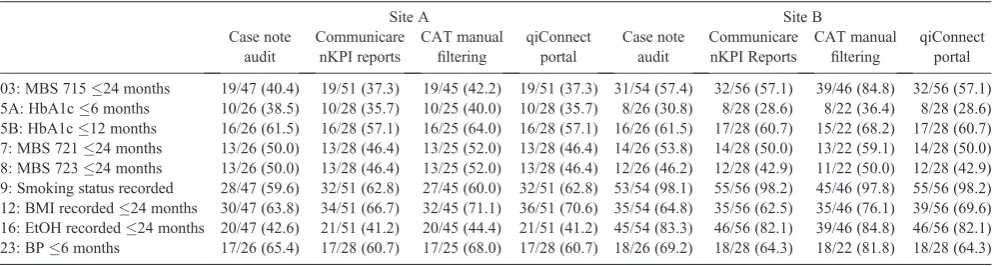
total population or a subpopulation, such as people with T2D. Although for some nKPIs included in the present study there were no differences in the totals between the case note audit and the automated query methods (where no deceased and/or past patients were included in any of the totals), the nKPI total (numerator) as a proportion of the total population or the pop-ulation with T2D (denominator) varied depending on whether deceased and past patients were included in the denominator (see Table 3). This mostly affected nKPIs that are measured over shorter time frames, such as HbA1c (nKPI 5A and nKPI 6A) and BP (nKPI 23).
For example, the proportion of patients with T2D at Site A who received an HbA1c test within the previous 6 months, as measured by the Communicare reports and the qiConnect portal, was 35.7% (10/28). If deceased patients were excluded from the denominator total, this proportion increased to 38.5% (10/26). If both deceased and past patients were excluded, as with the CAT manual query, 40% (10/25) of patients received an HbA1c test within the previous 6 months (see Table3). For Site B, the proportions with deceased patients included, with deceased patients only excluded and with deceased and past patients excluded were 28.6% (8/28), 30.8% (8/26) and 36.4% (8/22) respectively.
Most of the other nKPIs where proportions were recorded were also lower for the Communicare report and qiConnect portal
nKPI results compared with the case note audit with deceased patients excluded and the CAT manual query. Smoking status recorded (nKPI 09) and BMI recorded (nKPI 12) were excep-tions. For smoking status, the time frame for inclusion was‘ever’ and, as a result, for both Sites A and B, all deceased patients had a smoking status recorded. For BMI, results were higher for both the CAT and qiConnect portal queries due to the automated recording of BMI in the CAT compared with Communicare, as already described. Further, for Site A, the proportion recorded by the Communicare query was slightly better than for the case note audit because all deceased patients had a BMI recorded (because this is a common and simple clinical measurement).
Discussion
[image:5.595.63.553.125.436.2]No errors were found in the nKPI data extraction from Commu-nicare by the CAT and then submitted to the qiConnect portal. We found that the Communicare nKPI report included deceased clients and past patients, and we can be very confident that deceased clients and past patients are also included in the qiCon-nect portal data. This resulted in inflation of client denominators and an underestimation of health service performance as mea-sured by the OCHREStreams system, particularly for nKPIs recording activity in the past 6 months. Minor errors were found
Table 2. National key performance indicator (nKPI) totals for Site B comparing the case note audit (totals excluding deceased patients in parentheses), the Communicare nKPI internal reports, manualfiltering in the Clinical Audit Tool (CAT; Pen Computer Systems) and the Improvement Foundation
qiConnect portal
MBS, Medicare Benefits Schedule; BMI, body mass index; BP, blood pressure
nKPI Case note audit
of Communicare (deceased excluded)
Communicare internal reports
CAT manual
filtering
qiConnect portal
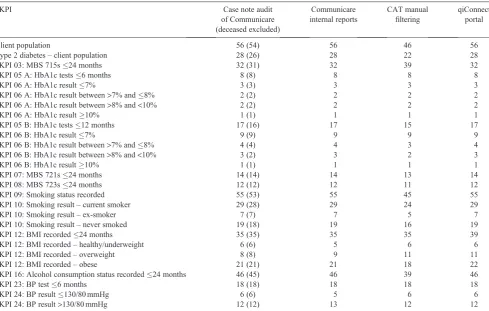
Client population 56 (54) 56 46 56
Type 2 diabetes–client population 28 (26) 28 22 28
nKPI 03: MBS 715s24 months 32 (31) 32 39 32
nKPI 05 A: HbA1c tests6 months 8 (8) 8 8 8
nKPI 06 A: HbA1c result7% 3 (3) 3 3 3
nKPI 06 A: HbA1c result between>7% and8% 2 (2) 2 2 2
nKPI 06 A: HbA1c result between>8% and<10% 2 (2) 2 2 2
nKPI 06 A: HbA1c result10% 1 (1) 1 1 1
nKPI 05 B: HbA1c tests12 months 17 (16) 17 15 17
nKPI 06 B: HbA1c result7% 9 (9) 9 9 9
nKPI 06 B: HbA1c result between>7% and8% 4 (4) 4 3 4
nKPI 06 B: HbA1c result between>8% and<10% 3 (2) 3 2 3
nKPI 06 B: HbA1c result10% 1 (1) 1 1 1
nKPI 07: MBS 721s24 months 14 (14) 14 13 14
nKPI 08: MBS 723s24 months 12 (12) 12 11 12
nKPI 09: Smoking status recorded 55 (53) 55 45 55
nKPI 10: Smoking result–current smoker 29 (28) 29 24 29
nKPI 10: Smoking result–ex-smoker 7 (7) 7 5 7
nKPI 10: Smoking result–never smoked 19 (18) 19 16 19
nKPI 12: BMI recorded24 months 35 (35) 35 35 39
nKPI 12: BMI recorded–healthy/underweight 6 (6) 5 6 6
nKPI 12: BMI recorded–overweight 8 (8) 9 11 11
nKPI 12: BMI recorded–obese 21 (21) 21 18 22
nKPI 16: Alcohol consumption status recorded24 months 46 (45) 46 39 46
nKPI 23: BP test6 months 18 (18) 18 18 18
nKPI 24: BP result130/80 mmHg 6 (6) 5 6 6
in the Communicare nKPI reports related to the grouping of HbA1c and BP results and the calculation of BMI.
When deceased patients were included, the case note audit and the qiConnect portal data results were found to be identical for all nKPIs examined in the present study except those related to BMI. It was found that the CAT automatically calculates BMI if both height and weight variables are present, whereas Commu-nicare requires clinical staff to prompt for a BMI calculation. This resulted in better recording of BMI in the qiConnect portal for nKPI 12 (BMI recorded in the past 2 years) compared with Communicare. Therefore, no errors were found in the accuracy of data extraction by the CAT for the nKPIs examined in the present study at either of the study sites.
Importantly, however, it appears that deceased and past patients are included in the nKPI data submitted via the CAT to the qiConnect portal. It is from here that nKPI data are aggregated and accessed by the AIHW. There is a lack of clarity as to the definition of a regular client for the OCHREStreams program and whether or not it is intended for deceased and past patients to be included. Including deceased and past patients in nKPI data submissions has the potential to underestimate health service performance as measured by the OCHREStreams program. Although this affected most nKPIs in the present study, those measured over time frames shorter than 2 years were particularly affected, such as those relating to HbA1c and BP. It is likely that a similar effect would be observed for other nKPIs not included in the present study.
The effect of the inclusion of deceased and past patients is likely to be far reaching because Communicare is used by more than 60 ACCHSs nationwide,17,19,20the majority of which are likely to have deceased people included during any reporting period. Further, although the present study only examined one time point, it is possible that the inclusion of deceased patients has occurred over the life of the OCHREStreams program. If this is the case, over 4 years of submitted data would be affected. The CAT was replaced by the Canning Tool9,11for the December 2015 nKPI extraction, although the CAT was used again together with the Canning Tool in the June 2016 submission13(there was no submission of nKPI data in December 201614). Given the uncertainty related to future submission of nKPI data via the OCHREStreams program, it is unclear whether deceased people
will be included in future nKPI data submissions. Finally, the same deceased patients will continue to be captured in multiple reporting periods if they still satisfy the definition of a regular client of three visits in 2 years.
We found minor errors in the Communicare nKPI reports related to the grouping of HbA1c and BP results and calculation of BMI. Therefore, the use of Communicare nKPI reports has the potential to underestimate health service performance for these nKPIs. This is in addition to the effect of including deceased patients in nKPI calculations, as already discussed. As a result, the querying of the XMLfile by the CAT for the nKPI subset was more accurate than Communicare’s internal querying methods.
Limitations
Although the present analysis only focused on OCHREStreams-defined regular clients aged55 years, further investigation into the total populations for the 13 nKPIs aimed to compare the Communicare reports with automated nKPI reports that are available in the CAT, which could not be disaggregated by age. All the CAT nKPI totals were identical to the Communicare nKPI reports, which include deceased patients, and so we are confident that the qiConnect portal data also include these deceased patients. Thus, given the higher mortality rate at younger ages for Aboriginal people compared with non-Aboriginal people, the inclusion of deceased patients will also affect nKPI results for those aged 55 years, although to a lesser extent. Further, although we only examined a subset of nKPIs, it is likely that the inclusion of deceased patients will also affect other nKPIs not examined in the present study, although those related to child and maternal health will be less affected. Although we were able to detect several minor errors in the internal Communicare nKPI reports, the small sample size of the present study may not have been sufficiently large enough to detect all internal nKPI reporting errors. In addition, we only assessed internal reporting errors for a subset of nKPIs.
[image:6.595.41.539.126.259.2]The present study assessed the CAT version 3.14.2.0; as far as we are aware, these issues also affected the CAT– OCHREStreams reporting periods in June 2015 and June 2016. Further, the present study only investigated the accuracy of the CAT system for Communicare. However, given that Pen
Table 3. Site A and B comparisons of national key performance indicator (nKPI) proportions with the inclusion and exclusion of deceased and past patients
Data show the number of patients including/excluding deceased and past patients, with this value expressed as a percentage in parentheses. CAT, Clinical Audit Tool (Pen Computer Systems); MBS, Medicare Benefits Schedule; BMI, body mass index; BP, blood pressure; EtOH, alcohol
Site A Site B
Case note audit
Communicare nKPI reports
CAT manual
filtering
qiConnect portal
Case note audit
Communicare nKPI Reports
CAT manual
filtering
qiConnect portal
Computer Systems use a standardised definition for regular clients, it is likely that deceased and past patients are included for all PIMSs that rely on the CAT for OCHREStreams nKPI submissions.
Finally, the report for the case note audit was developed in conjunction with a senior Communicare software programmer and thus was not completely independent from a system that was being assessed for accuracy by this project. However, the report was independently validated using a fictitious Communicare patient database with the same version of Communicare based at the AHCSA and was found to be 100% accurate.
Conclusion
The present study showed that the CAT accurately extracts a subset of nKPI data from Communicare, which is then accurately submitted to the qiConnect portal (although the CAT is no longer used to extract data for the OCHREStreams program). The inclusion of deceased patients and past patients in the Commu-nicare nKPI reports and the high likelihood that this is replicated in the submitted qiConnect portal nKPI data resulted in health service performance being underestimated for several nKPIs measured in the present study. Given the widespread use of Communicare in health services that submit nKPI data to the OCHREStreams program,17,19it is likely that there has been systematic under-reporting of health service performance nation-ally through this program. Further, minor errors were discovered in the Communicare report coding for some nKPI outcome measures, although the effects of these were overall very small. From ourfindings, we make the following recommendations:
* The definition of‘regular client’used for nKPI reporting is clarified; ideally this should not include deceased or past patients, which may affect the comparability of future nKPI data collection with earlier reporting periods
* Communicare correct their internal nKPI reporting codes as a matter of urgency
* Other PIMSs need to have similar validation studies performed to assess nKPI accuracy
* The Arche Health Canning Tool needs to be validated for nKPI data submitted to the Improvement Foundation (if it is to be used for future submissions).
Competing interests None declared.
Acknowledgements
The project team acknowledge Beth Hummerston (Aboriginal Health Council of South Australia Inc.) for support with data analysis. This project was funded by the Centre for Research Excellence for Prevention of Chronic Conditions in Rural and Remote High Risk Populations, a collaboration between the University of South Australia, the Aboriginal Health Council of South Australia, Queensland Aboriginal and Islander Health Council, the Royal Flying Doctor Service and James Cook University.
References
1 Liaw S, Taggart J, Yu H, de Lusignan S. Data extraction from electronic health records–existing tools may be unreliable and potentially unsafe.
Aust Fam Physician2013; 42: 820–3.
2 Bailie R, Bailie J, Chakraborty A, Swift K. Consistency of denominator data in electronic health records in Australian primary healthcare services: enhancing data quality. Aust J Primary Health 2015; 21: 450–9. doi:10.1071/PY14071
3 HealthConnex. Communicare Client Portal. 2017. Available at: https:// portal.healthconnex.com.au/ [verified 5 April 2017].
4 Peiris D, Agaloitis M, Patel B, Patel A. Validation of a general practice audit and extraction tool.Aust Fam Physician2013; 42: 816–9. 5 Pen CS. Pen CS CAT4. 2017. Available at: http://install.pencs.com.au/
ClickOnce/CAT4/publish.htm [verified 7 April 2017].
6 Aboriginal Health & Medical Research Council. ACCHS data in ACCHS hands. AH&MRC health data workshop 19 February 2013. Final report. 2013. Available from: http://cqidata.org.au/wp-content/ uploads/AHMRC-Data-Workshop-Report-May-2013.pdf [verified 28 August 2015].
7 Improvement Foundation. History. 2016. Available at: http://improve. org.au/about-us/history/#2012 [verified 21 June 2016].
8 Australian Institute of Health and Welfare. Indigenous primary health care national key performance indicators nKPI. 2016. Available at: http://www.aihw.gov.au/indigenous-primary-health-care-nkpi/ [verified 6 January 2016].
9 OCHREStreams. OCHREStreams eBulletin July 2015. 2015. Available at: http://www.ochrestreams.org.au/Pages/eBulletins/July_2015.aspx [verified 18 January 2017].
10 Pen Computer Systems. 02 Jun Media release–Pen Computer Systems (PCS). 2015. Available at: http://www.pencs.com.au/media-release/ [verified 4 December 2015].
11 Improvement Foundation. A change for good–introducing new data extraction software. 2015. Available at: http://improve.org.au/news-and-media/media-centre/canningtool/#.VqA4pLTi8uM [verified 10 Novem-ber 2015].
12 The Canning Tool. Demonstration Access. 2017. Available at: http:// canningtool.com.au/demo.html [verified 5 April 2017].
13 OCHREStreams. OCHREStreams eBulletin August 2016. 2016. Available at: http://www.ochrestreams.org.au/Pages/eBulletins/August_ 2016.aspx [verified 21 December 2016].
14 OCHREStreams. OCHREStreams eBulletin December 2016. 2016. Available at: http://www.ochrestreams.org.au/Pages/eBulletins/Decem-ber_2016.aspx [verified 18 January 2017].
15 AusTender. Closed ATM view – HEALTH/016/1617. Australian Government. 2017. Available at: https://www.tenders.gov.au/?event= public.atm.showClosed&ATMUUID=55CA9A31-FB82-3D5F-9811A 83E9C029174 [verified 20 January 2017].
16 Improvement Foundation. OCHREStreams key results. 2014. Available at: http://improve.org.au/news-and-media/media-centre/key-results/och restreams-key-results/#.WOb0QW-GO9I [verified 7 April 2017]. 17 SMS Technology & Management. Final report. National key
perfor-mance indicators. Data quality review. 2014. Available at: http://www. health.gov.au/internet/main/publishing.nsf/content/9A3654F963F938B 0CA257DDA00771054/$File/nkpquality.pdf [verified 3 March 2017]. 18 Australian Institute of Health and Welfare. Indigenous primary health
care key performance indicators (2015). 2015. Available at: http://meteor. aihw.gov.au/content/index.phtml/itemId/584983 [verified 6 January 2016].
19 McDonald K. Communicare rolls out across Indigenous communities in Qld. Pulse+IT 2015. Available at: https://www.pulseitmagazine.com. au/news/australian-ehealth/2577-communicare-rolls-out-across-indige nous-communities-in-qld?highlight=WyJ0ZWxzdHJhIiwidGVsc3RyYS dzIiwidGVsc3RyYXMiXQ== [verified 8 August 2016].
Appendix I. List and description of the national key performance indicator (nKPI) subset
MBS, Medicare Benefits Schedule; T2D, Type 2 diabetes; GP, general practitioner; BMI, body mass index; BP, blood pressure
Indicator Definition Description (MeTEOR 2015)18
nKPI 03 Health Assessments (MBS 715) Calculation B: aged 25 years
Number of regular clients who are Indigenous, aged25 years and for whom an MBS health assessment for Aboriginal and Torres Strait Islander People (MBS Item 715) was claimed within the previous 24 months
nKPI 05 A T2D clients who have an HbA1c test recorded–Calculation A: in the past 6 months
Number of regular clients who are Indigenous, have T2D and who have had an HbA1c measurement result recorded at the primary health care service within the previous 6 months
nKPI 05 B T2D clients who have an HbA1c test recorded–Calculation B: in the past 12 months
Number of regular clients who are Indigenous, have T2D and who have had an HbA1c measurement result recorded at the primary health care service within the previous 12 months
nKPI 06 A HbA1c levels in T2D clients who have an HbA1c test recorded–Calculation A: in the past 6 months
Number of regular clients who are Indigenous, have T2D and whose HbA1c measurement result, recorded in the previous 6 months, was:7%;>7% but8%;>8% but<10%; or10% nKPI 06 B HbA1c levels in T2D clients who have an HbA1c test
recorded–Calculation B: in the past 12 months
Number of regular clients who are Indigenous, have T2D and whose HbA1c measurement result, recorded in the previous 12 months, was:7%;>7% but8%;>8% but<10%; or10%
nKPI 07 GP management plan (MBS item 721) for T2D only Number of regular clients who are Indigenous, have T2D and for whom a GP management plan (MBS Item 721) was claimed within the previous 24 months
nKPI 08 Team care arrangement (MBS item 723) for T2D only Number of regular clients who are Indigenous, have T2D and for whom a team care arrangement (MBS Item 723) was claimed within the previous 24 months
nKPI 09 Smoking status recorded Number of regular clients who are Indigenous, aged15 years and whose smoking status has been recorded at the primary health care service
nKPI 10 Smoking status result Number of regular clients who are Indigenous, aged15 years and whose smoking status has been recorded as‘current smoker’,‘ ex-smoker’or‘never smoked’
nKPI 12 BMI classified as overweight or obese Calculation A: overweight (25 kg m–2BMI<30 kg m–2)
Number of regular clients who are Indigenous, aged25 years and who have had their BMI classified as overweight or obese within the previous 24 months
nKPI 16 Alcohol consumption status recorded Number of regular clients who are Indigenous, aged15 years and who have had their alcohol consumption status recorded at the primary health care service within the previous 24 months nKPI 23 T2D clients who had a BP test in the past 6 months Number of regular clients who are Indigenous, have T2D and who
have had a BP measurement result recorded at the primary health care service within the previous 6 months
nKPI 24 BP levels in T2D clients who had a BP test in the past six months
Number of regular clients who are Indigenous, have T2D and whose BP measurement result, recorded within the previous 6 months, was 130/80 mmHg