Object Structured Query Language
into
Object Algebra Expression
Sainaaz Bi Hussain
This thesis is submitted in partial fulfilment of the requirements for the Masters
of Science Studies (Computer Science).
Department of Computer Science
University of Tasmania
Australia
published by another person, except where the reference is made in the text of the thesis.
Many thanks to Dr. Chris Keen for his guidance throughout the project.
I would also like to thank Dr. Vishv Malhotra and Dr. Charles Lakos for their help in getting the parser working. Also many thanks to Carl Lewis for giving valuable ideas on the implementation of the parser, Sunee Pongpinigpinyo for helping in the selection of the Object Algebra, Crystal Austin and the Overseas Students Office for proofreading the thesis.
effective solution to providing the database management facilities for complex applications. This project involves in deriving a set of rules which specifies the translation of Object SQL statements into an Object Algebra expression.
The language chosen for this project is Object SQL
(Object
Structured Query Language). Object SQL is a high-level user language whose standard does not exist yet.Chapter 1. Introduction
1
1.1. Aims
1
1.2. Definitions
1
1.3. What is Original?
4
1.4. Brief Literature Review
5
1.5. Chapter Summaries
6
Chapter 2. Background
7
Introduction
7
2.1. Object-Oriented Database Management Systems
7
2.2. Query Languages in OODBMSs
8
Introduction
8
2.2.1. Object SQL (OSQL)
10
2.2.1.1. Object SQL Statements
12
2.2.1.2. OODBMS for Object SQL query languages 23
2.2.2. Query Algebra
24
Introduction
24
2.2.2.1. The Encore Query Algebra
24
2.2.2.2. The Straube Object Algebra
26
2.2.2.3. Properties of Query Algebra
28
Chapter 3. Implementation of the translator
33
Introduction
33
3.1. An overview of LEX programming
33
3.2. An overview of YACC programming
34
3.3. YACC and LEX
35
3.4. System Overview
36
3.4.1. Modification of the Parser for the Translation Rules. 37
3.4.2. Use of Translator
59
Chapter 4. Results
60
Chapter 5. Conclusion
70
5.1. Achievements
70
5.2. Discussion/Conclusions
71
5.3 Summary
72
A.2.Grammar for Object SQL parser 75
Appendix B: Output file for the translator
99Chapter 1. Introduction
1.1.
AimsThe aim of this project is to design a translator which can translate from Object Structured Query Language (Object SQL) into an Object Algebra (OA) expression. Therefore, one of the main contributions of this project is the derivation of a set of rules to specify the translation of a large subset of Object SQL statements into the equivalent Object Algebra expressions.
The major conceptual problem in this project is determining a scheme for compiling Object SQL constructs into Object Algebra expressions. The first part of the project is to select an Object Algebra. I will use the Object Algebra
proposed by Dave Straube [Straube 1990a]. Then using this Algebra the translation from Object SQL into Object Algebra expressions will be performed. The categories of Object SQL statements are :
a)
DATA DEFINITION
Commands For example : CREATE.b)
DATA MANIPULATION
CommandsFor example : SELECT, DELETE, UPDATE, and INSERT.
1.2. Definitions
Relational Database
[Date 1990] : defines a relational database as a database that is perceived by its users as a collection of tables (and nothing else but tables).Object
-Oriented :
a software development strategy that organises software as acollection of objects that contain both data structure and behaviour.
Object
-Oriented Database Management System
(00DBMS) : This is adatabase system which supports an object-oriented model. It manages complex objects with object identity, supports objects that encapsulate data and behaviour, structures objects in classes, and organises classes in a hierarchy. The OODBMSs augment the programming language by providing persistence, concurrent control, a query language, and other Database Management Systems (DBMS) capabilities [Catell 1992]. The application programmer may
programming language, or may perform associative lookups of objects using the query language.
Query :
this is a language expression that describes what data is to be retrieved from a database and initiates the retrieval operation in the Database Management System.Query Optimisation
means strategies which seek to improve the efficiency of query evaluation so that there is minimum use of expensive resources such as the time involved in using the central processing unit (CPU), the secondary storage cost, and the storage cost.Query Languages :
this is a special purpose programming language used in the database system to formulate queries.Object
represents entities and concepts from the application domain being modelled; a concept, abstraction or thing with definite boundaries and meanings for the current problem; an instance of a class or type; or encapsulation of data and functionality (behaviour), for example, a car, a cup, a person. Objects can be classified as•
literal objects :
these are self identifying objects such as integers and character strings.•
surrogate objects :
these are objects that are represented by system generated, unique, immutable object identifiers or OIDs.Type :
a function type is to characterise objects in terms of the functions that can be applied to the object.Class :
a description of a group of objects with similar properties, common behaviour, common relationships, and common semantics.Function
denotes attributes of objects, relationships among objects, and operations on objects.Extension : the extension of a function defines the mapping between the arguments and the results of that function. The extension of a type is the set of objects of that type.
Instances :
objects in the extension of a type are the instances of that type.Abstraction
consists of focusing on the essential, inherent aspects of an entity while ignoring its accidental properties, that is, focusing on what an object is and does before deciding how it should be implemented.Encapsulation
means hiding representation and implementation in order to enforce separation between the external interface of an object and its internal implementation.Inheritance :
an Object-Oriented mechanism that permits classes to share attributes and operations based on a relationship; deriving new definitions from existing ones; the way in which classes relate to each other.Identity :
the characteristic of an object that provides a means of uniquely denoting or referring to the object independent of its state or behaviour.Abstract Data Types :
this is a class of data structures described by an external view.Late Binding :
an object may be created and stored under the version n of its class definitions.Schema :
a collection of definitions of types, classes and objects.Recovery :
The process of reproducing a consistent state of a system after a failure. The failure may be in an application process, the OODBMS, the operating system, or the underlying hardware.Complex Objects
are the objects which are built from other data structures or other objects.Data Integrity
relates to unauthorised access.Extensibility :
in the Object-Oriented systems it is easier and safer to add extra program components.Code Reuse :
this means using the existing code in different programs. Reusability of code (by specialising a class via inheritance) is a very powerful, robust, and safe way of extending the existing modular codes (that is, creating a new class just like the parent class but with some differences).Ease of Use : in
an Object-Oriented environment ease of use comes with experience.Views :
this can be thought of as different ways of looking at "real" objects.Multi
-User Concurrency Control :
a mechanism that controls simultaneoussharing of objects among processes.
Predicate :
this is a Boolean expression that can be established as TRUE or FALSE for a given record by examining that record in isolation.Procedural Language :
A language is referred to as procedural if the user has to specify in detail the steps necessary to obtain the information he wants to retrieve.Data Definition Language (DDL) :
This is a traditional term for the subset of the constructs of a database language in which the data model is declaratively expressed.Data Manipulation Language (DML) :
This is a traditional term for the subset of the constructs of a database language in which the behaviour is specified.1.3. What is Original?
Initially the parser did not compile but after working on it for a few weeks, I managed to compile it only to find that a lot of files were either missing or not written at all. Also the parser was written in C++ and the E (extension of C++ language) language about which I have very little knowledge.
I decided to write another Object SQL parser. Leroy Cain [Cain 19891 wrote an ANSI SQL parser in 1989. Using the information (on Object SQL) supplied by Hewlett-Packard [Lyngbaek 1991], this grammar was modified so that it was similar to Object SQL. Most of the operators used in the translation rules are those defined by D. Straube in his Ph.D thesis [Straube 1990a].
1.4. Brief Literature Review
Object-Oriented database systems have been proposed as an effective solution for providing data management facilities for complex applications [Straube 1990a].
In addition, they combine the advantages of Object-Oriented Programming and semantics of data modelling (abstract data types, encapsulation, inheritance, polymorphism, extensibility) with the advantages of traditional data management systems (declarative queries, set-oriented access, views, access control, and multi-user concurrency control) [Lyngbaek 1991].
Object SQL is a database language designed for Object-Oriented database systems. It supports user-defined operations in addition to the traditional data definitions and manipulations [Lyngbaek 1991].
1.5. Chapter Summaries
In Chapter 2 a brief background to the theory of query languages, Object SQL and Query Algebra is outlined. This chapter also explains why Straube's Object Algebra was selected for this project.
The experimental design of the project is presented in Chapter 3. The YACC/LEX grammar and the translation rules are also presented in this chapter.
Chapter 4 presents the results.
Chapter 2. Background
Introduction
Indexed files were the earliest form of database management systems. These files provided a simple way of storing records and data. In the 1970s, the first complete database management system evolved. These used hierarchical and network models of data. Then in the 1980s relational databases such as INGRES and ORACLE were developed and commercialised. Since then relational database management systems have been widely used.
In the early 1980s Object-Oriented data modelling appeared. Since then, this field of Object-Oriented database has turned into a major research area and has become reasonably mature. The origin of Object-Oriented systems comes from the object-oriented programming environment where the main idea is that the user should be able to deal with objects and operations that closely resemble the real world. The main advantage of OODBMS over RDBMS is their query languages and rich data structures. In OODBMS the query languages support a high level of data abstraction because these database systems are based on object-oriented data models.
2.1. Object
-Oriented Database Management Systems
Object-oriented database management systems have the advantage of both object-oriented programming and the semantics of data modelling along with the advantages of traditional data management systems. Its benefits to application developers include reduced schema complexity, an application code that is simpler to develop and easier to maintain, code reuse, extensibility, increased programmer productivity, and ease of use. This means more reliable and less costly applications.
language that handles in-memory data structures and database access, thereby
markedly improving productivity.
According to [ONTOS 1991] some of the main features of Object-Oriented
databases are :
1)
Persistence :
This feature saves objects on the disk so that they can be
used in future sessions and can be shared by many users. Without
persistence, objects would disappear when the program is completed.
2)
Data independence :
Application programs have abstract interface to
data, which hides the data structure inside the database from the
application. The database can be changed or recognised without
changing any application code, greatly improving productivity.
3)
Query :
A query is a filtering or sorting mechanism. A collection of
records can be compared with the query and those that satisfy the query
are returned. A query is an excellent mechanism for finding objects in a
database based on common characteristics.
4)
Transaction :
A transaction is a single unit of work performed by an
application. It ensures that changes to the database are made in a
consistent fashion. Either the transaction succeeds and all of the changes
are committed to the database, or the transaction is aborted and none of
the changes are made. Transactions insure that the database remains in a
consistent state.
5)
Concurrency :
Concurrency is the ability for multiple users or
applications to share the same data in a controlled, predictable fashion.
Applications need to share data, but transactions tend to isolate them
from each other. Concurrency mechanisms work together with the
transaction model to synchronise simultaneous accesses to information
in the database. Transaction and concurrency combine to create a
powerful and flexible set of tools for development in complex
application areas which demand the utmost in speed for data storage
and retrieval.
2.2. Query Languages in OODBMSs
Introduction
capable of using the database. Hence, the query concept is used to overcome
this problem, that is, it allows individuals with little or no programming
expertise to effectively use a database.
A query is a single interaction between an end-user and a database, that is, it is
used for specifying what data is to be retrieved, from where it is to be retrieved
or which data is to be updated in the database. The user formulates a request in
a non-procedural manner, specifying 'what' to do rather than 'how' to do it. In
other words, a query does not specify how to manipulate the data. The query
processor analyses the request, and dynamically constructs and executes a
program to respond to the request. Queries usually operate on sets or
collections of instances and may return or affect a single or a collection of
objects.
A query language is a frame for expressing a query. It consists of data
definition and data manipulation languages.
Traditionally the database query languages had only minimal type checking
requirements. For example, in the relational model type checking ensures that
relational schemes are compatible and that only appropriate comparison
operations are performed on the tuple fields. This is because this model
supports only a limited number of primitive domains (for example : integer,
string, boolean). However, object-oriented database query language introduces
complexity into this process since query results may be homogeneous sets of
objects, that is, all objects in the query results are not of the same type.
According to [Cattell 1992] an OODBMS should satisfy the following goals for
query languages :
•
It must provide a declarative DML that can be used for ad hoc
operations.
•
A high degree of physical data independence must be provided by the
query language processor.
•
An OODBMS must support a programming language that includes
query language as a subset.
2.2.1. Object SQL
[Lynbaek 1990]SQL (Structured Query Language) is a well-known and widely used query language for relational databases. It was originally proposed by IBM in 1981 as the user interface language to the System R relational database [Harris 1990]. This product was released in 1986. The first commercial SQL product developed was ORACLE. Since that time, several other implementations have been made. Because of the general acceptance of SQL in the 1980s, ANSI undertook languages standardisation.
Since the object paradigm is gaining attention in the programming community, and because SQL already enjoys considerable popularity, we can expect to see various implementations of an Object SQL from relational and object system vendors.
Object SQL is a subset of the ANSI SQL standard with object processing extensions. It is a language for posing questions about objects using the SQL paradigm. It is a high-level database language for object-oriented database management systems that supports both user-defined operations and traditional data definition and manipulation languages. It was defined to create a standard language for object-oriented databases that would be independent of any specific application programming language and specific implementation of object-oriented database management systems. Its main aim is to provide a database interface with modelling constructs which closely matches the real-life situations and the needs of business or technical applications. It has the advantages of both object-oriented programming : abstraction, encapsulation, extensibility and reuse, and the relational data definition and manipulation languages : declarative queries, set-oriented access, views, and authorisation. Being a functional language with special syntactic form, Object SQL closely resembles SQL for common database functions. The four basic constructs of Object SQL are :
1)
Objects
- The two types of objects are :•
literal objects :
They may be-
atomic,
such as Num, Char, Binary, Boolean, Date, Time, DateTime, Decimal, Float, Integer, LongInt, SmallInt.-
aggregate,
such as Set, Bag, List, Tuple. A set or bag is an unordered collection of objects whereas a tuple is an ordered, fixed-sized collection of objects.2) Type - Types are related in a subtype/supertype hierarchy, known as the type hierarchy. The type hierarchy models the mode type containment, that is, if an object is an instance of a type it is also an instance of all the type's supertypes. In Object SQL a given type can have multiple supertypes. Object SQL's aggregate types (sets, bags, lists, tuples) support arbitrarily complex objects and can be composed of other types and objects using a set of object constructors. The constructor [ . . . . constructs bags, . . } constructs sets, [ I .... II constructs lists, and < . . . . > constructs tuples. For example, (char) is a set of character strings and
'green', 'red', 'blue' ) is an instance of the above type.
3)
Functions -
Functions that perform database updates by updating other functions may change the state of the database as a side-effect of their execution. A function consists of a declaration (defining the signature of the function and the constraints of its extension) and implementation (defining the behaviour of the function). A stored function maintains its extension as an associated, persistent data structure and so has no side-effects on the database state. A function whose body is defined by an Object SQL statement may query or update the database. If the defining Object SQL program is a query, the function is called aderived function
(has no side-effects) whereas if the defining program contains a statement other than a query, the function is called aprocedure
(has side-effects).Object SQL is not tied to a specific language but is intended to combine the best from object-oriented programming languages with the benefits of declarative data definition and manipulation languages of SQL. Specifically, Object SQL was designed to provide the following goals :
• Provide object-oriented features such as improved productivity, extensibility, and code reuse.
• Provide declarative database language features such as association access, query optimisation, alternative views of data and integrity.
• Since Object SQL is a semantic superset of SQL, it provides the current technology features of SQL such as multi-user access, and authorisation/security.
• Ensure that the Object SQL syntactic form and keywords closely resemble SQL wherever possible in order to lessen the learning curve for Object SQL programmers.
• For built-in functions, it should provide language constructs for common data definition and manipulation tasks, in the form of Object SQL statements. For example, the
SELECT
statement is a syntactic embodiment of theSELECT
function.4)
Variables -
Since Object SQL supports variables, they can be used to communicate data between Object SQL and an application program. There are two types of variables :1)
Local variables -
these have a declared type. They can be declared inside function bodies and in the FOR EACH clause of certain Object SQL statements. They have limited scope, that is, the scope of a variable declared in a function is limited to the body of that function and the scope of a variable declared in a given statement is limited to that statement.2)
Session variables -
are global, do not require explicit declarations, cannot be used inside function bodies, can be thought of as being implicitly declared of type Object, and can be used any time during an Object SQL session. An object of any type can be assigned to a session variable.2.2.1.1.
Object SQL Statements
Object SQL statements are provided for defining, implementing, and declaring types and functions. The definition of types and functions in an Object SQL application correspond roughly to the definition of tables and views in an SQL application.
a) Data Definition
i) Defining Types
CREATE TYPE TeachingAssistant SUBTYPE OF Student, Teacher;
Figure 2.1 [Lynbaek 1991]
If the SUBTYPE clause is omitted then the new type automatically becomes a subtype of the built-in type UserType.
A type can also be created together with a set of functions on the new type, for example, the Employee and its functions shown in Figure 2.2 below can be created with the following statement :
CREATE TYPE Employee SUBTYPE OF Person FUNCTIONs ( FixedSalary Integer,
Salary Integer AS FORWARD, Date0fHire Date,
SocSecNum Char[11] UNIQUE
[image:19.568.55.479.40.355.2]Employee subtype of Person
FixedSalary
Salary = FixedSalary
Date0fHire
SocSecNum
Teacher subtype of Employee
Admin subtype of Employee
OvertimePay
Salary = FixedSalary + OvertimePay
Researcher subtype of Employee
ContractPay
Salary = FixedSalary + 1/2 * ContractPay
TeachingAssistant subtype of Student, Teacher
UnitsTaught
[image:20.564.55.474.39.361.2]Salary = UnitsTaught * UnitPay
Figure 2.2: Payroll Application [Lynbaek 1991]
The optional keywords
AS FORWARDspecified for the function
Salaryshows
that implementation is deferred although the function is being declared. A
function can not be used until its implementation is specified. Those functions
without an
AS FORWARDspecification are implemented as stored functions.
The optional keywords
UNIQUEspecified for function
SocSecNumindicates a
uniqueness constraint; that is, each result of the function is a unique string.
Other optional keywords such as
DISJOINTspecified for a multi-valued
function constraint indicates that the bag and set result objects of the functions
are disjoint, that is, a given object can belong to at most one of the result objects
of the function.
ii)
Defining and Implementing Functions
a) CREATE FUNCTION - This statement defines a new function, for example,
the function
Marriagesis defined as follows :
The
ASclause specifies how the function is implemented and
FORWARDclause defers the implementation. The keywords AS STORED specifies the
stored function:
SELECT statement is used to implement a derived function; for example,
CREATE FUNCTION
Salary(Employee e) -> Integer s
AS SELECTs
WHERE
FixedSalary(e) = s;
defines a derived function,
Salary,in terms of the function
Fixed Salary.Here the
salary of the employee is defined to be equal to the employee's fixed salary.
The value of a specified function can be changed by using the
UPDATEstatement; for example,
CREATE FUNCTION
RaiseAllSalaries (Integer incr)
AS UPDATEFixedSalary(e) = newsal
FOR EACH
Employee e, Integer newsal
WHERE
newsal = FixedSalary(e) + incr;
defines the procedure,
RaiseAllSalaries.The procedure body updates the
function
FixedSalaryby increasing the salaries of all the employees by a certain
amount.
b) IMPLEMENT FUNCTION - This statement provides an implementation for
a previously declared function. The various options for implementations are
the same as those for
CREATE FUNCTIONstatements. For example, the
function
Salarydeclared on the type
Employeecould be implemented using the
following statement :
IMPLEMENT FUNCTION
Salary(Employee e) -> Integer s
AS SELECTs
iii) Deleting Types and Functions
A type or function can be removed from the database schema if it is no longer needed. For example, the function Salary defined on the type Employee can be deleted by the following statement :
DELETE FUNCTION Salary.Employee;
The ALL option can be used to delete all the functions with a given generic name; for example :
DELETE TYPE TeachingAssistant;
deletes the type TeachingAssistant. A CASCADE option can also be used to automatically delete the types, subtypes, and the functions defined on the deleted types. The CASCADE option should be used to delete a function that is used in the implementation of other functions.
DELETE TYPE statements can be used to delete a type which has no functions
defined on it and no subtypes
b) Populating The Database
CREATE statements are used to create new objects. This statement optionally
allows variables to be bound to the new object for future direct reference to the object; for example :
CREATE
Person :mary, :alex, :sue;creates three new Person objects in the object identifier form such that the objects can be referred to by the variables :mary, :alex, and :sue.
CREATE Person FUNCTIONS (Name, Address, Birthdate, Children) :george ('George Smith', 'Santa Cruz', DATE' 1955-03-18', t:kevin)), :linda ('Linda Norton', 'Sunnyvale', DATE'1957-02-23', t:alex, :sue));
creates two additional Person objects and initialises their Name, Address, Birthdate, and the name of their Children functions. A single-valued as well as a
many-valued function can be initialised in the same Object SQL statement.
An object can have several types. Initially it has the type it was created with and all supertypes of that type. However, at any time additional types can be added or existing types deleted. ADD TYPE statements can be used to add
types to objects, for example, the following statement gives the additional type
Employee to the Person object representing George Smith and denoted by the
variable :george:
ADD TYPE Employee FUNCTIONS (FixedSalary, Date0fHire, SocSecNum) TO :george (2000, DATE'1990-02-01', 218-34-33421;
REMOVE TYPE statements can be used to remove types from objects, for
example :
REMOVE TYPE Employee FROM :george;
DELETE statements can be used to delete an object explicitly. This has the effect
of removing the object from each of its types.
c) Updating the Database (Function Update)
UPDATE statements can be used to explicitly update the updatable functions.
UPDATE Address(linda) := 'San Jose';
The value of function
Addressfor object
:lindais changed to
'San Jose'.The "+="
assignment operator may extend the existing value of a function by adding
components, while the "-=" assignment removes components from the existing
value of a function.
d) Querying The Database
The
SELECTstatement provides the basic query facilities of Object SQL and has
three parts :
SELECT
result specificationsFOR EACH
local variable declarationsWHERE
predicateResult specification in the SELECT clause determines the objects to be
returned. It may contain constants, functions (a single function, several
functions separated by a comma, a list of functions, a tuple of functions, a
set of functions, or a bag of functions), reserved functions (AVG, SUM,
MIN, MAX, COUNT), expressions (consists of multiplication, division,
addition or subtraction of constants, functions or reserved functions. For
example, 5 * AVG(Salary(p)) or Salary(p) + OvertimePay(p)).
Declarations of variables in the FOR EACH clause defines a set of target
values for the variables.
Predicate specified in the WHERE clause specifies a criteria for pruning
the variables to a final set. It is a boolean expression consisting of
function calls (including recursive SELECT Calls), literal objects, local
and session variables, comparison (<, >, <>, =, <=, >.) and boolean
operators (AND, OR, and NOT).
The following queries illustrate some of the different forms of the SELECT
statement.
Example Q2.1 : Obtain the names of all people who live in San Jose.
SELECT
Name(p)
FOR EACHPerson p
WHERE
Address(p) = 'San Jose';
Example Q2.2 : Obtain the names of all people who live in either San Jose or Los
Angeles.
SELECT
Name(p)
FOR EACH
Person p
WHERE
Address(p) = 'San Jose'
ORAddress(p) = 'Los Angeles';
Example Q2.3 : Obtain the names of all people whose age is greater than 40.
SELECT
Name(p), Age(p)
FOR EACHPerson p
WHERE
Age(p) > 40;
Example Q2.4: Obtain full details of all employees.
SELECT *
FOR EACH
Employee e;
SELECT Name(p)
FOR EACH Person p
WHERE Name(p) IN
(SELECT Name(c)
FOR EACH Children c
WHERE Name(c) = 'Alex');
OR
SELECT Name(p)
FOR EACH Person p, Children c
WHERE Name(c) = 'Alex' AND Name(c) IN Children(p);
Complex Queries
The basic statements can be extended with the following clauses.
1)
DISTINCT - specifies that the result should not contain any duplicates.
2)
UNION operator - combines the results of two subqueries into a single
result with no duplicates. The UNION ALL operator concatenates the
results of two subqueries and has duplicates.
3)
GROUP BY - groups objects together into bags of related objects. The
HAVING clause specifies a predicate on each bag formed by the GROUP
BY clause.
4)
ORDER BY - useful for producing reports. It specifies an order
(ascending, descending) in which the results are to be returned.
e) Cursors
Object SQL supports the concept of a cursor which is a mechanism that allows
query results to be obtained one (or several) at a time.
OPEN CURSOR - associates a cursor with a given query; for example, in the
following a cursor called
names
is created for the retrieval of
Person
names :
FETCH - allows one or more objects from the query results to be returned.
NEXT clause can be used to return several results; for example, the following query can be used to obtain the next five objects of the query results :
FETCH names NEXT 5;
CLOSE - closes and deletes the cursor. For example, the following statement
closes the cursor :
CLOSE names;
Control Flow
Some of the basic control flow Object SQL statements used for defining procedure bodies are :
BEGIN END. This block contains an optional list of local variables
followed by one or more statements. Here the scope of the variable is limited to the BEGIN END block.
IF predicate THEN statement ELSE statement. If the predicate is true than the
first statement is executed, otherwise the second one is executed. The ELSE clause is optional.
WHILE predicate DO statement. The statement is executed if the specified
predicate evaluates to true, otherwise the loop terminates. These steps are executed repeatedly until the predicate evaluates to false.
FOR EACH varname IN bag_specification DO statement. The specified
statement will be executed for each set of binding (defined by the bag of specifications) of the specified variable.
Authorisation And Access Control
other hand, Object SQL which is based on a functional approach provides support for controlling the calling and updating of functions.
Object SQL provides statements for granting and revoking privileges to individual users and groups. The GRANT statement can be used to grant privilege. For example, the following statement grants call authority on the function Salary.Employee to the salary-user user :
GRANT CALL ON FUNCTION Salary.Employee TO salary-user;
The REVOKE statement can be used to revoke privileges. For example, the following statement revokes update authority from the PUBLIC group :
REVOKE UPDATE ON FUNCTION FixedSalary FROM PUBLIC;
Object SQL also provides statements for creating and deleting users, and changing their password.
h) Session And Transaction Control
Object SQL provides statements for database transactions and session control. These statements are very similar to SQL statements.
A transaction is a unit of work consisting of a series of accesses to the database. A transaction is started with the BEGIN WORK statement. The COMMIT WORK ends the current transaction and so all changes made during the transaction becomes permanent. The ROLLBACK WORK statement can also be used to terminate the current transaction.
A session consists of zero or more transactions and can be established between an application process and a database with the CONNECT statement, for example :
This statement also supports additional options for different system configurations, for example, the host machine name, login account name and a database password can be specified.
DISCONNECT statement is used to terminate a session, for example :
DISCONNECT testdatabase;
2.2.1.2. OODBMS for Object SQL query languages
1) ONTOS
ONTOS [ONTOS 1991], a product of Ontologic Inc., is a commercial Object-Oriented database based on the C++ language. It provides a persistent object store for C++ programs. It is based on a client/server architecture where multiple clients on different workstations can concurrently access object stored on one or more servers.
The schema of database is managed by DataBase (DB) Designer which is a browsing tool and an interactive visual schema design.
The queries can be stored as objects in a database. Thus queries which are used very often do not have to be specified repetitively. Once a query object is created it can be named and evaluated. Object SQL defines types for queries and query results. Users may freely define subtypes and supertypes so as to replace, refine or redefine the query processing operations.
2) Open0DB
Open0DB, developed by the Hewlett-Packard Company, is a hybrid OODBMS evolved from and coexisting with RDBMS. It includes an Object SQL language interface and a graphical browser on the client side and an object manager with a relational data storage engine and an external interface on the server side.
The relational database, ALLBase/SQL, provides the data storage and manipulation capabilities such as authorisation, declarative queries, high availability, multimedia (for example, graphics, images, voice) support, multi-user concurrency support, recovery, referential integrity, and transaction management.
Object SQL can be used to create types, functions, and objects. Functions define attributes, and relationships that are retrieved or calculated with Object SQL statements.
This Object SQL also includes programming flow statements, such as IF....THEN....ELSE, FOR, and WHILE. This procedural language allows the definition of complex functions.
2.2.2. Query Algebra
Introduction
Currently, query algebra is gaining a lot of attention in the database area. The two main reasons for this are :
1) Query algebra provides an abstract language which provides not only the meaning of the queries but also the expressiveness of user query languages.
2) One of the important uses of query algebra is query optimisation.
A number of researchers are currently trying to define a query model and an Object-Oriented algebra which corresponds to the relational algebra used for the optimisation of the queries in relational databases. The two algebras considered for this project were the Encore query algebra [Shaw 1989] and the object algebra by Straube [Straube 1990a].
2.2.2.1. The Encore Query Algebra
In 1989 Shaw and Zdonik [Shaw 1989] developed an algebra for the Encore Object-Oriented database system. This algebra characterises all types as abstract data types whose implementations are hidden from the algebra.
types, namely Tuples and Sets. The data model used in this algebra views everything as an object with an identity.
Most operations of this query algebra return collections of existing database objects as well as create new objects to store the requested relationships. The operators preserve the typing of the object-oriented data model.
Definitions of Encore Query Operators
This algebra defines the following operators :1)
Select.
The operation creates a collection of database objects which satisfy a selection predicate. The operation is defined as :Select (S,p) = fs I (s in S) A p (s))
where S is a collection of objects and p is a predicate defined over the type of the objects in S. This operation creates a new collection object containing the identifiers of all members of collection S satisfying the predicate.
2)
Image and Project.
These operations are used primarily to return components of objects in the collection being queried.The Image operation is used to return a single component or value for each object in the queried collection and has the following form :
Image (S, f : T) = (f(s) I s in S)
where S is a collection of objects and f returns an object of type T.
The Project operation extends Image by returning multiple components
of an object. Thus the maintenance of selected relationships between components of an object is supported. The relationships are stored as tuples, with the tuple type defined by the operation as follows :
Project (S, < (Alti),...,(Anfn)>) = (<A1 : fn(s)> I s in S)
3)
Ojoin.
This operation is an explicit join operator used to create relationships between objects from two classes in the database. It creates new tuples with unique identities in the database to store the generated relationships. Ojoin is modified to handle sets of objects which may not be tuples.4)
Set operations.
The algebra includes set operations Union, Difference, and Intersection which are used to create new collections of objects. They arethe general set operations with set membership based on object identity.
The other set operations are Flatten, Nest and UnNest which are used to
restructure collections of objects.
The Flatten operation is used to restructure sets of sets and is defined in
the following way :
Flatten (S). = fr I 3 t t in S A r in t)
Nest and UnNest operations allow the representation of tuples as flat or
nested relations. The Nest operation compares attribute values using
object identity and collects values of objects into a set type. The UnNest
operation converts a set type into a simple type.
A result collection may be either existing database objects or new tuple objects created during the operation. To maintain the identity of objects in the database, the algebra contains two identity operators :
DupEliminate (S, i ) : This operator keeps only one copy of i-equal objects
from a collection of objects.
Coalesce (S, Ak, i ) : used for the collection of tuple objects. This operator
eliminates i-equal duplication in the Ak components (attributes) of the tuples.
2.2.2.2. The Straube Object Algebra
property (the result of a query can be used as the input to another). Some of the operators are qualified by a predicate.
Definitions of Object Algebra Operators
This algebra defines the following six operators :
1)
Union
(denoted P u Q). Here the set of objects are in either P or in Q or in both.2)
Difference
(denoted P — Q). Here the set of objects is only in P and not in Q.3)
Intersection
(denoted P Q) can be derived by P-(P-Q). Here the set of objects is in both P and Q.4)
Select
(denoted P oT <Q1...Qk>). Select returns the objects denoted by p in each vector <p,q/,...,qk> E P x Qi x ....Qk which satisfies the predicateF.
For example, find all documents about cars by persons over 50 years of ages. Let d range over Doc and p range over Person. Then
Doco- ("car" E <d>.keywords A p == <d>.author A "50" = x A "True" = <p,x>.age.greater j <Person>
The result of this expression is a set of Document objects and not sets of
<Document, Person> objects. This is because the algebra has an 'object preserving' nature and does not create new objects. Hence,
Select
is like a semi-join operator.5)
Generate
(denoted QlYtF<Q2...Qk>). F is a predicate with the condition that it must contain one or more generating atoms for the target variablet where t does not range over any of the argument sets. This operation is
objects denoted by t in F for each vector <qi,...,qk> E QI X ....xQk such that it satisfies the predicate F.
For example, return all coauthors of the document "Object oriented concepts". Let t be the target variable and d range over Doc. Then
The most common uses of
Generate
operators are : • to collect results of method applications.• to iterate over the content of set valued objects.
6)
Map
(denoted Qi ->must
<Q2...Qk>). Letmust
be a list of method namesof the form m1...mm. Map applies the sequence of methods in
must
toeach object q 1 E Qi using objects in <Q2 ...Qk> as parameters to the
methods in
must.
This returns the set of objects resulting from eachsequence application. If no method in
must
requires parameters, then<Q2. ..Qk>
is the empty sequence <>. Map is a special case of the generateoperator.
2.2.2.3. Properties of Query Algebra
[Yu 1991] identified several features that could be used for evaluating query algebras. They are as follows :
object-orientedness, expressiveness, formal properties,
performance,
anddatabase issues.
a) Object-Orientedness : The
four main properties that should be supported by query algebra are :1)
Object identities :
To support object identity, an object algebra shoulddefine its semantics over identities. That is, its operations should take object identities as input and produce an object identity as output. Straube's object algebra is defined on sets of identities, supporting identity-test whereas Encore's query algebra is defined in terms of the identities of collection of objects.
2)
Encapsulation :
To support encapsulation, the definition of an objectalgebra should be restricted to the operation on objects only through their interfaces. Straube's object algebra operates on objects whose internal representation is inaccessible, while Encore's query algebra supports encapsulation by defining Tuple and Set objects.
3
Inheritance hierarchy :
To support this concept, queries expressed in anquery trees can be either a class name C or a class sub-hierarchy C* which includes all members of class C and its subclasses. On the other hand, Encore's query algebra supports type inheritance for integrity.
4) Heterogenous sets : Heterogenous sets are those sets which can have
members of different types. They may have to be used to support the generalisation concept. For example, if a set has member type Person then it may contain objects of Person, Student and Employee. Both Straube's object algebra and Encore query algebra support heterogenous sets.
b)
Expressiveness.
1)
Extends relational algebra consistently :
For query algebra to be at least aspowerful as relational algebra, it should be provided with the five operations that are defined in relational algebra :
Selection, Projection,
Cartesian product, Union
andDifference.
These operations work on sets ofobjects rather than on objects only. Straube's object algebra has five operations :
Select, Union, Difference, Generate
andMap
which are similarto the relational algebra. However, Projection and Cartesian product are not included in this algebra. Encore's query algebra is seen as an extension of relational algebra, for example, Ojoin with appropriate predicate specifications can simulate the Cartesian product defined in relational algebra. The five operations of Encore's query algebra are :
Select, Image, Project, Ojoin
andSet operations.
c)
Formal Properties.
The 2 main properties are :1)
A Formal semantics.
It is important for the query algebra to have a precisemathematical definition for each of its operations. The correctness of proposed query evaluation algorithms should be provided mathematically. Straube's object algebra has a concise, mathematical semantics whereas Encore's query algebra has only a partially formal semantics.
2)
A closed algebra.
Any algebra should specify the types of objects itcan produce atomic or aggregate objects. Its set operations do not accept atomic and aggregate objects as operands.
d) Performance.
1) Provides optimisation strategies. The main aspect of the query algebra is the
implementation efficiency. Therefore, equivalence properties between the algebra operations should be studied and strategies for optimising algebraic expressions should be provided. Straube's object algebra defines semantic transformations for some of its operations. Equivalence-preserving rewrite rules that can be applied to object algebra expressions are also defined. Most of the conditions under which a transformation occurs reduces the execution cost of an expression. Encore's query algebra defines a form of equivalence as weak equivalence [Shaw 1989]. It is based only on database objects returned by a query. i-equivalence recognises the preservation of the relationship between database objects and structural equivalence recognises differences in identities in the structures of objects storing query results.
2) Supports strong typing. Every variable must have its type declared and it
should be only assigned objects of its type or of a subtype of its type. This property determines whether an algebraic expression is type safe or not. This can help in preventing run-time failures and the performance can be greatly increased. Both Straube's object algebra and Encore query algebra operate upon entity types, class names and collections of objects.
e) Database Issues.
1) Support both persistent and transient objects. The query algebra should
provide assignment operations that distinguish between persistent and transient objects. Persistently tagged objects are retained as the permanent object store while transiently tagged objects stay in volatile memory. Straube's object algebra deals with persistent objects while Encore query algebra does not deal with this issue.
2) Equivalent object calculus. It is desirable to have an object calculus whose
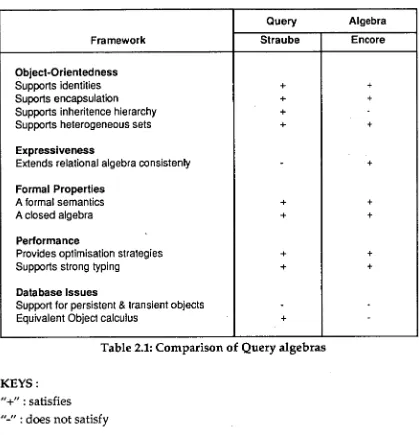
Table 2.1 summarises the two query algebras considered in this project.
Framework
Query Algebra Straube Encore
Object-Orientedness
++
• +
. +
++
++
I I
Supports identities Suports encapsulation
Supports inheritence hierarchy Supports heterogeneous sets
Expressiveness
Extends relational algebra consistenly
Formal Properties
A formal semantics A closed algebra
Performance
Provides optimisation strategies Supports strong typing
Database Issues
[image:37.565.53.472.83.518.2]Support for persistent & transient objects Equivalent Object calculus
Table 2.1: Comparison of Query algebras
KEYS: satisfies
does not satisfy
There are two main features that make the Object Algebra an important internal representation which can be used in the optimiser. Firstly, Object Algebra is a procedural language since an expression in Object Algebra gives a set of operations on sets and the order in which they are to be performed. Secondly, Object Algebra is an intermediate level language designed for a range of user languages.
Chapter 3. Implementation of the translator
Introduction
The first part of the project was to design and implement the Object SQL parser. The implementation of the Object SQL parser is based on Leroy Cain's version of the ANSI SQL parser written in 1989.
The implementation was written in YACC and LEX, which are available on most machines. After writing the parser, the translation rules for the Object Algebra expressions were added to the parser. The rules were written in C language.
Section 3.1 briefly describes LEX programming while section 3.2 describes YACC programming. Section 3.4 gives an overview of the system developed. It also describes how the translation was done.
3.1. An overview of LEX programming
LEX (LEXical analysis program generator) is a software tool that allows the user to solve a wide class of problems drawn from text processing (can be used to check the spelling of words for errors), code enciphering (can be used to translate certain patterns of characters into others), compiler writing (can be used to determine what tokens, that is, smallest meaningful sequences of characters or reserved words, there are in the program to be compiled), and other areas.
LEX can also be used to collect statistical data on features of the input, such as character count, word length, number of occurrences of a word, etc.
A LEX specification consists of at most three sections : 1) Definitions : may contain #include, or abbreviations,
2) Rules : each rule consists of a specification of the pattern sought and the action(s) to take on finding it, and
3) User subroutines : an action code that is to be used for several rules can be written here and called when needed.
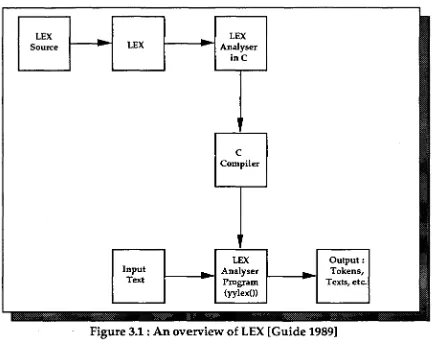
Output : Tokens, Texts, etc. LEX
Analyser Program (yylex())
LEX Analyser
in C
[image:40.565.49.481.106.447.2]The lexical analyser that LEX generates (not the file that stores it) has the name
yylex().
Figure
3.1 given below shows the creation and the use of a Lexical
analyser with LEX.
Figure 3.1 : An overview of LEX [Guide 19891
3.2. An overview of YACC programming
YACC (Yet Another Compiler-Compiler) provides a general tool for imposing
structure on the input to a computer program. The YACC user prepares a
specification that includes :
•
a set of rules to describe the elements of the input.
•
the code to be invoked when a rule is recognised.
•
either a definition or declaration of a low-level routine to examine the
input.
is invoked. Actions are fragments of C language code and so they can return
values and also make use of the values returned by other actions.
Each grammar rule describes a
constructand gives it a name. One grammar rule
might be :
date : month_name day ',' year ;
where date, month_name, day, and year represent constructs; month_name,
day, and year may be defined elsewhere. The comma enclosed in single quotes
means that a comma will appear literally in the input.
The lexical analyser is an important part of the parsing function. This
user-supplied routine reads the input stream, recognises the low-level constructs,
and communicates these as tokens to the parser.
A full specification file looks like :
declarations (optional)
%%
(grammar) rules
%%
subroutines (optional)
YACC turns the specification file into a C language procedure, which parses the
input according to the specifications given. The function produced by YACC is
yyparser() which is an integer valued function.
3.3. YACC and LEX
36 ' Chapter 3. Implementation
Lexical Grammar
rules rules
Parsed input yylex()
Object SQL YACC Grammar Parser
Co Ge ration
Object Algebra
Mapping
Object SQL -> Object Algebra Object Algebra Expression
of the Object SQL Statement
Figure 3.2:
3.2 : LEX with YACC [Lesk]
3.4. System Overview
Figure 3.3
shows the design model of the translator from Object SQL into the [image:42.565.49.484.43.309.2]Object Algebra expression.
[image:42.565.54.491.417.756.2]Based on the design model shown above the following steps were undertaken to write the parser and the translator from Object SQL statements into the Object Algebra expressions :
1) Using YACC and LEX, Leroy Cain's ANSI SQL parser [Cain 1989], and the information supplied on Object SQL by Hewlett-Packard [Lynbaek 1991] the Object SQL parser was written.
2) The translation of Object SQL query statement into the equivalent Object Algebra expression was performed using Dave Straube's Object Algebra operators [Straube 1990a], namely UNION, INTERSECTION, DIFFERENCE, MAP, and GENERATE. Using the C language the parser was modified to write the translation rules.
The parser was written for all Object SQL statements, but the translation of an Object SQL statement into the equivalent Object Algebra expression was peformed only for the SELECT statement (query statement). Because of time limitations the translation rules for the GROUP BY, ORDER BY, and HAVING clauses for the SELECT statement were not written. Translation of the SELECT statement with only the session variable (SELECT Name(:Alex); ) was also not done because the Object Algebra does not have the operator to handle this.
3.4.1. Modification of the Parser for the Translation Rules.
As each word of the Object SQL statement goes through the parser, it is recognised by the compiler as a token (that is, a reserved word such as SELECT, FOR EACH, WHERE, etc) or an identifier (that is, types, subtypes or supertypes, functions, predicate in the WHERE clause, etc).
i) Creation of data dictionary using the CREATE statement
Before parsing the query statement to produce the Object Algebra expression, the functions, types, subtypes, and supertypes have to be created and stored in the 2-dimensional array called st_types defined below. This is referred to as the
data dictionary throughout the project.
st_types[MAXNUMIDS][MAXSTRING]
where
MAXNUMIDS : this is the maximum number of functions, types, subtypes or
MAXSTRING :
this is the number of characters that each function or type
can have. Function
Namehas 4 characters, for example.
The MAXNUMIDS and MAXSTRING values are defined in the header file
named
variables.hand can be changed if necessary.
The initialisation of all the arrays is done in the
initilisation.cfile.
The following file
st_types.cshows how the types and functions are stored in
the
st-typesarray.
File st_types.c
*********************************************************************************************************************
include "variables.h" #include <string.h>
store_types()
/* This procedure stores the types, subtypes, supertypes and functions in the data dictionary so that it can be used in the translation of the queries. */
initialisationOfstoring_types(); ml = 0;
while ((ml < MAXNUMIDS) && (st_types[ml][0] != '\0')) ml++;
if (ml == MAXNUMIDS)
printf("ERROR in storing functions"); else
stropy(st_types[ml], s_type[0]); init_st_types = 1;
initialisationOfstoring_types()
/* This procedures initialises the st_types array only once during the execution of the program so that more types can be added on.*/
if (init_st_types != 1)
for (m1=0; ml<= MAXNUMIDS; ml++) st_types[ml][0] =
Creation and Storing of types, subtypes, supertypes and functions can be done
using the following four statements :
2)
CREATE path_element FUNCTION (type_name_list) varlist. In this
statement path_element is the name of the type, supertype or subtype
and type_name (type_name_list) is used for storing functions.
3)
CREATE object_name plist. In this statement object_name is the name
of the type, supertype or subtype.
4)
CREATE path_element (t_list) r_type. Here also path_element is the
name of the type, supertype or subtype.
More types, subtypes, supertypes and functions can be added to the data
dictionary in each running of the program. That is, once the program is
compiled and is running, a data dictionary consisting of the type, subtypes,
supertypes and functions can be created. SELECT statements can then be
parsed and the Object algebra expression of the statement obtained. At any
time during the execution of the program new types, subtypes, supertypes and
functions can be added to the data dictionary if the need arises.
ii) Storing of Result Specifications, Local variable declarations, and
Predicates of the SELECT statement.
The basic form of the SELECT statement is as follows:
SELECT
result specification
FOR EACH
local variable declaration
WHERE
predicate
The basic form of the Object algebra expression is as follows :
Q1 y t F<Q2...Qk>
where
Ql, Q2, Qk
are sets of objects, the symbol is the generate operator,
F
is the
predicate, and
t
is the target variable.
i) Result Specification
specifications are the target variable
(t)for the Object Algebra expression. The
result specification of the parser constructed has the following forms :
a)
One or more functions, types, subtypes or supertypes separated by
comma or a tuple, list, bag, or set of functions. The functions can be
single valued, for example,
Age, Name,etc or multi-valued, for example,
Childrenwhich may in turn have single-valued or multiple-valued
functions.
b)
Constants.
c)
Reserved functions (Average, Minimum, Maximum, Count, and Sum).
d)
Expressions with one of the above, that is, functions, constants or
reserved functions and the manipulation operators : multiplication (*),
addition (+), subtraction (-), or division (/).
NOTE : To avoid duplicates the word
DISTINCTis used.
Some of the different types of expressions implemented are :
1) Simple expressions
a) SELECT DISTINCT Name(p).
b) SELECT DISTINCT Name(p), Age(p). c) SELECT DISTINCT
I
Name(p), Age(p)I).
d) SELECT DISTINCT <I
Name(p), Age(p)>.
e) SELECT DISTINCT [I
Name(p), Age(p)I].
f) SELECT DISTINCT [: Name(p), Age(p) :].where
Name
and
Ageare the functions and p is the range variable
-
for the type. [ I ... I }
is a set of functions, [ : : ] is a bag of functions, < I ... I > is a tuple of
functions, and [ I ... I ] is a list of functions.
In the above statements,
<p>. Nameand
<p>.Ageare the
target variables(t)for the
Object Algebra expression. When doing the translations for a list, bag, tuple,
and set of objects the Object Algebra
MAPoperator is used.
The target variable(t) for the above simple expressions are :
a) t e <p>.Name
Types, supertypes, or subtypes such as Children(p) which are multi-valued, that is, which have several single-valued functions can also be used in the result specification.
NOTE: A query may have only one of the above forms. Although the parser
will not give an error message if more than one of the above result specifications is used in the query, the Object Algebra expression produced will not be correct. That is, if the result specification for a query has the following form :
b) SELECT DISTINCT E
lName(p), Age(p)
I], < IName(p), Age(p) I>
then the target variable (t) for the Object Algebra expression is t E <p>.(Name, Age, Name(p), Age(p)). This is not correct because the specification needs a list and a tuple of functions.
Assumption :
All the range variables in the set, list, bag, tuple, or result specification with more than one simple expression should be of the same type. That is, if the type is Person then the range variable should all be "p", range variable for type "Person" and not a combination of type Person, p, and subtype Children, c. For example, the following is correct :SELECT DISTINCT [ I Name(p), Age(p) I]
whereas this is not correct
SELECT DISTINCT [ I Name(p), Age(c) I]
2)
Expressions with constants
a) SELECT DISTINCT 5
where5 is a constant. In the above statement, 5 is the
target variable(t)
for the ObjectAlgebra expression; that is, t E 5.
AVG
(Average) is a predefined function,
Salaryis a function and p is the range
variable for the type
Person.In the above statement,
AVG(<p>. Salary)is the
target variable(t)
for the Object Algebra expression, that is, t
EAVG(<p>.Salary).
Other types of predefined functions that were implemented include MIN
(Minimum), MAX (Maximum), SUM, and COUNT.
4) Expressions with operators
a) SELECT DISTINCT [5* Salary(p)]
where
5 is a constant, * is an operator for the expression,
Salaryis a function and p is
the range variable. In the above statement, (5 *
<p>.Salary)is the
target variables(t)for the Object Algebra expression, that is, t
E(5 * <p>.Salary).
NOTE : A query can have any number of the above four types of expressions,
that is, Simple expressions, Expressions with constants, reserved functions or
with operators.
Each function, constant, reserved function, and the expression containing the
operators that will be used for the translation into the Object Algebra
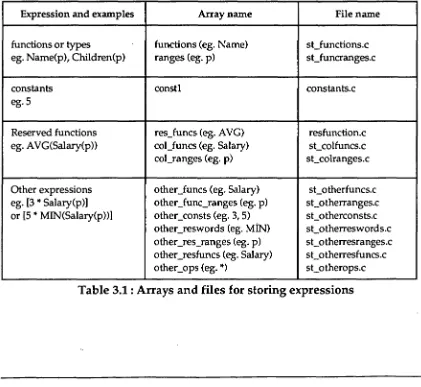
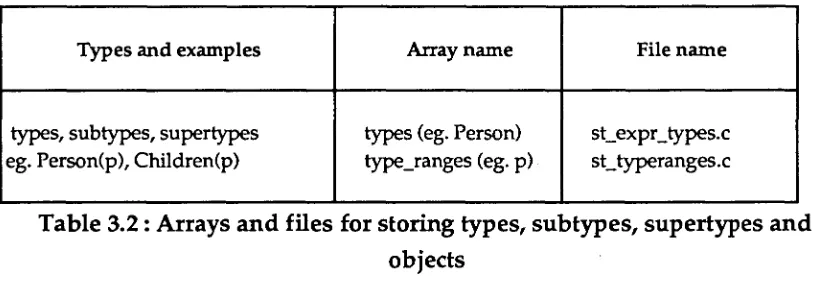
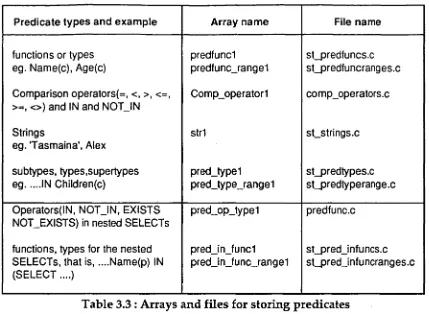
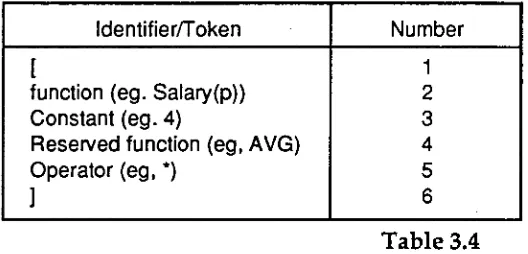
expressions is recorded or saved in a 4-dimensional array; that is, an array with
the following structure :
array name[...][...][...][...].
For example, if
t E <p>.Name,then function
Nameis stored in
function[MAXSELECT][MAXLEVEL][MAXNUMIDS][MAXSTRING]
![Figure 2.1 [Lynbaek 1991]](https://thumb-us.123doks.com/thumbv2/123dok_us/8472819.340710/19.568.55.479.40.355/figure-lynbaek.webp)
![Figure 2.2: Payroll Application [Lynbaek 1991]](https://thumb-us.123doks.com/thumbv2/123dok_us/8472819.340710/20.564.55.474.39.361/figure-payroll-application-lynbaek.webp)
![Figure 3.2: 3.2 : LEX with YACC [Lesk]](https://thumb-us.123doks.com/thumbv2/123dok_us/8472819.340710/42.565.49.484.43.309/figure-lex-yacc-lesk.webp)